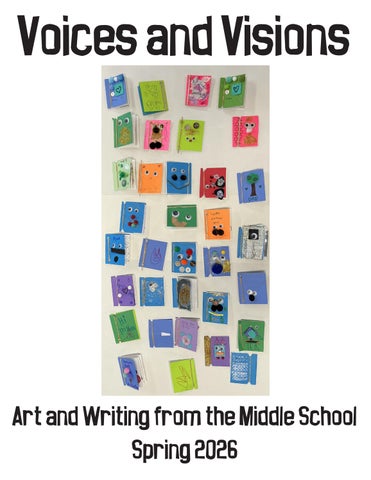
Voices and Visions
Art and Writing from the Middle School Spring 2026
Contour Line Drawings of Hands by Nica Tagger ’30 Student Editors: Sena Bezirkan ’30 & Kiva Pur-Rashid ’30 Faculty Advisor: Marsha Kleinman Visual Art Teacher and Curator: Joelle Francht Layout and Design: Diane Giangreco 8th Grade, Class of 2030 7th Grade, Class of 2031 6th Grade, Class of 2032 5th Grade, Class of 2033 4th Grade, Class of 2034 Cover Art: Ms. Walker’s 4th Grade Class Wesley Brown Ryan Desai Sophia Dowdell Cameron Feld Ollie Flick Evie Harrison Alexander Heller Rory Helmick-Fox Suryansh Kadyan Maxwell Kessler Freya Mahanthappa Zaviyar Naqvi Trishan Patel Myles Perlow Elina Thumar Andi Wong
VOICES
Chloe Banks ’30 Abigail Bashur ’30 Milin Bernberg ’30 Sena Bezirkan ’30 Arden Brawley ’30 Nia Desai-Green ’30 Keshav Jagan ’30 Logan Jones ’30 Kiva Pur-Rashid ’30 James Ruberton ’30 Frankie Sasso ’30 Anika Tole ’30 Morgan Wente ’30 Reuben Whitman ’30 Elena Wilska ’30 Isaac Zheng ’30 Annabel Johnson ’31
VISIONS
Chloe Banks ’30 Victoria Brandford ’30 Nia Desai-Green ’30 Elenna Fischbeck ’30 Alli Helmick-Fox ’30 Marit Hedberg ’30 Keshav Jagan ’30 Logan Jones ’30 Bode Klabin ’30 Claire Kiang ’30 Natalija Milic ’30 Kiva Pur-Rashid ’30 Noa Streater ’30 Kaylie St Pierre ’30 Nica Tagger ’30 Anika Tole ’30 Elena Wilska ’30
Anya Anders-Weiner ’32 Riaan Bansal ’32 Aspen Basra ’32 Ava Benjamin ’32 Serena Coutinho ’32 Gideon Feldman ’32 Adelaide Khublall ’32 Matias King ’32 Charlotte Rabasca ’32 Sunaina Sood ’32 Hailey Stratthaus ’32 Chase Williams ’32 Alex Wilska ’32
Damien Ahern ’31 Arya Bhukhanwala ’31 Rosie Cocco ’31 Aviva Gardner ’31 Augustin Girard ’31 Ellie Grabowsky ’31 Molly Harrison ’31 Annabel Johnson ’31 Tessa Kramer ’31 Navyaa Makin ’31 Elizabeth O’Neill ’31 Kavya Singh ’31 Gabriel Rodriguez ’31 Wilson Zhang ’31
Ollie Flick ’34 Alex Heller ’34 Trishan Patel ’34
Alexandria Adams ’32 Eduardo Araujo ’32 Aspen Basra ’32
Jaden Bhatia ’32 Avik Bodepudi ’32 Conor Brown ’32 Kingsley-Rae Francisco ’32 Richard Hua ’32 Jack Kelly ’32 Adelaide Khublall ’32 Zoe Sanders ’32 Eloise Spritzer ’32 Freddie Turgoose ’32 Chloe Wang ’32 Maya Baker ’33 Mishika Bhargava ’33 Lauren Borzell ’33 Dakota Franklin ’33 Avery Jia ’33 Soumya Kapoor ’33 Cole Lissauer ’33 Diya Loganathan ’33 Ethan Maza ’33 Leah Miller ’33 Devin Nagrecha ’33 Sophia Pataki ’33 Uma Raval ’33 Nico Rodriguez ’33 Maeve Rugel ’33 Arlowe Willford ’33 Anatole Girard ’34 Aydan Hutchinson ’34 Serafina Mendoza ’34 Zaviyar Naqvi ’34 Effie Shade ’34 Andi Wong ’34
A Note from the Editors: The 2026 edition of Voices & Visions: Art & Writing from the Middle School truly showcases the best work of our flourishing writers and artists throughout the Middle School. Works include the story of a girl whose life is turned upside down after being awakened from a coma. Creative writing about characters in The Odyssey offer perspectives from nymphs, enchantresses, and monsters. Various poems delve into the identity of writers chosen to represent their age group. Papers analyzing Colonial America describe topics that range from the Salem witch trials to marriage to slavery and racial injustice. Feature articles explore politics, sports, healthcare, and societal norms. Each piece of writing was meticulously chosen by the editors, and we have enjoyed every step of the way. The students featured kept us spellbound throughout the process of making this magazine come to life, and we hope you enjoy the 2026 edition as much as we do! With love, Sena Bezirkan ’30 & Kiva Pur-Rashid ’30
The National Council of Teachers of English (NCTE) hosts a yearly Promising Young Writers writing program where students across schools in America get nominated by their English teachers to participate. Each year, a prompt is selected and given to students to write a piece of their choosing, such as short essays, poems, or more. The top few writing pieces from each state are chosen and awarded on the NCTE website and given different levels of honor. Kiva Pur-Rashid ’30 submitted to the 2026 contest, titled Good Trouble, and was given the highest award of “First Class.” This year’s prompts for Good Trouble are shown below. Prompts: For this year’s Promising Young Writers prompt, we invite you to consider this concept of good trouble. What does it mean, what does it require, what does it cost, and how do we benefit from it? John Lewis engaged in good trouble as it related to racial injustice, but your response does not need to focus on that. We invite you to think about times when you have faced a moment where you could speak up for what is right, regardless of what a majority of your friends and peers may have thought. This action could range from standing up to a bully to speaking out against gun violence to protesting unjust laws. Possible questions that you might explore are provided in the following list. You are not expected to respond to all (or any) of these questions. Rather, they may inspire you and your writing. Additionally, your response can be in whatever style or genre of writing you prefer—expository, persuasive, narrative, descriptive, or creative. We invite you to think about what it means to engage in “good trouble”: • • • • • •
How have you benefited from the good trouble that others before and around you have engaged in? What laws have been passed or battles won that have made life better for you? What is an issue in your world that inspires you to engage in good trouble? Do you agree that it is okay to disobey unjust laws? If not, what might youth do to bring about needed change? What does it mean to create good trouble in your community? Was there a time you regretted not interrupting injustice? What were the circumstances? If you could go back in time, would you respond differently, and if so, how? What do you risk by getting into good trouble?
Here is Kiva’s submission: Some people ask: What is good trouble? How can trouble be life-changing or beneficial when it is, by definition, a difficulty or problem? What makes trouble “good” and how can we reprimand certain trouble yet applaud others? I like to think of trouble as rule-breaking, but perhaps it has a deeper meaning in life. Good trouble invites us to question the rules we live by and why they exist. Upon pondering this, we can evaluate these rules we encounter and consider their true purpose in our lives and society. Are they meant to protect us or to control us? Usually, we like to believe that rules are set to enforce good behavior, habits, or order. But after all, good and bad can be very subjective terms. Who gets to decide the true meaning of good? Everyone has different standards and perspectives, causing some of us to perceive things as good, while others perceive them as the opposite, bad. Good is often used as a word to motivate us to do better. In movies like Wicked, for example, we are taught to be popular, liked, and “good” like Glinda, the Good Witch. But the truth lies deeper, as this film shows. Glinda doesn’t hold real magical powers, despite being portrayed as good, which is what is actually needed to save the land of Oz. Elphaba, the “bad” protagonist, as seen by the citizens of Oz, possesses the power within to do true good. The Wizard of Oz is portrayed as a primarily good character, yet he abuses his falsely powerful position in selfish ways by trapping animals and stripping them of their rights, voice, and status. Elphaba demonstrates her true goodness by saving the animals from the Wizard of Oz, despite breaking rules and fighting the Wizard’s soldiers. This fictional plot is beyond a popular movie; instead, it foreshadows our world of rules and good trouble. ... How people view others is shaped by different opinions, perspectives, and societal norms or regulations. Rules in our world are set by what is viewed as “normal” or “good.” This can limit our expression, artistically, vocally, and socially. These rules
themselves have forced this term, “good trouble,” upon our society. If we, as individuals, were free to express our opinions and voice our beliefs without fear of ostracism, cancellation, or stigmatization, we wouldn’t need to disobey rules to fight for our rights. Of course, rules are absolutely necessary to some extent. Otherwise, the world would collapse and become pure chaos without any social order or economy. People would also live in a constant state of fear, violence, and insecurity. However, unjust, strict rules that oppress certain groups of people create the need to fight for our rights. And here, in the midst of oppression, lies the longing for “good trouble.” ... In 1776, before John Adams signed the Declaration of Independence, his wife, Abigail Adams, sent him a letter saying, “...I desire you would remember the ladies…Do not put such unlimited power into the hands of the husbands…If particular care and attention is not paid to the ladies, we are determined to foment a rebellion, and will not hold ourselves bound by any laws in which we have no voice or representation.” Despite this plea, the Declaration of Independence was written to include the pronouncement, “all men are created equal.” In that statement lie several problems that have remained hidden for decades. First, the word “men.” This one word completely diminishes women and their place in society. Excluding fifty percent of the population from basic equal rights leads to oppression and conflict, thereby increasing the need for civil disobedience, or good trouble. Secondly, as we now know, this statement was hypocritical since it didn’t even include all men. Vague messages, especially in law, allow us, as individuals, to interpret them anyway that is most convenient for us at the moment. The way this law was seen by a male slave owner versus by a slave was probably completely different. So what if all men were created equal? Maybe they don’t stay equal? Maybe Black men and women can become slaves later in life because their “equalness” has changed? This falsity led to years of unjust rules and foundations for life, hence the call for justified rule-breaking and disobedience. Good trouble is often left undefined. I believe that it is taking action by standing up or “causing trouble” in order to object to unfair injustices that occur in our world. For example, in the case of the Declaration of Independence, the good trouble that resulted from its misogyny was years of women’s battles for equal rights. Until 1920, over half the population was denied the right to vote. Women also could not own property, have a credit card without their husbands, or even ride bikes or wear pants. So yes, some women did “break the rules.” Starting the bicycle craze, women in the 1890s rode bicycles and wore trousers, despite their knowledge that this “wasn’t allowed.” As a result, female bike riders were yelled at and harassed from the sidelines. The brave cyclists from the 1890s sacrificed so that girls nowadays could live without those restrictions. Their demonstration was one of the key events that paved the way for young girls to be able to ride bikes with their brothers or for women to ride on the way to work. Similarly, brave women from the 19th and 20th centuries, suffragists, risked imprisonment, physical violence, and even their lives to fight for decades to change the future of all women and allow them the right to vote. Their actions, such as protests, could be seen as misbehavior or trouble-making, depending on perspective. Yet when unjust laws are set, this act of disobedience is absolutely beneficial since some laws chastise people for who they are and deny them basic human rights. However, protesting for change comes with consequences, as many things do. Most people cannot fathom breaking laws because of the many risks involved in the process. Suffragists, during their many protests for women’s right to vote, got severely punished for their activities. After picketing at the White House, thirty-three suffragists were imprisoned, beaten by the police, and sent to the Occoquan Workhouse. The suffragists at the Workhouse faced arbitrary consequences they could not comprehend, yet they still refused to give in. They went on a hunger strike in 1917 on a night known as “The Night of Terror.” In response to this, many workers at the Occoquan Workhouse brutally force-fed these imprisoned women, causing severe gum and throat injuries, as well as lung issues such as pneumonia. Many of these women suffered long-term health problems and died because of this uncivil, barbaric abuse. Fearless suffragists demonstrated exactly what good trouble looks like: fighting for something you believe in, and breaking a couple of rules along the way. Another example of rule-breaking being used for good was shown in 1955 in segregated Alabama. Up until 1964, Black people, no matter their status, were forced to segregate from White people in many states. They were separated in places like restaurants and schools, and even in bathrooms and by water fountains. Black and White citizens living in the same neighborhoods couldn’t interact, be friends, or marry each other. This separation and inequality sparked protests and fights for Black rights across America. One example of a brave individual who demonstrated civil disobedience by challenging these segregation laws was Rosa Parks. On December 1, 1955, in Montgomery, Alabama, buses were heavily segregated places, and Black people had to sit at the back and give up their seats for White people. Rosa Parks sat in the “colored section” in the back of the bus, but was forced out when a white passenger got on and demanded a seat. Rosa simply refused to get up and stayed in her seat. She was arrested for violating the city’s segregation laws. Yes, Rosa wanted her bus seat as a Black citizen, but her main message lay deeper in her actions. This rule-breaking she showed protested laws that she believed were utterly unfair. Her effort showed that it takes one person at a time to change unjust rules and improve our society. She fought for her rights and used good trouble to help unite the Black American population. Good trouble is a catalyst for positive change in situations where someone’s rights are being stripped away or they’re being discriminated against. ...
Life is full of injustices, and it throws them at you. Whether you reflect on it or not, there are plenty of important issues that occur in everyone’s daily life. From the pay gap, in which women still earn eighty-three to eighty-five cents for every dollar a man makes at the same job, to children getting worse education in poorer neighborhoods, these social imbalances surround us. This makes the world feel like it’s closing in on some of us while the rest are blissfully living their lives. In my life, personally, I find misogyny and sexism to be an important issue that resonates with me the most. Women have been suppressed for hundreds of years, and still are. Every day, we, as a whole society, fail to recognize that women are equal to men and deserve the same rights, despite all the protests and hardships we’ve been through. Many women, and some men, have fought to change this issue for years and years. What is lacking in our society is certainly not issues; it is simply us. We need to speak up, stand up, and fight for what is right. Many of us have a topic of injustice that we stand against, one more paramount than all the rest. Yet, many of us do nothing to help improve it. Good trouble is the act of challenging our obstacles and facing adversity. When someone knows that something is wrong, feels they know how to make it right, and stands up against it, they are demonstrating good trouble. Every time someone does something, sexist, transphobic, racist, or homophobic, an opportunity for someone to stir up good trouble opens. However, when an injustice goes uninterrupted, it creates a void in our society, a missed opportunity to fight for freedom. When a society is infected by persistent prejudice, it cannot function fairly. Hence, we the people must come together and address these issues to build a more inclusive and united community. Good trouble is the spark of rebellion that ignites our passion for justice, propelling others to demand equal rights. We must instill the need for good trouble in future generations and teach others that questioning the status quo is sometimes necessary to push for equality. The importance of good trouble was shaped by the trailblazers who came before us: the suffragists, challenging societal norms that deny women voting rights, or Rosa Parks, inspiring Black people to fight against segregation. These courageous people and their struggles remind us that breaking unjust rules can lead to progress and that standing up for what is right is necessary. Good trouble isn’t merely a concept; it is a reminder that we all hold the power within to advocate against the unfair world around us. The question isn’t whether good trouble exists; it always has. It is whether or not you are ready to be a ripple in the vast ocean, to ignite change for the better.
Anika Tole ’30
Victoria Brandford ’30
Bode Klabin ’30
Elena Wilska ’30
Elenna Fischbeck ’30
Logan Jones ’30
Noa Streater ’30
“The Lab of Sleeping Souls” by Annabel Johnson ’31
Prologue: The girl is still sleeping. He refills her nutrients and pats her on the shoulder. She looks so peaceful in her coma. If only she knew. Chapter 1: The familiar jolt shocks my body and I realize that it is time to wake up again. I stretch but don’t open my eyes, nearly falling forward from the astronaut-style vertical bed the scientists have me rest in. I finally open my eyes, excited to see the friendly faces of the lab assistants that issued the shock. Instead I see no one. Confused, I unlock the waist strap that holds me in place from the hips down and step out. Like always, I trip on the first step and fall onto my knees. I rub my pale legs, trying to get circulation back into them. I stand back up, but my movements are jerky and unnatural because there’s no one to help me up. “Hello? It’s me, Imogen.” My voice sounds foreign even to my own ears. “Is anyone there?” Silence answers my question by itself. “How can I be awake if there is no one here to wake me up?” I wonder out loud. “Did they cure me?” No, it can’t be. They would be here to see my reaction. I walk, slowly, over to the door and turn the knob. It doesn’t budge. I kneel down and peel up the doormat. A small silver key attached to a keychain labeled “door.” Security is great around here. I laugh to myself and pick up the key. I jiggle it around in the keyhole until it clicks and turns. I hesitantly step out into the hallway, nervous for what awaits me. Instead, there’s… nothing? I don’t know what to do. Who would wake me up remotely? And the more pressing question, who could? A horrid stench hits my nose. I push the nagging thoughts back, gag and duck back into my room quickly. I look for the first aid kit under the desk. I pull out the bright yellow box, which is heavier than expected. I click the lid open and turn the entire box over, which is perhaps not the smartest idea because medicine and pill bottles roll all over the floor. I kick them back in a futile attempt to contain all of the medical supplies to one pile. Fishing through the mess, I pull up a large gas mask. Attached to it is a brief instruction manual, which I skim through and strap the oversized mask onto my face. I may look comedic, but that smell was no joke. I poke my head out of the room again and look around at my surroundings. A bare white hallway dotted with doors. As I walk along the hall, I peek into the rooms. All of them have empty laboratories, similar to mine but with varying technology for whatever experiments the scientists are working on. None of them are turned on, which is odd for—I check my watch—Thursday at two in the afternoon. I yell down the hall, “Anyone? Hello?” Silence still. I round the corner and nearly break my jaw tripping over something and flying across the floor. I cry out with shock and look back. To my horror, what I just fell over is the body of a scientist. Chapter 2: I scramble back on all fours and get up and run further down the hallway. Scattered all around me are the bodies of lab assistants and scientists in various stages of decomposition. Most look fine, suggesting that their deaths were recent, but some look so terrible that I don’t even want to describe them. Several, the five that look the worst, are dragged up into a line against the wall with their eyes shut like in a makeshift morgue. I guess whoever did that died before being able to do it for the rest of them. I decide to venture further forward, because if I’m already infected with whatever this is, it can’t get much worse. I pass by the staff lounge and peek in. The fridge is still humming, so I open it. Sadly, all of the fresh food is spoiled, but the nonperishables in the pantry all look fine. I set a pot of water boiling and drop the instant ramen in. The hot water scalds my hand and I jerk it back. I run my hand under the cold water from the sink and consider if I should be eating this ramen or touching this water. The cause of these mysterious deaths could be water poisoning. I think about it for a minute more, then decide to just eat so the cause of my death isn’t starving. Besides, once I get out of here I can just visit a hospital. I think a person that hasn’t been hooked up to a machine all her life would have more survival skills, but I don’t have much time to learn about that in my infrequent conscious periods. Alyssa, my best friend and one of the most brilliant lab assistants that’s working on finding a cure for my defect, tries, or tried, to show me how the real world worked. I was about as good at navigating the city as a lost puppy, overwhelmed with all the sights and sounds. She took me to her apartment to show me what it was like and said that once it’s safe for me to be out of the lab I could live there with her. I think that’s when I realized that I wanted out of the lab. Not knowing what was outside and what life could be like made the lab seem like a safe haven, but I could do so much more than be stuck to a machine all day and be shocked awake whenever the owner and lead scientist fancied. Sometimes I think that the assistants are the only ones doing the real work. I need to get out of here and save my friends if they aren’t dead already. Coming out of my reverie, I realize that the water is about to boil over. I quickly grab a large bowl that I found earlier in one of the cabinets and pour all of the ramen in. The hot pot handle scalds my hands and I set it back down with a clatter on the stovetop. The ramen is super hot. My mouth feels burnt, but I keep eating because I’ll hardly have a chance to eat once I make it out of here with no money whatsoever. If whatever this is hasn’t killed the rest of the population. I blow on the ramen, which is steaming up my face. However, it is welcome and comforting because it is freezing in here. It must be winter outside. I don’t want to go out.
❁❁❁ The ramen is long gone. It is quiet again, without the sounds of the water boiling or the crinkle of the packaging. There is a couch in the lounge, which is where I decide to stay for the night. The lights are automated to turn off at ten thirty, so I awkwardly huddle under the thin blanket and stare out at the still bright room. Tomorrow I will get out of here. Chapter 3: The building rings with silence and the lonely sound of his footsteps. Gogo Dodo trots up next to him and rubs his fluffy pink neck against his legs. “Gross!” he laughs, wiping off the hair. He looks up and realizes something is different. He doesn’t know what, but something has changed within these halls. It may be subconscious, as nothing has moved in the past three weeks. He decides not to risk it and walks back to his room. Something—or someone— is loose in these labs. Chapter 4: I wake up to the sound of tapping on hardwood floors, like a dog walking around. I hear it more faintly as I gain consciousness, then sit bolt upright as I realize what I’m listening to. Maybe one of the animals is loose, like the monkey-dog hybrid Gogo Dodo or the cat-bird mix Aerolynx. Guess which one of the two was named by one-year-old me when I could barely talk? I throw the blanket off of me and get up. My clothes are all wrinkled, but I don’t mind. Shivering in the cold without the blanket, I reconsider and pull it back on. I open the pantry again and find it still only stocked with ramen and peanut butter. Not hungry just yet, I wrinkle my nose and close the cabinet door. I straighten out my plain clothes and ready myself for the unbearable stench of the halls. I put on the bulky gas mask again, then step out. This section of the halls is empty, so I consult the map posted on the wall. I’m still on the second floor, but I’m all the way on the end without a staircase. I study it more intensely, but the halls all lead to the same place. Taking a deep breath, I fly down in the direction of the stairs. I quickly hop over all of the bodies, trying to avoid accidentally looking at them and recognizing their faces as the scientists who woke me up every week, taking scans of my brain to stop my defect. They were so sweet. Maybe they’re just unconscious, like me. I console myself with the thought, but then realize that maybe I was the cause for this. Am I… contagious? A wave of self-doubt and guilt washes over me. I push away the thought and keep running. After a short while, I am winded. I rarely run and the motion feels awkward, but I keep running, knowing that I would rather be out of breath outside than in this hallway with the foul smell that pervaded the entire building. I finally reach the stairs and give myself a moment to recollect myself. The memory of me running through the halls already feels fuzzy. Maybe I don’t want to remember it, seeing all of my friends passed out or dead on the floor. Anyway, I look at the layout of the first floor. It seems pretty much identical to the second floor, which is as expected in this monotonous building. I don’t want to face what’s downstairs, knowing that the second floor has the least labs occupied in it. I determine that I will stay up here for a minute to relax, then run through again without looking. I finally calm myself down and look down the staircase. I remember when Alyssa, my favorite lab assistant, took me here to hear our echoes. She’s probably gone now. It doesn’t matter. I smooth down my hair and find an old hair tie on my wrist. I quickly pull my hair up, as not to delay this. My foot hovers over the step, then I run down as fast as I can. I hear my heavy footsteps echoing around, but I don’t mind because who would hear? I use the banister to swing myself around the curve. I sprint off the steps and into the halls. I avoid looking down again, but I can tell that there are bodies lining the wall. I close my eyes briefly and hope this nightmare will all be over soon. Chapter 5: He hears footsteps clattering down the stairway. No one has moved in here in a long time. Unsure, he heads out to investigate. Hopefully it’s his savior. Chapter 6: I can tell by the odd angle of this turn in the halls that I am close to the exit. I imagine flinging open the front doors and breathing in fresh air. I hop over the final body and run down the home stretch. I can see the front desk and the doors and the freedom beyond them. I crash into the glass panel, hands reaching for the handle. The cool metal presses against my hand and I push with all my might, ready to be done with this. Instead, nothing budges. For the next two minutes, I try pushing and pulling with all my body weight at every angle. I finally realize that this door isn’t moving. I turn away, looking down in despair. All of a sudden, I hear loud, clomping footsteps and look up to see a tall boy descending on me with a fluffy pink creature. I gasp and punch at him by instinct. There’s a moment when I hear a horrible crunch as my fist makes contact with his nose. “AHHHH!” he screams, holding his hand up to his bloody nose. The deep red dripping down his face is a stark contrast to his pale skin that matches mine. “I’m so so sorry!” I squeal, reaching for the box of tissues that sit on the front door. I feel dizzy, but I hand him the box anyway and keep standing up. He gratefully accepts them and gingerly towels off his probably broken nose. As his face clears up,
a flash of recognition pops into my mind. “I know you!” I say, then realizing, “You’re Silas, right? I met you when we were just kids in here, both with an incurable defect or disease.” He nods. “Yup, that’s me.” His deep voice startles me. I slump into the desk chair as my vision goes black at the edges. “Are you okay?” He bends down to get on eye level with me and I notice how dark his hair and eyes both are. “Yeah, just a little dizzy,” I say wearily. “Well, that means you’re about to pass out, right?” The concern in his voice is rising. “Listen, I know you barely know me, but you’re our only way out of here. I need the passcode for the computers. I was told that Alyssa told you what they were, and the only way to get everyone to wake up is if I turn off the controls for some gas that was let out, and those are on the computer system.” “Yeah, I can tell you that. It’s—” I break off. I’m so tired right now. I know the fate of myself and my best friends depends on me, but I just want to submit to the sleepiness washing over me. “What? What is it, Imogen?” He reaches out as if to shake me awake, but then takes back his hand like he thought he’d better not touch me. The mention of my name wakes me up one last time. “It’s… it’s pioneer gene works, like the name of the company.” He nods attentively. “Capital ‘p’, capital…” “Imogen?” “Capital ‘g’.” The last thing I see before I go under is his dark eyes looking into mine. ❁❁❁ Epilogue (11 months later): Alyssa walks into the apartment loudly, throwing off her shoes at the door. “Long day at work?” I ask, looking up from my schoolwork. “Yeah,” she says tiredly, slumping into a chair. “How was your last day of treatment?” “Great, I’m all disease-free!” I chirp. “What’s that?” I say, pointing to a thick folder in her hands. “Good news.” I wonder what it could be. She pushes it across the counter to me and I open it suspiciously. At the top, I see what I was hoping for: CASE FILE. Excitedly, I flip through the pages. I already know the gist of it. The authorities said that Silas got to the computers and managed to shut off the gas and message the police before he passed out from forgetting to put on his gas mask. He carried me out of the building once the cops unlocked the doors. It is said that they locked up the building because they wanted to keep the gas inside, thinking that everyone was dead, not knowing that Silas and I were unconscious and hooked up to machines, in too deep of a rest to get the effects of the gas. We only managed to stay conscious for so long because of the gas masks we used. The scientists woke up, but some of them received permanent skin damage from prolonged exposure to the gas and are now threatening to sue the state for not investigating what was inside. “Great! So did they end up pressing charges?” I ask Alyssa, shoving the papers back into the folder. “I don’t know. But tomorrow, at the holiday party, you can ask.” She shrugs. “It’s my first party for my own company so you know I had to make it good. That’s why I came back so late. Sorry.” “It’s okay. If you own a company, you have to make the perks good, unlike the last head scientist.” We both laugh. It’s kind of a joke, the parties that the last head of Pioneer GeneWorks would throw. I mean, he would make his employees pay, as if he didn’t earn millions per year! He was pretty messed up anyway. I remember something and rifle to the back of the papers. “So, I guess Jean got arrested?” I say, assessing the pages with his verdict on it. “Yup, from illegally testing the effects of gases using humans as guinea pigs. For thirty-five years.” “Wow!” I exclaim, surprised. I don’t think that old man has thirty-five years left in him. Serves him right, keeping me and the other patients trapped in that place for ages. Speaking of… “When is Silas coming over? I need him to see this,” I question Alyssa. “In a minute or two. I guess this really is our happy ending.” She comes over and hugs me, and I think that, for the first time ever, I feel completely and utterly joyful.
Wilson Zhang ’31
Arya Bhukhanwala ’31
Augustin Girard ’31
Damien Ahern ’31
Gabriel Rodriguez ’31
Pointy, tall, and bright. Shining all through the night. Crystal blue glimmering, the whole rainbow shines, making the bright light. The big scene: cars, ads, people walking. Voices, voices, voices, some piercing, some a mouse couldn’t hear. Boats slide mysteriously on the water. It is true that this city never sleeps. So much happens. You will never want to sleep either. I felt calm when I lived there. Every night from my room, I can see the glorious colors. Every night, the city set the mood: bright or dim No matter what it was, it attracted millions. I felt happy, sad, and all kinds of emotions, no matter what I looked at. The river, big enough to be an ocean, The city, touching the sky. The city has all the tastes of multi-cultural restaurants; I think there are too many to count. Their smell is exhaust, smoke, and food. I had an experience on the top of a tower, The air smelled fresh like no other. Extraordinary, extraordinary, extraordinary. -Trishan Patel ’34
I see the metal starting to rust, The safety tab locking it off, As if keeping a secret. All of it is dirty, Except for the tiny bit of inside That I can see. I hear the hum of an air conditioner And the people in the hallway. Doors opening and closing, And people running back and forth. I wonder how old it is, what it does, who built it? I smell the fresh, cool air And dust, trying to form While the wind keeps blowing it away. -Ollie Flick ’34
Serafina Mendoza ’34
In the sky, clouds pale and white. The sun casts its heat with fiery might. The blue background brings out the clouds. They both connect in the breeze. Who has passed here, and how many times? The answer can only be answered sometimes. The taste of cotton candy fills my mouth, From the beautiful, white, and fluffy clouds. The smell of rain fills my nose, Just like the scent of a rose. Pale white clouds, pale white clouds, pale white clouds. Endless blue sky, endless blue sky, endless blue sky. -Alex Heller ’34
Effie Shade ’34
Anatole Girard ’34
Andi Wong ’34
Aydan Hutchinson ’34
Zaviyar Naqvi ’34
WHERE I’M FROM I’m from 5 a.m. skating practice, Practice, Practice, Competitions, Gold medals, Hairspray and bobby pins.
Alexandria Adams ’32
I’m from Saturday horseback riding, Summer swimming, Winter skiing, School studying, Frequent tourist-ing, Occasional guitar strumming. I’m from snacks, S’mores and ice cream, Pineapples and apples, Delicious Polish angel wings, Fudge-making and rice treats, I’m from CHEESE! I’m from Dagmara, Still the U.S., but biologically half Polish, And French-speaking, too Learning algebra and reading books, books Reading all the books I can in my free time. I’m from looking through Mom’s photos, When she was young, A child, Living in Poland, Looking with Mom through the boxes and boxes, In the basement of the house I used to live in, but no longer do. Hailey Stratthaus ’32
Aspen Basra ’32
Culture and Success I’m from migration and struggle I’m from North and West born in the garden where I live and sprout I’m from pig guts, hamhocks, and drum sticks, I’m from roots across the Prime Meridian I’m from struggle and perseverance I’m from grit and determination I’m from success and courage I’m from brotherhood and joyfulness I’m from jet skiing in paradise I’m from dancing in ceremony I’m from whales jumping from blue waters I’m from early soccer games I’m from hours in the backyard
Avik Bodepudi ’32
I’m from competitive 1v1s I’m from culture and success -Chase Williams ’32
Chloe Wang ’32
A Cure I fearNot of the sky falling, Nor of the world splintered, But of it being eaten
I fearThe world being eaten, Not by Cerberus, Nor by Ammit, But by fear,
I fear-
Adelaide Khublall ’32
That this monster,
“Thorny Bush”
Will kill,
It is a tangled green where darkness plays. It is where little birds hide away. Little petals there bloom bright Filling the air with sweet delight. Tiny and small, but standing tight, Not afraid to bite. The hidden guards will attack, Fortifying every crack. It stays alone, on the ground. Its sense of peace, genuinely profound. -Riaan Bansal ’32
And bring pain, But Fear has a weak point,
I hopeThat we find it, Use it to help us, And to save as many as we can,
I hopeThat this war never ends, For when it does it will strike back harder, We should not destroy this beast,
I hopeWe find its beauty, We see the lotus on this mud-soaked pond, And I hope we see, this beast with wings
Alex Wilska ’32
Alexandria Adams ’32
Where I’m From I am from the Barbie dolls that lay forgotten in the black woven basket and Sparky the horse who took me everywhere and nowhere all at once.
The Whispering Forest
I am from the rooms with windows large and bright where I would lie with a book to my chest and from the cushy swing that broke the lamp that had been kept for a lifetime.
The morning sun spills golden light, across the trees so tall and bright. the wind moves softly through the air, like gentle fingers through my hair.
I am from the cherry blossom tree in the front yard whose branches would hold me higher than I could have ever imagined.
The river sings a silver song, as quiet shadows drift along. bright leaves dance slowly in the breeze, as if the forest sways with ease.
I am from the bathroom sink and Oreo, a stuffed dog to hold a place for a new dog in the future. I am from Sood and Jani. From messy hair and scratchy handwriting, and from the plates scraped so clean they could bleed, and from the Bollywood movies where the guy got his girl. I am from sight words and answer keys, from fractions and “demicals” and large dictionaries that would collect dust. I am from the YMCA pool where toddlers would shriek and screech at the top of their lungs. I am from Nani and Dada from rajma and dal from a war fought long and hard and from the first steps in a new country. And from sitting on the steps of my Edgemont knowing where I would be someday; inside those especially pristine halls and especially open classrooms. I am from those moments where the girl writing this was made. -Sunaina Sood ’32
A bird’s song echoes, fresh and clear, a tiny voice the world can hear. The earth smells sweet from fallen rain, cool drops are still resting on the plain. The forest feels alive to me, a calm and ancient melody. It shows that life, both wild and free, can grow as strong as any tree. -Anya Anders-Weiner ’32
“Lemon Tree” A tree with leaves so very green, Shining bright in a golden sheen. It holds small drops of light As they glow and glimmer bright. Pouring light into your eyes, They carry a refreshing prize, A tangy gift that nature sent With numerous gifts and sweet intent. It changes its moods as it grows From dark green leaves to yellow glows. -Riaan Bansal ’32
Zoe Sanders ’32
Unusual Narrator Every day, I stay tall Hanging from the long white wall People pass, some grow old Some are born - young and bold
Kingsley-Rae Francisco ’32 Microaggression Poem “Just slow down,” they say, while my words trip over each other. Someone laughs, someone finishes my sentence for me.
Friends drift away, like leaves in the fall Some stop texting, some don’t call Rumors float from ear to ear And suddenly, no friends are near
“It’s not that hard,” “Just spit it out,”
But quiet days can still be kind Some people go, Some stories end
but they never hear the traffic jam inside my mouth.
And somewhere out there Waits a better friend
-Ava Benjamin ’32
-Ava Benjamin ’32
Every day, I’m still here My arm is running, close and near Day and night 1-12 Spinning gears all year round Every day, time goes by People staring with squinted eyes Then one sad day I grow old My face shattered Numbers uncontrolled I am gone My hands drawn On the floor Time is no more -Serena Coutinho ’32
Where I’m From
Where I’m From
I’m from coffee and beans Work and family Food both Cuban and Italian Big celebrations and parties
I’m from the rainy days, hope-filled summers I’m from the 30th of August waiting for the day my wish comes true I am from the chlorine-filled fun days and the Lake Hut getaways I am from putting myself in a made-up story SNAP! back to reality in the corner of the couch I’m from one place but foreign countries run in deep in my blood I’m from the small but crazy house down the street something’s always going on I’m from the loving mom who’s always there from the funny dad that makes your day from the chaotic little brother from the mighty man’s best friend I’m from friends, family and all in between I’m from the love that’s shared
I’m from Spanish speakers And hard workers Immigrants from far away That escaped from Cuba I’m from cooking and cleaning Walking and sleeping Talking and dancing Friends and family I’m from hope and dreams Wanting to achieve My family is loyal And I’m thankful for it
-Aspen Basra ’32
-Charlotte Rabasca ’32
Fake Imitations Half of my past is from The East But I have always been here People may mean it As attention But I don’t care
Jack Kelly ’32
The fake mix of my ethnicity hangs in the air Hard Cold Wrong My stomach does weird tumbles Whenever I hear it I speak up They give me weird looks And tell me to “chill” Those fake imitations -Aspen Basra ’32
Richard Hua ’32
Where I’m From I am from sleep The essential rest
I would malfunction without I am from coffee The assister in staying up late And waking up early I am from brotherhood My built in friends Always by my side I am from pain I am from fear I am from overcoming challenges I am from support The assistance My family Ever so kindly provides me with I am from school From the uncomfortability of friendship To the excitement of learning I am from Ghana From the stinky aroma of the market To the drool-enduring scent of food I am from America From New Jersey
Eloise Spritzer ’32 Dolphin I am lost The sun is hot on my skin I wish my pod Turned back to get me. Instead There are people surrounding me. Thousands of people just here To watch me suffer.
From the familiarity of home I am from Purpose From the Unpleasantness of a Lack of purpose I am from the search To find Purpose
I am helpless. There is a rope around me Suspending me above the murky water. It’s almost as if the water is taunting me, With that bright blue hue, it’s begging me to jump.
-Gideon Feldman ’32
As the crowd roars, They lower me. I know What is going to happen. I know They will use me as a toy Still, hard I will try. Later, I am in the ocean Reunited with calves, Free once again. -Matias King ’32
Eduardo Araujo ’32
“Bats” We sleep During the day Upside down We sway
Conor Brown ’32
We fly In the night So we can avoid The light We carry sickness In our bites As we soar Like a kite We spend time hidden In a cave For we Are not brave But when the sun Disappears Our cave Clears
Freddie Turgoose ’32
We creep Under cloud Careful not To be loud At the end Of our journey We return home Tired and dirty This is Our life In our habitat Full of wildlife -Adelaide Khublall ’32
Jaden Bhatia ’32
Suddenly, my cave wasn’t my own anymore. Nightfall tore the sky, crying out the burnt hues of the day’s dying light. Dusk struck. Ants of men encroached onto my quiet sanctuary. Their fingers, like twine, wrapped around my precious cheeses. My steaming milk vanished into thin air like smoke, slipping away like water. As they raided my haven, feasting on my labor, I tended to my beloved sheep, unaware of the monstrosities I would return home to. I herded my living warmth into my cave. I prepared my body and mind to relax, brushing the soft, soothing wool of my flock. Before I could rest, I noticed them. Sparks of evil dancing throughout my territory right beneath my eye, threading through my stores as if my belongings were meaningless. I confined them inside with my great, dark boulder. I had won the battle. Until, one bearded man approached me, stronger-looking than the others. I tensed, primed to defend myself. Instead, he offered me a delicious-smelling wine. I presumed there was no harm in drinking his peace offering. It tasted incredible, sweet and decadent, but I instantly fell weary. Sleep seized me in seconds, leaving me helpless and betrayed. Captured by the malevolence of deep slumber, I sensed an abrupt, sharp shadow looming over me. Before I could jerk myself awake, my orb was struck by a force like lightning piercing. -Anika Tole ’30
Uma Raval ’33
Arlowe Willford ’33
Once upon a time, I was beautiful, both outside and in. I danced through rivers and freshwater streams, naive and filled with the innocence of youth. With my sisters and cousins, I sang and laughed from dawn until dusk. Graceful, gentle, without a care in the world, I drew the eyes of many men, though I desired none. My perils began when I caught the gaze of the sea god, Glaucus, a patron of fishermen and sailors. I had no interest in returning his affections, and I confess I found him repulsive in form. Yet even being rejected countless times, he continued to pursue me, turning to Circe, the witch of Aiaia, for a love potion. Little did the sea god know, that witch was infatuated with him. Seething with jealousy at his request, she instead brewed a potion with a spell cast over it to turn me into a horrifying beast. In agony, I transformed. My neck split and elongated, growing into six snake-like heads, each with three rows of razor sharp teeth, as my delicate legs grew and transformed into twelve writhing tentacles. Yes, once upon a time, I was beautiful, both outside and in. Now, at the mercy of the witch, I am beautiful in neither sense. I repulse those who once loved me, abandoned by my family, abandoned by my friends. They turned their backs on me, so I fled my home. On one side of a strait, in a dark cavern, I hide, waiting to ambush the rare passing sailor and appease my hunger. Circe is a witch who transforms people in her likeness, you see. She projects herself onto her victims, making them as hideous and evil-looking as her heart is. If I am to credit her with one thing, it is for teaching me the cruel nature of this world. It is lonely, hiding here in the darkness for all this time. I have no steady companion, set aside Charybdis, who lives across the strait, and we cannot visit one another. It is often years between each time I have guests. But worse than my loneliness is my hunger. A primal rage, an instinct telling me to feed on flesh and blood that would have disgusted me before my transformation. A gnawing sensation in my stomach, that can never be satisfied until it has devoured everything there is to feast upon. It is the witch’s doing, I’m certain, yet I have no desire to fight it. I have learned how every individual seeks only to better themselves. With this knowledge, I rest easy, even knowing how many lives I have taken. I am merely teaching those who remain what it is to feel shame and humility. While their comrades die, they celebrate their escape, and they realize they are not the perfect men they thought themselves to be. For how could a good man feel joy in life, having sacrificed another to survive? Listen, now, do I hear someone approaching? Their whispers echo loudly through these cavernous walls, no matter how softly they speak. I believe I shall listen to their words and stalk them for some time, before taking my meal. Wait… can this be true? What luck…! This captain, their leader, has stated the witch’s name. She has advised him, he says? To take this route? Well, I suppose it is preferable to my friend across the strait. For him, I am glad to take the price of passage. I am glad to make the one the witch holds dear live in guilt for the rest of his days. For each of my heads, I shall devour one of his men. See how they shriek and flee, rowing for their lives. Now he has given up the lives of six of his friends for his own survival. How does it feel to sacrifice another? To think only for yourself? I’m sure you’re familiar with it. Indeed, deep inside, we are all the same. I see the truth, now that the witch has ripped the veil of innocence from my eyes, forcing me to look into the sea of monsters that inhabit the earth mother. Indeed, we are all the same deep inside. That pitiful man, the witch, Glaucus, myself, every mortal, every god, and every spirit. Every last one of us is nothing more than a beast. We are all monsters at heart. -Elena Wilska ’30 Devin Nagrecha ’33
They say it’s isolation, living on this enchanted island. That the exile I faced long ago made me weak. But this island isn’t a prison; it’s my home. I live here in peace, among the animals I created. I am not a witch nor a devil! Those men had deserved what they got, When they mistook my pain for weakness! I sensed their presence the moment they set foot on my island. Their voices, loud and desperate. The sound of their armor and their feet crushing the dead leaves. They pushed the door open without knocking, They never knocked. Not on the door, not on my heart, yet I opened it every time. I set the table and prepared the food. They feasted as though they had not eaten in months. Greedy pigs! Hmm…. pigs, that’s perfect! I poured the wine. Then mixed in the poisoned herbs. My mind, fueled with irony and bitterness. They always think they can take advantage of me. But that never works… I served them their fate, and they drank it without question. Silence. Then terror. Their noses turned to snouts and their hands to hooves…. I laughed as they screamed in agony! Their shrieks echoed in betrayal. Betrayal? Hah, such a funny word. I led them to their new forever home, the sty. Then I heard his footsteps. The great tactician stood at my door. He radiated patience and anger. Finally, I could take him down now–break his spirit. The so-called “great hero” will be taught a valuable lesson. He never should have doubted me!
Diya Loganathan ’33 I wanted to trick him and rejoice in his anguish. So, I prepared the potion and set the table again before I headed to the door. I greeted him with kindness and sat him down. Although his men before were filled with gluttony, He seemed different. He gave off power and brilliance. When I looked into his eyes, for a moment… I hesitated. Still, I refused to let that odd feeling get in my way. I invited him in and patiently waited for him to take a sip. But to my surprise, when the cup emptied, he was still himself. My potion didn’t work Did my power fail me?
Instead, he drew his sword, ready to attack. In seconds, I went from hunter to prey. I fell helplessly to the ground. For the first time in years, I felt…terrified? With my life on the line, I begged for his forgiveness“Change them back,” he said. His voice, so demanding and strong, though I couldn’t help feeling as though he were desperate. So I did. I gave his men back their dignity. I had never felt so intimidated; it made me intrigued. So, I invited this man and his soldiers to stay in my home, and they did. For a full year, I shared my bed with him until he left. I grew to enjoy his company and even felt sorrow during his departure. Why? I never expected an outcome like this! I suppose he truly was a “great hero” after all. -Nia Desai-Green ’30
Ethan Maza ’33
Lauren Borzell ’33
I Can Still See I am Polyphemus. A one-eyed giant, Who walks through life, Mainly self-reliant. I move the boulder, Ever so heavy, From the entrance to my abode, With a multitude of sheep, An armload. Though I am one-eyed, I can still see The crowd of men, Facing me. I question them, As I milk my ewes. They greet me as Phaikians, And seem very confused. They demand my respect, Exhibit kindness. I tell them, “I don’t care!” While I stare at the men’s ripeness. “Say, where does your ship lie?” I say, trying to trick them. They respond, telling me it’s gone. But I know they’re trying to Lead me on. Though I have my stash of food, The men seem awfully tasty. I grab a snack, And grab it hastily. Though I am one-eyed, I can still see, The main soldier disappeared. My eye shudders, It floats. Dawn has left me, As I fall A S L E E P Not worried about the men, I don’t hear a peep!
Dreaming about a land, Far, far away. Where I am two-eyed, Where I don’t have to pray. Though I am one-eyed, I can still see. As the morning falls upon us, I’m busy as a bee. “Time for breakfast,” I exclaim. As I make the men My game.
…
I come back at night, Run through my chores. Starving from the day, That has come before. I get on my feet, Grab my next feast, Gobble them up, Eating like a beast. I ask for the leader’s name, “Nohbdy” replies, I give him a gift, My greatest prize. “You shall die last,” I say with a smile. How clever I am, Using my guile.
Blood gushing from my face, Like a mighty stream. My one and only eye My vision, My sight. Without it, How am I supposed to fight? Though I have no eyes, I can still see. The voice of soldiers Rushing past me. Chest pounding, Eye stinging, Something in my head Is ringing. They’re escaping, Faster than ever. I kneel over, They think they’re so clever. Moving my arms about, In one big fury. Can’t catch them, Can’t catch them, They’re in such a hurry. The men beat me to it, They all escape. But me, I’m tumbling like a headless ape. Though I have no eyes, I can still see My empty socket. I cry to the vast sea.
The men offer me booze, Call me a brute. Ah, whatever! More wine goes down my chute. No other Kyklopes understands my pain, Nohbdy’s a nobody. ThOugh I aM one-eyed, He has tricked me, I cAn stilL sEe, To set himself free. ThE wOrLd SpInNiNg, AlTeRiNg My ReALitY. I am blind, I cannot see, I wake up to hell. And that is that. “WHAT EVILNESS IS THIS?!” What a little brat! Nohbdy and his men, SPEARED MY EYE, -Kiva Pur-Rashid ’30 Dark as an abyss. I SHRIEK, I SCREAM.
Skylla I was not born with fangs. I was braided once with sea-grass laughter, my ankles silvered by tide foam. Now cliffs cage me. Wind claws my throat. Hunger drills its command into bones I did not choose. Your ship slices the strait— wood groaning, oars stabbing water. I smell your living heat. I lunge. Six shadows snap upward— not rage, not cruelty, Only the spell is tightening its leash. You call me a monster.
Maeve Rugel ’33
Nico Rodriguez ’33
But when the waves go still and gulls stitch the sky shut, I taste salt and remember hands instead of jaws. -Morgan Wente ’30
Leah Miller ’33
SKylla’s Grudge Beautiful, ethereal But in the end, it was ephemeral. Incredible, ineffable, In a moment I became detestable. Revolting, nauseating, Voracious for the flesh of man. What have I become? Not wholly a monster, but not quite mortal. The insolent, irksome witch, who could not stand her fate. It’s her fault I ended up like this. For her sabotage she must suffer. But her dismay, her distress, is useless. In the end it will leave me apathetic. Her tears, her pleas, will never compare to the withering distraught I felt that day.
-Chloe Banks ’30
Maya Baker ’33
Mishika Bhargava ’33
James Ruberton ’30
5/22/26
20TH CENTURY TODAY How Modern Leaders are using populist rhetoric to gain power, and the science behind it.
Russia, 1999. The economy is broken, oligarchs run the government, and President Boris Yeltsin is spilling Russian blood in a pointless war in Chechnya. Russians can barely afford to live, and the police do nothing. They are at the oligarchs’ beck and call, who ruin the country for their own gain. Then Yeltsin resigned, and a former KGB officer, unknown to most, was ushered into the presidential office to fill the gap until the next election. He began to change everything. His name was Vladimir Putin. He had risen from ruin after the fall of the USSR, became prime minister under Yeltsin, and manoeuvred his way into power. Western media ignored him; nobody knew who he was. Yet after Yeltsin resigned and Putin was sworn in, he fought oligarchic corruption and turned a Weimar-style Russia into a global power, using militarism and revanchism to rile the people into a
“Democracy driven by populism leads to a savage, superstitious, and divided society, not a civilised, thinking, and united one.” -Abhijit Naskar
1
James Ruberton ’30
patriotic frenzy. He told Russians exactly what they needed to hear. “You are right,” he said. “Russia has been broken by liberalism, and these oligarchs are destroying our economy. I can change everything and make Russia great again.” (Moulton, 2024). With these words, the Russian people re-elected him, to the shock of the now-scared Duma. Putin has run the Russian Federation for 27 years, the secondlongest non-royal rule in Russia, only beaten out by Joseph Stalin and his totalitarian rule. Fifteen years later, the United States is in a similar situation. Many working-class Americans are losing their jobs to immigrants who will work for less money. The Steel Belt has rusted, and with the North American Free Trade Agreement (NAFTA), everyday Americans feel more betrayed by their government and system, which they believe has been catering to large companies and illegal immigrants. Then, a realestate millionaire with a charismatic smile and his own relatively famous TV show announced he was running for the Republican 2016 Presidential Nomination on the platform of “Making America Great Again” (2016 Presidential Election Speeches & Remarks | the American Presidency Project, n.d.). He told people exactly what they were scared to say: immigrants had stolen their jobs, dangerous ones at that, and the government wasn’t doing anything about it. News channels slandered him; every major election prediction said his Democrat opponent, Hillary Clinton, would win (2016 Presidential Election Forecast Maps, n.d.). But come the day of January 6th, 2016, when Congress was finished counting the electoral votes, the 45th President of the United States of America was Donald Trump. Now, whether his policies are correct or not is a different story. But it is impossible to deny that he broke all predictions when he won in one of the most important elections in modern US history. So how did they do it? How did these two men, with almost no backgrounds in politics, become the two most powerful leaders in the world? And how did they do it in incredibly similar ways? Merriam-Webster defines ‘Populism’ as: “a political philosophy or movement that represents or is claimed to represent the interests of ordinary people, especially against the Establishment” (Definition of POPULISM, 2019). While Trump and Putin differ on many issues, they seem to understand one major thing: popular support. When Putin first appeared on national television in ‘99, it was one of the first times most Russians had ever seen their new president, and he needed to make a good first impression, or he would never win the support he needed. He made powerful promises to a struggling Russian people. He promised to “raise the standard of living,” and “ensure dynamic economic growth.”(Welle, n.d.) But why did they believe him? What made him so charming? People tend to follow those who give them hope or promise them wealth, power, or strength (Rob Henderson, 2017). This isn’t a problem; it's just what makes us human.
5/22/26
Vladimir Putin meeting with American President Bill Clinton, September 7th, 2000.
2
James Ruberton ’30
5/22/26
We love to work as a group and follow a common goal. It’s a leftover from our time as tribes, where working together meant survival (Rob Henderson, 2017). Putin understood this and used people’s want for a united community to stay in power. He fed on the love people in Russia had for the USSR, even going so far as to change the Russian National Anthem back to the old Soviet one (Graff, 2000). While he had no love for communism, he understood that Russians were unhappy with their current situation and that they believed that things were better for them under the Soviet Government than under the Russian one. Putin's promises were not just empty words; he delivered, bringing an end to the Second Chechnya War in 2000, and he saved the lives of thousands of young Russian men. These were the results people so desperately needed to see: someone in power understood their plight and was willing and able to fix their problems. They loved him, and he delivered. Fighting back against oligarchs in government and restoring Russian pride by expanding her sphere of influence. He ultimately used the fervour of the Russian people and human psychology to propel himself into power, twisting their anger and hatred towards the current system into popular support for him. Donald Trump understands populist politics and rhetoric in another way. His 2016 campaign was focused on the major issues that plagued all parts of the country—the biggest one being immigration. A common trope of populist leaders is to separate the population into two groups: “Us” and “Them.” They do this because it gives the people a common enemy who is incompatible with the “Us” group’s society (The Others or the Outsiders - ECPS, n.d.). Incompatible, meaning that they either cannot assimilate into the larger cultural norms of the “Us” or choose not to. Trump’s chosen “Them” were illegal immigrants and corporate elites. He used illegal immigrants to point to why Americans were losing jobs to people who were willing to work for less, and corporate elites who hired those people, then jacked up the prices of common goods. Trump knew that people feared that illegal immigrants were only going to take more jobs and cause more problems in major cities; they had already helped destroy the Steel Belt, and people were scared of what was going to come next. Trump was one of the first major politicians to call out NAFTA for allowing this to happen, going so far as to call it “one of the worst trade deals in the history of the United States” (Chatzky, 2020). He promised to drastically reform immigration policy along the Mexican-American border and to deport 3 million illegal immigrants (Chappel, 2016). His willingness to call out the status quo and promise sweeping reforms to many policies that Americans had problems with allowed him to take the Republican nomination, and later the presidency, by storm. While populism isn’t inherently evil, as popular support is necessary for any leader to have a stable regime, some leaders use it to instil fear and hate in the populace. In contrast, others use it to whip up the people into a patriotic frenzy of nationalism. Free people must know when they are being catered to or fed fear to stop populist leaders from exploiting human nature in an authoritarian way. Sources 2016 Presidential Election Forecast Maps. (n.d.). 270toWin.com. https://www.270towin.com/2016-election-forecast-predictions/ 2016 Presidential Election Speeches & Remarks | The American Presidency Project. (n.d.). Www.presidency.ucsb.edu https:// www.presidency.ucsb.edu/documents/presidential-documents-archive-guidebook/documents-related-to-presidentialelections/2016/report/200301/all/63 Chappell, B. (2016, November 13). Donald Trump Says He’ll Deport 2-3 Million People Once In Office. NPR. https://www.npr.org/ sections/thetwo-way/2016/11/13/501921177/donald-trump-says-hell-deport-2-3-million-people-once-in-office Definition of POPULISM. (2019). Merriam-Webster.com. https://www.merriam-webster.com/dictionary/populism Moulton, C. (2024). “It’s a remarkable feat.” In power since 1999, how Vladimir Putin became a Russian leader rivaled only by Josef Stalin. Northeastern Global News. https://news.northeastern.edu/2024/03/21/vladimir-putin-russian-leader/ Andrew, C. NAFTA and the USMCA: Weighing the Impact of North American Trade | Council on Foreign Relations. (2020, March 21). Cfr.org. https:// www.cfr.org/backgrounders/naftas-economic-impact The Others or The Outsiders - ECPS. (n.d.). https:// www.populismstudies.org/Vocabulary/the-others-or-the-outsiders/ Welle (www.dw.com), D. (n.d.). Putin’s promises, 20 years on: A fact check | DW | 29.12.2019. DW.COM. https://www.dw.com/en/putins-promises-20-years-on-a-fact-check/a-51790097 Image Sources: Times, T. M. (2025, August 14). In Photos: Vladimir Putin’s Meetings With U.S. Presidents Over the Decades. The Moscow Times. https://www.themoscowtimes.com/2025/08/14/in-photos-vladimir-putins-meetings-with-us-presidents-over-the-decades-a90172 Reynolds, N. (2025, April 15). Russia Is Playing Along With Trump’s Hopes for a Rapprochement. Carnegie Endowment for International Peace. https://carnegieendowment.org/emissary/2025/04/putin-trump-russia-goals-opportunity-ukraine
3
Arden Brawley ’30
May 18, 2026
IS HANTAVIRUS THE NEW CORONAVIRUS? By Arden Brawley ’30
In 2019-2023, our world was hit with a catastrophic pandemic causing over 7.1 million people to die because of coronavirus (Centers for Disease Control and Prevention, 2020). This deadly virus had an impact on everyone and changed everyday life for millions of people. The coronavirus affected the economy, education, people’s social lives, and their physical/mental health. The pandemic caused an increase of $132 million in poverty, and nearly half of the world’s 3.3 billion global workforce was at risk of losing their livelihoods (World’s Health Organization, 2020). These statistics represent the amount of influence that the disease had on everyone. Recently, another virus arose called the hantavirus. On May 2nd, there was a reported outbreak of hantavirus on a cruise ship. Three people died, and many are still infected with the disease (Syal + Lauren Dunn, 2026). Many people fear that this outbreak will result in another lockdown like the one previously caused. Although the virus is dangerous, scientists have proven that hantavirus is very different from coronavirus and is extremely unlikely to cause another worldwide pandemic.
https://www.medicalnews.pk/13-May-2026/who-debunks-hantavirus-misinformation-online-panic
Hantavirus is different from coronavirus in many ways and is not capable of causing the impact that coronavirus did. Coronavirus spread rapidly from person to person through air, allowing it to infect millions across the world in a short period of time (Helmy, Fawzy, Elaswad, Sobieh, Kenney, Shehata, 2020). Hantavirus, however, is primarily spread through air-borne contact with infected rodents, passing through their urine, saliva, and droppings (Shamim, 2026). Because of this, the virus is harder to spread between humans. These facts show how hantavirus does not have the same capability as coronavirus did to cause a global pandemic. The only known exception of the hantavirus spreading from person to person is the Andes virus. This can spread through a “result of close, prolonged contact, such as proximity within the same household or intimate contact. It does not spread like an airborne virus through casual social contact” (K.M. Johnson, n.d). Even then, the transmission is rare compared to Covid-19. Coronavirus spreads through coughing, sneezing, and shared public spaces (Centers for Disease Control and Prevention, 2020).
1
Arden Brawley ’30
https://www.kolabtree.com/blog/wp-content/uploads/2020/03/covid-19-myths.jpg
May 18, 2026
Even though hantavirus is very unlikely to spread globally and affect homes like the coronavirus did, people still believe that hantavirus could have the same effects as coronavirus. People believe that because there are similarities between the two viruses. Both diseases can be severe, causing death and fear among the people. In addition, both viruses stem from animals and can affect the respiratory system. The Andes virus, has also been known to show person-to-person transmission, and that worries citizens. After all of the hardships that the coronavirus brought, people are more alert and fearful of the new diseases. These similarities explain how some believe that hantavirus can be the next disastrous pandemic.
Another important fact is that hantavirus infections are relatively uncommon compared to coronavirus infections (Houston, 2026). Hantavirus is a family of viruses that include illnesses such as Hantavirus pulmonary syndrome (HPS) and Haemorrhagic fever with renal syndrome (HFRS). Hantavirus pulmonary syndrome attacks the lungs and heart, killing about 40% of people infected. Haemorrhagic fever with renal syndrome (HFRS) affects the kidneys, killing about 1-15% of people infected. Although these illnesses can have high fatality rates, they affect far fewer people worldwide than coronavirus did. Symptoms include fatigue, fever, muscle aches in the thighs, hips, back, and sometimes the shoulders, headaches, dizziness, chills, abdominal problems, like nausea, vomiting, diarrhea, and abdominal pain (Shamim,2026). Unlike Covid-19, which killed 7 million people (worldometer, 2024), hantavirus is caused by rodents and more rare than coronavirus.
While hantavirus is a serious illness that should not be ignored, scientific evidence shows that it is not likely to become the next coronavirus. The virus spreads differently, cases are much rarer, and human-to-human transmission is very uncommon. Although many people fear another pandemic is going to occur after experiencing Covid-19, these conceptions are misleading and should not replace medical research. As Tomas Strandin, a virologist at the University of Helsinki in Finland explained “People shouldn’t panic since human-to-human transmission is so rare that a pandemic is impossible.” This statement represents the idea that awareness and prevention are important, but should not be a The hantavirus does not just have the scientific capabilities to cause of panic about hantavirus becoming another coronavirus. create the same worldwide impact that the coronavirus did, especially because people now view viruses much differently after Resources: experiencing Covid-19. Since the coronavirus pandemic affected Sara Shamim (May 12, 2026). Aljazeera. Why the millions of people globally, many individuals are fearful of another hantavirus outbreak is different from COVID-19 outbreak and as a result, are more alert to potential health threats. (Shamim, 2026) https://www.aljazeera.com/news/2026/5/12/why-the-hantavirusBecause of this people are more willing and prepared to take safety outbreak-is-different-from-covid-19 precautions. In 2019, when the coronavirus was announced to the (Syal + Lauren Dunn, 2026) https://www.nbcnews.com/ world, people were not immediately concerned because they had health/health-news/hantavirus-andes-virus-what-is-cruise-shipoutbreak-deadly-strain-rcna343901 never experienced a modern global pandemic on that scale before. However, as death polls continued to rise into the millions, the virus (Helmy, Fawzy, Elaswad, Sobieh, Kenney, Shehata, 2020) https://pmc.ncbi.nlm.nih.gov/articles/PMC7230578/ shocked the world. No one expected the coronavirus to be as deadly (K.M. Johnson, n.d)https://link.springer.com/chapter/ and disruptive than it was. As a result, after Covid-19, people became 10.1007/978-3-642-56753-7_1 cautious by using materials like masks, hand sanitizer, sanitary wipes Worldometer (April 13, 2024) https://www.worldometers.info/ coronavirus/coronavirus-death-toll/ and other protective measures to keep them safe. The coronavirus (World’s Health Organization, 2020) https://www.who.int/ permanently changed society’s perspective on health and safety news/item/13-10-2020-impact-of-covid-19-on-people'sbecause people now understand the importance of pandemics. livelihoods-their-health-and-our-food-systems Today, people are bringing up concerns about the hantavirus (Houston, 2026) https://katv.com/news/local/is-hantavirus-thesame-as-covid-19-expert-discusses-symptoms-andthat are fueled by fear of experiencing another pandemic like the transmission-mv-hondius-cape-verde-spain-americacoronavirus. However, unlike 2019, people are already more coronavirus-plague-death-epidemic-outbreak-pandemic (Centers for Disease Control and Prevention, 2020) prepared and aware of the safety measures needed to reduce the https://www.cdc.gov/covid/about/index.html spread of the disease. 2
Boys Can’t Wear Skirts! (And Other Unfair Clothing Standards) Elena Wilska ’30
Clothing Trends
By the time you’ve finished reading this article, there will be a new trend on the rise. These days, social media spreads the word so quickly: new dances, memes, stories, anything one could imagine in all forms of media can get all over the world in seconds. With this has come a rapid rise in the rate at which society starts trends. Clothing trends, what’s considered “cool,” changes every few months. Most trends last a few months at best, before dying out and making room for a new one. But what doesn’t change quite so quickly are the social norms that inspire each of those trends in some way. The social conventions of nations and the world as a whole are constantly changing, yes, but they take a long time to do so. They’ve evolved much since the beginning of time, but there’s still a long way to go before they can be considered perfect—if they’ll ever get there. However, there are some major flaws in current society that could easily be fixed by simply having a more open mind. From a young age, children are subjected to stereotypes in clothing and appearance. Girls wear pink, boys wear blue. Girls wear dresses, boys wear suits. Girls are taught that clothing is fun and expressive, and they get to play with dolls and play dress up. If a little boy is playing with dolls, he’ll be frowned upon or even laughed at by his peers. As a society, many people are fighting for “gender equality,” but even the most outspoken activists sometimes don’t realize how deep the double standard runs. And it’s not just as simple as feminism or women’s rights (not to say that those are any less important). These cultural biases go both ways.
https://www.onmanorama.com/lifestyle/beauty-and-fashion/ 2018/01/12/pink-girls-blue-boys-gender-toys-affect-childdevelopment.html
Pink vs. Blue
It’s common knowledge these days that colors for boys and colors for girls don’t actually exist. Even still, certain colors are regarded as more feminine, and certain colors as more masculine. It’s imprinted into the mind of this generation, just because of how long the practice has been around. However, “pink is for girls” and “blue is for boys” actually wasn’t always the case. Back during the 18th century, pink was considered a more masculine color, and blue was considered more feminine (Bhattacharjee, 2018). Actually, the same was true for dresses as well. In the past, until the age of six or seven, little boys wore dresses until they transitioned to trousers as a coming of age tradition (Maglaty, 2025). Yet nowadays, if a little boy wears a pink t-shirt, he might still be asked by his friends, “Why are you wearing that? Pink is a girl’s color.” And suddenly, he associates pink with something he shouldn’t be wearing.
https://www.theessentialman.com/blog/business-casual-style-guide-men
Never The Same Outfit
If one were to look at the adults in their lives, especially those in office jobs, they might start to notice a theme. Very few women are out and about without makeup, and their outfits are almost never the same. If a woman starts wearing the same thing over and over again, she immediately gets called out on it. There’s even a recurring feature in the People magazine called “I really love my…” that features clothing articles or accessories that celebrities have worn on multiple occasions (Apatoff, 2012). On the other hand, a man working in the same office as that woman could be switching between the same three shirts and the same three pairs of pants every week, and no one would even notice.
The Crossdressing Bias
As evidence that the standard goes both ways, think about this: have you ever seen a boy wearing a skirt? No? Why do you suppose that is? It’s because while girls now have the privilege of wearing pants and suits, if a man puts on a dress or a crop top or a skirt, he’ll face immediate backlash from the people around him. If a girl wears an outfit that isn’t inherently “feminine,” she’ll be dressing “androgynously.” Perhaps she’ll be called a “tomboy.” There’s no negative connotation there. But if a man is wearing a “feminine” outfit, he’s a crossdresser. This isn’t something that should be considered “bad” or “weird.” Style of clothing, how one dresses, these are things that should be by choice, not some cemented or static part of identity that can’t be changed. But the moment a man puts on a traditionally feminine outfit, he’ll be harassed, slandered, excommunicated. People will throw slurs his way. They’ll call him gay, or accuse him of being transgender (Campbell, 2017). Which, for the record, are not inherently derogatory terms, nor do they mean anything bad. However, the assumption is the problem. His friends will hesitate to associate with him or make fun of him. Unless he brushes it off as a dare or a joke—and perhaps even if he does—it will be on the record and part of his reputation forever.
https://www.gq-magazine.co.uk/article/heatwave-boys-skirts
Mental Health Effects
When someone is ostracized in this manner, it can do serious damage to their mental health. Humans are social animals. We need to be part of a group, not just for survival but for our wellbeing, both mental and physical. To suddenly find oneself ripped from that environment and dropped into social isolation causes a lot of harm—even if it isn’t that drastic a change. Whispers behind the back, insults shouted across the lunch room, there are many instances to fear in being “different,” not just in the clothing a person wears. Clothing is a part of a person’s free will and freedom of expression. Forcing those choices into dormancy or hiding—be it caused by insecurities, social norms, or peer pressure—is something that needs to be addressed. For both the simple joy of picking an outfit each day and the safety of the individual doing so.
“Attention Seeking”
Another aspect of clothing that ought to be considered is the reason a person wears what they wear. Oftentimes, people will look at what someone else is wearing, and if it’s different from what they’re used to, they may scoff, “Take a look at that person. What are they trying to achieve with all that? If they want attention, they certainly have it, and not for a good reason.” From teenagers who want to wear more revealing clothes, to adults with piercings and tattoos, the manner in which one accessorizes their body is their business and their business alone. To judge them based on their appearances, to dub them as “rebellious” or “stuck in a phase” or “childish” or especially this one—“attention seeking”— is rather closeminded. Even if their fashion choices are difficult to understand based on the environment one is used to, or the way they were brought up thinking, the important thing is to accept them as they are. Society and its social norms change over time. Perhaps these people are just happy to finally be able to wear what they like. Don’t hold them at fault for that.
https://www.zazzle.com/ warning_offensive_t_shirt-235304468675884007? srsltid=AfmBOoo7ns5R9fiVGwTAPeRF5zIr5n5SXuc8hta71G0Kv3it7 LlL4x-b
Cultural Appropriation And Offensive Clothing
However, something important to remember is that clothing and accessories are not meant to harm other people. Clothing is for the wearer, not those around them. As important as it is to express oneself, self-expression is only as valuable as it is if it’s not harming anyone else. Cultural appropriation is a serious problem. Closed practices belonging to other races, ethnicities, religions, nationalities, any other group, are not for the general public to use on a whim. They hold significant meaning in those cultures they belong to, and to undermine that is to ignore those meanings and insult the people of said culture. The same goes for wearing clothing that’s derogatory or holds a negative connotation. Whether it’s a graphic tee or an article with hidden meanings, even as a joke, it is not a form of self expression. It is not a form of self expression to intentionally cause harm, to intentionally be rude, or to intentionally ignore the fact that something is a closed practice. If you are unsure if something is okay to be worn, do research and learn more about the style or culture or traditions. And most importantly, be understanding. Again, clothing is for the wearer. So even if it might look “cool” or “in-style” or “trendy,” avoid those trends that are ignorantly appropriating culture or derogatory towards any group of people.
Comfort in Your Choice
Many of the flaws in modern day society are rooted in sexism and double standards based on gender. It’s important to remember that wearing more feminine clothing does not make a boy anything different than those around him, certainly not in a bad way, and the same goes for a woman in traditionally masculine clothing. It’s important to remember that a woman wearing the same thing every other day does not mean she doesn’t care about her appearance, and, more importantly, does not mean she’s less valuable in her profession. It’s important to remember that clothing is for the wearer, not to “seek attention,” and certainly not to harm others. Lastly, it’s important to remember that no matter what you’re wearing, it doesn’t change who you are as a person. Whatever you’re comfortable in, within reason of safety and respect, wear it. It’s your choice.
https://www.pexels.com/photo/stylish-eccentric-manwith-tattoos-and-piercing-6889776/
Resources: Apatoff, A. (2012, January 16). I Really Love My... People. Retrieved May 21, 2026, from https://people.com/style/i-reallylove-my-20/ Bhattacharjee, P. (2018, January 12). The complicated gender history of pink. CNN Health. Retrieved May 21, 2026, from https:// www.cnn.com/2018/01/12/health/colorscope-pink-boy-girl-gender Campbell, K. (2017, September 25). Deconstructing the Idea of Gendered Clothing. The Observer. Retrieved May 21, 2026, from https://fordhamobserver.com/32782/opinions/deconstructing-theidea-of-gendered-clothing/ Maglaty, J. (2025, April 23). Unraveling the Colorful History of Why Girls Wear Pink and Boys Wear Blue. Smithsonian Magazine. Retrieved May 21, 2026, from https:// www.smithsonianmag.com/history/unraveling-the-colorful-historyof-why-girls-wear-pink-and-boys-wear-blue-1370097/
Frankie Sasso ’30
May 22, 2026
HOW HAVING THE PERFECT BODY IS AFFECTING YOUNG GIRLS Are You Insecure? What do you think of when you think about your body? Do you feel confident or insecure in your body? If you’re insecure, you’re not alone. In fact, there are around 95 million photos and videos put on Instagram per day that have been manipulated by the person making the post to give them flawless features. This shows that most people—although it’s more girls than boys statistically speaking—do not feel completely comfortable in their body, and it is important to remember that you look just the way you were meant to: naturally beautiful (Wisner, 2025).
MKA Feature Article
A girl editing her face before making a post to make herself feel prettier. Source: https://www.bark.us/blog/body-image-social-media/?
srsltid=AfmBOoqC6AvTOQVNap12MtDDxB09gf71ft6JFs7d32ch5HV8CbeOXeJn
Causes of Body Image Issues in Young Women First, we should look at how social media is affecting how girls feel about their body. In the 21st century, with the introduction of constant media use, posting, etc., and the way it can be manipulated using AI, it’s impossible to feel completely comfortable in one’s skin. As the ‘Instagram Face’ became more of a standard for young girls, research shows that they’ve been feeling like they have to get cosmetic surgeries to look the way that they want to. This is destroying the belief in natural beauty, as well as confidence and self-esteem. Being altered shouldn’t be the standard, but being confident in your natural beauty should be. Social media is also a place where cyberbullying is most prominent, which can be very harmful to body image as girls are developing physically and emotionally into young women. “Adolescents who were cyberbullied were twice as likely to consider themselves ‘too fat,’ and of those who were bullied about their appearance, 53% felt anxious, and 29% felt depressed” (Body Image, n.d.). These are scary statistics that shouldn’t exist, as everyone is made differently and shouldn't be
1
Frankie Sasso ’30
A woman seeing her body in a positive way and being happy about it. Source: https://www.solhapp.com/ blog/strategies-for-promoting-ahealthy-self-image-and-bodypositivity
Helping Yourself Next, and perhaps most importantly, we’re going to talk about some ways you can help yourself if you’re having body image issues. It’s very important to note that you are who you surround yourself with. Make sure you are picking people who are positive and know how important self-worth and being comfortable in your body is. You want to be friends with people who are going to lift you up, not tear you down. Next, appreciate your body! Your body gets you around and helps you do everything you need to do! Celebrate it and know that you are perfect just the way you are! Something that can help with that is replacing negative thoughts with positive ones! Remember that you are the way you were meant to be! Use selfaffirmations to make yourself feel better about how you look when you’re feeling less than confident! To do so, make a list of at least 10 things that you like about yourself. This can help you feel so much better! Make them intrinsic things, not extrinsic, because you are so much more than what you look like! Read the list a lot, as you will start to believe what you wrote down. This, in turn, will make you feel more confident in your body (Ten Steps, n.d.).
MKA Feature Article
May 22, 2026 limited to having the perfect “Instagram face” to be considered beautiful. Nearly just as harmful as the comparison of yourself to people on social media is the comparison to peers and other family members —as well as being made fun of by them!—to our body image. Girls are now feeling pressure from others to have the perfect body, and these pressures are especially present if a girl doesn’t feel completely accepted by her friends and family. In fact, 42% of girls said that their friends and family have shaped how they view their own bodies and caused them to stress about it. “One study of adolescent girls found that over half had experienced weight-based teasing from family members, particularly girls who weighed more. These experiences were related to higher levels of body dissatisfaction and unhealthy eating behaviour” (Body Image, n.d.). It is important to be positive about the bodies of our family members, as even though our family (and even sometimes ourselves) don’t realize it, comments from them hurt the worst, as they mean the most. This kind of teasing can cause catastrophic damage to not only mental health, but also physical health because of the eating disorders that can be a result. No girl should ever feel ashamed of their body, and no loving family member should ever make them feel that way. In addition, how our immediate family members feel about their own bodies can directly influence us. If your mom is uncomfortable about her stomach, the chances are that you're going to be uncomfortable about your stomach. It is just as important that parents are positive about their own body image as well as their daughter’s so that young girls grow up loving their body instead of hating it (Body Image, n.d.). Let’s move on to puberty. That word makes a lot of people uncomfortable for many different reasons. A critical part of puberty that needs attention is how it can create body image issues in teens. This occurs especially when girls hit puberty before the rest of their friends and feel insecure; they want to look like their friends and still have a “kid” body so they don’t stand out. Girls shouldn’t be afraid to embrace their body even if it looks different than their peers at a certain stage of their life. If you see someone struggling with this issue, let them know that it’s okay, and that we’ll all have to go through it at some point! It’s natural! (Body Image, n.d.).
Moving Forward
Finally, having a positive body image is very important. Life will be so much easier if we all learn to love our bodies and not feed into what we see on social media (because most of it is fake!); pressures we feel from friends and family; or even taking on their emotions. Remember that there is no exact way a body should look, and the way your body is is perfect for you! Reassure yourself daily that you are beautiful, and you don’t need anything like surgeries, eating less, or changing yourself after you take a photo to feel pretty. Natural beauty is the best kind of beauty, and it always will be.
References:
Body image in childhood. (n.d.). Mental Health Foundation. Retrieved May
13, 2026, from https://www.mentalhealth.org.uk/explore-mental-health/articles/bodyimage-report-executive-summary/body-image-childhood Ten steps to positive body image. (n.d.). University of California, Berkeley. Retrieved May 15, 2026, from https://uhs.berkeley.edu/sites/default/files/ Bewell_tenstepsbodyimage.pdf Wisner, W. (2025, October 21). The rise of the 'Instagram face'- and the mental health crisis it's fueling. Parents. Retrieved May 13, 2026, from https://www.parents.com/ how-instagram-face-is-hurting-girls-selfesteem-11828316
2
Isaac Zheng ’30
May 26, 2026
Planned Obsolescence Why your products don’t last anymore Imagine spending hundreds on a brand-new phone, only for it to slow down after a few years. The battery starts to fail, apps don’t work anymore, and a newer model seems necessary. Most people think this is just the aging of technology, the result of the past not working. However, many consumers and experts believe companies sometimes intentionally make products to become outdated in order to increase profits. This method, known as planned obsolescence, has become one of the biggest issues in consumer behavior. Planned obsolescence is the strategy where products are designed with limited lifespans so consumers are encouraged to replace them sooner than they anticipated. Critics of planned obsolescence argue that many major companies intentionally make products harder to repair, stop software support, and release frequent updates to pressure consumers into buying newer models. Though many businesses claim that the rapid progress they make benefits customers, others believe the updates are stalled and released in small increments so that they can preserve their one goal: keep the customers spending. Even though the issue feels relatively modern, planned obsolescence has officially been around for over a century. One of the earliest and most famous examples was the Phoebus cartel, created in the 1920s by many companies in the lighting industry, such as General Electric, Philips, and Osram. According to Bloomberg, the companies created a pact to limit the lifespan of their bulbs to 1000 hours, even though the technology to make them better already existed (“The Curious History of a Forgotten Lightbulb Cartel,” 2022). They would also further regulate this policy by testing randomly selected bulbs on racks to ensure they stayed within the set limit. By lowering the lifespan of their bulbs, the cartel made sure customers would constantly buy replacements. Not only was the cartel one of the most famous examples of planned obsolescence, but it was also one of the first publicly shared examples of companies intentionally diminishing the quality of their products. Today, people still argue that the same strategy appears everywhere, especially in the technology industry. One of the most prominent modern examples involves Apple. In 2017, Apple publicly admitted to intentionally slowing the performance of some older iPhones to prevent phones from crashing due to the aging batteries. According to The New York Times, many customers felt deceived since not only were they not informed of this slowdown, but many had also not experienced any shutdowns prior to the updates (Chokshi, 2017). Critics accuse Apple of tricking users into thinking their phones were too old, encouraging them to buy a new device instead of replacing the batteries. Although Apple eventually
One of the Phoebus Cartel’s Secret Light Testing Racks Image Source: https://spectrum.ieee.org/the-great-lightbulb-conspiracy
defended the decision as a safety measure, the controversy still sparked countless lawsuits and debates on whether companies have too much control over products that consumers already own. In addition to intentionally worsening the software of products, many modern companies also make their products difficult to repair. Batteries are often glued in, special screws are used that need unique tools, and manufacturers sometimes also limit the sale of replacement parts. Independent repair shops also frequently struggle to get official parts, forcing expensive manufacturer repairs. Supporters of the “Right to Repair” movement also think that consumers should have the freedom to repair the products they buy, as indicated by protests earlier this year when John Deere began to try and shut down repair shops (Tita, 2026). Additionally, supporters of this movement also think companies create repair barriers since replacing products generates more profit for them than fixing them. On top of the economic consequences of planned obsolescence, its environmental problems are just as large. As customers replace products more often, electronic waste continues to increase rapidly worldwide. According to the Environmental Protection Agency, many of the discarded devices have toxic materials such as lead and mercury inside, which can leak into soil and water if not properly disposed of (US EPA, 2019). At the same time, making new electronics needs valuable resources such as lithium and other rare earth metals, many of which are becoming increasingly difficult and environmentally damaging to mine due to demand.
1
Isaac Zheng ’30
May 26, 2026
Fast fashion has also created similar problems, contributing to planned obsolescence. Spread primarily by social media, fast fashion is when companies mass produce clothes as quickly as possible to match the current trend. Clothing companies often constantly release new collections, pushing consumers to buy cheaply made trendy clothes that either quickly wear out or go out of style (David, 2020). However, people argue that the companies involved also rely on a culture of disposability, in which products are not expected to last. This mindset mirrors planned obsolescence in other industries, where products are designed for limited use so consumers continue to buy more. Another major component of the success of planned obsolescence is consumer psychology. Corporations spend billions of dollars yearly on advertising to convince people they always need the newest versions of a product. Ads rarely focus on whether older devices still work; instead, they emphasize trends and the fear of missing out. New technology is also often marketed as a symbol of success, even though there might not be that many differences between the newer version and the original. Ads promoting new products have become exponentially effective over time due to new technology. According to the Pew Research Center, smartphone ownership continues to increase, especially in younger generations (Pew Research Center, 2024). Phones have become an essential part of their lives in areas such as communication and entertainment, allowing ads to take a much more active part of their attention due to their abundance online. However, not everyone thinks that planned obsolescence is entirely negative. Some business leaders argue that rapid updates drive innovation and improve the quality of life. Using some form of planned obsolescence also ensures that the business will be able to continue to survive, as having a product that is too good prevents the need to buy more from the company. The frequent updates produced by this system also ensure a constant feeling of progress. Using this perspective, consumers can benefit from a constant stream of upgraded technology. Nevertheless, many still believe the problem is not the innovation by itself but the intentional limitation. Most consumers already know that technology naturally evolves; the reasons they disagree are when companies purposely shorten lifespans or prevent repairs. When products become difficult to maintain, or software support disappears quickly, customers may not have another option except to spend more money. In the end, planned obsolescence is the embodiment of a larger question about modern consumerism. Are companies trying to create products or profits? As technology becomes increasingly prevalent in life, more people are beginning to question if the products they buy are actually there to last.
Millions of Nokias and Blackberries trashed after iPhone release, creating millions of pounds of electronic waste Image Source: https://www.pexels.com/photo/pile-ofelectronic-waste-19037726/
25% of consumers will upgrade their phones this year
150 million phones are discarded every year
56% of US consumers believe companies intentionally worsen their products
$40K-50K: the average lifetime cost of planned obsolescence for consumers References:
Chokshi, N. (2017, December 21). Is Apple Slowing Down Old iPhones? Questions and Answers. The New York Times. https:// www.nytimes.com/2017/12/21/technology/iphone-battery-problem-slow.html Davis, N. (2020, April 7). Fast fashion speeding toward environmental disaster, report warns. The Guardian. https:// www.theguardian.com/fashion/2020/apr/07/fast-fashion-speeding-toward-environmental-disaster-report-warns Pew Research Center. (2024, November 13). Mobile fact sheet. Pew Research Center. https://www.pewresearch.org/internet/fact-sheet/ mobile/ The Curious History of a Forgotten Lightbulb Cartel. (2022, May 4). Bloomberg.com. https://www.bloomberg.com/opinion/articles/ 2022-05-04/cheering-for-led-bulbs-read-this-cautionary-tale-about-the-phoebus-cartel Tita, B. (2026, May 15). Right-to-Repair Advocates Are Taking On Deere Again—This Time in Construction. The Wall Street Journal. https://www.wsj.com/business/right-to-repair-advocates-are-taking-on-deere-againthis-time-in-construction-a93aa654 US EPA. (2019, May 17). Electronics Donation and Recycling | US EPA. US EPA. https://www.epa.gov/recycle/electronics-donation-andrecycling
2
KIVA PUR-RASHID ’30
Behind the Screen:
How the Algorithm Affects Girls’ Lives Social media and girls. Girls and social media. A topic rarely explored but often mentioned. Ever hear the famous parenting phrase, "Get off your phone!”, or the constant notifications between teenagers and their parents, asking for more screen time? The battle between girls and social media is a never-ending one filled with depression, anxiety, poor body image, and dread. The grappling job of a parent: to say yes or no. Let your daughter succumb to the fate and dangers of the online Stock.adobe.com world or be the “bad parent” and fear her turning against you. Some parents, on the other hand, don’t know the true damage beneath the scrolling and what the simple use of these platforms causes children, especially girls. Yet, social media is still seen by many, despite the warnings, as a space to express and or entertain oneself. Sure, it’s a time-suck, but what’s so bad about it? Right? Wrong. According to Merion Mercy Academy, a past study found that teenagers spend an average of 3.5 hours a day on social media (Merion Mercy Academy, n.d.). This might not seem like a striking number; however, previous research has shown that people who spend over 3 hours a day on social media are twice as likely to have poor mental health, not to mention depression and anxiety. Similarly, on a weekday, about one-in-three teenagers use their screens and social media until or past midnight (Merion Mercy Academy, n.d.). The difference between girls and boys is eye-catching, as teenage boys spend about 4.4 hours on social media per day while teenage girls spend nearly 5.3 hours (DeAngelis, 2024). This means that in a month, girls spend about 150 hours on social media, and in a year? Well, in a year, girls spend about 1,825. In this time, you could write 4 books, learn a foreign language to conversational level, or read about 75 to 100 books. This time spent endlessly scrolling through reels and comparing oneself to fake filters could be used to develop a new hobby or to read. These types of recreations connect the front and back parts of the brain, creating and strengthening neural pathways (Harvard Medical School, 2016). Social media is certainly a time waste, but dillydallying is not the most harmful aspect of this online environment. Many parents wonder what exactly social media feeds to their daughters. What are these innocent girls seeing, and how does that impact them? All children see lots of damaging content on their socials; however, according to former Surgeon General Vivek Murthy, children and teenagers on social media can be exposed to anything. Some of these topics include hate speech, suicide content, disordered eating habits, low self-esteem, and toxic body-image content (Merion Mercy Academy, n.d.). Posts with this content are not hard to find, as many people falsely believe, and it doesn’t require a specific search for these topics. Suicide is a growing problem, as about 30% of
1
Wallpapers.com.darkbluesadgirl
About 60% of girls reported lasting sadness and hopelessness
CNN.com.bluemonday
About 25% of those girls revealed that they had a suicide plan to escape if they got so overwhelmed.
Macrumors.com.darkblue.iphone
By 2014, over 80% of teen girls were using social media daily, compared to less than 60% in 2009.
teen girls seriously considered committing suicide. This rate is up about 60% from 10 years ago. Suicide content could be fed to a teenage girl on her for-you page, even if she has never watched similar content. According to PubMed, on TikTok there have been hundreds of self-harm videos identified by this organization as damaging and suicidal (GrantAllen et al., 2016). Aside from physically harmful content, several posts on social media damage a girl’s mental health by making her feel “less than,”selfconscious, ugly, fat, or anxious. Girls often feel this way because of the multitude of fake posts online. For example, face filters are widely used by social media influencers, creating a standard of beauty that can never be met, realistically. Over time, exposure to these filters can cause girls to “become detached from reality” as they begin to question and criticize their own looks, which negatively affects their self-esteem and confidence (Habib et al., 2022). Viewing harmful content or not being able to tell real from fake doesn’t stop teenage girls from using these platforms…but The Anxious Generation, by Johnathan Haidt why is that? The dangers and effects of social media on girls are inevitable. Some effects are physical, while others directly harm girls’ mental health. For example, studies from Merion Mercy Academy have shown a relationship between social media use and girls’ sleep quality, including difficulty falling asleep, depression, and reduced sleeping time (Merion Mercy Academy, n.d.). Sleep is an important part of our day, when our brain takes time to reset and process information, but disrupting sleep patterns, especially during the teenage years, can impair emotional regulation, cognitive processing, and mental health (Uccella, n.d.). Furthermore, girls’ social media use depended heavily on their mood. According to Psychology Today, girls’ moods fluctuated drastically from day to day and week to week due to social media use. If a girl’s mood is up, their view on others’ glamorous lives makes her happier, but when her mood is down, then watching pretty girls on TikTok can make her feel deficient (Apter, 2023). Also, Northwestern researchers found that cyberbullying, or bullying online, and a lack of sleep in teen girls accounted for about 60% of the reason why social media decreases girls’ mental well-being (Northwestern, 2020). Similarly, they found that the stress that social media generates in teenage girls is a very common factor associated with suicide rates. In other words, the rise of social media use is directly correlated to the rise of teenage suicide attempts (Northwestern, 2020). The many statistics and stories presented by studies and sources are oftentimes not enough to illustrate the detrimental effects of social media, especially on teenage girls. What parents must remember is that these pieces of information are not opinions by people against social media: they are plain facts. Social media can present its benefits —entertainment and a platform for connection—yet it is no coincidence that the increase in social media use among our population leads to a spike in negative behaviors, like suicide. Studies showing these rates are not hidden; they are, in fact, the complete opposite. All the information is out for parents, caregivers, and even teenagers themselves, but they have to want to know. Information is power…so use it. Let’s help teenage girls together. Apter, T., Ph.D. (2023, March 6). Not Hapless Victims: Teen Girls and Social Media. Physcology Today. Retrieved May 26, 2026, from https://www.psychologytoday.com/us/ blog/domestic-intelligence/202303/not-hapless-victims-teen-girls-and-social-media?sa=D&scrlybrkr=11e61d7a DeAngelis, T. (2024, April 1). Teens are spending nearly 5 hours daily on social media. Here are the mental health outcomes. American Psychological Association. Retrieved May 20, 2026, from https://www.apa.org/monitor/2024/04/teen-social-use-mental-health Grant-Allen, G., Wang, L., Amini, J., Dhaliwal, S., Sinyor, M., & HB Mitchell, R. (2025, September 18). Self-Harm and Suicide-Related Content on TikTok: Thematic Analysis. PubMed Central. Retrieved May 21, 2026, from https://pmc.ncbi.nlm.nih.gov/articles/PMC12491888/ Habib, A., Mahfooz, A., Nazir, Z., & Ali, T. (2022, September 17). Snapchat filters changing young women's attitudes. PubMed Central. Retrieved May 21, 2026, from https:// pmc.ncbi.nlm.nih.gov/articles/PMC9577667/ Harvard Medical School. (2016). Reading and the Brain. Harvard Medical School. Retrieved May 20, 2026, from https://hms.harvard.edu/news-events/publications-archive/ brain/reading-brain Merion Mercy Academy. (n.d.). Protecting Teen Girls from the Harmful Effects of Social Media. Merion Mercy Academy. https://www.merion-mercy.com/about/blog/~board/ blog/post/protecting-teen-girls-from-the-harmful-effects-of-social-media Northwestern. (2020, March 11). Managing the Effects of Social Media on Teen Girls. Northwestern. Retrieved May 26, 2026, from https://counseling.northwestern.edu/blog/ effects-social-media-teen-girls/ Uccella, S. (n.d.). Sleep Deprivation and Insomnia in Adolescence: Implications for Mental Health. PubMed Central. Retrieved May 26, 2026, from https:// pmc.ncbi.nlm.nih.gov/articles/PMC10136689/
2
Reuben Whitman ’30
May 27, 2026
The MLB 2023 pitch clock rule is believed to increase elbow injury rates, and pitchers are more prone to suspension Pitcher Status To the right is Tigers’ Tarik Skubal, a star pitcher who was injured in early May, along with many other all stars.
Pitchers Now
In the present day, the 2026 season alone, 11 allstar, and in total, nearly 100 pitchers have been injured and won’t return for a couple of weeks, even months. Some of these may include Tarik Skubal, Blake Snell, Shane Bieber, Edwin Diaz, and Max Fried.
Conflict
One of the game's top stars, pitcher Max Scherzer, went public with complaints after the 2023 season was over, saying orthopedic surgeons had told him that pitchers' elbow injuries had become more severe, and that the pitch clock was one contributor to this.
The Pitch Clock
Baseball is a game of seconds. It’s a game where you have little time to perform actions and little time to think. The pitcher throws the ball, the batter hits the ball, and it’s up to the fielders to make an out or not. While the fielders do a lot of the work, the pitcher is the one constantly throwing his arm out, and now they have only so much time in between pitches to do so. The pitch clock, introduced in the 2023 season, is either a 15-second or an 18-second clock that runs while the pitcher gets ready to throw the next pitch. This rule was implemented to speed up the game, and it worked. The time for each game was reduced by 24 minutes on average. The new rule was intended to make people less bored, to make the game go faster, and to keep people engaged. The average time of each game used to be around 3 hours, but with the pitch clock, that time has been cut down by about 20-30 minutes. But since then, it has sparked significant debate about whether it increases elbow stress; some believe it does. However, some people think otherwise, because before careful research, the 2023 season showed a decrease in the rate of the total number of injuries when compared to the 2021 and 2022 seasons. There was no numerical difference in the rate of Tommy John, Flexor Tendon Injuries, or other elbow injuries. Fast-forward to the present day: in the 2026 season
1
Reuben Whitman ’30
The Result All of the factors that affect injury come into play when we talk about baseball. The ATP-CP system affects pitchers due to the lack of recovery time they have after each pitch; it takes longer than the clock allows them to. Starters can throw more than 80 pitches in the first couple of innings before their coaches take them out. “With the understanding of the energy systems used in baseball and the length of the pitch clock, we hypothesize that the number of injuries experienced by MLB pitchers will increase following the institution of the pitch clock,” explained the MLB.
May 27, 2026
alone, 11 all-star, and in total, nearly 100 pitchers have been injured and won’t return for a couple of weeks, even months. Pitchers use fast movements relying on the Adenosine Triphosphate-Creatine Phosphate (ATP-CP) energy system. The ATP-CP system uses the energy stored in the muscles to provide an immediate source of energy for all-out effort lasting 6 to 10 seconds. It provides a lot of energy immediately, but only for a short period of time. The aerobic system, which is the primary energy system used during all forms of recovery, kicks in when the effort decreases, e.g., between pitches, plays, bases, innings, practice sessions, and games (Krausse, 2026). This system is about 50 percent restored after 20 seconds and 87 percent restored after one minute. In theory, the pitch clock does not give enough time for full recovery of the ATP-CP energy system. This lack of recovery time could lead to muscular fatigue and increased forces upon a pitcher's elbow tendons (Krausse, 2026). Importantly, the most serious injuries, such as Tommy John surgeries, have not become more common since the rule’s implementation. While it is still too early to know the long-term effects, these results provide some evidence that the pitch clock has been damaging elbow health, as some initially feared. Before the pitch clock was added, pitchers would have less stress in their elbows, and we see this from past data. Even the MLB itself agrees that the pitch clock may be the main reason why pitchers’ arms are more prone to elbow injury today. MLB. (2023). Pitch Timer (2023 rule change): Glossary. MLB.com. https://www.mlb.com/glossary/ rules/pitch-timer Krause, M. (2026, January 31). Aerobic Capacity in Baseball Players. Professional Baseball Strength. https://pbsccs.org/aerobic-capacity-in-baseball-players/ MLB. (2026, May 14). Injuries: Altuve, Story, Snell, Fried, Seager, Buxton, Donovan. MLB.com. https://www.mlb.com/news/baseball-injury-updates Gever, J. (2026, March 5). Has baseball’s pitch clock altered players’ injury risk? Medical News. https://www.medpagetoday.com/meetingcoverage/aaos/12017 The Major League Baseball Pitch Clock: First year analysis of pitcher injuries - sciencedirect. (n.d.). https://www.sciencedirect.com/science/article/abs/pii/S0972978X24002460 Graphicals from: The Major League Baseball Pitch Clock: First-year analysis of pitcher injuries - sciencedirect. (n.d.). https://www.sciencedirect.com/science/article/abs/pii/S0972978X24002460
2
LOSING TO WIN: EXPOSING THE CONTROVERSY OF NBA TANKING By Milin Bernberg ’30
https://tinyurl.com/3tckdcm5
controversial, so the league chose the draft lottery system Imagine this: your favorite NBA team is halfway alternative. From 1985 to 1989, all non-playoff teams would through the 82 game season. The team isn’t doing so well, have an equal chance at the first overall draft pick. with a record of ten wins and thirty-one losses. The front Every pick was chosen by a random envelope office and coaching staff of the squad is faced with an ageselection by the commissioner. The feeling around the long dilemma: should the team attempt to compete and try league about this system was suspicious, so the league their hardest the rest of the season, or should they turn to changed the lottery to a weighted the growing popular decision, system where the worst non-playoff purposely losing games in teams had a greater probability of order to secure a high draft landing a top-5 draft pick, while the rest pick the next year? This of the picks were based on reverse strategy is known as regular season win totals. This system is “tanking” in the NBA, and it is the current way the draft lottery works. a tactic oftentimes However, it has been nearly forty years implemented by struggling since its implementation, and teams teams who want to rebuild for have found various loopholes that ruin the future. The problem is, the https://tinyurl.com/3rkzz3kj entire seasons for a team. According to different methods teams use an article issued by the NBA website in 2026, “the modern to discretely lose these games make watching the franchise NBA Draft Lottery determines the order of selection for the boring for the fanbase and lowers team morale in the locker first 14 picks of the NBA Draft. Drawings will be conducted room. to determine the first four picks. The drawing uses 14 pingWhat is the cause of the problem? pong balls, numbered 1 through 14” (NBA Staff, 2026). This The current NBA tanking problem is a rapidly new system was effective, as the lower-end teams received growing problem, and there needs to be a limit to how overt “compensation” for their poor seasons. the tanking methods can be.The idea that tanking may be a dishonorable way to secure a high draft pick is rooted in the beginnings of the NBA draft lottery. The NBA lottery started in 1985, but in previous years, the worst team in the Eastern and Western Conferences would vie for the first two picks decided by a coin flip. This method was extremely
What are some possible solutions?
There have been many proposed solutions to the NBA tanking problem. In a March 27, 2026 article released by ESPN, they state there are four main ideas that have circulated around the NBA community. The first proposal
says that instead of fourteen teams making the lottery, eighteen would be included in the process. These teams would include, “the bottom 10 that miss the play-in tournament, and the eight that qualify for it” (NBA presents 3 comprehensive anti-tanking proposals, 2026). The article also refers to a second possible solution. This proposal states that twenty-two teams would make the draft lottery, “the bottom 10 teams that miss the play-in tournament, the eight that qualify for it and the four playoff teams that lose in the first round”(NBA presents 3 comprehensive anti-tanking proposals, 2026). From there, the draft order would be decided by the team’s accumulative record over the previous two seasons. A third proposal is nearly the same as the first proposal, in that eighteen teams are involved in the lottery. What’s different about this proposition is that, “there would be a lottery drawing for each of the top five picks in the draft. After those five picks are selected, there would be another lottery drawing for the remaining 13 teams” (NBA presents 3 comprehensive antitanking proposals, 2026). This system ensures that a team with a poor record doesn’t slide too far down the draft order. All of these ideas are plausible and just, but there’s one proposal that stands out the most. In fact, the league will hold, “an owner’s vote on draft lottery reform at a Board of Governors meeting on May 28, 2026” (Sam Amick, 2026). This proposal contains the strengths of all of the other ideas, such as having sixteen teams in the lottery instead of fourteen. The system is known as the ‘3-2-1’ proposal due to how it punishes the bottom three finishers in the league, giving them worse odds than those who finished spots four through ten. Other specifics of the system include that, “the same team couldn’t win the top overall pick two years in a row, and the league would have expanded disciplinary authority to regulate tanking by having the option to reduce teams’ lottery odds”( Sam Amick, 2026). Although this system works for most sides, there could be unrest among bottom three finishers who are prevented from having better odds in the lottery. This structure could be effective, but instead of eliminating tanking all together, it just changes the way teams can weasel their way into high draft odds.
“As a general principle, I don’t think teams should be rewarded for poor performance because it creates backwards incentives. ” - Ira Boudway
An Interview with Ira Boudway
Ira Boudway is a global business and sports writer for Bloomberg LP. He has written many articles on sports business such as “The NBA Draft is Bad for Business” and “Saudis Are Winners Even If LIV Golf Fails After Burning Billions.” His work is expansive, from pieces on March Madness gambling to the benefits of prime-time football. According to Boudway, “teams shouldn’t be rewarded for poor performance because it creates backwards incentives” (Ira Boudway, 2026). According to him, the general public believes that an amateur draft is necessary to maintain competitive balance, while ideally, teams are more active in signing the young players directly. When asked about whether the new ‘3-2-1’ proposal will eliminate the trading of draft picks, he proposed a radical idea. He thinks, “the NBA should abolish its draft. It would solve the tanking problem once and for all and would be better for players, who would have a choice about where to begin their careers” (Ira Boudway, 2026). This idea has been tossed around in league discussions, but the league has yet to settle on one solution to this ongoing conflict. With every new regulation or punishment the league provides, there is a way to deteriorate the overall system of the NBA draft as a whole. This is why Mr. Boudway’s proposition to abolish the draft is the only way to fix the tanking problem.
Resources: • NBA Website: Staff, F. NBA. com. (2026, May 11). 2026 NBA draft lottery: Odds, history and how it works. NBA. https://www.nba.com/news/nba-draftlottery-explainer • Authors, M. (2026, March 27). Sources: NBA presents 3 comprehensive anti-tanking proposals. ESPN. https://www.espn.com/nba/story/_/id/ 48320910/sources-nba-presents-3-comprehensiveanti-tanking-proposals • Ira Boudway, personal communication, 2026 • Amick, S. (2026b, May 18). Why NBA execs Believe Lottery Reform is inevitable: ‘they’re hellbent on doing this’ - the athletic. The Athletic. https:// www.nytimes.com/athletic/7283401/2026/05/17/ nba-draft-lottery-reform-league-executives/
Sena Bezirkan ’30
May 22, 2026
THE DARK SIDE OF MODERN BEAUTY STANDARDS Close your eyes. Think of what most people would agree would be the most perfect woman in the world. She’s most likely slender, but not flat. She probably has accentuated features, but isn’t fat. She most likely has clear skin and straight, shiny hair, and perhaps even makeup. Now think of what you look like. Do you look anything like that woman? Chances are, your answer is a “no.” Women around the world wonder why they can never reach society’s expectations, even with all the effort they put into their appearances. From makeup and skincare products to their wardrobe, it can clearly be recognized that women’s beauty standards are incredibly unrealistic. However, there’s a darker side to beauty standards that many don’t recognize—the sexism and pedophilia that are rooted deep within beauty standards go generally unnoticed by the public. This underlying, darker problem must be addressed and discussed to eventually eradicate the beauty standards that are pushing women to the edge, risking their health, and causing women to tie themselves into knots that tighten every day just to be considered a human being. To truly understand where beauty standards originated, going back in time and going through the different eras of beauty is essential. Beauty standards did not stay the same throughout human history—in fact,
they were quite different when looking at Ancient Egyptian all the way to Paleolithic standards. The “ideal” Paleolithic woman had emphasized features, like her chest, thighs, and stomach. The favored Ancient Egyptian woman was more thin, yet still had a pronounced stomach and posterior (Sterner, 2020). Throughout history, beauty standards derived from more natural bodies to a specific body type that every woman was expected to abide by. By the Victorian era, women wore corsets so tight that fainting spells were a natural occurrence (Sterner, 2020), not only fueling the idea that women are “helpless” and require the help of a man, but showing that companies were willing to risk the health of their customers.
Today, we can see the effects beauty standards have on the entire world. Per day, American women spend around 45 minutes preening, and they make up 80-90% of the entire beauty industry, which is around 115 billion dollars (Ramati-Ziber, L., Shnabel, N., & Glick, P., 2019). When unrealistic standards are set, more women feel insecure, motivating them to buy products from more beauty companies, which in turn produces more money. It’s an effective, if not vile, system that uses low selfesteem for corporate benefit.
A depiction of Paleolithic beauty standards.
Victorian era woman wearing a corset.
https://tinyurl.com/4tb8ecme
https://tinyurl.com/4tb8ecme
1
May 22, 2026
Sena Bezirkan ’30
One key example of this system at work today are the modern beauty standards that exist in Asia, primarily Korea. “Aegyo sal” is a roll of skin that appears directly under one’s lash line that shows on one’s face when you smile (Bar Alezrah, 2026). This roll of skin is a trait that is common in Asian people, especially in younger people and children. It gives off a youthful, innocent appearance, and it’s a trending beauty standard across adult women all across Korea. Even though aegyo sal is utilized by men as well, it is a beauty trend that leans more towards the feminine. The fact that a beauty trend is making one look like a child speaks a lot about the true nature of beauty standards.
Aegyo-sal (undereyes). https://tinyurl.com/ yej6f9ed
According to a survey conducted on 8th grade girls from Montclair Kimberly Academy, 42.9% say that they are constantly aware of their looks, and 66.7% say they are tired from always caring about their looks. 28.6% have been wearing make up for quite a while, and 19% say they have been wearing makeup ever since they can remember. Beauty standards are being taught to children that are as young as 13 (and even younger) that their worth stems from their appearances.
Child beauty pageant participant. https://tinyurl.com/2s42wd6
Child beauty pageants are infamous for their controversy and roots in pedophilia. It is apparent that pedophilia has more of an influence on beauty culture than ever. Some argue that child beauty pageants are inappropriate for minors, and that the age range goes too low: child beauty pageants go from ages 2-18 (Andrews, 2016). Supporters state that child beauty pageants enhance a child’s confidence on a stage and get them ready for public speaking later in life. However, these excuses are flimsy at best and weakly hide the darker, yet more obvious side of child beauty pageants that we as a society ignore. The girls that participate in these pageants are dressed up in heavy layers of makeup, revealing clothing, fake hair extensions and teeth, and more. Clearly, these pageants are targeted towards a specific demographic, and it’s not just young girls looking for inspiration, or parents wanting to learn how to make their children more confident. Not only do these competitions exploit young girls and sexualize them to appeal to a specific audience, beauty contests are
having a bad effect on the mental health of the children themselves. Eating disorders are occurring in children ages 6, and children at the age of 10 are even starting diets (Perry, 2017). We have been ruining the lives of women and girls all across the world far too long, and it has to be stopped. Resources: Sterner, N. (2020). It’s All Relative: How Beauty Standards Have Evolved Throughout History. Nena Sterner Photography. https:// www.nenasterner.com/journal/its-all relative-how-beauty-standards-haveevolved-throughout-history Ramati-Ziber, L., Shnabel, N., & Glick, P. (2019). The beauty myth: prescriptive beauty norms for women reflect hierarchy-enhancing motivations leading to discriminatory employment practices. Journal of Personality and Social Psychology. 1-27. DOI: /10.1037/pspi0000209. Bar Alezrah. (2026, January 7). What Is Aegyo Sal? The Korean Eye Trend Explained (With How-To). Mirai Skin. https:// www.mirai-skin.com/blogs/news/what-isaegyosalsrsltid=AfmBOooqRKJJpjkQfCGVJS BQDtIDdwVK5szt7VKebwhmHvsqtegwI1hk andrews, kendra. (2016, December 12). Child Beauty Pageants. Medium. https:/ medium.com/@kendra.elizabeth2/childbeauty-pageants-a0dc20d321f6 Why Do Our Little Girls Want To Be Sexy? (2011, August 2). HuffPost. https:/ www.huffpost.com/entry/sexualizationyoung-girls-eating-disorders_b_906192
2
May 22, 2026
By Abigail K Bashur ’30
The Real Healthcare System
_______________________________________________________________________________________________________________________________________
“They wanted to make me ‘functional enough’ to live with the symptoms instead of figuring out what caused them in the first place.” -Shobaa Sherawat Modern healthcare is fundamentally broken, and it’s no secret why: the system profits more from keeping people sick than from preventing illness. Pharmaceutical companies, hospitals, and insurance providers make far more money managing chronic diseases than actually stopping them. Meanwhile, genuinely preventative approaches—nutrition counseling, stress reduction, exercise programs, and environmental health interventions—are chronically underfunded and undervalued. The system isn’t designed to keep people healthy; it’s designed to keep them coming back. According to the Centers for Disease Control and Prevention, six in ten American adults live with at least one chronic disease, while four in ten live with two or more. Similarly, the World Health Organization reports that noncommunicable diseases account for approximately 74% of deaths globally each year. These statistics raise an important question: if healthcare technology continues advancing, why are chronic illnesses becoming more common? Chronic inflammation, linked to conditions like arthritis, heart disease, and diabetes, is often ignored by conventional medicine. Instead of addressing root causes such as poor diet, chronic stress, lack of sleep, environmental toxins, and sedentary lifestyles, doctors treat symptoms with medications that offer temporary relief. Healthcare doesn’t ask why patients get sick; it focuses on controlling the damage after the fact.
https://tinyurl.com/5f4n8nrd
One patient’s story exposes this failure perfectly. A woman suffering from chronic Lyme disease and various other illnesses spent years seeing specialists—neurologists, rheumatologists, infectious disease specialists—only to be blatantly labeled with fibromyalgia, chronic fatigue, or pain syndromes. Appointments lasted 15-20 minutes, leaving no time to discuss diet, stress, sleep, or environmental exposures. Shobaa Sherawat recalls, “They were trying to make me functional enough to live with the symptoms instead of asking what caused them in the first place.” After years of frustration, she became her own detective, researching her illness while juggling an executive job and family. Despite skepticism from physicians, she uncovered patterns involving Lyme disease, chronic inflammation, and immune dysfunction. Only then did she begin meaningful healing through integrative and alternative medicine that treats the whole person rather than a collection of symptoms. Stories like hers highlight the ethical rot at the heart of modern medicine. If the system profits most from ongoing treatment, there is zero incentive to prevent illness. Patients are rushed, given medications, and left to navigate complex, chronic health issues on their own. Meanwhile, true
prevention, nutrition, stress management, sleep health, and mental wellness remain marginal. Yes, doctors face insurance restrictions and administrative burdens, and some illnesses are unavoidable. But these excuses cannot justify a system that continues to reward symptom management over prevention. The rise of chronic illness is not a mystery; it is the predictable outcome of a healthcare system built on profit, not healing. To create a future where individuals can achieve genuine health and well-being, it is imperative that we shift our perspective on medicine. We must cease viewing it merely as a profit-driven business and instead embrace it as a vital aspect of healthcare. This transformation requires us to place a strong emphasis on prevention, focusing on the underlying causes of health issues rather than simply managing symptoms. We need to invest in sustainable, long-term wellness strategies that empower individuals, rather than perpetuating the endless cycle of medications and procedures that often leave patients reliant on temporary fixes. By prioritizing holistic approaches, we can foster a healthier society where true healing is the ultimate goal.
Bibliography
https://tinyurl.com/yfyfvjev
Centers for Disease Control and Prevention. (2025, August 8). Fast facts: Health and economic costs of chronic conditions. https://www.cdc.gov/chronic-disease/dataresearch/facts-stats/index.html Hacker, K. (2024). The burden of chronic disease. Mayo Clinic Proceedings: Innovations, Quality & Outcomes, 8(1), 112. https://doi.org/10.1016/j.mayocpiqo.2023.08.005 Harvard Health Publishing. (2023, November 1). How acute inflammation turns chronic. Harvard Medical School. https://www.health.harvard.edu/healthbeat/how-acuteinflammation-turns-chronic World Health Organization. (2025). Noncommunicable diseases. https://www.who.int/news-room/factsheets/detail/noncommunicable-diseases
Avery Jia ’33
Cole Lissauer ’33
Dakota Franklin ’33
Sophia Pataki ’33
Soumya Kapoor ’33
Social Class, Gender, and the Effects of the High Death Rate on Marriage in Colonial Virginia Frankie Sasso ’30 Marriage was one of the most important aspects of life in Colonial Virginia. First, the gentry had arranged marriages to increase their wealth and land and had large receptions to celebrate this, while the lower and middle classes had simpler weddings based on initial love, respect, and happiness. Second, marriage differed for men based on social class and gender because they had different roles within their marriages. Finally, regardless of these factors, all marriages were heavily affected by the high death rate in Colonial Virginia. While there were many differences in life in Colonial Virginia, it was built around marriage, as these unions affected a person’s social standing and financial situation; however, the role of each partner differed for people based on their social class and gender. Arranged marriages, or marriages that didn’t happen for love, were common in the gentry to get benefits like more land and money for each spouse’s family. This was made possible through courting one another. To start, the gentry were the most powerful families in society. This came from the land they owned, as well as the fact that they were extremely wealthy. Therefore, they had the highest status in the economy, in society, and in politics.1 Thus, it was considered an honor to be a part of the gentry, and their reasons for marriage were much different than the lower and middle classes because they had to always think about how their spouse could increase their social status and wealth as well as that of their family. It was also important to make smart matches when choosing two people from different classes, as the spouse from the other classes will have a lot of newfound power and status that they have to be able to handle in order to be an influential and successful member of the gentry. Another factor in making a smart match was age. Depending on one’s gender, a member of the gentry was usually married at a different age than their spouse. Men were generally married at 27, while women were at 22.2 People were matched to others within their same age range because it was important for these marriages to succeed by lasting as long as possible. This was because the reputation of their families, as well as their riches/wellbeing, were all tied to their children’s marriages. Next, while young people commonly didn’t get to pick who they got married to, arranged marriages in the gentry weren’t always less happy than middle and lower class marriages that were for love. Arranged marriages gained love, had respect, and all other factors that made up a strong marriage, even though they didn’t start out loving each other.3 Although they lacked free choice as to whom they married, the gentry were still able to have respectful and happy marriages like those of the lower and middle classes. Nevertheless, arranged marriages were tough to orchestrate; thus, it was often a delayed process, as the negotiations for what each family would get because of the new couple could take a long time. The courtship of George and Martha Washington is a great example of how the Virginia elite chose their partners. Washington visited a wealthy family living in Colonial Williamsburg called the Chamberlaynes. There he met Martha Custis, and they talked for so long that he was later convinced by the Chamberlaynes to stay because they were going to have dinner, and then stayed overnight in their home.4 Social events were important to genteel life because they helped people meet their spouses and advance socially, as these events were very exclusive. After their initial meeting, the two began to court each other and were a match that was immediately accepted by society. Although it isn’t known how long they spent time together before their eventual wedding, their engagement was short-lived, with them marrying 9-10 months after their original meeting, on January 6, 1759, at Martha’s house in Virginia. Their courting was successful and quick because they had things in common, as they both loved dogs and horses as well as living in Virginia’s countryside and gardening there.5 This showed how talking and truly getting to know one’s spouse were an important part of courting. All in all, arranged marriages within the gentry were based on key factors like status and age to ensure a long-lasting marriage where both families would gain as much money and land out of it as they could through a successful courting, demonstrating the importance of it in Colonial Virginia’s gentry. While the process of arranging a marriage and courtship was very important to genteel society, the actual wedding day was just as important. These days were large, tasteful events filled with the best food, drinks, and dancing one can imagine to display a genteel family’s wealth, and also served as a place where more marriages could be arranged and courting could begin. Their events were also much more sophisticated than those of the lower and middle classes. First, the genteel wedding receptions were lively and fun! After having a church wedding, the guests and newlyweds would go back to one of the family’s mansions and participate in dancing as well as drinking hearty refreshments.6 It was also important to attend a wedding if someone was looking to get courted, because there were constantly new courtships happening at weddings. During these receptions, the newlyweds and their guests would have a lavish feast. Depending on the financial situation of the family, there would be more or less food during the feast. These tables of food displayed their cake in the center of a table and other foods, often including pastries, meats, fruits, 1 Virginia Humanities, “Gentry in Colonial Virginia,” Encyclopedia Virginia, https://encyclopediavirginia.org/entries/gentry-in-colonial-virginia/. 2 Regents of the University of California and Monterey Institute for Technology and Education, “Hippocampus United States History: Family and Social Life,” HippoCampus.org, https://www.hippocampus.org/player/topicText;jsessionid=5496BC7A749AD707781AA5C5A5DF0B28?topic=1491. 3 Holliday, Woman’s Life, 271. 4 Zoie Horecny, Ph.D., ed., “The Courtship of George and Martha Washington,” Mount Vernon, Mount Vernon Ladies’ Association, last modified July 24, 2025, https://www.mountvernon.org/library/digitalhistory/yourdigital-encyclopedia/article/courtship. 5 Horecny, “The Courtship,” Mount Vernon. 6 Carl Holliday, Woman’s Life in Colonial Days (Dover Publications, 1999), 270-271.
etc, around it.7 High-quality food at a wedding showed that the spouses’ families were respectful and powerful. Lastly, wedding days were just as important to the colonial elite as arranging a marriage because they helped to increase their social status by showing off their wealth through their extravagant wedding receptions. Lower and middle class marriages were more low-key, as their marriages didn’t involve having to come to an agreement over land and money, but rather a marriage for love and each other. How the way they celebrated depended on their race and class. First, there were plenty of places where middle and lower class people would meet. They would meet before and after church, as this was a time to make friends and establish themselves within their community. Since these communities were fairly small, they would often see people they knew from their community while running errands. Another way to court someone was dancing. Dance partners would get to know each other by talking while they were dancing, as well as when they were sitting out.8 Meeting your spouse in the ways lower and middle class people would was much more natural than how the gentry met their spouses, therefore making dancing a great way to meet someone. Second, a couple was legally recognized as married through spoken marriage contracts. Because there was a spoken contract for marriage, naturally, there was one for engagement as well. It was called “spousal de futuro,” which meant that the couple was going to be married at a later date. Couples would start living together soon after their engagement. More often than not, they would end up pregnant. Their community would automatically view them as married because of the pregnancy.9 Because marriages happened more quickly in the lower and middle classes than in the gentry, people who decided to be engaged didn’t really understand how to wait for an extended period of time before getting married. Extended engagements caused couples to often move too quickly and become pregnant, making them married in the eyes of their peers well before they were actually supposed to get married and later have children. Middle class people celebrated their marriages similarly to the gentry, by having a reception with food, dancing, and drinking. Their celebrations, however, were less extravagant than the gentry’s, as they didn’t have as much to spend on their weddings.10 Lower and middle class ceremonies were still fun even if their weddings weren’t as large, because they brought two spouses and their communities together in a way the gentry couldn’t. On the other hand, lower class wedding ceremonies were even simpler. Handfasting or spousal wedding ceremonies were often used. These consist of the couple holding hands and saying their vows. These ceremonies didn’t need to be legally officiated, but people would call upon their local blacksmith to officiate them anyway, because they were a symbol of a long-lasting marriage. Lower class weddings were held in fields, gardens, alehouses, and bedrooms, with bedrooms being the most popular.11 Lower class weddings were simple but had the same sentimental value as middle class weddings, as they brought two people together to be happily married. Even though we know a decent amount about lower and middle class marriage, there isn’t much known about the ceremonies and wedding traditions for free and enslaved Black people, other than the custom of “jumping the broom” as well as having some elements of Christianity incorporated, and only marrying people of the same race. Regardless if they were free or enslaved, Black marriages weren’t legalized by the government.12 Because they weren’t legally seen as married, there is a lack of documentation from their weddings. However, women who were indentured, though part of the same class as free and enslaved Black people, often married into the gentry after completing their indenture. They were able to start families that had children who became very prominent in the world. They also interacted with Black and lower class white men during their indenture, and married these people from the lower class as well.13 Indentured servants married people from all classes in Colonial Virginia. They were considered to be part of the lower class during their indenture, and sometimes married people they knew from the lower classes as a result of this. It is also important to recognize that indentured servants weren’t tied to the socially confining lower class forever because they became part of the middle class when they were finished with their indenture, allowing them to court people from the upper middle class and even the gentry, which caused a lot of former indentured servants to join Colonial Virginia’s high society. In comparison, lower and middle class marriage was more about committing to having a loving and happy relationship rather than being concerned with being matched to someone respectable for their own personal gain in society. Regardless of social class, marriage looked different for women than it did for men, as women held different roles than their husbands to support their families and run their homes. Even though Virginians didn’t really have a prominent patriarchy until later in the 1600s and 1700s, it became a defining feature of their society. This was because the ratio of men to women in the colony was six to one.14 Because of this imbalanced gender ratio, men were more likely to get positions of higher power than women, who were therefore seen as less powerful. There were more jobs for men than there were for women, also due to the gender imbalance. To husbands, their wives were one of their closest friends and took a weight off their shoulders by having most of the control over their homes, and in some other tasks. Wives had to obey their husbands and support their beliefs even though 7 Nicole Trifone, “A Wedding Season,” Colonial Williamsburg, Colonial Williamsburg Foundation, last modified January 13, 2020, https:// www.colonialwilliamsburg.org/discover/resource-hub/trend-tradition-magazine/trend-tradition-winter-2020/wedding-season/. 8 Stacey (Lecture, Colonial Williamsburg the Living Museum, Colonial Williamsburg the Living Museum, Virginia, United States, October 16, 2025). 9 Gardner, “Courtship, Sex,” Colonial Williamsburg. 10 Trifone, “A Wedding,” Colonial Williamsburg. 11 Gardner, “Courtship, Sex,” Colonial Williamsburg. 12 Trifone, “A Wedding,” Colonial Williamsburg. 13 Holliday, Woman’s Life, 271. 14 Digital History, “Themes and Variations,” Digital History.
they had their own ideas.15 Even though they had their own ideas on a lot of matters in Colonial Virginia, women had to agree with their husbands and do whatever they asked, limiting their power. However, they did have power over their homes. For instance, a gentlewoman’s main job as a wife was to make sure her children were ready to be a part of society. This was achieved through teaching or getting a tutor to teach her children to read, write, do math, and be well-versed in their religion. On top of this, they stressed teaching their children ‘proper etiquette’ and how to talk to important members of the gentry, as well as guests in their homes. Lastly, it was very important in Colonial Virginia to be a good dancer, so the wives taught their children the art of dance as well. The education of their children was a way to ensure the gentry never lost their power. Another way to preserve this power was to make sure that their children married well.16 Wives were in charge of this. Other than education with genteel wives, another example of how women helped their husbands at home was a wealthy planter’s wife. While the family’s enslaved laborers worked in the fields of their plantation, the planter’s wife was the one who would work the most inside the family’s home to make sure it ran smoothly. They were in charge of making sure food was bought or made on their plantation and distributed throughout the entirety of their land. These wives also were the heads of all dairy production, as well as working in the garden and smokehouse on their plantation. They also did a bit of work in the barnyard. All this made wealthy planters’ wives the leaders of their plantations’ important food-production spheres. They also had the key to their land to show how important their role was in it.17 More importantly, they had a greater influence over their society than regular genteel wives did, as they were producing food and other materials on their plantation, which was a source of high income for Colonial Virginia itself as well as their family. Lastly, a wife in the middle class usually assisted her husband by running their shops/businesses, including taverns, and also by working in agricultural fields, but they still influenced the public less than their husbands.18 Because it was more common for lower and middle class women to hold jobs outside of their homes, they were able to have more direct influence over their communities and societies than genteel wives did, even though they didn’t have powerful jobs like their husbands. In short, wives mainly handled their homes and children, while some were able to work outside their homes and have power within their communities. In contrast to his wife, a husband’s role within his marriage was to be their family’s voice outside of their home (in politics and social matters, especially) as well as to have a good job to provide the majority of their family’s income. Because of this, husbands were the leaders of their families. A husband had full responsibility over his wife, any children they had, and all of the servants that worked for him. Husbands provided more for their families than their wives did in an economic sense as well. They also controlled all their family’s money as well as told their servants and slaves where they needed to work. Also, husbands oversaw the education of their children with their wives.19 The most important roles held by Colonial Virginia’s husbands were that they were the ‘heads’ of the family, which meant that they had the final word on all matters inside the home, including when their children started apprenticeships. Children aged 7-12 would be apprentices, with guidance from their fathers about what profession they should pick, while teenagers would live with their parents when going through the marriage process. They strategically didn’t let their sons have their legal title to land before they died, which kept their children still needing their help financially, socially, and in starting a family and a life. This would be the case until their sons were middle-aged men.20 This meant that fathers of the gentry had control over their families for most of their children’s lives, by using controlling tactics over their children. Lastly, a father in the gentry was heavily involved in their children’s lives much longer than lower and middle class fathers were, making their familial roles different. Finally, the most prominent constant factor between all marriages in Colonial Virginia was the effect of its high death rate. First, the average age gap (not from any specific class) between spouses before the year 1700 was large, as men got married from ages 24-26 while women got married at age 17 or younger.21 The general age gap was much larger in Colonial Virginia than in the other colonies because of the high death rate. Wives likely got married young so they would spend the most time possible with their husbands before they died. Because there were so many more men than women in the colony, men contributed more to the high death rate as they died in greater numbers. This made people who were married married for life. It wasn’t socially accepted to get a divorce or a separation in Colonial Virginia.22 This strict stereotype made divorce out of the question for all social classes, and only allowed couples to be separated by death. This meant that women (and some men) were only able to get remarried after their spouses died. Remarriage caused multiple families to be strung together, and there were many children, parents, and caretakers all jumbled into one giant, confusing mess.23 Because people always had to be married to fit into Colonial Virginian society, families became way too large and added a lot of stress to people’s lives. The high death rate complicated things for all 15 Rosemarie Zagarri, A Woman’s Dilemma : Mercy Otis Warren and the American Revolution, 2nd ed. (John Wiley & Sons, 2015), 9. 16 Virginia Humanities, “Women in Colonial Virginia,” Virginia Humanities Encyclopedia Virginia, https://encyclopediavirginia.org/entries/ women-in-colonial-virginia/. 17 Catherine Clinton, “Excerpt from The Plantation Mistress,” Penguin Random House Canada, https://www.penguinrandomhouse.ca/ books/28926/the-plantation-mistress-by-catherine-clinton/9780394722535/excerpt. 18 Virginia Humanities, “Women in Colonial,” Virginia Humanities Encyclopedia Virginia. 19 Karin Wulf, “Gender and Gender Roles in the 18th Century,” in Women and Gender in U.S. History (Facts On File, 2018), [Page #], http:// online.infobase.com/Auth/Index?aid=17980&itemid=WE52&articleId=358153. 20 Digital History, “Themes and Variations,” Digital History. 21 Digital History, “Themes and Variations in Men’s and Women’s Roles in Colonial America,” Digital History, https://www.digitalhistory. uh.edu/topic_display.cfm?tcid=84. 22 Regents of the University of California and Monterey Institute for Technology and Education, “Hippocampus United,” HippoCampus.org. 23 Digital History, “Themes and Variations,” Digital History.
social classes and genders across Colonial Virginia. People noticed this complication and made it socially acceptable for women not to remarry and stay widows. Widows were given more protection by the government for their personal and real property.24 A widow became both the father and the mother of her family after her husband died, and kept up with all of his jobs, such as keeping their family, businesses, land, and servants/enslaved people running. This made widows very powerful and influential in society. Altogether, the high death rate in Colonial Virginia connected all of the classes because it made remarriage without a divorce possible, causing a lot of confusion between families, but later allowed widowed women to become more powerful across the colony. A Colonial Virginian’s life was centered around marriage, as their alliances with their spouses affected their social rank and financial health; however, a spouse’s role in their marriage differed based on factors like social class and gender. For example, the gentry based their marriage on advancing their social standing and collecting more money and land for their families, while lower and middle class marriages were based on creating a loving and supportive marriage together. Yet in all marriages, women and men had different ways they supported their families, as men worked mostly outside the home to improve their family’s wealth while women mostly worked inside their home to care for their children. Even though there were a lot of differences in these unions, one constant factor was the effects of Colonial Virginia’s high death rate. Marriage was extremely important because it was a main part of how a person’s future was shaped in Colonial Virginia. Bibliography Clinton, Catherine. “Excerpt from The Plantation Mistress.” Penguin Random House Canada. https://www.penguinrandomhouse. ca/books/28926/the-plantation-mistress-by-catherine-clinton/9780394722535/excerpt. Digital History. “Themes and Variations in Men’s and Women’s Roles in Colonial America.” Digital History. https://www. digitalhistory.uh.edu/topic_display.cfm?tcid=84. Farrel, Cassandra. “Early Virginia Marriage Records.” Virginia.gov. Last modified July 2010. https://old.lva.virginia.gov/public/ guides/research_note_26.pdf. Gardner, Andrew G. “Courtship, Sex, and the Single Colonist.” Colonial Williamsburg. https://research.colonialwilliamsburg.org/ Foundation/journal/Holiday07/court.cfm. Holliday, Carl. Woman’s Life in Colonial Days. Dover Publications, 1999. Horecny, Zoie, Ph.D., ed. “The Courtship of George and Martha Washington.” Mount Vernon. Mount Vernon Ladies’ Association. Last modified July 24, 2025. https://www.mountvernon.org/library/digitalhistory/digital-encyclopedia/article/courtship. Mount Vernon Ladies’ Association. “Martha Washington’s Style.” George Washington’s Mount Vernon. https://www. mountvernon.org/george-washington/martha-washington/martha-washingtons-style. Nitcholas, B.B.A., Mark C. “The Evolution of Gentility in Eighteenth-Century England and Colonial Virginia.” UNT Digital Library. Last modified August 2000. https://digital.library.unt.edu/ark:/67531/metadc2617/m2/1/high_res_d/Thesis.pdf. Regents of the University of California and Monterey Institute for Technology and Education. “Hippocampus United States History: Family and Social Life.” HippoCampus.org. https://www.hippocampus.org/player/topicText; jsessionid=5496BC7A749AD707781AA5C5A5DF0B28?topic=1491. R.Squared Communications. “Marriage and Family in the New Nation.” American History Central. https://www. americanhistorycentral.com/entries/new-nation-marriage-family/. Smithsonian. “January 6, 1759: George and Martha Washington Tie the Knot.” Smithsonian Institution. Last modified January 6, 2009. https://npg.si.edu/blog/january-6-1759-george-and-martha-washington-tie-knot. Stacey. Lecture, Colonial Williamsburg the Living Museum, Colonial Williamsburg the Living Museum, Virginia, United States, October 16, 2025. Trifone, Nicole. “A Wedding Season.” Colonial Williamsburg. Colonial Williamsburg Foundation. Last modified January 13, 24 Digital History, “Themes and Variations,” Digital History.
2020. https://www.colonialwilliamsburg.org/discover/ resource-hub/trend-tradition-magazine/trend-traditionwinter-2020/wedding-season/. Virginia Humanities. “Gentry in Colonial Virginia.” Encyclopedia Virginia. https://encyclopediavirginia.org/ entries/gentry-in-colonial-virginia/. Virginia Humanities. “Women in Colonial Virginia.” Virginia Humanities Encyclopedia Virginia. https:// encyclopediavirginia.org/entries/women-in-colonial-virginia/. Wulf, Karin. “Gender and Gender Roles in the 18th Century.” In Women and Gender in U.S. History. Facts On File, 2018. http://online.infobase.com/Auth/ Index?aid=17980&itemid=WE52&articleId=358153. Zagarri, Rosemarie. A Woman’s Dilemma : Mercy Otis Warren and the American Revolution. 2nd ed. John Wiley & Sons, 2015.
Arya Bhukhanwala ’31
Tessa Kramer ’31
Annabel Johnson ’31
Ellie Grabowsky ’31
Arya Bhukhanwala ’31
The Impact of Apothecaries in Early America Keshav Jagan ’30 A lack of equitable and accessible medical support has long been a part of America’s history. Many people in the history of America have died due to the limited medical care they could access. In recent decades, people have been denied care because of the positions they held and their ability to afford health insurance. However, the theme of insufficient access to services dates back to the colonial era of America’s history. There was a lack of physicians in the colonial era, but there was one group of people that would be there to serve no matter a person’s social status, rank, or job: the apothecaries. Apothecaries were a division of a colonial medical system that was made up of three different groups: the apothecaries, the surgeons, and the physicians, which emerged in Europe during the early modern period.1 The apothecaries were medical professionals who worked in a variety of places, including apothecary shops and in their patients’ homes. The apothecaries were inexpensive. Apothecaries impacted the quality of healthcare in colonial America by applying their training to daily medical work in their shops, expertise in drugs, daily medical care, and necessary surgical work. The apothecary was created due to the demand for medical care in areas where there were no physicians, leading to a new class of medical professionals with extensive training, mainly through apprenticeships, that had a huge impact on their communities by providing medical services. Apprenticeship was the common form of training for every one of the colonial occupations. In the field of medicine, practitioners usually took apprentices for the same exact reason why the blacksmiths or cabinet-makers took them. The starting apprentice did the unskilled duties and a portion of the semiskilled duties, learning the entire way. As the apprentices gained more knowledge, they could aid the doctor further in the practice.2 Therefore, one of the main reasons that the apothecaries were so impactful was because of the first-hand experience they had when working below and then alongside the doctors. This way, while the apothecaries were first learning to treat a patient, they were watching a professional with extensive practice, rather than tending to the patient themselves without proper education. Although a portion of the apothecaries in colonial America went to medical school, most apothecaries learned the trade using apprenticeships.3 “There just were not many medical schools available in colonial North America.”4 Because of the time spent in either an apprenticeship or medical school, the apothecaries gained knowledge that made them trustworthy and reliable professionals. The extensive training they had helped create trust with their clients, an important part in keeping their roles in communities in the colonial era. When the apothecary finished this apprenticeship, probably less than seven years, they had the option to “set up in the ‘curing trade’” for themselves, carrying only a certificate they received from their master as credentials, “to the effect that” they had served a specific term and had studied specific books. They also had the option to go for further study at a university or hospital in Edinburgh or London.5 The apothecaries’ knowledge and their training would be put to the test if they were to become independent practitioners after their apprenticeship. Their impact on healthcare would be full-fledged now, as they would be servicing patients and clients without the help of their master. They had the opportunity to make a difference and allow many people’s health to improve. The apothecaries, along with their shops, impacted colonial healthcare by providing everyday items to clients. In history, the term “’apothecary’” referred not only to the person who produced and supplied medicines, but also to the store where medicines were sold. Unlike in fantasy novels, the apothecaries were not mystical or magical humans, or even expensive oil dealers. They were actually respected and important medical professionals.6 Since the apothecaries had a positive reputation, they had to have been assisting their customers well, and their goods and medicines had to be helping the customers. The apothecaries’ shops were made to draw in the shopper, and they contained the merchandise in ornate jars that appeared beautiful in the store.7 Once the customer was in the store and choosing the items, since things were neat and tidy, and goods were displayed, customers could easily find what they were looking for. The merchandise was displayed very well. The personal and household items that the apothecaries usually vended included soap, candles, and tobacco.8 The apothecaries impacted healthcare when vending soap, and they prevented illness, because the lack of sanitation for the public at the time could have led to illness if soap was not used to cleanse the body. The candles impacted the healthcare of the colonial era as well, because the medical practitioners needed to use these candles to read about medicine and carry out medical tasks. Tobacco was one harmful substance in the colonial era, and, as for other things during that time period, there was limited knowledge of its dangers, and selling it was one way the apothecaries negatively impacted some people’s health. Apothecaries used their chemistry skills to compound, understand, and sell drugs to customers so that they could get 1 1. “Who Were the Apothecaries?” [Who Were The Apothecaries?], Harvard University, accessed November 9, 2025, https://collections.countway. harvard.edu/onview/exhibits/show/apothecary-jars/sequence. 2 1. The Apothecary in Eighteenth-Century Williamsburg (Colonial Williamsburg, 1978), 14 and 15. 3 1. MaryKate Wust, “The Evolution of the Apothecary at the Nation’s Oldest Hospital” [The Evolution of the Apothecary at the Nation’s Oldest Hospital], Penn Medicine, last modified October 2017, accessed November 13, 2025, https://www.pennmedicine.org/news/the-evolution-of-the-apothecary-in-historic-hospital. 4 1. Paige Gibbons Backus, “’Medicine Has Scarcely Entered Its Threshold’: Medicine in the 1700s,” American Battlefield Trust, last modified August 21, 2025, accessed October 30, 2025, https://www.battlefields.org/learn/articles/medicine-has-scarcely-entered-its-threshold-medicine-1700s. 5 2. The Apothecary, 16. 6 2. Wust, “The Evolution,” Penn Medicine. 7 2. “Who Were,” Harvard University. 8 Wust, “The Evolution,” Penn Medicine.
well. The nature of the apothecary’s work essentially led the apothecary to diagnose and prescribe.9 Diagnosing and prescribing meant giving the patient/client a chance to get better from their current condition by taking the prescribed drug. The apothecaries were intriguing druggists who carefully combined herbs and minerals, and added a small bit of animal fat and a small piece of earwax as they went, with the aim of curing the normal illnesses.10 The apothecaries were trained, through their apprenticeships and medical school, to make the medicines. Having this skill of compounding drugs was vital to helping people’s health get better. The apothecaries vended drugs from a set shopfront, supplying not only to various medical practitioners, such as surgeons, but also to clients and shoppers coming from the street.11 The apothecaries were impacting not only some shoppers’ and clients’ healthcare directly by selling drugs to them, but also other patients’ healthcare indirectly by selling to other medical practitioners. Not all people knew how to handle these drugs. From the drugs that the apothecary worked with and made, they could distinguish one drug from another, knew how to take care of the drugs, and had knowledge of how to control the chemical and mechanical apparatus, and came to know of the claimed therapeutic traits of the drugs.12 In Williamsburg, from the Virginia Gazette in September of the year 1769, according to William Pasteur, he wrote about fever powders, pills, and fit drops being used.13 A reason why the apothecary positively impacted the healthcare of the colonial era was because of how their training paid off over the years, such as when they were working with drugs. The drugs that the apothecaries worked with could be very dangerous. If the wrong drugs, such as powders, pills, and drops, were administered to patients requiring a different drug, that could possibly be harmful. If the apothecaries supplied the wrong drug to patients/clients either directly or indirectly, then the apothecaries would be negatively impacting the clients instead of positively impacting them. Since an apothecary was meant to help people and since they were drug experts, they could and should prevent the wrong drugs from going to a customer. Aside from working in stores and shops, apothecaries typically performed daily in-person health services for patients and served as midwives. In a place like London, for example, apothecaries tended to the sick people during the Great Plague, from 1665-1666, when the majority of the physicians who had survived the plague had fled the city.14 Apothecaries accomplished so much because of their dedication to the profession. They risked their lives to treat sick people, even though the plague was very contagious and deadly. In 1744, apothecaries began to be known as midwives as well. The midwife did not turn apothecary, but the apothecary profession began to integrate the midwife’s practices in 1744.15 In line with the practice of midwifery, the midwives learned about the profession through apprenticeship from the older and more experienced midwives. The midwives traveled to homes to tend to mothers and babies.16 Midwives were vital to their communities and usually the sole primary care providers. The midwives used all of their skills to take care of the women in the traditional manner, including “wellbeing manifested through physical, emotional, mental, and spiritual aspects.”17 The midwife was accountable for delivering women’s babies and managing the female illnesses of their reproductive system, and overseeing abortions.18 In the colonial era, the apothecaries (apothecaries who served as midwives) were the only primary care providers in their communities because of the lack of physicians. Apothecaries cared for their patients by assisting women during their pregnancy, labor, and the period after childbirth. This shows how the apothecaries affected healthcare, because if the apothecaries were not there to assist the women during the steps leading up to the childbirth and during the childbirth, some things could have gone seriously wrong with the pregnancy, leading to both the baby and the mother being affected. The apothecaries helped preserve both the lives of the women and the babies. The knowledge that the apothecary had (most likely) from the apprenticeship helped the apothecary do things the right way when delivering and aborting a baby. A person without training could not be a midwife. In some cases, such as during the American Revolution, when many soldiers were injured, an apothecary performed surgeries. The most common wound that soldiers fighting in the American Revolution went through was due to musket balls.19 Severe trauma could be caused by being hit by a musket ball, and death could occur. To remove a musket ball, the person performing the surgery had to initially locate the musket ball by using a finger or probe. The ball was then extracted by using forceps. If the musket ball could not be extracted, the ball made of lead was left inside, and the site of the wound was cleansed and bandaged.20 The apothecary needed to be very delicate with their actions in order to be successful in each step they performed. All of the time spent doing firsthand learning under a professional needed to be used in these situations. The apothecaries... could 9 1. David L. Cowen, “Apothecaries,” in Europe, 1450 to 1789: Encyclopedia of the Early Modern World, ed. Jonathan Dewald (New York, NY: Charles Scribner’s Sons, 2004), 1:82, https://link.gale.com/apps/doc/CX3404900050/GVRL?u=tmka_ca&sid=bookmark-GVRL&xid=f768fc13. 10 2. Wust, “The Evolution,” Penn Medicine. 11 2. “Who Were,” Harvard University. 12 2. Cowen, “Apothecaries,” 1:82. 13 Va. Gaz. (Williamsburg) (Rind) , Sept. 21, 1769. 14 “Apothecary.” Scholastic GO!. https://go.scholastic.com/content/schgo/C/article/001/441/0014410-0.html (accessed November 8, 2025). 15 1. Roger Jones, “Apothecaries, Physicians and Surgeons” [Apothecaries, Physicians and Surgeons], National Library of Medicine, last modified March 1, 2006, accessed November 23, 2025, https://pmc.ncbi.nlm.nih.gov/articles/PMC1828274/. 16 1. “A Brief History of Midwifery in America” [A Brief History of Midwifery in America], Center for Women’s Health, accessed November 24, 2025, https://www.ohsu.edu/womens-health/brief-history-midwifery-america. 17 2. “A Brief,” Center for Women’s Health. 18 1. “Women in Science and Medicine during the Colonial and Revolutionary Eras,” in Colonization, Revolution, and the New Republic: Beginnings to 1860 (Facts On File, 2020), http://online.infobase.com/Auth/Index?aid=17980&itemid=WE52&articleId=165740. 19 2. Backus, “’Medicine Has Scarcely,” American Battlefield Trust. 20 2. Backus, “’Medicine Has Scarcely,” American Battlefield Trust.
amputate in some situations, where the wound was damaged past repair.21 In the cases where amputations were necessary, they were meant to stop the bleeding coming from the wound. If the amputation went well, then the patient’s life would be saved. If not, then a death would have taken place. Due to the lack of knowledge of germs or sanitation, almost all of the people performing the surgeries operated without gloves or cleansing their instruments, “causing infections to spread rampantly throughout the wounded, almost just as quickly as disease.” 22 Another side to the apothecaries’ impact on healthcare is shown here, as the apothecaries could not only impact healthcare positively, but also negatively. Although the apothecaries did so much good when helping their clients and patients, they unknowingly were the cause of death for some soldiers, because it was not until later that the people who were performing the surgeries came to know of the need for sterility. The effects of the apothecaries in the colonial era on public healthcare were widespread throughout the American colonies, as the apothecaries used their training to conduct medical work in their shops through compounding drugs, direct patient care, and emergency surgeries. The apothecary profession emerged due to the scarcity of physicians, and with the limited medical schools in the colonies during the era, the majority of apothecaries learned through apprenticeships, which were the usual mode of training for professions at the time. In the shops that the apothecaries could open after they trained, they offered merchandise to customers that supported public health and hygiene. More importantly, the apothecaries diagnosed their patients and prescribed drugs for them accordingly, which could be harmful if misused or wrongly prescribed. The apothecary also provided in-depth service to women, as the role of the apothecary began to include midwife services in the 1700s. Through the process of midwifery, since giving birth was a huge task, apothecaries especially cared for every aspect of their patients’ health, to ensure that everything went smoothly for both the mother and the child. When surgery for soldiers in the army was necessary, the apothecaries performed multiple tasks to make sure that the wound would not lead to death, even amputating in some cases, but due to the limited knowledge of keeping the surgical items clean, the apothecaries unknowingly were the reason for the spread of infections with some of those they treated. The apothecaries successfully filled the medical gap caused by the lack of physicians, and the healthcare of the colonial era was addressed because of the work of the apothecaries. The apothecaries meant so much to those in the colonial era requiring medical assistance, as they were the most available and accessible healthcare providers of the colonial era. The apothecaries helped people, whether they were regular customers in their shops or customers requiring assistance at their homes; whether they were women or men; and whether they were soldiers or civilians in the area. Today, there are still similarities to healthcare and medical education from the colonial era. The problem of getting access to medical care and medical schools is still apparent, although it is dependent on socioeconomic status. In the present day, there are similar people and groups in the medical field that offer services to combat problems with healthcare and medical education, but none were nearly as effective as the apothecaries were in America in the colonial era. Bibliography Abrams, Jeanne E. Revolutionary Medicine : the Founding Fathers and Mothers in Sickness and in Health. New York University Press, 2013. “Apothecaries from the Eighteenth Century Onward: USA” [Apothecaries from the Eighteenth Century Onward: USA]. Harvard University. Accessed November 9, 2025. https://collections.countway.harvard.edu/onview/exhibits/show/apothecary-jars/ eighteenth-century-usa. “Apothecary.” Scholastic GO!. https://go.scholastic.com/content/schgo/C/article/001/441/0014410-0.html (accessed November 8, 2025). The Apothecary in Eighteenth-Century Williamsburg. Colonial Williamsburg, 1978. Backus, Paige Gibbons. “’Medicine Has Scarcely Entered Its Threshold’: Medicine in the 1700s.” American Battlefield Trust. Last modified August 21, 2025. Accessed October 30, 2025. https://www.battlefields.org/learn/articles/medicine-has-scarcelyentered-its-threshold-medicine-1700s. “A Brief History of Midwifery in America” [A Brief History of Midwifery in America]. Center for Women’s Health. Accessed November 24, 2025. https://www.ohsu.edu/womens-health/brief-history-midwifery-america. Cotner, Sharon. Physick : the Professional Practice of Medicine in Williamsburg, Virginia, 1740-1775. Colonial Williamsburg Foundation, 2003. Cowen, David L. “Apothecaries.” In Europe, 1450 to 1789: Encyclopedia of the Early Modern World, edited by Jonathan Dewald. Vol. 1. New York, NY: Charles Scribner’s Sons, 2004. https://link.gale.com/apps/doc/CX3404900050/GVRL?u=tmka_ ca&sid=bookmark-GVRL&xid=f768fc13. Delbourgo, James. “Medicine in Colonial America.” In Colonization and Settlement, Third Edition. Facts On File, 2017. http:// online.infobase.com/Auth/Index?aid=17980&itemid=WE52&articleId=212084. “Drug Production in the Seventeenth Century” [Drug Production in the Seventeenth Century]. Historic Jamestowne. Accessed December 11, 2025. https://www.nps.gov/jame/learn/historyculture/drug-production-in-the-seventeenth-century.htm. “Drug Production in the Seventeenth Century” [Drug Production in the Seventeenth Century]. Historic Jamestowne. Accessed December 15, 2025. https://www.nps.gov/jame/learn/historyculture/drug-production-in-the-seventeenth-century.htm. 21 22
2. The Apothecary, 5. 2. Backus, “’Medicine Has Scarcely,” American Battlefield Trust.
“Inside a Mid-Nineteenth-Century Pharmacy” [Inside a Mid-Nineteenth-Century Pharmacy]. Harvard University. Accessed November 13, 2025. https://collections.countway.harvard.edu/onview/exhibits/show/apothecary-jars/nineteenth-centurypharmacy. Jones, Roger. “Apothecaries, Physicians and Surgeons” [Apothecaries, Physicians and Surgeons]. National Library of Medicine. Last modified March 1, 2006. Accessed November 23, 2025. https://pmc.ncbi.nlm.nih.gov/articles/PMC1828274/. Kipps, Robin. “The Art and Mystery of the Apothecary” [The Art and Mystery of the Apothecary]. Colonial Williamsburg. Colonial Williamsburg Foundation. Accessed November 1, 2025. https://research.colonialwilliamsburg.org/Foundation/ journal/Autumn06/apothecary.cfm. Nordman, Bethany L., and Jamie Newman. “The Colonial Formulary” [The Colonial Formulary]. The Hospitalist. Last modified February 2, 2006. Accessed November 23, 2025. https://www.the-hospitalist.org/hospitalist/article/123059/colonialformulary/. “1600–1754: Science and Medicine: Overview.” In American Eras. Vol. 2. Detroit, MI: Gale, 1997. https://link.gale.com/apps/ doc/CX2536600409/GVRL?u=tmka_ca&sid=bookmark-GVRL&xid=57c2b768. “Who Were the Apothecaries?” [Who Were The Apothecaries?] Harvard University. Accessed November 9, 2025. https:// collections.countway.harvard.edu/onview/exhibits/show/apothecary-jars/sequence. Wilbur, C. Keith. Revolutionary Medicine, 1700-1800. 2nd ed. Globe Pequot Press, 1997. “Women in Science and Medicine during the Colonial and Revolutionary Eras.” In Colonization, Revolution, and the New Republic: Beginnings to 1860. Facts On File, 2020. http://online.infobase.com/Auth/ Index?aid=17980&itemid=WE52&articleId=165740. Wust, MaryKate. “The Evolution of the Apothecary at the Nation’s Oldest Hospital” [The Evolution of the Apothecary at the Nation’s Oldest Hospital]. Penn Medicine. Last modified October 2017. Accessed November 13, 2025. https://www. pennmedicine.org/news/the-evolution-of-the-apothecary-in-historic-hospital.
Molly Harrison ’31
Elizabeth O’Neill ’31
The Witch Trials of Colonial America and Their Impact on History Sena Bezirkan ’30 When you think of witches, you may think of the stereotypical depiction of them—old, green-skinned, ugly women in black dresses and hats, flying across the sky with their brooms. They may even have a cute black cat sidekick with them. Witches today are not given much more thought than as popular decorative objects and costumes during the Halloween season. However, in early colonial America, witches were perceived very differently. Witches were a real fear that many people believed in. Witchcraft was considered to be taboo, and many believed that witches were influenced by the devil himself. Whether it be laws implemented into the legal systems of multiple colonies, public executions, court trials, and more, witchcraft was not a topic that was taken lightly over three hundred years ago. As people used fear and religion to manipulate each other, many innocent people lost their lives over the witch craze that took over the American colonies. The witch trials of colonial America are important to history because it shows how social status, prejudice, sexism, and religious extremism turned neighbor against neighbor in one of the darkest periods of American history. Witch hysteria did not originate in colonial America; rather, it’s been a subject of concern for hundreds of years. In the fifteenth century, witch trials really started and began to grow in popularity as a result of campaigns against magic, heresy, and a concern about the devil. Some factors for its increase in popularity are war, religious tensions, weather patterns, population increase, and inflation. Witches were seen as the perfect scapegoat for any and all misfortunes; falling ill, losing a loved one, a bad storm, and more1. Witchcraft being something feared by many made it easier for people to use it to their benefit in the form of accusations. There had been a witch craze long before the one in colonial America. Hunting for witches wasn’t anything new in Europe, especially France, Germany, and Scotland. England also was under witchcraft hysteria, enacting the Witchcraft Act of 1542, which classified witchcraft as a felony. The Witchcraft Act of 1604 issued the death penalty to anyone who was suspected of being a witch2. This shows that fear would make people go to great lengths to eradicate witches forever. The craze for witchcraft eventually ended up in Britain’s American colonies, like how the Witchcraft Act of 1604, which issued the death penalty to suspected witches, was adopted by the Maryland Assembly in 1635. Most of the colonies were Puritanical, so there was already a substantial amount of fear for the devil and evil specters. As scientific knowledge wasn’t well adapted at the time, nearly anything could be classified as the supernatural3. Fear surrounding witches was so intense that even logic wasn’t used anymore, and the fact that anything could be deemed suspicious made people more wary of each other, separating communities, towns, and even colonies. Witchcraft spread through the colonies like wildfire, and many took drastic measures to keep the witches away. Around the fourteenth century, the Catholic Church categorized “folk magic and cunning folk” as witchcraft. People who didn’t fit in with the Church’s beliefs were associated with heresy and the devil. Witches were perceived, or defined, as someone who used magic to inflict harm on others4. As religion was one of the biggest influences in the world at the time, it was the reason why everyone feared and scorned the idea of witchcraft. The first witch hunt happened after the death of eight-year-old Elizabeth Kelly in late March 1662. Her parents, John and Bethia Kelly, were convinced that her death was caused by witchcraft. Specifically, they thought that the witch was Goodwife Ayres, a neighbor who had returned home with Elizabeth, as Elizabeth had fallen ill the night after she returned and accused Goodwife Ayres of hurting her. The town of Hartford, Connecticut flew into hysteria and accusations occurred everywhere5. Due to the already rising tensions and poor conditions in the colonies, many people were susceptible to start accusing each other of witchcraft. After Elizabeth Kelly died, an extremely religious girl named Ann Cole became ill as well, shaking and babbling nonsense. Cole blamed her supposed “bewitchment” on her neighbor, Rebecca Greensmith. Greensmith was already considered a strange, old woman, so accusations were already everywhere. Even the accused, as well as their spouses, began accusing each other6. This goes to show how dangerous the way these beliefs of witches were utilized—they were so dangerous that they turned neighbors and loved ones against each other. Women and misogyny also had big roles to play in the witch trials. Witchcraft was made a crime punishable by death in Connecticut. These laws were based on the original laws from Massachusetts Bay and England, and included Old Testament scriptures as well. In May of 1647, Alse Young, who is also referred to as Achsah or Alice, who came from Windsor, Connecticut was the first person hung for witchcraft in colonial America7. A woman being the first person to be executed for witchcraft in the American colonies shows how women were naturally targeted, hinting at misogyny accompanied with the fear of witches. The average accused person was a poor, old woman with no property or money. Men that were poor and elderly were accused as well, with most accused witches being significantly low in economic status. However, the majority was women. The suspected witches 1 “Witches: Evolving Perceptions,” Salem Witch Museum, https://salemwitchmuseum.com/witches-evolving-perceptions/. 2 “The Salem Witch Trials: Casting a Spell of Hysteria,” HeinOnline, https://home.heinonline.org/blog/2021/10/the-salem-witch-trials-casting-a-spellof-hysteria/. 3 “The Salem,” HeinOnline. 4 Carson O. Hudson, Witchcraft in Colonial Virginia (History Press, 2019), 16. 5 Christopher Klein, “Before Salem, the First American Witch Hunt,” History, A&E Television Networks, last modified October 31, 2012, https:// www.history.com/articles/before-salem-the-first-american-witch-hunt. 6 Klein, “Before Salem,” History. 7 “Witches and Witchcraft: The First Person Executed in the Colonies,” State of Connecticut Judicial Branch, https://www.jud.ct.gov/lawlib/history/ witches.htm.
were described as “disagreeable and quarrelsome,” they were isolated with no friends or family8. The people of colonial America valued uniformity, and the witch trials were the perfect excuse to rid their society of the “outliers,” those who didn’t resemble an average colonial person. Women were usually seen as inferior to men, and were blamed for most things like natural disasters, bad harvests, and financial hardships. Women who were independent, free-willed, and “different” from what people usually thought women were like were seen as dangerous, and they were vulnerable to witch accusations. By accusing women who were like this, it made it much easier to blame women once more and reinforce the gender roles everyone was used to9. Free-willed women were viewed as dangerous because they were the complete opposite of how the “average” woman was—compliant and unassertive. They went against the conventional ways of early America, making it easy for them to be accused of witchcraft, which was viewed as unorthodox and dangerous. The two went hand in hand. The witch trials took place over the span of around 300 years. In that time, about 45,000 people were executed for witchcraft in total, with approximately 75% of them being women10. The numbers speak for themselves—with a staggering 33,750 women being executed, it’s safe to say that misogyny had a large influence in the witch trials. Many accusers did not base accusations on real evidence; instead, they would base it on spectral evidence, meaning they would claim that they saw the accused’s spirit in a vision or dream, harming the accuser. It was the winter of 1691-1692, and it was a harsh winter at that; the Puritan settlement known as Salem clung to the Church for guidance and comfort. This same winter, two girls, Elizabeth Parris and Abigail Williams, began acting strangely after taking up fortune-telling: they convulsed, babbled and recited demonic speeches, and their bodies contorted in ways a normal human can’t. Reverend Parris tried praying to cure them, and when it didn’t work, he called physician William Griggs, who confirmed that they were victims of evil witchcraft (“in the grip of the ‘Evil Hand’”)11. With a lack of medical knowledge, people were quick to go the witch route, showing an outlandish fear and hysteria for witches. In January of 1692, two girls started having fits, and on February 29, another girl experienced the same thing. Magistrates Johnathan Corwin and John Hathorne pressured the girls to blame three women for their episodes: Tituba, an enslaved woman from one of the girls’ families, Sarah Good, a homeless beggar, and Sarah Osborne, an old, poverty-stricken woman. When they were interrogated on March 1, 1692, Osborne and Good said they were innocent, but Tituba confessed and went into great detail about how there were other witches as well12. Witch accusations were thrown easily, and even the closest neighbors were willing to essentially sentence others to death to save their own skin. In the beginning of Tituba’s examination, she denies that she hurt the children and that she has a connection to the devil, but later says, “the devil came to me and bid me serve him” and that four other women and one man hurt them. She accuses Sarah Good and Sarah Osborne. Tituba promises she will not hurt them anymore13. This shows that most people wouldn’t listen to the accused if they deemed themselves innocent—the terror surrounding witchcraft was that strong. It showcases that the witch hysteria was so strong it even caused those who were oppressed due to it to turn on each other. At last, the witch trials that tormented the lives of the colonial people for so long came to an end. Governor Phips, in order to try the accused witches of Salem, created a special court, entitled the Court of Oyer Terminer. When a person is accused of committing witchcraft, the law would assume that they were guilty. The courts would go off the saying “guilty until proven innocent”14. Once again, the people would do everything in their power to eradicate the witches, even if they had to bend a few rules. A few days after the court was founded, Cotton Mather wrote a letter to the two courts asking for spectral evidence to not be allowed, but this request was ignored and five people were hanged in July, five in August, and eight in September. Mather’s son Increase Mather criticized spectral evidence and its use. William Phips’s response to the requests and his own wife being accused for being a witch was to forbid any other arrests and released accused witches, ending the Court of Oyer and Terminer on October 29, replacing it with the Superior Court of Judicature which didn’t allow spectral evidence15. Without spectral evidence, the foundation for the majority of witch accusations crumbled. With no other sufficient, legal ways to accuse each other, the witch executions steadily decreased in the colonies. After dissolving the Court of Oyer and Terminer, Governor Phips pardoned the people who were imprisoned due to witchcraft charges. Nineteen men and women had been hanged on Gallow’s Hill. Five accused died in jail, and two dogs were killed by colonists who believed that they were connected to the devil16. The witch craze lasted even after spectral evidence was abolished, but eventually, it died down. After the trials and executions of Salem, some people involved like judge Samuel Sewall and accuser Ann Putnam confessed their error and guilt. On January 14th, 1697, the General Court of Massachusetts established a day of fasting and reflection on the tragic events of Salem. The court deemed the trials unlawful in 1702, and in 1711, the colony passed a bill clearing the names and restoring the rights to many of the accused 8 Alan Axelrod, 100 Turning Points in American History (Lyons Press, 2019), 30-31. 9 Warrender, “They weren’t,” Open Access Government. 10 “Witches: Evolving,” Salem Witch Museum. 11 Axelrod, 100 Turning, 29. 12 Jess Blumberg, “A Brief History of the Salem Witch Trials,” Smithsonian Magazine, last modified October 23, 2007, https://www.smithsonianmag. com/history/a-brief-history-of-the-salem-witch-trials-175162489/. 13 Ezekiell Chevers, “(Examination of Tituba, as recorded by Ezekiell Chevers ),” March 1, 1692, https://salem.lib.virginia.edu/n125.html. 14 Sarah Pruitt, “How the Salem Witch Trials Influenced the American Legal System,” History, A&E Television Networks, last modified October 4, 2021, https://www.history.com/articles/salem-witch-trials-justice-legal-legacy. 15 Blumberg, “A Brief,” Smithsonian Magazine. 16 Blumberg, “A Brief,” Smithsonian Magazine.
and gave £600 as repayment to their descendants17. The trials finally came to a close. However, even after outlawing these trials, compensating those affected, and establishing a day of reflection, the severe damage had already been done. These witch hunts impacted thousands, if not tens of thousands, of people living in colonial America. Innocent people were put to death by the thousands, affecting their and their family’s lives. Women’s rights and social statuses were also deeply affected. Getting accused of being a witch came with severe consequences for the accused person and their families, even if they were proven not guilty. As women were viewed with suspicion for centuries, the witch hunts reinforced the belief that many people had that men were superior to women and were the only ones who should have access to authoritative roles18. The devastating aftermath’s ramifications, which have lasted to today, demonstrate how impactful the witch trials were, and what the consequences of prejudiced actions are. During the witch trials, factors including misogyny, status, prejudice, and power broke apart communities and turned people against each other resulting in the persecution and deaths of so many innocent individuals. Originating in European countries, the witch hysteria seeped into the lives of the people living in the American colonies, and it was easy for it to grow in strength as science wasn’t developed and religious extremism was prioritized. As the craze grew, the punishments for alleged witches were more harshly inflicted and the fear and hatred for them became increasingly, dangerously intense. Women were some of the most afflicted victims, with the majority of accused witches being women as well as the “outcasts” of traditionalized society. A unanimous contempt harbored towards witches allowed many to base accusations on flimsy evidence. After all the pain and suffering the colonies went through, it was finally decided that the witch trials would no longer continue, and those that were affected by them in any way were compensated. The witch trials, no matter how bizarre they may seem, are actually a crucial part of history. While witches being a threat may be unheard of today, we are definitely familiar with the dangers of scapegoating, mass hysteria, and religious prosecution and extremism. The witch trials emphasized the need for due process and fair trials and highlighted major flaws in America’s early legal system, which led to significant reforms to the justice system. They remind us of what can happen when fear is combined with a lack of education and abused judicial power amongst a group of people. The witch trials of colonial America are representative of the injustice we see throughout history and today, the injustice that has taken the lives of many, and the injustice we must work towards eradicating. Bibliography Andrews, Evan. “7 Bizarre Witch Trial Tests.” History. A&E Television Networks. Last modified March 18, 2014. https://www.history.com/ articles/7-bizarre-witch-trial-tests. Axelrod, Alan. 100 Turning Points in American History. Lyons Press, 2019. Blumberg, Jess. “A Brief History of the Salem Witch Trials.” Smithsonian Magazine. Last modified October 23, 2007. https://www. smithsonianmag.com/history/a-brief-history-of-the-salem-witch-trials-175162489/. Chevers, Ezekiell. “(Examination of Tituba, as recorded by Ezekiell Chevers ).” March 1, 1692. https://salem.lib.virginia.edu/n125.html. Hudson, Carson O. Witchcraft in Colonial Virginia. History Press, 2019. Klein, Christopher. “Before Salem, the First American Witch Hunt.” History. A&E Television Networks. Last modified October 31, 2012. https://www.history.com/articles/before-salem-the-first-american-witch-hunt. Pruitt, Sarah. “How the Salem Witch Trials Influenced the American Legal System.” History. A&E Television Networks. Last modified October 4, 2021. https://www.history.com/articles/salem-witch-trials-justice-legal-legacy. “Salem Witch Trials.” https://go.scholastic.com/B/article/atb/999/atb999h5983.html?highlightTerm=salem%20AND%20witch%20AND%20 trials. “The Salem Witch Trials: Casting a Spell of Hysteria.” HeinOnline. https://home.heinonline.org/blog/2021/10/the-salem-witch-trials-casting-aspell-of-hysteria/. Sheposh, Richard. “Witchcraft in Colonial America.” Ebsco. Last modified 2022. https://www.ebsco.com/research-starters/history/witchcraftcolonial-america. Warrender, Emily. “They weren’t witches; they were women: The witch-hunts and their repercussions.” Open Access Government. https:// www.openaccessgovernment.org/they-werent-witches-they-were-women-the-witch-hunts-and-their-repercussions/181902/. “Witches and Witchcraft: The First Person Executed in the Colonies.” State of Connecticut Judicial Branch. https://www.jud.ct.gov/lawlib/ history/witches.htm. “Witches: Evolving Perceptions.” Salem Witch Museum. https://salemwitchmuseum.com/witches-evolving-perceptions/. 17 18
Blumberg, “A Brief,” Smithsonian Magazine. Warrender, “They weren’t,” Open Access Government.
Natalija Milic ’30
Chloe Banks ’30
Claire Kiang ’30
A System Sustained by Fear: Enslaved Resistance and Colonial Violence in Early America Logan Jones ’30 “The slave who has been flogged into obedience is the one who dreams most of freedom.” This observation, echoed by abolitionist Frederick Douglass, captures the tension at the heart of slavery in colonial America. Slavery was not only an economic system but also a structure of power built on violence, fear, and racial hierarchy. Colonists relied heavily on enslaved labor to sustain agricultural production and urban growth, yet this dependence created constant anxiety among enslavers who feared resistance from those they oppressed. Enslaved people, stripped of freedom and subjected to brutal conditions, repeatedly challenged the institution through rebellion, escape, and collective defiance, asserting their humanity in a society determined to deny it. Rather than addressing the cruelty that fueled these acts of resistance, colonial authorities responded with overwhelming force, harsher laws, and public displays of terror designed to reinforce control. These reactions expose the fragile foundation of a system that depended on coercion rather than consent. The violent retaliation of enslavers and colonial authorities to enslaved resistance exposed slavery as a system sustained not by strength or legitimacy, but by fear, insecurity, and moral corruption. The Stono Rebellion and the surrounding conditions in South Carolina reveal how the oppressive reliance on enslaved labor, combined with enslavers’ fear of resistance, provoked both acts of courageous defiance and a violent crackdown that exposed the instability and corruption at the core of the colony’s power structure. In the early 18th century, South Carolina developed as an agricultural colony with a plantation economy primarily focused on rice cultivation, later expanding to include indigo. These crops required intensive labor, which was met through the enslavement of Native Americans, but it soon shifted to the importation of individuals from Africa, who were forcibly taken against their will. By 1708, the number of enslaved individuals surpassed that of free people in the colony. By 1740, approximately 39,000 enslaved people resided in South Carolina, comprising 66.1% of the colony’s total population.1 South Carolina’s economy deeply depended on the exploitation of Africans who were stolen from their homelands and forced into a labor system they never chose. As the enslaved population rapidly expanded, it created a severe demographic imbalance that heightened white anxieties and fears of revolt. One of the most significant forces driving the Stono Rebellion was the promise of freedom offered by Spanish Florida. Enslaved people in South Carolina were well aware that small groups of runaways had successfully reached St. Augustine, where Spain granted them liberty and land. Spanish officials even issued a proclamation guaranteeing the same rewards to any enslaved person who fled south. This possibility of escape—and of a life beyond slavery—helped inspire enslaved people’s determination. During that time, Britain and Spain also went to war, which made it more likely that Spanish authorities would welcome those escaping from Carolina plantations.2 The promise of freedom in Spanish Florida gave enslaved people a rare but powerful sense of possibility, motivating them to risk their lives despite the threat of brutal punishment. Their willingness to revolt reflects immense courage, especially given that any act of resistance could result in torture, execution, or the destruction of their families. Because of how harshly they were treated on South Carolina plantations, a dangerous escape seemed worth it. The revolt began at dawn on September 9, 1739. Roughly twenty enslaved people gathered near the Stono River, raiding a store for weapons and killing the shopkeepers before marching south and attacking several homes. Their numbers grew to nearly fifty as some enslaved people joined willingly and others were forced to participate. By late afternoon, the rebels had traveled over ten miles, killing roughly twenty to twenty-five white colonists along the way.3 In response to the Stono Rebellion, South Carolina’s colonial leaders imposed a comprehensive system of legal and physical controls designed to monitor, restrict, and dominate enslaved people, revealing the insecurity and coercion that underpinned their authority. By late evening, a militia of twenty to one hundred armed white colonists confronted the group, killing about fourteen immediately, and by nightfall, roughly thirty rebels were dead, while others fled. Over the next several months, most of the survivors were captured and executed, with only one managing to remain free for three years. Many of their severed heads were also displayed on posts as a brutal public warning.4 Enslavers relied on overwhelming violence to maintain control, often causing more destruction than the rebellion itself. By killing dozens of rebels and displaying severed heads as a warning, white authorities used terror to reinforce their power and deter future resistance. Insecurity was at the heart of the slave system, as those in power feared the very people they oppressed. The brutality also highlights the moral corruption of a system sustained not by strength, but by intimidation and ruthless enforcement. South Carolina’s leaders then strengthened their control through the Negro Act of 1740. Though reinstating many past laws, the Negro Act sharply restricted the intellectual autonomy of enslaved people. The law made it illegal to teach the enslaved to read or write—“particularly writing”—because officials feared that literacy would allow them to forge passes, share information, and coordinate future uprisings or escapes.5 This prohibition on education was not incidental; it was an intentional strategy designed to keep the enslaved population in enforced ignorance and dependence, limiting their ability to challenge the system or pursue freedom. The Assembly also passed a new 1 Terry M. Mays, “Stono Rebellion,” American History, last modified 2025, https://americanhistory-abc--clio-com.eu1.proxy.openathens.net/Search/Display/253313. 2 “People & Events The Stono Rebellion 1739,” PBS, accessed November 8, 2025, https://www.pbs.org/wgbh/aia/part1/1p284.html. 3 “Two Views of the Stono Slave Rebellion South Carolina, 1739,” National Humanities Center Resource Toolbox, accessed November 8, 2025, https://nationalhumanitiescenter.org/pds/becomingamer/peoples/text4/stonorebellion.pdf. 4 “Two Views,” National Humanities Center Resource Toolbox. 5 “May 10, 1740: The South Carolina Negro Act is Passed,” Zinn Education Project, accessed November 8, 2025, https://www.zinnedproject.org/news/tdih/ south-carolina-negro-act-passed/.
law mandating that plantations maintain at least one white overseer for every ten enslaved people, further ensuring surveillance, as well as forbidding enslaved people from cultivating their own food or earning money.6 These measures reinforced the power imbalance on plantations and curtailed any opportunities for independence. The lengths to which colonial authorities went to maintain control through oversight and economic restriction. The Negro Act also tightened control over the daily movement of enslaved people, turning even basic mobility into a heavily regulated privilege. Under the law, no enslaved person was permitted to leave a plantation or town unless accompanied by a white individual or carrying written authorization from their enslaver. Any violation of this rule could result in brutal punishment, including “up to 20 lashes on the bare back.”7 Colonial authorities relied on surveillance and physical violence to confine enslaved people’s freedom of movement and suppress any possibility of resistance or escape. While plantation slavery in the South produced large-scale revolts like Stono, similar patterns of resistance and repression also emerged in Northern urban centers. The 1712 New York City slave revolt reveals how urban slavery’s exploitation and dehumanization prompted courageous resistance, which in turn provoked violent reprisals that exposed the fragility and corruption of colonial authority. In 1712, New York City had a population of roughly 6,000 to 8,000 people, including about 1,000 enslaved Africans. Unlike the relatively isolated plantations of the South, enslaved people in the city lived in proximity to one another and interacted frequently, even when they belonged to different owners.8 The reliance on enslaved people’s labor, combined with harsh treatment and grueling work, created conditions ripe for resistance. Because enslaved people endured extreme exploitation, the potential for rebellion was a constant concern for authorities. The 1712 New York Slave Revolt began late one evening when a group of about twenty-four enslaved Africans, including two women, gathered in New York City and set an outhouse ablaze at the center of town. Pushed to the limits of human endurance by a system that denied their basic dignity, these men and women chose open resistance over continuing to live as property defined solely by their race.9 The inhumane treatment of enslaved people was so extreme that it drove them to risk their lives in rebellion. By choosing to resist, these individuals asserted their humanity in a system that treated them purely as property and machines of labor. When white residents rushed to extinguish the blaze, the rebels emerged armed with axes, guns, and swords, attacking the crowd and killing nine colonists while wounding several others. In response, militias from across the New York area were quickly mobilized to suppress the uprising.10 Fear drove the colony to respond with extreme force, prioritizing control over justice. The violent reaction of the white residents and militias and the swift and deadly suppression highlight that the system of slavery depended not on consent but on intimidation and coercion. After the 1712 rebellion, New York authorities did not see the revolt as a reason to dismantle slavery or challenge the racial hierarchy; instead, they responded by tightening and reinforcing the system of oppression.11 Facing inevitable imprisonment or execution, six enslaved people took their own lives rather than endure the courts. Of the roughly forty brought to trial, eighteen were acquitted, and a few others were pardoned, but the remainder faced horrific punishments: four were burned alive, one was crushed by a wheel, another was left in chains to starve, and a pregnant woman was kept alive until giving birth before being executed. The rest were hanged.12 Although nine white colonists were killed and roughly twenty more were injured, property damage was minimal.13 The severity of the reprisals far exceeded the actual harm caused by the revolt, revealing the extreme lengths to which authorities would go to suppress resistance. New York’s provincial government also enacted laws that made manumission nearly impossible, requiring a £200 bond and a lifelong payment of £20 to the freed person. Additionally, Africans, American Indians, and mulattoes were barred from inheriting or owning property, further restricting their autonomy. These measures disrupted even educational efforts, as Elias Neau, a preacher and catechist at Trinity Church, struggled to maintain his school for Black and Indigenous students in the aftermath of the rebellion.14 Enslaved people were also prohibited from gathering in groups larger than three, and masters were granted broad authority to punish their slaves at will, provided the punishment did not result in the loss of life or limb. Any enslaved person found handling a firearm faced twenty lashes, and involvement in conspiracies to kill or in cases of rape was punishable by execution. These measures reveal how the colony reinforced an oppressive system of control rooted in fear and the threat of extreme violence.15 By restricting education, property ownership, and assembly, authorities deliberately limited opportunities for independence or self-improvement, reinforcing dependence on forced labor. Instead of addressing the abuses that provoked resistance, colonial leaders responded with more violence and tighter regulations, showing that they valued oppression over justice. These measures reveal how slavery relied on fear and coercion, sustaining a colony maintained by racial superiority and overall cruelty. 6 Claudia Sutherland, “Stono Rebellion (1739),” BlackPast, accessed November 20, 2025, https://blackpast.org/african-american-history/stono-rebellion-1739/. 7 “South Carolina Slave Code of 1740,” American History, last modified 2025, https://americanhistory-abc--clio-com.eu1.proxy.openathens.net/Search/Display/2342113. 8 Naomi Blumberg, ed., “New York slave rebellion of 1712,” Brittanica, accessed November 11, 2025, https://www.britannica.com/event/New-York-slaverebellion-of-1712. 9 “April 7, 1712: Revolt by Enslaved Africans in New York,” Zinn Education Project, accessed November 11, 2025, https://www.zinnedproject.org/news/ tdih/revolt-by-enslaved-africans-in-new-york/. 10 “April 7, 1712,” Zinn Education Project. 11 “April 7, 1712,” Zinn Education Project. 12 Blumberg, “New York,” Britannica. 13 Stallings, “New York,” 14 “New York City Slave Revolt,” EBSCO, accessed November 11, 2025, https://www.ebsco.com/research-starters/history/new-york-city-slave-revolt. 15 “New York: The Revolt of 1712,” PBS, accessed November 11, 2025, https://www.pbs.org/wgbh/aia/part1/1p285.html.
Even decades later, the fear generated by earlier rebellions continued to shape colonial responses to perceived threats. The events of 1741 in New York City illustrate the deep racial divide in British America, as fear and panic among white residents led to widespread violence and harsh repression of the enslaved population. During the winter of 1740-1741, New York City, which had a population of about 11,000, approximately 2,000 of whom were enslaved, faced an economic depression. Harsh winter conditions left many residents living in poverty, struggling even to afford enough fuel to stay warm. Although conditions improved slightly by early spring, widespread hardship persisted, fueling tension throughout the city.16 Colonial authorities were already on edge due to fears of attacks on the Province by Catholic powers such as France and Spain, and reports of slave uprisings in neighboring colonies only heightened their anxiety.17 On March 18, 1741, a fire broke out at Fort George, the home of Lieutenant Governor George Clarke, marking the first in a series of destructive blazes that would soon spread throughout the city.18 In the following weeks, the city experienced nine additional major fires, leaving residents in a state of panic. Between March and April, a total of ten fires occurred, including a day in early April when four separate fires broke out simultaneously, heightening fear and chaos throughout New York City.19 On April 21, 1741, a court convened at City Hall, and a grand jury was assembled to investigate the fires and determine their causes.20 Colonial authorities also offered both a substantial reward and the promise of a pardon to anyone willing to provide information. Sixteen-year-old white indentured servant Mary Burton, enticed by the offer of freedom and 100 pounds, testified that a widespread plot existed to set fire to the city and harm white residents. She implicated John Hughson, the tavern owner where she worked, his wife, two enslaved people, and a prostitute who frequented the tavern. All those accused were tried by the New York Supreme Court, denied involvement, and were ultimately executed by hanging.21 Fear and insecurity among white authorities fueled extreme measures to maintain control over enslaved people. The panic caused by the fires, combined with preexisting anxieties about slave uprisings and foreign threats, led the government to respond with widespread executions rather than addressing the underlying social and economic tensions. Enslaved individuals were treated as inherently dangerous, and even tenuous accusations were enough to justify brutal punishment. The system of slavery relied on intimidation and violence to suppress resistance and maintain white dominance. After many more trials, over a hundred enslaved people were imprisoned in the basement of City Hall, accused of burglary, arson, and insurrection. Thirteen were executed by burning at the stake, while seventy others were sold into harsh labor.22 Following the deportations, the New York Assembly took further measures to tighten control over the enslaved population. They expanded the city’s night watch, restricted enslaved people from drawing water at any pump other than the nearest one, and shifted their importation of enslaved people from the Caribbean to Africa, believing that Africans would be less likely to organize revolts than those from the Caribbean.23 New York authorities, choosing mass imprisonment, executions, and deportations, prioritized their own well-being, or “safety,” over what is right, responding to panic with torture. By selling dozens of enslaved people into harsher conditions, the colony reinforced a culture of punishment that extended beyond the immediate perpetrators. The government sought to micromanage every aspect of enslaved life to prevent future resistance using new regulations, including tighter surveillance and restrictions on basic tasks like drawing water. Importing enslaved people from Africa rather than the Caribbean reflects a calculated attempt to manipulate demographics to minimize the possibility of organized uprisings, highlighting how fear shaped policy as much as economics. Months later, critics from New England accused New Yorkers of exaggerating or even imagining the conspiracy, drawing parallels between the events of April 1741 and the Salem witch trials of 1692 as enslaved people were beaten, harassed, and pressured by white interrogators. They argued that these coercive tactics were the only reason for the confessions of many Black individuals.24 The authorities relied on intimidation rather than evidence. Enslaved people’s voices were systematically silenced using beatings, harassment, and coercion during interrogations. The legal system was manipulated to justify extreme repression rather than to seek the truth. Ultimately, colonial power prioritized control over humanity, shaping responses to resistance through terror and psychological manipulation. The rebellions of enslaved people in colonial America reveal more than mere acts of defiance—they expose a system riddled with fear, fragility, and moral decay. From the rice fields of South Carolina to the crowded streets of New York City, enslaved Africans risked their lives to resist a world that sought to deny their humanity. Their courage, whether in organized revolt or desperate escape, forced colonists to reveal the extremes they would pursue to maintain dominance: brutal punishments, restrictive laws, and constant surveillance. These responses were not signs of a society built on strength or justice, but rather 16 Justin Corfield, “New York Slave Conspiracy of 1741,” American History, last modified 2025, https://americanhistory-abc--clio-com.eu1.proxy.openathens.net/Search/Display/382535. 17 “Trials Relating to the New York Slave Insurrection, 1741,” Historical Society of the New York Courts, accessed November 12, 2025, https://history. nycourts.gov/case/slave-conspiracy-trials/. 18 “New York slave rebellion of 1741,” Brittanica, accessed November 14, 2025, https://www.britannica.com/event/New-York-slave-rebellion-of-1741. 19 “March 8, 1741: New York Conspiracy,” Zinn Education Project, accessed November 14, 2025, https://www.zinnedproject.org/news/tdih/new-york-conspiracy/. 20 Trials Relating to the New York Slave Insurrection, 1741,” Historical Society of the New York Courts, accessed November 12, 2025, https://history. nycourts.gov/case/slave-conspiracy-trials/. 21 “People & Events Witchhunt in New York: The 1741 rebellion 1741,” PBS, accessed November 14, 2025, https://www.pbs.org/wgbh/aia/part1/1p286. html. 22 “March 8, 1741: New York Conspiracy,” Zinn Education Project, accessed November 14, 2025, https://www.zinnedproject.org/news/tdih/new-york-conspiracy/. 23 Claudia Sutherland, “New York Slave Conspiracy (1741),” BlackPast, last modified March 6, 2007, accessed November 14, 2025, https://blackpast.org/ african-american-history/new-york-slave-conspiracy-1741/. 24 Sutherland, “New York,” BlackPastThe.
evidence of a power structure dependent on intimidation, coercion, and the dehumanization of those it oppressed. In every instance, the violent retaliation of colonists and enslavers underscores the instability at the heart of slavery–a system that could only survive by controlling bodies, limiting knowledge, and silencing dissent. Ultimately, the struggles and resistance of enslaved people illuminate the inherent corruption and insecurity of a society built on exploitation, proving that slavery’s authority was never natural, but always enforced, fragile, and morally bankrupt. Bibliography “April 7, 1712: Revolt by Enslaved Africans in New York.” Zinn Education Project. Accessed November 11, 2025. https://www. zinnedproject.org/news/tdih/revolt-by-enslaved-africans-in-new-york/. Blassingame, John W. Slave Testimony: Two Centuries of Letters, Speeches, Interviews, and Autobiographies. Louisiana State University Press, 2002. Blumberg, Naomi, ed. “New York slave rebellion of 1712.” Brittanica. Accessed November 11, 2025. https://www.britannica.com/ event/New-York-slave-rebellion-of-1712. Corfield, Justin. “New York Slave Conspiracy of 1741.” American History. Last modified 2025. https://americanhistory-abc--cliocom.eu1.proxy.openathens.net/Search/Display/382535. “An Empire of Slavery and the Consumer Revolution.” Lumen. Accessed November 14, 2025. https://courses.lumenlearning.com/ ushistory1/chapter/an-empire-of-slavery-and-the-consumer-revolution/. “Finding Freedom Big Idea 4: Agency and Resistance.” Museum of the American Revolution. Accessed November 14, 2025. https://www.amrevmuseum.org/finding-freedom-big-ideas/finding-freedom-big-idea-4-agency-and-resistance. “March 8, 1741: New York Conspiracy.” Zinn Education Project. Accessed November 14, 2025. https://www.zinnedproject.org/ news/tdih/new-york-conspiracy/. Mays, Terry M. “Stono Rebellion.” American History. Last modified 2025. https://americanhistory-abc--clio-com.eu1.proxy. openathens.net/Search/Display/253313. “May 10, 1740: The South Carolina Negro Act is Passed.” Zinn Education Project. Accessed November 8, 2025. https://www. zinnedproject.org/news/tdih/south-carolina-negro-act-passed/. “New York City Slave Revolt.” EBSCO. Accessed November 11, 2025. https://www.ebsco.com/research-starters/history/newyork-city-slave-revolt. “New York slave rebellion of 1741.” Brittanica. Accessed November 14, 2025. https://www.britannica.com/event/New-Yorkslave-rebellion-of-1741. “New York: The Revolt of 1712.” PBS. Accessed November 11, 2025. https://www.pbs.org/wgbh/aia/part1/1p285.html. “People & Events The Stono Rebellion 1739.” PBS. Accessed November 8, 2025. https://www.pbs.org/wgbh/aia/part1/1p284. html. “People & Events Witchhunt in New York: The 1741 rebellion 1741.” PBS. Accessed November 14, 2025. https://www.pbs.org/ wgbh/aia/part1/1p286.html. “South Carolina Slave Code of 1740.” American History. Last modified 2025. https://americanhistory-abc--clio-com.eu1.proxy. openathens.net/Search/Display/2342113. Stallings, Melissa. “New York Slave Revolt of 1712.” In American History. https://americanhistory-abc--clio-com.eu1.proxy. openathens.net/Search/Display/252866?terms=The+new+york+slave+revolt&sTypeId=2. Sutherland, Claudia. “New York Slave Conspiracy (1741).” BlackPast. Last modified March 6, 2007. Accessed November 14, 2025. https://blackpast.org/african-american-history/new-york-slave-conspiracy-1741/. Sutherland, Claudia. “Stono Rebellion (1739).” BlackPast. Accessed November 20, 2025. https://blackpast.org/african-americanhistory/stono-rebellion-1739/. “Trials Relating to the New York Slave Insurrection, 1741.” Historical Society of the New York Courts. Accessed November 12, 2025. https://history.nycourts.gov/case/slave-conspiracy-trials/. “Two Views of the Stono Slave Rebellion, South Carolina, 1739.” National Humanities Center Resource Toolbox. Accessed November 8, 2025. https://nationalhumanitiescenter.org/pds/becomingamer/peoples/text4/stonorebellion.pdf.
The Effects of Mercantilism on the American Colonies Isaac Zheng ’30 During the 18th century, mercantilism was a major economic theory that shaped almost every aspect of the economic relationship between Great Britain and the American colonies. It was rooted in the belief that national strength came from controlling trade and gaining wealth through colonies and conquest. Mercantilism created a structure where colonial production, markets, and credit were regulated strictly to benefit the mother country. While the policies created guaranteed markets and offered protection from the British Navy, it also restricted colonial freedom and ensured wealth flowed only to England. The tension between opportunity and restrictions became the center of the colonies’ economy during the colonial era, defining how trade was conducted at the time. Mercantilism connected the colonies to England through controlled trade, especially in tobacco and the slave trade, creating not only economic growth but also dependence that limited colonial freedom and made later conflict inevitable. In order to understand how mercantilism affected the colonies, it is crucial to understand how it operates first. Mercantilism was an extremely important economic philosophy from the 16th to 18th centuries that stated that national power depended on controlling trade and gaining wealth. This framework directly influenced England’s approach to control its American colonies, structuring a tightly regulated commercial relationship in order to benefit the mother country.1 As a system, mercantilism was meant to use economies to expand state power. Because wealth was thought to be “fixed” at the time, attempts to gain power were meant to happen at the expense of rival nations. 2 Mercantilism also reflected absolutism, where one ruler controlled the entire nation. Since governments naturally directed trade and production under this economic system, mercantilism centralized authority and shaped domestic policy and colonial oversight. The combination of mercantilism and absolutism can also be used to explain some of the unreasonable spending by governments, as the wealth of a nation was placed into the hands of the king to control. 3 The spread of mercantilist ideas started in the 16th century, notably by Thomas Mun in England, Jean Baptiste Colbert in France, and Antonio Serra in Italy. However, the term was only coined by economist Adam Smith in his book The Wealth of Nations in 1776.4 Another principal belief of mercantilism was that a nation’s wealth also relied on the possession of precious metals and people. If a nation couldn’t obtain precious metals naturally, then it should either colonize an area or trade with other nations. Furthermore, trades should always be favorable for the mother country, and exports should always outweigh the imports.5 This led many nations to use colonies as major assets, as their raw materials created guaranteed markets for exports. Additionally, the large number of indigenous people could be easily conquered with their superior technology, creating a major incentive for the king to trigger a conquest or campaign. This explains the major diaspora of indigenous peoples and the many conquests for gold at the time, and also shows how economic rivalry was one of the most important factors in colonization.6 Large populations and limited consumption also played an important role, as keeping a large workforce and military with minimum upkeep was important to maximize profits. Thrift was encouraged and taken as a social norm, while luxury imports were frowned upon. Though this norm wasn’t followed by everyone, prominently the nobles, the emphasis on spending as little as possible maximized economic growth in England.7 Though all the aforementioned principles were essential to mercantilism, the core of mercantilism was competition. Because of the mentioned assumption of fixed wealth, even a minor colonial dispute could trigger a major war, an example being the Seven Years’ War.8 Together, these mercantilist ideas defined England’s expectations for the colonies and created the relationship of control and economic imbalance. However, this intentionally imperfect system could be further reflected in the many acts created to limit the colonies. Because of the strict commercial regulations funneling all colonial trade into English markets, mercantilism bound the colonies to England through many laws that deepened economic ties and structural dependence. England first tried to formalize their control with the Navigation Acts, which were created to expand English shipping at the expense of foreign competitors, especially the Dutch, who dominated 17th-century trade and shipping. 9 The laws were not only administrative, but also meant to secure England’s place as a global trade power. These laws ensured that colonial resources fueled English wealth instead of rival economies. The Navigation Acts of 1651 and 1660 clearly demonstrate this, as Parliament restricted colonial trade exclusively to English or colonial ships, blocking Dutch ships from earning money for shipping goods.10 Because these new rules were aimed directly towards the Dutch, they triggered the Anglo-Dutch War and pushed colonists towards smuggling in order to keep profits lost from English duties. This shift towards smuggling shows the uneven benefits because merchants in England gained options while colonial traders lost them. England doubled down on its oversight against the Dutch with the Navigation Act of 1663, 1 Britannica Money, “Mercantalism” [Mercantalism], ed. Britannica Money, Britannica Money, Britannica, accessed November 2, 2025, https://www.britannica.com/money/mercantilism. 2 Scholastic, “Mercantalism,” ed. Scholastic, Scholastic Go!, https://go.scholastic.com/C/article/019/051/0190510-0.html?highlightTerm=mercantilism. 3 Britannica Money, “Mercantalism,” Britannica Money. 4 Britannica Money, “Mercantalism,” Britannica Money. 5 Britannica Money, “Mercantalism,” Britannica Money. 6 Britannica Money, “Mercantalism,” Britannica Money. 7 Britannica Money, “Mercantalism,” Britannica Money. 8 Scholastic, “Mercantalism.” 9 Scholastic, “Mercantalism.” 10 Smith Carmen Miller, “Navigation Acts (1651, 1660),” NCpedia, last modified 2006, accessed November 21, 2025, https://www.ncpedia.org/navigation-acts-1651-1660.
requiring that at least ¾ of all ship crews be English, and necessitated that captains needed to pay bonds to ensure compliance. Additionally, all European goods shipped to the colonies were now required to go through tariff processing in England.11 These policies show England’s distrust of both foreign competitors and of its colonies, which previously had enjoyed salutary neglect. Even after creating higher costs, longer transport times, and increased surveillance, Parliament decided to tighten colonial control further with the Plantation Duty Act of 1673. This act tried to prevent smuggling by forcing colonists to pay English import duties even in intercolonial trade.12 While presented as a way to enforce existing laws, the act signaled a shift toward active policing and asserted that colonists were subjects to be monitored rather than equal trade partners. England also expanded its system of “enumerated commodities,” a list of valuable colonial exports such as tobacco, sugar, indigo, rice, and naval stores. These commodities were only allowed to be shipped to England or other British colonies, ensuring they could be taxed with duties before being exported to other nations. 13 The constantly growing list of enumerated goods changed ordinary economic activity into a way for England to control its colonies. Even when exceptions were allowed, such as when England let some goods be directly shipped to the south of Cape Finisterre, the exceptions only occurred when they improved England’s interests. After the many aforementioned acts, England further reinforced this trade by restricting colonial manufacturing. The Wool Act of 1699, the Hat Act of 1732, and the Iron Act of 1750 all prohibited the colonies from manufacturing and exporting their own finished goods.14 Furthermore, currency restrictions were placed in 1764, preventing the colonies from using paper currency and forcing them to use British silver instead in order to slow local industry. These laws froze the colonies’ general economic independence, putting them in a fixed economic role: producing raw materials and consuming finished English goods, and pushing forward the mercantilist cycle. Together, the Navigation Acts tied the colonies tightly to England by restricting what they could produce, how they could trade, and where their exports could go. The effect was a system that expanded England’s economic power while still forcing colonies into a dependent and frustrated position. However, though the ideas of mercantilism shaped the general economy of the colonies, its effects are more prominent in specific examples, especially cash crops such as tobacco. Mercantilist policies heavily shaped the tobacco trade by requiring all colonial tobacco to pass through England, expanding colonial trade while deepening planters’ reliance on English merchants. In the early 17th century, Virginia struggled to find a profitable export. The Virginia Company had invested more than £50,000 transporting 1,700 settlers by 1616, but still remained relatively unproductive and unprofitable. While the colony had many exports such as glass, pitch, tar, potash, sassafras, and iron, these common exports sold for too little to sustain its costs.15 To combat this, the company reorganized land ownership and labor rules in the 1610s by allowing colonists to keep private property and granting 50-acre plots of land to any people willing to travel and live in the colonies. This created a strong incentive for more laborers to arrive, something that efficient farming lacked at the time. However, the colonies still were losing money without a viable cash crop.16 Tobacco transformed the colony’s future after John Rolfe introduced commercial cultivation in 1616. Despite King James’s hatred of smoking, he tolerated the trade because the tobacco revenues soon became a backbone of the English treasury. Virginia’s warm climate and river-based geography allowed tobacco production to go from 200,000 pounds in 1624 to over 3 million pounds in 1638.17As tobacco became Virginia’s cash crop, England introduced tobacco into the mercantilist system by classifying it as an enumerated commodity, placing tobacco under the restrictions of the aforementioned Navigation Acts. The most prominent effect was that tobacco could only legally be exported to England, ensuring all profits, taxes, and duties flowed through the royal treasury. The control over the growing industry tightened with the Tobacco Inspection Act of 1731. The document states: “the laws heretofore made, have been found ineffectual, to prevent the exportation of bad and trash tobacco, and the many frauds in deceiving his majesty of his customs, which of late years have greatly increased, to the great decay of the trade of this colony…all tobacco…shall be first brought to some public warehouse hereinafter mentioned, and there shall be viewed and inspected”18 Though the act seems to be trying to prevent fraud, it unintentionally raised the bar for tobacco. After this law was passed, many planters needed to discard most of their harvest in order to meet quality standards, even if it passed previous guidelines, and further decreased overall income. Not only did planting become harder, but all the tobacco also fit into England’s strategy of using high-quality, low-supply tobacco to drive up prices in their mercantilist market. What made things worse was the financial dependency of the credit and consignment system. Since colonial planters needed to wait months at a time for each harvest, they often made little to no money between the
11 Jack Plane, “The Navigation Act of 1663,” Pegs and ‘Tails, last modified July 27, 2013, accessed November 22, 2025, https://pegsandtails.wordpress. com/2013/07/27/the-navigation-act-1663/. 12 Carmen Smith Miner, “Plantation Duty Act of 1673,” NCpedia, last modified 2006, accessed November 22, 2025, https://www.ncpedia.org/plantation-duty-act-1673. 13 Encyclopedia.com, “Enumerated Commodities,” ed. Encyclopedia.com, Encyclopedia.com, accessed November 21, 2025, https://www.encyclopedia. com/history/dictionaries-thesauruses-pictures-and-press-releases/enumerated-commodities. 14 Britannica, “The Carolinas and Georgia, New Shapes of Colonial Development,” Britannica, last modified October 1, 2025, accessed November 22, 2025, https://www.britannica.com/topic/American-colonies/The-Carolinas-and-Georgia#ref1268561. 15 Alan Taylor and Eric Foner, American Colonies : [the Settling of North America] (Penguin Books ; Paw Prints, 2010), 133. 16 Taylor and Foner, American Colonies, 133-134. 17 Taylor and Foner, American Colonies, 134. 18 Encyclopedia Virginia, “’An Act for amending the Staple of Tobacco; and for preventing Frauds in his Majesty’s Customs’ (1730),” Encyclopedia Virginia, accessed November 22, 2025, https://encyclopediavirginia.org/primary-documents/an-act-for-amending-the-staple-of-tobacco-and-for-preventing-frauds-inhis-majestys-customs-1730/.
seasons. Therefore, planters would obtain funding from an English investor and receive credit to buy tools and food.19 However, this kept planters in permanent debt, tying them indefinitely to English trading houses. By examining a specific case, it is clear to see how enumeration, inspection, and credit tied colonial tobacco to England’s mercantilist economy, allowing the colony to prosper only when it ensured English control over long-term economic development. Not only was mercantilism prevalent in the tobacco industry, but it was also a quintessential part of another industry: the slave industry. The mercantilistic economy depended heavily on the Atlantic slave trade, which supplied the labor needed to produce the exports to England, deepening colonial economic dependence further. The roots of the Atlantic slave trade began during the rise of transcontinental trade in the late 15th and early 16th centuries. During this time, intercontinental trade flourished, and empires linked China, India, North Africa, and Eastern Europe together. Wealth flowed along Eurasian and African trade routes, with goods like silk, wool, spices, metals, and timber. European powers, especially Portugal, frequently turned to the West African coast, trading textiles for valuable commodities like sugar, ivory, and gold.20 However, these trips soon became direct involvements in human trafficking. An early case of European slave trading was when enslaved Africans were purchased to labor on sugar plantations in the Canary Islands and other ventures in the Caribbean and the Americas.21 Although initially meant to decrease labor prices overseas, it also established slavery as the foundation for any emerging plantation economies. The slave trade further expanded once indigenous populations were destroyed by disease and conquest. As the natural labor supply dwindled, officials increasingly imported Africans to lessen the labor shortages, creating a predominantly Black population in plantations. 22 In turn, slavery was normalized as a common economic institution due to the influx of African laborers. Besides England’s colonies, other empires followed similar patterns, as most European colonies shifted from white indentured servitude to enslaved Black labor, reflecting the economic efficiency and mercantilist policies that encouraged the continuation of slave labor. The shift towards the Atlantic slave trade created the blueprint that England later adopted, where African labor was essential for producing export commodities. The shift also meant that slavery became socially and economically embedded in the colonial mercantilist system even before England directly entered trade. England’s involvement started to grow with John Hawkins’s 1562 voyage, where slaves were first sold in the Spanish Indies. From there, the first slaves were brought to Virginia in 1619, the same year 20,000 pounds of tobacco were exported.23 As plantation crops boomed, England formalized its participation in the slave trade with monopolistic companies such as the Royal Adventurers Trading to Africa in 1663 and its successor, the Royal African Company, which controlled the English slave trade until 1698 and continued trafficking slaves until 1731.24 By giving such companies a monopoly over the slave trade, England not only ensured the loyalty of the companies, but also indirectly gained full control over the labor supply for valuable colonial exports, constricting the amount of goods that could be produced each year. It also illustrates how mercantilism reorganized slavery into a profit-driven system, as the demand for exports from England would need a constant supply of slaves from Africa, which the crown would easily tax through shipment duties. English merchants profited enormously, as by the 17th century, the Royal African Company could purchase a slave in Africa for £3, and sell them in the Americas for £20, creating an average 38% return per voyage in the 1680s.25 The enormous economic weight of such returns made slavery a central pillar of England’s mercantilist system, right up against other important goods such as tobacco. Mercantilism’s biggest effect on the slave trade, however, is in the form of the triangular trade. In this system, Europeans exchanged finished goods for slaves in Africa during the first leg. Then, the labor was sold to the American colonies in the second leg. The labor was used in the colonies to produce raw materials, which would be shipped back to the mother country in the third leg to create more finished goods.26 This cycle formed a closed, tightly regulated loop, allowing England to oversee every part of their trade with the colonies and Africa, upholding their mercantilist standards. In this way, wealth was ensured to flow mainly to England, a recurring theme throughout colonial mercantilism. The Atlantic slave trade wasn’t just a system to fit within mercantilism; it was the source of the labor that made the system profitable, guaranteeing production costs stayed low. Up to this point, with all the aforementioned acts of mercantilism, the overall reaction from the colonists was neutral, as there were many benefits along with the disadvantages. However, this precarious balance didn’t stay forever, as some of the infamous policies created by England in the late colonial era marked the beginning of the end for mercantilism in the colonies. Although mercantilism had many advantages, such as guaranteed markets for raw materials and the protection of the British navy, the benefits came with increasing restrictions that reduced colonial autonomy and eventually pushed Americans to revolt. In the early 18th century, many colonists welcomed Britain’s vast mercantilist networks, which made sure there were always buyers and stable prices set by the crown. However, the system also pushed the colonies into England’s economic 19 David T. Flynn, “Credit in the Colonial American Economy,” Economic History Association, accessed November 22, 2025, https://eh.net/encyclopedia/ credit-in-the-colonial-american-economy/. 20 Waterhouse, The Land, 8-9. 21 Waterhouse, The Land, 9. 22 Britannica, “Mercantalism,” ed. Britanicca, Britannica, accessed November 2, 2025, https://www.britannica.com/topic/Western-colonialism/Mercantilism. 23 Britannica, “Mercantalism,” Britannica. 24 Britannica, “Mercantalism,” Britannica. 25 Alan Rice, Dr, “The economic basis of the slave trade,” Revealing Histories Remembering Slavery, accessed November 23, 2025, http://revealinghistories.org.uk/how-did-money-from-slavery-help-develop-greater-manchester/articles/the-economic-basis-of-the-slave-trade.html. 26 OpenStax, ed., “5.4 The Atlantic Slave Trade,” Open Stax, accessed November 23, 2025, https://openstax.org/books/world-history-volume-2/pages/5-4the-atlantic-slave-trade?.
problems. One example is when Britain tried to recover from the £59,000,000 of debt created by the Seven Years’ War. 27 The start of the dramatic escalation was the enactment of the Stamp Act in 1765, which was a direct internal tax imposed on the purchase of legal documents, newspapers, and other paper goods. Because it was a direct internal tax, it bypassed the approval of colonial governments and also needed to be paid in British sterling instead of local currency.28 This sudden change showed the colonies that the ultimate economic authority lay in the hands of the motherland. It also revealed how the mercantilist system could be extremely harmful to economic growth and the economic status of the colonies. Parliament then doubled down after numerous protests with the Townshend Acts, which put taxes on items such as lead paint, paper, and tea. Though export and import taxes were a common occurrence at the time, the only items selected were the ones colonists could not easily produce themselves.29 For many colonists, this act alone pushed the idea of mercantilism into question. Up until this point, taxes were seen as a way to contribute to the overall health of the British Empire, but now the colonies felt pressured and targeted by the selective taxation. The revenue from these taxes was also used to pay governors and judges, attempting to force political control on top of economic influence. After even more boycotts and the Boston Tea Party, Parliament passed the Intolerable Acts of 1774. These laws represented the most forceful expression of mercantilist authority to date. The acts included: closing Boston’s port until the tea was repaid, revoking Massachusetts’s colonial charter, protecting British officials’ acts of corruption by allowing trial in England, and allowing troops to be quartered in private homes.30 These measures made it clear that Britain was willing to use mercantilism as a weapon to create pressure, restructure politics, and create military presences to enforce obedience. While colonial trade once boomed under British markets, the many acts showed the fragile nature of the benefits mercantilism provided. The benefits were conditional, removable, and easily turned into tools of suppression. The colonies’ frustration with this imbalance shows how mercantilism was the cause of their own success and downfall, setting the stage for open rebellion. Mercantilism tied the colonies to Britain through tightly controlled trade networks that greatly boosted colonial economies, yet also restricted freedom, especially in industries such as the tobacco trade and the slave trade. Throughout the 18th century, mercantilism shaped almost every part of colonial life, from what could be produced, where something could be sold, and who gained the most profit. Numerous laws were created, such as the Navigation Acts, to maintain a mercantilist trade relationship and keep wealth flowing to Britain. Though mercantilism originally provided stability and protection, its increasing restrictions revealed a system not for economic growth, but imperial dominance. The realization that economic freedom was conditional after the Seven Years’ War turned economic frustration into political resistance. Understanding mercantilism is not only important in order to gain a glimpse into the past, but also to see how economic systems can shape power and generate inequality in modern times, where trade structures still influence politics to this day. Bibliography BBC. “Impact of the Seven Years’ War on Britain’s Empire.” Edited by BBC. BBC. Accessed January 3, 2026. https://www.bbc.co.uk/bitesize/ guides/zyh9ycw/revision/2. Berlin, Ira. “The Origins of Slavery.” The Gilder Lehrman Institute of American History. Accessed November 23, 2025. https://www. gilderlehrman.org/history-resources/essays/origins-slavery. Britannica. “The Carolinas and Georgia, New Shapes of Colonial Development.” Britannica. Last modified October 1, 2025. Accessed November 22, 2025. https://www.britannica.com/topic/American-colonies/The-Carolinas-and-Georgia#ref1268561. Britannica. “Intolerable Acts.” Britannica. Accessed November 23, 2025. https://www.britannica.com/event/Intolerable-Acts. Britannica. “Mercantalism.” Edited by Britanicca. Britannica. Accessed November 2, 2025. https://www.britannica.com/topic/Westerncolonialism/Mercantilism. Britannica Money. “Mercantalism” [Mercantalism]. Edited by Britannica Money. Britannica Money. Britannica. Accessed November 2, 2025. https://www.britannica.com/money/mercantilism. Carmen Miller, Smith. “Navigation Acts (1651, 1660).” NCpedia. Last modified 2006. Accessed November 21, 2025. https://www.ncpedia.org/ navigation-acts-1651-1660. Ellis, Elisabeth Gaynor, and Anthony Esler. Prentice Hall World History. Student ed ed. Pearson, 2014.
27 BBC, “Impact of the Seven Years’ War on Britain’s Empire,” ed. BBC, BBC, accessed January 3, 2026, https://www.bbc.co.uk/bitesize/guides/zyh9ycw/ revision/2. 28 The Gilder Lehrman Institute of American History, “The Stamp Act, 1765,” The Gilder Lehrman Institute of American History, accessed November 23, 2025, https://www.gilderlehrman.org/history-resources/spotlight-primary-source/stamp-act-1765. 29 History.com, “Townshend Acts,” History.com, last modified November 9, 2009, accessed November 23, 2025, https://www.history.com/articles/townshend-acts. 30 Britannica, “Intolerable Acts,” Britannica, accessed November 23, 2025, https://www.britannica.com/event/Intolerable-Acts.
Encyclopedia.com. “Enumerated Commodities.” Edited by Encyclopedia. com. Encyclopedia.com. Accessed November 21, 2025. https://www. encyclopedia.com/history/dictionaries-thesauruses-pictures-and-pressreleases/enumerated-commodities. Encyclopedia Virginia. “’An Act for amending the Staple of Tobacco; and for preventing Frauds in his Majesty’s Customs’ (1730).” Encyclopedia Virginia. Accessed November 22, 2025. https://encyclopediavirginia.org/ primary-documents/an-act-for-amending-the-staple-of-tobacco-and-forpreventing-frauds-in-his-majestys-customs-1730/. Flynn, David T. “Credit in the Colonial American Economy.” Economic History Association. Accessed November 22, 2025. https://eh.net/encyclopedia/ credit-in-the-colonial-american-economy/. The Gilder Lehrman Institute of American History. “The Stamp Act, 1765.” The Gilder Lehrman Institute of American History. Accessed November 23, 2025. https://www.gilderlehrman.org/history-resources/spotlightprimary-source/stamp-act-1765. History.com. “Townhend Acts.” History.com. Last modified November 9, 2009. Accessed November 23, 2025. https://www.history.com/articles/ townshend-acts. Kelly, Martin. “Mercantilism and Its Effect on Colonial America.” ThoughtCo. Last modified August 2019. Accessed November 2, 2025. https://www. thoughtco.com/what-is-mercantilism-104590. OpenStax, ed. “5.4 The Atlantic Slave Trade.” Open Stax. Accessed November 23, 2025. https://openstax.org/books/world-history-volume-2/pages/5-4-the-atlantic-slave-trade?
Ellie Grabowsky ’31
Plane, Jack. “The Navigation Act of 1663.” Pegs and ‘Tails. Last modified July 27, 2013. Accessed November 22, 2025. https://pegsandtails.wordpress. com/2013/07/27/the-navigation-act-1663/. Rice, Alan, Dr. “The economic basis of the slave trade.” Revealing Histories Remembering Slavery. Accessed November 23, 2025. http:// revealinghistories.org.uk/how-did-money-from-slavery-help-developgreater-manchester/articles/the-economic-basis-of-the-slave-trade.html. Rust, Randal. “Mercantilism in Colonial America.” Edited by American History Central. American History Central. Last modified July 28, 2023. Accessed November 2, 2025. https://www.americanhistorycentral.com/ entries/mercantilism/. Scholastic. “Mercantalism.” Edited by Scholastic. Scholastic Go! https://go.scholastic.com/C/article/019/051/0190510-0. html?highlightTerm=mercantilism. Smith Miner, Carmen. “Plantation Duty Act of 1673.” NCpedia. Last modified 2006. Accessed November 22, 2025. https://www.ncpedia.org/ plantation-duty-act-1673. Taylor, Alan, and Eric Foner. American Colonies : [the Settling of North America]. Penguin Books ; Paw Prints, 2010. “The Tea Act and the Boston Tea Party.” Jamestown Settlement. Accessed November 22, 2025. https://www.jyfmuseums.org/learn/research-andcollections/essays/the-tea-act-and-the-boston-tea-party. Waterhouse, Benjamin C. The Land of Enterprise : a Business History of the United States. 2018 ed. Simon & Schuster, 2018.
Navyaa Makin ’31
Alli Helmick-Fox ’30
Kiva Pur-Rashid ’30 & Nica Tagger ’30
Marit Hedberg ’30 & Claire Kiang ’30
Keshav Jagan ’30 & Kaylie St Pierre ’30
Nia Desai-Green ’30 & Natalija Milic ’30
Keshav Jagan’ 30
Alli Helmick-Fox ’30
Annabel Johnson ’31
Kavya Singh ’31
Rosie Cocco ’31
Aviva Gardner ’31