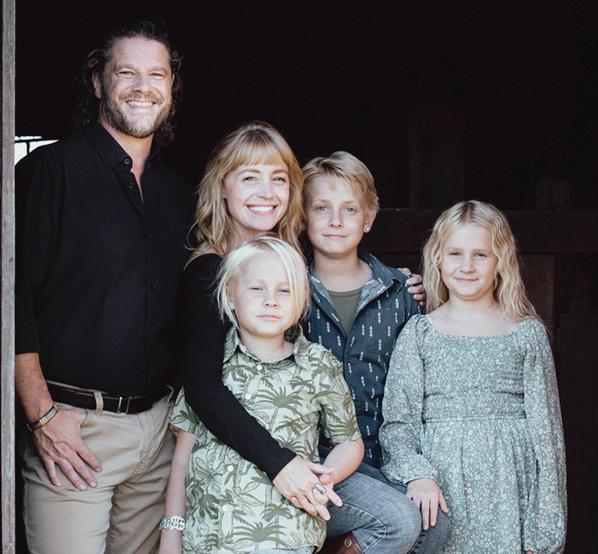
By Emily Senkosky, UM News Service
MISSOULA – According to naturalist and author John Muir, between every two pines is the doorway to a new world. In Noxon, Montana, at a base camp for wildlife biologists nestled deep in the pines, camera traps and other measuring instruments are capturing forensic evidence of what is happening to the state’s elk population.
A new management plan released by Montana Fish, Wildlife and Parks last year has accelerated matters concerning the antlered ungulate, and an investigative team consisting of University of Montana wildlife biology professors and students is helping FWP spearhead research to understand the many complex factors affecting the species.
The town of Noxon is a twoand-a-half-hour drive northwest from Missoula, on the border of Idaho’s panhandle at the heart of Montana’s Hunting District 121. Over the past decade, the local community raised concerns about reduced elk populations with local wildlife managers.
“The public in Montana is passionate about wildlife, with elk being particularly important to the hunting public,” said Neil

Anderson, an FWP regional wildlife manager. “When there
are changes – especially when those changes aren’t viewed as
being positive – the public looks for actions to improve the situation.”
Researchers are considering the many ecological factors that impact the species, including predator roles, habitat changes, population distribution and human modifications to the landscape.
Collectively, efforts aim to provide answers to foundational questions: Where are elk on the landscape, and what are the main drivers of their population dynamics? Although outcomes are still a work in progress, these scientists are diligently working to help ensure a balanced and sustainable future for Montana’s elk and the communities that depend on them.
The Fabric of the Landscape
Before this project began, there was limited data on elk mortality rates and population distribution in HD 121.
“There were many thoughts as to why elk numbers and distribution had changed, but no data to determine what was really happening,” Anderson said.
Previously, aerial counts were used in the area, but this method can only obtain an estimated minimum population abundance and cow-calf ratios. Noxon, like
see page 2
most of northwest Montana, also has a unique ecosystem due to its dense forested areas and humid climate, making this method potentially inaccurate due to the difficulty of sighting and counting elk.
Data from other studies in western Montana and even nearby areas in Idaho also have been used to make inferences for what’s happening in Noxon, said Chad Bishop, director of UM’s Wildlife Biology Program, who helps oversee the project. He said this hasn’t provided a real snapshot of Noxon’s elk.
“The issues regarding wildlife can be really complex depending on what kinds of landscape you’re evaluating,” Bishop said. “This project is aimed at getting a holistic view of what’s going on with this specific population.”
The Noxon elk project is the largest research effort in recent times within the hunting district and includes the collaborative fieldwork of experts ranging from UM students to wildlife researchers and FWP staff. Project members spend weeks at a time in the Noxon area, staying at the study sites both in the winter and summer to tease apart the various factors that could influence elk.
“Having accurate information on wildlife populations forms the frame-
work for discussions,” Anderson said. “Information from this study helps inform biologists and carries a lot of weight in determining what tools to use to achieve management goals.”
According to many of the students and FWP representatives, local community involvement is key to project success. Landowners have allowed camera traps to be set up on their property and worked one-on-one with the students and researchers.
“This is a major research project that will address important questions for elk management in an area where elk are especially important ecologically and culturally,” Bishop said. “The research will simultaneously contribute to the professional development of students who will be the future stewards of Montana’s wildlife.”
In particular, he said, students learn the value of working alongside private landowners and management agency biologists as part of con-
ducting rigorous research with an applied focus.
A Changing Habitat Researchers on the project are leaving no leaf left unturned – literally or figuratively – as they investigate what environmental factors impact elk.
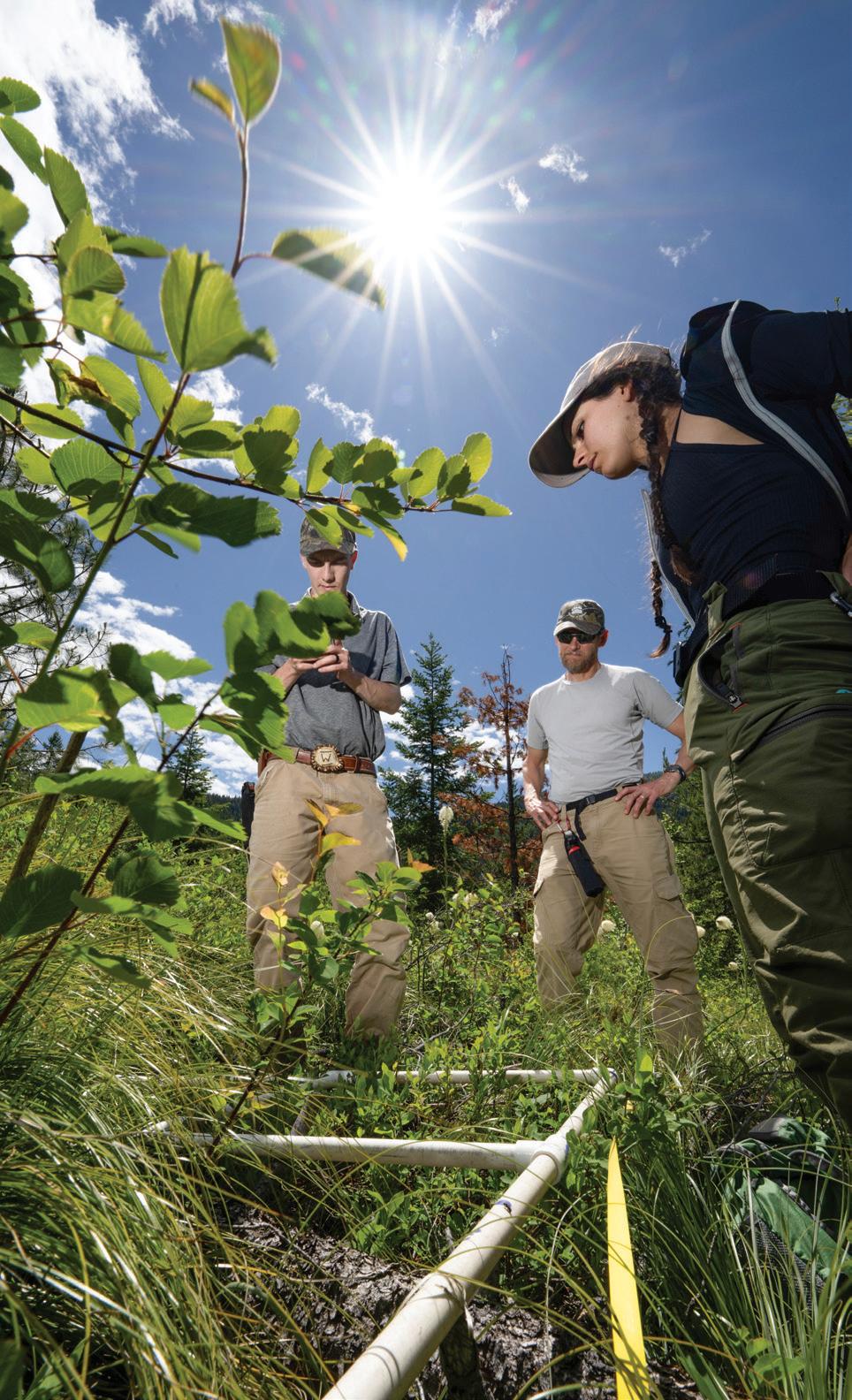
Trevor Weeks, a UM wildlife biology master’s student advised by Bishop, studies vegetation in HD 121 habitat. Elk are herbivores, so the quantity and quality of forage and landscape disturbance can be critical.
His main task is to gather information that can help piece together an elk’s diet in this area.
“Environmental variability matters a lot with population dynamics,” Bishop said. “Oftentimes, the big-picture driver of a species’ decline is tied to a reduction in habitat quality.”
By understanding what elk eat and the nutritional value of their diet, Weeks’ work supports the project’s overarching goal of developing models that predict how elk use the landscape. In his meticulous fieldwork, he
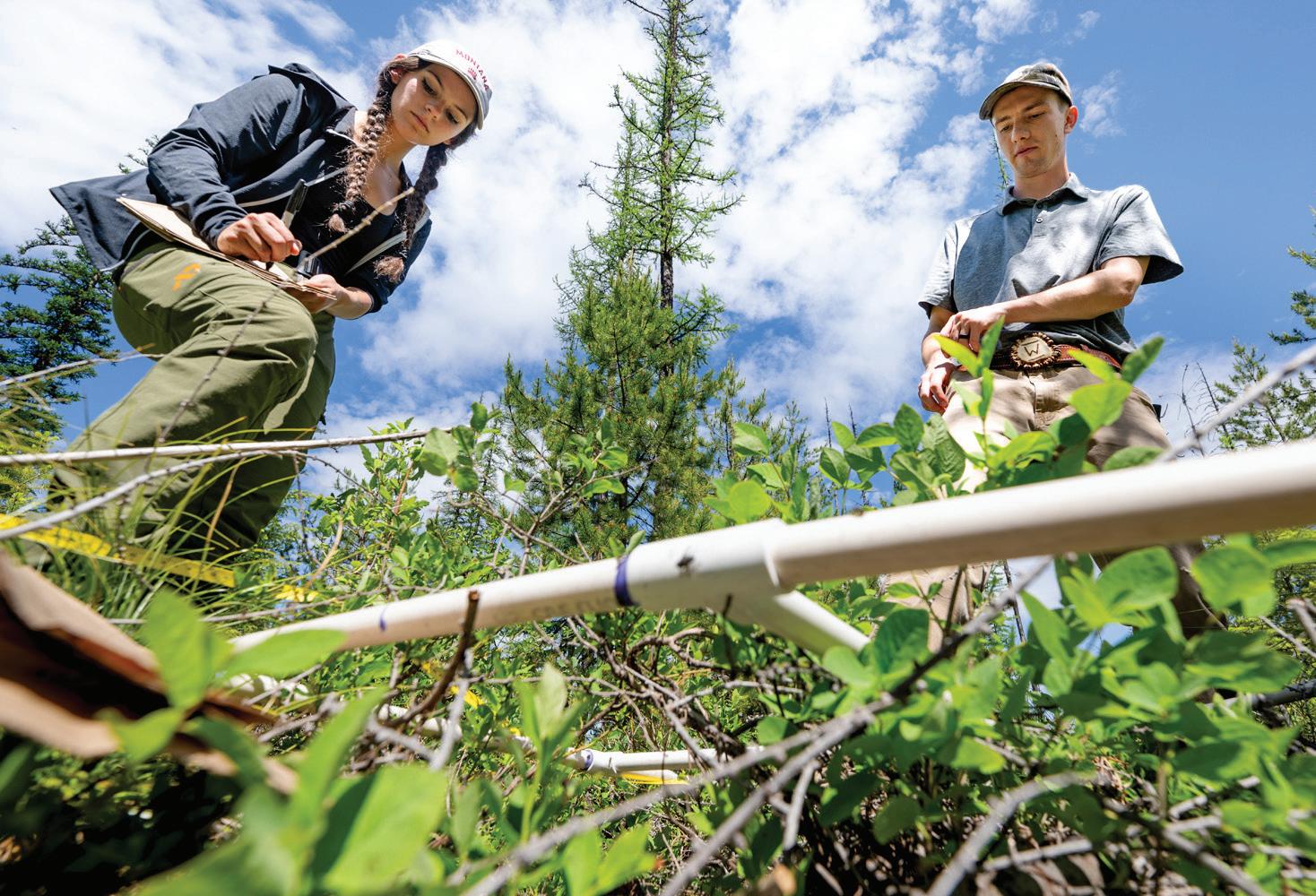
documents every plant species within a square meter frame, dries them out and weighs them. He then collects scat for a DNA metabarcoding analysis, cross-comparing the results to model what specific things elk are eating. This data also can help predict the amount of forage available in different areas of the study site.
Weeks has identified 45 unique diet items for elk in Noxon. This includes plants such as huckleberries, raspberries, roses, fireweed and clovers. With foundational knowledge on the values of elk nutrition, his research later can be used to inform population changes.
Weeks also studies impacts of forest disturbances on elk nutrition, such as timber harvesting or prescribed fires. By examining forage across
sites that are disturbed versus undisturbed, he can categorize the major forest types and historical trends to get a glimpse into an elk’s nutritional intake within the larger ecosystem. Weeks emphasizes the need to understand elk nutrition as it can have significant long-term impacts on the population.
“Nutrition can impact a lot of things. Understanding their diet creates steppingstones to see what is impacting the population,” Weeks said.
“We’re looking at this situation comprehensively – both top down and bottom up – meeting in the middle to figure out all the factors affecting elk.”
Population Dynamics
Karly Tellier, also a UM master’s student in wildlife biology, is working to obtain a more representative estimate
of both elk and carnivore populations in the hunting district. As part of a wildlife modeling team, she helps deploy different types of field cameras, a technique championed by her adviser Paul Lukacs, UM senior associate dean of research and graduate studies.
This part of the research uses over 100 camera traps, with 80 randomly and 40 semi-randomly placed near game trails, to gather a more accurate portrayal of predator-prey ratios. The study area covers about 2,500 square kilometers (about the size of Yosemite National Park) around Noxon on private and public land.
“Paul has revolutionized the use of field cameras to estimate abundance of species,” Bishop said. “He’s led that nationally and internation-











Boone Goddard
Advertising Sales, Owner (406) 249-1728 boone@valleyjournal.net

The Valley Journal newspaper (PE 23-190) is published weekly by Valley Journal LLC. Periodicals postage paid at Ronan, MT.
Business hours are 9 a.m. to 5 p.m., Monday through Friday.
Distribution is by mail subscription ($59 per year in Lake County, MT; $74 per year elsewhere in U.S.) and by newsstand sales. Postmaster: send address changes to Valley Journal, P.O. Box 326, Ronan, MT. 59864.
Your homegrown newspaper serves residents of Lake
Summer Goddard
Publisher, Owner (406) 249-1793 summer@valleyjournal.net
County and the Flathead Indian Reservation.
Deadline for display advertising is 2 p.m. Thursday. Deadline for news submissions, calendar items, classifieds and legal advertising is noon Friday, for the following week’s newspaper.
News, letters to the editor and calendar submissions may be sent by email to: vjeditor@valleyjournal.net. Classified and legal advertisements requests should be emailed to: vjmail@valleyjournal.net.
All print subscriptions include full access to online news,
And find us online for more photos, videos, breaking news and special sections!

Kathi Beeks
Office Manager, Copy Editor (406) 676-8989 vjmail@valleyjournal.net news@valleyjournal.net
archives. Sign up online at: www.valleyjournal.net/ subscribe

For general inquiries: call 406-676-8989, email summer@valleyjournal.net, or send mail correspondence to P.O. Box 326, Ronan, MT 59864. Copyright 2024, the Valley Journal. All rights reserved. Reproduction, reuse or transmittal in any form or by any means is prohibited without written permission of the Valley Journal.
News from the Polson Police Dept.
POLSON — The Polson Police Department is proud to announce the recognition of two of its dedicated officers for their exemplary service to the community.
Sergeant Kyle Cooper and Officer Michael Wharton were honored at last night’s city commission meeting for their commitment to upholding the law and ensuring the safety and well-being of the residents of Polson. Their contributions reflect the highest standards of law enforcement and serve as a testament to the values that the Polson Police Department upholds.
Sergeant Kyle Cooper was recognized for his five years of dedicated service to the community. Throughout his tenure, Sgt. Cooper has consistently demonstrated a proactive approach to community policing, fostering strong relationships with the citizens of Polson. His attention to detail and ability to connect with the community have significantly impacted public safety and trust. His work embodies the principles of “community, nobility, and service,” core beliefs of our department.
Officer Michael Wharton was honored for his
remarkable 20-year career in law enforcement, with 10 of those years dedicated to serving the Polson community. Officer Wharton’s two decades of service are marked by resilience, professionalism, and an unwavering commitment to the people of Polson. His leadership, experience, and mentorship have been invaluable assets to the department.
Officer Wharton continues to exemplify the values of integrity and honor that define our mission.
The Polson Police Department extends its deepest gratitude to Sgt. Cooper and Officer Wharton for their unwavering commitment and service. Their dedication to protecting and serving Polson has made our community a safer and better




News from Stefanie Nordberg and Stephanie Herried
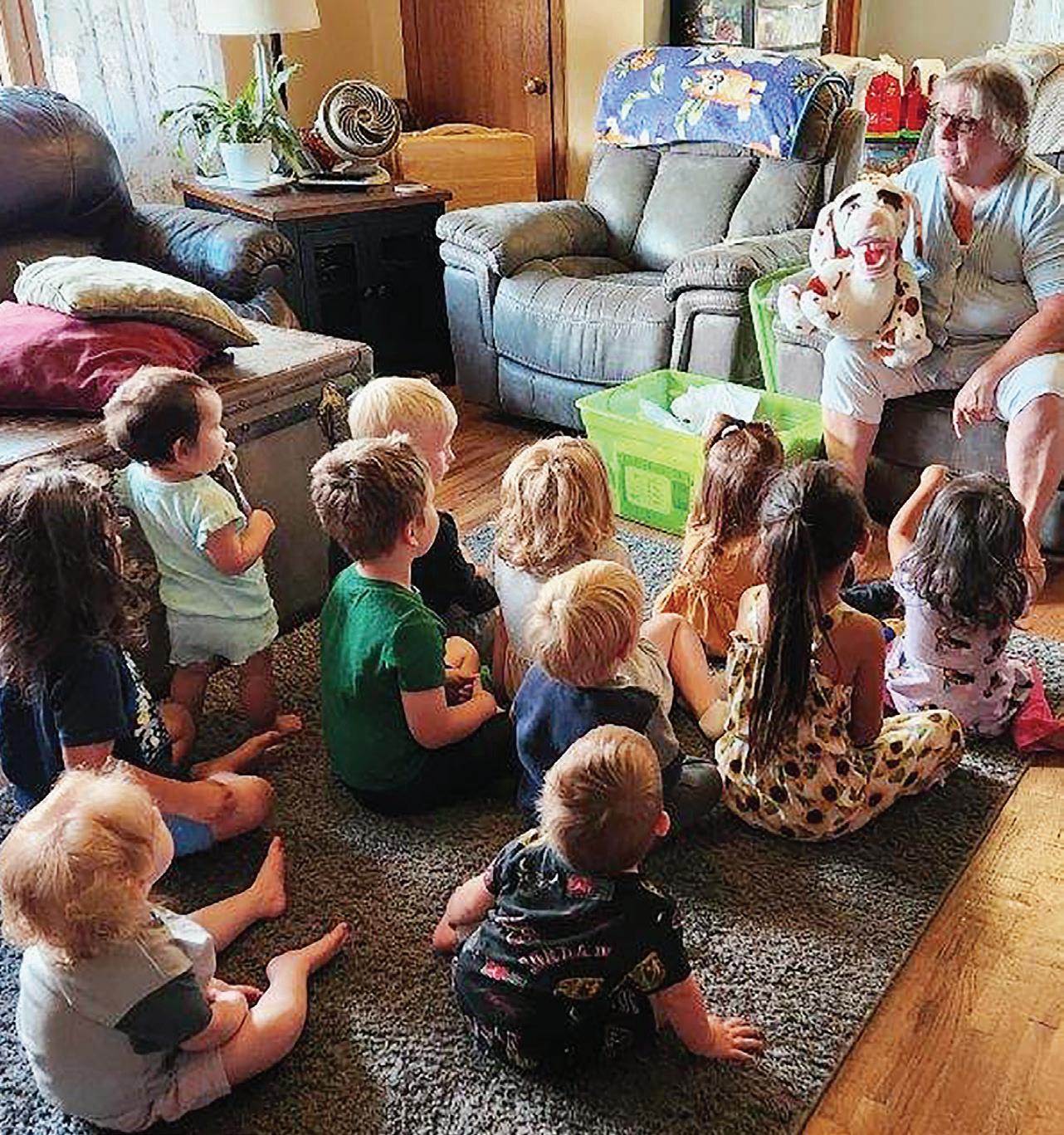
POLSON — Stefanie Nordberg from Rainbow Home Daycare and Stephanie Herried from Lil’ Yellow House Daycare brought their two childcare groups together and had the privilege to welcome Cyndy Marengo from Polson’s Tribal Dentistry to make a presentation to our group.
Cyndy brought a puppet named Dennis, who had teeth and a toothbrush, and gave a fun demonstration to our combined group of 11 kids, aged 13 months to 6 years. She asked interactive questions of all the kids, let them brush Dennis’ teeth, and gifted each of them a bag of age appropriate dental items including a toothbrush, floss, timer, swish fluid, and more.
Nordberg and Herried want to extend their genuine gratitude to the tribe for the dental gift bags given to each child as well gift bags for the adults.
Cyndy was very professional and personable, and the kids all loved it her presentation.
News from Sloane Stinson, Montana Dept. of Transportation
RONAN — Riverside Contracting, Inc. crews will continue with sign installations next week, including the sign bridge, just north of the intersection of US Highway 93 (US 93) with Adams Ave. SE. This is an overhead support structure that will hold multiple directional signs.
Single-lane closures may be required where work is occurring. Work will occur Monday, Aug. 26, through Friday, Aug. 30, from 7 a.m. to 6:30 p.m. All work is dependent on weather and other unforeseen factors.

Please follow all posted signage and watch for workers and equipment.
Once clean-up activities and sign installation are finished, the project will be put on hold until the design changes for the intersection of US Highway 93 (US 93) with Old US 93 and Third Ave. are finalized. This construction is
News from the National Park Service
WEST GLACIER, Mont. [August 26, 2024] – The body of missing mountaineer Grant Marcuccio, a 32-year-old man from Whitefish, Montana, was found by Two Bear Air at approximately 2 pm on Sunday, August 25. Cause of death is still under investigation, but traumatic injuries and location of the body are indicative of a fall.
Two Bear Air spotted Marcuccio from the air. He was found one-third of a mile east of McPartland Peak below the ridgeline between Heavens Peak and McPartland Peak.
The body was transported to the Apgar horse corrals where Two Bear Air met the Flathead County coroner. Marcuccio was last seen by his hiking party on Sunday, August 18 at about 1 pm. Marcuccio separated from his party to summit McPartland Peak alone and planned to rendezvous at a designated location. Rangers were alerted by the hiking party on Sunday evening that Marcuccio never made it to the rendezvous spot.
Two Bear Air and ground teams began searching on Monday, August 19. US Forest Service also flew over the area and dropped off ground searchers.
Glacier National Park officials would like to thank North Valley and Flathead County Search and Rescue, USFS, US Geological Survey, Flathead County Sheriff’s Department, Two Bear Air Rescue, NPS staff and members of the public who provided tips.
Glacier National Park staff would like to express their sincere condolences to the family and ask that the public respect their privacy.
tentatively scheduled for October, but this date may change based on factors such as the final design completion, contractor availability, weather, and unforeseen circumstances.
For more information on the Ronan-North project, visit: www. mdt.mt.gov/pubinvolve/ronanurban/.
will steal your heart! He is very outgoing and friendly, loves walks (although he is still working on his leash manners). Drayco loves playing fetch with his favorite orange ball and would love a family that would play and snuggle with him!


News from the MT Meth Project
MONTANA – The Montana Meth Project is expanding its program to tackle the deadly fentanyl crisis. On Aug. 21, National Fentanyl Prevention and Awareness Day, the Meth Project launched the first Montana Fentanyl Prevention Lesson and Not Even Once: One Pill Can Kill campaign to educate teens about the deadly risks of Fentanyl.
“Experimentation with drugs has never been more deadly. Much like we did with methamphetamine, the Meth Project is responding now to scale a public health crisis,” said Amy Rue, executive director of the Montana Meth Project. “Young people in our communities are dying of fentanyl poisoning when taking substances that they had no idea were laced with fentanyl. There is a dire need to educate teens about the risks of this lethal drug.”
According to the U.S. Drug Enforce-
ment Agency, seven out of ten illegal pills seized in 2023 contained a lethal dose of fentanyl. Last year, the DEA seized more than 79.5 million fentanyl-laced fake pills and nearly 12,000 pounds of fentanyl powder. These seizures, in one year alone, are the equivalent of 377 million lethal doses of fentanyl — enough lethal doses to kill every American.
“Drug cartels primarily operating in Mexico are not slowing down production and distribution of deadly fentanyl and methamphetamine. Every day, the men and women of the DEA in Montana and across our division are working around the clock to get this poison off the streets,” said DEA Rocky Mountain Field Division Special Agent in Charge Jonathan Pullen. “Fentanyl poisonings are the leading cause of death for Americans 18 to 45 years of age. The DEA continues to urge you to discuss the lethal nature of fentanyl and the dangers of other drugs with family, friends, and
within your community. We commend the Meth Project for releasing life-saving education at this critical time.”
The Meth Project’s Fentanyl Prevention Lesson is now available online at MontanaMeth.org. Presented by a high school senior, applying the Meth Project’s research-based peer-to-peer approach, the 10-minute video lesson is appropriate for middle school and high school students, as well as anyone who wants to learn more about the risks of fentanyl.
The Meth Project is also introducing the Not Even Once: One Pill Can Kill campaign on social media to inform its vast audience of the risks of fentanyl.
“I invite all Montanans to join us in the urgent need to educate our young people about the deadly risks of fentanyl,” added Rue. “Please go to our website at MontanaMeth.org to learn more about fentanyl, talk with the young people in your life about the risks of illegal
drug use, and share the message with your community online and in-person. One pill can really kill, and by being Not Even Once Champions we can save lives.”
To help roll out the free Fentanyl Prevention Lesson in schools across the state this fall, the Meth Project asks Montanans to support the nonprofit by making a donation at MontanaMeth.org/Donate.
“If every Montanan gave just $1 in support of the Meth Project’s Fentanyl prevention work, we could reach every school and every teen in the state with life-saving education,” Rue said.
About the Montana Meth Project
The Montana Meth Project is a largescale prevention program aimed at reducing teen Meth and Fentanyl use through public service messaging and community outreach. The nonprofit was founded in 2005 by businessman and philanthropist Tom Siebel as a private-sector response to Montana’s critical public health issue.

ally. We have brought that technique in on this, and it is really helping to glean good data.”
The cameras also provide time-lapse images throughout the landscape every 10 minutes at random. By ensuring a constant data stream unaffected by motion sensors, the researchers can construct a clearer picture of elk movements and predator-prey interactions. Similar to an approach used in Idaho, the strategy allows for noninvasive monitoring of these populations under dense vegetation and tree canopies where traditional aerial surveys struggle to penetrate. Finally, the use of both random and semi-random cameras aims to capture more accurate species density estimates. This is especially prevalent when trying to get a count of predators like wolves, which avoid cameras and have been one assumption as to why elk populations are decreasing.
“FWP wants to better understand through data how to improve the balance between prey, predator and private homeowners so that harmony can be achieved on the landscape,” Tellier said.
Tellier is helping to collect data around the time of elk births and during hunting seasons to compare population numbers and distributions. This also helps
“
FWP wants to better understand through data how to improve the balance between prey, predator and private homeowners so that harmony can be achieved on the landscape.”
- Karly Tellier, UM master’s student in wildlife biology
understand elk migration patterns, particularly the shifts in abundance throughout the year. Through images and data modeling, this approach helps determine whether predators or elk behavior adaptations are contributing to the decline in bull elk harvests observed over the past decade. Chris Hansen, a UM post-doctorate on the project, supports and assists with modeling. He works to make sense of existing FWP elk data, using it as a baseline for the current research.
Hansen will take all the information currently being excavated in the field and piece it together in a model that helps project where elk are today, the drivers of their dynamics and their distribution in the landscape.
UM Ph.D. candidate Andy Stewart and her adviser, Professor Joshua Millspaugh, have traced reproduction versus survival rates of Noxon
elk through a variety of different data-capture methods. Stewart’s efforts are aimed at estimating population abundance and movements by using expandable satellite GPS collars administered to elk calves.
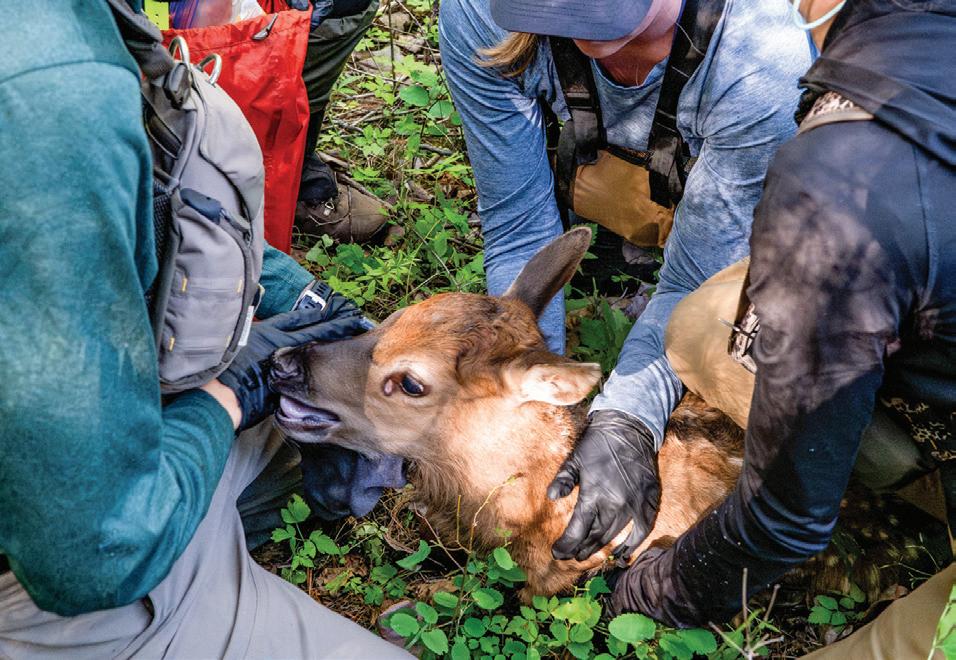
These collars serve multiple purposes. First, they provide precise survival data by sending mortality signals if the collar remains still for six hours, allowing researchers to quickly reach the site where an elk has died to gather accurate cause-specific mortality information. Additionally, the collars enable researchers to monitor surviving animals’ data – informing scientists about elk activities such as migration patterns, routes and landscape use.
Stewart also used transmitters placed in the vaginal canals of elk cows in the wintertime to confirm pregnancies. The transmitters communicate with the GPS collars when a birth is taking place. This data is sent to
“I’m hopeful that at the conclusion of this project all of the various people invested in it will be excited to learn what we have found,” Bealer said.
The ability to accurately track elk survival and mortality factors means wildlife managers are better informed about administering hunting licenses and adjusting season dates to help better support their populations. When there are higher numbers of elk, not only does the ecosystem thrive but the hunters who rely on the species do too.
Project funding was provided by revenue from the sale of Montana hunting and fishing licenses and matching Federal Aid in Wildlife Restoration grants to FWP. Additional funding was provided by the Rocky Mountain Elk Foundation.
Stewart is a hunter herself and believes that hunters play a significant role in elk conservation.
satellites and then back to the researchers so they can accurately track birth rates.
“Andy’s research ties everything together, looking at population and vital rates, which have the biggest impact on population growth,” Bishop said.
Nicole Bealer, a recent graduate of the UM wildlife biology program now working for FWP, collaborates closely with Stewart. Bealer spent months developing new analytic tools to bolster
collaring strategies. She also used coding to create algorithms that could more accurately predict calving locations, with the goal of detecting birth events in real time.
When the transmitters tell researchers an elk has been born, they dispatch to the location and collar the calves to better inform survival rates after birth – making it so the researchers can not only track reproduction but the number of calves making it to adulthood as well.
“It’s been a very cool experience to work on a project of this size that is looking at so many different factors of such an iconic species,” Stewart said. “It’s really fulfilling to have agency support and local support – especially the sportsmen.”
By providing a holistic view that combines topdown and bottom-up approaches, the collaborative efforts of UM researchers, students and FWP are helping to paint the bigger picture of Montana’s elk population.

Get a job – earn college credits – make a difference!
Nursing Faculty (10 months)
Salary Range: $55,935 - $65,551 DOEE
Closing Date: Open Until Filled
Nursing Simulation Lab Instructor
Salary Range: $54,301-$56,400 DOEE
Closing date: Open Until Filled
Mechanic/Instructor- HCT Department
Salary Range: $ $52,947 DOEE
Closing Date: Tuesday, September 03, 2024, 4:00pm MST
Childcare Center Cook-Early Learning Center (9.5 months)
Salary Range: $15.65-$16.92/hr DOEE
Closing Date: Open Until Filled
Custodian Part-time
Salary Range: $14.80/hr
Closing Date: Open Until Filled
Health Promotion Specialist
Salary Range: $40,789 - $44,310 DOEE
Closing Date: Open Until Filled
Custodial Services Team Leader (2 positions)
Salary Range: $16.97/hr
Closing Date: Open Until Filled
Indigenous Language and Cultural Specialist-Division of Education
Salary Range: $51,311-$53,586 DOEE
Closing Date: Tuesday, September 03, 2024, 4:00pm MST
Dental Assisting Education Coordinator
Salary Range: $16.91-$18.28/hour DOEE
Closing Date: Monday, September 9,2024, 2023 at 4:00pm MST
Wildlife/Fisheries Ecologist
Salary Range: $51,062 - $56,111 DOEE
Closing Date: Monday September,9 2024; 4:00pm MST
Accounting Tech/Receptionist
Salary Range: $14.48 - $15.12/hr DOEE
Closing Date: Open Until Filled
Bookstore Clerk (9 months)
Salary range: $14.20/hr - $14.54/hr DOEE
Closing Date: Open Until Filled
Instruction & Outreach Services Librarian
Salary Range: $19.40 - $19.99/hr DOEE
Closing Date: Monday, July 29, 2024 at 4:00 pm MST
President for Salish Kootenai College
Salary Range: to be negotiated with the Board of Directors DOEE
Closing Date extended to: August 29, 2024; 5:00 pm MST
Part-Time HEO Instructor/Mechanic Helper - HCT Department
Salary Range: $19.10 - $19.81/hr DOEE
Closing Date: August 26, 2024; 4:00 pm MST
Tutor/Technical Support Director - Business Division
Salary Range: $45,293 - $47,757 DOEE
Closing Date: August 26, 2024; 4:00 pm MST
To apply you must submit an SKC application, resume and applicable transcripts to: Human Resources, P.O. Box 70, Pablo, MT 59855. Toll free 877.752.6553, ext. 4985 Direct Dial 406.275.4985/4977
Hydrology Instructor Limnology 9month
Salary Range: $51,062 - $56,111 DOEE
Closing Date: Monday September,9 2024; 4:00pm MST
Indigenous Research Center (IRC) Program Assistant
Salary Range:$39,133-$40,365 DOEE
Closing Date: Monday September 9,2024; 4:00pm
NYCP Cultural Outreach Coordinator
Salary Range:$42,829 - $45,293 DOEE
Closing Date: Tuesday, September 9, 2024 4:00pm MST
The Nursing Department is actively seeking adjunct nursing faculty who are excited about teaching and student learning. Adjunct nursing faculty will hold a minimum of a Bachelor of Science in Nursing (BSN) degree and a Master of Science in Nursing (MSN) degree from both an accredited nursing program and college. If a BSN prepared nurse is currently enrolled in a master’s program, they will be considered as a qualified applicant. Any person seeking adjunct employment please send a completed SKC application, resume, and unofficial transcripts to Teresa Sias at teresa_sias@skc.edu. Official transcripts will be required upon hire.

Like many others, I wept watching Vice-President candidate Tim Walz’s son Gus express his sheer admiration of his dad during the Democratic National Convention.
Gus had tears in his eyes and as expression of pure joy when he pointed his index finger at his dad during his speech and said, “I love you, dad” and “That’s my dad!” Much has been made about the fact that Gus has a nonverbal learning disorder
as well as anxiety and ADHD. While none of that matters in regard to his elated show of affection for his dad, it did perhaps offer some people the chance to think about those issues and to consider how the Walz family has admirably supported Gus.
What should not have happened is that hateful people took to the internet to make fun of Gus. But it did. For example, conservative
All Democrats rubberstamp, Republicans don’t
Editor, Obviously the Democrat calling Representative Reksten “Rubberstamp Reksten” has never reviewed the house votes. As a former member of the Montana House and Senate, I can attest that all Democrats rubberstamp. In fact, I was so shocked when first elected that I would attend Democrat caucuses, often led by then Governor Schweitzer. Representatives were told how to vote on the day’s agenda. Republican leadership would try the same, but we tend to be independent and our votes were all over the board. For example: check the votes on House Bill 2, the state budget bill, for any
columnist Ann Coulter wrote on the platform X “Talk about weird.” The comment has since been deleted but that does not erase the despicable sentiment behind making fun of a teenager who expressed his love for his father. Trump supporter and podcaster Mike Crispi referred to Gus as Walz’s “stupid crying son” and wrote on X “You raised your kid to be a puffy beta male. Congrats,” while another Trump supporter, Alec Lace, who actually hosts a podcast about fatherhood, wrote “Get the kid
of the last 17 years. Democrats lockstep, Republicans do not. So Joe, do a little research before you start calling names.
Janna Taylor Retired State Legislator
Dayton
Vote hard-working teachers into government
Editor, “The teaching profession contributes more to our society than any other single profession.” (John Wooden) Teachers work hard. If asked to do extra jobs, they may grumble, but they do them. They care about all students, listening to their concerns and advancing solutions. Teachers work miracles; often while juggling a family at home.
a tampon already.”
The issue goes beyond people saying disgusting comments about Gus Walz, however. It brings to light the fact that to some in the United States, politicians’ kids are fair game. They should never be. Sadly, there is a long history of trolls attacking politicians’ kids. Remember all the comments about Chelsea Clinton? How about the grotesque things people said about Sasha and Malia Obama? It is not just conservatives who play dirty and attack the kids.
Shirley Azzopardi taught special education for 30 years. Running for Representative of House District 13, she aspires to be a voice for all Montanans. Shirley will work to protect and strengthen our public school system by supporting increasing teacher pay and attracting new teachers, while opposing taxpayer dollars funding private charter schools.
Concerned about crushing property taxes? Our constitutional right to privacy? Women’s rights? Medicaid expansion? Fiscal responsibility? Your taxpayer dollars wasted on legal fees to fight unconstitutional laws? Government interference in healthcare? Shirley Azzopardi will listen to you and work on solutions.
Like Chelsea, Barron Trump was also ridiculed on Saturday Night Live after his dad took office. Barron faced more mean-spirited attacks when he decided to get involved politically as he was turning 18.
It really is quite simple: Leave the kids alone. They have nothing to do with their parents’ choice to run for office. There are plenty of policy issues that desperately need to be the focus of the upcoming election. Let’s pay attention to those and not to bullying kids. We can do better.
Laura Finley, Ph.D., syndicated by PeaceVoice, teaches in the Barry University Department of Sociology & Criminology and is the author of several academic texts in her discipline.
Another teacher I’ve met and can vouch for is Shannon O’Brien, who is running for State Superintendent of Schools. A high school teacher, tennis coach and educational policy advisor, her main focus is on improving public education while fighting privatization. She wants to protect taxpayers from having to fund private schools. Shannon also wants to stop the brain drain of teachers leaving Montana for better pay and working conditions.
Let’s “get to yes” by voting for Azzopardi and O’Brien. Teachers are wonderful, hard-working people. Trust me; I know.
Nancy Teggeman Polson
more letters on page 11
Letters to the editor are welcome. The content is the opinion of the letter writer and not the newspaper. The decision to publish letters is made by the editor. Letters must be 350 words or less. A writer will only be published twice per month. Letters may be edited for content or length, or may not be published if considered libelous, in poor taste, spiteful, self-promotional or of limited interest to the general readership. Space limitations also dictate when or if letters are published. Letters must be signed by the author and name, address and phone number must be included – phone number is for verification purposes only. Letters from organizations must include the name of at least one author. Please limit “thank you” letters to four people/organizations or less. Deadline is 5 p.m. Friday to publish the following week.
Opinions expressed in this section are not necessarily those of the newspaper.
Lots of hate speech at DNC convention
Editor,
As I read Bob McClellan’s letter to the editor, the adage “the pot calling the kettle black” came to mind. He came up with the term “Trumpism” to label anyone supporting President Trump.
He said Trumpism is characterized by fear, anger, and self-centeredness. I would argue that this is a definition of Trump Derangement Syndrome. It was on full display at the DNC convention. There was lots of hate speech, anger and the inability to separate facts from lies. Joe Biden even advocated to “beat the hell out of the Republicans.”
They accused Trump of everything the Democratic party is currently doing. As RFK put it this week, the Democratic party is the anti-democratic party. It is the party that believes in censorship and using lawfare against any political op-
ponent, including fellow Democrats. They want total control and do not care what they must do to obtain that control.
Another characterization of TDS is total obsession with President Trump and MAGA policies to the point of being neurotic and even being possessed. Anyone with TDS seems to lose the ability to think logically and discuss issues in a calm manner. Instead of disagreeing in a respectful way they immediately start denigrating you by calling you names such as, racist, homophobe, misogynist, deplorable, etc.
After hearing what the Democratic party did to RFK I hope more people will be delivered from TDS and choose a more acceptable human thinking and behavior. Looking forward to see Bob move in that direction and reject the dangerous form of autocracy the Democratic party has become.
Lonnie D. Haack Polson
News from Stephanie Gillin, CSKT
FLATHEAD RESERVATION
— Everyone is welcome to the fourth annual Wildlife Festival. Bring some apples to the Ronan Visitor’s Center for free cider pressing where you can learn more about fruit gleaning and chronic wasting disease. You will also have a chance to talk with CSKT’s wildlife biologists about our current projects on the Flathead Reservation. For more information go to: www. cskt.org/wildlife or www.facebook. com/CSKTWildlife Get to picking. Borrow free apple pickers and drop off any unwanted fruit at: St. Ignatius Community Center, 240 Mountain View Dr.; Ronan Co-op Brewery, 23 4th Ave. SW; and Polson, 406 6th Ave. E. For more information go to Mission Valley Fruit Gleaning page on Facebook.
Senate President responds to judge’s ruling on ballot initiatives
News from MT State Republicans, MT Legislature
HAMILTON — Senate President Jason Ellsworth, R-Hamilton, responded today to a ruling earlier

this week from Lewis and Clark County District Court Judge Mike Menahan striking down major portions of laws passed by the 2021 and 2023 Legislatures designed to improve the ballot initiative process.
Part of Menahan’s ruling was to remove public comment and legislative review from proposed ballot initiatives prior to signature gathering.
“Judge Menahan has robbed Montanans of their one and only opportunity to voice their opinions on proposed initiatives in a public forum and removed the only part of the process that involves a public debate over the merits of these proposed laws and constitutional amendments,” Ellsworth said.
“Further, the judge’s ruling reduces the amount of information presented to qualified electors when they’re asked to sign petitions to qualify initiatives for the ballot. For the past few years the public has known whether their elected representatives reviewed the initiative and voted to recommend it as a good idea or reject it as a bad idea. Now Montanans will be less informed when they are deciding whether or not to add their names to a ballot initiative,” Ellsworth added.
“This is a ruling against transparency, against public participation, and against informed lawmaking,” Ellsworth concluded.
Interior Dept. announces nearly $7M for Indian Youth Service Corps Projects
News from the Dept. of the Interior WASHINGTON D.C. — The Department of the Interior announced nearly $7 million through the Indian Youth Services Corps (IYSC) for Indigenous-led conservation projects across the nation. The IYSC, launched by Secretary Haaland in 2022, is a partnership-based program helping provide meaningful education, good-paying jobs, and training opportunities to Indigenous youth through conservation projects on public and Tribal lands, and Hawaiian homelands. This latest round of projects will further advance the American Climate Corps, the Biden-Harris administration’s effort to empower a new, diverse generation of Americans to tackle the climate crisis and become part of a growing clean energy and climate-resilience workforce. These efforts help advance the Biden-Harris administration’s America the Beautiful initiative and ongoing efforts to support local and Tribally led conservation and restoration priorities.

News from the Greater Polson Community Foundation
POLSON — Last month the Greater Polson Community Foundation awarded their Annual IMPACT Grants to an unprecedented 15 local non-profits as part of its 2024 IMPACT grant cycle. Non-profit directors, team members and GPCF Grant Committee members were on hand from Sandpiper Art Gallery, Mission Valley LIVE, Friends of the Children, Polson Boxing Club, Flathead Lake Bio Station, Safe Harbor, Polson Theatres, Polson Youth Soccer Association, Flathead Lake International Cinemafest, North Lake County Library District, Mission Valley Aquatics, the Mission Valley Animal Shel-
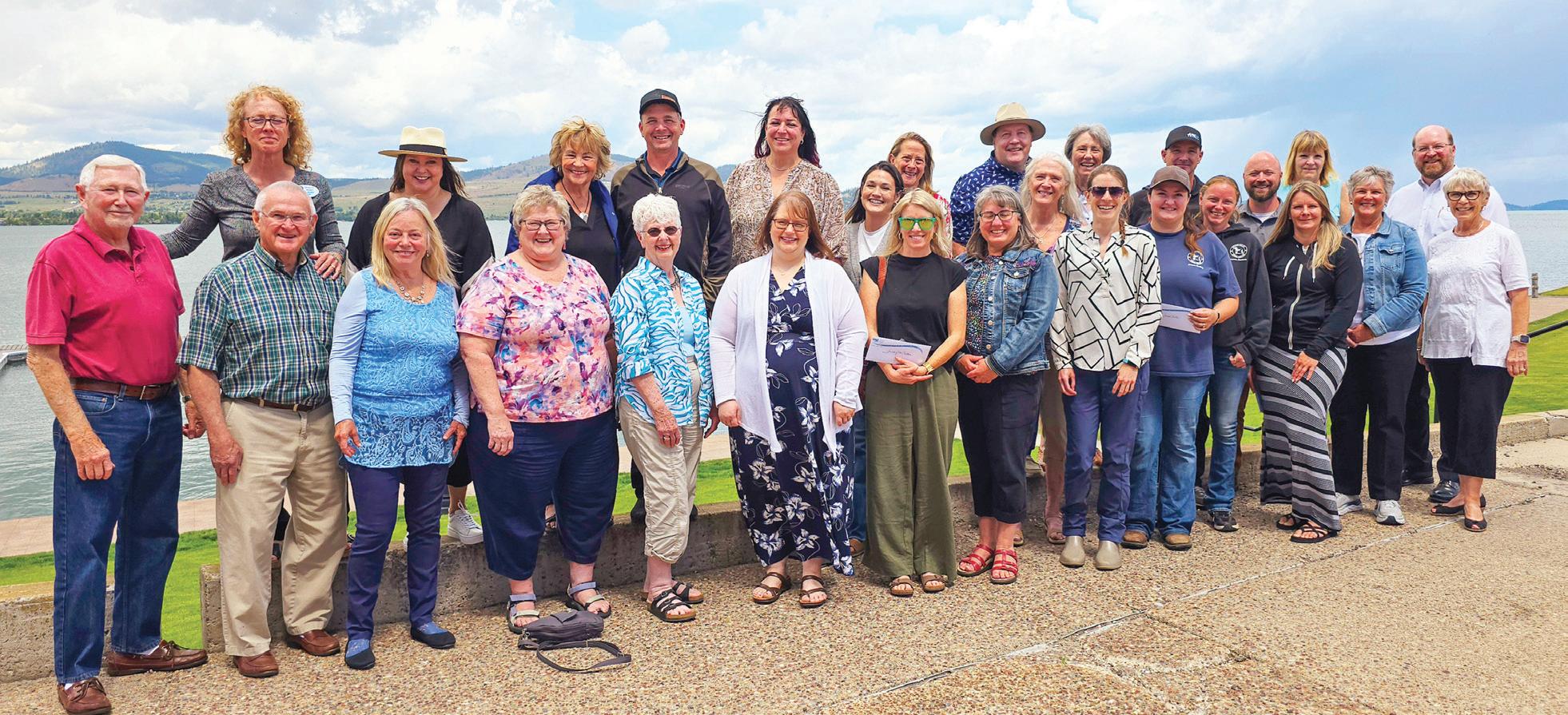
ter, Boy’s and Girl’s Club of Flathead Reservation, Polson Parks Department and the Mission Valley Choral Society to discuss their projects and accept funds on behalf of the nonprofits. Since 2009, over 1.5 million dollars has been
granted to organizations to meet our community needs. “Being able to support our community non-profits and their projects is definitely a highlight of our year” said GPCF Grants Chairman Jeanette Phillips. The growing generosity of
Event designed to encourage healthy eating habits, support local food-based initiatives throughout state
From MSU News Service
BOZEMAN — Residents across the state are invited to participate in Montana Crunch Time, a celebration of National Farm to School Month, local producers and nutritious foods. Montana Crunch Time is a statewide event encouraging par-
ticipants to “crunch” — or bite — into locally grown and raised food. The program is designed to support Montana producers and local food-based initiatives throughout the state, according to Haley Scott of Montana Team Nutrition, which is based at Montana State University. Crunch Time is also intended to help participants learn about healthy food and nutrition choices. All Montanans are encouraged to participate.
This year Montana will compete against Colorado, Kansas, Missouri, Nebraska, North Dakota, South Dakota,
GPCF donors through directed gifts, donations and grants make it possible to add significantly to our permanent endowment, which totals over $1,000,000.00. GPCF Grants are funded by the interest earnings from our permanent endow-
Utah and Wyoming for the Mountain Plains Crunch Off Champion’s Banner, which is awarded to the state that records the most crunches per capita. Crunches can be registered online throughout October.
“Though participants can register their crunches throughout the month, it is encouraged to crunch on Oct. 8 to create a big crunch heard ‘round the region,” Scott said.
Groups around Montana, such as schools, early care facilities, education sites and workplaces can organize crunch events, or individuals can crunch on their
who truly love making a difference in the community that they love.”
ment and are awarded annually through Trust
Based Grants in February and our Impact Grants in July. Foundation President Toni Whealon added “We are only able to do these Impact & Trust Based grants because of our dedicated donors
own throughout the month.
Last year 23,933 Montanans joined the collective crunch, including more than 20,000 participants ages 6-18. The statewide goal is 30,000 crunches this year.
This will be the 11th annual rendition of Montana Crunch Time. It began in 2013 as an event in schools but has expanded to include all Montanans.
The event is hosted by the Montana Farm to School leadership team, Montana Team Nutrition and the Montana Office of Public Instruction.
Longstanding GPCF Board and Grant Committee member Marc Vergeront reminds community members to “look for newspaper articles and updates on these amazing projects happening all around us and as the 2024 grant projects are off and running, we at the foundation are dedicated to putting our words into action by inspiring philanthropy, community pride and improvement.” If you would like to learn more about the Greater Polson Community Foundation, you can contact us at 406-883-GPCF, find us on Facebook or visit our website at: www.greaterpolsoncommunityfoundation.org
“National Farm to School month showcases the importance of agriculture in our state,” said Elsie Arntzen, superintendent of OPI. “I am Montana proud of the partnership between our farmers and ranchers, our schools, MSU and my office. Montana Crunch Time is a great teaching and learning opportunity for all our students and teachers.”
To register your crunch, download the crunch guide and access more resources, visithttps://www.montana.edu/mtfarmtoschool/mt-crunch-time. html.
News from the office of Governor Gianforte
HELENA — On Aug. 22 Governor Gianforte asked Montana superintendents and school board trustees to adopt policies to limit learning distractions in the classroom and improve student academic performance by establishing “cell phone-free” schools.
For our Montana students to reach their full, outstanding potential, “we should seek to remove distractions and disruptions in our schools, a place where students should be focused on learning,” Gov. Gianforte wrote in a letter to Montana superintendents and trustees.
“Unfortunately, cell phones distract students and disrupt the learning environment, and according to studies, it leads to learning loss and lower grades.”
The use of smartphones by students during the school day has increased dramatically in the last 20 years. According to a 2023 report from Common Sense Media, 97 percent of 11- to 17-year-olds use their cell phone during school, including to text, access social media, play games, and watch videos. They receive an average of more than 50 notifications per day on their phones during school hours.
“Studies and data point to the urgent need to act,” Gov. Gianforte wrote, emphasizing the negative impact of students’ use of cell phones
use in school on their academic outcomes and mental health.
“Given the gravity of the situation, I ask you, and all school districts throughout our state, to consider adopting policies that create “cell phone-free’ schools,” the governor wrote. “Schools across the country that have enacted policies to make schools “cell phone-free” have seen increased student engagement and improved academic outcomes.”
Some Montana school districts have already adopted “cell phonefree” school policies, but the governor’s letter is the first official effort in Montana to reduce cell phone-driven distractions in learning environments.
News from DPHHS
MONTANA — State and local health officials are reporting today the first Montana West Nile virus (WNV) detections for summer 2024 across four counties.
Six mosquito pools in Blaine, Dawson, Prairie, and Wibaux counties have tested positive for WNV. Detection in mosquitoes is an early indicator that activity is increasing within the state, putting humans at higher risk of illness.
Infections can occur in humans after a bite from an infected Culex mosquito. Increased risk of transmission to humans is expected to continue through October – or as long as mosquitoes are active in the state.
Most people who become infected with WNV will not experience symptoms, but 1 in 5 experience minor illness causing headache, rash, body aches, joint pains, fatigue, vomiting, and diarrhea. Fatigue and body aches may persist for weeks following infection.
About 1 in 150 human infections result in severe disease, referred to as
neuroinvasive West Nile. Neuroinvasive West Nile can cause neurological symptoms including disorientation, stupor, coma, paralysis, vision loss, and convulsions. WNV can be fatal or lead to long-term neurological complications such as paralysis.
Currently, there is no vaccine or targeted medication for WNV in humans, aside from supportive care.
To keep mosquitoes away from homes, it’s important to regularly empty standing water at least once per week. For items such as rain barrels, a screen can be applied to the opening to restrict mosquito access. Check out the 4 Ds of mosquito bite prevention below for other mosquito bite prevention tips.
The 4 Ds of Mosquito Bite Prevention:
DEET: Use insect repellent containing DEET or picaridin.Go to: https://www. epa.gov/insect-repellents
Drain: Drain standing water around. Dawn/Dusk: Mosquitoes are most active during dawn and dusk.
Dress: If possible, wear long-sleeved shirts and pants.














Assistant Secretary Newland completes investigation, releases final report
News from the Department of the Interior
— The Department of the Interior recently announced next steps on the Federal Indian Boarding School Initiative, launched in June 2021 by Secretary Deb Haaland as the first-ever comprehensive effort by the federal government to recognize the troubled legacy of past federal Indian boarding school policies with the goal of addressing their intergenerational impact and shedding light on past and present trauma in Indigenous communities.
The Department released the second and final volume of the investigative report called for as part of the Initiative, led by Assistant Secretary for Indian Affairs Bryan Newland. The second volume builds on the initial volume published in May 2022 to significantly expand on the number and details of institutions to include attendee deaths, the number of burial sites, participation of religious institutions and organizations, and federal dollars spent to operate these locations.
It also includes policy recommendations for consideration by Congress and the Executive Branch to continue to chart a path to healing and redress for Indigenous communities.
“The federal government – facilitated by the Department I lead – took deliberate and strategic actions through federal Indian boarding school policies to isolate children from their families, deny them their identities, and steal from them the languages, cultures and connections that are foundational to Native people. These policies caused enduring trauma for Indigenous communities that the Biden-Harris administration is working tirelessly to repair,” said Secretary Haaland. “I am immensely proud of the hundreds of Interior employees – many of them Indigenous – who gave of their time and themselves to ensure that this investigation was thoroughly completed to provide an accurate and honest picture. The Road to Healing does not end with this report – it is just beginning.”
“For the first time in the history of the United States, the federal government is accounting for its role in operating historical Indian boarding schools that forcibly confined and
attempted to assimilate Indigenous children. This report further
“provides detailed profiles of each school and confirms that at least
tary Haaland and Assistant Secretary Newland also met with govern -
For the first time in the history of the United States, the federal government is accounting for its role in operating historical Indian boarding schools that forcibly confined and attempted to assimilate Indigenous children.”
- Secretary of the Interior Deb Haaland
proves what Indigenous peoples across the country have known for generations – that federal policies were set out to break us, obtain our territories, and destroy our cultures and our lifeways,” said Assistant Secretary Newland. “It is undeniable that those policies failed, and now, we must bring every resource to bear to strengthen what they could not destroy. It is critical that this work endures, and that federal, state and Tribal governments build on the important work accomplished as part of the Initiative.”
Volume 2 updates the official list of federal Indian boarding schools and maps to include 417 institutions across 37 states or then-territories. It
973 American Indian, Alaska Native, and Native Hawaiian children died while attending federal operated or supported schools. It also identifies at least 74 marked and unmarked burial sites at 65 different school sites and estimates that the U.S. government made appropriations available of more than $23.3 billion in Fiscal Year 2023 inflation-adjusted dollars between 1871 and 1969 for the federal Indian boarding school system as well as other similar institutions and associated assimilation policies.
In the process of publishing these two volumes, the Department’s staff and contractors reviewed approximately 103 million pages of federal records. Secre -
ment officials and Indigenous leaders from Australia, Canada and New Zealand to understand the processes they used to address the legacy of similar assimilation policies, to include boarding schools and institutions.
The report includes eight recommendations for the federal government from Assistant Secretary Newland that aim to support a path to healing the nation, including:
— Issuing a formal acknowledgment and apology from the U.S. government regarding its role in adopting and implementing national federal Indian boarding school policies;
— Identifying and repatriating remains of children and funerary objects who never returned from federal Indian boarding schools;
— Returning former federal Indian Boarding school sites to Tribes;
— Telling the story of federal Indian boarding schools to the American people and global community;
— Investing in further research regarding the present-day health and economic impacts of the federal Indian boarding school system; and
— Advancing international relationships in other countries with similar but their own unique histories of boarding schools or other assimilationist policies.
In recognition of the damage that federal Indian boarding schools and associated policies had on Native languages, investing in their restoration and preservation has been an early priority of the Biden-Harris administration. In 2021, the
see page 15
— Investing in remedies to the present-day impacts of the federal Indian boarding school system; — Establishing a national memorial to acknowledge and commemorate the experiences of Indian Tribes, individuals, and families affected by the federal Indian boarding school system;
Departments of the Interior, Education and Health and Human Services launched an interagency initiative to preserve, protect and promote the rights and freedom of Native Americans to use, practice and develop Native languages. Since then, both Secretary Haaland and Assistant Secretary Newland have traveled with First Lady Jill Biden and other Administration leaders to learn more about how Tribal Nations are leveraging federal investments to revitalize Native languages. The Administration expects to roll out a new ten-year Native Language Strategy by the end of 2024.
Telling the story of the impact of these boarding schools has been a guiding purpose of the Federal Indian Boarding School Initiative, including Secretary
Haaland’s op-ed sharing her own personal history. In late 2023, Secretary Haaland and Assistant Secretary Newland completed “The Road to Healing,” a historic 12-stop tour across the country that provided Indigenous survivors the opportunity to share with the federal government their experiences in federal Indian boarding schools for the first time. The Road to Healing events included opportunities to connect survivors with trauma-informed support through the Department of Health and Human Service’s Indian Health Service and Substance Abuse and Mental Health Services Administration. The reflections of many of those individuals are included in Volume 2 and transcripts are available on the Federal Boarding School Initiative website.
The Department also launched an oral history
project to document and make accessible to the public the experiences of generations of Indigenous then-children who attended the federal Indian boarding school system. Through a grant from the Bureau of Indian Affairs and with funding from the Mellon Foundation and the National Endowment for the Humanities, the National Native American Boarding School Healing Coalition is currently interviewing survivors for what will be a collection of first-person narratives. The Department and the Smithsonian’s National Museum of American History, part of the largest museum, research, and education complex in the world, are partnering to explore how best to share with the public the history of the federal Indian boarding school system and its role in U.S. development, with a proposed focus on the never-told-before experi-
ences of survivors.
Some institutions classified as historical federal Indian boarding schools continue to operate in the United States, but without assimilationist intentions or practices, including schools operated or funded by the Bureau of Indian Education (BIE).
The BIE provides high-quality educational opportunities from early childhood through life, accounting for the mental, physical, religious, and cultural aspects of Native learners. Similarly, Kamehameha Schools across the Hawaiian Islands provide critical educational services, to include essential language preservation curriculum, that is unique and foundational to the Native Hawaiian Community.
Both volumes of the report as well as the associated appendices can be found on the Bureau of Indian Affairs website.
Asylas Madplume
POLSON — Akasha and Aryka Amaya are excited to announce the arrival of their little brother, Asylas Killyan Madplume. Asylas was born on Aug. 9, 2024, at Providence St. Joseph Medical Center’s Nesting Place. He was 21 inches long and weighed 9 pounds, 3 ounces. Asylas’ mother is Nicole Amaya.
For Sept. 4, 2024 newspaper:
Display ads are due by 2 p.m. Wednesday, Aug. 28
Classifieds, Legals ads, Op-ed and News submissions are due by 12 p.m. Thursday, Aug. 29
Thank you for adhering to these deadlines, for advertising and reading local!
27’ Jayco trailer-pristine condition, Sym scooter, chop saw, matching M/F antique Schwinn road bikes, tires, locking gun cabinet, gun safe, reloading equipment, ammunition, large inventory of rebuilt starters and alternators for cars - $25 ea., household items and much, much more!
Saturday, Sunday & Monday Aug. 31, Sept. 1 & 2 from noon to 6pm


summer@valleyjournal.net • 406-676-8989
38 Litler Lane, Polson
Refrigerated or frozen foods may not be safe to eat after the loss of power. Find out what you can do to keep food safe during a power outage, and when you need to throw away food that could make you sick.
Before a power outage:
— Keep appliance thermometers in your refrigerator and freezer. The refrigerator should be at 40 o F or below.
— The freezer should be at 0 o F.
— Prepare for emergencies or natural disasters by freezing containers of water and gel packs to help keep your food at 40 o F or below. — Have a cooler hand and buy dry ice or block ice to keep food cold in the refrigerator if the power might be out for a long time.
During a power outage:
— Keep refrigerator and freezer doors closed. After 4 hours without power, put refrigerated perishable foods in a cooler. Add ice or another cold source to keep them at 40 o F or below.
After a power outage:
cut fruits and vegetables, eggs, milk and leftovers) after 4 hours without power or a cold source.
— Throw out any food with an unusual odor, color, or texture. Check temperatures of food kept in coolers or your refrigerator with a cold source.

— Throw out food above 40 o F.
— If you have an appliance thermometer in your freezer, check to see if it is still at 40 o F. or below.
— You can safely refreeze or cook thawed frozen food that still contains ice crystals or is at 40 o F. or below.
Remember foods will stay safe for: — Up to 4 hours in a refrigerator
— Up to 48 hours in a fully -stocked freezer
— Up to 24 hours in a halfstocked freezer

• Housekeeping / Laundry
— Never taste food to determine if it is safe to eat. When in doubt, throw it out.
— Throw out perishable food in your refrigerator (meat, fish,
• Activities 406-883-8970 Call Joel Mohler or Logan Goodin for a tour.








Irrigators to meet
RONAN — The Flathead Irrigation District will hold their monthly meeting, Aug. 28, at 1 p.m. at Mission West Community Development Partners building, 407 Main Street SW.
Sanders County Fair begins
PLAINS — The 2024 Sanders County Fair takes place Aug. 28-Sept. 1 and includes three full nights of PRCA Rodeo performances, a demolition derby, carnival rides, and a wide variety of food and fun for the whole family. This year’s fair theme is “Blue Jeans and Country Dreams.” PRCA Rodeo events begin at 7 p.m. Rodeo tickets are available at: rodeoticket.com and are priced $20-$35. Weekly dry camping begins on Wednesday, Aug. 28, at 10 a.m. Campsites are $45 per day and can be purchased at: rodeotickets.com.
Page Turners to read ‘The Lightning Thief’
POLSON — The North Lake County Public Library’s Page Turner’s Youth Book Club will meet from 3:30-4:30 p.m. Grab your copy of the “The Lightning Thief” by Rick Riodan early in the month and come ready to share your favorite parts.
Meditation classes offered
ZOOM — Mission Mountain Zen is offering free online meditation classes. Join the Mission Mountain Zen Center on Wednesdays, for an online meditation class led by Zen Teacher, Zenku, including meditation instruction, practice and discussion via Zoom from 6-7:30 p.m. For more information and a Zoom link to the class call Zenku at 847-721-0665.

tion for more information and to register at 406-837-3041, ext. 0. On Aug. 30 the presentation will be: FWP Tribal Liaison Kqyn Kuka.
Rock the Dock
POLSON — Listen to Northern Lights Band on Friday, Aug. 30, at 7 p.m. at the KwaTaqNuk Resort. Admission is free and all ages are welcome. There will be food, drinks, live music and more.
Library closes for Labor Day holiday
POLSON — The North Lake County Public Library will be closed from Saturday, Aug. 31, through Monday, Sept. 2. We look forward to seeing you again on Tuesday, Sept. 3, at 9 a.m.
Open enrollment parenting class held
POLSON — “Children in Between,” an open enrollment parenting class will be held on three consecutive Saturday sessions 8/27, 9/3, and 9/10, from 11 a.m.-1 p.m., at 410 1st St. E. Call 406-883-0158 to reserve your spot.
Dust off dancing shoes for Big Arm Barn dance
Rock the Dock
POLSON — Listen to Kelley and Ben on Thursday, Aug. 29, at 7 p.m. at the KwaTaqNuk Resort. Admission is free and all ages are welcome. There will be food, drinks, live music and more.
FWP hosts outdoor speaker series at Flathead Lake State Park
KALISPELL — Montana
Fish, Wildlife & Parks is hosting an outdoor speaker series in August in the Harry Horn Picnic Shelter at the Wayfarers Unit of Flathead Lake State Park, 8600 Mt. Hwy 35, Bigfork. The speaker series event is held every Friday evening from 7-7:45 p.m. in August. There is no cost to attend the event, but registration is required. Call the ranger sta-
BIG ARM — The Big Arm Association will host our 15th annual barn dance on Friday, Aug. 31, from 5:30-9 p.m. at our historic Big Arm School. We will serve grilled burgers with all the fixings, coleslaw, baked beans, potato chips, and a beverage. Everyone loves the delicious huckleberry ice cream from the Cove Deli that we serve for dessert. Dinner is from 5:30-7 p.m. We see page 18
from page 17 gladly accept donations for the meal. We will be holding a 50/50 raffle, and we will give away door prizes. Live music will be provided by “Music by the Country Folks” from 7-9 p.m. They encourage you to join and sing along with some of your “oldtime favorites,” and dust off your dancing shoes for a fun-filled evening. Contact Nancy Foster at 406-849-5064 with any questions.
Open enrollment parenting class held
POLSON — “Children in Between,” an open enrollment parenting class will be held on three consecutive Tuesday sessions 8/27, 9/3, and 9/10, from 5-7 p.m., at 410 1st St. E. Call 406-883-0158 to reserve your spot
Get an ID for your child
POLSON — The Mission Valley Elks Club will provide EZ Child ID to create an ID for the children in your life, from 3-6 p.m. on Friday, Sept. 6, at the Elks Club, 512 Main Street. Come take advantage of this amazing service. For questions, call 406-883-1695.
CASA holds Trunk Treasures sale
POLSON — On Saturday, Sep. 7, from 10 a.m.-2 p.m. CASA will
hold a Trunk Treasures sale in the parking lot of Polson High School. Sellers can purchase a 9 X 18 parking spot for $15 or two for $25 to sell their goods from. Proceeds are kept by the sellers. Call 406-883-0158 to reserve your space.
POLSON — The Mission Valley Elks Club will provide EZ Child ID to create an ID for the children in your life, from 3-6 p.m. on Saturday, Sept. 7, at the Mission Valley Race Way, 1113 Reservoir Road. Come take advantage of this amazing service. For questions, call 406-883-1695.
SKC holds spay-neuter clinic
PABLO — On Satur-
day, Sept. 7, and Sunday, Sept. 8, at Salish Kootenai College’s Joe McDonald Gym, there will be a free clinic for low income friends who need assistance. It is not open to individuals who are secure and can afford private veterinary services. The clinic is only open to Flathead Reservation residents.
A strong preference will be given to cats from the Jocko Valley.
Due to safety considerations, the clinic is limited to healthy dogs and excludes short-snout breeds (pugs, boxers, etc.) and giant breed dogs.
Low-cost annual and rabies vaccines ($15) and microchips ($20) will be available for any walk-ins. Spay/neuter surgeries are by appointment only. You will receive a call from our volunteers for further questions and to set your
appointment time. Space is limited.
To be considered text the following complete information to ARC at 406-552-8322. For each animal provide their name, species (dog or cat), sex, age, size (for dogs only). For each owner provide your full name, address, phone, and email address.
Monday, Sept. 9
Mother Goose takes a break
POLSON — The North Lake County Public Library’s Mother Goose program will not meet on Monday, Sept. 9. Mother Goose is taking a break but will return on Monday, Sept. 16.
The Polson City Commission meets every first and third Mondays (Wednesday, if the Monday falls on a holiday) of the month at 7 p.m. at City Hall, 106 1st Street East. Meetings are open to the public.
St. Ignatius City Council meets the second Tuesday of the month at 6 p.m. at City Hall, 12 First Ave. 406- 745-3791
Ronan City Council meetings are held on the second and fourth Wednesday of each month at 6 p.m., 207 Main Street SW, Ste A. 406-676-4231
Lake County Commissioners , 106 Fourth Ave. E, room 211, (Lake County Courthouse) 406-883-7278, Monday-Thursday 10 a.m.-12 p.m. & 1:30 p.m.-4:30 p.m.
The Ronan School District No. 30 Board of Trustees have regularly scheduled board meetings once a month. They meet the second Monday of every month in the K. William Harvey Elementary Multi-Purpose Room. Regular meetings begin at 7 p.m.
The Polson School District No. 23 Board of Trustees have regularly scheduled board meetings once a month. Meetings are held the second Monday of each month from 5:30-7:30 p.m. at the District Office, 111 4th Ave. E, 406-883-6345.
The Charlo School District 7J B Board of Trustees have regularly scheduled meetings on the third Thursday of every month. Meetings are held in the school library, 404 1st Ave. W, and begin at 7 p.m. The phone number is 406-644-2206.
The Arlee School District No. 8 Board of Trustees hold regularly scheduled meetings on the second Tuesday of each month. Meetings are held in the Arlee High School Library, 72220 Fyant Street, and begin at 6:30 p.m. The phone number is 406-726-3216.
Valley View Elementary is located at 42448 Valley View Road. The phone number is 406883-2208.
St. Ignatius School District No. 28 Board of Trustees meetings are held the third Tuesday of each month at 7 p.m. in the library, 76 Third Avenue. The phone number is 406-7453811.
By Donna Daniels for the Valley Journal
RONAN — Mission Valley Senior Center is located across from St. Luke’s Hospital. Any age is welcome to come enjoy our meals. You don’t have to be a senior citizen. We are open Mondays, Wednesdays and Fridays for lunch and other activities. Our menu:
Wednesday, Aug. 28: taco bar, salad, dessert Friday, Aug. 30: birthday dinner –roast beef, salad, dessert Monday, Sept. 2: We will be closed. Have a safe and happy Memorial Day.
Wednesday, Sept. 4: chef salad w/ the works, dessert
We are always looking for new members. Come in and give us a try. Pinochle has started again. It’s played on Mondays from 1:30-4 p.m. If you need Ensure, we have it. Have your doctor send us a prescription and we can fill it. We have Ensure Plus for $19.61 for a case of 24 and Ensure High Protein for $38.52 for a case of 12.
The Mission Valley Ronan Senior Center is available to rent for your events. Call us if you are having an event and need a location to have it.
We also have pool table available on Mondays, Wednesdays, and Fridays from 9 a.m. to 2 p.m. Come join the fun.
Everyone is welcome for our meals no matter what age you are. We ask for a $7 donation for our Monday, Wednesday, and Friday meals and $10 for our Sunday meal.
If you would like a meal delivered to your business just call us by 10 a.m. Also, we will gladly send you a menu if requested.
Polson
By Pete Mangels for the Valley Journal
POLSON — Labor Day already? Tourist season will be extended for another thirty days. Stay tuned for further information.
The annual membership meeting was held Friday. The Annual Report was given as well as elections of leadership positions in the Polson Senior Citizens, LLC. Copies of the report and results of the election are available at the center.
You can look forward to our annual membership drive in September. (banana splits?) Dues are only $15 a year.
A Nutrition Director is wanted either full or part-time. Apply at the center.
Activities:
Wood Carving for beginners: Wednesdays & Fridays at 1 p.m. Join any week.
Bridge: inquire at the center
Game Days: Wednesdays 1-3 p.m. bring a board and a group of friends - cribbage and other board or card games
VSO (Veterans Service Officer:) first Friday and third Tuesday of each month. 9 a.m.-noon, walk-ins OK Bingo: bingo (low cost), Friday nights - 6 p.m. start - doors open at 5:30 p.m. “Playing Card” bingo first and third Wednesdays of each month at 6 p.m.
Exercise: sitting or standingM-W-F, 10:30–11:30 a.m., video-assisted
Pinochle: Thursdays -12:30-3 p.m. walk-ins welcome
Pool: open table from 8 a.m.-3 p.m. Menu (subject to change): lunch from 11:45 a.m.-12:30 p.m. - meals are delivered to qualified people if you call before 10 a.m. Sign up for daily deliveries.
Wednesday, Aug. 28: Catalina taco salad, Mexican corn, fruit, cheesecake Thursday, Aug. 29: stuffed peppers, beets, baked apple, Jell-O, custard Friday, Aug. 30: beanie-weenies, tots, mixed vegetables, Tex-Mex slaw, cookie
Monday, Sept. 2: closed - Thank you to our staff and all the laborers in America. We celebrate all workers who continue to keep America as great as it always has been and always will be.
Tuesday, Sept. 3: spaghetti, garlic bread, corn, green salad, brownies
Wednesday, Sept. 4: hot turkey sandwich, mashed spuds, veggie mix, cranberry-salad, fruit crisp
Thursday, Sept. 5: barbecue ribs, Baker beans, copper penny salad, lemon pudding
Friday, Sept. 6: sloppy Joes, tater tots, baked apples, veggie marinade, cookie
We are located at 504 3rd Ave. East; 8 am. – 3 p.m. weekdays. 406883-4735. polsonseniorcenter@gmail. com Visit us on Facebook!
By Barb Plouffe for the Valley Journal
ST. IGNATIUS — We are looking for a site manager to work 8-12 hours a week. If interested, please call 406745-4462 and leave message.
If anyone has extra garden produce and don’t know what to with it call the St. Ignatius Senior Center in your area and share with the people, there. The local food banks may need donation also.
Remember if the stop arm is out on a school bus, we must stop.
We still have an Area VI Cook Book to sell. It is filled with recipes from local resident of Lake, Sanders, and Mineral Counties and sells for
$1.5 Proceeds help families from these areas that have financial needs. Menu:
Friday, Aug. 30: noon - sausage gravy/biscuits, scrambled eggs, fresh fruit, plum cake
Tuesday, Sept. 3: noon - meatloaf, potatoes, cream corn, mixed fruit, oatmeal raisins cookies
Wednesday, Sept. 4: 5:30 p.m.chili, fry bread, melon, apple pie
Friday, Sept. 6: noon - beef/broccoli stir-fry, tomato slices, fruit, rolls, lemon bars
Come play bingo on Sept. 7 at 2 p.m.
If you would like a takeout meal, call 406-745-4462 by 10 a.m. on Tuesdays and Fridays and by 2 p.m. on Wednesdays. Times of meals are listed below. Menus for the month are available in the entryway of the center. Remember everyone is welcome at our meals. Come enjoy a delicious meal and good conversation. The St. Ignatius Senior Center is available to rent. If you are interested, call 406-745-4462 and leave a message.
If you have question about obtaining Elder Commodities call or stop by for information and an application.
Gently Yoga is held on Wednesdays from 1-2:15 p.m. If you are interested, call Bonnie Kiser at 406-2530177. Her rates are five sessions for $65.
Taiji exercise program will be held Mondays at 1 p.m. Kory Gunderson is the instructor. For any question call Kory at 406-361-0304. Charge is $12 a session.
Is it difficult for you or a loved one to trim toenails? Call “Nurse on the Go” at 406-253-5114 and schedule your 30-minute foot appointment for a cost of $25 a treatment. Nails will be trimmed and callouses and corns buffed smooth. The nurse is licensed and insured.






HUGE PRE-ESTATE SALE this Labor Day Weekend!
Tools, reloading equipment, bicycles, Jayco camper, scooter and much more!
Saturday, Sunday & Monday
Aug. 31, Sept. 1 & 2 from noon to 6 p.m.
38
Switch and save up to $250/ year on your talk, text and data. No contract and no hidden fees. Unlimited talk and text with flexible data plans. Premium nationwide coverage. 100% U.S. based customer service. Limited time offer - get $50 off on any new account. Use code GIFT50. For more information, call 1-877-324-0193
Connect to the best wireless home internet with EarthLink. Enjoy speeds from 5G and 4G LTE networks, no contracts, easy installation, and data plans up to 300 GB. Call 855-419-7978
Get DISH Satellite TV + Internet! Free Install, Free HD-DVR Upgrade, 80,000 On-Demand Movies, Plus Limited Time Up To $600 In Gift Cards. Call Today! 1-855-995-3572
Get your deduction ahead of the year-end! Donate
your car, truck, or SUV to assist the blind and visually impaired. Arrange a swift, no-cost vehicle pickup and secure a generous year-end tax credit. Call Heritage for the Blind Today at 1-855901-2620 today!
Portable Oxygen Concentrator May Be Covered by Medicare! Reclaim independence and mobility with the compact design and long-lasting battery of Inogen One. Free information kit! Call 855-762-1508
Safe Step. North America’s #1 Walk-In Tub. Comprehensive lifetime warranty. Top-of-the-line installation and service. Now featuring our FREE shower package and $1600 Off for a limited time! Call today! Financing available. Call Safe Step 1-855-601-2865
ATTENTION ALL WOODCUTTERS!
Get your chainsaws gassed up, and ready to saw, our woodcutting season for 20242025 is beginning and we are recruiting Sawyers who want to cut wood for CSKT elders at $275/cord. If you are eager to help us out, please contact Shawn or Diane at 406-675-2700, ext. 1303/1317. We look forward to partnering with you.
MEDICATION ASSISTED TREATMENT (MAT) CARE MANAGER - (Level 1-6)









When you donate your car, you’ll receive:


(Pablo/SKC)
The successful applicant must have a Health-related degree (ex. MA, ASN, BSN, LAC, LCSW). Valid Montana driver’s license, Basic Life Support certification. Proficiency in medical databases and Microsoft Office. For MAT Care Manager Level 1- Associate Level Behavioral Health (ex. LAC) - Has completed Associate in BH related degree. MAT Care Manager Level 2 - Bachelor’s level Behavioral Health (ex. Psychology) - Has completed Bachelor’s in BH related degree. MAT Care Manager Level 3 - Master’s Level Behavioral Health (ex. LCSW): Has completed Master’s in Social Work. MAT Care Manager Level 4 - Medical Assistant - Has completed medical assistant program. MAT Care Manager Level 5 - Associate Nursing - Has
completed Associate’s of Nursing program with degree. MAT Care Manager Level 6 - Bachelor’s of NursingHas completed Bachelor’s of Nursing program with degree. All applicants must submit a Tribal application, copy of degree or academic transcripts, and training certificates, copy of current licensure, a copy of current valid driver’s license, proof of enrollment from a federally recognized Tribe if other than CSKT, and if claiming veteran’s preference, a copy of DD214 must be submitted. FAILURE TO SUBMIT ALL OF THE ABOVE INFORMATION WILL RESULT IN IMMEDIATE DISQUALIFICATION DURING THE SCREENING PROCESS. This is a Testing Designated Position (TDP) within the definition of the CSKT Drug Testing policy. The successful applicant, if not already employed by
the Tribes must pass a prehire drug test. Salary range:
Level 1 - $18.83 to $21.65, Level 2 - $19.78 to $22.73, Level 3 - $20.50 to $23.56, Level 4 - $16.89 to $19.42,
Level 5 - $18.87 to $21.69, Level 6 - $19.93 to $22.91.
To apply, contact Personnel at (406) 675-2700 Ext. 1040 or personnel@cskt.org. Tribal applications are also available online at www.csktribes. org. The closing date will be Thursday, September 5, 2024 @ 5:30 p.m. (MST).
CSKT IS A TRIBAL MEMBER PREFERENCE EMPLOYER.
TRIBAL WATER RIGHT REGISTRATION SPECIALIST (Contract position) LEGAL DEPARTMENT
The successful applicant must have a high school diploma or GED and at least 3 years of experience in positions related to water rights,
hydrology, natural resources, legal, or closely related field. Administrative experience, associate’s or bachelor’s degrees, and other combinations of education/ experience may also be considered. Must have experience entering data into a Microsoft Access or other database. Must have experience with Microsoft Word, Outlook, and Excel. Must have understanding of GIS mapping, KMZ files, and similar tools. Ability to write reports and general correspondence. Must be proficient in the use of personal computers, printers, and other office equipment. Must possess a current valid driver’s license and be insurable under the Tribes’ Insurance Policy. All applicants must submit a Tribal application and copy of academic transcript and/or
see page 22





cont’d from pg. 21
training certificate, valid Montana driver’s license, proof of enrollment from a federally recognized Tribe if other than CSKT and if claiming veteran’s preference a copy of DD214 must be submitted. Rate of pay is D.O.E. To apply, contact Personnel at (406) 675-2700 Ext. 1040 or personnel@cskt.org. Tribal applications are also available on-line at csktribes.org. Closing date will be Thursday, September 26, 2024 at 5:30 p.m. This position is not a Testing Designated Position (TDP) within the definition of the CSKT Drug testing policy. The successful applicant, if not already employed by CSKT must pass pre-hire drug test.
CSKT IS A TRIBAL MEMBER PREFERENCE EMPLOYER.
Snow Plowing Season
Oct. 1, 2024 - April 30, 2025
Attention all snow plowing operators who are interested in plowing elderly driveways!
Chain up, get your winter clothes ready, dust off your plows.
Please drop by our office and pick up a bid sheet at 36521 Felsman St., Pablo, MT (Kitty corner from Pablo Post Office).
Bids are due September 23, 2024. Please address your completed bid sheets to: Attn: Shawn Matt/DHRD, PO Box 278, Pablo, MT 59855. For questions contact: Shawn or Diane, 406-6752700, Ext. 1317/1303.
PUBLIC HEALTH EDUCATOR (1 or more positions, Polson, St. Ignatius) TRIBAL HEALTH

The successful applicant must have an Associate’s Degree in a health related field with a minimum of two years’ working in a public health, community health, or health care setting. Documented experience providing education to individuals, families, and groups. Valid and unrestricted driver’s license. Heartsaver CPR or BLS within six months of hire. All applicants must submit a Tribal application, a copy of academic transcripts, certifications, proof of state licensure, copy of valid driver’s license, if claiming Tribal preference, proof of enrollment from a federally recognized Tribe if other than CSKT, and if claiming veteran’s preference, a copy of the DD214 must be submitted. FAILURE TO SUBMIT ALL OF THE ABOVE INFORMATION WILL RESULT IN DISQUALIFICATION DURING THE
SCREENING PROCESS.
This position is a Testing Designated Position (TDP) within the definition of the CSKT Drug Testing policy. The successful applicant, if not already employed by the Tribes must pass a pre-hire drug test, subject to random testing, and serve a mandatory six (6) month probationary period. Salary is $22.37 - $25.71 per hour, plus benefits (Health ins, Life ins, Retirement, long term disability, and personal time off), may be employed under contract. To apply, contact Personnel at (406) 675-2700 Ext. 1040 or personnel@cskt.org. Tribal applications are also available online at csktribes.org The closing date will be Thursday, September 12, 2024, at 5:30 p.m. (MST) CSKT IS A TRIBAL MEMBER PREFERENCE EMPLOYER.
When veterinary care is unavailable or unaffordable, ask for Happy Jack® animal healthcare products for cats, dogs, & horses. At Tractor Supply® (www. happyjackinc.com).

All real estate advertising in this newspaper is subject to the Fair Housing Act and the Montana Human Rights Act



which makes it illegal to advertise any preference, limitation or discrimination based on race, color, religion, creed, sex, marital status, age, familial status, physical or mental disability, or national origin, or an intention to make any such preference, limitation or discrimination. Familial status includes children under the age of 18 living with parents or legal custodians, pregnant women and people securing custody of children under 18. This newspaper will not knowingly accept any advertising for real estate which is in violation of the law. Our readers are hereby informed that all dwellings advertised in this newspaper are available on an equal opportunity basis. To complain of discrimination call HUD Toll-free at 1-800669-9777. The toll-free telephone number for the hearing impaired is 1-800-927-9275.


























































is set forth below.
All creditors of the decedent having claims against the decedent’s estate must present their claims within four (4) months after the date of the first publication of this Notice, or be forever barred as creditors of the decedent.
operated at STAGELINE PIZZA, 63917
US Highway 93, Ronan, Lake County. The public may protest this license transfer in accordance with the law.
Who can protest this transfer?
Chuck Wall
Turnage & Wall, PLLP
Attorneys at Law
312 First St. East Polson, MT 59860
Telephone: (406) 883-5367
Fax: (406) 883-5328
ChuckWall@TurnageMercerWall.com
MONTANA TWENTIETH JUDICIAL DISTRICT COURT, LAKE COUNTY
IN THE MATTER OF THE ESTATE OF: MARY ROGERS, Deceased.
Cause No.: DP-24-16
NOTICE TO CREDITORS
NOTICE IS HEREBY GIVEN That the undersigned has been appointed as Personal Representative of the above-entitled estate, and that the address of the Personal Representative
A written statement of the claim indicating its basis, the name and address of the claimant, and the amount claimed, may be filed with the Clerk of the District Court, at Polson, Lake County, Montana, or mailed, Return Receipt Requested, to the Personal Representative, c/o TURNAGE & WALL, PLLP, Attorneys for the Personal Representative, at 312 First St. East, Polson, MT 59860.
/s/ Wade Burland WADE BURLAND
Personal representative, Estate of MARY ROGERS, Deceased.
Aug. 21, 28 and Sept. 4, 2024 MNAXLP
PUBLIC OPPORTUNITY TO PROTEST TRANSFER OF OWNERSHIP OF Montana Retail On-Premises Consumption Beer and Wine with Catering Endorsement Gaming Restricted License
G & M PIZZA, INC. (GARY JUSTIN GREEN: 51%, EMMANUEL LEON: 49% , Owner(s)) has applied to transfer Montana Retail On-Premises Consumption Beer and Wine with Catering Endorsement Gaming Restricted License No. 15-864-3706-312 to be


Protests will be accepted from residents of the county of the proposed location Lake County, residents of adjoining Montana counties, and residents of adjoining counties in another state if the criteria in 16-4-207(4)(d), Montana Code Annotated (MCA), are met.
What information must be included? Protest letters must be legible and contain (1) the protestor’s full name, mailing address, and street address; (2) the license number 15-864-3706312 and the applicant’s name G & M PIZZA, INC.; (3) an indication that the letter is intended as a protest; (4) a description of the grounds for protesting; and (5) the protestor’s signature. A letter with multiple signatures will be considered one protest letter.
What are valid protest grounds?
The protest may be based on the applicant’s qualifications listed in 16-4-401, MCA, or the grounds for denial of an application in 16-4-405, MCA. Examples of valid protest grounds include: (1) the applicant is unlikely to operate the establishment in compliance with the law; (2) the proposed location cannot be properly policed by local authorities; and (3) the welfare of the people in the vicinity of the proposed location will be adversely and seriously affected. How are protests submitted? Protests must be postmarked to
the Department of Revenue, Office of Dispute Resolution, P.O. Box 5805, Helena, Montana 59604-5805
What happens if the transfer is protested? Depending on the number of protests and the protest grounds, a public hearing will be held in Helena or Ronan. All valid protestors will be notified of the hearing’s time, date and location. Hearings typically are scheduled within 90 days. A protester’s hearing testimony is limited to the grounds in the protester’s letter. Following the hearing, the Department of Revenue will notify the public whether the license transfer is approved or denied.
How can additional information be obtained? The cited MCA statutes are online at leg.mt.gov/bills/mca_toc/. Questions may be directed to Andrew Erickson, Compliance Specialist for the Department of Revenue’s Alcoholic Beverage Control Division, at 4444332 or Andrew.Erickson2@mt.gov.
August 21 and 28, 2024 MNAXLP
Kalmbach Law Office, PLLC
Justin Kalmbach, Esq. PO Box 249 1 Fifth Avenue West Polson, MT 59860
Telephone: (406) 883-1159
Fax: (406) 883-1497
Email: justin@polsonlegal.com
Attorney for Personal Representative
IN THE TRIBAL COURT OF THE CONFEDERATED SALISH & KOOTENAI TRIBES OF THE FLATHEAD RESERVATION, PABLO, MONTANA
IN THE MATTER OF THE ESTATE OF: DAWNA DAE HARROD, Deceased.
Cause No. 24-0194-P NOTICE TO CREDITORS
NOTICE IS HEREBY GIVEN that the undersigned has been appointed Personal Representative of the above-named estate. All persons having claims against the decedent are required to present their claims within four (4) months after the date of the first publication of this notice or said claims will be forever barred. Claims must either be mailed to James Harrod, the Personal Representative, return receipt requested, c/o Kalmbach Law Office, PLLC, PO Box 249, Polson, MT 59860 or filed with the Clerk of the above Court.
Dated this 13th day of August, 2024.
/s/ James Harrod
James Harrod Personal Representative C/O Kalmbach Law Office, PLLC PO Box 249 Polson, MT 59860
Aug. 21, 28, and Sept. 4, 2024 MNAXLP
• Call