


By Justin Franz, Montana Free Press
Following decades of penny-pinching, the first half of the 2020s appeared to be the beginning of a golden age for passenger rail investment in the United States.
Since 2021, Amtrak has received approximately $32 billion from the federal government as a result of the Infrastructure Investment and Jobs Act, allowing the national passenger railroad to address a years-long backlog of infrastructure and equipment upgrades. The act also provided funding to study the expansion of Amtrak’s network — including reviving a second route across Montana, the North Coast Hiawatha, that hasn’t had service since 1979.
While the fruits of that historic investment are still years away in some instances, officials had other reasons to celebrate.
During fiscal year 2024, Amtrak carried a record-breaking 32.8 million passengers, a 15% increase over the previous year and a return to its pre-pandemic ridership. The railroad also brought in $2.5 billion in ticket revenue, a record amount in its 53-year history.
Despite those reasons for optimism, passenger rail advocates are concerned that the progress

made in the last few years will come to a halt, given the rapidly changing politics in Washington, D.C., and the continued need for new equipment, particularly in the western United States.
“We are trying to reverse 50 years of neglect, and you just can’t do that in a year or two,” said Jim Mathews, president and CEO of Rail Passengers Association, a non-profit that advo-
cates for more train service.
Amtrak began running trains on May 1, 1971, when it took over the passenger services of 20 privately owned freight railroads. While passenger trains had been profitable decades earlier, the advent of air travel and the construction of the federal interstate system stole a sizeable chunk of rail’s ridership. However, the
government was reluctant to let the railroads give up on passenger service altogether, so it created a quasi-public organization to run a slimmed-down network. Using a fleet of old equipment cobbled together from the previous operators, Amtrak survived and slowly increased its ridership from 15 million annually in the
from page 1
early 1970s to about 30 million by the 2010s. Despite that growth, Amtrak still relies on state and federal governments for about $2 billion a year to cover approximately half of its operating expenses.
Over the years, Amtrak has generally tried to get as much use out of its equipment as it can, particularly on its coastto-coast long-distance routes, like the Chicago to Portland/Seattle Empire Builder through Montana. Many of the passenger cars used on the Empire Builder were constructed in the 1970s and 1980s, while the locomotives date back to the 1990s. Covering thousands of miles every week, Amtrak’s double-decker long-distance passenger cars (called “Superliners”) are the most heavily used in North America and put on enough miles to circle the Earth seven times a year.
In 2018, Amtrak announced that it was purchasing new locomotives for its long-distance trains. The first new locomotives entered service in early 2022, and Amtrak expects to eventually have 125 of them operating by the end of the decade. The new units reduce emissions by 95% compared to the older locomotives and can reach speeds of 125 miles per hour (though on the Empire Builder, they’ll only
reach 79 mph, the top speed on the route).
The election of President Joe Biden in 2020 brought the promise of funding to spark what he called the “second great railroad revolution.” Biden was a major passenger rail supporter and even earned the nickname “Amtrak Joe” from his years commuting by train to Washington, D.C., when he was in the U.S. Senate. In 2021, the Infrastructure Investment and Jobs Act (sometimes called the Bipartisan Infrastructure Law) provided $66 billion for rail-related projects in the country, including $22 billion directly to Amtrak and $44 billion to the Federal Railroad Administration to be dolled out as grants to improve both freight and passenger railroads.
So far, about $10.3 billion of those discretionary FRA grants have been awarded to Amtrak. Nearly half of the $66 billion (approximately $30 billion) has been used by Amtrak and other operators on the Northeast Corridor, the 457-mile route between Washington, D.C., and Boston that is owned by Amtrak and shared with various commuter rail agencies. It is the busiest rail corridor in the country but also one of the oldest, with sections dating back to the 1830s.
Approximately $16 billion of what was given directly to Amtrak was earmarked for its national network, which includes
“ The North Coast project has more legs under it than other long-distance proposals I’ve seen. There are no doubt challenges facing it, but I think it’s a no-brainer when you consider the economic benfits.”
- Jim Mathews, president and CEO of Rail Passengers Association
state-supported routes (such as the Cascades service between Eugene, Ore., and Vancouver, B.C.) and its 14 long-distance services (trains that run on routes longer than 750 miles). Unlike trains between Washington, D.C., and Boston, national network trains are almost always operated on tracks owned by freight companies. As a result, much of the funding Amtrak has received has gone towards maintaining locomotives and cars (called “rolling stock” in railroad parlance) and improving stations.
A key project has been spending $28 million to refurbish passenger cars so that they can last another decade or so. Amtrak also began searching for a builder to construct brand-new long-distance passenger cars, something that has not happened in North America in decades. In 2024, the railroad issued a “request for proposals” from perspective builders, but it is expected to be a lengthy process that won’t see new cars arriving until
County Commissioner Dave Strohmaier is the group’s chairman.
Strohmaier said the project had already received a boost in 2023 when it received a $500,000 grant from the Federal Railroad Administration to study the benefits of restoring the route and what exactly it would take to reopen it.
Mathews, the president and CEO of the Rail Passenger Association, said the economic benefits of the project, mixed with grassroots support for its return, make it one of the most logical long-distance runs to restore.
at least the early 2030s.
The Infrastructure Investment and Jobs Act also funded the Federal Railroad Administration to study adding new passenger routes across the country or reopening old ones. Among them was the revival of the North Coast Hiawatha, which ran between Chicago and Seattle via southern Montana. The North Coast Hiawatha was operated by Amtrak until 1979 and served Billings, Bozeman, Butte and Missoula. On Jan. 20, the Federal Railroad Administration released its long-distance service study that recommended 15 routes to be restored or initiated, including the North Coast Hiawatha. The report also recommended that a new route between Billings and El Paso, Texas, be considered.
The recommendation was a major victory for the Big Sky Passenger Rail Authority, a coalition formed in 2020 to advocate for the restoration of service through southern Montana. Missoula
Presently, Big Sky Passenger Rail Authority is in the initial phases of the project, but eventually, it will produce a plan that will outline what exactly needs to be done and how much it will cost.
Strohmaier said it is too early to know exactly how much it would cost to restore the North Coast Hiawatha (now being called the Big Sky North Coast Corridor). Last month’s long-distance study did, however, offer a range: $850 million to $1.1 billion for equipment, $1.3 billion to $1.7 billion for stations and support facilities, and $720 million to $930 million for track and signaling upgrades. The report estimated that the service would cost between $96 million and $136 million annually to operate.
A 2021 report from the Rail Passenger Association estimated that restoring the North Coast Hiawatha would generate $271 million annually in economic benefit to the seven states served, including $44.6 million in Montana. The study estimated that as many as 426,000 people would ride the train every year.
“The North Coast project has more legs under it than other long-distance proposals I have seen,” he said. “There are no doubt challenges facing it, but I think it’s a no-brainer when you consider the economic benefits.”
UNCERTAINTY AHEAD?
Donald Trump’s return to the White House and a Republican-controlled Congress has introduced new uncertainties for passenger rail projects across the country. While Mathews said it’s premature to know what a Trump administration will do to Amtrak — “Anyone who tells you they know what is going to happen is lying,” he said — past actions could offer a preview. In 2020, Trump proposed eliminating federal funding for long-distance trains, a move that would almost certainly see the end of trains like the Empire Builder. More recently, Republicans in Congress have called for eliminating all government support for Amtrak.
“It’s a feeling of ‘Oh well, here we go again,’” said Barry Green, a retired railroader and Montana representative for the Rail Passenger
see page 9

Secure














Boone Goddard
Advertising Sales, Owner (406) 249-1728 boone@valleyjournal.net

The Valley Journal newspaper (PE 23-190) is published weekly by Valley Journal LLC. Periodicals postage paid at Ronan, MT.
Business hours are 9 a.m. to 5 p.m., Monday through Friday.
Distribution is by mail subscription ($59 per year in Lake County, MT; $74 per year elsewhere in U.S.) and by newsstand sales. Postmaster: send address changes to Valley Journal, P.O. Box 326, Ronan, MT. 59864.
Your homegrown newspaper serves residents of Lake
Summer Goddard
Publisher, Owner (406) 249-1793 summer@valleyjournal.net
County and the Flathead Indian Reservation.
Deadline for display advertising is 2 p.m. Thursday. Deadline for news submissions, calendar items, classifieds and legal advertising is noon Friday, for the following week’s newspaper.
News, letters to the editor and calendar submissions may be sent by email to: vjeditor@valleyjournal.net. Classified and legal advertisements requests should be emailed to: vjmail@valleyjournal.net.
All print subscriptions include full access to online news,
And find us online for more photos, videos, breaking news and special sections!

Kathi Beeks
Office Manager, Copy Editor (406) 676-8989 vjmail@valleyjournal.net news@valleyjournal.net
archives. Sign up online at: www.valleyjournal.net/ subscribe

For general inquiries: call 406-676-8989, email summer@valleyjournal.net, or send mail correspondence to P.O. Box 326, Ronan, MT 59864. Copyright 2025, the Valley Journal. All rights reserved. Reproduction, reuse or transmittal in any form or by any means is prohibited without written permission of the Valley Journal.
By Joanna Hudorovich for the Valley Journal
Standing on the sidelines of Super Bowl
LIX, Anthony Patch of Ronan watches, feeling a sense of pride for the outstanding NFL recruiting work he’s done for the Philadelphia Eagles.
The crowd roars, 73,208 fans loudly cheer as the first kick of the 2025 Super Bowl soars through the sky.
Patch, Senior Director since 2016, enters his 23rd season with the Eagles. Patch collaborates with the scouting staff, during draft preparation and is responsible for finding and analyzing the top college players across the United States.
“I worked hard from a young age, out on the local Hocker farms harvesting potatoes for four summers,” Patch recalled.
“This is what really taught me dedication.”
Born and raised in Ronan, Patch reminisced about his connection to his hometown, and how growing up in the Mission Valley planted the seeds of hard work, effort and perseverance.
“Growing up where I did, taught me a lot of important lessons,” he said. Patch’s mother worked at the bank while his father worked at the Job Corps to provide him a stable foundation growing up.
Patch was a star on the Ronan Chiefs wrestling and football teams, learn-

ing under the guidance of Frank Ceiz, Rusty Weiser and Jeff Rosy, men who helped prepare him for being a linebacker at Carroll College upon graduating from Ronan in 1996. “It’s the people in Ronan that really got me going,” he reflected.
“The coaches I was constantly around through sports, that taught me everything I know about teamwork and accountability.”
“It all started there,” he said. “Both my wife Rikki and I are from Ronan.
nection he had with St. Ignatius head coach Steve Buccaard who had previously also played at Carroll in Helena, that he was given the opportunity to do an internship with the Miami Dolphins in 2001-02 after graduating with his MBA in Missoula. After Miami, Patch began working for the Philadelphia Eagles, and has had an amazing career, participating in four Super Bowls, including last week’s win against the Kansas City Chiefs during Super Bowl LIX.
Dedicating an extensive amount of time recruiting, he said, “You

Montana is so unique and the Mission Valley is such a special place for us. It always will be.” He reminisced that they still have friends from the RHS class of ‘96. “It’s a place where you could go 10 years without seeing someone and you could re-start a conversation easily.” Additionally, since both of their extended families are still local, they come home to visit every chance they get. “We love Montana. It’s all about relationships.”
In fact, it’s the con-
learn the most about someone when they are in the locker room. It’s the most important spot in assessing team ability; how they connect with the team.” He added; “I of course look for talent, skill, work ethic, effort and background, but also accountability, room for learning, and most importantly team-ability.”
It was an incredible season for the Philadelphia Eagles, who won 40 to 22 against the Chiefs in the LIX Superbowl. After losing to the Chiefs in 2023 LVII, 35 to 38, the Eagles came for redemption and victory was theirs.
News from Lake County Sheriff, Coroner Don Bell LAKE COUNTY — The identity of the human remains located at Buffalo Bridge on Feb. 4, has been determined by the Montana State Medical Examiner’s Office to be 54-yearold Danette Tenas, of Ronan. Ms. Tenas was reported missing from the Buffalo Bridge area on Oct. 14, 2024. The cause and manner of death are still under investigation by the Lake County Coroner’s Office. We extend our deepest condolences to the family and friends of Ms. Tenas.
Tribal and Non-Tribal Members
Experience appreciated, No Experience-must be willing to learn.
Work up to 8 weeks April-May, Monday-Thursday. 10 hours per day
MUST BE 18 YEARS OF AGE OR OLDER.
Rate of Pay: $17 per hour
EACH INDIVIDUAL EMPLOYEE MUST FILL OUT APPLICATION AT TRIBAL FORESTRY BUILDING ON OR BEFORE March 17, 2025:
Tree Planting Application
W-4 Form
MW 4 Form (MT Tax)
1-9 Form
Beneficiary Designation Form for final salary check.
Emergency Notification Form REQUIRED- PLEASE BRING TWO FORMS OF IDENTIFICATION
Driver’s License
Tribal ID
Social Security Card
Birth Certificate
Applications are available at the CSKT Tribal Forestry Building 104 Main St. SE Ronan, MT 59864 (406) 676-3755
Reforestation Forester: Randy Finley ext. 6010
Staff Support Specialist: Charlene Charlo ext. 6030
The preference for hiring will be in the following order:
1. Enrolled members of the Confederated Salish and Kootenai Tribes
2. First generation descendent of enrolled CSKT members, must provide documentation
3. Any Tribal member who is enrolled member of an Indian Tribe, Band, Group Pueblo or Community that is recognized by the Federal State Government as eligible for services from the Bureau of Indian Affairs and any “Native” as defined in the Alaska Native Claims Settlement Act,” 18 years or older, enrolled members of other Tribes much have Tribal Identification or Certification of Indian Blood (CIB) Documentation present at the time of hiring.
4. Non-Native American.
Planters will be required to plant in all weather conditions including rain, wind, and snow. Work sites may be steep and treacherous with mud and down woody debris. Must wear appropriate work attire for all weather conditions. Transportation to worksites from CSKT Tribal Forestry Building will be provided.
News from Dawn May at BigSky Public Relations
– The Confederated Salish and Kootenai Tribes (CSKT) invite the public to attend a second open house event to learn more about the Community Safety Action Plan (SAP) project and the recommendations to improve roadway safety throughout the Flathead Reservation. The event will be held on March 4 from 4
Attendees are welcome to stop by any time during the event, as no formal presentation will be given. The event will be family-friendly with an activity for children. All are welcome to attend.
The recommended policies and strategies proposed will guide CSKT and its partner agencies in refining the existing processes or implementing new processes to eliminate fatal and serious crashes. The recommendations are
findings, input from key stakeholders, and planning efforts.
The plan will lead to long-term improvements in road safety, helping to reduce crashes and enhance the quality of life. Community feedback is an important factor in helping to address local safety concerns and helps make communities eligible for Safe Streets and Roads for All (SS4A) grant funding to support safety improvements.

fatalities by identifying and addressing high-risk areas through data-driven strategies. The plan provides a comprehensive approach to road safety by integrating engineering improvements, along with enforcement and education actions.
plan. Community engagement and input are essential in developing the right plan.
A Community SAP is essential for identifying safety concerns, reducing traffic injuries and
CSKT has completed the Safety Assessment and is in the Action Plan Development Phase of the SAP and will collaborate with the Montana Department of Transportation (MDT), local governments, community organizations, emergency services, and schools to create a comprehensive and effective
This project specifically focuses on developing a Safety Action Plan that will prioritize future construction projects and support future grant funding requests.
Contact: mirtha.becerra
The SS4A program is a federal initiative established to enhance road safety and reduce traffic- related fatalities and serious injuries across the United States. It is part of the U.S. Department of Transportation’s broader efforts to improve road safety through targeted funding and strategic planning.
Community members who are unable to attend the open house, but would like to provide feedback, are encouraged to add their comments and feedback digitally on the project website: https://www. csktsafetyactionplan. com.
For more information, please contact Scott Johnston at 406-6762600 or scott.johnston@ cskt.org or Mirtha Becerra at 406-721-4320 or mirtha.becerra@djanda. com.
S T . L U K E W E L C O M E S D R . C H R I S T I N A M A R C H I O N
Dr. Christina Marchion recently joined the dedicated team at St. Luke Community Clinic - Southshore in Polson. Offering full-spectrum family medicine and obstetrical care, Dr. Marchion is passionate about women’s and children’s health. Call today to schedule your appointment!



PO Box 97, Pablo MT 59855-0097 (406) 883-7900 or (406) 675-7900 www.missionvalleypower.org
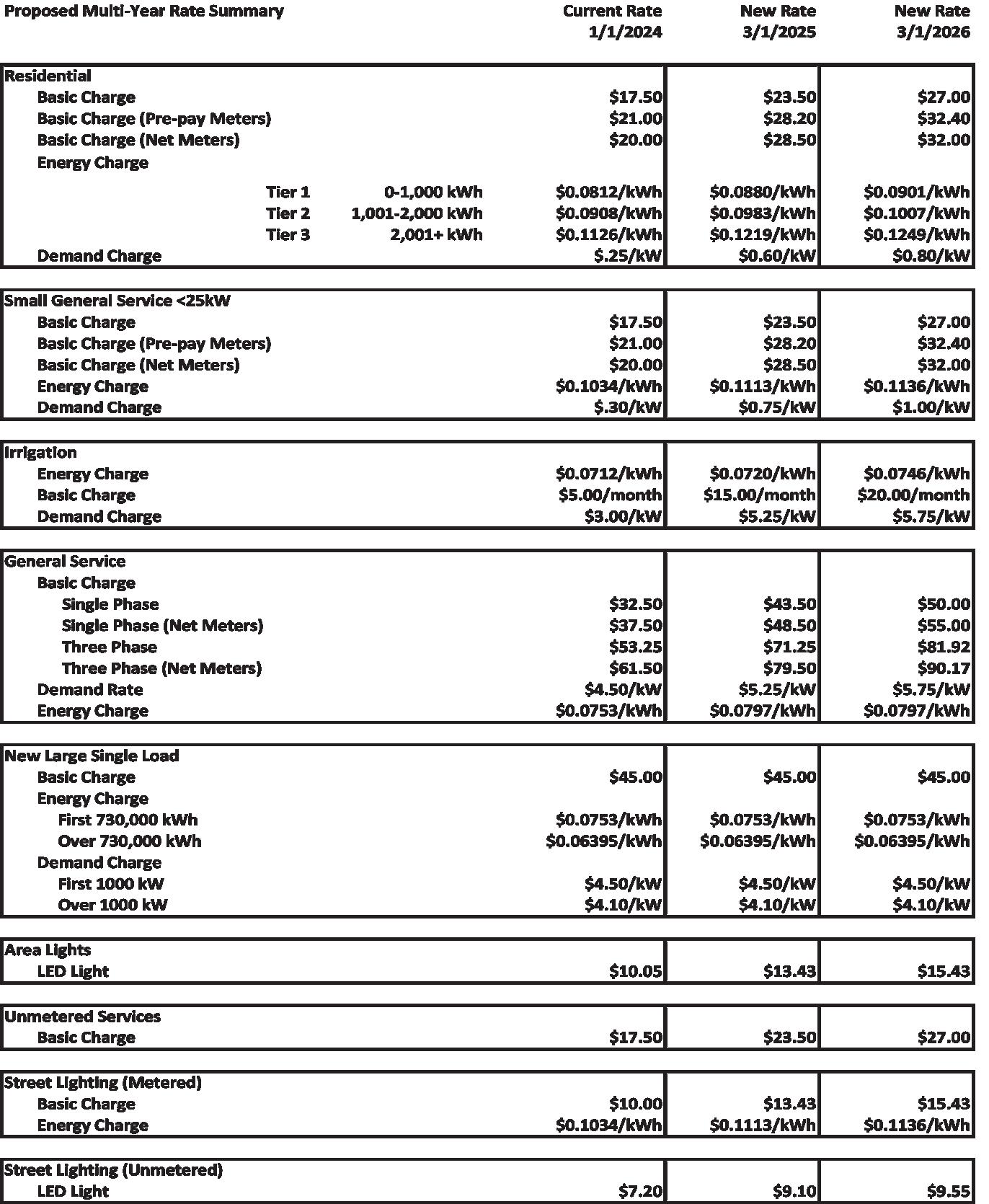
Mission Valley Power (MVP) maintains reliable service and reasonable rates.
However, a rate adjustment is necessary due to significant increases in materials, fuel, and general operating expenses. Additionally, we have an obligation to invest in improvements essential to our aging infrastructure.
All MVP rate classes will see an increase (see below) on March 1, 2025, which will take effect during our customer billing cycle in April. Additionally, there will be another rate adjustment for all rate classes on March 1, 2026. These multiple rate increases are essential for maintaining the reliability of services provided in our area.
POLSON - While Valentine’s Day is not the most celebrated holiday around the globe, it is continually growing in popularity. Here at Cherry Valley there is a definite buzz in the air!
Our hallways are filling up with fun Valentine’s Day artwork and teachers are leading fun learning activities surrounding this affectionists’ holiday. Some staff members have even gone as far as wearing pink and red for the entire week leading up to the day of love.
During the 2023/2024 school year, Polson Public Schools adopted and implemented the Character Strong curriculum. Since its induction, it is not uncommon to hear students talking about caring, kindness, empathy, respect, cooperation, honesty, and gratitude. With all of these affectionate terms floating about, Valentines Day seems like the perfect holiday for our young learners. Because of this, we decided to ask some of our students a few questions about the upcoming holiday.
During an afternoon lunch break, a Cherry Valley staff member went around and asked a few students the following question 1. “Why do we celebrate Valentine’s Day?” 2. “Why is it important to do that?” 3. “Why don’t we do that everyday?”
Here are some kindergarten students’ answers:
“We celebrate to show kindness.”
It is important so your
friends won’t be sad.”
“It is important because we want to be nice to people.”
“We should be nice to them everyday for 100 years!”
“It is important to be kind and help people.”
“We don’t do it everyday because not every day is Valentine’s day!”
“It is important to show them we love them.”
“We celebrate because long ago people discovered love.”


Mission Valley Power is implementing a pass-through rate adjustment due to the contracts in our cost of wholesale power purchased from Bonneville Power Administration and Energy Keepers, Inc. The rate adjustment is anticipated to be effective January 1, 2024.
The Department of the Interior (DOI) and the Bureau of Indian Affairs (BIA) published the final rate decision in the Federal Register on January 17, 2025. Local customers can call MVP at (406) 883-7900 to request that a copy of the Federal Register be mailed to them. Additionally, copies are available at the MVP Customer Service area in Pablo, MT.
As a non-profit organization, MVP reinvests all its revenue into the utility. We take pride in the trust our customers place in us to provide a consistent and reliable energy supply. Our commitment to delivering safe, efficient, dependable electrical power services is unwavering and our top priority. At MVP, we adhere to sound business principles while representing all our customers’ interests.
Per 25 CFR 175.230 – 235, the Northwest Regional Director of the Bureau of Indian Affairs Central Office has to approve the pass-through rate adjustment. If you would like to read the complete a copy at Mission Valley Power’s Main
In summary, the the following classes of service: General Service Single Phase, G arge General Service, and vary depending on your individual usage. S
The Greater Polson Community Foundation awarded trustbased grants to 12 different area non-profits including those pictured, clockwise: Helping Hands, the Mission Valley Animal Shelter and the Boys and Girls Club of the Flathead Reservation.

News from the Greater Polson Community Foundation
POLSON — The non-profit sector adds tremendous value to our community’s well-being. GPCF celebrated February “the month of love” by sending their Valentine’s and sweet Trust Based Grant funds to locally selected non-profits.
“Trust-based grants go to organizations with which we have worked for years that are important to our community, have earned our community’s trust, and deserve support for general operations” states Jeanette Phillips, Grant Chair for the GPCF. Trust Based Grant applications are by invitation only from the GPCF Grant Committee and organizations receiving these funds may still apply for the annual IMPACT Grant cycle. The application process and reporting for these unencumbered grant funds is kept simple. Our ‘trust’ reflects confidence in an organization’s board, management, and programs.

Long standing committee person
Shauna Rubel explains that “We expect to renew these Trust grants annually for deserving non-profits and as our experience and awareness of needs grows, we hope (with community support) to invite other organizations to apply for these funds, as well as to increase support for project grants.”
Board President Toni Whealon would like to thank the many donors making possible grants totaling over 1.5 million dollars over the past 15 years. “We are grate-

ful for the legacy left by John & Elaine Cowan that enabled GPCF to double the amounts initially granted and hopeful to see this increase into the future. We know benefits realized through the generosity of our donors depend on the hard work of non-profit volunteers and their employees. To both our donors and our non-profits we are grateful.”
The Greater Polson Community would like to congratulate the following organizations for being selected as a 2025 Trust Based Grant recipients. North Lake County Library, Boys and Girls Club of Flathead Reservation, FLIC, Polson Loaves & Fishes Food Pantry, Mission Valley Live, Miracle of America Museum, Helping Hands, Ninepipes Museum, Women 4 Wellness, Mission Valley Animal Shelter, CASA & the Mission Valley Ice Arena. We appreciate and acknowledge these non-profits’ continued hard work to keep our communities strong. You are the heart of our communities.

page 2
Association.
Mathews said that while the Trump administration previously tried to eliminate funding for long-distance trains, Republicans and Democrats in the U.S. Senate were able to reinstate it.
“We have people in the Senate who understand the value of long-distance passenger service,” he said. “These are services that people use and use a lot.”
During the fiscal year 2024, 387,953 passengers rode the Empire Builder. Support for Amtrak from Montana’s congressional delegation has been mixed in the past. Sens. Steve Daines and Tim Sheehy have both voiced
support for the long-distance service, citing the economic benefits and ability to connect rural communities. But Rep. Ryan Zinke has been less supportive, recently stating that he opposes any additional government funding for Amtrak.
“The federal government already spends billions of taxpayer dollars a year on Amtrak, and they can’t get it right,” Zinke’s office told KPAX last month. In 2015, Zinke supported an effort to pull all federal funding for Amtrak, calling the vote a “shot across the bow” to show he was serious about reforming passenger rail. Montana’s newest House member, Rep. Troy Downing, did not respond to a request for
comment from Montana Free Press.
Green said his biggest concern for the Empire Builder’s future is its aging equipment. While Amtrak has begun looking for new passenger cars and is trying to refurbish the ones it does have, it has few spares if one breaks down or is damaged in a derailment. Already, trains like the Empire Builder operate with fewer passenger cars than they did a decade ago, meaning there are fewer seats for passengers.
“Those of us who watch this stuff closely are holding our breath because it seems like we’re only one or two incidents, say a derailment or a grade crossing accident, away from not having enough
equipment to operate the long-distance network as it is today,” Green said. Mathews said the aging trains are a real concern and that Amtrak will have to “get creative” in the decade ahead to ensure it has enough equipment.
Last year, Amtrak combined two long-distance services on the East Coast into one to free up equipment for its trains west of Chicago, including the Empire Builder. Mathews said while the Infrastructure Investment and Jobs Act did include money to start the process of replacing Amtrak’s fleet, more will be needed in the years ahead to see the project through.
It’s also unclear what appetite the Trump White House and a Re-
publican-held Congress will have for funding an expansion of Amtrak services, including a new southern route through Montana. Strohmaier said that restoring service along the Big Sky North Coast Corridor has received bipartisan support in the past, including from those who are now in the Trump administration, such as former North Dakota governor and now Secretary of the Interior Doug Burgum. Strohmaier also hypothesized that the effort could appeal to someone like President Trump, who has expressed a desire to build new infrastructure in the past.
“This has never been done before,” Strohmaier said of restoring a
long-distance route that Amtrak previously closed. “It’s audacious. But I’m convinced that this country is up to the task if we put our minds to it. This is an opportunity to make rail great again in the United States.”
Green said that when people have asked him when passenger service could return to southern Montana, he tries to be realistic and tells them that it’s likely a decade away at the earliest — regardless of who is in power in Washington, D.C. Mathews echoed the sentiment.
“For better or worse, new train projects in the United States are measured in decades, not years,” he said.

This series has already discussed the changes in Montana’s climate, the science behind those changes, and some of the impacts on Montana’s agriculture industry. When it comes to our own health, or the health of our families, things get more personal. Even discussing the health impacts of climate change is difficult. It’s not due to a lack of connections between climate change and health impacts – there is ample scientific evidence of those connections –but because there are so many negative and overwhelming health impacts. However, even as we focus on all the bad things that can happen to us, remember that most actions to address climate change also have positive health impacts.
Central to climate change are increased temperatures. In other words, heat. Whether in the form of more frequent and intense heat
waves, warmer nighttime temperatures, or just slight increases in temperatures without reaching extreme levels, there are detrimental impacts on people’s health.

Wildfires are burning more frequently, intensely, and cover more acres. This not only puts lives and property in the immediate area at risk, in-
Extreme heat leads to increased deaths from heatstroke and dehydration. It has been associated with more heart attacks, strokes, and worsening of heart failure and lung conditions, and can even lead to kidney failure over many years.
Equally impactful is decreased productivity, especially for outdoor workers. Though not a direct health impact, decreased productivity can have widespread effects, with less take-home pay, fewer consumer products, and increased risk of job-related injuries.
Urge congressman to protect Constitution
Editor,
Our Congressional representatives Congressman Ryan Zinke, Senator Steve Daines, and Senator Tim Sheehy are not
cluding those who respond to the fires, but wildfire smoke also affects people distant from the fires. Smoke events have been associated with more deaths, more emergency department visits, hospitalizations related to lung, heart, and other chronic conditions, long-term worsening of lung conditions, and an increased risk of adverse birth outcomes for pregnant women.
Every climate change-related event, such as heat, more intense storms, drought, and flooding, has been associated with wors-
honoring the pledge that each of them took to protect and defend the Constitution of the United States. Zinke and Sheehy have taken multiple pledges with their military service. Our Constitution specifically spells out that there are three branches of gov-
ening mental health. Domestic violence, substance abuse, and suicidal ideation are more common with even modest increased temperatures. Similar patterns are seen after extreme weather events, with the addition of more post-traumatic stress disorder, depression, and anxiety. Those impacts are more profound given that mental health services are unable to meet the demand even in the best of times.
Some of the most significant and least recognized health effects are those on pregnant women and their fetuses and the impacts on mental health. Babies are at risk even before they are born. If a pregnant woman breathes polluted air, for example, from wildfires or car exhaust, her baby is more likely to suffer from developmental abnormalities ranging from autism to learning disabilities. If the mother is exposed to even mildly elevated temperatures
ernment that can act as checks of abuse of power. Currently Trump, with his henchman Elon Musk are massively abusing the power given to the executive branch by the constitution. Our congressional delegation has not lifted a finger to prevent this il-
toward the end of pregnancy, stillbirth and premature birth are more likely.
Despite this depressing information, there is hope. Actions we take now, especially together, can result in rapid improvements to health. Changes that result in cleaner air translate into better health for everyone. Acknowledging the contributions fossil fuels have made to our lives and economy, we now know that they also harm our health and our world. We ignore that at our own peril. Switching to clean energy sources will have beneficial impacts on our health.
Technology already exists to let us stop burning polluting fossil fuels and move to energy sources that are affordable and healthier.
Put your, your children’s, and your grandchildren’s health first. Find out how you can support less polluting energy sources. Learn more
at https://www.montanahphc.org/, or contact us directly through the website.
Robert and Lori Byron are physicians and on the board of Montana Health Professionals for a Healthy Climate.
legal power grab. Please call your congressional representatives and ask them to protect out U.S. Constitution.
Mary Stranahan Arlee
more letters on next page
Letters to the editor are welcome. The content is the opinion of the letter writer and not the newspaper. The decision to publish letters is made by the editor. Letters must be 350 words or less. A writer will only be published twice per month. Letters may be edited for content or length, or may not be published if considered libelous, in poor taste, spiteful, self-promotional or of limited interest to the general readership. Space limitations also dictate when or if letters are published. Letters must be signed by the author and name, address and phone number must be included – phone number is for verification purposes only. Letters from organizations must include the name of at least one author. Please limit “thank you” letters to four people/organizations or less. Deadline is 5 p.m. Friday to publish the following week. Opinions expressed in this section are not necessarily those of the newspaper.
Calling Trump’s cabinet ‘all star’ is laughable
Editor,
To Senator Dainesrecently, you proclaimed that the inauguration of Donald Trump as 47th president marks a new day in America. Wow. Where to start. Calling Trump’s cabinet nominations “all-star” is laughable. Pete Hegseth, ousted as head of two veterans’ groups for mismanagement and misconduct, as Secretary of Defense? Tulsi Gabbard, apologist for Edward Snowden with no formal role in intelligence, as Director of National Intelligence? Robert Kennedy, conspiracy theorist extraordinaire whose stances on vaccines depend on who’s listening, as Director of Health and Human Services? Kash Patel, no relevant experience, and supporter of the J6 rioters, who stated that the FBI planned the J6 attack, as FBI Director?
Perhaps you’ve reserved your highest accolades for Secretary of the Treasury, Scott Bessent, who recently turned over access to Treasury Department systems responsible for all government payments (think Social Security, Medicare, Veteran’s benefits, congressionally approved programs supporting, school lunches, cancer research, small business loans, etc.) to Elon Musk and his junior engineers (ages 19-24), in violation of federal law. (They are, after all, on the prowl for government waste, and with their vast historical knowledge and sound judgement are likely to use access to the federal checkbook wisely).
Or …., recently approved Director of the Office of Management and Budget and primary architect of Project 2025 Russell Vought, who believes the power of the president should be unlimited (but only if the president is a Republi-
can, right?).
These are among the all-star cast of Cabinet picks you are applauding?
Caryl
Cox Polson
Congressmen should do their jobs
Editor,
This is an open letter to Senators Sheehy and Daines, and Representative Zinke: Do your own work. If you believe USAID should be closed, the Department of Education shuttered, or other changes to government agencies should be made, do it the legal way. Write legislation. Republicans control the House, Senate and White House. The legislation will pass both chambers of Congress and the president will sign it into law. Sure, it’s ok to have an outside group audit and report to Congress about how money is spent within a government agency, but

not to take control of the agency. That’s a congressional duty. Why are you ceding your power and authority to Elon Musk and his troupe of youngster hackers? He wasn’t elected, you were. He doesn’t have security clearance, you do. Montanans did not vote you into office to be subservient to Musk.
Stephanie
Brancati Big Arm
We need to act with peace, love
Editor,
The present chaos in our nation and our
world calls for a dramatic change in the way we humans live together. This change can only occur by how we individually think, speak, and act.
For me this change occurred in the summer of 1982. That summer I was introduced to a course of study that changed my life. It is entitled “A Course in Miracles.” The following comments on this course were offered by Marianne Williamson, an American author, spiritual leader, and political activist.
“This is a self-study program of spiritual
psychology. It is not a religion but a psychological training in the relinquishment of a thought system based on fear and the acceptance of a thought system based on love.”
“A Course In Miracles” did change my life. I share this at a critical period in our lives together as both a nation and a world. There are other teachings available to us humans as we learn to live together in healthy harmony. We need to find them, learn from them, and act with peaceful intent and love. Bob McClellan Missoula

Property tax relief is a top priority for Senate Republicans this legislative session. I’m sponsoring one such bill, SB 2, which reforms how tax increment financing (TIF) districts sunset – if they ever do – in order to lower property taxes for all local taxpayers. Essentially, the bill rewards taxpayers who contribute to economic development over the span of a TIF project.
TIFs are subsidized by taxpayers outside the TIF district over the decades-long life of a project, which increases residents’ taxes and takes money away from schools and other services. I support TIFs, but they need to be transparent and not abused.
SB 2 does not stop the development of TIFs. That choice will still be up to local governments. However, TIFs should not be used to inflate city budgets at their conclusion, increasing taxes after that point. Under SB 2, TIF districts would become standard parts of a city’s overall tax base when they are sunset, instead of entering as newly taxable property.
There are ongoing disputes in Montana over TIFs, highlighting the need to reform how they work. In Missoula, TIFs currently collect approximately $20 million per year in property taxes, indirectly raising taxes on everyone in the city. Common sense dictates that diverting $20 million in property taxes will cause other Missoula residents’ taxes to increase. The city already collects approximately $50 million
per year in total property taxes right now.
Moreover, the redevelopment agency that administers Missoula TIFs has an annual personnel budget of nearly $1 million for seven full time employees. I suspect some of those employees are making more than average at the expense of taxpayers and schools.
Roseburg Forest Products properties have several developers looking at developing their site, which will provide more jobs in Missoula. Some of those developers do not want to be annexed into the city of Missoula, nor do they desire TIF money.
Regardless, Missoula wants to put the property into a TIF district to directly control all the taxes from new growth that will happen. Doing so would increase the taxes of Missoula residents, who are already paying some of the highest property taxes in Montana.
By reforming how TIFs work, local residents can directly benefit from their contribution to TIFs through lower property taxes. Taxpayers should not be punished for supporting development; they should be rewarded.
Montanans have made it clear that they want property tax relief. This bill delivers precisely that, while keeping TIFs as an option for cities to revitalize their communities.
Senator Greg Hertz, R-Polson, chairs the Senate Tax Committee in the Montana Legislature
POLSON — The Polson Lady Pirates fell to the visiting Bigfork Valkyries 27-71 on Thursday, Feb. 13. Bigfork jumped out with the lead in the first quarter, scoring 20 points to Polson’s 5 and continued to outscore the Lady Pirates every quarter thereafter. Olivia Ramirez put up the most points for Polson, scoring 10 points on the evening followed by Rylee Taylor-Jefferson and Samantha Rensvold who pitched in 8 points apiece. The Lady Pirates defeated the Libby Lady Loggers 54-24 at home during senior night on Feb. 15. Ahri Rushing led Polson with 10 points followed by Hinkley Moss and Samantha Rensvold who each scored 9. Next up, the Lady Pirates play the Ronan Maidens at home on Saturday, Feb. 22.
WHITEFISH — The Ronan Maidens basketball team defeated the Whitefish Lady Bulldogs, 63-20 on Feb. 13. The Maidens took an early lead and never looked back, scoring 44 to Whitefish’s 13 points at the half. Kailyn Marengo was the top scorer for the evening with 14 points followed by teammate Arianna Zepeda who scored 13. The Maidens claimed a hard-fought win against the Browning Lady Indians, 55-50 during a Feb. 15 home game. Kailyn Marengo led her team with 19 total points scored. Next up, the Maidens face off against the Bigfork Valkyries during senior night on Thursday, Feb. 20.
Great Falls High Pool
Feb. 15, 2025
Team Scores
AB girls: 1, Billings Central, 116; 2, Whitefish, 57; 3, Havre, 42; 4, Hardin, 24; 5, Columbia Falls, 13; 6, East Helena, 12; 7, Polson, 7; 8, Butte Central 1.

BOB GUNDERSON / GUNDY ARTISTRY PHOTO
Senior and future Montana Grizzly Astin Brown put the shot 57’ 7” last weekend at the BTC indoor meet. This is the farthest shot put by any PHS athlete effort. Bob Morigeau has the longest throw outdoors of 56’ 9” which he accomplished in 1971.
AB boys: 1, Billings Central, 120.5; 2, Havre, 62; 3, Polson, 61; 4, Hardin, 12; 5, East Helena, 7.5; 6, Whitefish, 4; 6, Columbia Falls, 4.
Individual
Girls 200 Yard Medley Relay Class AB: (A - Final) 6, Polson High School ‘A’ 2:20.09.
Boys 200 Yard Medley Relay Class AB: (A - Final) 3, Polson High School ‘A’ 1:53.76.
Boys 200 Yard Freestyle Class AB: (A - Final) 4, Sloan, Lachlan, Polson, 1:57.80.
Boys 200 Yard IM Class AB: (A – Final)-3, Sawyer, Truman, Polson, 2:17.28.
Girls 50 Yard Freestyle Class AB: (A - Final) 6, Stene, Amelia, Polson, 28.30.
Boys 50 Yard Freestyle Class AB: (A – Final) 3, Sloan, Lachlan, Polson, 23.67. -5, Kinnick, Isaac, Polson, 25.36.
Girls 100 Yard Butterfly Class AB: (A – Final) 4, Stene, Amelia, Polson, 1:10.34.
Boys 100 Yard Butterfly Class AB: (A - Final) 1, McElwee, Teague, Polson, 6, Sawyer, Truman, Polson, 1:01.17.
Boys 100 Yard Freestyle Class AB: (A - Final) 3, Sloan, Boden, Polson, 55.06. 6, Ricks, Hayden, Polson, 57.49.
Girls 200 Yard Freestyle Relay Class AB: (A - Final)-4,
see page 13


Polson High School ‘A’ 1:59.00.
from page 12
Boys 200 Yard Freestyle Relay Class AB: (A - Final) - 3, Polson High School ‘A’ 1:34.76.
Boys 100 Yard Backstroke Class AB: (AFinal) 1, McElwee, Teague, Polson, 54.32.
Girls 100 Yard Breaststroke Class AB: (AFinal) 4, Olson, Grace, Polson, 1:22.24.
Boys 100 Yard Breaststroke Class AB: (A –Final) 5, Ricks, Hayden, Polson, 1:13.06.
Girls 400 Yard Freestyle Relay Class AB: (A - Final) 6, Polson High School ‘A’ 4:38.00.
Boys 400 Yard Freestyle Relay Class AB: (A - Final) 2, Polson High School ‘A’ 3:37.16.
Ronan girls placed 2nd River Cote 3rd
Saellah Nomee 4th Haven Houle 6th Tirza Twoteeth state champion Leona Dodson Howe 4th
Ronan boys: Koda King 2nd Ridge Cote 2nd Jairyn Krause 6th
St. Ignatius/Charlo: Sharbono 5th
Polson: Abigail Sorrel 4th












News from the Arlee Senior Citizens’ Board
ARLEE - Already January 2025 has passed, bringing us colder weather, beautiful night skies with a full moon and stars abundant, even a bit of Northern lights. Our annual meeting was well attended, and two new members were added to the Board: Ann Younger and Delores Arrowsmith. There are still agendas/minutes for anyone to pick up and read concerning the financials and happenings here at the center during the 2024 year.
Area VI Council on Aging from Polson provides us with monthly newsletters on how to stay healthy, help to fight depression, eat proper nutritious meals, and do puzzles and crosswords to keep our minds alert. Copies can be made for anyone who would like to read them. We can offer an AARP Driving Class this month. We will do it on a weekday, and it will take about four hours. The time and date will be announced at the meals in February. This does bring a discount on your auto insurance. Those of you who have suffered from colds, flu and other maladies this winter, we certainly hope and pray you are on the mend and will enjoy the end of winter. We have been blessed with little snow for all of us driving hither and yon
(until just recently) and are looking forward to a bit more exercise outside once it gets warmer. The CSKT Community Center offers twice a week exercise classes if you are so inclined. We also have a CD of easy Yoga we can do from our chairs or floor here at the center.
Commodities were delivered the last of part of January and there are many openings if anyone would like to fill out an application. They now deliver cases of food here to the center for us to fill the six bags of different nutritious food from the government. We also have monthly distribution of food from the Missoula Food Bank to assist in our menus. The Arlee Food Bank also distributes to those who need assistance once a week. And again, a big thank you to Marvin Rehbein for the donation of another half of beef for our cooks to savor our palates with joy. Thanks again to our wonderful staff: President Cherie Garcelon, Vice President Betty Shoemaker, Secretary/Treasurer Anne Stewart, Jerry Garcelon, Lilie Willison, Judy Miller, Marie Gillette, Gladys Brown, Patty Tiensvold, and cooks, Dustin and Randy Tiensvold and Marti Bogess. We also thank Roman Adams for the snowplowing, Wade Gillingham for mowing the lawn and handyman jobs, and all those who clean the cen-
ter, decorate and send out the newsletter and menu as well as everyone who comes to enjoy our meals. Call 406-726-3213 to order your next meal. Happy February.
- Wednesday, Feb. 19: hot pork sandwich, gravy, veggies, fruit, dessert - Friday, Feb. 22: chicken fried steak, mashed potatoes, gravy, roll, veggies, fruit, dessert - Monday, Feb. 24: fish, chips, coleslaw, fruit, dessert
- Wednesday, Feb. 26: beef/cheese noodle casserole, veggies, fruit, dessert Call 406-726-3213 the day of the meal by 9:30 a.m. Include your name, phone number and the number of meals you wish to order and whether you want to dine in or takeout.
Polson
By Pete Mangels for the Valley Journal
POLSON - Our Polson Senior Community Center is located at 504 Third Ave. E. We are open from 8 a.m. to 3 p.m. weekdays. Call us at 406883-4735 or email: polsonseniorcenter@gmail. com or visit us on Facebook!
A toenail clinic held by a certified nurse will be held on Feb. 28 at the cost of $30. Enroll early, space is limited. Call or sign up prior the 28th to ensure a time slot. The clinic includes callous sanding/ shaving. There are 10 res-
ervations spots available. AARP tax preparation assistance is given by reservation and appointment times are 10 a.m. until 3 p.m., Mondays and Thursdays only.
Activities:
- Bowling: “no-tap” Tuesdays, 1-3 p.m. Join any time.
- Wednesday Play Day: cards, board games, Dominoes, Yahtzee, etc. Invite a foursome, or just the two of you.
- VSO (Veterans Service Officer:) first Friday and third Tuesday of each month, 9 a.m.-noon, walkins OK
- Spinning Wheelers: first Tuesday of each month (March 5,) 11 a.m.-1 p.m., 208-5201013
- Bingo: Fridays - open at 5:30 p.m. play at 6 p.m.; “playing-card” bingo Wednesdays - March 6 - Exercise: sitting or standing or dancing, M-W-F, 10:30– 11:30 a.m. Video-assisted, low impact
- Pinochle: Thursdays and Mondays, 12:15-3 p.m. We play 3, 4 or 5 handed. Late arrivals OK. Last week we had 30 players! Beginners are welcome.
Pool: open table from 8 a.m.-3 p.m.
Menu (subject to change): lunch - $5 donation from 11:45 a.m.-12:30 p.m.
- Thursday, Feb. 20: pork chops, stuffing, gravy, peas, Jell-O, cucumber salad, bread pudding - Friday, Feb. 21: blue-
berry strata, sausage link, orange salad, cookie - Monday, Feb. 24: vegetable beef soup, tuna sandwich, pickled beets, vanilla pudding
- Tuesday, Feb. 25: orange-chicken, rice pilaf, cream corn, potato salad, brownie
- Wednesday, Feb. 26: taco salad in a bowl, Frito salad, lemon bars.
- Thursday, Feb. 27: Carolina hot dog, coleslaw, chips, spaghetti salad, chocolate pudding - Friday, Feb. 28: birthday dinner for lunch - roast pork, potatoes and gravy, green beans, birthday dessert - door prizes
By Theresa Yares for the Valley Journal
ST. IGNATIUS -
More on egg substitutions: For binding (to hold shape and stick e.g., meatloaf) –1 tablespoon of flax or chia seed plus 3 tablespoons of water (combine and let sit for five minutes). Another option is plain gelatin plus two tablespoons of water – do not combine the two until ready to use.
Other options to replace eggs – two egg whites is equal to one whole egg. Also, one quarter commercial egg substitute is equal to one whole egg.
Upcoming events: An afternoon movie will be held on Friday, Feb. 21, at 1:30 p.m. Come for lunch and stay to watch a movie. Tentative movie choice
playing: “His Girl Friday” with Cary Grant and Rosalind Russell. There is no cost but a free will donation is appreciated. Game Day is planned for March 14. More information to follow.
Bingo will be held on Saturday, March 8.
Menu: - Friday, Feb. 21: pork chops, potatoes/gravy, peas, applesauce, cornbread, peanut butter cookie - Tuesday, Feb. 25: turkey wild rice soup, biscuits, mixed fruit, pumpkin bars - Friday, Feb. 28: fish, macaroni and cheese, mixed fruit, oatmeal cookie
If you would like a takeout meal, call 406745-4462 by 10 a.m. on Tuesdays and Fridays and by 2 p.m. on Wednesdays. Mealtimes are listed with the menu. Menus for the month are available in the entryway of the St. Ignatius Senior Center. Everyone is welcome to our meals (young and old). Come enjoy a delicious meal and good conversation.
Our Senior Center is available to rent. If you are interested, call 406-7454462 and leave a message. If you have questions about obtaining Elder Commodities, call or stop by for information and application.
Gentle Yoga is held on Wednesdays from 1-2:15 p.m. If you are interested, call Bonnie Kiser at 406253-0177. Her rate is five sessions for $65.
Robert Gauthier
RONAN - Robert Leroy Gauthier, 75, passed away surrounded by his family on Feb. 8, 2025, after a long battle with cancer. Despite his illness, he felt he had actually won his battle, grateful to have been blessed with several months to share memories and laughter with beloved friends and family as he said his goodbyes. He insisted that love and hope made the dying part of life every bit as important and just as meaningful as the living part.

Bob was born on Jan. 18, 1950, on a chilly, negative-13-degree Wednesday at St. Patrick Hospital in Missoula, to Louie and Mary Gauthier. Bob was taken home to the family’s small ranch in Arlee where he joined twin brothers, Larry and Gary, and older sister, Vicky. His younger sister, Bonnie, joined the family three years later.
Life in Arlee was filled with great friends, a few horses, a few cows, and all the other animals that required “chores” –hogs, chickens, and sheep. Growing up in the little log house near Mountain Home also meant orchard work, riding horses, exploring Finley Creek with the Vanderburgs, Matts, and Lytles, and bringing home a bread sack full of brook trout to earn a day off from chores.
Bob and his family were active in 4-H and enjoyed getting ready for the Missoula County Fair each fall, but things changed when the family moved to Missoula where Bob made a whole new group of friends, many of whom remained treasured friends for life. Bob graduated from Missoula Sentinel High School in 1968—sort of. He eventually received his diploma a couple of years later after meeting his final requirements by correspondence. Bob’s education continued briefly at the University of Montana and then at Montana State, both of which invited him to try his luck at a different school.
During the next 15 years Bob worked 25 separate jobs where he sold cars, furniture, appliances, vacuums, insurance, and whiskey. He eventually became a jailer for CSKT Tribal Law & Order, which began his professional affiliation with the Confederated Salish & Kootenai Tribes, where he was an enrolled member. He also worked as a tribal consumer credit counselor and tribal appellate court judge before he was offered the Housing Director position at Salish & Kootenai Housing Authority (SKHA) in 1983, a job he would hold for the next 20 years. It was during his tenure at SKHA that Bob realized his passion for the development of tribal communities and as he gained knowledge and experience, he became an invaluable asset to all of Indian Country. Bob served as the Chairman of the National Commission on American Indian, Alaska Native, and Native Hawaiian Housing in the early 1990’s, a Commission established by Congress to evaluate factors that impede the development of safe and affordable housing. Bob was very proud of the work done by the Commission, whose findings resulted in the passage of the Native American Housing Assistance and Self-Determination Act of 1996 (NAHASDA). Bob worked tirelessly to implement NAHASDA over the next thirty years with unfailing devotion to the principles of tribal self-determination and tribal sovereignty.
Being involved in the creation of successful organizations was one of Bob’s talents as he was the first President of the United Native American Housing Association (UNAHA), comprised of over 30 Tribally Designated Housing Entities in the Northern Plains. He was a founding member of the AMERIND Risk Management Corporation, a national self-insuring risk management pool providing property and liability coverage to several thousand homes in Indian Country, serving on the Board of Directors for more than ten years as Treasurer and Chairman. Bob spearheaded the formation of Eagle Bank in Polson, one of few banks in the nation owned by a Native American
Tribe, serving as a co-founder and the bank’s first Board Chairman, and he was the owner and operator of Gauthier’s Steak and Seafood, a fine dining establishment he ran in Polson from 1985 to 1997. Bob also played a fundamental role in the development of the successful S&K Technologies, a wholly owned corporation of the CSKT, overseeing its tremendous growth as longtime Chairman of the Board.
Over the course of his impressive career, Bob served on the Seattle Board of the Federal Home Loan Bank, Fannie Mae’s Housing Impact Council, the NAHASDA Negotiated Rule-Making Committee, and the Montana Board of Housing, and was appointed by President Bush in 2002 to serve on the Community Development Financial Institutions (CDFI) Advisory Board.
After leaving SKHA, Bob served as Economic Development Advisor for CSKT then spent the remainder of his years running Ahoy Leasing & Development, his own real estate and property management firm, and Gauthier Agency, which specialized in providing training and technical assistance to tribes and tribal housing authorities in the area of housing management and economic development, both with his wife Myrna by his side.
As active as Bob was in the tribal housing community, he was just as active in his home community, hosting fundraisers, coaching baseball, serving on countless boards and advisory committees, and always giving his full attention and considerable ability to each one. With Myrna, Bob especially enjoyed preparing his famous sirloin steak, baked beans, salad, and fruit dinner for the annual Pheasants Forever Banquet, a tradition they started in 1993. He was also the patriarch of his family, providing a tremendous amount of support and guidance to his children, grandchildren, siblings, nieces, and nephews, a role he relished and put his whole heart into. He found great joy in being a Montanan and a CSKT Tribal Member, in Griz football and basketball, in Pen-
delton on the rocks, in delicious food, in a loud game of cards, in good company, in sunset boat rides, and in being at the cabin on White Swan Bay.
The consummate gentleman, Bob exemplified how to treat people with respect and dignity, how to speak so that people will listen, and how to put people at ease with a smile or a joke. For all his gifts, these may have been his greatest – his storytelling ability and his sense of humor. He brought such joy to the world. How blessed the world was to have him.
Bob is preceded in death by his parents, Louie Gauthier and Mary Major; sisters, Vickie McCarthy and Bonnie Rice; and brother, Larry Gauthier.
He leaves behind the love of his life and wife of 30 years, Myrna; daughters, Charmagne Dolphin (Andy) and Rochelle Gauthier (Bill); sons, Timothy Gauthier (Sami) and Robbie Gauthier (Adessa); grandchildren, Madison, Kanyon, Ally, Scout, McKaul, Cache, Natalie, Jackson, Kylie, and Robert “Eiler”; great-grandchildren, Atticus, Nova, and Mateo; brothers, Gary Gauthier and Robert Decker; and many nieces and nephews.
The Gauthier family would like to thank the Community Cancer Center, Partners in Home Health Care, and the incredible staff at the St. Luke Extended Care for all their support during this difficult time. The family would also like to personally thank Dr. Vizcarra for his exceptional care throughout Bob’s journey.
At Bob’s request, a memorial service will be held later in the spring and has been scheduled for May 23, 2025, at 11 a.m. at the Salish Kootenai College, Joe McDonald Center. Memorial donations may be made in his name to the Lower Flathead Valley Community Foundation at P.O. Box 255, Ronan, MT 59864, www.lfvcf.com. Messages of condolences may be shared with the family online at: www.lakefuneralhomeandcremation.com.
Arrangements are under the care of The Lake Funeral Home and Crematory.
more obituaries on page 17
RONAN - Delores Lee Funk, 84, peacefully entered into the arms of our creator, surrounded by family on Nov. 13, 2024. At her request, there will be no services. Delores was born to Maurice and Nethalee Martin in Hill Lake, Minnesota, on July 10, 1940. She was the fifth of their seventeen children. She moved to Montana with her family where they lived at several places in Flathead County.

On Aug. 3, 1957, she married Edward J. Funk of Kalispell, at the Hitching Post in Coeur d’Alene, Idaho. After several years in Kalispell, they moved to Glasgow, Montana, where she learned to do upholstery work through Earl’s Body Shop, alongside her husband Ed, who was employed there as an auto body paint technician. Being a natural craftswoman, she quickly became gifted in her upholstery creations. In 1969, they moved to Ronan where she went to work for Glen McDorman in his upholstery shop. Later she was able to open her own business, Dee’s Upholstery. She created beautiful furniture. With the help of her husband in the evenings, they were also able to recreate car interiors, boat tops and even RV awnings. She operated Dee’s Upholstery for over 30 years in Ronan; where she retired and lived until her death.
Delores was very family orientated. She raised four children with Ed and also helped with some of her siblings at times. She enjoyed living within five generations consisting of numerous grandchildren, great-grandchildren and also had three great great-grandchildren. She was always there with love and support. She will always be greatly loved and missed.
Being an avid outdoorswoman, she greatly enjoyed hunting and the large hunting camps of family and friends. She also enjoyed fishing and many camping vacations, enjoying all those who attended.
Delores was preceded in death by her husband, Edward; their grandson, Kendall Shae Schiele; her parents; three sisters; and one brother. She is survived by her four children and their families, Dixie Steptoe, Kathy Schiele, Cindi Hendricks and Jim Funk.
The magazine is designed for Montana agricultural producers facing early to middle stages of Alzheimer’s disease, their families and family caregivers
From the MSU News Service
BOZEMAN — Montana State University Extension has released volume two of a magazine on Alzheimer’s disease and related dementias. The free magazine is designed for Montana agricultural producers facing the early to middle stages of Alzheimer’s disease, as well as their families and family caregivers.
“Alzheimer’s and Related Dementias: Support for Montana Farmers and Ranchers” includes six articles. Those articles discuss Alzheimer’s disease and driving; wandering; safety measures in homes and surrounding environments; planning for the cost of long-term care; legal documents, including financial, health and estate documents; and helping children understand Alzheimer’s.
Volume one of the magazine also has six articles discussing potential causes, signs and the importance of an early diagnosis, the progression of Alzheimer’s and how it is not a normal part of aging, caregiver wellness, communicating with others about an Alzheimer’s diagnosis and treatments for Alzheimer’s.
“Working in isolation and living in Montana’s rural communities creates a need for education about Alzheimer’s specific to farm and ranch operations,” said MSU Extension Family Economics Specialist Marsha Goetting, lead author of the magazine. “Empowering farm and ranch families to
recognize early signs of Alzheimer’s and ensure the safety of the person living with Alzheimer’s were specific reasons we created this publication. Another was to enable caregivers to know the vital importance of self-care for their physical, mental and emotional health.”
To obtain a copy of either volume of the magazine, contact a local MSU Extension office, or go online to download or order a copy (with free shipping) at: https:// www.montana.edu/extension/alzheimers/magorderform.html.
The following organizations provided funding to make the magazine available to Montanans at no charge: AARP Montana;
AgWest Farm Credit; Montana Farmers Union; Montana Geriatric Education Center at the University of Montana; and Western Extension Risk Management Education.
In addition to Goetting, authors include Vicki Schmall, emerita professor and Extension gerontology specialist at Oregon State University; S. Dee Jepsen, professor and Extension agricultural safety and health state leader at Ohio State University; Jennifer Munter, assistant director, MSU Extension Nutrition Education Program; and E. Edwin Eck, emeritus professor, Alexander Blewett III School of Law at the University of Montana.

Page Turners Youth Book Club meets
POLSON - The North Lake County Public Library’s Page Turners Youth Book Club will meet on Wednesday, Feb. 19, from 4– 5 p.m. This month’s selection is “Rascal” by Sterling North.
We’ll want to hear your thoughts at the meeting. We have social time, games, discussion and snacks.
Attend free Aquatic Invasive Species speaking event
CHARLO - The free Mission Valley Conservation Speaker Series for winter ’25, “Aquatic Invasive Species,” will be held at the Ninepipes Lodge in Charlo on Wednesday, Feb. 19, at 6 p.m.
This free educational event is open to the public. Email: LakeCD@ macdnet.org for more information.
Free meditation classes offered
ZOOM - Mission Mountain Zen is offering free online meditation classes. Join the Mission Mountain Zen Center on Wednesdays from 6-7:30 p.m. for an online meditation class led by Zen Teacher, Zenku Jerry Smyers, including meditation instruction, practice and discussion via Zoom. For more information and a Zoom link to the class call Zenku at 847721-0665 or email at: Jerry.Smyers@gmail.com.

tickets online or in person with the Polson Chamber. Tickets are $65 each.
Polson Friends of the Library continue book sale
POLSON - The last day for the North Lake County Public Library District Friends of the Library used book sale is Saturday, Feb. 22, in the Community Room at the Polson Public Library, 102 First Street E. Sale hours from 10 a.m. to 3 p.m.
Arlee’s Rehabilitation Center holds fundraiser
ARLEE - On Feb. 22 at the Missoula Hilton Garden Inn, from 4:30-9 p.m. the 4th annual Gala will be held. Call 406-2079338 or go to www.k9arc. org. The Arlee Rehab Center holds a summer healing camp, spay/neuter surgeries, dog intakes and adoptions. Help us make a better world with your support.
weekly ‘Story Time’ cancelled
Library cancels
‘Toddler Time’ and ‘Story Time’
POLSON — The North Lake County Public Library will not hold programs on Thursdays at 10 a.m. and at 2 p.m. due to the library’s book sale.
Donate a book
POLSON - Thursday, Feb. 20, is Book Donation Day at the North Lake
County Public Library. You are welcome to bring donations from 9 a.m.-5 p.m. There is a limit of two boxes at a time.
Polson Friends of the Library announce book sale
POLSON - The North Lake County Public Library District Friends of the Library will hold a used book sale on Friday
and Saturday, Feb. 21 and 22, in the Community Room at the Polson Public Library, 102 First Street E. Sale hours are 10 a.m. to 4 p.m. on Friday, and 10 a.m. to 3 p.m. on Saturday. Browse huge selection of recently donated books and media over many genres. Gently used and priced to sell. Book sale proceeds support the library’s educational programs, resources, and services available to all in the community.
Mother Goose cancelled
POLSON - Mother Goose at the North Lake County Public Library is being cancelled due to the book sale.
Polson Community Awards Banquet held
POLSON - Enjoy dinner, drinks, awards and music at the annual Community Awards Banquet on Friday, Feb. 21, at the KwaTaqNuk Resort. Book
POLSON - The Saturdays at 2 p.m. Story Time is cancelled due to the book sale.
Learn about ‘Full Plate Living’
ARLEE - Tribal Health is offering “Full Plate Living,” a series of
from page 18 classes to help participants lead a healthy lifestyle.
Classes include information on meal planning, nutrition, and weight loss, and setting realistic goals for healthy living.
Classes will be held Mondays from noon to 1 p.m. starting Jan.13 and continuing for eight weeks at the Arlee Community Development Corporation. Attend seven out of eight sessions to receive a free kitchen gadget. Space is limited to 12 participants, so call Amber at 406-241-5768 to reserve your spot.
Biologist discusses wolves at SKC
PABLO — “A Woman Among Wolves: My Journey Through Forty Years of Wolf Recovery” with Diane
Boyd is a free community lunch and presentation at the Salish Kootenai College Johnny Arlee/Victor Charlo Theater 12-2 p.m. on Feb. 26.
Join author and researcher Diane Boyd as she takes us on a wild ride from the early days of wolf research to the present-day challenges of wolf management across the globe, highlighting her interactions with an apex predator that captured her heart and her undying admiration. A debut memoir from one of the first women biologists in the United States to study wild wolves in their natural habitat-a story of passion, resilience, and determination.
Lunch and beverages will be provided 12-12:30 p.m. and the presentation will begin at 12:30 p.m.
Free meditation classes offered
ZOOM — Mission Mountain Zen is offering free online meditation
classes. Join the Mission Mountain Zen Center on Wednesdays from 6-7:30 p.m. for an online meditation class. For more information and a Zoom link to the class call Zenku at 847-721-0665 or email at: Jerry.Smyers@gmail. com.
Library holds ‘Toddler Time’ and ‘Story Time’
POLSON — The North Lake County Public Library will hold two programs for little ones on Thursdays. At 10 a.m. “Toddler Time,” a program for 2-3 year olds that is all about movement will be held. At 2 p.m.” Story Time” a program for 3-5 year olds that includes stories and activities for
kindergarten readiness will be held.
Book signing on tap at library
POLSON — On Friday, Feb. 28, at 5:30 p.m. George Simpson will hold a book signing. Join us in the Community Room to hear about George’s two new books, “Odyssey of the Flathead Indian Reservation & Public Law 280: The Evolution of Policing and Public Policy in Western Montana.” One of the books focuses on the story of the importance of Public Law 280. The second delves into the law itself. It promises to be a great discussion.
The Polson City Commission meets every first and third Monday of the month (Wednesday, if the Monday falls on a holiday) at 7 p.m. at City Hall, 106 1st Street East. Meetings are open to the public.
St. Ignatius City Council meets the second Tuesday of the month at 6 p.m. at City Hall, 12 First Ave. 406- 745-3791
Ronan City Council meetings are held on the second and fourth Wednesday of each month at 6 p.m., 207 Main Street SW, Ste A. 406-676-4231
Lake County Commissioners , 106 Fourth Ave. E, room 211, (Lake County Courthouse) 406-883-7278, Monday-Thursday 10 a.m.-12 p.m. & 1:30 p.m.-4:30 p.m.
The Lake County Conservation District , 64352 US HWY 93, Ronan, meets monthly on the second Thursday of the month at 6:30 p.m. Meetings are open to the public and agendas may be found at LakeCountyConservationDistrict.org.

(877) 265-4463
ReachHigherMontana.org or info@ReachHigherMontana.org

The Ronan School District No. 30 Board of Trustees have regularly scheduled board meetings once a month. They meet the second Monday of every month in the K. William Harvey Elementary Multi-Purpose Room. Regular meetings begin at 7 p.m.
The Polson School District No. 23 Board of Trustees have regularly scheduled board meetings once a month. Meetings are held the second Monday of each month from 5:30-7:30 p.m. at the District Office, 111 4th Ave. E, 406-883-6345.
The Charlo School District 7J B Board of Trustees have regularly scheduled meetings on the third Thursday of every month. Meetings are held in the school library, 404 1st Ave. W, and begin at 7 p.m. The phone number is 406-6442206.
The Arlee School District No. 8 Board of Trustees hold regularly scheduled meetings on the second Tuesday of each month. Meetings are held in the Arlee High School Library, 72220 Fyant Street, and begin at 6:30 p.m. The phone number is 406-726-3216.
Valley View Elementary is located at 42448 Valley View Road. The phone number is 406-8832208.
St. Ignatius School District No. 28 Board of Trustees meetings are held the third Tuesday of each month at 7 p.m. in the library, 76 Third Avenue. The phone number is 406-745-3811.






Whispering Pines Mini Storage Public Sale, March 3, 2025, 11:00 am, 35417 Clairmont Rd. Pablo, MT. Sell to highest bidder for CASH OR CERTIFIED CHECK ONLY. Contents of Units #4, #51, #60, #62, #76, #100 and #104. Subject to redemption prior to sale time. Call 406-675-8620.
Be Your Own Boss! Looking for a fresh start? This well-established (20 years old), award-winning, weekly newspaper is for sale. $150,000. Call 406-2491793 for details.
WANTED TO BUY: Old Car, Truck, Motorcycle, also old signs and license plates, gas station items or dealership items. Call 406-270-8630 any time.
Switch and save up to $250/ year on your talk, text and data. No contract and no hidden fees. Unlimited talk and text with flexible data plans. Premium nationwide coverage. 100% U.S. based customer service. Limited time offer - get $50 off on any new account. Use code GIFT50. For more information, call 1-877-324-0193
Connect to the best wireless home internet with EarthLink. Enjoy speeds from 5G and 4G LTE networks, no contracts, easy installation, and data plans up to 300 GB. Call 855-419-7978
Get DISH Satellite TV + Internet! Free Install, Free HD-DVR Upgrade, 80,000 On-Demand Movies, Plus Limited Time Up To $600 In Gift Cards. Call Today! 1-855-995-3572
Get your deduction ahead of the year-end! Donate your car, truck, or SUV to assist the blind and visually impaired. Arrange a swift, no-cost vehicle pickup and secure a generous year-end tax credit. Call Heritage for the Blind Today at 1-855901-2620 today!
Portable Oxygen Concentrator May Be Covered by Medicare! Reclaim independence and mobility with the compact design and long-lasting battery of Inogen One. Free information kit! Call 855-762-1508
Safe Step. North America’s #1 Walk-In Tub. Comprehensive lifetime warranty. Top-of-the-line installation and service. Now featuring our FREE shower package and $1600 Off for a limited time! Call today! Financing available. Call Safe Step 1-855-601-2865
Help wanted AG/RANGE LEASING TECHNICIAN/ TRAINING TO SPECIALIST TRIBAL LANDS DEPARTMENT
The successful applicant is required to have a high school diploma or equivalent, with training or education in realty or some other land-related field. Possession of, or eligibility for, a valid Montana Motor Vehicle Operator’s license and be insurable under the Tribes’ insurance policy. Federal background check for access to the BIA TAAMS (Trust Asset Accounting Management System) and be willing to attend all required trainings in the TAAMS system. Basic knowledge of land description and location techniques. Basic knowledge of land record filing systems used in the realty field. Basic knowledge of leasing practices and procedures. Basic knowledge of Federal, State, and Indian Law. Basic knowledge of conservation practices, construction and
building requirements. Working knowledge of contract management and records management. Skill in software program experience including Microsoft, Excel, and Access. Skill in operating office equipment, including computers, scanners, calculators and copy machines. All applicants must submit a Tribal application and copy of academic transcript and/or training certificate, copy of current valid driver’s license, proof of enrollment from a federally recognized Tribe if other than CSKT and if claiming veteran’s preference a copy of DD214 must be submitted. Salary range is $24.46 to $28.11 per hour including benefits. To apply, contact Personnel at (406) 675-2700 Ext. 1040. Tribal applications are also available on-line at www. csktribes.org. Closing date will be Monday, March 3, 2025 at 5:30 p.m. This position is not a Testing Designated Position (TDP) within the definition of the CSKT Drug testing policy. The successful applicant, if not already employed by CSKT must pass pre-hire drug test and serve a mandatory six (6) month probationary period. CSKT IS A TRIBAL MEMBER PREFERENCE EMPLOYER
K-8 teacher, 2025-2026 school year. Mountain View Elementary. Starting bonus, competitive salary. Call 406-336-2638 or email jerryhofer73@gmail.com.
FARM & RANCH HAND wanted full-time, near Peerless, Montana. Housing available. Call 406-724-7099.
PUBLIC HEALTH REGISTERED DIETITIAN 1 or more positions Location negotiable TRIBAL HEALTH
DEPARTMENT
The successful applicant must be certified as a registered dietitian with the Commission on Dietetic Registration (CDR). A bachelor’s degree in nutrition and dietetics, with 3 years of experience in community health, or a master’s degree in nutrition and dietetics, with 1 year of experience in
community health. A valid driver’s license. All applicants must submit a Tribal application, copy of degree/ academic transcripts, training certificates, licensure, copy of current valid driver’s license, proof of enrollment in a federally recognized Tribe if other than CSKT and if claiming veteran’s preference, a copy of DD214 must be submitted. Failure to submit all of the above information will result in immediate disqualification during the screening process. This is a Testing Designated Position (TDP) within the definition of the CSKT Drug Testing policy. The successful applicant, if not already employed by CSKT must pass a pre-hire drug test and serve a mandatory six (6) month probationary period. Salary is $27.08 to $31.13 per hour, plus benefits. May be employed under contract. To apply, contact Personnel at (406) 675-2700 Ext. 1040 or personnel@cskt.org. Tribal applications are also available on-line at cskt.org. The closing date is Monday, March 3, 2025 at 5:30 p.m. MST CSKT IS A TRIBAL MEMBER PREFERENCE EMPLOYER.
HEALTHCARE BENEFITS COORDINATOR 1 or more Positions TRIBAL HEALTH DEPARTMENT Various locations The successful applicant must have a Bachelor’s or Associate’s Degree in Social Work, Medical or Business Administration or minimum of five (5) years’ increasingly responsible and relevant work experience including 2 years’ experience working with electronic health record data system. Must possess a valid driver’s license. Employee must become a Certified Application Counselor for the Federally Facilitated Marketplace within the first 90 days of hire. Employee must complete State Health Insurance Assistance Program training and the Tribal Veteran Representative training within the first year of hire. These certifications must be maintained annually. All applicants must submit a Tribal
application, copy of degree/ academic transcripts, training certificates, licensure, copy of current valid driver’s license, proof of enrollment in a federally recognized Tribe if other than CSKT and if claiming veteran’s preference, a copy of DD214 must be submitted. Failure to submit all of the above information will result in immediate disqualification during the screening process. This is not a Testing Designated Position (TDP) within the definition of the CSKT Drug Testing policy. The successful applicant, if not already employed by CSKT must pass a pre-hire drug test and serve a mandatory six (6) month probationary period. Salary is $17.17 to $19.73 per hour. May be employed under contract. To apply, contact Personnel at (406) 675-2700 Ext. 1040 or personnel@cskt.org. Tribal applications are also available on-line at cskt.org. The closing date is Monday, March 3, 2025 at 5:30 p.m. MST. CSKT IS A TRIBAL MEMBER PREFERENCE EMPLOYER.
JUVENILE PROBATION OFFICER
TRIBAL PROBATION OFFICE
The successful applicant
must have Proof of Bachelor’s from an accredited college, preferred in Criminology, Social Work, or related fields; OR Proof of Associate from an accredited college and two (2) years’ experience in Sociology, Criminal Justice, or related fields; OR Minimum of five (5) years’ experience in one of the following fields, Social Work, Criminal Justice, or related fields. Must be 21 years of age. No felony convictions ever. No misdemeanor convictions in the past year except minor traffic. Must never have had a conviction involving child abuse, a sex offense, assault with a weapon, or violent crime against a person. Must not have any criminal record of habitual use of alcohol within the past three (3) years. Must not have any criminal record or history of drug use/abuse within the past three (3) years. Must not be subject of a current investigation involving criminal activities including indictments. Must not have three (3) or more moving traffic violations in the past two (2) years. Must not have a driving while intoxicated or reckless driving conviction within the past


https://donorbox.org/montana-newspaper-foundation-charitable-giving. print and digital journalism to ensure a vibrant future for Montana’s newspaper enterprises and champions the value of a free press.

cont’d from pg. 21
three (3) years. Must not have been dismissed or resigned from Law Enforcement of previous position due to threat of disciplinary action that would have resulted in termination of employment during the past three (3) years. Must possess a valid driver’s license and be insurable. Must be POST-certified within twelve (12) months of hire. Must be able to obtain a First Aide and CPR certification and other certifications as requested. Must be proficient in the use of urine screening devices and Blood Alcohol Concentration (BAC) devices. All applicants must submit a Tribal application and copy of academic transcript and/or training certificate, proof of enrollment from a federally recognized Tribe if other than CSKT and if claiming veteran’s preference a copy of DD214 must be submitted. Salary range is $21.57 to $24.79 hour plus benefits. To apply, contact Personnel at (406) 675-2700 Ext. 1040. Tribal applications are also available on-line at csktribes.org. Closing date will be Monday, March 3, 2025 at 5:30 p.m. The successful applicant, if not already
employed by CSKT must pass pre-hire drug test and serve a mandatory six (6) month probationary period. CSKT IS A TRIBAL MEMBER PREFERENCE EMPLOYER.

All real estate advertising in this newspaper is subject to the Fair Housing Act and the Montana Human Rights Act which makes it illegal to advertise any preference, limitation or discrimination based on race, color, religion, creed, sex, marital status, age, familial status, physical or mental disability, or national origin, or an intention to make any such preference, limitation or discrimination. Familial status includes children under the age of 18 living with parents or legal custodians, pregnant women and people securing custody of children under 18. This newspaper will not knowingly accept any advertising for real estate which is in violation of the law. Our readers are hereby informed that all

dwellings advertised in this newspaper are available on an equal opportunity basis. To complain of discrimination call HUD Toll-free at 1-800669-9777. The toll-free telephone number for the hearing impaired is 1-800-927-9275.

Ann L. Moderie MODERIE LAW FIRM, PLLC P.O. Box 1180 Polson, Montana 59860 (406) 883-2332 (888) 454-5939 (Fax) ann@moderielaw.com Attorney for Personal Representative
MONTANA TWENTIETH JUDICIAL DISTRICT COURT LAKE COUNTY
IN RE THE OF THE ESTATE OF JOHN DYLAN MILLER, Deceased.
Solution to Word Search

Probate No. DP-25-6 NOTICE TO CREDITORS
NOTICE IS HEREBY GIVEN that the undersigned has been appointed Personal Representative of the above-entitled estate, and the address of the Personal Representative is set forth below.
All creditors of the decedent having claims against the decedent’s estate must present their claims within four (4) months after publication of this Notice, or be forever barred as creditors of the decedent.
A written statement of the claim indicating its basis, the name and address of the claimant, and the amount claimed, may be filed with the Clerk of 20th Judicial District Court, at 106 4th Ave. East, Polson, Montana, or mailed, Return Receipt Requested, to the Personal Representative, c/o Moderie Law Firm, PLLC, attorney for the Personal Representative, at P.O. Box 1180, Polson, MT 59860.
/s/ Casey Kroker CASEY KROKER
Personal Representative Estate of John Dylan Miller, Deceased
Feb. 19, 26 and Mar. 5, 2025 MNAXLP
Public Notice
This is to notify all interested parties that Mission Mountain Empowerment (MME – formerly Mission Mountain Enterprises Inc) is applying for $223,548 through the capital assistance grant.

The capital assistance grant is funded by the Federal Transit Administration (FTA) and administered by the Montana Department of Transportation. FTA funds will be used to purchase a 9-passenger ADA AWD van and two 7-passenger AWD non-ADA minivans, for providing transportation services for our clients.
The application is on file at 35647 S Hills Dr, Polson MT 59860. If requested, a public hearing will be held and public notice indicating the location, date and time of the hearing will be provided. For more information or for those who require accommodations for disabilities, contact MME Transit Coordinator @ 406-676-2520 or Dept of Transportation, Helena MT @ 4449192 (voice), or 444-7696 (TTY).
Feb. 19 and 26, 2025 MNAXLP
Notice is hereby given that electronic bids for the construction of the New Headworks Facility will be received by the Pablo Water & Sewer District, electronically through Morrison- Maierle’s electronic bidding site, www.questcdn.com, until 2:00 p.m., local time, on March 6, 2025. The bids will then be publicly opened and read aloud
digitally via a Microsoft Teams meeting. Registration to obtain the meeting link is required. See Section 00 01 30 for information and registration form.
The Pablo Water & Sewer District requires bidders to submit electronic bids as prescribed on the electronic bidding site, www.questcdn.com
The Project generally consists of but is not necessarily limited to the following major items:
• Construction of a new CMU block headworks shelter, concrete channels and wastewater screen system.
The complete Invitation to Bid, Contract Documents consisting of half-size Drawings, and Project Manual may be viewed or obtained by electronic documents on-line beginning on Monday, February 10, 2025.
Prospective Bidders must purchase contract documents through QuestCDN. QuestCDN is a web- based platform for construction project advertisements, bid documents distribution and plan holder lists. Prospective bidders will need the seven-digit QuestCDN project number #9535626) to locate


cont’d from pg. 22
the job on the QuestCDN website search page. Bids will not be accepted from any prospective bidder who has not purchased contract documents through QuestCDN.
A pre-bid conference will be held at 1:00 p.m.. MST on February 26, 2025 at the office of Pablo Water & Sewer District, 36520 Carbine Road, Pablo, MT 59855. Attendance at the pre-bid conference is highly encouraged but is not mandatory. A pre-bid site walk thru will be conducted after the meeting.
All questions concerning bidding, documentation and interpretation should be directed to: Jason C. Mercer, Project Manager, Morrison- Maierle, (406) 495-3488.
Contractor(s) and any of the Contractor’s subcontractors bidding on this project will be required to obtain registration with the Montana Department of Labor and Industry (DLI).
All laborers and mechanics employed by Contractor(s) or subcontractors in performance of the construction work shall be paid wages at rates as may be required by the laws of the United States and the state of Montana in accordance with the schedule of Davis-Bacon prevailing wage rates established by the United States Department of Labor and the schedule of Montana Prevailing Wage Rates established by the Montana Department of Labor and Industry included in the Project Manual.
The CONTRACTOR(s) is required to be an Equal Opportunity Employer and must comply with Federal and State requirements as described in the bidding documents.
All listed iron and steel products used in this project must be produced in the United States.
Each bid or proposal must be accompanied by a Certified Check, Cashier’s Check, or Bid Bond payable to the Pablo Water & Sewer District, in an amount not less than ten percent (10%) of the total amount of the bid.
This project is funded in part or in whole with grant funding from the Montana Department of Natural Resources American Rescue Plan Act of 2021 (ARPA). Award of the project will be contingent upon receiving funding and award concurrence by these agencies.
No bid may be withdrawn after the scheduled time for the public opening of the bids specified above.
The District reserves the right to reject any or all bids received, to waive informalities, to postpone the award of the contract for a period of not to exceed sixty (60) days, and to accept the lowest responsive and responsible bid which is in the best interest of the Pablo Water & Sewer District.
Feb. 19, 26 and Mar. 5, 2025 MNAXLP
Request for Quote: Planting Contract Spring 2025
The Confederated Salish and Kootenai Tribes are solicitating quotes for reforestation planting contract of the Elmo Salvage, Spring 2025 Planting Season. This Burned Area Emergency Rehabilitation (BAER) reforestation planting contract requires proper plantings of 165,135 conifer seedlings within 545 acres. There will be 3 contracts that are request for quote. The first will be 184 acres, the second will be 172 acres, and the third will be 189 acres.
The Elmo Salvage Spring 2025 planting quote submission window
will close March 18th , 2025, at 9:00 am.
This advertisement is to serve the general requirements and details for the proposed planting contracts. For all competitors to submit a complete proposal package for planting contracts; review contractor requirements and details, and/or to request contractor checklist for guidance, please call Linden Plant, Forest Development Manager at CSKT Forestry (406) 676-3755 ext.6020 or Randy Finley, Reforestation Forester at CSKT Forestry (406)-676-3755, ext.6010. Electronic file available upon request by emailing linden.plant@cskt.org or Randy.Finley@cskt.org
All competitors are proposed to make your own independent estimate of sowing and filling conditions to determine your appropriate decision. A contract competitor must be prepared to assume full responsibility for the success of the operation under the terms of the contract at the prices bid. If the wording of this notice disagrees with the contract, the contract is final and binding.
THIS IS A SEALED, INDIAN PREFERENCE REQUEST FOR QUOTES, HOWEVER ALL CONTRACTORS, TRIBAL AND NON-TRIBAL, ARE ENCOU RAGED TO SUBMIT A QUOTE.
This is an Indian Preference request for Quotes. Tribal Contractors who wish to receive Indian Preference must obtain certification by the Confederated Salish and Kootenai Tribes Indian


Preference Office as a legitimate Indian owned business prior to the submission of bids. In order to claim Indian Preference, proof of Indian Preference Certification must be included with your quote in the form of a copy of the certificate issued by the Indian Preference office. Be advised, evidence of your membership or affiliation with a tribe does not constitute Indian Preference certification. The selection of the successful contractor and award of this project will be per the provisions of the CSKT Indian Preference Ordinance 101 A. It is the sole responsibility of the bidder to obtain and provide proof of Indian Preference certification from the Indian Preference Office. For more information on Indian Preference certification, contact Melinda Charlo, (406) 675-2700 ext. 1045.
Feb. 5, 12, 19, 26 and Mar. 5 and 12, 2025 MNAXLP
William P. Williams, IV FRENCH, GRAINEY & WILLIAMS, PLLC
324 Main SW Ronan, MT 59864
Telephone: (406) 676-4470
Attorney for Personal Representative bill@fgwilliamslaw.com
MONTANA TWENTIETH JUDICIAL DISTRICT COURT, LAKE COUNTY
IN THE MATTER OF THE ESTATE OF LINDA L. JOHNSON, Deceased.
CAUSE NO. DP-23-82
NOTICE IS HEREBY GIVEN that the undersigned has been appointed Personal Representative of the above-entitled estate. All creditors of the decedent having claims against the decedent’s estate are required to present their claims within four (4) months after the date of the first publication of this Notice or said claims will be forever barred as creditors of the decedent.
A written statement of the claim indicating its basis, the name and address of the claimant, and the amount claimed, must either be mailed to JAYE W. JOHNSON, the Personal Representative, return receipt requested, c/o FRENCH, GRAINEY & WILLIAMS, PLLC, 324 Main SW, Ronan, MT 59864, or filed with the Clerk of the above-entitled Court.
DATED this 4th day of February, 2025.
/s/ Jaye W. Johnson JAYE W. JOHNSON, Personal Representative
Feb. 12, 19 and 26, 2025 MNAXLP
Don’t miss your chance to Advertise in the 2025 Lake County Fair Book! Call 406-249-1793 to secure your spot today.



Get a job – earn college credits – make a difference!
Nursing Faculty 2 openings (10 months)
Salary Range: $55,935 - $65,551 DOEE
Closing Date: Open Until Filled
Wildlife/Fisheries Ecologist (9 months)
Salary Range: $51,062 - $56,111 DOEE
Closing Date: Open Until Filled
Division of Education Early Childhood Instructor (9 months)
Salary Range: $47,276 - $53,586 DOEE
Closing Date: Monday, Feb. 10, 2025; 4:00 pm MST
Assistant Director of Center for Prevention & Wellness
Salary range: $42,829 - $45,293 DOEE
Closing Date: Feb. 24, 2025; 4:00 pm MST
Institutional Research Analyst
Salary Range: $47,757 - $50,221 DOEE
Closing Date: Open Until Filled
President of Salish Kootenai College
Salary Range: $107,000 - $135,000 DOEE
Screening of applicants will begin immediately and will continue until the position is filled.
To apply you must submit an SKC application, resume and applicable transcripts to: Human Resources
P.O. Box 70, Pablo, MT 59855. Toll free 877.752.6553, ext. 4985 Direct Dial 406.275.4985/4977
NLTE/Selis and Qlipse CALS Dept. Chair (9 months)
$2500 Chair stipend included Salary Range: $51,038 - $56,086 DOEE
Closing Date: Monday, Feb. 3, 2025; 4 pm MST
Life Sciences Instructor
Salary Range: $53,586 - $57,373 DOEE
Closing Date: Open Until Filled
Vice President of Academic Affairs
Salary Range: $78,750 - $89,250 DOEE
Closing Date: Monday, Feb. 3, 2025; 4:00 pm MST
Indigenous Research Center (IRC)
Administrative Assistant
Salary Range: $39,133 - $40,365 DOEE
Closing Date: Tuesday, Jan. 21, 2025; 4 pm MST
Wildland Fire Instructor (9 months)
Salary Range: $44,752-$58,848 DOEE
Closing Date: Open Until Filled
Supporting Tribal Education Pathways (STEP)
Project Assistant
Salary Range: $21.02 - $21.93 hourly DOEE
Closing Date: Open Until Filled
Soils & Groundwater Hydrology Instructor-9month
Salary Range: $44,752-$54,848 DOEE
Closing Date: Open Until Filled
The Nursing Department is actively seeking adjunct nursing faculty who are excited about teaching and student learning. Adjunct nursing faculty will hold a minimum of a Bachelor of Science in Nursing (BSN) degree and a Master of Science in Nursing (MSN) degree from both an accredited nursing program and college. If a BSN prepared nurse is currently enrolled in a master’s program, they will be considered as a qualified applicant. Any person seeking adjunct employment please send a completed SKC application, resume, and unofficial transcripts to Teresa Sias at teresa_sias@skc.edu. Official transcripts will be required upon hire.

Salish Kootenai College (SKC) is an Indian preference and equal opportunity employer. SKC does not discriminate on the basis of race, ethnicity, national origin, sexual identification, gender, age, or disability, except as allowed by the Indian preference provision of the Civil Rights Act of 1964, as amended. Consistent with state and federal law, reasonable accommodation will be provided to persons with disabilities.