What’s That Animal Called?
The oft-confusing common names, nicknames, and misnomers of fish and wildlife—and how a Swedish naturalist in the mid-1700s tried to clear things up.
BY TOM DICKSON
Imagine four friends fishing the Milk River near Havre one summer afternoon. After splitting up for a few hours, they rejoin and swap stories. One angler says she caught and released a “gray bass”; another landed a “croaker”; the third caught a “grunter”; while the fourth hooked a nice “sheepshead.”
If you didn’t know these nicknames, you’d have no idea that all four refer to the same fish: freshwater drum.

Ever since humans developed language, we have been inventing names for animals, plants, and other species—and then puzzling over the names. This process of devising or assigning labels, known as nomenclature, is essential for scientists studying living organisms. For the rest of us, knowing the names of animals allows us to talk about them with each other. It also creates intimacy with those creatures so we can better understand and appreciate them. Robin Wall Kimmerer, noted author and director of the Center for Native Peoples and the Environment at the State University of New York, considers naming a way to know the true essence of an organism. “Finding the words is another step in learning to see,” she writes.
Each species has several different names—ranging from localized slang to Latinized taxonomy (which we’ll get to in
a minute). Though the multiple monikers can be fun, illuminating, and descriptive—think “speed goat” for pronghorn or “spoonbill” for paddlefish—they can also create confusion. Your “polecat” might be my “stink weasel,” without either of us knowing we’re both talking about the striped skunk. Further complicating matters are scientists who continue to change animal names and reclassify species based on new DNA science.
A Northern European naturalist devised a nearly foolproof scientific naming solution nearly four centuries ago. Yet confusion still remains—a result of local pride, cultural tradition, human movement between regions and continents, and even disagreements among the very experts whose job it is to clarify animal names.
nicknames we use now were coined by Europeans who, upon visiting the American West, saw unfamiliar animals and named them for similar species back home.
UH-KA-SHE and TAHTO’KANAH
North Americans have been naming fish and wildlife ever since humans arrived here from Asia thousands of years ago. Over time, each group developed its own word in its own language to identify, for instance, the large mammals we today call moose, the fish-eating raptors known as ospreys, and the barking communal rodents commonly called prairie dogs.
In Prairie Ghost: Pronghorn and Human Interaction in Early America, authors Richard E. McCabe, Bart W. O’Gara, and Henry M. Reeves documented more than 220 different names given to the pronghorn by roughly 100 tribes across the West— including, in today’s Montana, uh-ka-she (Apsáalooke), tahto’kanah (Assiniboine), and choo ool le (Salish).
When Europeans arrived, even more names were invented, as zoologists and government officials began “discovering” species and applying new scientific labels. Meanwhile explorers, hunters, and others affixed their own nicknames—sometimes several for the same creature. Lewis and Clark, for instance, used 10 different names for the sagegrouse they observed during their 1805-06
journey, including “long-tailed heath cock” and “prairie fowl.”

TAXING TAXONOMY
In addition to the unique scientific name for each species is its “common name.” These are determined by taxonomists—biologists who specialize in naming and classifying species with organizations like the American Fisheries Society and the Society for the Study of Amphibians and Reptiles. Taxonomists base their decisions on factors like historical usage, contemporary usage, and new scientific information.
Many common names are derived from an animal’s highly visible features, like the westslope cutthroat trout’s vivid orange neck slashes or the red-winged blackbird’s
bright crimson wing patches. Others are named for their places of official “discovery,” such as the Idaho giant salamander. Some names honor people who originally identified or helped collect the species for science, like the Richardson’s ground squirrel (named for Sir John Richardson, a Canadian physician who collected specimens in Saskatchewan in the 1820s).
Though taxonomy aims to reduce confusion and misidentification, some official labels create more problems than they solve.
For instance, little brown bat sounds like a description, like “little brown bird,” but is actually the common name of the bat species Myotis lucifugus. Another puzzler is the common nighthawk, which looks hawklike as it swoops overhead at dusk eating
winged insects but isn’t a hawk at all. It’s actually related to whip-poor-wills. One of the most vexing name-related challenges for Montana Fish, Wildlife & Parks staff is when someone calls to report a “brown bear.” Most likely they are seeing a black bear, the species Ursus americanus, which can be a black, brown, or cinnamon “phase.” Yet the caller could mean a grizzly bear, a protected species that FWP must manage under strict federal provisions. That’s because the grizzly, found in the Alaskan and western interior, including Montana, is the same species (Urus arctos horribilus) as the brown bear species, which lives along the Alaskan coast. In other words, there can be a big difference between “a” brown bear and “the” brown bear.
MONTANA OUTDOORS MARCH–APRIL 2023 15
14 MONTANA OUTDOORS MARCH–APRIL 2023
DIGITAL COMPOSITIONS WITH PUBLIC DOMAIN IMAGES BY LUKE DURAN. FRESHWATER DRUM ILLUSTRATION BY WILLIAM B. GILLETTE, 1907.
Then there’s the taxonomists themselves, who occasionally decide to change common names. For decades, what are now officially rock pigeons, the cooing residents of town squares and grain terminals, were officially named rock doves. The American Ornithological Society also changed the name Canada jay—twice, first to gray jay in 1957, then back to Canada jay in 2008. In 2006, geneticists discovered that the blue grouse was actually two species: the sooty grouse of the Pacific Coast and the dusky grouse of the Rocky Mountains (including Montana). Alas, the blue grouse is no more.

Though rarely, names may also change to reflect new social conventions. In 1998 the American Fisheries Society changed northern squawfish to northern pikeminnow in deference to Native people and others who find the term “squaw” offensive. (“Squawfish” may have come from “squawk fish,” perhaps coined for the sound the fish made when held. Somewhere the “k” may have been omitted.) In 2020, the American Ornithological Society replaced the McGown’s longspur, previously named after Confederate general John Porter McGown, with the name thick-billed longspur.
The easiest way to verify official common names here in the Treasure State is to
check the Montana Natural Heritage Program’s Montana Field Guide website (field guide.mt.gov).
LIKE BACK HOME
Many of us don’t use official names. Instead we go with nicknames, often coined years ago by people who, upon visiting the American West, saw unfamiliar animals and named them for similar species back home. “Buffaloes” looked enough like African Cape buffaloes or Asian water buffaloes, which
early visitors to the West had presumably seen in picture books, that the name seemed appropriate for the shaggy Great Plains denizens. More than a century after scientists came up with the name American bison to describe the species Bison bison, people still refer to the animal by its original moniker.

Some nicknames are shortened forms, like “grizzly,” “whitetail,” “smallmouth,” and “rainbow.” Others act as descriptors, like channel catfish, called “talkers” or “squeakers” for the noise they make when held. Yellow-rumped warblers are nicknamed “butter butts,” and ospreys are called “fish eagles.”
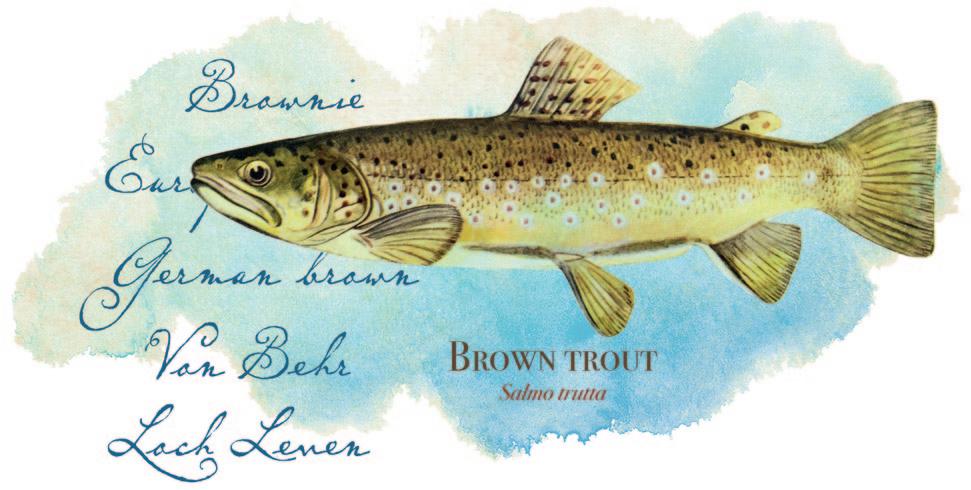
Nicknames can also refer to a species’ origins. The names “Mackinaws” or “Macs” for Flathead Lake lake trout originated as a reference to an island in Lake Michigan where the large char are native. Some older anglers still talk of brown trout as “German browns” or “Loch Levens” for the German or Scottish origins of the fish first stocked in Montana more than a century ago. (In fact, the FWP fisheries staff code for brown trout is still “LL.”)
The nicknames “croaker” and “grunter” for freshwater drum come from a sound, sometimes audible to anglers above water, made when the fish rubs a ligament against its swim bladder. Anyone who has heard a Canada goose knows why they are dubbed
16 | MONTANA OUTDOORS | MARCH–APRIL 2023
DIGITAL COMPOSITIONS WITH PUBLIC DOMAIN IMAGES BY LUKE DURAN. GRIZZLY BEAR ILLUSTRATION BY WINIFRED AUSTEN, 1909; ROCK PIGEON ILLUSTRATION BY JOHN GOULD, 1862.
COMMON NAMES AND NICKNAMES
Official common name: “nickname” (likely reason).
FISH
Brook trout: “speckled trout” or “speck” (spotted sides).
Brown trout: “German brown” (some of the first fish imported to North America came from Germany); “Loch Leven” (others came from this lake in Scotland).
Bull trout: “salmon trout” (size of large adults).
Burbot: “cusk”(variation of “torsk,” a saltwater cod related to burbot); “poor man’s lobster” (taste and texture of burbot meat); “ling” (shortened form of “ling cod”); “eelpout” (resemblance to the American eel; “pout” reference unknown); “lawyer” (skin texture).
Channel catfish: “talker” or “squeaker” (for noise made when held); “blue cat” (resemblance to blue catfish of southern states); “mud cat” (murky water habitat); “spotted cat” (small black spots on sides and tail).
Cutthroat trout: “cuttie” (shortened form).
Freshwater drum: “croaker” or “grunter” (sound audible to anglers made when fish rubs a ligament against its swim bladder); “sheepshead” (shape of fish’s sloping forehead).
Goldeye: “goldeneye” (misnomer for goldeneye duck); “shiner” (coloration); “skipjack herring” (resemblance to a silvery, flat-sided fish of large Midwestern rivers).
Kokanee salmon: “blueback” or “silver salmon” (bright blue or silver coloration).
Lake trout: “laker” (casual form); “Mackinaw” or “Mac” (a large island in Lake Michigan where
these char are prevalent)
Mountain whitefish: “snout trout” (elongated nose); “Rocky mountain bonefish” (slight resemblance to the saltwater species); “whistle pig” (pursed lips that appear to be whistling; the round, chunky shape of larger specimens).
Northern pike: “slough shark” (backwater habitats); “slimer” (slimy mucous body coating).
Paddlefish: “spoonbill” or “spoonbill catfish” (paddleshaped rostrum and catfishlike skin).
Rainbow trout: “bow” (shortened form).
Sauger: “sand pike” (creamgray coloration, sharp teeth, body shape, though not a member of pike family but rather of the perch family).
Sculpins and stonecats: “bullhead” (small size, body shape).
Smallmouth buffalo, river carpsucker, other suckers with lips: “carp” (misidentification due to lipped mouth).
Walleye: “eye” (shortened form); “walleyed pike” or “yellow pike” (sharp teeth and body shape, though not a member of the pike family but rather the perch family); “marbleeye” (opaque iris).
American kestrel: “sparrow hawk” (preys on small birds).
American wigeon: “baldpate” (light-colored forehead).
Black-necked stilt: “tuxedo bird” (distinct black-and-white coloration).
Canada goose: “honker” (bird’s honking call); “Canadian” goose (seemingly more appropriate adjective).
Canada jay: “gray jay” (gray color); “whiskey jack” (origin unknown); “camp robber” (thieving tendencies).
Canvasback (drake): “bull” (large size).
Common or Barrow’s goldeneye: “whistler” (for sound of wings).
Common nighthawk: “skeeter hawk” (bird’s consumption of mosquitoes).
Franklin’s grouse: “spruce grouse” (conifer habitat); “fool hen” (naïve behavior).
Gulls (14 different species in Montana): “seagulls” (people unaware of species).
Loggerhead shrike: “butcher bird” (tendency to kill small birds and small mammals like voles, and impale them on sharp brush thorns or barbed wire).
Mallard (drake): “greenhead” (head color).
Mourning dove: “turtle dove” (familiarity only with name from books or songs).
Northern harrier: “marsh hawk” (wet meadow and shallow wetland habitats).
Northern pintail: “sprig” (long central tailfeather resembles a twig or shoot).
Northern shoveler: “spoonbill” (rounded oversized bill)
Osprey: “fish eagle” (piscatorial diet)
Owls: “hoot owl” (name given to great horned and barred owls for their distinctive calls).
BIRDS
American bittern: “thunderpumper” (bird’s deep, resonant calls).
American coot: “mud duck” (wetland habitat).
American dipper: “water ouzel” (dippers spend much time walking underwater looking for insects; ouzels are European thrush species.)
Gadwall: “gray duck” (coloration).
Goldfinch and yellow warbler: “wild canary” (resemblance to pet canaries).
Gray partridge: “Hungarian partridge” (previous official common name based on the bird’s eastern European heritage); “Huns” (short form).
Peregrine falcon: “duck hawk” (tendency of river cliffdwelling individuals to prey on waterfowl)
Red-tailed hawk: “chicken hawk” (tendency at one time to prey on domestic fowl next to homesteads). uu
MONTANA OUTDOORS | MARCH–APRIL 2023 | 17
Submissions from more than 100 FWP employees who responded to a request for examples of animal nicknames used across Montana.
“honkers.” Mosquito-eating nighthawks are sometimes called “skeeter hawks,” and thieving Canada jays are rightly labeled “camp robbers.”
Chris Phillips, manager of FWP’s Yellowstone River Trout Hatchery, says his crew has come up with a tongue-in-cheek nickname for any large spawned-out hatchery trout: “flat tire.”

FUN BUT TROUBLESOME
Many nicknames are playful, like “ditch parrot” for ring-necked pheasant roosters, or “baldpate” for the white-foreheaded American wigeon. The pika’s moniker “haymaker” refers to the way the small alpine mammal harvests and stores grass for winter consumption. “I think it’s just more fun for people to use the colorful names,” says Ryan Schmaltz, an FWP educator in Helena.
Perhaps to make the reptiles less fearsome, some eastern Montanans call rattlesnakes “buzz worms.” Anglers may refer to northern pike as “slough sharks” (for their shallow backwaters habitat and sharp teeth) or “slimers” (for the fish’s slippery protective coating). Other nicknames seem more logi-
cal than the standardized versions. “Gardener” snake makes more sense than garter snake for reptiles often found in backyards, and the grammatical “Canadian” goose nickname rings truer to the ear than the awkward-but-official Canada goose.
A few nicknames border on slurs. Calling gray partridge “Huns” (for the nickname “Hungarian partridge”) is considered an insult by some people of German descent.
People occasionally use the cringeworthy “sky carp,” “snot rockets,” and “swamp donkeys” for Canada geese, northern pike, and moose, respectively—species held in high regard by many Montanans. Similarly, more than a dozen fish species are dismissed with the term “trash fish” by anglers unaware that carp, suckers, freshwater drum, and other nongame fish species can be fun to catch and delicious to eat.
Still, most people are reluctant to give up names they’ve used since childhood. For instance, even though it’s common knowledge these days that the kestrel is a falcon and not a hawk, and the fisher is not a felid, people hold fast to the names “sparrow hawk” and “fisher cat.” Resistance is especially staunch when wildlife agencies or professional organizations introduce a new name for an animal. “We need to be careful to not tell people that words they’ve used their whole lives for an animal are wrong,” says Corie Bowditch, an education specialist at FWP’s Montana WILD Education Center in Helena.
One animal that especially pits scientific nomenclature against nicknamers is Antilocapra americana—better known as pronghorn or antelope. Biologists say the world’s only “true” antelope are members of the

18 | MONTANA OUTDOORS | MARCH–APRIL 2023
DIGITAL
COMPOSITIONS WITH PUBLIC DOMAIN IMAGES BY LUKE DURAN. PRONGHORN ILLUSTRATION BY CARL RUNGIUS, 1918; CHANNEL CATFISH ILLUSTRATION BY SHERMAN F. DENTON, 1903.
Tom Dickson is the Montana Outdoors editor.
COMMON NAMES AND NICKNAMES (continued)
Ring-necked duck: “ringbill” (prominent light ring around bill tip); “ringie” (shortened form).
Ring-necked pheasant (rooster): “ditch parrot” (colorful plumage and frequent appearance near roadsides); “ringneck” (shortened form).
Ruffed grouse: “ruffie” (shortened form).
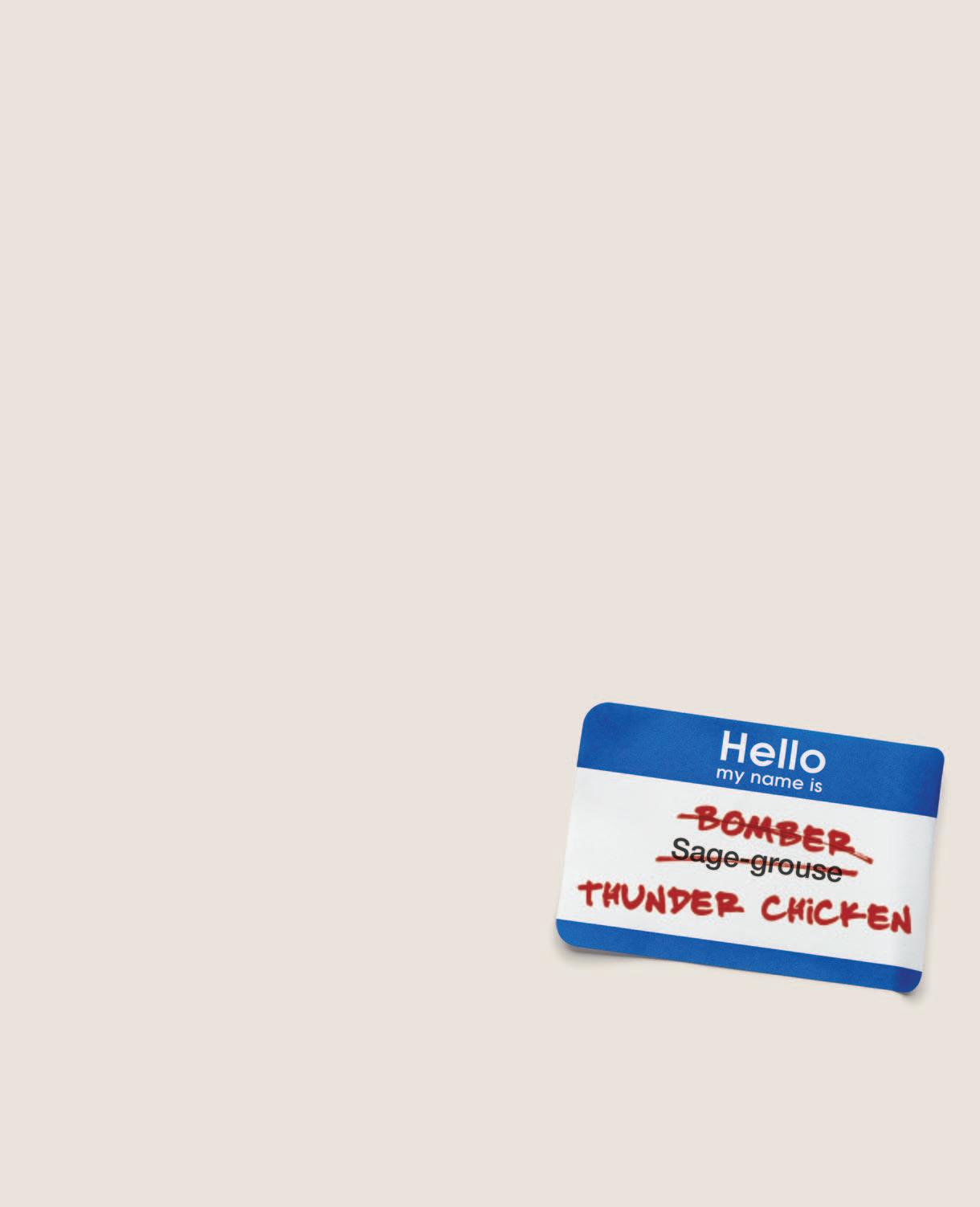
Sage-grouse: “bomber” (large, slow-flying bird resembles a B-52); “thunder chicken” (booming sound made by males during mating season); “sage chicken” or “sage hen” (sagebrush habitat and slight resemblance to domestic fowl).
Scaup (lesser and greater): “bluebill” (bill color).
Sharp-tailed grouse: “prairie grouse” or “speckle-belly” (white spots on breast); white-breasted grouse (light breast feathers); “prairie hen” or “prairie chicken” (resemblance to species in states to the east).
Yellow-rumped warbler: “butter butt" (selfexplanatory).
Mountain lion: “lion,” “puma,” or “cougar”
Mule deer: “blacktail” (tail tip color); “muley” (shortened form).

Pika: “haymakers” (tendency to cut and store wild alpine grasses for winter consumption).
MAMMALS
American marten: “pine marten” (conifer habitat); “tree cat” (long claws resemble those on felids).
Bats: “flying mice” (resemblance to mice; old German word for bat, fledermaus, means “fluttering or flying mouse”; knowledge of the famous opera by Johann Strauss, Die Fledermaus).
Bison: “buffalo” (resemblance to African Cape or Asian water buffaloes).
Bushy-tailed woodrat: “packrat” (trait of “packing” or carrying around various items).
Pocket gophers: “moles” (people unaware of the species or that there are no moles in Montana).
Porcupine: “quill pig” (sharp quills and piglike appearance).
Prairie dog: “whistle pig” (whistling call).
Pronghorn: “speed goat” (rapid acceleration when alarmed); “antelope” (slight resemblance to African and Eurasian antelopes).
Raccoon: “trash panda” (garbage scavengers with black-and-white coloration); “wash bear” (tendency to wash food in streams. Raccoon, an Algonquin-derived term, translates as “handwasher”).
Red squirrel: “pine squirrel” (conifer habitat).
Skunk (striped or spotted): “stink weasel” (olfactory discharge); “polecat” (European name for a relative on that continent that sometimes preys on chickens, which are called poule in French).
Swift fox: “kit fox” (resemblance to relative species not found in Montana but in southwest U.S. and southern Great Plains).
Sparrows and other small brown birds: “LBJs” (little brown jobbers); “LBBs” (little brown birds); “tweety” or “dickey” birds (people unaware of various species.“Dickey” is 17th-century British slang for “small”).
Wood duck: “woody” (shortened form).
Fisher: “fisher cat” (catlike screams made at night).
Grizzly bear: “griz” or “grizzly” (shortened form).
Moose: “swamp donkey” (for alder and willow wetland habitats).
Mountain goat: “billy goat” (mistaken belief in a close relation to domestic goats).
Various ground squirrels and prairie dogs: “gophers” (people unaware).
Vole: “mouse” (mistaken identity to similar-looking species).
Weasels (winter phase): “ermine” (for the name given to the winter phase of the European stoat, a relative of North American weasels, though not an official name in North America).
Yellow-bellied and hoary marmots: “whistle pigs” (whistle call when alarmed); “rockchucks” (boulder habitats); “woodchucks” (closely related species not found in Montana but mostly in eastern states).
OTHER
American larch: tamarack (resemblance to the eastern U.S. tree species).
Antlers/horns: “horns”/ “antlers” (antlers, which are shed annually, are on only deer, elk, and moose, while horns are on only bighorn sheep, mountain goats, and pronghorn).
Aquatic plants: “moss” (by many farmers and ranchers) and “weeds” (many anglers).
Army cutworm moth: “miller” (perhaps because the powdery wings resemble dust that accumulated on people working in grinding mills).
Butterfly chrysalis: “cocoons” (unaware of the difference).
Crayfish: “crawdad” or “crawfish” (from other regions of the U.S., “craw” referring to “claw”); “mudbug” (underwater substrate habitat).
Garter snake: “garden” or “gardener” snake (similar sounding and more logical meaning).
Greater short-horned lizard: “horned toad,” “horny toad,” or “horny lizard” (appeal of saying “horny,” and not knowing that lizards aren’t toads).
Rattlesnake: “buzz worm” (rattling tail).
Toads: “frogs” (people unaware of the difference). n
Readers: Surely we missed some. If you know of other animal nicknames that are used in Montana, send us a note at tdickson@mt.gov.
MONTANA OUTDOORS | MARCH–APRIL 2023 | 19
“SparRow hawk.” “Kestrel!”
Bovidae family and live in Africa (like the gazelle) and Asia (like the saiga). The “antelope” of the American West, they explain, is the sole survivor of a family of speedy animals that raced across North America millions of years ago, and its closest relatives are the giraffe and okapi of Africa. To end the misperception, they insist on the name pronghorn. Yet the use of “antelope” persists—so much so that it’s still in Montana statutes and emblazons FWP’s “Deer, Elk, and Antelope” hunting regulations booklets.
While different common names and nicknames can be fun and colorful, they can create headaches for wildlife managers and game wardens. It’s even trickier when scientists and wardens are communicating with each other from different regions of the United States, each with its own local common names and nicknames, and even more so among worldwide science organizations, where people are describing the same
species in dozens or even hundreds of different languages.
Fortunately, about 375 years ago, someone invented a solution.
THE TWO-NAME SYSTEM
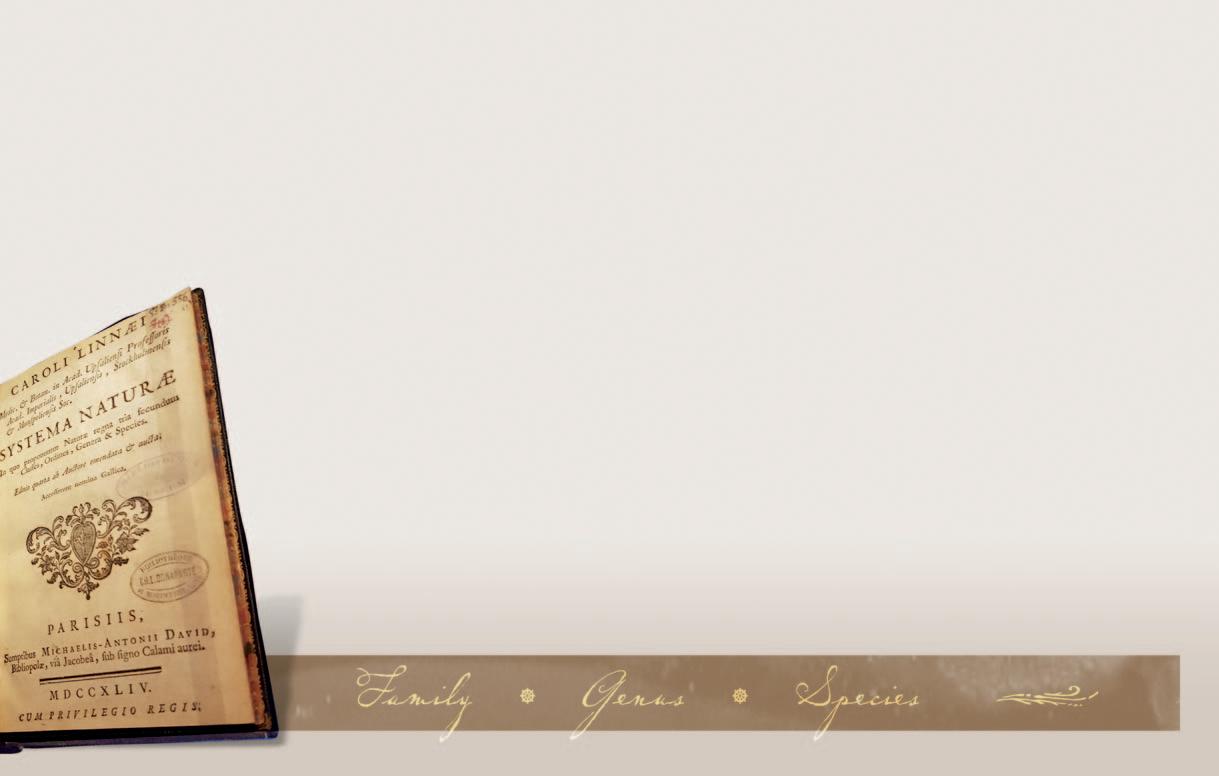
In the mid-18th century, the Swedish naturalist Carl Linnaeus came up with a naming system using two words, known as binomial nomenclature, for each species. The first word of each animal’s “scientific” name is the genus (group of animals sharing certain characteristics), and the second is the species name, which differentiates it from other individuals in that group.
The genus name is always uppercase, the species name is always lowercase, and both are always italicized.

Think of the genus as someone’s last or family name, and the species like their first name. (And yes, it’s confusing that scientists talk of an animal “species” and also call part
of its two-part scientific name “species.”)
For instance, Montana’s black-footed ferret, short-tailed weasel, and least weasel all belong to the genus Mustela. Their scientific binomials are, respectively, Mustela nigripes, Mustela richardsonii, and Mustela nivalis.
The genus name is usually a Latin or Greek descriptor, such as Mustela, Latin for “weasel.” The species name often refers to a place where the animal was first described in English, or some characteristic of the animal. For instance, the turkey vulture’s scientific name is Cathartes—a Latinized form of the Greek word catharses, meaning “purifier,” referring to the scavenger’s biological role of cleaning up dead things—and aura, a Latinization of the native Mexican word for the bird, auroura. “It’s such a great system, in that scientists anywhere in the world can know what animal they are talking or writing about,” says Bowditch.
Scientific naming is governed by the In-
NO WONDER YOU’RE PUZZLED
Official common names sometimes add more confusion than they clear up. For instance, the name for Lepus townsendii is white-tailed jackrabbit, but it is not a rabbit (born hairless and blind) but a hare (born with fur and open eyes).
Northern waterthrushes aren’t in the thrush family but are instead closely related to the 38 warbler species that migrate through or nest in Montana. And meadowlarks are not larks at all but rather a type of blackbird.
Ringneck ducks have a barely perceptible neck ring and are usually called “ringbills” by waterfowl hunters for the bird’s far-moreprominent bill ring. The red-bellied woodpecker lacks a red belly, sporting only the faintest pink blush that few people ever see.
Then there’s the oddly named fisher—a cat-size, forest-dwelling member of the weasel family that doesn’t hunt for or eat fish.
Lake trout and brook trout are both species of char, a salmonid related to but not the same as trout. What’s more, many people refer to any trout that lives in a lake, like the rainbow trout that FWP stocks in mountain waters, as a “lake” trout, and any trout that lives in a stream or brook—even cutthroats and browns—as a “brook” trout.
No wonder people get confused.
Even experts disagree
“There really are no rules for common names, and that leads to some issues,” Dr. Joe Mendelson, director of research for Zoo Atlanta, writes on the zoo’s popular blog. “Taxonomists can be very territorial and dogmatic about their preferred names for the creatures they study, and the debates can get ferocious.” Hyphens are particularly troublesome. For instance, some biologists with the American Ornithological Society still fume over the organization’s decision to include a hyphen in the common name sage-grouse (apparently done to show the close relationship between the bird and its fast-vanishing sagebrushsteppe habitat).
So many lookalikes
Some nicknames, meanwhile, arise from people not knowing or caring about the differences among ani-
20 | MONTANA OUTDOORS | MARCH–APRIL 2023
ternational Code of Zoological Nomenclature (ICZN), which ensures a species has just one official scientific name and that names can’t be changed without extensive discussion among taxonomists.
NEW KNOWLEDGE
Because what people call animals is a personal preference, there’s really no wrong or right term. Of course, there are errors of identification, like when I catch what I think is a longnose sucker and call it that, when in fact it’s a mountain sucker. But if anyone wants to call a sage-grouse a “bomber” or porcupines “quill pigs”—just for fun or because people in their region have always done so—no one will stop them.
At the same time, many people enjoy
learning and using the official common and even scientific names for Montana’s fish and wildlife and what those terms reveal about different species. For example, what many people commonly refer to as “horny toads” are actually greater short-horned lizards. Lizards, as it turns out, are reptiles, with
scales, while toads (and frogs) are scaleless amphibians. “We find that kids, especially, love learning names for fish and wildlife,” Bowditch says. “They get that empowerment of new knowledge—and then get to go back home and share what they’ve learned with their parents and friends.”
mals. Though Montana is home to more than a dozen different gull species, like the ring-billed and Iceland, many people call all white, long-winged birds soaring over box store parking lots “seagulls.” Others commonly refer to any small brown bird as a “sparrow,” “LBJ” (little brown jobber), “LBB” (little brown bird), “dickey bird,” or “tweety bird,” even though dozens of unique species live here. (The generic labels are no surprise, though. Many prairie songbirds, especially, look amazingly alike, often challenging even expert birders.)
Anglers often dub any small fish a “minnow,” even though Montana’s only true members of the minnow family are daces, shiners, chubs, and a few other species. Anglers also often incorrectly apply the name “carp” to any lipped fish they catch, like a longnose
sucker, smallmouth buffalo, or shorthead redhorse (all members of the sucker family).
More misnomers
Adding to the nomenclature mess are the nicknames for males, females, and young of some species. Male bears are often mistakenly called “boars” and females “sows,” remnants of the age-old myth that bears are related to pigs. And male, female, and young mountain goats, only distantly related to domestic goats (and more closely to bison), are known as “billies,” “nannies,” and “kids.”
A few senior anglers in Montana still call walleye “walleyed pike” and sauger “sand pike”—century-old Midwestern names based on the mistaken belief that the two species, due to their sharp teeth and elongated body shape, were related to northern pike (when in truth they are members of the perch family). Midwestern anglers visiting Montana sometimes call goldeye “skipjack herring” because they resemble these silvery, flat-sided fish of that region’s larger rivers.
Some people mistakenly think great blue herons, with their long legs and thin necks, are cranes. One FWP wildlife biologist reports that some older Montanans in her region still refer to bats as “flying mice” (though bats are not rodents), a myth reinforced by an old German word for bat, fledermaus, meaning “fluttering or flying mouse,” made famous by Johann Strauss’s opera Die Fledermaus. n
MONTANA OUTDOORS | MARCH–APRIL 2023 | 21
DIGITAL COMPOSITIONS WITH PUBLIC DOMAIN IMAGES BY LUKE DURAN. BROWN TROUT ILLUSTRATION BY H.H. LEONARD, 1914.
THE CLARIFIER Systema Naturae, by Carl Linnaeus, 1744, on display at the Musee de l’Homme, Paris. The Swedish naturalist revolutionized animal nomenclature by devising a two-name system for every species using Greek and Latinized genus and species names that could be understood by scientists throughout the world.
