WHAT’S HIDING IN BEAVERHEAD SAGEBRUSH? THE WALLEYE ORIGIN STORY YOU NEVER KNEW IN THIS ISSUE:
MONTANA
All Hands on Peck
Collecting 60 million walleye eggs from pitching boats in freezing weather and whitecaps takes grit, dozens of volunteers, and a surprising number of turkey feathers. By Andrew McKean
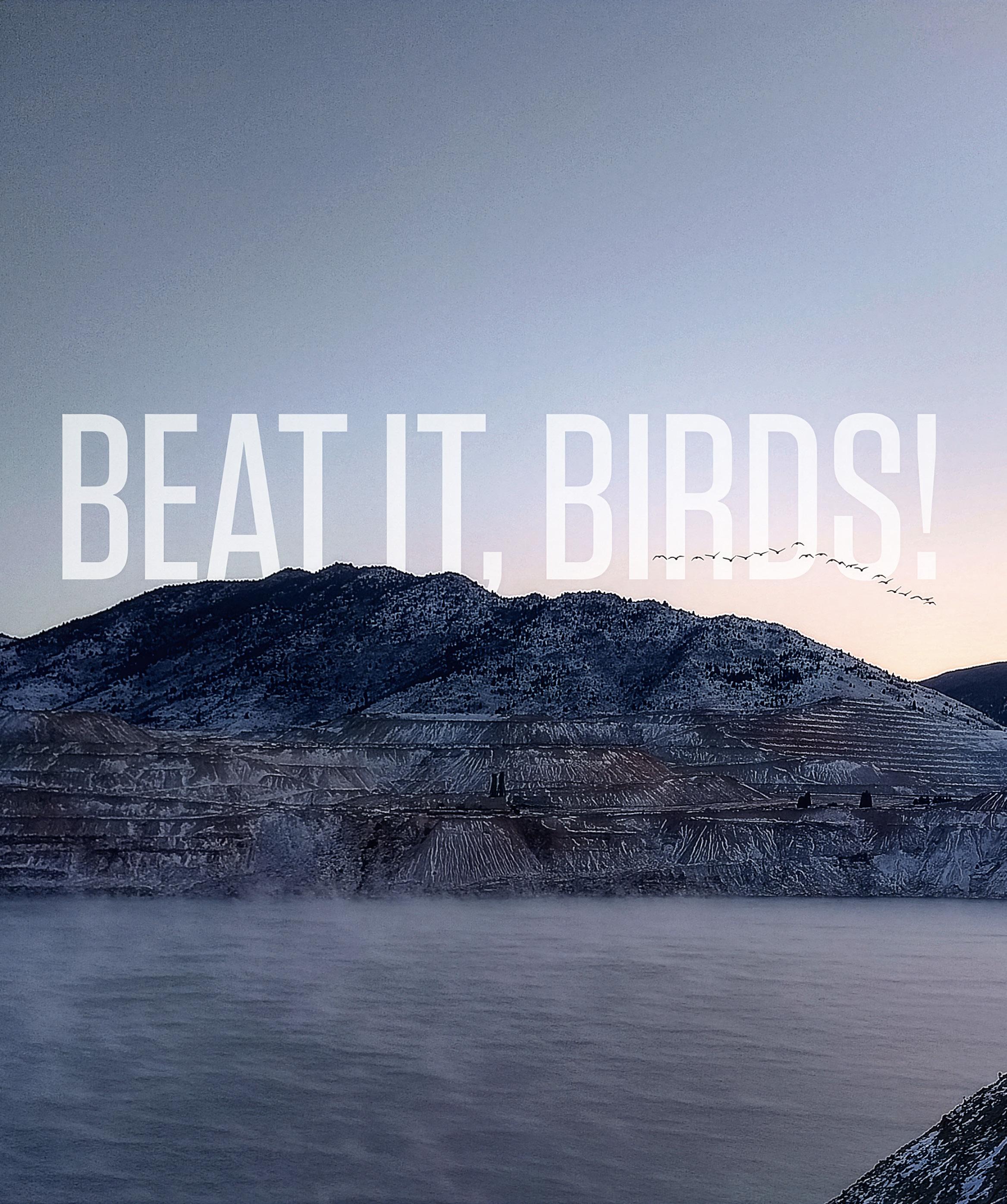
Beat it, Birds! Scientists are figuring out how to keep Butte’s Berkeley Pit from killing waterfowl. By Nadia White
Calling All Gobblers Sweet-talking a tom turkey into shooting range provides a thrilling way to shake off Montana’s long winter. By
E. Donnall Thomas Jr.
Chasing Phantoms in the Beaverhead
Southwestern Montana hosts one of the healthiest swaths of sagebrush steppe on the planet, and a surprising bird species has taken notice. By Sneed B. Collard III
For address changes or subscription information call 800-678-6668. In Canada call +1 406-495-3257
Postmaster: Send address changes to Montana Outdoors Montana Fish, Wildlife & Parks, P.O. Box 200701, Helena, MT 59620-0701. Preferred periodicals postage paid at Helena, MT 59601, and additional mailing offices.
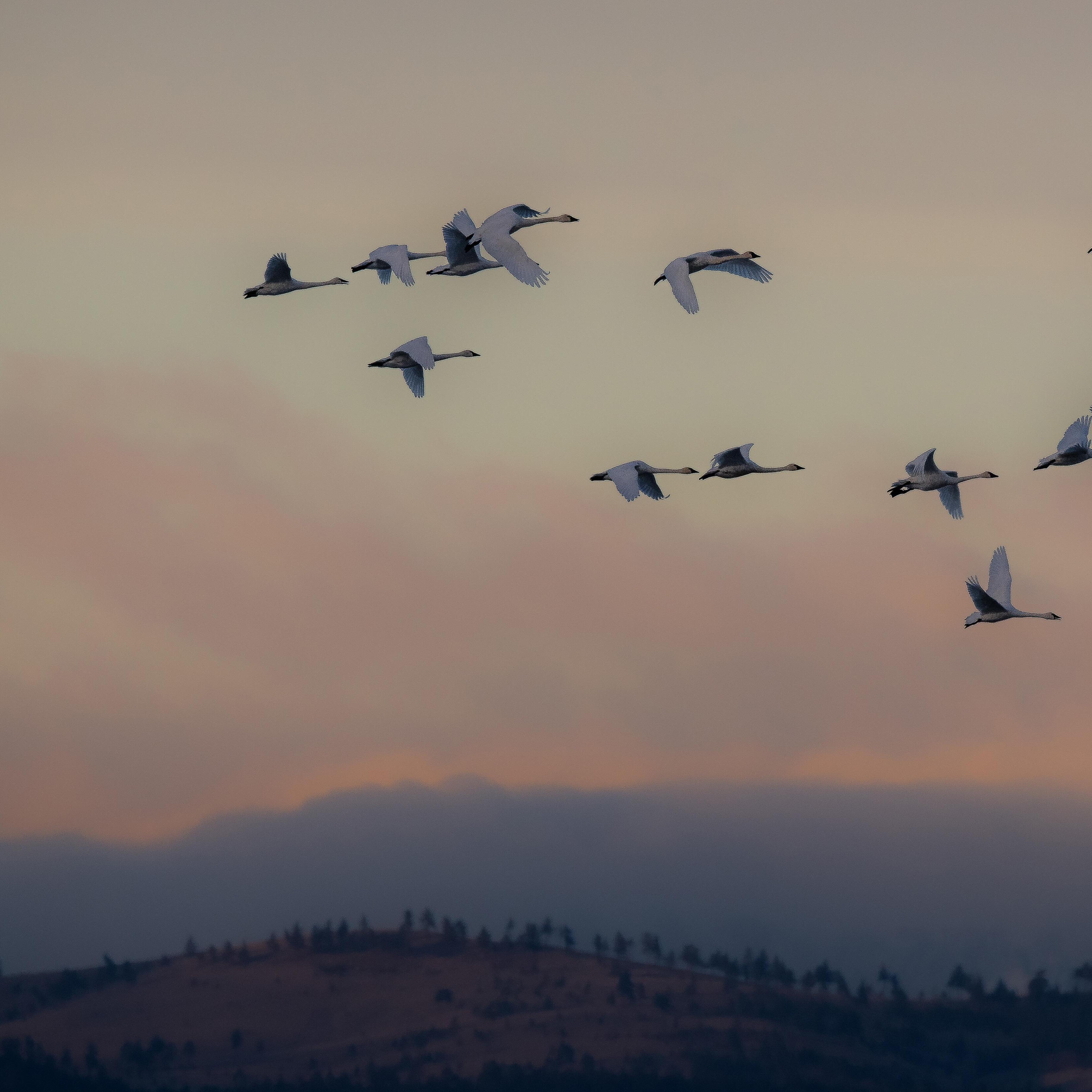
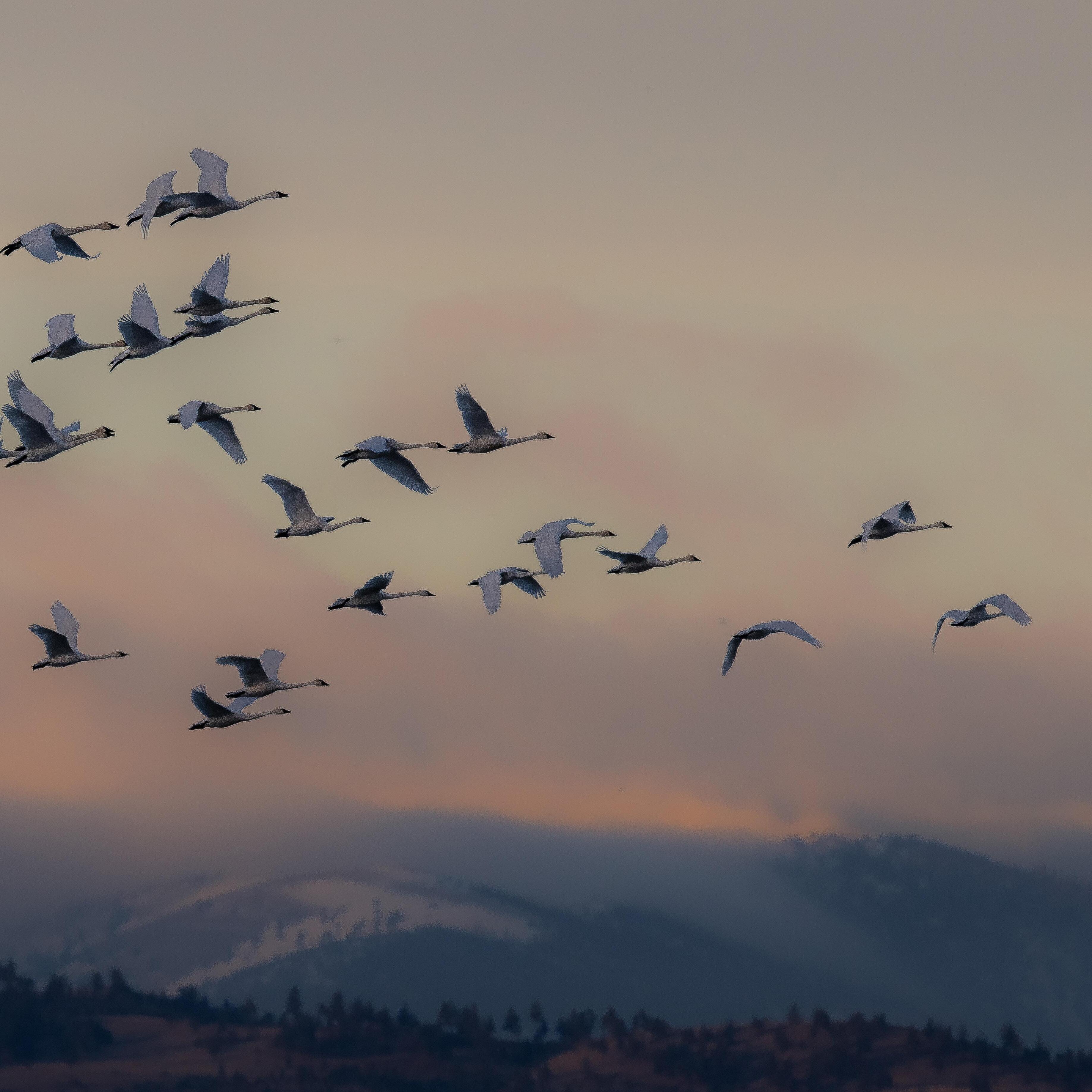
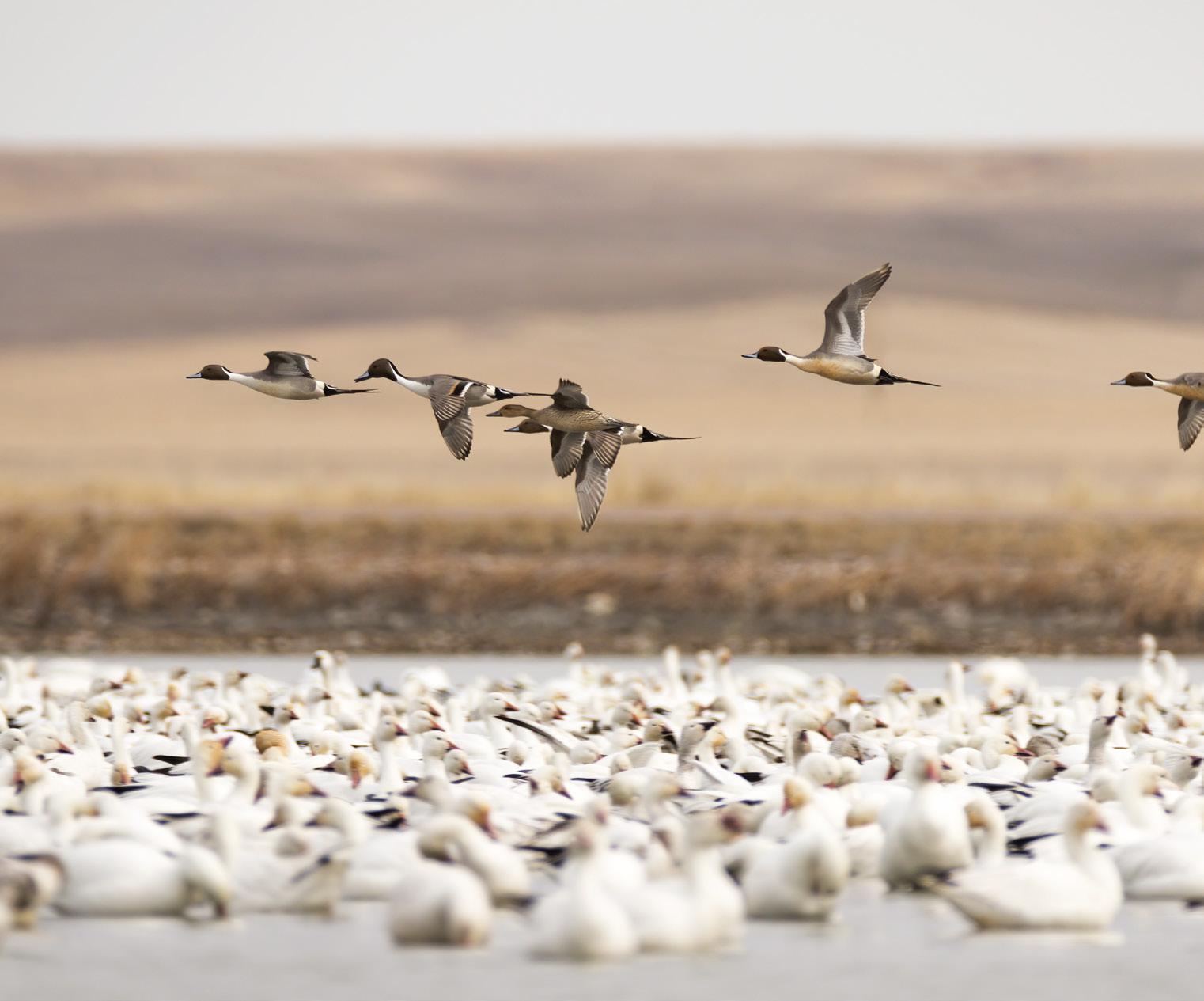
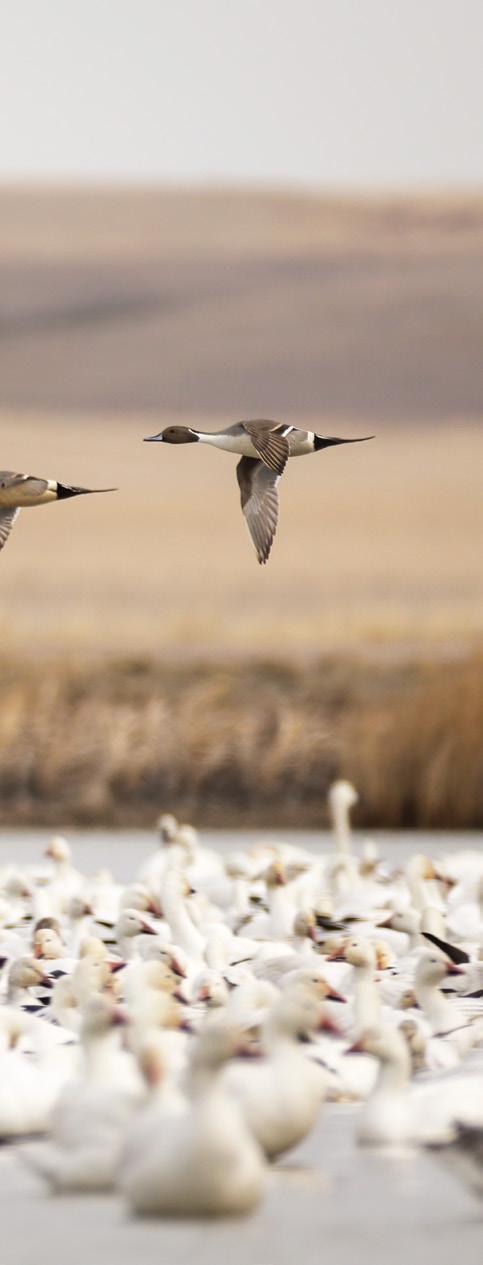
SAFE TRAVELS A flight of swans migrates south over the Helena Valley on a fall morning. Scientists are keeping tabs on waterfowl to prepare for any large flocks that might look to land on the toxic waters of the Berkeley Pit in Butte. For more on this effort, turn to page 20. Photo by Lea Frye.
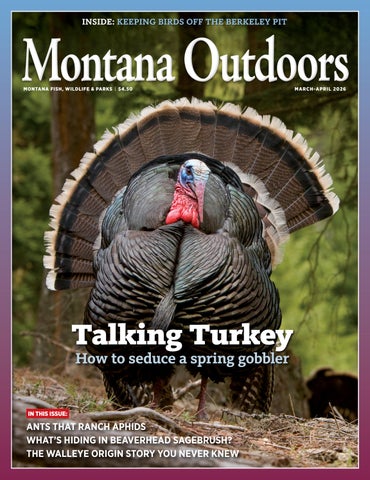
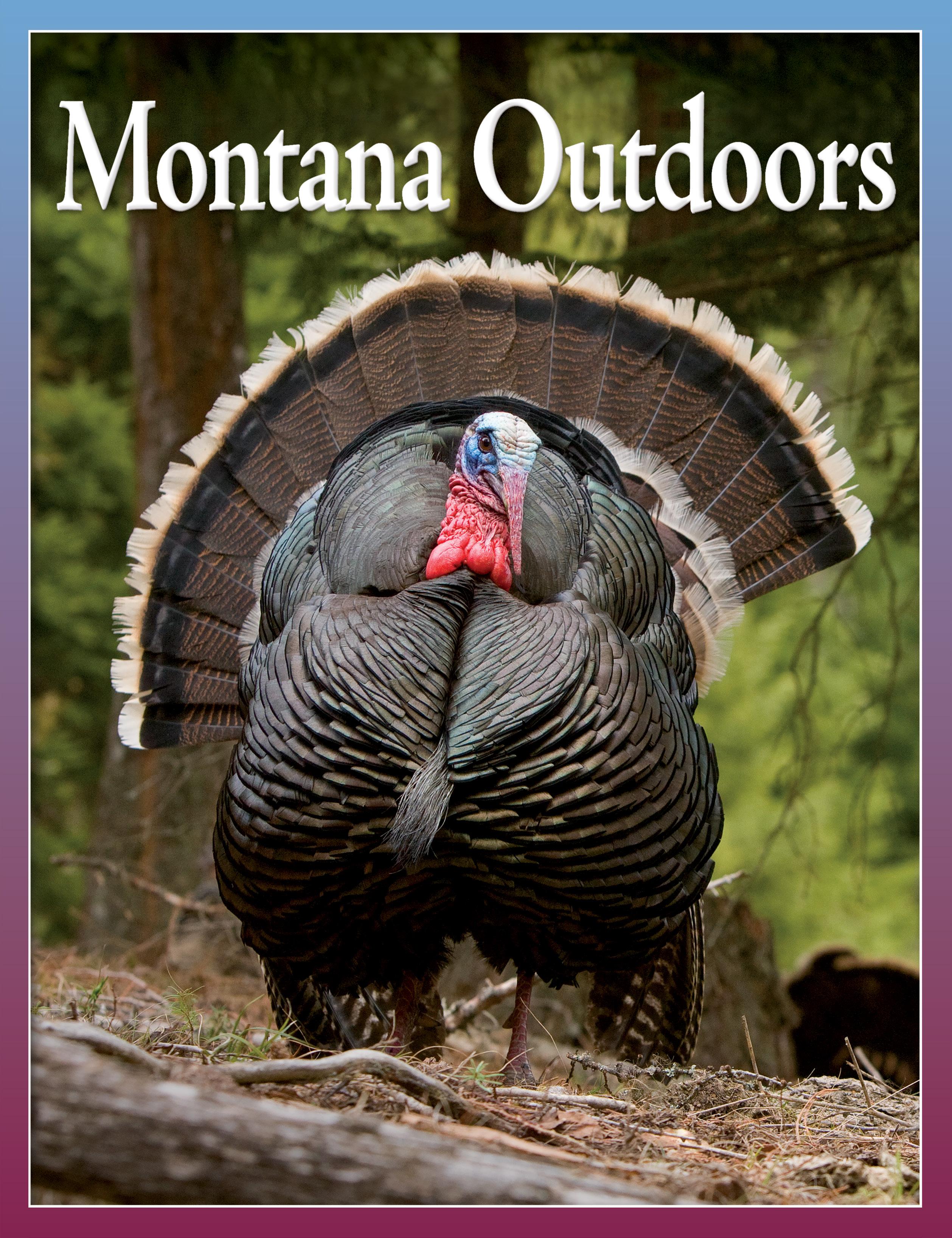
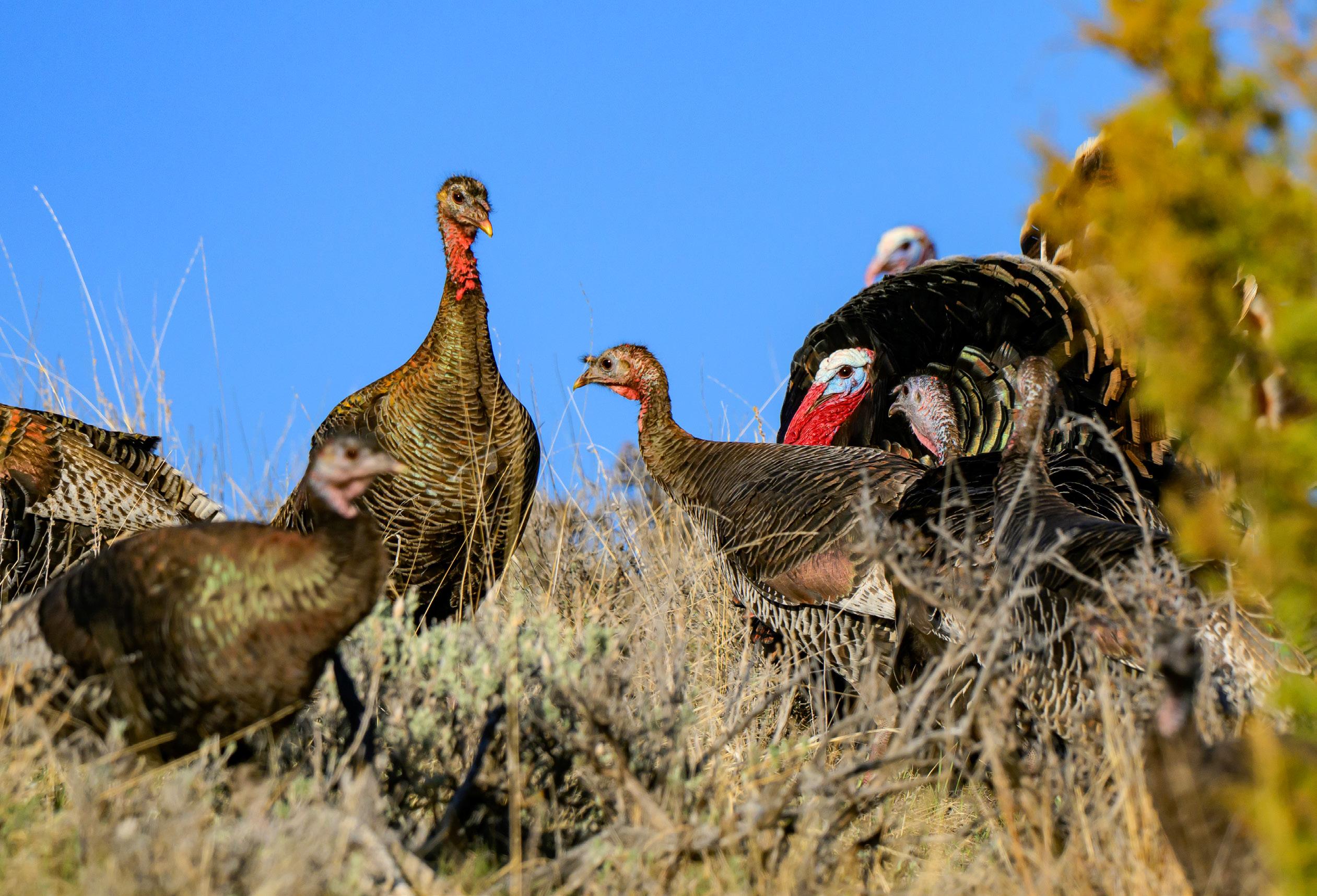
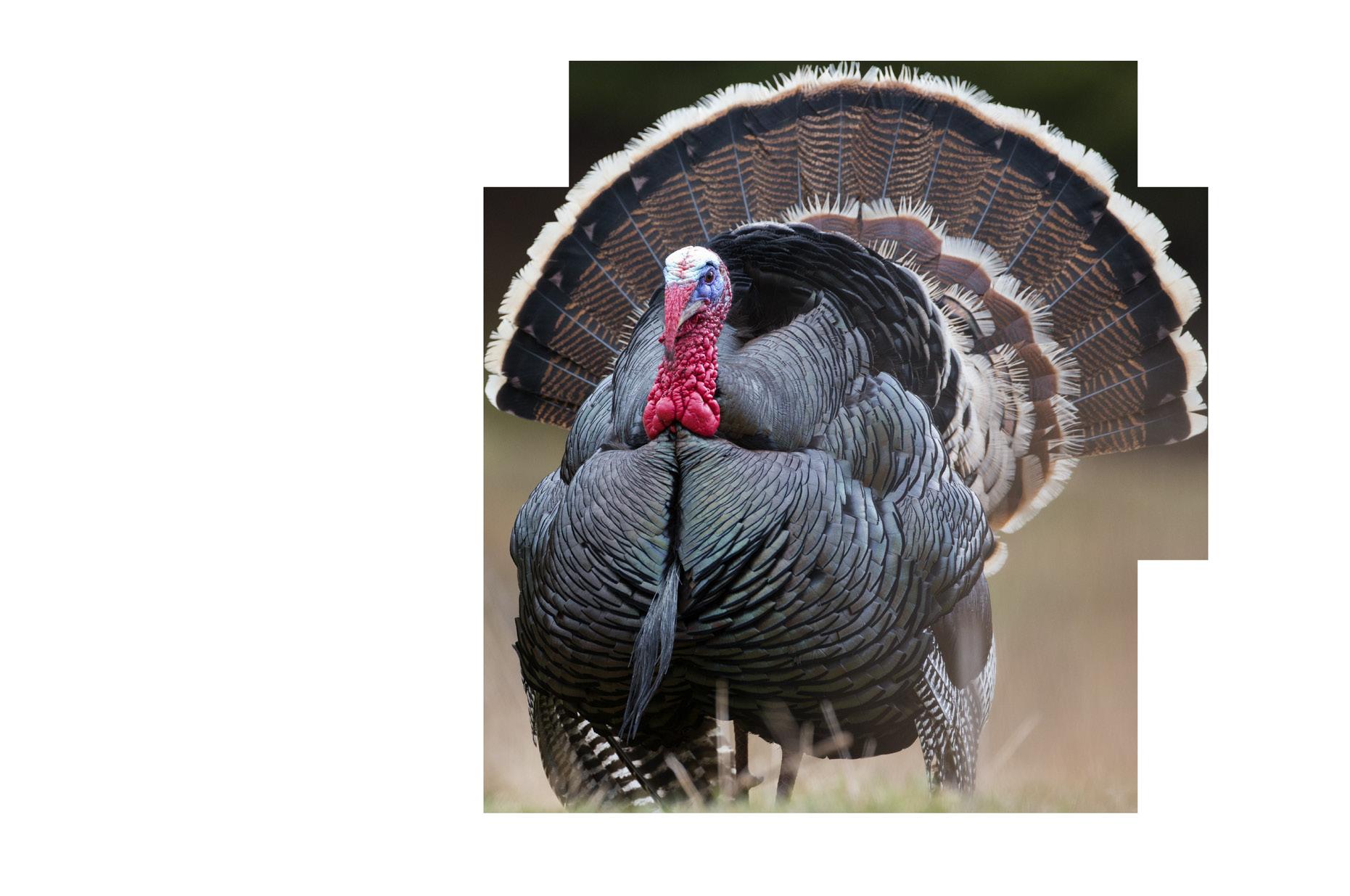
COVER A male wild turkey struts during the spring mating season, which is peak time to ambush one with a bow or shotgun. To read more, turn to page 28.
Photo by Donald M. Jones.
LETTERS
Park beaches held strong through December storms
Soon after “Absorbing the Blows at Flathead Lake” appeared in your November-December issue, record precipitation and warm temperatures in December filled the lake to an unprecedented level for that late in the year, followed by an epic wind storm with 70 mph gusts that took out much of the electrical service in the valley and pounded shorelines with some of the largest waves ever recorded. The constructed gravel beaches at state parks held strong while many docks and unprotected shorelines were severely damaged—a testament to the wisdom of FWP’s decision to use a nature-based solution and to the Montana Legislature for providing funding. It’s a perfect example of collaborative leadership at a time when cooperation is challenging, and a ray of hope for continued collaboration addressing erosion issues
through a design-with-nature alternative to seawalls and riprap that stops erosion, protects water quality, creates aquatic habitat, and, most importantly, improves public recreation. Thank you for helping spread the word.
Mark Lorang Bigfork
Photo issue yays and nays
Congratulations to Montana Outdoors and all 75 photographers with 120 photos in the splendid 45th annual photo issue. Every year my wife and I are thrilled to see such glorious pictures from our majestic Montana. This is by far our favorite issue from our favorite magazine. We say “well done” for capturing stunning shots from all around Big Sky Country. As an aside, am I the only one who noticed the shadow of a woman in the spray mist on the back cover?
Dr. Jay Forseth Columbus
Another stunning photo issue! I really enjoyed it. However, it looks like your staff got stumped on page 21. “A dabbling duck.” Really? For a top-notch issue that identified no less than a Colombia spotted frog and Deconica mushrooms, this really stood out. As a duck lover, I noticed.
Jeff Moore Livingston
Editor replies: Thanks for the feedback, Jeff. I ran that photo past several bird identification experts who agreed they couldn’t be 100 percent sure of the species due to the crop and angle of the image. After some consideration, I chose to be less specific rather than risk mislabeling it.
Good books to share I loved your Recommended Reading section in the November-December issue. I went right out and bought Smoke Elser’s Hush of the Land. I’d also
Dodging a dam on the Yellowstone River
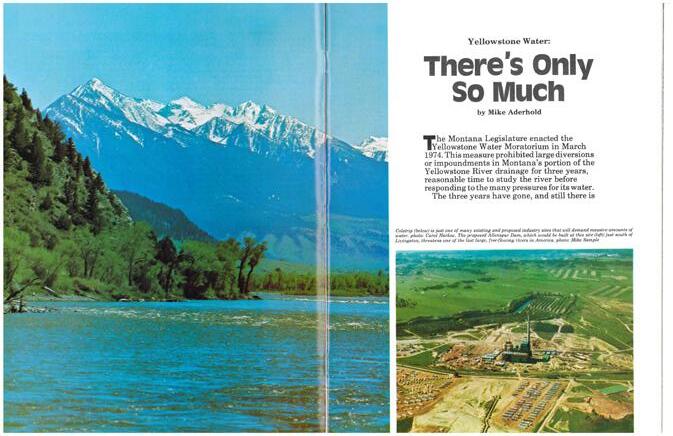
In the early 1970s, the energy industry wanted to divert millions of gallons of water from the Yellowstone River to generate steam-driven, electricity-generating turbines on two dozen proposed coal-burning power plants in Montana.
To store the water, a 380-foot proposed dam spanning a shallow gorge at Allenspur 2 miles upstream of Livingston would have created a reservoir inundating roughly 41 miles of the Yellowstone and trout spawning tributaries, including much of the Paradise Valley.
“The possible construction of the Allenspur Dam is the single greatest threat to the aquatic resources of the Yellowstone River,” stated a 1972 report from the Montana Department of Fish and Game.
Montana Fish and Game responded by launching research studies on the fish, bird life, insects, and other natural resources in the Yellowstone Basin. Jim Posewitz, head of the Environment and Information Division, led a campaign to publicize the studies and potential losses.
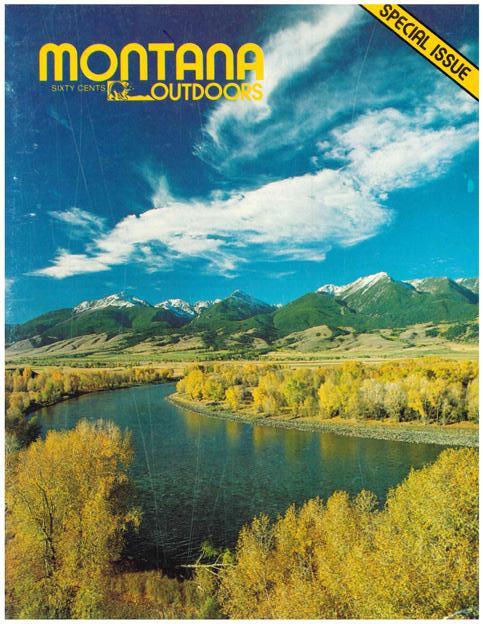
In spring 1977, in addition to producing a 16mm film, Yellowstone Concerto, the department created a special issue of Montana Outdoors devoted solely to the Yellowstone.
Stopping the Allenspur Dam proposal required convincing the Montana Board of Natural Resources and Conservation that some river flow should be “reserved” forever for fish and wildlife. “The decisions about to be made will have an impact second only to the basic geologic events that actually shaped this land,” wrote Posewitz in the issue’s epilogue. “These decisions will direct the future of the Yellowstone.”
The following year, the board ruled that 5.5 million acre-feet of “instream flows” on the Yellowstone and 67 tributaries should be perpetually reserved for the good of fish and wildlife.
The dam plan was nixed and the Yellowstone was saved, still the longest free-flowing river in the lower 48 states. n
recommend Bryce Andrews’ Down from the Mountain, chronicling the challenges of bears coexisting with people. I hope you continue with your reading recommendations since you have so many great Montana writers!
Robin Millar Solomon Hamilton, New York
CORRECTION
The photograph of a male summer tanager on page 26 of the JanuaryFebruary 2026 photo issue was incorrectly labeled as a western tanager. The mistake was made by the editor, not the photographer Tracy Enterline, who had the bird correctly identified in the metadata. Our apologies for the error.
We welcome your comments, questions, notes, and letters. Write to Montana Outdoors, P.O. Box 200701, Helena, MT 59620-0701, or email paul.queneau@mt.gov.
Venison Coconut, Lentil, and Sweet Potato Stew
By Tom Dickson
I Preparation time: 30 minutes (plus refrigeration) I Cooking time: 2 ½ hours I Serves: 8
fter 15 years of reading recipes on this page, longtime Montana Outdoors subscribers have likely learned that I’m a fan of the fast and fabulous— dishes easy to throw together for weeknights while yummy enough for company or even a holiday dinner.
But I also love recipes that are slow and splendid. These use tough cuts from the shoulder, neck, or flanks that, sadly, are too often squandered as burger meat. Cooking these cuts for several hours at low heat with moisture transforms them into delicious, aromatic, fork-tender braises or stews perfect for the chilly nights we have this time of year.
How? Their very toughness creates the magic. The cuts come from muscles that do the animal’s major work. The sinewy white interior tissue, called collagen, provides structure and strength to muscles, tendons, and ligaments, improving elasticity, force transmission, and recovery.
That’s essential if you’re an elk fleeing a mountain lion. But it doesn’t make for a very edible steak or chop. Under high heat—like when grilling, pan frying, or hot roasting — collagen contracts and stiffens, turning these cuts of venison muscle into meat as tough as a catcher’s mitt.
Transforming that protein into something delicious requires melting the collagen, which happens only over several hours in low, moist heat. The collagen, now a velvety goo, absorbs the wine, broth, or in this case coconut milk, drawing flavors deep into the meat.
This dish, adapted from one on the NYT Cooking app, takes far more time than grilling a steak. But the splendid results are definitely worth the wait. n
—Tom Dickson is a previous editor of Montana Outdoors.
Find more recipes online at
INGREDIENTS
2 ½ lbs. boneless venison shoulder, neck, or flank meat (or pork shoulder, also known as butt, fat trimmed), cut into 1 ½-inch pieces
2 t. ground cumin
1 ½ t. kosher salt (or more to taste)
1 ½ t. garam masala (available in spice sections of major grocery chains)
½ t. cayenne
1 cup dried red lentils
1 lb. sweet potato, peeled and chopped into 1-inch chunks
2 ½ T. coconut oil
1 large yellow onion, finely chopped
1 cinnamon stick
6 cloves garlic, minced
1 jalapeño pepper, minced
1 28-ounce can diced tomatoes
1 c. unsweetened coconut milk, solids and liquid whisked together
Chopped cilantro, for garnish (optional)
DIRECTIONS
Step 1: In a large bowl, combine the venison with the cumin, salt, garam masala, and cayenne. Cover and refrigerate from 2 hours to, ideally, overnight.
Step 2: Heat oven to 325 degrees. On stovetop, heat oil in large Dutch oven over medium-high heat. Add onion and sauté for 8-10 minutes, or until tender and golden brown. Add cinnamon stick, garlic, and jalapeño. Sauté for 5 minutes, until the jalapeño is tender. Add the venison and any juices from the bowl and sauté until lightly browned all over, about 7 minutes.
Step 3: Stir in tomatoes and coconut milk and season with more salt, to taste. The venison should just be covered by liquid. If it’s not, add a little water until it is. Bring to a brisk, bubbly simmer (not a boil) over high heat.
Step 4: Once the mixture is simmering briskly, cover Dutch oven and place in oven for 2 ½ hours, or until the venison is falling apart and cooked through.
Step 5: After 2 hours, stir in lentils and sweet potato. Cook another 30 minutes.
Step 6: Serve warm with chopped cilantro n
125 years of conservation commitment
s the 27th director of Montana Fish, Wildlife & Parks, I’m proud to announce our quasquicentennial—the department’s 125th year of conserving the state’s amazing fish and wildlife resources.
The agency now known as FWP began as a modest enforcement effort in 1901 after Montana’s seventh state legislature passed an act to “provide for the appointment of...game and fish wardens...to examine into and inquire about any violation of the game and fish laws of the state.”
This came thanks to a steadfast effort by then-governor John E. Rickards. Like many Montanans back then, he was deeply concerned about drastic declines in fish and wildlife populations despite an assortment of state game laws—regulations that had no teeth without any field officers to enforce them.
Rickards appointed W.F. Scott as Montana’s first game warden. Scott quickly hired eight deputy game and fish wardens across the state, the maximum allowed by law. To say these wardens had their work cut out for them is a vast understatement. Each patrolled an astounding 18,000 square miles on average, traveling by train with their horses from town to town. They were the department’s only field employees at the time.
By the end of the decade, the number of wardens increased to 15, but the decline in game and fish species continued. Montana’s pronghorn population, as just one example, fell from more than 2 million in the late 1800s to around 3,000 by 1926.
Luckily, the 1930s proved to be a turning point. In 1933, Aldo Leopold published Game Management, a seminal text establishing the field of wildlife science. A year later the U.S. Congress passed the Migratory Bird Hunting and Conservation Stamp Act and issued the first Federal Duck Stamp. Then in 1937, the milestone Federal Aid in Wildlife Restoration (Pittman-Robertson) Act was signed into law, placing an excise tax on sporting firearms and ammunition, handguns, and archery equipment. To this day, Pittman-Robertson funds underpin wildlife restoration and hunter safety education efforts across the nation, including here in Montana.
These funds allowed FWP to purchase its first big game winter range in 1940, protecting the Judith River game range for wintering elk near Utica. That same year the agency hired its first wildlife biologist, Robert F. Cooney. These conservation efforts slowly began to bear fruit.
Elk transplanted from Yellowstone National Park in the 1920s and ’30s were beginning to repopulate ranges in Montana. Deer herds showed improvement as well. That helped inspire more transplants. Between 1941 and 1950, the department trapped and moved mountain goats, bighorn sheep, elk, mule deer, white-tailed deer, pronghorn, sage-grouse, American martens, and beavers to help restore them where they’d been killed off. Much of this could not have been accomplished without the consent and assistance of Montana’s private landowners—including my own family.
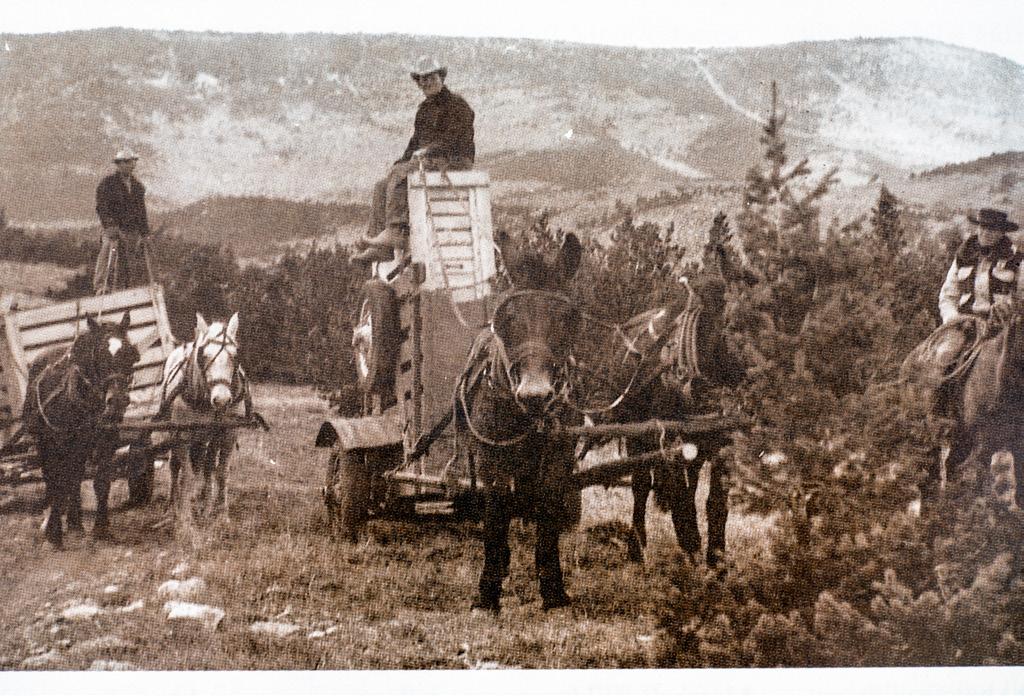
I grew up on a ranch on the Rocky Mountain Front near Choteau that’s been in our family for seven generations. I remember my grandpa telling us stories about when state game managers came and trapped mountain goats on a high corner of our land to be transplanted to other parts of the state. It’s a terribly rough road to get up to that spot (we still refer to it as the Goat Trap) even on an ATV. I can’t imagine hauling mountain goats in wooden carts down that mountain, but they pulled it off.
In truth, FWP’s history has always been a balancing act. Generations of Montanans—my family proudly among them— came together to ensure future generations would have fish, wildlife, and a state park system to enjoy.
Take time this year to appreciate this legacy by getting outdoors to experience what 125 years of vision and joint effort has brought to life.
—Christy Clark, Director, Montana Fish, Wildlife & Parks
PHOTO COURTESY OF VICKY MCLUCAS
Transplanting mountain goats in the 1940s was dangerous, difficult work. Goats trapped west of Choteau were packed in crates and moved down the mountain by mule-drawn carts.
TAG TENDER
Payton Schild Licensing Business Analyst
I’M BOTH A PROUD NUMBERS NERD and an avid hunter, which are nice attributes to have in my job overseeing FWP’s license drawings.
I grew up in Lolo in a family that didn’t hunt much until my dad saw the interest my brother and I had in it. He took each of us out after deer as soon as we were old enough to get a license at age 12, and my enthusiasm for hunting has grown steadily ever since.
After taking a wildlife biology class in high school, I chose that as my major in college at the University of Montana. While I was a student, I got a work-study position selling licenses, fielding phone calls, and checking harvested game at FWP’s Region 2 office in Missoula. I really enjoyed it, so right after I graduated, I applied to be a licensing specialist based in Helena and was thrilled to be chosen. A central part of my duties was talking on the phone to hunters and anglers, which turned out to be ideal training for my current job
as FWP’s licensing business analyst.
My goal from the start has been to create better tools and documentation that explain the inner workings of our licensing system and tag drawings in the simplest terms possible. I have put in to hunt moose, sheep, elk, you name it, for many years and have yet to draw a marquee license (a common story among License Bureau staff), so I fully appreciate people’s interest, excitement, and especially their heartbreak after not drawing their dream tag for the umpteenth time.
There is no getting around the complexity that bonus and preference points add to the mix, but I get a deep satisfaction from analyzing the data and finding good ways to pull back the curtains and help people understand, trust, and make the most of FWP’s system, whether it’s an individual hunter, members of the Montana Fish and Wildlife Commission, or the state Legislature. In fact, that is my favorite part of the job.
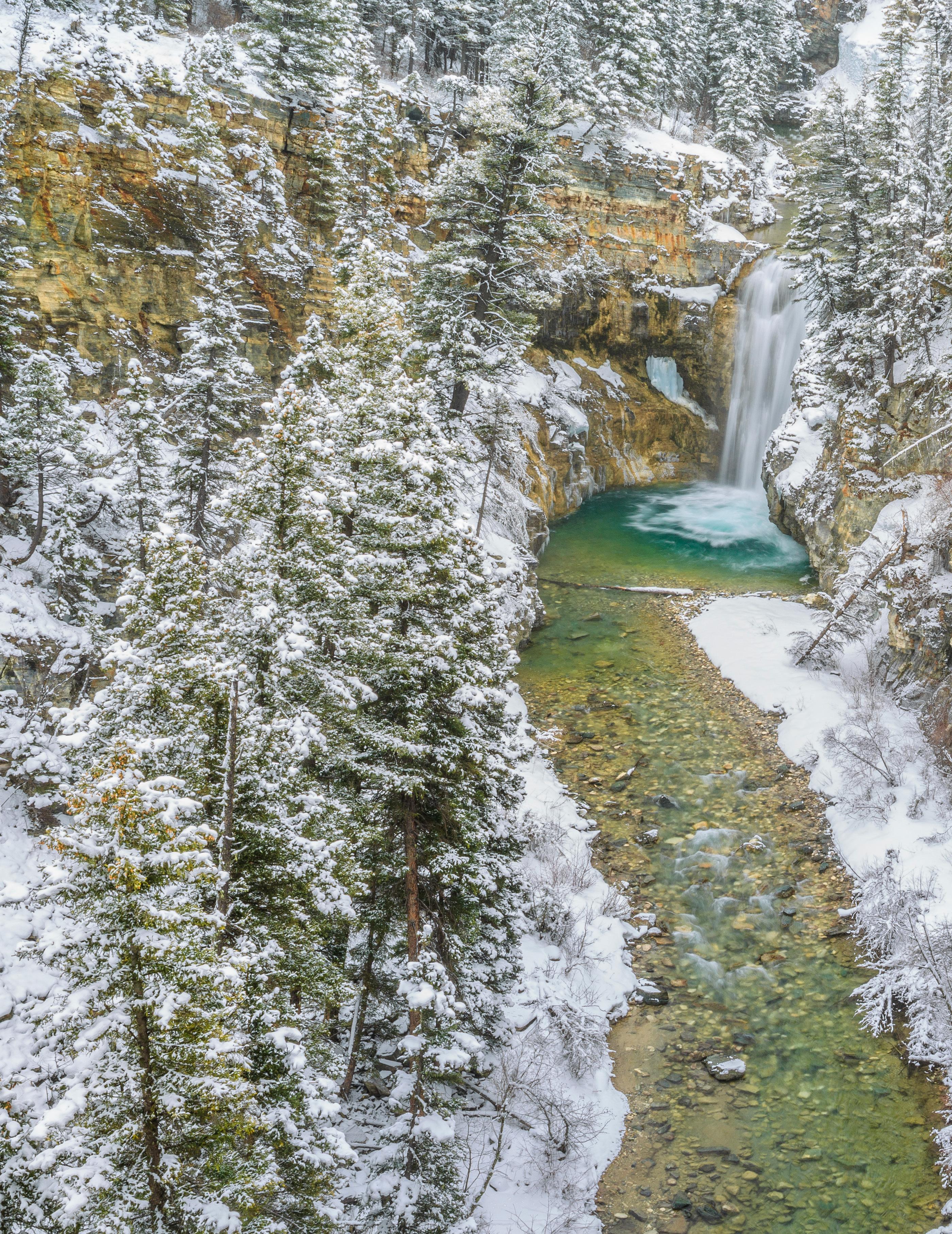
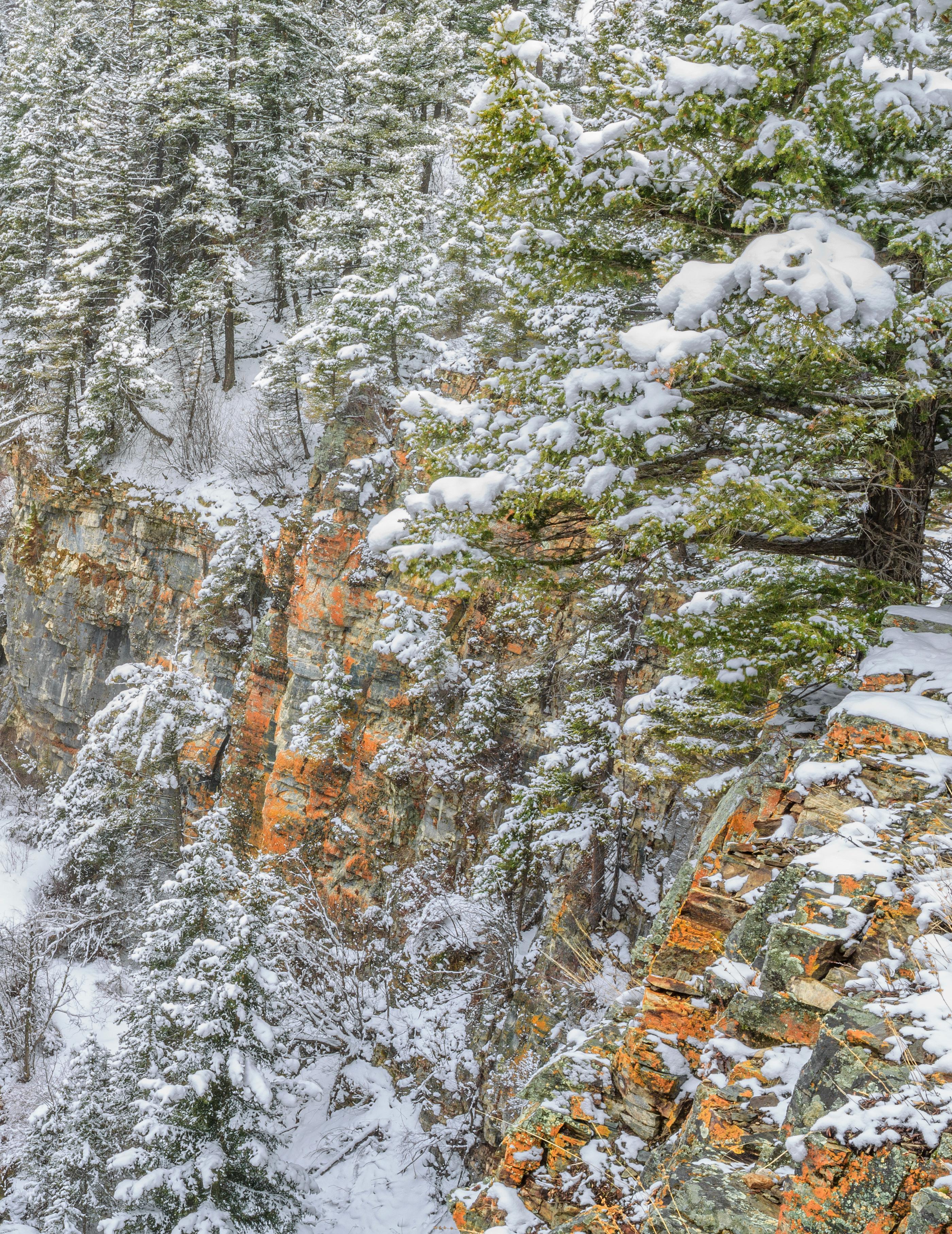
Helena-based photographer John Lambing had taken the half-mile hike to photograph Falls Creek’s namesake waterfall many times across many seasons before he caught it just right on the day after a fresh snow. The falls plunge 60 feet just upstream from the creek’s confluence with the Dearborn River on the Rocky Mountain Front, 20 miles south of Augusta. “I had tried several times in winter, but the falls were always frozen, which makes for a less dramatic photo. Then I tried in late March right after we got a fresh dump of snow but after the creek had melted out. It turned out to be the perfect day—dead calm and overcast—just the lighting you want in a tight canyon like that. I roped myself to a tree so I could get safely out right to the cliff’s edge.” Lambing also credits a project led by the Rocky Mountain Elk Foundation that secured public access to the falls in 2019. “It is one of my go-to spots when I have visitors willing to take a short hike. You can’t beat the view there right on the edge of the Scapegoat Wilderness—wild and scenic country at its finest.” n
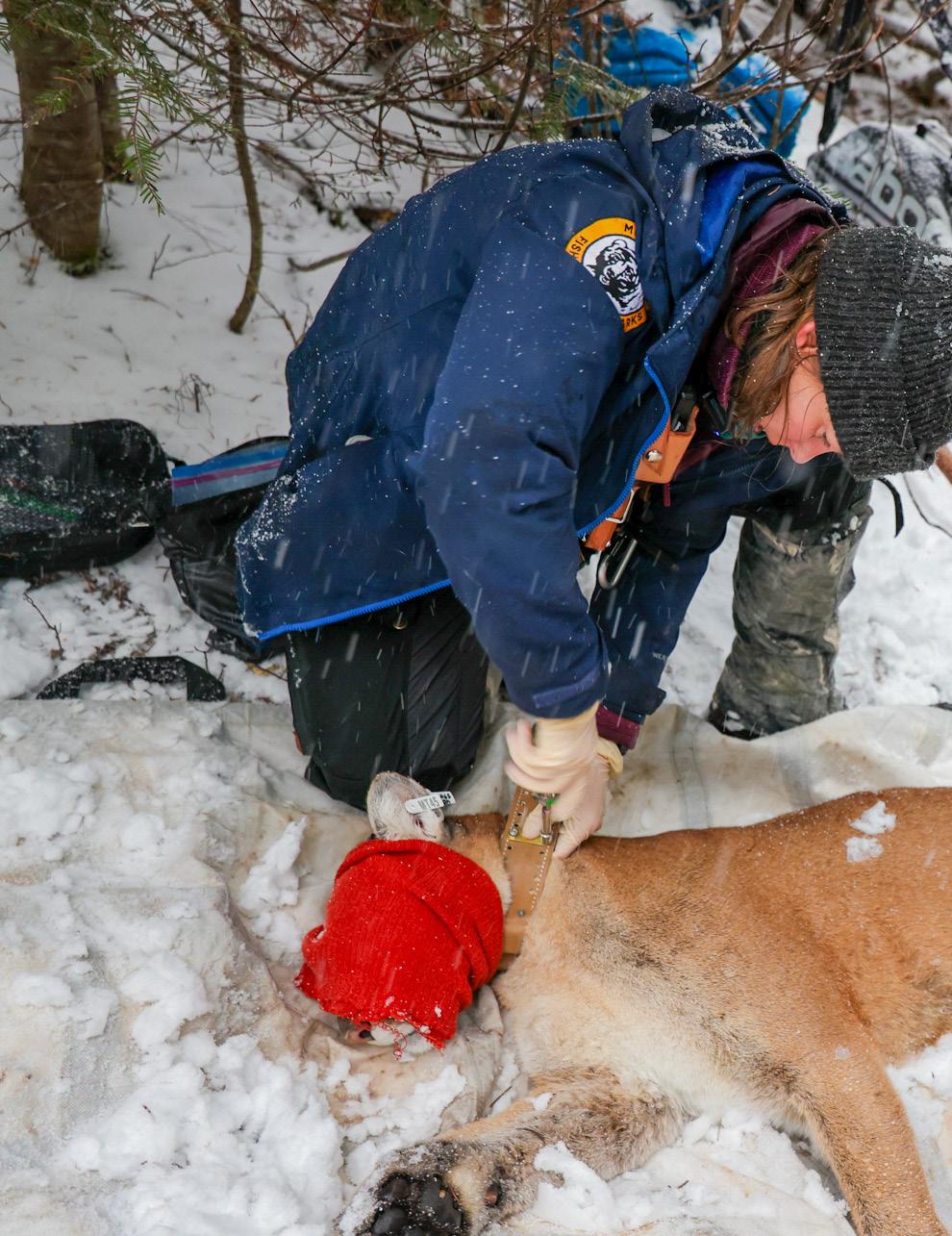
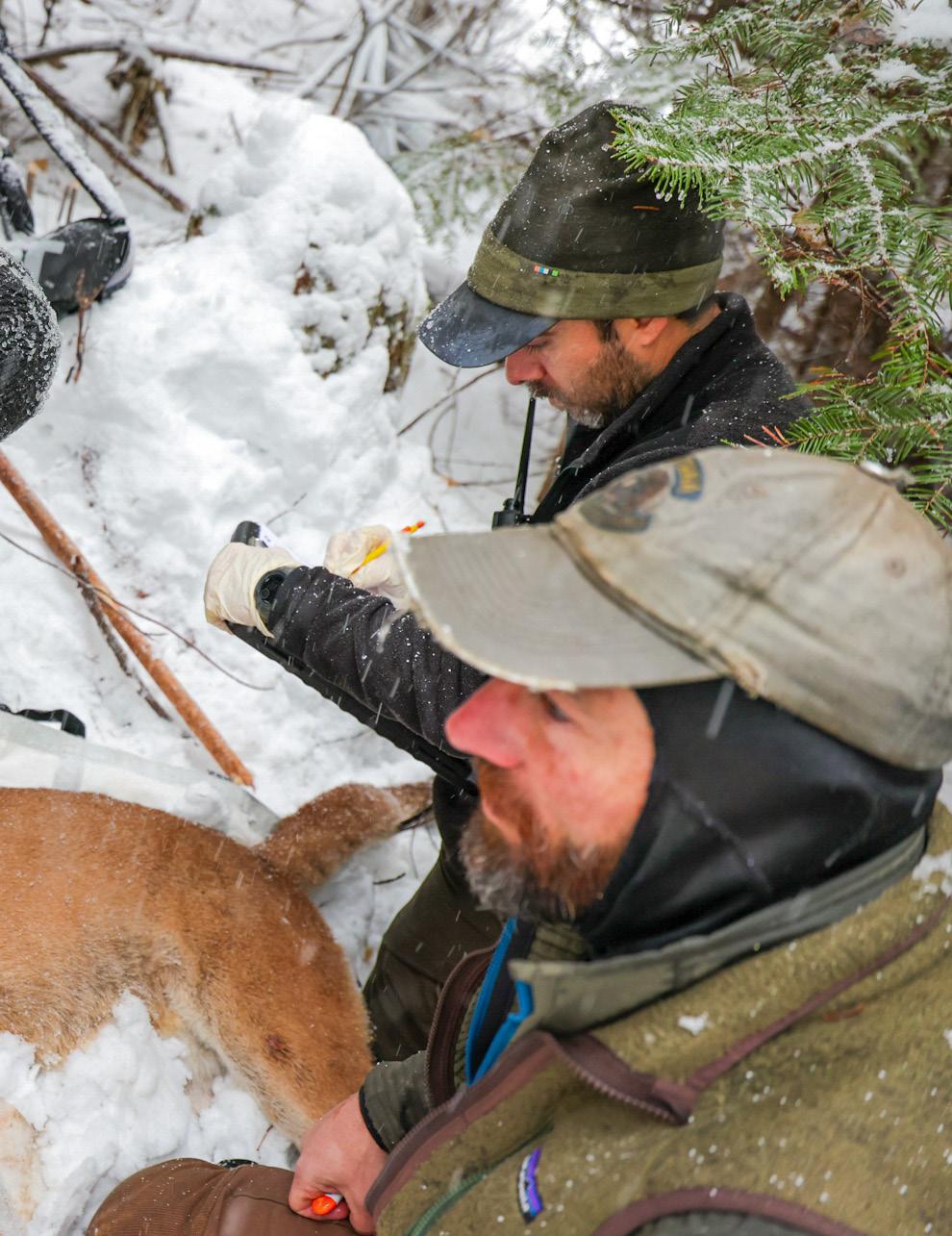
CAT TRACKER FWP mountain lion monitoring biologist Ashley Hodge installs a GPS tracking collar on a female cougar in the Cabinet Mountains south of Libby, part of a statewide research project to estimate the number and density of Montana’s largest wild cat. FWP is in its seventh year of this new population monitoring strategy, which this winter focused on northwestern Montana using experienced houndsmen to track and tree mountain lions before darting them with biopsy darts to get DNA samples. This data will be compiled with past research to analyze the effects of lion harvest and help biologists manage lion numbers in balance with prey species and public interests. To watch how FWP collars cougars, scan the QR code at left or visit qr1.be/IR088T n
PHOTO BY LAUREN KARNOPP/MONTANA FWP
100 Billion
Nix ticks this spring
ot long after the snow melts and Montana temperatures start flirting with 50 degrees, ticks clock in. Besides being creepy, they can in rare cases transmit Rocky Mountain spotted fever and other diseases. And now with black-legged ticks (aka deer ticks) confirmed in the state, Lyme disease is a growing concern as well.
This doesn’t mean you should stay indoors. By wearing the right clothing and keeping a sharp eye out, you can spot unwanted hitchhikers quickly and give them the boot before bringing any home. Here are some tips for staying tick-free:
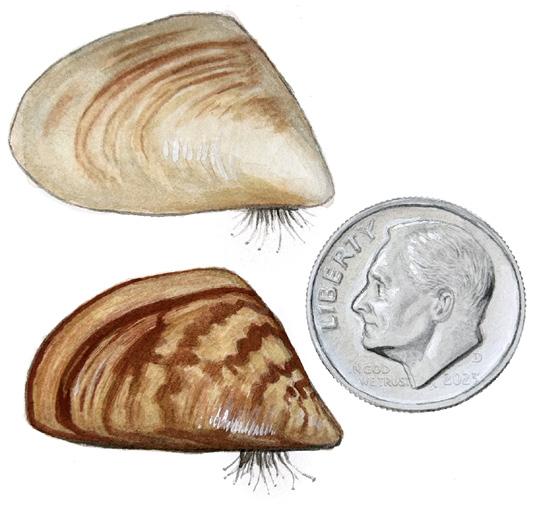
Montana remains invasive mussel–free thanks to the hard work of FWP’s Aquatic Invasive Species (AIS) team, its partners, and watercraft owners stopping at AIS inspection stations. Staff inspected more than 120,000 watercraft in 2025, uncovering 38 fouled with mussels and 570 transporting aquatic weeds before they touched Montana waters. Staff also identified more than 20,000 high-risk boats—watercraft that last launched in states with known AIS infestations. Many were towed by Montana residents who had traveled out of state.
“In Montana, we are fortunate to have a great group of dedicated staff and partners who work together to prevent invasive species from being introduced to our waters,” says AIS Bureau chief Tom Woolf. n
Light-colored pants and long sleeves: It’s not a fashion statement—it’s a detection system. Light-colored long sleeves and pants help keep ticks off your skin and make them easy to spot quickly before they can find a nook (or cranny) to hide in.
Nip and tuck: Tuck your shirt into your pants and your pants into your socks to keep ticks outside your duds. If you can’t stomach the lederhosen look, wear gaiters. Also remember that your hair is an enticing hideaway, so tie it up or wear a cap.
Bug spray: Apply to clothing and exposed skin around socks, cuffs, and waistbands.
Permethrin-treated clothing: Many outdoor brands sell pretreated gear, or you can treat your own at home. It lasts through multiple washes and adeptly repels ticks.
Post-adventure tick check: Ticks are masters of evasion that can go undetected without a careful search using a good mirror or a trusted friend (cue the famous Brad Paisley song). Common hiding places include underneath hair on the scalp, behind ears, and in armpits, groin, and other tucked-away places.
How to remove a tick: If one is embedded, don’t panic—just act quickly. Use tweezers to grip the tick as close to the skin as possible (right at the head). Pull slowly and steadily upward until it comes out, head and all. Clean the bite area and your hands with soap and water or rubbing alcohol. Don’t squish the tick. Flush it, drop it in alcohol, or seal it in a bag.
Know what to watch for: If symptoms develop after a bite, consult a medical professional. The CDC has guidance at cdc.gov/ticks/after-a-tick-bite, as does the Montana Department of Public Health and Human Services, where you can file a report for their tick surveillance dashboard at qr1.be/W3N22Q. n
TICK BITE PREVENTION TIPS
Fossilized findings
ontana’s fossil record continues to surprise researchers.
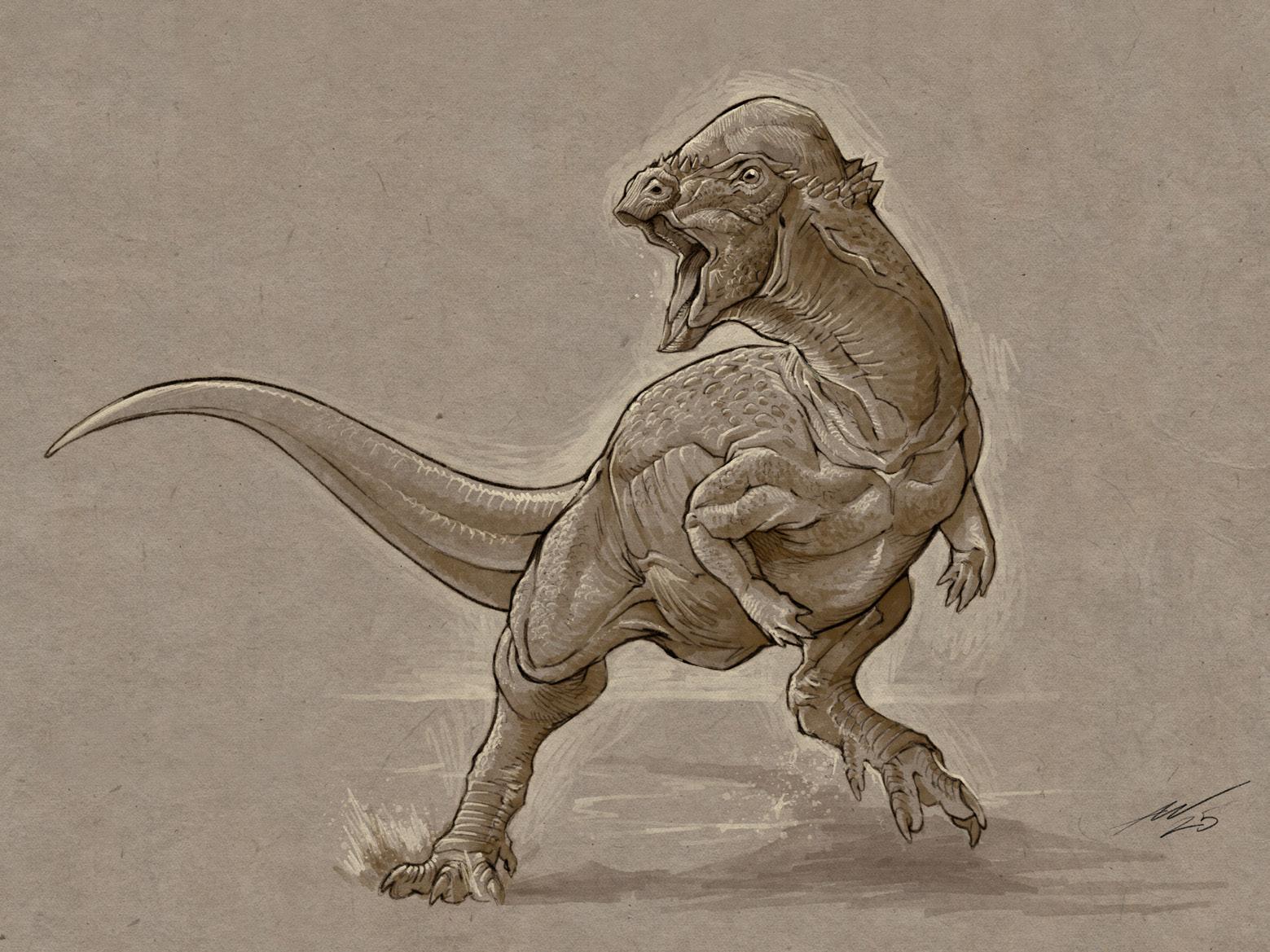
Earlier this fall, paleontologists announced the discovery of a new species of dome-headed dinosaur, Brontotholus harmoni, from the Two Medicine Formation in western Montana. Estimated to be around 75 million years old, the bones from this 10-footlong beast are the first ever found of this species of pachycephalosaur, known for thick, domed skulls they may have used for combat.
The find is an exciting new addition to the diverse cast of dinosaurs that roamed what is now the northern Great Plains during the late Cretaceous period. Although the Two Medicine Formation has been studied for decades, the discovery shows that this area still holds hidden surprises. It also provides a clearer picture of how ecosystems in this region changed over the course of geologic time.
Many fossils of this new species were discovered by Museum of the Rockies (MOR) field crews and are now housed in the museum’s paleontology collections. FWP has a long-standing agreement with MOR to host paleontological research on agency lands, though the latest find was discovered off state property.
Each summer, museum staff lead a multi-week field excursion in Makoshika State Park, drawing scientists and
students from around the world. The field program has produced a wealth of new data about the park’s fossil resources and provides hands-on training for the next generation of paleontologists.
MOR serves as a repository for paleontological remains recovered from FWP lands, and many of the specimens in the museum’s galleries were originally excavated from properties the agency manages.
FWP’s Heritage Program also relies on MOR specialists to help evaluate how proposed projects might damage fossils, as FWP is required to do by state law. Their expertise ensures that development and stewardship decisions consider the scientific value of these irreplaceable materials. FWP staff have sometimes also helped discover new fossils since field crews, maintenance staff, and seasonal employees cover a lot of ground in the course of their daily duties.
To dig deeper into the science and learn more about Brontotholus harmoni, visit the Zoological Journal of the Linnean Society at academic.oup.com/zoolinnean
Anyone who finds a fossil on FWP state parks or other lands should report it to the department at 406-594-4322. A quick photo and location description can make all the difference. You never know when a small observation might lead to a big discovery. n
New Outdoor Hall-of-Famers
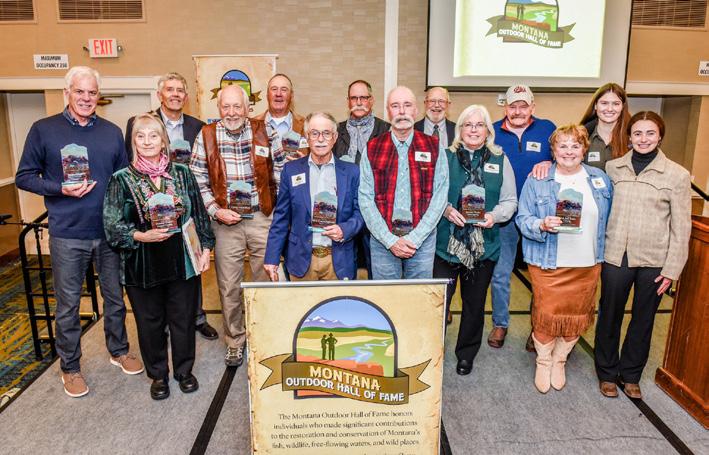
This past December, the Montana Outdoor Hall of Fame (MOHF) announced its 2025 inductees at an awards dinner held in Helena. This marks the sixth time MOHF has celebrated Montana “conservation heroes” since the awards began in 2014. The awards also gave special recognition to the 16 Held v. Montana youth plaintiffs, whose lawsuit in 2023 successfully argued before the Montana Supreme Court that the state’s constitutional rights to a “clean and healthful environment” applied to climate effects from energy projects.
To read the biographies of the 2025 inductees listed below, visit mtoutdoorhalloffame.org
• Bill Cunningham (Choteau)
• Thomas “Hobnail Tom” Albin Edwards (1899–1975)
• Sean Gerrity (Bozeman)
• Clarence “Clancy” Conrad Gordon (1928–1981)
• Rick and Susie Graetz (Missoula)
• Jim Jensen (Helena)
• Robert “Robbie” Magnan (Poplar)
• Wallace “Wally” McRae (1936–2025)
• Greg Munther (Missoula)
• Teddy Roe (Billings)
• Chris Servheen (Missoula)
• Jeanne-Marie Souvigney (Livingston)
The Montana Outdoor Hall of Fame Class of 2025, including two youth Held v. Montana plaintiffs, at the December celebration dinner in Helena.
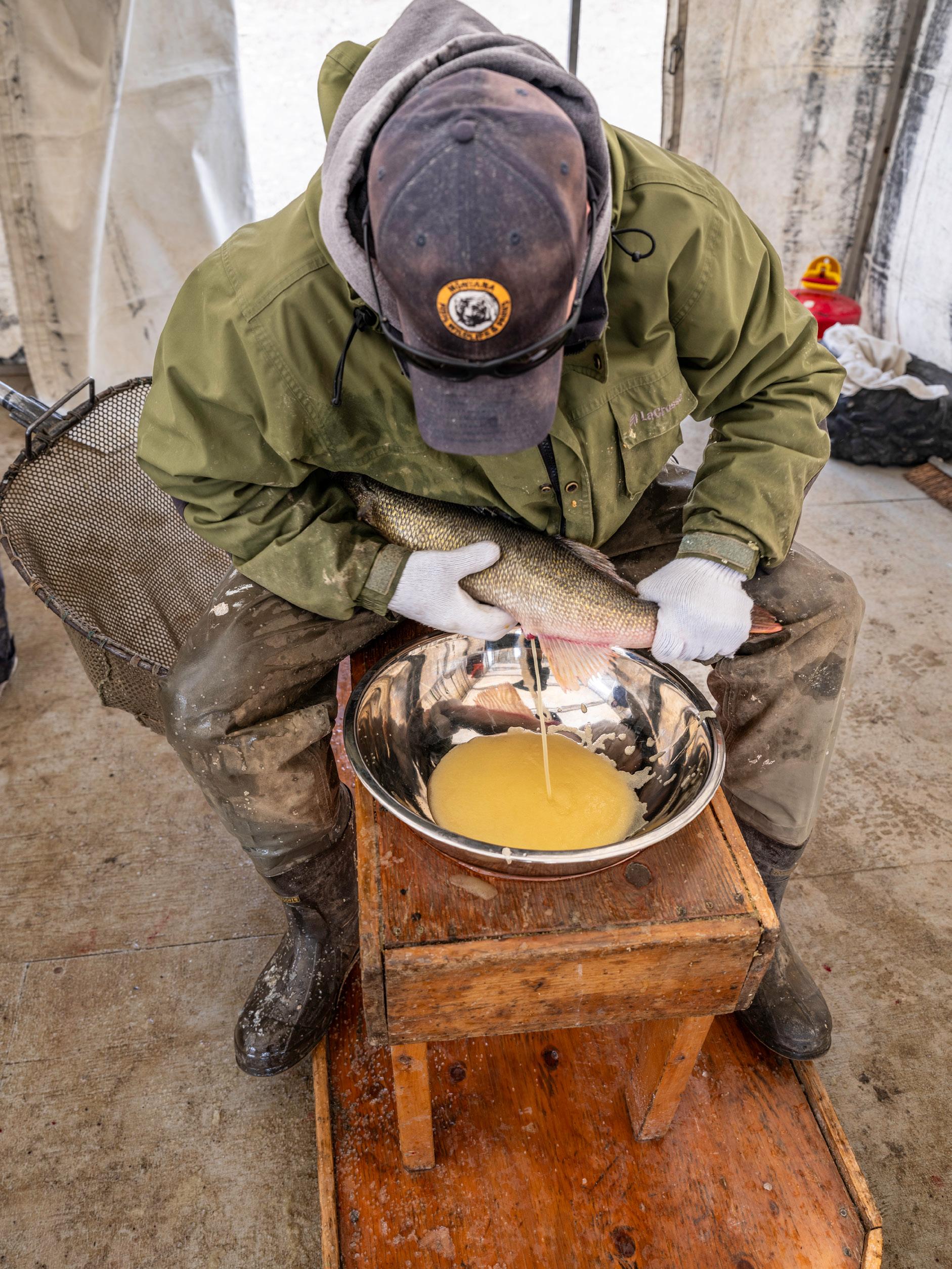
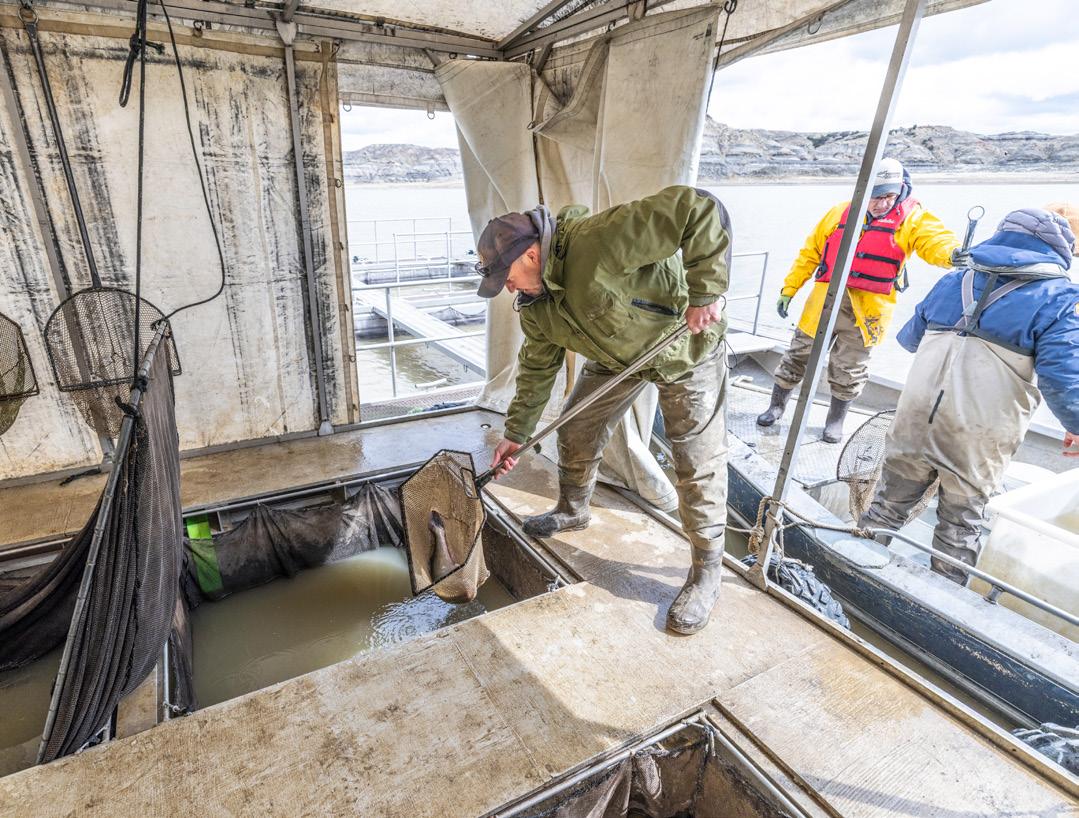
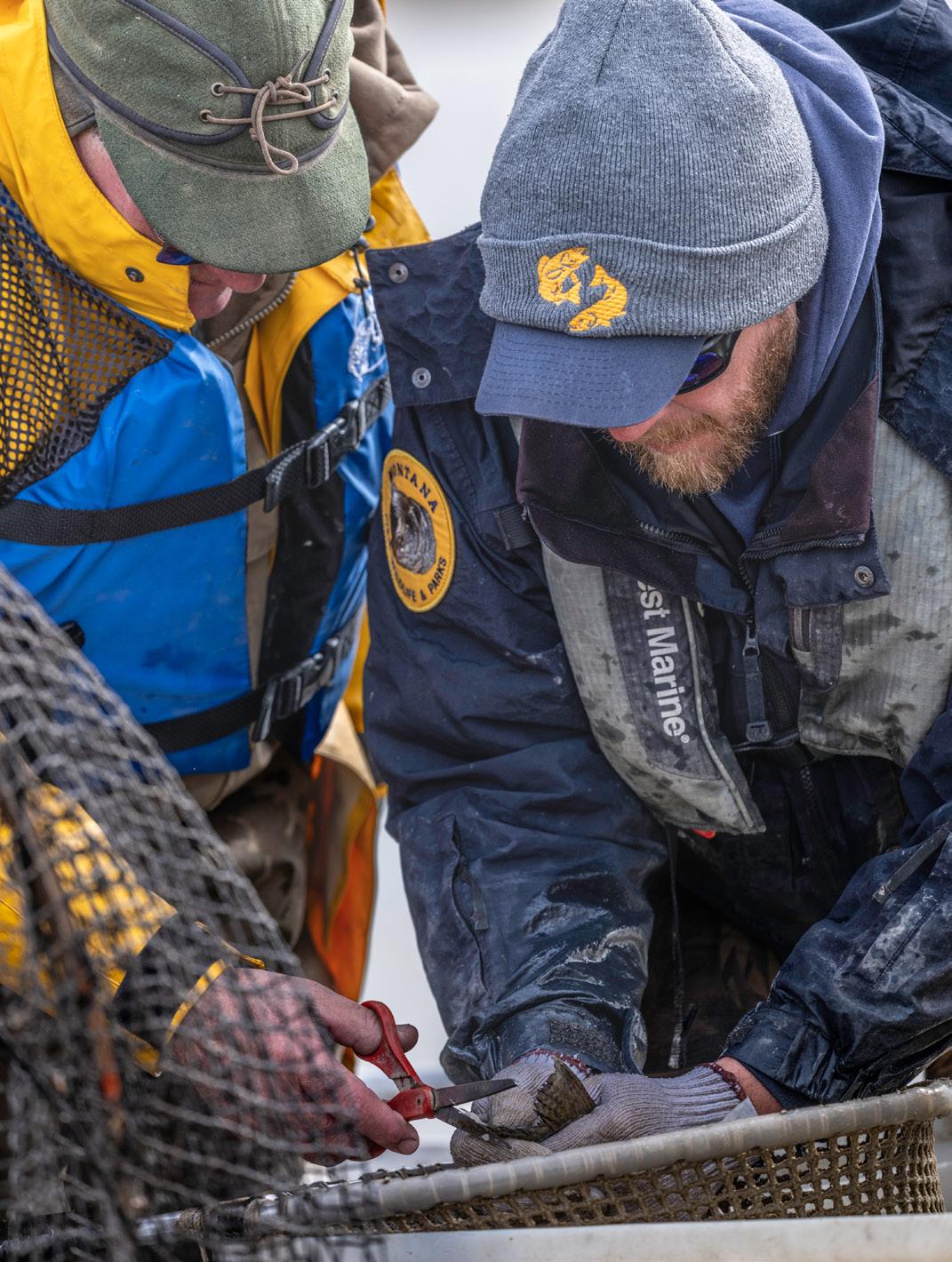
FUTURE FISH A gentle press on the belly of a walleye releases milt or eggs that will be used to help sustain Montana’s walleye fisheries. Afterward, these fish are safely returned back into Fort Peck.
ALL HANDS ON PECK
Collecting 60 million walleye eggs from pitching boats in freezing weather and whitecaps takes grit, dozens of volunteers, and a surprising number of turkey feathers.
BY ANDREW MCKEAN. PHOTOS BY SEAN R. HEAVEY
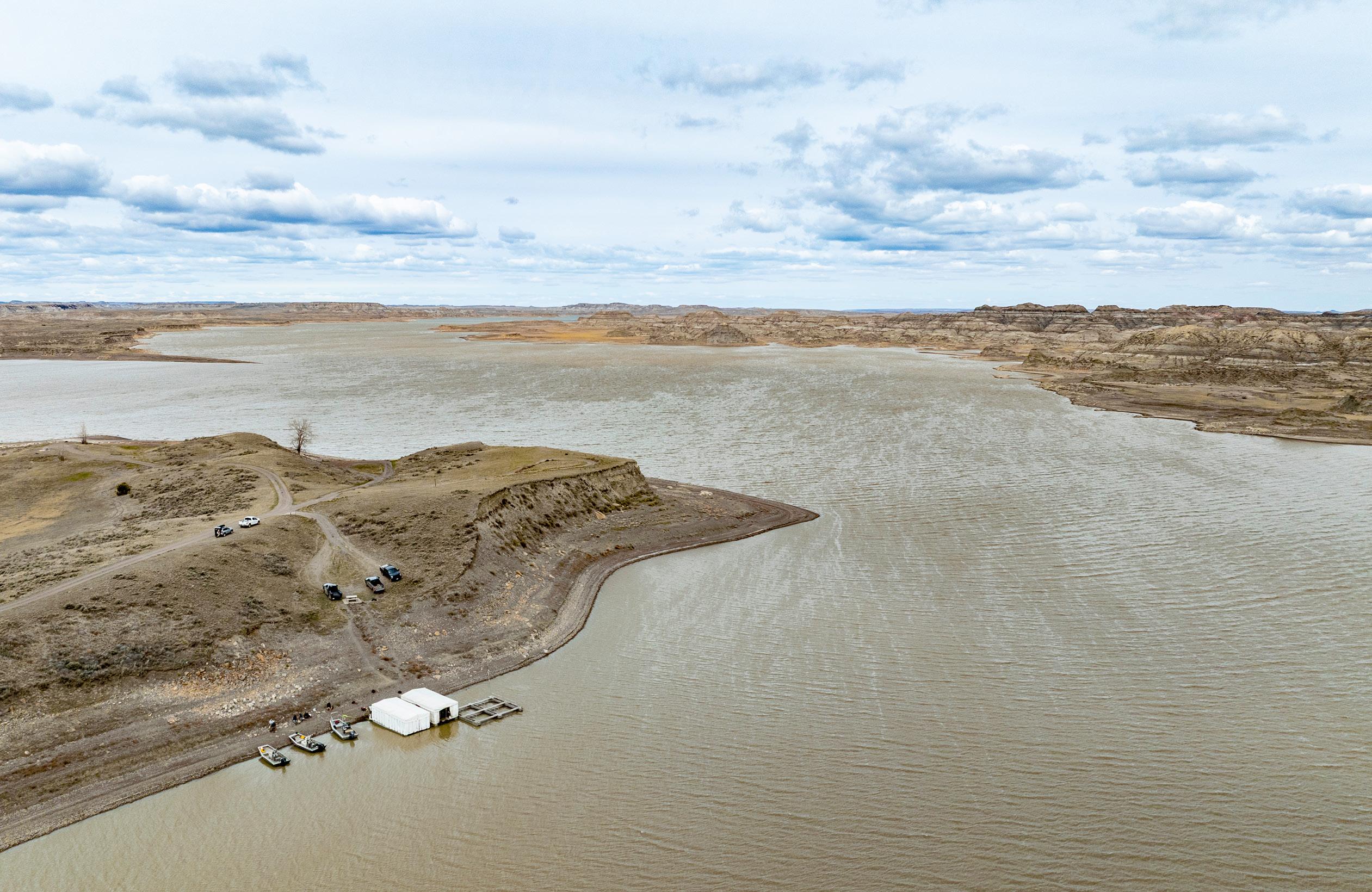
IF YOU CATCH A WALLEYE IN MONTANA, there’s an excellent chance it started life as an egg squeezed out of the belly of its mother by a burly FWP worker perched on a fourlegged stool in a temporary spawning barge nosed up to the wind-whipped shoreline of Fort Peck Reservoir.
April’s annual Fort Peck “spawn,” as it has come to be known, supplies walleye fry and fingerlings back to the reservoir. It is also the source of every walleye stocked statewide. This “assisted reproduction” is especially important in years when conditions hamper natural reproduction.
“There’s limited natural spawning habitat in Fort Peck to begin with, and low reservoir elevations leave rock and gravel substrates high and dry,” says Heath Headley, Fort Peck Reservoir fisheries manager for Montana Fish, Wildlife & Parks. “And in some years with high reservoir elevations and spring runoff, we’ll see walleye and all
variety of other fish species trying to navigate some pretty skinny water to spawn,” he says, flocking to tributaries like Big Dry Creek on the lake’s southeast arm. “I mean, you can see their fins sticking out of the water. I look at our spawning operation as essentially giving walleye a hand.”
Actually, hundreds of hands. The annual Fort Peck walleye spawn, which marked its 25th year in 2025, is the fisheries equivalent of a bucket brigade. Dozens of volunteers work shoulder to elbow with FWP staff to capture wild walleye, extract their eggs, mix them with milt (fish sperm), and transport them to hatcheries where they’re incubated, reared, and eventually planted back into Fort Peck and more than a dozen other Montana waters as juvenile fish.
Fort Peck owes its reputation as a trophy walleye fishery to this cold, gritty, demanding, and often surprisingly euphoric work. Unlike egg-collection efforts in the sterile
and controlled environment of fish hatcheries, the Fort Peck spawn starts in the windy wild of the Big Dry Arm, just after ice leaves the sprawling reservoir. While hatcheries often use captive broodstock for egg production, Fort Peck’s source is wild fish.
The abundance and size of wild walleyes are influenced by dozens of variables. Fluctuating reservoir levels determine the type and amount of vegetation that hides juvenile walleye from predators. Shoreline conditions influence the number and type of prey fish that grow the predatory walleye to the size anglers want to catch.
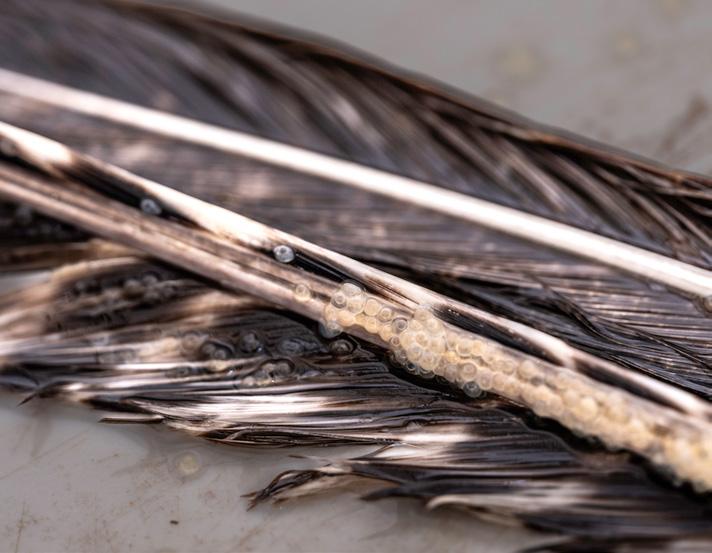
When it all comes together, years of consistent growth allow a mature female walleye to pack on as many as 200,000 eggs, each the size and consistency of a tapioca pearl.
HELPING HANDS
Because of the massive scale and compressed timeline of the spawn (last year’s operation
collected nearly 60 million individual walleye eggs from around 400 females in 15 days), FWP relies on dozens of volunteers. Some are avid anglers who view the spawn as an opportunity to give back to the resource they enjoy. Others cherish the camaraderie created by hard and unusual work. And for others, like Doug Voigt from Red Lodge, it’s a welcome getaway during a slack season.
“It’s sort of an in-between time for a Montana outdoorsman,” says Voigt, a perennial volunteer who joins the spawn crew at the Nelson Creek Fishing Access Site on Fort Peck’s Big Dry Arm. “I camp out here and fish in the evenings, when I can. I’ve seen some great weather when the spawn was done in five days, and I’ve seen it so cold that the reservoir froze back over. It’s something different every year.”
One constant, aside from a custom Fort Peck walleye spawn baseball cap every volunteer receives, is Bill Viste, a 21-year veter-
Andrew McKean is the hunting editor for Outdoor Life and a frequent contributor to Montana Outdoors. He lives on a ranch outside of Glasgow.
an of FWP’s Fort Peck crew who coordinates volunteers, making sure each day and shift is covered.
“It’s quite a balance,” says Viste. “You want dependable people, because our staff really relies on these volunteers. But every year somebody cancels at the last minute and we’re scrambling to fill in. I maintain a list of backups who I can call in an emergency.”
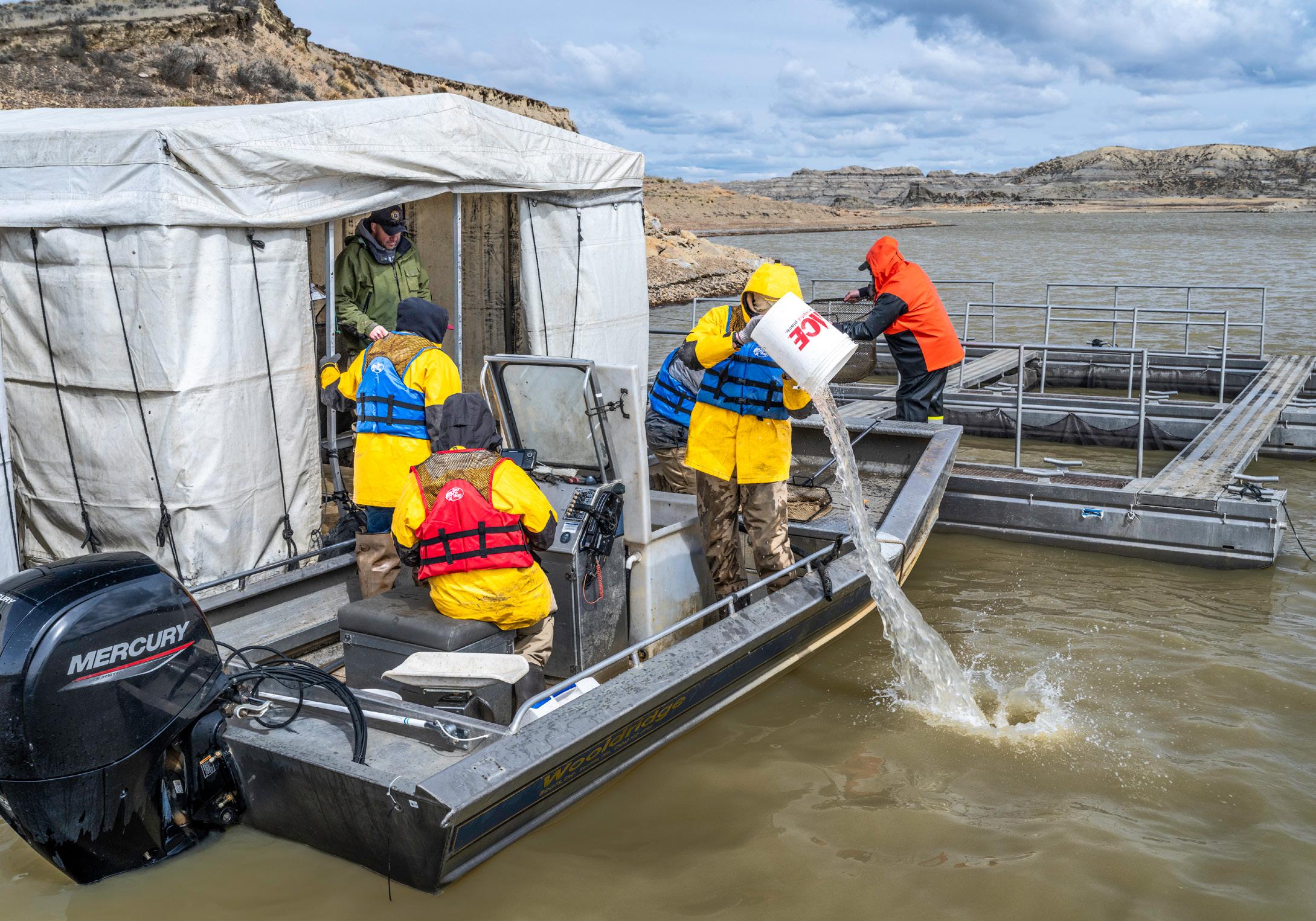
Viste stresses to volunteers to pack a hearty lunch because the work won’t be easy or comfortable. The spawn takes place on the remote, tumbleweed-strewn shoreline at least 40 miles from the nearest retail establishment. April can bring sunburns or sideways snow, sometimes in the same day. It’s wet, muddy, and often physical work for volunteers, who help FWP fisheries staff on boats check trap nets set up overnight to catch spawning walleye cruising the shoreline.
INSIDE THE SPAWN
Each morning of the spawn starts with collecting these wild fish from the pre-set nets. Walleye are just one species in the mix. Northern pike, channel catfish, river carpsuckers, burbot, white suckers, shorthead
redhorse, goldeye, cisco, black crappie, yellow perch, common carp, and smallmouth buffalo also thrash and writhe in the nets. Volunteers help FWP staff weigh, measure, and document the impressive diversity.
“You get to handle fish that most people can’t imagine seeing,” says Hal Pavelis, a Billings contractor who’s been volunteering for about 10 years. “Today we pulled up a 29-inch, 11-pound, 9-ounce walleye. That’s a world-class fish.”
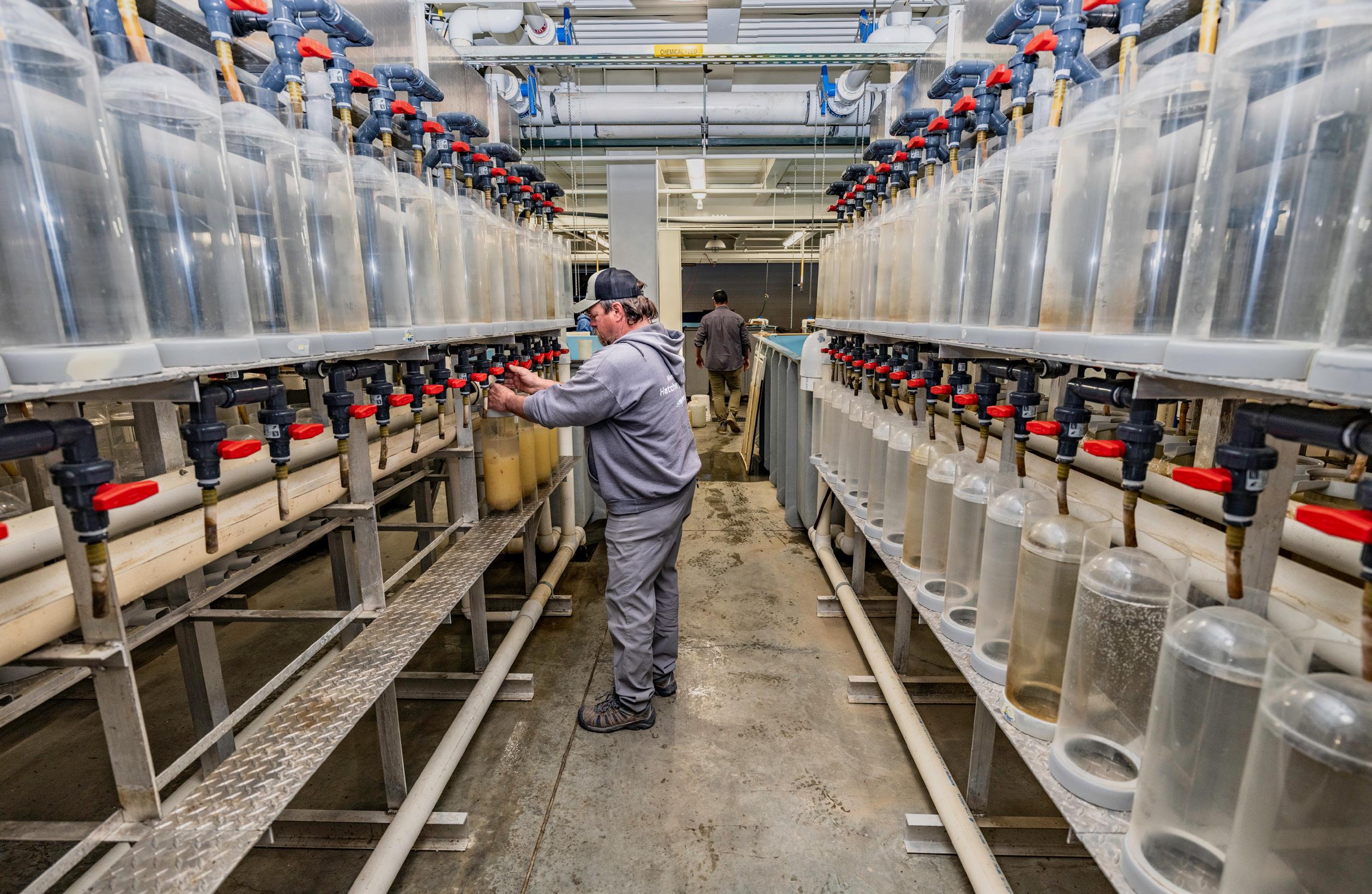
While other species are released back into Fort Peck, the walleye are placed in holding tanks on the boats, then delivered to FWP’s twin spawning barges. These custom-made pontoon boats with canvas sides (like a wall tent) are tied up along the shoreline in a wind-protected cove a short boat ride from the trap nets.
The operation is a mash-up of sophisticated aquaculture and farmyard improvisation—part chemistry lab, part milking barn. Wade Geraets, manager of FWP’s Fort Peck Hatchery, whose crew does most of the actual egg and sperm gathering, calls it “assisted reproduction.” Hatchery staff in rubber overalls gently press on the bellies of
SPAWNING SHELTERS On Fort Peck’s Big Dry Arm south of Glasgow, FWP docks custom pontoon boats that function as floating fish spawning huts.
“Today we pulled up a 29-inch, 11-pound, 9-ounce walleye. That’s a world-class fish.”
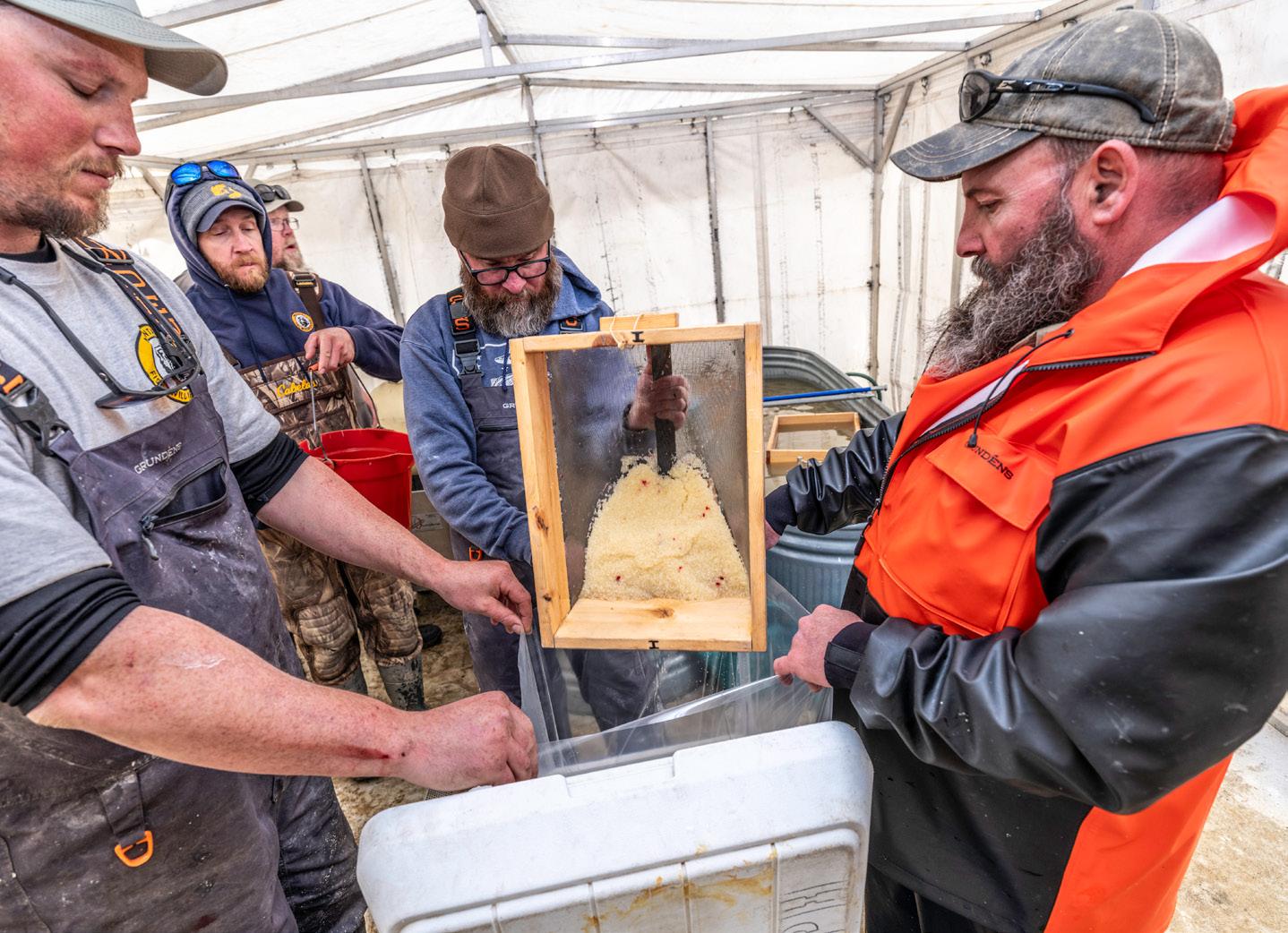
PROLIFIC BUCKET BRIGADE For 25 years, legions of volunteers have stood shoulder to shoulder with FWP staff to collect walleye from nets before their eggs and sperm are harvested and the fish are returned back into the reservoir. This work is the source of every walleye stocked statewide.
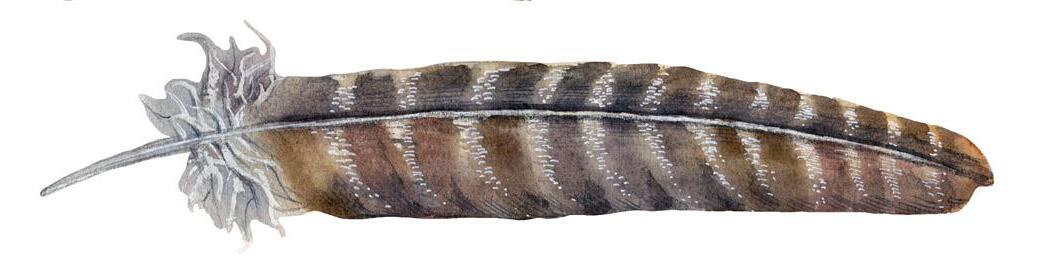
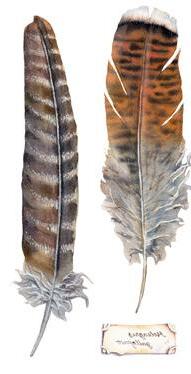
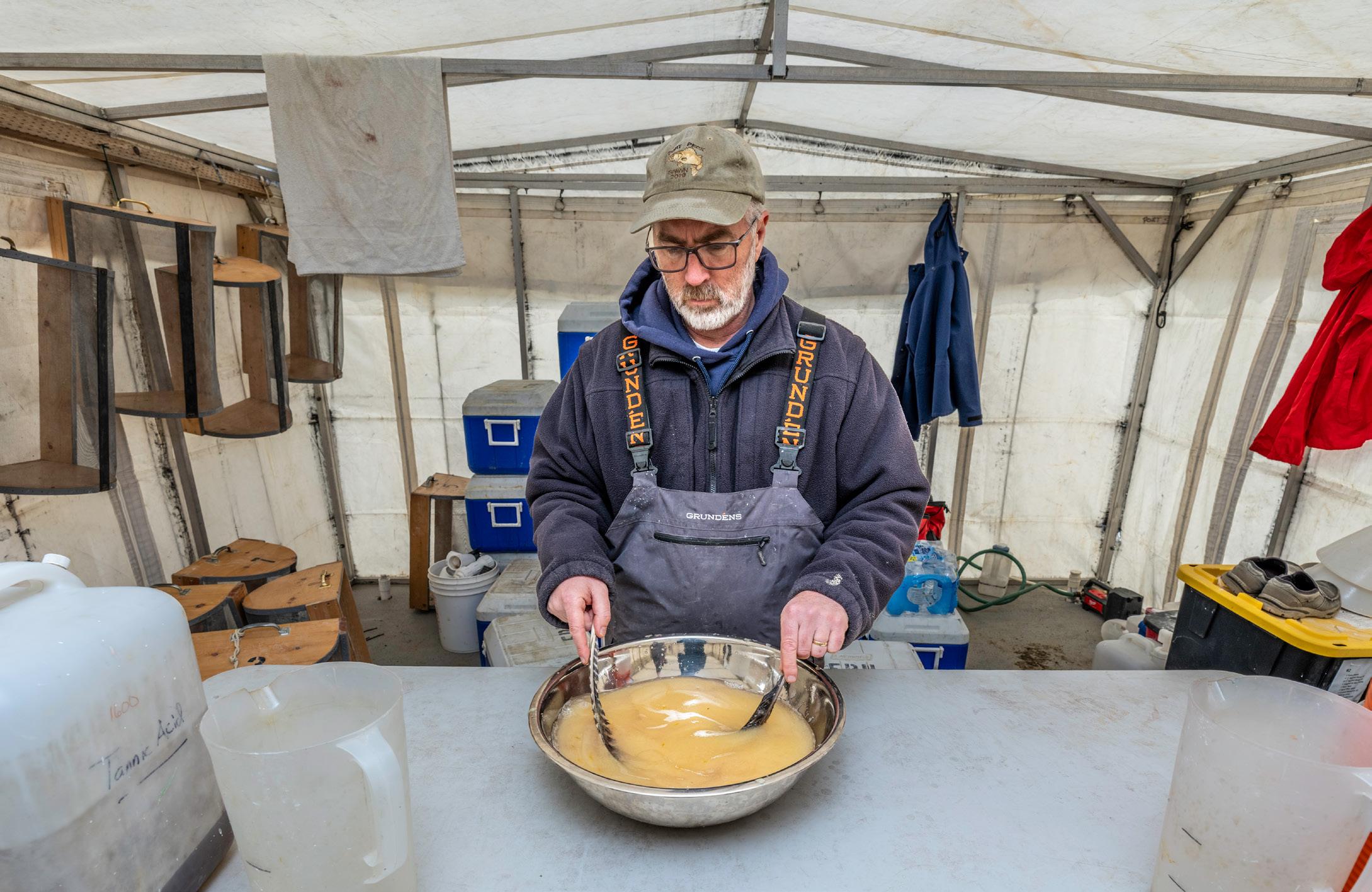
MIX MASTER TURKEY FEATHER Retired
FWP hatchery bureau chief Jay Pravecek uses wild turkey feathers to mix a slurry of walleye eggs and milt, mimicking the gentle wave action of the reservoir.
the male and female fish to release their milt and eggs into stainless-steel kitchen bowls before safely returning fish back into the reservoir.
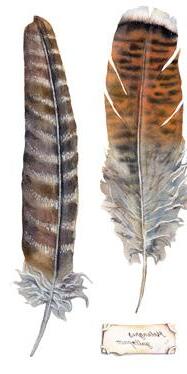
The egg slurry is then ushered to the fertilization table, where Tupperware-type containers hold walleye sperm treated with a glucose formulation to extend shelf life. Hatchery employees use a science-classroom microscope to confirm that the milt is viable, then delicately stir it in with the eggs using perhaps the least high-tech yet most ingenious tool in the process—a wild-turkey wing feather, which helps mimic the gentle wave action of the reservoir.
The operation is a mash-up of sophisticated aquaculture and farmyard improvisation—part chemistry lab, part milking barn.
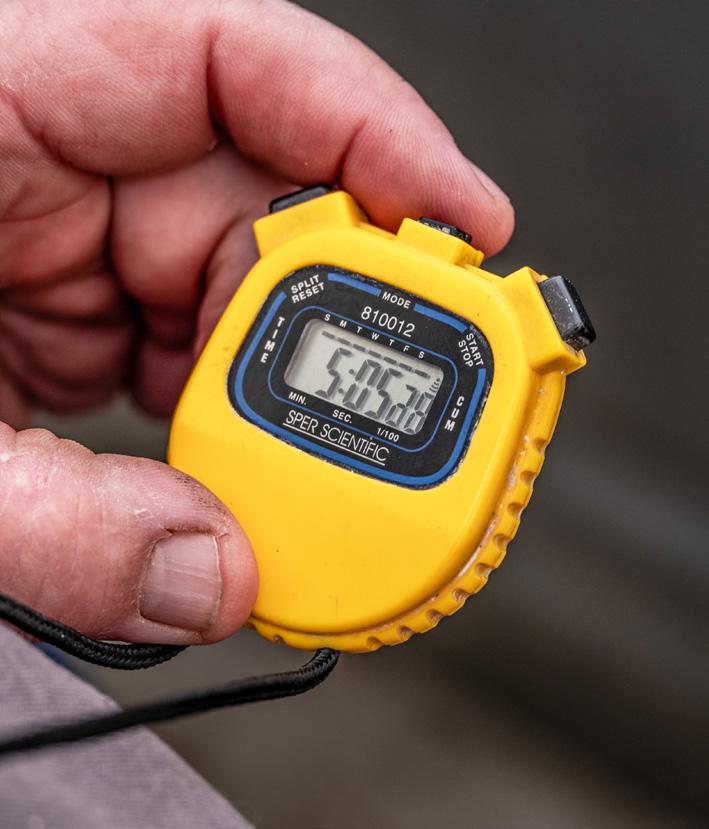
Stopwatches measure precise durations. Clipboards record the quarts and gallons produced. Geraets tracks progress toward the annual goal of gathering 60 million fertilized eggs.
Diatomaceous earth (a naturally occurring silica powder) is added to the slurry to prevent the fertilized walleye eggs from clumping. The eggs are then gently rinsed and water-hardened in screen-and-lath cradles in galvanized stock tanks. Industrial-grade water filters sift out fine sediment and unwanted organisms.
Once eggs leave the barge, pure oxygen is piped into the holding bags as they make the
hour-long drive to the Fort Peck Hatchery, where they’re incubated for several weeks.
Disinfection intensifies once eggs reach the hatchery, Geraets explains.
“All wild eggs that are brought in are immediately disinfected with an iodine solution before coming into the main hatchery area to remove pathogens,” he says.
Ultraviolet light and another filter further clean the Missouri River water that oxygenates the fertilized eggs in the hatchery. In the field, adult walleye that contribute eggs and sperm are randomly biopsied to confirm that they’re healthy and not introducing a novel fish pathogen into the hatchery ecosystem.
RECIPE FOR REPRODUCTION Fine-tuning their formula across more than two decades of spring spawning events, FWP staff have honed a meticulous, multi-step method to fertilize walleye eggs using a blend of handmade and store-bought equipment, ranging from items you’d find in most kitchens or garages to instruments purpose-built for a fish lab. The Fort Peck Hatchery manager calls the process “assisted reproduction.”
FRACTURE
Pressure makes…triploids?
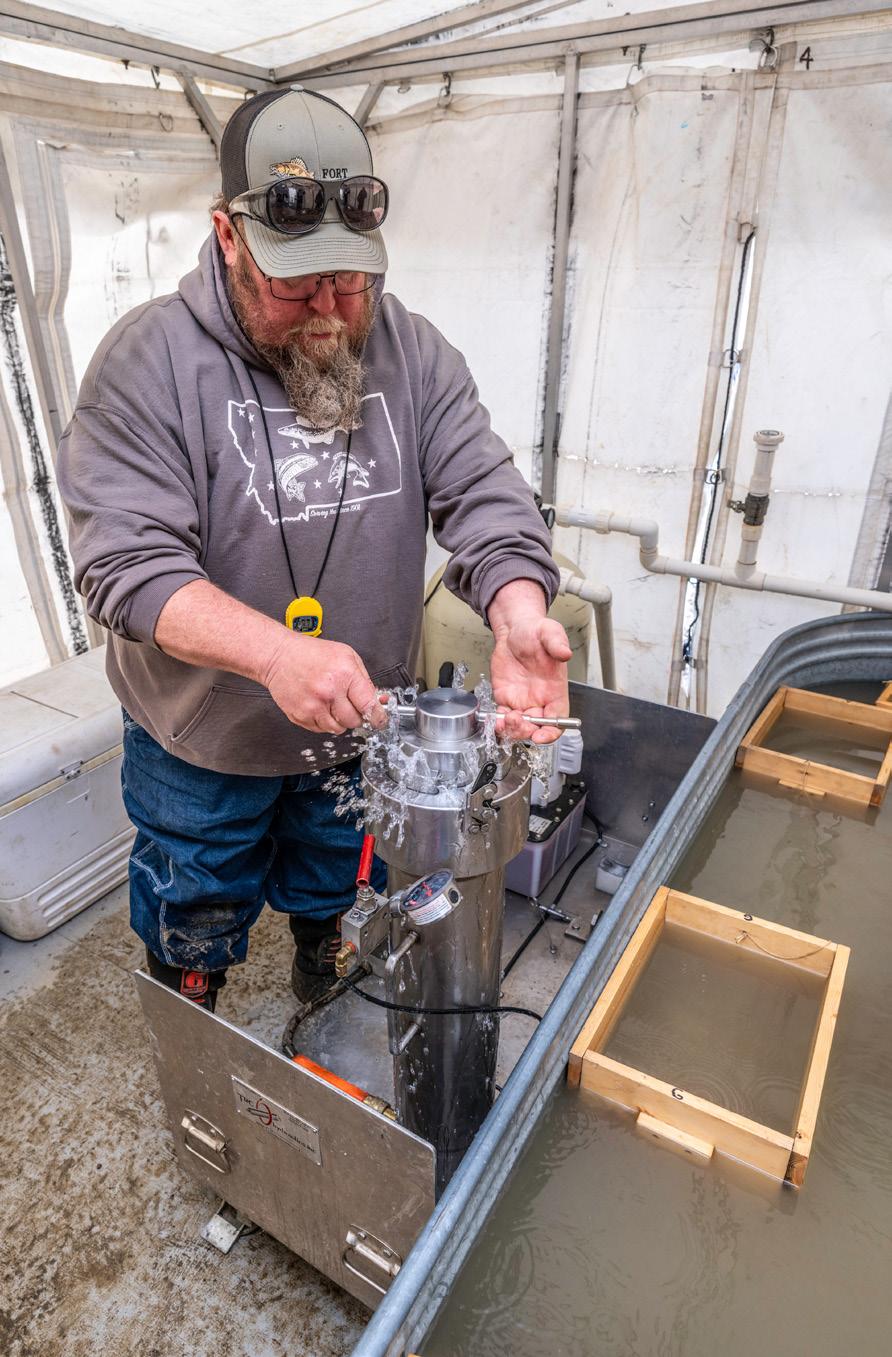
In a corner of a Fort Peck walleye spawn barge, a stainless steel canister the size of an artillery shell waits for service. It’s a pressure chamber, and an example of the applied science of the Fort Peck walleye spawn.
Fertilized walleye eggs are placed in the chamber, the lid of which screws down like a submarine hatch, then subjected to intense pressure for several minutes. This renders the fish produced from these eggs, called triploid walleye, to be entirely sterile. They serve an important management goal in select waterbodies. In Montana, all triploid walleye are bound for Yellowtail Reservoir, often called Bighorn Lake.
FWP supplements the walleye population in Yellowtail to ensure good fishing for anglers, but the agency also has an obligation to protect the large population of native sauger in the Yellowtail Reservoir/Bighorn River system, which Montana shares with Wyoming. Walleye can outcompete sauger because they spawn at the same time and in the same places.
Indeed, many waterbodies shared by both species are home to “saugeye”— hybrids of native sauger and non-native walleye.
By planting sterile triploid walleye, fisheries managers supplement Bighorn Lake’s popular walleye population without harming the native saugers. This year the Fort Peck spawn contributed about 5.5 million of these specialized fish eggs.
COMPRESS
Fort Peck hatchery manager Wade Geraets locks down the lid on the triploid pressure chamber used to produce sterile walleye.
CULTURE CLUB
The weeks-long effort is orchestrated by FWP’s hatchery staff and the Fort Peck fisheries crew—department employees who typically focus on different things.
“It’s such a large operation that covers so many facets of biology and fish culture, that you can’t have one without the other,” says Headley of the combined campaign.
In the weeks after Geraets’s hatchery staff incubates eggs and transfers the tiny walleye larvae to rearing ponds to grow larger, crews plant millions of fry and later 1.5-inch walleye fingerlings in the warming waters of Fort Peck Reservoir and other Montana lakes and
Last year, of the 59 million eggs collected in April, Fort Peck received 21 million fry and 1.8 million fingerling walleye.
reservoirs. Last year, of the 59 million eggs collected in April, Fort Peck received 21 million mosquito-size fry and 1.8 million pinkie-sized fingerling walleye. Tongue River, Fresno, and Nelson reservoirs, and 13 other waters received fry or fingerling walleye reared in both FWP’s Fort Peck and Miles City hatcheries. Certain fisheries are stocked every year, others biennially.
Walleye fry tend to be stocked in waterbodies that warm gradually in early spring, helping support abundant zooplankton that fry feast on to grow larger. Fingerlings, meanwhile, are put where fickle water temperatures limit zooplankton production
or where swarms of predatory fish would quickly gobble up the slower fry.
It all starts with dedicated volunteers, which both Headley and Geraets will attest are vital to the success of the Fort Peck walleye spawn.
“Apart from the work they perform, volunteers bring a ton of energy, which is often needed when we run this operation seven days a week for typically three weeks, and sometimes longer depending on the conditions,” says Headley. “It gives me a little needed boost when I see someone get excited about all the fish we handle, elevating it from a job to something more.”
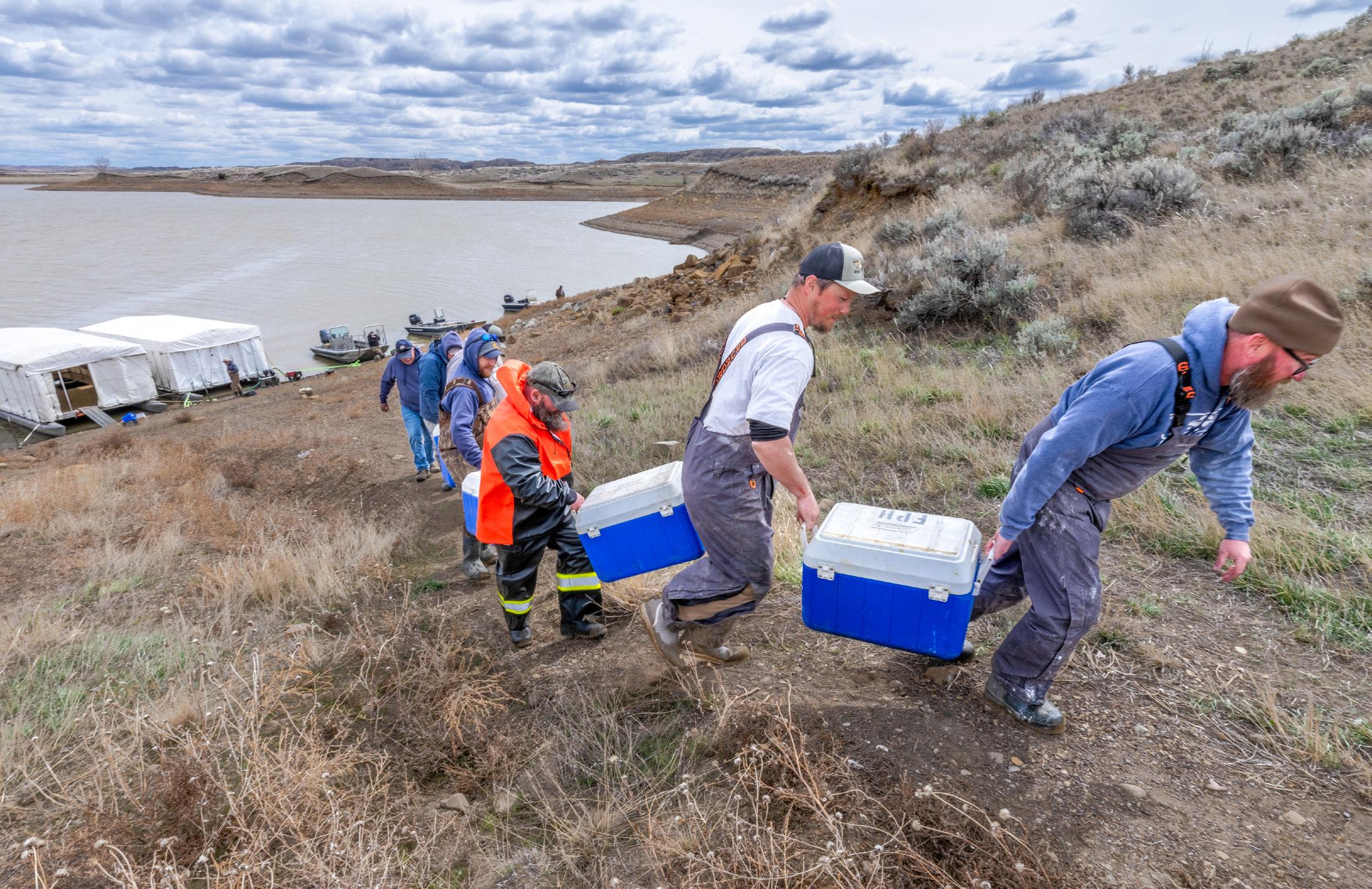
OFF TO THE RACES Volunteers and FWP staff transport precious cargo—fertilized walleye eggs— from lakeside spawning tents to the hatchery nearby.
For a video of staff and volunteers working the annual walleye spawn, visit qr1.be/XLPLMM
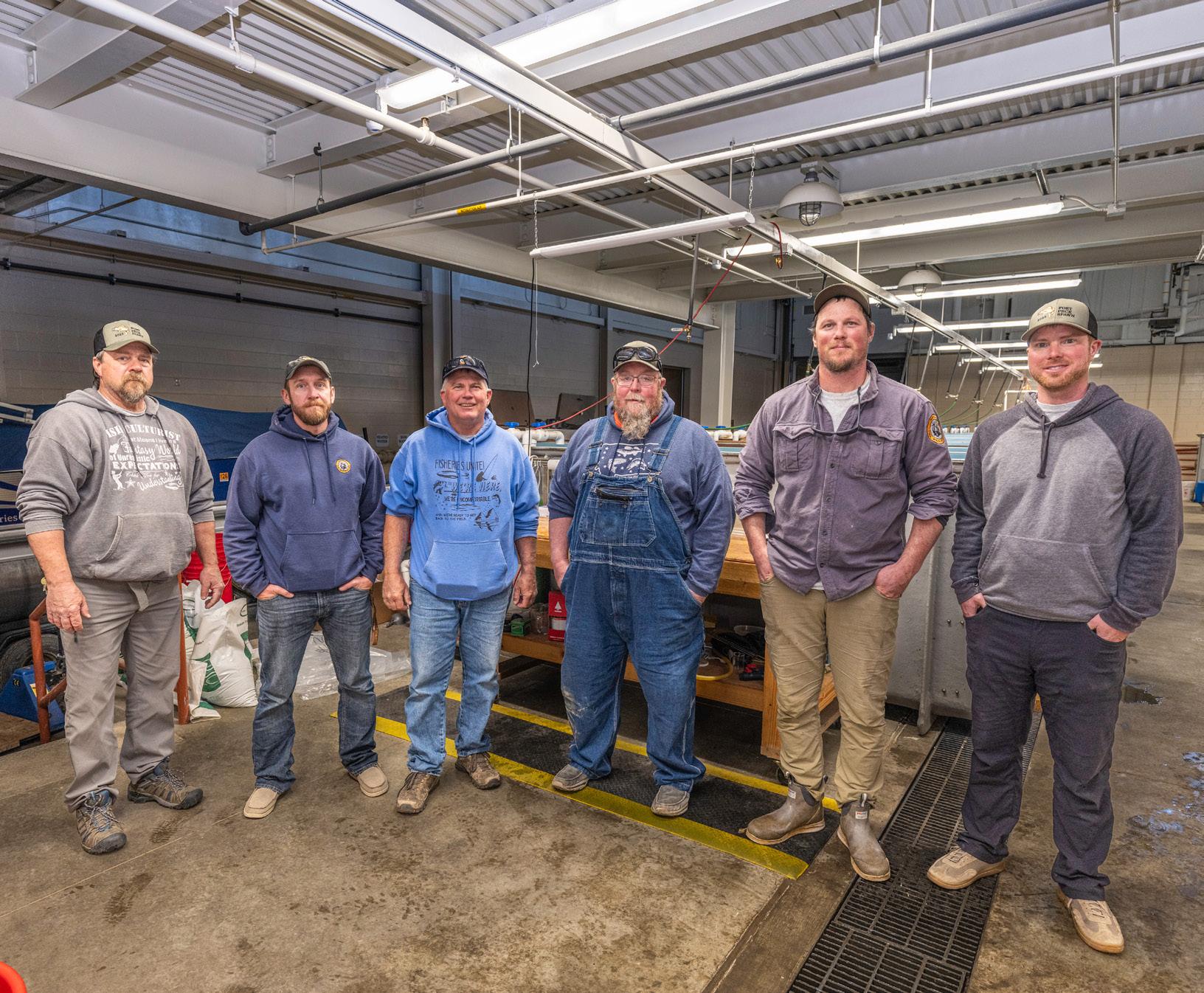
TEAM WALLEYE The Fort Peck spawn brings together FWP fisheries and hatchery staff, all committed to maintaining Montana’s legendary walleye fishing. The FWP crew is backed by dozens of volunteers who donate hours and days to help with the egg-take operation. “You get to handle fish that most people can’t imagine seeing,” says one Billings resident who has volunteered for the past 10 years.
NEST EGGS Matt Baxter, hatchery fish culture specialist, places fertilized walleye eggs into incubation cylinders at the Fort Peck Hatchery.
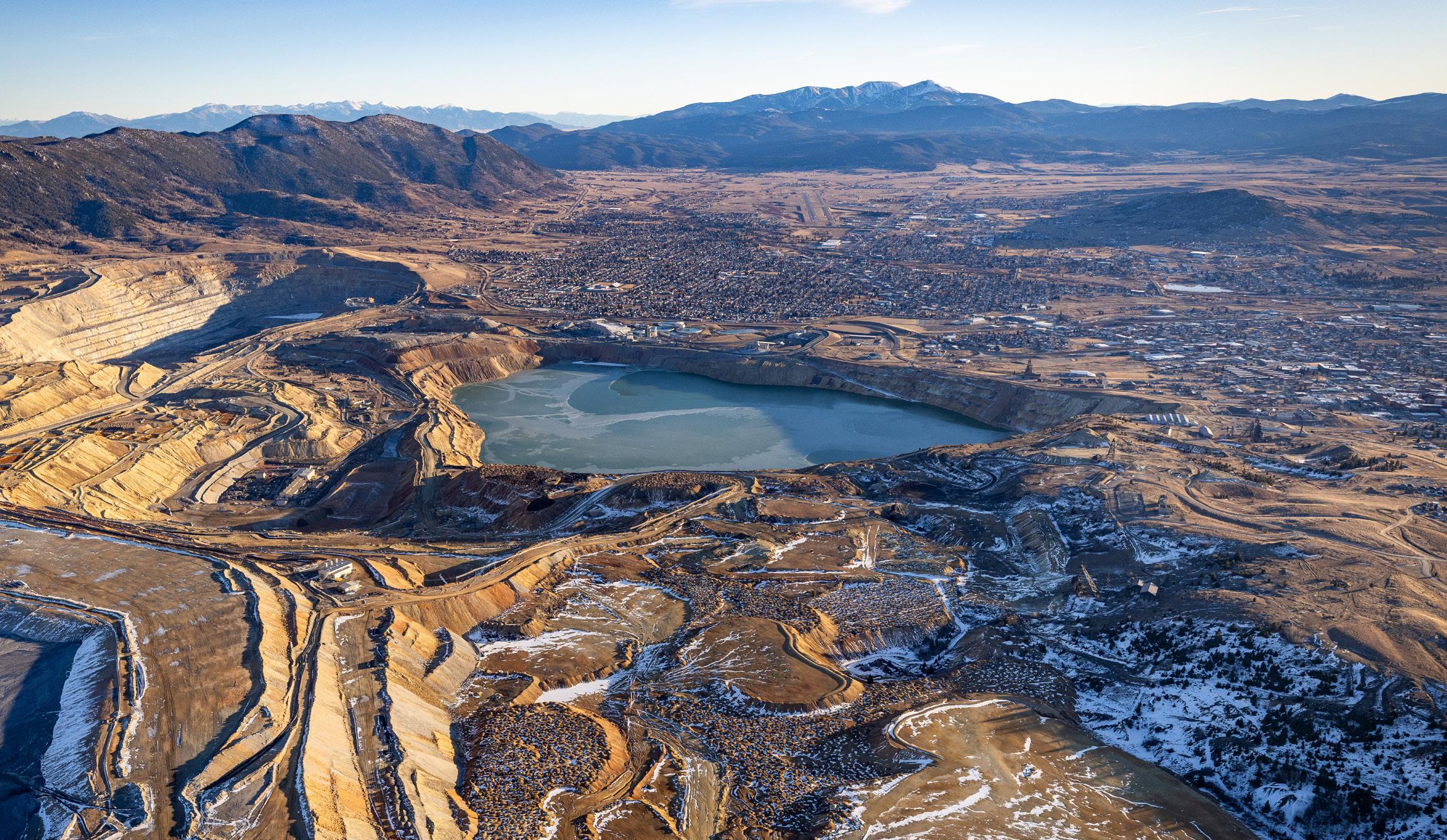
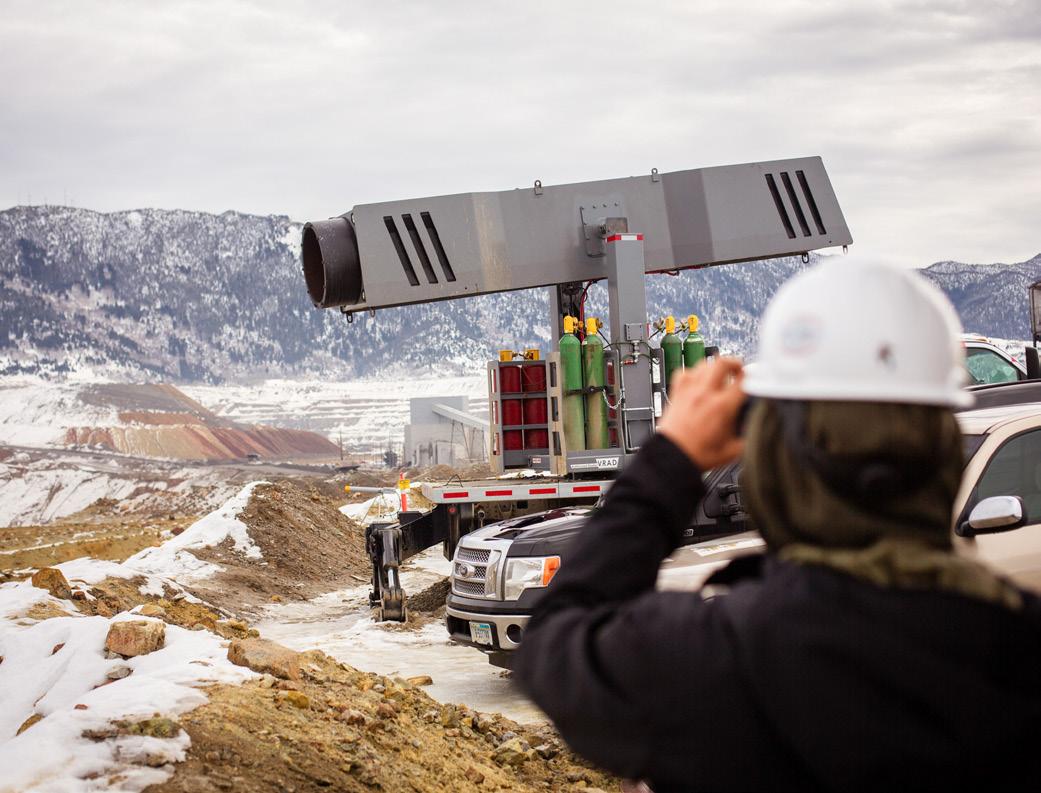
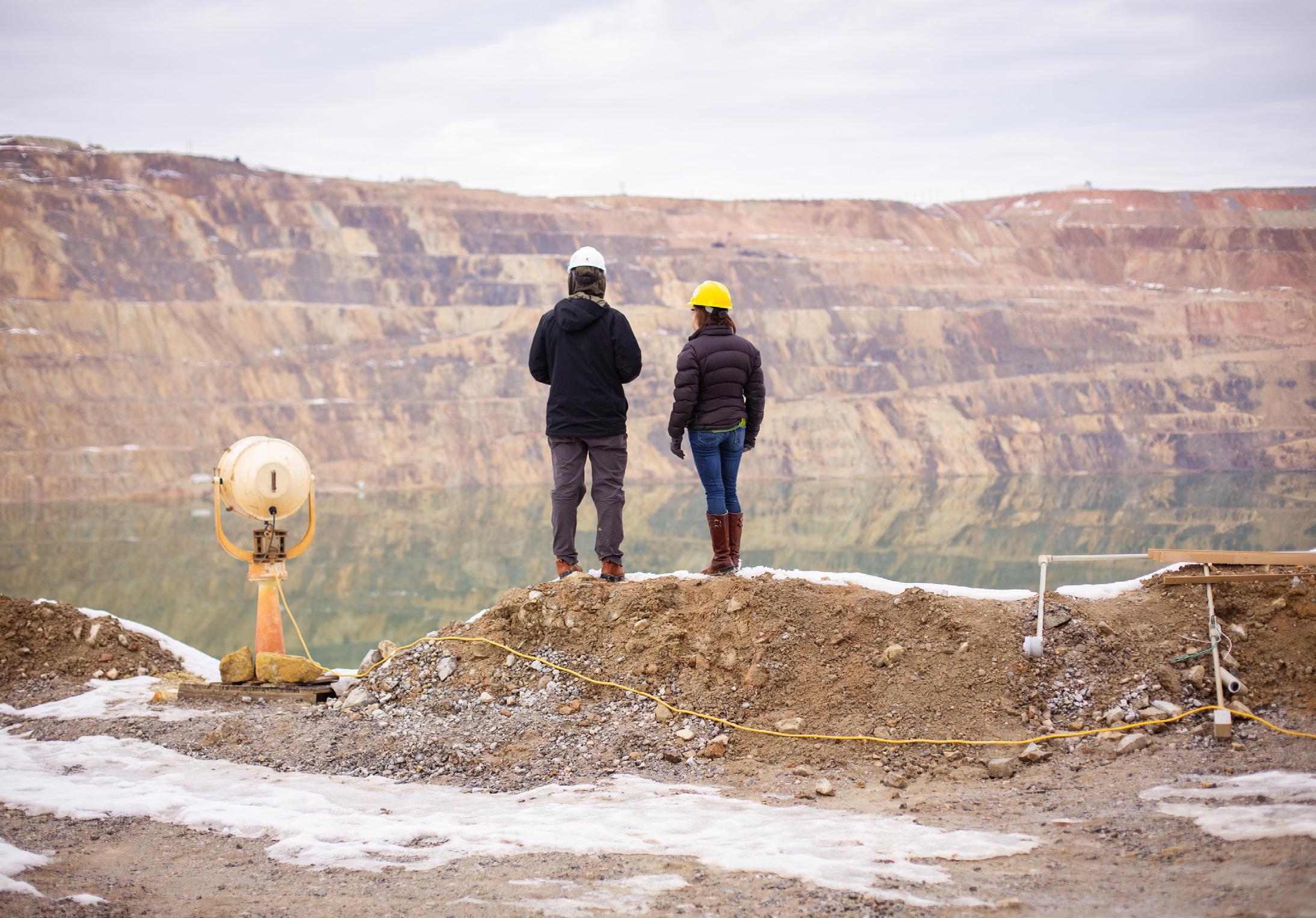
RISKY BUSINESS A former open-pit copper mine, the Berkeley Pit cradles a mile-long lake that formed after mining stopped in 1982 and dewatering pumps were shut off. Its acidic mine-waste water is fed by groundwater flowing through 10,000 miles of underground tunnels from Butte’s long history of hard-rock mining. PHOTO BY MARK MARIANO/PITWATCH
Scientists are figuring out how to keep Butte’s Berkeley Pit from killing waterfowl.
BY NADIA WHITE
In November 2016, 60,000 migrating snow geese collided with an intense winter storm, forcing them to land on the acidic waters of the Berkeley Pit in Butte.
The popular legend is that they died an instant and gruesome death. That’s not the case. Most of the birds rested and flew off, continuing their migration. But 3,000 geese that lingered on the water for several days perished, sparking a multifaceted, scientific effort to better understand the interplay between the massive toxic lake and waterfowl. Ten years on, those efforts are paying dividends.
A group that would become the Waterfowl Advisory Committee began meeting in January 2017. Montana Technological University biology professor Dr. Stella Capoccia was co-chair, along with Gary Swant, a retired high school biology teacher from nearby Deer Lodge and a well-known Montana birder.
“We started sitting around a table with a yellow notepad trying to figure out the best approach,” Capoccia says, looking back. The committee’s goal was to find moreeffective ways to keep waterfowl off the acidic, heavy metal–laced water of the pit. They focused on four guiding questions: They wanted to understand which waterfowl are most likely to visit the pit; why large flocks occasionally land there; which species are most likely to be harmed; and how different species respond to various kinds of hazing to shoo them away.
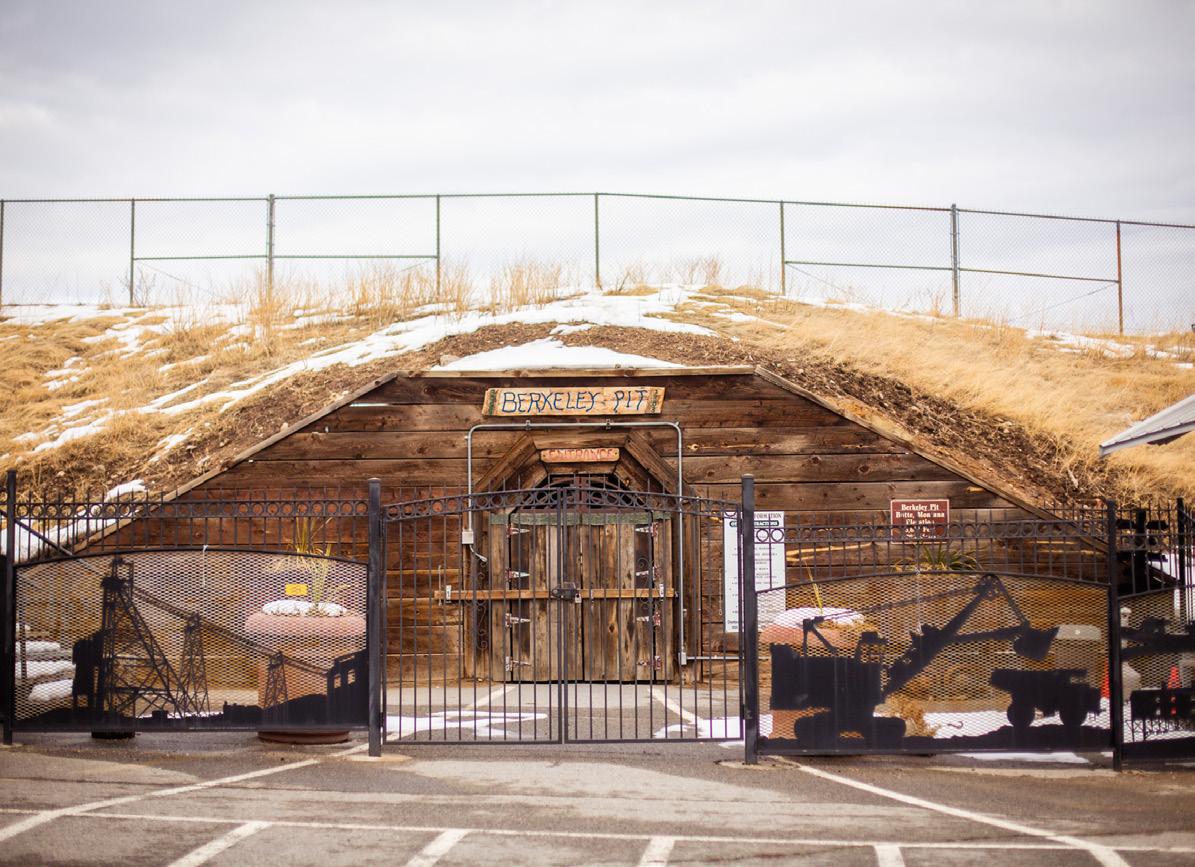
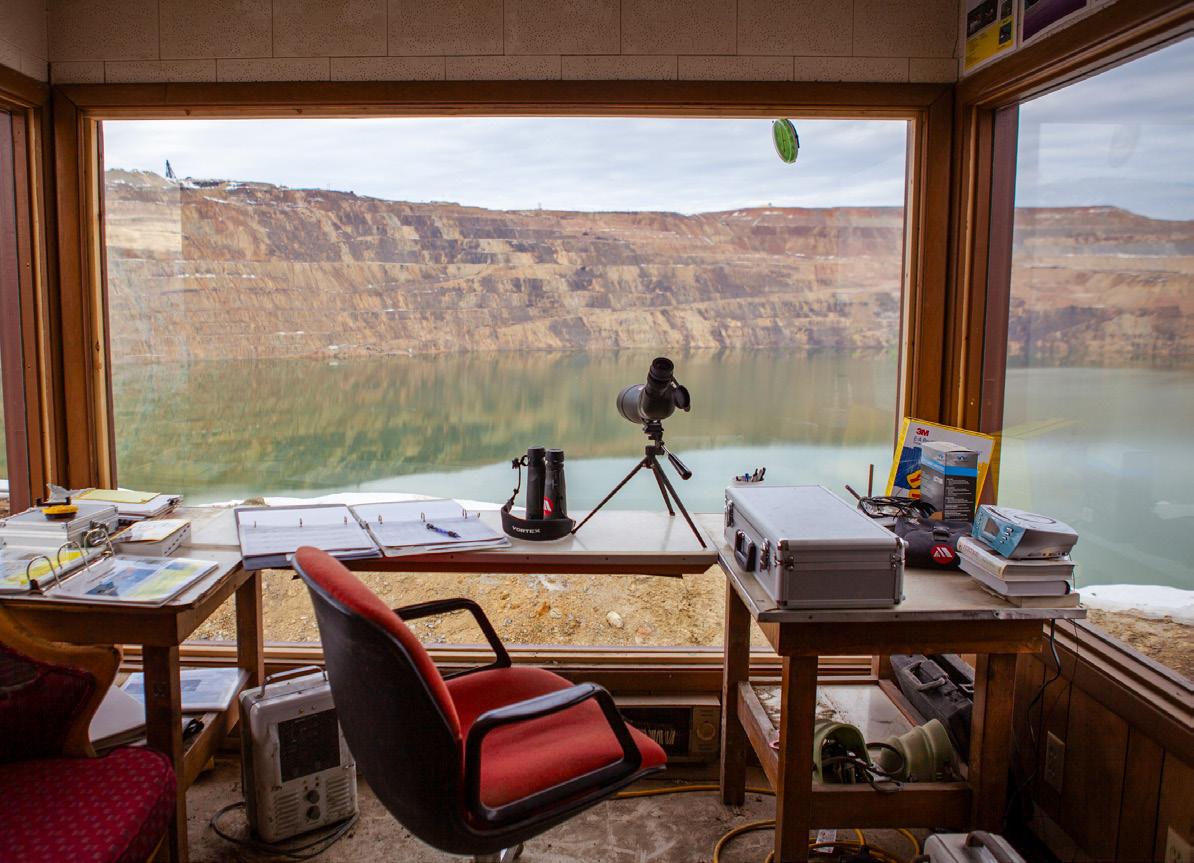
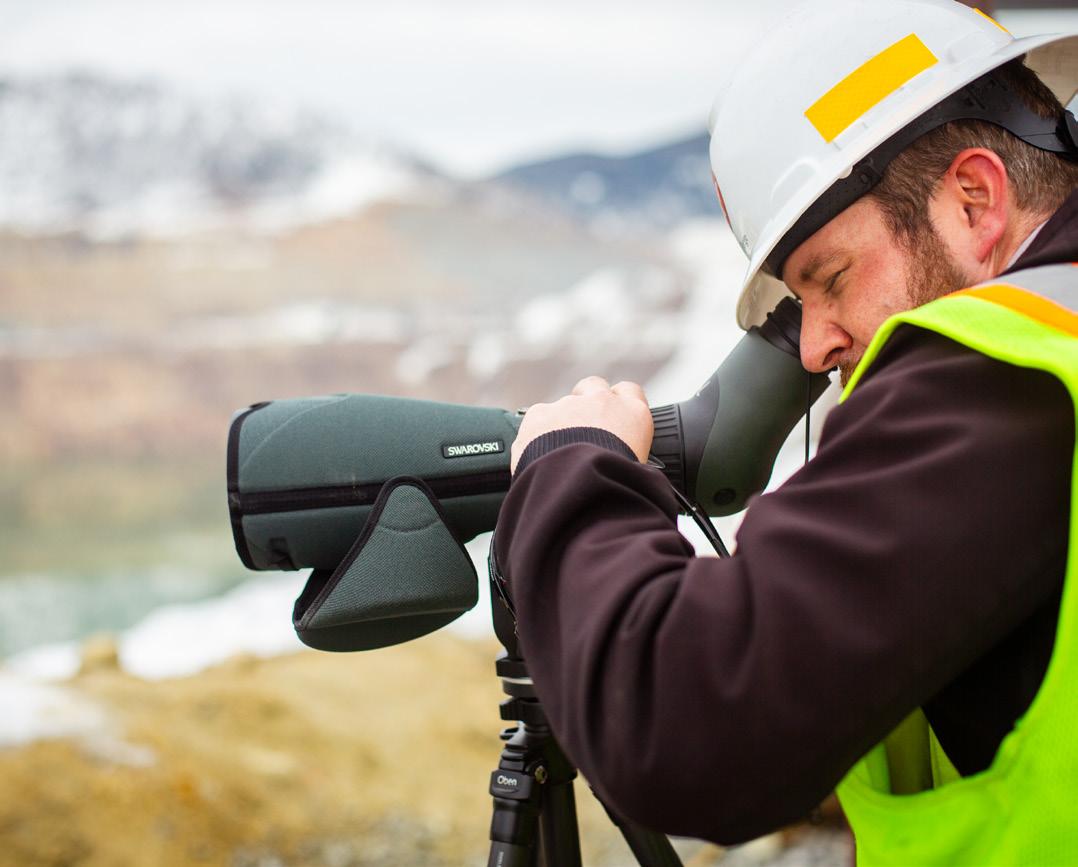
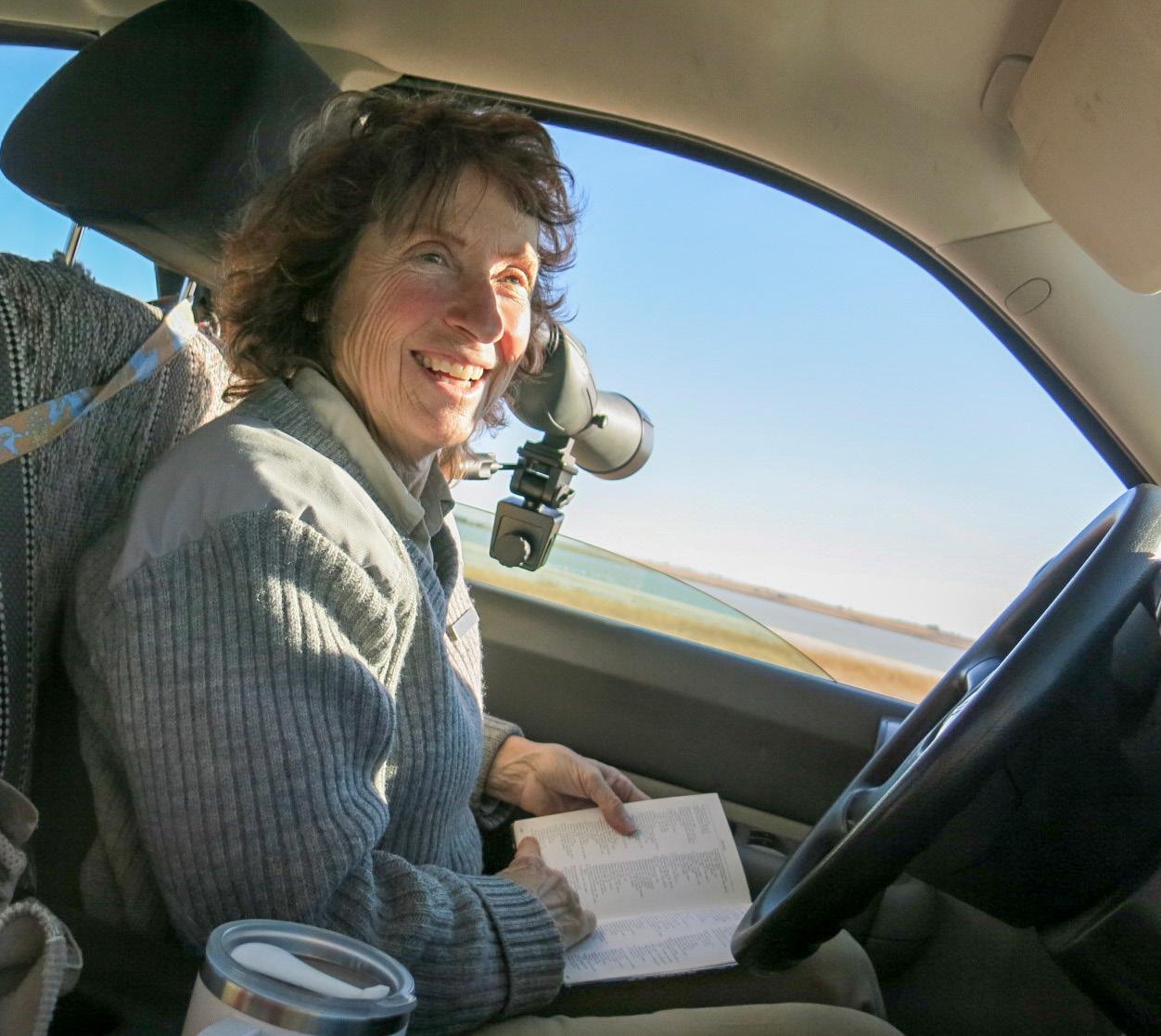
SEARCHING FOR SOLUTIONS The “Richest Hill on Earth,” Butte (above) supplied more than 20 billion pounds of copper since mining began in the 1880s, at one point producing 41 percent of the world’s supply. Open pit mining began in 1955 near the Berkeley Mine shaft, and the name of that older mine stuck. The Berkeley Pit now hosts a visitor center with a viewing platform accessible through a small tunnel (opposite, top left), attracting throngs of tourists. The Pit's 900-foot-deep toxic tailings pond, meanwhile, attracts more than 50 species of water birds, which miners from a neighboring mine help identify using a custom bird manual (opposite, top right) and spotting scopes (opposite, bottom right). These Montana Resources employees visit the “Bird Shack” (opposite, bottom left) perched on the edge of the Pit to survey the water once an hour most days to note the species and numbers of any birds that might have landed.
The [Pit’s] water has a pH of roughly 4.2, about the same as tomato juice or beer. It’s not battery acid, but it’s no milk bath, either.
An eclectic team of Montanans dedicated themselves to gathering data that might answer these questions: biologists, restoration experts, a hospice nurse from the Flathead, a retired U.S. Air Force meteorologist, all working to understand birds that haven’t arrived yet, on water that researchers cannot touch. Gradually, the group has figured ways to help keep birds from perishing in the Pit.
“Now we have a well-oiled machine that continues to improve,” Capoccia says.
WHY THE WATER IS DEADLY
Perched over a mile high in elevation near the Continental Divide on the edge of Butte, the Berkeley Pit is among the nation’s greatest mining mitigation challenges. A former
Nadia White is an associate professor at the University of Montana’s School of Journalism, where she directs the master’s program in environmental science and natural resource journalism.
open pit copper mine, it now hosts a large manmade lake a mile long and a half-mile wide created after the mine closed in 1982 and dewatering pumps were shut off. The acidic mine-waste water is more than 900 feet deep, fed mostly by groundwater flowing through 10,000 miles of underground tunnels from Butte’s long history of hardrock mining.
During the decades when the Pit was being dug, those tunnels were exposed to air. Iron pyrite on the surface of the bare rock reacted with oxygen, and once water flooded in, it further reacted. That produced sulfuric acid that increased the acidity of the water and the amount of dissolved minerals, including toxic levels of copper and zinc.
The water has a pH of roughly 4.2, about the same as tomato juice or beer. It’s not battery acid, but it’s no milk bath, either. Various treatments have made it less acidic than it used to be, but it remains inhospitable to most organisms.
FORECASTING FALLOUTS
When large numbers of migrating geese are forced to land suddenly, it’s referred to as a “fallout.” Some 342 geese died on the Pit in a 1995 fallout. Before that, “the thought of migratory waterfowl landing on the Pit was not on anyone’s mind,” Capoccia says. Those deaths ignited a marked shift in approach.
Miners were central to this effort, recruited to track the comings and goings of waterfowl. The historic Pit is next to the Continental Mine, an open-pit copper and molybdenum mine operated by Montana Resources, which at the time oversaw federally mandated reclamation of the Pit, designated in 1987 as a Superfund site.
Montana Resources diverted miners from their work to take a shift at the “bird shack,” a plywood hut perched 200 feet above the water of the Pit. From 1995 to 2017, they recorded each species of waterfowl that landed on the water, the time and date it landed, and whether hazing tech-
niques such as electronic noisemakers and fireworks moved it on.
Following the 2016 goose deaths, Swant, the retired teacher, instructed miners in the nuances of bird identification. This allowed them to make more detailed observations to help answer the Waterfowl Advisory Committee’s four key questions.
After seven more years of data collection, Capoccia, Kaleb Starr at Montana Tech, and Dr. Brian Balmer of the U.S. Fish & Wildlife Service published their research on the relative risk that different species face on the Pit.
From 2017 to 2024, 54 species of waterbirds landed on the Pit—a total of 62,666 individual birds. Of those, 99.8 percent eventually flew away, while 0.2 percent—92 birds from 17 different species—died. Some species seemed unaffected. Hundreds of American wigeons and northern pintails landed on the water, but none died.
Snow geese made up a quarter of the 92 birds that died. Like most migrators, they
tend to take off when the sun comes up or after they’ve rested for a few hours, and the vast majority of snow geese that land on the Pit fly away without issue.
But birds that stay for hours to a day or more—or whose response to hazing is to dive—are more likely to die. The birds perish when they drink the water, which eats away at their esophagus and stomach lining. The data showed that canvasbacks, mallards, and northern shovelers have a higher risk, with 10 deaths each. Snow geese are especially vulnerable, says Mark Mariano, a restoration ecologist leading waterfowl protection efforts at the Pit, because they “gorge drink,” consuming vast amounts of water during their migratory stopovers. “If they stay longer than 18 hours at the Pit, they could be in real trouble.”
FOCUS ON FREEZOUT
Knowing when large numbers of at-risk waterfowl might arrive at the Pit is essential
Migration is an exhausting thing. They can’t fly and fly forever. They have to stop, and if they stop at the Pit that can be a real problem.”
so crews can be ready to monitor the birds and scare off those that land. Those efforts start 100 miles north.
Freezout Lake Wildlife Management Area rests at the southern tip of an international staging area for snow geese and other water birds. Fewer birds tend to show up there during the fall migration south, which holds greater risks than the enormous northbound flights of spring.
Driven south by winter storms, fall migrators seldom have the option of turning back or waiting. This mass movement also includes vulnerable young birds making the trek for the first time. And the warming climate has left some migratory birds less able to fatten up in preparation for fall travels.
“Migration is an exhausting thing. They can’t fly and fly forever,” says Brent Lonner, a Montana Fish, Wildlife & Parks biologist at Freezout Lake Wildlife Management Area. “They have to stop, and if they stop at the Pit that can be a real problem.”
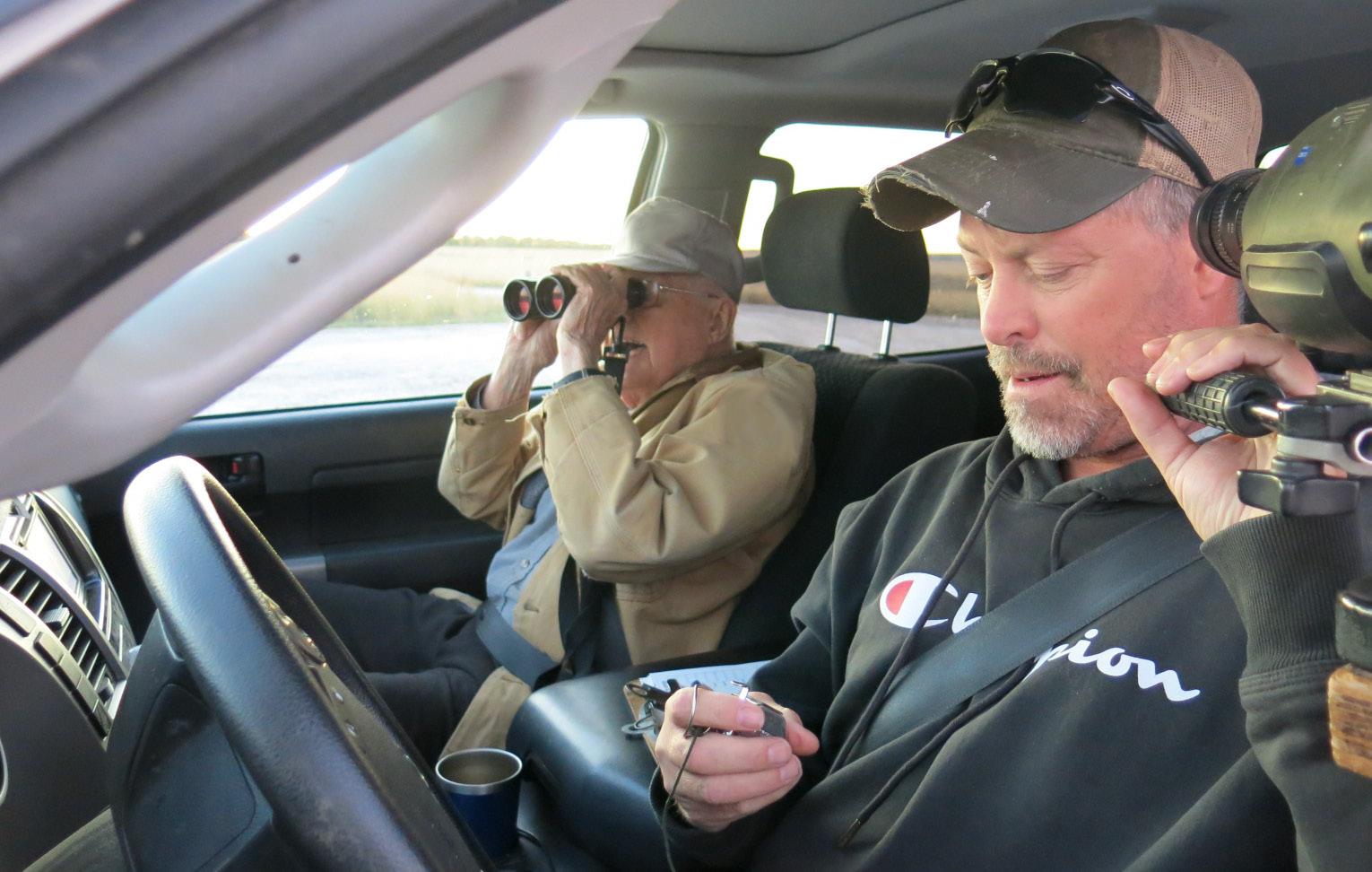
At dawn during spring and fall migration, Mike and Brian Schwitters drive around Freezout, counting and identifying geese and tundra and trumpeter swans. The migrations at Freezout led Mike, an avid birder, to settle in Choteau after retiring from his job as a U.S. Air Force meteorologist.
He went on to develop the definitive birder’s checklist for the area. Now that he’s 86, his son Brian does a lot of the counting,
driving his father on the familiar migration season routine. They count swans and geese in the early morning before those birds take off to continue their migration or to feed in the neighboring barley and wheat fields.
More light is required to identify the various ducks on the ponds. That’s Nancy Milewski’s specialty. After 20 years providing hospice care in rural Montana, she reached out to the Freezout Lake WMA office seeking volunteer opportunities. She wasn’t an avid birder, but she was ready to help in any way she could. “I came in looking for a happy place, because nursing can be hard,” she says. She is now in her 12th year—24th migratory season—of counting ducks. “It definitely has saved my soul.”
It has also made her an expert at identifying ducks. On a bright, calm November morning, Milewski scans the shoreline for waterfowl, marking different species on her clipboard. “If it was dark skies and windy, I wouldn’t even try,” she says. Meticulous hashmarks reflect her counts of mallards, canvasbacks, wigeons, and ruddy ducks. A breeze stirs the Coke bottle–green water, and the dancing glare challenges her scope.
“I have to know when to give up. That’s the hard part sometimes,” she says. “At some point they’re just unidentifiable. And that’s okay. There’s no use in guessing. That’s not data. That’s just B.S.” she says.
At the Freezout Lake WMA headquarters,
Lonner uses the bird count data to maintain an online swan and goose “dashboard,” as well as a weekly bird report that includes ducks. At peak migration, the publicly accessible dashboard shows tens of thousands of geese staging on the ponds. Before those birds show up in the fall, low numbers at Freezout keep waterfowl managers at the Berkeley Pit on edge. A late start from the Arctic for huge numbers of geese can set the stage for a fallout.
A FOWL PINCH
While working on her master’s degree in ecological restoration at Montana Tech, Bailey Tasker studied weather and wind data and worked with the U.S. Geological Survey to develop a migration model for the fall staging areas north of the Berkeley Pit.
Many snow geese in the Pacific Flyway winter in California’s Central Valley. They usually make the trip in just a few days from their staging areas in Alberta, Manitoba, and northern Montana. Most of the birds cross the Rocky Mountains right over Butte. “That’s why the Pit has become such a critical water feature,” says Mariano. “All those geese funnel right through there.”
Coupled with the observations from Freezout and other areas, the migration model Tasker helped develop is used to predict when large numbers of geese are likely to be passing through.
CLOCKWISE FROM TOP LEFT: DOUG TATE; NADIA WHITE; NADIA WHITE
tabs on migrating pintails (left) and other waterfowl at
to warn when they might be Butte-bound.
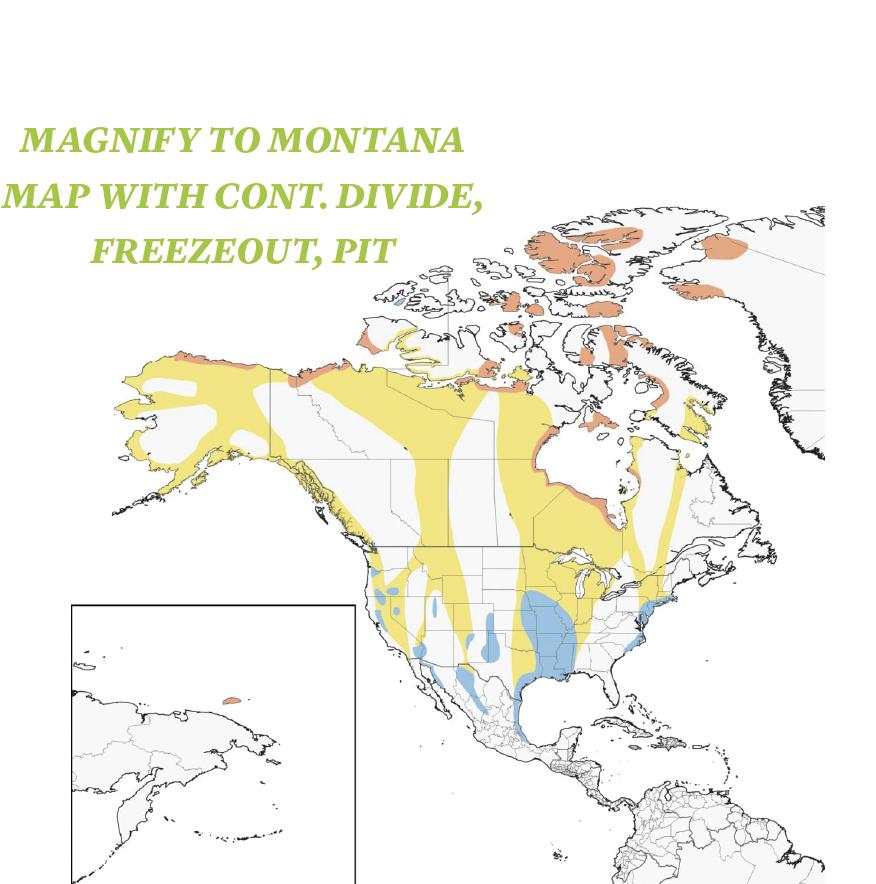
Snow Geese Migration Patterns
PASSING LANES The map at left shows the main migration routes of snow geese across North America, with a large corridor crossing central and western Montana. Snow geese are medium-distance migrants, making flights of 2,000 to 3,000 miles broken up by stopovers in staging areas. Freezout Lake Wildlife Management Area near Choteau sits at the southern tip of a large staging area extending into Canada, with thousands of geese landing there during the peak of spring migration.
Source: BirdLife International and Handbook of the Birds of the World (2025) Bird species distribution maps of the world. Version 2025.2. Available at http://datazone.birdlife.org/species/requestdis.
Butte Freezout Lake WMA
FIRST ALERT Mike and Brian Schwitters (above) and Nancy Milewski (bottom right) help keep
Freezout Lake
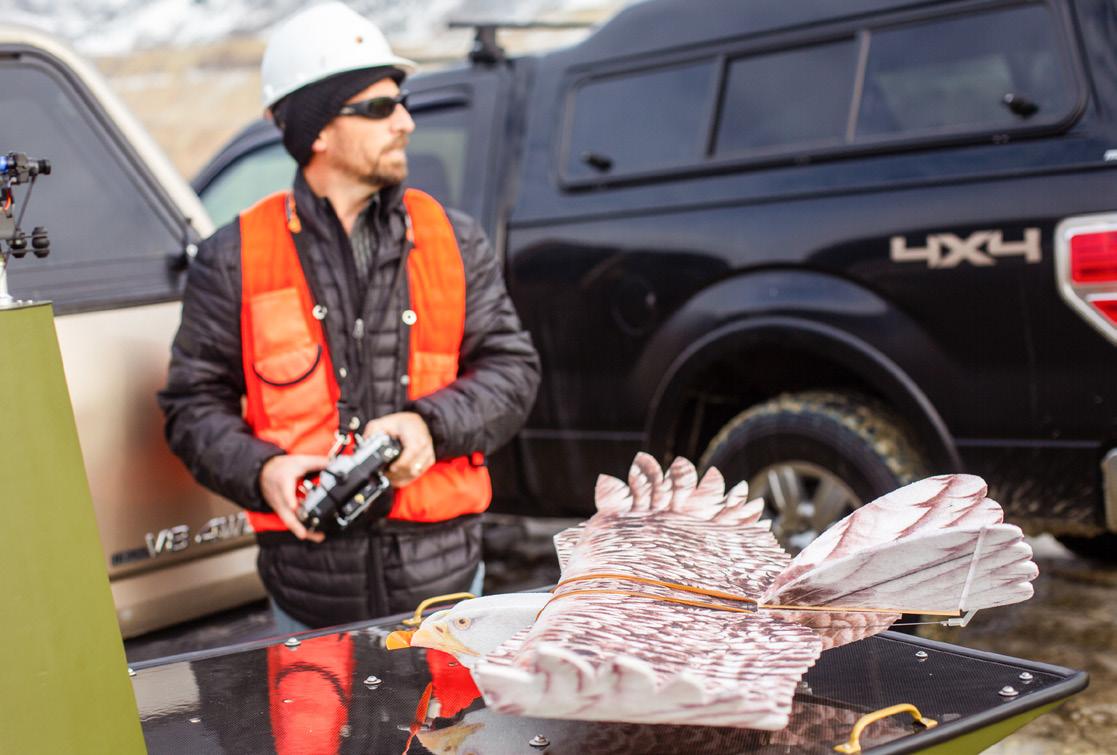
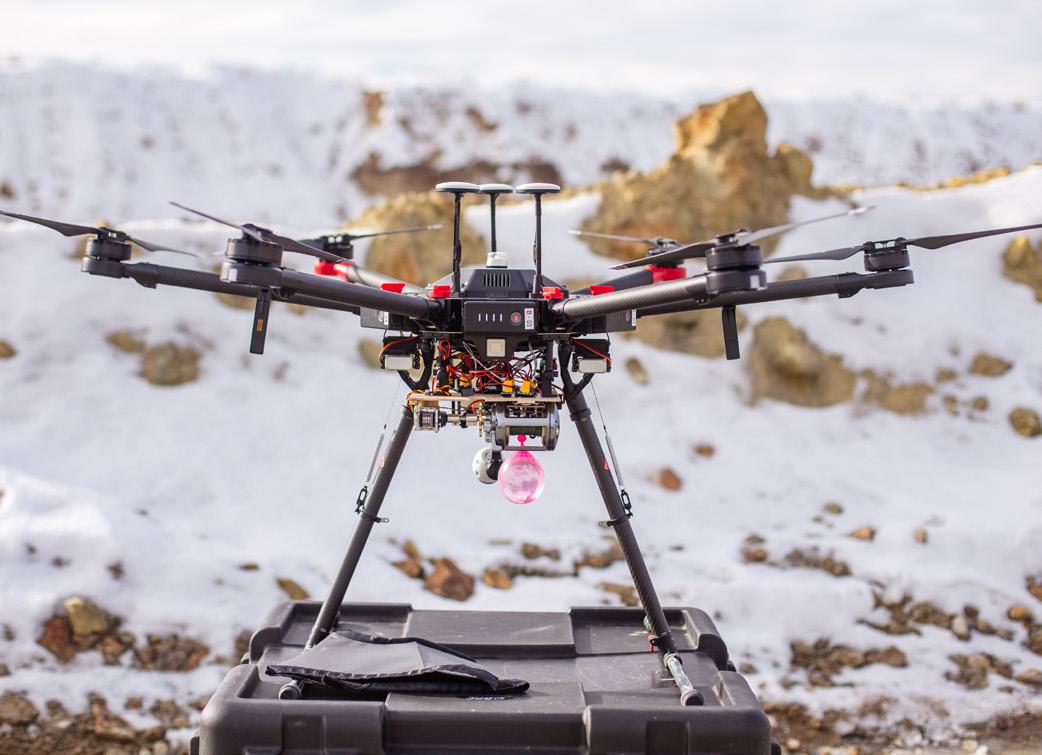
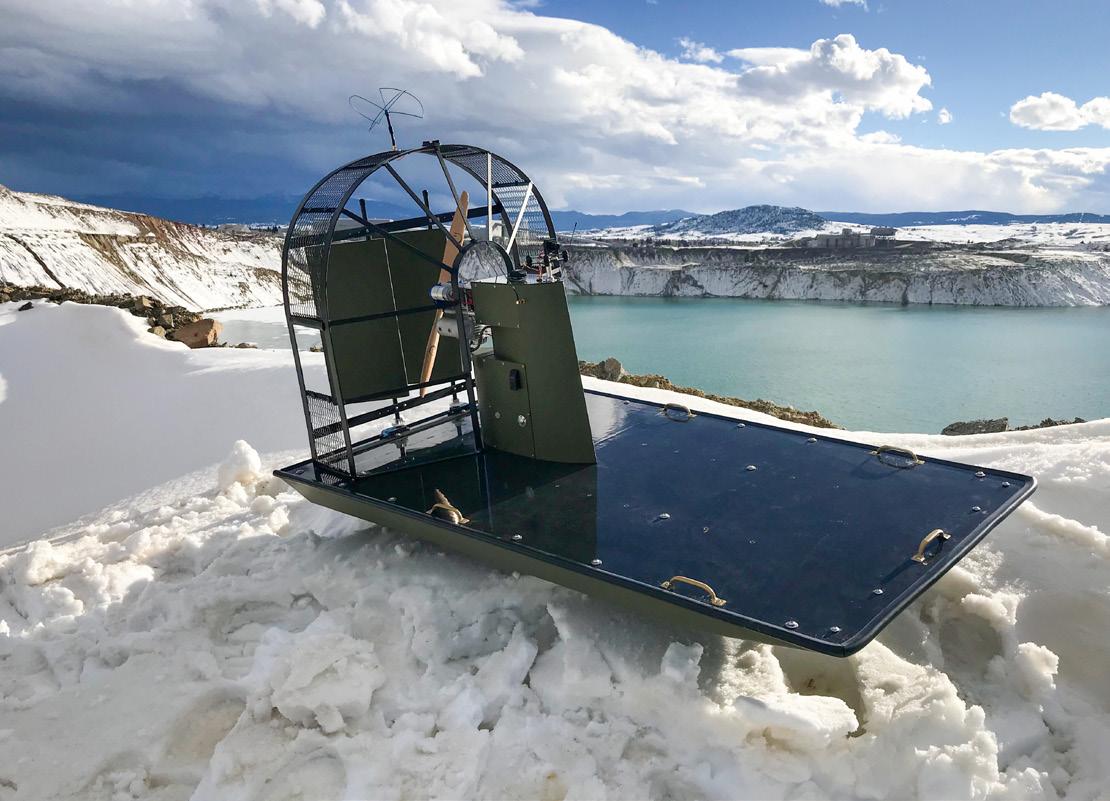
SCATTER GADGETS (clockwise from top left) Researchers have experimented with a range of creative devices to encourage waterfowl to depart from the Berkeley Pit, including drones dressed up to look like raptors (which did not prove effective), traditional drones, propane cannons, and noisy drone boats. This testing has revealed that each species responds differently, and that some such as diving ducks are best left alone to rest and leave at their own behest. That makes identification a key first step, along with knowing if large flocks of more vulnerable birds such as snow geese may be inbound.
But it doesn’t explain why some birds land on the Pit while most fly right by it. Mariano studied Tasker’s model and focused on an unusual collision of winds he calls a “pinch.” A pinch occurs when strong winds from the south collide with cold Arctic winds over western Montana. The cold to the north triggers migration and can freeze smaller ponds along the way. For birds, wind from the south is a headwind, challenging them to stay in the air. The Pit, meanwhile, sits high on the Continental Divide where those winds collide. The water, which takes longer to freeze due to its depth and dissolved minerals, beckons exhausted birds flying to stop and rest.
In 2016, the 60,000 geese that landed on the Pit didn't stop because the weather was cold, Mariano says. “They’re snow geese! They landed because they hit a headwind.”
It is hard to test a theory that explains rare
events. But in November 2024, the barometer indicated a pinch was in the making, offering a chance to observe the effects. Geese were still staging in Canada when cold northerly winds signaled it was time to leave. By the time they reached Montana, Freezout and similar shallow bodies of water were frozen over.
Meanwhile, what is known as a “bomb cyclone” over Oregon was driving southerly winds into Montana. “The low-pressure system was huge,” Mariano says. Winds of 50 mph crashed into the milder north wind, disrupting the geese’s flight. “On the radar you could see these birds trying to cross the Divide multiple times. They’d try at Helmville. They’d try wherever. It was the headwind factor.”
Wave after wave of exhausted geese had to land, but instead of resting at the Berke-
ley Pit, this time they found another option. The warm winds had thawed the upper Clark Fork basin west of Butte, including the ponds at Warm Springs.
Caleb Lashway, Swant’s 32-year-old grandson, is a grad student at Montana Tech and a member of Capoccia’s research team. He watched as thousands upon thousands of birds descended on open water there.
“Surrounded by grain fields, Warm Springs is an emergency gas station for snow geese when they hit a big headwind like that—as long as it’s not frozen solid,” says Lashway.
That storm reassured the research team that keeping a close eye on weather conditions can be another effective tool to help anticipate when snow geese might descend en masse on the Pit. If a pinch is predicted over Butte and Warm Springs and other
“
Anything is better than staying too long in the Pit.”
surrounding waters are ice-covered, it’s “all hands on deck” to make sure any geese landing in the Pit stay for as little time as possible.
DETERRING DIFFERENT BIRDS
Ultimately, protecting waterfowl from the Pit means convincing certain species that land there to leave. To do that efficiently requires understanding the biology of the birds most likely to die in the water. In the early days, those conducting hazing didn’t distinguish between divers and dabblers, or ones that arrived during the day or night.
“If a loon lands in the Pit, it’s probably not
going to stay long, because there’s no food,” says Swant. “But loons are both night migrators and divers, so if they are hazed during the day, they’re going to dive, and that’s going to be worse for them.”
Necropsies showed that the snow geese that died in December 2016 had lesions in their stomachs, intestines, and throats “suggestive of chemical tissue damage induced by a corrosive substance.” That may have been a result of the copper and zinc found inside the birds’ stomachs, according to the report issued by the U.S. Fish & Wildlife Service. Other metals, including manganese, were found in the organs of the geese.
Several birds including eared grebes get most of their water through their food, so are not inclined to drink the water. Researchers have recorded extremely low mortality in those species, which also don’t tend to respond well to hazing. For those birds, it’s a matter of waiting for them to take off.
Once birds do decide to leave, they have an 800-foot climb to clear the Pit walls, and need to be well-rested to make it out. “Hazing birds from one part of the Pit to another just adds to their exhaustion,” says Swant, “so sometimes leaving diving ducks
to rest is the best response.”
But usually that’s not the case. With many duck and goose species, crews do all they can to scare the birds away so they don’t spend more than a few hours in the water.
To ensure hazing crews are ready and waiting when they are most needed, Mariano and other researchers work to anticipate when large flocks might show up in the face of a wind-driven pinch over Butte. When a major migration is expected, the waterfowl protection team increases monitoring at the Pit and calls in contractors hired to haze birds with propane cannons, rifle shots, fireworks, and noisy drone boats.
Mariano knows that migrating snow geese and other waterfowl are tired and thirsty and want to land—especially if they’ve been bucking a headwind for hours. But there are far less toxic places not too far away where they can rest for a few days, including the Clark Fork River, Warm Springs, and nearby harvested grain fields.
What the cannon booms, drone boat sirens, and firework explosions are telling the birds, Mariano says, is, “Keep on going. Anything is better than staying too long in the Pit.”
PROBLEM SOLVERS Stella Capoccia (right) and Mark Mariano stand next to a searchlight previously used at a prison that now moonlights at the Berkeley Pit to help identify birds at night.
EARLY BIRD At sunup, a tom turkey prepares to fly down from his roost and begin another day of chasing off rivals and rounding up his harem of hens.
PHOTO BY BILL KINNEY
Sweet-talking a tom turkey into shooting range provides a thrilling way to shake off Montana’s long winter.
BY E. DONNALL THOMAS JR.
It’s mid-April, and as I hike down a ridge in the dark, the stars are aligning for me, both literally and figuratively. The eastern horizon is just starting to lighten, and high overhead the Summer Triangle holds forth against the advancing dawn after its long seasonal retreat. The sound of air whistling through a courting Wilson’s snipe’s wings fills the basin, music that seems impossible to imagine coming from a bird. Back at ground level, a drumming ruffed grouse adds bass notes to the snipe’s soprano. These harbingers of spring are always welcome sounds after the long Montana winter, but I’m even more excited to hear another bird call: the liquid gobble of a tom turkey roosted in a tree, preparing to flap down and begin rounding up his harem of hens.
EARLY MORNING TALK SHOWS
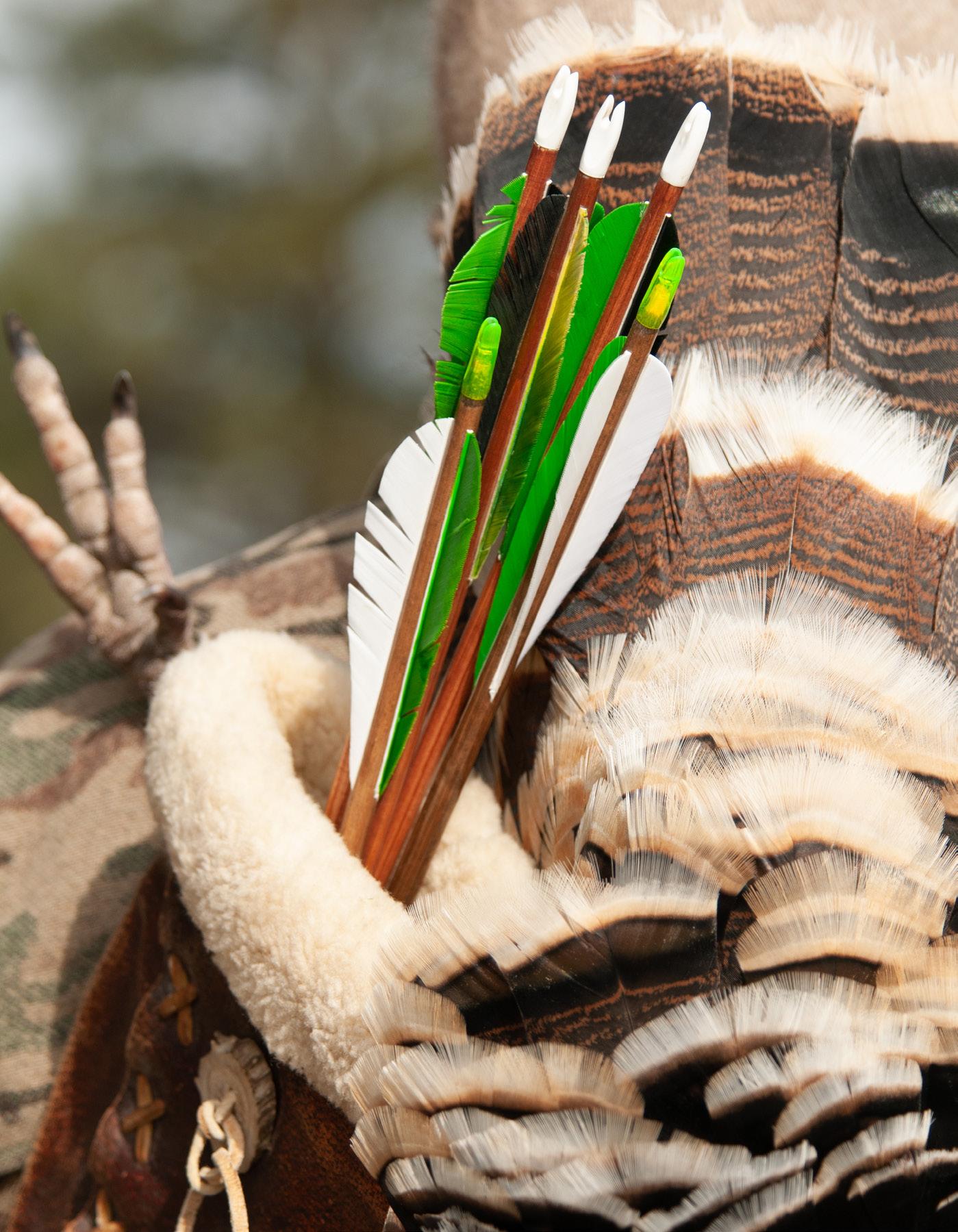
In my experience, an intimate knowledge of any quarry is key to successful, satisfying hunting. That’s especially true when chasing wild turkeys as I do using a traditional longbow.
Like most experienced wild turkey hunters, I rely on my ears more than my eyes to outwit spring gobblers.
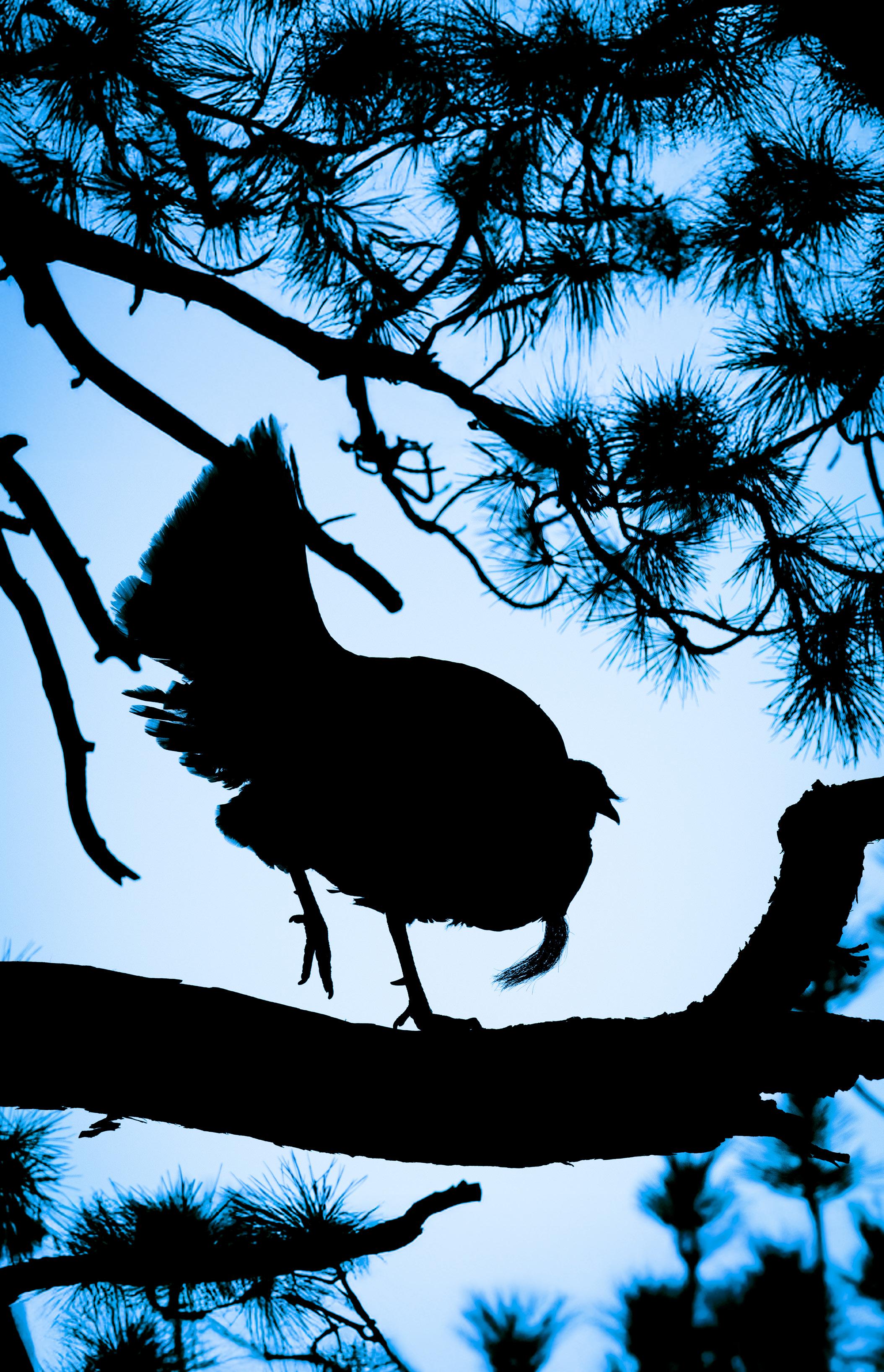
Wild turkeys are most vocal as dawn approaches, when they begin calling from roost trees where they sleep. Often tall ponderosa pines, these trees provide safety at night from coyotes, bobcats, and other predators.
I like to get as close as possible to roosting trees before the birds fly down. This lets me take advantage of the confusion when toms and hens first hit the ground and are trying to locate each other in the early morning light. The trick here is to get just close enough without getting so close that I scare them.
The first tentative sounds a tom makes from the roost are often enough to provide me with a fix on his position. Once I’m within 100 yards, I look for a spot from which to call. I keep an eye out for a fallen pine with needles still on its branches— an ideal natural blind. The previous deer season I had noted a nice deadfall at the edge of a little clearing near where the wild turkeys now gobbled, so I used it to set up an ambush.
Risking detection, I crawl from my shelter to erect two hen decoys. I hunted without them for years and am still not convinced decoys draw birds any closer than my calls alone. But if a gobbler does respond to calling, the decoy can help place him in an ideal spot for a shot, a critical concern when hunting with a bow.
After settling back in behind the pine, I offer a soft “tree yelp” just to let the gobbler think a hen is in the area. If he heard my rustling while I set up the decoys, he might mistake me for a live bird and that would make the call even more convincing.
A frequent contributor to Montana Outdoors, E. Donnall Thomas, Jr. has written hundreds of articles and essays and more than a dozen books on the outdoors. He lives in Lewistown.
I rely on my ears more than my eyes when I’m trying to outwit spring turkeys.
An immediate gobble confirms I haven’t spooked the birds. Other gobbles in response to the first one tell me I’m dealing with more than one tom. Competition among toms generally favors the hunter, yet I also hear several hens calling from the trees. Competing with a live hen is always a challenge.
Now there’s nothing to do but nock an arrow and wait.
JOINING THE FAN CLUB
No game bird has enjoyed a more prominent place in American lore than the wild turkey. But sorting fact from fiction can get murky. Most of us don’t think about—or eat— turkey until Thanksgiving. This holiday traces back to the Plymouth Colony in the
autumn of 1621, though there is little evidence that wild turkey was actually served— or that it even took place in November or was called Thanksgiving.
The modern concept of Thanksgiving was the brainchild of 19th-century magazine editor Sarah Hale, who spent years trying to get it recognized as a national holiday and finally succeeded during Abraham Lincoln’s administration.
Benjamin Franklin’s alleged effort to make the wild turkey rather than the bald eagle our national bird is similarly suspect. Franklin did admire the wild turkey, as expressed in a letter to his daughter in which he described the bald eagle as a “Bird of low moral Character” and the turkey as “a much
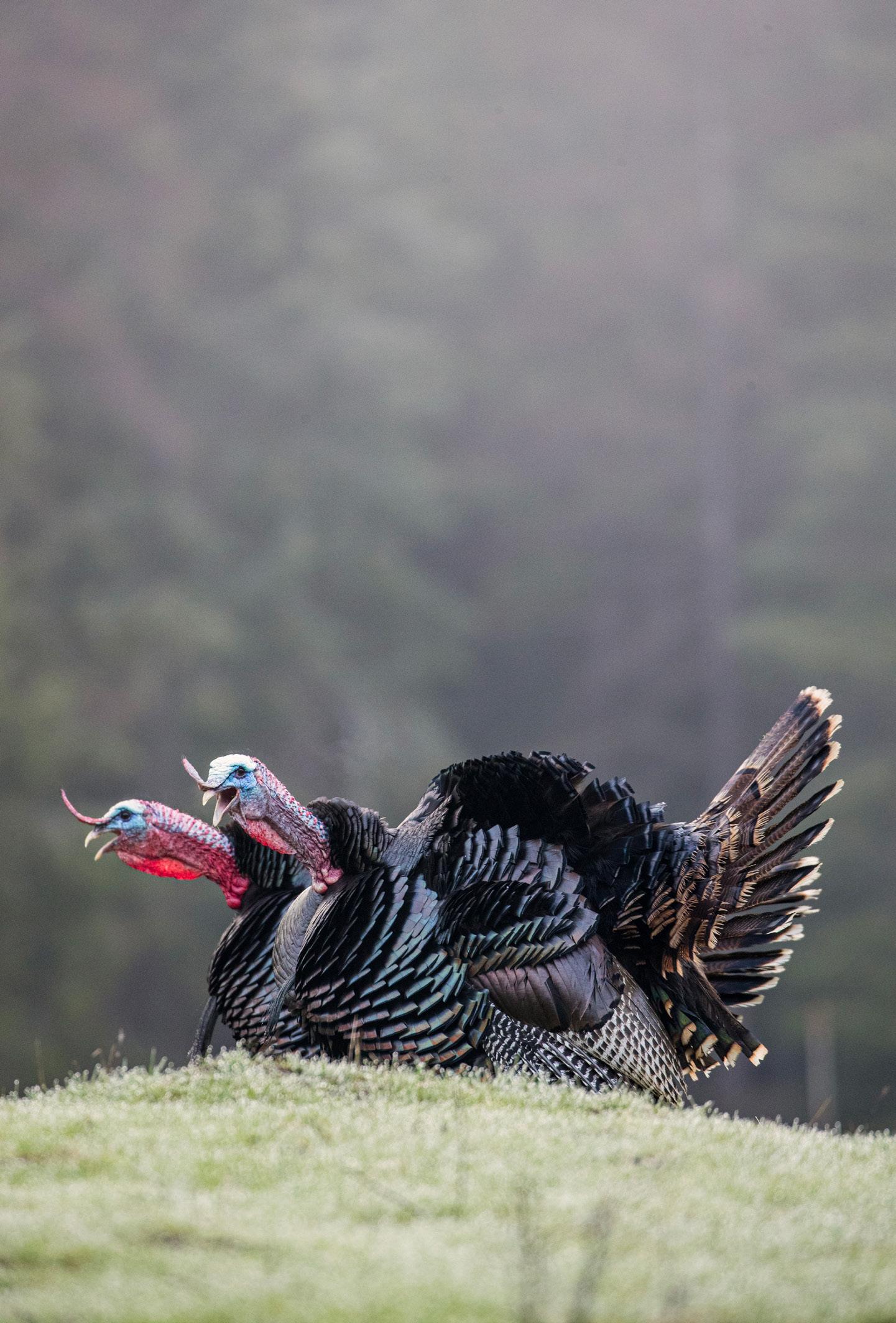
MARCH MADNESS Though male turkeys gobble year-round, their calls crescendo as the spring mating season heats up. Breeding peaks in March, well before the start of spring turkey season in mid-April, but frequent gobbling persists into May, helping hunters locate toms and potentially call them into range.
PHOTO BY DONALD M. JONES
more respectable bird and withal a true original Native of America.” However, there is no evidence that Franklin ever took the matter further.
The biology of the wild turkey is more certain. It’s one of only two native New World birds to be successfully domesticated (the other being the Muscovy duck). It is the world’s largest gallinaceous (chicken-like) game bird. The wild turkey’s population recovery from near extirpation in North America to more than 1.3 million today is one of the great wildlife success stories of our time.
Though the journals of Lewis and Clark recorded occasional wild turkey encounters while they traveled between Missouri and South Dakota, all such mentions ceased before the expedition entered Montana.
Given their meticulous records of wildlife, particularly those they shot and ate, the complete lack of references to turkeys as they crossed the state is consistent with the widely held view that there weren’t any. Montana and other northern states were just
too cold for the birds to survive winter without high-calorie foods like oak acorns.
But once farmers began to plant millions of acres in corn, alfalfa, and other highcalorie crops, wild turkeys were able to survive winters as far north as Manitoba and British Columbia. Over the past half-century, wild turkeys have been introduced to every state in the Lower 48 and several provinces in Canada.
Montana first released wild turkeys in 1954 when the Montana Fish and Game Department (FWP’s precursor) transplanted Merriam’s turkeys from Colorado into the Judith Mountains. From the deck of my home in Lewistown, I can see the release site. Subsequent transplants and natural dispersal have helped spread wild turkeys border to border across the state. The vast majority are Merriam’s, one of five subspecies in North America, the others being Osceola, Rio Grande, eastern, and Gould's (in pockets of southern Arizona).
With striking white tips on their tail feathers, Merriam’s are considered by
many to be the most beautiful of the subspecies, an opinion I share. They are also said to be the most vocal, calling louder and more frequently, an advantage to those hunting with their ears. Some consider them more gullible and easier to call into close range. If so, I think this behavior is more reflective of reduced hunting pressure rather than a lower IQ.
FASTER BAKING THAN A BUTTERBALL
Wild turkey meat is delicious. However, not every turkey hunter agrees, which I chalk up to an all-too-common mistake people make when preparing wild game cuisine: overcooking. Roast a wild bird as you would a grocery store Butterball, and you’ll wind up with a dry, stringy mess. When preparing a whole wild bird, pluck, don’t skin; cover loosely with foil while roasting; pop it out of the oven when a meat thermometer approaches 155 degrees; then let it rest 20 to 30 minutes before serving.
Don’t expect to eat the legs like drumsticks; they will be tough and stringy since
SOON TO BE ABANDONED Hens feed while staying near a boss gobbler in eastern Montana. Over the course of several weeks, the male mates with each female. The impregnated hens then move off to secluded areas to lay their eggs, leaving the tom alone—and susceptible to an alluring call from a hunter.
PHOTO BY BILL KINNEY
Calling a wary gobbler into close range is the essence of spring turkey hunting.
wild turkeys do so much running. My wife Lori and I cut the legs off after roasting and put them in a crockpot with whatever leftover vegetables are in the refrigerator to make stock that will serve multiple purposes throughout the year.
CALLING (TO) COLLECT
Back on the wooded ridgetop, the action starts to pick up as the toms begin to gobble louder and more frequently, a sure sign they are ready to fly down from their roosts. Until this point my own calls have been soft and subtle, intended to simply advertise the presence of a roosting hen nearby. But now the time has come to start talking turkey (one of many allusions to wild turkeys that have become part of the American idiom).
Calling a wary gobbler into close range is the essence of spring turkey hunting. For me, accomplishing that means success, even if I don’t shoot a bird.
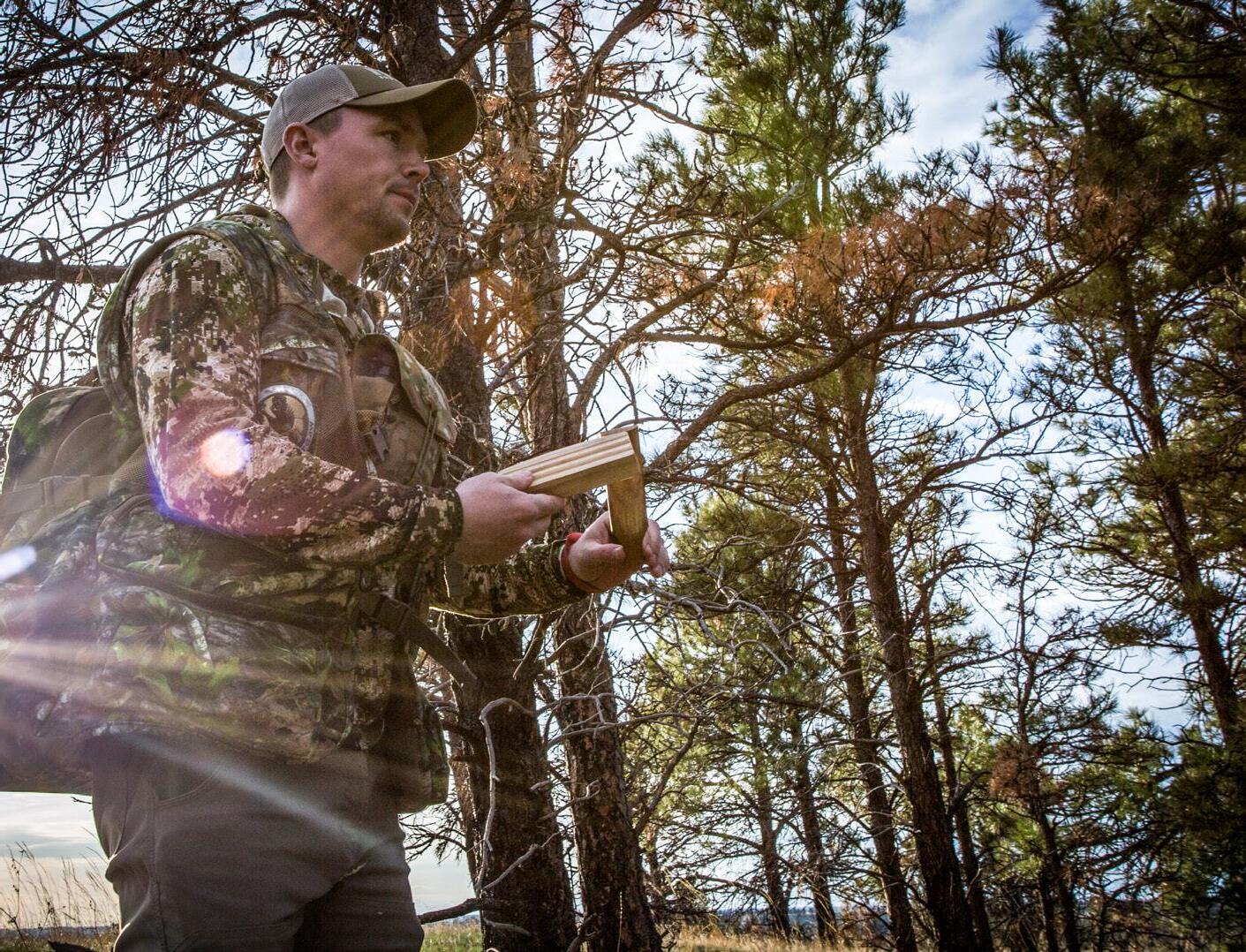
The easiest wild turkey-calling device to master is the box call, which is usually made from cedar with a hinged wooden slat on top. After a bit of practice, scraping the slat across the edge of the box will produce a sound like a hen turkey’s yelp. With a glass or slate call, you can produce a yelp (or other hen calls) by scratching the material with a small wood rod.
Both require two hands to use and a bit of movement, which a wary approaching tom may spot due to their extraordinary eyesight. I like to stay motionless and keep my hands on my bow as a turkey approaches, so
FROM TOP:
JESS MCGLOTHLIN; E. DONNALL THOMAS JR.
SPRING INVITATIONAL Wild turkey hunting can be more like bowhunting for elk than traditional upland bird hunting. It’s all about stealth, calling, and setting up an ambush.
Talkin’ Turkey
BOX CALL
Spring turkey hunting is as much about listening as it is calling. By understanding the tools hunters use—and the sounds wild turkeys make in return—you can read the mood of a tom, avoid mistakes, and strike up the right conversation at the right moment.
A classic wooden call that creates loud, raspy yelps by sliding the lid across the box. It’s easy to use and great for locating birds or calling across big, windy country.
SLATE/GLASS CALL
A round call played with a striker to produce soft, realistic turkey sounds. Excellent for close-range work when subtlety matters.
PUSH-BUTTON CALL
A compact call activated by pressing a small plunger. Simple and reliable, ideal for beginners or tight shooting situations.
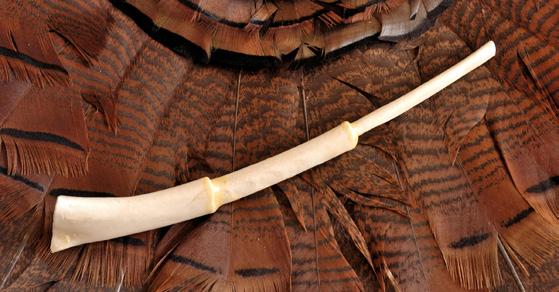
WINGBONE CALL
A traditional call made from turkey wing bones that produces hollow, high-pitched yelps and clucks.
MOUTH DIAPHRAGM CALL
Held inside the mouth, leaving hands free for your bow or shotgun. Takes practice but offers the most versatility and realism.
I prefer a diaphragm call similar to those that elk hunters use. With a latex reed pressed against the roof of my mouth, I can imitate a wide variety of calls.
Wild turkeys have an extensive vocabulary that includes putts, purrs, cutting, cackles, and various assembly calls in addition to gobbles and yelps. Understanding each call’s specific meanings isn’t essential other than to note that the putt is an alarm call to be avoided. I stick to the basic yelp, which is easy to make in different volumes with a diaphragm call, depending on the distance between me and the tom. Over the years, I have called dozens of mature gobblers into close range with nothing but yelps.
GROUND GAME VICTORY
As I hide behind the fallen pine, the moment of truth finally arrives with ponderous wing-beats and a hysterical eruption of gobbles as three toms and a gaggle of hens leave their roost trees.
Yelp: The most common call, used by hens to communicate location and interest. A steady series often signals a receptive bird.
Putt: This is the alarm call turkeys make when they are nervous or running away. If you hear it, that means you’ve been busted.
Purr: A soft, rolling sound made when birds are relaxed and feeding. Loud purrs can also signal tension between birds.
Cutting:
Usually means a hen is fired up—and can trigger a competitive response from toms.
Gobble:
advertising dominance and attracting hens. Hunters use it to locate birds but are careful when imitating it in the field so another hunter doesn't mistake them for a turkey.
Tree Yelp: while turkeys are still on the roost. Signals early morning movement before birds fly down.
Fly-Down Cackle: notes made as turkeys leave the roost.
As soon as their feet hit the ground, the toms break into full strut, spreading their magnificent multi-hued tail feathers into a wide fan to offer up one of the most striking visual displays in nature. With no further need for subtle calling, I’m yelping steadily like an eager hen, throwing in an occasional cackle for good measure.
Then one large gobbler zeros in on my decoy and struts in less than 10 yards from my hideout. When he pivots away from me and his fanned tail blocks his view, I draw my
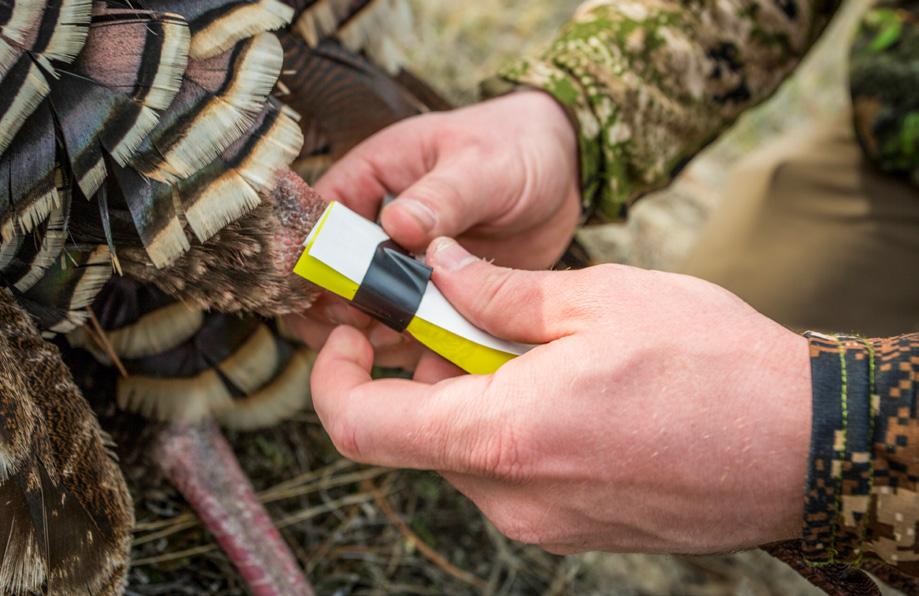
I punch my tag, tape it to a leg, and my spring turkey hunting is over until next April.
When I arrived here 50 years ago, Montana lacked the centuries-old turkey hunting tradition enjoyed east of the Mississippi. It was hard to learn about hunting a bird that was found in only a few parts of the state. Today, though, turkeys range across most of the Treasure State and provide excellent opportunities for thousands of hunters. The spring hunt is a wonderful way to enjoy solitude and wildlife in the woods after Montana’s long winter. My exciting morning afield thrilled me nearly as much as a successful elk hunt. And better yet, the turkey was far easier to pack out of the woods.
TAG, YOU’RE IT The chance to get back out into the woods in hopes of tagging a tom turkey is an annual rite of spring.
Southwestern Montana hosts one of the healthiest swaths of sagebrush-steppe on the planet. A surprising bird species has taken notice.
BY SNEED B. COLLARD III
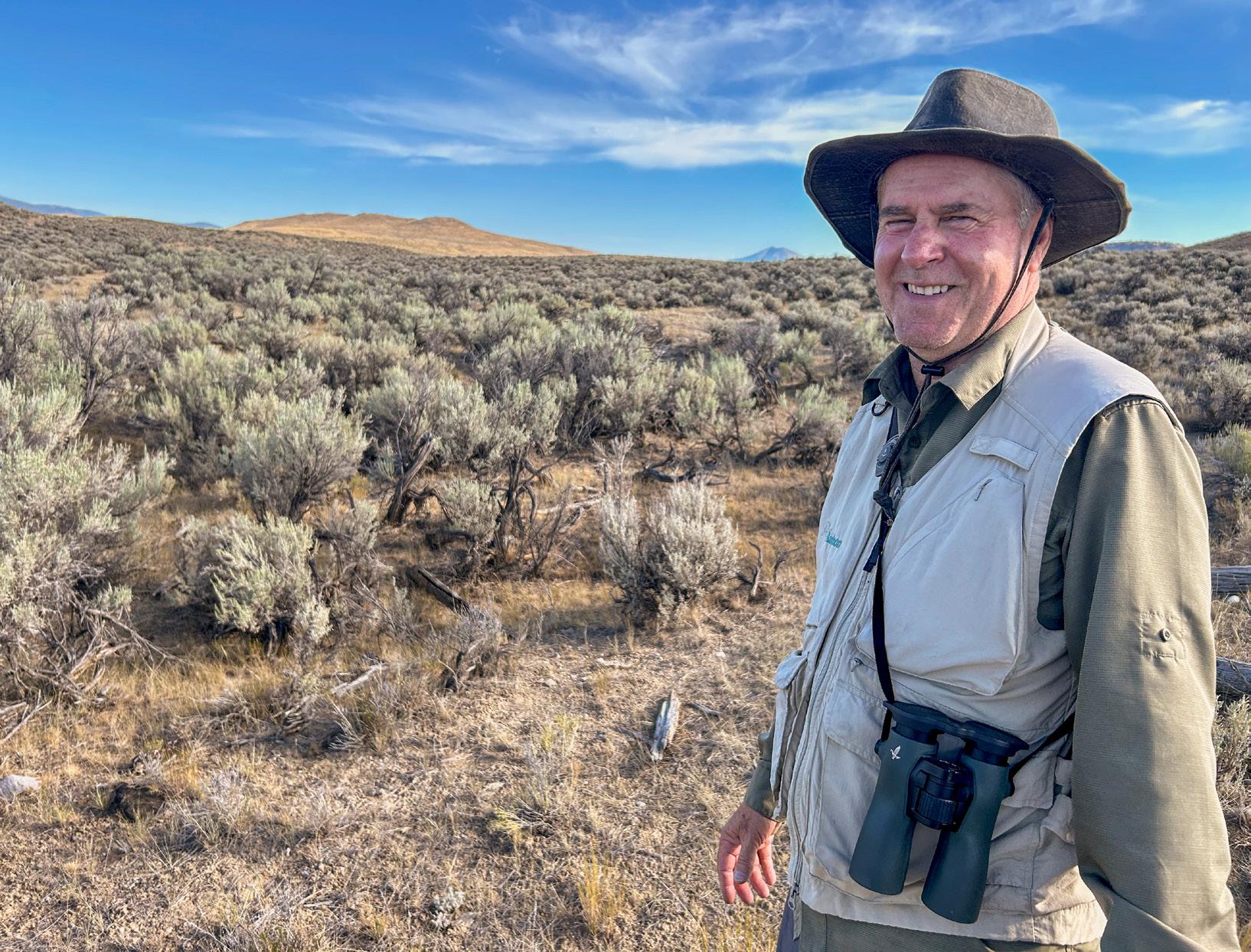
It’s a warm, late July morning in the heart of Beaverhead County southwest of Dillon, and I’m following biologist Jeff Marks up Sheep Corral Gulch. We’re searching for a phantom bird that before 2005 had never been found nesting in Montana.
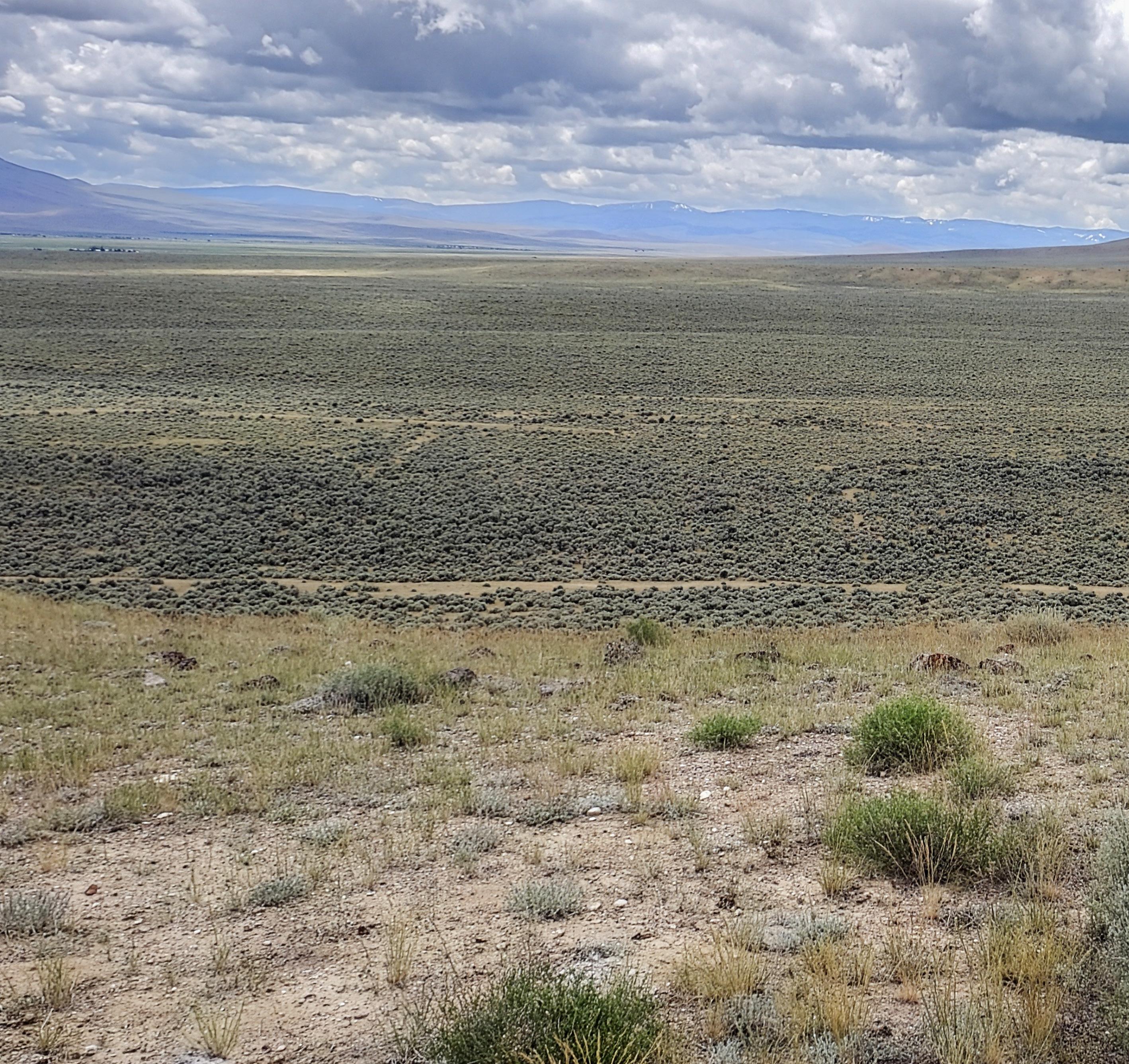
The dried grasses and forbs crunch beneath our boots as we wind through widely spaced sagebrush. Barely reaching our knees, the plants have a stunted, scorched look in what has turned into a particularly
dry year. But as we enter the main channel of the gulch, the sagebrush leap skyward taller than our heads, the lush leaves effusing their signature fragrance.
Marks stops suddenly and raises his binoculars. “There’s one up ahead.”
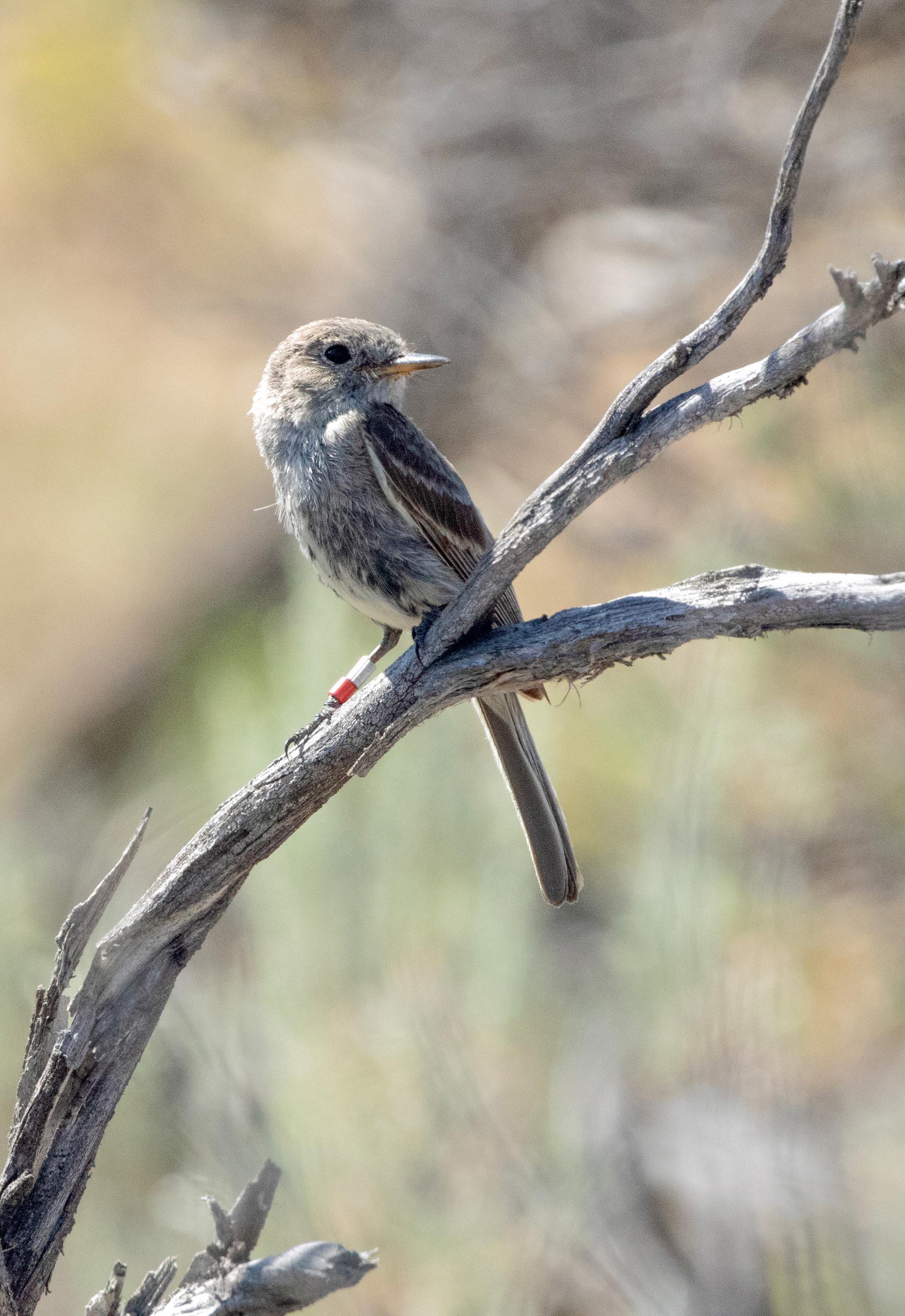
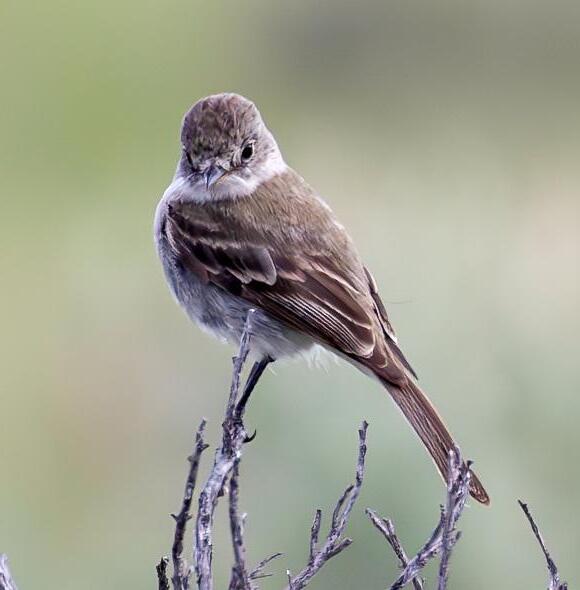
About 50 yards away, a small drab songbird perches high on a sagebrush—a gray flycatcher! Through my binoculars I see it has a gray head and back, but also brownish wings and narrow white rings
around its eyes. It belts out a sharp wit and repeatedly flicks its tail downward, as if nervously waiting for an appointment.
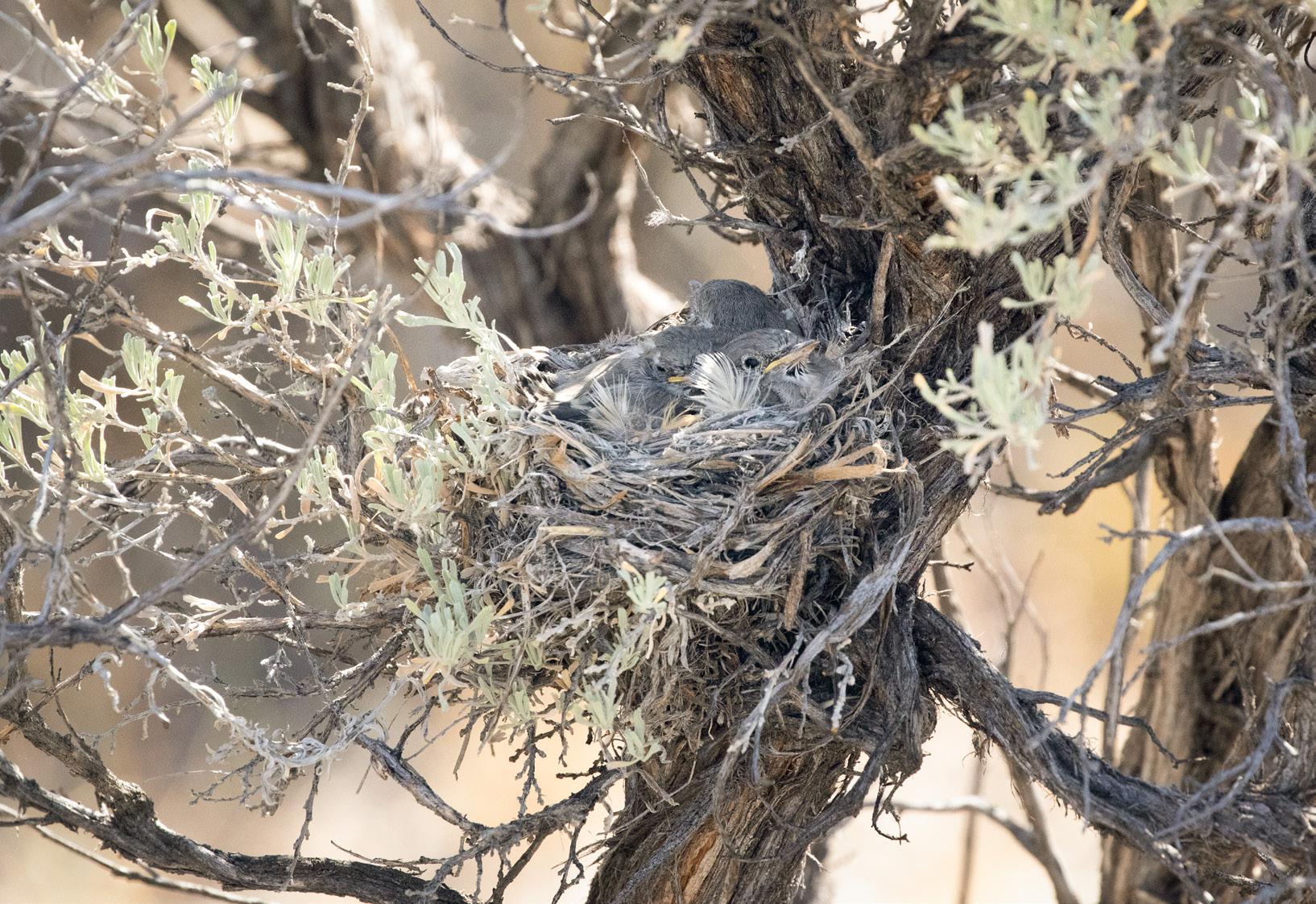
“We’re right in the middle of its territory,” Marks tells me, double-checking his GPS device. “The nest should be just ahead.” Moving slowly, we scrutinize the sagebrush forest surrounding us, and moments later, Marks whispers, “There it is! And the nestlings are still in it.”
Focusing on where he is pointing, I don’t
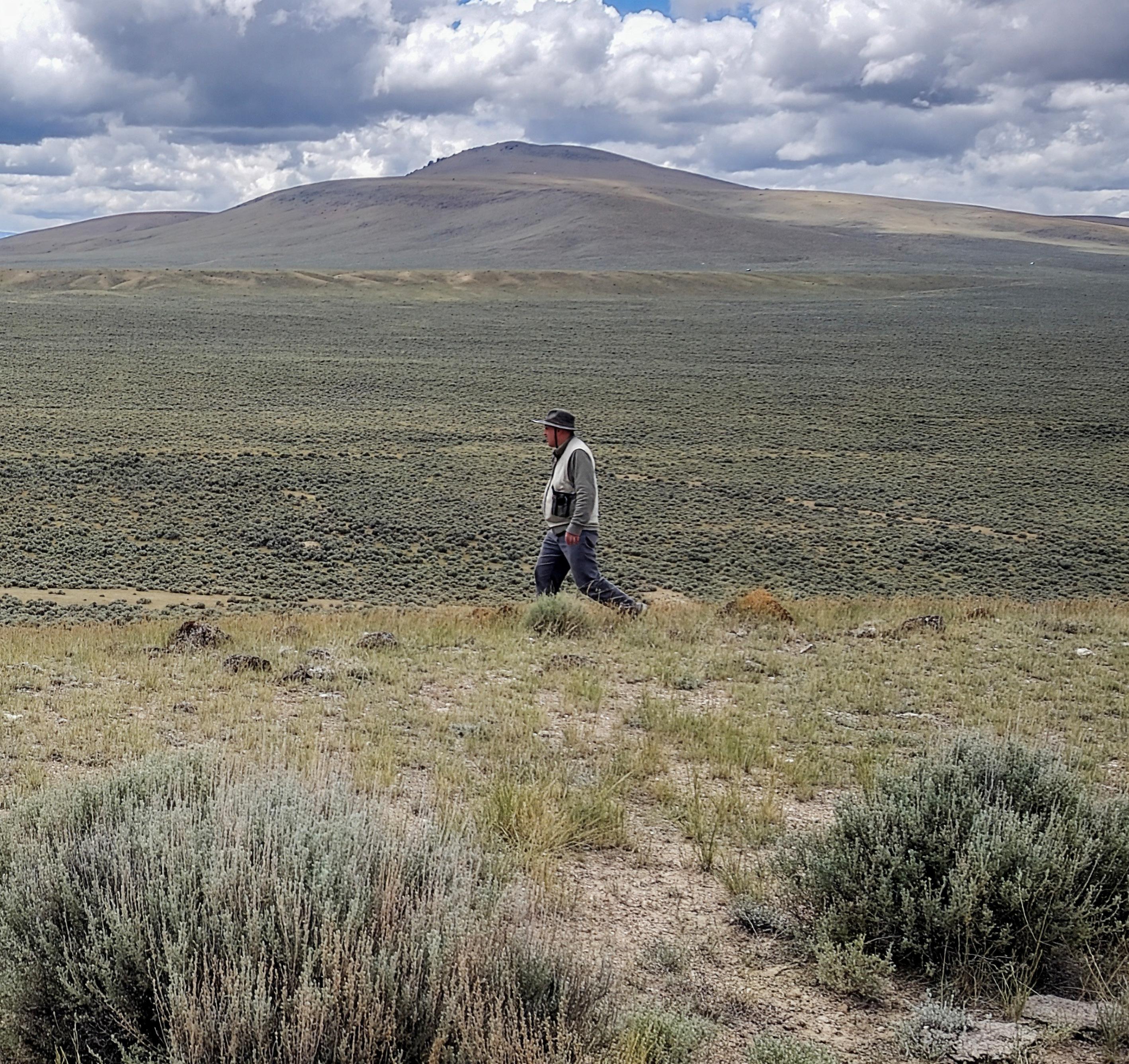
SCOURING THE SCRUB Jeff Marks descends into Badger Gulch in Beaverhead County searching for nesting gray flycatchers.
PHOTO BY NATE KOHLER
see a thing among the gnarled branches.
“Where?” I ask, struggling to spot it.
“Right at the fork there, about three feet high.”
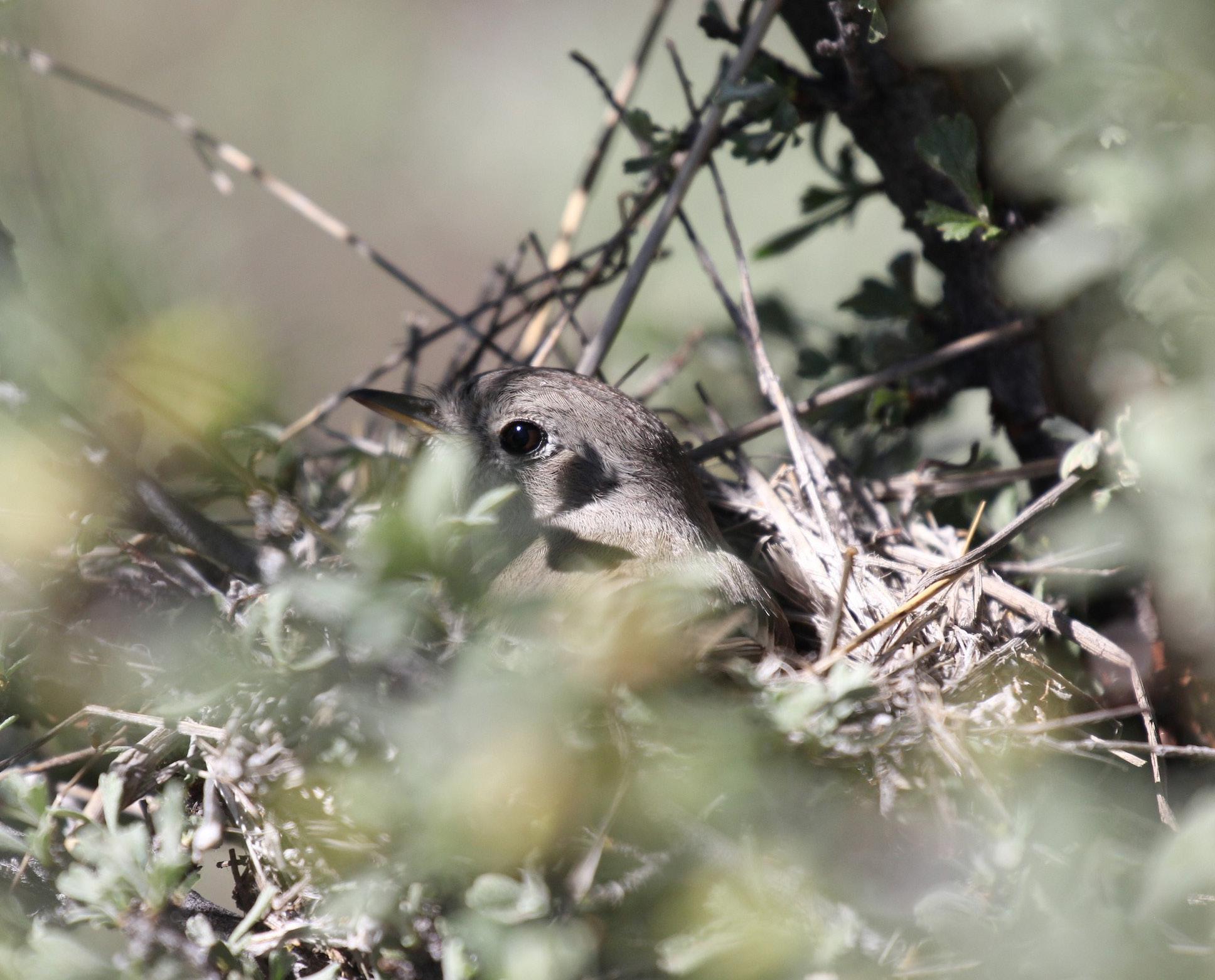
A camouflaged nest-cup gradually materializes before my eyes, its texture and color the same as the rough gray bark that cradles it. Even more impressive, the babies within are perfect soft lumps of blended gray betrayed only by their bright yellow bills.
“This is good news,” Marks says. “They look healthy, and the parents are still coming to feed them. They’re going to fledge any day.”
Gray flycatchers rely on healthy sagebrush-prairie habitat, often called sagebrush-steppe, one of the West’s most imperiled ecosystems. But here in southwestern Montana, they’ve landed in one of the healthiest areas for sagebrush not just in the state, but in all of North America.
BLUE-GREEN BEDFELLOWS
Marks is leading a study of the gray flycatcher with his colleagues at Montana Bird Advocacy, a nonprofit dedicated to expanding knowledge of the state’s avian species.
Many animals depend on sagebrush-steppe. The greater sage-grouse might be the first to come to mind, but this land-
Sneed B. Collard III is a frequent contributor to Montana Outdoors and the author of Birding For Boomers and more than 100 other books. He also co-writes the blog fathersonbirding.com with his son, Braden.
Why sagebrush-steppe matters
Sagebrush country can look empty and austere. In reality, it’s one of the most biologically important—and most threatened—landscapes in the American West.
BIG GAME BACKBONE Elk, mule deer, and pronghorn tend to flourish in large, healthy
SOME SPECIES CAN’T LIVE WITHOUT IT
Several songbirds as well as sage-grouse and pygmy rabbits rely on healthy, unbroken sagebrush to nest and feed.
COMMUNITIES & LIVELIHOODS
Ranching, hunting, wildlife watching, and outdoor recreation in sagebrush landscapes are the backbone of many rural Montana economies.
AN ECOSYSTEM IN TROUBLE
Sagebrush-steppe is the largest ecosystem in the Lower 48, but more than a million acres are lost each year, replaced by non-native grasses or human developments.
GRAY GHOSTS Camouflaged to vanish in sagebrush, gray flycatchers flew under the radar in southwestern Montana until their first official sighting in 1999. PHOTO BY SNEED B. COLLARD III
expanses of sagebrush steppe.
The bird we thought was a vagrant in 1999 most surely wasn’t.”
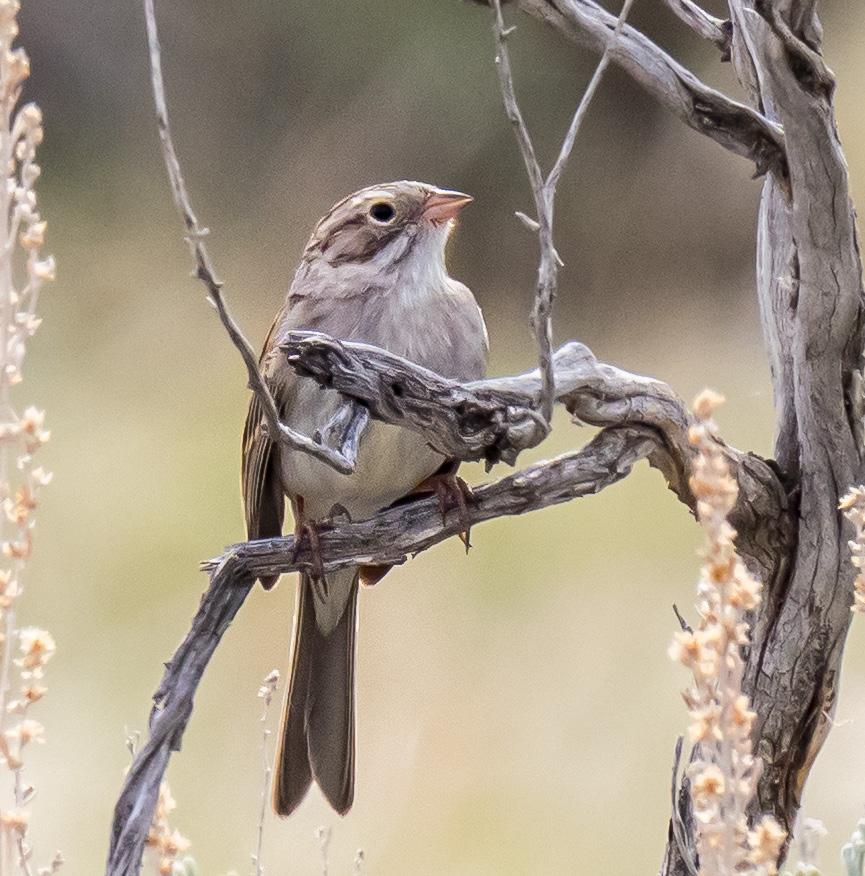
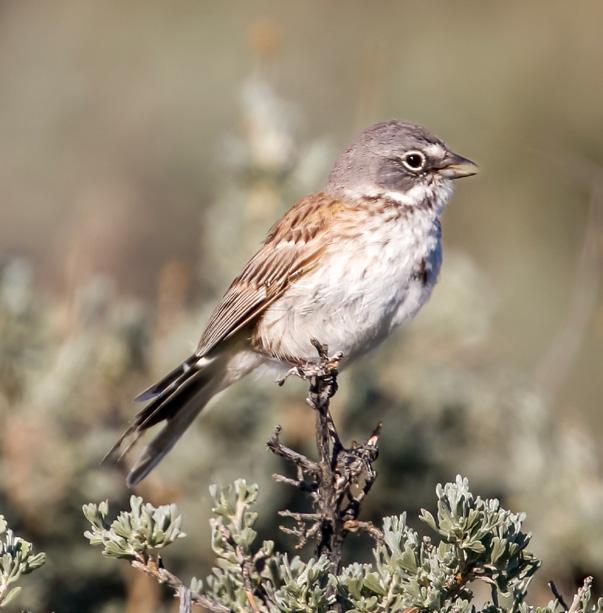
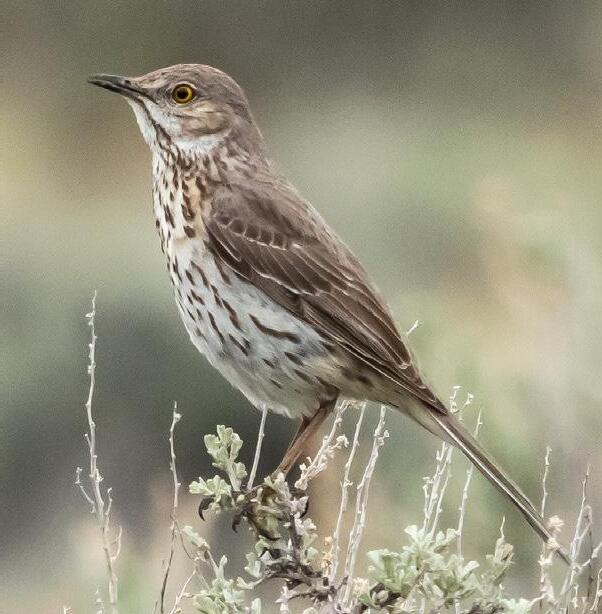
scape is also vital to elk, mule deer, pronghorn, pygmy rabbits, and many songbirds. Some are only found in sagebrush, including Brewer’s sparrow, sage thrasher, sagebrush sparrow—and the relative newcomer to our state, the gray flycatcher.
Gray flycatchers breed throughout the Great Basin, a region of the West encompassing all of Nevada and surrounding arid lands, using varied habitats in different parts of their range. In some places they nest almost exclusively in juniper; in others, pinyon or ponderosa pine. In Beaverhead County, where the birds have recently become established, tall, old-growth sagebrush is the ticket.
Camouflaged to avoid predators, sagebrush-dependent songbirds sport drab colors that require up-close viewing to fully appreciate. Some, however, make up for their modest attire with vivacious songs.
A favorite of many birders, the song of the Brewer’s sparrow is sometimes described as a chipping sparrow trying to sing like a canary. The bird belts out an impressive series of buzzes, trills, and chirps that can last up to 30 seconds.
That’s brief compared with a sage thrasher’s varied medley, which can last several minutes without pause. In comparison, the lovely song of the sagebrush sparrow lasts just a few seconds, while that of the gray flycatcher has been edited down to a short chuwip similar to that of other flycatchers in its genus.
Although the other three songbirds have
been well documented in Montana for more than a century, the gray flycatcher holds some mystery. The first recorded sighting was a male near Bannack in 1999, and the species was considered an accidental visitor until birders discovered multiple breeding pairs near Dell in 2005.
“So that bird we thought was a vagrant in 1999 most surely wasn’t,” Marks explains.
“They had just been overlooked, and the question is: How long have they been here? Nobody knows the answer, but it is fairly well known that gray flycatchers spread north from the Great Basin into Idaho, Washington, and southern British Columbia in the 1970s. My guess is that they weren’t always here in Montana, but were part of that recent expansion.”
A STEPPE AHEAD One of Montana’s foremost bird experts, Jeff Marks (above) was one of the first to discover hard-to-spot nesting gray flycatchers (below) in sagebrush-steppe in Montana. He has been searching for them ever since, and continues to find more. PHOTOS BY SNEED B. COLLARD III
CATCH ME IF YOU CAN
The many unknowns about the gray flycatcher in Montana sparked the interest of Marks and his colleague Paul Hendricks, both PhD biologists with decades of experience.
The two co-authored the landmark book Birds of Montana with another veteran ornithologist, Dan Casey, which helped open their eyes to how little is known about some birds in the state. Marks and Hendricks founded Montana Bird Advocacy to help increase that knowledge. In 2008, they also managed to discover the first gray flycatcher nests in the state at Badger Gulch south of Bannack.
“During one outing, we found close to half a dozen nests in three hours. It was crazy!” Marks says. “Then we went the next day and found a bunch more.”
Their primary goal was to gather data on nesting biology by placing unique colored leg bands on breeding adults. That proved easier said than done.
“Right away, we discovered they were hard to catch,” Marks recalls. Throughout his career he’d come up with creative ways to catch all kinds of wily bird species. Unfortunately, the flycatchers proved adept at avoiding his 8-foot-tall “mist nets,” erected near gray flycatcher areas. Still, throughout the first three years of the project, his team managed to band about a dozen individuals each year—and with astonishing results.
Originally, Marks and his colleagues set out to study nesting flycatchers in two areas south of Bannack—Badger Gulch and Sheep Corral Gulch. Once they color-banded birds, big surprises followed.
STRATEGIC POLYAMORY
They found that gray flycatchers can be polygynous, with a single male breeding with more than one female at the same time.
“That’s never been documented before,” Marks explains. “But we had the same banded male provisioning two different nests in 2023 and 2024. In 2025, we documented three new cases of polygyny among our small sample of marked males.”
Another eye-opening discovery was that the flycatchers sometimes raise two broods of nestlings in a season. “In 2024, hardly any of the birds double-brooded,” he says, “but the year before most of them attempted to raise a second brood after their first broods fledged. So, what’s normal? What they did the first year, what they did last year, or something in between? It will take us several more years to figure it out.”
That ability to double-brood may play a key role in the birds’ survival. In late June 2025, a freak snow storm descended on Beaverhead County just after the first fledglings hatched, killing almost 100 percent of the baby birds. Researchers suspect that was because adults were unable to find insects to
It’s not often a state actually gains a bird species.
feed their young during the storm.
“It looked catastrophic,” says project research assistant Nate Kohler, who has played an integral role in monitoring.
Yet by the time I visited the area with Marks in late July that year, almost every gray flycatcher pair had re-nested and successfully produced a crop of youngsters ready to head out into the world.
A SHRUBBY SHANGRI-LA
With years of research still to come, Marks and the team plan to keep peeling back the mysteries of this little-known bird while building a better understanding of the Beaverhead’s unique sagebrush-steppe. It could not come at a more critical time.
Sagebrush once covered more than 320 million acres of North America, an area roughly twice the size of Texas. But conversion to agricultural uses, housing, energy development, and competition from junipers and non-native annual grasses such as cheatgrass, have cut that number in half. Even at 175 million acres, though, it’s still the largest contiguous ecosystem in the Lower 48. It’s also one of the most endangered. A 2022 study by the U.S. Geological Survey estimates that 1.3 million acres of sagebrush is burned, plowed up, paved over, or invaded each year. Southwestern Montana, though, is faring better.
“Many sagebrush habitats here remain in
relatively good condition,” says Katie Benzel Phillips, a wildlife biologist with the Bureau of Land Management in Dillon. She points to a strong presence of native grasses and forbs that support wildlife and pollinators, and collaborative conservation efforts by landowners, ranchers, public agencies, and nonprofits. Rotational cattle grazing helps protect and improve sagebrush-steppe, as does removal of encroaching Douglas-fir and Rocky Mountain juniper.
The gray flycatchers’ strong preference for nesting in tall sagebrush renders them particularly vulnerable to anything that might harm or destroy older plants. Marks especially worries about wildfires.
Historically, most sagebrush-steppe rarely burned—maybe once or twice per century—but the spread of highly flammable cheatgrass and other invasive annual grasses has hastened fire frequency across the West. After the flames die out, those same grasses race in to fill the void, burning again year after year in quick succession, thwarting the regrowth of sagebrush seedlings.
Fortunately, Beaverhead County has so far seen less sagebrush loss to cheatgrass and other invasives than many other regions. It’s home to more than a dozen kinds of sagebrush, including three-tip sagebrush, the only species that resprouts from its own stump after a wildfire. Other species depend on reseeding. Mountain big sagebrush, which is widespread in Beaverhead County, can bounce back to its pre-fire heights in as little as 15 years. Compare that to Wyoming big sagebrush, which may take more than 100 years to fully recover.
“If we somehow lost the tall sagebrush plants from the study area, the flycatchers would disappear overnight,” Marks says.
It would be a shame for Montana to lose the gray flycatchers that now call this state home. But if we can keep the unique high-elevation sagebrush-steppe in the Beaverhead healthy, they’re bound to stick around. After all, it’s not often a state actually gains a bird species.
SAGEBRUSH SONGBIRDS
Sagebrush country is home to a handful of small, subtly colored songbirds that can be tricky to tell apart at first glance. These four species share similar size, colors, and habitat—but each has telltale features if you know what to look for.
BREWER’S SPARROW
Spizella breweri
Very drab sparrow, usually pale breast; best identified by its lively song.
Range in Montana: Throughout the state except for the far west and upper northeast where sagebrush is scarce.
Length: 5-6 inches
Present: May through August
SAGEBRUSH SPARROW
Artemisiospiza nevadensis
Distinct gray head, white chin, and white eye-ring; pale chest with dark spot in the middle.
Range in Montana: Southwestern Montana, mainly Beaverhead and Carbon counties.
Length: 5-6 inches
Present: April through August
GRAY FLYCATCHER
Empidonax wrightii
Overall gray appearance; slim bi-colored bill; wags tail only downward, not up and down as similar dusky flycatchers do.
Range in Montana: Southwestern Montana, mainly Beaverhead and Carbon counties.
Length: About 6 inches
Present: May through August
SAGE THRASHER
Oreoscoptes montanus
Larger size, erect posture, distinct yellow eyes.
Range in Montana: Mainly southwestern, south-central, and central Montana, in sagebrush-dominated habitats.
Length: 8-9 inches
Present: May through August
Early lovebirds
By Tom Dickson
Spring is just around the corner. Poets and songwriters laud this season of romance and reproduction, when animals—humans included—inspired by warming days and budding flowers begin courting and mating. “And that’s why birds do it, bees do it, even educated fleas do it,” wrote American composer and songwriter Cole Porter. “Let’s do it, let’s fall in love.”
But try telling that to great horned owls. They were exchanging courtship calls back in January.
Owls aren’t the only early birds when it comes to romance. Bald eagles, ravens, Canada jays, and Clark’s nutcrackers all start mating in January and often nest as early as March.
There still might be snow on the ground as you read this, but great horned owl chicks may have already hatched.
What’s with the rushed reproduction? It’s part of what biologists call “reproductive strategy.”
Egg development ranges widely, from just 11 days or so for small songbirds like purple finches and yellow warblers, to four weeks for mallards and Canada geese. It can take golden eagle eggs 40 days or more to hatch.
Generally, the bigger the bird, the longer the incubation.
For most bird species, May and early June are peak times for calling, mating, and nesting. That way, when fledglings hatch, forests and fields are filled with crickets, moths, and other bugs to stuff into those gaping mouths. Baby birds are ravenous, and parents need a ready supply of food to keep them fed.
Herons and cranes must ensure it’s warm enough for small fish and amphibians to be available. Flycatchers, warblers, and other bug-eaters delay nesting until enough flying insects are out. Cedar waxwings wait even
longer, until the tree fruits they feed their young are ripe. Same with American goldfinches, which hold off nesting until thistle, aster, and sunflower seeds have ripened in mid-summer.
Safety is a factor, too. Many ducks delay nesting until ponds and lakes thaw out so that newly hatched ducklings can be ushered single file from their grassland nests to open water.
Another aspect of bird reproductive strategy is migration timing. Birds returning to Montana from southern climes each spring make a housing gamble. Show up early enough to nab one of the best nesting sites to start a family, and they risk a snowstorm killing their eggs. Delay arrival to avoid cold weather, and all the best sites— safe from predators, out of the wind, near food sources—might already be occupied.
By late July and August, even the delayed nesters have raised a brood (or two or even three) and sent them on their way. Meanwhile, the big raptor parents are still tied
down with their developing young that are learning to hunt.
Great horned owl young don’t leave the nest for seven weeks after hatching. By then they are ready to pounce on a vole or at least grab a night crawler off the ground.
But then it’s back to the nest for another month or two, receiving supplemental feeding from mom and dad while honing their hunting skills. A vole is one thing. Killing an adult mallard or Canada goose takes more coordination, stealth, and strength. Sometimes an owlet will still be hanging around the nest in November.
It had better vacate soon. Winter is just around the corner. When the snow is flying, most birds don’t do it and definitely bees don’t do it. But great horned owls, which mate for life, will be doing it, preparing to bring another generation of owlets into the world.
Tom Dickson is a former editor of Montana Outdoors.
Western thatching ant Formica
obscuripes
MBy Scott Turo
ore than 75 species of ants have been recorded in Montana alone, making these insects among the most common creatures in Rocky Mountain forests. One species that’s hard to miss is the western thatching ant. You’ve probably noticed their nests during an afternoon hike or bike ride, and if you lingered too close, perhaps you’ve been bitten by their powerful jaws. If so, be forgiving—these ecosystem engineers play a vital role in forest health.
IDENTIFICATION
Western thatching ant colonies can be recognized by their unusual nests, which are thatched mounds built from conifer needles, sticks, and leaf litter. The size and density of these anthills are relative to the number of workers in the colony. Usually, a mound is 1 to 2 feet tall and wide, often found in clusters interconnected by an underground tunnel system.
Individual worker ants range from 4 to 8 millimeters long, with a bold copperor crimson-colored head and a body that tapers toward a matte black underside and rear segment. A key identifying feature is the length of the hairs (called setae) on the first segment of the antenna. Western thatching ants have short, fuzzy setae, unlike the longer hairs found on other ant species in the Formica family. Queens are larger, measuring up to 12 millimeters.
DISTRIBUTION AND HABITAT
Common in Montana forests, western thatching ants live in habitats ranging from grasslands to alpine meadows across western North America from New Mexico north to British Columbia and Manitoba, and east to Missouri. They are ectothermic, meaning they don’t produce body heat, but instead use their extensive tunnel networks and mounds to regulate temperatures. Dr. Peter Marting, a research
fellow at Auburn University in Alabama, studied western thatching ants in the Pacific Northwest and found that these uniquely talented engineers adjust temperature within their well-insulated mounds to stay warm in winter and cool in summer. Because their nests are made of vegetation, the microbial decomposition of plant matter generates heat. Similar to adjusting a thermostat, thatching ants shift the vegetative contents and aeration levels within their mounds to help control the temperature.
BEHAVIOR
Breeding and population growth are managed by one or two queens per nest, with tens of thousands of worker ants typically residing in each colony. Their job duties depend on their size: Larger workers generally handle nest maintenance, foraging, and defense, while smaller workers care for ant larvae and aphids (more on that below). At one massive connected colony with 210 mounds spread across 10 acres in Oregon’s Blue Mountains, researchers used nest excavation to estimate that it held 56 million ants—a larger population than any human city on earth.
RANCHING APHIDS
Western thatching ants feed on nectar and have devised a clever way to obtain it: They become aphid farmers. Knowing that the tiny sap-sucking aphids feed on plants, which makes their bodies and excretions
rich in nectar, ants herd them into large colonies, acting as insect ranchers in a mutually beneficial relationship. They protect the aphids from predators, and, in return, harvest the honeydew they excrete. The ants transfer nectar to nest workers by regurgitation, a process called trophallaxis.
During a midsummer wildflower hike in Montana’s Bridger Mountains, I witnessed aphid ranching firsthand after I noticed aphids and ants concentrated on the stems and stalks of Indian paintbrush and lupine.
ECOSYSTEM ENGINEERS
The western thatching ant’s life cycle offers a range of ecological benefits. As the insects haul in vegetation and build mounds, they aerate and mix the soil, improve drainage, and increase microbial activity, nutrient cycling, and seed dispersal. Two common wildflowers in Montana forests, kidney-leaf white violet and western trillium, produce a nutrient-rich fleshy appendage on their seeds that attracts ants. Ants cut off the appendages, called elaiosomes, and transport them back to the nest as food. Along the way, the seeds find new spots to germinate.
Farmers, ranchers, loggers, gardeners— western thatching ants wear many hats, each an important contribution to the local environment. If one ever happens to crawl up your leg and pinch you, try not to take your frustration out on the colony. The ants’ intentions are good, even if they might get aggressive while defending their homes.
Scott Turo is a writer from Madras, Oregon.
Whether you’re fishing, camping, mountain biking, boating, hiking, hunting, wildlife watching, or spending the night in a fire lookout, Montana is a place where everyone can find their own way to connect with the natural world. Around here, the outside is in us all.