
The first week in August last year was a busy one for two subadult grizzlies on the move in western Montana—and for Montana Fish, Wildlife & Parks employees who received a flurry of reports about the pair acting “young and dumb,” in the words of Missoulabased FWP bear specialist Jamie Jonkel.
Eyewitness accounts, videos, and trail camera photos revealed details of the bears’ journey from the Blackfoot Valley to the northern Bitterroot, where they spent the next two months crisscrossing a key travel corridor used by many wildlife species.
It’s normal for young bears to disperse as they seek their own home range, and also to occasionally use poor judgment as they learn how to survive without their mother. The two-year-old male and female grizzlies—assumed to be siblings—attracted plenty of attention along their southwesterly route. They were first spotted on August 3 on Montana Highway 200 near Potomac, about 30 miles east of Missoula, eating a road-killed deer. The next day, a homeowner photographed the pair walking up the hill behind her house about 20 miles southeast of Missoula. Three days later, they were seen on Interstate 90, eating roadkill again, as traffic whizzed by at high speed. By August 8, the bears had crossed the freeway and triggered a trail camera on the 15,000-acre MPG Ranch east of Florence. And then the siblings dropped down to the floor of the Bitterroot Valley, home to valuable wildlife habitat as well as a rapidly increasing human population.
A LONG ABSENCE
That put the young bears just a short ramble from the edge of the Bitterroot Ecosystem, one of six grizzly recovery areas established in 1993 under the Endangered Species Act. But this recovery area—which comprises the SelwayBitterroot and Frank Church-River of No Return wilderness areas, mostly in eastern Idaho —hasn’t held a resident grizzly population for about a hundred years.
In the early 2000s, grizzlies began making occasional appearances in the Bitterroot Valley and surrounding mountains, likely just passing through as they traveled outside of grizzly population centers to the north—in the Selkirk, Cabinet-Yaak, and Northern Continental Divide ecosystems— and the southeast, in the Greater Yellowstone Ecosystem. Grizzly sightings have become more common in the area over the past decade, according to Jonkel. But no female has stuck around and raised cubs, a critical first step to reestablish a Bitterroot population.
Once they arrived in the valley, the young grizzly siblings spent much of their time on large agricultural properties, says

Young grizzly siblings’ high-profile journey to the Bitterroot Valley leads to an unexpected ending. ByJulie Lue Julie Lue is a writer in the Bitterroot Valley. SIMILAR SIBLINGS Two-year-old bear siblings feed on grass in the Paradise Valley. At this age, young bears often are pushed out by their mother to begin life on their own. Grizzly siblings similar to this pair wandered throughout the Bitterroot Valley last summer before being captured and relocated in the nearby Sapphire Mountains. PHOTO BY DUANE HUIE
Bruce Montgomery, FWP’s first Bitterroot bear management specialist, who was hired in May 2022. The bears did not pose a threat to people. When a rancher startled the two bears in a creek bottom, Montgomery says, “They ran out of there soaking wet at 100 miles per hour in the other direction.” The bears were also seen running away from cars on rural roads.
But the situation was tenuous for the naive young grizzlies. They crossed busy U.S. Highway 93 multiple times between Florence and Lolo, in an increasingly developed area that remains a critical passage for wildlife, including elk herds often seen from the road. This stretch can be difficult for animals to cross safely; a high percentage of crashes here are due to wildlife-vehicle collisions.
While moving between large properties, Montgomery says, the siblings were also traveling close to unnatural food sources. “They were starting to pass by homes and unsecured chicken coops and walking right by trash cans.” It seemed only a matter of time before they followed in the footsteps of
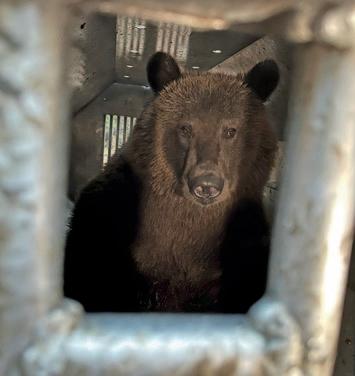
OKAY, KIDS, PARTY’S OVER Above: FWP wildlife technicians Eli Hampson and Brad Balis take blood samples and body measurements of the 230-pound male sibling captured on September 30, 2022. The 172-pound female sibling (below left), captured on October 2, and the male (below right) were released in separate locations but apparently reunited on their own 11 days later, likely where they were born, in the Scapegoat Wilderness, more than 75 miles away (see map at right).

the valley’s numerous black bears, many of which have become food-conditioned.
PREEMPTIVE CAPTURE
Up to 90 percent of what black bears and grizzlies eat can be plants, and they have a hard time passing up easy meals in the form of unsecured garbage, seed in bird feeders, pet food, and fruit trees. Bitterroot Disposal and Republic Services is working to offer more bear-resistant garbage containers to local homeowners, and some valley residents are taking steps to make attractants off-limits to bears. But communities don’t become bear-safe overnight.
FWP managers working with the U.S. Fish & Wildlife Service decided to trap and
relocate the grizzly siblings. Jonkel stresses that this was a preemptive capture, designed to move the bears before they got into trouble. “They were starting to show some indications that they were feeling comfortable around people,” he says. “For example, they were at several houses eating apples and
people were concerned, though there were no issues other than the bears being at the edge of the property eating fallen fruit.”
Jonkel adds that several photos posted to social media showed the bears at empty garbage cans. “We want to make it clear that, to the best of our knowle dge, there

This is something we have not really considered before....
Bears keep showing us new things.PHOTOS: MONTANA FWP Julie Lue is a writer in Florence.
were no food rewards at these cans. But the bears were starting to show some interest, which is why we thought it best to preemptively trap and transport them.”
BOUNCING AROUND
Montgomery spent a lot of time moving culvert traps as he tried to predict where the bears would pop up next. “When you’re trapping bears, you tend to be a day behind if they’re bouncing around like those two were. They were just all over the map,” he says. Several landowners provided essential assistance. “They were great to work with, and a lot of them didn’t even mind that the bears were there,” Montgomery adds.
FWP officials hoped to relocate the siblings together. But they trapped the male first on September 30, and had to relocate him. “We couldn’t keep him in the trap any longer,” Jonkel says. Two days later, they captured the female. Jonkel credits Montgomery with “finding two needles in a really big haystack.”
It was “monumental” to confirm the presence of a female grizzly in the Bitterroot area, Montgomery says. “If you don’t have females, you can’t have a population.”
According to FWP bear biologist Cecily Costello, males tend to disperse farther than females; a female will usually end up with a home range that overlaps her mother’s. “But long-range female dispersal sometimes occurs, and perhaps a female tagging along with her wandering brother is one way it happens,” she says. “This is something we have not really considered before as a way females could disperse long distances. Bears keep showing us new things.”
After the grizzlies were captured, biologists anesthetized the bears; took blood, hair, and tooth samples; and applied tags and collars. The youngsters, which Jonkel refers to as “furballs,” appeared almost more hair than bear. The male and female weighed in at
around 230 and 172 pounds, respectively.
The bears were released a few days apart in the nearby Sapphire Mountains close to the Welcome Creek Wilderness, in a relocation site previously approved by the Montana Fish & Wildlife Commission for nonconflict bears. Bear managers wondered if the siblings would stick around, or even head west to the Bitterroot Recovery Zone, but instead, “they ended up bolting for what is probably their natal home range in the Scapegoat Wilderness,” Montgomery says.
POINTS CONVERGING
This time, the bears were wearing GPS collars that recorded their separate journeys after release. A map of their routes appears much less random than the earlier trek to the Bitterroot.
The young male initially traveled south to the Burnt Fork and then returned to the
release site. But his sister had already taken off, heading toward Drummond; she managed to cross I-90 on her second try and continued on to the Lincoln area. Meanwhile, the male also headed northeast but crossed the interstate near Ryan Creek and traveled through the Blackfoot River area. As they approached the Scapegoat Wilderness, the bears’ paths began to converge. And then one day the radio collars showed the siblings to be in exactly the same place, more than 75 miles from their release sites.

“They appeared to have joined up again on Scapegoat Mountain,” says Jonkel. “We believe they were in a den together, hibernating.”
PREVENTION THE BEST STRATEGY
The siblings’ long journey back home
No one knows where these two young grizzlies will head this year now that they’ve emerged from hibernation, or whether they will ever return to the Bitterroot. “They’re just young bears going out exploring country, trying to find their place in life,” Montgomery says. But he and other FWP bear managers say Bitterroot residents should be prepared to encounter both grizzlies and black bears in the area. FWP offers bear safety programs that teach participants how to use bear spray and keep tempting foods, from trash to apples, away from bears so they don’t venture into human settlements.
Preventing conflicts with bears is much more effective than trying to solve problems after they’ve occurred, says Montgomery, who spends much of his time trapping problem black bears and providing advice and help to Bitterroot homeowners. “If you secure your stuff, you probably won’t have any trouble with either black bears or grizzlies.”
HOMECOMING? After being captured, fitted with GPS collars, and released in the Sapphire Mountains, the two grizzly bears independently headed northeast. Biologists tracking the pair were surprised to see them travel to the same area, where it appears they may have denned together, likely in their natal range.
For more information on bear safety programs or advice on securing attractants, please call the FWP bear specialist in your area. In the Bitterroot Valley, call Bruce Montgomery at 406-422-6184.