ISSUE 18
SUMMER 2017
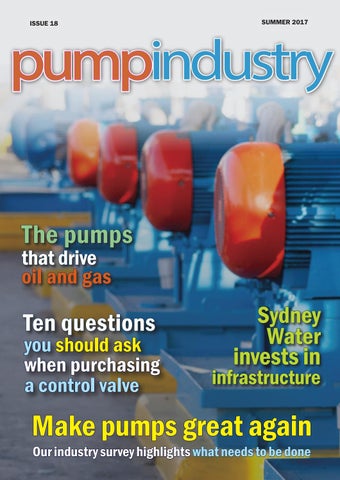
pumpindustry The pumps that drive oil and gas
Ten questions
you should ask when purchasing a control valve
Sydney Water invests in
infrastructure
Make pumps great again Our industry survey highlights what needs to be done
When it comes to
WaterMarked has valves, Zetco you covered
Zetco specialises in WaterMarked manual isolation valves including ball, gate, globe, check valves and YÂ strainers in DZR brass, bronze and stainless steel.
Phone 1300 659 639 Email enquiries@zetco.com.au www.zetco.com.au
IAPMO WM-000110 AS 5830.1
PUMP INDUSTRY
President’s welcome F Pump Industry Australia Incorporated PO Box 55, Stuarts Point NSW 2441 Australia Ph/Fax: (02) 6569 0160 pumpsaustralia@bigpond.com Dave Alexander – President KSB John Inkster – Vice President Brown Brothers Engineers Kevin Wilson – Treasurer/Secretary Executive Officer Keith Sanders – Councillor Executive Officer – Marketing & Statistics Life Member Alan Rowan – Councillor Executive Officer Publications & Training Life Member Ken Kugler Executive Officer – Standards Life Member
irstly, a big thank you for nominating and electing me as PIA President for 2017. I’ve always valued the informative market insights gained from my connections through the PIA, and I look forward to giving back to the association during my time as President. Outgoing President Ron Astall has left big shoes to fill. Thankfully, we will continue to share his insights and experience as he stays on as a councillor for the PIA. Working alongside my fellow councillors, we hope to foster more engagement and opportunities to network for members of the pumping equipment industry in 2017. We’d like to encourage the best of the best to consider careers in the pumping industry, and support them through training as we welcome them into the fold. The PIA is here to help and support our members, and will look for your feedback in improving our services. Please feel free to contact myself or any of the council members with your suggestions and ideas.
It’s encouraging to see commodity prices increasing, including thermal coal and iron ore. I hope this increase is sustainable and will result in investment in infrastructure and new projects. The end goal for us is to fill demands for new pumping equipment and service requirements. In 2017, the PIA will be focusing on providing training seminars that will benefit our members, and we will continue our normal meetings which are held across the country. I will be encouraging our members to attend these meetings and training seminars. It is important to all members that we have a strong PIA association to act on our behalf. Yours in pumping, Dave Alexander President, Pump Industry Australia
Ron Astall - Councillor United Pumps Australia Ashley White – Councillor Davey Pumps Peter Passalacqua – Councillor Grundfos David Brooks – Councillor Flowserve FSD Jamie Dixon – Councillor White International
www.pumpindustry.com.au
pump industry | Summer 2017 | Issue 18
1
SUMMER 2017
ISSUE 18
pumpindustry
Editor’s welcome
The pumps that drive oil and gas
Ten questions
you should ask when purchasing a control valve
Sydney Water invests in
infrastructure
Make pumps great again Our industry survey highlights what needs to be done
Cover image highlights our State of the Industry feature - read the article on page 32.
4,153 1 April 2016 - 30 September 2016
Published by Monkey Media Enterprises
ABN: 36 426 734 954 PO Box 1763 Preston South VIC 3072 P: (03) 9988 4950 F: (03) 8456 6720 monkeymedia.com.au info@monkeymedia.com.au pumpindustry.com.au magazine@pumpindustry.com.au Publisher and Editor: Chris Bland Managing Editor: Laura Harvey Associate Editor: Jessica Dickers Contributing Editor: Michelle Goldsmith Journalist: Lauren Cella Journalist: Jesse Tyler Marketing Director: Amanda Kennedy Marketing Associate: Mathew Walker Marketing Consultant: Aaron White Marketing Consultant: Steven Golding Production and Customer Service: Titian Bartlau Senior Designer: Alejandro Molano Designer: Jacqueline Buckmaster
W
elcome to the first edition of Pump Industry for 2017. We’ve started off the year with our in-depth State of the Industry survey to see what worked and what didn’t work for pump companies in 2016, and find out how industry professionals are feeling going into 2017. While our survey found 2016 to be a mixed bag for most pump companies, respondents have a much more positive outlook for 2017, with around 70 per cent feeling confident for what this year will bring. The survey also found the water, wastewater, and irrigation sectors were key areas of opportunity for pump companies, with respondents expecting these areas to continue to grow. The full analysis of your responses and an insight into industry trends and areas for growth can be found in our feature ‘New opportunities drive optimistic outlook’. The new year also brings change to Pump Industry Australia with the departure of President Ron Astall and the appointment of Dave Alexander to the role.
Ron has been the PIA President since just after we launched the first ever issue of Pump Industry magazine in 2012 and we have greatly enjoyed working with him over the years. His encouragement, advice and practical support as our unofficial technical adviser has been a huge help in getting this magazine off the ground in its early years. While we will miss working with Ron in this capacity, we’re glad he is staying on board as a PIA councillor and will also continue to provide his much valued technical advice and contributions to this magazine. We are excited to welcome Dave Alexander to the position. Dave has many great ideas for the PIA moving forward, including a focus on growing the membership and networking opportunities, and we look forward to continuing the collaborative relationship between Pump Industry and the PIA. Chris Bland Publisher and Editor
This magazine is published by Monkey Media in cooperation with the Pump Industry Australia Inc. (PIA). The views contained herein are not necessarily the views of either the publisher or the PIA. Neither the publisher nor the PIA takes responsibility for any claims made by advertisers. All communication should be directed to the publisher. The publisher welcomes contributions to the magazine. All contributions must comply with the publisher’s editorial policy which follows. By providing content to the publisher, you authorise the publisher to reproduce that content either in its original form, or edited, or combined with other content in any of its publications and in any format at the publisher's discretion.
LaserBond® surface engineering technologies can significantly extend your pump’s operating lifespan by reducing wear to its components from abrasive and corrosive fluids.
Three times longer life for pump components significantly lowers production costs. High fluid velocity means wear, erosion and
Production equipment and components surface-
corrosion at high impact points like pump
engineered by Laserbond® will operate in-situ for
impellers, valve seats and stems, and bends and
longer and perform more efficiently. An extended
elbows in pipe work systems. A worn component
operating life increases the cycle time for regular
means inefficiency and delays. We work with
maintenance and decreases maintenance costs.
both pump OEMs and end-users to produce
Pump impellors, pump shafts, housings and seal
cost-efficient long-wearing solutions to high wear
areas are returned to original specification with
components. Our unique surface engineering
laser cladding and machining. LaserBond® surface
technologies - developed to increase resistance
engineering improves and maintains operating
to wear and corrosion – optimise component
efficiency, improves the overall process, and cuts
and system performance so they work better, last
production loss.
longer and cost you less.
Find out more at laserbond.com.au/fluid_handling
Contact LaserBond now and our Tech Team (experienced engineers) will recommend a cost-saving 3 x longer wear-life solution. LaserBond Limited | www.laserbond.com.au Sydney | Adelaide | Freecall 1 300 527 372 International +612 4631 4500 | Fax +612 4631 4555 Email info@laserbond.com.au
Quality 9001, Environment 14001, Health & Safety 4801 14587 A4
CONTENTS
NEWS ACCC takes legal action over “flushable” wipes............................. 6 Wastewater pump station upgrade wins award........................ 8 Launceston pumps ready for flood protection.............................. 9 Queensland explores first solar-pumping water supply......... 10 New partnership for HVAC industry............................... 11 Eliminating snaking and leaking from irrigation hoses....................12 PIA NEWS Solving sludge pump choking problems ....................................... 14 Shaping the industry’s future....... 16 PIA Industry Innovation Award..... 18 INDUSTRY NEWS Flygt Concertor trial a success for Swedish municipality.................... 22 Is drought proofing Australia the possible dream?............................ 26 A new innovation in solar pumping................................ 28 Providing a complete pumping solution.......................................... 30
4
MARKETING Marketing 101 for pump companies: how to get your business noticed......................... 20 STATE OF THE INDUSTRY State of the Industry in 2017: New opportunities drive optimistic outlook ......... 32 OIL AND GAS The pumps that drive oil and gas............................ 40 Do you have a spare pump in case of failure?......... 44 ENERGY EFFICIENCY Sydney Town Hall powers up with trigeneration.................................................... 46 TECHNICAL Interaction of components in piping systems.......................................................... 62
pump industry | Summer 2017 | Issue 18
www.pumpindustry.com.au
pumpindustry
SYDNEY WATER Major investment in new Sydney Water infrastructure........................................................... 52 VALVES Ten questions you should ask when purchasing a control valve............................................................. 56 TRAINING Become a master of pump systems........................ 60 PUMP PIONEERS Keith Sanders............................................................ 64
REGULARS President’s welcome.................... 1 Editor’s welcome.......................... 2 Pump school............................... 59 Pump Standards Part 2
Ask an Expert Progressive cavity pumps in the oil and gas industry......................... 50
Editorial schedule....................... 72 Advertisers’ index...................... 72
PUMP HANDBOOK Thinking positive: the characteristics of positive displacement pumps................................. 68
www.pumpindustry.com.au
pump industry | Summer 2017 | Issue 18
5
NEWS
ACCC takes legal action OVER “FLUSHABLE” WIPES The Australian Competition and Consumer Commission (ACCC) is taking several companies to court for allegedly making false and misleading claims that their wet wipes were “flushable”.
T
he ACCC has instituted proceedings in the Federal Court against Kimberly-Clark Australia and separately against Pental. “Flushable” wet wipes that are entering sewer systems are causing serious damage to pumping infrastructure as pumps are unable to break down the wipes, causing blockages. The ACCC alleges that, by labelling these products as “flushable”, consumers were led to believe that the products had similar
characteristics to toilet paper, would break up or disintegrate in a timeframe and manner similar to toilet paper, and were suitable to be flushed down the toilet, when this was not the case. ACCC Chairman, Rod Sims, said, “The ACCC alleges that the impression given by the representations which Kimberly-Clark and Pental each made about these products was that they were suitable to be flushed down
NEW! ®
PRESSURE SYSTEMS
AUTOJET SERIES - MULTIMAX 120 PERFECT FOR THE HOUSE PERFECT FOR THE GARDEN
FOR INFORMATION VISIT WWW.PENTAIR.COM.AU
6
pump industry | Summer 2017 | Issue 18
www.pumpindustry.com.au
NEWS
household toilets in Australia, when this was not the case. “These products did not, for example, disintegrate like toilet paper when flushed. Australian water authorities face significant problems when non-suitable products are flushed down the toilet as they contribute to blockages in household and municipal sewerage systems.” In both proceedings, the ACCC is seeking declarations, pecuniary penalties, injunctions, corrective notices, compliance program orders and costs. Sydney Water’s Peter Hadfield said Sydney Water supports the ACCC’s milestone announcement. “Sydney Water has been a leader on this issue for the past 18 months through our ‘keep wipes out of the pipes’ education program and we have strongly advocated that only the three P’s should be flushed down the toilet - pee, poo and (toilet) paper,” Mr Hadfield said. Water Services Association of Australia (WSAA), Executive Director, Adam Lovell, said WSAA and its members from Australia and New Zealand have been joined by over 300 water utilities and partner organisations around the globe in a joint international statement raising awareness of the issues
associated with products labelled ‘flushable’. “The international statement also outlines that only the three P’s should be flushed,” Mr Lovell said. “It also calls for clearer labelling and covers the key requirements for any future standard for ‘flushable’ products’.” Queensland Urban Utilities has also welcomed the decision of the ACCC to take court action, citing it as a positive step towards solving a big problem for sewer pipes as they can cause blockages to the network and household pipes, leaving homeowners with expensive plumbing bills. Queensland Urban Utilities spokesperson Michelle Cull said, “Wet wipes, including those labelled ‘flushable’, don’t disintegrate quickly like toilet paper and can lead to costly blockages in our network. “We spend around $1.5 million every year clearing blockages from our sewers. We also remove around 20 million wet wipes from our sewage treatment plants annually, which laid end-to-end would stretch from Brisbane to Bali. “Labelling can be confusing for shoppers, so we welcome the ACCC’s decision and will be following the matter with interest.”
FLEXIBORE FLEXIBLE RISING MAIN
22 Industry Place Bayswater VIC 3153 Australia Phone: +61 3 9720 1100 Email: sales@crusaderhose.com.au
Flexibore reduces head loss, improves flow rate and eliminates iron bacteria build-up due to swelling under pressure.
www.crusaderhose.com.au
SWELLING
ELIMINATES BUILD-UP www.pumpindustry.com.au
pump industry | Summer 2017 | Issue 18
7
NEWS
Wastewater pump station upgrade wins award
A
$7.7 million upgrade of the largest wastewater pump station in the City of Logan, Queensland, has been recognised at the 2016 Institute of Public Works Engineering Australia Queensland (IPWEAQ) Excellence Awards. The Alfred Street pump station, located at Slacks Creek, has operated since 1984, taking wastewater from residential and commercial properties to the Loganholme Wastewater Treatment Plant for processing. Logan City Council Roads and Water Infrastructure Committee Chairman, Phil Pidgeon, said the pump station was a “quiet achiever” in the city’s infrastructure assets. “Treating sewage is an essential community service, but it usually goes unnoticed by the community because it operates so efficiently,” Mr Pidgeon said. “Because we’ve completed this upgrade, we have reduced the risk of
8
overflows to waterways or the urban environment. “We have increased capacity and improved efficiency to prepare for the significant population growth we are expecting in the next few years.” Mr Pidgeon said the council’s Logan Water Infrastructure Alliance had saved $1 million during the project by reusing existing pump station components. “The project was delivered by 270 mostly local workers in 22,500 working hours, and approximately 95 per cent of the major construction and supply contracts were completed by SouthEast Queensland companies,” Mr Pidgeon said. “All of this led to the project winning the top accolade for water projects between $5 million and $10 million
pump industry | Summer 2017 | Issue 18
at the IPWEAQ awards – testament of the expertise we see in the Logan Water Infrastructure Alliance. “On behalf of Logan City Council, I’m thrilled to say that we are continuing to lead the way in delivering quality infrastructure for our residents and I’m excited to see that work recognised by our industry peers.”
www.pumpindustry.com.au
NEWS
Launceston pumps
READY FOR FLOOD PROTECTION
T
asWater has completed upgrades and maintenance works on stormwater pumps at the Margaret Street Pump Station near Kings Park in Launceston. Glen Rowlands, TasWater’s Department Manager, Urban Treatment Plants, said, “The major flood event in June this year demonstrated the effectiveness of the Launceston flood protection system of which the Margaret Street Pump Station is one of a number of key facilities in Launceston’s combined system, which provides
sewerage and stormwater services to the city as well as protection from flooding during periods of heavy rain.” The pumps can remove massive volumes of stormwater from the system during high rainfall events, transferring it over the levee system into the river, even against the flow of a high tide. Mr Rowlands said if the pumps did not operate as designed, stormwater would collect behind the levee system and cause flooding in and around the city centre. “When all of the pumps are operating
the station is capable of discharging almost 10,000 litres of stormwater each second into the river.” The Margaret Street pump station is one the largest of its type in Australia and at the time of construction in 1990, was reportedly the largest in the southern hemisphere. The maintenance work will ensure the pumps remain in good working order and have an optimal asset life. “All the pumps have been lifted to the surface and have undergone an inspection and performance check by specialist service agents,” Mr Rowlands said. “The pumps have proven to be in excellent condition and should provide many more years of reliable service.” Installed by the Launceston City Council, the pump station is now part of TasWater’s infrastructure, who will also carry out ongoing operations and maintenance of the pump station.
THE P LATYCAT S NATCHER IS A NEW AND SAFER WAY TO LIFT Australian safe lifting invention designed to deliver: • • •
enhanced workplace safety simplicity of use significant cost-savings
PlatycatSnatcher is distributed through Australia’s foremost certifier and distributor of lifting equipment, All Lifting P/L.
TO FIND OUT MORE GO TO:
www.platycatsnatcher.com.au CALL 1300 666 733 www.alllifting.com.au www.pumpindustry.com.au
pump industry | Summer 2017 | Issue 18
9
NEWS
Queensland explores first solar-pumping water supply
T
he Mount Isa Water Board is progressing a study to bring reduced-cost solar pumping from Lake Julius in Queensland’s Gulf Country region, in what would be the state’s first solar powered water supply. Queensland Minister for Biofuels, Energy and Water Supply, Mark Bailey, said the innovative project could see renewable energy being used to increase water supply security, while reducing operational costs. “This project has the potential to reduce the substantial cost of pumping water from Lake Julius to Mount Isa’s water treatment plant, some 70km away,” Mr Bailey said. A pre-feasibility study has been completed for the project,
and it will soon progress to a concept design. Mount Isa Water Board Chief Executive, Stephen Farrelly, said the pre-feasibility study undertaken in June 2016 found that the project is expected to be viable and would generate a net cost saving for customers. “The project is still in its infancy and, as is appropriate for such a substantial investment, it will need to progress through a series of approvals before a final investment decision can be made,” Mr Farrelly said. “We can see that if successful, it will have great benefits to our customers and the community.” Mount Isa Mayor, Joyce McCulloch, said the study aligned with the council’s plans for exploring renewable energy projects for the future of Mount Isa. “This project could bring so many benefits to Mount Isa,” Ms McCulloch said. “There is the obvious water security and reduced costs of pumping from Lake Julius, but it would also mean greater year-round recreation access for Lake Moondarra if the region can use water from Julius for a similar cost. “North West Queensland and Mount Isa have been identified as having one of the highest amounts of solar radiation per square metre, so it makes perfect sense for solar projects to be pursued.”
Are the Fire Panels that you supply FULLY AS 2941-2013 Compliant? Welling & Crossley Diesel Fire Control Panels are Fully Compliant with Australian Standard AS 2941-2013 The ones we’ve seen that are not, don’t have: 3 stage Battery Charger - Standard Ref. # 9.4.14 Jacket Heater Failure Indicator - Standard Ref. # 9.4.7 Battery Charge & Temperature Monitoring - Standard Ref. # 9.4.14
GO CHECK YOURS NOW! Don’t risk it with a non-compliant panel “The inspectors are coming” 59 Export Drv Brooklyn VIC 3012 Email: sales@wellcross.com.au
10
pump industry | Summer 2017 | Issue 18
. www.pumpindustry.com.au
NEWS
New partnership for the HVAC industry
T
he Australian Institute of Refrigeration, Air Conditioning and Heating (AIRAH) has signed a collaborative agreement to promote and enhance energy efficiency practices and services in the HVAC&R industry to end users. AIRAH and the New South Wales Office of Environment and Heritage (OEH) will work together to promote a better understanding of HVAC&R energy efficiency. AIRAH CEO, Tony Gleeson, said, “AIRAH and OEH have long held a strong collaborative relationship. “The agreement solidifies the parties’ commitment to enhance the skills, knowledge and opportunities for HVAC&R service providers to assist NSW businesses. “It will also support both organisations’ current and future programs, schemes and related initiatives. AIRAH is committed to conducting cross-promotion activities, communications, and to deliver other appropriate support to OEH’s relevant activities.” As per the agreement, some initial areas of focus will be the commercial refrigeration sector, HVAC optimisation, energy efficiency training courses, PRIME, the New South Wales Energy Savings Scheme, NABERS, and other industry events. AIRAH Executive Manager, Government Relations and Technical Services, Phil Wilkinson, said he is looking forward to working collaboratively with OEH to explore a range of potential projects. “There are several exciting developments already in the pipeline,” Mr Wilkinson said.
“We will assist in a national delivery of co-branded OEH energy efficiency training courses, and work to develop commercial refrigeration information material, such as an optimisation guide and fact sheets. A cool room/freezer room benchmarking tool is also on the cards. “Also, off the back of the successful co-branded, jointly developed HVAC Optimisation Guide, we’re looking to further advance strategies to enhance the market’s capacity to deliver energy-efficient HVAC services.” AIRAH will deliver co-branded versions of the OEH’s Energy-efficient commercial refrigeration, Introduction to HVAC and Advanced HVAC training courses in all Australian states and territories, excluding New South Wales. Both parties will promote selected initiatives to its members, program participants, and newsletter recipients through their various communication channels.
THE NEXT GENERATION OF SOLARPAK
www.pumpindustry.com.au
pump industry | Summer 2017 | Issue 18
11
NEWS | PARTNER SOLUTIONS
Eliminating snaking and leaking from irrigation hoses
An Australian cane grower has found a solution to eliminate snaking and puncture tears in irrigation hoses, making the process of irrigating his crops faster and easier.
N
orman Anderson, a cane grower in Queensland’s Childers region, operates 21 travelling irrigators and four centre pivots as part of his business. Mr Anderson often faces tough farming conditions which means finding an irrigation hose that can withstand extreme weather and possible punctures, without being too bulky, is a difficult task. However, advancements in technology and products have allowed Mr Anderson to find an irrigation hose
12
that has minimum pressure loss and maximum hydraulic efficiency. “Technology keeps bringing on improvements with machinery, use of machinery and reductions in labour. Even hoses for the travelling irrigators are so much better,” Mr Anderson said. “We’ve been trialling Angus’ latest hose, Flowmaster, and their advanced manufacturing technique has more or less eliminated the old problems of snaking, wearing and puncturing we have associated with hoses. “Overall, it is working smarter, not harder or longer. Easy to say, many don’t do it.” Angus Flexible Pipelines’ irrigation hose, Flowmaster, is a flexible layflat drag hose for all types of irrigation applications that boasts a long service life, easy deployment and retrieval, and a 10-year warranty. One of the main difficulties irrigators like Mr Anderson find with hoses is the balance between durability and ease of use. Often, tough long-lasting hoses are either not practical to use or don’t coil back easily. The Flowmaster irrigation hose comprises a circular woven hightenacity polyester reinforcement covered in a tough elastomeric
pump industry | Summer 2017 | Issue 18
polyurethane cover and lining, designed to fit a wide range of coupling types. The polyurethane cover is resistant to abrasion, cutting, ozone, UV, weathering and microbiological attack, allowing it to last for a long period of time with minimal maintenance. While its construction makes it durable, the Flowmaster is also steamed to size which minimises snaking and ensures the hose coils back easily. The Flowmaster has a maximum swell of only six per cent which maintains pressure and eliminates hose contraction, and its ‘fine weave’ one-piece construction maximises reeler capacity. The Flowmaster is available in standard lengths of 200m, and up to 400m, and is suitable for both travelling irrigators and linear irrigation systems. Mr Anderson has been trialling Angus Flexible Pipelines’ irrigation hoses for six years and says he finds it lightweight, easy to deploy continuous lengths without the hose twisting, and that it fits well on a standard reel. “This latest hose is the one. I’ve trialled and tested it for over six years and bought several more. No leaks, and a generous 10-year warranty,” Mr Anderson said.
www.pumpindustry.com.au
ANGUS FLEXIBLE PIPELINES PROVIDES INNOVATIVE LAYFLAT HOSE SOLUTIONS FOR MINE DEWATERING AND A WIDE RANGE OF FLUID TRANSFER
Wellmaster is the Industry Standard Flexible Rising Main for all types of ground water extraction and well-monitoring operations. Wellmaster Approvals:
0 OVER 90o,rl0dw0ide w installations
Flexible Risin
Reg 31 NSF 61 DVGW W270 DM174 Institut d’Hygiene AFNOR AS 4020
UK USA/Canada Germany Italy Switzerland France Australia/NZ
g Main
Angus Flexible Pipelines Australia Pty Ltd
Ph: 07 3256 7624 M: 0497 799 098 9/67 Depot Street BANYO Qld 4014
PIA MEMBER NEWS | PARTNER SOLUTIONS
Solving sludge pump choking problems Lismore City Council was having chronic problems with their digester pump choking at their South Lismore Sewage Treatment Plant, until an innovative new solids management system was introduced at the plant.
A
ccording to plant employees Matt Potter and Brad Hampson, the pump would choke on a daily basis during its job of turning over the digester. They were using a Gorman-Rupp T3A3S-B self-priming sewage pump, but the sheer number of rags made it very difficult for even this excellent solids handling pump to pass all the rags, all the time. Over the years, they tried different
wear plates (even from different companies), but the best they could achieve was to limit choking to once or twice per week by installing one of Gorman-Rupp’s self-cleaning wear plates. The council was then told of Gorman-Rupp’s new Eradicator Solids Management System and wanted to try it. The Eradicator™ system features an aggressive self-cleaning wear plate incorporating a number of notches and grooves, as well as a patent-pending lacerating tooth that helps break up stringy materials (such as rags), scrape them off the impeller vanes and pass them through the pump – all without impacting performance or interrupting service. A special cover plate with the system also includes a patented lightweight inspection cover that can easily be removed, if necessary, to inspect pump internals. The Eradicator system is available on all Gorman-Rupp Super T Series pump models, so the range can achieve flows from five litres per second (LPS)
through to 150 LPS and deliver heads to 40m, all while working on suction lifts to 7.6m. Because they are self-priming pumps, the pumps can be located at ground level, giving operators easy and safe access to the pumps for monitoring and/or service, unlike submersible pumps which require cranes and several operators to access. Wet well lids also stay closed with self-priming pumps so that operators are not exposed to falling into the wet well when anything needs to be done with the pumps. Clearance adjustments, oil changes, and general inspections only take minutes, which adds up to massive savings in time over the life of the pump. As the new system is available as an upgrade kit for existing Super T, Lismore City Council installed one of these into their existing Gorman-Rupp T3. The pump then ran for three months without a single choke. In the same period, they would have expected to have between 12 and 24 chokes. Matt, Brad and their colleagues at the council are very pleased with the result.
Gorman-Rupp Super T Series Pumps now available with:
Lightweight Inspector Cover Revolutionary Cleaning Tooth Cover Plate With Obstruction Free Path Designed for “Todays Sewage”: Sanitary wipes, Plastic bags, Fibres and Sludge The system consists of a new, patented lightweight inspection cover, an innovative back cover plate incorporating an obstruction free flow path, and an aggressive self-cleaning wear plate including laser cut notches and grooves, along with a revolutionary tooth designed to clear material from the eye of the impeller.
Retrofit Kits Available For Current Super T Series Pump
HydroInnovations.com.au 02 9898 1800 sales@hydroinnovations.com.au
14
pump industry | Summer 2017 | Issue 18
www.pumpindustry.com.au
Power, performance and reliability with larger four-cylinder engines Sludge pump applications Transfer pump applications Agricultural irrigation Engine power packs are fully assembled with world class components Support of a national dealer network for Service and Spare Parts requirements
liable Always Re
- Kubota
INES G N E L E S DIE
Call now for low finance rates & your nearest dealer
AUSTRALIA WIDE 1300 582 582
kubota.com.au
PIA NEWS
Shaping the industry’s future Last November, the PIA council and members met for the association’s 13th annual general meeting and dinner. Attendees discussed the extensive training and liaison activities undertaken by the PIA in 2016, and discussed potential pump opportunities in China.
T
he PIA was happy to report the continuing success of its Installation and Commissioning training course, which was held twice during 2016 at Link Pumps in Sydney in February and September. The course is continually being updated and improved, with the council currently exploring the possibility of running the course in Perth if suitable facilities for the practical “hands on” demonstrations can be organised. The PIA also discussed its continuing liaison with industry organisations and government departments to promote cooperation between industries. During his President’s speech Ron Astall reported that a fire pump installation checklist produced by PIA life member Ken Kugler has been adopted by the Fire Protection Association Australia as an official document. The checklist will be included in the next revision of AS 2941 as an appendix. The council reported it is continuing to work with the Department of Environment and Energy on Emissions Reduction Fund initiatives and is putting together the Industrial Equipment Upgrade proposal for pumping equipment. The council also awarded the PIA Industry Innovation Award 2016 to Pentair for its SX Solids Pneumatic Air
Operated Vacuum Pump. To find out more about the award, see page 18. At the end of the AGM, attendees also enjoyed a presentation by special guest speaker Harry Katunar, Queensland and New South Wales Sales Manager at Pentair, who discussed his experience doing business in China while working at KSB. He discussed the differences and similarities in the industry between the countries, as well as the opportunities that China could provide the Australian market. The presentation provided great insight for those wanting to break into the Chinese market.
Outgoing President Ron Astall passes the baton to new President Dave Alexander.
Scott Donoghue, Peter Passalacqua and Craig Frank.
16
pump industry | Summer 2017 | Issue 18
James Blannin and Ken Kugler.
www.pumpindustry.com.au
PIA NEWS
The PIA Council for 2017.
Rhys Laughton and Derek Price.
Aaron White and Carl Gilbert.
Kevin Wilson and Alan Rowan.
www.pumpindustry.com.au
PIA WELCOMES NEW COUNCIL MEMBERS At the PIA’s general meeting last November elections were conducted for the positions of President, Vice-President and councillors. Outgoing President Ron Astall was thanked for the work he had done for the PIA as its leader over the past four years, and it was noted that he will continue his work with the association as an elected councillor. The outgoing councillors were also thanked for their work over the past year and David Alexander, Managing Director of KSB Australia, was elected as the new PIA President. Mr Alexander has worked for KSB Australia for 21 years and held the position of Managing Director for the past nine years. John Inkster, CEO of Brown Brothers Engineering, joined Mr Alexander on the council as the re-elected Vice-President. Earlier in the evening, a motion to amend the PIA constitution was passed to increase the council to eight members, with at least six being accredited representatives with full association membership. Mr Alexander, Mr Inkster and Mr Astall are joined by Alan Rowan, Keith Sanders, Peter Passalacqua, Ashley White, and David Brooks who were elected as councillors during the meeting, with Jamie Dixon appointed at a later date. Congratulations to Mr Alexander and all the new and re-elected members of the council. pump industry | Summer 2017 | Issue 18
17
PIA NEWS
PIA Industry Innovation Award In 2016 the PIA launched the Industry Innovation Award, which recognises and encourages new products and techniques the Australian industry will need to foster in the coming years to remain a powerhouse in the global pump industry.
I
n developing the Industry Innovation Award, the PIA noted that the future prosperity of the Australian pump industry will be heavily dependent on the ability of PIA members to introduce innovation that meets the needs of Australian and regional pump users. The climate, geography and resource development potential in the Asia Pacific will continue to present challenges for innovation to meet the environmental and economic circumstances of the region. The PIA believes that Australian businesses are ideally placed to capitalise on this potential, the aim of the Industry Innovation Award is to encourage businesses towards impressive achievements in this arena. In calling for applications for the 2016 award, the PIA asked applicants to demonstrate the contribution their design team had made to the industry with their new pump, pumping system or similar pump related project. Applicants were advised that initiatives that save energy or minimise environmental impact through innovative design or system development would be well regarded in the judging process.
2016 award The winner of the inaugural PIA Industry Innovation Award was announced last November at the association’s annual dinner.
The award for 2016 went to Pentair Southern Cross for their SX700 – E-Vac In Line Vacuum Units. These pumps provide increased efficiencies and reduced completion times, all while meeting the increased safety requirements of working within a confined space. In early 2016, a demonstration of the abilities of these pump units was conducted at Malaysia Marine and Heavy Engineering (MMHE), with very impressive results – the chosen SX pumps delivered up to 30m vertical discharge. Following this demonstration, Pentair Southern Cross was awarded a contract with ZAR Lynx Malaysia on a product for Floating Production Storage and Offloading (FPSO) tank sludge removal and cleaning. An ongoing issue that FPSO owners and operators experience is that the vessels need to be in dry dock for the tank sludge removal and cleaning for a number of days; resulting in high costs. Often a hole had to be cut into the vessel for cleaning which then needed to be repaired.
Jon Mans from Pentair accepts the PIA Innovation Award from President Dave Alexander.
ZAR Lynx and Pentair Southern Cross worked together to develop the SX700 series specifically for this application. The compact unit can be carried by an operator, allowing for the possibility of tank sludge removal and cleaning to occur while the vessel is afloat, reducing dry dock costs and reducing the down time for the FPSO – a significant benefit to vessel owners and operators.
For further information please contact Southern Cross on 131 PUMP.
18
pump industry | Summer 2017 | Issue 18
www.pumpindustry.com.au
Repair, Re-Manufacture and Re-Design Service For ALL types of Centrifugal Pumps Efficiency Improvement Reconditioning Restore Clearances Re- Engineering P f Performance T Testing. ti Services available include:
• Inspection and trouble-shooting • Case build up and re-machining • Axial A i l split lit case facing f i and d reboring b i • Axial thrust balancing • Shaft and bearing API 610 upgrades • Mechanical Seal upgrades to API 682 • Bearing housing & back cover retrofit • Lube system upgrades • Composite Wear Parts • Tighter clearances • Hydraulic Re-Rating • Rapid R id prototyping t t i • Driver upgrades (MEPS compliance) • Baseplate adaptors and rebuilding • Custom Spare Parts • Rotating Element balancing • ASME & AS1210 qualified Welding • Hydrostatic Testing • Performance Testing • FFT Vibration analysis
A.B.N. 37 006 317 979
31 WESTERN AVENUE SUNSHINE, VICTORIA 3020 P.O. BOX 348, SUNSHINE, VICTORIA 3020 • PHONE +613 9312 6566 • FAX +613 9312 6371
EMAIL unitedpumps@unitedpumps.com.au http://www.unitedpumps.com.au/
MARKETING
Marketing 101 for pump companies:
how to get your business noticed
With hundreds of local and international businesses vying for a customer’s attention, pump companies need to know how they can stand out from the crowd. The marketing landscape has changed enormously in the past decade with SEO, social media, and content marketing all becoming key elements of any marketing strategy. The team at Monkey Media have evolved at the same time, and in this edition we give you a peek into how our marketing agency operates to help take pump companies’ marketing to the next level.
A
ustralian pump companies need to be across a diverse range of industries, including water and wastewater, oil and gas, HVAC, dewatering, food and beverage, and chemicals, among other sectors. Due to the sheer number of companies in the market, the internet can be a pump company’s best friend, but only if they know how to use it to their advantage. We’ve analysed how pump end users find the products they are looking for online and found that when someone is searching for a pump they won’t go directly to a company’s website, but will Google how to fix a specific problem and find a pump that can help. With this in mind, the best way to get noticed by pump users is to actively provide an answer to their questions or a solution to their problems.
How to get started? Businesses talk about things like SEO, EDMs and adwords but when it comes to using these techniques for their company, they are often unsure where to start. Most pump companies don’t have the time to dedicate to understanding this area properly or don’t have the resources to employ one person to work solely in marketing. Monkey Media often works with companies who are only just beginning to market their business and helps to demystify how these marketing strategies can be implemented. Our team also stays up-to-date on all the news and trends in the pump industry to make sure our clients always know what is going on. To start, we help pump companies develop a clear strategy outlining exactly what they want their marketing to achieve (promoting a service, product, being viewed a certain way) and then we help deliver this by developing high quality articles. Some companies spend a large amount of time creating well thought-out marketing plans but never actually implementing them, making any strategy useless. While it’s essential to know what you want to achieve, without tangible outcomes it won’t be successful. Our outcomes are the articles created, which can be targeted to a specific market or be used to reinforce a message. While any company can write a few paragraphs telling everyone how great their product is, the difference with Monkey Media is that a team of journalists and editors are creating content that shows your business in a positive light while still providing the reader with useful and sought-after information. These stories are sent directly to the inbox of customers and can be tracked, so pump companies can see how many people are reading them, and who, which creates hot sales
20
pump industry | Summer 2017 | Issue 18
Marketing Associate Mathew Walker and Associate Editor Jessica Dickers discussing the details of a pump company’s marketing focus to ensure upcoming articles maintain the company’s core messages.
leads. The key here is to have good information – it shouldn’t just be about you, it should be useful information for your reader. If customers receive regular online newsletters filled with articles they find helpful or interesting they are more likely to have your company front-of-mind the next time they need to buy the products or services you offer.
Writing informative and useful articles Firstly, we work with the business to decide what areas they want to focus on, which is then clearly laid out in a one to two page ‘marketing focus’ document. This document then becomes a guide for our journalists to refer back to, ensuring each article relates back to a core focus. Once the focus is decided, we develop a list of topics and write the articles. This can include interviewing staff or writing technical and issues-based articles. The process is easy because the company can decide what level of input they want, while retaining overall approval. The articles produced for pump companies can include technical information; tips for selecting, installing, or maintaining a pump; how to fix or prevent specific pump problems; how to reduce costs or fuel; how to increase efficiencies; case studies of clients using pumps; or the benefits of specific products or services offered. We also create a bank of less time-sensitive story ideas while keeping tabs on what is happening in the industry.
www.pumpindustry.com.au
MARKETING
The Monkey Media team deciding on the content and layout for a client’s newsletter.
Looking at the big picture Our marketing process isn’t as simple as writing standalone stories and sending them off – it’s more holistic. We check-in regularly to see if current procedures are still working or if anything needs to move in a different direction. As we’re also a publishing agency with our own magazines, namely Pump Industry, there are also opportunities to use this relationship to get stories published in the magazines and on our websites. We can also manage external publications so stories can be seen by different markets or industries, or use our publishing and industry contacts to enhance the visibility of stories. All of our experienced writers and editors have a strong knowledge of the pump industry and write content for Pump Industry magazine. We know what pump users want to read and can create technical articles that are interesting to read without sacrificing the technical information. Pump companies can be confident they have a trusted expert on board rather than a marketing generalist. Well written articles are at the core of all the content we create but we can also create other types of content for pump companies as part of a strong marketing strategy, including: • LinkedIn shareable graphics/updates on various social media platforms
• A variety of design work, thanks to our in-house design team • Creating, managing or upgrading pump company websites and web hosting platforms • Sourcing images from our extensive database
It all comes down to content There’s no use having a great product or service if no one knows about it, so having a strong online marketing strategy is vital in making sure your company is the one pump users go to. As consumers, no one likes to be bombarded with in-your-face promotional materials spamming their inboxes, which is why providing content that is useful and informative is key. For example, if a pump company is providing information on a technique that will save pump users money or that will increase system efficiency, this is helpful content that people will want to read because it can directly impact their pump applications. Or if a pump user is experiencing a specific problem, goes online to find a solution and finds an article explaining how your pumps can help solve that problem, they are more likely to contact you. This high quality content allows pump companies to be seen by pump users as experts in their field, and as a company that can provide the solutions (and products) they need. If your pump company could benefit from online marketing, contact Chris Bland or Mathew Walker at Monkey Media on (03) 9988 4950 for a confidential discussion about your needs.
Top five tips to get started
Managing Editor Laura Harvey and Senior Designer Alejandro Molano repurposing a client article that proved popular on LinkedIn into Pump Industry magazine.
www.pumpindustry.com.au
1. Be clear on what your message is and who your target audience is 2. Focus on content that will be useful to your customers 3. Make sure your website and social media profiles are up-to-date 4. Consider a newsletter/EDM to keep your business front-of-mind for customers 5. Track and record all leads
pump industry | Summer 2017 | Issue 18
21
INDUSTRY NEWS | PARTNER SOLUTIONS
Flygt Concertor trial
A SUCCESS FOR SWEDISH MUNICIPALITY Operators of a municipal wastewater pumping station in the rural town of Lomma on Sweden’s south-western coast agreed to install and trial a revolutionary new wastewater pumping system in an effort to solve clogging issues at the pump station.
A
s well as delivering clogfree pumping, Xylem’s Flygt Concertor, a state-of-the-art pumping system with integrated intelligence, significantly reduced energy consumption at the wastewater pumping station. The operators were so impressed that they decided to purchase and permanently install the new system at the facility.
Efficiency challenges Lomma Municipality is located in the Skåne region of southern Sweden. It serves over 23,000 inhabitants in three main districts, including several villages and neighbouring communities. The municipality’s Civil Administration Unit is working intensively to expand and improve its services as its population has steadily grown over the last five years. It is in this context that operators of the Borgeby Treatment Plant agreed to trial Concertor, Flygt’s new wastewater pumping system, in one of their pump stations. The main challenges were to improve plant efficiency and reduce instances of pump clogging, which typically required maintenance staff to intervene once a month.
22
Delivering clog-free pumping and significantly reducing energy consumption In June 2015, Flygt Concertor was installed at Flädie Lundavägen pumping station and the system’s performance was closely monitored over a period of six months. This showed that the newly installed system delivered a significant reduction in energy consumption. In addition to the energy savings, maintenance costs decreased by €1,300 annually. Anders Sjöstrand, Manager at Borgeby Treatment Plant said, “Since installing Flygt Concertor we have seen a significant drop in our energy bill. Furthermore, maintenance call-outs have also been reduced to zero as the overall performance at the station has been greatly improved. “We were so impressed with the system that we decided to replace our current system and install this new solution permanently at Flädie Lundavägen.” Furthermore, the benefits of acquiring a system that is so flexible is that, in addition to the immediate positive impact of the trouble-free pumping and energy savings, operators can, for example, plan a significant
pump industry | Summer 2017 | Issue 18
reduction in their pump stock, reducing the variety of pumps needed to cover all of their applications. Lomma Municipality is aware of the inventory savings made possible with Flygt Concertor. “By having Concertor with three outlet dimensions, we can drastically reduce our inventory as we won’t need so many varieties of pumps and impellers. We’re confident that this can deliver savings for us, and we are looking forward to seeing how it will work in the future,” concluded Sjöstrand. One of Concertor’s unique features is its flexibility. Not only does this new system adjust pump performance based on actual flow requirements, making selection easier and guaranteeing optimal performance under variable flow, but it is also scalable, which means that it is possible for operators to add new functionality without losing their initial investment. This makes it suitable for challenges in many different sectors, being able to improve the efficiency of stations with different characteristics. Flygt Concertor will be available in New Zealand from early 2017.
www.pumpindustry.com.au
NEW
CONCERTOR™
PUMPING SYSTEM WITH
INTEGRATED
INTELLIGENCE
WORLD’S FIRST WASTEWATER PUMPING SYSTEM WITH INTEGRATED INTELLIGENCE This revolutionary system delivers optimal performance while reducing your total cost of ownership. It also offers unparalleled flexibility and simplicity on a whole new level. You might even say it thinks for itself. We invite you to enter a new era in wastewater pumping with Flygt Concertor. See Flygt Concertor for yourself at the New South Wales Water Industry Operators Conference & Exhibition in Canberra, 29th & 30th March 2017. One powerful solution. Unlimited possibilities.
www.xylem.com/pumping
Pump Genius WEG PUMP INTELLIGENCE TO YOUR SYSTEM The Pump Genius is a customizable feature of WEG drives that enables your standard VSD to become dedicated for pumping systems. It ensures accurate pressure / flow control throughout the processing cycle, starting with raw water and its usage, ending on wastewater treatment. With an easy-to-use programming wizard, Pump Genius helps you to minimize downtime and maximize energy savings. Everything you need is available through selecting one of the three options that best fits to your application.
simplex
Submersible pumps
multipump
Wastewater plants
Desalination plants
multiplex
Irrigation systems
Water distribution
simplex The Simplex software adds ideal features to the VSD for single pump control. g Pipe Charging Mode g Sleep & Wake-Up Modes g Dry Pump Protection g Broken Pipe or Leakage Detection g Pump Cavitation Monitoring
multipump Multipump is the best choice when a pumping system needs to be integrated with a costeffective solution. It enables one single VSD to control up to 5 pumps via DOL, soft-starter or other starting methods.
multiplex Multiplex software is the most complete solution to accurately control flow and pressure with high reliability. The VSDs control, monitor and manage the entire system on their own. There is no need for additional PLC, HMI or any external devices thus installation costs can be optimized.
INDUSTRY NEWS
Is drought proofing Australia the possible dream? by Warwick Lorenz, Managing Director, Australian Pump Industries
A
few years ago I picked up a book at a second hand book shop called Australia Replanned. Thumbing through it I noted that it was written in 1944 and published in January 1945. What drew me to the book was a fold-out map of Australia that showed an inland sea in the north east of South Australia, with rivers draining into it fed from the north east sectors of Northern Queensland. The book was written by a gentleman writing under the name of Veritas. Veritas was a pseudonym for a journalist called Luscombe who also, as I recall as a kid, was writing for The Truth newspaper in Sydney. The book is a call to arms, warning Australians that they need to get with it and do something with this wonderful huge country of ours. Here’s the key points he makes:
Our opportunities Luscombe points out that in 1944, the war is effectively over and that we need to start thinking about what to do with our country. He draws a parallel with the United States, a country of three million square miles and a population of 130 million. Australia, he points out, is 2.9 million square miles with a population of seven million. Of that seven million, approximately one million were in uniform or working 100 per cent in the war effort. Luscombe also points out that in the years of the Second World War we tripled the productivity of the country, which leads to the obvious question – what next?
The dead heart Luscombe, who of course was writing long before climate change, refers to the central regions of Australia as the “dead heart” of the country. He points out that this was once fertile land covered with dense and luxurious vegetation, evidenced by the fossilised remains found in the Diamantina and Lake Eyre districts.
Creating a vast live heart It should be pointed out that Luscombe wrote at a time when horsedrawn graders were not that uncommon and crawler dozers used cable controls to raise and lower tractor blades. In spite of that, he dared to dream that the parched and arid dead heart of Australia could be brought to life. The vision was an inland sea of approximately 50,000 square miles. This sea would be fed by northern and north eastern rivers, and the flood waters
26
pump industry | Summer 2017 | Issue 18
www.pumpindustry.com.au
INDUSTRY NEWS diverted back across the Dividing Range to flow along the dry central river beds to the inland sea.
the fact that water storage and water security are essential for the progress of our agricultural industries and to foster population growth in the years to come.
Why bother?
Warwick Lorenz.
Examining the scheme In 1944, almost 90 per cent of the total land area of Australia was put to very little use. Those huge areas of land, mainly arid, barren and useless, needed water security. The question we have to ask ourselves is, are we ready to carry out projects like that in Australia? Ion Idriess, one of the great Australian writers of the 20th Century, used the slogan ‘Water is Life’ in a number of his books. In Luscombe’s plan, an inland sea would be created and connected to the Great Southern Ocean by a canal from the head of the Spencer Gulf via Lake Torrens. The canal would be up to half a mile wide with a depth of around 25 feet! The bed of Lake Torrens might be excavated, and locks and pumping stations would be required in order to provide a shipping passage similar to the Panama Canal. Luscombe, of course, is writing at a time when the greatest civil engineering feats the world had seen were considered to be the Panama and Suez Canals. He must have been conscious of the Hoover Dam, draining approximately 1,000 square miles across seven states and capturing up to 740 billion cubic feet of water from the Colorado River each year. When you consider the fact that the Hoover was built in around four to five years, with the primitive equipment and methods of the time, Luscombe’s plan, or something like it, seems absolutely achievable. However, whether the drought proofing of the country, or large sections of it, can be achieved with an inland sea is questionable in today’s world with our 70 years of additional knowledge. What is beyond dispute is
www.pumpindustry.com.au
In a world where Australians appear to enjoy higher wages than just about anybody else on the planet, we are sitting on the biggest piece of unused real estate in the world. It is also possibly the greatest opportunity to provide food resources for a growing world population. It seems there’s plenty of good reasons to provide farms and cities with water security. From a political perspective, governments of either persuasion are and will be faced with financial challenges that must be addressed. The country clearly can’t rely purely on commodity prices to maintain our lifestyle, create employment or sustain our welfare programs. In other words, something has got to give. Imagine a drought proof Australia where we brought life back to country towns, provided farmers with water security, built processing plants to value add raw product, and at the same time, provide the Greens with an environmental wonderland. Going back to Luscombe’s dream, he envisioned forests throughout the centre of Australia – all in a time before we had to worry about greenhouse gases.
Is there a market for what we produce? When Luscombe wrote his book in 1944, the global population was three billion. Now we are seven billion and heading for ten, so it is highly likely there will be a market for top quality food and agricultural produce for at least the next thousand years. The Prime Minister preaches jobs and growth. Well here’s a package that will deliver both. I’ve discussed this idea with civil contractors, farmers, irrigation specialists, water well drillers and a whole wide range of folk to test the water. What I get in return is astonishment that somebody had thought on this scale 70years ago. I get excitement at the possibility of a vision that would change the country forever. I get 100 per cent unqualified support of the vision. Of course the question everybody asks is, “Who is going to do it?” Gina Rinehart would do it! Barnaby Joyce would do it! Most of the people I talk to in the pump industry would certainly not only support it but would
The original scheme for drought proofing Australia.
be happy to be deeply involved. Would it rebirth our pump manufacturing industry? Maybe it would. Think about these statistics: 1. China had the same sized economy as Australia in 1990 2. Twenty-six years later, their economy is 16 times ours and they are number two in the world 3. They have 1.3 billion people, we have 24 million people. We produce approximately 60 million people’s worth of food per year (my rough calculation) and they produce 1.3 billion. In other words, they produce 22 times more food than we do but from about the same landmass Let’s assume we drought proof Australia and can produce five times more food than we do at the moment (i.e. $300 billion worth). That’s bigger than the iron ore business. Not only that, but it’s a much bigger employer and there are loads of benefits that we will get from employment, not the least of which is lower taxes for the rest of us.
Let’s go Luscombe prefaced his book with the comment that if he was wrong in his ideas, he would welcome correction. He also stated three principles that appear to be just as relevant today as they were in 1944. Here they are: 1. Think clearly, without prejudice 2. Think fearlessly, with regard for nothing but the truth 3. Think big, with the knowledge of the almost limitless possibilities of technology As a simple pump man, I welcome the comments of my peers. Copies of Luscombe’s map are freely available from Australian Pump Industries and may serve to inspire some of the readers of this magazine. Bring it on!
pump industry | Summer 2017 | Issue 18
27
INDUSTRY NEWS | PARTNER SOLUTIONS
A new innovation in
SOLAR PUMPING Shakti helical rotor pumps are high quality products designed for drinking water supply and smaller irrigation applications. DC powered helical rotor pumps have been designed specifically to pump water efficiently using solar power. The helical rotor pump is simple, efficient and reliable, pumping water with very low levels of solar power.
T
he motor has been developed specifically for the helical pump and is designed according to the permanent magnet principle with controller. The motor speed range is 500-3,600rpm, depending on power input and load. Each system consists of a pump, motor and a controller. This modular concept keeps all electronics above ground providing, simple servicing. Benefits of the Shakti helical pump: • Designed for use in remote and harsh conditions • Smart modular design for simple and cost effective servicing and repair • Water filled motors for reliability and to avoid oil contamination • Fast and simple installation • Cost effective spare parts philosophy • Very strong ROI against diesel powered pumping • Helical pump to closely match high head and low flow application and optimise efficiency Features: • Water temperature specific variants to provide the most efficient outputs, with a permanent magnet motor (PM motor) featuring a higher efficiency within the power range compared to a conventional asynchronous motor • Stainless steel components • Magnet motors, designed for solar, with over 85 per cent efficiency even low power This form of water pumping has become increasingly popular throughout the world. As a widely adopted solar energy technology, the usage has increased dramatically over the past 20 years. Even though a solar water pump motor is used for smaller operations, the benefits are huge. The key to success is using a high quality solar water pump motor created by a company with years of experience in the business. The development of such affordable, inexhaustible and clean solar energy technologies will have huge long-term benefits. It will increase countries’ energy security through reliance on an indigenous, inexhaustible and mostly importindependent resource, enhance sustainability, reduce pollution, lower the costs of mitigating climate change, and keep fossil fuel prices lower than otherwise.
28
pump industry | Summer 2017 | Issue 18
www.pumpindustry.com.au
INDUSTRY NEWS | PARTNER SOLUTIONS
Providing a complete pumping solution Global leaders in pump control ComAp introduce their plug-and-play solution for the pumping market, making installation easy.
> Complete solution with plugand-play in a polycarbonate or mild-steel panel
We’ll help you grow That’s smart control
> Simple, intuitive controls mean you always know how your pump is performing > Easy speed control of mechanical or electronic engines > Remote monitoring and alarms from your smart phone or tablet > Quickly disable failed sensors to ensure continued water supply to stock or crops
comap.com.au/products/drive
30
pump industry | Summer 2017 | Issue 18
C
omAp has just released a new solution featuring the InteliDrive IPC in either a polycarbonate or mild steel panel, providing significant benefits to the operator. The solution is easy to install, use, fault-find and repair. The polycarbonate panel features an IP67 rating, suitable for mounting outside in all weather conditions, and the mild steel panel features an IP44 rating, making it ideal for mounting in a shed or lean-to. Both the mild steel and polycarbonate solution come standard with a resettable fuse to protect the controller, while also having space for an emergency stop button should it be required. Deutsch connectors are included in both the polycarbonate and mild steel solution for easy installation, incorporating the same pin configuration, so that if the application changes, the solution can change to match. The irrigation pump controller at the heart of the solution allows for control, monitoring and protection for both mechanical and electronic diesel/gas engines in one unit. With automatic, manual or remote start/stop of the engine and automatic SMS on alarm, an increase in automation and efficiency can be expected in process and operation of the application. With only the highest quality materials used, the solution is dependable, durable and supported by ComAp’s strong local sales and engineering team. ComAp services a range of industries, including mining, oil and gas, commercial and agriculture. Specialising in electrical engineering services, including design, installation, commissioning, technical support and consulting, ComAp has a range of products and services to suit your needs.
www.pumpindustry.com.au
RPS Group made in Germany
pair W h y re o u l d ou sh when y !
ADE UPGR
THE NEXT GENERATION
OF THERMAL OIL PUMP HAS ARRIVED
To see the pump in action, go to https://www.youtube.com/watch?v=VL6S2-k92sU NKX-Design <350oC Thermal oils
SiC-sleeve bearing set
Large ball bearing for extended service
Volute casing, interchangeable with most common DIN/EN pumps
Cooling fan
Efficient Impeller design
Std low temperature mechanical seal
Cooling fins
Drain plug
Patented cooling and self-venting system for personnel and environmental safety
FOR DISTRIBUTION ENQUIRIES, CONTACT SALES@RPS-GROUP.NET OR +61 (03) 9763 3221 www.rps-group.net
STATE OF THE INDUSTRY
Recently Pump Industry undertook its fourth annual State of the Industry survey. The survey’s results provide insights into current trends in the industry, areas for growth and opportunity, what has or hasn’t been working for companies over the last year, and the industry’s outlook for the year ahead.
State of the In
NEW OPPORTUNITIES DRI
32
pump industry | Summer 2017 | Issue 18
www.pumpindustry.com.au
STATE OF THE INDUSTRY
What is your company's outlook for 2016?
What is your company's outlook for 2017? 5.6%
2.8%
8%
3%
44%
21.2%
45%
70.4%
POSITIVE
POSITIVE
NEUTRAL
NEUTRAL
NEGATIVE
NEGATIVE
DON'T KNOW
DON'T KNOW
Figure 1. What is your company’s outlook for 2017?
O
ur survey results suggest that 2016 was a mixed bag for the pump industry. While some companies reported exceeding their expectations for the year by various degrees, and a good number of others performed as expected, many still fell short due to a range of factors, including restricted government project expenditure, reduced market confidence, increased competition from imports, lower oil prices, economic downturn and political uncertainty. However, while 2016 undoubtedly had its challenges, the majority of survey respondents were positive about what 2017 might bring. 70.4 per cent of respondents thought their company’s outlook for 2017 was positive, while 21.1 per cent had neutral expectations for the year. Only 5.6 per cent of respondents had a negative outlook
Figure 2. What is your company’s outlook for 2016? Note the increased positivity in 2017.
for 2017, while 2.8 per cent were unsure what to expect. These results are shown in Figure 1. These results signify greater confidence and a more positive general mood within the pump industry than last year, when around equal numbers of respondents expected to perform better (45 per cent) or the same (44 per cent) than during the previous year, and eight per cent expected to perform worse (Figure 2). This increased optimism was also reflected in responses to the question of whether respondents expected their company’s 2017 performance to exceed that of 2016. As shown in Figure 3, 77.4 per cent of respondents answered in the positive, while 16.9 per cent didn’t expect better performance, and 5.6 per cent weren’t sure. Comparing the results of the first two questions
dustry in 2017 VE OPTIMISTIC OUTLOOK www.pumpindustry.com.au
pump industry | Summer 2017 | Issue 18
33
STATE OF THE INDUSTRY of this year’s survey suggests that some respondents expected their company’s performance to improve in 2017, but still did not consider the year’s outlook to be positive overall. Possible explanations for this include that some respondents considered an increase in performance as a neutral result, perhaps because the expected improvement was not huge, or that, for some companies, the expected 2017 improvement was required to make up for a slower 2016, but wouldn’t necessarily result in burgeoning growth. Similar to last year, our respondents were more confident about their own company’s outlook than about the outlook for the industry in general. 41 per cent of respondents expected 2017 to be a positive year for the industry,
Do you expect your company to perform better in 2017 than 2016? 5.6% 16.9%
77.5%
YES NO DON'T KNOW
Figure 3. Do you expect your company to perform better in 2017 than 2016?
30.5 per cent had neutral expectations, while 12.6 per cent thought the industry as a whole was in for a bad year. 15.8 per cent were unsure about what 2017 would bring. These expectations are considerably more favourable than results for 2016, as shown in Figure 4.
Performance by vertical Key to understanding the current state of the pump industry is to examine which particular verticals performed the best and worst for businesses during 2016, and to identify how key sectors are expected to fare in 2017. We asked our respondents how the volume of work across key verticals had changed for their businesses during 2016, and how they expected them to change in 2017. Figure 5 illustrates the actual reported performance of various verticals for our respondents during 2016, compared to their expected 2016 performance at this time last year, and their anticipated performance in 2017. The rundown on 2016 According to our respondents, the best performing verticals in 2016 were water and wastewater, and irrigation. On the other hand, the vertical that performed the worst overall was mining, with the greatest number of respondents reporting a slight or significant decrease in the volume of work in that industry. Overall, a greater range of verticals experienced increases in volume of work than in 2015, and fewer verticals exhibited overall decreases in work volume. These results fall relatively close to the expectations for 2016 expressed in last year’s survey results, suggesting that our respondents have their fingers
Industry outlook in 2017 versus industry outlook in 2016. 50
2016
40
2017
30 20 10 0
POSITIVE
NEGATIVE
NEUTRAL
DON'T KNOW
Figure 4. Industry outlook in 2017 versus industry outlook in 2016.
34
pump industry | Summer 2017 | Issue 18
on the pulse of the industry. What’s in store for 2017? Once again, our respondents considered the water and wastewater industry to be the biggest boom area. Most respondents thought the volume of work in this area would increase during 2017, and no respondents thought it would decrease at all. Significantly more work was also expected in irrigation. In contrast to last year, a greater percentage of respondents seemed to consider the sharp decline in the mining, and oil and gas industries to be coming to an end, with most respondents expecting the work volumes in these verticals to increase slightly or remain stable.
Factors affecting the industry Our respondents cited a variety of key factors that had impacted upon their performance, for better or worse, throughout 2016. Our respondents’ thoughts are summarised in Figure 6, which showcases the factors that have had a negative impact on the industry against the factors that have had a positive impact on the industry; and Figure 7, which summarises the overall impact various factors have had on the industry. Asking our respondents to identify the industry trend or external factor that had the single biggest impact on their businesses in 2016 unearthed a number of recurring themes. An increase in agricultural and irrigation projects was a positive for some respondents. “The agricultural industry is experiencing a boom at the moment and there are still government grants available for private irrigation infrastructure upgrades,” said one respondent. However, other respondents said that, in their experience, higher rainfall had reduced irrigation requirements, which had affected their business negatively. This reflected a general trend in responses where some respondents cited an increase in greenlit projects as having positively affected their business, while others, perhaps operating in other states or industries, considered project spending to have dropped off, affecting their businesses negatively. Increases in electricity prices were also mentioned by a number of respondents, with companies that managed to take advantage of the increased demand for energy efficient or solar-powered pumping products reaping rewards as a result. “The rising cost of power is forcing
www.pumpindustry.com.au
STATE OF THE INDUSTRY
www.pumpindustry.com.au
Performance by vertical. d se ly rea nt Inc nifica sig
2016 - EXPECTED 2016 - REPORTED
d se t rea ha Inc mew so
2017 - EXPECTED
d ye e Sta sam the ed as t cre ha De mew so ed as ly cre cant e D nifi r e g n C er s er sig als ring on ate tio rag bb nin Ga Pap VA tic u ati Mi Ru era es/H beve tew Irrig eu fact l& & s n c & a a e u Oi c s lp w & rm Man rG rvi Pu astic od r& ha Se we Fo Pl ate &P Po ding W s l l i ica Bu em Ch
Figure 5. Performance by vertical. Note the difference between expected performance in 2016 and the actual reported performance; as well as the significant expected increase across a range of verticals in 2017.
Agricultural industry
Performance of mining industry
Commodities prices
Other
Global oil price
20
Australian unemployment rate
40
Interest rates
60
Major projects approved and/or underway
Influential factors on the Australian pump industry in 2016 – negative to positive.
Value of Australian dollar
larger agricultural producers to upgrade pumping plants to more efficient units,” said one respondent, while another cited solar pumps as the “next big thing”. Changes in the HVAC industry had caused real problems for a number of respondents, who expressed serious concerns about the quality of product being specified throughout the industry. “The HVAC industry is declining in quality with builders/plumbing contractors changing specifications and putting in the cheapest rubbish available,” said one respondent. “Fire services has also gone the same way and these jobs have decreased significantly in value and quality.” Similar sentiments were expressed in other responses. “In the building services industry, D&C (design and construct) jobs have meant a lower standard in engineering and quality of product supplied, driving prices down,” said another respondent. Competition from cheaper imports, especially from Asia, also had negative impacts on a number of companies. Some respondents cited the downturn in mining as having the biggest negative influence on their business in 2016. However, others managed to make this trend a positive by capitalising on the mining industry’s “heavy focus on cost reductions and operational improvements”. Low commodity prices were a negative for some respondents, however a number said they expected them to improve during the next year. Other factors that had affected our respondents included the value of the Australian dollar, unemployment, and reduced focus on staff training. Weather conditions were also listed as a big influence on performance during 2016 by many respondents. Other respondents had received benefits from making the most of marketing opportunities. Looking forward into 2017, we asked our respondents about a range of economic trends and whether they thought they would have a positive or negative impact on the Australian pump industry. Trends that the majority of our respondents expected to have a positive impact on the industry included the agricultural industry, and major projects being approved or underway. Opinions were more divided over other trends, such as the value of the Australian dollar, global oil prices, interest rates, the performance of the mining industry, and commodity prices.
0
-20
Figure 6. Influential factors on the Australian pump industry in 2016 – negative to positive.
The end of the mining downturn? In response to last year’s survey, many of our respondents said that they had been hit hard by the collapse in commodity prices and subsequent downturn in the mining industry during 2015. This year, we asked whether they thought we had reached the end of the mining downturn. Opinions were divided on this topic, ranging from, “Yes, there are signs that commodity prices are improving,” to “Yes, but it will remain flat for some time before any recovery,” to “No – American imports from China being restricted will have a detrimental affect on our raw products,” or “No, due to government disincentives and the cost of power”. However overall, a slightly greater
number of respondents thought that the bottom of the downturn had been reached than didn’t.
The impact of ChAFTA Another topic upon which our respondents had vastly differing opinions was the China–Australia Free Trade Agreement (ChAFTA), which removed tariffs on a range of exports and imports. We asked our respondents how this agreement had affected their businesses in 2016. Responses from those who viewed the agreement positively included: • Made pumps that we import from China slightly cheaper • No impact in 2016, but expect positive impact in 2017 • We have identified and engaged
pump industry | Summer 2017 | Issue 18
35
STATE OF THE INDUSTRY
The water industry is expected to be an area of significant growth for the pump industry in 2017.
a number of high-value Chinese manufacturers, allowing for more adaptable products and higher margins Others had been negatively affected by the agreement, with responses including: • It will negatively impact on us due to cheaper Chinese products flooding the market • Allowed a lot of illegal electrical products into our market that are non-conforming • Huge impact on building/mechanical services industry, where price is a main decision-making factor. Lots of low-cost pumps suppliers are finding their way into this industry, taking advantage of the non-existent local industry protection • Cheap rubbish pumps entering Australian market, including cheap copies of other manufacturers’ product from China However, many other respondents
said that they had noticed little or no impact on business whatsoever.
Key drivers of growth in 2017 When we asked our respondents which verticals will drive growth for the Australian pump industry in 2017, the water and wastewater industry was the clear winner, with 76.6 per cent of respondents anticipating growth in this area. Coming in second was irrigation, which was expected to drive 2017 growth by 61.7 per cent of our survey respondents. Mining took out third place, with 57.5 per cent of respondents identifying this vertical as a likely key driver of 2017 growth, suggesting that many of our respondents do feel that the worst of the downturn is over. Growth driven by the building services/HVAC industry was expected by 38.3 per cent of respondents, making it the fourth most common choice. Areas that relatively few respondents expected to drive growth included
Overall impact (positive or negative) several factors had on the Australian pump industry in 2016.
chemicals and pharmaceuticals (4.3 per cent), and pulp and paper (6.3 per cent). No respondents anticipated growth driven by plastics and rubber. This information is represented graphically in Figure 8.
Innovation, projects, and efficiency: areas of opportunity In a challenging market, success relies on quickly and effectively taking advantage of the opportunities offered. Our respondents identified a range of major opportunities for Australian pump industry players over the next 12–24 months. Many of our respondents considered upcoming irrigation projects and growth in water-related industries as likely to provide significant opportunities for companies working within those spaces. “The water industry is the sector which will provide the best opportunities,” said one such respondent. A number of respondents believed opportunities could be found by
What are the key verticals that will drive growth in the Australian pump industry in 2017?
te
Global oil price
er
Figure 7.
36
25%
Oth
Commodities prices
Water & wastewater
ent ra
Mining industry
Irrigation
50%
Mining
ploym
Building Services/HVAC
Unem
Oil & Gas
Interest rates
Food & beverage
Major projects
Manufacturing
75%
Power Generation
Australian dollar
Pulp & Paper
Agricultural industry
Chemicals & Pharmaceuticals
100%
0% Figure 8. Key verticals that will drive growth in the Australian pump industry in 2017.
pump industry | Summer 2017 | Issue 18
www.pumpindustry.com.au
STATE OF THE INDUSTRY
doubling down on service and quality. “The more regulated industries – such as mining, water and wastewater – will continue to need a quality approach,” said one respondent. “A slight rise in manufacture may also see companies requiring a whole of lifecycle approach rather than something just to get them through the defects period.” “The (companies) with local service capabilities will strive and maintain valuable customer relationships, which will be very important for when the projects come back to the discussion table,” said another respondent. Innovation was also considered key to unlocking opportunities, with respondents listing smart pump designs, energy efficiency, and the export of innovative pump designs as likely to provide benefits to those who got in on the game. “Companies must innovate to find other solutions to meet market needs,” said one respondent. “Maintenance and efficiency gains are key moving forward.” Many of those who believed low commodity prices had run their course also thought that the mining and oil and gas industries would once again be areas of opportunity. “Increasing capital availability in the mining and oil and gas
sectors (offers opportunities),” said one respondent. Others saw opportunity in construction projects (both in housing developments and infrastructure upgrades such as sewage bypass projects and backup food production), diversification, smart marketing, and increased export potential with a low Australian dollar.
Energy efficiency: the next big thing? The topic of energy efficiency was frequently mentioned throughout responses to a range of survey questions, with many respondents clearly considering energy efficient pumping solutions to provide the single biggest opportunity across a range of verticals in the foreseeable future. Key drivers of the push towards energy efficiency included increasing electricity prices and initiatives by major end user businesses to reduce power consumption. Solar pumps or pumps powered by other renewable energy sources were also mentioned. A number of respondents described potential opportunities from energy efficiency as “huge” or “massive”. One respondent suggested that energy efficiency would “highlight the gap between cheap copies of innovative
ACTION AQUATICS HAVE JUST CHANGED THE GAME
Multifunctional Dehumidification System FUNCTIONS:
It’s Not The Heat, It’s The Humidity! Keeping humidity under control in enclosed swimming pool facilities is critical to the longevity of the facility.
dehumidifier / heat exchanger units to the Australian market. Fully automated, scalable systems with programmable customised operating profiles, the systems are multifunctional, allowing them to be utilised for:
Evaporation, condensation, fungus, mould, sodium, chlorine and bromine combine forces to create corrosion problems in pool facility environments.
equipment and the genuine article”. “A lot of customers are looking for energy efficiency in motors and pumps,” said another. Others thought there would be “increased opportunities in renewable power solutions for smaller installations and builds, or as backups,” and that “energy efficiency will provide good opportunities to offer value to existing installations”. Some thought that companies who failed to capitalise on energy efficiency would fall on hard times. “The brands that haven’t focused on efficiency in their design are struggling in our market, particularly on the top end of the market,” said one respondent. “All operational costs are under a microscope, so any inefficient products will have a very hard time staying in place,” said another. However, the push for efficiency was considered more significant in some industries than others. “Most of our equipment is too big to run on electric power,” said one respondent, while another noted that their industry is “not focused on efficiency”. One recurring theme throughout responses was that focusing on energy efficient products would only reward
C-Series
Dehumidification
Fresh Air Ventilation
Air Heating
Shower Hot Water Heating
Air Conditioning
Energy Recovery Ventilation
Pool Water Heating
• Dehumidification
Keep them all under control with adequate dehumidification, designed into the facility from the outset or retrofitted after construction.
• Water cooling • Water heating • Air cooling
Save your clients money and add decades to the useful life of their facilities while saving them substantial maintenance and running costs.
• Air heating Programmed set points can be customised to your local conditions, to ensure prevailing seasonal humidity levels, temperatures and dew points are accommodated in the operating profile of the dehumidifier.
Action Aquatics have joined forces with one of the world’s leading pool dehumidifier manufacturers to bring a range of high efficiency
Action Aquatics Dehumidifier Range Technical Specifications Specification
C-250
C-350
C-500
Dehumidification capacity (kg H2O/hr)
25
35
50
60
80
100
120
150
180
Air processing intake (m2/hr)
6000
9000
12500
15000
24000
30000
36000
50000
60000
Air processing intake (cu.f/min)
3525
5288
7344
8813
Fresh air intake, mixed to output (m2/hr)
1800
2500
4500
4500
6000
7500
9000
12000
15000
Air heating capacity @30 C & 80%RH (kW)
48
67.5
95.8
114.1
142.5
175
215.2
291.4
322.5
Refrigerant type
407c
407c
407c
407c
407c
407c
407c
407c
407c
Dimension - Height (mm)
4350
Dimension - Width (mm)
1400
1680
1800
1800
1900
2050
2400
3150
3500
Dimension - Length (mm)
1430
1730
1780
1780
1980
2130
2380
1980
2130
Weight (kg)
1250
1550
2150
2300
2750
3050
3300
3750
4300
Power supply ( V / Hz / Phase)
415/50/3
415/50/3
415/50/3
415/50/3
415/50/3
415/50/3
415/50/3
415/50/3
415/50/3
Dehumidifier power consumption (kW)
15.3
21.0
30.0
34.4
45.7
58.5
69.7
89.0
103.6
Optional pool heating unit capacity (kW)
55
77
110
110
160
210
250
300
380
Optional electrical pool water heater (kW)
55
75
110
110
180
210
250
300
350
Air heating capacity @30 C & 80%RH (kW)
43
60
85
100
130
165
200
260
305
O
4500
5500
C-600
5500
C-800
14100
6200
C-1000
17625
7100
C-1200
21150
7800
C-1500
29375
6700
C-1800
35250
7200
WE HAVE AUSTrAlIA COVErED www.acTionaquatics.com.au/mfdh
Optional units
O
*Test standard: Dry bulb temperature of 30 C and Relative humidity of 80% O
www.pumpindustry.com.au
PH +61 7 3051 5861 FAX +61 7 3806 4528
**Specifications subject to change at manufacturer’s discretion
pump industry | Summer 2017 | Issue 18
37
STATE OF THE INDUSTRY
pump suppliers if customers considered long-term costs and weren’t just looking to buy equipment with the cheapest purchase price. “(Energy efficiency) is a main focus for us and works when the customer is educated,” elaborated one respondent. “However when the contractor holds the strings and isn’t paying for power or maintenance then he doesn’t care. One approach to fix this would be to see more complete build and maintain packages, as then they care.” Respondents who were less enthusiastic about the opportunities provided by energy efficient products believed that many customers were still too focused on getting the lowest purchase price to care much about energy efficiency, or that infrastructure owners in their sectors had other problems that needed to be resolved first. “Asset owners currently have reliability issues which must be resolved before energy efficiency becomes a real consideration,” said one respondent.
Challenges and customer behaviour The focus of some customers on purchase price, often at the expense of quality or long-term cost savings, was frequently cited by respondents as one of the major challenges currently
facing the Australian pump industry as a whole. “Whilst customers used to want a quality product, they are now going more for price,” said one respondent. “The building sector has become extremely competitive and specifications are largely being ignored.” Another phrased the issue succinctly as “Price, price, price. Little value is put on quality.” “Price is the key driver over technology, expect this to remain,” said another. This issue often interrelated with that of competition from cheap imports, which many said were pushing prices down and having negative impacts on quality. On a more positive note, some respondents believed this trend was changing. “Customers are looking for energy efficiency and total cost of life,” said one. “The cycle is turning, but (focus on cheapest rather than best) will continue for a while yet,” said another. Other respondents saw challenges for the industry resulting from reduced capital spending, lack of adaptation to changing market conditions, lower consumer confidence, the fallout of the US election, the value of the Australian dollar and wages growth.
BAKER-BLOC
BAKER-LINE
BAKER-FLOW
Local Support Engineered Design Rugged construction Optimum Efficiencies High Pressure, up to 40bar Conforms to API standards Sydney – Brisbane – Melbourne – Perth
Head Office +612 9748 2022
www.masterflow.net.au 38
pump industry | Summer 2017 | Issue 18
~w
30 Y ith ~ EAR OF AUS S T R
SUC ALIAN CES S
www.pumpindustry.com.au
STATE OF THE INDUSTRY
On the other hand, some respondents said they had recently noticed an increase in customer confidence. Other trends in customer behaviour noted by many of our respondents included customers doing more research before purchasing, being more aware of alternative suppliers, and being more willing to buy online. However, whether respondents considered these trends as good or bad varied. “Customers are more informed due to internet access,” said one. However, another respondent said, “They are more aware of alternative sources of supply but I’m not sure that they analyse carefully how to choose their suppliers.” Other customer behavioural changes cited by our respondents included: • Customers trying to get their existing pumps to last longer, rather than replacing them • Services/maintenance outsourcing now being done in-house • Contractors being more prepared to separate pump packages on major projects, and award each portion to the most suitable company
Where to now? Despite some tough years, the Australian pump industry continues to provide essential products and services to an array of different industries in Australia and across the world. As the tide starts to turn in influential sectors including mining and oil and gas; and as industries such as irrigation and water and wastewater continue to offer promising new opportunities, we are starting to see a generally more optimistic and hopeful outlook for the Australian pumping industry. While 2017 will not be without its challenges, the coming year will also offer various opportunities to companies that successfully adapt to macroeconomic conditions and changes in customer behaviour, and take advantage of innovation and areas of growth.
OVER 50 YEARS EXPERIENCE
YOUR CUSTOM DESIGN PARTNERS
NEVER HAVE A MECHANICAL
SEAL FAILURE AGAIN WITH THE CANTILEVER COLUMN
C SERIES PUMP RANGE No mechanical seals or bearings submerged in the liquid Can run dry indefinitely without damage Self-priming Wide range of options to suit all applications Solids Handling & Clean water options available Phone: 03 9793 7577 Web: asmpumps.com.au Email: sales@asmpumps.com.au www.pumpindustry.com.au
pump industry | Summer 2017 | Issue 18
39
OIL & GAS
THE PUMPS AND
OIL GAS
The process of extracting oil and gas resources, processing them, then delivering them to where they are required is dependent on an array of pumps and associated equipment. This is true regardless of whether the oil and gas in question comes from conventional or unconventional reservoirs, from fields located onshore or offshore, and whether it is destined to supply domestic markets or for export. In this article, we take a look at some of the types of pump playing key roles in enabling Australia’s oil and gas industry.
40
pump industry | Summer 2017 | Issue 18
www.pumpindustry.com.au
OIL & GAS
THAT DRIVE Australian oil and gas resources Oil and gas resources are located in either conventional or unconventional reservoirs, which can be located in either onshore or offshore geological formations. The key difference between conventional and unconventional oil and gas relates to the geology of the reservoirs where deposits are located. Conventional gas reservoirs consist mostly of porous sandstone and are capped with impermeable rock, which traps the gas and stops it from reaching the surface. This means these reserves can be extracted by drilling wells through the cap rock, through which the oil and gas then flows to the surface. Conventional resources are located across Australia in both on- and offshore reservoirs. Developed offshore oil and gas resources in Australia are conventional resources. Although the extraction of offshore unconventional resources is theoretically possible, the technological challenges of doing so mean that it is considered uneconomical compared to extracting other available hydrocarbon resources. Unconventional oil and gas – which includes shale oil and gas, tight oil and gas, and coal seam gas – is contained in more complex geological systems that complicate its extraction. As a result it cannot be extracted via traditional wells and requires innovative technology and techniques for extraction. This often involves the use of hydraulic fracturing (or fraccing), which involves pumping a fluid mixture made up of water, sand and chemical additives into the wellbore under high pressure to create cracks in the deep rock formations to free the trapped hydrocarbons. In the past, the cost of this process was considered to outweigh the potential gains. As a result, the extraction of unconventional oil and gas resources is a relatively recent development compared to conventional oil and gas. However, in recent years technological developments have made fraccing more economical and these resources are now being developed, with most unconventional gas in Australia to date coming from Queensland’s CSG projects.
Close to the source: upstream applications For onshore unconventional hydrocarbon resources that require fraccing, specialised pumps are needed for various applications including: • Transporting the water required for fraccing to the well site • Pumping fluid into the wells at high pressure for the fraccing process • The transportation of produced water away for treatment and/or reuse • To transport the extracted gas and/or oil to processing facilities While conventional oil and gas resources, and some CSG resources, do not require water to be pumped into the ground
www.pumpindustry.com.au
for hydraulic fracturing, they do require pumps for an array of other applications. For instance, CSG wells that don’t require fraccing still require the removal of some of the water trapped in the coal seams so that the pressure holding the gas to the coal is reduced, allowing the gas to flow to the gas well. This is usually achieved through the use of progressive cavity pumping systems, which are lowered inside the well casing on steel tubing to a depth of around 800 to 1,000 metres – depending on the location of the coal seam. Both the gas and associated water are then extracted via the CSG well, and are then separated and pumped to relevant treatment facilities via separate pipelines. At the gas processing facility the gas is compressed to high pressure using a multi-stage reciprocating gas compressor. Gas is generally dehydrated before it is transported via a high pressure gas pipeline. This process may involve monoethylene glycol (MEG) injection or triethylene glycol (TEG) dehydration. This process usually involves centrifugal pumps for recycling the separated glycol and reciprocating pumps to reinject glycol at the wellhead. Crude oil is generally piped to a refinery for processing into products such as petrol, diesel fuel, liquefied petroleum gas (LPG) and others. Processing plants require an array of pumps for applications including transporting hydrocarbons throughout the process, transporting boiler feed water, cooling, transport and metering of chemicals, acid gas removal, and booster services. Pumps that handle hydrocarbons during processing are generally API 610 centrifugal process pumps. Pumping may also be required for water injection to boost the flow of declining conventional wells, onshore or offshore. Additionally, the process of extracting oil and gas often requires application-specific chemicals at precise quantities, requiring pumps that can handle these materials and deliver the required accuracy and reliability. For example, an offshore oil and gas platform may have up to 100 metering pumps, often diaphragm pumps, installed. Pumps are also often required to transport fluids needed for cooling, removing slurry, control of drilling mud, multiphase application, separating components, boosting pressure, emptying tanks, and other functions. It is worth noting that associated and ancillary facilities at any oil and/or gas field will also require pumps to provide a variety of services.
Pipelines and transport: midstream applications Oil and gas resources often need to be transported over large distances from their point of extraction, necessitating the use of pipelines. Functions of transmission pipelines in the oil and gas industry include transporting hydrocarbons from pump industry | Summer 2017 | Issue 18
41
OIL & GAS extraction wells to processing facilities, transporting natural gas to end users, or transferring hydrocarbons to additional processing plants to be prepared for export. Common types of energy pipelines in Australia include natural gas pipelines, liquid petroleum pipelines, and crude oil and condensate pipelines. Australia’s natural gas network is particularly extensive, comprising more than 47,000km of natural gas transmission pipelines across the country. In order to keep the hydrocarbons flowing through the pipelines under high pressure, pumping stations, known as compressor stations, are located along the pipelines. The intervals at which these compressor stations are placed depends on factors including the length of the pipeline, pressure, and other conditions. The compressor units at these stations are usually centrifugal compressors, powered either by turbines powered by some of the gas from the pipeline or by electric motors, or reciprocating compressors. In addition to compressing the gas to maintain adequate pressure throughout the pipeline, compressor stations also generally include scrubbers, strainers or filter separators, which remove liquids that may condense out of the gas as it travels through the pipeline, dirt, particles, and other impurities from the natural gas. They may also incorporate cooling systems to counter increases in temperature during the compression process. Compressor stations also play other important roles such as incorporating safety features and emergency shutdown systems, enabling gas to be rerouted into storage areas if necessary, and may incorporate infrastructure to enable PIGs to be launched and received to clean and maintain the pipeline.
LNG for export Natural gas that is destined for export must first be
converted to liquefied natural gas (LNG). In this case a pipeline will carry it to an LNG plant. LNG plants produce LNG and condensate (natural gasoline) products, and in some cases LPG (propane and butane). An LNG plant will have vast numbers of pumps – over a thousand is not uncommon – to support its operations. These pumps cover a wide range of duties including water, chemicals, hydrocarbons, and lube oils. A range of specialised pump types including centrifugal, high-speed centrifugal, positive displacement, metering, and cryogenic pumps are involved. Major pump services at a LNG plant include: • Solvent/amine circulation pumps • Reflux for scrub column and fractionation towers • LNG product pumps • Seawater pumps (if facility is seawater cooled) or fresh water pumps • Hot oil or water pumps Solvent pumps, at the acid gas removal unit, are often the largest pumps at a plant. This service is often split into two parts. The first part involves a low head pump working at high temperature, then this is followed by a high head pump operating at near-ambient temperature. Using the low head booster pump at the high temperature avoids problems with cavitation within the pump that would occur if the high head pumping were done at high temperature. The gas leaving the acid gas removal unit is saturated with water from the amine solvent, and a dehydration unit removes the water. The gas is then transferred to the mercury removal/ scrub column, where a multiple stage propane refrigeration system chills the gas through a series of heat exchangers down to around -30°C. The natural gas drops out liquids at this temperature, and the scrub column removes these heavy liquids (especially benzene and other aromatics), which would
For sales and support, call H.E Brehaut Pty Ltd. Australia's Amarillo experts since 1982. Phone (03) 9873 8744, or email sales@hebco.com.au
42
pump industry | Summer 2017 | Issue 18
www.pumpindustry.com.au
OIL & GAS otherwise freeze in the main cryogenic heat exchanger. The reflux pumps for the scrub column operate at about -30 to -50°C, and in the fractionation unit the de-ethaniser reflux pumps also operate at about -30°C. After this, the gas enters the main cryogenic heat exchanger (MCHE) where it is cooled down to about -160°C. At this temperature the natural gas is a liquid at atmospheric pressure. The LNG product pumps used in this process are specially designed for cryogenic service and mounted, along with their motors, inside a container, which is flooded with LNG during operation. The suction of the pump is at the bottom of the container and the LNG discharge flows through the motor, providing cooling. When the LNG is ready for shipping, loading pumps move it from storage tanks onto the LNG carrier. These ships for LNG transport generally have two different types of pumps. These are the large cargo pumps for transferring LNG, and the small spray pumps, which provide LNG for the spray ring that helps keep the entire storage container cool. Other pumps that play vital roles at LNG plants include heating pumps to circulate hot oil or hot water for elements of the plant, such as the amine stripper reboiler that require heating; and various water pumps, which perform functions including cooling using seawater or freshwater.
Key considerations for pumps in oil and gas applications Throughout every step of the extraction, transportation and refining processes, hydrocarbon applications tend to be highly demanding, requiring equipment of the upmost quality and reliability. Pumps in the oil and gas industry are frequently required to operate under extreme environmental conditions, which may include extremely high temperatures and pressures,
or extremely low pressures and cryogenic temperatures, depending on the specific application. Pumps must be composed of materials capable of withstanding their operating conditions and be non-reactive with any chemicals they will be exposed to. Material choice is often governed by the prevention of corrosion, oxidisation and build-up on pump components. Some pumps must also be able to handle abrasive or volatile materials. Often pumps and other equipment must be highly specialised to the application for which they are required, and must also conform to a variety of standards. For instance, process pumps handling oil and gas must often conform to the American Petroleum Institute (API) 610 standard for pumps handling hydrocarbons. As these process pumps must handle hydrocarbons at extremely high pressures and temperatures, with the risk of explosion if they are inadvertently released, the integrity of the pump casing is the foremost priority in their design and construction. Failure of pumps in oil and gas applications can come at huge financial cost, and pose safety and environmental hazards, making the reliability and safety of pumps and systems extremely important. Apart from fulfilling duty requirements and flow rate, other important considerations in oil and gas applications may include precision in metering, flexibility of operation, efficiency, and maintenance requirements. In some cases, such as for pumps that might need to be moved between wells upstream, portability may also be an important consideration. These are just some of the many factors that must be taken into account when specifying pumps and associated equipment for oil and gas applications. In an industry with little room for error, quality, fit-for-purpose and reliable pumping equipment and systems are vitally important for efficient, safe, compliant, economic and effective operation.
Diesel Mine Spec Skid Packages
PIONEER HEAVY DUTY CENTRIFUGAL PUMPS
Skid Mount & Trailer Mount Diesel Silent Packages
Available in End Suction and Fully Automatic Vacuum Assist Self Priming versions. Sized from 2 ½” (65mm) to 30” (760mm) Port diameters. Bare Shaft and SAE Mount for direct mounting to diesel engines. Highest efficiency impeller and volute designs. High Head dirty water and 3” plus solids handling impeller designs. Run Dry Mechanical Seals are standard through out the ranges.
Electric Drive Packages
Materials of Construction Standard Ductile Iron/ CA6NM SS/ 17-4 SS, also available in 316SS, CD4MCU DUPLEX SS, and 27% CHROME IRON for some of the range.
Diesel Mine Spec & Road Spec Trailer Packages
Max Flows up to 2600 LPS Max Head up to 260M T +61 (0)3 8390 0851
www.pumpindustry.com.au
E PPAUsales@pioneerpump.com.au
W www.pioneerpump.com
pump industry | Summer 2017 | Issue 18
43
OIL & GAS
Do you have a spare
IN CASE OF FAIL
A
s the cost of downtime for oil and gas operations in Australia is extremely high it’s crucial that backup plans are in place should a failure occur. Oil and gas pump components are generally specialised and consist of exotic materials, so any generic pump won’t cut it. These components are also associated with higher costs and longer lead times for delivery. Brian Dixon, Oil and Gas Sales and Business Development, Sterling Pumps, said it’s therefore extremely important that if equipment is critical to operation, it needs to have an appropriate backup. “There is generally a long lead time to manufacture oil and gas pumps, so if there’s an emergency breakdown, with no spare ready, production could halt for 8-12 weeks while a new pump is manufactured,” Mr Dixon said. “Can you imagine running a business and it shuts down operation for as long as it takes to get a new component?”
What you need to know before you buy Sterling Pumps supply standard and
44
tailor-made submersible pumps to oil and gas installations in many regions, including Wheatstone and Gorgon, and specialise in super duplex stainless steel pumps. Mr Dixon said there are three main things for operations managers to consider when planning to purchase a spare pump, including: 1. Identifying the critical pumps 2. Identifying the cost per day of downtime 3. Identifying the lead time and cost of a spare pump “It’s very important that the criticality of each piece of equipment is identified,” Mr Dixon said. “Ask what is the cost of the equipment in question, how long does it take to replace and what would the cost be if this equipment failed. From this, it becomes obvious which equipment requires an onsite spare. “If a pump is only used once, a few times a year, it would have a low criticality and you would have time to get a new replacement pump if it fails. “But if it’s something that’s pumping
pump industry | Summer 2017 | Issue 18
24 hours a day, seven days a week, you can’t afford for it to fail and be left without a replacement. “Basically you need to identify the critical equipment that will cost you lots of money if it’s not working and ensure you have a spare that is good quality and specified correctly for the application.”
Tailor-made solutions Mr Dixon said that spare pumps are not only essential for new projects, but existing installations should also assess their redundancy plans. “A major consideration involves making sure the spare is a perfect fit for the specific application and system. There’s no point in having a spare generic pump if it’s not exactly what is needed,” Mr Dixon said. Besides a range of standard pump products across oil and gas, irrigation, mining and fire, Sterling Pumps also manufacture specially engineered products, purpose-built for the job at hand, which means they can make an exact replacement of the pump currently in place.
www.pumpindustry.com.au
OIL & GAS
Given the significance of the oil and gas industry in Australia, if an operation had to shut down production due to a faulty pump, it would be a major problem. Having a tailor-made spare pump on hand is essential to avoid costly downtime. Here, we clear up common misconceptions about spare pumps and what you should consider when buying a spare for your system.
pump
LURE? “Yes, we do stock standard pumps across industries, but all of our oil and gas pumps are made to order,” Mr Dixon said. “It’s one of our advantages because we’re not just mass producing one product, regardless of the application, we’re actually tailor-making pumps to suit the exact production needs. “Given the huge variation in pump models and materials, it’s not practical for pump companies to stock the relevant parts for a breakdown situation. “An onsite spare pump for the identified critical applications is therefore common sense and good business practice.”
Lightning can strike twice Mr Dixon said Sterling supplied two major service water pumps to an offshore platform. Both submersible motors were damaged by a lightning strike during a storm. “The platform was new and about to go online when a lightning strike blew a hole through the two motors, destroying them. “Lightning is very common when
www.pumpindustry.com.au
you’ve got a steel structure sitting 30 meters in the air with no land around it. In this instance their lightning mitigation efforts failed to protect the motors and they didn’t have a spare in place, which meant the start of operations would be delayed. “We were able to provide them with two super duplex stainless steel motors to pump the seawater and ensure the platform went online,” Mr Dixon said.
Do they require maintenance? Mr Dixon said it’s a possibility that some pumps won’t take well to sitting in storage for years, but spares can also be used while the main pump undergoes maintenance. “If you build a new platform with new pumps, the idea is for them to last around 25 years, but that’s only if they’re serviced and maintained. “A spare pump can go in when the other one is serviced, and while they’re in storage all that really needs to be done to keep them in good condition would be to rotate the component by hand and turn the pump over so the bearing and seals don’t bond,” Mr Dixon said.
Have confidence in operations For some operators, spending money on backup equipment might seem unnecessary if primary pumps are serviced regularly. However, Mr Dixon said that having the correct spare pump in place is a practice that must occur in all oil and gas operations. “Consider what the cost of having a pump fail would be on production. I know some offshore platforms that have functions which can stop the operation from producing oil if they fail, which could cost many thousands of dollars a day, for every day it’s not replaced. “Once we know which equipment is the most important, Sterling can size, manufacture and deliver the right pump for that application and operations can have confidence in continued production,” Mr Dixon said.
pump industry | Summer 2017 | Issue 18
45
ENERGY EFFICIENCY
Sydney TOWN HALL powers up wi  46
pump industry | Summer 2017 | Issue 18
www.pumpindustry.com.au
ENERGY EFFICIENCY
A low-carbon trigeneration plant is now powering, heating and cooling Sydney Town Hall and neighbouring Town Hall House, where 1,500 City of Sydney employees work.
 th trigeneration www.pumpindustry.com.au
pump industry | Summer 2017 | Issue 18
47
ENERGY EFFICIENCY
T
rigeneration is a low-carbon form of energy production, producing less than half the carbon emissions of the coal-fired plants that generate around 80 per cent of Sydney’s electricity. The contract for the Town Hall trigeneration plant was awarded in early 2015, with the plant becoming operational 18 months later. Delivery of the project was preceded by years of thorough investigation and documentation to ensure that the system would be commercially viable and technically feasible. After being gradually phased in, the plant is now fully supplying the city’s civic buildings on working weekdays from 7am to 10pm. Sydney Lord Mayor Clover Moore said the 1,400 kilowatt system was expected to cut carbon emissions by more than 40,000 tonnes over its 30-year lifetime, equivalent to 1,500 small cars. “Installing trigeneration power at Town Hall is already helping us reduce our reliance on coal-generated energy hauled in from the Hunter Valley, and allows us to power, heat and cool our buildings from a clean, local supply,” the Lord Mayor said. “Decentralised plants like this one offer the grid more reliability. As well as meeting the weekday energy needs of Sydney Town Hall and Town Hall House, the rooftop generation
plant is ready to export significant amounts of electricity to the grid. This could help manage peak power demands and defer costly investment in electricity network upgrades.” The plant uses seven 200kW capstone micro-turbines that can each turn down to a tenth of their total power output, meaning they can follow the electrical demand in the building during both summer and winter months. Micro-turbines were chosen for Town Hall because they were cost-effective, easily integrated into the existing grid and provided greater reliability than reciprocating engines for the building’s particular circumstances. Trigeneration is an extremely efficient decentralised energy technology where electricity is made near where it is used, avoiding the need to transport electricity over long distances. It replaces coal-fired electricity and reduces emissions from connected buildings. Producing energy locally helps avoid expensive upgrades to the NSW electricity grid of poles and wires which have pushed up power prices. Consumers are forced to pay for upgrades to an aging and inefficient network that moves coal-fired electricity from the Hunter Valley to Sydney. According to Chris Barrett, Commercial Manager, Green Infrastructure, the trigeneration plant has reduced electricity consumption at Sydney Town Hall by more than 50 per cent.
WHEN IT COMES TO LOOKING AFTER YOUR CLIENTS FIRE FIGHTING PUMPS YOU CANNOT TAKE CHANCES Our Staff are all skilled, QBSA Licenced, qualified and reliable specialists who will perform routine servicing of the Fire Pumps as well as attending to the Post annual requirements around the Fire Pumps as required under AS1851 to ensure many years of trouble free performance.
We can also certify pump installations and testing
CALL US ON 3883 3833 TO DISCUSS YOUR REQUIREMENTS 32 Beach Street, Kippa-Ring, QLD 4021 Ph: (07) 3883 3833 | F: (07) 3883 3933
48
SERVICING AND MAINTAINING FIRE FIGHTING PUMP SETS THROUGH SOUTH EAST QLD AND SUNSHINE COAST
info@northerndiesel.com.au www.ndhs.com.au
pump industry | Summer 2017 | Issue 18
www.pumpindustry.com.au
ENERGY EFFICIENCY
In addition, the plant is on course to generate 2,800 megawatt hours of electricity per year. The plant reduces carbon emissions by around 1,500 tonnes per year, or three per cent of the organisation’s annual emissions. “The plant uses a series of pumps to push waste heat through the trigeneration system and to send the energy to the rest of the building as cooled or hot water,” said Mr Barrett. “Equipment used for the project includes waste heat recovery equipment, absorption chillers, circulation pumps, heat exchangers and a range of system controls. The plant has been exporting to the grid since it came into operation in mid-2016.
Leading by example Trigeneration plants are growing in popularity as they represent a cleaner and cost-effective option for commercialscale energy generation, particularly where the size of the site restricts large scale renewable generation. Trigeneration already operates in many properties across Sydney, including commercial buildings like Qantas Flight Services, Google, 1 Bligh Street, 133 Castlereagh Street, 20 Bond Street; leading community clubs like Rooty Hill RSL and Castle Hill RSL; and multiple local governments like Hornsby,
Leichhardt, North Sydney, Willoughby and Wagga Wagga Councils. The city is investing in a number of other trigeneration and cogeneration systems at the Ian Thorpe Aquatic Centre and the Green Square Aquatic Centre. “Trigeneration is part of our practical portfolio of sustainability programs to cut carbon emissions by 70 per cent based on 2006 levels, along with building retrofits for energy efficiency, installing solar panels on the buildings we own and offsetting carbon emissions,” said the Lord Mayor. “We’re leading by example. The city is Australia’s first carbon neutral government and we’ve already reduced emissions in our own buildings and operations by 27 per cent on 2006 levels.” The city has pushed for changes to Federal energy regulations to allow decentralised energy generators to be provided with credits for exporting power to the grid. The City of Sydney received a grant of $3.05 million from the Federal Government’s Community Energy Efficiency Program for the trigeneration project. The system was designed and installed by leading national building services contractor AE Smith.
Lowara has an extensive range of pumps and pressure systems suitable for commercial buildings, homes, general industries, agriculture and irrigation. Reliable, high performance, quality materials, and the widespread Lowara support network make these pumps an ideal selection for your water supply requirements.
11/16
Call us today to see how we can deliver your pumping solution.
www.pumpindustry.com.au
Ph: 1300 4 BBENG www.brownbros.com.au
DELIVERING PUMPING SOLUTIONS pump industry | Summer 2017 | Issue 18
49
ASK AN EXPERT SECTION HEADING
The pump industry relies on expertise from a large and varied range of specialists, from experts in particular pump types to those with an intimate understanding of pump reliability; and from researchers who delve into the particulars of pump curves to experts in pump efficiency. To draw upon the wealth of expert knowledge the Australian pump industry has to offer, Pump Industry has established a panel of experts to answer all your pumping questions.
Progressive cavity pumps in the oil and gas industry We receive many questions regarding the use of progressive cavity pumps for oil and gas applications. Below is a selection of those which are most commonly asked. Q: The oil and gas industry has been hit hard in the past cou-
Q: What are some of the areas where progressive cavity
ple of years. How do progressive cavity pumps (PCPs) fit into cost containment plans?
pumps are used in the oil and gas industry?
A: PCPs are specifically designed based on your application
A: They are used in a variety of applications. Just to name a
and media. They are self-priming and offer minimal pulsation, excellent suction lift capabilities, solids handling, and very low NPSH requirements. These benefits ensure the long and reliable operation of a PCP in your system, keeping your costs down and adding value to your purchase.
50
pump industry | Summer 2017 | Issue 18
few: • Drilling mud transfer • Produced water treatment • Fraccing • Open/closed drains • LACT • Multiphase pumping • MEG/TEG • Reject oil • Polymer dosing
www.pumpindustry.com.au
ASK AN EXPERT
Q: Can PCPs correctly handle oil and water mixtures to prevent the creation of emulsions?
A: According to the Society of Petroleum Engineers’ (SPE) paper 18204, PCPs are the best technology for oil and water separation to prevent the creation of emulsions. They have a gentle, low shear pumping action.
Q: Can PCPs really handle viscous and troublesome media? A: Yes, they can handle anything from low viscosity condensates to heavily
dewatered oily sludge, along with reliably pumping multiphase liquids with up to 99 per cent gas content. PCPs have also been proven to transport oil containing thiols, which are toxic and have a penetrating smell. PCP systems can run in a closed pipeline thereby offering maintenance workers a way to work risk-free. From offshore to upstream, midstream or downstream, progressive cavity pumps can provide the best solution for your needs. Fully submersible caisson with progressive cavity pump.
Peter Vila, Managing Director of SEEPEX Australia, is a progressive cavity pump expert. He has been involved with pumps for over 35 years. Peter spent the first five years repairing pumps and the following 30 years in technical sales, 15 of which have been with SEEPEX progressive cavity pumps. For more information on progressive cavity pumps, please contact SEEPEX Australia on +61 2 4355 4500 or info.au@seepex.com
TO EXACTING STANDARDS API 676 PUMP As an established global supplier of progressive cavity pumps and engineered products for fluid and solids handling SEEPEX produces solutions to withstand the tough demands placed by the oil and gas industry on its equipment and suppliers. The new BNA pump uses advanced construction methods to ensure compliance with API 676 while reducing costs for our customers. It’s the soluton for offshore, upstream, midstream & downstream production.
www.pumpindustry.com.au
API 676 and 682 compliant Low shear: gentle pumping action Stable flow rates against changing pressures Very low NPSH requirements Multiphase liquids (99% gas content) Viscosity does not affect pump performance Self-priming SEEPEX Australia Pty. Ltd. info.au@seepex.com www.seepex.com
pump industry | Summer 2017 | Issue 18
51
SYDNEY WATER
Major
INVESTMENT in new Sydney W Sydney Water is investing a record $2.2 billion over the 2016-2020 cycle to upgrade and expand its water and wastewater infrastructure.
K
evin Young, Managing Director at Sydney Water said, “Sydney Water’s infrastructure projects provide the foundation and investment to allow for the growth of Sydney. “We are helping to fulfil the dream for thousands of extra families to own a home in Sydney, one of the world’s most liveable cities. “A key driver for the investment program is to deliver quality services to Sydney Water customers while reducing customer bills, which we have been able to deliver in real terms by around $100 a year. “The next two years of the infrastructure program includes some significant growth projects to support expansion in the North West and South West growth areas of Sydney.”
The projects Lower South Creek in Sydney’s South West is a $300 million program which will provide new and upgraded wastewater infrastructure to support an additional half million people in Sydney’s West by 2040, providing significant improvements to the quality, capacity and reliability of the wastewater system in the area. The Lower South Creek Treatment Program will be managed by the WSP Parsons Brinckerhoff and UGL Limited joint venture on behalf of Sydney Water. The Lower South Creek project includes amplified wastewater treatment facilities at Riverstone Wastewater Treatment Plant and St Mary’s Water Recycling Plant, and a new 12 kilometre pipeline from St Marys to the Quakers Hill Water Recycling Plant, which will be completed by December 2018. A new biological nutrient removal plant at the Quakers Hill Water Recycling Plant will be completed in December 2019.
The first sod turning for the Oran Park Wastewater Pumping Station Project.
52
pump industry | Summer 2017 | Issue 18
www.pumpindustry.com.au
SYDNEY WATER
Water infrastructure Planning for growth
North Western Sydney
Sydney Water plans to invest around $800 million in catering for growth across greater Sydney, with most of that investment to take place in Sydney’s North West and South West. This includes not only investment in the network, but also upgrades to existing facilities such as wastewater treatment plants.
Sydney Water is planning for the next stages of growth in western precincts of the North West Priority Growth Area, including Marsden Park, Marsden Park Industrial, Marsden Park North and Schofields West. While this project is still in the early stages of planning, this represents a long-term investment of more than $130 million, and will provide water and wastewater services for around 20,000 new dwellings.
Aqseptence Group - Summer - Half Page (PRINT).indd www.pumpindustry.com.au
1
1:50:17 PM pump industry | Summer 2017 |13/12/2016 Issue 18
53
SYDNEY WATER
South Western Sydney In the South West at Oran Park, the construction of a $27 million wastewater pumping station and the installation of around eight kilometres of wastewater pipelines will allow for 7,000 new homes to be built in the area. This is in addition to the Sydney Water wastewater projects just completed in nearby Leppington and Austral, allowing a further 12,000 new dwellings in the area to be constructed. The project at Austral involved the construction of a new wastewater pumping station and 4.2km pipelines at a cost of $19 million. Two wastewater pumping stations and 12km of pipeline were built at Leppington at a cost of $45 million.
Investing in the existing network As well as delivering projects that will cater for growth, Sydney Water will invest in existing infrastructure to ensure the continued reliability of the water and wastewater system. Major upgrades planned include: • A $100 million program to upgrade the Northern Suburbs Ocean Outfall Sewer network, which collects about 25 per cent of Sydney Basin’s wastewater and runs from Blacktown to North Head. The work will include desilting and repairs to this critical pipeline between West Ryde and North Head • Upgrading the biosolids stream at North Head Wastewater Treatment Plant, increasing capacity to improve the quality of the biosolids, manage odour and ensure the plant can continue to meet growth in the catchment • Separating Sydney’s last remaining combined stormwater/ wastewater system. The $45 million Woolloomooloo Separation Project aims to help reduce the number of wet weather wastewater overflows to Woolloomooloo Bay. The project will involve construction of 4.2km of new wastewater pipes, 650m of new stormwater pipes and the connection of 220 properties. Construction will start in 2017 and take approximately two years to finish.
54
pump industry | Summer 2017 | Issue 18
Opportunities for contractors and suppliers The program roll out over the next four years will provide significant opportunities for contractors and suppliers in the wastewater and water sectors. Mark Simister, Delivery Manager at Sydney Water, said “Sydney Water is driving better customer outcomes by working more collaboratively and innovatively with suppliers and contractors to reduce time and cost, while ensuring quality delivery. “We have adopted a new approach to procure planning, design and specialist services – using the Delivery Partner model. We’re looking forward to partnering with the best of industry to deliver these important infrastructure projects to drive the growth of our city.
www.pumpindustry.com.au
SYDNEY WATER
In Oran Park, the construction of 7,000 new homes is being supported by the construction of a $27 million wastewater pumping station and 8km of wastewater pipelines.
“Sydney Water is the first water utility in Australia to use this innovative delivery model to deliver best outcomes for customers and government. “The Delivery Partner model is a highly collaborative performance based approach, where the delivery partner takes accountability for the overall program outcomes and manages contractors, while Sydney Water remains principal for those contracts. “Using the Delivery Partner model for a program of works, Sydney Water is able to realise cost efficiencies through packaging of works, improved supply chain integration and uniform procurement of materials and construction contracts. “We can now cater for accelerated mobilisation, team integration and delivery implementation. We have also
designed the model to be agile enough to take advantage of changing technical priorities and customer needs, along with cost and scheduling opportunities. “The model will benefit our customers by providing better access to industry expertise, innovation and management resources, and the new approach allows us to better manage multiple concurrent projects for professional services, supply and construction. “We conducted market sounding in August 2016 to ensure a fair and diligent process, which secures the best outcome for the projects and for our customers.” Sydney is entering a period of rapid housing growth, and Kevin Young summed the situation up best when he said “Without the investment in infrastructure by Sydney Water, this growth is not possible”.
CALL 1300 789 466 WHEN PUMP KNOWLEDGE MATTERS
KELAIR PUMPS AUSTRALIA
Brands
Industries
Type
Service
Kelair stock a wide range of high quality pump brands. Find the Brand you’re looking for.
From mining to pharmaceutical, Kelair has an extensive range for applications across all industries.
Whether you need Positive Displacement Pumps or Centrifugal Pumps, we’ve got one that will hit the target.
All our pumps are supported by our highly skilled service division for all your service needs.
When pump knowledge matters, turn to Kelair Pumps Australia. Visit us at www.kelairpumps.com.au
When Pump Knowledge Matters 09/16
KELAIR PUMPS AUSTRALIA - 1300 789 466 - www.kelairpumps.com.au
www.pumpindustry.com.au
INDUSTRIAL PUMPS | BUILDING AND FIRE | ENVIRONMENTAL | SERVICE NSW | VIC | TAS | QLD | WA
pump industry | Summer 2017 | Issue 18
55
VALVES
TEN QUESTIONS YOU SHOULD ASK
when purchasing a control valve by Mark Gimson, Business Development and Marketing Manager, Singer Valve
Automatic control valves, much like everything else we purchase these days, are not all created equal. Some fall into the high quality bracket with pricing to match, while others hover closer to the lower quality and price sensitive end of the scale. Unfortunately, when evaluating control valve prices, it is not always clear what you are being offered and what standards the valve actually meets. Here are a few questions to consider and ask the supplier to ensure you get years of trouble free operation.
STRONG, MODULAR, RELIABLE POPE™ electric motor designs have survived for decades in harsh locations, the bar has been raised even higher with the introduction of the new POPE Flexi-Frame™ range of 3 phase motors. POPE Flexi-Frame models have special modular bolt on feet & flange rings that allows for thousands of mounting and installation configurations for numerous world wide applications using the one common base frame design. Choose our high end Extreme model with IP69K high ingress protection against dust & high pressure wash-down, VFD inverter duty windings and patented shaft grounding bearing arrangement, Tru-Flush™ grease system, Class H 180°C insulation and VPI varnish, inbuilt winding & bearing protection devices and much more. Designed to survive in harsh conditions for mining, heavy industry, utilities, food, dairy or any harsh environment. Other model choices include our Class H / IP66 MinePak™ models for mining & heavy industry or our base Class F / IP55 E-Series for OEM, general industry, pumping & HVAC. 0.12kW to 5000kW, low / medium / high voltage, brake motors, special application & all models are high efficiency as standard.
PHONE: +61 (8) 8295 5566 FAX: +61 (8) 8295 5533
56
pump industry | Summer 2017 | Issue 18
www.rototech.com.au www.pumpindustry.com.au
VALVES
1. What materials are being used? Make sure you know what the different components of the valve are made of, as this will certainly affect the life of your valve, specifically: Body material – is the valve body cast iron or ductile iron? Traditionally valves were cast iron but ductile iron has become the new standard due to its superior physical properties that are much better at weathering the elements. Body coating – most of the world insists on fusion bonded coating of a valve, inside and out. Unfortunately, that is not always requested. This just makes common sense for valves
that are constantly wet and sit in locations that are not always dry and pristine. A valve should last for many years, so insisting on a coated valve is a wise choice. Seat material – bronze is typically the common material for seats but over time, depending on water quality and velocities, bronze wears resulting in the need for replacement. This is time consuming and expensive as seat replacement requires a complete disassembly of the entire valve. Ideally go for stainless steel. Valve internals – most valve manufacturers use stainless steel for their valve stems. Make sure that you ask what grade of stainless you are getting as not all stainless steel is created equal. Grade 316 stainless steel is always the best choice because it is harder and least likely to corrode. External fasteners – over time valves experience condensation or flooding and this can play havoc with coated studs or bolts. There is nothing worse than trying to remove heavily rusted studs out of an old valve to perform maintenance. Request stainless steel fasteners as this will ensure that bolts will be removable at any age.
2. Does the valve supplier fully understand your application? Too frequently a specification will be requested and a valve is supplied that is simply the wrong valve for the job. It may also be the case that there is just a better solution. Ensure you give your valve supplier all the necessary pressure and flow details including details of the actual application and what you want this valve to do. Having the wrong valve for the wrong application, at best case will result in a significantly shorter life and worst case, a malfunction that can result in destruction of the valve and other parts of your water distribution system.
View KSB Australia’s new range of wastewater pumps
www.ksb.com.au
KSB Australia‘s new pumps with non-clogging impellers Reliable and Efficient
24hr Service: 1300 301 356
KSB Australia’s new generation of wastewater pumps, with non-clogging impellers and high-efficiency motors, offer the best efficiency and reliability. The new KSB wastewater pumps, the Amarex KRT max series, are achieving efficiencies which have previously only been reached by single-channel impellers. Contact KSB Australia for all your pump and wastewater system solutions. Our Technology. Your Success. Pumps • Valves • Service
www.pumpindustry.com.au
pump industry | Summer 2017 | Issue 18
57
VALVES
3. Will this new valve fit into my existing piping layout? Don’t be tempted to just stay with brand X because that is the valve you may be replacing and has the same lay lengths. Most manufactures can be quite innovative on providing solutions to combat varying lay lengths, so explore all of you options rather than just settling because you think it may be easier.
4. Do you need specialty tools for maintenance? Nobody wants to have to carry around a specific tool that only performs one task. Ensure that your valve can be maintained with everything you would carry in a regular tool kit. Some valve manufacturers require specialised seat removal tools, or vice jaws installed with copper jaws to protect valve stems. While these are great ideas, they are certainly not things that the average operator has in his toolkit.
5. Will your personnel receive complimentary factory qualified training? Control valves are not so difficult to understand and once taught, most operations personnel can easily perform maintenance. Ensure that you will not be reliant on the additional cost of having to bring out a factory person every time your valve requires maintenance. Request that a factory-trained representative is onsite when the valve is commissioned. This will allow your operators to be schooled in the regular maintenance needs, know what to look for if things go awry and how to start up a valve in a new system or after service. Simple tricks like removing air out of the pilot system are valuable lessons to see
in practice.
6. Does your valve have a solid warranty? These days having a product with the long-term backup of the factory is important. Three years should be the standard to ensure there are no manufacturing faults.
because they ensure that the valve has been built to a given standard so the user can be assured they meet approval for such things as low lead content, bacterial growth tests, functional tests etc.
9. Do you have local and factory support?
7. Can I make changes to the valve if required? Having a valve “expansion ready” for the future can save you money and make your decisions a whole lot easier. For example, can you add a limit switch or a position indicator easily? Or, if you need to move the pilot system to the other side of the valve, can you do it, or is it not possible because the valve body does not have the required connections? Things always change and a flexible valve gives you more options to keep your now perfect valve, perfect down the road.
8. Does your valve meet industry standards? There are third party accreditations that ensure your valve was built to the correct specifications such as NSF 61, WRAS, UL/FM, AWWA and ISO 9002, among others. They are important
Make sure there is someone in the area that is factory trained and available to come out and assist when you have questions or problems. This sounds like a given but it’s best to ensure the local agent will in fact be there for you when you need him. When a valve fails, timing is usually of the essence so you should know whom to call prior to such an event.
10. Is the valve solution offered able to handle future needs? In the world of “low bid wins”, a supplier may be tempted to squeeze as small a valve as possible into the application in order to reduce price. Make sure that the offered solution will supply your needs for the foreseeable future without the burden and additional cost of having to change a valve in a couple of years.
Mark Gimson is the Business Development and Marketing Manager for Singer Valve. Mark has an engineering background that gives him a deep understanding of valve mechanics. He has worked around the globe in the valve industry for over 35 years. Mark also runs operator training sessions around the world and speaks at industry conferences.
LOCALLY SUPPORTED, FACTORY TRAINED & FULLY STOCKED Represented in
Queensland, New South Wales, Western Australia, Northern Territory, South Australia, Tasmania, Victoria and ACT
singervalve.com
58
pump industry | Summer 2017 | Issue 18
www.pumpindustry.com.au
PUMP SCHOOL
Pump Standards Part 2
I
n Part 2 of our article looking at pump standards, we take a closer look at organisations that prepare and certify pump specifications.
American National Standards Institute – ANSI
The American National Standards Institute (ANSI) is a private non-profit organisation that oversees the development of voluntary consensus standards for products, services, processes, systems, and personnel in the United States. The organisation also coordinates US standards with international standards so that American products can be used worldwide. For example, ANSI made sure that people who own cameras could find the film they need for that camera anywhere around the globe. ANSI accredits standards that are developed by representatives of standards developing organisations, government agencies, consumer groups, companies and others. These standards ensure that the characteristics and performance of products are consistent, that people use the same definitions and terms, and that products are tested the same way. ANSI also accredits organisations that carry out product or personnel certification in accordance with requirements defined in international standards.
Protected Risk (HPR) property insurance market sector. FM Global is the communicative name of the company, whereas the legal name is Factory Mutual Insurance Company. The company employs a non-traditional business model whereby risk and premiums are determined by engineering analysis, as opposed to historically based actuarial calculations. This business approach is centred on the belief that property losses can be prevented or mitigated. FM Global engineering personnel regularly visit insured locations to evaluate hazards and recommend improvements to their property or work practices to reduce physical and financial risks if a loss occurs. FM Approvals certifies industrial and commercial products and services for companies worldwide. When a product or service meets the standards of FM Approvals, it is issued the FM APPROVED mark to signify it will perform as expected and support property loss prevention.
Deutsches Institut für Normung (DIN)
The Hydraulic Institute (HI) is a non-profit industry (trade) association established in 1917. HI and its members are dedicated to excellence in the engineering, manufacture, and application of pumping equipment. The Institute plays a leading role in the development of pump standards in North America and worldwide. HI standards are developed within guidelines established by the American National Standards Institute (ANSI). HI members work through a number of technical committees to develop draft standards. The Institute involves pump users and other interested parties to reach consensus on published standards. HI standards are developed to define pump products, installation, operation, performance, testing, and pump life and quality.
DIN, headquartered in Berlin, is the German national organisation for standardisation and is that country’s ISO member body. There are currently around 30,000 DIN Standards covering nearly every field of technology. One of the earliest, and probably the most well-known, is DIN 476 – the standard that introduced the A-series paper sizes in 1922 – adopted in 1975 as International Standard ISO 216. It was founded in 1917 as the Normenausschuss der deutschen Industrie (NADI, Standardisation Committee of German Industry). In 1926, the NADI was renamed Deutscher Normenausschuss (DNA, German Standardisation Committee), to reflect the fact that the organisation now dealt with standardisation issues in many fields, not just for industrial products. Since 1975, the DNA has been known as DIN and is recognised by the German government as the official national standards body, representing German interests at the international and European levels.
National Fire Protection Association – NFPA
RELEVANT STANDARDS
Hydraulics Institute – HI
The National Fire Protection Association (NFPA) is a US organisation (albeit with some international members) charged with creating and maintaining minimum standards and requirements for fire prevention and suppression activities, training, and equipment, as well as other life safety codes and standards. This includes everything from building codes to the personal protective equipment utilised by firefighters while extinguishing a blaze.
FM Global
FM Global is a US-based insurance company, with offices worldwide, that specialises in loss prevention services, primarily to large corporations throughout the world in the Highly
www.pumpindustry.com.au
The various pump industry standards are covered by application, for example fire, oil and gas, process, and general purpose. For the most up-to- date and relevant standard for your application, refer to the bodies responsible for the standard, or contact your local pump supplier. Make standards a part of your best practices for pump operations.
* Article courtesy of Kelair Pumps Australia “When Pump Knowledge Matters” Phone: 1300 789 466 or visit www.kelairpumps.com.au pump industry | Summer 2017 | Issue 18
59
TRAINING
Become a master of pump systems The only way for a new pump system to work effectively and reliably is with a trained installation and commissioning engineer. Pump Industry Australia runs the country’s only installation and commissioning course that provides attendees with national pump industry accreditation.
W
hy take this course? The answer is simple: it trains you to effectively install and commission a pump set and its ancillary equipment. This results in both the pump vendor and buyer knowing that their pump system will be reliable, have minimum downtime and reduced running costs. The course is run by personnel who have many years experience in the installation and commissioning of a wide variety of pump systems. They conduct the course on an interactive basis, which allows them to clearly explain what is required for the proper installation and commissioning of pump sets. It also gives course attendees direct access to their deep industry knowledge and experience.
Multi-faceted approach to learning The course is divided into two parts. The first takes place in a classroom and covers how a pump system is installed to the point of commissioning, followed by the commissioning process itself. The second part of the course is practical, where participants learn how to align pumps using the simple method with a straight edge and gap gauges, then with laser alignment equipment to get fully accurate alignment. Participants then move to a pump system set-up, to allow a commissioning run to be done by the participants - effectively putting all of the processes learned in the classroom into practice. Finally, there is an
60
assessment session, where the readings taken during the commissioning run are assessed and analysed.
A detailed course outline The installation part of the course covers what is required for the correct installation of a pump and its ancillary equipment. This begins with the basic OH&S requirements for installing a pump system, then goes on to cover the foundation requirements for the pump, the erection of the pump on its foundation, grouting of both the foundation bolts and the pump baseplate, how to connect the suction and discharge piping, and how to check the alignment of the pump set. The alignment is covered in some detail as it is of critical importance – a correctly aligned pump will enhance the life and reliability of the system, however a badly aligned pump will ensure early maintenance is required. This is why, as well as teaching about pump alignment, the practical part of the course lets participants practice aligning a pump set. The installation part of the course is an important precursor to the actual pump system commissioning, because a commissioning engineer must know how a pump system is installed – one of the first things that is required in the commissioning process is to check that the pump system has been correctly installed, including pump alignment. The commissioning part of the course begins by discussing the people, tools, instruments and documentation
pump industry | Summer 2017 | Issue 18
needed for commissioning. We then move on to the pre-start checks and procedures needed prior to pump start. This leads on to the pump start process, with the starting procedure covered, followed by how to handle the commissioning run, including what readings should be taken. It concludes by covering pump shutdown. Once the commissioning process has been explained we show participants how to analyse the readings which have been taken, including how to estimate if pump duty has been met, how to check the pump power consumption, and more. During commissioning problems can arise, so the course also covers troubleshooting. Finally, we cover the preparation of a commissioning report, which should detail what has happened during the process. During the practical part of the course, participants put into practice what has be learned in the classroom. Importantly, they learn how to interpret actual readings taken during the commissioning process. During the course we conduct ongoing assessment and testing of each participant. On satisfactory completion of the course, participants are awarded a certificate of competency, which qualifies the participant to be listed on the Register of Commissioning Personnel on the PIA website. From this course, each participant will take the knowledge and ability to competently undertake the installation and commissioning of a pump system.
www.pumpindustry.com.au
TRAINING
The 2017 Installation and Commissioning Course schedule is as follows: Sydney, 22 February 2017 at Hydro Innovations, Rydalmere Melbourne, 22 March 2017 at Link Pumps, North Williamstown Melbourne, 23 August 2017 at Link Pumps, North Williamstown Cost is $550 plus GST for PIA members, $650 plus GST for non-members. Register for the course at www.pumps.asn.au.
www.pumpindustry.com.au
pump industry | Summer 2017 | Issue 18
61
TECHNICAL
Interaction of components in piping systems by Ray Hardee, Chief Engineer, Engineered Software
Piping systems are often called upon to deliver product or services that differ from their original design intent. The engineer is then tasked to make the required changes with minimum impact to production or service delivery with the smallest possible capital outlay. Sometimes what might seem to be a simple, straightforward solution has unintended consequences due to the interaction between all the pump, process, and control elements. Using system analysis software, an engineer can explore these interdependencies and determine the best course of action.
T
he piping system shown in Figure 1 is a simplified continuous filtering process unit consisting of a constant speed pump element (filter unit pump) which provides energy into the fluid, control elements (process control and recirculation valve) that maintain the quality of the product, and the process elements (tanks, pipe, and filter rack) which transport, store, or modify the product or service. The initial design required the system to take fluid from the pressurised tank, filter it through the filter rack, and deliver to a lower pressure staging tank at a rate of 375 litres per minute. The pump trim was well selected, as the pump curve in Figure 2 shows the operating point to be almost exactly on the best efficiency point (BEP) for that pump. If demand for the product of this process unit was doubled to 750 litres per minute, the engineer has a number of options to consider. However, since the unit is in operation and the engineer is not completely sure of the consequences of component changes on the entire system, flow simulation software provides a way to investigate without impacting production.
Figure 1: Continuous filtering unit.
62
pump industry | Summer 2017 | Issue 18
In Figure 1, over 660 litres per minute are flowing through the recirculation line; it would seem simply throttling that flow by closing the valve on that line would divert sufficient flow through the filter rack to add the additional 375 litres per minute required. The engineer reduces the flow through the recirculation valve and discovers that even with the valve completely closed, the flow through the filter rack only increases to around 390 litres per minute (Figure 3). Clearly this is not a viable solution. Instead of closing the recirculation valve, the engineer looks to simply open the process control valve but discovers that, with the valve open 100 per cent, the system can only achieve a flow of 700 litres per minute. It becomes clear that adjusting a single valve will not achieve the desired flow rate. Closing the recirculation valve and opening the process control valve to a little over 60 per cent open results in the desired flow. At this point the engineer may feel like they have reached a solution, but a quick look at where the pump will be operating on the pump curve (Figure 4) reveals the operating point to be well off the BEP and, if this solution had been implemented instead of simulated, the pump would have experienced significant cavitation resulting in high vibration and impeller damage. Fortunately the engineer does not have to test and discover the impacts of the myriad of possible changes the hard way in the live system, and through multiple iterations settles upon the solution shown in Figure 5 and Figure 6: changing out the pump impeller from a 240mm trim to a 260mm trim, adjusting the recirculation valve back to 10 per cent open, and setting the process control valve to just under 51 per cent open. As can be seen, the desired process flow rate has been achieved and the pump is operating at its BEP.
Figure 2: Filter unit pump curve operating in as-designed condition
www.pumpindustry.com.au
TECHNICAL
“If demand for the product of this process unit was doubled to 750 litres per minute, the engineer has a number of options to consider.” Figure 3: System behaviour with recirculation valve closed.
The pump, control, and process elements in a piping system are interdependent and changes that might seem simple often have unintended and unforeseen consequences as seen in the simple example system discussed here. In most actual systems, the number of components and their interactions are much more complex, making it even more important to look at the system as a whole and not as individual elements. Readily available tools such as system simulation and analysis software make this task simpler, saving both engineering and production time as well as enabling determination of a solution that is optimised for performance, cost, and implementation.
Figure 4: Pump operating point with valves adjusted to 750 litres per minute.
Figure 5: Final system configuration with new impeller trim and valve adjustments.
Figure 6: Pump curve with 260mm trim and valve adjustments.
ABOUT THE AUTHOR Ray T Hardee, PE, is the Chief Engineer and a principle founder of Engineered Software Inc., creators of PIPE-FLO® and PUMP-FLO® software. The PIPE-FLO product line helps some of the largest companies across a variety of industries find hidden profit in the design and operation of their fluid piping systems through simulation software, modeling services, and training opportunities. Hardee is a member of the Hydraulics Institute, ASME Energy Assessment for Pumping Systems standards committee and ISO Pumping System Energy Assessment committee. Hardee’s publications include Piping System Fundamentals and contributions to HI’s Pump Life Cycle Cost and Optimizing Piping Systems.
He can be reached at SimGuyRay@eng-software.com.
www.pumpindustry.com.au
pump industry | Summer 2017 | Issue 18
63
PUMP PIONEERS
Keith SANDERS Keith Sanders is a stalwart of the global pump industry. Having completed his training and commenced his career in the UK, he made his way to Australia after a distinguished stint in Southeast Asia, developing the Asian markets for a number of pump companies. Since arriving Down Under in the 1980s Keith has had a significant impact on our pump industry, taking on a number of senior management roles and being actively involved in the PIA for a number of years.
64
pump industry | Summer 2017 | Issue 18
www.pumpindustry.com.au
PUMP PIONEERS
When did you first get into the pump industry? My first introduction to pumps and hydraulics was during my university years. Queen Mary College at London University opened a new Engineering Laboratory in 1960, which included a testing facility for pumps, turbines and IC engines. I conducted my very first pump test at the age of 20. It must have been infectious. However, it was not until 1972 that I had any practical involvement with pumps, when I underwent a one week training course at Mather & Platt in Park Works, Manchester. At that stage, M&P were one of the leading designers of Engineered Pumps, who specialised in high pressure and high temperature applications. They developed multistage pumps in special stainless steel material (Zeron 25) for boiler feed and seawater injection pumps, which were built and tested in Park Works. This was a great introduction to the industry and I have been involved in it ever since in one way or another.
What do you like about the pump industry? They say variety is the spice of life and this is something that one can certainly say about the pump industry. There is an incredible variety of products, technical specifications, operating environments and client preferences that present a continuing challenge for pump engineers. While the basic technology has not changed significantly over the years, there have been many areas where modern design tools and new materials have brought about major improvements in pump efficiency and reliability. I find the technical challenges fascinating and continue to be stimulated by these advances as they appear in the market.
What other companies have you worked for during your time in pumps? I have been fortunate to work for some of Australia’s leading pump manufacturers. After working for the Kelly & Lewis Distributor (Paterson Simons) in Singapore and Indonesia from 1972 to 1977, I joined K&L as Regional Manager Southeast Asia, operating from Singapore. This was a dynamic time, because Asian countries were growing very fast and the oil and gas exploration in the region meant that there were many large engineering and
www.pumpindustry.com.au
Keith Sanders with fellow PIA Life Members.
infrastructure projects going ahead. K&L was very successful in this period because the company was export orientated, so I had great support from colleagues in Springvale under the leadership of Ken Willcock. In 1981, I came to Melbourne with my family and began my journey in the Australian pump industry as General Sales Manager at K&L. The influence of Wormald in the company resulted in some changes in the way K&L operated, so in 1983, I moved to Thompsons Byron Jackson. Unfortunately, this was not such a good fit for my strengths and at the end of 1985, I moved to Ajax Davey. At that time Graeme Denton asked me to reinvigorate the Ajax Pumps engineered pump activity and separate it from the Davey style of business, which was run by Bob Robinson. This turned out to be a very successful strategy and resulted in McPherson’s being able to find a buyer for the Ajax business, whereupon it became part of the Southern Cross Group in 1986. Rob Campbell became the General Manager at that time and Ajax traded Keith taking part in the MS Melbourne Cycle in 2016.
very profitably because we adopted a strategic approach to achieve the business objectives and increase sales in its traditional market sectors. Rob deserves great credit for identifying the value in the Ajax brand and we worked extremely well together. The sales team got the orders and Rob’s operational team ensured they were executed on time and in line with estimates. In 1991, Southern Cross sold 50 per cent of the Ajax business to KSB to form KSB Ajax, and I was appointed General Manager, reporting to a board which consisted of both Southern Cross and KSB Directors. The company moved to completely refurbished premises on the old ABB site in Tottenham early in 1993, which was opened by Jeff Kennett. Not popular with the Unions, but the plant set-up by Jimmy Hamill was utilising JIT principles wherever possible and manufacturing costs were reduced as a consequence. This was a good time for KSB Ajax and everyone was motivated by the success. Some months later, KSB purchased the remaining 50 per cent and a new chapter in the business began, with greater emphasis on introducing the KSB product range into the Australian market. At the end of 1993, I moved to Hong Kong to manage a KSB joint venture in the region as MD of KSB Jebsen, but the real task was to assist KSB form a JV in China. After 18 months of research into large state-owned enterprises, many factory visits and lengthy contract negotiations, KSB finally concluded a JV agreement with Shanghai Pump Works in September 1994. Shortly after, I began a three year engagement as MD of KSB Shanghai Pumps in Min Hang Industrial area. Again, it was an exciting
pump industry | Summer 2017 | Issue 18
65
PUMP PIONEERS
time with all that China had to offer, both good and bad. However, the cultural differences between China and the west in 1995 were much greater than they are today, and the going got tough. When it appeared that KSB Shanghai would need to reduce its workforce significantly if it was to become profitable in the years ahead, relations with the Chinese shareholder became strained. By the end of 1996, I needed a break and returned to Australia to see what life had to offer. At that time I was lucky enough to rejoin Southern Cross as a consultant. First with Ken Porter and later with Warren Bee, we set about restructuring the pump division which was travelling poorly. It took nearly three years to turn the business around, but this was achieved by the end of 1999. The strategic approach again proved successful and the business prospered. Sales growth and PBIT were attractive but capital expenditure controls were tight. As a result, the pump division business was sold to Tyco, who installed new management early in 2000. My consultancy ended in June 2000, as the Tyco strategy focused on a new direction. Mergers and acquisitions – been there done that.
66
That is when I went out on my own, and I have been running Australian Industrial Marketing ever since. That has been both interesting and challenging, but worth the effort if only from a personal satisfaction perspective. No more KPIs for me! Know your market, know your products and work to build trust with your customer base. Nobody buys a pump as a status symbol, so it better be offering the right pump for the job.
How has the industry changed during your time in it? When I first started in the industry, most pump manufacturers were independent businesses who made what they sold. However from the mid 1970s, mergers and acquisitions became the name of the game, management buyouts became commonplace on a global scale and the industry began to rationalise, not always for the better. Reducing tariffs and the cost of product development during the 1980s and 1990s saw a dramatic change in the way Australian pump businesses operated. Global products soon dominated the high end market, while standard products, predominantly sourced from low cost countries, became almost commodities and could even be found on the shelves at
pump industry | Summer 2017 | Issue 18
Bunnings. It became tough out there.
Did you have a mentor at any time in the industry? Probably the single largest influence in encouraging me to join the industry was Ken Willcock at Kelly & Lewis, as he had been in Singapore a few years before I joined the company and he was able to guide me in the ways of Southeast Asian business. However, since I started my career as a Mechanical Engineer, the technical side of pumps was always of interest to me. When I came to Australia, Geoff Smith at K&L was both a friend and a mentor, who helped me understand about the product strengths of the company and how to get results by putting up a good technical submission. Geoff was extremely thorough in that respect and became the guru for GIW product in Australia. On the management side, Peter Callaghan, a Director of Southern Cross in the 1990s, provided me with some key insights into evaluating a business and then restructuring it to get the best out of it. These techniques are not rocket science but can be extremely effective if correctly interpreted and applied. He also encouraged me to study for my MBA at Deakin, which proved to be invaluable as my career progressed.
www.pumpindustry.com.au
PUMP PIONEERS
Tell me about some of the other personalities in the industry that you have worked with? I have been lucky to work with some of the very interesting and imaginative people of the pump industry, both in Australia and abroad. I have mentioned several of them already, but I have to acknowledge some other key players who have helped me along the way. Bob Moore, Kevin Wilson, Geoff Daniels, John Link, Ken Kugler, Bala Thuraisingam, Les Boelckey, Ron Astall, Andrew Black, David Hobson are all people known to the PIA fraternity, but people like Martin Thomas (M&P, Sulzer UK ), Himadri Sen (M&P India), Kilian von der Tann (KSB), Ronny Yap (Asiatic Engineering) and Allan Mak (Prominent) have all played a part in my business development and I am grateful to them all.
What are the most significant developments you have witnessed in the industry? These fall into a number of categories: 1. The computerised design tools currently available make new product development so much easier and more predictable. The time from drawing to prototype with rapid manufacturing
technologies is startling and means that both costs and risks are dramatically reduced 2. Advanced seal designs and seal-less pumps are now commonplace even in very aggressive environments, so leakage problems have largely been eliminated 3. New drive technologies are now commercially available that provide excellent power saving opportunities for operators who have to cater for a range of flow conditions during the operating cycle. VFDs have become cost effective options in many circumstances and small drives are commonplace in today’s market
Are you still involved in the industry today? Yes. My main business activity is in pump technology training. However, I still take on some special consultancy assignments on a case-by-case basis. I also fulfil the role of Executive Officer – Marketing and Statistics for Pump Industry Australia. I have been a Councillor for PIA for a number of years and was President for two years from 2009-2011.
What are the greatest challenges facing the pump industry? What does the future hold for pumps? Pump production in Australia is in deep decline. Where will the next generation of pump engineers come from? Product development is rapidly moving offshore and with this will go a significant knowledge base. What will fill the gap? The market in Australia is over-serviced and margins are being squeezed. How to develop a growth strategy and support the people in the industry with worthwhile careers? There are many challenges at the moment and only time will tell what the future holds.
What do you like to do in your spare time? There is never any spare time for me. My family obligations are very important to me and two grandchildren seem to put quite a heavy load on Lynne and myself these days. However, I like to keep fit and engage in cycling, as well as gym and swimming at RACV when I can. I have participated in the annual MS bike ride in Melbourne (50 km) for last five years, I umpire cricket for MPCA in the summer and play in the Victorian Over 60’s Cricket Association when time permits.
Keith Sanders and the current PIA committee.
www.pumpindustry.com.au
pump industry | Summer 2017 | Issue 18
67
PUMP HANDBOOK
THINKING POSITIVE: the characteristics of positive
displacement pumps The PIA’s Australian Pump Technical Handbook is a cornerstone text for the Australian pump industry and, in our opinion, a must have for anyone who deals with pumps on a regular basis. In this ongoing series, we feature abridged chapters from the classic book to showcase the various areas covered and to reacquaint readers with the technical aspects of pumps. In this issue, we explore the defining characteristics of positive displacement pumps.
68
pump industry | Summer 2017 | Issue 18
www.pumpindustry.com.au
PUMP HANDBOOK
www.pumpindustry.com.au
pump industry | Summer 2017 | Issue 18
69
PUMP HANDBOOK
P
ositive displacement pumps are pumps in which force is exerted upon movable boundaries of enclosed fluid containing volumes, causing a direct increase in pressure and resulting in the movement (or displacement) of the fluid. Essentially, positive displacement pumps move fluids by transferring confined amounts of liquid from the inlet to the outlet of the pump.
Types of positive displacement pumps There are two main types of positive displacement pump. These are: • Reciprocating • Rotary
Reciprocating pumps In reciprocating pumps, the pumping cavity is formed by one or more pistons, plungers or diaphragms reciprocating within a cylinder or pump barrel. Automatic valves control the flow in and out of the cavity.
Rotary pumps In rotary pumps, the pumping cavity is generally formed by closely fitting elements that revolve continuously within a fixed casing. The flow of fluid into and out of the pump is usually
70
controlled by the rotary elements opening and closing the openings to the pump cavities, and there are no valves.
Flow versus speed The amount of fluid displaced by a positive displacement pump changes in direct proportion to the running speed of the pump. These pumps are subject to internal leakage, which varies with factors such as pressure, viscosity of the fluid, pump speed, and condition of the pump. The pump output is reduced by the amount of internal leakage. Therefore, at a constant operating speed, output flow from a positive displacement pump is essentially constant, almost vertical on a pressure versus flow curve. Normally, positive displacement rotary pumps have greater internal leakage than their reciprocating counterparts and, as a result, the head discharge characteristic will depart more from the vertical for the same viscosity and pressure.
Effects of viscosity As viscosity increases, internal leakage is reduced and friction power is increased in the system. Internal leakage within positive
pump industry | Summer 2017 | Issue 18
displacement pumps can be quite high when pumping low viscosity fluids, especially at high pressures, but reduces to virtually zero at medium to high viscosities. However, friction power increases significantly with viscosity. Consulting a pump supplier is recommended to calculate performance when pumping medium to high viscosity fluids.
Density – a non-issue Density normally has no impact on the performance graphs or power calculations of positive displacement pumps. This is because it is accounted for in the conversion of static head to pressure.
Maximum pressure rating Although positive displacement pumps have a “maximum” operating pressure, this is a nominal design figure selected to ensure a satisfactory lifespan without excessive wear or breakage. The actual operating pressure is the pressure imposed on the pump discharge by the combination of static and dynamic (mainly pipe friction) head. If a positive displacement pump is operated against a closed discharge valve, the pressure attained will only
www.pumpindustry.com.au
PUMP HANDBOOK
be limited by the driver, the strength of the materials composing the pump and piping, or, in some cases, by internal slip of liquid back to suction. Unless overpressure protection is employed, only the breaking point of some component in the system will limit the pressure developed.
Capacity control of positive displacement pumps In most cases, flow is regulated by varying the speed of pump operation. Throttling is usually not recommended due to the danger of overpressure damage and power wastage. In some cases, a bypass from discharge back to suction can be used for flow control when speed control is not possible, but this also results in power being wasted. A few types of positive displacement pumps have a built in ability to vary output (for instance, changing the pitch of screw pumps or varying the stroke length on plunger pumps). Air-operated diaphragm pumps are automatically self-regulating in the sense that their rate of flow adapts to the delivery head as air pressure is varied.
Overpressure protection – relief valves www.pumpindustry.com.au
Overpressure protection is vital to all positive displacement pumps to protect against operating at a dead head, which will result in the breakage of the pump, pipe or another component of the system. Many manufacturers offer pumpmounted relief valves to limit the maximum attainable pressure in the system. However, other options include system relief valves, rupture discs, torque-limiting couplings, pressure switches, and motor power load monitors.
Pulsation can also pose a problem for series operation, as can flow variations between series pumps. These problems arise more frequently in systems with low slippage pumps or applications handling fluids of medium to high viscosities. If positive displacement pumps are operated in a series, the first pump should be equipped with a pressure relief valve set to a pressure created by the first pump. In other words, the first pump should normally operate at an output greater than the delivery of the second pump for its differential pressure.
Parallel and series operation of positive displacement pumps When operating positive displacement pumps in parallel, each pump will deliver its rated flow against the pressure established by the system. Therefore, for normal volumetric efficiencies there will be no significant change in each pump’s output. However, in cases of higher friction loss the system pressure will depend on the total capacity delivered. Parallel operation should only be attempted after consultation with the pump manufacturer or supplier. If the positive displacement pumps have high pulsation levels, pulsation dampeners may be necessary.
Further information and detailed diagrams, equations and schematics can be found in the Australian Pump Technical Handbook, available from the PIA website. In the next edition of Pump Industry, we go into further detail regarding selecting and applying different types of positive displacement pumps.
pump industry | Summer 2017 | Issue 18
71
Editorial schedule
ADVERTISERS’ INDEX Action Aquatics........................................ 37 Angus Flexible Pipelines....................... 13
AUTUMN 2017
Aqseptence Group.................................. 53
Deadline: 10 March 2017
ASM Pumps .............................................. 39
MAIN FEATURE
Water & wastewater
Australian Pump Industries ................. 8 Brown Brothers Engineers.................... 49
Also featuring
Seals Motors & drives Food Irrigation
ComAp........................................................ 30 Crusader Hose ......................................... 7 Franklin Electric....................................... 11
WINTER 2017
Future in Lifting........................................ 9
Deadline: 2 June 2017
HE Brehaut (Hebco)................................ 42
MAIN FEATURE
Mining
Also featuring
Coal seam gas Wastewater Recycling
Hydro Innovations .................................. 14 Kelair Pumps Australia........................... 55 KSB Australia ............................................ 57 Kubota......................................................... 15 Laserbond.................................................. 3
SPRING 2017
Masterflow Solutions............................. 38
Deadline: 22 September 2017
Northern Diesel & Hydraulic................ 48
MAIN FEATURE
Energy efficiency
Also featuring
Fire Power generation Smart pumps
Plus the 2018 Industry Capability Guide
Pentair Southern Cross......................... 6 Pioneer Pump............................................ 43 Rototech..................................................... 56 Royce Water Technologies................... OBC RPS Group.................................................. 31
SUMMER 2018
SEEPEX Australia..................................... 51
Deadline: 24 November 2017
Shakti Pumps............................................ 29
MAIN FEATURE
Oil & Gas
Also featuring
State of Industry survey Valves Training
Singer Valve .............................................. 58 Sterling Pumps......................................... 54 United Pumps Australia......................... 19 WEG Australia .............................................24-25 Welling & Crossley .................................. 10
Subscribe NOW www.pumpindustry.com.au/subscribe/ pump industry | Summer 2017 | Issue 18
Xylem........................................................... 23 Zetco Valves.............................................. IFC
www.pumpindustry.com.au
How do I make the most of the web, SEO, social media and content marketing to reach my customers? Visit www.monkeymedia.com.au and sign up to our newsletter to get free marketing tips for companies in the pump industry
www.
.com.au publishers of
pumpindustry
Sub sav stanti com ings al o p solu arati n tion ve s!
FOGRod
®
WASTEWATER LEVEL SENSOR
The FOGRod (Fats, Oils, Greases - ROD) and LIT (Level Indicator Transmitter) is a unique wastewater Level Sensor System with Intelligent Control for Pump Stations. Keep it simple with the FOGRod! • 10% of the maintenance time of Float Switches • Easier to install and maintain than Ultrasonic and Radar Level Sensors • Unbreakable - 10 year warranty • Replace your floats in a half day or less - with minimal rewiring of your Control System • Available in 0.9m, 1.5m and 2.1m lengths
LIT installed in control panel
The level device that keeps on working. The level indicator transmitter device that keeps your pumps working - even when it detects breaks in the cable, loose wiring or the build-up of fats, oils and grease on the FOGRod.
See the FOGRod in action! Scan the QR code or contact your wastewater specialist on 0438 014 446 to request a presentation.
If you can’t afford the time to clean Float Switches or troubleshoot Level Transducers, try the FOGRod today to experience its clear advantages over all other Level Sensing devices in Pump Stations. CONNECT
www.roycewater.com.au R OYC E WAT E R T E C H N O LO G I E S P T Y LT D A B N 2 1 1 1 0 0 5 7 3 9 9
FOGRod at installation