
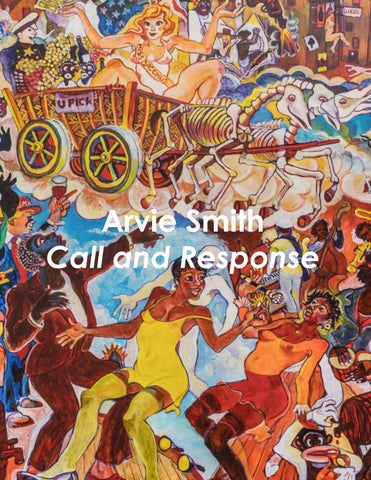
Arvie Smith: Call and Response

Page 1

Arvie Smith Call and Response

2 Front and Back cover: Bacchus, 2022

Arvie Smith

Call and Response

Monique Meloche Gallery

September 23-November 5, 2022

Introduction by Alyssa Brubaker

Essay by Heather Nickels Designed by Megan Foy Edited by Staci Boris

Photographed by Robert Chase Heishman

This catalogue was published on the occasion of Arvie Smith’s first solo exhibition at Monique Meloche Gallery, Chicago.
3
©2022
6

Table of Contents

7
Introduction 10 Essay 14 Installation views 20 Artworks 32 Biographies 92

Introduction

moniquemeloche is pleased to present Arvie Smith: Call and Response. Spanning both galleries, the exhibition features a series of new and legacy paintings by the Portland, OR-based artist Arvie Smith and is the artist’s first solo exhibition at the gallery.

Smith’s practice contends with the complex history of social and racial injustices in America. Born in Houston and raised in Roganville, TX and Los Angeles, Smith conveys the collective horrors, humiliations, and dis criminations that Black people have suffered in the United States over the past 450 years. Fueled by a drive to be an artist at an early age, Smith started copying paintings of Michelangelo when his family moved to Los Angeles. He had a solo show at a bank at age 15 and was the school artist for its sporting events. Excited to continue his early painting career, Smith applied to an art institute but was abruptly dissuaded by a receptionist who said, “we don’t need your kind here.” He would go on to earn his BFA from Pacific Northwest College of Art with a concentra tion in painting and printmaking in 1986, twenty-some years later. It was at PNCA where Smith met painter Robert Colescott–the first Black artist to represent the U.S. at the Venice Biennale–who influenced Smith’s approach to racial taboos and stereotypes through satire. Smith contin ued to earn his MFA from the Hoffberger School of Painting at Maryland Institute College of Art where he was a teaching assistant to abstract expressionist Grace Hartigan, who challenged him to raise his ambitions and reach for his canvases. He later returned to PNCA where he taught painting for over 20 years. In 2017, Smith received the recognition of professor emeritus and an honorary PhD from PNCA.

Smith’s wildly colorful paintings combine stereotypical Black imagery found in advertising and pop culture such as Aunt Jemima, Sambo, Bojangles, and Minstrel shows; historically taboo subjects such as inter racial relationships; current and historical events referencing the history of slavery, the KKK, segregation, and police shootings; and Smith’s own experience to create lyrical 2-dimenstional master works. Chock full of

10

10

identifiable symbols and figures, Smith’s warm-toned paintings are often inspired by epic tales from Greco-Roman history, through a fascination with stories intended to shape minds and behavior. Fittingly, Smith’s work is included in the affiliate exhibition at the Venice Biennale, The Af ro-Futurist Manifesto: Blackness Reimagined at Palazzo Bembo, Venice through November 27, 2022.

Contextualized through paint, Call and Response evokes the oral tradition that enslaved Africans brought to colonized America. Firm ly entrenched in African history, ‘call and response’ can be found in storytelling, religious rituals, protest, public discourse, children’s rhymes, and most notably music, in gospel, blues, R&B, rock and roll, jazz and hip-hop. Tapping into the spiritual significance that influenced and built upon African American culture, the act of call and response was a way to exchange stories about African life and create new lore about the American experience, shedding light on instances of hardship shared, unifying each other together. Smith embraces his ancestors’ songs using his art as resistance to call out embedded truths on America’s racial, so cial, and cultural history. As an American citizen and artist, Smith intends his work to be the “call,” a springboard for meaningful dialogue and understanding, soliciting the viewer’s “response” thus making space for us to collectively find the rhythm towards empathy by seeing others in ourselves.

In reflecting on his 4-decade career Smith remarks “I paint as an Amer ican of African descent, who grew up in the Jim Crow South and South-Central Los Angeles, and living in a white man’s America, I paint. My narratives connect the present to the past, examining America’s complex history of social and racial inequities. I have consumed a steady diet of racial injustices personally and collectively, providing an ever-growing catalyst for my artistic journey.”

11
11

Essay

A Smile or a Snarl? Pain, Pleasure and Perspective in Arvie Smith’s Oeuvre

“Pure white teeth. Large red lips. Bright, wide eyes. Grinning mouths. Or… are they grimacing?”1

Before speaking with Arvie Smith on the phone for the first time several weeks ago, I was already familiar with the artist, having encountered his work on several occasions prior. Most recently was in May of this year in the exhibition, The Afro-Futurist Manifesto: Blackness Reimagined, at the European Cultural Center (ECC), in Venice, Italy, which overlapped with the most recent edition of the Venice Biennale entitled, The Milk of Dreams.

Despite it being our first encounter with one another, I felt an acute and immediate sense of familiarity with Smith. Perhaps it’s in part due to the fact the artist is around the same age as my maternal great-uncle, who was also born and raised in the American South, only in North Carolina instead of Tex as. In recollecting on my time speaking with the two, I recognized both had experienced eerily similar and innumerable instances of bigotry during the height of Jim Crow segregation; at one point during our conversation, Smith remembered that at a very young age, members of the local Ku Klux Klan (KKK) burned down his neighbor’s farm (which also happened to belong to his grandfather’s brother). In the aftermath of this traumatic experience, he recalled building small sculptures out of the farm’s ashes and remnants, and which he stated, in retrospect, was him “playing in the rubble of hate.”1

This image of a young Black child creating structures out of found materi als – of that which was meant to be obliterated – stuck with me. I heard that story and thought of no better metaphor to encapsulate his art and prac tice. Making something out of nothing, despite the adversity faced – this is a common refrain for many artists, particularly those of color. However, I could

14
1 Arvie Smith et al. Arvie Smith: 2Up and 2Back. Disjecta Contemporary Art Center : Jordan Schnitzer Museum of Art at Portland State University, 2020.
14

Honky Tonk, 2015 (detail)

not help but think that since that time, he has returned, again and again, to constructing art as an act of perhaps equal parts desperation and defiance. As a child, of course, he had no greater understanding of this particular inci dent on the farm, nor how it reflected a large system that positioned him, and those like him, at the bottom. He would quickly come to learn all of this – from being told “[w]e don’t need your kind here”2 when trying to enroll in one art program, to the animosity he experienced while studying in Italy (notably from the white American students, as opposed to the Italian ones), Smith has fought numerous personal and professional battles. Taking the many experi ences he has encountered as a Black man in the United States and beyond, Smith incorporates these “persistent denigrations” into his art, blurring the lines between the tragic and the satirical, the stereotypical and the appropriative, the damaging and the transformative.3

One aspect of his work that I believe perfectly encapsulates this tension – and which I return to frequently – is the “grin” of his subjects. This particular facial expression recurs as a common theme throughout Smith’s long multi-decade

2 Smith et al. Arvie Smith: 2Up and 2Back, p. 17.

3 Artist personal statement for Arvie Smith : 2Up and 2Back II, at Jordan Schnitzer Museum of Art at Portland State University, https://www.pdx.edu/museum-of-art/arvie-smith-2-and-2-back-ii.

15
15

career, and can be seen in presently-exhibited works such as Honky Tonk (2015), Watermelons, White Women, and Straight Razors (2022) and Echo and Narcissus (2022). Some of his Black figures (such as the “mammy” nurs ing a white baby in Honky Tonk, the waiter holding the turkey on a platter in Watermelons…, and the reflection of “Sambo”4 in the pool of water in Echo and Narcissus, to name a few) look directly out at us, as if to meet our gaze, while others seem unable – or unwilling – to reach our own.

Is there something funny that we, as viewers, are missing? Or is what we are witnessing a strange product of the continual accumulation of trauma?

In “Embedded Truths: Five Paintings by Arvie Smith,” scholar Berrisford Boothe describes the “Sambo” figure in Smith’s painting, Bojangles Ascend ing the Stairs, stating: “his [Sambo’s] grin is not a smile. His teeth, chomping on his cigar and enclosed by his inflated, cartoonish lips, represent the pro jected predatory menace of Black men – projected onto them by ‘white’ men.”5 Thus, one’s understanding of this gesture – a grin/grimace – revolves

4 Artist personal statement for Arvie Smith : 2Up and 2Back II, at Jordan Schnitzer Museum of Art at Portland State University, https://www.pdx.edu/museum-of-art/arvie-smith-2-and-2back-ii.

5 Berrisford Boothe, “Embedded Truths: Five Paintings by Arvie Smith,” Arvie Smith: 2Up and 2Back, p. 10.

16
Fact Checker, 2019 (detail)
16

around the positionality of the person making the meaning. To white au diences unaware of the historic implications, a “smiling” Aunt Jemima, set of Gold Dust Twins, Sambo, or minstrel performer might not be associated with anything nefarious; however, to many Black audiences, what appears as a “smile” reflects a grave reality: since the emotions of Black people are deemed societally “irrelevant,” Black people often feel compelled to mask their feelings of discontent, discomfort or outright anger behind what could be perceived as a “smile.”

Clearly attuned to this tension between (white) perception and (Black) real ity, Smith frequently uses images of “smiling” Black people in his work, often through the appropriation of well-known stereotypical icons. Which makes one wonder… is it possible to take images of hate (or perhaps the burnt ashes of one’s home?) and create something if not beautiful, then at least meaningful? Smith seems to think so: he finds it important to think about –and then depict – how Black people are seen by white people in his work, as if to ask viewers directly how they might come to these assumptions. He then takes those projections, mixes them with various historic imagery or, more recently, Greek myths (as seen in Leda and the Swan, Bacchus and Echo and Narcissus, all from 2022), which eventually (d)evolve into these almost nightmarish reveries.

Smith’s jarring color palette – inspired by his ancestor’s vibrant quilts and the brightly-colored patterns he sees on his recurring visits to West Africa – and the subject matter of his paintings have remained consistent, from the earliest work in the show, Manumissions (2006) to the works produced earlier this year. A troubling series of events, particularly when it comes to the treatment of Black people, American history can often feel like a series of nightmares, one after another – multiple affronts that appear unceasing. Arvie Smith, unafraid of shining a light on these cauchemars himself, forces his audience not to look away either. The decision to give into either (both?) the pain and pleasure we witness, therefore, is ours to choose.

17
17

Installation

Views
20
21
22
23
26
27

Artworks

Echo and Narcissus, 2022 oil on canvas

x 60 in 182.9 x 152.4 cm

32
72
33 Detail
34 Detail
35 Detail
36 Detail
37 Detail

Leda and the Swan, 2022 oil on canvas 72 x 60 in 182.9 x 152.4 cm

38
39 Detail
40 Detail
41 Detail
42 Detail
43 Detail
44 Detail
45 Detail

x 40 in 152.4 x 101.6 cm

46
Watermelons, White Women, and Straight Razors, 2022 oil on canvas
60
47 Detail
48
49 Detail
50 Detail
51 Detail

Bacchus, 2022 oil on canvas 72 x 60 in 182.9 x 152.4 cm

52
53 Detail
54 Detail
55 Detail
56 Detail
57 Detail
58 Fact Checker, 2019 oil on canvas 72 x 60 in 182.9 x 152.4 cm
59 Detail
60 Detail
61 Detail
62 Detail
63 Detail

Strong Man, 2019 oil on canvas

x 60 in 182.9 x 152.4 cm

64
72
65 Detail
66
67 Detail

Honkie Tonk, 2015 oil on canvas 68 x 78 in 172.7 x 198.1 cm

68
69 Detail
70 Detail
71 Detail
72 Detail
73 Detail
74 Manumissions, 2006 oil on canvas 68 x 120 in 68 x 60 in, each panel 172.7 x 304.8 cm
75
76 Detail
77 Detail
78 Detail
79 Detail
80 Detail
81 Detail
82 Detail
83 Detail
84 Detail
85 Detail

Watermelon Tree, 2006 oil on canvas 40 x 30 in 101.6 x 76.2 cm

86
87 Detail
88 Detail
89 Detail

Biographies

Arvie Smith lives and works in Portland, OR. In his artistic career spanning over 4 decades, Smith transforms the history of oppressed and stereotyped segments of the American experience into lyrical two-dimensional master works. His paint ings are commonly of psychological images revealing deep sympathy for the dispossessed and marginalized members of society in an unrelenting search for beauty, meaning, and equality.

Smith holds an MFA from the Hoffberger School of Painting, Maryland Institute College of Art and a BFA from Pacific Northwest College of Art. Smith studied at Il Bisonte and SACI in Florence in 1983. Recent solo exhibitions include the Hallie Ford Museum of Art, Salem, OR; Jordan Schnitzer Museum, Portland, OR; and Disjecta Contemporary Art Center, Portland, OR. His work has been included in group exhibitions at UTA Art Space, Beverly Hills, CA; Portland Art Museum, Port land, OR; and Upfor Gallery, Portland, OR. Smith’s work is held in the Permanent Collections of the Portland Art Museum, Portland, OR; Delaware Museum of Art, Wilmington, DE; Reginald F. Lewis Museum, Baltimore, MD; Hallie Ford Museum of Art, Salem, OR; Jordan Schnitzer Museum of Art at the University of Oregon, Eugene, OR; and Petrucci Family Foundation Collection of African American Art, Asbury, NJ. Smith is a recipient of the 2020 Joan Mitchell Painters and Sculp ture Grant and the 2022 Hallie Ford Fellowship in the Visual Arts, The Ford Family Foundation Visual Arts Program.

92
92

Heather Nickels currently holds the position of Blackmon Perry Cura torial Fellow in African American Art and Art of the African Diaspora at the Memphis Brooks Museum of Art (MBMA) in Memphis, Ten nessee (previously titled the Joyce Blackmon Curatorial Fellowship). In this role, her main project was an exhibition entitled, Persevere and Resist: The Strong Black Women of Elizabeth Catlett, which was on view at the MBMA from June 5August 29, 2021. This exhibition, and the catalogue that accompanied it, received significant funding and support from the Terra Foundation for American Art, and two short videos were produced in conjunction with and related to the project, one of which has received over 700,000 views to-date.

Several years prior, she completed a two-year project research associateship (2016-2018) at the Wallach Art Gallery at Columbia University, where she worked on traveling exhibition Posing Modernity: The Black Model from Manet and Ma tisse to Today (which later traveled to the Orsay Museum in Paris, France), and held a one-year curatorial position in the Department of Drawings and Prints at the Museum of Modern Art (MoMA) from September 2016 to September 2017, where she provided research assistance on the exhibition Bodys Isek Kingelez: City Dreams (2018-2019).

She graduated cum laude from Barnard College of Columbia University in May 2016 with a major in Art History, and completed her M.A. in the History of Art from The Courtauld Institute of Art in London, U.K. (Distinction) in 2019. She has exten sive professional experience in arts non-profits, for-profit institutions and in the fashion design industry. Starting in Fall 2022, she will be a first-year doctoral can didate in the department of Art History and Archaeology at Columbia University. 93

93

94

Monique Meloche Gallery is located at 451 N Paulina Street, Chicago, IL 60622

For additional info, visit moniquemeloche.com or email info@moniquemeloche.com

95

Turn static files into dynamic content formats.

Create a flipbook