Google Cloud DevOps Certification Skills and Learning Roadmap
Introduction
Cloud platforms are now a major part of modern software development. Companies need engineers who can release applications faster, maintain system stability, improve security, and reduce operational problems.The Google Cloud Professional Cloud DevOps Engineer certification helps professionals build these skills using Google Cloud technologies.This certification is not limited to deployment tools. It covers the complete journey of an application, including planning, building, testing, releasing, monitoring, troubleshooting, and improving reliability.It is a suitable learning path for software engineers, DevOps engineers, cloud professionals, SREs, platform engineers, and technical managers.
Quick Certification Information
Category
Information
Certification name Google Cloud Professional Cloud DevOps Engineer
Track Cloud DevOps, Automation, and Reliability
Level Professional
Best suited for Engineers, developers, SREs, platform teams, and managers
Prerequisites Linux, Git, networking, cloud basics, containers, and CI/CD
Major skills GCP, automation, GKE, Terraform, Cloud Run, monitoring, and SRE
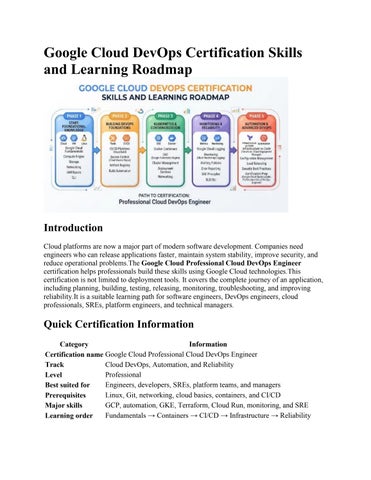
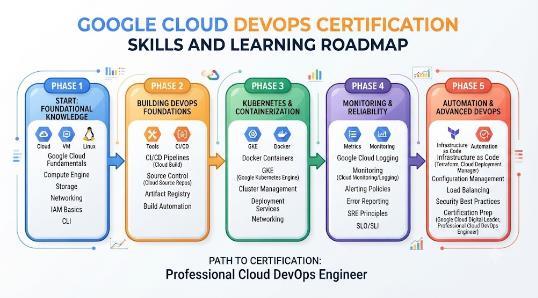
Learning order Fundamentals → Containers → CI/CD → Infrastructure → Reliability
Why This Certification Matters
Modern applications must remain available, secure, and easy to update. Manual processes often create delays and increase the chance of mistakes.
This certification teaches engineers how to replace manual work with automation. It also explains how to measure system performance and improve services continuously.
The main objective is to prepare professionals who can manage production systems with confidence.
Who Can Benefit from This Certification?
This certification is useful for:
DevOps engineers working with cloud platforms
Software engineers learning deployment and operations
Cloud engineers managing Google Cloud resources
Site Reliability Engineers
Platform engineers
Kubernetes professionals
System administrators moving into cloud roles
Technical leaders managing engineering teams
Managers responsible for software delivery and reliability
Professionals moving from AWS, Azure, or traditional data centres can also use this certification to understand Google Cloud operations.
Knowledge and Skills Covered
Learners can develop practical knowledge in the following areas:
Google Cloud projects and services
Automated software build processes
Continuous integration and delivery
Cloud Build and Cloud Deploy
Container image storage and management
Google Kubernetes Engine
Serverless application deployment with Cloud Run
Infrastructure provisioning with Terraform
Application monitoring and logging
Performance tracing and alerting
Service Level Objectives
Error-budget management
Incident response
Access and identity management
Secret protection
Security checks in delivery pipelines
Cloud cost analysis and optimisation
These skills are useful in both small engineering teams and large enterprise environments.
Projects You Should Practise
Practical projects make certification preparation more effective.
Try to complete projects such as:
Automating the build and release of an application
Deploying a containerised application on GKE
Running a serverless workload on Cloud Run
Creating cloud infrastructure using Terraform
Setting up application logs and dashboards
Creating alerts for failures and performance issues
Testing canary deployment
Designing a rollback process
Creating reliability targets for an application
Securing services through IAM
Writing an incident response guide
Planning backup and disaster recovery
Reviewing cloud expenses and removing unused resources
These projects can also become part of your technical portfolio.
Preparation Roadmap
7–14 Day Fast Plan
This plan is better for professionals who already have cloud and DevOps experience.
Review Google Cloud architecture and IAM
Practise build and deployment pipelines
Work with GKE and Cloud Run
Create basic Terraform configurations
Review monitoring, logging, and SRE
Solve scenario-based questions
Revise weak technical areas
30-Day Working Professional Plan
This plan provides balanced learning for busy engineers.
Week 1: Study Google Cloud basics, Linux, networking, and Git.
Week 2: Learn containers, CI/CD, Cloud Build, and Cloud Deploy.
Week 3: Practise Kubernetes, Cloud Run, and Terraform.
Week 4: Focus on monitoring, SRE, security, incident response, and revision.
60-Day Beginner Plan
This plan is suitable for learners who need more practical time.
Days 1–15: Build knowledge of cloud computing, Linux, Git, and networking.
Days 16–30: Learn Docker, source control workflows, and CI/CD automation.
Days 31–45: Practise GKE, Cloud Run, and infrastructure as code.
Days 46–60: Study reliability, monitoring, security, cost management, and recovery planning.
Common Preparation Problems
Learners often struggle because they focus only on examination questions.
Common mistakes include:
Learning definitions without practical implementation
Ignoring Linux and networking concepts
Skipping IAM and security
Avoiding hands-on Google Cloud practice
Learning deployment without rollback
Creating dashboards without useful alerts
Ignoring application logs
Not understanding SLOs and error budgets
Studying Kubernetes without solving failures
Forgetting cost management
Not reviewing mistakes from practice tests
Depending only on recorded videos
A stronger method is to practise each concept in a working project.
DevOps Path
The DevOps path is best for professionals who want to automate software development and deployment.
Important skills include:
CI/CD
Git
Cloud Build
Cloud Deploy
Terraform
GKE
Cloud Run
Release automation
DevSecOps Path
The DevSecOps path adds security to development and operations.
Important topics include:
IAM
Secret management
Vulnerability scanning
Secure containers
Policy enforcement
Security automation
Software supply-chain protection
SRE Path
The SRE path is suitable for professionals responsible for production reliability.
Main areas include:
Monitoring
SLOs
Error budgets
Incident response
Capacity planning
Automation
Service availability
AIOps and MLOps Path
This path is suitable for professionals working with artificial intelligence, machine learning, or intelligent IT operations.
It includes:
Automated model deployment
Model monitoring
Data and model drift
Intelligent alerts
Pipeline automation
Operational analytics
DataOps Path
The DataOps path applies automation and reliability practices to data systems. It focuses on:
Data pipelines
Data testing
Workflow orchestration
Data quality
Governance
Data monitoring
FinOps Path
The FinOps path is useful for professionals who want to manage cloud spending effectively. It covers:
Cloud billing
Budget planning
Cost allocation
Forecasting
Rightsizing
Resource optimisation
Cost accountability
Best Next Certification
After completing this certification, learners can continue with:
Google Cloud architecture
Cloud security
Kubernetes administration
DevSecOps
Site Reliability Engineering
Platform engineering
MLOps
DataOps
FinOps
The right next certification depends on your current role and long-term career direction.
Institutions That Can Support Learning
DevOpsSchool
DevOpsSchool provides certification-oriented learning in Google Cloud, DevOps, CI/CD, Terraform, Kubernetes, SRE, and security.
It can be suitable for learners who want instructor guidance, practical exercises, and projectbased preparation.
Cotocus
Cotocus supports cloud and DevOps learning for individuals and organisations.
Its programs may help professionals understand automation, modern engineering practices, and enterprise technology adoption.
Scmgalaxy
Scmgalaxy focuses on software configuration management, source control, build tools, release processes, and CI/CD technologies.
It can help learners create a strong foundation before moving into advanced Google Cloud DevOps topics.
BestDevOps
BestDevOps provides knowledge and guidance related to DevOps tools, cloud engineering, automation, and platform operations.
It can support professionals who are comparing career paths, tools, and industry practices.
DevSecOpsSchool
DevSecOpsSchool is suitable for professionals interested in cloud security and secure delivery pipelines.
It focuses on security automation, vulnerability management, access control, policy enforcement, and secure software delivery.
SRESchool
SRESchool helps learners understand reliability engineering and production operations.
Key topics may include SLOs, monitoring, incident management, error budgets, troubleshooting, and automation.
AIOpsSchool
AIOpsSchool supports learning in artificial intelligence for IT operations.
It is relevant for professionals interested in intelligent monitoring, anomaly detection, event analysis, and automated operational decisions.
DataOpsSchool
DataOpsSchool focuses on automation and reliability for data engineering.
It can help learners understand data workflows, testing, governance, quality, and observability.
FinOpsSchool
FinOpsSchool supports cloud financial management learning.
It is useful for engineers, managers, and finance teams who want better control over cloud costs, budgets, and resource usage.
Conclusion
The Google Cloud Professional Cloud DevOps Engineer certification can help professionals develop strong cloud automation and reliability skills.It covers important areas such as CI/CD, Kubernetes, infrastructure as code, monitoring, security, SRE, incident management, and cost optimisation.To gain real value from this certification, learners should combine study with practical work. Build applications, automate deployments, create infrastructure, monitor systems, and practise solving production problems.