Practical Guide to Certified Kubernetes Application Developer Skills
Introduction
Kubernetes has become a major skill for professionals working in software development, DevOps, cloud, and platform engineering. Today, applications are not only written and tested; they are also containerized, deployed, scaled, monitored, and improved continuously.The Certified Kubernetes Application Developer certification helps learners understand how applications are built and managed inside Kubernetes. It is useful for engineers and managers who want practical knowledge of cloud-native application delivery.
What This Certification Covers
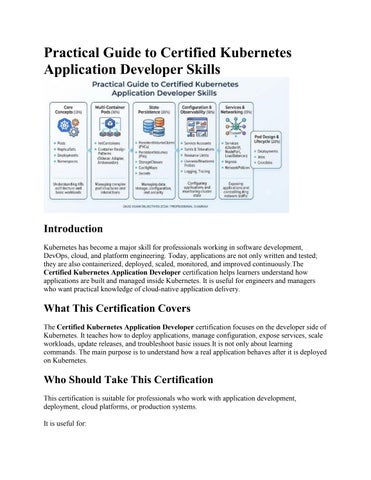
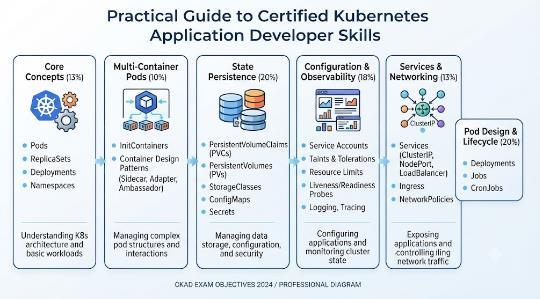
The Certified Kubernetes Application Developer certification focuses on the developer side of Kubernetes. It teaches how to deploy applications, manage configuration, expose services, scale workloads, update releases, and troubleshoot basic issues.It is not only about learning commands. The main purpose is to understand how a real application behaves after it is deployed on Kubernetes.
Who Should Take This Certification
This certification is suitable for professionals who work with application development, deployment, cloud platforms, or production systems.
It is useful for:
Software Engineers
DevOps Engineers
Cloud Engineers
Backend Developers
Platform Engineers
It is also helpful for managers who want to understand Kubernetes project planning, team responsibilities, and production challenges.
Skills You Will Gain
After completing this certification, learners should be able to understand and work with:
Kubernetes pods and containers
Deployments and replicas
Services and application access
Namespaces, labels, and selectors
ConfigMaps and Secrets
Application scaling
These skills are important for anyone working with cloud-native applications.
Real-World Projects You Can Do
After learning this certification, you should be able to perform practical Kubernetes tasks such as:
Deploying a containerized application
Creating Kubernetes YAML files
Managing application replicas
Exposing applications through services
Adding configuration using ConfigMaps
Managing sensitive data using Secrets
Scaling applications when needed
Preparation Plan
7–14 Days Plan
This plan is good for learners who already know Docker and Linux. Start with Kubernetes basics, then practice pods, deployments, services, ConfigMaps, Secrets, scaling, and troubleshooting. Focus more on hands-on practice than theory.
30 Days Plan
This is a balanced plan for working professionals.
Week 1: Learn Kubernetes basics, pods, namespaces, and YAML.
Week 2: Practice deployments, replicas, services, labels, and selectors.
Week 3: Learn ConfigMaps, Secrets, scaling, rollouts, and resource settings.
Week 4: Practice logs, events, troubleshooting, and real deployment tasks.
60 Days Plan
This plan is suitable for beginners. Start with Linux, Docker, containers, and YAML. Then slowly move into Kubernetes objects, application deployment, configuration, scaling, updates, and troubleshooting.
Common Mistakes to Avoid
Many learners make Kubernetes harder by studying only theory. Kubernetes becomes clear when you practice regularly.
Common mistakes include:
Not writing YAML files manually
Ignoring indentation errors
Confusing pods, deployments, and services
Not understanding labels and selectors
Skipping ConfigMaps and Secrets
Avoiding troubleshooting practice
Not checking logs and events
Moving to advanced topics too early
The best approach is to deploy small applications, break them, fix them, and repeat the process.
Best Next Certification After This
After completing the Certified Kubernetes Application Developer certification, learners can move toward:
Kubernetes Administration
DevOps Engineering
DevSecOps Engineering
Site Reliability Engineering
Cloud Architecture
Platform Engineering
AIOps or MLOps
FinOps
Your next certification should match your career goal. Choose DevOps for automation, SRE for reliability, DevSecOps for security, and FinOps for cloud cost management.
Choose Your Path
DevOps Path
This path is for professionals who want to automate software build, test, and deployment processes. Kubernetes knowledge helps in managing containerized applications through CI/CD pipelines.
DevSecOps Path
This path is for learners who want to secure applications and delivery pipelines. Kubernetes skills help with Secrets management, secure configuration, and access control.
SRE Path
This path is useful for professionals responsible for uptime, monitoring, incident response, and production stability. Kubernetes troubleshooting is very important for SRE roles.
AIOps/MLOps Path
This path is useful for professionals working with intelligent operations, automation, machine learning workloads, and scalable platforms.
DataOps Path
This path is helpful for data engineers and data platform teams using Kubernetes for pipelines, workflow tools, and data processing.
FinOps Path
This path is useful for professionals who manage cloud cost and resource usage. Kubernetes knowledge helps in workload sizing and cost optimization.
Top Institutions for Training cum Certification Support
DevOpsSchool
DevOpsSchool provides the Certified Kubernetes Application Developer certification and offers structured training in Kubernetes, DevOps, cloud, and related technologies.
Cotocus
Cotocus supports professionals and organizations with DevOps, cloud, automation, and Kubernetes implementation in real business environments.
Scmgalaxy
Scmgalaxy focuses on SCM, DevOps, automation, release engineering, and cloud practices. It helps learners build a strong technical foundation.
BestDevOps
BestDevOps helps learners understand DevOps tools, CI/CD, automation, and cloud-native software delivery practices.
devsecopsschool
devsecopsschool is useful for professionals who want to connect Kubernetes learning with security and DevSecOps practices.
sreschool
sreschool helps learners understand reliability engineering, monitoring, incident response, and production support with Kubernetes.
aiopsschool
aiopsschool supports professionals interested in AIOps, intelligent monitoring, automation, and modern IT operations.
dataopsschool
dataopsschool is helpful for learners working with data pipelines, DataOps practices, and scalable data platforms.
finopsschool
finopsschool helps professionals learn cloud cost management, resource optimization, and financial control in cloud-native environments.
Conclusion
The Certified Kubernetes Application Developer certification is a useful starting point for professionals who want to understand Kubernetes application delivery. It helps software engineers, DevOps engineers, cloud professionals, SREs, platform teams, and managers build practical Kubernetes knowledge.This certification teaches how applications are deployed,
configured, scaled, updated, and troubleshot on Kubernetes. It also improves teamwork between development, operations, security, and platform teams.