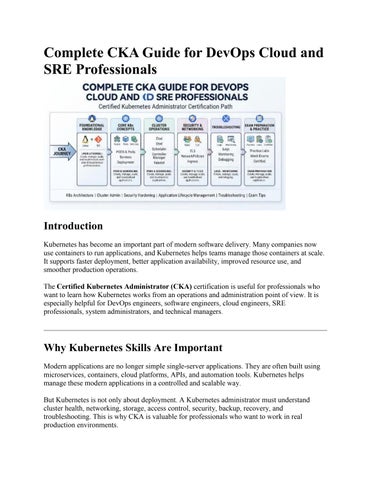
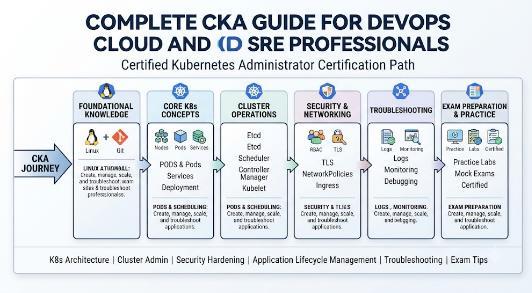
Complete CKA Guide for DevOps Cloud and SRE Professionals

Page 1


Complete CKAGuide for DevOps Cloud and SRE

Professionals
Introduction

Kubernetes has become an important part of modern software delivery. Many companies now use containers to run applications, and Kubernetes helps teams manage those containers at scale. It supports faster deployment, better application availability, improved resource use, and smoother production operations.

The Certified Kubernetes Administrator (CKA) certification is useful for professionals who want to learn how Kubernetes works from an operations and administration point of view. It is especially helpful for DevOps engineers, software engineers, cloud engineers, SRE professionals, system administrators, and technical managers.

Why Kubernetes Skills Are Important

Modern applications are no longer simple single-server applications. They are often built using microservices, containers, cloud platforms, APIs, and automation tools. Kubernetes helps manage these modern applications in a controlled and scalable way.

But Kubernetes is not only about deployment. A Kubernetes administrator must understand cluster health, networking, storage, access control, security, backup, recovery, and troubleshooting. This is why CKA is valuable for professionals who want to work in real production environments.

What It Is

The Certified Kubernetes Administrator (CKA) is a certification focused on practical Kubernetes administration. It helps learners understand how to manage Kubernetes clusters, deploy workloads, configure networking, handle storage, secure access, and troubleshoot common issues.

This certification is useful because it connects theory with real operational tasks. It prepares learners to work with Kubernetes in practical environments instead of only understanding basic concepts.

Who Should Take It

CKA is a good choice for professionals who want to work with Kubernetes, containers, cloud platforms, and modern infrastructure.

It is suitable for:

 Software Engineers who want to understand application deployment on Kubernetes

 DevOps Engineers working on CI/CD and automation

 Cloud Engineers managing cloud-native platforms

 System Administrators moving toward container-based infrastructure

This certification is not limited to one job role. It is useful for anyone who wants to understand how modern applications are managed in production.

Skills You’ll Gain

During CKA preparation, learners build practical Kubernetes knowledge.

You will learn:

 How Kubernetes clusters are structured

 How control plane and worker nodes function

 How to create and manage Pods, Deployments, and Services

 How to expose applications using Services and Ingress

 How to manage ConfigMaps and Secrets

These skills help professionals become more confident in handling Kubernetes-based systems.

Real-World Projects You Should Be Able to Do After It

After completing CKA learning, you should be able to handle practical Kubernetes tasks.

You should be able to:

 Set up a basic Kubernetes cluster

 Deploy a container-based application

 Scale applications based on workload needs

 Configure Services and Ingress for access

These projects are important because Kubernetes learning becomes useful only when you can apply it in real situations.

Preparation Plan

7–14 Days Plan

This plan is suitable for professionals who already have Kubernetes experience.

Focus on:

 Kubernetes architecture revision

 kubectl command practice

 Workloads and Services

 Storage and networking

 RBAC and security

 Backup and restore

 Troubleshooting practice

 Mock exam-style tasks

This plan is best for experienced DevOps or cloud professionals.

30 Days Plan

This plan is suitable for working engineers who know Linux and containers.

Week 1:

Learn Kubernetes architecture, Pods, Deployments, ReplicaSets, Namespaces, and YAML.

Week 2:

Practice Services, Ingress, ConfigMaps, Secrets, networking, and storage.

Week 3:

Learn RBAC, security basics, node maintenance, backup, restore, and upgrades.

Week 4:

Focus on troubleshooting, practice labs, revision, and mock scenarios.

This is a balanced plan for most working professionals.

60 Days Plan

This plan is useful for beginners or managers who want a deeper understanding.

Days 1–15:

Learn Linux, containers, YAML, and basic networking.

Days 16–30:

Study Kubernetes architecture, Pods, Deployments, and Services.

Days 31–45:

Practice storage, networking, security, RBAC, ConfigMaps, and Secrets.

Days 46–60:

Work on troubleshooting, backup, restore, labs, and practical projects.

This plan gives enough time to build knowledge slowly and clearly.

Common Mistakes to Avoid

Many learners face problems because they try to learn Kubernetes only through videos or theory. CKA needs hands-on practice.

Avoid these mistakes:

 Not practicing daily

 Ignoring Linux basics

 Learning commands without understanding concepts

 Skipping YAML practice

 Avoiding networking topics

The best way to learn Kubernetes is to practice, make mistakes, fix errors, and repeat.

Choose

Your Path After CKA

CKA gives you a strong Kubernetes foundation. After that, you can choose a career direction based on your role and interest.

DevOps Path

Choose this path if you want to work on CI/CD pipelines, automation, GitOps, infrastructure as code, and cloud deployments. Kubernetes is a major part of modern DevOps delivery.

DevSecOps Path

Choose this path if you want to add security into DevOps and Kubernetes workflows. You can learn container security, RBAC, image scanning, policy controls, and secure deployment practices.

SRE Path

Choose this path if you want to work on reliability, monitoring, incident response, uptime, and production stability. Kubernetes knowledge helps SRE teams troubleshoot and manage systems better.

AIOps/MLOps Path

Choose this path if you want to use Kubernetes for AI-driven operations or machine learning workloads. Kubernetes is often used for scalable automation, model deployment, and intelligent monitoring platforms.

DataOps Path

Choose this path if you want to manage data pipelines, data platforms, and data workloads. Kubernetes is useful for running scalable and automated data systems.

FinOps Path

Choose this path if you want to focus on cloud cost management. Kubernetes knowledge helps professionals understand resource usage, workload optimization, autoscaling, and cost control. Best Next Certification After CKA

If you want to become a DevOps professional, choose DevOps, cloud, CI/CD, Terraform, or GitOps-related certification. If you want to move into security, DevSecOps is a good next step. If you want to work in production reliability, SRE is a strong path. If you are interested in cost control, FinOps can be a useful direction.

Top Institutions for CKA Training and Certification Support

DevOpsSchool

DevOpsSchool provides structured training and certification support for Kubernetes, DevOps, cloud, SRE, and related technologies. It is useful for learners who want guided learning, practical labs, assignments, and real examples. For CKA, it helps professionals build both concept clarity and hands-on confidence.

Cotocus

Cotocus works in DevOps, cloud, automation, and enterprise technology solutions. It helps learners understand how Kubernetes is used in real business environments. This is useful for professionals who want practical exposure beyond basic theory.

Scmgalaxy

Scmgalaxy supports learning in SCM, DevOps, CI/CD, automation, containers, and cloud-native tools. Kubernetes learners can benefit from its broader DevOps knowledge. It helps professionals understand how Kubernetes connects with build, release, and deployment processes.

BestDevOps

BestDevOps focuses on DevOps learning and modern IT practices. It helps learners understand Kubernetes as part of the complete DevOps workflow. This is useful for professionals who want to grow in automation, deployment, and cloud operations.

devsecopsschool

devsecopsschool is helpful for learners who want to move toward security-focused DevOps roles. After CKA, professionals can learn Kubernetes security, container scanning, policy management, and secure CI/CD practices through this learning direction.

sreschool

sreschool supports learners who want to connect Kubernetes with site reliability engineering. It helps professionals understand monitoring, alerting, incident handling, reliability, and production support. This is a good path after CKA for those interested in stable production systems.

aiopsschool

aiopsschool focuses on AIOps, MLOps, automation, and AI-driven IT operations. Kubernetes knowledge is useful in these areas because modern AI and automation platforms often run on container-based infrastructure. It is suitable for learners interested in intelligent operations.

dataopsschool

dataopsschool helps professionals learn DataOps, data pipelines, and data platform management. Kubernetes is becoming useful for running data workloads and workflow automation. CKA can give learners a strong infrastructure base before moving into DataOps.

finopsschool

finopsschool is useful for professionals who want to understand cloud cost management and infrastructure optimization. After CKA, FinOps learning helps engineers and managers control Kubernetes resource usage, reduce waste, and improve cost visibility.

Conclusion

The Certified Kubernetes Administrator (CKA) certification is a valuable learning path for professionals who want to build strong Kubernetes administration skills. It helps learners understand cluster management, workloads, networking, storage, security, backup, restore, and troubleshooting.

For software engineers, CKA improves understanding of how applications run after deployment. For DevOps and cloud engineers, it builds confidence in managing container platforms. For SRE professionals, it supports reliability and troubleshooting work. For managers, it improves technical planning and decision-making.

Turn static files into dynamic content formats.

Create a flipbook
Complete CKA Guide for DevOps Cloud and SRE Professionals by Monika18 - Issuu