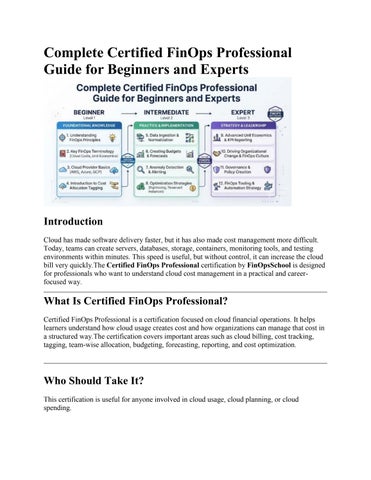
Complete Certified FinOps Professional Guide for Beginners and Experts
Introduction
Cloud has made software delivery faster, but it has also made cost management more difficult. Today, teams can create servers, databases, storage, containers, monitoring tools, and testing environments within minutes. This speed is useful, but without control, it can increase the cloud bill very quickly.The Certified FinOps Professional certification by FinOpsSchool is designed for professionals who want to understand cloud cost management in a practical and careerfocused way.
What Is Certified FinOps Professional?
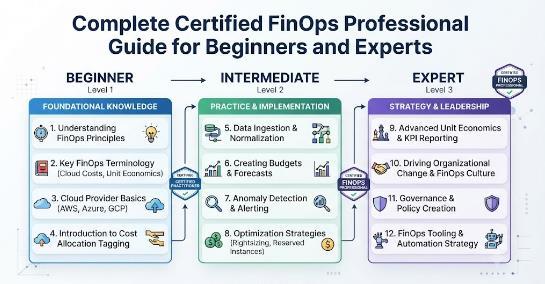
Certified FinOps Professional is a certification focused on cloud financial operations. It helps learners understand how cloud usage creates cost and how organizations can manage that cost in a structured way.The certification covers important areas such as cloud billing, cost tracking, tagging, team-wise allocation, budgeting, forecasting, reporting, and cost optimization.
Who Should Take It?
This certification is useful for anyone involved in cloud usage, cloud planning, or cloud spending.
Software engineers should take it because code, architecture, storage, APIs, and application design can directly impact cloud bills.
DevOps engineers should take it because infrastructure automation, CI/CD systems, testing environments, and Kubernetes platforms often create major cloud costs.
Skills You’ll Gain
After preparing for Certified FinOps Professional, you should gain practical knowledge in:
Understanding cloud cost and usage
Reading cloud billing reports
Tracking cost by team, project, or application
Creating tagging and allocation standards
Preparing cloud budgets
Forecasting future cloud spending
Detecting unusual cost increases
Finding idle or unused resources
Rightsizing cloud workloads
Reducing waste safely
Creating FinOps dashboards
Preparing cost reports for managers
Building cost ownership across teams
Improving communication between engineering and finance
These skills are valuable because cloud cost management is now a shared responsibility in modern IT teams.
Real-World Projects You Can Do After This Certification
After learning FinOps concepts, you should be able to work on practical projects such as:
Build a cloud cost visibility dashboard
Create a monthly cloud cost report
Prepare a tagging policy for cloud resources
Identify unused virtual machines or storage
Create team-wise cost reports
Track budget vs actual cloud spend
Find sudden cost spikes
Recommend rightsizing actions
Prepare a showback report for business units
Build a cost optimization plan
Help managers understand cloud cost trends
Support cloud governance practices
These activities are useful in real companies because they help reduce confusion, improve ownership, and control unnecessary spending.
Preparation Plan
7–14 Days Plan
This plan is suitable for experienced cloud, DevOps, or SRE professionals.
Start with FinOps basics and cloud cost concepts. Then study billing reports, tagging, cost allocation, budgeting, forecasting, and optimization methods. In the final days, revise key topics and practice scenario-based questions.
30 Days Plan
This plan works well for most working professionals.
In the first week, learn cloud cost fundamentals and FinOps principles. In the second week, focus on billing, tagging, allocation, showback, and chargeback. In the third week, study forecasting, budgets, anomaly detection, and optimization. In the fourth week, revise and practice practical examples.
60 Days Plan
This plan is best for beginners.
Begin with cloud basics such as compute, storage, networking, databases, and monitoring. Then move to cloud billing, FinOps concepts, cost allocation, budgeting, forecasting, and optimization. In the final stage, create sample dashboards, cost reports, and optimization plans.
Common Mistakes to Avoid
Many learners think FinOps is only about reducing cloud bills. This is not correct. FinOps is about understanding cost, creating ownership, improving planning, and getting better value from cloud usage.
Avoid these mistakes:
Thinking FinOps is only a finance topic
Ignoring the role of engineers in cloud cost
Skipping billing and usage reports
Not learning tagging properly
Ignoring cost allocation
Reducing resources without checking performance
Depending only on tools
Not learning budgeting and forecasting
Avoiding real-world practice
Preparing only for certification, not for practical work
A strong FinOps professional should know how to turn cloud cost data into useful action.
Best Next Certification After This
After Certified FinOps Professional, your next certification should depend on your career goal.DevOps professionals can move toward DevOps, Kubernetes, or cloud architect certifications. SRE professionals can choose reliability engineering, observability, or monitoring certifications. Security professionals can explore DevSecOps and cloud governance certifications.
Choose Your Path
DevOps Path
FinOps helps DevOps engineers understand how infrastructure automation, CI/CD pipelines, and cloud environments affect cost. It supports better planning and cleaner resource usage.
DevSecOps Path
FinOps helps DevSecOps professionals connect security, compliance, governance, and cost control. This is useful for building secure and financially responsible cloud environments.
SRE Path
FinOps helps SRE teams balance reliability, uptime, scaling, monitoring, and infrastructure cost. It supports smarter production decisions.
AIOps/MLOps Path
FinOps helps AIOps and MLOps teams manage the cost of AI workloads, automation tools, data processing, experiments, and compute-heavy systems.
DataOps Path
FinOps helps DataOps professionals manage the cost of storage, pipelines, analytics, data movement, and cloud-based data platforms.
FinOps Path
The FinOps path is best for professionals who want to specialize in cloud cost management, reporting, budgeting, forecasting, and optimization.
Top Institutions for Training and Certification Support
DevOpsSchool
DevOpsSchool supports learners in DevOps, cloud, CI/CD, automation, and modern software delivery. It is useful for professionals who want to connect FinOps with real engineering workflows.
Cotocus
Cotocus helps with cloud consulting, implementation, and enterprise technology transformation. It is useful for companies that want to apply FinOps practices in real business environments.
Scmgalaxy
Scmgalaxy focuses on software configuration management, DevOps, release management, and CI/CD practices. It helps learners understand how software delivery processes influence cloud cost.
BestDevOps
BestDevOps supports practical DevOps and cloud learning. It is useful for beginners and working professionals who want to build a strong technical base before moving deeper into FinOps.
devsecopsschool
devsecopsschool focuses on DevSecOps, security, compliance, and governance. It is helpful for professionals who want to combine secure cloud operations with cost control.
sreschool
sreschool supports SRE, monitoring, observability, and reliability engineering learning. It is useful for professionals who want to connect reliability planning with cloud cost awareness.
aiopsschool
aiopsschool focuses on AIOps, automation, intelligent monitoring, and IT operations. It is useful for learners who want to combine FinOps with automation-driven operations.
dataopsschool
dataopsschool supports DataOps, data engineering, and data platform learning. It is useful for professionals who want to manage and optimize the cost of cloud-based data systems.
finopsschool
FinOpsSchool is the official provider of the Certified FinOps Professional certification. It is the most relevant platform for learners who want focused FinOps training and certification.
Conclusion
Certified FinOps Professional is a practical certification for engineers, managers, DevOps teams, SREs, cloud professionals, finance teams, and consultants.It helps professionals understand cloud cost, improve visibility, reduce waste, forecast budgets, and build accountability across teams.As cloud adoption grows, companies need people who can manage both technology and cost. This certification helps you build that important skill and become more valuable in clouddriven organizations.