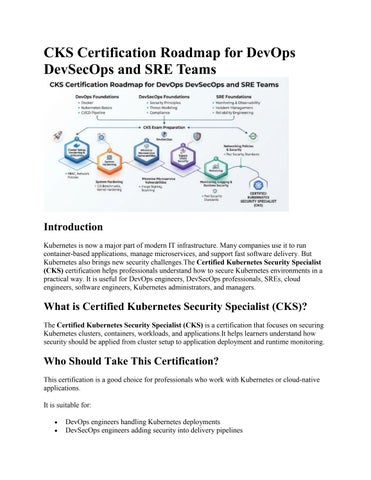
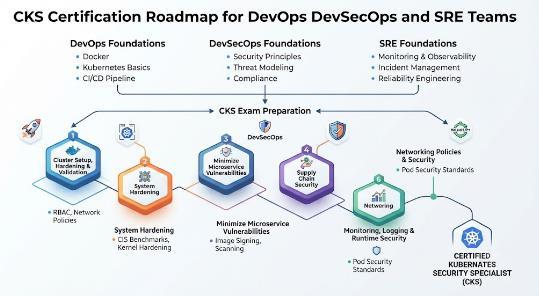
CKS Certification Roadmap for DevOps
DevSecOps and SRE Teams
Introduction
Kubernetes is now a major part of modern IT infrastructure. Many companies use it to run container-based applications, manage microservices, and support fast software delivery. But Kubernetes also brings new security challenges.The Certified Kubernetes Security Specialist (CKS) certification helps professionals understand how to secure Kubernetes environments in a practical way. It is useful for DevOps engineers, DevSecOps professionals, SREs, cloud engineers, software engineers, Kubernetes administrators, and managers.
What is Certified Kubernetes Security Specialist (CKS)?
The Certified Kubernetes Security Specialist (CKS) is a certification that focuses on securing Kubernetes clusters, containers, workloads, and applications.It helps learners understand how security should be applied from cluster setup to application deployment and runtime monitoring.
Who Should Take This Certification?
This certification is a good choice for professionals who work with Kubernetes or cloud-native applications.
It is suitable for:
DevOps engineers handling Kubernetes deployments
DevSecOps engineers adding security into delivery pipelines
SREs managing production reliability and risk
Cloud engineers working with container platforms
Software engineers building microservices
Kubernetes administrators managing clusters
Managers responsible for secure platform teams
Skills You Will Gain
CKS helps you build practical Kubernetes security skills such as:
Securing Kubernetes clusters
Managing users, roles, and permissions
Applying least privilege access
Securing service accounts
Hardening pods and containers
These skills are important because most Kubernetes security issues come from weak permissions, unsafe containers, poor secrets handling, or missing security policies.
Real-World Projects You Can Do After CKS
After learning CKS concepts, you should be able to work on tasks like:
Secure a Kubernetes cluster before production release
Create RBAC rules for different users and teams
Reduce unnecessary permissions
Block unsafe container behavior
Apply network restrictions between services
These are real workplace skills that help teams run Kubernetes more safely.
Preparation Plan
7–14 Days Plan
This plan is best for professionals who already have strong Kubernetes experience.
Start with a quick revision of Kubernetes architecture, pods, namespaces, services, deployments, and YAML. Then focus on RBAC, pod security, network policies, secrets, image scanning, audit logs, and runtime monitoring. Practice daily with hands-on labs.
30 Days Plan
This plan is suitable for working engineers.
Use the first week to revise Kubernetes basics. In the second week, focus on RBAC, service accounts, and access control. In the third week, practice pod security, secrets, image security, and network policies. In the last week, work on audit logs, runtime security, mock practice, and revision.
60 Days Plan
This plan is useful for beginners and managers.
Begin with containers, Linux, YAML, and Kubernetes fundamentals. Then learn workloads, namespaces, services, and cluster operations. After that, move into Kubernetes security topics step by step, including RBAC, pod hardening, image scanning, secrets protection, network security, and monitoring.
Common Mistakes to Avoid
Many learners face problems because they prepare without enough practical work.
Avoid these mistakes:
Learning only theory
Skipping Kubernetes fundamentals
Not practicing RBAC properly
Giving broad access to users
Ignoring service account permissions
Not testing network policies
The best way to prepare is to learn one topic, practice it, test it, and repeat it.
Best Next Certification After CKS
After completing Certified Kubernetes Security Specialist (CKS), you can choose your next certification based on your career path.
DevOps engineers can move toward advanced Kubernetes or DevSecOps certification. Security professionals can choose DevSecOps or cloud security certification. SREs can focus on observability, reliability, and incident management. Managers can explore platform engineering, cloud governance, or DevOps leadership.
Choose Your Path
DevOps Path
CKS helps DevOps professionals secure deployments, CI/CD pipelines, container images, and Kubernetes workloads.
DevSecOps Path
This path is useful for professionals who want to bring security into every stage of software delivery.
SRE Path
SREs can use CKS skills to reduce production risks, improve monitoring, and handle securityrelated incidents.
AIOps/MLOps Path
AIOps and MLOps platforms often run on Kubernetes. CKS helps secure AI workloads, automation tools, and model deployment environments.
DataOps Path
DataOps teams can use Kubernetes security knowledge to protect data pipelines, access control, and sensitive workloads.
FinOps Path
FinOps teams can connect Kubernetes security with better cloud governance, resource control, and cost accountability.
Top Institutions for CKS Training Support
DevOpsSchool
DevOpsSchool provides structured training for Kubernetes, DevOps, DevSecOps, cloud, SRE, and automation certifications. It helps learners prepare for CKS with practical concepts and guided learning.
Cotocus
Cotocus supports DevOps, Kubernetes, cloud, and enterprise engineering practices. It helps professionals understand how Kubernetes security works in real production environments.
Scmgalaxy
Scmgalaxy focuses on DevOps, CI/CD, release management, and software configuration practices. It is useful for learners who want to connect Kubernetes security with the complete software delivery process.
BestDevOps
BestDevOps provides learning support for DevOps, containers, cloud, and Kubernetes. It helps professionals build job-focused skills for secure Kubernetes operations.
devsecopsschool
devsecopsschool focuses on DevSecOps, cloud security, automation security, and secure software delivery. It is helpful for learners who want to connect CKS topics with security automation and compliance.
sreschool
sreschool supports learning in SRE, monitoring, observability, incident response, and production reliability. It helps learners understand how Kubernetes security supports stable systems.
aiopsschool
aiopsschool focuses on AIOps, intelligent monitoring, automation, and AI-driven IT operations. It is useful for professionals working with Kubernetes-based automation platforms.
dataopsschool
dataopsschool supports DataOps, data pipeline governance, and automation learning. It helps professionals understand how Kubernetes security protects data workloads.
finopsschool
finopsschool focuses on FinOps, cloud cost governance, and cloud accountability. It helps teams connect Kubernetes security with better control over cloud resources.
Conclusion
The Certified Kubernetes Security Specialist (CKS) certification is a valuable choice for professionals who want to grow in Kubernetes security and cloud-native operations.
It helps engineers secure clusters, workloads, containers, images, secrets, networks, and runtime environments. It also helps managers understand how to build safer Kubernetes teams and improve production governance.