Tranemo Safety Expert Guide
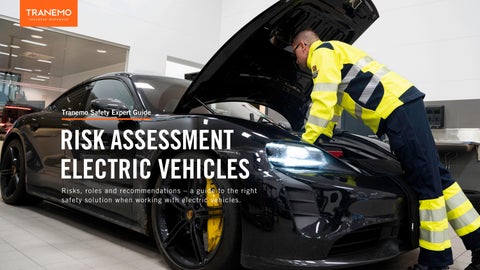
RISK ASSESSMENT ELECTRIC VEHICLES Risks, roles and recommendations – a guide to the right safety solution when working with electric vehicles.
RISK ASSESSMENT FOR ELECTRIC VEHICLES The electric vehicle industry is a rapidly growing sector and conditions are changing at a rapid pace. It is therefore crucial to continuously update risk management procedures when working with electric vehicles, including staff competence and the adaptation of safety measures. In this guide, we highlight the risks that may arise when working with electric vehicles and the skills that relevant professional roles need to manage them. We present key standards to consider when selecting protective clothing. We also provide recommendations for protective clothing that can reduce risks within the electric vehicle industry.
© 2026 Tranemo Workwear | Risk Assessment Electric Vehicles
RISK ASSESSMENT
1.
Understanding electric vehicles
2.
Identify the risks
© 2026 Tranemo Workwear | Risk Assessment Electric Vehicles
3.
Tailor your skills
4.
5.
6.
Assess the level of risk
Apply the right standards
Design the right protective solution
1. ELECTRIC VEHICLES: AN ELECTRICAL SYSTEM Electric vehicles can be regarded as powerful electrical systems. With voltage levels of 400V–800V, high energy storage capacity and the ability to deliver high power output, they carry energy levels that can cause serious injury or even death in the event of an electrical accident.
What is a high-voltage system? A high-voltage system is a term used to distinguish the vehicle’s electrical propulsion system from the internal low-voltage system, which powers other electronics within the vehicle. A high-voltage system is not necessarily high voltage, but the energy levels can still be high.
Can a battery be switched off? No, a battery cannot be switched off in the same way as a standard electrical system. Therefore, there is always a risk when working on or near the battery.
© 2026 Tranemo Workwear | Risk Assessment Electric Vehicles
2. IDENTIFY THE RISKS Electric vehicles are equipped with high-energy batteries, which pose a number of safety risks. These can lead to serious consequences such as electric shock, electric arcing and fire. When conducting a risk analysis for the electric vehicle industry, the following risks must be taken into account:
Electric shock
Fire
» Current flow
» Toxic smoke and gas » Heat and flame
Arc Flash
» Radiant heat » Optical radiation » High noise » Shock wave © 2026 Tranemo Workwear | Risk Assessment Electric Vehicles
IDENTIFY THE RISKS: ARC FLASH A risk that can NEVER be ruled out Electric arcs pose a significant risk that can never be completely ruled out. They can occur as a result of short circuits, faulty connections or damage to the electrical system. Many electric arc accidents are caused by human error, which means that the risk cannot be completely eliminated.
Thermal arc energy
Quantify the risk
High-risk area
Vehicle manufacturers calculate the thermal arc energy for each type of electric powertrain in order to include this information in their instructions to workshops.
When working on electrical installations, the protective system must be designed so that the protection level exceeds the thermal arc energy specified by the vehicle manufacturer.
To minimise the risk of electric shock, a sufficient safety distance from electrical equipment must be maintained, and direct contact must be avoided. Exposure to intense electric arcs from electric vehicle batteries can cause severe burns.
These instructions help workshops to understand the risks and determine the level of protection required when the risk of electric shock cannot be ruled out during work.
© 2026 Tranemo Workwear | Risk Assessment Electric Vehicles
Standard electric vehicle batteries often have a high thermal arc energy – ranging from 30 cal/cm² up to over 40 cal/cm².
Unprotected personnel within 4 metres of the arc are at risk of serious injury. This highlights the importance of carrying out work involving electrical hazards in isolated and safe locations.
IDENTIFY THE RISKS: FIRE Difficult to extinguish with high risk of spread
Toxic smoke
Corrosive fumes
Fires in batteries, regardless of size, are extremely difficult to extinguish. The high energy density of lithium-ion batteries can lead to intense fires that quickly reach temperatures above 1,000 degrees Celsius.
A burning battery can produce heavy smoke that quickly spreads to adjacent rooms and areas. The smoke is extremely toxic and contains substances such as hydrogen fluoride and hydrofluoric acid, which can cause serious injury if inhaled.
The fumes from a car battery fire can cause serious chemical burns if inhaled or if they come into contact with the skin. They contain toxic substances such as hydrogen fluoride and hydrofluoric acid, which can lead to breathing difficulties and burns. The fumes can also react with moisture in the air and increase the risk of irritation.
This heat development increases the risk of the fire spreading, especially during thermal runaway—a process in which an uncontrolled rise in temperature can cause explosions. Therefore, it is crucial to have effective extinguishing methods and a clear emergency response plan.
© 2026 Tranemo Workwear | Risk Assessment Electric Vehicles
Therefore, it is important to take the necessary safety measures and ensure that personnel are aware of the risks associated with battery fires.
It is important to ensure good ventilation and the correct protective equipment when handling batteries.
3. TAILOR YOUR SKILLS
A.
Job roles and skill requirements in an electric vehicle workshop Everyone who works in an electric vehicle workshop plays a vital role in safety procedures. Even reception staff need basic training and an understanding of electricity and electrical systems.
1.
B.
The level of training and knowledge should then be tailored to the level of risk associated with each specific role.
© 2026 Tranemo Workwear | Risk Assessment Electric Vehicles
6.
3.
5.
2.
C.
4.
A. Location
1. Electric Vehicle Safety Officer
4. Qualified Electric Vehicle Specialist
B. Workplace
2. Electric Vehicle Supervisor
5. Trained Electric Vehicle Technician
C. High-risk area
3. Electric Vehicle Specialist
6. Informed Electric Vehicle Specialist
Occupational roles and illustration from the industry standard “Safe handling of high-voltage systems in electric vehicles,” developed by BIL Sweden, the Swedish Vehicle Service Association (MRF), and the Swedish Vehicle Workshops Association (SFVF).
4. ASSESS THE LEVEL OF RISK Before handling electric vehicle batteries, for example during repairs or servicing, the supervisor must carry out a risk assessment. This identification must answer the following questions:
NO ELECTRICAL HAZARD General handling of electric vehicles
» Work on a de-energised high-voltage system » Work on a live high-voltage system where there is no obvious risk of electric shock » Work carried out by a trained electric vehicle technician or higher » Clothing and PPE in accordance with the employer’s instructions » Equipment and training in first aid following an electrical accident are mandatory
1. Is there a risk of electric shock? 2. Can the risk of electric shock be ruled out? If the risk of electric shock cannot be ruled out, the work must be carried out by qualified personnel with the appropriate skills, using certified personal protective equipment (PPE) and tools. © 2026 Tranemo Workwear | Risk Assessment Electric Vehicles
THE RISK OF ELECTRIC SHOCK CANNOT BE RULED OUT High-voltage work
» Work on a high-voltage system that has not been isolated » Work in the vicinity of a high-voltage system that has not been isolated, where there is uncertainty about whether an electrical hazard is present
» Work carried out by a qualified electric vehicle technician or higher, depending on the task » PPE must be worn when the risk of electrical hazard cannot be eliminated
5. APPLY THE RIGHT STANDARDS Standards to refer to when designing the right protection solution
EN 61482-2 This standard specifies requirements for protective clothing intended for use when working with electrical equipment where there is a risk of electric arcing, for example when a system needs to be opened. Arc-protective clothing is always classified as Category III under the PPE Regulation and must meet strict requirements regarding textiles and design in order to be certified.
EN ISO 11612 This standard specifies requirements for protective clothing for work involving a risk of contact with heat and flames. The standard is divided into different categories, with code letters indicating the level of protection that the garments provide. For a complete protective system, the clothing must cover the neck, torso, arms and legs, either in the form of a full-body coverall or a two-piece system, such as a jacket and trousers, which meet the same certification standards.
© 2026 Tranemo Workwear | Risk Assessment Electric Vehicles
6. DESIGN THE RIGHT PROTECTIVE SOLUTION
Arc Flash
Electric Shock
Welding
The arc flash protective clothing should cover the entire body, including the hands and head, and be CE-marked and certified to a protection level in cal/cm² (ELIM) that exceeds the thermal arc flash energy specified in the electric vehicle manufacturer’s risk assessment.
To protect against electric shock, the correct working method must be followed and insulated gloves and tools must be used. The gloves must be certified and checked before use.
When welding, cutting or grinding metal, clothing certified to EN 11611 must be worn.
Using certified layer-on-layer systems is an effective way of combining comfort with protection. Tranemo Skinsafe is one such system that offers a high level of protection.
© 2026 Tranemo Workwear | Risk Assessment Electric Vehicles
It is also important to minimise contact with electrical components and to ensure that switches are turned off. Risk assessment and proper training are essential for preventing accidents.
Welding aprons may also be worn for extra protection. The clothing should be available in both women’s and men’s sizes to ensure a good fit and comfort.
6. DESIGN THE RIGHT PPE SOLUTION Protective Clothing 61482-2:2020 (arc flash), the ELIM must always be » EN higher than the thermal arc flash energy specified by the manufacturer. A minimum of one layer with 8–12 cal/cm² is required to ensure protection in the event of an arc flash incident.
» EN ISO 11612 (heat and flame) ISO 14116 (for garments with limited flame resistance, » EN e.g. high-visibility vests) » EN 11611 (welding) » EN 13034 (liquid form chemicals) © 2026 Tranemo Workwear | Risk Assessment Electric Vehicles
Other Protective Equipment
» Helmet » Eye/face protection » Gloves » Insulated gloves » Hearing protection
EN 397, EN 13087-7 (arc flash) EN 166, 170, 171 EN 407, 388 (+arc flash) EN 60903 EN 352-1, 352-2, 130087-7
Source: Industry standard – “Safe handling of high-voltage systems in electric vehicles,” developed by BIL Sweden, the Swedish Vehicle Service Association (MRF), and the Swedish Vehicle Workshops Association (SFVF).
6. EXAMPLES OF PROTECTIVE SOLUTIONS General Adjust the arc flash protection according to the thermal energy level of the electric vehicle and the distance to the source of risk.
For work involving high energy levels (direct contact with the vehicle/battery) Switch, including helmet
40 cal/cm²
Cantex Arc 25+
27 cal/cm²
Switch
Cantex Arc 25+
Tera TX
Arc Flash Gloves
For work in the vicinity of high energy levels (within the arc flash boundary, but without direct contact with the vehicle or battery) Tera TX Non-Metal
8 cal/cm²
Arc flash gloves
> 8 cal/cm²
© 2026 Tranemo Workwear | Risk Assessment Electric Vehicles
EVERYONE WHO GOES TO WORK HAS THE RIGHT TO COME HOME UNHARMED. UNDERSTAND THE RISKS ASSOCIATED WITH ELECTRIC VEHICLES. ENSURE YOU HAVE THE RIGHT PROTECTION. For more in-depth information on risk assessments, standards, certifications and sustainability, please visit tranemo.com.