Tranemo Safety Expert Guide
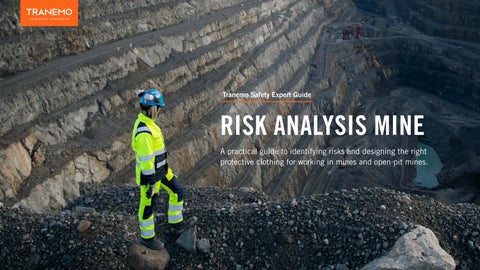
RISK ANALYSIS MINE A practical guide to identifying risks and designing the right protective clothing for working in mines and open-pit mines.
RISK ANALYSIS MINE Working in the mining industry, both above and below ground, involves high production rates, exposure to gases and dust, large vehicles and often limited visibility. The risks in open pits and mines are extensive and require careful protection.
Identify the risks
03
Understand the dangers
06
In this guide, we go through the most common types of accidents and the specific risks that exist in the mining industry. We also present relevant standards for protective clothing to support your safety work and recommend the types of protective clothing that best meet these risks.
Apply the right standard
07
Design the right protection solution
12
© 2026 Tranemo Workwear | Risk Analysis Mine
1. IDENTIFY THE RISKS The mining industry is globally an accident-prone industry. According to the International Labour Organisation (ILO), mining accounts for around 1% of the global workforce but accounts for as much as 8% of work-related fatalities. The highest proportion of fatalities occurs in metal mines, followed by coal mines. In general, the risk of serious accidents is greater when working in underground mines than in open-pit mines.
© 2026 Tranemo Workwear | Risk Analysis Mine
8% of the world’s work-related fatal accidents
1. IDENTIFY THE RISKS Common accidents in mining
» Falling accidents » Traffic and transport-related accidents » Explosion accidents » Machinery-related accidents » Electrical accidents and accidents caused » Damage by falling mining materials Above Ground Mine Source: The dangers of mining work – On the job injury lawyer
© 2026 Tranemo Workwear | Risk Analysis Mine
2. UNDERSTAND THE DANGERS Unlike many other high-risk sectors, the mining industry does not have a specific and uniform risk profile. Instead, mining is characterised by a wide range of risks and hazards that vary depending on the tasks, working environment and type of mining activity. These risks can range from fall and crushing hazards in underground work to hazards associated with dust, gases and large machinery in above-ground work. It is therefore important to adapt the risk analysis based on both the job role and the area of operation in order to obtain a comprehensive picture of the specific safety measures required.
Risks and hazards to consider when conducting a risk analysis:
» Heavy traffic and moving machine parts
» Chemicals, dust and acids
» Electrical hazard
» Mine gases
» Heat and high temperatures
» Large temperature differences
© 2026 Tranemo Workwear | Risk Analysis Mine
3. APPLY THE RIGHT STANDARD: EN ISO 20471 Huge transport vehicles and machinery with moving parts, combined with blind spots and limited visibility, pose a significant risk of serious accidents in the mining industry. It is therefore not surprising that many accidents in mining can be linked to incidents involving vehicles and moving machine parts. High-visibility garments certified according to EN ISO 20471 are therefore essential for safety when working in a mining environment.
© 2026 Tranemo Workwear | Risk Analysis Mine
3. APPLY THE RIGHT STANDARD: EN 61482-2 Electrical hazards (arc flashes and electric shocks) In mining, many people work with electrical installations, where the risks of electric arc and electric shock are significant. By using protective clothing that is certified according to EN 61482-2 and has a protection level that exceeds the thermal arc energy in the facility, the effects of these risks can be minimised. We also recommend a multi-layer system with an outer layer that meets PPE 2 requirements and has an Arc Rating (ATPV or EBT value according to NFPA 70E) of at least 8 cal/cm². This provides effective protection against the energy from an electric arc and reduces the risk of serious injury. When working near electrical installations, electrically insulated gloves in accordance with EN 60903 are strongly recommended. These gloves protect against electric shocks and provide important insulation protection, which reduces the risk of electric shocks and contributes to a safer working environment.
© 2026 Tranemo Workwear | Risk Analysis Mine
3. APPLY THE RIGHT STANDARD: EN ISO 11611, EN ISO 11612 Heat and high temperatures in metalworking In mining, many people work with maintenance and construction. When welding, grinding and cutting metal, they are often exposed to high temperatures and risk being hit by molten metal, known as welding spatter. Protective clothing marked according to EN ISO 11611 and EN ISO 11612 helps to minimise these risks. In cases of high exposure to welding spatter, standard protective clothing should be supplemented with specially adapted accessories, such as sleeve protectors and aprons.
© 2026 Tranemo Workwear | Risk Analysis Mine
3. APPLY THE RIGHT STANDARD: EN 13034 Chemicals, dust and other hazardous substances Miners are exposed to a variety of hazardous chemicals, minerals and acids during mining operations, which pose significant health risks if not handled properly. Sulphuric acid and other chemicals used in ore processing pose serious risks if spilled or inhaled, and can cause burns and breathing difficulties. To protect against acids and chemicals, it is important to use the correct protective clothing in accordance with standard EN 13034. Another risk is quartz dust, which is formed when drilling or crushing quartzcontaining rock. Prolonged exposure can lead to serious lung diseases such as COPD, lung cancer and silicosis (dust lung). Proper respiratory protection is essential to counteract these risks.
© 2026 Tranemo Workwear | Risk Analysis Mine
3. APPLY THE RIGHT STANDARD: EN 1149-5 AND EN ISO 11612 Explosive and toxic gases Mine gases are a mixture of gases that can be released during mining operations and can pose serious risks to miners if not handled correctly. In ATEX environments, where workers handle explosives or are present in mine tunnels with potentially occurring natural gases such as methane, antistatic protective clothing in accordance with standard EN 1149-5 in combination with EN ISO 11612 is recommended. Monitoring and control of mine gases is crucial to ensuring worker safety and reducing the risk of explosions, poisoning and other accidents. To effectively manage the various gases found in modern mines, a robust ventilation system is one of the most effective solutions.
© 2026 Tranemo Workwear | Risk Analysis Mine
Some common types of mine gases include:
» Methane (CH4) - explosive gas that is colourless and odourless monoxide (CO) – a highly dangerous gas that can quickly » Carbon cause poisoning gas (N2) - can replace oxygen in the air and cause » Nitrogen sudden suffocation sulphide (H2S) – foul-smelling gas that can be lethal even » Hydrogen in low concentrations » Water vapour - can cause heat stress
3. APPLY THE RIGHT STANDARD: EN 342 Deeper mines mean greater temperature differences As mines become deeper, the temperature difference between the surface and the bottom of the mine increases. For example, it is not unusual for a miner to work at a depth of 1,400 metres in a temperature of +28°C, while the outdoor temperature is -30°C. Large temperature differences mean an increased risk of both heat stress and severe cooling. To minimise these risks, we recommend flexible clothing systems in several layers, certified according to EN 342, for quick and effective adaptation to varying temperatures.
© 2026 Tranemo Workwear | Risk Analysis Mine
4. DESIGN THE RIGHT PROTECTION SOLUTION
Cantex WS – Weld Stretch
Tera TX
© 2026 Tranemo Workwear | Risk Analysis Mine
Zenith
Shell FR
Merino/FR Underwear
EVERYONE HAS THE RIGHT TO RETURN HOME FROM WORK UNHARMED. UNDERSTAND THE RISKS OF MINING. ENSURE PROPER PROTECTION.