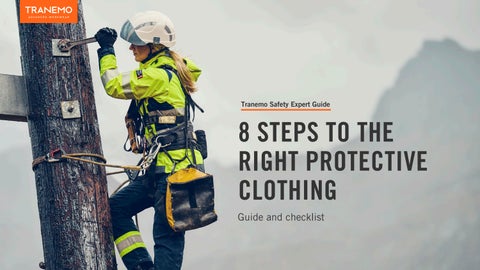
Tranemo Safety Expert Guide
8 STEPS TO THE RIGHT PROTECTIVE CLOTHING Guide and checklist
8 STEPS TO THE RIGHT PROTECTIVE CLOTHING Purchasing protective clothing for a specific work environment is a complex process that requires focus and precision in addition to risk analysis and testing. This guide serves as a checklist and is designed to provide an overview of the purchasing process and help you ensure that each step is completed.
© 2026 Tranemo Workwear | 8 steps to the right protective clothing
8 STEPS TO THE RIGHT PROTECTIVE CLOTHING
1.
2.
3.
4.
5.
6.
7.
8.
Avoid PFAS if possible
Ensure that the garments can withstand industrial washing
Customise the cover
Think ladies and gentlemen
Involve the users
Form a clothing council
1.
Conduct a risk analysis
Test the fabrics if necessary
© 2026 Tranemo Workwear | 8 steps to the right protective clothing
1. CONDUCT A RISK ANALYSIS What are the potential hazards in your particular workplace – explosion risk, electric arcs, molten metal, chemicals, vehicles or perhaps batteries? Furthermore, how serious are they and how likely are they to occur? Different industries have different hazards that require different types of protection. To find the right protective clothing for your specific work environment, you must begin by identifying and assessing any hazards and risks.
© 2026 Tranemo Workwear | 8 steps to the right protective clothing
2. TEST THE FABRICS IF NECESSARY The risk analysis provides you with the certifications required to protect against the risks and hazards in your working environment. With these certifications as a basis, you can specify which fabrics – i.e. which protection – you need in your protective clothing. Since reality often differs from the laboratory environment, you must test the selected fabrics in your working environment. The tests are adapted to the risks you have identified in your workplace. For low risk working environments, this type of fabric testing is not usually required.
© 2026 Tranemo Workwear | 8 steps to the right protective clothing
3. AVOID PFAS IF POSSIBLE – STRIVE FOR SUSTAINABILITY Do you need protection against chemicals? If so, it is particularly important for the environment that you know exactly what type of protection you need. It is easy to order PFAS clothing even though PFAS-free garments provide just as much protection against the risk. Be aware that this detail and this decision – PFAS or not – has a major impact on the environment. Consider this: 1. 2.
Is EN 13034 required? Acid or base: PFAS-free impregnation Oil or oil-based chemicals: PFAS impregnation Otherwise, PFAS-free protective clothing.
Strive for long-term use and sustainability in all aspects of protective clothing. For example, ensure that garments are easy to repair when necessary (replacing zippers, etc.). Remember that high-quality garments last longer.
© 2026 Tranemo Workwear | 8 steps to the right protective clothing
4. ENSURE THAT THE GARMENTS CAN WITHSTAND INDUSTRIAL WASHING Protective clothing that cannot withstand industrial washing can quickly lose some of its protective properties. For example, reflectors can fall off and visibility can be impaired, meaning that the garments may no longer meet the requirements. The garment may also become pilled, shrink and lose its shape. An important step in choosing protective clothing is therefore to ensure that the garments can withstand industrial washing. Also check whether the clothing requires re-impregnation after washing. Protective clothing certified according to EN 13034, for example, requires re-impregnation every fifth wash, which must be carried out by certified laundries.
© 2026 Tranemo Workwear | 8 steps to the right protective clothing
5. ADAPT THE PROTECTION TO THE TASK If protective clothing is not properly adapted to the task at hand, it can quickly lead to discomfort and heat stress, which can affect concentration and increase the risk of accidents and injuries. Therefore, optimise your clothing by:
» » »
Adapting the level of protection to the risk (do not over-dress) Choose protective clothing that is suitable for your specific task (avoid multi-norm) Utilize the layer-on-layer principle (Tranemo Skinsafe)
NOTE! Do not forget to protect hands and face
© 2026 Tranemo Workwear | 8 steps to the right protective clothing
6. THINK LADIES AND GENTLEMEN A good fit is crucial for comfort and therefore also for safety. Therefore, ensure that the manufacturer offers:
» » »
Options that suit different body types with different waist sizes and lengths A wide selection for both women and men Maternity trousers
Avoid Unisex if Possible Unisex garments are often based on men’s sizes, which can result in sleeves that are too long for women.
© 2026 Tranemo Workwear | 8 steps to the right protective clothing
7. INVOLVE THE USERS – CONDUCT WEARER TRIALS To successfully choose the right protective clothing, it is important to involve users in the process. After all, they are the ones who know best what they need in terms of comfort and ergonomics to be able to perform optimally.
» » » »
Involve the users early in the process Conduct in real conditions Gather feedback and adapt accordingly Repeat until the desired balance between protection and comfort is achieved
© 2026 Tranemo Workwear | 8 steps to the right protective clothing
8. FORM A CLOTHING COUNCIL Is everything working as it should? Is anything missing? What could be improved? Once you have chosen protective clothing and are up and running, we recommend that you form a clothing council consisting of users and decision-makers. Here you can gather users’ insights and opinions and continuously evaluate the need for protective clothing for different tasks. In the long term, this group could also develop within areas such as risk assessment, with expertise in identifying and reporting risks.
© 2026 Tranemo Workwear | 8 steps to the right protective clothing
EVERYONE WHO GOES TO WORK HAS THE RIGHT TO COME HOME UNHARMED. CHOOSE THE RIGHT PROTECTIVE CLOTHING. For more in-depth information on risk analysis, standards, certifications and sustainability, please visit www.tranemoworkwear.com.
Book meeting