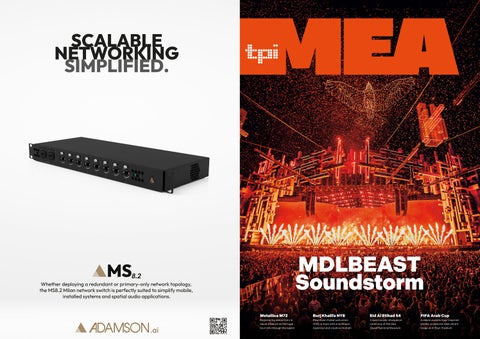
SCALABLE NETWORKING SIMPLIFIED.


Whether deploying a redundant or primary-only network topology, the MS8.2 Milan network switch is perfectly suited to simplify mobile, installed systems and spatial audio applications.

![]()


Whether deploying a redundant or primary-only network topology, the MS8.2 Milan network switch is perfectly suited to simplify mobile, installed systems and spatial audio applications.


Concert Stuff is a premier end-to-end concert and event production company specializing in delivering world-class live entertainment experiences through their dynamic range of businesses. With over four decades of industry expertise, Concert Stuff partners with leading promoters and artists to deliver unforgettable performances to audiences around the globe.


OLA MELZIG
PRODUCTION MANAGER
M&M PRODUCTION MANAGEMENT


I just love the new generation of the Artist user interfaces. The SmartPanel‘s intuitive workflow and its very visual layout are simply fantastic.
I can customize it in any way I need, which is absolutely crucial for the big live events I typically work on.“

ARTIST INTERCOM
Professional and reliable live communications. Seamless integration of Riedel‘s SmartPanel and Bolero wireless intercom. Easily scaling from 16 to 1024 ports with flexible licensing.


Peter Iantorno Editorial Director
As we send this issue of TPiMEA to print, the whole Mondiale Technology Media team – and I dare say most of the industry – is still reflecting on, reminiscing about and, in some cases, reeling from the gargantuan annual gathering that is ISE. While I only attended for two days before making my escape to put the finishing touches to this magazine, what I saw in Barcelona was an event that has very much transcended the traditional tradeshow. Not only were the halls packed with record numbers of visitors, but there was also a stacked roster of content, including the Live Events Stage, curated by our very own Stew Hume and featuring a selection of talks and panels, including some chaired by Todd Staszko and Daisy Thorogood from fellow Mondiale publication, MONDO-DR.
For me, ISE was a chance to get in front of some of the manufacturers that I rarely get the opportunity to see directly on my usual beat and, of course, catch up with a few of the many friendly faces who had made the trip from the Middle East and Africa.
This issue of TPiMEA features three bumper Production Profiles from huge shows that took place in the region over the past couple of months, with deep dives into Metallica’s M72 World Tour (Page 40), Eid Al Etihad (page 56), and MDLBEAST Soundstorm (page 76). I was fortunate enough to attend two out of these three events in person, meeting the Metallica crew at Bahrain’s Beyon Al Dana Amphitheatre before roaming the newly configured Soundstorm festival grounds in Banban the following week.
Elsewhere in the issue, our First Look interview features a mainstay of Dubai’s audio sector, Wissam Shaheen, who recently landed a role at his dream company (page 10). There’s also coverage of the Burj Khalifa’s incredible New Year’s Eve celebrations (page 18), opinions from both Lucy Magee of West End Worldwide (page 98) and Jemma Joy on her new venture, Standard Practice (Page 100), and much, much more.
Enjoy the issue.


10 Wissam Shaheen
A pillar of the UAE’s audio scene and a dyed-in-thewool d&b audiotechnik enthusiast, Wissam Shaheen looks back on his career so far and shares his ambitions after landing his dream role…
18 Burj Khalifa New Year's Eve
Dubai’s most iconic building is the centrepiece for a narrative-driven spectacular conducted within one of the busiest urban environments on the planet.
28 Formula 1 Qatar Grand Prix
Creative Technology Middle East delivers a turnkey technical solution to transform Lusail International Circuit into a world-class concert destination.
32 Spanish Super Cup
The crowd at Jeddah’s King Abdullah Sports City Stadium is transformed into a visual canvas as Spanish giants face off in Saudi Arabia.
34 FIFA Arab Cup
Arabian architecture-inspired kinetic structures take centre stage in a visually ambitious and creatively rich opening ceremony at Al Bayt Stadium.
Production Profile
40 Metallica: M72 World Tour
As Metallica’s monster production continues to roll around the globe, TPiMEA catches up with the crew in Bahrain to find out more about the incredible feats of engineering and artistry behind the M72 World Tour
56 Eid Al Etihad
A spectacular showpiece ceremony at the newly opened Sheikh Zayed Museum marks a triple celebration for the UAE.
76 MDLBEAST Soundstorm
The flagship festival in the MDLBEAST catalogue returns with an all-new site design and an elevated creative that means there’s something new to discover at every turn.
96 STEVES
Named after the company’s late founder, Steve Lakin, Protec launches its brand-new production space for pre-production, pre-builds and rehearsals.
98 Beyond the spectacle
West End Worldwide’s Lucy Magee explains why the Middle East needs producers, not just shows.
100 From fast growth to strong foundations
Jemma Joy of Standard Practice discusses the increasing need for compliance, sustainability and governance within the industry.
The latest MEA news, including Star Live and Electra's new strategic partnership; the launch of NMK Beyond; Martin Audio rolling out to East Africa with Tech Ease Systems; and DWR taking on Panasonic distribution.
Editorial Director
Peter Iantorno
Tel: +44 (0)161 476 8360
Mobile: +44 (0)7763 233637
e-mail: p.iantorno@mondiale.co.uk
Managing Editor
Stew Hume
Mobile: +44 (0)7702 054344
e-mail: s.hume@mondiale.co.uk
Contributing Editor
Jacob Waite
Mobile: +44 (0)7592 679612 e-mail: j.waite@mondiale.co.uk
Contributing Assistant Editor
Alicia Pollitt
Mobile: +44 (0)7508 441986 e-mail: a.pollitt@mondiale.co.uk
Commercial Director
Fran Begaj
Mobile: +44 (0)7852 336728 e-mail: f.begaj@mondiale.co.uk
Senior Account Manager
Matilda Matthews
Mobile: +44 (0)7413 555978 e-mail: m.matthews@mondiale.co.uk
Account Manager
Tom Dyson
Mobile: +44 (0)7306 505230 e-mail: t.dyson@mondiale.co.uk
Account Manager
Molly Cummins
Tel: +44 (0)161 476 8360
e-mail: m.cummins@mondiale.co.uk
Digital Content Manager
James Robertson
Mobile: +44 (0)7725 475819 e-mail: j.robertson@mondiale.co.uk
Marketing and Event Manager
Alice Clarke
Mobile: +44 (0)7752 392465
e-mail: a.clarke@mondiale.co.uk
Marketing and Event Assistant
Charlie Moore e-mail: c.moore@mondiale.co.uk
Chief Executive
Justin Gawne
Mobile: +44 (0)7768 850767 e-mail: j.gawne@mondiale.co.uk
Mondiale Group Chairman
Damian Walsh
Graphic Design & Production
Dan Seaton: d.seaton@mondiale.co.uk
Jez Reid: j.reid@mondiale.co.uk
Accounts
Lynette Levi / Sarah Miller: ar@mondiale.co.uk
Cover Photography
MDLBEAST Soundstorm by MDLBEAST
Printed By Buxton Press www.buxpress.co.uk
www.tpimeamagazine.com www.tpimeaawards.com www.tpimagazine.com www.tpiawards.com
@TPiMEA_Magazine
/ TPiMEAMagazine
@ tpimea_magazine /company/tpimeamagazine


A pillar of the UAE’s audio scene and a dyed-in-the-wool d&b audiotechnik enthusiast, Wissam Shaheen looks back on his career so far and shares his ambitions after landing his dream role…
With a passion for perfecting the live sound experience, Wissam Shaheen has spent the past two decades not only using d&b audiotechnik products but also being a committed advocate of them to anybody who will listen. So, when he revealed to TPiMEA that he would be joining the company full-time, the only surprise was that it hadn’t happened sooner. “This is an ambition I’ve had since my early 20s,” said an enthused Shaheen, clearly delighted to have landed a role at his dream company. “People keep telling me that it was bound to happen sooner or later, but I feel incredibly blessed that it has. Everything I’ve done over the past 20 years has been leading me here.”
As ide from his long-term affinity with d&b, Shaheen has played a significant role in the development of the Middle East’s live events market, bringing his audio expertise to countless high-profile shows, playing a major role in building the audio departments of both Eclipse and Creative Technology, and even winning twice at the TPiMEA Awards along the way. Here, Shaheen shares his story so far – from a boy in Beirut with big dreams to a leader in Dubai’s live events community – explains his new role, and discusses his plans for the position.
What sparked your interest in the industry?
Like many in this industry, I started as a musician. I always had a knack for music, and my parents noticed this early and were very supportive. Growing up, I was completely obsessed with music and, as soon as I got the opportunity
to get involved in something that would allow me to play music, I jumped at the chance. I joined a marching band, starting with clarinet before moving to saxophone tenor. It was a great way to get access to instruments and free music lessons. I did well and my teacher put me forward for the Lebanese National Higher Conservatory of Music, which I did for a couple of years before focussing on music theory.
At the age of 17, I started a summer job working in a music store, which we used to call a discotheque in Lebanon. As well as selling records, the store used to put on DJ gigs, and as part of that we would put in our own sound system. That was my first taste of working with amplified sound and I loved it from the start.
By my early 20s, I’d started doing music production for TV ads, and the sound engineer in the studio started taking me to help on the live shows that he was mixing. After being locked away in the dark studio where you barely see any sunlight, being outside and seeing the reaction of the people in the crowd to the music was a real eye-opener, and I immediately fell in love with the live environment. I decided then and there that I wanted to be a live sound engineer.
What was your introduction to d&b?
I spent over a decade working in Lebanon. The music scene in the country is so rich; I was introduced to so many genres early on from a sound engineer perspective, from flamenco to jazz – which is to this day still my favourite genre to mix. The first time I came across d&b was when my first mentor


in live sound, the late Khaled Sultan, started working with Seebeck Audio, a d&b distributor in Lebanon. I was used to using massive point source boxes on every little gig, and I remember clearly the first gig I went out on using d&b; when I saw the system we were using, I thought there was no way that it would be enough to cover the room. As soon as Khaled turned it on, my mind was blown. I’m really fortunate that from that time to now, I’ve worked almost exclusively with d&b loudspeakers.
How did your move to Dubai come about?
Despite doing a few freelance gigs in the UAE, I was enjoying the scene in Lebanon so much that I was convinced I would never leave. However, fast-forward to 2014 and John Parkhouse, then the Head of Audio at Eclipse, was looking for some d&b skills after the company had made a substantial investment and become the first in the region to invest in J-Series, and d&b introduced us. After speaking to John, it seemed like there might be a good fit, so I took the chance and went to work for him. It turned out to be the best decision I ever made.
Working on the Eclipse audio team was an incredible experience that was made special because we had this amazing mix of the right company, the right kit and – most importantly – the right people. It felt like everyone there was on the same wavelength and in their element, pulling together and working towards the same goal, and learning from each other along the way. Although there were some tough days and exhausting periods, for most of the time, it didn’t feel like work. That core team from those days has shaped my whole experience in Dubai, and although we’re not all working together anymore, we formed a proper
community that remains close-knit to this day, which is built upon likeminded people who share the same passion and belief in the emotional impact of live music. John Parkhouse is a huge mentor to me, and I’ll always be grateful to him for bringing us together and starting the movement.
What were some of your favourite shows from that era?
The gigs at Dubai Media City Amphitheatre were all special. It’s such a beautiful venue, and it was my first grown-up arena experience working with A-list acts. I was given the freedom to experiment in many ways – to design, commission, implement and optimise a system – and I met so many amazing people working on those shows.
We also did some very special corporate shows. Some people knock corporate gigs, but I believe there’s a real beauty to be found in corporate work – especially when you have an event that includes both a conference element that demands clarity for spoken word and a musical element that requires more punch. Designing a system that can cover the whole spectrum while remaining discreet – as nobody wants to see the PA on a corporate – is an exciting challenge that I enjoyed.
Tell us about your time as Head of Audio for Creative Technology Middle East…
My time at CT was another career highlight. I was fortunate to be given the opportunity to build the audio department, and the company was incredibly supportive in helping me achieve my vision, including attracting the right talent for the team and making some substantial investments in d&b. For me, now as a d&b employee, CT is a very important partner. We built the department around the ethos that every single


gig, no matter how big or small, received the very best treatment. Nothing left the warehouse without a proper design and thorough prep. That really resonated with the industry, which was evident in some of the amazing shows that we pulled off over the past few years.
To see the department now handed over to Tim Cook – somebody who I’ve worked with solidly over the past decade – just feels right. He’s played such a major part in the building of the department, and I have no doubt that it’ll be onwards and upwards for him and the team.
What does your new position at d&b entail?
I have joined the Education and Application Support department. There are quite a few of us on a global scale, and we do exactly what the job title suggests. We treat every entity or every person that carries d&b in exactly the same way; we want to enable them, support them, and offer education to them and their teams to ensure that they’re using their systems to their full potential.
I’ve been working with d&b in this market for over 20 years. Since the launch of the SL-Series, we’ve seen the brand really take off in the region. We’ve seen a huge shift, with d&b being specified on riders more and more. With that comes a responsibility to make sure that d&b users are being supported to get the most out of their systems.
How much importance do you place on training?
This industry has always been about the people, irrespective of what kit is used, and I’m still a firm believer
that it’s in everyone’s interest to help elevate the level of the local talent pool – especially when it comes to the next generation of audio engineers.
Th e amount of talent I’ve seen imported into the country temporarily is significant, but if standards among local engineers are raised to a high enough level, the need for importing talent will be greatly reduced, which will benefit everyone from rental houses to integrators. With the volume of demand now throughout the region, this will become increasingly important if we’re to have the resources to cover the busiest periods such as Q4.
Throughout my time in Dubai, I’ve been lucky enough to be part of a community that is passionate about delivering outstanding-quality sound experiences; I want to take that community and scale it up by enabling the newer generation, and education is the number one priority to do this. It’s not even about a singular brand – it’s about raising the standards across the board and finding more people who share that same sense of satisfaction.
How does the Middle East fit into d&b’s global operation?
In a way, d&b Middle East feels a bit like a start-up in that we’re enthusiastic, agile and take a fresh approach, but we’re also very fortunate to belong to a large, very wellestablished multinational group, and we get all the benefits that come with that. It’s the best of both worlds.
Expectations are high, and rightly so. The MENA region is thriving and includes huge markets such as Egypt and Saudi Arabia that still have so much untapped potential. I
also see major developments in Oman and Jordan as well as Lebanon, which is obviously a very special country to me and somewhere I’m keen to develop further.
How important is your local distribution network?
Our distribution network plays a significant role in our plan for the region. We can’t do it on our own. Their expertise and their relationships are invaluable to us and vital to help us spread the word. It’s important that we’re present for our partners every step of the way – offering support wherever it is needed, from design to technical knowledge, to support on the ground. All of our partners are experienced d&b users so they have great knowledge of our systems and workflows, but if there are any areas where we can add value and help push projects to the next level, then I’ll do everything possible to make that happen.
Aside from your history with the brand, why is d&b so important to you?
The idea of ‘democracy for listeners’ is my favourite d&b slogan – it’s an ethos that I truly believe in. When you look at it from a technical perspective, we all know that every venue has a sweet spot, and every venue also has areas that are not optimal from an audio perspective. Minimising the gap between the best seat in the house and the worst is the practical meaning of democracy for listeners. We achieve that through a combination of offering the right tools coupled with true, real-life, honest predictions, taking the system from design to execution.
If I flip it back to the emotional side of things – and live sound to me is mostly about emotion – if you can facilitate an emotional connection between the audience and whatever is happening on stage, whether that’s a rock ’n’ roll gig or a corporate seminar, that’s when you’re doing something special. Most people in the audience won’t notice or care about what brand the PA is, but if we get it right then they will leave with that feeling of enrichment that will stick with them long after the show is over. That, to me, is democracy for listeners.
How does the global touring market boost the brand in the region?
The touring circuit is increasingly seeing the importance of the Middle East and India, and we’re now seeing more major acts coming through and playing multiple dates in the region. This is great for d&b because the product is so popular it has long been a touring standard, making the top of pretty much all riders in the touring world, so when big bands come through the region, we’re here to support.
Af ter 20 years using the brand, it’s very refreshing to see how popular d&b has become in the region and globally. It’s been a gradual build over the years, but it’s really started to gain traction and is now snowballing. The more shows and projects that d&b is used for, the more the word spreads.
Pe ople will always have their favourites when it comes to audio, and the beautiful thing to me is not to try to convert an engineer who is loyal to another brand to start using only d&b products, but to make that engineer see that even if it’s not their preferred product, you can still achieve an incredible result using d&b.
What are your priorities in your new position?
The immediate aim is to give as much as I can to the local market. First and foremost, to ensure that local technicians and engineers are as comfortable as possible using d&b systems, gaining a deeper level of understanding and enjoying using them to their full potential.
Another aim is to demystify and progress the use of Soundscape in the region. I believe that spatial audio is the next big thing in sound amplification. I’ve used it on everything from rock ’n’ roll to corporate, and the benefits are massive. For that extra bit of effort, a few more boxes and a bit more pre-production, the result is almost incomparably better.


Previous page: Wissam Shaheen wins the TPiMEA Awards 2025 Sound System Designer of the Year.
Facing page: Shaheen with Mark Ross, during Westlife’s Coca-Cola Arena show, 2019; At FOH at Party in the Park, Dubai Media City, in the same year; Members of the CTME audio team for the 2025 Qatar F1 After-Race Concerts; Taking part in the recent CTME and d&b training at Coca-Cola Arena.
Above: With Tim Cook at the same d&b training; Coca-Cola’s new d&b system gets its debut in-theround deployment for AP Dhillon.

As a two-time winner at the TPiMEA Awards, how much importance do you place on industry awards? They are extremely important. As well as being a recognition that peers are noticing your craft, they can also be a major factor in career progression. I’ve been lucky enough to be recognised at the TPiMEA Awards on two occasions – winning Corporate Audio Engineer of the Year in 2018, and Sound Designer of the Year last year.
Wh en you see some of the names on the shortlist, even to be nominated alongside them is an honour. We’re more often than not hidden behind the scenes and only noticed if there’s a mistake, so it’s very refreshing to have an outlet that recognises the work that goes on in the industry.
With the awards taking place at Coca-Cola Arena this year, with its amazing new d&b system, I’ve no doubt that it’s going to be epic.
Do you get time to switch off?
In my previous role I must admit that there was almost no time to switch off. That’s not a company-specific thing – that comes with the territory of being a head of department at any major rental house in the region. It’s the nature of the beast, in a region where last-minute requests are the norm.
I’m now aiming to achieve a much better work-life balance. Stepping away to something that is a lot more focussed allows me to – to use a d&b term – ArrayProcess my energy. It means I can direct my energy exactly where it’s needed rather than it being scattered all over the place.
With this refocussing, I enjoy the simple things in life like taking my dog for a walk, cooking, and barbecues with friends – where we invariably end up in passionate discussions about audio!
Do you see a solution to the last-minute nature that is so prevalent in the region?
It’s been going on for a long time, but I believe it can change. In fact, we were starting to see how it could be done properly just before the pandemic. I found 2019 to be as close as possible to a perfect season. It was as busy as they come, but it seemed that there was a lot more awareness from agencies and end clients about the importance of allowing lead time on projects – especially when it comes to the live sound element.
Th e pandemic was a massive reset, followed by a rush to recover, which was important financially but saw those more sustainable practices thrown away in favour of packing in as much as possible. It feels like that way of thinking has remained even though the industry has settled back to normal now.
Th e only way for us to achieve that sweet spot of ‘busy but organised’ is for us as practitioners to continue to push the awareness back again and deliver projects in a much more sustainable way that ultimately benefits everyone. That’s not to say that we should be doing less, but if we can get back to those realistic lead times and more efficient planning, then with the right people in place, the industry can actually produce even more.
My passion of enabling people feeds into that. I believe the more that the word spreads, the more stakeholders will see the benefits of allowing more planning time and we will start to see that way of thinking return. It’s easier said than done, but it was starting to happen once, so I see no reason why we can’t get back there again and grow from there.
Photos: d&b Middle East, TPiMEA, Coca-Cola Arena www.dbaudio.com


Dubai’s most iconic building is the centrepiece for a narrative-driven spectacular conducted within one of the busiest urban environments on the planet.


Downtown Dubai welcomed 2026 in style with a technically and logistically complex New Year’s Eve spectacle. Viewed from Burj Park, the Dubai Mall promenade and across the Dubai Fountain lake, the Burj Khalifa New Year’s Eve programme combined fireworks, water-based performance, lasers, lighting, aerial choreography and live music into a multisensory, broadcast-ready experience delivered at extraordinary scale.
Premiering on New Year’s Eve, the show was run for a further seven nights continuously afterwards. At its core sat a tightly integrated technical ecosystem designed to operate within one of the busiest urban environments on the planet, while delivering a fault-tolerant performance for both live audiences and millions of global viewers.
Ap pointed by Emaar as Artistic and Creative Execution and Production Partner, Our Legacy Creations (OLC) led the creative realisation and on-site execution, working in close collaboration with Emaar and a network of local and international suppliers including Kvant (lasers and architectural lighting), CRYSTAL (aqua drones, water screens and underwater lighting), Groupe F (special effects and pyrotechnics), SKYMAGIC (drone show), NeonBlack (lighting design), MediaPro International (audiovisual equipment
and technical support) and ON THE SLY (preshow music and sound design for façade content, produced by Artists in Motion), among many others.
Founded in 2023, OLC has quickly established itself in the delivery of complex, technology-driven live entertainment. Following its launch project – the remount of The House of Dancing Water in Macau – Burj Khalifa New Year’s Eve marked the company’s most highprofile Middle East engagement to date.
“The Burj Khalifa New Year’s Eve project really demonstrated OLC’s creative and technical capability,” said Anna Robb, Producer at OLC. “While the people behind the company have been in this industry for more than 25 years, we were honoured that Emaar placed their trust in us as an emerging company on a project of this scale and visibility.”
Ar tistic direction was led by Tiziana Pagliarulo, with the creative process rooted firmly in research rather than abstract storytelling. “You never want to appropriate culture; you want to understand it,” Robb explained. “The vision was to tell the story of Dubai, from its early pearl-diving and fishing heritage through to its technological advancement as a global, multicultural city.”
Th e show opened with fishermen performing in the water before evolving into increasingly
futuristic visual languages. Crucially, the narrative was developed around the physical and technical realities of the site. “Our creative process always begins with understanding the space,” Robb said. “Then we look at the elements we can safely and effectively deploy, and only then do we write the story. Emaar was deeply involved in that process, which made collaboration exceptionally strong.”
Beyond technology, logistics and safety were defining factors. Pyrotechnics were deployed on land, on jet skis and on aerial drones, delivered in collaboration with Groupe F, which also executed the Burj Khalifa midnight fireworks.
“That lake is precious,” Robb noted. “Anything that creates turbulence brings environmental and safety challenges. Even the simplest elements required extensive permissions, engineering and risk assessment due to the proximity of people, buildings and other infrastructure.”
‘A new artistic language’
One of the defining features of the production was the transformation of the Dubai Fountain lake into a fully programmable performance environment. This was achieved through the world premiere of Aqua Drones, a technology developed by CRYSTAL following more than two years of research and development. Neither conventional floating pontoons nor traditional


automation, Aqua Drones are autonomous, GPScontrolled mobile platforms capable of carrying scenic structures, lighting, AV equipment and live performers. For Burj Khalifa New Year’s Eve, eight Aqua Drones – each measuring approximately 50 sq m – were deployed as moving stages.
“For the first time, floating scenic platforms were controlled via GPS and Wi-Fi and choreographed with fountains, lighting, lasers and live performance,” said Michel Amann, CEO at CRYSTAL. “The lake became a living stage.”
Each p latform was dressed in scenic architecture reflecting Emirati visual heritage. Integrated lighting allowed the structures to interact seamlessly with the wider lighting and laser environment, while performers embarked and disembarked via two dedicated technical docks – a process requiring frame-accurate synchronisation across departments.
“M anaging GPS stability and control networks in such a saturated RF environment was one of the biggest challenges,” Amann explained. “The Aqua Drones also had to share space with fountains, jet skis, pyrotechnics and live water performers, all within an iconic and heavily used public location.”
Eight Aqua Drones operated simultaneously, supported by two technical docks enabling the boarding and disembarking of more than 70
dancers and musicians between sequences, all requiring extremely precise live synchronisation.
Aqua Drones were not treated as a supporting technology but as a central scenography device that structured the artistic narrative. “Each Aqua Drone functioned as a mobile stage, hosting performers, musicians and lighting equipment while continuously moving across the lake,” Amann commented.
“Every trajectory, speed and position was programmed to align precisely with the rhythm and structure of the show. This physical, mobile scenography transformed the water into a living narrative space, allowing the creative vision of Tiziana and the whole OLC team to be realised through an entirely new artistic language.”
‘A piece of visual storytelling’ SKYMAGIC was appointed by OLC to deliver a drone show at the Burj Khalifa, forming a key aerial chapter within the New Year’s Eve spectacle. “From the outset, the brief was not to create a simple standalone moment in the sky, but to become part of an exceptionally layered live production,” explained SKYMAGIC’s Head of Creative Studio, Sammy Gooch.
“W ith the show bringing together tightrope walkers, dancers, jet skiers, giant puppets, pyrotechnics and full-height screen content
across the Burj itself, our role was to ensure the drones felt like a natural extension of that world – another performer in the cast, another element of the set – rather than an isolated spectacle competing for attention.”
Th e SKYMAGIC team worked closely with Artistic Director Pagliarulo, maintaining what Gooch described as “a genuine dialogue where ideas moved fluidly between disciplines rather than a handover”. She added: “Together, we leaned into elegant, travelling forms: drifting moonlight, shifting dunes, flocks of birds, that felt organic rather than mechanical. The aim was for the drones to support the emotional and visual narrative unfolding on the ground, expanding the world Tiziana and her team were building.”
A total of 500 drones were deployed, with additional pyrotechnic drones allowing the aerial choreography to be punctuated with moments of fire and light that heightened moments in the score and visual narrative.
While the SKYMAGIC team is accustomed to working in complex environments, on this project, the flightbox – the defined airspace in which the drones operate – proved to be the primary challenge.
“Typically, a flightbox is a clean rectangle, often positioned over water or unoccupied land. In this case, we were operating in one of the


most densely built-up areas of Dubai, during the busiest nights of the year, surrounded by active roads, live audiences, performers and infrastructure,” Gooch recalled.
“D esigning the flightbox was an extensive process involving site analysis, coordination around road closures and pedestrian flow, and careful integration with other show elements. Every metre of airspace was considered,” she added. “The result was a flight environment that allowed the drones to feel visually close and emotionally connected to the action, while maintaining the highest operational standards.”
Looking back on the show, Gooch recalled the “standout moment” of the opening reveal, in which a silver moon rose up as screen content on the Burj Khalifa before appearing to dissolve from the building’s surface and lift into the air as drones, crossing the 572m space towards a tightrope walker below.
“Technically, this required the drones to appear as close to the building as safely possible, to sell the illusion of light transferring from architecture into the sky. Artistically, we spent significant time defining what ‘moonlight’ should feel like in this context,” she recalled. “Through


multiple concept iterations, we landed on an inky, watercolour-inspired quality – soft, fluid and reflective, drawing on the way moonlight behaves across water rather than a literal celestial depiction. It’s a moment where technology disappears, and what remains is a piece of visual storytelling, which is always the goal.”
‘One of the most technically demanding shows in the world’
NeonBlack was engaged by OLC to join the collaborative process of the creative team, with Dom Smith and Paul Johnson working in close collaboration with the creative and technical teams to provide a lighting design for both the lake and pre-show parade.
“T iziana at OLC created a strong narrative for the show, and it was our job to take her creative vision and turn the lighting element into a reality – working within all the associated challenges that come with a complex project of this nature,” explained Smith.
“F inding a creative balance between creating a large aerial beam spectacle and a more nuanced theatrical creative is always a challenge,” he added. “As is key lighting
effectively over water, where reflections are a problem and distances involved are high.”
With the production taking place in such a high-traffic space that remained open to the public until 1am in the days and weeks before the show, working time was compressed into short periods in the middle of the night.
Th e nature of the site also brought a challenge in terms of fixture placement. “There were not many natural places to install lighting, so, one of our biggest challenges was providing a toolbox that was big enough to respond to whatever was required, with powerful enough fixtures that could light things from a long distance away.”
Me diaPro International supplied the lighting equipment and provided technical support, with NeonBlack selecting a range of fixtures from the company’s extensive inventory, including: Robe iFORTE LTX, Ayrton Domino LT, Cobra and Kyalami, CHAUVET Professional Color Strike M, Claypaky HY B-Eye K15, GLP X5 Bar and Astera Quickspot, Quick Punch and Titan Tubes. The deployment totalled around 1,200 fixtures.
Smith praised the work of the MediaPro team, noting one particularly smart piece of


AWAY FOR PROJECTS DESIGNED TO BE SEEN BEYOND THE SKYLINE.


PETER PROKOPČÁK CEO FOR MIDDLE EAST, ASIA PROKOPCAK@KVANT.SK


fabrication, which allowed them to attach the Ayrton Domino LTs to the handrails around the lake. “MediaPro did a fantastic job; their input and influence was especially important to this aspect of the delivery,” he reported.
Se nior Technical Director, Seminov ‘Sam’ Dsouza led the project for MediaPro, and the company’s COO, Shaam Pudaruth, described his work as “outstanding”. He added: “Sam’s involvement was crucial from the outset; receiving the initial brief, translating it into detailed technical drawings, and providing bespoke solutions for each department, including custom elements that seamlessly integrated with the iconic venue. Throughout the month of setup, much of which took place at night, Sam’s experience was instrumental in resolving challenges as they arose.”
Te chnical Manager Alex Kotov was responsible for designing and implementing a fully redundant networking solution for signal routing and DMX distribution. The infrastructure
featured a dual-ring fibre topology using Luminex GigaCore switches, with redundant DMX distribution via LumiNode. VLAN-segregated networks were deployed for MA-Net, sACN, NDI, and Follow-Me, including a fully isolated FollowMe network via LumiCore. Wireless CRMX, enabled by LumenRadio, provided control of all fixtures on the floating scenic elements.
Th e entire system ran on MA Lighting grandMA3 consoles with full redundancy. A total of 11 grandMA3 desks – nine Full Size and three Light – were used for the show with four positioned at FOH and the rest distributed across various locations around the venue.
Me diaPro also supplied the Follow-Me system for the show, which Pudaruth described as “one of the largest ever deployed”.
The setup consisted of six active Follow-Me 3D SIX systems with 24 mouse and fader units and six cameras placed around the venue, which simultaneously tracked live moving objects. This scale of operation required a robust video
backend to support multiview monitoring for all six cameras, with two Analog Way Aquilon RS2 switchers selected to handle the task.
“We needed the flexibility to be able to choose which lights we would turn on at any given time, which ones would be tracking which objects, and sometimes change that as objects moved between zones,” Smith recalled. “FollowMe provided us with that flexibility and, once it was calibrated, it was rock solid.”
Running through the rig, the design duo described the Ayrton Domino LT as “the natural choice” as the show’s main workhorse. “It travels for miles, the colour mixing is good, and it was important to have a framing system to keep reflections under control,” they commented.
Th ey were also dead set on the Robe LTX for follow spotting and pleasantly surprised by the fixture’s ability to throw to its subjects 180m away. CHAUVET Professional Color Strike M was selected as eye candy, with the distances involved meaning that each fixture was utilised as
an individual pixel, rather than the granular mode the fixture is capable of. Claypaky HY B-Eye K15 meanwhile was used to add colour to the water, along with some underwater pars, which diverted attention from the bottom of the pool.
Th e original show file was built by Eliot Jessup, while Alex Douglas came in as the primary programmer. “Alex did a great job,” Smith said. “It’s not easy to take on somebody else’s show file because everybody thinks in a different way, but he made some tweaks to make it his own and performed admirably in what was quite a pressured environment.”
Previsualisation using Syncronorm Depence R4 allowed the lighting team to build and test the show as well as create an accurate preview for the client. “We discovered that despite it being a massive amount of fixtures over a huge area, Depence stood up to the challenge well.”
Complementing the choreography was one of the most powerful permanent laser installations ever deployed on an architectural landmark. Kvant delivered the Burj Khalifa’s laser and lighting system, covering both the tower and also the nine surrounding buildings around the Dubai Fountain.
“O ur responsibility went far beyond delivering equipment,” said Peter Prokopčák, CEO of Kvant Events Middle East. “We oversaw the complete laser and lighting solution, from supply and installation to maintenance and daily operation.”
For New Year’s Eve, Kvant configured the system to meet the requirements of Emaar and OLC, working closely with the show’s programmers to adjust parameters in real time. The installation included custom-built Kvant laser systems developed specifically for Burj Khalifa, alongside the Monsoon Atom 70W RGB, engineered with protective housing for the UAE climate, and the Kvant Prestige 600, which at the time of writing, is considered one of the most powerful laser light sources in the world.
“These fixtures deliver exceptional brightness, long-range visibility and colour performance,” Prokopčák said. “Even without haze or atmospheric effects, the lasers remain clearly visible – which is essential for outdoor landmark shows of this scale.”
‘The popularity grew each evening’ Beyond lighting and the Follow-Me system, MediaPro also delivered the complete audio solution, overseen by Sudhakar Madulla, Senior Audio System Engineer. A bespoke PA system was deployed, made up of 48 L-Acoustics Syva arrays, with Syva Low deployed around the fountain, supplemented by KARA II.
In -ear monitoring for the performers was handled by 174 Shure Axient Digital PSM receivers with four G56 transmitters. “This represented one of the largest deployments of Axient Digital PSM bodypacks that we have ever implemented on a single show,” Pudaruth stated, also noting that nine L-Acoustics A15 were used as foldback monitors positioned around the lake.
Th e entire audio system was controlled via a DiGiCo Quantum 7 console and supported by a complex Luminex network infrastructure. In addition, MediaPro’s comms department deployed a comprehensive Riedel Artist frame system, featuring 101 Bolero wireless packs, 29 Riedel DSP-2312 desktop smart panels, and 30 BL antennas, augmented by an additional 24 wired Riedel C3 units. “As the turnkey technical


production supplier, we also delivered the complete video solution for the fountain screen,” Pudaruth stated, noting that video operations were led by Anton Nesterenko.
Six Panasonic PT-RQ50K laser projectors, equipped with ET-D3QW200 short-throw lenses, were strategically positioned to project onto the water screens, with the system driven by two Disguise VX4 media servers.
“This project was one of a kind. The scale, complexity, and level of collaboration involved made it not just another show, but a landmark production that set a new benchmark for what is possible at this venue. Being part of a project of this importance was both a challenge and a privilege for our entire team,” Pudaruth concluded. “I’d like to sincerely thank the OLC team – especially Vincent Schonbrodt, Terrence Williams, and Jayden Sutherland – for their trust, collaboration, and unwavering support.”
Ah ead of the headline event, ON THE SLY was commissioned to create the music and
sound design for a series of pre-show audience engagement moments on the Burj Khalifa façade, produced by Artists in Motion.
“Rather than telling a single story, the content was conceived as a collection of short, playful moments that brought energy, movement and atmosphere to the building as anticipation built,” explained ON THE SLY Director, David Wakefield. “The brief called for a light-hearted, contemporary musical approach that could support a range of visual sequences while remaining deliberately restrained and complementary to the main show.”
Encouraged by public response, Emaar elected to extend the show across eight consecutive nights. “The popularity grew each evening,” Robb commented. “There is a clear appetite for enhanced fountain and water-based shows at this site.”
For OLC and its partners, Burj Khalifa New Year’s Eve 2026 stands as a case study in how large-scale live entertainment is increasingly
defined by systems integration, redundancy and long-term value.
As urban landmarks increasingly become permanent performance platforms, Robb believes that Burj Khalifa New Year’s Eve offered a signal of where large-scale, technology-led live events are heading – where architecture, water, automation and narrative move as one.
“What impressed me the most about this project was the professionalism of the local performers and crew,” Robb concluded. “This project only worked because everyone cared deeply about every detail.”
Photos: OLC, Luca Parisse (Aqua Drones), Kvant www.mydubainewyear.emaar.com www.olc.live www.neonblack.design www.mediaproav.com www.crystal.fr www.skymagic.show www.kvantshowproduction.com www.onthesly.com


Creative Technology Middle East delivers a turnkey technical solution to transform Lusail International Circuit into a world-class concert destination.

Since the 2022 FIFA World Cup, global attention has remained firmly fixed on Qatar’s emergence as a major sporting and entertainment destination. The Formula 1 Qatar Grand Prix is the latest showcase in that evolution, bringing an expanded live entertainment offering that saw the circuit transformed into a premier concert venue following the race.
This year’s line-up included Seal, Cheb Khaled and Metallica, with Creative Technology Middle East (CTME) tasked with delivering the production infrastructure to support performances for an audience of over 30,000.
Building on previous editions, CTME supplied both the equipment and the expertise required to elevate production values and meet the demands of A-list touring artists, with a wide-ranging brief including a main stage, VIP hospitality areas, and four-sided LED delay towers.
“O ur long-term relationship with Lusail International Circuit has really allowed us to deliver at the highest level,” Irum Ashraf, General Manager at Creative Technology Qatar proudly informed TPiMEA.
“We’ve seen a steady development of projects in Qatar, and this was no different – a fantastic set of concerts with a great line-up.”
The concerts demanded a complex production infrastructure, including 684 LED panels totalling more than 600 sq m of display surface, a distributed audio system featuring 28 line array speakers per side, and over 400 lighting fixtures controlled by a high-capacity network processing thousands of DMX channels.
“It’s a great circuit and a beautiful space –especially since the 2023 renovation – and we were tasked with building on that,” Ashraf added.
At the heart of the production was a robust Luminex network infrastructure. Twelve GigaCore 10 switches provided PoE to distributed devices, while GigaCore 26i and 30i switches handled


the core routing. One of the biggest technical challenges was extending reliable internet connectivity across the entire concert footprint, with access points positioned to ensure coverage.
“The big advantage was that we already knew the client’s requirements and understood the site,” said Darius Charlery, CTME’s Head of Integrated Networks and Communications. “Last year, we covered the control rooms, but this time it was the entire track with network connectivity.”
Aesthetic considerations added another layer of complexity. “Everything had to be hidden,” Charlery explained. “Because our team knows the site so well, we were able to adapt quickly to lastminute changes.”
Th e scale of the concert operation pushed the network far beyond previous deployments. “Everywhere needed Wi-Fi, catering for a 500-strong production team,” he said.
“We went in a month early to build sitewide internet coverage – from Artist Village to control room, stage, boneyard and catering,” Charlery added. “It was the biggest project my team executed in 2025 – certainly one for the books.”
Crew communications were handled via a Riedel Communications Artist matrix with SmartPanels and 20 Bolero wireless belt packs, supported by Hytera radios during pre-production.
‘The stage package had to work for any genre’ Lighting for the post-race concerts was significantly expanded this year, with a total of 392 moving lights deployed.
Fixture choices were made with specific performance criteria in mind: Robe iFORTE units provided key light and beam effects, while Ayrton Kyalami fixtures delivered the punch needed to cut through ambient light. Twelve Robe RoboSpot systems allowed remote follow-spot operation.
“We produced a much larger lighting design this year, enhancing the existing architectural lighting and adding eye-candy to functional elements,” said Sam Connolly, Head of Lighting. “We had a dedicated team for the concerts, the same as last year, so the process was familiar and very smooth.”
Beyond the stage, 450 Cameo ZENIT W600 LED wash lights by Adam Hall Group illuminated
the track buildings and pit lanes, while helipads, grey zones and the F1 Academy building were lit for helicopter shots. VIP platforms were accented with Astera LED Titan Tubes and Elation Professional KL PAR FC fixtures.
Three four-sided lighting totems combined LED screens with ACME PIXEL LINE IP fixtures, alongside Elation PROTEUS EXCALIBUR and a Robe iBOLT for long-throw effects.
Lighting control was handled via three MA Lighting grandMA3 consoles, networked using sACN, with grandMA3 NPU XL processors providing additional horsepower and redundancy. The lighting network ran on a dedicated Art-Net and sACN structure, isolated but carried over the same Luminex fibre backbone.
This approach enabled sitewide colour changes and effects from a single control point. “Depending on who won the race, we could change the entire site’s colour scheme to match the winning team,” Connolly explained.
CT ME worked closely with Al Laith on stage design, overlaying the new layout onto the previous year’s footprint. Using Syncronorm

Depence, the team produced detailed 3D renders and pre-visualisations. “At that stage, none of the artists were confirmed,” Connolly said. “The stage package had to work for any genre, from DJ to singer to full band.”
An LED concept proposed by Carlos Aguilar, Head of Video, saw the main screen coil across the stage, with Elation PROTEUS EXCALIBUR fixtures laid out in curved floor patterns. Ayrton Argo 6 units were positioned behind ROE Visual Vanish LED panels.
“We really wanted to showcase lighting through the Vanish LED,” Connolly noted. “The Argo 6 was perfect – it could act as both beam and wash.”
De lay towers mirrored the stage lighting, ensuring audience members at the rear received the same visual experience. “We cloned the stage looks onto the delay towers,” Connolly recalled, crediting the work of the whole CTME Lighting team, which this year included Lighting Programmer, Warren Hutchison. “We used largely the same team as last year, which is a huge advantage,” he added. “The client knows exactly who they’re getting.”
‘It’s an impressive amount of equipment’ CT leaned into current festival trends by deploying large-scale IMAG to connect the audience with the stage. ROE Visual Vanish V8T LED was selected for the main canvas, allowing lighting to be integrated behind the screen. In total, 700 sq m of LED was installed on stage, with a further 800 sq m across four audience totems using 3.9 mm LED.
“The idea was to use Vanish more creatively,” Aguilar commented. “We doubled the screen size and treated it as a massive canvas. Because you can put lighting behind it, you get layers rather than a flat image.”
Video processing was handled by Disguise media servers, with VX units delivering eight 4K outputs. “Using Pixel Hue meant we could receive 32 4K inputs,” Aguilar explained. “Everything was connected from day one, so when artists arrived, their content was ready.”
Live camera mixing was handled via a Ross Carbonite 4K 2ME switcher. Coverage included four Panasonic UC4000 broadcast cameras, two Panasonic AW-UE150 PTZs, six Marshall mini cameras, and an RC dolly camera running on a
45m track in front of the stage. “It’s common at UK festivals but less so in this region,” Aguilar said of the camera setup. “With IMAG screens and VIP displays, it makes sense to capture the best possible footage.”
Reflecting on the delivery of 1,800 sq m of LED, he added: “It’s an impressive amount of equipment, and it takes serious expertise to make it show-ready in just two days.”
‘We converted a lot of sceptics’ CTME’s audio team, led by Head of Audio Tim Cook, took on the challenge of covering the 200m-wide outdoor site. “This was your typical rock ’n’ roll gig,” Cook laughed. “…Just a bit bigger than expected!”
A d&b audiotechnik PA was selected for the project, comprising 16 GSL per side, supported by 14 KSL outfills and 36 SL-SUBs across the front. Four KSL delay towers ensured coverage to the back of the audience. Control was via a DiGiCo Quantum 338 at FOH, with a DirectOut PRODIGY.MP acting as the central hub.
“At Metallica’s request, we used split subarrays left and right,” Cook explained. “But we
aligned them in a way that minimised phase issues. Once [Metallica FOH Engineer] Greg Price arrived and listened, it was hugs all around.”
Seal’s FOH Engineer, also new to GSL, was similarly impressed. “We converted a lot of sceptics on this gig,” Cook said. “The touring teams were very accommodating from the start – they knew they were working with people who know what they were doing.
“It was a great team,” Cook concluded. “The load-in was quick, everything was thought through, and everyone was happy.”
Th e successful delivery of the 2025 Qatar Grand Prix post-race concerts further underlined both CTME’s growing footprint in the region and Qatar’s continued ascent as a global hub for major live events.
Looking back, Ashraf commented: “Qatar has really cemented itself as a destination for major corporate and sporting projects. We have recently delivered the FIFA Football Awards, alongside events such as Mobile World Congress and Web Summit. All of that brings the world’s eyes to Qatar.”
For CTME, the Grand Prix represented not just a technical challenge, but the culmination of years of collaboration, regional investment and local expertise. Delivering a complex, multidisciplinary production within the constraints of a live racetrack environment required detailed planning, trusted partnerships and an experienced on-the-ground team.
“I want to thank our client, Lusail International Circuit, for trusting us to bring their vision to life,” Ashraf concluded. “Racetracks are challenging environments for ambitious productions, particularly from an access and logistics perspective, but the CT team on the ground was fantastic. We received great feedback.”
Photos: CTME www.formula1.com www.lcsc.qa www.ct-group.com


The crowd at Jeddah’s King Abdullah Sports City Stadium is transformed into a visual canvas as Spanish giants face off in Saudi Arabia.

Taking place on 11 January, the 2026 Spanish Super Cup Final saw Barcelona claim a record 16th title over their bitter rivals, Real Madrid. Meanwhile off the pitch, the crowd at Jeddah’s King Abdullah Sports City Stadium became part of the spectacle, with 25,000 ENJOYGALAXY Apollo wireless pixel lights from ENJOY TECHNOLOGY installed seat-byseat across an entire stand.
“The client wanted the stands to function as a large-scale visual canvas that could support the Opening Ceremony, enhance the live football broadcast, and elevate key emotional moments such as goals and the trophy presentation,” recalled ENJOY TECHNOLOGY’s General Manager and co-owner, Ada Chen.
“The solution needed to work seamlessly across different phases of the event – from ceremony to live match play – while remaining reliable, fast to deploy, and clearly visible under full stadium lighting and broadcast conditions.”
Having been deployed at numerous landmark sporting occasions in the past,
including the 2023 Asian Games and the 2025 UAE President’s Cup, the Apollo system is designed specifically for stadium environments.
“Apollo combines high brightness, long battery life, and precise wireless control, ensuring reliable performance in the toughest of conditions,” Chen stated.
Each unit functions as an individually controllable pixel, which allowed an entire stand of 25,000 seats to operate as a single, largescale visual display. “The system is fully wireless and centrally controlled, enabling both preprogrammed content and live-triggered effects during the match,” Chen noted.
On this project, the Apollo system was used throughout the event not only for the Opening Ceremony visuals, synchronising with floor projection, drones, and pyrotechnics, but also during play for goal celebrations.
“We also used the system for a large trophy animation during the award ceremony, reaching approximately 60m in height across the stand,” Chen said, noting the versatility of the system.
Despite the typically compressed schedule, with installation, system configuration, testing, and rehearsals all taking place within a very limited window while coordinating with multiple other show departments, the team utilised detailed planning and close coordination with ceremony, broadcast, and venue teams to ensure that the entire system was installed, configured, and fully tested ahead of the final.
“We were particularly pleased with how seamlessly the system integrated into both the ceremonial and sporting aspects of the event,” Chen commented. “The fact that the same audience lighting system could support artistic opening visuals, enhance live goal moments, and deliver a powerful trophy presentation highlighted the flexibility of the solution.
“Equally important was the reliability of the system throughout the event, allowing the production team to focus on creative execution rather than technical limitations.”
Photo: ENJOY TECHNOLOGY www.enjoyvote.com


Gigantic Arabian architecture-inspired kinetic structures take centre stage in a visually ambitious and creatively rich opening ceremony at Al Bayt Stadium.


The FIFA Arab Cup 2025 kick-off in style at Qatar’s Al Bayt Stadium, with more than 60,000 spectators treated to a spectacular and visually ambitious Opening Ceremony ahead of the first match on 1 December 2025. Katara Studios engaged SILA SVETA to develop the full creative concept for the stage design and visual content, while Roland Greil produced the lighting design and Auditoria delivered the full stadium audio design.
Inspired by ancient Arab legends, the 20-minute show explored the themes of unity, heritage and renewal through a narrative-driven cinematic experience that traced the creation, transformation and symbolic rebirth of the gigantic structure at the heart of the production –a 40m-tall inflatable golden dome surrounded by columns, which were gradually revealed as the elements rose into their full form.
Ar thur Kond, Creative Director at SILA SVETA, explained how he and his team pinpointed two key ideas from Katara Studios’ initial brief in the early conceptual phase of the project: “First, the
object had to feel truly monumental,” he recalled. “And second, it needed to be assembled and dismantled during the show.”
With these parameters always in mind, Kond set about creating a structure that was not only lightweight and safe for the pitch but also could be dismantled within just 15 minutes, ensuring there was no delay to the start of the match.
Th e distinctive, almost fractal threedimensional muqarnas commonly found in Arab architecture provided inspiration for the structure.
“This shifted the idea away from a single object toward a larger architectural structure, closer to a temple or a city, built from columns inspired by traditional elements,” Kond explained.
“This direction introduced a clear challenge: combining monumental scale with strict technical limitations. Finding the right balance became central to the stage design process.”
Fu rther inspiration came from a detail in Gaudí’s Casa Batlló in Barcelona, where Japanese architect Kengo Kuma used chains as a structural decorative element to clad a
staircase and unify vertical space. “This reference suggested a solution – using chains as the bodies of the rising columns for our monument,” Kond revealed. “This approach made it possible to bring the columns onto the field in a compact, folded state and visually convey the moment of the monument’s construction.”
As the columns rose, the chains – hidden within the platforms – gradually unfolded downward, creating a sense of what Kond described as “endless verticality”.
He a dded: “It was important that the audience could not immediately perceive where this movement ended, giving the impression of an almost infinite structure.”
The resulting kinetic structure transformed into five levitating columns, with 22km of chromefinished chain forming shimmering tails beneath them. The entire stage, produced by Stage One, was supported by truss systems, with 20 automation winches lifting and lowering scenic elements weighing around eight tonnes. Eleven steel-wire catenaries ran across the pitch to


carry the load and divert the winch lines, while all scenic pieces were brought onto the field on custom platforms using 102 wheels to distribute weight and protect the playing surface.
Th e storyline and visuals were integrated with the choreography, music, and projection mapping on the field, creating a seamless visual and emotional flow across the stadium.
Roland Greil created the lighting design, with PixMob technology used to transform the audience into a synchronised field of light, while Creative Technology Middle East delivered a comprehensive projection solution including 48 Barco 40K projectors for the field of play and 16 Panasonic 35K projectors for the scenic, with Disguise media servers handling content.
Th e project continued SILA SVETA’s longterm collaboration with Katara Studios, which comprises several major sporting events in Qatar, including the FIFA World Cup Qatar 2022 Closing Ceremony and the 2023 AFC Asian Cup Opening Ceremony at Lusail Stadium.
“This project marks our sixth collaboration with Katara Studios and our third football ceremony in Qatar,” said Magrifa Güra, Producer

at SILA SVETA. “This involved dozens of partners, industry specialists, and around 200 performers. Our previous experience in Qatar proved invaluable; knowing the venue and its technical limitations allowed us to develop ideas much faster and avoid unnecessary rounds of testing.
Katara Studios – and Qatar as a host – continue to impress us with their level of preparation and their ability to bring together top professionals for live sports productions.”
‘A positive project from start to finish’ Auditoria supplied the full stadium audio design, completing its second delivery at Al Bayt Stadium following its deployment at the FIFA World Cup 2022 Opening Ceremony.
While the creative brief was entirely new, the team’s experience at the venue and prior understanding of its unique architecture and structural limitations proved invaluable.
Unlike conventional stadiums, Al Bayt’s roof is formed from fabric, designed to evoke a traditional Bedouin tent. While visually striking, this conceals all roof steelwork, meaning no new rigging points can be introduced. As a result, the
stadium’s existing house system had to be fully removed and replaced, with all new arrays flown from the original hanging locations and within the original weight loadings.
“The venue comes with a few technical constraints,” explained Scott Willsallen, Sound Designer at Auditoria. “We had a fixed number of hanging points, fixed weight capacities, and a very short timeline. The key was using those limits creatively rather than fighting them.”
Au ditoria designed a system using L-Acoustics K2 throughout both the upper and lower seating bowls. Additional subwoofer arrays were introduced to extend low-frequency performance, creating a more even full-range experience across the stadium.
With rehearsals largely restricted to off-site locations to protect the playing surface, on-field access was limited. To maximise accuracy, the system was fully modelled using Soundvision and EASE, with live measurement points in the stadium used to calibrate predictions against real-world behaviour.
“The rehearsal window was tight, but that didn’t limit our ability to refine the system,”
Willsallen stated. “Because everything was flown and installed early, we could tune and optimise outside of rehearsal time. That gave us the headroom we needed to really focus on intelligibility and musical clarity.”
Sp oken word was used throughout the ceremony, meaning that speech intelligibility was just as critical as musical impact. The system was tuned to deliver clear spoken word across all 60,000 seats while preserving depth and energy in the musical score. Katara Studios supplied fully prepared music stems, allowing the team to mix dynamically on site.
“For a stadium of this scale, it sounded remarkably controlled,” added Willsallen. “The narration was clean, the music carried real weight, and the broadcast feed translated beautifully. The overall system gave the composers and director exactly what they needed to tell the story.”
Th e system was supplied and integrated by Clair Global, and it remained in place following the Opening Ceremony to support fixtures throughout the tournament.
Au ditoria worked closely with the Katara Studios production and technical teams, including: Executive Producer and Head of Production, Mahmoud Hamaky; Executive Creative Director, Ahmed Al Baker; Technical Director, Adrian Burke; and Systems Technical Manager, Greg Kershaw.
“N one of the restrictions became obstacles,” Willsallen reflected. “Everyone involved understands this environment inside out. That shared experience makes a huge difference and is what contributed to making this a very positive project from start to finish.”
Photos: SILA SVETA www.katarastudios.com www.silasveta.com www.auditoria.systems www.roland-greil.com www.ct-group.com www.clairglobal.com


No compromise IP65/66 high-output low footprint
LED WashBeam and FollowSpot


As Metallica’s monster production continues to roll around the globe, TPiMEA catches up with the crew in Bahrain to find out more about the incredible feats of engineering and artistry behind the M72 World Tour…


With legions of fans in all corners of the planet, wherever in the world Metallica and their loyal crew find themselves, one thing is for certain: they always put on a show that delivers the very best version of themselves. “This show is all about the band,” stated Show Designer, Dan Braun. “I work for a band that’s not like anything that existed before. So, each show also has to be different from what existed before. The goal is always to create a platform where they can go out, connect with the audience, and be the best Metallica they can be. Nothing else matters…”
With the M72 World Tour entering its third year, TPiMEA caught up with the dedicated Metallica crew at the end of 2025 during the tour’s Middle East leg, which saw them follow up a stint in Australia and New Zealand with two Formula 1 shows in Qatar and Abu Dhabi respectively, either side of a one-off performance at Bahrain’s Beyon Al Dana Amphitheatre.
We lcoming TPiMEA backstage in Bahrain, longtime Metallica collaborator Braun and Production Manager, John Mulder, delved into some of the creative inspirations and technical achievements behind the M72 World Tour
“A M etallica show is half band, half audience,” Braun commented. “The band pushes energy
into the crowd and the audience amplify that energy and throw it back to the band; it’s all about that transfer of energy between band and audience, and it’s my job to create an environment where that can happen in the most unencumbered way possible.”
With this people-focussed approach placed front and centre of every design decision, Braun developed an in-the-round stage design that eschewed the old tropes often trotted out on rock and metal shows and instead aimed to create an intimate atmosphere in large-capacity stadiums. “The stage set was never going to be a giant haunted house or a Harley-Davidson,” he laughed. “Wherever you are in the stadium, the backdrop is always the crowd on the other side; the audience are just as much a part of the show as the band.”
Mu lder chimed in: “The ultimate goal is for each fan, no matter where in the venue they are, to feel like Metallica is playing especially for them. That’s not easy when you’ve got up to 80,000 people like we have in some of the stadiums we’ve played on this tour, but Dan’s design is so effective in creating this feeling.”
A fan of the Bauhaus school of design, favouring minimalist architecture, Braun opted to go to a circle – “the simplest form in nature” –
when creating the design, which features eight gigantic steel towers around a circular runway, enveloping the iconic Metallica Snake Pit, which allows select fans the opportunity to get a unique perspective on the show from inside the stage.
Conceived by Metallica’s Manager, Peter Mensch, Braun described the Snake Pit as “the single biggest transformation in staging since the Romans raised the Greek stage from the floor to a platform”. He added: “It has been copied by so many since Peter came up with it, and it’s something that we continue to embrace in our stage designs.”
The circular runway stage features four main playing positions where the band are “at their most powerful”. Braun commented: “When the four of them are together in those positions on stage, that’s the money shot. Playing in the round is the only way I can take the worst seat in the house and make it just as good as any other. I was the kid in the worst seat, so I want everyone who comes to our show to experience the full force of Metallica.”
This concept of democratising the audience experience was thrown into particularly sharp focus on both the Australia and New Zealand and Middle East shows, which were presented in an end stage format rather than the in-the-


round stadium production. However, according to Mulder, “there’s no such thing as a B show when it comes to Metallica”. He commented: “I’ve seen a lot of acts in my life and very few have this ability to deliver no matter what. It’s very special to play a supporting role in it.”
‘Bahrain clearly loves Metallica’
While Beyon Al Dana Amphitheatre’s capacity of around 10,000 meant that far less equipment was required than would be necessary for a stadium show, Mulder was just as exacting as always with his team’s deployment. “While physically we can’t put into this building what we put into a stadium, every single show, no matter the scale, the goal is the same: to create a platform for the band to interact with their audience and be the best they can be.”
Th e PM went on to share his appreciation for the venue: “It’s our first time in Bahrain and everything has been perfect,” he commented. “It’s a great venue, and we had fans here queuing at 7am to get their spot on the front row, so Bahrain clearly loves Metallica.”
In fact, to say that Bahrain loves Metallica may well be an understatement as not only was the show sold out many months in advance, but
the principle architect for the venue, Marwan Lockman of SL Architects, actually designed Beyon Al Dana Amphitheatre with Metallica specifically in mind. “Growing up as a massive fan of Metallica and a keen guitarist, I was never able to see the band live as we didn’t have a big enough venue in Bahrain. So, when I won the contract to imagine, design and build our Al Dana Amphitheatre, I envisioned Metallica on stage in all the renders,” Lockman told TPiMEA.
“It’s overwhelming to think that years later, we built the new music venue, and they came. An important element in the design of the new venue in addition to great acoustics, was how welcoming it would be to every element of a big production, from making the backstage crew really comfortable to brilliant backstage facilities for the band and guaranteed good sight lines for the audience,” he added. “It means a lot to everyone in Bahrain that Metallica performed here and especially to me – this is a special moment in our musical history and the start of an exciting future for us as a music destination.”
Ab dulla Al Shamlan, Senior Events Manager at Beyon Al Dana Amphitheatre, was “incredibly pleased” with the project delivery. “We have a strong in-house team covering production, audio,
lighting and stage operations,” he told TPiMEA. “We work very closely with the artist’s touring crew from early planning right through to show day – it’s a very collaborative, solutions-driven approach and making sure that all is set prior to their arrival. Hosting an artist of Metallica’s calibre is a big milestone and a real validation of the venue’s capability,” he added. “It’s exciting seeing the positive response from the fans within the region. And to have such positive feedback from the travelling party shows that the team here in Bahrain can do it all.”
Similarly delighted was the venue’s Vice President of Talent Booking, Lance Tobin. “It’s a rare opportunity to witness a globally renowned act performing to fans for the first time,” he said. “The intimate connection from band to fan is a piece of what makes Bahrain a unique home for concerts. Even Metallica, one of the most legendary touring acts, still have fans they haven’t met yet, and our job was to make the introduction. We hope it will be the first of many.”
‘It takes an army to deliver a show’ Helping to keep the show on the road, the suppliers for the M72 World Tour include: 4Wall Entertainment (video), Ampco Flashlight (rigging),


Clair Global (audio), Premier Global Production (lighting), Pyrotek Special Effects (SFX), Rock-it Cargo (freight), Stageco (structures), Stonewall Energy (power), TAIT (staging and automation), and Upstaging (trucking), with direct support from manufacturers including Meyer Sound and AV Stumpfl, among many others.
“We have an amazing support team. At this level, you can only work with the best; anything less and you’re totally screwed.” Mulder stated, praising the tour’s suppliers – many of which have been with the band for decades. “It takes an army to deliver a show on this scale, and we’re lucky to have support from the very best in the business. We push our vendors to the limit, and they deliver time after time.”
Each of the eight Stageco towers surrounding the stage is 90ft tall, weighs 14.1 tonnes, with an 11-tonne base and creates a combined 26,000lbs of tension on the suspension cables. There are 256 motors in all – 32 per tower – which pull up the video and lighting rigs in just 33 seconds.
Th e PA weighs 110,000lbs without any cabling, with 588 speakers connected by more than two miles of fibre.
Th ere is around 13,000 sq ft of LED, with 72 cameras and approximately 15 miles of cabling;
lighting meanwhile comprises 650 fixtures with a total of 22 miles of fibre. In all, it takes around 350 crew to put on the show, made up of 130 Metallica production crew, 40 steel crew, 92 local hands and 87 truck drivers.
“ The M72 show shouldn’t be able to move and do what it’s doing. It’s a beast,” Mulder said, noting that an incredible 87 trucks are required for the combined production and steel. “For the first two days of the load-in, it is more like a heavy construction site than a rock show.”
Be hind the almost unfathomable scale of the production is an uber-sophisticated design backed by permanent install-standard architectural engineering. “The way the catenary system works, the towers have to be in exactly the right place because it’s engineered in such a way that each tower is balanced against the others,” Braun explained, praising the support of Stageco and TAIT in helping to realise the vision. “They figured it out so we could do everything that we wanted to do,” he added.
‘Awe-inspiring moments’
Also adding its expertise to help realise the creative vision was Pyrotek Special Effects, which has a long history of providing special
effects for Metallica dating all the way back to 1994. Vice President of Global Touring, Reid Derne, explained how the in-the-round stage configuration informed the company’s brief for the M72 World Tour
“For aesthetic purposes, and to avoid trip hazards as the band moves around the stage during the performance, part of our mandate was to support a ‘clean stage’ look, with no equipment being visible,” Derne stated, going on to mention that the company supplied 14 Galaxis G-Flame systems and worked with the stage manufacturer to ensure that these could be recessed under the stage.
“We also supplied various stage pyro cues for each show, using a variety of PITA Flashes, Silver Comets, Green Mines and Sparkle Cannons,” he continued, noting that both he and Tristan Ford (senior pyrotechnician and veteran of many Metallica tours) worked to ensure that flames and pyrotechnics were placed strategically to avoid interfering with rigged production elements suspended over the stage.
“B oth pyro and flame effects were controlled through our G3 Fire Control platform, which is internally designed, engineered and produced by our team in Sweden,” he added. As ever when
working with flames and pyrotechnics, safety is paramount. “There are very specific rules that govern the safe use of flames and pyrotechnics in proximity to the band, crew and audience and these can vary according to the venue and the requirements of the permitting authorities in each specific location,” Derne explained. “These rules regulate the types of flame and pyrotechnic effects that can be used, as well as the mandating of distances between each effect and the audience. We have a dedicated permitting department that supports our designers and technicians so that product selection and positioning comply with these requirements. Given our long history of working with Metallica, we have a good understanding of what types of locations and proximities the band is comfortable with, and we factor all this into the effects layout.”
De rne closed by sharing his satisfaction in his team’s involvement. “We have great pride that we’ve been able to help the band create some iconic and awe-inspiring moments in the show but, at the same time, have done this in a fashion that observes the highest level of safety for the artists and the audience and can be reliably and efficiently recreated wherever in the world the band performs,” he commented. “Our relationship with Metallica has evolved away from a typical vendor-supplier dynamic toward a collaborative partnership, based on mutual trust, where we work together to conceive and develop innovative designs for the show.”
‘Stereo sound to every seat’
With no roof to hang audio from, Braun and the Metallica audio team had to “get clever” with the PA. “Our goal was to provide stereo sound to every seat in the house,” Braun explained. “The PA is enormous not for volume, but for coverage. We’re doing something that no one’s ever done before, and we’re pushing the manufacturer to a place where they’ve never been. This is something I’d wanted to do for a long time, and it really helps bring that intimate environment into the stadium setting.”
Metallica’s audio team is led by FOH Engineer, Greg Price, who works alongside “an amazing 15-person audio crew from all corners of the globe”, including System Engineers, Chris Rushin and Sebastian Jordan. “The system can be deployed in roughly one-and-a-half days and taken down overnight after the show,” Price explained, adding that staffing, logistics and global technical support is made possible by the camp’s “invaluable partnership” with audio supplier, Clair Global.
Greg Smith, Senior Director at Clair Global, commented: “Metallica and their touring team continue to push the boundaries of large-format, outdoor concerts. The groundbreaking in-theround design of the M72 World Tour promotes audience engagement and artist interaction, giving fans a powerful, 360 listening experience to remember. Clair Global is honoured to support Metallica and their crew with worldwide audio services, complemented by our local teams in the Middle East and beyond.”
To g et full stereo coverage in an in-the-round stadium setup, a colossal 522 Meyer Sound loudspeakers are deployed. “Meyer Sound has been and continues to be a strong force behind Metallica’s touring audio systems,” Price stated. “Owners Helen and John Meyer contribute personally, along with Bob McCarthy.” The


system consists of 288 PANTHER large-format linear line array loudspeakers, 112 2100-LFC low-frequency control elements, 48 VLFC very low-frequency control elements, 22 ULTRA-X40 compact loudspeakers, eight ULTRA-X80 point source loudspeakers, 36 MJF-210 monitors (72 total inventory for touring), and eight MJF-212A stage monitors (12 total inventory for touring).
Inward-firing UPQ-D2 loudspeakers are utilised to cover the Snake Pit in the centre of the stage. “People told me that I was committing audio suicide,” joked Price, referring to the unusual setup. “Thankfully we have a lot of very smart people on this team to make it work.”
Each of the eight towers has a dedicated drive rack that is connected to the main drive at FOH using fibre. Redundancy is achieved by using three isolated networks – primary and secondary Milan AVB networks that drive the analogue inputs of the speakers as well as a Milan endpoint network that connects directly to the network interface in each speaker. The entire system runs on AVB and relies on 26 Luminex GigaCore 30i


and 24 Luminex GigaCore 10 Network Switches.
All signal processing is done using 25 Galileo GALAXY 816 and 10 GALAXY 408 processors. For control, Price has an Avid S6L with 192 inputs.
“I b elieve there’s been a general trend in the industry of audio falling behind video in recent years, but with this system, we’re aiming to achieve pristine audio that matches the quality and texture of the video,” Price stated, going on to praise the entire touring camp. “I feel privileged to be part of a group of people that will not let up no matter what happens. We are dedicated to this; we’re dedicated to producing the very best game-changing experience for Metallica fans throughout the world.”
‘A visual punch in the eyeballs’ Discussing the tour’s video deployment, Braun revealed his long-held interest in developing a show design with cylindrical video screens such as the ones positioned around each of the eight towers on M72. “It’s something that I’ve wanted to do for a long time, and the fact that there’s
a product available that can be used for that purpose without having to reinvent the wheel meant it was a no-brainer,” he commented.
Th e product in question is ROE Visual CB5 MKII, with a total of 1,680 panels – 210 per tower – utilised to bring the design to life. While the panels are owned by the band, 4Wall Entertainment was enlisted to support the video team. Video Director Gene McAuliffe explained the relationship between the tour and the video vendor: “4Wall are a great help in building the custom production kit,” he commented. “It all travels in set carts – we have six of them, which makes load-in and load-out much faster.”
Th e video team made a change to its media server setup at the end of 2023, switching to an AV Stumpfl PIXERA system, which got its first outing on that year’s MDLBEAST Soundstorm in Riyadh. Tom Denney, Media Server Engineer, explained the rationale behind the move: “PIXERA’s rendering capabilities, especially for Notch effects, are unmatched,” he said. “These boxes handle up to two simultaneous Notch


effects without dropping frames, which is critical for our camera setup and dynamic visuals.”
The system comprises eight PIXERA servers (four main and four redundant), which make up one of the six custom set carts that comprise the tour’s video infrastructure. Fibre lines connect video village to the racks of the eight towers in the stadium hundreds of meters away. “PIXERA’s Hub tool simplifies managing eight servers, from network configuration to fan speeds, making our workflow incredibly efficient,” Deeney noted.
The tour carries 40 cameras, including handhelds, POVs, spider cams, PTZs and an Agito robotic dolly system, with 32 cameras live at any given time. All cameras are recorded every night, with each show generating around 10TB of data, which is archived on the media servers. This not only enables easy transitions between the stadium and festival configurations without time-consuming offloading but also provides content for use on social media and in the press.
In terms of the content, McAuliffe recalled how the design direction has changed over the years. “I remember in around 2017 having the discussion
of trying to push more art into the show rather than the standard rock ’n’ roll video content,” he commented. “Since then, we started using a lot of non-traditional looks. Everybody’s got fire and skulls, so it’s been fun bringing in other looks.”
As well as displaying creative and IMAG content, the LED is also used for colour and ambient light on occasion. “The goal is to create a complete show from start to finish with no gaps or dead space,” McAuliffe explained. “There’s always something happening in the room – even during any short breaks between songs we will run interstitial videos where video, lights, and audio are all synced together. All departments are involved in creating a cohesive show.”
As ked about his favourite looks of the show, the Video Director referenced the towers’ transformation into sparking electrical coils during Ride the Lightning, as well as the visual “punch in the eyeballs” of Creeping Death –“that’s when we really let people know we’re here,” he smiled.
With a 25-strong video team and 18 camera operators, McAuliffe noted the importance of
collaboration among the group. “It gets pretty busy on comms, but everybody realises that they’re here to play an important role,” he commented. “We’ve had this crew together for almost three years now and it’s a great team to be a part of because there’s a level of trust that can only be earned through time.”
‘Master of lighting’
Metallica’s lighting design is the result of a collaboration between Dan Braun and Lighting Designer/Director, Rob Koenig.
“The design process is driven by Dan’s stage design,” Koenig explained. “Broadly, Dan does the architecture, and I do the art. We work together very closely and have reached a great place of mutual understanding.” Braun added: “Rob is a master of lighting. In addition to being a good friend and a joy to work with, he is truly unbelievable at what he does. What we’re able to create together is magical.”
When it comes to the M72 World Tour Braun revealed to TPiMEA that there are “a bunch of things in the show that nobody has noticed yet”.


One of these things is a clever nod to the name of Metallica’s latest album, 72 Seasons. “We placed eight banks of lights around the field and each of those banks contains nine lights, making up 72 in total; we also have the same with the eight towers, each of which contains a row of nine lights. You’d never notice it when you see the whole design working together, but I enjoy leaving these little hidden quirks that are only seen by those who look hard enough.”
Braun has always been an advocate for using the lighting to bring the audience into the performance. “The whole show is about crowd participation,” he stated, referencing the aforementioned transfer of energy between band and audience. “If you come to a Metallica show, you’re not just watching it – you’re part of it.”
Discussing the evolution of Metallica’s lighting design, Koenig cast his mind back to 2017’s WorldWired tour, which was also designed primarily for outdoor venues. “Back then it was a real struggle to find the right IP-rated fixtures for the job, but by the time we got to the All Within My Hands benefit concert at the end of 2022, the
technology had come on so much so we were able to invite all the manufacturers together for a big shootout, and we had so many amazing products to choose from,” he recalled.
Af ter being impressed with several manufacturers’ offerings, Koenig opted for the Vari-Lite VL3600 as the main workhorse of the rig, deployed at the top and bottom of the towers. “The reason I chose that light is – and this feels strange to say about a Metallica show – it did everything more elegantly,” he explained. “I like the gobo selection and the richness of the colour, and although we sacrificed a bit of brightness, I’m OK with that as we’re in the round, and not firing from one side of the stadium to the other.”
Next on the LD’s radar was a crowd blinder option, with CHAUVET Professional Color STRIKE Ms selected and mirrored up with the 3600s on the towers. “I then started with the process of looking at laser diode-type lights,” he said. However, what was on the market at the time didn’t suit the tour’s needs. He recalled how James Vollhoffer of the tour’s lighting vendor, Premier Global Production, suggested the
Claypaky Aqua Sharpy Plus. “It did everything we needed it to do,” Koenig commented.
“We needed something that was more versatile from the stage – to frame the lights towards the band and zoom them out,” he continued. “This fixture has a very wide zoom range, helping create a great backdrop when the camera is shooting across the stage without giving out too much heat, so that was a big reason why we went with it.”
For big beam looks out in the field, the Elation Excalibur was “a big yes” from the moment Koenig laid eyes on it. “It’s a big, fat piece of glass and a howitzer of a cannon,” he described. “It also has some great versatility to it, which means we don’t have to stay on beam looks all night. It’s incredibly robust, too.”
With microphone positions on both the outside and inside of the stage to accommodate the Snake Pit, Koenig had to give careful consideration to how the band would be lit –especially for the inside mic position.
“The Snake Pit is designed in such a way that the audience get as close as possible to the band,

and we couldn’t afford to leave any possibility of someone pulling a light down off stage, so we kept it very simple on the inside with some TMB Solaris Mozart Ones,” he described. On the outside, the LD opted for more Mozart Ones as well as one of Koenig’s “favourite LED wash lights of all time” – the SGM Q-7.
TMB equipment also played an important role on the networking side, with the company’s ProPlex data distribution forming the backbone of the lighting networking system for the tour.
On the use of spotlights, Koenig added: “There’s no set choreography, so we had to come up with a colour temperature and a look that would work as both front and a back light, no matter where they stand on stage.”
In an evolution of the lighting design, the tour also recently incorporated ACME Supernovas for wash light. “They are amazing – bright, crisp and they have held up to the weather well,” Koenig reported, also noting that Robe BMFLs are
utilised for spots, four per band member, spread between eight follow spot positions.
Koenig praised his 14-person lighting team, including Assistant LD and “expert spot caller” John Niles, and Crew Chief Sonny Hensley who is “absolutely crushing it” on this tour. “Every person in the team has their specific strengths and they have been chosen because when combined, they can deliver the full picture we need,” he commented. “Everybody is firing on all cylinders and we’re a tight-knit family across every department, which is pretty rare these days.
“O ur ethos comes from the top down – from the band, from John Mulder and from all the department heads,” Koenig concluded. “The most wonderful thing about working with Metallica is that we have a band that is committed to continually making improvements to their show, and the whole crew shares that commitment.”
Dan Braun concurred: “The band’s attitude helps drive the crew forward,” he stated. “There is
a massive respect and a level of trust given that is quite scary when you take a step back and think about it. These four guys who started out playing in a garage and grew this thing into a worldwide phenomenon with millions of fans are committed to delivering the very best possible experience to their audience, and I’m lucky to work with a fantastic bunch of people who thrive on the challenge of helping them do exactly that.”
Photos: Brett Murray and Jeff Yeager, Metallica www.metallica.com www.aldana.com.bh www.4wall.com www.ampco-flashlight.com www.clairglobal.com www.premierglobalproduction.com www.pyrotekfx.com www.rockitcargo.com www.stageco.com www.taittowers.com www.upstaging.com


A spectacular showpiece ceremony at the new Zayed National Museum marks a triple celebration for the UAE…


Eid Al Etihad is always an important date on the UAE calendar. However, for the 54th annual celebration, which took place on 2 December 2025, there was even more reason to mark the occasion, as it coincided with the unveiling of the new Zayed National Museum as well as the debut of the UAE National Orchestra.
Th e National Projects Office (NPO) once again tasked People with producing a spectacular show worthy of the triple-celebration, with Tim Elliott reprising his role as Artistic Director. Catching up with TPiMEA after the dust had settled, Elliott wound back the clocks on how the creative vision came together.
“The unusual thing for us this year was that we knew what the venue would be from the outset,” he recalled, referencing the launch of the Zayed National Museum. “That gave us a hook of a story, which was to celebrate the late Sheikh Zayed bin Sultan Al Nahyan and his journey of discovery. The team at the museum was very collaborative and great in helping us to unearth and understand new stories, which we were able to tell creatively in the show.”
The ceremony unfolded within a purposebuilt sunken stage directly in front of the Zayed National Museum, designed to feel uncovered
rather than constructed, placing the audience within the narrative as it emerged around them.
“U nlike last year, where we were in a UNESCO World Heritage Site and only allowed to scrape 30cm deep into the ground, here we had a 7m void before we even started,” Elliott explained. “It gave amazing opportunities for underground cast entry and for elements to be revealed.”
As the creative team started to discover the space and establish the stories that would be told in the ceremony, the importance of the pit became clear. “We realised that many of the stories of the museum are about artefacts that have been unearthed from the ground across the UAE,” Elliott commented. “So, not only did the pit become a storytelling device representing the unearthing of artefacts, but it also provided the perfect staging solution for the new UAE National Orchestra to be showcased in its traditional form.”
With the pit accounting for foreground action, the production was given a sense of scale thanks to the giant wings of the Zayed Museum, which was highlighted through lighting and augmented through an accompanying drone show.
“It really accentuated the story,” Elliott recalled, describing the multilayered nature of the show site. “This was the greatest example of ‘up-and-
down’ production that we have ever experienced in a show.”
The production team featured some familiar faces from previous years of Eid Al Etihad celebrations, including: Creative Director, Gavin Robins; Production Designer, Josh Zangen; Managing Director, Spectaculars, William Jensen; Project Director, Robyn-Marie Camilleri; Choreographer, Soha Frem; Head of Costume, Oxana Rausch; and Head of Props, Pam Nichol.
Pe ople’s Head of Technical (and TPiMEA Awards 2025 Production Manager of the Year) Mark Fogwill also lent his expertise, working alongside: Production Director, Simon Jones; Majlis & Guest Experiences Director, Dara O’Hanlon; Head of Operations, People, Carl Shaw; Operations Lead, Alison Gusbeth; Associate Director, Alfred Kouris; Director Associate, Staging, Hamza El Balaj; Senior Producer, Anne Tanaka; and Producers, Hazem Altattan and Andrew Jeffrey.
As if taking on Eid Al Etihad wasn’t complicated enough, People was also delivering the launch of the National History Museum Abu Dhabi, with both projects running concurrently. While Elliott served as Artistic Director on both shows and split his time between the two, he


explained that the size of each project meant that largely separate teams were selected.
“Some collaborators and suppliers overlapped and some were deliberately different,” he commented. “We judged it on a case-by-case basis, looking at who had the capacity and would be best suited for each project.”
Bruno Poet returned as Lighting Designer, Moment Factory handled projection content design, while Composers Studio Al Watan and Musicom worked with Eden Mulholland on the soundtrack. Also on-board were: Al Laith (staging), Analog (drones), Auditoria (audio design), Bani & Al Culture and Barker Langham (cultural consultancy), Clair Global (audio and communications), Creative Technology (lighting and video), DONE+DUSTED (broadcast), Gulf Crewing Company (crew), FLOW (power), Magical Production (water fountains), Pitchblack Events Services (production rigging and automation), VK Exhibitions & Décor Industry (scenic), and Wonder Works (technical consultancy).
Turning vision into reality
Wonder Works, led by Production Manager
Ben O’Neill, provided technical design and management for the ceremony, working closely
alongside the People team to lead the initial technical specification and oversee the design and delivery of the structural build, technical integration and CAD designs.
While every Eid Al Etihad ceremony comes with its own site complexities, this one introduced an additional challenge: the fact that the performance environment was a live construction site throughout the build. The team used CAD not only to align technical disciplines, but as a negotiation and communication tool with the wider construction contractors, ensuring the ceremony’s requirements could be delivered safely under an immovable deadline.
“The biggest challenge on this project wasn’t any single technical element, it was negotiating a live construction site while keeping the creative vision intact,” O’Neill explained. “CAD became as much a management tool as a design tool.”
With the museum façade utilised as the primary storytelling canvas, a detailed LIDAR scan enabled the creation of an accurate digital twin, allowing projection content, designed and produced by Moment Factory, to arrive aligned with minimal on-site adjustment. One challenge was that the museum’s secondary public entrance sat directly in the centre of the
projection surface. A substantial temporary infill structure was designed and built to visually extend the façade, transforming it into a continuous mapped plane without compromising the building’s design language.
Th e decision to make the newly formed UAE National Orchestra the visual and emotional hero of the ceremony was central to the design. Iterative adjustments to the pit height and stage layout ensured that the 71 musicians were elevated and fully visible, framed alongside projection, choreography, and aerial performance, giving live music a commanding presence at the heart of the story.
The grandstand received the same design attention as the staging. With audience numbers deliberately kept to around 800, the team could prioritise quality over capacity. Low-lying and grounded, it mirrored the museum’s massing, creating an embedded audience experience that felt intentional and fully connected to the performance environment.
“D elivering this ceremony in such a complex environment was a true test of collaboration, planning, and adaptability,” O’Neill commented, reflecting on the challenge. “Seeing it come together so seamlessly was very rewarding.”


VK Exhibitions & Décor Industry was responsible for the overall scenic package, including the main stage, grandstand, majlis structures, and ramps. “Our role covered scenic finishes, coordination, and seamless delivery,” stated Project Director –Special Projects, Sachin Chikhodrawala.
“The project process was structured to balance creative ambition with technical execution,” Chikhodrawala explained, noting that early collaboration with the creative team allowed VK to shape scenic concepts into buildable solutions. “Technical drawings and specifications were developed to guide fabrication, and deployment was managed through staged logistics and on-site supervision.”
According to Chikhodrawala, the most significant challenge was the compressed three-week time-frame. “Balancing ambitious creative concepts with technical feasibility under such tight deadlines demanded intensive coordination,” he recalled. “We addressed this through early technical reviews, close collaboration with the creative team, and phased deployment planning, ensuring every element was delivered seamlessly and on schedule. This
project was a showcase of VK’s ability to turn vision into reality under pressure.”
‘Meaning and emotion at scale’
The creative took inspiration from the 1968 documentary, Farewell Arabia, which tells the story of the UAE’s founding father, Sheikh Zayed.
In the film, Sheikh Zayed is shown humming along to a tune while driving through the desert in his iconic Chrysler Newport. “The idea of Sheikh Zayed driving through the desert and essentially driving through our show became our metaphor for the creative,” Elliott explained.
Th e show opened with the sound of Sheikh Zayed opening the car, his keys jangling as he turned them in the ignition and the engine starting, all played out to a black background with no visuals. The car’s headlights then turned on and illuminated the UAE National Orchestra, which then burst into life as the car revved its engine before taking over the sound design for the rest of the show.
“The musicians went through a considerable journey just to be selected to be part of the orchestra, so we felt the weight of responsibility
to honour their debut performance, alongside the opening of the Zayed National Museum and Eid Al Etihad,” Elliott recalled.
Th e Artistic Director worked closely alongside Moment Factory, which was brought in by People as a strategic creative and technical collaborator. David Conway, Producer at Moment Factory, provided some insight on the company’s twofold scope on the project, which included the creation of large-scale projection-mapping content and the provision of technical consultancy for the projection systems, software, and integration required to deliver it.
He commented: “Moment Factory supported the visual storytelling by translating the show’s narrative into projection across the museum façade. Working with People, we focussed on how key moments could be expressed clearly and consistently as the story developed.”
Moment Factory’s role focussed on translating the approved narrative into architectural-scale visual storytelling, with projection serving as the central connective layer of the experience.
“M oment Factory translated the story into projection across the museum façade and wings,
using the architecture itself to shape imagery, rhythm, and transitions,” Conway explained.
This visual framework established pacing, tone, and transitions, providing a stable reference point as the wider show evolved. “Projection served as the visual backbone of the ceremony, giving teams a shared reference point and tying together live performance, audio, drones, and other show elements.”
Conway explained how the Moment Factory team coordinated closely with all departments. “We worked closely with all departments across lighting, audio, drones, special effects, and live performance, sharing visuals and timing early to support coordination as the show developed.”
The Producer was particularly pleased with how the architecture was transformed into a powerful storytelling surface. “The team successfully used the distinctive form of the Zayed National Museum to elevate the storytelling, allowing the building itself to carry meaning and emotion at scale,” he stated, adding that the strength of collaboration across the wider production was equally important.
Creating a cohesive overall picture
The lighting design was provided once again by long-time Eid Al Etihad collaborator, Bruno Poet, who was challenged with creating a design that would not only celebrate the UAE’s annual national holiday but also show off the new Zayed National Museum in its best light, and launch the new UAE National Orchestra.
De scribing the museum as “a beautiful gift to the set design”, Poet explained how it brought a challenge in terms of how to connect the museum, which was very large but far away in the background, to the performers, who were comparatively very small but closer up.
“A lot of thought went into the scaling and how to tie the two main elements together,” he commented. “For the broadcast, the camera could help a lot with that, but it was very important for the live audience that we were able to pull focus to the right areas at the right times and create a cohesive overall picture.”
To that end, Poet specified a lighting rig capable of delivering both architectural-style and theatrical effects. The giant sails of the museum were covered by a combination of SGM P-10 and P-6 and Ayrton Domino LT fixtures, with the P-10 positioned in the bottom of the museum towers, skimming upwards to light the bottom half of the sails, and the Domino LTs used to add more heat to the top of the sails. “We also used the Domino’s shutters to light the outsides of the sails, which enabled us to either separate the sails using different textures or visually glue them together,” Poet revealed.
SG M P-6 floods were placed around the back of each sail, used mainly to highlight the structure on drone camera shots.
The mound-shaped concrete structure of the museum was lit by a mixture of Robe iFORTE and iFORTE LTX, with an array of the fixtures positioned around the base of the mound. “These served two main functions: to emit aerial beams, and also to skim up the concrete structure,” Poet explained. “We were able to achieve some beautiful shapes and textures, which played incredibly well with the video projection.”
More iFORTE fixtures were spread evenly across the downstage side of the moat, used to both light the museum and for beam work,


with the opportunity to tilt the fixtures so light was reflected off the water in the moat on to the museum. “It was a bit of an experiment, but we were very happy with the effect,” Poet recalled. Further iFORTEs were also placed on the extreme stage left and right to light the landscaped area either side of the stage.
Fur ther downstage, Ayrton Rivales and CHAUVET Professional COLORado PXL Bar 16s were hidden in the orchestra pit, used to provide key light, skim up the stairs and pick up smoke and fire effects.
RATstands Opera Stands with lights were also specified for the orchestra. “I’m obsessed with trying to make music stands look decent, and these were a great solution,” Poet commented.
More PXL Bar 16s were positioned between the auditorium and stage, while three lighting towers at FOH were stacked with Robe iFORTE LTX for key light, with six RoboSpots for spotting moments, and the grandstand roof edge was lined with Elation KL Par FCs.
Robe’s powerful iBOLT also got an outing, with two of the fixtures used to create sharp beam looks during specific moments during the show. “We wanted something that could create a
piercing, narrow beam to suggest the idea of the performance being connected with the drones,” Poet commented, explaining his choice of fixture.
Astera AX3s with domes, as well as a selection of custom-designed lighting fixtures, were used as handheld props carried by the performers. Some of these handheld fixtures were triggered by the performers, adding a layer of complexity to the choreography.
“We also had a fair quantity of LED pixel tape lining the set,” Poet added, recalling how the tape was used to create a glowing effect that matched the projection. Astera HydraPanels meanwhile were used to light the VIPs.
Th e construction taking place on the show site meant that programming time was limited. “We had to keep lighting levels low for the camera balance, which meant that at times during programming we could barely see our lighting against all the work lights, but we relied on experience and had the courage to keep lighting levels low enough that they wouldn’t take over the video,” Poet recalled.
“We managed to get a few hours of darkness at the end of each night when the construction stopped, and we were did some fine-tuning.”
MA Lighting grandMA3 in MA3 Mode was used for programming, with the lighting team using the Recipes function, which came in particularly useful when it came to the LED tape, which arrived on site relatively late in the process. “It meant we could programme it all offline, then drop it in quickly and efficiently once the LED tape arrived,” Poet explained.
Working alongside Poet in the lighting team was: Johanne Jensen, Associate Designer; Max Narula, Associate and Programmer; Aria Hailey, Programmer; Ben Pits, Production Manager Lighting; and Nick Read, Production Electrician. “We were also incredibly well supported by Creative Technology,” he noted.
Ever the team player, Poet was most pleased with the way that the lighting interacted with the other visual elements. “The most exciting aspect of the show for me was when everything came together to form the finished piece. When lighting and projection are so well blended that you’re not quite sure which is which – that’s what we were aiming to achieve,” he recalled.
“It was a real honour to be on that site, working with that extraordinary building and trusted to take on this project,” Poet concluded.

EagleStrike was born from a bespoke request for a signature luminaire. It stands as the first LED-source followspot in Ayrton’s range, engineered for intensive outdoor use across long distances where precision is paramount. To create this uncompromising and unmatched extreme-luminaire, Ayrton developed an oversized 270 mm front lens that delivers a record-breaking illuminance of over 100,000 lux at 10 metres, with the beam narrowed to just 2.9°.

Illuminance at 10m > 100,000 lx
Zoom Aperture 2.9° to 43°

“This was my sixth year working on Eid Al Etihad; they are always different, challenging and exciting, and the people involved are a pleasure to work with.”
‘A flagship show’
Brought on-board to supply both video and lighting, Creative Technology Middle East (CTME) played a significant role in this year’s Eid Al Etihad. CTME’s Head of Video, Carlos Aguilar, worked closely with the Moment Factory team to support the creative vision.
“The main challenge on Eid Al Etihad from a projection standpoint was the sheer size of the canvas, with projection not only on the museum building but also on the massive sails above it,” he recalled, noting that the complex shape of the building meant that 3D modelling and projection studies were vital. “Eid Al Etihad is always a flagship show, and we’re always up for the challenge of maintaining standards every year.”
A total of 44 Panasonic projectors were used, with 35K projectors covering the base of the museum building and 50K projectors utilised to cover the sails. Content was run through Disguise VX 4+ media servers, with OmniCal used to ensure that calibration was on point. The
CTME video team also handled the distribution of monitors for each guest in the grandstand, allowing the broadcast of the show to be viewed by the live audience.
“S ome of the visuals were designed to be most effective when viewed from the broadcast perspective, so it was important to give the live audience this point of view,” Aguilar stated.
With CTME also entrusted with supplying the lighting this year, Aguilar was pleased with the cross-departmental collaboration.
“We’ve always had a great relationship working across all the teams, but the fact that we were providing lighting meant that technical discussions were expedited between video and lighting,” he reported.
CT ME’s Head of Lighting, Sam Connolly, was delighted to fulfil an ambition he’s held since moving to Dubai 15 years ago.
“This is the first time that I’ve been part of an Eid Al Etihad show; I’m very happy to have been involved and with what the team achieved,” Connolly beamed. “It was a pleasure to work so closely with Bruno and his team.”
Connolly explained how the CTME lighting team decided to install a full ring of fibre network, from the top of the roof, around 1km away, to
the floor. “We installed fibres from the roof to the floor, all the way to the previz suite back of house, and FOH, and we ringed it so that if any problems were to occur, we would always have a backup,” he described. “Being on a construction site, there was a chance that someone could cut a cable, but if that happened, we were covered.”
With the construction site creating a lot of dust ahead of the show, the CTME team made the decision to cover the fixtures to avoid any damage. “We also did a daily round of cleaning and focussing to ensure that the lenses were as free from dust as possible,” Connolly noted.
And the CTME team’s job was far from over at the end of the show, as the museum was opening the next day, meaning that a superquick derig was required. “We had a whole new crew come in and handle it incredibly quickly,” Connolly commented. “The whole team pulled it off brilliantly – everyone did a fantastic job.”
Pitchblack Events Services was tasked with the Production Rigging and Automation scope. “This involved two performer flying winches to lift the performers up the main wings of the building,” reported Pitchblack’s Technical Project Director, Mark Hammond. “We also delivered PA and lighting rigging as well as cable bridges.”


Overcoming the challenges of the active construction site and the gruelling uphill battle to get equipment to the top of the museum sails without the use of plant, Hammond was delighted with the outcome of the project.
“The show looked great and inaugurated the museum in a beautiful way,” he commented. “The aerial sequence, with the combination of the architecture of the wing, the automated flying and choreography, was a moment we will all remember and were proud to have been part of.”
‘A creative explosion’
The brief for Analog was simple: “To deliver the most spectacular drone show ever seen, alongside our partner, Nova Sky Stories,” said Analog’s Head of Production, Adam Rogers, who described the project as “unique”. He added: “Typically, a drone show exists as a standalone piece… This, however, was a full production, with multiple elements coming together to deliver a narrative on the birth of a country, the coming together of seven emirates, paying huge homage to Sheikh Zayed, while also showcasing the majesty of this incredible National Museum.”
A total of 6,500 drones were utilised across the production, split into three separate fleets to
cover the 30-minute show. “For the final chapters four and five, we were flying 3,800 drones simultaneously,” Rogers commented.
Analog’s role on the production began in June, when the company was asked to attend a meeting with the NPO. Multiple video calls with Creative Director Gavin Robins followed, during which it became clear that drones would be integrated into the show to extend the canvas of the museum into the sky.
“By October, you could see this integration starting to take shape,” Rogers recalled, noting the development of one of his favourite scenes featuring a huge boat. “As the boat scales up over the museum’s falcon wings, it begins to block out the stars as it rises into the sky with the drones,” he described. “It was such a simple moment, yet unbelievably powerful.”
As c oncepts were developed, Nova Sky Stories Design Lead, Sander ter Braak, joined the on-site team to enable faster feedback loops and in-person brainstorming.
“This project was living and breathing,” Rogers commented. “Most drone projects work perfectly well remotely, but it soon became abundantly clear to me – especially once I arrived on site – that being there in person weeks in advance
from a design perspective would allow us to do something truly magical.”
De scribing them as “a creative explosion”, Rogers recalled the “incredibly powerful” final acts of the show. “You see the drones navigating the falcon wings of the museum, dancing across them, followed by a rocket launch with drones creating a dust cloud, an F-16 flying overhead, and then transitioning into the diamond, where an ensemble cast physically drives the light movements of the drones,” he explained.
“I ’ve never seen this level of human performance combined with drones before. It’s an incredibly powerful moment, and when paired with the phenomenal projection mapping from Moment Factory and all the other elements, it’s breathtaking,” he added.
“The finale was always going to be a challenge, representing a falcon, such an important symbol for the country. It came down to the wire, but we landed in a great place through abstraction, followed by the convergence of all drones to add an additional wing to the museum itself. It fit perfectly.”
Th e Head of Production was particularly pleased with how the project team was able to leverage the technology being built at Analog.

“As an AI company, we are developing a Digital Twin for the Nation within what we call Hive. This allows us to visualise the world around us in real time, as well as look into the past and plan for the future,” he explained. “For this project, we didn’t just bring the drone elements into Hive, we brought the entire show. That included drones, lighting, fountains, projection mapping, staging, and all major production elements. This meant the full creative process for this project, and all future drone productions, could live inside both mixed reality and virtual reality.”
This virtual environment was continuously updated as new creative files were produced. “Even before being on site, teams could see how the show was coming together. It enabled collaboration between Analog and Nova Sky Stories in ways I’ve never experienced before. We would jump into headsets with Gavin and the creative teams on site to review material before flying at night, make adjustments, and give feedback, creating an incredibly efficient and lifelike way of working,” Rogers said.
Getting 6,500 drones onto site, prepped and ready, is no small feat. “Priority number one was securing an airfield,” Rogers recalled. “For 6,500 drones, you need roughly 8,000 sq m. It took around a month-and-a-half to secure the required space. From there, it was about
levelling the land, laying protective coverings for the drones, and navigating obstacles, both expected and unexpected. Setting up a production of this scale alongside a museum still under construction was, at times, challenging. Curveballs were frequent. But with everyone working together on site, nothing was going to stop the show. Every problem has a solution.”
Ro gers commended Production Manager Tim Van Aarst of Nova Sky Stories – “together, we overcame countless challenges to reach show day fully prepared,” he commented, also praising Sander ter Braak for “pushing creative boundaries with his team for a drone show like never before”.
‘Powerful and memorable’
Musicom was commissioned to compose, arrange, and produce the original orchestral soundtrack for the show, producing music that was composed and orchestrated specifically for the 70-piece UAE National Orchestra, blending Western classical and Arabic instruments.
“The UAE National Orchestra was a central element of the show, and its inaugural public performance – attended by national leaders and broadcast nationwide – needed to be both powerful and memorable,” commented Musicom’s Music Director, Pierre Mussche.
Following a detailed artistic briefing, the music composition and arrangement process began, developed segment by segment in close alignment with the show’s narrative.
“O ngoing feedback from the show directors and choreography team further refined and enriched the musical structures,” Mussche recalled. “In parallel with the orchestral writing, Arabic instrumentation and Emirati chants were produced by our long-time partner, Mohamed Al Ahmed at Al Watan Studio.”
Once all compositions were approved, orchestral arrangements and orchestrations were finalised and the full scores and individual parts for the orchestra were prepared. The orchestral recordings then took place in Dubai at the newly built Firdaus Studio, performed by the UAE National Orchestra, conducted by Maestro Amine Kouider.
Af ter meticulous editing and mixing, the master files were delivered onsite to sound designer, Auditoria. “We provided both stereo masters and approximately 100 stems, allowing Auditoria to spatialise the music with a high level of precision,” Mussche explained.
Th e 33-minute show was meticulously structured into clearly defined chapters, with multiple segments and sub-segments closely aligned with the storytelling. “This level of


precision in show architecture is quite rare,” Mussche stated. “As a result, the music needed to fit with absolute accuracy, delivering highly dynamic and well-structured arrangements while leaving sufficient space for sound effects and voiceover moments.”
Th e Music Director attributed the success of the project to the “very close and ongoing collaboration” with Show Director Gavin Robbins, alongside Associate Director, Alfred Kouris, as well as the intensive use of shared show animatics. “These animatics – timecoded videos outlining stage content, cast movements, and lighting – were invaluable in providing a clear overview of each segment, illustrating the narrative flow, and defining the required musical dynamics,” he explained. “They were continuously updated and refined throughout the process, right up to the final locked version.”
Working alongside Composer Eden Mulholland, the Musicom team on the project included: Music Producer, Renaud Charlier; Music Co-composers and Arrangers, Gwenaël Mario Grisi, Para One, and Michel Duprez; Music Editor and Co-producer, Benjamin Wuthe; and
Recording and Mixing Engineer, Adam Miller.
“We successfully met the high expectations by delivering a modern, contemporary symphonic score that closely followed the storytelling and all staging elements,” Mussche stated. “The resulting performance by the UAE National Orchestra was both powerful and enthusiastic.”
‘Clarity, impact, and immersion’
Auditoria delivered the immersive audio and show control systems design and operation, joining the project at concept stage to shape an audio approach that could deliver full-scale orchestral performance, cinematic sound design and worldwide broadcast within a visually discreet, architecturally sensitive environment.
“This was one of those projects where the venue drives everything,” noted Ethan Curry, Sound Designer at Auditoria. “The stage and audience layout changed several times during the design process, so the system had to stay flexible while maintaining its core intent of clarity, impact and immersion for every listener.”
As the venue design evolved into a shallow, sunken amphitheatre carved into the surrounding
landscape, traditional frontal loudspeaker deployment became impractical. In response, Auditoria designed a full nearfield stereo system across the entire 800-seat audience area, giving each listener a localised, full-range stereo image supported by distributed low-frequency reinforcement. Far-field systems integrated into the museum façade added scale and depth for key musical moments, while rear surround arrays were used to envelop the audience.
“N earfield systems let us give every guest their own detailed listening position while keeping the staging completely clean,” Curry explained. “It’s a luxury you rarely get at this scale, and it’s incredibly effective for delivering an intimate and impactful audience experience.”
As with previous Eid Al Etihad ceremonies, Auditoria acted as the timecode host for the entire production, delivering fully redundant synchronisation across lighting, video projection, fountains, drones, broadcast, orchestra cueing and control room systems.
Multiple DiGiCo Quantum 7 consoles, dualredundant Merging Ovation replay systems and a dedicated Optocore network formed

the backbone of the control infrastructure, ensuring stability across rehearsals, broadcast and live performance. “Everything in the show depended on timing, from drones and fountains to broadcast and orchestral cues,” Curry noted. “Our role was to make sure every department had a clean, resilient time reference at all times. Once that’s locked, everyone else can do their job with confidence.”
During the final stages of rehearsals, a key scene featuring separate cultural chants was expanded to include three cast groups positioned across the stage and surrounding gardens.
To localise these voices accurately, Auditoria introduced a wide left and right L-Acoustics K2 loudspeaker system, positioned on the audience edge of the museum moat and concealed within the deliberately unlit landscape. The music stems delivery for this scene was also altered by Musicom, allowing each group to be spatially localised within the additional sound field.
“It was a late change, but creatively it made a huge difference,” said Curry. “Being able to place each group exactly where the audience could see them added real theatrical weight to the
scene. It was one of those moments where audio quietly transforms how something feels.”
The ceremony unfolded across five chapters, tracing the journey of Sheikh Zayed and the founding of the nation, using a recurring radio motif to move the audience through time.
Localised sound effects played a central role in storytelling, from a car journey across the dunes to a pearl-diving sequence, where breath, water and movement were layered with live performance, projection and drones.
The debut performance of the UAE National Orchestra formed the emotional centre of the evening, including their inaugural rendition of the UAE National Anthem.
The project unfolded with a series of challenges for everyone involved to overcome, with compressed timelines and a museum construction site completing its final finishes. Despite this, the systems were installed, commissioned and delivered with the expected finesse and attention to detail required for the world-renowned project.
Curry explained: “From a technical point of view, it was a particularly intense project this
Above: Members of the production team assemble on the steps to Abu Dhabi’s brand-new Zayed National Museum, which served as the location for the 54th Eid Al Etihad celebration and the launch of the UAE National Orchestra.

year. But as ever, the collaboration, expertise and familiarity across departments and individuals was outstanding. Everyone understood what the show needed to be, and that shared focus made a real difference.”
Coverage, redundancy, and speed of execution
Supplying both audio and communications was Clair Global. “This event carried exceptional national significance and equally exceptional operational constraints,” commented Clair Global UAE COO, Al Woods, referencing the active construction site that the project build took place on. “This context created an unusually compressed timeline. Infrastructure was still being finalised, access routes were evolving daily, and installation windows were tightly controlled to align with construction milestones. Despite these challenges, the communications scope had to be designed, installed, tested, and commissioned to full show readiness within a narrow and non-negotiable timeframe.”
Th e site layout spanned multiple operational zones, including the grandstand, FOH, stage, and extensive BOH areas. “Each zone required resilient, low-latency communications to support show callers, technical departments, production management, and a cast numbering in the hundreds,” Woods stated, noting that with rehearsals and final fitout running in parallel, there
was no margin for rework. “Every deployment decision had to balance coverage, redundancy, and speed of execution – often within hours of construction handovers.”
Th e event communications system was engineered to provide seamless integration across production, operations, performance, and broadcast requirements. It included two core communications nodes comprising three Riedel Communications 1024 Matrix frames, which served BOH operations and the show-critical areas, including the grandstand, FOH, and stage.
An Additional 25 site Nodes comprising Netgear M4350 switches were positioned around the site to allow for quick and easy connection of the communication end points.
Th e deployment also included: six channels of BW Broadcast FM transmitters for the cast and key show personnel, with approximately 500 receivers in total; 48 Riedel panels, comprising a mix of RSP1232HL and RSP1216HL units – several fitted with expansion modules – which were deployed across production control, FOH, stage management, and technical departments; 160 Riedel Bolero wireless beltpacks to provide flexible, high-density wireless intercom coverage across the site, as well as 45 Bolero Antenna.
A sitewide radio coverage system was implemented using 16 Motorola repeaters, combining Motorola Solutions SLR8000 and
SLR5500 units to ensure consistent coverage across the expansive and partially constructed venue. “The radio network was fully integrated into the show communications system via an additional 16 Motorola DM4400e radios, acting as radio-to-comms interfaces and enabling seamless coordination between radio users and intercom panels,” Woods stated.
To support broadcast operations, 24 channels of MADI interface were integrated directly with the communications system, providing clean, synchronised audio feeds to the broadcast team, who recorded the event live. “This ensured full alignment between show control, communications, and live recording workflows,” noted Woods.
Th e project was led by Robert Turner, Head of Communications for Clair’s UAE location, with Jentry Sierra serving as Site Project Manager. Together, they coordinated with construction teams, production management, and event stakeholders to sequence installations, manage access constraints, and maintain system integrity throughout rehearsals and live operations.
Des pite the pressures of time, construction constraints, and the sheer scale of the event, Woods was pleased with the “smooth and safe” nature of the delivery. “The communications and broadcast infrastructure performed reliably throughout rehearsals and the live show,


Monza WET is a compact and powerful Spot projector, equipped with a 350W white LED, delivering a luminous flux of 13,000 lumens.
With an extended zoom range from 3° to 49°, a CMY trichromy coupled with a progressive CTO, and a color wheel featuring 8 colors + 4 filters, Monza WET offers maximum flexibility to meet all creative requirements.
It includes 7 rotating gobos, 11 fixed gobos, an iris, a full-closing 4-blade framing system, and two stackable prisms (linear 6-facet and circular 6-facet), providing a wide range of effects. Two progressive frosts, Heavy and Medium, enhance its capabilities for smooth transitions and homogeneous projections.
With its IP65 rating, Monza WET is designed to withstand all conditions, both indoors and outdoors. It supports DMX, RDM, Art-Net, and sACN protocols, and includes a wireless DMX solution, ensuring a simplified and efficient setup.


enabling clear coordination across hundreds of users, multiple systems, and diverse operational zones,” he commented.
“The project stands as a clear demonstration of disciplined planning, technical expertise, and collaborative execution – showcasing how critical communications and broadcast integration for a national-level celebration can be successfully delivered, even when the venue itself is still in its final stages of completion.”
‘A flawless Eid Al Etihad celebration’ FLOW delivered a full turnkey power solution, covering both primary and secondary power across the entire site, totalling 11MVA of power capacity across the site – equivalent to nearly 9MW of actual power demand.
Aa ron Lewis, Senior Account Manager, FLOW, discussed the company’s rigorous engineering process. “All available information provided by the client was assessed and developed into a comprehensive design and engineering package,” he recalled. “This included generator sizing, cable calculations, distribution boards, and fully coordinated power layouts. All systems were calculated, measured, and documented, with full schematics, SLDs, and SLOs produced to ensure clarity, accuracy, and resilience.”
A su bstantial infrastructure operating behind the scenes was required to support the scale and
complexity of the event. The BOH infrastructure alone exceeded 6MVA, while the show itself required close to 5MVA of power.
In total, 41 FLOW generators were mobilised and deployed across the site, providing robust, redundant, and highly reliable power distribution for the entire event.
Lewis commented on the heightened pressure brought by the live construction site.
“This created a significantly elevated health and safety environment, requiring constant vigilance and proactive management,” he explained.
“F LOW operated alongside construction teams throughout the build and delivery phases, ensuring that staff, equipment, and infrastructure complied with the highest possible H&S standards, without compromising programme deadlines or operational integrity.”
Th e greatest satisfaction for Lewis came from delivering the project on time, safely, and without any operational issues.
“The strong synergy between FLOW’s engineering team, who produced a robust and highly detailed design package, and the operations team, who executed and delivered it on site, was critical to the project’s success.
The installation required minimal adaptations or variations – a direct result of thorough planning and engineering discipline,” Lewis reflected.
“Supporting a flawless Eid Al Etihad celebration
at such a significant national venue is always a source of immense pride, and this project stands as a testament to FLOW’s capability to deliver at the very highest level.”
For People’s Elliott, the project served as a reminder of how far he and his company have come. “There were times during the build-up that I would be watching rehearsals on site at Eid Al Etihad, and I could see the drone show testing over at the National History Museum a few hundred metres away,” he recalled.
“It made me take a step back and think about what a privilege it is – both for me as an Artistic Director and for People as an agency – to be trusted to deliver two such culturally important events. It’s an honour and a responsibility that we don’t take lightly.”
Photos: People www.experiencesbypeople.com www.analog.io www.auditoria.systems www.brunopoet.co.uk www.clairglobal.com www.ct-group.com www.flowsolutions.me www.momentfactory.com www.musicom-studio.com www.pitchblack.ae www.thevkgroup.com www.wonder.co.uk


•
•
•
•


• Abu Dhabi (United Arab Emirates)
• Dubai (United Arab Emirates)
• Muscat (Oman)
• Riyadh (Kingdom of Saudi Arabia)
• Doha (Qatar)


The flagship festival in the MDLBEAST catalogue returns with an all-new site design and an elevated creative that means there’s something new to discover at every turn. TPiMEA is on-site in Banban to find out more…


MDLBEAST has been at the forefront of the development of Saudi Arabia’s live events industry since it burst onto the scene with the first Soundstorm festival in 2019, achieving feats of production that have never been seen before (or since), and smashing several world records along the way. Having displayed its capabilities on the grandest scale possible, for the 2025 edition of Soundstorm, the MDLBEAST team redesigned the entire footprint of the festival to a format that was more compact yet no less compelling.
Sp eaking to TPiMEA on site from the festival’s Event Management Centre (EMC), MDLBEAST Executive Director of Events, Michael ‘Curly’ Jobson, explained the rationale and the methods behind the changes. “The decision was taken after last year’s Soundstorm to make this year’s festival a much more compact event, but at the same time to increase the content output from last year,” he commented.
With the new footprint came a new creative concept for the site, with the festival’s 14 stages now split between North, South, East, and West districts, which all emanate from a new central Downtown district.
As well as cutting travel time between stages significantly, this new layout is much more
conducive to the site being utilised commercially outside of the annual Soundstorm festival. “Every part of the site has the ability to be disassembled – from the shipping containers that make up the new West district to the bridges that offer the elevated VIB experience – and we moved most of it this year,” Curly laughed.
Even the VIB boxes in the Big Beast Arena were taken down and rebuilt. “We did this to create a much more intimate environment, and the result was immense,” he added.
Soundstorm has always benefitted from strong creative direction in terms of both staging and its functional and social areas, and for this year, the smaller footprint meant that there was even more opportunity to elevate this aspect of the festival. Alex Reardon of Silent House again played a major role in the overall creative direction of the site, collaborating with MDLBEAST’s Chief Creative Officer, Ahmed Alammary (better known as Baloo) and his team from the inception of the project.
Also catching up with TPiMEA from the EMC compound, Reardon explained how the biggest challenge this year was the development of the new central Downtown district, which started as “a concept of a feeling” before being developed into the polished product that was presented on
show weekend. “Downtown is geared towards the creation of memories through experienced emotion,” he commented, noting that the Silent House team put in just under 600 combined days of work, in tandem with the MDLBEAST creative team, including Azeez Malhas and Issa El Assaad. The build of the Downtown district meanwhile was project managed by Alex White.
Th e result was a space more akin to an urban city neighbourhood than a typical festival site, with everything from food and beverage to seating, access for trucks overnight, trenching, power, data, fibre, screens and more all considered carefully.
“It was less like festival planning and more like town planning,” Reardon quipped. “We came at it from a position of ignorance – we weren’t daunted by it because we weren’t sure how big the mountain was until we’d climbed it.”
Another change to the Downtown area was the inclusion of stages, with the Brass, Yard, and Mixtape stages offering a selection of everything from jazz to heavy metal. “It was a brilliantly vibrant area, with the programming all feeding into that sense of discovery,” Reardon stated.
“We really wanted to capture that sense of meandering around and being surprised at every turn,” he added. Now five years into his


Soundstorm journey, Reardon shared his pride at how the festival has developed. “Soundstorm is still the craziest thing I’ve done in 40 years in the business. You don’t see anything like this anywhere in the world,” he reflected.
“There’s a unique flavour to the festival. The level of detail we’ve been able to achieve has risen dramatically, and the festival has really found its soul. Curly has led the charge here for the past five years and he deserves huge recognition for what has been achieved.”
‘A visual spectacle’
Visual Noise Creative (VNC) produced visuals and oversaw cameras across seven of the festival’s stages, along with the hundreds of informational screens distributed throughout the site, managing a web of interconnected content ranging from performance visuals across the stages, to house looks, wayfinding and scheduling information. “Our charge relates to anything and everything that is based on pixels,” commented Trevor Burk, Principal Designer at VNC, describing to TPiMEA the “soup to nuts” video brief handled by his team.
As part of this sitewide infrastructure, the new Downtown district of the festival acted as
a gathering place for crowds, offering a multistorey experiential site filled with immersive screens and stages. The result was a more connected festival with visuals that could be updated in real-time on a huge scale to both entertain and educate fans.
NEP managed the festival camera system, MediaPro International handled the playback system across the festival along with the Park, Tunnel, and new Arabic-focussed 6AG stages, while Creative Technology (CT) supplied sitewide LED and processing, delivering some 2,200 sq m of LED from the likes of ROE Visual and INFiLED, along with Brompton Technology processing.
Having been given his first taste of working with the MDLBEAST team on the Esports World Cup Opening Ceremony and concerts in summer 2025, CT Middle East’s Head of Video, Carlos Aguilar, was delighted to be invited to work on Soundstorm for the first time. “We had a great experience on this project,” he stated. “There was a real synergy between the MDLBEAST, Visual Noise and CT teams. We understood each other well and everyone left happy.”
Disguise powered every stage and screen, with the festival being the first in the region to deploy the new GX 3+ server. “Our overall
creative brief was focussed on the ability to display anything anywhere, and at a moment’s notice,” Burk commented. “With Disguise, we knew we had a solution that we could rely on to do just that, from the Big Beast stage to the smallest screen at the festival.”
Th e Big Beast stage also saw an impressive overhaul this year, with PRG returning to supply rigging, lighting and video.
“H aving worked with Visual Noise on the festival since 2021, we knew attendees would expect a visual spectacle on the Big Beast stage,” stated Yvonne Donnelly Smith, Director of Concert Touring and Live Music Events at PRG.
“I n the past, we were limited to doing Notch effects on camera on a 16:9 canvas. This year, we took things one step further,” she added.
“We wanted to offer artists the flexibility to use different layouts on the stage’s LED canvas, which was made up of a mixture of 4mm, 5mm, and 8mm pixel pitch panels. With the GX 3 and GX 3+, we were confident we had the processing power to do that without hitting latency issues.”
PR G also streamlined production, creating a Notch content library and guiding artists through a previsualisation workflow on the GX 3+ ahead of the live show. PRG’s Head of Video, Cameras

Attention seekers scan here:

Representing a dramatic leap forward in power and connectivity within a remarkably compact format, Quantum 338 Pulse follows the Quantum 7 in defining the future of audio mixing. Boasting a wealth of new design features and enhancements to create ultimate flexibility of use plus the speed of operation that only Quantum can deliver, Quantum 338 Pulse is based on seventh generation FPGAs with an entirely new system architecture.
• 156 Input Channels
• 72 Aux / Sub -Group Busses
• LR/LCR/LCRS/5.1 Master Buss
• 24 x 24 Full Processing Matrix
• 330 Dynamic Equalizers
• 48/96 kHz Sample Rate

& Servers, Jordan McMahon, ran through some more of the technical elements of the Big Beast video setup. “We had INFiLED AR4 as the upstage wall which was on a tracking system designed to keep the screen wind braced as it is raised for changeovers,” he described.
IN FiLED Titan-X was used for the curved return screens, while AR5 was deployed on the wings. “There was a lot of emphasis placed on achieving consistency between all these products,” McMahon stated, noting the use of NovaStar MX40 processing, which allowed for “pinpoint colour balancing” to make each of the products “essentially identical and seamless across the board”.
Mc Mahon closed by paying tribute to the work of the VNC team, including Burk and Tim Naus, who he collaborated with closely on Big Beast. “The VNC team is supportive whenever we try to introduce new technology and new methods into our workflow, and the improvements made this year are the result of close collaboration,” he commented.
Bu rk has had a front row seat for the development of Soundstorm, which he described
as “lightyears ahead” of where it was in its first year. “The site has changed, and the number of screens has grown exponentially, which keeps us on our toes, but we’ve become so embedded within the Soundstorm operational team that the workflow is seamless,” he stated.
“O ur focus now is to continue with the development, improve year on year, and ensure that we are helping to deliver a show that treats both artists and guests better than they have ever been treated.”
‘Many hands and a wide skillset’
Designed once again by Heather Shaw of Vita Motus, this year’s Big Beast stage was a gravity-defying composition of different sized horizontal and vertical blocks, with long catenary wires running between the stage and the VIB structures at the back of the Big Beast Arena, which supported further scenic sculptural pieces.
Th e imposing yet intricate stage design provided a significant challenge for the Big Beast production team, which was spearheaded as usual by Big Beast Production Director, Andy Head. “It was a very ambitious build from a scenic
perspective. TAIT had multiple cranes working around the clock on the scenic elements for weeks, and this had a knock-on effect on the timeline, reducing the amount of time we had to deliver the production elements,” Head explained. “However, when you look at the final effect that was created, it’s undeniably fantastic.”
With such a challenging build, getting the right people in place was vital, and the Production Director brought in his usual team of stage managers, backline managers, and production staff to keep things running smoothly and on time. He was also pleased to call upon the services of both 24/7 Event Crew and Showforce.
“This is such a massive stage, we needed many hands and a wide skillset,” he commented. “This was Clair’s first year looking after the audio on Big Beast, and they did a fantastic job. PRG, VNC, LED Creative and ER Productions returned to Big Beast and did an amazing job out there.”
LED Creative was brought in to collaborate on several scenic elements, including the Big Beast header, hanging sculptures, and the B-stage. In all, around 1,000m of the company’s Sigma 96 high-density pixel tape was utilised. “We used our
Giga Byte Drivers, running up to 55m of Sigma 96 from each 1U driver,” explained LED Creative’s Senior Project Manager, Tim Rees. Content was mapped and run from LED Creative’s servers using LJLM software, offering three-way control.
“It was great returning for our second year to the incredible Big Beast stage,” Rees reflected. “Soundstorm is a fantastic festival to work on with all teams mucking in together to pull off this colossal stage. Massive thanks to the team at Vita Motus, Jeremy Shand and Andy Head for asking us to join this project again, as well as Rock-it Cargo for the quick and painless shipment.”
PRG provided the Big Beast lighting package, which comprised a range of CLF Lighting fixtures including Poseidon Wash XL, Poseidon Hybrid, Sera SMD and LEDbar PRO; along with the huge GLP Mad Maxx CW; Robe Mega Pointe; ACME Lighting Tornado; as well as Vari-Lite VL3600 and Robe iFORTE LTX fixtures running on PRG’s GroundControl followspot system.
PRG’s Head of Lighting, Rich Gorrod, explained how the stage’s scenic ‘sticks’ were clad in wash lights and strobes, with backlighting placed behind to give the idea of scale. The main rig meanwhile comprised several chevron trusses with spot, wash, and LED batten fixtures, while the GLP Mad Maxx was the “star of the show”, with four of the giant fixtures located on each of the towers, stage left and right.
PRG Icon Edge moving heads were on delay towers to do some audience wash and “eye candy” looks, while ACME Lighting Tornados were rigged to the catenary wires – “they really helped to bring the show out into the house,” Gorrod said.
“M ark Jones and his team at FOH were fantastic as usual. It’s a massive system and a major undertaking, but we’ve been doing this for a few years now and the delivery was very smooth,” he recalled. “Thanks to Jeremy, Andy and the whole MDLBEAST team for their trust and support.”
‘From screen to sky’
A visual flourish was added by SKYMAGIC, which was brought onboard to deliver a high-octane aerial programme across the festival weekend.
“The primary deliverable was a 1,600-drone spectacle (featuring 300 pyro drones) that ran for seven minutes each night, designed specifically to highlight the festival’s site evolution,” explained Matthew Bateman, Senior Creative at SKYMAGIC.
Beyond the main display, the brief extended into curated artist collaborations and brand activations, including high-intensity, 90-second sequences for the Big Beast headliners and a technically precise brand moment for Saudi car brand, CEER. For the latter, the drones had to act as a live extension of the screen content, requiring tight integration between flight paths and the on-stage visuals.
“We worked hand-in-hand with the MDLBEAST team, using open workshops to brainstorm. We took those ideas and turned them into animatics, reworking the visuals until they were perfect,” stated Bateman, explaining the SKYMAGIC team’s process. “Moving from screen to sky, we spent significant time onsite conducting test flights. Because we were augmenting the drones with pyro and synced lighting, the rehearsal phase was intense.”
Th e workflow was just as collaborative for the artist-specific shows. “We adapted to their


schedules on the fly – adjusting designs for Anyma and Cardi B or leading the creative for Benson Boone – to ensure that when they hit the stage, the drones were perfectly in sync with their performance,” Bateman stated.
Op erating a fleet of 1,600 drones across multiple different show profiles meant that the biggest challenge for the SKYMAGIC team was the heavy flight frequency and the proximity to other high-production elements.
“W ith tight rehearsal windows and a constantly evolving schedule, adaptability was our greatest asset,” Bateman said. “We overcame these pressures through a two-pronged approach: our ground crew provided immediate on-site responsiveness to schedule changes, while our international design team provided around-the-clock support. This allowed us to update choreography and technical parameters within a 24-hour turnaround, ensuring every artist and brand moment was perfectly integrated with the wider festival production.”
While he was especially pleased with the ‘flaming raven’ motif created for Cardi B’s performance, Bateman was equally proud of the MDLBEAST flagship show. “We successfully used
the drones to extend the stage’s design language into the sky, creating a seamless connection between the ground-based production and the aerial canvas,” he recalled. “Using drones to reinforce a festival’s wider design identity in such a visible way is exactly where we see the future of this technology heading.”
‘We had to make sure we delivered’ In a change to previous years, Clair Global was brought in to handle Big Beast’s audio delivery.
Clair KSA’s, Stu Wright, “felt the pressure” having been given the opportunity to impress on the festival’s flagship stage. “We do plenty of stadium shows all over the world, all the time, but this one was very different,” he told TPiMEA. “We had to make sure we delivered it well given the amount of people that had backed us by making the change. It’s a big deal to change your audio vendor on any main stage, especially this one, and I personally felt the pressure to get it right.”
Wright emphasised the importance of selecting the correct crew for the job.
“Fortunately, we had the best talent available to us,” he stated. “Our Project Managers, Pete McGlynn and CW Alkire, made sure everything
ran smoothly. The whole interaction between festival production, festival management and the Clair team was seamless. Our designers and engineers at Soundstorm are all world class.”
Designed by Josh Lloyd, the PA comprised main and side hangs of L-Acoustics K1, K2 and K10SB, with KS28 subs both flown and in a ground subs array, and delay hangs of K1, K2 and K1-SB, with DiGiCo SD7 Quantum consoles used for FOH and monitors, as well as an SD12-96, which served as a production console.
“It’s quite varied in terms of artistic content, with a mix of both EDM acts and live bands performing. So, from a system design point of view, we needed to generate high impact, with an almost ‘in your face’, low end, chest-pumping system response for that club experience, while creating a system that also works for bands,” Lloyd explained. “Getting the rejection on-stage, the directivity control with low frequency and sub information were all important.”
While typical festival sites will often afford the possibility of dropping the levels at the back of the area, the elevated VIB grandstands and Royal Box in Big Beast Arena meant that this wasn’t possible. “These spaces still needed to feel like


an immersive experience with the audio,” Lloyd stated. “Six large delay hangs were installed to maintain the level and low-end impact, particularly with the EDM music towards the back of the Big Beast Arena. There was also the consideration that it’s a multistage site and we don’t want too much bleed into the other stages, so how we distributed the system in terms of the delay hangs was a big factor.”
Lloyd praised System Engineers Dan Fathers and Andy Fitton, who “both did a brilliant job” and “were a big part of the Big Beast success”. He added: “I knew I was handing the design over to two very talented system engineers who worked collaboratively and who assured the design was deployed as intended, and who could adjust as needed if necessary.”
In a ddition to its new role on Big Beast, Clair Global also continued its extensive comms and data services delivery, which has grown significantly year on year.
This year saw the company service eight stages as well as Event Control with communications, deploying 171 wireless Riedel Communications Bolero belt packs and 64 antennas. “We also used 108 Smart Panels, all powered by three 1024 frames and a 32 frame,” stated Comms Engineer, Jimmy Xiloj, also noting
the use of 120 RTS DBP hardwired belt packs with an ODIN frame and 36 Netgear 4250 switches.
Th e Clair team also oversaw the integration of the Soundstorm digital mobile radio system – a state-of-the-art integrated trunk system comprising four sites made up of 24 Motorola SLR repeaters collocated in the main site compound. A massive 3,200 Motorola R7 radios were distributed among the event crew, with radio channels organised in order of priority across the repeater sites.
“The radio system was integrated into an Avtec dispatch console system, allowing dispatchers in Event Control site-wide channel access,” explained Clair’s Neil Chapman. “Strategically planned radio channels were also integrated into the site wide Bolero show communications system with the use of Motorola Mobile DM4600es. Additional repeaters were also located at the Big Beast Audio FOH to provide constant transmission of firework time code to remote firework firing sites.”
Meanwhile, Clair Data Services was responsible for delivering a fully integrated connectivity platform supporting both production operations and fan-facing services across the entire site. “We deployed an enterprise-grade Cisco and Meraki network stack, using high-
capacity access points and Cisco Catalyst switches capable of multi-gigabit connectivity. These are paired with custom Clair enclosures and tactical fibre cables that are manufactured and terminated in-house,” explained Director of IT for Clair Data Services on Soundstorm, Carlos Elizondo. “We used a suite of custom tools and software for configuration, live monitoring, and performance reporting.”
This architecture allowed Soundstorm to operate as a single, cohesive digital campus, where fan-facing services and mission critical production systems coexisted without interference. “The environment is high performance and high stakes. Everything is live, everything is visible, and there is no margin for error,” Elizondo commented.
“What makes Soundstorm work is the combination of a strong architecture and a team that has built real trust with our partners across the site. That shared understanding and collaboration is what allows issues to be identified quickly and resolved before they impact the event,” he added. “It’s especially meaningful for Clair given how many different teams come together to make Soundstorm happen – teams from different disciplines, regions, and brands, all aligned around a single goal, and the result was


a system that performed reliably under the most demanding of conditions.”
Clair Global KSA General Manager, Nora Al Salem, added: “I’m proud to be part of the progressive development happening here. The Saudi people are benefiting greatly from all the changes, and I am excited to help with the transformation by creating new employment opportunities for Saudis while we build a new entertainment industry, aid tourism and welcome overseas visitors.”
‘Different layers and levels’
Having built something of a cult following over the years, Soundstorm’s distinctive shipping container district formerly known as Underground was re-imagined for this year as Soundstorm West. Sam Tozer of Vision Factory was once again entrusted with the creative concept and design, and he explained how the all-new location for the area in between the Tunnel dance tent and central Downtown district proved to be a master-stroke.
“People have always loved Underground, but in our old location tucked away in the southwest corner of the site, it was a long way away from all the other stages and required a special effort to come to,” he commented. “This new location gets


a much higher natural footfall.” To make the most of this higher footfall, Tozer and the Vision Factory team designed four distinct arenas – Plexi, Log, Silk, and Port – each with clever details that are begging to be uncovered on closer inspection.
“I want anyone who stumbles through West to be drawn into the arenas to explore what is going on inside, and maybe they will discover an artist they hadn’t been aware of before,” he explained. “We put a lot of focus this year on creating different layers and levels to each arena – especially for the VIB experience.”
Lo g is styled on a sawmill; Plexi was designed with a Greek Amphitheatre in mind; Silk is an in-the-round concept with strings of material leading into a central point; and Port transported Soundstorm-goers into the Elrow universe. “We wanted each stage to feel unique and have its own style of production,” he stated. “I think we’ve achieved that this year – all the productions are so different that you can go into each arena and have a completely different experience.”
Tozer also shared his admiration for the work of West Production Manager, Philip Winward. “Our arenas are made out of almost 1,000 shipping containers; it takes a huge amount of work to get everything into position and Philip is heavily involved in that process,” he commented,
also praising technical vendor, Colour Sound Experiment. “When you put it all together, the outcome is extremely impressive.”
‘An incredible portfolio of designers’ On the creative side, Soundstorm has clearly benefitted from the creative brains of some of the world’s top talent with the likes of Sam Tozer alongside Alex Reardon, and Heather Shaw combining with MDLBEAST’s in-house team led by Baloo and Quentin Greyling. “The creative variation across the site is spectacular,” Curly stated. “We have an incredible portfolio of designers working year-round to produce this.”
This year the designs for both the Park stage and Arabic 6AG stage were taken in-house, with Production Director Jonny Gaskell charged with taking the creative concepts and bringing them to reality. “I essentially take Quentin’s initial drawings, put them into Vectorworks, drill down into the details, and then lead the tendering process,” Gaskell explained. “We’re building up the in-house team to a place where we can deliver more internally, which allows us to produce stages at a level that is affordable and realistic as a long-term proposition.”
Re placing what was known as Down Beast last year, the Park stage is a highly decorative

design, with a giant scenic tree structure placed centrally on the stage and two scenic AlUla-style rock structures either side of the performance area, which double as IMAG projection surfaces.
“This year we have a much more scenic environment,” commented Park stage Production Manager Tiago Machado as he gave TPiMEA a walk-through before doors.
Sim ple Solutions provided the scenic elements while Al Laith provided the stage super structure, and Machado was impressed with both companies’ delivery on the project. “These are significant pieces of scenery we’re dealing with – the trunk of the tree is one tonne on its own,” he stated. “A lot of work went into not only the scenic pieces but also ensuring that they would be supported by the stage structure.”
Me diaPro International provided a turnkey technical solution for the Park stage, including audio, video, lighting and rigging, with Production Manager Darell Adams heading up the delivery, while ER Productions supplied special effects and MEI met the backline requirements.
On e of the major wins for Machado this year was a larger monitor world than in the previous Down Beast stage. “This year, we have a larger monitor world, which allows me to place two DiGiCo 338 consoles side by side, plus a Yamaha
QL5. This was made possible using a lighter PA system – the L-Acoustics L2 – along with scenic elements,” he explained. “In the previous years, the scaffolding structure required to support the K1 hangs and the LED needed much more depth, which directly reduced my space for monitor world and SFX world on both stage right and left.”
Rounding out the audio setup were L-Acoustics Kara II front fills and KS28 subwoofers, while stage monitoring included X15 wedges, K3 and KS28 as side fills, plus a Kara system for the DJ booth. MediaPro also supplied an extensive package, featuring Shure Axient AD4D and AD2 systems, with around 50 PSM1000 in-ear monitors for the artists.
Th e lighting rig featured CHAUVET Professional COLORado PXL Bar16, Robe MegaPointe, GLP impression X5 Wash and JDC2, Ayrton Domino LT, with eight Robe iFORTE LTX units used as follow spots, all controlled via RoboSpot controllers. Overall control for the Park stage lighting was handled by two MA Lighting grandMA2 full size consoles and one grandMA3 light console, while a previsualisation suite had an additional grandMA3 with Syncronorm Depence R4 to accommodate incoming LDs.
Around 175 sq m of Unilumin 4.8mm LED was used for the stage’s central video element, while
16 Panasonic 35K laser projectors covered the scenic rocks stage left and right. Control was managed by two Analog Way Aquilon RS4, six Disguise GX3 servers, and three Resolume Arena 7, with the capability to accommodate four show control inputs for different artists, with two MA Lighting grandMA3.
A se parate previz suite included a Disguise GX3, Resolume Arena 7, and a grandMA3 full size console, while TVs and monitors were placed around FOH and backstage, all integrated into a solid network backend.
Med iaPro also delivered the technical supply on the new 6AG stage, with Project Manager Simonas Narkevicius overseeing an extensive deployment including L-Acoustics PA, Unilumin LED, and a lighting rig featuring a selection of fixtures from the likes of Ayrton, Robe, CHAUVET Professional, Martin Professional and GLP.
‘Soundstorm is on another level’
As well as the sitewide creative, Alex Reardon also oversaw a design evolution of Soundstorm’s dance tent, now known as Tunnel. “The programming in there is very strong, and we just wanted to add something that would draw the eye to the stage when people were looking from afar,” he said, noting the addition of a scenic


ellipse clad in LED tape and firing pyro from its roof, placed at the entrance to the stage, creating a portal-like effect.
Th e delivery for Tunnel was led by Production Manager Graham Filmer, with MediaPro supplying a significant technical setup, overseen by their PM, Ankit Gupta.
Reardon’s design called for some specialist engineering from the MediaPro team. “Due to the angles and positions defined in Alex’s design, we had to fabricate custom frames for the circular LED screens,” MediaPro COO Shaam Pudaruth revealed. “These were built as individual custom elements so they could sit exactly where required and achieve the look safely and accurately.”
Th e screens comprised more than 1,000 sq m of Unilumin 4.8mm LED, which made up the rear circular screen, DJ booth and ceiling canvas. Video control was handled via Analog Way Aquilon RS4 and Resolume Arena 7 media servers, plus MA Lighting grandMA3 full size offering the capability to accommodate up to four show-control artist inputs simultaneously.
Th e lighting rig was equally impressive, with 63 ACME Lighting Tornado fixtures rigged
around the circular LED screen, as well as on the top and bottom of the DJ riser, along with 50 Robe MegaPointes and 44 GLP JDC Burst 1 units. The flown package included more MegaPointes and JDC Burst 1 fixtures, and Robe Spikies. The system was controlled using two grandMA2 full size consoles and one MA3 light console over a Luminex network, with a grandMA3 full size and Syncronorm Depence R4 for previsualisation.
L-Acoustics was the PA of choice, with the setup consisting of 16 K1 and eight K2, with eight L2 and four LD2 used as delay, and 36 KS28 subwoofers. Monitoring included 12 X15 wedges, while 24 Kara II served as outfill, and 12 Kara II with eight SB18 subs were used for side fills and DJ fills. Control was managed via two DiGiCo Quantum 7 consoles at FOH and two DiGiCo Quantum 338 consoles at monitors.
Th e rigging package included approximately 295 CM Lodestar one-tonne hoists, with some two-tonne hoists for the K1 hangs and half-tonne hoists for cable management, along with a huge run of Litec 40 trussing throughout the venue.
Alongside their deployment on the stages, MediaPro also supplied sitewide environmental
lighting, with Project Manager Nitin Paul working closely with LD Stuart Pring and his team throughout to facilitate more than 3,000 mixed type fixtures deployed across the entire festival.
“C oordinating such a large number of crew and fixtures across the entire site while maintaining consistency and reliability is always a challenge, and the end result really elevated the overall festival experience,” said Pudaruth.
“Working with MDLBEAST has always been incredible, but Soundstorm is on another level,” he concluded. “Massive thanks to Curly, George Haddad, and the whole MDLBEAST team for trusting us. This is a partnership we truly value.”
‘Positive sustainable changes’
A lot of emphasis was placed on sustainability at Soundstorm 2025, with the festival building on its previous successes, expanding the already widespread recycling across both public and back of house spaces, introducing advanced meal donation initiatives, cutting single-use plastics, and increasing water recirculation.
Th ere was also a significant step forward in terms of power usage, with over 90% of the back


of house and infrastructure power at the festival running from the grid.
Showpower worked closely with MDLBEAST and its suppliers to help ease the transition onto grid power and provide accurate measurements of the results. After being introduced to MDLBEAST in 2021 through speaking at the XP Music Futures event about their welldocumented work with Coldplay’s Music of the Spheres World Tour, Paul Schurink and fellow Showpower cofounder Rob Scully were later engaged to assess the feasibility of introducing widespread grid power to the Soundstorm site.
“S oundstorm is a massive festival with a fixed location, so it makes perfect sense for it to be connected to the grid,” Schurink explained. “We specified the power precisely, and this was used to finalise the details of the festival grid.”
With the grid design in place, Schurink stationed himself onsite throughout the build, not only to monitor the power consumption, but also to act as a first point of contact for the power production team and for any supplier who had questions. “I was there to make sure that everyone was completely comfortable with the


new setup and to give the right answers to any questions,” he noted.
Af ter taking accurate sitewide measurements throughout the build and the festival weekend, the Showpower team reported an impressive 80% reduction in the number of running generators compared to 2024, a 61% reduction overall in installed generator capacity kVA –including standby sets that didn’t run – a 38% reduction in installed generator capacity kVA for stage tech, and an expected 70% reduction in fuel use per day compared to 2024.
“A transition to festival grid power on this scale has never been done before in the region – in fact, there are very few festivals in the world that have taken this step,” Scully stated. “The MDLBEAST team have been extremely receptive to making positive sustainable changes, and they understand how important it is for the long-term future of the festival market.”
Showpower’s comprehensive energy monitoring and analysis produced verified data to show that it would be possible to run the festival entirely on the grid in 2026, with a 100% reduction in fuel use and full redundancy. “The
most difficult part of the process is done now,” commented Scully. “The backbone of the festival is running from the grid, and we would love the next step to be a complete move to grid power, which would be a massive achievement on a festival of this scale.”
This year FLOW’s power and HVAC infrastructure supported multiple critical zones across the site, combining grid integration, generator backup, and advanced monitoring systems. “The Tunnel dance tent was supplied with 1,750 kVA of technical power, utilising a SCADA suite and remote monitoring interfaces for real-time system oversight,” noted FLOW’s Project Manager, Robert Pile.
“H VAC provision totalled 2,000 kVA, delivering approximately 1,150 TR of cooling via highefficiency packaged units.”
North Services domestic power was delivered through an ATS system using the grid as the primary source, supported by a 1,500 kVA diesel generator backup.
“This network powered temporary structures, cabins, and catering facilities, alongside the operation of more than 70 individual 5 TR split

air-conditioning units,” Pile added. The Artists’ Village, Performers Compound, and Media Centre were also supported by a similar ATS configuration, with grid primary power and a 1,000 kVA generator backup, supplying all associated temporary structures and support facilities. “Across the site, FLOW installed more than 30 individual ATS panels, and these were set up in coordinated power-management modes alongside their DG counterparts,” Pile concluded, noting that generator utilisation was optimised across the board, to reduce fuel consumption.
Fur ther supporting Soundstorm’s sustainability vision, MTD has worked with MDLBEAST for the past five years to enhance the on-site water infrastructure, including both semi-permanent and overlay phases. “Water is the world’s most used resource, and preserving it is a shared responsibility,” commented Niels Bouwman, Regional Director GCC. “Our goal is clear: a world where water is used wisely and responsibly, with lasting impact for people and the planet.”
With an ultimate aim of 100% of water being recycled, the MTD team strives to eliminate wastewater and reserve drinking water solely for consumption. “Safe drinking water is our standard,” Bouwman stated. “We handle
everything from design and installation to ongoing monitoring and maintenance. All equipment is disinfected, installations flushed, and water tested by independent certified labs. Our 10-step approach ensures clean, safe water at every point of consumption.”
Th e Regional Director explained how the company’s Smart Water Meters provide real-time insights into water use. “This helps to optimise consumption and detect irregularities early,” he said, noting that the BLUEWAVE report summarises all sustainability initiatives and is useful for ESG reporting, internal purposes, or sharing with stakeholders.
MT D also designs sustainable temporary water infrastructures. “Our Silver Label Unit treats wastewater, seawater, and groundwater for reuse in utilities, irrigation, or safe discharge. The process includes mixing, DAF separation, AFM filtration, and RO + ION polishing,” Bouwman described. “We have a fantastic cooperation with MDLBEAST built over several years, and we’re making positive steps together to make even better use of the incredible site here at Banban,” Bouwman concluded.
Cu rly had the final word: “Soundstorm is now a firm fixture on the Middle East’s live events calendar and MDLBEAST is part of the fabric of
the region. We’ve put the hard work into building the infrastructure and permanency on site, and the festival is in a great place to reap the rewards for years to come,” he commented.
“We had 245 BeastED graduates this year, and around 140 of them were working on site at Soundstorm, plus many of the alumni from last year’s intake,” he added, discussing the company’s initiative to nurture the next generation of Saudi Arabian talent. “The ambition has always been to get young Saudis into the workplace and in positions of influence in the future. It’s not an overnight process, but we’re well on our way to achieving that.”
Photos: MDLBEAST www.mdlbeast.com www.silent-house.com www.visualnoise.co www.ct-group.com www.prg.com www.led-creative.co.uk www.skymagic.show www.clairglobal.com www.vision-factory.co.uk www.mediaproav.com www.showpower.com www.flowsolutions.me www.mtd.net


Named after the company’s late founder, Steve Lakin, Protec launches its brand-new production space for pre-production, pre-builds and rehearsals. Stew Hume reports.

With ever-increasing production demands for shows taking place in the Middle East, there is a greater need than ever for rehearsal facilities that can accommodate large-scale, complex productions. In response to this demand, Protec has proudly opened the doors to STEVES – a brand-new, purpose-built space designed to cater for full-scale event rehearsals. The space is also fully equipped to host film and TV shoots, theatre rehearsals and even live performances.
Na med after Protec’s founder, Steve Lakin, who sadly passed away in 2023, the goal of the facility, according to the official website, is a “commitment to perfection, precision and innovation, reflecting the pioneering spirit that defined Steve himself.”
“This was all built by Steve, and while we’re continuing to honour his legacy through the running of Protec, we wanted to take this opportunity to pay our respects to him,” said
General Manager, Matt Allen. “He was a great innovator, always doing things differently to gain that competitive edge.”
ST EVES is located within Protec’s headquarters in Dubai Investment Park 2, within easy reach of key districts and major venues across the region, including Expo City, Coca-Cola Arena and Etihad Arena. The space offers an ample 700 sq m floor area with a 6m ceiling height and 63A three-phase power as standard, with additional power available on request. The facility also features a 4m by 4m loading bay, kitchen, loft lounge, control room and two multifunction rooms, giving incoming productions plenty of space to settle in.
“We’re so fortunate to have a massive space available here, which is unlike anywhere else in Dubai that I’m aware of,” Allen added, explaining the benefit he believes the space will bring to the wider events community. “Historically, everything is so last-minute in Dubai, but so much more can
be achieved with the right lead time. Our best projects to date have been the result of long-term planning and detailed pre-production. Timelines on site are always compressed, but now we have the perfect facility where all the production pillars can come together and prepare. By the time you get on site, you’re more efficient, more organised, and everything is planned. We hope that the introduction of STEVES encourages agencies, promoters and organisers to focus on lead time to maximise the quality of experiences.”
Prior to its official opening, STEVES has already hosted five separate projects that validated the concept, with each project markedly different in scope. The team pre-built the Tourise main stage set, which included a 19m revolve and three complex scenes. Karan Aujla and his band rehearsed at the facility and utilised its previsualisation space ahead of Rolling Loud in India and a sell-out show at Etihad Park.
Kyle Jadon, Tour Manager of Karan Aujla & Director of Touring as well as Business Development, Promosa, was impressed by the facility. “STEVES rehearsal space is genuinely built for purpose,” he commented. “Having additional production offices on site made a huge difference in accommodating our full production team, and the upper control room for FOH mixing allowed our lead engineer to deliver his best mix in a long time. The open kitchen flowing into the performance area worked very well for rotating musicians and backline crew during audio checks, keeping everything moving smoothly.
“H aving pre-vis on the same campus at Protec was a big win, too – the whole team could work simultaneously before heading off to Rolling Loud India,” he added. “A lot of thought and detail has gone into the space. STEVES is an ideal, private, and secure setup for touring parties coming to the Middle East, and we’ll definitely be back.”
Echoes of the Sand Festival’s stage underwent rigorous R&D, build and programming in the control room using Depence and Resolume. The space also hosted rehearsals


for the theatre production Once Upon a Time in Dubai, with more than 40 cast members in attendance. Most recently, STEVES welcomed Rolls-Royce for a video shoot.
“This process was very humbling, knowing that what we have built truly fits all the various types of projects we deliver,” Allen said. “It’s something we consider a USP – being able to operate across such diverse projects.”
Fo llowing in a similar vein to other event rehearsal spaces around the world – such as Production Park in the UK and Rock Lititz in North America – STEVES benefits from being located on the same site as the wider Protec operation. This includes its extensive video, lighting and audio equipment inventory, as well as its fabrication and scenic department, covering set carpentry and metalwork.
The site also houses the company’s staging and automation department, along with design and pre-visualisation suites, enabling creative and technical stage design support from concept through to rehearsals and execution. STEVES falls under the newly formed Production Spaces division and complements the existing pre-visualisation suite and a dedicated client production office named Build With Us.
Allen explained to TPiMEA how the structure of Protec enables the company to remain flexible when offering solutions that best suit the market, such as building STEVES. “Protec has always been independent, and the company has always had to operate in a smart way to maintain that edge in a competitive and ambitious market. We’re aiming to continue that ethos today and build on those foundations.”
Des pite the company’s growing infrastructure and physical presence in the region, Allen was also keen to highlight one of the founding principles left by Lakin. “Steve’s ethos was to get the best people. It’s not been easy rebuilding post-COVID, coupled with the loss of Steve, but I believe that we now have the right blend of talent within the team to succeed, with five very strong internal divisions that, combined, make us a unique proposition in the Middle East market.”
To find out more about the rehearsal facility, visit www.steves.ae.
Photos: Protec www.protecevents.com
West End Worldwide’s Lucy Magee explains why the Middle East needs producers, not just shows.

The Middle East has never lacked ambition. From recordbreaking opening ceremonies to immersive mega-events and headline-grabbing international tours, the region has built a reputation for scale, speed and spectacle. When it commits to a vision, it delivers – and often does so better than anywhere else in the world.
But as the live entertainment landscape here matures, a quieter and more important question is beginning to surface beneath the lights and laser beams: are we building an industry, or are we simply importing moments?
Af ter over two decades producing theatre, live events and large-scale entertainment across the Middle East, I have come to firmly believe: the next chapter for the region will not be led by shows alone. It will be led by producers.
This distinction matters more than it may first appear. A show is, by nature, a finished object. It arrives with a script, a creative blueprint, a budget structure and a history of success elsewhere. That has enormous value. It brings
confidence, credibility and often a ready-made audience. But it also has limitations.
A producer, by contrast, is not a product but a process. Producers are involved long before the curtain rises and long after it falls. They are concerned not only with what appears on stage, but with how that moment came to exist at all – and what it leaves behind.
Producers sit at the intersection of creative ambition and commercial reality, shaping ideas so they can survive contact with budgets, venues, cultural context and human beings. They are responsible for coherence – between story and spectacle, between vision and delivery, between aspiration and sustainability.
Wh en a touring production lands in the region, the central question is often framed as “Can this work here?” A producer asks something more nuanced: “Should it? And if so, how do we make it belong?”
Th e Middle East does not suffer from a lack of talent. On the contrary, the region is rich with creative minds, skilled technicians and world-class suppliers. What is often missing is the connective tissue: people who understand both global best practice and regional nuance, and who can translate between the two. That translation is not administrative; it is deeply creative.
It is understanding why a West End musical may need adaptation rather than replication. It is knowing when spectacle serves the story, and when it overwhelms it. It is recognising that cultural intelligence is not a constraint on creativity, but one of its greatest assets. This is where producers add irreplaceable value – not by diluting ambition, but by sharpening it.
Im porting a show into the region is, at its core, a transaction. Building a creative ecosystem is a relationship.
True producers think in terms of years rather than seasons. They ask how a production develops local crews rather than flying everything in and out. They consider how regional performers are nurtured alongside international talent. They pay attention to audience literacy – how tastes evolve, how trust is built, how appetite grows. They care about what remains once the trucks have gone and the marketing banners have come down.
In markets such as London or New York, producers are trusted custodians of continuity. They carry institutional memory. They absorb risk so artists can take leaps. They provide the long view. For the Middle East to reach a similar maturity, producers must be empowered – not bypassed.
Th e region now stands at an inflection point. Audiences are more discerning. Clients are more experienced. Technology, once the primary differentiator, has become ubiquitous. What increasingly sets work apart is not how impressive it looks, but how deeply it resonates.
The Middle East does not need ever-bigger shows for the sake of scale. It needs smarter production thinking:


experiences designed for place rather than pasted onto it; events that balance innovation with meaning; entertainment that engages emotionally, not just visually.
This is not just the work of suppliers or platforms alone. It is also the work of producers.
My own career has been built through total ownership of production rather than a single lane within it. Across theatre, live events, licenced productions, bespoke spectacles and large-scale ceremonies, I have been directly responsible for every stage of the process – from casting and creative development to sponsorship, financing, venue negotiations, licensing, budgets, contracts and delivery.
That breadth is not incidental; it is what has made me a stronger producer. Understanding how a show is funded changes how it is conceived.
Und erstanding casting changes how it is written. Understanding venues, logistics and risk changes how ambition is shaped into something completely deliverable.


Through West End Worldwide, my focus has never been simply to bring shows into the region, but to build productions from the inside out – creating worlds where creative excellence, commercial reality and regional context are aligned from day one.
I have seen what happens when producers are embedded early, guiding decisions holistically, and I have seen what is lost when production thinking is fragmented, reactive or brought in too late.
Th e Middle East has already proven it can host the world. The opportunity now is to shape it.
If the region wants longevity, legacy and leadership in live entertainment, it must invest not only in what appears on stage, but in who is shaping it from the start. Shows will always come and go. Producers are the ones who build what remains.
Photos: West End Worldwide www.westendworldwide.com
Jemma Joy, Founder & Chief-of-Staff at Standard Practice, explains why there’s a greater need than ever for compliance, sustainability and governance within the industry.

The live events industry has always been fast paced, particularly here in the Middle East – we solve problems quickly and deliver under pressure. It’s one of the reasons I’ve always loved working in this industry. It rewards agility, resilience, and creativity. However, the industry is maturing. Speed alone is no longer enough. Structure, governance, and responsibility are becoming just as critical as technical delivery.
Af ter more than 20 years working across major events, production environments, and complex operational businesses in the region, I have seen first-hand how rapid growth can create both opportunity and risk.
Over the past few years in particular, I’ve noticed a change between how event and AV companies operate and what the market now expects of them – particularly around compliance, sustainability and governance.
Many business leaders know what they want to improve and simply don’t have the time, headspace, or certainty to move those changes forward while still delivering day to day. That observation is what led me to launch Standard Practice, a consultancy focused on governance, ESG, and operational systems.
Learning from growth
My career began at Eclipse Staging Services – a company founded by my father, Mark Brown. I joined when the
business was scaling rapidly, and over time I watched the company evolve from a tight-knit operation into a major industry player.
It was an invaluable education. I saw how fast expansion can stretch people, systems, and decision-making. I learned that operational success arrives long before governance maturity, and when internal systems don’t keep up with scale, risk grows.
My role was always to bring order to the entrepreneurial excitement – to run the numbers, sense check the strategy, strengthen and support the systems. Eclipse grew fast, was owner managed, and grew to become the Eclipse Group, but a lot of lessons were learned on the way.
Years later, when I joined Creative Technology Middle East (CTME), I found myself working inside another fastgrowing organisation, this time, within one of the most respected global AV brands.
As CTME grew beyond 100 staff, expanded facilities, and deepened its regional footprint, the need for formal structure became critical, and as Head of Operations and later Head of Business Administration, I supported and improved systems, managing ISO audits and frameworks, implemented ESG integration, improved governance frameworks, and operational system development across the business. That experience reinforced something I now see repeatedly across the industry; great delivery capability must be matched by strong foundations.
Expectations are rising
Many events companies in the region have grown at extraordinary speed. Demand is strong, project complexity is increasing, and expectations are rising.
Environmental legislation, labour law reform, government procurement frameworks, ESG expectations, and ISO-based tender requirements are no longer just considerations; they are rapidly becoming standard. Yet, many businesses are still operating with informal systems, knowledge held in people’s heads, policies created reactively, and compliance treated as paperwork. This creates unnecessary operational confusion and doesn’t give scope for improvement.
ESG can feel intimidating – particularly for SMEs. It’s often presented as complex, corporate, and resource heavy. In reality, ESG in the event sector is much simpler: operate safe offices, warehouses and sites, look after people, reduce environmental impact, make transparent and
responsible decisions, be able to evidence what you say you do, then develop goals you can deliver on. Most event businesses already do elements of this well. The challenge is consistency, documentation, and accountability.
With the introduction of UAE Federal Decree-Law No. 11 on Climate Change requiring UAE businesses to implement National Measurement, Reporting, and Verification (MRV), alongside existing labour, environmental, and governance regulations, ESG is becoming less about aspiration and more about expectation. Monitoring of greenhouse gases is now a legal requirement. Clients, venues, and government entities want proof, not promises, and data is the key.
ISO certification is often misunderstood as a badge exercise. When implemented properly, it is the opposite.
ISO 9001 (quality), ISO 14001 (environment), and ISO 45001 (health and safety) provide practical frameworks for embedding consistency, accountability, and improvement into everyday operations. They turn experience into process, good intent into repeatable behaviour, and compliance into operational strength.
What matters is not the certificate on the wall, but whether the system genuinely supports how people work on site, in warehouses, and across project teams.
The live events industry operates in uniquely demanding environments. This means governance and compliance can’t be lifted directly from office-based industries. They must be designed for real-world delivery environments. Event companies don’t need more policy; they need better
structure, clearer systems, aligned goals and practical tools that reflect how they actually operate.
Af ter leaving CTME, I launched Standard Practice to work with leadership teams who know where they want to go but need support turning that ambition into action. Often the intent is there, but time, capacity, or uncertainty around the right approach gets in the way. My role is to help sensecheck strategy, translate it into workable plans, and support implementation through to delivery.
The aims are simple: to build governance frameworks that support growth; complete those business projects that are always on the to-do list; implement ESG in a way that works operationally; develop management systems that strengthen, rather than restrict delivery; and help leadership teams create clarity, consistency, and confidence of all stakeholders. This work is not about slowing businesses down. It is about making them more resilient, more credible, and more commercially competitive.
Th e events industry is entering a new phase. Technical excellence and delivery will always matter, but increasingly, so will governance maturity, ESG credibility, risk management capability and operational resilience.
Companies that invest early in these foundations will not only meet regulatory and tender expectations, but they will also build stronger cultures, reduce operational stress, and position themselves for sustainable growth – and if the industry can embrace that shift, I believe the next decade will be even more exciting than the past.
Photo: Standard Practice www.standardpractice.ae


The new 21,500 sq ft space brings together the latest in audio, video, lighting, control, infrastructure and collaboration technologies in the heart of Dubai.

NMK Electronics, a Midwich Group company, has launched NMK Beyond in Al Quoz Dubai.
Described as “a ground-breaking 21,500 sq ft technology experience hub”, the space is set to “redefine how people discover and interact with modern technology”, offering a “fully immersive, real-world environment where visitors can see, hear, and experience innovation” in action.
“N MK Beyond reflects how technology is fundamentally changing the way people work, learn, and collaborate,” said Stephen Fenby, Managing Director at the Midwich Group. “As the UAE continues to invest in connected, experience-led environments, this venue provides the industry with a practical space to explore, test, and understand those technologies in real-world settings.”
Inside NMK Beyond, visitors can explore immersive audio and visual environments, a Dolby Atmos-enabled recording and listening studio, equipped AI-powered meeting, training,
and collaboration rooms, content creation zones designed for modern production workflows, and realistic working set-ups that demonstrate how technology behaves in actual installations.
“We created a space for non-technical people, where technology works quietly in the background and feels completely natural, allowing people to experience it live and understand its value through interaction,” commented Alex Kemanes, Regional Managing Director, MESEA at Midwich Group.
NM K Beyond is also a major hub for upskilling the region’s technology workforce. In 2025, the centre welcomed over 6,000 visitors, with more than 4,000 professionals participating in training, certifications, and interactive demonstrations.
Th e hub has already hosted global industry experts, including Greg Price, FOH Engineer for Metallica, who hosted an Avid Masterclass, sharing knowledge and details of the realworld workflow of the S6L platform he uses on Metallica’s stadium tour. Ziad Lakis, Brand
Manager for Avid at NMK, emphasised the importance of bringing global expertise to the local market. “When Greg designed Metallica’s touring system, the Avid S6L was selected specifically for its flexibility and input capacity,” he commented, noting that a four-member band like Metallica can require up to 192 inputs to deliver their signature sound on stage.
The workshop combined technical discussion with hands-on console interaction, allowing attendees to apply the concepts discussed throughout the day.
Fe edback from participants described the session as both technically valuable and personally inspiring, with engineers highlighting the benefit of learning directly from a practitioner operating at the highest level of live sound.
Th e masterclass was a full house, with over 50 attendees from the professional audio and live sound engineering community.
Photo: NMK Electronics www.nmkelectronics.com
The companies form a strategic collaboration to support Saudi Arabia’s rapidly expanding live events and experiences sector.

Star Live and Electra have entered into a strategic collaboration to support the delivery of live events and complex temporary venues across Saudi Arabia, with a wider focus on the Middle East.
The collaboration combines Star Live’s global expertise in staging, structures, seating and modular solutions with Electra’s established leadership in premium fitout, bespoke temporary structures, furniture and end-to-end experiential delivery, creating a joined-up, turnkey offer for clients operating in the region.
“Saudi Arabia is redefining what’s possible in live events and temporary venues,” stated Grahame Muir, CEO, Star Live. “Our collaboration with Electra is about combining shared core values, international experience with strong local delivery to support projects of unprecedented scale and ambition, and to play a meaningful
role in the Kingdom’s long-term cultural and entertainment landscape.”
Sau di Arabia continues to invest heavily in culture, entertainment and sport, increasing both the pace and scale of delivery. As a result, clients are looking for delivery partners that can take responsibility across multiple disciplines, simplify procurement and deliver at pace on site. The Star Live and Electra collaboration has been established in direct response to this shift.
Ja mes Payne, CFO and Acting CEO, Electra stated: “Saudi Arabia’s ambition demands delivery partners who combine creativity with world-class executional standards. Partnering with Star Live strengthens our ability to deliver fully integrated, multidisciplinary solutions and premium environments at speed while maintaining the quality, accountability and onsite excellence our clients expect from Electra.”
Star Live has an established and expanding presence in the Kingdom through Star Live Arabia, while Electra has a strong regional track record delivering complex event and temporary environments across the Middle East. Together, the companies combine international experience with established local operations in KSA and Dubai, reinforcing a shared, long-term commitment to the Kingdom and wider region.
The collaboration will deliver turnkey environments across entertainment, sport, brand activations and cultural projects, supporting both temporary and long-term installations. It also aligns with KSA’s ambition to develop worldclass destinations and experiences as part of its ongoing national development programmes.
Photo: Star Live www.stargrouplive.com www.electrasolutions.com
DWR Distribution becomes the official Panasonic Projector & Display (MEVIX) Partner in South Africa.

Panasonic has appointed DWR Distribution as its distributor for MEVIX (Media, Entertainment, Visual Transformation) in South Africa. The DWR technical support team has undergone extensive training and is now an official Panasonic service and maintenance centre.
Th e partnership was confirmed at a recent Panasonic launch event in Dubai, attended by DWR’s Robert Izzett and Timothy Wilson.
“It was great meeting the Panasonic EMEA team,” said Izzett. “Tony Molloy played a key role in making this partnership possible.”
Anthony Molloy, Division Head of Projector and Display Division at Panasonic Marketing Middle East and Africa FZE, commented: “We are a technology-agnostic manufacturer, providing LCD, one-chip DLP, and three-chip DLP projectors – from our entry-level 4,000 ANSI laser series to high-end 50,000 ANSI models.
“Over the years, we have delivered the correct solution for our customers across a wide range of vertical markets, including corporate, education, live events, and location-based entertainment,” he added. “With our large-format displays and newly launched all-in-one LED displays, very few brands can offer such diverse visual solutions to the market.”
Mo lloy shared his confidence in DWR as an ideal partner. “DWR is an established, specialist
pro AV distributor with deep local market access, technical expertise, and a track record of successfully representing premium global brands in exactly the sectors Panasonic aims to grow,” he commented. “From the first meeting, it was clear that DWR has the necessary skills, expertise, and, most importantly, the people to drive our brand forward in South Africa.”
DW R customers can now access the range of Panasonic business projectors, along with the brand’s high-brightness range from 5,000 to 50,000 ANSI Lumens, designed for long operating hours in environments such as retail, hospitality, live events and immersive experiences.
In January, Molloy and colleagues Toru Akahori and Craig Clarke travelled to South Africa, where they shared intensive hands-on knowledge with the DWR team. “We are very excited about this partnership,” said Timothy Wilson from DWR. “We can now service the business projector market, high-end staging and retail, which is incredibly exciting. Thank you to everyone involved. We look forward to growing our partnership with Panasonic and expanding its presence in South Africa.”
Photo: DWR Distribution
www.dwr.co.za
www.panasonic.com
The loudspeaker manufacturer formalises its partnership with the Kampalabased distributor across East Africa.
After enjoying a long and successful trading relationship with Tech Ease Systems across the East African countries, Martin Audio has formalised the partnership by upgrading the reseller to full distributor status.
Fou nded by systems consultant Vincent Kasule, the company had been promoting the brand on an informal basis in Uganda, Kenya, Tanzania, DR Congo, Rwanda and Burundi from as far back as 2018. “Since then, we have seen opportunities mature and been able to make the brand more visible in our region and at the same time eradicate ‘fake’ products,” Kasule said.
Again st this background, Martin Audio EMEA Account Manager, Andy Duffield confirmed that Tech Ease Systems has now formally taken on distributorship across the above territories.
“The market in the region has experienced a big upturn post-COVID,” Kasule stated. “Music is a major part of African cultural expression, and demand for quality is growing in the region, especially in the house of worship and rental sectors. This points to a very bright future.”
Te ch Ease Systems will be looking to establish Martin Audio’s larger format systems to service major one-off concerts, featuring both international and local acts. “There is already an entity in DR Congo that holds WPL, WPC, SXH, XE inventory, and we are in talks with others in Kenya that we hope to close in the first half

of 2026,” Kasule continued, adding that the company will host local and regional open days to extend the outreach.
Th e company has also been liaising closely with Martin Audio’s Product Support Group (PSG) for virtual systems training, and this will transition into physical training in 2026 .
With Allen & Heath and DiGiCo also in Tech Ease Systems’ distribution portfolio, Kasule is optimistic of creating a powerful synergy. “This is a great opportunity for us. Martin Audio is a well-respected brand in the region, and we are excited to make the quality and consistency of Martin Audio accessible in our part of the world.”
An dy Duffield added his thoughts on the partnership: “Over the course of a relationship
stretching back to 2018, the team at Tech Ease Systems have consistently impressed with their technical competence, proactive sales and marketing, strong solutions and customer focused approach,” he commented.
“S ignificant successes, together with the resulting uplift in brand awareness across their areas of operation – along with Tech Ease’s obvious commitment to the brand – made the formalisation of the agreement a very logical and easy step to take for both parties and one which will provide great benefit our customers across Central and Eastern Africa.”
Photo: Tech Ease Systems www.martin-audio.com www.techeasesystems.net
The 2026 theme reflects growing convergence across technology sectors.
Mediatech Africa has announced its official theme for the 2026 edition: “Converge. Connect. Create.”
Ru nning from 30 June to 2 July 2026 at the Kyalami Grand Prix Circuit in Johannesburg, Mediatech Africa will celebrate the convergence of technology sectors that are increasingly driving how industries work together, create content, and connect audiences.
The theme reflects the prevalence of South African distributors supplying products across multiple verticals.
“O ur distributors were already working across sectors, so it made sense for the show to do the same. Looking back, it turns out we were living the ‘convergence’ story long before it became a global trend,” commented Simon
Robinson, Show Director of Mediatech Africa. “Converge. Connect. Create. sums up exactly where the industry is now.”
Ro binson went on to reference the success of ISE as a case in point for the convergence of sectors. “ISE started purely as an AV integration show and has adapted to the needs of the market,” he commented. “It is now attracting a large number of live event technology and broadcast AV brands.”
Th e 2026 edition of Mediatech Africa promises three days of hands-on technology showcases, live demonstrations, and networking opportunities, with an emphasis on solutions for real-world environments across Africa.
Photo: MediaTech Africa www.mediatech.co.za


