TPi #291 Jan/Feb

Page 1


The breakthrough star embarks on his first arena tour, backed by

One of the UK’s most compelling and visionary performers hits the road

The artist’s team bring audiences closer than ever to the on-stage action

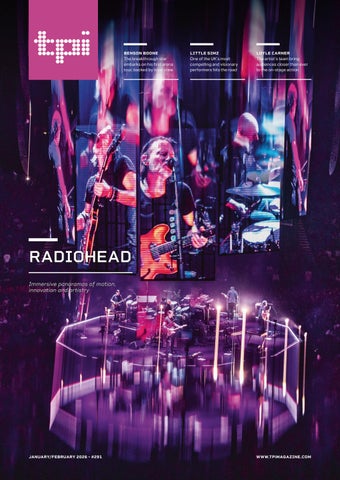
RADIOHEAD

Immersive panoramas of motion, innovation and artistry

BENSON BOONE
loyal crew
LITTLE SIMZ
LOYLE CARNER

Create curved truss systems without extra components.

Leave mounted video modules in the truss during transportation.

Mount lighting equipment at the transition between two trusses.

Extremly extensive structural analysis.

EagleStrike was born from a bespoke request for a signature luminaire. It stands as the first LED-source followspot in Ayrton’s range, engineered for intensive outdoor use across long distances where precision is paramount. To create this uncompromising and unmatched extreme-luminaire, Ayrton developed an oversized 270 mm front lens that delivers a record-breaking illuminance of over 100,000 lux at 10 metres, with the beam narrowed to just 2.9°.

Illuminance at 10m > 100,000 lx

Zoom Aperture 2.9° to 43° Weight

Front Lens

YOU AND WHOSE ARMY?

Perhaps it’s too on the nose, but as I sit here writing this to Pink Floyd’s The Great Gig in the Sky, desperately trying to lock in and shake off the end-of-year rust, I’m reminded of the luxury of our jobs as roving reporters who get to go behind the scenes of some of the world’s best shows. Generally, when we arrive on site, a large portion of the hard work has already been done by the riggers, local crew, stagehands, truck drivers, and, of course, the touring crew.

We t hen spend the next few hours being whisked between departments to try and catch up with the crew members who are always polite and welcoming despite being interviewed while they are still focussing lights or doing a line check. What makes it into print is generally a summation of those stories. However, for every feature, countless individuals behind the scenes don’t make it to the final copy. Promoters, booking agents, warehouse technicians, office staff, wardrobe, the list goes on.

As always, we strive to make sure everyone is name-checked, but as the adage goes, ‘it takes an army’, and the ever-patient printers can only withstand so much ink. This isn’t a plea for forgiveness but an acknowledgement that we, as a magazine, can do better to share these invisible roles and among the long list of targets we set ourselves at TPi, this is one of them.

Don’t be a stranger. Our emails and phone lines are open, and unlike sound engineers, we welcome feedback.

If t his print edition of curated tales from the touring circuit is anything to go by, we are all set for a busy year ahead. Our cover story documents Radiohead’s record-breaking ‘in the round’ production, which, despite its scale and technical complexity and creative impressiveness, brings crowds closer than ever to a band who have

been away for seven years [p48]. Likewise, Loyle Carner’s latest live campaign provides that same level of intimacy, as Ali discovers [p42].

Worlds apart, stylistically, yet bonded by their ability to command arenas, and beyond, Little Simz [p62] and Benson Boone’s [p74] respective production crews put the naysayers professing a lack of headliners to bed. These stories, and the grand reveal of the TPi Awards shortlist [p24], signify a sector that enters the year not merely resilient, but creatively restless. See you on the road, ISE, or the TPi Awards...

Issue #291 January / February 2026

Managing Editor

Stew Hume Tel: +44 (0)161 476 8360

Mobile: +44 (0)7702 054344

Email: s.hume@mondiale.co.uk

Editor Jacob Waite

Tel: +44 (0)161 476 8360

Mobile: +44 (0)7592 679612

Email: j.waite@mondiale.co.uk

Assistant Editor

Alicia Pollitt

Tel: +44 (0)161 476 8360

Mobile: +44 (0)7508 441986

Email: a.pollitt@mondiale.co.uk

Commercial Director

Fran Begaj Tel: +44 (0)161 476 8360

Mobile: +44 (0)7852 336728

Email: f.begaj@mondiale.co.uk

Senior Account Manager

Matilda Matthews Tel: +44 (0)161 476 8360

Mobile: +44 (0)7413 555978

Email: m.matthews@mondiale.co.uk

Account Manager Tom Dyson Tel: +44 (0)161 476 8360 Mobile: +44 (0) 7306505230 Email: t.dyson@mondiale.co.uk

Account Manager Sophie Edwards Tel: +44 (0)161 476 8360 Email: s.edwards@mondiale.co.uk

Digital Content Manager James Robertson Tel: +44 (0)161 476 8360 Mobile: +44 (0)7725 475819 e-mail: j.robertson@mondiale.co.uk

Marketing and Events Manager Alice Clarke Tel: +44 (0)161 476 8360

Mobile: +44 (0)7752 392465

Email: a.clarke@mondiale.co.uk

Marketing and Events Assistant Charlie Moore Tel: +44 (0)161 476 8360

Email: c.moore@mondiale.co.uk

Editorial Director Peter Iantorno Tel: +44 (0)161 476 8360 Mobile: +44 (0)7763 233637 Email: p.iantorno@mondiale.co.uk

Chief Executive Justin Gawne Tel: +44 (0)161 476 8360 Mobile: +44 (0)7768 850767 Email: j.gawne@mondiale.co.uk

Accounts Lynette Levi / Sarah Miller: ar@mondiale.co.uk

Mondiale Group Chairman Damian Walsh

Graphic Design & Production

Dan Seaton: d.seaton@mondiale.co.uk

Jez Reid: j.reid@mondiale.co.uk

Cover Photo

Radiohead by Alex Lake

Printed By Buxton Press • www.buxpress.co.uk

Annual subscriptions (including P&P): £42 (UK), £60 (Europe), £78/$125 (RoW).

Subscription enquiries to: Subscriptions, Mondiale Media Limited, Strawberry Studios, Watson Square, Stockport, SK1 3AZ, UK. Tel: +44 (0)161 476 5580 Email: subscriptions@mondiale.co.uk www.tpimagazine.com www.tpiawards.com www.gtlsessions.com

Total Production International (TPi) is a controlled circulation magazine, published six times a year by Mondiale Technology Media Limited under licence. ISSN 1461-3786

Access our complete range of globally available professional AV equipment and request your rental quote online.

Stay up to date with the latest innovations and product r releases from our partner brands.

ON THE COVER

RADIOHEAD

The band and their touring team transform arenas across Europe into immersive panoramas of motion, innovation and artistry, breaking attendance records along the way.

EVENT FOCUS

12 Busted and McFly face off amid a nostalgic co-headline tour. 18 Ed Warren creates an ‘impossible’ line of light for Four Tet.

An AeroAVA drone show lights up Royal Edinburgh Military Tattoo.

ER Productions joins Parkway Drive’s 20-year celebrations. 38 MOTOR Stage Automation powers Sabaton’s latest live show. PRODUCTION PROFILE 42 LOYLE CARNER

The artist, his crew and technical suppliers bring audiences closer than ever to the action. 62 LITTLE SIMZ

One of the UK’s most compelling and visionary performers hits arenas with her team in tow.

74 BENSON BOONE

With an exuberant production and performance, the artist embarks on his first arena tour.

INTERVIEW

88 Jaakko Kaivonen takes on the role of CEO at d&b group.

92 Funktion-One showcases the next evolution of sound solutions.

96 Spartan Crew reflects on the pursuit for reliable crewing.

IN PROFILE

100 TRUCKINGBY celebrates 50 years of business.

106 TPi visits Dutch Barrier Services’ Netherlands HQ.

PRODUCTION FUTURES

112 Celebrating 2025’s Breakthrough Talent Award winners.

GEAR HEADS

114 Matrox Video releases the ConvertIP Series.

FEEDBACK

116 Matt Wright highlights the minds behind live event logistics.

118 TPi heads across the Atlantic for THE Conference: Live at Lititz.

122 PSA amplifies crew welfare resources to normalise support.

BACK CHAT

126 Chance Stahlhut shares Concert Stuff Group’s mission to foster a culture of collaboration.

ISE 2026

Fira de Barcelona I Gran Via I 3 - 6 February 2026

The world-renowned annual tech show is back. At our last edition, 20,495 leading Venues & Live Events affiliated professionals joined us for a taste of state-of-the-art industry tech. This year, that number’s set to grow as we Push Beyond.

So don’t miss seeing, hearing and feeling it first. Test what’s next – and what’s possible – in the world of Venues & Live Events.

GET YOUR FREE TICKET

Register with code: tpimagazine at iseurope.org

BUSTED VS MCFLY

With creative direction inspired by the world of wrestling, the two bands face off in a nostalgia-fuelled co-headline tour.

Words: Stew Hume

Photos: Dylan Swann and Fran Parry

Since forming in the early 2000s, the stories of Busted and McFly have always been interwoven. From the days of Popworld’s Simon Amstell joking that they were so similar, to the later years when the shared camaraderie of the groups was seen as they toured together under the moniker of McBusted. However, for some time behind the scenes, a plan was put in place to create a tour that would pit the two bands against each other for the ultimate co-headline tour.

The difference between B usted vs McFly compared to many other co-headline tours is that instead of flip-flopping w ho headlined each night, t he t wo bands created a t ruly shared performance w ith several face-offs’ and collaborations throughout.

W ith t he show overseen by Production

Manager, Iain W hitehead of Production North and creative direction courtesy of David Spearing, t he resulting t wo-month tour, comprising 35 shows, ended up being t he biggest arena tour of t he UK in 2025.

Greeting TPi at FOH in Manchester’s Coop Live, Lighting Designer, Sam Parry – w ho oversaw t he v isual dialogue for both acts –walked t hrough t he creative process for t he tour. T he LD had crossed paths w ith both

bands, having worked for McFly for several years w hile working for Busted f rontman Charlie Simpson’s other band, Fightstar, during an OVO Wembley A rena performance. The Fightstar show led to a positive relationship with Charlie and w hen t his tour began to t ake shape t he creative consultants were happy to have me look after both acts,” Parry explained. A lthough many departments including backline and audio were split for both bands, Parry and his v ideo counterpart, Media Server Operator, T homas Hunter, acted as a creative throughline. We had a long lead-time into t his show,” explained Parry. “ I still approached t he projects as if I was designing for t wo bands and early on, we k new w hat t he overall look for the stage would be w ith t he massive monolith diamond shape above t he band.” To ensure t hat both bands were still able to have t heir own looks during t heir t ime on st age, versatility in t he fi xtures on t he r ig was at t he top of Parry’s list. V ia t he tour’s lighting, video and automation supplier PRG, t he lighting department deployed many Ayrton fi xtures including 100 Zonda 9s, 52 Veloce Profiles and 14 Perseo Profiles. “ I t hink we managed to achieve different looks for both bands t hanks to how much choice we had w ith t he colour

spectrum we had f rom t he fi xtures we chose,” commented t he LD. “ The 100 Zonda 9s are up in t he grid on t he four pods and hats off to t he team at A mbersphere for helping us source so many.” He f urther praised t he “incredible” Veloces. “ It’s almost upsetting as t here is nothing to criticise,” he chuckled.

The LD selected 34 “uber-punchy” ROXX Lighting Clusters. “ They are not ‘actual’ blinders, w hich means we are not pulling a lot of dimmers around w ith us,” stated Parry.

In addition were 14 GLP JDC Burst 1 strobes and 14 impression X5 units. Lining t he stage were 20 ACME PIXEL LINE IP striplights. “ The PIXEL LINE has been everywhere over festival season. T hey look incredible and are not too heavy, making t hem very versatile.”

For key light, Parry used seven Robe iFORTE LT X w ith PRG’s G roundControl FollowSpot system. “ I didn’t k now we’d be able to use the G roundControl for t he Robe fi xtures, but they’ve been great,” stated Parry.

T he production had seven stations, w ith one spare. Two of t he lighting crew worked t he spots for t wo of t he musicians w ho went into the audience during t he show, w ith t he other spots being looked after by some of t he tour’s dr ivers. “ The drivers have all done a great job

and they’ve really learned the show, which makes my job much easier,” he commented. On the topic of crew, the LD was keen to praise the work of his wider lighting team of Aidan McCabe, Adam Hodgson, Tom Begley and George Wilson. “They’ve all been wonderful. I also must give a shout out to our automation team of Ameer El Elryan and Toby Bale.”

The automation in question was a MOVEKET system that gave motion to the four independent square lighting pods, set as a diamond offset to mirror the stage below.

“T here is a lot going on up there and although I’ve used MOVEKET before, I never had the chance to push what it would really do,” commented Parry. He went on to point to his favourite looks, such as when McFly singer Danny Jones went right up to the audience and ‘commanded’ the whole rig with all the elements closing right in on the performance. “It was like he was using the force,” he said. As well as its technical capability, he also enjoyed the back-end software options of MOVEKET. “The software does all the calculations for the loads on each point and gives me a technical previsualisation to show me the gradient and angle relating to those hoists before anything even moves. I can just say what I want the pods to look like, and the software calculates the weights, angles and speeds, which is much easier to work with.”

For control, the LD used MA Lighting grandMA3. “We have two full sizes and a light out with us. The two mains have been from PRG and they have been rock solid. I was thrown into the deep end when I moved onto the MA in 2023 for a McFly tour, but both the software and hardware have been very good.”

To close, Parry gave his thoughts on supplier PRG and its contribution to the project: “We opted to go with PRG as our supplier because they had what I wanted with people that I knew. We’ve had a good relationship for several years and my experience has always been positive. Working with Steve Major and Yvonne Donnelly Smith especially has been great. They deliver what I want every single time I ask for it.”

PARTNER IN CRIME

Sat to the right of Parry at FOH was Thomas Hunter, Media Server Operator and overseer of all the screen content on both the rear wall and the large banner screens. “I’ve worked on a variety of jobs for PRG, but Disguise is not usually my world,” admitted Hunter, who had to learn the entire Disguise system and workflow ahead of this tour. “It’s been fun to see some of the ways it works. The media distribution has been particularly interesting.”

Hunter had roughly a terabyte of video files on one machine, which due to its internal

distribution system is then manually backed up. Alongside the two Disguise GX3 machines, Hunter utilised Notch to varying degrees for both bands.

“For McFly, a lot of the Notch effects are quite subtle such as a bit of smoke on the image, but for Busted, there are some more prominent Notch looks including background removal and edge detection that are used to create the ‘punky’ block colour look graphics.”

The rear LED wall was made up of INFiLED AR5.9 with NovaStar MX40 processors. The flown banner LED was made up of ROE Visual Vanish 8T using ROE’s EV4 processors.

“One of my favourite looks for the show happens during the song What Happened to Your Band,” continued Huner. “All the musicians come up on lifts and we use the LED almost like a lighting effect, which provides a silhouette of all the guys on stage. What’s great is that you really can’t capture it on a camera – believe me I’ve tried – which means it’s an experience just for those in the crowd.”

For almost all the bands’ sets, the visual teams took cues from timecode, bar a few songs in McFly’s set – Five Colours in Her Hair and It’s All About You. “They have never played to timecode on those songs,” interjected Parry, explaining that they always want to play them at the pace they are feeling that night. That means it was all hands-on deck for the lighting

designer and the media server operator. Video Director, Chris Keating ensured each element was captured for the IMAG. “It’s been a fantastic tour to be involved with,” stated Keating. “It’s a great crew and it’s good to work with Iain Whitehead again who I’ve known since 1999.”

From t he first moments he s aw t he renderings of t he set, Keating knew it was going to be a good show. “The set is quite unconventional and adds an extra layer to the camera shots. It’s a strong visual presentation with the large upstage screen, two portrait IMAG screens and the four-sided overhead banner screen.”

In total there were seven cameras deployed, including two long lenses at FOH and two cameras on track in the pit.

“It’s a busy, high-energy show, with lots for the camera guys and myself to play with,” stated Keating. “There’s been a good cohesion between the various visual elements of the show, with lights, video content and cameras. It all makes for a great-looking show.”

Aiding Keating and Hunter in the video department were Video Crew Chief, Steve Jones alongside Brad Baker, Chris Hobson, Matt Heitman, JJ Mikinzi and Gavin Brunton.

Closing out the extensive 35-date run at the start of November, Busted vs McFly set the bar for other 2000s nostalgic acts looking to also head out on the road and prove that despite their heritage, productions such as these can still push modern technical innovation. www.busted.komi.io www.mcfly.com www.prodnorth.com www.prg.com

FOUR TET LIVE AT ALLY PALLY

Production and Lighting Designer Ed Warren masters multi-fixture geometry, creating an ‘impossible’ line of light supported by Lights Control Rigging for Four Tet at London’s Alexandra Palace...

Words: Jacob Waite

Photos: Luke Dyson

When pioneering electronic artist Four Tet returned to Alexandra Palace’s Great Hall, the brief was as deceptively simple as it was ambitious: create a vast, communal dancefloor experience anchored not by a performer, but by light, geometry and feeling. For award-winning Production and Lighting Designer Ed Warren, the challenge was irresistible, as TPi discovers.

A long-time collaborator, Warren has worked with Four Tet’s Kieran Hebden for 17 years, and that history shapes every iteration of the project. He designed the entire room concept and layout, programmed the artist’s latest show’s, and operated the lighting live, busking.

“T he core principle has always been that the dancefloor is the focal point, not Kieran onstage,” he explained. “The aim is for everyone, wherever they stand, to feel fully immersed in the experience.”

Sc aling up to Ally Pally, and to arena-size rooms beyond, required a fresh architectural gesture. Warren found it in what would

become the show’s defining feature: a single, uninterrupted axis of light. “When we learned we were scaling up, I knew I wanted a continuous line of light running down the centre of the room,” he recalled. “The first question was: ‘How long can we physically make this?’ Once that was established, the geometry of the entire show grew from that single decision.”

The result was a 58m line of CHAUVET Professional COLORado PXL Curve 12s, suspended on Kinesys and capable of descending to just above the audience’s heads or tilting into angled formations. “It shrinks an enormous arena into something that feels intimate, like the small clubs where Kieran first started DJing,” Warren noted.

Each PXL Curve houses 12 individually tilting pixels, giving nearly 700 controllable points in a perfectly straight line. “I spent a long time experimenting with effects across that array,” he said. “During the previsualisation stage, the results looked almost impossible, and they were even better. At times, it became

this slow, ominous sheet of bending light; at others, a room-filling rainbow broken into hundreds of moving pieces. It suited my love of symmetry and geometry perfectly.”

Some of the show’s most striking moments came from just two fixtures. “We drop two Ayrton Kyalami into the centre of the room, just above head height,” Warren noted. “With a single rotating beam each, they create a rotorblade effect overhead that slowly accelerates with the music. For nearly ten minutes the room runs on just those two fixtures. In a 10,000-capacity production, that kind of restraint is incredibly powerful.”

Supporting the central truss are four straight runs loaded with Ayrton Rivales and GLP JDC1s, simple tools deployed with precision. “Often the simplest looks were the most effective. A single bounce-dimmer chase running the length of the JDC1s could transform the space. Simplicity is always the guiding principle, especially as we deliberately avoid video content.”

Control for all of this comes from Warren’s own ChamSys MQ500M Stadium Console, the same surfaces he uses in his studio. “They are perfect for a busked show of this scale,” Warren said. “They let me build and manipulate multiple effect types across whichever fixtures I select, quickly and flexibly. I busked a four-hour show with almost 200 fixtures from a single page of faders and buttons.”

Lights Control Rigging (LCR) supplied all lighting and handled the rigging advances, including coordination with audio. “I work directly with LCR Senior Account Manager, Rob Watson, who brings a huge amount of care, detail, and consistency to every project. From prep to plots to onsite support, the whole team is solid – reliable gear, meticulous work, and a genuinely collaborative attitude,” Warren said.

Having first worked with Production Manager Matt Barker and the Four Tet team at Glastonbury Festival, Watson, alongside LCR Project Manager Sam Dilworth, LCR Crew Chief Gaz Horridge, Lighting Technicians Richard Griffin, Ashley Tutt, Ben Webster, Rich Hoxley,

Jon Barlow and Dan Turner, Kinesys Operator Tom Darby and Production Rigger Zack Wade, oversaw the deployment of five static trusses and one Kinesys truss, each measuring 60m, as well as 48 rigging points for the audio infrastructure and cable management.

KB Event supplied four 45ft Megacube trucks, steered by long-time drivers Ian Botham, Marcus Baugh, Steve Parks, Alister Stone and Mike McCord.

“We evaluated fixture types to make the logistics feasible. It all loaded in on the same day as the first show, four and a half trucks’ worth of LCR gear, on what was essentially an in-show day with no production rehearsals,” Watson recalled, speaking to TPi following a recordbreaking 2025.

The project’s primary challenges, as ever, were time and the sheer volume of infrastructure required: five, 60m of lighting truss alone, 10 cable bridges for lighting and four for audio. Three trucks’ worth of truss were stacked and transported ready to be rolled out. On site, the team ensured perfect symmetry among the

Production and Lighting Designer, Ed Warren ‘busks’ the show using a ChamSys MQ500M Stadium Console.

210 mm x 150mm W x

Production manager: Matt Barker

Lighting Design: Ed Warren

Proud to light Alexandra Palace for Music Producer & DJ Four Tet
PHOTO: luke dyson

lighting fixtures using laser measurements.

“It was a challenging feat, but the result made it all worthwhile. We love working with Ed Warren, he is a lovely human being, flexible yet someone who knows exactly what he wants,” Watson said, emphasising that collaboration was fundamental to the project’s success.

“Every department had to liaise and work together to deliver this show.”

With no support act, Warren used GLP JDC1s to create a warm white palette that could easily be mistaken for house lights. Dynamic lighting looks were introduced slowly, and at 8.30pm the first Kinesys move took place. All the data in the dimmer areas were driven by Luminex. The wider rig incorporated 1,250kg and 500kg hoists as part of a Kinesys Apex automation system.

“Seeing the audience realise that a truss was moving above their heads out of nowhere was a special moment,” Watson said. “It is a greatlooking show, nothing is overdone. There is a moment where a small truss in the middle of the room, with two Ayrton Kyalami on it, drops in

for one song, does a clockwork spin, then rises again. There was a surprisingly diverse range of looks, despite it being a busked show.”

The main challenge for Warren was rigging above a densely packed dancefloor. “Every cable bridge and drop had to be extremely discreet and clean. Beyond that, the rig itself is deceptively simple: five straight trusses. The real challenge was using that minimal geometry to create a show that stayed varied, coherent and uncluttered over four hours.”

Among his favourite moments is one that happened almost by accident. “I was splitting the PXL Curve pixels into symmetrical, morphing shapes while running a full-length rainbow chase across them,” he said. “It was entirely busked, but it created a moment of pure visual magic.”

And, of course, the rotor-blade sequence remains a personal highlight.

“T he slow build, the restraint, and then the release when the full show comes back in… it hits hard every time,” he added. “For a production of this scale to rely on two small

fixtures for that long, that contrast is exactly what makes it so powerful.”

Reflecting on nearly two decades with Hebden, Warren is clear about why this partnership continues to evolve.

“Working with Kieran for so many years says everything,” he said. “He trusts my instincts completely and gives me the freedom to experiment, while also pushing me to challenge expectations of what a show should look like. There is no ego, no compromise, just a shared commitment to making the experience better every time.”

According to the production and lighting designer, the shows journey is far from over. “The show will continue to develop; every iteration teaches us something new,” Warren revealed. “We are only just getting started…” www.fourtet.net www.edwarren.org www.kbevent.com www.lcr-rental.com www.chamsyslighting.com

THE ROYAL EDINBURGH MILITARY TATTOO

AeroAVA drones take centre stage amid the 75th anniversary of The Royal Edinburgh Military Tattoo. Back on the ground, the team shares the hoops it must fly through to make such an event happen.

There’s no doubt that drones had a greater presence within the live events landscape in the UK throughout 2025. Whether it was hailing the coming of Oasis to stadiums across the country or their multiple appearances at festival grounds throughout the summer, it seems more creatives are looking to extend their visual canvas into the sky. Another famed event that sought aeronautical excellence in ’25 was the Royal Edinburgh Military Tattoo, with organisers bringing in AeroAVA to add drones into the wider creative conversation.

Discussing the company’s involvement with the project was Tom Rees, Managing Director of AeroAVA. Having first discussed the event challenges with Harry Guthrie, Production Director of the Tattoo, at the PLASA show in 2024, the seed was planted that drones could reliably and safely play a part in the production’s 75th anniversary, with AeroAVA Technical Director, Chris Bradbury, starting to plan site visits in the first part of the year. “We wanted to deliver not only something unique for the show, but also give something to the whole city as part of Edinburgh’s 900-year celebrations,” noted Guthrie. “The Tattoo is a unique event with unpredictable weather conditions, and has a daily audience of 9,000. Everything must work perfectly every single night. AeroAVA truly went above and beyond to ensure this exceptional collaboration went ahead.”

“A big part of this project was a close collaboration with Historic Environment Scotland as well as the ASSU [Aviation Safety and Security Unit within Police Scotland],” explained Rees, who stated that cooperation was vital both in the build-up, rehearsals and during the shows where planned flights took

place. “We were in regular contact with all stakeholders throughout the show evolution process, coordinating with the Police when necessary and even had to cancel a small number of shows due to Storm Floris. In fact, one day the entire castle was closed due to the storm, the first time a Tattoo show didn’t happen in 75 years,” explained Rees, highlighting the importance of flying safely and planning for every eventuality.

On t hat note, one reason why the MD explained AeroAVA presented a good use case for the organisers was the company’s 2:1 separation to audiences. “Up to 50m of flight height, there is a rule of a minimum 50m separation from the audience. For most other drone companies, every extra metre above this height usually means that the crowd also needs to be an extra metre away. But due to our flight analysis and safety systems, we’ve proven a safe separation that works on a 2:1 ratio, meaning drones can fly in closer proximity and as high as 180m.”

Rees emphasised that his company’s involvement with the Tattoo was not to provide a stand-alone drone show, but to complement the overall production. The show featured 100 drones revealing the number “75”, 150m above the Edinburgh Castle Esplanade, synchronised with cast cues, sound and pyrotechnics for full audience engagement. Beginning with a young female piper pointing an illuminated torch skyward, the drones responded by revealing the anniversary motif, then rotating 360 degrees so the entire city could witness this historic milestone for the event.

Additional sequences throughout the display honoured military heritage and Scottish identity

Words: Stew Hume
Photos: AeroAVA
The AeroAVA team on site amid the 75th edition of The Royal Edinburgh Military Tattoo.

through 2D and 3D formations and lighting animations depicting military symbols, the Victoria Cross, musical representations, and Scottish symbolism, including a striking thistle formation representing how Scottish values spread across the world. Each look was designed and sequenced to timecode in line with all the other production departments.

Due to the special aviation clearances issued by the Police Air Safety and Security team, AeroAVA was able to provide two other elements within the overall production. The first was a stand-alone SFX moment separate from the swarm of 100 drones. Nicknamed ‘Tinkerbell’, the company provided a customised drone, with a specialist pilot, that acted as a ball of light, which the narrator of the show appeared to magically conjure up in his hands before soaring skyward.

“We also provided aerial filming services for the BBC broadcast of the event,” stated Rees, explaining the multiple solutions he and his team could provide for the overall project. “While drone display technology is evolving fast, our approach is focused on combining flight resilience, safety and creative boundary pushing,” mused Rees as he and the team look to the future of drone technology and its place within the wider events space. “These drone displays and effects serve the story, not the other way around, and our job is to deliver them to be efficient, reliable and creative. At AeroAVA, we’re also looking at the future of integrating digital technology, how it is evolving across the board with all different kinds of interactions, and what really excites me is what a drone show will look like in two to five years.”

www.edintattoo.co.uk

www.aeroava.com

PARKWAY DRIVE: 20TH ANNIVERSARY TOUR

To celebrate two decades of the Australian metal act’s live shows, the band’s creative team enlists ER Productions to create a jaw-dropping show with pyrotechnics and special effects aplenty…

Parkway Drive have long been a mainstay of the alternative music zeitgeist, steadily elevating their production values and becoming certified headliners across festivals and arenas worldwide. For their latest anniversary tour, the Aussie metal group pushed their stage show to new heights, deploying an eye-watering level of pyrotechnics and special effects.

Clips quickly went viral on social media including one moment where pyrotechnics were fired from an automated bridge above the audience while the entire stage was engulfed in flame, firmly capturing the attention of fans and industry professionals alike. With the tour coming to an end, TPi jumped on a call with ER Productions to learn how a show with this much firepower comes together. “We were approached last summer to work on the Australian leg,” began ER’s Dan Mott.

ER Productions had worked with the band previously as well as collaborating with the band’s Creative Designer, Sam Tozer on several occasions. “Ben Fenwick, the band’s Production Manager, flew to the UK from Australia for a creative meeting that helped set

the vision for the tour,” explained Mott, who got to show Fenwick several of the company’s new products, which included FABER Engineering’s new FlamebER.

With the tour kicking off in Australia, ER’s relatively new outpost in the country handled the first iteration of the production. “We only opened our Australian office a few years ago so it was great to bring out a show of this scale from that base,” mused Mott, also commending the work of the entire team making some of the looks achieved possible despite Australia’s stringent health and safety measures.

The road team comprised Michael Morey, Tom Freeman, Matthew Marwick, Ron Spizak, Jay Scrivener and Sam Wakerley. For the UK and European run, Freeman and Marwick stayed on and were joined by Dan Wilce, Michael Attkinson, Gary Sharpe, Paolo Roselli, Eden Mclachlan and Sam Batchelor. “We had six crew out on the road at one time, as well as an arctic worth of equipment,” stated Mott, praising Project Manager, Nina Clements. “Project Managers are often not mentioned but she did a great job,” stated Mott. Despite some slight alterations, the Australian and European

shows were very similar with ER providing 80 FlamebERs – a solution created by ER Productions’ FABER Engineering division – 40 G-Flames, 14 Liquid Flames, six Stadium Shots, seven Luminous Hydrotech heads and eight Eco2Jets. ER Productions also provided Low Fog, with effects controlled by Galaxis software and an MA Lighting control surface.

Freeman, one of the key players of the SFX team on the road, walked through how all the looks were choreographed: “It’s a collaborative process between artist, production and ER. Together we design pyro effects and moments that match artist expectations, to fit in the venues and around other supplier equipment, all while being able to fire safely. When all of this comes together in rehearsals, we check that there are no surprises or changes, and that it all will work as planned.”

With the looks set, the team began programming all the pyro cues that created the best visual impact. “We’ll do a couple of band rehearsals without pyro and SFX, so we can see where the band will be at the specific moments. Once we’re happy, we’ll do flame and pyro commissioning for ourselves with a closed

Words: Stew Hume
Photos: @thirdeyevisuals

stage – only us on stage with our air guitars – to test each individual unit and its direction of effect before putting the band up there for a ‘hot’ rehearsal.”

Freeman stated that it was great working with such a seasoned band that had played their material for many years and knew exactly where to be on stage “and more importantly where not to be,” he said. “There were 77 individual flame fixtures and 20 pyro positions on the stage, most of which were active at the busiest points of the show! There really were only four places on stage that weren’t on fire, and we had a band member in each. Knowing the guys were going to be in the right place was a huge help.”

As w ill come as no surprise, safety was paramount, with ER deploying a comprehensive package of safeties and E-stops, both at control and at various points around the stage. “Come show time, the audience see a show that hopefully made some memorable moments for the fans, whilst keeping the band safely performing amongst the effects and pyro night after night,” he stated.

For one notable moment during the show, lead singer Winston McCall was elevated high above the crowd on a bridge and then, when it was at a set height, flames shot horizontally above the crowd. For this moment the team taught McCall specific signals that he would give if he was not happy, so they could stop the effects.

Mott highlighted other safety measures incorporated in the package: “We had the Magic FX Safety Arm System on all our flames,” he said. “It’s relatively new and gives operators the ability to have remote E-stops on specific

Open the Trade Expressway. GETshow helps you, Easily expand into the international market. Zone

We cordially invite you to visit and purchase professional lighting and audio systems in Guangzhou,China

Welcome to contact and register for exhibition services!

Booth consultation : Ms.Tina :+86 18138780160

URL: https://www.getshow.com.cn/ E-mail: info@getshow.com.cn

Flame Projector G-Flame

bi-directional

Highlights of the Flame Projector "G-Flame":

•A range of control options including DMX512, 12-24V, ext. contact, radio and RS-485 offer unparalleled versatility

•The internal fitted battery provides up to 110 h stand-by time with no tethered power cables giving greater portability

•Water resistant, with improved water drain system

•Operation with readily available and inexpensive gas canisters, aerosol canisters or gas cylinders possible

•Fuel canisters are completely encased in the housing and therefore well protected

•Canister holder fitted with non-return valves for additional safety

•All components are equipped with quick-couplers for fast assembly

•Independent operation when used with the optional Advanced radio module or wireless DMX receivers

•Integrated fine filter prevents particle ingress and leakage of solenoid valves

•Equipped with two solenoid valves connected in line for increased safety

•Electronic flame monitoring by means of a highly selective optical sensor

•Equipped with digital tilt sensor for maximum safety

•Bi-directional communication with the PFC Advanced controller and USB Radio Modem PFM Advanced for remote programming and remote data requests

•Prepared for quick mounting on stands and truss elements

•Illuminated text display with convenient menu navigation

•Optical warning when armed

•Delayed ignition after gas release programmable (Atomic Effect)

•Fast step sequences possible because the flame extinguishes within a short time of solenoid valve closure, even during canister operation

•Additional features: Flame quota, flame duration limit and optional sleep mode

Flame Comparison:

Control Inputs:

•Radio: -

-

•External

•Voltage

•DMX512,

G-Flame with 5 kg gas cylinder, liquid phase (dip tube)
G-Flame with four gas cartridges, "Power Upgrade"
G-Flame with two gas cartridges
G-Flame

fixtures as well as a warming system when it is about to fire.” He further explained that the E-stop allowed operators to disarm the fixture without it powering down. The protocol also means that a spotter can shut down a specific fixture without losing all the effects in the show.

Mott highlighted the use of timecode to fire the show: “It was a necessity as there were simply too many effects to busk. With the effect firing via timecode, it also meant the team are

just focussing on the safety, both with the Magic FX Arm system as well as a DMX safety via the faders on the console.”

He closed by stating that setups like the one deployed on Parkway Drive really showcase the maturity of the industry. “We’ve been using timecode to launch effects for around 10 years but these days it’s becoming the go-to rather than busking. It also requires a different set of skills as an operator. Before we were always

looking for people with musical timing but now there is a far bigger focus on the programming side,” Mott added. “It was a pleasure working with the entire team. It was such a unique show, and incredibly exciting to collaborate with an iconic Australian band – first through our Australian office, and then by supporting the same tour and design from our UK office.” www.parkwaydriverock.com www.er-productions.com

A True Workhorse Long-throw Luminaire

No compromise IP65/66 high-output low footprint

LED WashBeam and FollowSpot

Discover more

SABATON: THE LEGENDARY TOUR

Castles, catwalks and control: MOTOR Stage Automation helps power Sabaton’s latest live offering…

Sabaton and their 200-strong touring crew have announced themselves on the European arena circuit with a production that matches the Swedish power metal band’s reputation for theatrical, history-infused live performances. Their latest touring design features a towering castle, a support orchestra, an automated drawbridge with integrated lighting and smoke, a rising and descending drum riser encased by inflatable hands, and fire-breathing dragons – an ambitious brief which required equally ambitious engineering.

MOTOR Stage Automation, based in Denmark, began its relationship with Sabaton a year ago, flying a tank set piece during the band’s set at Sweden Rock Festival in front of 60,000 fans. Drummer Hannes Van Dahl performed inside the tank itself. “A strange request, but one we certainly rose to,” recalled Jimmy Johnson, Automation Project Manager for The Legendary Tour and Technical Sales at MOTOR Stage Automation.

Production Manager, Johan Bengs wanted a system that was quick, safe and efficient –not only to meet tight show-call demands, but to give the crew adequate rest on an intense touring schedule. The band, known for spending time among their fans, also required a stage architecture that let them physically connect

with the audience. “The best way to do that was to utilise our automation solutions and integrate them fully into the show,” said Jimmy.

Central to this was MOTOR Stage’s M:CAT automated catwalk, which would become a defining element of the tour. Early conceptual meetings saw MOTOR Stage sharing Vectorworks drawings and product catalogues with the band and creative team, among them bassist, band manager and co-designer, Pär Sundström and Lighting Designer, Bertil Mark.

“T he aim was to achieve their vision – the castle, the inflatable hands, the drawbridge, while guaranteeing the level of safety essential for any automated system,” Jimmy explained.

Af ter initial prep at MOTOR Stage HQ in Horsens, Denmark, production rehearsals continued for two weeks at BBM Clair in Berlin.

The design was informed by available inventory – including a 70m cable limit for floorbased drive racks, which set strict parameters for positioning the B-stage and the connection to the main stage. “This is one of the band’s largest shows to date, and their fanbase has grown accordingly. Everything needed to scale up safely,” Jimmy added.

Safety was overseen by Blumano Associates, brought in as specialist consultants. “There are a lot of ‘what if’

questions, from engineering to working at height,” Jimmy said. “If we can remove doubt for the artists, that’s when they can truly perform.”

For the drum riser, Hannes was secured in a restraint harness, with eight RCF Light Locks, some double-stacked, sub-hired from Neg Earth Lights to prevent platform drift.

A deadlock system ensured the riser could not move unless Hannes was fully strapped in. Integrated lighting within the MLT4 system was installed via MOTOR Stage’s sister company Vigsø, with wiring by PRG as part of their master rig. The truss and catwalk were fully pre-rigged, supported by collaboration with HOF, who helped further develop the M:CAT system.

Their dollies allowed the MLT4 elements to be sent quickly into the rig “much like you would approach with lighting,” said Jimmy.

The smooth integration of automation, rigging and lighting impressed him most: “Head Rigger Yose Lawson worked closely with UK Rigging to ensure clear paths and safe working zones. Service hoists meant we could fix issues without climbing.”

IN MOTION

As Automation Programmer and Operator, Kentaro ‘Ken’ Johnson ensured the full automation package operated seamlessly on

Words: Jacob Waite
Photos: TPi

site, as part a team of four overseeing 14 hoists on the catwalk leading to the B-stage, plus four 1250kg units on the drum riser – each hung on two separate mother grids built from MLT4 truss. One grid sat above the lighting, the other extended above the audience to the B-stage.

MOTOR Stage Automation deployed a full MOVEKET system with dual Expert desks (primary and backup) and an automation barge housing all drives and low-voltage motor control in the grid. “Load-in and load-out is straightforward,” Ken explained. “Two caddies of cables come straight out and into the roof –we’re live within half an hour of powering on. It’s a very efficient system.”

MOVEKET was chosen for its suitability over audiences and its compliance with EN 17206. “Each hoist has its own configured drive. Once set in prep, it stays consistent throughout the tour,” Ken said.

With over a decade’s rigging experience, he stressed the value of load understanding: “We’re moving a lot of weight – the drum platform is just over two tonnes with pyro and lighting; the bridge is just over five tonnes; and around eight

tonnes including hoists and catwalk suspended from the mother grid.”

MOVEKET’s SIL3 rating was a key factor. “All the technology talks to each other – load monitoring, fault reporting, global E-stops, deadman switches on everything. The data feedback gives the operator real confidence,” Ken added.

Additional safety layers were built in, including an isolation switch for the drum riser. “If a spotter or drum tech isn’t happy, they can isolate the riser instantly. It cannot be controlled until it’s safe.”

Two mechanical constructs defined the show’s automation: the drum platform and the main drawbridge leading to the B-stage. The riser moved between load-in height and balcony level – Hannes mounts at the mid-position before ascending to full height, performed twice during the set. The drawbridge is the show’s signature moment, used for band entrances and audience interaction. “It’s a very theatrical show, so actors distract the crowd during movements,” Ken said. During Attack of the Dead Men, smoke machines under the catwalk

KINETIC ENTERTAINMENT TECHNOLOGIES

activate as the bridge lowers over the audience. “Automation becomes part of the storytelling, not just a transport mechanism.”

The 24m catwalk and 30m bridge (28m with stairs deployed) run on a combination of 1250kg and 500kg hoists.“MOVEKET treats the whole thing as one object, providing synchronised movement. If any error is detected, the entire construct stops – ideal from a safety perspective,” Ken noted.

Touring with 42 stagehands – trained during rehearsals – brought consistency to daily workflows. With 26 trucks, including three dedicated to automation (one for the catwalk alone), the tour required tight scheduling. Advanced rigging meant hoists were hung before the touring crew arrived. “We start unloading at 9am and are fully assembled by midday. Automation rolls in ahead of lighting –the catwalk has integrated wheels, so it glides straight out,” Ken added.

“MOTOR Stage is brilliant,” he continued. “With a four-person automation crew, we can rotate and rest which makes an enormous difference.” The wider automation team featured MOTOR Stage Automation Project Manager, Jimmy Johnson; Operations Manager, Daniel

Klausen; Special Projects Engineer, Valdemar Enemark; Automation Crew Chief, Martin Kirch; Automation Programmers and Operators, Samuel ‘Sam’ Colclough and Kentaro ‘Ken’ Johnson as well as Automation and Performer Safety Technician, Gareth Sumnall.

Having wrapped projects with Dua Lipa in South America, Lewis Capaldi and now Sabaton, 2025 marked a landmark year for MOTOR Stage Automation. “Production managers and designers value a personal touch,” Jimmy concluded. “We’re a family-orientated company – from the office to the road. We’re excited to see the HOF MLT4 pushed to its limits. It’s fast, efficient, and made for this kind of show.”

Speaking to TPi backstage, Sabaton drummer, Hannes Van Dahl concluded: “This tour has been in the works for two years, and it takes a great deal of time to prepare and decide what we want to do. It’s been a long journey to get here but it’s been a blast – 200 people all working their asses off to deliver a truly great show. It’s a dream come true and we’re incredibly grateful for that.”

www.sabaton.net

www.motor-stage.com

www.moveket.de

Automation Project Manager, Jimmy Johnson of MOTOR Stage Automation with Automation and Performer Safety Technician, Gareth Sumnall, Automation Crew Chief, Martin Kirch and Automation Programmer and Operator, Kentaro ‘Ken’ Johnson on site at Manchester’s Co-op Live.

LOYLE CARNER: HOPEFULLY ! TOUR

The artist, his crew and technical suppliers bring audiences closer than ever to the on-stage action…

Words: Alicia Pollitt
Photos: Eljay Briss

Following one of this year’s most talked about Glastonbury Festival headline performances, Loyle Carner returned to the touring circuit with a live show stripped back in performance and production, which sees the same band involved in his most nuanced album yet take to the stage with him.

Meeting TPi at the stage door of the O2 Academy Brixton on the second day of Carner’s four-day residency at the venue was Production Manager, Eric Wade of EZ Services and Tour Manager, Chris Tyler. “The show is very dynamic, eye-catching and in tune with everything you would want in a performance. This is genuinely sonically and visually, one of the most accurate messages conveyed in a live show from concept to fruition that I’ve had the pleasure of working on,” Wade began.

Aiding the production manager on the road was Colour Sound Experiment (lighting), Britannia Row Productions (audio) and All Access Staging & Productions (staging).

“T hese suppliers are a ‘no-brainer’,” he explained. “Britannia Row has been a long-time ally of the camp and being able to lean on its global coverage has been beneficial. Colour Sound Experiment always looks after any production I’m involved in, from prep to the road. I have such a fondness for the team. I’ve collaborated with All Access for the past three years when it comes to staging and I don’t see any reason to change.”

Delving into the meetings before the tour began, Tyler explained that the line the team

worked toward was ‘big stage intimacy’. He elaborated: “We didn’t want the usual fanfare, and as we were working towards this huge headline on The Other Stage at Glastonbury, we also had the tour on our minds, but the idea was to invite fans into the warm, intimate world of his music.”

Having headlined OVO Arena Wembley on his last album cycle, the stripped-back attitude extended towards the venue choices for the hopefully ! tour, with the artist choosing to do multiple dates in smaller venues in each city instead, bringing him closer to audiences. “The team didn’t want the anonymity that comes with the bigger rooms for this record,” Tyler said. “Intimate has definitely been the word of the tour and has been the world we’ve been aiming for show on show.”

Wade echoed Tyler’s statement and described the benefit of walkaway shows for this specific production: “There is a comfort in being able to work the same schedule for a couple of days in each place, which has been great – the crew on this have been fantastic and steadfast in their dedication to the show,” he said. “They are continuously making the show better each day for the rooms that we’re in, they are always tweaking something and making the show a higher standard.”

For the tour and production management duo, the dynamic within the camp was a specific highlight. “We both attach a huge importance towards interpersonal dynamics. My company is called Golden Rule Production,

and the golden rule is: ‘Be nice’. We know touring is hard and stressful, so we’re trying to create a safe space where people can come to us if they need to,” Tyler explained.

Wade concurred: “It’s been a joy. This camp, this tour, is something precious I’m holding close to my heart and will do for a long time.”

FEEL AT HOME

With deep-seated closeness at the heart of the creative on the tour, Lighting Designer Will Reeve and Unlimited Dream Company (UDC)’s George Thomson worked hand in hand to convey the album’s feeling into a live show. “The creative for the hopefully ! tour is based right back to the beginning of the album creation process,” Thomson said. “Loyle Carner wanted to make a record with his live band, so they went into the studio and did it all together – it was important for him to show the audience how that experience felt for him and bring them into the ‘jamming’ process.”

Thomson utilised his foundations in architecture to convey that atmosphere on stage, beginning his design process through paintings and Photoshop which resulted in a band setup that gave each musician a view of each other, which echoed the album creation process. “We wanted everything to be restrained, stripped back and raw, just like the album,” Thomson explained. “The band looking at each other for the show makes it feel like more of a collective, it also means Avi [Aviram Barath, Musical Director] can act upon

opportune moments, and we get to see more improvisation from the band, which is great.”

Thomson and the team at UDC, with Glastonbury and the subsequent tour in mind, wanted to bring audiences into the same world but had the challenge of recreating the feeling for a field of 50,000 people compared to the venues, such as Brixton, with a 90% decrease in capacity. “We brought in a video package supplied by Vanta for Glastonbury, and they made a custom-fabricated mic stand camera for the occasion to bring people as close as possible,” Thomson explained. “But if we were to bring video into these venues, it would have the complete opposite effect and it was important to keep the core intimacy of the show.”

The lighting rig included CHAUVET Professional STRIKE Array 2, Color STRIKE M, COLORado PXL Bar 16 and COLORado Solo Bar 1; Ayrton Huracán LT and Rivale Profile; Robe iFORTE LTX; Martin MAC AURA XIP, and ARRI SkyPanel S60-C lighting solutions with a Smoke Factory Tour Hazer II providing atmospherics. Reeve cited the Martin MAC AURA XIP as the ‘workhorse’ fixture of the rig, situated on the overhead truss. ARRI SkyPanel S60-Cs also stood out to the designer, providing keylight. “We emphasised as little front light as possible on this show; we had the standard front and back spots, which we would utilise to silhouette him, and he was more than happy just to bask in that,” Reeve explained. “We had

to navigate when he did and didn’t want to be silhouetted and that’s just all down to watching his reactions on stage and knowing how to shine that the music stands for itself.”

Reeve utilised Syncronorm Depence software for previsualising the show, making the initial technical drawings using Vectorworks. On the road, Lighting Operators, Matt Davies or Johnny Myers conducted Reeve’s design from an MA Lighting grandMA2 console.

Reeve praised Colour Sound Experiment’s crew and support on the tour, both in the lead up and on the road: “It feels very full circle to have Colour Sound back on the gig, because they were with Loyle Carner when he was starting out and to have Alex Ryan to deal with directly has been such a treat; they have been attentive and on the ball.”

DESOLEIL (BRILLIANT CORNERS)

Musical Director, Aviram Barath, ensured the studio album’s sound translated live. “The aim is to bring the attitude of the album into the show by being as respectful as possible towards the decisions we made in the album process,” Barath said. “At the same time, we’re allowing enough space for real-time decisions and musicianship so the momentum remains.”

Intimacy, the word that reverberated through the camp, was also crucial to Barath’s process when working with Loyle Carner to portray the same dynamic in a live setting that was

Production Manager, Eric Wade; Tour Manager, Chris Tyler; Monitor Engineer, Matt Wickens; FOH Engineer, Jay Thomas Heigl; Unlimited Dream Company’s George Thomson and Musical Director, Aviram Barath.

TheTRUe PROFILE

All the features you ever dreamed of – in one unit.

TheTRUe INDOOR FIXTURE

Lightweight and Compact. No compromises.

TheTRUe

HIGH CRI UNIT

No filters. No LED changes. Always accurate.

TheTRUe WASH

No filters. Just a real Fresnel or PC lens.

TheTRUe OUTDOOR FIXTURE

IP54 rated. Built for the real world.

TheTRUe

HIGH OUTPUT UNIT

Over 20,000 lumensVariable CRI up to 93.

cultivated between the band in the studio. “Ben didn’t want to be in front with a faceless band; it’s more that the stage is now a group of friends who have created lots of music together, and we’re inviting them to come along with us,” Barath explained.

“We’re enjoying ourselves in the hope that other people can come enjoy it, too,” he added. “Verbal language has its limitations. Whenever we try to describe music, it always feels a bit stupid or reductive, but with this show, Loyle Carner has surrounded himself with people who he has an ongoing musical communication with – we don’t have to talk much but we’re closer to the vision.”

FOH Engineer, Jay Thomas Heigl mixed on a Solid State Logic L550 console with Universal Audio Live Racks, Waves Audio servers and a Pro Tools Saramonic SmartRig+. “I’ve been using SSL for years; I originally moved over to see if I could get a better quality from the preamps. When we were working on Loyle Carner’s Royal Albert Hall show a couple of years back I was working with 64 Neve 1073 DPX Dual Preamps, and I was blown away by the quality I was getting into the desk and I wanted to see if I could replicate that quality and make it tourable, and SSL was the route I took.”

For Heigl, energy was paramount: “Ben is moving in a different space right now, and the

difficulty for me was bridging the gap between what we have been doing in the previous campaign and trying to find the nuance in between,” he commented. “I’m focussing on musicality and colour, whereas before it was all full of energy as a rap show – I’m still trying to find those moments when I need them, but now I know when to pull it back.”

The hopefully ! tour was the first time Loyle Carner had sung on stage, which saw some adaptations from Monitor Engineer, Matt Wickens, who utilised a DiGiCo Quantum 338 console with Sennheiser Spectera wireless system. “The workflow on DiGiCo is so crucial to my show. The Macros system saves me so much time, and since the Quantum series I lean heavily on Mustard and Quantum processing the flexibility is a bit of a no-brainer for me,” Wickens said.

Loyle Carner’s in-ear monitors of choice were Cosmic Ears C8A, with some of his band utilising a mixture of Ultimate Ears and Cosmic Ears models with Wickens selecting JH Audio.

“I have moved onto digital ears recently, and I try to keep it as locked into the DiGiCo console as possible. I’ve been working with Cosmic Ears and Sennheiser on this tour, as it is a flagship tour for the working relationship between them,” he stated. “I have found Sennheiser Spectera to be second to none for

audio quality. The noise floor is incredibly quiet – I have 16 stereo mixes, and the scalability is very good.”

Bot h engineers praised the support from audio supplier, Britannia Row Productions, and shouted out Olesya Lesyk, who joined the camp from the vendor, and Account Executive, Ed Shackleton. “The support Olesya has given us has been incredible and is a perfect demonstration of the entire Britannia Row team,” Heigl commented. “Ed will always make sure we have everything we need, whether it is last-minute or not.”

Shackleton reflected on his involvement: “It’s been another great experience working with Loyle Carner’s production team. His stage prowess at Brixton Academy was amplified by brilliant engineers who we are very proud to support with full audio services.”

With Loyle Carner reaching new heights following the release of his fourth studio album, the Hopefully tour favoured old-school sensibilities with a personal performance style that brings fans closer to the artist than ever before, thanks in part to the dedicated crew. www.loylecarner.com www.allaccessinc.com www.coloursound.com www.britanniarow.com www.unlimited-dream.com

2025 RADIOHEAD TOUR

Radiohead and their touring team transform arenas across Europe into immersive panoramas of motion, innovation and artistry, breaking attendance records along the way. Well, what did you expect from a band renowned for redefining the live experience?

Words: Jacob Waite
Photos: Alex Lake and TPi

After seven years away, Radiohead returned to the stage with one of their most technically ambitious productions to date – the band’s first ever ‘in-the-round’ concert experience, featuring an automated video ‘halo’ with 100% real-time driven visual content, a Metallicainspired TM Array, and the largest ever touring use of kinetic lighting winches among the production highlights.

Having wrapped up eight months on the road with Robbie Williams’ BRITPOP Tour [see TPi #289], Production Manager, John Lafferty – who has orchestrated the logistics of the band’s touring exploits since 2017 – flew from Istanbul to London to assemble the campaign. “It’s great to be back with this band,” he began.

“T hey are such great people who have a lot of time for their crew. The organisation between management and booking agencies is like no other.”

Production Designer, Sean Evans, put together a design for the tour in February 2025, enlisting Wonder Works for CAD drawings and the idiosyncrasies of figuring out cable management and dealing with technical vendors. “We worked hand in hand for months to get it where it is now,” Lafferty stated, proudly, showing TPi around the floor ahead of the band’s final show at The O2.

The tour’s suppliers included Britannia Row Productions (audio), Lite Alternative (lighting), WHITEvoid (KINETIC LIGHTS), Universal Pixels

(video), WICREATIONS (automation), TAIT (staging), Popcorn (catering), McGuinness (trucking), Phoenix (artist travel), Equinox Travel (artist and crew travel agents), Surfhire (radios, digital communications, Wi-Fi and RF licensing), among others.

The production loaded into Fly By Nite Rehearsal Studios on 11 October 2025 with two weeks of tech and programming while the band rehearsed at The Church Studios. “Radiohead were one of the first artists we welcomed when we opened in 2016,” FBN Studios’ Scottie Sanderson commented. “The crew are all relaxed, and it is a finely tuned production team. It was a pleasure to host them.”

Closer to the tour, the band moved to AED Studios in Lint, Belgium. “We needed a minimum of a 20m rigging height, as anything lower compresses the show, so to find a place for seven days was a blessing,” Lafferty recalled. “However, the challenge with it being a broadcast studio is hanging it, so it meant we had to get spreaders for us to make it work. A collaboration between us, Stageco and PRG Belgium to make it happen.”

To t ransport the production from A to B, McGuinness Trucking provided 16 production trucks and one merch truck. Lead Truck Driver, Noel O’Regan and Truck Driver (2nd), Linda Scoffin were supported on the road by Drivers, James Finnegan, Dirk Mullers, Luigi Mainiero, Rui Pinto Nogueira, Piotr Kostanski, Sergejs

Pavlenko, Imants Glaudans, Tamas Osvath, Igor Kusnarjovs, Miguel Rodrigues, Manuel Jimenez, Neringa Narkeviciene, Attila Kiss, David Bereczki and Merch Truck Driver, Tom O’Dwyer.

“We’ve been involved with Radiohead tours for the past 25 years, and they’ve always been incredibly loyal and supportive. When the 2021 tour had to be cancelled because of COVID-19, they honoured all their commitments and checked in with us throughout, which meant a great deal,” McGuinness Trucking Director, Siofra McGuinness, commented. “It’s a longstanding relationship built on trust, and it’s always a privilege to be part of what they do.”

Phoenix Bussing provided a 14-berth double decker from its fleet for the artist party. “It’s been a great tour for James Baugh, the driver; as ever, Ade Bullock and SJ have looked after him extremely well,” said Phoenix Bussing’s Garry Lewis. “Hopefully, this has whetted their appetite for more touring.”

St arting at 4am with mark out, tipping catering and production, by the time the mark out is done, the production team were into rigging. “We try to give the riggers around two hours before we start encroaching. It works well; since we have the whole arena floor, we can start staging and pre-building before we roll into hanging motors,” Lafferty said.

Assembled by Head Carpenter, Stu Sims, Carpenter, Stephen ‘Xumi’ Schumacher and a team of local crew, TAIT supplied a

custom-built dodecagon stage, complete with integrated LED deckettes to provide foot lighting around the perimeter.

The team also produced a manual drum revolve, FOH platforms, custom decks to allow for stair removals during sets, and audio monitor hammocks that housed the monitors beneath the stage, using circular grills to allow sound to travel up through the stage. The under stage area was designed to remain as clear as possible, giving the crew unobstructed access.

TAIT Project Manager, James Pemblington collaborated with John Lafferty and Wonder Works’ Jeremy Lloyd throughout rehearsals and the build. “The process was smooth, with only a few minor refinements made on the ground,” Pemblington said. “As someone who’s followed Radiohead for years, it was a privilege to contribute to one of their productions.”

The wider 2025 Radiohead Tour team included: Managers, Brian Message and Julie Calland; Tour Manager, Ade Bullock; Assistant Tour Manager, Sarah-Jane Pearson; Assistant Tour Manager and Physical Therapist, Shannon McEwen; Security, Cory Price, John Novo, Simon Preston and Advance Hotel Security, Dario Campos; Venue Security Director, Colin Lish; Venue Security Lead, Dave White; Venue Security, Darren Edwards; Production Coordinator, Jil Aram; Production Assistant, IT, Communications and Eco, Katie Friesema; Tour Accountant, James ‘JB’ Bullock; Stage Manager, Jesse Thayer; Assistant Stage

Manager and Utility, Chris Roper and Pieterjan ‘PJ’ Nouwynck; Head Rigger, Reuben Pinkney; Rigger, Matt Lazenby; Merchandisers, Morty McCarthy and Neil Bunn; Furniture Technician, Scotty Thawley.

“T he reception has been unbelievable. This production is different to any other Radiohead show,” Lafferty stated. “The visuals are stunning. The setting is different. The band feeds off the audience. Like many others, I’ve grown up listening to the band.”

Tour Manager, Ade Bullock, has worked with Radiohead in different capacities since 1997. However, this campaign marked his first as TM: “I’ve never seen them happier,” he said of the band. “The shows are amazing! There are no bad seats. They walk to and from the stage and it adds to the build-up of the show. There is something about this band that makes everyone go the extra mile, as they treat us all well and we’re all fans.”

‘INTIMACY AND INNOVATION’ Wonder Works was appointed to lead the technical design, coordination, and technical direction of the production, transforming the creative brief – a video-led, in-the-round show – into a touring reality.

Working closely with Creative Director Sean Evans, Lighting Designer Pryderi Baskerville, and Video Director Ellie Clement, Wonder Works developed the engineering solution for the moving transparent LED screens, kinetic

lighting system, stage, audio sub-frame design, and rigging, lighting, and audio integration. The kinetic lighting system was supplied by KINETIC LIGHTS (WHITEvoid), whose technology enabled precise, programmable motion for each individual fixture.

The concept placed Radiohead at the centre of a constantly shifting visual environment. The band performed inside a ring of 12 ROE Visual Vanish 8T LED panels, forming a suspended halo that enveloped the stage and moved independently throughout the show. Each screen could rise, lower, and rotate, allowing the structure to transform fluidly in response to the music. Live camera feeds were blended with Notch effects to create an evolving visual language that ensured every performance felt distinct yet unmistakably Radiohead.

This was far from a standard arena setup. The in-the-round format demanded 360° visibility and uncompromised sightlines. The design team replaced traditional lowering trusses with 60 individually controlled winches, each carrying a moving light that travelled independently above both stage and audience. The result was a kinetic, sculptural lighting system that shifted dynamically without obstructing the view from any angle.

The same level of precision applied to the sound design. Working with System Designer Josh Lloyd at Britannia Row, Wonder Works helped develop a custom central rigging frame to suspend four hangs of L-Acoustics KS21

subs in a compact configuration, maintaining the band’s signature low-end presence while preserving visual clarity.

Wedge monitors mounted beneath the stage, with grilles built into the decking, further reduced the production footprint and kept the aesthetic clean and unobtrusive.

Weight distribution proved one of the most significant engineering challenges. With more than 50 tonnes of equipment suspended at the centre of the arena.

Wonder Works – alongside Production Rigger Reuben Pinkney – coordinated and optimised the rigging for all departments to ensure safe, repeatable deployment.

Sustainability and touring efficiency also underpinned the design approach. The system was built primarily from rental stock, with minimal custom fabrication and efficient truck packs. Wonder Works co-Director Jeremy Lloyd commented: “Radiohead has always pushed the relationship between music, art, and technology. This show was about finding the balance between intimacy and innovation – delivering a production design that felt alive and reactive but never distracted from the performance itself.”

‘KEEPING IT FLUID’

Production Designer Sean Evans first posed the ‘in-the-round’ concept to the band,

ensuring the overall vibe felt welcoming and natural. “I thought they’d really dig the in-theround idea – being immersed in the crowd. I’m a huge fan of 2008’s In Rainbows – From the Basement feel, and the idea of replicating that in a larger room, making it feel like you’re in the studio, seemed like a cool vibe,” he explained.

“I’ve seen them play countless times and they’re amazing. No backing tracks – just six guys on stage making music. They’re musos, so having them concentrated in one space and able to interact is thrilling.”

A major design goal, he noted, was accommodating the band’s fluid set list. “You can’t do anything on a strict timeline – everything must be flexible. Being able to present something experimental and a bit weird is a joy when you’re collaborating with a band like this in a live setting,” Evans said. “I love the idea that the cheap seats get the best show in the house.”

Evans undertook extensive previsualisation. “A lot of the early sketches were built in the venue using a CAD model, constantly evaluating sightlines to make sure the vibe was right for everyone. I like taking an arena-scale design and making it feel intimate. It’s meant to feel communal,” he said.

“T heir shows always look and sound fantastic but doing it all in the middle of the room is particularly cool.”

Automation, he added, opened a wealth of possibilities. “There are all kinds of patterns and mapping within those patterns. Sometimes the screens move in a slow undulation – it might even be imperceptible to the audience, but it creates a great energy. The combination of automated screens and lighting lets us shapeshift the room. The ‘fan-out’ moment during Karma Police is brilliant.”

All visual content was driven through Notch. “We generate weird content to keep it fluid –there’s no need to worry about a timeline, and we’re not mangling the band. It’s a simple VHS look, but all the distortion is controlled by hand on sliders, so it’s easy to keep in time. I love Notch – it’s fun to use and super powerful. Not having to render content, having everything in real time, is amazing. And the way Notch integrates with Disguise media servers is fantastic,” he added, praising the crew.

“It’s powerful having someone like [Video Director] Ellie Clement and [Lighting Designer/ Director] Pyrderi Baskerville at FOH, playing off the band’s energy with their hands on the sliders. The crew are amazing. The way they drive the show is impressive, and the fact everything is live is fantastic.”’

‘CALM LEADERSHIP AND CREATIVITY’

The show’s video element relied on realtime generative content, mapped in multiple

configurations to accommodate the shifting geometry of the moving screens. Each look combined busked responses to the band’s performance with software-driven sequences, all manually triggered and controlled via MA Lighting grandMA3 consoles.

One of the earliest sequences Evans designed was All I Need, drawing on In Rainbows and layering RGB colour. He also highlighted the opening of Planet Telex, the fan-out moment during Karma Police, and the piano-mounted camera in You and Whose Army? “There’s a lot of taking live loops of the band and overlaying them on themselves. It looks like a subtle prerecord, but it’s all live,” he said.

“T he video effects rely heavily on how the band and arena are lit,” added Video Director Ellie Clement. “Pryderi has a real skill for balancing what the video needs without compromising the mood he creates.” She also credited Camera Director, Drew Mercadante: “Drew has been brilliant cutting cameras and tweaking effects as the show has evolved.”

Mercadante of SUPERVOID.tv joined the conversation: “I grew up listening to the band, so being involved is surreal. The set list is open, so the brief was to build a giant toolkit of looks rather than tie ideas to specific songs. The directive was: ’90s VHS – textured, glitchy.”

Not every look was complex. Simple grain overlays via an Edge Dictator could create trail-

heavy or trickling effects, while other moments leaned into abstract visuals, pin-art-style imagery, and CD-era distortions. “The whole show is in Notch – no pre-renders – everything real-time,” Mercadante explained. “It makes for an exciting show, and Radiohead being Radiohead, means we can experiment.”

He detailed the system’s flexibility: “There are three MEs on one song. We use the multiview as an input, send two screens to Disguise, and within Notch we clone and noise-cycle through camera feeds we’ve preselected. We can ‘park’ the noise on whichever feed fits the tempo. The band have always loved that CCTV vibe, so we wanted to honour it.”

Mercadante also praised the Blackmagic Designer switcher at his fingertips. “It does everything we need and more. We use the Supersource to build four-way multiviews for backline techs. The macro capability saves us 20 seconds of routing each time. This is my first time working with Universal Pixels and it’s been great. Ellie thought through the whole system. Every time they play How to Disappear Completely – a song that got me through a lot – I get to watch it from the best seat in the house.”

The video system centred on 24 cameras: 17 mini cameras and seven PTZs, all required to be available on screen simultaneously. “Each camera had its rigging optimised to reduce vibration from the stage, which has worked

Left page: KINETIC LIGHTS Crew Chief, Lutz Rennart; Some members of the video crew; Lighting Crew Chief, Blaine Dracup with Lighting Designer/Director, Pyrderi Baskerville; Automation Crew Chief, Programmer and Operator, Chris Sabelleck. Right page: Production Manager, John Lafferty; Monitor Engineer, Daniel Scheiman with FOH Engineer, Simon Hodge; Tour Accountant, James ‘JB’ Bullock and Tour Manager Sarah-Jane Pearson with Assistant Tour Manager/Physical Therapist, Shannon McEwen and Tour Manager, ‘Ade’ Bullock; Camera Director, Drew Mercadante.

incredibly well,” Clement said. Blackmagic Micro Studio Camera 4K G2 minicams were selected for their flexible lensing and tactile controls. “With the BMD infrastructure we can remotely rack them with familiar CCPs and adjust zoom and focus as needed,” she noted.

Panasonic PTZ cameras were used by backline for monitoring and were adjusted by operators when required. A Polecam Autopod/ Waterbird system was specified for its compact footprint and ability to form a custom curved track around the stage.

Video Engineer Owen Evans oversaw the 24 stage-level cameras. “Everything comes back to us over fibre in UHD 4K,” he said, speaking from ‘video world’ at The O2. “We’re shading a lot of cameras, so we’ve developed tricks – traditional RCPs for the PTZs and moving heads, with companion apps tying the static cameras together. Backline techs see our feeds via multiviews and under-stage monitors. Pryderi has his own monitor and router panel for automation and the bird’s-eye camera.”

Fellow Video Engineer Piotr Klimczyk said this was his first in-the-round arena show. “I thought it would be spatially challenging, but it’s been smooth. There are 24 camera looms plus monitors, backline gear and audio and lighting infrastructure piled on the stage. More bandwidth is needed at this quality, but it’s the operators who have the tough job.”

Camera Supervisor and Operator, Dan English; Tracking Camera Technician, Harri Selby; Lead LED Technician, Jens Couckuijt;

LED Technician, Tyler Hilton and LED Technician and Camera Operators, Danny Sheldon and Kieran Yates made up the video crew. “Owen and Piotr are masters at juggling the camera-control science project. Dan English, who’s worked on The Smile and Thom Yorke’s solo shows, has been essential in leading the camera team. Tyler, Danny and Harri’s operating expertise brings real energy – they’ve captured some magic moments with perfect timing,” Clement said.

The system expanded into a “beast” of a full-UHD setup, integrating MIDI triggers, PSN tracking, Art-Net and sACN.

Both the ROE Visual V8T screens and ROE Strips were driven by Disguise GX 3 servers and Brompton Technology SX40 processing. “Control of the ROE Strips passes between video and lighting,” Clement explained. “We map content to them like any LED product but also treat them as metre-long RGB DMX fixtures. There’s not much else you could throw at a media server that we’re not already doing.”

Custom ROE Strip attachments for the V8T panels were designed by Wonder Works. “The Universal Pixels team has been incredible,” Clement added. “Custom camera connection units, power supplies to reduce cable spaghetti, custom camera-control software for the minicams, and a bespoke PPU – they’ve gone above and beyond.”

Universal Pixels Project Manager Hamanshu ‘Hammy’ Patel commented: “This is the most technically complex project we’ve done – 24 12G cameras, automated LEDs constantly moving,

and our first investment in automated and tracking cameras. We’ve enjoyed working with John Lafferty, Ade Bullock, Jeremy Lloyd, Sean Evans, Ellie Clement and Pryderi Baskerville.”

Video Crew Chief Bob Aitkenhead said: “It’s a lovely camp to be in. Most of the control is IPbased, racked backstage. Early on the cameras struggled with command latency, so Universal Pixels built custom elements to solve it.”

He added that load-ins were “frenetic but carefully orchestrated”, with the most time-consuming task being the setup of the 12 screens and 400 ROE Strips. “Bob brings decades of experience,” said Clement. “Jens and Kieran’s attention to detail keeps the LED looking pixel perfect.”

The crew also built an extensive monitoring system so audio and backline techs could access switchable multiviews, with additional on-stage monitors allowing band members to see one another when sightlines were obscured by the in-the-round layout.

“T he video team have been brilliant,” Clement continued. “Everyone contributes to what ends up on screen. I’m incredibly proud of them for embracing such a uniquely challenging show… It’s a privilege to help realise Sean and the band’s vision. Working alongside Sean, John, Wonder Works and Pryderi has been the best experience – such a supportive team, and such calm leadership and technical creativity.”

‘DIFFERENT LOOKS AND FEELINGS’

“The visuals are live – and so is the motion,

which is unusual,” reported Automation Crew Chief, Programmer and Operator Chris Sabelleck. “Normally we get a set list and fixed cues, but every show on this tour has a different set list, which means different looks and different feelings. That’s what makes it exciting.”

Sabelleck oversaw 18 cues in total. The finale, Karma Police, saw the 12 LED screens “fan out” and almost fold open, powered by WICREATIONS’ patented rotators. “It’s a really nice effect,” he said, noting that all movements were triggered via WIMOTION.

“It’s sail-free, so there are safety elements built into both the software and the hard limits. Everything is certified for flying in Germany. WICREATIONS’ health and safety documentation and risk assessments are provided by Blumano Associates.”

Collaboration was crucial – particularly given the interaction between the automated screens and the winches overhead. “We share one display with KINETIC LIGHTS, and I send out PSN references for both video and KINETIC LIGHTS so they always know where my screens and winches are. Once everything is up, I can rotate safely. We’re working very smoothly and it’s a pleasure to collaborate with such skilled professionals, especially after some time away from the industry.”

WICREATIONS Key Account Manager Koen Peeters oversaw the deployment of the 12 identical LED screens. Each screen was automated by two 250kg hoists to raise and lower it, while a 3m-wide video bumper and hoist assembly hung from a central rotator, creating

a compact, transport-efficient system. “We’re known for delivering transportable packages that are simple to assemble and quick to load in and out. Everything fits on one small dolly – we have 12 identical dollies, one for each screen,” Peeters commented.

The WICREATIONS team comprised Project Managers Xander Ballet and Cas Verbruggen; Structural Engineer Mustafa Abbass; Lead Technical Designer Tim Bernaerts; WIMOTION System Engineer Lesly Van Rompaey; and Automation Technicians Maarten Heyens and Andrej Petrovič.

With such a dense central rig, weight posed a challenge. “We had to make it as light as possible,” Peeters said. “That’s always important with an in-the-round show, and especially on a relatively small 11m by 9m stage, where everything is concentrated in the centre of the venue. Keeping it light was essential. Overall, it’s been a joy to work with this production team. We hope to continue the collaboration.”

‘VISUAL COHESION’

Lighting Designer and Director, Pryderi Baskerville programmed and operated the show while also calling the automation cues. With his hands full, working in the round also introduced its own complexities. “There’s always a side you can’t see,” he explained. “However, Follow-Me’s remote followspot system and a camera hung beneath the flown subs mean I have full coverage. Our 5ft FOH platform also gives a great vantage point.” Lighting and video were deeply interdependent, with constantly

shifting screen positions and an overhead rig in perpetual motion thanks to KINETIC LIGHTS’ winches. Fixtures were grouped into four-unit Robe SVB1 pods or deployed as single Ayrton Rivales, depending on the cue. “Different screen configurations demand different approaches,” Baskerville continued. “Instead of a fixed rig, we have 36 fixtures overhead and four side trusses each carrying six Rivales for band and audience cross-light. I wanted movement without heavy truss, so I worked with Jeremy Lloyd at Wonder Works to develop podded clusters rather than standalone units.”

The full lighting rig comprised 96 Robe SVB1s, 36 Ayrton Rivales, 44 ACME Pixel Line IPs, 24 Martin MAC Aura XBs and additional Aura PXLs between the Rivales on the winches. Sixty-three TMB Solaris Flares, fitted with Rosco OptiSculpt to widen and soften the beam, replaced each venue’s house lighting, allowing Baskerville to take over the room during the preshow from his MA Lighting grandMA3 console.

Behind each transparent LED screen sat 24 ROE Visual Strips, with further strips integrated into a trough around the stage to light the band when the screens lowered. Video content was also mapped across these elements, integrating lighting and video into a single evolving surface. Baskerville programmed 70 songs into the desk, preparing for an ever-changing setlist.

“T here are known bookends, but the beauty of a kinetic rig is how the screen and lighting configurations evolve depending on what the band decides to play,” he said. The LD highlighted the “lightweight” power of the

the

introducing transform.suite ‘25.

70+ plugins. 10 world-class brands. exclusively for transform.engine. available now. fourieraudio.com/suite activate today.

bring the studio to live!

$699 for 12 months. key features

- one-click install and activation

- manageafleet of engineswitheaseonline

- one annualpayment for non stop access

- perfect for arider

SVB1 and the Pixel Line’s “clarity” through the transparent screens, in addition to the “reliability” of the Rivale. “It’s a flexible system that adapts to whatever the moment needs,” Baskerville remarked.

Lighting Crew Chief, Blaine Dracup emphasised the precision required to keep the SVB1 and Rivale pods under the 50kg weight limit. “We’re at 49.5kg including the Rivale and the Lightlock, which is 15kg alone. Even cabling had to be calculated.”

Despite the inherent cabling challenges of an in-the-round show, Dracup described the process as “civilised”. Collaboration between departments was essential. “It’s a densely packed stage, and we’re running Ethernet instead of five-pin DMX to the winches, which changes control. Trim height is critical, if we’re 40cm low, the screens can’t rotate. At The O2, we have comfortable full trim. Lite Alt’s crew and equipment have been excellent.”

Lite Alternative supplied the lighting package, including the pods, Solaris Flare house-light replacements and Follow-Me tracking system. The touring team included Follow-Me and Systems Technician, Phil Sharp; Dimmers, Ricky ‘Avo’ Butler and Lighting Technicians, Paul Burke, Rhys King, Jake Welch and Felix Konig.

Ex tensive pre-production went into custom truss wheels for the video mother grid, allowing WICREATIONS’ screen rotators to travel; bespoke carts that kept gyros attached during transport; and cable-management solutions

to keep departments clear of one another. “We worked closely with HOF and Litec on custom spacers to achieve exact truss-circle dimensions,” Lite Alt’s Andy Scott said. “There was a lot of CAD work and measuring three or four times over. When the parts arrived and fit perfectly, it was a huge relief.”

Universal Pixels to 10 Lite Alt staff supported the prep week. “With two 50m shared cable bridges, we all had to work together,” Scott added. “Florian and the KINETIC LIGHTS team spent a week with us in-house to build the system together, which really set the tone.”

The kinetic system saw 136 moving lights performing intricate 12m vertical flights, driven by 60 KINETIC LIGHTS Winch XLs and 60 KL Gyros. KINETIC LIGHTS Crew Chief, Lutz Rennert – supported by technician, Darryl Potthoff – oversaw the system on site.

“I ’m the safety command-station technician,” he said. “Pryderi triggers the cues, but I maintain full override control. It’s the first tour for the new XL Winch, and it’s incredibly reliable, especially given the trucking.”

The in-house KLC system provided safety monitoring and dead-man functionality, relaying information to Baskerville’s MA3 via Art-Net. “The big benefit is flexibility; rather than moving whole trusses, we can drop fixtures cleanly with minimal visual footprint. They can travel at up to a metre per second with a 12m reach, though we run 30 to 80% for more classic looks.”

WHITEvoid’s Florian Fink echoed the sense of achievement: “It’s the first time all units

have been used on a full touring truss system. Watching Karma Police when the wall opens and rotates is a special moment – it reveals the magic of the winches.”

For Baskerville, the creative impact of the system was immense. Planet Telex provided what he described as a “breathtaking” opening. Bodysnatchers delivered a favourite moment when the FOH winches dropped into view for the middle-eight breakdown while Paranoid Android offered one of the few moments where lights pierced outward through the screens.

“Mostly the lights sit inside the screen environment, but in Paranoid Android they drift out, it’s a big lighting moment. It’s about visual cohesion with an unbelievable band.”

Reflecting on the journey, he added: “I saw them in a club in Cardiff in ’92 on the Pablo Honey tour. To now be working with a team you trust implicitly – people who support your bonkers ideas – is something special. This show only happens because every department is working together, every night, to deliver.”

‘A MUSICAL MONSOON’

FOH Engineer Simon Hodge mixed the show alongside System Engineer and Audio Crew Chief, Giacomo Gasparini. Hodge described himself as “console agnostic”, but a recent tour in Japan sparked a new approach.

To minimise freight without compromising audio quality, he turned to the Rupert Neve Designs RMP-D8 Dante mic preamp, which paired with Yamaha RIVAGE. “We tried it, loved it,

Offices - Redditch, Dublin, Amsterdam, Tilburg, Cluj Rehearsal Studio - Redditch

and stuck with it. We have 14 of them under the stage now,” he said, mixing on a Yamaha PM10 RIVAGE with an RX-EX engine and a hybrid of onboard processing and an extensive analogue outboard rack.

That rack included Roland RE201 Space Echo, MAS Overstayer 81081 Harmonic Processors, Manley Massive Passive EQ and ELOP, UA 1176 LN compressors, Kush Tweakers, Vermona VSR 3.2 spring reverb, and CTP DIO 1616 Dante interfaces.

Monitoring was handled by Neumann KH310s and a pair of Glensound Divine Dante speakers, isolated on Primacoustic units. The team spent time refining microphone choices, supported by Britannia Row. DPA’s d:facto 4018 became the preferred vocal mic for its clarity and low spill, vital on a busy in-theround stage, paired with Sound Devices Nexus radio systems.

Dr um mics included a Neumann FET47 on kick, Josephson E22S on snare, Shure Beta 98s for toms, Neumann KM140s for cymbals and AKG 414s in M/S overheads. Guitars were captured with AEA N8 and Reslo Beeb ribbons, audience ambience via a DPA 5100, with an array of DPA, Shure and Sennheiser mics rounding out the deck.

One device proved invaluable: the Alpha Labs De-Feedback. “Being in the round, gain before feedback is tough. This wonder box keeps vocals clean,” Hodge said.

RF Technician Matt Hayes created a switching system allowing all guitar packs to stay live, with players selecting which guitar routed to their rig, critical for Ed O’Brien’s everchanging arsenal of 30-plus instruments. With more than 70 potential songs in play each night,

Hodge relished mixing everything from the “holy trinity” of 2+2=5, Sit Down Stand Up and 15 Step to the delicate Pyramid Song “Thom’s vocal falls out of the PA like a musical monsoon,” he said, praising Brit Row’s prep and responsiveness. “The stage is tiny, round, and packed. The RMP-D8s aren’t small, so Brit Row customised racks to maximise space.”

Working in the round introduced challenges – particularly coverage overlap at the base of the arrays. “The L-Acoustics L2 system has been incredible,” Hodge said. “We’ve had people in the cheap seats tell us it sounds better than most end-stage shows.”

Gasparini deployed the PA, designed by Brit Row’s Josh Lloyd, in each venue. “Given the complexity, it’s surprisingly easy to deploy and tune,” he said.

The system used L-Acoustics L2 mains in eight arrays, with independent feeds for spatial content and pre-show effects. LA7.16 amplifiers were flown behind each hang.

Distribution relied on DirectOut Technologies PRODIGY.MP and PRODIGY.MC units – nine in total – handling Dante, AES, AVB, MADI and analogue redundancy. “It sounds complicated, but with this much cabling, running socas isn’t ideal. Redundant MADI over fibre into the amplifier racks gives us resilience.”

Controllers and return lines were flown with the arrays; under the stage, LA12X amps drove ground subs and LA7.16 front fills. A concealed centre sub array, four clusters of KS28 configured as a TM Array, originally developed by Thomas Mundorf for Metallica, provided omnidirectional horizontal coverage with stage-level cancellation. “We expected more spill on stage,” Gasparini admitted, “but both our

measurements and the band confirm it’s quieter than most shows.” Custom frames designed by Lloyd and Wonder Works allowed the centre sub cluster to be flown from four points instead of eight, creating space for the Follow-Me system.

Gasparini cited Exit Music (For a Film) as a standout mix moment: “It goes from whisperquiet to nearly 100dB. The L2 transitions beautifully; it’s smooth and controlled.”

Si x Kara delays with flown amps covered the upper seats, while the L2 arrays handled most of the room. “We’re using almost every audio protocol – MADI, Dante, AVB, AES and analogue,” Gasparini said.

“T hat’s why I love PRODIGY. We can convert anything to anything with a close-to-none latency increase.”

Josh Lloyd emphasised how early collaboration shaped the system. The goal was minimal visual intrusion inside the video halo while maintaining even, immersive coverage. “The stage needed to feel intimate, very ’90s/2000s, so we pushed the design as small as possible,” he commented.

Flown subs removed visual bulk and created consistent low-end. The PA was divided into autonomous quadrants, each with flown amplification and motor control, meaning hangs could be lowered individually without halting the production. “Once the mother grid is up, everything else snaps into place.”

Br it Row’s decision to fly nearly all amplification freed floor space, increasing venue capacity.

Lloyd’s team also implemented PRODIGY. MPs for guitar-rig switching, allowing RF packs to remain active while techs pre-heard the next guitar via rack-mounted Stream Decks – another

Hayes-executed solution. Hodge’s company Surfhire – now part of Britannia Row Productions – provided radios, digital communications, Wi-Fi and RF licensing.

This comprised a converged network between functional areas that then carries audio, voice communications and internet everywhere. “Functionality that everyone appreciates,” the engineer noted.

The RF licensing covered stage microphones and in-ear monitors and tied in the frequency management for all radios and communications so that with “a simple button change when we arrive in a new city and everything just works,” Hodge proudly stated.

Guitar Technician for Ed O’Brien and Backline Crew Chief, Adam Cummings; Guitar Technician for Thom Yorke, Scott Gillies; Guitar Technician for Jonny Greenwood, Duncan Swift; Bass Technician for Colin Greenwood, Jez Webb; Keyboard Technician, Gavin McComb and Drum Technician, Simon Jayes, kept pace with the band’s changeovers and instrument maintenance on the road.

“It’s a dream project,” Lloyd reflected. “ What

Sean designed is visually enormous yet intimate; Pryderi’s lighting is stunning; every department

integrates seamlessly. And as a fan of the band, the unpredictability of the setlist is magic.”

The wider audio crew comprised Monitor Engineer, Daniel Scheiman; Assistant System Engineer, Cesar Lopez; PA Technicians Joseph Walton and Thomas Robson; Monitor Stage Technicians, Ross Anderson and Oli Middleton.

Around 30 people at Brit Row were involved in preparing t he audio package, w ith office staff providing the foundation for the touring team’s work. Britannia Row Productions’ Dave Compton summed up the operation: “Radiohead are one of the greatest live bands,” he commented. “Supporting Simon, Daniel and John has been a real privilege.”

RECORD-BREAKING RADIOHEAD

Keeping morale high and stomachs full, the Popcorn catering team included Backstage Hospitality, Sarah Muir; Head Chef, Darren Staats; Chefs, Tom Grierson and Julia Lammertink, Em Franklin, Steffy Head and A li McLoughlin, among others.

Radiohead’s temporary residency at The O2 set an all-time attendance record for the venue, surpassing Metallica’s 2017 record by hosting over 90,000 fans total, w ith t he final night

hitting 22,355 attendees, thanks in part to the band’s mass appeal and innovative production design. Following the news, FOH Engineer, Simon Hodge’s closing sentiments, which echoed across all departments, were even more poignant: “Radiohead are extraordinary. Musically and personally, they’re wonderful people. T hat attitude flows downhill; everyone is here to make something beautiful, and that only happens through collaboration.” www.radiohead.com www.aedstudios.com www.britanniarowproductions.com www.equinox-travel.com www.fbnstudios.co.uk www.lite-alternative.com www.sandbagheadquarters.com www.surfhire.net www.supervoid.tv www.taittowers.com www.universalpixels.com www.wicreations.com www.wonder.co.uk www.whitevoid.com www.popcorncatering.com www.mcguinness.eu www.beatthestreet.net

LITTLE SIMZ: LOTUS TOUR

Following a successful tour of Europe, Little Simz and her road-tested touring team brings a stunning, high-impact production to Manchester’s Co-op Live and London’s O2 arena.

Words: Jacob Waite
Photos: Justin De Souza

Little Simz has cemented her place as one of the UK’s most compelling and visionary performers on the touring circuit. Her latest live offering is a bold celebration of everything that has defined her career so far – a highenergy journey through her back catalogue and latest album, Lotus

On stage, she’s joined by a stellar band of musicians, backed by a crew of backstage masterminds, and, naturally, a towering, automated set piece that makes a statement as unforgettable as the music.

Tour Director, Tom Bielby of Hit Different, oversaw the entire touring operation – from financial planning and logistical movements of the A party to accommodation, all production aspects of the show, and liaising with management and booking agents. “ The first iterations of the design began quite early on. It was a long process to get to this point. It was important that we gave her an arena show that truly told her story and demonstrated that she belongs in arenas and beyond.”

Creative Director, Jeremy Ngatho Cole; Production Designer, Tom Taylor and Francis Clegg at TANCK provided the initial drawings, after which the team held round-table discussions about how the design should evolve. “We wanted an arena design that could be adapted to fit t he smaller venues in Europe. Key to the success of the design was that the petals of the lotus could be removed or repositioned to provide the same cohesive look of the tour while using less infrastructure in the smaller venues,” Bielby explained. The tour’s suppliers included Hit Different (production and tour management), TANCK (show and lighting design), Siyan (automation, lighting, rigging, video), Ox Event House (set and staging), Solotech (audio), Stagetruck (trucking), More Eyes (video programming and playback), Phoenix Bussing (crew and artist travel), STS Touring Productions (backline), Creative Technology (LED), Sarah’s Kitchen

(catering), ER Productions (special effects and lasers), Production Park (production rehearsals) and BBM Clair (band rehearsals), among others.

“T hey are some of the best in the business and have pulled out all the stops, going above and beyond to make this tour happen. Their knowledge, support and crews are second to none. They are not afraid to go the extra mile when it involves an exciting artist they believe in and see potential and growth with,” he said, praising the 90-strong touring crew. “There is a great deal of complexity to these shows, and without the support of the wider crew, this would not be possible.”

Stepping forward was Production Coordinator and de-facto Tour Manager, Maggie Salisbury, who oversaw the day-to-day needs of the artist, band members and crew. “Being flexible, creative, and able to pivot during a tour with a production that was evolving – being nimble enough to adjust required for each show and each setup – was key to the success of this tour. Being reactive and treating each show as an individual experience rather than part of a broader set of dates made the whole experience exciting,” Salisbury said.

THE BLUEPRINT

“One of Simz’s favourite parts of her varied, complex career is performing live,” Creative Director, Jeremy Ngatho Cole explained, reflecting on his decade-long role as a v isual collaborator. In recent years, his remit has expanded to include the creative direction and design of the album campaign and subsequent tour. “When we started developing the visuals, we wanted to broaden the scope without overshadowing her work,” he said.

“T he goal was to visually represent the album w ithout t aking it in a different direction for the live stage. This album spans rap, jazz, and afrobeat, so the visuals had to encompass all of that and anchor the performance.”

The album cover, a still life of a lotus emerging from a storm, became the blueprint for the stage. “We wanted to take that image into the live world, creating a home for all the music,” Cole explained.

Af ter multiple design iterations, the team landed on a stage centred around a lotus set piece, with Little Simz at its heart. The set evolves throughout the show: a rave section transforms the lotus into an intimate nightclub, before shifting again to evoke a punk rock live space. “I’ve worked with TANCK for years; they understand Simz’s flow,” Cole noted. More Eyes brought fresh ideas. Automation allowed us to expand or shrink the stage, turning different areas into focal points as needed.”

During the Drop 7 rave club section, Simz takes the DJ decks while the band is removed, creating a half-time breather. The two central lighting trusses lower on either side to form a tunnel of v isuals. “ These effects kept t he show focussed over two hours, and the automated elements allowed us to create different looks and shape the stage dynamically,” Cole said.

“Designing an arena show was thrilling,” he added. “We thought about the whole room, not just the stage, from row Z to the front. Our aim was for the audience to feel every word, to feel connected to Simz. The challenge was making a large-scale show feel intimate.”

Reflecting on his favourite moment, Cole returned to the Drop 7 section. “It’s a risk – the audience expects a rap concert, and instead they get an electronic dance rave. Seeing the crowd jump and engage was a proud moment. Even as these shows mark a new level for Simz, it feels like just the beginning…”

VISUALS

The creative journey began when Cole shared an early sketch of a lotus flower on stage – a concept TANCK and the wider team eventually realised as t he show’s defining architectural piece. “Francis and I, Jamie and Ed from TANCK

were all involved in this project, collaborating with Tom Bielby, Jeremy and Little Simz. This is our fifth design with this camp. When we first came in, we were lighting designers and since then our scope has evolved,” Tom Taylor of TANCK said, praising the support of Lighting Programmer, Guy Knox-Holmes who did an “amazing” job.

Si yan delivered automation, lighting, rigging, and video infrastructure across the tour, supplying four technicians for the European run and peaking at 23 crew members for the UK arenas. Acting as Technical Coordinator, Tom Grant oversaw the technical systems integration, from global cable management and rigging considerations, to cross departmental networking, working alongside Network Technician, Harry Bilney. “Most of the lighting rig was fed directly with the network, which is the way we are doing a lot of systems now. Everything is in high pixel mode. Because the pixel count was so high and we were handling so much data, it made sense that the rig was fed directly through the Luminex network switches and nodes on the truss, rather than via DMX cables from dimmers. It gives you the ability to do big system architecture well in an AV sense,” Grant explained.

The two advanced trusses required multiple protocols and networks – including ‘CameraNet’ for the RoboSpot camera and RDM Net from the Robe iFORTE units. “Rather than having to run separate lines for DMX from base stations to trusses along with network for the cameras as well as additional DMX for other non-Robo fixtures, it was all achieved via

network protocols direct fixtures given Robe’s recent update,” Grant noted, highlighting how the network-led workflow streamlined touring.

“We also have some Art-Net running normal spots – Martin Professional MAC Ultras doing key light, so rather than having to run multiple DMX lines because there are 20 universes on that truss, here is one cable that made system deployment a bit simpler because Luminex is inbuilt redundancy with two lines.”

Collaboration across disciplines underpinned the production’s visual cohesion.

“It was great to work with TANCK for the first time, their paperwork and attention to detail during the planning process was a massive help – as was their flexibility and openness to technical suggestions back from us, when new creative requirements would come up,” Grant reflected. “More Eyes took control of the signal aspect to balance content. We were also pleased to work alongside our friends at Creative Technology, who we had no doubt would do the job right.”

VIDEO

Four members of CT crew supported Siyan on site: “We have a long-term working relationship,” CT’s Tom Walsh explained. “Selecting the right products to achieve the curved column IMAGs, working out the angles and curvature, was an ongoing conversation.”

ROE Visual BQ4 LED panels made up the upstage screen with BQ6 selected for the IMAGs, driven by Megapixel HELIOS video processing with fibre distribution across the board. “Typically, it’s hard to strike the balance

between brightness but if you balance right, it can be very effective.”

Set elements scaled up significantly for the UK arenas, with a larger, higher-resolution upstage LED wall selected to suit the increased canvas and to complement enhanced projection. The European lighting rig was comparatively modest, comprising a floor package and two half-height lighting towers with a pair of 21K projectors. These were replaced for arenas with a trio of Barco QDX45 45K units, while the overall fixture count grew “by around 10 times”, according to Grant.

TANCK designed the set in Blender, previsualising lighting and animation in Syncronorm Depence before programming in MA Lighting grandMA3. “We previsualised the show at Drawn to the Light… Simz and Jeremy were able to visit, bounce ideas around, to green light looks. It also provides an immense level of confidence for the artist to see what the show will look like before it hits the road,” Taylor said. He described the challenge of integrating lighting within a multi-layered visual system.

“T here is a lot of balancing to do with a lot of moving parts. There are moments with intense lighting, where video is off or takes a back seat and it’s more textural, and there are moments where we let the projection sing,” Taylor explained. “There are 15 spots on individual winches around the set piece, which live above the screen, and then lower at portions of the show, sitting at the tip of each petal, or fill out a row of the petal, to define the space.”

A row of GLP JDC Burst 1 fixtures delivered backlight, while LED tape defined the projection

surfaces, and three petal-shaped thrusts were outlined with backlight to extend the motif into the room. The rig blended familiar ‘workhorses’ with newly adopted fixtures. Flown “super bright” Martin MAC Ultras were hung from Wahlberg 50kg double winches, while TANCK also piloted GLP JDC Burst 1s.

“T hey were vital as they have a white chip in them, and a lot of this show is white light. Getting the colour balancing was important and they are super bright and intense and deliver a spot, wash, strobe kind of look,” Taylor said.

The colour palette tracked the evolving mood of the setlist: the opening four songs in crisp white before shifting into hot pink, echoing the Lotus album artwork. Venom provided a dramatic contrast with green strobing and the first appearance of ER Productions’ lasers.

“There is a temptation, with a wider and larger canvas to fill, to include lots of unnecessary lights but I think less is more,” Taylor said. “Simz’s performance is enough.”

Automation played a crucial role, with 15 Wahlberg double winches and Martin MAC Ultra Performance fixtures travelling in pre-rigged HUD truss, while six points of Kinesys mastered the two central spines using Vector software.

All of this supported a single, high-impact moment in the show – “15 minutes of massive impact,” as Grant described it. The tight touring

schedule demanded precise planning. An advanced motor package was deployed ahead of the crew’s arrival at The O2, just hours after loading out of the Co-op Live.

“Credit to the production team for mastering two challenging back-to-back shows,” Grant said. “It’s great to work with this camp on such an ambitious project.”

VISUAL CONTENT

More Eyes was brought in to provide creative guidance on producing the very specific formats and finish needed for the content to work with the technology chosen, assisting the creative vision of Jeremy Cole and the Yout team with animating some tracks for The O2 show.

“T he energy for the hometown show is special,” commented Matt Sharp and Pete Thornton of More Eyes, noting the mixed demographic of fans across the tour. “The visual content developed throughout the tour, too, as with Jeremy and the Yout team, as a collective, we experimented with projection, LED screens and modern lighting fixtures all at once.”

As t he tour moved through Europe, the team worked to find the right balance, performing in venues of varying sizes and adjusting the visuals daily to get the best out of the set.

“Projection is a soft, reflected light, whereas LED is an emitted light source,” Sharp explained.

“Getting those two to coexist – and settling them into a happy medium for the eye, while also maintaining intricate lighting moods on stage –was an exciting challenge.”

By t he time the tour reached the UK, the team had opted for a reflective material that doesn’t bounce back ambient light. This switch provided several new design avenues, allowing the team to evolve the lotus motif into concrete structures, African tribal patterns, embossed stone textures and more.

“T he evolution from the first show in Berlin to The O2 is like night and day,” Sharp added. “We’ve ended up with a much more varied show that moves from scene to scene – an everevolving set piece.”

Projection mapping was previsualised using Syncronorm Depence with TANCK, providing a clear idea of how the system would behave once in the venue. “It let us reposition the projectors in the software to ensure they wouldn’t be visible to the audience,” noted Thornton.

As Little Simz rose from beneath the stage on a riser equipped with CDJs and DJ kit, her versatility shone through. With the lighting shifting towards the crowd to create a club feel, a few strobes on the artist and the petals dimming to a monochrome outline delivered a “punchy” moment, underscored by 15 minutes of original techno from Simz. “My new favourite

look is Free, a London streetscape the team created with overground trains passing by and the petals transformed into concrete, reflective sound-mirror-style installations. It looked fantastic on stage,” said Sharp.

Resolume proved to be the VJs’ “handiest” mapping tool for the complex projection layouts, handled by More Eyes’ Tom Bassford. “He was incredibly helpful – he joined halfway through the run and, with his years of projection experience, used Resolume and other Adobe tools to streamline our mapping workflow,” Sharp said. He and Thornton praised the wider crew: “Massive shout-out to Siyan – four crew hanging LED, lighting and projection with local teams, on back-to-back shows across Europe. As well as Jack and Gary, the set carpenters at Ox Event House: efficient people with solid communication. By the time we reached the UK, it ran like clockwork.”

SETTING THE STAGE

Tom Bielby brought in Ox Event House to fabricate the 9m-high lotus petals positioned on stage. “We worked closely with Tom, who visited

our workshop regularly to ensure the aluminium lotus-leaf structures performed as required with projection, the LED edging, and the rigging demands needed for building, breaking and touring,” explained Ox Event House’s Ben and Fiona Levitt.

The floor system featured a circular riser with three floor petals that angled down as ramps, each with LED edging and a high-gloss black finish, as well as two automated lift systems with vertical chain lifts built into them. Ox Event House also supplied a catwalk, B-stage and a full rolling stage for deployment.

“We had a seven-strong team involved, supported by 28 local technicians who helped blend custom, hire and automated elements across venues of varying sizes. Production and design teams provided excellent support throughout,” said Ben Levitt.

The production process took around six weeks to develop both the A and B rigs, with the latter shipped to Europe. “Producing projection surfaces on petals up to 9m tall and 5m wide as one seamless piece – while allowing the frame holding the fabric to be separated for trucking

– was a huge challenge,” he commented. The set piece’s integrated LED was assembled at Ox Event House. “We now stock a selection of those components – a high-powered floppy flex system driven by Dave Bicker-Lee in that department – alongside the integration of the fabric-based scenic elements led by Esther Roy,” he added.

The crew included Head Carpenter, Garry Stockton; Set Carpenters, Jack Stevens, James Jones, Ross Thaxton, and Reggie GaisieAmoah; LED Technician, Jon Cooper and Stage Manager, Spencer Pickering. Head of Design, Kieren Ward and Fabric & Soft Goods Lead, Esther Roy were heavily involved with the design and fabrication process back.

“We had a few laughs along the way, but the priority was always delivering a safe and effective product – especially given the scale of the set piece,” Ben said, recalling the extensive R&D required to guarantee safe implementation.

Ox Event House liaised with Advance Tour Rigger Zack Wade and Siyan’s Tom Grant to determine weight distribution, motor requirements and how best to conceal the

motor chains. “All petals were fabricated from graded, fully traceable aluminium, calculated to be riggable from any point in the frame to ensure maximum flexibility. We provided full weight and structural calculations to the installation teams,” said Ben. Fiona Levitt added: “It’s such a unique design – the crew were blown away by it.”

BEHIND THE FADERS

FOH Engineer Claudio Cueni first worked with Little Simz in LA 13 years ago, when she was performing in a small club on her debut US tour. “She instantly blew me away with her performance,” Cueni recalled.

With a predominantly studio background – having mastered her first four records as well as Drop 7 – Cueni made a habit of mixing Simz’s ever-evolving LA shows whenever she came through town. The first tour ran on house consoles; later runs used a DiGiCo SD11i with 79 inputs across headline shows and festivals, before an upgrade to a Quantum 225. “I like Quantum processing,” Cueni said, pairing the desk with select outboard and an Apple Mac Mini running Live Professor. “You can get DiGiCo anywhere in the world. It’s a great-sounding, flexible console – you can customise your fader banks quickly, and it’s easy to operate.”

One of the first things Cueni noticed was Little Simz’s deep concern for sound quality. “Most soundchecks, she sits in front of the console, which is great – I can get immediate feedback,” he said, crediting MD Kadeem Clarke. “Instead of throwing a plug-in on something, I can go straight to the source and work on arrangements. It’s a huge advantage.”

His outboard rack included a WesAudio PANDORA compressor, patched across the stereo bus. “It’s a great-sounding unit that tightens things up. When the room fills and

the PA doesn’t sound quite the same as it did in soundcheck – maybe it’s warmer or more forward in the mids – I can reach over and add half a dB. It’s one of those boxes where whatever the setting is, it’ll sound good.”

For the vocal chain, Cueni deployed a Rupert Neve Designs 545 Primary Source Enhancer to control gain before feedback when Simz performs in front of the PA.

“She walks into the audience at every show. At The O2, we have a catwalk, so I run the 545 into a dbx 520 de-esser using a DPA d:facto mic. Her lyrics are the most important element of the mix, and with the DPA they just come through; the 502 lets me control the top end. Then it hits a Rupert Neve Designs 551 Inductor EQ.”

Plug-ins follow a ‘less-is-more’ philosophy. Cueni uses an SSL Native Channel Strip 2 on the kickdrum, a Relab 176 compressor on bass and an SSL multiband on the drum bus, routed via an Apple Mac Mini and DAD 256 interface offering MADI or Dante with “sub-millisecond latency”.

For microphones, he chose a Shure Beta 91A and RE20 on kick to deliver “that chest punch”. He elaborated: “With Shure Beta 91A I get the low end and chest thump without it immediately sounding like a rock kick – which the RE20 gives me straight away,” he said. “It’s my go-to mic.”

The rest of the kit featured Shure Beta 57s on snare, AKG C414 microphones as underheads and an AKG C451 on the ride. “I’m mixing accomplished musicians who love to play.”

STS Touring’s Pete Dutton supplied backline for the shows and rehearsals, managing UK deliveries and collections. “STS supplied drums, keyboards and various items. It’s always a pleasure to work with Tom and his team. The feedback was fantastic,” Dutton said.

For PA, Cueni insisted on a d&b audiotechnik system. “I like the rear rejection – it helps clean

up the mix. We arrived at The O2 two hours late from Manchester and audio is last in the build. The system tech tuned the PA within 10 minutes, then we did 15 minutes of virtual soundcheck. It came together and sounded damn good.”

One of Bielby’s long-term vendors, Solotech supplied the European audio control package and picked up PA in the UK for both shows. The monitor console was upgraded for the arena dates to accommodate guest acts.

“It was my first time working with the engineers,” said Solotech’s David Shepherd. “Fulfilling their technical spec and ensuring it aligned with the budget was key.”

PA comprised d&b GSL on mains, KSL for side hangs and flown SL-SUBs, with system control via DirectOut Prodigy.MP.

“T he biggest challenge was that it was a very complicated show for just two one-offs, with 17 trucks of gear,” Shepherd said. “The curved screens meant double cable bridges for the PA.”

He praised the support of Control Tech Harry Dilloway and System Technician, Gary Kenyon. “We went through multiple stages of system preparation – everybody at Solotech played a key role,” Shepherd added. “It’s an impressive-looking and impressive-sounding show, especially given the timeframe. Credit to the team for making it happen.”

In closing, Cueni praised Monitor Engineer James Pearce, calling him “amazing” and a “consummate professional” at just 24. “The additional support, service and communication with Solotech is great,” he added.

MONITOR WORLD

Monitor Engineer, James Pearce mixed the band, production and technical team’s in-ear monitors. “They are all extremely talented musicians. We have 22-plus mixes on this tour.

Little Simz is using Cosmic Ears and some of the bands are on UEs and JH Audio; some guests were on generics, so I was aware of the differences when building the mixes.”

Little Simz’s mix is full and like the FOH mix, with herself present on top. The band similarly had full record-like mixes. “It allows me to home in on the finer details to give the whole team a better experience. The stage was clear of wedges with IEMs being the driving force, with low end from sidefills providing feel and energy, plus a drum thumper for the kick.”

Pearce and Dilloway oversaw RF, marking their first time using Shure ADPSM. “We were fortunate to use it and had some prep time with it. Overall, it’s a fantastic system – sounds amazing, the RF is super impressive, especially when paired with Shure Axient Digital on guitars and microphones. We ran the system in digital via AES and had all channels coordinated in Wideband mode.”

Band rehearsals began at BBM Clair, Berlin, when MD Kadeem Clarke came onboard, giving the engineers a clearer idea of the setlist. Guest tracks were added for the UK shows, though transitions and set order remained consistent across Europe.

“As a fan before coming on this project, I was studying the latest album in my free time to see how the arrangements and mix align, so on day one of rehearsals I already had an idea of what the music should sound like in a live environment,” Pearce said.

Transitioning from a DiGiCo SD12 in Europe to a Quantum 5 in London to account for six guest performers gave Pearce more flexibility and surface real estate.

“DiGiCo is my console of choice, and being able to keep the show on one file regardless of the surface is ideal. The brand provides

reliability and flexibility. It’s second nature to mix on their consoles – it’s muscle memory.”

Like Cueni, Pearce praised Solotech: “One of my first times working with them. Their kit and support are great. It’s an impressive production with a lengthy build before audio setup. The control package was efficient and flexible.”

TRANSPORT

Stagetruck’s Andy Young first met with Tour Director, Tom Bielby in March, when the tour was still planned as a one-off Meltdown show at the Royal Festival Hall, followed by a small European run and a UK arena leg. The initial requirement of one truck for Meltdown and four for Europe quickly escalated. “Overnight it jumped from nine to 15 trucks for the UK leg,” Young recalled.

It was a challenge during what became the busiest summer in Stagetruck’s history, with no spare vehicles or drivers. Young turned to sister company Stagefreight in Bradford, which supplied two trucks and two drivers. The tour began in the North, allowing Stagetruck’s Northern division to work alongside Solotech in Rochdale and Ox Event House in Hull.

Young praised Bielby’s approach: “Despite the production growing massively in scale, he always had time for us. He brings real passion and energy to every tour,” he said.

St agetruck’s touring team included transport planner Andy Young, lead driver Andy Rackham, and drivers Matt Sear, John Bateman, Mike Essai, Nick Burmingham, Sean Bartrupe, Alice Stott, Barry Dando and Gareth Edwards. “It was a fantastic tour to be part of,” Young added.

With the equipment taken care of, the task of transporting crew was handed on to Phoenix Bussing, who supplied a new 5 Series artist bus and four 5 Series 16-berth buses.

“We worked closely with Lead Driver, Charlie

Hunter, supported by Cameron on the artist bus, alongside Graham, Richard, and Dave,” Stewart Scott of Phoenix Bussing commented. “It was fantastic to collaborate with the production team, and I hope we’ll be one of the first contacts when this artist tours again.”

For Bielby, it was not only a personal and professional highlight; from a fan’s perspective, witnessing an artist he had first seen perform to 200 people in a record store for the album release earlier in the year, now standing in front of a ‘Goliath-level’ production, with 19,000 people hanging on her every word, and seeing that she truly belonged there, was a “special” moment. He shared some of his favourite moments from the show, such as Sampha’s appearance on the lift with a piano, Drop Seven and more intimate moments like Heart on Fire

“We were able to take a massive room in which at one moment, you would feel the might of the production, and make people feel as though they were standing right in front of her. To be able to go from the epic pyro and automation moments to the complete opposite is a testament to stagecraft and the hard work of all those involved.” www.littlesimz.com www.hit-different.com www.tanck.co.uk www.siyan.co.uk www.oxevents.co.uk www.solotech.com www.stagetruck.com www.moreeyes.co.uk www.phoenix-bussing.co.uk www.ststouring.co.uk www.ct-group.com www.er-productions.com www.productionpark.co.uk www.bbmclair.com

BENSON BOONE: AMERICAN HEART TOUR

With his devoted crew, suppliers and fans, the artist who took the world by storm in 2025 embarks on his first-ever arena tour, with a production that had to keep up with his exuberant stage performance.

Words: Alicia Pollitt
Photos: Shayden Schoonover and Kevin Mauser

With a show full of acrobatics, sequinned jumpsuits, a flying chandelier and a catalogue of hits, American singer-songwriter Benson Boone embarked on his biggest tour yet, including three sold-out nights at O2 arena. With the backing of industry legends, suppliers and show designers, TPi met with the production crew in London to learn all of the Beautiful Things that went into staging the American Heart tour.

Production Manager, Paul English enlisted the help of a range of suppliers for the European run, including: Clair Global (audio), Neg Earth Lights (lighting and rigging), TAIT (automation and staging), Solotech (video), VisA-Vis (video production), ffp effects (special effects), Luke Halls Studio (content), STUFISH Entertainment Architects (staging design), Beat The Street (busses), Transam Trucking (trucks), Cassius Creative (lighting design), Popcorn Catering (catering), Freight Minds (freight), and Dutch Barrier Services (barriers).

The size of production reflected the artist’s growing popularity, with 25 trucks, over 70 crew members and nine buses – a far cry from the artist’s previous tour, Fireworks & Rollerblades, which was a one-bus, one-truck tour.

English was brought in before Boone’s Coachella performance to support the increase in production. “It has been a fast and furious ride,” English said, ruminating on the seven-day turnaround between the end of the US tour and the start of the European run. “We needed to replicate the show on both

sides of the pond, so we ended up freighting only essential kit, and using our suppliers to make it happen, which was a crucial decision in choosing who we did.”

Coming as a team in the production office alongside English was Maya Gas, Tour Logistics Manager, Adam Carr, Tour Manager and Emily Stahlman, Tour Assistant. “I joined in 2024, and since then we have grown as a team,” Carr said.

“I was able to introduce Maya and Paul, as we’ve worked together before. I knew they were a safe pair of hands. There is a real appetite for success that comes from Benson, and it has really set the tone for the tour.”

For the Tour Logistics Manager, American Heart is her first tour in a while, after being involved in multiple residencies. “The logistics are what I love about this world, and the way Paul and I work together has meant that I’ve been involved in the process from the start, which is great, so I know how to time and action tasks as planning progresses,” she said. “When we came into rehearsals, and I heard Benson sing live for the first time, I got goosebumps, so it has been great to be involved in bringing that to audiences all over.”

St ahlman, whose experience touring began at the start of the American Heart campaign, reflected on her first time on the road: “I have fully committed to the touring nomad life,” she laughed. “I love it and I don’t think I will ever get sick of it. I have even started the Department of Fun with Heather [Barlow, Showcaller], we organise fun things for the crew, make skits

and just try to make everyone feel better when they’re away from home.”

The younger demographic of Boone’s crowd required daily security meetings to ensure they were cared for, with Michael ‘Woz’ Wozniak taking on the role of Venue Security. Woz mentioned the integral role the audience played for the artist, stating: “Benson is an artist who has such a positive energy. As a parent, knowing what I know about the demographic of the crowd, I would be more than happy to bring my child to this show as their first live music experience. I think it is good for this generation to embrace an artist like Benson.”

PLACES, PLEASE

Getting everyone into place at the top of the show each night, and Stahlman’s righthand woman in the ‘Department of Fun’, was Showcaller, Heather Barlow, who had spy cams dotted around the venue to ensure she could coordinate every cue across each department.

“Everything is done through verbal cues, and I have the camera feeds that I flick through to ensure the moving parts of the show are going ahead as they should be,” Barlow said.

Communicating through a Riedel ARTIST-64 and ARTIST-32 intercom network, deployed by Communications Technician, Mars McGurl, Barlow also utilised a timecode reader to ensure moments were happening at the correct time. For Barlow, her job doesn’t just start with getting everyone in place, but instead between doors opening and curfew, with the

pre-show anticipation for fans interspersed with video clips and a recurring playlist.

McGurl, taking on the responsibility of looking after 30 comms channels, reflected on why Riedel was the ideal choice for the tour: “The way the kit works is one of the best things the tour could have got,” McGurl said. “The one thing we wanted as comms was to be invisible, and because the Bolero antenna can be positioned under the stage, but still provide excellent coverage, it’s been a game-changer.”

McGurl also implemented a backup radio system where radios have been integrated so that even if someone is far away from an antenna, they can still communicate and know what’s happening. “I’m always listening to something across the 30 channels at once,” McGurl laughed. “But I like to be available to make changes on the fly.”

MYSTIC ELEMENTS

Taking the themes of the American Heart album on the road was down to Show Directors Nick Florez and RJ Durrell working with Content Creator, Luke Halls Studio. Video Designer, Charli Davis discussed the collaboration: “We knew we wanted to take the themes from his latest album and translate them into worlds that we could explore visually in the video content,” Davis said. “We also knew we wanted the show to be very IMAG heavy, so developing a visual language that kept a sense of magic and stylisation was important to all of us.”

Davis went on to tell TPi that the creative teams didn’t want the show to feel too documentary-like, and instead took inspiration from ’70s glam, and “otherworldly mystic elements from the lyrics of Benson’s music”. Beginning the design process by exploring

references and developing them with the full creative team, Davis and the Luke Halls Studio team then created style frames and began to test different looks. “We developed live effects and pre-rendered content in 3D previs by using footage from previous shows, which meant we were able to play around before we even got to rehearsals,” Davis added. “The team is one of the most experienced in the industry and Benson is a very supportive and humble artist who is very excited and grateful to be working with such a professional team.”

Overseeing the deployment of video on the road was Solotech and Vis-A-Vis, with Phil Hesketh acting as Video Crew Chief, Luke Cartwright as Vis-A-Vis Crew Chief and Charles Woods as Video Director.

With trucks tipped at 9am, Hesketh noted the speed of deployment offered by the ROE Visual V8T panels. “It is a great tile – lightweight, and designers and engineers love it,” he commented. “It is a great setup.”

Additional CB5 MKII panels were utilised for left and right IMAGs, with content powered by Brompton Technology SX40 / XD processing.

“Solotech has provided a great package on this,” Hesketh continued. “I love working with them; they really have their finger on the pulse when it comes to the big tours.”

Solotech also provided Disguise media servers, Grass Valley and Ross Carbonite cameras and a bespoke CCTV and show relay system to allow easy distribution of multiple custom views. Ian ‘Woody’ Woodall, Vice President of Business Development at Solotech and TPi Awards 2025 Video Specialist of the Year commented on the supplier’s involvement: “I remember sitting in one of the first meetings where the tour was being

discussed looking at the first sketches. Looking around the room, I was confident that it was going to be a great show because all the right people were involved. When you go to a show, and you can’t put a finger on why it was magical, it is 100% because of the crew – and the crew on the Benson Boone tour are on top form. The show is amazing.”

Vis-A-Vis supplied specialist camera systems including the first-ever ‘super towers’ developed with BlackCam Robotics and supported by Fujinon, designed exclusively for the supplier.

“T hese fully remote operated towers reach up to 3m and, most impressively, can carry heavy box style broadcast lenses such as the Fujinon 107 and Duvo 25-1000m while maintaining full functionality of zoom and focus demands,” said Amira Woodall, Project Coordinator at Vis-A-Vis. “This design meant fewer seat kills, no platforms and no operators on the show floor.”

The supplier also provided Blackmagic Design Micro Studio cameras with Laowa 6mm lenses, which were mounted onto the chandelier that Boone travelled across the top of each venue on – with signals transmitted via the newly released Vislink Cliq systems and Quantum decoders in dual-decode mode.

“W ith Benson’s unpredictable, high-energy performance, the flexibility of the tower and rail systems kept operators on their toes,” Amira concluded. “After an intense three-month run, the team were glad to contribute to one of 2025’s most exciting shows.”

In charge of cutting the 14 cameras, Video Director Charles Woods focussed on following Boone around the stage. With backflips and sprints down a thrust to contend with, a

plethora of cameras was imperative. “I’m using a Ross Video TouchDrive switcher and I send two outputs to our Disguise Operator, Jeffrey Bertuch, who then runs Notch effects,” Woods said.

MR ELECTRIC BLUE

With a lighting design from Cassius Creative, TPi sat down with Dan Hill after the show to get an insight into the design. “Benson is such a brilliant performer on stage; he has a huge personality, famously acrobatic and energetic – but he is also an amazing vocalist – with huge pop-bangers, and moments and stories where it’s just him and a piano,” Hill said. “Lighting needed to match his energy. In some regards, the lighting was simple without lots of the more complex fixtures and technology, but that was purposeful.”

We wanted to fill the arena with big energetic looks, but also be able to be discreet when needed, subliminally adding light to the stage and audience to keep that visual connection between Benson and the crowd,” he added.

Lighting supplier Neg Earth Lights provided a range of fixtures including: ROXX Lighting CLUSTER B2 FC and CLUSTER B4 FC, Robert Juliat Dalis 860, Astera PixelBrick, GLP impression FR10 Bar and JDC1, Elation Professional Pulse Bar S, Ayrton Mamba and Kyalami, Robe iESPRITE LTL, iFORTE and iFORTE LTX, Wahlberg Motion Design lifting platforms and MDGFog THE ONE.

Jasmine Williams, Project Manager at Neg Earth Lights, commented on the

vendor’s involvement: “We’re so proud to have supplied the lighting system that brought Cassius Creative’s lighting design and STUFISH stunning stage to life,” she stated.

“Highlights for us include our Wahlberg Lifting Columns, which provided dynamic flexibility and highimpact moments by concealing and revealing the Ayrton Mambas upstage. Our in-house Fabrication and CAD teams engineered custom rigging for the overhead Tyler-GT truss array, and we collaborated with TAIT to integrate the Pulsar S2s and ROXX B2s into the stage,” she added. “It’s been a fantastic challenge, and one we’ve thoroughly enjoyed from start to finish, particularly as we got to be part of another success led by Paul English and Maya Gas.”

Keith Johnson looked after the eight-person lighting crew, featuring Zac Saleh, Peter ‘Kiss’ Horne, James Harling, Joao Magalhaus, Craig Ralph, Steve Percey, Theo Le Breton, Bryce McGeehan and Lewis Gersbach.

Johnson celebrated his decade-long working relationship with the lighting supplier while on the road with the Benson Boone camp. “I have worked with Neg Earth for 10 years; they have the best kit and support in the world,” he said. “It is a lovely tour, and I’m always making sure my crew are smiling.”

Luke Elrod operated the show, overseeing more than 2,800 LED pixels, which were controllable around the whole stage. Due to the sheer size of the production, the standard FOH position

wasn’t feasible for most shows, and for The O2 arena, the lighting, SFX and showcaller position was situated in the 100s.

“I’m definitely used to it now; it’s great being able to see everything f rom up here,” Elrod said. “Benson moves around so much across the stage so we have had to implement a Follow-Me t racking system. Our tech is pulling the PSN data from TAIT, so we’re able to track every automated moment.”

POWER ROCKETS

Accompanying t he lighting design for t he r un was an SFX package f rom ff p effects, w ith Piotr Mizik overseeing the department, as well as acting as a pyro technician alongside JB Culp, and Adrienne Fitzpatrick. The team looked after mines, comets, gerbs, waterfalls, multishots as well as CO2 and Cryo fog and 12 confetti stadium shots – all fired f rom a wireless G alaxis firing system. “ The chandelier is t he most f un effect of t he show w here we’re fir ing waterfall gerbs to make it look like t he py ro is w hat is setting t he chandelier into t he air,” Mizik commented.

Culp laughed: “Automation s ays t hey make the chandelier go up, but we know it’s our power rockets.”

Fitzpatrick, reflecting on t he sheer amount of special effects on t he show, told TPi t hat despite t his, t he majority of t he effects aren’t actually positioned on t he stage “ We have t wo racks stage left and stage r ight, everything else is based on t wo 8 ft decks, so all t he pyro

is separate to the stage unit but it looks like it’s coming f rom t he v ideo wall,” Fitzpatrick s aid.

“Adapting t his to different venues c an be very tight, but we have always made it work.”

Mizik continued: “ Safety is t he most important part of our show, so adjusting angles and seating is never a problem for us – t he audience is always t he most important part of t he show.”

T he Crew Chief and his team reflected on t he tour, as it approached its final d ays on t he European r un: “ The Denver show had us all surprised, because the venue is so far above sea level, t he altitude was affecting t he confetti but in t he best way possible,” he s aid.

“Everything was much bigger t han it usually is, and it is already impressive.”

IN T HE STARS

A seven-strong team from TAIT oversaw the tour fl ying chandelier, t he bi-part v ideo wall and an 18ft lift at the B-stage.

“Benson is a wild child and doesn’t like to be confined,” began A bbey Wright, Automation Crew Chief. “ He is so incredibly aware of his surroundings, and because he has a history in cliff diving, I felt comfortable giving him a longer tether of Technora rope for when he’s up on t he chandelier.”

Wright, w ho has been in t he industry for 13 years, reflected on how automation is changing in live events: “I see shows become more elaborate and events are consistently tr ying to be bigger and better. People want to

Stage Managers, Jordan Jones and Matt Kaye; Lead Driver, Scott Cooper; Assistant Lead Driver, David Cuss; Venue Security, Michael ‘Woz’ Wozniak; Tour Manager, Adam Carr; Production Manager, Paul English; Tour Logistics Manager, Maya Gas; Tour Assistant, Emily Stahlman; Show Caller, Heather Barlow; Pyro Technicians, JB Culp and Adrienne Fitzpatrick with Head of SFX, Piotr Mizik; Automation Crew Chief, Abbey Wright.

be immersed in an experience, and I find that very exciting,” she said.

Nicknaming the chandelier gag, ‘shandy’, safety was of the utmost importance to the crew, who prepared an extensive rescue plan.

“Should shandy stop, we have a single chain reeved into two hoists, and even then, if one fails, we can bring him down with the other,” Wright explained. “He didn’t want to be tethered on the B-stage lift, so we calculated that 18ft was the highest we were allowing him to go.”

Wr ight told TPi that before the show each night, she and Boone would start the show with a dance party and sing the introduction together. “It warms me up and gets my adrenaline going. My awareness comes in and all of my senses awaken,” Wright enthused.

“This moment goes to show that as an industry we’re trying to insert humanity into our every day. It is a great way that we’re evolving, and as a woman, being a crew chief is an honour, I’m grateful to be a part of it.”

AMERICAN HEART

Audio was handled by Clair Global, with Joey Diehl taking on the responsibility of FOH Engineer, Carter Luckett as Monitor Engineer and Alex McKenna as Systems Engineer. “This is the fastest I’ve seen an artist go from zero to hero very quickly,” Diehl said, who started with Boone as both Production Manager and FOH Engineer. “He has got that popular, we’ve

changed the rig nearly every three months to accommodate his growth. I have even started working on my mix from back of house in most venues on the run because the stage is so big.”

Working from a DiGiCo Quantum 852, clarity is the most important thing to Diehl’s mix: “DiGiCo is the format that I am most comfortable with, and it can handle all of the stuff we’re doing each day while being adaptable to any on the day changes,” Diehl explained. “The demographic is younger, and we know they’re probably listening to the music from their cars or AirPods, so we want to get as close to the record as possible,” Diehl explained. “The band sticks to the record, which is hardcore, and it is my job to ensure that is conveyed.”

Aiding to his mix is a plethora of outboard of effects including: TC Electronic Clarity M, SPL Audio Mercury D/A, Vitalizer Mk3-T, Sonic Farm Creamliner III, Wes Audio ngTubeComp, MAAG EQ4M, Crane Song Interstellar, Digital Audio Denmark Core 256, Drawmer Electronics MC3.1, Rupert Neve Designs 5045, 5035, Orbit 5057, Master Bus Converter, Empirical Labs Distressor, Black Lion Audio Bluey, Solid State Logic Bus+ compressor, OVERSTAYER M-A-S, KMR Audio API 5500 stereo EQ, Solid State Logic Fusion, DirectOut Technologies Prodigy. MP and Steven Slate Audio Slate Digital VSX. The PA of choice was an L-Acoustics L2 system, accompanied by KS28 subwoofers, and a handful of A10s and A15s. “This show is unique

Head Carpenter, Ben Clarkson; Lighting Director, Luke Elrod; Backline Crew Chief, Desmond Broadbery; Automation Operator, Rich Perkin with Automation Technicians Ruben Martinez, and Noah Rosner, Automation Crew Chief, Abbey Wright, Automation Technicians, Ben Schiffer and David Peterson; Head Rigger, Steve Armstrong; Video Crew Chief, Phil Hesketh, Video Director, Charles Woods, and Video Engineer, Olivier Tremblay with Vis-a-Vis Video Crew Chief, Luke Cartwright and LED Technicians, Max McCauley and Roberto Villalobos.

in the sense that we don’t have a lot of space on the floor, so we’re flying as much of the PA as we can,” Diehl commented.

McKenna began each day of American Heart by making sure the PA tech team, made up of Juan Beilin Antuna and Adrian John Roche, had what they needed to have a smooth load-in. This consisted of verifying his SoundVision files against the real-world placements to ensure it matched what he expected and delivering that information to Antuna and Roche.

For Antuna, cable management was vital: “We are flying amps as well as the motor distribution, so the cabling that goes from the ground to the rack is very minimal,” he noted.

With Diehl mixing from back of house, communication with McKenna was critical in ensuring the show went off without a hitch. “We didn’t even know if it would be possible at first, and it took a lot of trial and error to achieve the result we were looking for,” Diehl said. “Once we were in the rooms, we got the result we wanted much quicker. More productions are heading in this direction, especially as they get bigger, so there will be improvements to this workflow.”

Also utilising a DiGiCo Quantum 852 was Monitor Engineer Carter Luckett, who looked after the entire band on FiR Audio Xenon 6 IEMs utilising a Wisycom wireless system. “The great thing about this band is they are all very

professional; they have been in the business for a long time, so by the time we hit the road, their tones and mixes are dialled in and they’re just adapting to the differences of each new venue we’re in,” Luckett commented, noting how Boone’s mix varied depending on how far away from the PA he was. “We have an 80ft thrust, and he is always going back and forth, so it’s making sure he has a good foundation of timing and pitch no matter where he is in relation to the PA.”

RF Technician, Thomas ‘Chip’ Valentino and Monitor Technician, Joe McCarthy, deployed a Shure Axient Digital AD4Q four-channel digital wireless receiver, a Wisycom MTK982 IEM transmitter as well as a network infrastructure to account for MIDI changes and an RF network for coordination. “We’re running a split antenna system with multiple zones to break it up because the staging is so unique,” Chip said, discussing the implementation of a Dante system. “Wirelessly, we’re mostly utilising DPA Microphones capsules, de:facto 4018’s, and a combination of Earthworks Audio and Shure for drum mics.”

McCarthy added: “As he has grown as an artist, so has the infrastructure that makes the magic happen. We’ve also implemented an OSC system for monitors, where the backline technicians have iPads so that they can have their own macros that will fire on the

Chefs, Grant Lloyd, Nathan Perrin and Jai Ash with FOH catering team of Cherry Pasby and Jane Funk and Catering Crew Chief, Stu Jackson; Playback Technician, Mikey Nardone; RF Technician, Thomas ‘Chip’ Valentino, PA Technician, Juan Beilin Antuna and PA Technician, Adrian Roche with Communications Technician, Mars McGurl, FOH Engineer, Joey Diehl and Monitor Engineer, Carter Luckett alongside Audio Systems Engineer, Alex Mckenna and Monitor Technician, Joe McCarthy.

The SSL Live production platform is extremely exible, with an almost in nite number of system con gurations available. SSL Live Bundles have been developed to provide complete systems optimised for touring, installed sound, and church audio, in the most cost-effective way possible. With the introduction of the new Dante-enabled MPL 16-8 stagebox, Solid State Logic has introduced new SSL Live Bundles for the L100 and L200 Plus consoles. Contact one of our live sound experts to learn more about the new SSL Live Bundles and to nd out why you should step up to SSL Live.

desk, so that they can listen to their specific instruments,” he explained. “Chip and I work very closely together to monitor everything.”

Taking care of Boone’s two pianos and having built the entire playback system for the gig, Desmond Broadbery reflected especially on the support from Yamaha’s Justin Elliott. “He has put these pianos together for us, along with some really clever MIDI inserts to make them look like grand pianos, and they have been solid throughout the tour,” he said. “Both pianos can be played at the same time with Benson often running from one to the other. He can also backflip off of them – they are excellent!”

Mikey Nardone looked after the playback rig, utilising a DirectOut Technologies PRODIGY.MX system with an iConnectivity MIDI interface.

“I love DirectOut, and iConnectivity,” he said. “Their systems are amazing and it has been entirely bulletproof. The entire framework has made my life easier; there is zero margin for error when it comes to the playback, and I can’t fault it at all.”

Nardone’s role, he described, was to be the liaison between band and audience. “It’s all about adding that extra 10% that brings extra sparkle,” he explained. “Benson and the band are really doing the heavy lifting for the American Heart tour. He is an absolute pleasure to work for and strives to give everyone a great show.”

When sat backstage with the crew at The O2 arena, they mentioned the tight turnaround between Boone’s performance

at The Governors Ball in New York City to his performance in Kværndrup, Denmark. “We wouldn’t have been able to do it without Clair Global. It is hard to find any company that can provide a rig as complex as ours and to be able to duplicate it with no problem wherever we are in the world is unlike anything,” Chip said.

Brad Bessinger, Account Manager at Clair Global, reflected on the supplier’s involvement: “Supporting Benson Boone’s tour has been a testament to what teamwork can achieve. At Clair Global, we’re fortunate to work with the incredible road crew whose dedication, precision, and tireless work behind the scenes make this show what it is. Every night, their craftsmanship turns complex production into a seamless experience for audiences. It’s a privilege to stand alongside such talented professionals and to help bring a tour of this calibre to life.”

POWERED BY YORKSHIRE GOLD

A team deployed by Transam Trucking took care of the 25 trucks on the tour, led by Lead Driver, Scott Cooper and Assistant Lead Driver, David Cuss. Due to the amount of kit, Cooper assisted the stage management team, made up of Matt Kaye and Jordan Jones on the day to day.

“It’s quite an undertaking with this much equipment, but between myself, Scott and Jordan, we match the trucks to the workflow,” Kaye began, explaining that Cooper got more involved with the stage management team

during the run in Europe and the UK, which saw Cuss taking lead of the trucking team during the overnighting of gear, while Cooper recouped on the tour buses following his daytime role. “It’s quite rare as lead driver to not be behind the wheel this tour,” Cooper laughed.

The aid from Cooper, and lots of Yorkshire Gold tea, was pivotal, as Kaye explained: “There is so much gear, the schedules are tight, it wouldn’t be possible to get the service you want from a team without complete burnout,” he said. “Even when we started as a bigger team than usual, it was like trying to tame a wild beast, but now we’re a well-oiled machine.”

As Cuss told TPi, the team got load-in finished within an impressive two to three hours, and attributed the set carp team of five, led by Ben Clarkson. Clarkson took up the story: “We don’t replicate our build process each day, as I like to understand the different venues to figure out what is the best process for that room,” he explained, going on to mention the surprise guest visit from Brian May at the second London show and how he and the team added an extra staircase for the Queen star.

The huge TAIT staging surprisingly fit into just five trucks and was a highlight for Clarkson: “The more I work with TAIT, I see my experiences growing in positivity, it was a tight timeline, and an ambitious project and they pulled it off.”

Clarkson also oversaw the deployment of barriers from Dutch Barrier Services, which encapsulated the large stage. TPi caught up

One-hand p Ortable

p Ower

Instagrid delivers silent, emission free energy at the flick of a switch. Bringing portable power to your event, wherever your team needs it.

Come visit our team at ISE in Barcelona, 3rd-6th February. Stand CS460 Key

with Cees Muurling, Managing Director at its HQ in the Netherlands, before the Ziggo Dome show. “Benson has a clear want to get as close to as much of the audience as possible, and here at Dutch Barriers, we love it – to be able to make premium, safe and well-manufactured barriers for this tour is great.”

Head Rigger, Steve Armstrong, joined the team after the pond crossing for the UK & European run, and took on the torch to oversee 143 rigging points, 61,000 kilos and a dedicated team of 36 riggers.

FUELLING THE MACHINE

Ensuring the crew got enough rest while traversing city to city, and guaranteeing their bellies were always full, was down to Beat The Street and Popcorn Catering.

Beat The Street’s, Dan Chitty commented: “It’s been an absolute pleasure working with Adam, Paul and Maya on the tour. From start to finish, it felt like we had been working together for years, and on the occasions I spoke to the drivers, they spoke very highly of the team. Fortunately, I managed to make it down to one of the London shows and spend time with them and the drivers, who spoke highly of the team, which solidified that opinion and I look forward to our ongoing working relationship.”

Popcorn Catering’s Jane Funk and Stuart Jackson set the mood before the show each night, lighting candles on each table in the

“We wanted to fill the arena with big energetic looks, but also be able to be discreet when needed, subliminally adding light to the stage and audience to keep that visual connection between Benson and the crowd”

Lighting Designer, Dan Hill of Cassius Creative

dining halls. Funk explained that this was in order to make the environment on the road feel as homely as possible. “We have two chefs, a pastry chef, and we bring in four kitchen porters in every venue,” said Jackson. “It’s nonstop, but we wouldn’t do it if we didn’t love it.”

The collection of industry stalwarts joining Benson Boone and collaborating with up-andcoming crew members made for a special camp, with the touring environment feeling familial. Case in point was the fact that even Boone’s own father was eager to get himself involved in the action, and was excited to be on hand to work with his son’s hard working crew, helping to tip trucks in Nashville!

www.bensonboone.com www.clairglobal.com www.negearth.co.uk www.taittowers.com www.solotech.com www.visavis.video www.ffp-fx.net www.lukehalls.com www.stufish.com www.beatthestreet.net www.transamtrucking.com www.cassiuscreative.co.uk www.popcorncatering.com www.freightminds.com www.dutchbarrier.services

A NEW ERA FOR D&B

After 11 years, Amnon Harman steps aside as CEO of d&b to make way for CRO Jaakko Kaivonen. TPi sits down with the duo to discover what’s next…

Words: Stew Hume

Photos: d&b

With a varied career, including experience as an aeronautic engineer and at a large investment bank, Amnon Harman has brought a great deal of business prowess to d&b. Under his 11year leadership, the company has witnessed significant growth, going from 300 employees with a €67M turnover to a staff base of 1,100 and a €320M revenue.

“I t hink a common theme when you look back at all the jobs I’ve had is that I’m good at aiding in growth and change management, bringing a team from A to Z,” mused Amnon. “d&b has been my longest stay in one company because I fell in love with the people and the industry.”

With an eye on the horizon, the CEO has decided it’s time to pass on the reins to the company’s current CRO (Chief Revenue Officer) Jaakko Kaivonen, who will take full control of the pro audio giant from 1 January 2026.

Harman – who remains a shareholder – will then take a seat on the company’s Advisory Board. The company has also announced that from the start of 2026, Dr. Thilo Ittner will take

on the role of Chief Technology and Operations Officer (CTOO) overseeing technology, Product Management, R&D, and Operations, shaping the long-term roadmap that anticipates customer needs and market developments.

THREE FOUNDATIONAL VALUES

Looking back at his 11 years with the company, Harman listed several highlights including the development of the popular SL-Series of speakers as well as the overall growth experienced by the company. However, one of his biggest points of pride was the development of the company’s brand image.

“W hen I first joined, d&b was a highly regarded German loudspeaker manufacturer where the quality of our products was the highest selling point. Today, we are now an international audio company that is not only known for our speakers but the overall experience that you can provide with our systems,” Harman commented. He f urther alluded to the development of new workflows and software such as ArrayCalc

d&b’s former CEO Amnon Harman, pictured left, makes way for Jaakko Kaivonen.

NEW: RACCOON JUNIORS

Strobe S250/4 Junior

Wash W18/4 Junior

✓ High output

✓ Section control

✓ Motorised tilt

✓ IP65-rated

✓ Comprehensive control

✓ GDTF files

Stand: 6M500N

and Soundscape. Despite these multifaceted offerings, he was happy that the “essence of d&b’s culture had not changed” over the past decade. He elaborated: “We identified three values that are still held in high regard. Those being: passion, quality and Wir-Gefühl (the feeling of togetherness). I’m proud that we have maintained these values.”

Noting how the overall events landscape had altered significantly in his tenure, Harman said: “Live entertainment is now a real economic factor. When I started nobody really talked about the live industry, especially when compared to other sectors such as the automotive world. This has all changed and politicians are recognising that it’s become a big economic factor. We now have phrases such as ‘experience economy’. Audiences are wanting to experience something bigger and better. It’s a phenomenon of our time and good for us and the basis of why we can invent new event formats and technologies. Crowds want to be entertained in different ways, and we reacted to that by bringing Soundscape to the market.”

He also noted the other major change was the trend toward “high quality.” He added: “We are operating in a segment that is at the upper end of the market. The growth is higher than in the general market and more people choose the better tech to provide their customers with a better experience. In the arena and stadium market for example, venues are built as multipurpose event spaces and for these you need a sound system that converges for all.”

A NEW ERA

Discussing the transition period and what he was looking forward to in his new CEO role, the first thing that Kaivonen was keen to emphasise was that his intention is to maintain the excellent path on which d&b is currently set. “We certainly don’t need to make major changes and it’s more about trying to keep building on the strengths we already have.”

Having joined the company in early 2025, Kaivonen has held multiple management roles in various other industries including tech company ASSA ABLOY. With an international business background, the new CEO stated some of his hopes for the future of d&b.

“We certainly have some overall themes we are working towards with some interesting growth opportunities. Geopolitically there are some markets that are currently more challenging. But we are doing well in the Middle East and Latin America along with growth in parts of Asia,” he said, revealing the possibility of further product releases. “Rest assured, exciting stuff is coming!”

Musing on the topic of new releases, Harman detailed how the process of presenting innovations to the industry has changed. “We’ve evolved beyond just relying on tradeshows to present products,” he explained. “We are developing products off the back of market research and what customers need, with it hitting the market when it’s ready. Our goal with tradeshows is to create a narrative for a whole year and therefore they still play a

very important part as a place to interact with customers and the wider industry.”

Clearly a constant theme under Harman’s leadership, and one that Kaivonen is maintaining, is to keep the wishes and needs of customers close to all developments – a task that both admit can be tricky due to the question of who exactly the customer is. “You must bear in mind that we don’t just have one customer – there are many stakeholders from distributors, dealers and end users such as FOH engineers and, of course, the artist. With so many stakeholders it becomes exciting but also complicated as there is no single interface you need to convince. But one benefit of the small size of the industry means that if you do good work and take care of people, word spreads.” Harman added: “We appreciate that all types of customers have different needs, but we also really focus on the needs of different segments. There are certain markets that have already embraced the possibilities of immersive systems like Soundscape. Above all highend theatres, but also Houses of Worship are increasingly recognising the benefits of this. In complex markets such as touring there is still some hesitation due to set-up times, but this will change in future. What is most important: you always need to know the added value you bring to each stakeholder.”

Under this new leadership, it will be exciting to see how the next decade shapes up for the loudspeaker manufacturer. www.dbaudio.com

J#211

FUNKTION-ONE LIVE

With half a century of professional audio innovation to its name, Funktion-One takes residency at Millennium Studios for two days of sonic wizardry and vibes, showcasing the next evolution of sound solutions, crafted entirely on its own uncompromising terms.

Words: Jacob Waite

Photos: Patrick Rooney/Dear Friend Films and TPi

Funktion-One recently invited the professional audio community to Millennium Studios, Bedfordshire, for Funktion-One Live, a two-day showcase of the company’s latest live sound technology and design philosophy. The event brought together press, distributors, promoters, production managers, engineers, and other industry decision-makers for an immersive experience of the company’s latest live sound solutions. Founder and industry legend, Tony Andrews, who has been pioneering live audio for half a century, reflected on the journey that has defined Funktion-One. “I’ve been in this business for around 50 years now. I was there

at the beginning of so many things, including Glastonbury, and we’ve toured with everyone from Santana to Oasis and the Pope. We did Pink Floyd’s Division Bell Tour and we’re still doing it on our terms,” Andrews proudly stated.

Andrews is no fan of compromise in sound. “When line arrays took over, we couldn’t bear the sound of them. Everybody copied each other and it all became commonplace. Eventually it dawned on me why they were successful: they’re easy to use. There’s no real audio progression behind it. So, in the end, we explored how to do a vertical array that doesn’t compromise on sonic performance. We learned a lot introducing the Vero system,

which we subsequently applied to the development of Vero VX. With the big Vero, we can comfortably do 100m without delays,” he explained. The event gave attendees the opportunity to experience Funktion-One’s newest innovations in action, including the world debut of the PSM15, the company’s new stage monitor, utilising some of the newest driver developments, and Vero VX, FunktionOne’s medium-size touring system.

“A lot of things have come together for us,” Andrews commented. “We’ve arrived at a new sonic horizon. Our team has put a huge amount into the presets, controllers, and prediction software… it’s now ahead of anything else

out there. We’re a small company, yet we’re innovating beyond our size.”

This commitment to meaningful progress was echoed by international distributors throughout the event. Joaquín Baeza of Funktion-One Chile highlighted the strength of the new workflow tools on show: “FunktionOne Live was a sophisticated and inclusive event. It was very nice to see the FunktionOne engineering team in action, teaching us about the new technology and equipment that the company has been working on in recent years. The new prediction and design software, Projection, is a very powerful tool for live venue design and the integration of Globcon for the DSP amps will make system configuration even quicker and easier.”

The philosophy behind Funktion-One, Andrews underlined, is about fidelity and connection, not spectacle. “I’ve never been concerned with frills; it’s always been about the sonic result. Too often, the industry hides flaws with hidden EQ. That’s a massive con. Having to use that much EQ steals all the headroom and attempts to correct problems that can only be fixed at source in the drivers. We have nothing to hide because we don’t need to use corrective EQ.”

Hands-on sessions allowed engineers and system operators to explore Vero VX and its patented flying system, Projection, Globcon/ presets, and monitoring, while networking over

food and drinks. Attendees were encouraged to explore timing subs to main hangs, the effect of room acoustics, and the subtleties of speaker alignment – an area Andrews has spent decades perfecting.

“I enjoy timing the subs to the main hangs and getting it spot on. It takes many years to get tuned in. After 50 years, I feel like I’m only just getting on top of it,” he said, laughing.

For many, the highlight was the opportunity to hear the systems pushed in a live environment. Andrés Zaina of FunktionOne Argentina noted the musicality of the listening sessions. He said: “Listening to a live band through the Vero VX system was a very comfortable, engaging and velvety experience. With Vero VX, it feels as if you are hearing the direct sound from the stage, especially in the vocal range - the singers sounded warm and clear. The new 15-inch wedge delivers excellent monitoring performance for bands. The sound Funktion-One has achieved with the PSM15 is powerful and clear at the same time. It’s very impressive.”

Beyond the technical, Andrews highlighted the social and emotional power of live sound. “What I love is people coming together. When we all gather for musical enjoyment, the vibe is good. There’s no pretence. People want consistency and predictability, repetition, but the awkward man doesn’t try to fit into the world, he tries to get the world to fit him. That’s

how we progress,” Andrews said earnestly. That spirit of individuality and human connection resonated strongly with long-time partners.

Enzo Chiodini of Funktion-One Brazil reflected on the culture behind the brand: “It is very important to mention that everyone involved at Funktion-One, especially the UK factory team, always gave us a family-like and friendly treatment. You always feel comfortable speaking with them, and they are always available to respond and support us when we need it.”

The live event included a showstopping performance by Big City Beats, demonstrating the full sonic potential of Funktion-One’s systems. “The Glade at Glastonbury this year was amazing. The bass drops during Goldie’s performance were so deep and impactful, I couldn’t believe what I was hearing. It was fantastic,” Andrews said, reflecting on other recent stage successes.

Funktion-One Live was more than a demonstration; it was a statement of intent. Fifty years of innovation have culminated in a portfolio built not just for power or convenience, but for the way humans perceive and connect with sound.

“If you try to break a man’s chains, he’ll fight you,” Andrews said, a fitting motto for a company that has long refused to compromise its vision for live audio. www.funktion-one.com

SPARTAN CREW: BORN READY

From Wimbledon to the BBC Proms, Spartan Crew is redefining what trained, reliable crewing looks like. Managing Director, Paz Brennan shares how the team keeps raising the bar.

Words: Jacob Waite

Photos: Spartan Crew

With a growing track record across some of the UK’s largest and most demanding live events, Spartan Crew has carved out a reputation as a staffing and multi-discipline agency capable of supplying everything from highly skilled technical personnel to the extra pairs of hands needed to keep a site moving, swiftly and safely.

Established w ith t he intention of offering a professional, personal crewing service underpinned by r igorous t raining, t he company now services t he f ull breadth of the live entertainment landscape – f rom live entertainment and corporate events to major sporting occasions.

At t he helm is Managing Director, Paz Brennan, w hose remit spans finance, commercial strategy, client relationships, crew retention, recruitment, t raining, and internal st aff management.

“As t he sole director, I ’m ultimately responsible for all actions,” he informed

TPi. I must be t horough and make sure all departments are in sync. If you don’t get your recruitment r ight, you have t he w rong crew. If you don’t get your quoting r ight, you don’t have jobs. A nd if you don’t have any jobs… you have a bigger problem!”

Brennan divides his t ime between office leadership and life on t he road. Two d ays each week are dedicated to being physically present with t he internal team, w hile t he remainder is spent on site v isits, meetings, and v isiting clients at t heir own headquarters.

“ While I ’m on t he road, I ’m in constant contact w ith HQ making sure everything is running smoothly, and t hey k now t hey c an call me any t ime,” he s aid. “ We r un a 24-hour

duty-manager system, so I ’m often on c all for the last-minute evening curveballs t hat appear from t ime to t ime.”

What people often overlook, he explained, is t he dual ecosystem he manages: an office team of eight, and a crew pool t hat c an surge over 250 during peak season. “ It’s my job to keep t hings r unning concurrently at both ends of t he operation w hile keeping motivation and morale high,” he explained.

TRAINING AS A USP

Asked w hat sets Spartan Crew apart f rom ot her crewing outfits w ithin t he live events and touring sectors, B rennan didn’t hesitate. “Spartan Crew was started w ith a drive and passion to deliver a f ully t rained crew – t hat has al ways been our USP,” he s aid.

“ No member of t he crew puts on one of our T-shirts unless t hey’ve been t hrough in-person manual-handling t raining and been briefed on our values and t he level of service we provide.”

He personally addresses every recruit during t heir initial t raining, w hich covers company expectations, regular venues, and health and s afety procedures before moving into lifting and loading techniques using flightcases and deck.

Sessions progress to pipe and drape, c able work – f rom t aping down to correct coiling, and af ter 50 hours on the job, crew return for further technical t raining on parabella stands, fast-fold screens, t ripod stands, t russ, ratchet straps and more detailed c able handling.

“We’re going to build t he back of a t ruck in the t raining area soon so we c an t rain proper tr uck loading rather t han just stacking c ases,” he revealed.

A LANDMARK YEAR

2025 s aw t he company support a roster of long-standing clients as well as several first-time projects. Spartan Crew returned to Tobacco Dock for its seventh consecutive Bike

Shed Show on May ’25.

T he following month brought a major milestone as t he team worked on W imbledon for t he first t ime, marking its entry into t he upper echelons of sporting events. Meanwhile, August s aw t he team support t he BBC Proms with Delta, provide crew for a large private wedding in Iceland, and work South Facing Festival w ith Method Events, before closing t he summer at V ictorious Festival in Portsmouth for t he t hird consecutive year.

At t he height of t he season, Spartan Crew’s active pool reached around 270, w ith numbers currently sitting nearer 220 – a figure ex pected to dip in January and February before recruitment resumes in March.

“Crew retention is something we monitor constantly,” B rennan commented. “ We’re al ways ready to recruit should we need to move fast, but our no-compromise t raining schedule means it c an t ake longer t han other outfits.”

Prospective recruits c an apply v ia t he company’s website, w ith opportunities r unning from March to mid-November. “ It’s a constant flow and we’re always on t he lookout for new talent,” he confirmed.

SAFETY FIRST

Gi ven t he increasing technical complexity and scale of modern productions, health and s afety remains a central focus. “ H&S has al ways been a hot topic for us,” B rennan s aid. “Training begins before t he crew even puts

on a T-shirt, and they’re led by Crew Chiefs trained to a higher standard.” Spartan Crew also sets expectations for its clients, consistently requesting RAMS, first-aid provision and sustenance information.

“If we feel the client isn’t meeting our standards, we won’t work with them. We’ll save the crew for a better client – it’s not worth the risk,” Brennan noted.

In May 2025, the company took the decision to externalise its health and safety oversight, contracting Citation to run all procedures. Operations Lead Anthony Dodd has since implemented the system company-wide.

“I ’ve seen a huge improvement in culture,” Brennan continued. “It comes from the top – if you get the office culture right, it trickles down to the crew.”

He also highlighted two key trends affecting the wider sector. The first is the growing number of accreditation processes for major events.

“It makes sense from a client’s perspective and supports security, but it does add complexity,” he stated.

“W hen we worked on the Commonwealth, crew sometimes had to wait up to two hours to get their pass. We encourage clients to factor

accreditation in as early as possible, so nobody loses valuable time.” The second challenge is last-minute confirmations and changes.

He elaborated: “We’re not dealing with inanimate objects inside flightcases – when we book crew, they’re giving us their time, and there’s an element of trust we must uphold. Cancellations or moved shifts can upset the crew, and I sit in the middle of that, offering flexibility to clients while reassuring the crew that it wasn’t anyone’s intention. It’s tricky!”

FUTURE PLANS

In October 2025, Spartan Crew launched a courier service operated by its own crew. “They know how to load and unload AV equipment properly and know the venues and loading bays,” Brennan explained. “It’s going well, so I’m just letting that simmer for now.”

As for what comes next, Brennan remained tight-lipped. “I’m working on a couple of options for expansion, but I couldn’t possibly let that cat out of the bag just yet,” he added. “It’s exciting exploring how we can bring that ‘born ready’ energy to the new solutions clients are calling out for. Watch this space!” www.spartancrew.co.uk

Managing Director at Spartan Crew, Paz Brennan.

NO BOUNDARIES

and Europe, we have your live special effects needs covered — wherever your audience may be

IN PROFILE: TRUCKINGBY

Following a change in the company’s upper management, TPi sits down with the TRUCKINGBY family to learn about its unique setup working both in live production and general cargo logistics, as well as its ambitious plans for the future.

Words: Stew Hume

Photos: TRUCKINGBY

Although TRUCKINGBY has only been on the live touring circuit for 14 years, the history of the company dates back to 1975, when founder Brian Yeardley established the business with a focus on general cargo. This side of TRUCKINGBY – now operating as CARGOBY – still makes up 50% of the business, with the remaining 50% coming from the live events sector. In the company’s 50th year, the founder opted to step away from the business, with longtime employees, Kevin and Sarah Hopper, heading an MBO in October 2024 with Damian Sharpe, the company’s Financial Director and Operations Director Jordan Potts.

Both Kevin and Sarah have worked with the company for many years, with Kevin starting at 21 in the late ’70s. He’s had a front-row seat to the company’s success – specifically how it found its way into the live touring sphere.

“We were asked by one of our customers from the general cargo side of the business if we’d be interested in doing a roadshow

for them,” he explained, adding that he was originally unsure whether this would be the right fit for the company, as at the time it only owned three box trailers. “But we did the job, which saw us take the roadshow to three locations in the UK.” Following the success of those jobs, the TRUCKINGBY team began to think that, with its vast experience in logistics across the UK and Europe, there could be an opportunity in the live events sphere.

Since that time, the company has become a dominant name within the touring world and, in 2025 alone, has provided full logistics support for the likes of Tate McRae, Wolf Alice, Morgan Wallen, Three Days Grace and Simply Red, to name but a few. “You don’t just walk into the touring business, and we had to build up relationships along with a reputation for reliability and quality,” stated Kevin, expressing how certain aspects of the business make it well-suited to touring. “Due to some of our clients’ needs for us to move certain goods, all

TRUCKINGBY Operations Director, Jordan Potts and Financial Director, Damien Sharpe with Quality and Marketing Director, Sarah Hopper and Managing Director, Kevin Hopper.

The New Original

JDC Burst 1 [R]EVOLUTION

+120% Red | +60% Green | +30% Blue

180° Tilt | IP65 rated | 14 kg / 30.8 lbs

/GLP.German.Light.Products /GermanLightProducts glp.de

JDC LineJDC2 IP JDC Burst 1

The JDC Family

our drivers are ADR trained and able to move dangerous goods – an advantage if they need to move pyro or generators with fuel safely and legally for our live events customers.

Likewise, the security of the cargo it carries has always been a focus, which can be worth millions of pounds. “All our trailers are set up to the highest standard of load securing and security,” he explained. “Driver’s security and welfare is also at the top of our agenda with every truck fitted with gas detectors, deadlocks on the cab doors and an emergency 24-hour alarm system, which not only has external audio alarms, but is connected to TRUCKINGBYS 24 hour traffic team and the authorities.”

Away from logistics, the team at TRUCKINGBY has offered space for touring clients for backline and set storage at both its Featherstone, West Yorkshire headquarters and its Ashford, Kent premises. Just like its fleet, these facilities are equipped with 24/7 CCTV temperature-controlled monitoring and full on-site 24/7 security. TRUCKINGBY’s own on-site crew are available for loading and unloading vehicles and containers.

Despite the differences between general cargo and live touring, Kevin stated that there are key principles that have enabled both sides of the business to be successful – namely that drivers are true representatives of the company. “We have a sticker on the back of every single one of our trailers that says: ‘clients are hard to get and easy to lose. Please look after our clients’.”

The Managing Director gave the utmost praise to all the company’s drivers. “Some drivers have been with us for 10, 15 and even 20

years. I think one of the reasons is that all our drivers are not on zero-hour contracts but fulltime contracts with private medical care. We pride ourselves on our staff’s welfare and that pays dividends.”

Before anyone gets behind the wheel of a TRUCKINGBY vehicle, they undergo an induction process crafted by Sarah Hopper. “The induction goes over everything from our values and environmental processes down to an overview and training for all our trucks and trailers.” She explained that each driver is also assessed by the company’s Fleet Manager before being given the keys to go out on tour. “We need to make sure the drivers know how to use all of these before they go out.”

KEEPING GOING DOWN THE ROAD

Part of Kevin and Sarah’s passion for TRUCKINGBY has meant the duo are not only focused on providing a great service for clients, but also on ensuring the company is built for a successful future. This has entailed building a strong staff base as well as expanding into more territories in response to post-Brexit legislation for the transport industry.

The two newest bases – in addition to its West Yorkshire head office and Kent operation –are located in Dublin and Copenhagen. Dublin is the most recent expansion, having been made official in December 2025.

“We have started with three trucks in that base with another seven vehicles on order,” explained Kevin, while also stating the need for caution when opening a new base.

The Danish operation is part of a partnership with Copenhagen’s Stokholm Transport. Due

The first three trucks from TRUCKINGBY’s new Dublin base.

to a close friendship with CEO Lars Stokholm, the two companies have joined forces to form STOKHOLMBY. Through this partnership, Kevin explained that the combined operation has a total of 160 trucks available at any one time. The collaboration has also brought in new business, such as providing transport for French metal band Gojira and Germany band Bohse Onkelz.

As t he adage often goes ‘it is not the equipment but the people that make the company’. On that note, Kevin is proud of the young team he has helped build to ensure the longevity of TRUCKINGBY. One such individual is Jordan Potts. Winner of a Production Futures Breakthrough Talent Award in 2018, Potts was one of a handful of students who received a guest lecture from Sarah Hopper at the Academy of Live Technology (then Backstage Academy). Inspired by the logistics element of live touring, Potts joined the ranks and quickly ascended to the position of Operations Director.

“We have a great young management team with the likes of Jordan and Damien Sharpe, our Finance Director, and I’m looking forward to seeing how they take the company into the future,” enthused Kevin.

Potts spoke to TPi about how, as Operations Director, he ensures the company is able to provide the best service to clients during periods of exceptionally high demand.

“It’s a small industry and we are aware that people talk,” he began, emphasising that TRUCKINGBY is determined to never let down a client or overpromise. “Each day we have planning meetings and one of the things we ensure is that we always have a 10% contingency within our fleet to give us some breathing space and to keep our clients happy.

For example, if a client suddenly needs an extra truck for a project, we can cater for this.”

The team admitted this requires a great deal of dialogue. However, they also noted that the company’s involvement in general cargo work can create interesting solutions where a job is split between the two sides of the business, reducing the need to move empty trucks. “All of this means a great deal of communication between departments,” stated Potts.

He continued by outlining how he sees the future of TRUCKINGBY. “We have got a lot of new clients on board and live touring for us continues to grow. TRUCKINGBY as a brand has only existed for 14 years and we are seeing the impact our brand has had on the industry.”

This was further reflected in the decision to rebrand the general cargo arm as CARGOBY to create synergy between the two branches of the business. “We have invested heavily in sales on both sides of the business recently with the employment of Sam Handley as Business Development Manager to aid in the sales of TRUCKINGBY,” commented Kevin. “We are excited about our future growth and taking the business forward.”

Despite being with the company for over 40 years, CEO Kevin Hopper remains excited about what lies ahead. “People are nervous about the future and investing, but we have made some of our recent steps, like opening our Dublin base, with confidence. All new investments we’ve made recently with vehicles and trailers have all been out all year. It’s controlled growth and I’m pleased to say every morning when I get up, I’m excited to get to the office and see what is going to come through the door.”

www.brianyeardley.com

TRUCKINGBY on the road this year with Morgan Wallen; a fleet of trucks from the STOKHOLMBY arm of the buisness.

DUTCH BARRIER SERVICES

Cees Muurling, Managing Director at Dutch Barrier Services, looks back on a whirlwind three and a half years of business…

Dutch Barrier Services is a relatively new name in the live events sector. However, the team is made up of familiar faces and industry stalwarts, driving the company to new heights. Having started from its Netherlands headquarters, the company has quickly established a global presence through servicing tours - building on relationships across Europe and beyond.

TPi visited its HQ in Emmeloord, Netherlands, to get an insight into its exponential growth and discover what the future looks like for the fullservice safety provider.

“It started as a hobby that spun out of control,” Cees Muurling, Managing Director at Dutch Barrier Services, began. “When we were in the first stages of the company during COVID-19, we knew that barriers were a niche product and thought we might sell or rent 200 units a year, and by the summer of 2022, after beginning the manufacturing processes that year, we had produced 1,200 units.”

The Emmeloord site spans 14,000sqm with 5,000sqm in warehouse space, which the company occupied in August of 2022. “It’s too small,” Muurling said, frankly. “This is with us just focussing on Europe too, before we even factor in any other potential continents.”

In t he first couple of years after the COVID-19 pandemic, as audiences were once again allowed to gather, live events made a welcome return on a large scale. Dutch Barrier Services was able to establish itself as a key player during this period. “One of the greatest challenges in business is simply getting people to take notice of your products,” Muurling explained. “With a high-quality product like ours, we were confident it would be well received, so the increased demand worked very much in our favour as a company. Bringing together decades of experience during development meant that we could have a system that considered everything from sustainability, to manufacturing process, to ergonomics and logistics.”

Dutch Barrier Services’ Manager of Operations, Daniel van Lochem; Managing Director, Cees Muurling; Senior Account Manager for Rental & Sales, Benelux, Erwin Sprengers and Senior Account Manager for International Festivals, Touring and Sales, Stanley Jilesen.

Photos: Graham Brown

Efficiency, from the manufacturing process through to implementation on the road is key to Dutch Barrier Services’ products, Muurling said, demonstrating how only one size bolt is required to install a full size system whereas existing systems use multiple bolts, which makes life complicated on the road.

“We wanted to make it as simple as possible to plug together so that tours and festivals can minimise crew numbers and time deploying the barriers,” he added. “We also have an efficient dolly system, which means that crew members are lifting the unit off at a lower height, so their arms are at a right angle, which is an improvement for health & safety.”

The aluminium the company sourced has the lowest carbon footprint on the marketcertified with a maximum of 4.5 kg CO₂ per kilogram of aluminum, compared to a traditional footprint of 10 to 22 kg CO₂ per kilogram.

“We never cut corners cosmetically, and the same principle applies for safety and quality,” he stated. “We source our sheet metal from Speira, an aluminium rolling and recycling company in Norway. It costs more, but we believe that as a factory and company, we should be as sustainable as possible.”

St anley Jilesen – Senior Account Manager for International Festivals, Touring and Sales at Dutch Barrier Services – oversaw several tours featuring the company’s solutions, which included Billie Eilish, Indochine, Imagine Dragons, Usher, Benson Boone, Twenty One Pilots and Metallica. “Stanley has built up his connections through his entire time in the industry, and thanks to him talking to touring

staff on a daily basis, we’re in the position that we’re in now,” Muurling said, revealing that Jilesen was in Japan, supporting a project, at the time of TPi’s visit to the Netherlands.

So, what does the future look like for Dutch Barrier Services? Muurling admitted that the ever-growing size of productions is not lost on the company. “Artists want to get closer than ever to their fans, which means stages designed with shaped thrusts and B stages to get closer to their audiences, as seen in the Benson Boon tour Dutch Barriers supplied as well as VIP spaces, like golden circles, are becoming more complex, which we love because it means more barriers,” Muurling enthused. “We’re also seeing more demand in artists wanting platforms integrated onto our barriers, so they can be a metre away from the audience – but we are happy to assist, whatever they want, or need.”

With ambitions for further expansion in the UK, new ventures in the Middle East and plans to explore markets in India, Asia or elsewhere in the world, Muurling is appreciative to be leading this chapter in the company’s short history.

“We never expected to grow this quickly – it feels as though it’s happened overnight,” he said, earnestly. “We are proud to manufacture great barriers, create innovative ways for event personnel to implement our equipment – efficiently and safely – and to provide on-the-ground whenever its needed. Seeing productions choose our products, and return to them, based on the quality, our team, and approach feels like the ultimate reward.” www.dutchbarrier.services

Dutch Barrier Services’ Managing Director, Cees Muurling.

LESSSOMETIMES ISMORE

All the wireless power, audio clarity, and seamless integration you expect from Bolero now in a lighter, smaller form. With proven Boleroperformanceinacompactanddiscreet body, Bolero Mini is ready for any challenge inbroadcast,sports,orliveevents.

•165g,28mmthin •Touch&GoNFCbeltpackregistration •Bluetoothconnectivity •Riedel-exclusiveAdvanced DECTReceiver(ADR)

Bolero User Chris Rostalski

We are passionate about what we do. Our expertise and extensive knowledge of the world’s leading pyrotechnic, laser, and flame manufacturers allows us to curate astonishing live events for each client.

We are proud to be part of the We

MATROX CONVERTIP SERIES

Daniel Maloney, Technical Marketing Manager at Matrox Video, shares how the company is striving to bridge the gap between traditional baseband video systems and emerging IP-based infrastructures with the release of ConvertIP Series.

What is the goal of the ConvertIP Series?

“Matrox Video developed ConvertIP with the goal of bridging the gap between traditional baseband video systems and emerging IP-based infrastructures. As a company deeply rooted in both the broadcast and pro AV markets, Matrox Video leveraged its extensive experience with SMPTE ST 2110 to extend this technology to pro AV areas such as live events, medical, military, and government environments. ST 2110 had already revolutionised broadcast workflows by enabling uncompressed, high-quality video transmission over IP networks. With the development of the IPMX standard, an initiative tailored specifically for professional AV applications and supported by Matrox Video among other contributors, the company recognised a path to bring these same benefits to non-broadcast environments.

“ConvertIP was thus designed to make the transition to IP-based workflows accessible and seamless for professionals outside the traditional broadcast world. The goal was to provide a set of products that deliver uncompromised video quality and minimal latency while remaining standards-based and interoperable. In doing so, Matrox Video aimed to empower users to take advantage of the flexibility, scalability, and efficiency of IP technology without sacrificing the reliability and performance of baseband video systems.”

How does a shift to IP-based workflows benefit the live events market?

“The move to IP-based workflows transforms video routing by replacing traditional, proprietary matrix switchers with standard IT network switches. This shift offers significant advantages in cost, scalability, and flexibility. IP switches are widely available and supported by

a large pool of IT professionals, making system design and maintenance more accessible. Expanding a setup is as simple as adding more switches or endpoints, allowing productions to scale efficiently based on event size. With video, audio, and control signals all carried over standard network infrastructure, often just a single Cat 5 cable - there’s no need for specialised SDI or HDMI cabling. This move away from proprietary hardware toward open, IT-based systems enables more adaptable, cost-effective, and future-proof workflows, giving live event professionals greater flexibility in routing and signal management.”

How does the development of the ConvertIP range assist with this process?

“ConvertIP serves as a flexible bridge between baseband and IP-based environments, offering devices with varying features that can be tailored to different applications. Each ConvertIP model is designed to meet specific workflow requirements, whether for temporary event setups, large-scale installations, or integrated into display systems. The devices convert traditional video formats such as HDMI, SDI, or HDBaseT into IP streams and back, enabling seamless interoperability between legacy and IP-native equipment.

“Depending on the needs of the production, users can choose from configurations that support fiber or RJ45 connections, with options for compressed or uncompressed video, and redundancy for added reliability. For simpler or mobile deployments, a singlecable setup can carry video, audio, and control signals, while more complex installations can benefit from separate control ports and dual network paths. The ConvertIP SDM (Smart Display Module) further enhances flexibility by integrating directly into displays and

projectors, reducing cabling and setup time. By offering a comprehensive, standards-based product family that supports both ST 2110 and IPMX, ConvertIP gives users the freedom to build solutions that best fit their performance, scalability, and installation needs using the “best of breed” tools from each manufacturer.”

What has the response been like?

“Feedback from early adopters in the rental and staging market for live events has been overwhelmingly positive, particularly regarding the ConvertIP SDM module. Users appreciate the ability to integrate the device directly into displays or projectors, eliminating the need for external boxes and simplifying setup. For live event professionals, where time and reliability are paramount, this ease of installation translates directly into reduced risk and faster deployment. Matrox Video continues to refine the ConvertIP line, adding features that respond to real-world production needs. For example, the addition of the multi-view allows users to display up to four HD signals on a single screen - an invaluable capability in live environments. The new gateway feature enables users to take uncompressed ST 2110 signals and distribute them over 1G networks, making high-quality video more accessible within venues that don’t have high-bandwidth infrastructure. Crucially, ConvertIP is fully standards-based, ensuring interoperability with third-party devices through open protocols like ST 2110, IPMX, and NMOS control. This commitment to open standards is key to enabling flexible, future-proof workflows in the live events market. Productions have noted that this interoperability, once a hallmark of HDMI and SDI - must carry over into the IP world, and ConvertIP was built with that principle.” video.matrox.com

Words: Daniel Maloney
Photo: Matrox Video

MORE THAN MOVING GEAR

Matt Wright, co-CEO at Freight Minds, highlights the creative minds behind live event logistics.

Words: Matt Wright

At today’s live music and entertainment events, the quality and level of immersion delivered by production teams have never been more important. Driven by truly spectacular visual and audio experiences, audience expectations are at an all-time high, and artists need to ensure that the impact of every show is optimised for each venue, regardless of location.

A huge amount of creative effort goes into the production process, w ith set, lighting, video and sound design integrating to create a seamless v isual identity t hat c an be reimagined for each performance.

Less well-known is t he role t hat logistics plays in channelling t he efforts of designers and technicians w ho depend on precise planning and movement to bring t heir concepts to life. Indeed, f reight logistics is an integral part of t he picture, even at t he earliest stage of live event planning. For instance, logistics specialists are often consulted before shows are even announced, w ith decisions about how much equipment c an be t ransported and how quickly, having a direct impact on production design and t he various systems used to create the live experience.

These practical boundaries act as creative parameters, w ith issues such as w hat c an fit on a 737 or 747 becoming part of t he design br ief. As a result, f reight planning c an determine the scale, configuration and v isual ambition of a production. For large tours, logistics input can even shape t he concept itself, w ith some productions designing multiple versions of a show (for example, a main arena format and a smaller fl y-away version).

CREATIVE PLANNING MEETS REAL WORLD APPLICATION

Take t he challenges associated w ith turning around a large production, f rom one venue to another, in just 24 hours. T his is a common requirement and, in practice, requires

production and logistics staff to complete a f ull deconstruction and rebuild – including lighting, video walls, sound systems, instruments and st age structures w ith little room for manoeuvre. Typically, t he process works like t his: once the performance finishes and t he audience leaves, crews load t rucks in a defined sequence and head to t he airport. On arrival, the t rucks are offloaded, and t he equipment clears customs before t he c argo is screened, palletised, and secured for flight, sometimes using sniffer dogs or x-ray equipment. A irline pallets are t hen built so t he items required first at t he next venue are placed for priority unloading. After fl ying to t he next destination, the shipment clears customs again, t he pallets are broken down, and t he equipment is loaded onto t rucks in t he correct order for t ransport. Rigging and lighting are t ypically delivered to t he venue first, w ith backline equipment following last, helping each department follow a st rict build sequence.

Every stage is subject to potential disruptors, such as delayed flights, customs bottlenecks, technical faults, bad weather, or ot her challenges, and all of t hese activities are frequently coordinated across multiple t ime zones to ensure t hat t he next show c an begin as scheduled.

Clearly, t hese t imelines are extremely t ight, so teams plan multiple contingencies and must be ready to get creative, w ith resourcefulness and improvisation playing major roles in finding new solutions w hen plans unravel.

T his problem-solving mindset keeps t he process r unning, as modern logistics requires teams to apply experience and intuition, not just procedure.

B ring all t hese elements together, however, and touring productions c an deliver a w in-win of events t hat deliver t he experiences artists require in each venue and audiences expect from world-class live entertainment. www.freightminds.com

Freight Minds co-CEO, Matt Wright.

LINEAR 9

THE SCALABLE LONG THROW LINE

Scalable system through horizontal clustering of the LINEAR 9 210 LTA

HK Audio’s custom-designed, rotatable multicell transformer for maximum sound pressure with unprecedented sonic depth

Modern and updatable DSP at the heart of every LINEAR 9 speaker

Non-networked speakers can be integrated into the LINEAR 9 network through DSP Out

Engineered and made in Germany

THE CONFERENCE: LIVE AT LITITZ

As the live events industry gathers once again at Rock Lititz, Pennsylvania, for three days of panels, networking and discovery, TPi returns to the event for the fourth year running to see what the 2025 edition has to offer.

Words: Stew Hume

Photos: Paige Durborow

In what has quickly become a concrete date in our annual calendar at TPi Magazine, THE Conference: Live at Lititz, now in its fourth year, presents an opportunity for those in the live touring community to gather for one last time before the Christmas break. This year, 1,300 attendees descended on the Rock Lititz campus to enjoy a schedule of 150 different sessions along with plenty of networking opportunities throughout the three-day event.

“We have really seen this scale to a global audience with people coming from all over the world,” commented Emily Cassidy, Director of Conferences and Partnerships, Rock Lititz. “While there is a larger demand from industry companies and vendors than we have tickets for, we work to keep the balance split between our corporate and production voices.”

With all attendees armed with the event’s app, people were able to create their own personal conference programming, signing up to specific panels as well as tours of some of the supporting businesses, including Clair Global, TAIT and ATOMIC.

The panel conversations ranged widely from discussions which looked to highlight some of the biggest challenges facing the live touring sector, to those hoping to give attendees

practical skills that they could take with them out on the road.

A change that THE Conference team made this year was with the ‘Journeys’ incentive. Although all panels were open to every attendee, the organisers created three specific categorisations - Foundation, Progress and Legacy – to ensure attendees got the most out of their experience by directing them to content most relevant to them. While Foundation sessions were geared towards those looking to discover more about the world of live events, Progress looked at those who were already deeply involved of the sector, exploring new approaches and better solutions for positive change. Then, Legacy content was geared at industry leaders and how teams could aid the next generation coming through.

“We wanted to help people navigate their experience with us in a thoughtful way,” commented Cassidy. “We are looking forward to hearing feedback from our attendees, but overall, people seemed grateful to have the ability to focus their time at THE Conference.”

A particularly interesting session, overseen by Marty Hom, was Bigger Show, Bigger Stakes, which saw Live Nation’s Vice President of Production, Chirs Weathers and Senior Vice

President Global Touring Operations, Tres Thomas speaking to Production Manager, Malcome Weldon, Silent House’s Cory FitzGerald and Raw Cereal’s Cort Lawrence. The discussed was centred on the changing nature of touring, with today’s show becoming increasinlgy large. Among many interesting anecdotes, a recurring theme was the need for effective communication between touring production and promoter reps.

There were also several sessions that were more case study-based – notably with the team at ER Productions giving a practical demonstration of some of the effects that are currently being offered to the market.

Aside from the panel sessions, this year, even more space was dedicated to companies based at Rock Lititz to open their doors, as well as new organisations making a real difference within the industry.

A st andout this year was found in Live Nation’s Accessibility Lounge. In the space, the team behind AAA (Audio Accessibility Alliance), which, in partnership with DiGiCo, was showcasing a beta version of software that enables blind and partially sighted engineers immediate audio feedback when users touch a control – telling the value of the gain or the

COMPACT STAGE

position of the fader. In a demo on DiGiCo’s new Quantum 112, users could get a firsthand example of how the DigiVoice software, which is open source and available for any other manufacturer to use, worked in real-time applications. Several members of the AAA were present, including Michelle Guadalupe Felix Garcia, Ritchell Lim, David Helberg, Jason Vrobel, Rick Roman, Charlie Hernandez Jr and Jon Lemon. The formation of the AAA came from THE Conference when Gracia attended in 2024 and outlined the plight of blind engineers, such as herself. DiGiCo’s R&D team then took up the challenge to try to tackle this issue, and in 10 months had a product to showcase.

Cassidy give some of her other highlights from the event. “PIXERA and Fuse worked with the Academy of Live Technology to have students projection map the outside of Studio 1. Sunbelt offered several batteries throughout the outside activations that allowed us to stick to our sustainability goals and avoid diesel generators.”

Wit h another successful conference, the team at Rock Lititz are turning their attention to the brand-new base in Nashville, which is opening its doors in January this year. Meanwhile, the organisers were pleased to announce that Rock Lititz will be returning next year from 8 to 10 December 2026.

“T his year had so many big highlights, and that is largely due to the incredible work from the Rock Lititz team,” commented Cassidy. “I was out this summer on maternity leave, and the team flexed and filled every gap.”

One of these hardworking team members was Rachel Pfennig Hales, lead for brand and content at Rock Lititz. “Every year, it’s amazing to see the industry showing up in such an authentic way,” she said. “Everyone is committed to building a strong industry. THE Conference: Live at Lititz and Rock Lititz are committed to creating a space to allow those connections to happen.”

www.theconferenceliveatlititz.com

The AAA (Audio Accessibility Alliance) team; Rick Roman, Charlie Hernandez Jr, Ritchell Lim, Jon Lemon, Michelle Guadalupe Felix Garcia, David Helberg and Jason Vrobel.

HARD HATS, HIVIS AND HELP

PSA amplifies welfare resources to normalise reaching out for support.

In live production, we’re very good at looking after the show. We’re not always so good at looking after ourselves. Yet our ability to deliver world-class events rests entirely on people who are healthy, supported and able to stay in this industry for the long term.

The PSA has made member welfare a core part of what we do – not a bolt-on. A big part of that is working with the charities and organisations that already do this brilliantly, and making sure our members know how to find them and feel confident using what they offer.

A great example is The BACK LOUNGE, the peer-support community for touring and live events folk. We host a dedicated space for them on the PSA website and contributed to the development of their own site, because we believe in the power of crew talking to crew.

Through this partnership we host recorded sessions on our website covering practical professional topics – the kind of real-world conversations you don’t get in a classroom but desperately need on the road. Alongside that, there are live, unrecorded sessions that anyone can access, tackling issues like mental health, ageing parents, neurodivergence and bullying. No cameras, no judgement – just honest conversations in a space where people understand the pressures you’re under. We’re equally proud of our relationship with Backup

Tech, the technical entertainment charity supporting those in serious hardship across live events, touring, theatre and broadcast. We regularly signpost members to Backup Tech’s resources and cross-promote their work on our channels, and we’re planning to step that up in 2026 – exploring new ways to support their fundraising and encouraging PSA members to engage with their training programmes. When life goes sideways, Backup Tech is often the difference between coping and crisis; we want more of our community to know that safety net is there.

Hear ing health is another area where the industry is waking up fast. Through Tinnitus UK we direct members to specialist support for hearing problems, particularly for those who spend their lives in loud environments. We’ve also partnered with ACS Custom to offer PSA members discounts on high-quality hearing protection – not a nice-to-have, but essential PPE. Hearing loss is still too often treated as an occupational inevitability; we’re determined to help change that.

Our proud and long-standing relationship with Stage Hand, the original live event technicians’ welfare fund, continues to grow as the charity itself expands its reach. Stage Hand supports production workers facing serious illness, injury or genuine hardship, and we’ll

keep backing their work and signposting crew their way. For many of our members, knowing Stage Hand exists makes the industry feel that bit less precarious and we’re right to be proud of them, after all, we started that as our very own benevolent fund, but it now supports everyone, whether a PSA member or not.

Looking ahead, we’re deepening our collaboration with EventWell. Together we’re developing a dedicated area on the PSA website focused on supporting neurodivergent people working in – and attending – events. The aim is to build a practical, accessible resource that anyone in the industry can use, whether they’re planning shows, staffing them, or simply trying to make their environments more inclusive.None of this replaces the day-to-day support we offer as a trade association – it amplifies it. By working hand-in-hand with these charities and wellbeing initiatives, we can give our members not just a voice, but a genuine support network.

If you’re a PSA member, or work alongside one, take ten minutes to explore these resources, share our website signposting with your crews, and talk about them on site. The more we normalise using this support, the much stronger – and more sustainable – our industry becomes.

www.psa.org.uk

Photo: Callan Halliwell

THE ONE BOX THAT

Works with any Dante or MADI system

16 analogue or 8 stereo digital outputs

Built-in redundancy with dual power and backup network

Converts both ways: Dante <> MADI, with passthrough

Simple remote control via the KLANG:app

Compact 1U rack design for touring or tight spaces

tarm VANQUISH

2.4 Million Lux @ 20 Meter* 0.29° up to 45° Zoom

25 static & 12 rotating gobos

3 radial & 4 linear prism

Direct Diode Laser Source by LaserAnimation Sollinger

CHANCE STAHLHUT

With more than 25 years’ experience in the sector, Concert Stuff Group’s Chief Operating Officer shares his mission to foster a culture of collaboration, excellence, and inclusion in his role

How did your interest in live events develop?

“As a nerdy kid growing up in the South, I was completely obsessed with concerts. I’d load a Lego stage into a toy truck and ‘tour’ it around my bedroom, imagining different shows night after night. By the time I was 12, I was spending a lot of time in church learning the technical elements, running cameras, and learning my way around the audio console. In fact, we used that console to mix the cassette tapes sold in the church bookstore after services. To this day, music was always a driver. I originally wanted to be a classical musician and threw myself into choral music, theatre, and anything creative I could find. One of the biggest turning points came later when I took a job at a Nashville music store. Even though I mainly took the job to get a discount on gear for my band, being in that environment meant constantly meeting people who were looking for help at their shows, and I learned to say “yes” to every opportunity and then would have to figure out how to deliver.”

Where would you say your first “big break” came from?

“I spent a few years switching between lighting, audio, and staging, but the turning point came when I was on tour as a lighting technician and the monitor engineer on my tour fell ill. I was in a fortunate place and was able to step in because I was familiar with the console. Soon after, I began freelancing for Clair Global and worked with them on the Dale Earnhardt Tribute Concert, which felt like a real milestone. It was the biggest show I’d worked on to that point, with hundreds of thousands in attendance. The Goo Goo Dolls played the event, and after I mixed their monitors, production asked if they could take me out on the road. I was only 20, and probably not as good as they thought, but being there and being willing and reliable is what mattered. Unfortunately, I was already slated to go onto another project and couldn’t hop on that bus.

That period was when I realised I’d entered the professional world.”

Moving to the present day, what does your role at Concert Stuff Group involve?

“As Chief Operating Officer, my job is to take the vision set by our CEO, Jim Brammer, and make it operational across an a-typical organizational structure: one where we consolidate the back office and administrative needs of companies without changing their forward-facing identities. Every brand in the group continues to run as its singular entity while supported by a central services team. My daily mission is finding efficiencies without flattening the cultural differences between a trucking company and a staging company, or an audio, video lighting company, and a barrier company. It’s a balancing act of maintaining independence, encouraging collaboration, and creating a cohesive structure that still feels authentic to every individual business.”

Which services does CSG offer to the live events sector?

“CSG can deliver every major component of a live event. Our goal is to offer infrastructural, and every technical element needed for concerts, festivals, touring, and other live events. Special Event Services (SES) provides expert audio, lighting and LED; G2 Structures designs and delivers large-format staging solutions, while G2 Mobile Structures supplies truck/mobile stages; Loud and Clear specializes in festival production, from staging to full technical packages; 7 Cinematics offers Emmy Award-winning live video capture; Special Event Transportation (SET) provides trucking; Musical Coaches charters tour buses; 340 Productions, works directly with artists and promoters to design shows and select suppliers to deliver full show production –whether using companies inside or outside the group; Guardian Barrier Services deploys crowd control barriers, cable ramps, and VIP

and ADA structures; Field Protection Agency (FPA) provides ground protection; Fabrineering builds our structures and barriers from the ground up. We even operate a storage and rehearsal facility in Las Vegas called S3.”

Looking ahead, what are the company’s short-, medium- and long-term goals?

“In the short term, we’re focused on process standardization across the group with different aspects of workflow. In the medium term, several companies are exploring expansion into new territories, and we’re in active conversations with potential new partners, based largely on cultural fit and missing components within the group. Long term, the aim is to continue refining group-wide business processes. Considering all these brands were independent less than two years ago, building them into a cohesive whole is ongoing work. Across all timeframes, the core objective is preserving the identity of each partner company while using the power of the group to strengthen the offering of what each already does well.”

Which gig stands out as the most memorable?

“Two come to mind. The first was Jazz Fest in 2006, the year after Hurricane Katrina, when the city desperately needed a sense of joy.

Lionel Richie stepped in last-minute for Dr John and headlined the final night. Wayne Trevisani was mixing it, and we both jumped on the console and spun it up as a true throw-andgo, and within minutes it felt incredible. The crowd, the band, and Lionel all understood the emotional weight of the moment, and 80,000 New Orleans locals having the time of their lives is something I’ll never forget. The second was Paul McCartney in 2012, during my last year touring, when we played a free show in Mexico City’s main square to half a million people. It was the perfect way to end my touring days and made me appreciate all the shows I had done before, but how do you top that last one?”

Turn static files into dynamic content formats.

Create a flipbook
Issuu converts static files into: digital portfolios, online yearbooks, online catalogs, digital photo albums and more. Sign up and create your flipbook.