
Supper - Issue 47

Page 1


HOTEL FOOD & DRINK
HOUSE OF GEORGE W DAVIES – COTSWOLDS • ANDRÉ CHIANG • FORESTIS – SOUTH TYROL
Brother's Bond Small Batch Whiskeys, Bottled and Distibuted

Ranked as 1 of the 5 Best Whiskeys in the World by New York International Spirits Competition and awarded a remarkable 98-point rating by San Francisco Spirits Competion, each expression of Brother’s Bond Whiskeys reflects a meticulous approach to grain selection, aging, and blending, resulting in a whiskey that is bold yet refined, complex yet unmistakably smooth. A modern classic, recognized by critics and savored by those who appreciate truly exceptional whiskey.

Hand-selected f y r enj ment

Create Unforgettable Dining Experiences with Ariane Fine Porcelain

MAIN COURSES

SERVICE

Chef’s Table

034

Niko Romito, the Italian chef behind Il Ristorante at Bvlgari Hotels & Resorts, talks inspiration, innovation and a passion for simple ingredients.

La Dolce Vita 036

Francesco Mazzei brings southern Italian charisma and effortless hospitality to Mezzogiorno, his latest collaboration with Corinthia Hotels.

Plot Twist

042

In a career defined by storytelling, the latest chapter of André Chiang’s culinary journey takes shape at the inimitable Raffles Singapore.

People Power 048

With an educational approach and a passion for people, Marvin Alballi is driving F&B success for Hilton in the Asia Pacific region.

DINING

Appetite for More

082

Accor launches Table For, a full-spectrum F&B group set to redefine the dining landscape across the Pacific region.

SIPPING

The Measure of Success 098

Authenticity is the buzzword behind the bar at Paris Society International as it kickstarts global expansion under Ennismore, part of Accor’s lifestyle collective.

A Sense of Adventure

100

Mixologists are reimagining cocktails as multisensory playgrounds, where colour, sound, texture and aroma turn every sip into an immersive experience.

Certainly Wunderbar

HANDCRAFTED. BATCH DISTILLED. UNFILTERED.

RENAISSANCE COLLECTION

Next trade shows:

The ARA Show | March 2-4 | Booth 2905

New York Restaurant Show | March 8-10 | Booth 2212

Marine Hotel Association Show | March 29-31 | Naples Grande Beach Resort

New York Tabletop Show | April 14-17 | 41 Madison, Floor 7

F&B@Sea | April 15-16 | Mana Wynwood Convention Center

Âmbar strikes a balance between artisanal beauty and the high performance that chefs demand, a perfect canvas for today’s sustainable food stories. The material ecogres is both an aesthetic statement and a sustainability highlight.

costanovaprofessional.com

Âmbar collection
Salt of the Sea, Dark Caramel, Sage Green

PROUD COFFEE & TEA PARTNER OF

JRE-INTERNATIONAL CONGRESS

19-20 APRIL 2026

COLOGNE, GERMANY

COFFEE THAT’S BETTER IN EVERY WAY.

THE ORIGINALS BIO FAIRTRADE .

DOUBLE CERTIFIED

Where every single bean is nurtured through responsible organic agriculture and Julius Meinl’s trademark Vienna craftsmanship. Three exquisite blends available in whole beans and ground. TIFIED

Crafted to meet hospitality needs from breakfast onward, with quality, variety, and new beverage trends.

porland | porland.gastro porland.com

The Elegance of Nature

Inspired by nature’s continuous cycle, the Lotus Series brings refined depth to every presentation through its delicately unfolding lotus motif. Designed for professional kitchens, it unites aesthetic elegance with enduring performance.

ENTRÉE

Enliven the Senses

Across the world, it’s become clear that guests are no longer satisfied with nourishment that simply tastes good. Increasingly, they are seeking experiences that make them feel good too; those that tell a story, create a lasting emotional connection and engage every sense. As a result, dining and imbibing has evolved from a functional necessity into a powerful form of expression, and in this issue of Supper, we explore how hotel groups, chefs and mixologists are rising to the challenge by creating multi-sensory experiences that are designed to build legacy, long after the initial taste or sip has evaporated on the tongue.

I experienced this in action myself this past January, on a trip to Forestis in South Tyrol. On the southern slope of the Plose mountain, surrounded by the snow-topped peaks of the Dolomites, I met with Roland Lamprecht, the chef behind Yera, a subterranean restaurant that’s sculpted directly into the hillside. Here, guests are immersed in another world, one where dishes are inspired by the surrounding forest’s bounty and, in place of a traditional tasting menu, served in a flowing rhythm around a roaring fire.

Using ingredients like wild mushrooms, spruce needles, coltsfoot and birch sap, guests are invited to eat with their hands or primitive wooden utensils, while the sound of hypnotic drums seems to mirror your own heartbeat. Phones are left at the door to avoid distraction, and the result is an unforgettable, immersive experience that’s both challenging and rewarding. Rooted in authenticity, every sensation is heightened, to long-lasting, emotive effect.

A similar intensity is being conjured in a slew of hotel bars, a trend we uncover in our multi-sensory drinks

feature. Our writer delves into the science, explaining how academic research has proven that flavour perception isn’t governed by taste alone, but rather, by a range of cross-modal interactions between sight, sound, smell, touch and context. Mixologists are translating this information into menu terms and exploring how perception can be influenced in real time. At Ginger Lily at Hilton Singapore, for instance, a libation entitled The Devil Wears Melon, is served with a pair of red and pink sunglasses, with guests encouraged to try the drink before adding in the visual element. Understanding the impact on guest experience is essential to crafting innovative bar programmes of the future.

The fact isn’t lost on the team at Paris Society International either, where the concept of elevated drama in drinks has become a mainstay at Mimi Kakushi. Manja Stankovic, Group Bar Manager, explains in our interview that the bar’s signature pour, the Kori Kakushi Martini, is chiselled from a block of ice tableside and served at -18°C, feeding into the current obsession with temperature. Proof again, that theatrics in a glass is a way to win the hearts of modern travellers.

Loaded with this knowledge, hotel groups can continue to lead as some of the most dynamic players on the F&B landscape, but first, they must free themselves from the constraints of traditional models, and step into the emerging world of the sensorial unknown.

House of George W Davies, Cotswolds

@SupperMag

THE BRIGADE

EDITORIAL

Editor-in-Chief

Matt Turner m.turner@mondiale.co.uk

Managing Editor Catherine Martin c.martin@mondiale.co.uk

Deputy Editor Abby Lowe a.lowe@mondiale.co.uk

Assistant Editor Hannah Currie h.currie@mondiale.co.uk

COMMERCIAL

Advertising Manager Rachel Chadwick r.chadwick@mondiale.co.uk

Account Manager Winston Gordon w.gordon@mondiale.co.uk

SUBSCRIPTIONS enquiry@sleeper.media

SUBSCRIPTIONS

Visit the online store to subscribe and save across all Sleeper Media magazines.

Subscription records are maintained at Sleeper Media. For address changes, email enquiry@sleeper.media

Supper (ISSN: 3033-4349) is published bi-monthly by Sleeper Media Ltd and is distributed by Spatial Global.

EVENTS

Commercial Lead Kieran Dean k.dean@mondiale.co.uk

Events Manager

Kayley Johnson k.johnson@mondiale.co.uk

Events Co-ordinator Charlotte Yiatrou c.yiatrou@mondiale.co.uk

Marketing & Events Olivia Mavers o.mavers@mondiale.co.uk

Data & Marketing Adam Cymbaluk a.cymbaluk@mondiale.co.uk

DESIGN

Design Manager David Bell

Production Mel Capper Dan Seaton

CORPORATE

Chairman Damian Walsh

Chief Operating Officer

Amanda Giles Accounts ar@mondiale.co.uk

SUSTAINABILITY

Natural • Renewable • Recyclable

Supper is printed by Buxton Press on FSC Mix-certified paper using 100% vegetable-based inks. Magazines mailed from Spatial Global are packaged in FSC-certified wrap that is fully recyclable.

Strawberry Studios, Stockport, SK1 3AZ, UK Tel: +44 (0)161 464 4750 • www.sleeper.media

POWERED BY

PORTFOLIO

www.candpceladon.com

APPETISERS

The rise of perfectly crumbly baked goods continues apace, this time with the opening of Claridge’s Bakery, which offers fresh-from-the-oven treats to Londoners and visitors alike.

Helmed by Executive Baker and Creative Director Richard Hart, alongside Head Baker Frederic Doncel-Latorre, the menu is an ode to beloved British classics, featuring sweet treats such as jammy dodger tarts and iced fingers; savoury snacks in the form of scotch eggs, cheese straws and sausage rolls; and of course, Hart’s famous sourdough breads.

Located on Brook’s Mews, just behind Claridge’s, the bakery serves delicacies throughout the day, in addition to a range of daily specials inspired by Hart’s London upbringing

and the hotel’s storied heritage. “Opening Claridge’s Bakery feels like the moment when all the work, the recipes and the ideas finally meet the people they’re meant for,” he comments. “Claridge’s has always stood for a certain kind of hospitality and bringing that spirit into the Bakery has been a joy. It’s been a privilege to develop the vision and the menu, and I’m excited for our customers to discover and taste all the fabulous things we’ve created for them.”

The new venture marks a long-awaited return home for Hart, who’s become an internationally recognised baker and chef thanks to his work in San Francisco, Copenhagen, Mexico City and beyond.

On a Roll

No strangers to a headline-grabbing hookup, The Hoxton has done it again, this time with a rotating monthly sandwich series that’s taking place in the stylish lobby of The Hoxton, Holborn. The limited edition Hox Sarnie Special is set to bring a different sandwich to the property every month throughout 2026 – the result of a collaboration with some of London’s most exciting food talents, as well as seasonal creations from neighbourhood bistro, Rondo.

Designed to celebrate great produce and the UK capital’s culinary excellence, the series launched with a one-off creation from Scottish food purveyors, Auld Hag. Entitled the Battered Balmoral Roll and inspired by the riotous good fun of Burns Night, the sandwich blended an indulgent stack of battered chicken with Ayshire bacon, haggis and a rich Lochlea Distillery Whisky, served between a soft milk bun and paired with a pint of Tennent’s lager.

The next sandwich in the series came in association with Dr Stings Hot Honey, a southeast London-based company that creates small batches of the spicy and sweet condiment. Dr Sting’s Hot Honey Brioche Roll was loaded with mortadella, Dijon mustard, Swiss cheese, pickled onions and matchstick fries, and a generous drizzle of hot honey to finish. The drinks pairing was a margarita with a twist, mixing Patron Silver with pink peppercorn, hot honey and lemon.

“Sandwiches are such a simple foundation, which makes them easy to be creative with, and that was the basis for this collaboration,” says Murray Scott, General Manager at The Hoxton, Holborn. “We’re always keen to work with partners that inspire and excite us, and on ideas that allow us to be playful and have a bit of fun. The Hox Sarnie Special gives us the chance to do that, all while working with great people to create something tasty for our guests every month.”

Lay of the Land

In celebration of the authentic essence of south-central Portugal, a new book entitled Malhadinha: The Heart of Alentejo, tells the story of Herdade da Malhadinha Nova, a country house hotel and member of Relais & Châteaux. Exploring how a deep connection to landscape can shape experiential hospitality, the tome delves into the hotel’s wine and agricultural production, as well as its Michelin Green Starawarded gastronomy concept.

Having acquired the estate in 1998, the Soares family spent decades transforming it into a thriving, ecoconscious sanctuary. Their commitment to sustainability and authenticity permeates every element of the property, while the pages of the book reveal a deep reverence for time, tradition and terroir. Nowhere is this truer than at the hotel’s signature restaurant, Nova, where produce is sourced from the surrounding olive groves, orchards, vegetable gardens and vineyards, before being prepared with precision by Executive Chef Joachim Koerpe and his team.

Published by Assouline and written by journalist Gaia Lutz, the book is an ode to the beauty that can be found in slow, sustainable practices, offering a serene escape to the heart of Portugal’s wine country.

© James Moyle

CHEF’S TABLE

The Italian chef behind Il Ristorante at Bvlgari Hotels & Resorts talks inspiration, innovation and a passion for simple ingredients.

When did you first fall in love with cooking?

It was late in life. I was 25 and about to finish my studies in Economics in Rome when my father got sick, so I took over his trattoria with my sister, Cristiana. The plan was to find a buyer and get back to my studies, but I very quickly became passionate about food and my life took a different direction.

Which chefs have inspired you?

Being a self-taught chef, I don’t have one particular maestro I look up to, but many chefs have inspired me over the years, either through a specific dish, an innovative technique or an unusual ingredient.

Where else do you find inspiration?

From many different sources. It might be a traditional dish that inspires a reinvention, or the flavours of a specific gastronomic culture. Sometimes, my creative trigger can even be a piece of art or architecture.

Tell us about your most memorable meal. There have been quite a few, for many different reasons. I will never forget eating at Le Calandre by Massimiliano Alajmo or Colline Ciociare by Salvatore Tassa in Italy, or my first time at Noma in Copenhagen.

How often do you dine out?

If I’m not working, I rarely dine at home.

Are you an easygoing or a demanding restaurant customer?

Easygoing, even if I notice everything! I like to feel relaxed when I’m dining out.

What’s your favourite hotel restaurant?

Plénitude at Cheval Blanc in Paris. It is not your typical hotel restaurant and offers an amazing gastronomic experience.

And which new restaurant are you eager to try? Enigma by Albert Adrià in Barcelona.

What’s your favourite dish, and who cooks it?

Handmade sheep ricotta ravioli - I still remember the way my grandmother makes it!

It’s Sunday evening at home: who’s cooking and what’s on the menu?

I’m usually working, but when I’m at home, I like to cook something simple, like spaghetti with chilli, lemon zest and Parmigiano Reggiano.

Who is your favourite person to cook for?

My friends have great palates, so I love to cook for them and hear their thoughts.

What’s your go-to cooking soundtrack?

I prefer to cook in silence, but I like to listen to music when I’m driving or at home. On those occasions, I would choose Italian classics or a Bvlgari Hotels & Resorts playlist.

Which cookbooks can we find on your shelf?

So many! But Sous-Vide Cuisine by Joan Roca changed my life.

Which city is food heaven for you, and why?

I particularly enjoy Paris and Tokyo for their ancient and deep-rooted gastronomic cultures. However, all the cities I regularly visit through my collaboration with Bvlgari are both interesting and inspiring.

NOTABLE VENUES

Reale at Casadonna, Castel di Sangro, Abruzzo; Il Ristorante at Bvglari Hotels & Resorts in Dubai, Beijing, Shanghai, Milan, Paris, Tokyo, Rome and Bali. www.nikoromito.com

In Abruzzo, the dish is traditionally served with tomato sauce, but I prefer it simply dressed in olive oil.

And what’s your favourite drink to accompany?

A glass of Trebbiano d’Abruzzo with a good structure and nice acidity.

Restaurant dining or room service?

It depends on the occasion! Restaurant to dine, room service for breakfast.

Sweet or savoury? Savoury.

Niko Romito

La Dolce Vita

Francesco Mazzei brings southern Italian charisma and effortless hospitality to Mezzogiorno, his latest collaboration with Corinthia Hotels.

With an affable smile, Francesco Mazzei paints an idyllic picture of a childhood spent among the vibrant hills of Calabria, the region spread across Italy’s southern tip. Mornings plucking grapes from the vines, afternoons stirring simmering pots of ripe tomato sauce and rolling fresh pasta, cacophonous chatter between his mamma and nonna floating out from the kitchen, and the midday sun streaming in through the windows. “I hated it though,” the chef laughs. “My family used to make everything – olive oil, salumi, bread, you name it. There was always something to do and you can’t imagine how boring I found it as a kid. The last thing in the world I wanted to be was a chef.”

Alas, the kitchen gods had other plans for Mazzei, whose early graft proved a gift in what has become a long-running and undeniably successful culinary career. There have been stints at The Grand Hotel and La Terrazza dell’Eden in Rome, The Dorchester in London’s Mayfair, plus venues far and wide in places like Edinburgh, Milan and Bangkok. He received

critical acclaim for his own restaurant, L’Anima, and teamed up with restaurant group D&D London to launch a series of Italian concepts across the UK capital, including Sartoria, Radici and Fiume.

He’s written a cookbook, become a recognisable TV personality, and recently entered a partnership with Corinthia Hotels – first at Corinthia Palace in Malta in 2023, and now at Corinthia London, where he’s launched his latest outing, Mezzogiorno. Not bad for the most reluctant cook in the family.

“I had no idea back then, but now I understand the greatness of doing all these activities when I was younger,” he says. “I was lucky to have a creative home, and it set the benchmark for me in terms of quality. My food goes back to those roots – it’s clean, simple and straightforward, but always made using the most fantastic ingredients.”

Mezzogiorno, then, is a love letter to Mazzei’s southern Italian heritage – a kind of reenactment of those grounding years in real time. The word itself means ‘noon’ in his mother tongue, but it’s also a collective description of Italy’s sun-baked southern regions: Abruzzo, Basilicata, Campania, Molise,

Puglia, the islands of Sicily and Sardinia, and of course, Calabria. “Because of our geographical position, we were invaded many times, so our food is shaped by Greek, Roman, Arab, Spanish and Moorish influences,” Mazzei explains enthusiastically of the cuisine that’s interwoven with his identity. “It’s sweet, sour and sometimes spicy, but its defining character is simplicity, which means we need to use lots of creativity to bring it to life at the table.”

Diving into the Mezzogiorno menu, which uses around 70% British produce, reveals as much. The primi section features Italian classics like cacio e pepe and carbonara, but it’s also peppered with lesser-known regional favourites: lasagne pastachjna is packed with meatballs, eggs, fried aubergines, spinach and pork ragu, while the pillowy tortelli – almost big enough to take a mid-meal siesta on – are stuffed with burrata and ricotta and served with rich brown butter and sage.

Secondis pay tribute to cherished family recipes, like Zia Maria’s Polpetta, a giant, three-meat meatball served with scamorza cheese – a creation by Mazzei’s aunt – and there are new additions to the generational canon that he’s made himself too. The King’s Porchetta, for example, is inspired by a dish prepared for King Charles at Highgrove in a meal celebrating Anglo-Italian relations last year: a traditional pork roast, it’s served with pumpkin mash, turnip tops and red pepper sauce, to the tune of royal approval. Dolci are equal parts indulgent and comforting, setting off the kind of internal chemical reaction that’s usually triggered by an endearing hug. There’s chilli jam and orange tart topped with a crunchy nut crumble; vanilla panacotta complemented by Sicilian oranges; and of course, an oversized tiramisu, served up in creamy caffeinated dollops at the table, just as it would be at a traditional Italian family gathering – though perhaps with less fighting over who gets the final bite.

It’s all deliciously relaxed and informal – very deliberately

“I was lucky to have a creative home, and it set the benchmark for me in terms of quality. My food goes back to those roots – it’s clean, simple and straightforward, but always made using the most fantastic ingredients.”

by design. “I love to welcome people, and this restaurant is my dream,” Mazzei says, arms thrown in the air to gesture at the surroundings. “To invite people into your home is very special, so we have a responsibility here to ensure we get it right.”

It’s not a task he takes lightly, but it’s one that radiates from Mazzei with ease. Naturally effusive and exuberant, he’s an easy-going yet meticulous host, leaping into action to greet guests the moment they enter – he does this multiple times during our conversation – and vitally, taking time to detail the intricacies of what he’s trying to build with his staff so that his message lands with guests, whoever is greeting them at the door. So invested was he in relaying what makes a Calabrian kitchen special, he once whisked the Corinthia communications team back to his family home to experience the joys of a Mazzei family feast first-hand. They were left amazed by the warmth of the welcome they received, and equally by the rapturous response Mazzei’s return inspired in residents – there was a palpable sense of pride in the local boy who is representing them and their cuisine on the world stage. “It’s the best reward I can ask for,” Mazzei nods. “They believe I’ve done something to put Calabria on the map, and that’s my greatest achievement.” They’re not alone in the fact, with Mazzei awarded the prestigious Order of Merit of the Italian Republic by President Sergio Mattarella back in 2019 - a credit for his significant contribution to promoting Italian gastronomy.

All these threads – from the food to the natural hospitality to Mazzei’s charisma, find a home in the physical space of Mezzogiorno, which echoes Mazzei’s experience of growing up around food and sets the benchmark for what Corinthia Hotels hopes to achieve with its restaurants. There’s a buzzy pasta station by the entrance, where dough is worked into fluttering ribbons and myriad shapes, and a chef’s table positioned directly opposite the kitchen, so that the scent

Dishes at Mezzogiorno are steeped in southern Italian heritage, and made using predominantly British produce
“This restaurant is my dream. To invite people into your home is very special, so we have a responsibility here to ensure we get it right.”

of sizzling garlic and zest from a freshly-cut lemon tantalisingly hit the nose long before being seated, and guests can see the team busy at work over a stove.

Afroditi Krassa, the Greek-British designer who presided over the design, aimed to imbue the restaurant with the same soulfulness that Mazzei ploughs into his cuisine, and the result speaks of passion over stuffiness. The faded glamour of Italy’s Baroque palazzos is conjured, and there are further hints to nostalgia in the form of handpainted stuccos inspired by Mazzei’s hometown. Shades of terracotta brush up against dark nutty hues and forest green fabrics, and – incredibly for London – there’s a natural Mediterranean glow to the place, despite the temperamental weather whirling outside.

This all contributes to a distinct feeling of unpretentiousness, in which guests don’t feel embarrassed if they pick up the wrong piece of cutlery, and merrily mop up the remnants of their plate with the last piece of bread. It’s

exactly what the Pisani family, who owns Corinthia Hotels, had in mind when they collaborated with Mazzei – the creation of something luxurious, yet with a personal touch that can’t be manufactured. “It’s reflective of what Mediterranean hospitality really is,” Mazzei affirms. “That was essential for both myself and the Pisani family. They are from Malta, so they share the same outlook; we don’t want people to feel intimidated eating here. Sure, you can buy a £1,000 bottle of wine if you want it, but you can also tuck into a bowl of pasta for £20.”

Proof, if required, that you can take the boy out of Calabria, but you can’t take Calabria out of the boy. “This is an Italian experience,” he says, still smiling, and with obvious pride. “So, it’s my job to do my best for every guest. I want people to know that food can be comforting, food can be family, and just as every good Italian will tell you, there is space for everyone at my table.”

Plot Twist

In a career defined by storytelling, the latest chapter of André Chiang’s culinary journey takes shape at the inimitable Raffles Singapore.

Words: Luo Jingmei

Whenever André Chiang’s mother made homecooked meals through his childhood, she made a different dish for every member of the family. “My mother was a great chef, but the thing I most appreciated about her cooking was that whenever we dined together, she cooked separate dishes for each kid,” he recalls during an interview at Raffles Singapore, the location of his latest venture.

The Taiwan-born, French-trained chef elaborates: “We always had multiple dishes on the table, which meant she spent a lot of time in the kitchen. As a child, that inspired me. I came to see that there’s no perfect dish; the perfect dish is simply the dish you are cooking - and it’s different depending on the person and the moment in time.”

This memory is one of the elements that has inspired Chiang’s menu at 1887 by André – set to open at the end of March. Relating the familial memory to his newest project,

he explains that each guest should be able to “find their preferences in the menu – to find the story that helps them relate to Singapore or the hotel”.

Located in the historic formal dining room of the hotel’s 139-year-old main building, which had past lives as Raffles Grill and Elizabethan Grill, the menu melds French culinary techniques with the culture and rituals associated with the location. “Firstly, I feel that it’s a really important period of the citystate’s history that needs to be highlighted,” he explains. “Secondly, I want to emphasise the hotel’s heritage, because it’s such an important part of Singapore.”

Many important worldwide cultural events took place in 1887 - the construction of the Eiffel Tower began, Sherlock Holmes was published, and it was Queen Victoria’s Golden Jubilee in Great Britain, where she marked 50 years on the throne. Back then, Singapore was a flourishing colony of the British Empire, and the Sarkies brothers turned an old bungalow along Beach Road into a 10-room hotel that

later became Raffles. The state-of-the-art property had electric lighting, ceiling fans and a guest list of royalty and elite that came to see and be seen. Naturally, the food was designed to meet their expectations, so grand banquets were common.

Last year, Chiang was invited to become the fourth Writer-in-Residence of the Raffles Singapore Writer’s Residency Programme, introduced in 2019 in a nod to the hotel’s many famous author guests. During his tenure, Chiang put together and later released a tome entitled Fragments of Time, in which 25 recipes were categorised under four key pillars of influence: Chinese ‘wok hei’, European ‘terroir’, Southeast Asian ‘mélange’ and Indian ‘spices’. “None of the recipes are complete,” he says, referring to them instead as fragments. “It’s like buying a pearl earring – it’s an accessory that can be matched with anything. Recipes are the same.”

Throughout his residency, Chiang spent time ambling the hotel’s storied corridors, observing the light that he lyrically describes in the book. He also dug deep into the hotel’s archives, unearthing fascinating menus served at past dinners that were reprinted in Fragments of Time. One Jubilee Dinner menu that caught his eye featured dishes starting with the letters that spelled out jubilee: ‘J’ was for Jamaican fruit cocktail, and ‘U’ was for ‘unless you prefer Turtle Soup with Golden Sherry’. The last dish ended with ‘R’ for Raffles.

Inspired by the archival material, Chiang plans to serve ‘turtle soup’ at 1887 by André, though pleasingly, his version aims to recreate the gelatinous texture and flavour of the dish without actually using a turtle. “This approach

“I see myself as a curator, not a chef. It’s my job to create a two-hour meal in the same way a director would create a movie. The setting is already in place, so the food becomes part of the show.”

allows us to tell the story of the dish, and guests will feel either connected, or perhaps surprised, that it was served more than 100 years ago.”

Chiang mentions this dish as an example when asked about lessons gleaned from ‘failures’ throughout his chef journey. He states that no such things exist in a kitchen – only work-in-progress experiments. “When I’m creating a dish, it’s never finished,” he says emphatically, noting that he doesn’t see an unsuccessful creation as a failure. “I revisit my dishes regularly. I think it builds a mentality that there’s never a problem, rather, there are challenges. It may take a year to eventually be happy with a creation, but I never give up.”

This tenacity, coupled with honesty and insatiable curiosity, has served Chiang well since he was a teenager growing up in Japan, where his mother moved to work as a chef, taking the family along with her. Then in 1991, when he was hungry to know more about the world of gastronomy, he upped sticks to France to learn about French cooking techniques, despite not knowing the language. What was supposed to be a short stint became 15 years.

By the time he was 25, Chiang was appointed Chef de Cuisine at Le Jardin des Sens, a threeMichelin-star restaurant in Montpellier. He also worked in other famed French establishments including La Maison Troisgros, L’Atelier de Joël Robuchon and Restaurant Pierre Gagnaire, before moving to the kitchen of Maia Luxury Resort in Seychelles.

Layering over these western teachings are his experiences in Asia. The opening of 1887 by André is a homecoming of sorts for the chef, who lived in Singapore for many years, heading

up Jaan par André at Swisshôtel The Stamford in 2008. In 2010, he embarked on his own venture, Restaurant André in the city’s Chinatown district. By then, he had developed his now renowned Octaphilosophy, a personal cooking theory that incorporates the eight elements that he believes make a dish complete: pure, salt, artisan, south, texture, unique, memory and terroir.

Four years later, Chiang relocated back to Taiwan to open fine-dining restaurant Raw, which he closed a decade later, declaring his retirement from the restaurant business. Yet, it was not the end of his gastronomic game, but the start of another chapter conceptualising new projects.

For a chef who is a mainstay on the Michelin Guide and The World’s 50 Best Restaurants - he attained a Lifetime Achievement Award from the latter - Chiang projects humility and keenness for frank discussion. Passion for his craft and quest for authenticity is met with an understanding of the challenges facing the industry, and a mission to seek value in his contribution to the craft rather than pursuing self-seeking ambitions. “After Raw, I decided to focus on the education of young chefs,” he explains, on developing the restaurant space into a food research laboratory to educate and inspire the next generation. “I think my purpose has shifted as I’ve grown older. So I said that if I were to do something in Singapore, it has to have meaning and continuity; it’s not just about André having a new restaurant. If I were to give anything back to the city, it would be the restaurant we’ve created in 1887 by André.”

Chiang’s past restaurants have worked to a

timeline of around a decade, but he confirms that 1887 by André does not come with a shelf life. The aim is to create an institution that lasts for generations, becoming an icon at Raffles Singapore, just like the famed Long Bar that opened in 1915 and continues to attract visitors today. “If guests are still coming here for a Singapore Sling and turtle soup 100 years from now, that would be great, right?” Chiang smiles.

Now back in Singapore, where he has spent a large portion of his life, Chiang’s also launched Bon Broth – a venue serving highquality broths, seafood, meat and vegetables. The menu includes dishes like Sichuan Green Pepper broth accented with Taiwanese pickled chilli, and sauerkruat broth, made with cabbage that’s been fermented for two months in Gao Liang wine made from sorghum - a nod to northern Chinese cuisine. Meals here begin with sampling each broth at a special counter, before choosing two to enjoy at a round table that is both intimate and communal. It’s a concept

Chiang is hoping to launch in other major cities like Tokyo, New York and Los Angeles.

Another of his recent projects is not in a fixed place, but a moving journey. When the Eastern & Oriental Express, A Belmond Train, relaunched in 2024, Chiang became its Culinary Curator. For routes between Singapore and Penang – taking in Taman Negara National Park or Langkawi - the chef has created signatures such as Laksa bouillabaisse and black-bone chicken consommé, served to the passing scenery of jungle landscapes and rubber plantations.

Throughout each of these explorations, Chiang has shown that he’s a whizz at culinary storytelling, likening his approach to cinema, particularly in hotel restaurants like 1887 by André, that come with a centuries-old history. “I see myself as a curator, not a chef,” he confirms. “It’s my job to create a two-hour meal in the same way a director would create a movie. The setting is already in place, so the food becomes part of the show.”

The menu at 1887 by André is inspired by time, place and tradition
Courtesy of Raffles Singapore

With a 25-year career in hospitality, Marvin Alballi’s experience spans a wide range of roles, from managing franchise and independent restaurants, to leading global F&B operations at IHG. Now based in Singapore, he is Vice President of F&B at Hilton Asia Pacific, as well as a bestselling author and motivational speaker.

People Power

With an educational approach and a passion for people, Marvin Alballi is driving F&B success for Hilton in the Asia Pacific region.

Words: Abby Lowe

Marvin Alballi is a man who talks in motivational soundbites. It’s not contrived – his pearls of wisdom seem to naturally roll off the tongue – but it is testament to his unfaltering dedication to hospitality. He’s spent 25 years in pursuit of knowledge on his favourite subject, much of which has been captured in his bestselling book, Restaurant Excellence. And now, as Vice President of F&B at Hilton Asia Pacific, he’s found another readymade outlet for expanding on his wealth of ideas, experience and vision for the future of the industry. “I really want to help people,” he explains in earnest over breakfast at a To The Table Asia event in Bangkok late last year. “So, if there’s a better way of doing something, I believe sharing it is the right and ethical thing to do.”

A NOBLE PROFESSION

Alballi’s career spans every facet of F&B. As a wide-eyed young man, he accidentally ended up with a job washing plates at a five-star hotel, an event that set the wheels in motion for a life in hospitality, long before he realised its significance. In the decades that followed, he honed his craft heading up standalone restaurant chains and F&B departments at large hotel groups on multiple continents. This experience has set him in good stead for overseeing the success of more than 1,100 Hilton restaurants

and bars across 26 countries in the Asia Pacific region, including those within a portfolio of well-established luxury brands such as Conrad, Curio Collection and Waldorf Astoria.

What underpins this ascension through the ranks, however, is an intrinsic appreciation of what the industry represents. “I learnt long ago that this is a noble profession,” he says. “We don’t know what someone’s going through when they come to our restaurants, but it’s our job to make their day regardless. We have a responsibility to provide an experience for every single guest, and one of my greatest inspirations is the knowledge that we can have a impact on people’s daily lives.”

HANDS-ON APPROACH

Unsurprisingly then, a key tenet of Alballi’s tenure at Hilton has been a talent development programme and the inauguration of a new training library built specifically for Hilton F&B employees, providing 80 hours of training for every recruit in the region on subjects including digital platforms, service, promotions and cultural exchange, all peppered with his tried and tested nuggets of wisdom.

Designed to inspire and inform, Alballi and his 15-strong team lead this process by conducting regular seminars attended by up to 4,000 APAC F&B team members. Hilton records each one,

Marvin

transcribing and translating the content into an online manual for use by new and existing employees across all levels.

Actively delivering these sessions is what Alballi believes sets his approach at Hilton apart. “Many hotel companies have online platforms for employees, but the difference here is that we’re actually executing the training,” he explains. “We spend time on research before we deliver the content – it’s something we’re genuinely passionate about.”

It’s also a marker of Alballi’s approach to hierarchy, which he eschews in favour of a more liberal take on staff grouping. “My personal view is that the term employee implies you have subordinates, so I prefer us not to use it,” he explains. “This industry can be quite corporate in that sense, but at Hilton, we are trying to change the culture.”

TALENT DEVELOPMENT

This philosophy is evident across all of Alballi’s initiatives, not least in his bid to source solutions directly from Hilton’s workforce. He regularly sends out incentivised questionnaires, for example, asking his team for their opinions on everything from revenue drivers and guest experience, to changes in the workplace that could have a beneficial impact on everyone.

“The best ideas don’t always come from top

management, in my view,” he confirms. “And that’s why schemes like this work so beautifully, because you’re engaging staff members at every level, asking them to think about how to achieve success, and offering a reward for their contribution. I’m very proud of it.”

According to Alballi’s rulebook, an engaged workforce is a happy one, and in turn, that’s key to ensuring guest satisfaction and revenue growth. “The most expensive thing in a restaurant is an empty chair; we want to avoid that at all costs,” he says, reeling off another tidbit. “In most hotels around the world, F&B is the largest workforce and has more interaction with the guest than any other department. So, if the people within it are content, then that puts them in the best position to make a lasting impression on our guests.”

A POSITIVE IMPACT

Internal policies strongly in place and team satisfaction secured, Alballi is confident in turning his attention to maximising the guest experience, a goal achieved through schemes such as Hilton’s Chef Exchange Programme, which sends up to 18 chefs every quarter to an international sister property, where they train and share culinary knowledge. In Q1 2025, the programme included chefs from Hilton hotels in 14 locations, including Colombo and

Bali, Hangzhou and Ningbo Dongqian Lake, Beijing and Xiamen, Pune and Bengaluru. The collaborations resulted in bespoke culinary experiences that enticed guests to visit Hilton, while also solidifying its position as a top employer that inspires talent. “We’re encouraged by our leadership team to come up with new ideas and try different initiatives, so we spend a lot of time understanding our restaurants – what works and what doesn’t,” Alballi confirms.

From this comes a desire to create venues that embody authenticity, fitting seamlessly within their respective neighbourhoods while ensuring returns for owner and operator. “Positioning is key, but it’s not easy when there are so many stakeholders involved,” Alballi notes. “My role is to come up with a strategy that speaks to everyone, and then as Chinese wisdom puts it: ‘The water will find its way.’”

And that sums up Alballi’s mission at Hilton. Determined to drive the group’s F&B topline while staying true to his own core principles, he leads by support and empowerment, identifying space for change and implementing growth opportunities. “I feel very fortunate to work in this industry,” he concludes emphatically. “I want to be known as someone who has a positive impact on people’s lives, whether it’s a guest or a team member. I don’t ever see myself doing anything else.”

Colette Bar at Kromo Bangkok, Curio Collection by Hilton

Saikindō

Four Seasons Hotel

Al Maryah Island

ABU DHABI

Words: Hannah Currie

Photography: © Don Loriezo

Hidden behind a fashion atelier, Saikindō - the new cocktail bar at Four Seasons Hotel Abu Dhabi at Al Maryah Island - combines Japan’s storied listening-bar culture with the architectural language of the Metabolism movement.

From the outset, sound served as the project’s primary design driver, as Kesaté Tadesse, Managing Director at AvroKo’s Bangkok office, explains: “Our vision was to bring a Japaneseinspired, world-class hi-fi listening bar to life, creating a sanctuary of sound and flavour.”

the room to ‘hum’ acoustically. “It makes the guest feel like they are stepping inside a giant, living speaker,” Tadesse continues. “We utilise specialised perforated wall and ceiling finishes to ensure the high-fidelity sound remains crisp and immersive.”

IN A BITE

Developer: Mubadala

Operator: Four Seasons Hotels & Resorts

Architecture: PLP Architecture

Interior Design: AvroKo

Main Contractor: A&T Group Interiors

Graphic Design: Brand Bureau

Beverage Director: Marco Corallo

Head Mixologist: Ann Pinsuda

Head Chef: Slamet Wahyudi www.fourseasons.com

This philosophy extends to the bar programme too. Led by Beverage Director Marco Corallo and Head Mixologist Ann Pinsuda, the team uses AI to translate tempo and tone to cocktails, each crafted from seasonal Japanese ingredients and international spirits.

Sound also shapes the spatial experience, as the DJ performs directly at the bar alongside the bartenders, surrounded by a curated vinyl collection. The experience is anchored by an integrated L-Acoustics system, which allows

Architecturally, Saikindō draws from Japan’s post-war listening lounges and izakaya dining culture, where compact spaces heighten connection. These references are layered with Metabolist principles, specifically modular and adaptable shapes. “We are inspired by Japan’s 1960s architecture,” the designer notes. “Repeated square and circular forms are used to create a rhythmic pulse throughout the venue.”

This structure is softened by rich oak panelling, soft jade velvet and green marble counters. Hand-stitched metallic embroidery and vintage speaker-inspired patterns invite more curiosity and reinforce the venue’s tactile, sensory depth. “Above all,” Tadesse concludes. “We want to create a space that fosters a sense of community around music and drinks.”

Cote

The

Venetian Resort

LAS VEGAS

Words: Abby Lowe

Photography: © Michael Kleinberg

IN A BITE

Operator: Gracious Hospitality Management

Architect of Record: KGA Architecture

Interior Design: Rockwell Group

Lighting Design: L’Observatoire International

Executive Chef: David Shim

F&B Manager: Victor Ratliff

Bar Manager: Christie Jucha

Wine Manager: Vivian Mehnert

www.venetianlasvegas.com

The unfurling of a flower as it blossoms, combined with the inherent sense of celebration embodied by Las Vegas, served as key touchstones for Rockwell Group when designing Cote, a 232-seat Korean steakhouse – and the brand’s first West Coast outpost –housed within The Venetian Resort.

“Cote is the phonetic spelling of the Korean word for flower, so our inspiration came from the idea of a flower in bloom,” explains Brad Zuger, Partner at the New York-based architecture firm, who worked alongside Gracious Hospitality Management on the project. “We also drew from the language of theatre, because this city calls for a heightened sense of drama and anticipation, so there’s a runway-like progression of thresholds that heighten anticipation before opening into the main dining room.”

Up above, a gold metal ceiling installation radiates like the petals of a flower, animated by a series of lights and effects that respond to the DJ, and implemented by the Lab, Rockwell

Group’s experiential, technology arm. Beneath, the dining space unfolds, with the eye naturally drawn to curved tiers of double-sided, mirrorfinish banquettes that cascade down towards a show-stopping central bar. “Each level rises like petals around the bar, allowing for intimacy in the high-energy environment,” Zuger adds. “Guests feel both part of the scene and slightly elevated within it.”

Elsewhere, references to Cote’s distinctive brand identity abound, most notably in the the polished red plaster staircase, green tiling and soapstone tables, which have the bonus of making every diner feel like they’re part of their own small stage production. “We spent a lot of time thinking about how to pique curiosity,” Zuger says – a feat further achieved through reflective finishes, tactile materials and layered lighting, which amplify movement and energy throughout the room. “We didn’t want to forget the core connection around food,” he concludes. “But because this is Las Vegas, the restaurant needed to be a place to see and be seen.”

PROFILE

Timeless Design for the Highest Standards

Tea House Senkutsu

Just beyond a moss-covered stone pathway surrounded by greenery, Tea House Senkutsu is a sukiya-style space within Aman Kyoto’s once-forgotten secret garden.

Words: Hannah Currie

IN A BITE

Operator: Aman

Hotel Architecture: KHA Studio

Interior Design: Sen Art Studio

Carpentry: Nakamura Sotoji Komuten

www.aman.com

“Aman places great importance on respecting local traditions, history and the environment,” explains General Manager, Yasuo Mizobuchi. “The tea house allows guests to experience an iconic part of Japanese culture and enjoy a moment of mindfulness within our grounds.”

Designed by Sen Art Studio, specialists in 16th century sukiya architecture, every effort has been taken to follow the principles of ‘urasenke’ – one of Japan’s most influential schools of tea ceremony. Carved from wood by Nakamura Sotoji Komuten, a collective of local carpenters that specialises in the traditional style, the interiors pair locally-sourced Kitayama cedar with earthen walls formed from soil gathered in the Takagamine region.

The tea house includes a ‘koma’ room, which is accessed by guests through a small crawlthrough entrance, encouraging humility and

respect. Inside, four tatami straw mats define a minimalist space designed for sitting barefoot. Here, as steam rises gently from a simmering kettle, seasonal flowers and scrolls adorn the walls, while fluctuations of light and shadow shine through shoji screens.

The second ‘ryu-rei’-style room overlooks the surrounding forest, and allows six guests seated at the table to take part in the art of ‘chanoyu’, a historic tea making ritual. This space connects to a preparation area, which also serves as a venue for cultural activities such as traditional sweet-making, art classes, calligraphy and flower arranging.

“We are proud to have brought to life a space imbued with the refined beauty of Japanese teamaking,” says Mr Toyama of Sen Art Studio.

“In conceiving Tea House Senkutsu, we sought to embrace the true spirit of chanoyu, while honouring the serene beauty of traditional tea house architecture and creating a space that harmonises with Aman Kyoto’s beautiful natural surroundings.”

Jumeirah Mina Al Salam

DUBAI

Words: Hannah Currie

Photography: © Nour Sabbagh

Taking its name from the word ‘beautiful’ in Mandarin, the newly opened Asian restaurant and bar at Jumeirah Mina Al Salam brings together a myriad of eastern influences in a design conceptualised by 4Space.

The venue embraces a Chinese-inspired aesthetic, featuring vertical timber screens and a sculptural central bar pavilion crowned by a pitched wooden roof – a nod to the country’s pagodas and temple architecture. Elsewhere, Japanese cues are found in clean geometry and an overall sense of restraint, but most notably in an origami installation that unfolds across the ceiling in faceted folds that catch the light.

IN A BITE

Owner: Dubai Holding

Operator: Jumeirah, SHI Hospitality Group

Interior Design: 4Space

Main Contractor: A&T Group Interiors

F&B Manger: Geoffrey Lachize www.jumeirah.com

Muted vermilion paired with brushed brass - expressed in furniture hardware and bespoke lighting - casts a warm glow, while textural depth is introduced through hand-finished murals and upholstery in shades of charcoal, jade and ink blue, typically associated with East Asian ceramics. “The palette is intentionally restrained, allowing craftsmanship and cultural cues to guide the experience rather than dominate it,” Alsahin explains.

After dark, Mei transforms into a nightlife destination. Pivot doors reorient the lounge, music intensifies and the bar pavilion is lantern-lit to become the glowing centrepiece of the room. “The ambition is to craft a hospitality environment that behaves almost like a living organism – shifting, breathing and adapting as the day unfolds,” he concludes. “From the outset, we moved beyond the idea of a singular dining room and instead have created a multilayered spatial journey where architecture, culture and atmosphere respond to one another in real time.” Mei

“These influences don’t compete; they exist in conversation,” says 4Space co-founder Firas Alsahin. “Symbolic touchpoints, such as crane motifs representing longevity and grace, are woven into the design with a level of subtlety that invites discovery rather than demanding attention. The result is a contemporary environment that honours cultural memory without becoming anchored to nostalgia.”

Yera Forestis

SOUTH TYROL

Roland Lamprecht takes immersive dining to the next level, inviting guests on a journey that celebrates ancient rituals and the abundance of forest cuisine.

Words: Abby Lowe • Photography: © Charlotte Lapalus

The night before dining at Yera, the new immersive culinary experience at Forestis in South Tyrol, I gaze as the last rays of fading winter sun turn the jagged tops of the opposing Geisler Peaks the delicate shade of blushing cheeks. Once darkness falls – the impenetrable, otherworldly kind that cloaks everything it touches – I make my way outside, where a handful of us gather to meditate. Sat in a circle around a flickering flame, we close our eyes and attempt to surrender, our thoughts dispersing like sparks in the cold night air.

Any expectations about the stay vanish around that fire. Weighted in the moment, with nothing but moon and stars glinting above and the imperviousness of silence all around, it’s easy to be struck by the power of this simple, ancient ritual. An ode to the Celtic tribes that occupied the Eastern Alpine region between the 4th and 1st centuries BC, activities like these are central to the Forestis raison d’être, but they’re also an invitation to tune in to a different frequency – one that encourages connection, and in a way, the acquiescence of control, if you can find the courage to relinquish it.

By the same breath, Yera was born from the collective consciousness of Forestis owners, Teresa and Stefan Hinteregger, together with the hotel’s Executive Chef, Roland Lamprecht. Named after the word for harvest in the language of the Rhaetian Celts, it’s a concept shrouded in

mystery. Nights here aren’t promoted using photos of the setting or cusisine, diners are banned from bringing their phones into the restaurant, and there’s no traditional tasting menu. Instead, plates are served in a flowing rhythm that is reflective of the seasons and its bounty: an ode to forest cuisine, as Lamprecht describes it. “Cooking is a way for me to share my deep connection to nature, our land and our traditions,” he explains. “We want our guests to feel like they have experienced something truly unique; to take them on a journey of discovery without any distractions.”

It’s a bold aim in an era of always-on, in which consumers share every perfectly curated moment on social media. But despite obvious challenges, the trio remain resolute in their goal to be different, guided by a set of immovable principles that they hope will leave an imprint on those who choose to dine here. “We want our guests to feel comfortable, of course,” Lamprecht affirms. “But it’s also important that we maintain the element of surprise.”

This begins with the restaurant itself, a subterranean space concealed from view and reached by a path that snakes through the forest. Guided by firelight, every sensation is immediately heightened: the icy-cold breeze on your face, the crunch of bark underfoot, the scent of long-shed pine needles and the blaze of smoking lanterns up ahead. On arrival, guests are guided inside the dimly lit entrance

through a thick wooden door, where candles burn in deep-set niches and belongings are placed in a box for the duration of the meal.

Sculpted directly into the mountain, the restaurant interiors honour ancient craftsmanship, echoing the protective cave structures once built by early settlers. Red earth, sourced only in the Dolomites, defines the floors and walls, while the wooden structure of the ceiling evokes the hull of an upturned boat. At its centre, a ceremonial fire pit roars into life, bringing people together to share in nourishment and storytelling. “As in ancient times, it was designed to create a sense of community,” Stefan explains. “It’s a celebration of the ritual of the harvest.”

Considered details abound, with local artisans enlisted to build layer upon layer of authenticity into the experience. Custom dishes, plates and smooth wooden utensils that fit perfectly in the palm were crafted especially for the restaurant, while tree trunks, each with fissures and cracks that speak of a storied life, serve as communal

tables. A rhythmic mish-mash of drums and vocals plays throughout, almost hypnotic in its ascendance, and just beyond, a team of disciplined chefs dance between cooking stations, evoking the elemental power of water and fire in the preparation of each plate.

The dinner itself comprises 14 courses from a menu that changes three times per year to reflect the evolving seasons. In keeping with the Yera ethos, the details of each dish remain a closely guarded secret, but there’s an intentional focus on local fish and game, as well as foraged produce, from alder, hazelnut and hawthorn to Pala pear, buckwheat, mushroom and spruce. One young chef reveals that in summertime, the team spend around five hours per day foraging, making the most of the seasonal abundance while stocking up for the inevitable shortage that comes in winter. To prepare, ancestral techniques including fermenting, drying, salting and low-temperature infusions are central to Lamprecht’s practice, alongside an admirable amount of trial and error. “I

Cuisine focuses on local fish and game, as well as foraged produce such as alder, hazelnut, Pala pear and mushroom

start by thinking about the ingredients that are in season, then I create the dish,” he explains. “Once the basic idea is there, I begin to experiment, and only when something feels perfect to me does it become part of the menu. It’s a process that can take several weeks, sometimes even months.”

Wine is not offered to accompany the meal. Instead, each dish is paired with a homemade, low-alcohol libation crafted through natural fermentation by the restaurant’s specialised resident drinks creator, who prepares the concoctions months in advance. Forming part of the menu’s narrative, these elixirs are integral to the dining experience, often containing similar ingredients to the course they accompany, while subverting preconceived ideas about what should taste sweet, savoury, salty, bitter or sour.

Meanwhile, Lamprecht’s creations – equal parts creative and colourful – leap from the plate, a tapestry of unexpected and intriguing flavour combinations that aren’t so much

influenced by the surrounding lands, as crafted in direct relation to them. And just as intended, it’s liberating to eat in this way – in unison with nature, with the absence of any expectation or the disturbance of technology. “I want to introduce my guests to flavours they don’t taste every day, in an environment they have never experienced before,” Lamprecht reflects. “This stems from what I perceive when consciously moving through the forest or alpine meadows.”

There is potential for a concept such as Yera to stray into the realms of pretentiousness, laced as it is with rules and exceptions. But in fact, it’s the antidote to the indulgent luxury some guests have come to expect. As the chef affirms: “It was important for us to offer something completely different.”

Imbued with this authenticity, the dining experience encourages guests to find meaning in a return to simplicity and the ritualistic nature of the past. “We do nothing differently than our ancestors,” Lamprecht concludes. “We only see it anew.”

IN A BITE

Owners: Teresa and Stefan Interegger

Executive Chef: Roland Lamprecht

Bar Manager: Hannes Unterberger www.forestis.it

House of George W Davies

COTSWOLDS

Retail royalty George Davies turns his design eye to F&B, creating a restaurant-with-rooms serving Nordic-inflected local cuisine.

Given its location in Broadway – a picture-postcard perfect village in the heart of the Cotswold countryside – you might expect House of George to be named after a former King of England. Perhaps one of the four Georges from the House of Hanover, who ruled from 1720 to 1830, most famously the mad King George III. Or the Georges of the 20th century – the fifth, who passed on the crown to Edward VIII less than a year before his scandalous abdication, or number six, whose stammer was so memorably immortalised on celluloid by Colin Firth in The King’s Speech.

But House of George is named not for a ruler of Albion but its founder, a figure who nonetheless passes for something approaching royalty status in the world of retail. George W Davies is best known as the creative force behind Next, which he launched and led through the 1980s; George at Asda, the very definition of a UK household brand name, which defined his career through the 1990s; and latterly, Per Una, the Marks & Spencer sub-brand created in the early 2000s in the aftermath of Walmart’s purchase of Asda.

Together with his wife Arlene – with whom he has lived near Broadway for the past thirtysomething years – Davies has now brought his eye for design and detail to bear upon a restored 17th century building, reimagined as a ten-bedroom restaurant-with-rooms.

We arrive at House of George amid a cold snap – and

Words: Matt Turner • Photography: Courtesy of George W Davies

what could be more welcoming on a freezing winter’s day than a snug with roaring fire and board games. But beyond the butter-yellow Cotswold stone exterior of this former doctor’s surgery, and the homely inn-like feel of its bar and reception areas, lies a crisply contemporary 30-cover dining operation that owes more to the modern kitchens of Scandinavia than it does the upmarket gastropub genre that dominates in these parts. Moda might sound like the sort of name Davies would once have given to a department store lingerie line, but it also references the du jour nature of its menus.

Head Chef James Wilson, most recently manning the stoves at The Newt in Somerset, has brought influences from previous stints at the likes of one-Michelin starred Grön in Helsinki, and subsequently, two-starred Stockholm restaurants Palace and Oaxen Krog. Though the techniques bear many hallmarks of New Nordic cuisine – think hay-smoked emulsions, flavours of buckthorn and buckwheat, and fermented, foraged flora and fauna – this is food

that wholeheartedly celebrates the produce of its Cotswold locality.

A nine-course tasting menu on Supper’s visit saw honeyed milk bread accompanied by butter whipped with fig leaf vinegar. Red mullet sat beneath a delicate carapace of dehydrated Jerusalem artichoke. Duck Boudin-Noir, Spice & Squash arrived in a sauce grau, flavoured with dandelion and burdock. Wintry brassica leaves, wrapped around three-cornered leeks, hit with the fungal funk of koji. And a fruit loaf with pickled walnut and candied pine-cone lay smothered in a buttery quilt of Reblochoninspired Rollright cheese. Alongside was a flight of wines to accompany each plate – Gardet Tradition Brut Reserve champagne to start, Jonty’s Ducks Pekin White and Elysium Black Muscat from Andrew Quady’s California label. On Sundays, the tasting menu makes way for a more homely field-to-fork roast dinner with all the trimmings. Local produce is at the heart of a menu that includes dry-aged Longhorn beef and Gloucester Old Spot pork from Martins Meats

Interiors by The Cole Collective remain sensitive to original features with a focus on British craftsmanship

MOMENT OF PERFECTION

The New A Line introduces features like the New FoamMaster, designed to improve in-cup quality and consistency by delivering the optimal milk temperature and highest foam quality for every milk-based beverage. It’s all about the moment

in Toddington. Worcester Produce, an 800-acre farm in the Vale of Evesham, supplies seasonal vegetables and fruit year-round. Tableware includes Studio William flatware and Gembrook stoneware by Off Grid Studio from Steelite.

As one would expect given the Davies’ background, the design is homely yet stylish, bearing testament to thoughtful restoration and British craftsmanship. “House of George isn’t just about luxury,” says Arlene. “It’s about connection - to our guests, our neighbours and this extraordinary village we’re so proud to call home.” Having admired the building for over a decade, George and Arlene were determined to preserve its architectural integrity while breathing new life into every space. Arlene, who completed a diploma at the National Design Academy, guided the aesthetic vision alongside Laura Cole, founder of interior design agency, The Cole Collective.

Eac h bedroom features bespoke pieces from British makers and artisans - Rapture & Wright’s handprinted fabrics and Abraham

Moon upholstery adorn bespoke joinery by Cotswood Fine Furniture and Cotswold Oak Joinery. Artwork from The Stratford Gallery and glassware by Carrie-Anne Funnell add the finishing touches.

Elsewhere, the House of George bar offers a contemporary take on the classic local pub. The main bar area has exposed brick walls fitted and plush red chairs, while cocktails offer cheeky references to the life and times of Davies. The Catwalk Collection includes a butter-washed take on the Old Fashioned, combining Cotswold Cask Bourbon with rooibos and orange bitters. The 1982 mixes vodka, gin, rum and tequila with Earl Grey syrup and milk. And YNWA –comprising strawberry and gin with egg whites – is a nod to the red and white kit of Davies’ beloved Liverpool Football Club and its terrace anthem You’ll Never Walk Alone.

On the opposite side of the main entrance sits the Snug where guests can sink into deep armchairs by a roaring fire for a game of backgammon and a post-prandial digestif.

IN A BITE

Owner: George W Davies

Interior Design: Arlene Davies, The Cole Collective

Main Contractor: Clarke Construction

Head Chef: James Wilson

Stoneware: Steelite

Flatware: Studio William www.houseofgeorge.uk

La Boca Faena

NEW YORK

Blending high-end hospitality with opulent interiors, the immersive hotel brand makes its Big Apple debut, with Francis Mallmann at the helm of the F&B programme.

Two decades ago, Argentine fashion designer turned hotelier Alan Faena debuted the culture-shifting Feana in a Buenos Aires neighbourhood. A centre of gastronomy, art, theatre and music, the hotel became an institution, a feat that was replicated with the opening of Faena Miami Beach in 2015.

Now, the group has landed on the banks of New York’s Hudson River, at the confluence of the artsy West Village and gritty Meatpacking District, in a handsome edifice designed by Danish architect Bjarke Ingels. As if that was not already an impressive set of credentials, Faena has enlisted Argentine collaborators including artist Diego Gravinese and acclaimed chef Francis Mallmann, resulting in a property that pays homage to Buenos Aires.

In all, the hotel features 120 guestrooms, an elaborate spa, its own theatre, a secretive nightclub and two distinct dining establishments. La Boca, the signature restaurant, is named after the colourful Buenos Aires neighbourhood that Mallmann calls home; a melting pot of cultures, it also gave birth to tango and one of the country’s most celebrated football clubs. “It’s an undeniably shabby part of town, but I love it,” says Mallmann. “It’s similar to the Meatpacking District in many ways, especially because of the brick warehouses and cobblestone streets.”

Mallmann is famed for revolutionising the art of cooking on an open flame using his ‘seven fires’ technique – a feat

Words: Ayesha Khan • Photography: Courtesy of Faena

that adds a distinct ruggedness to dishes, belying his classical French culinary training. The chef was keen to bring this approach to New York, but open-fire techniques in the confines of a highly regulated urban setting has proven a challenge. “We have some great quality Japanese propane grills and we’re trying to get the permits to do more,” Mallmann says. Still, he manages to imbue every dish with the subtle essence of char or smoke – from gnocchi finished on a griddle with crispy sage, to a branzino expertly singed on a cast-iron plancha, to the impressive signature seared steak tower.

Working with local ingredients – like a sharp, twoyear-aged Vermont cheddar for his empanadas or Long Island scallops and sea bass – was a priority for Mallmann. “Every time I go to Union Square Market I think ‘wow, I’d love to have this ingredient at home!’,” he says. “The quality and care they put into everything is just exceptional and, as a chef, the relationship you have with produce is quite different when it’s sourced from local growers.”

The wine programme at La Boca also feeds into the experience, with vintages carefully selected as much

for the stories they tell as their flavour. “Guests will notice a strong accent on unique Argentinian terroir and high elevation, covering regions from North Salta to South Patagonia with extreme high Mendoza altitude,” Mallmann confirms. “Carefully paired with our distinct flavours and ingredients, the wines bring additional rhapsody and harmony to the dishes.”

Decor plays another integral part of the immersive experience. Faena’s in-house design team partnered with Peter Mikic to create a sultry space that unfurls across a series of rooms, with standout features like banquettes set around glistening burl lacquer dining tables. “The banquettes are designed as conversation starters, encouraging different parties to share thoughts, connect and enjoy moments of collective revelry,” Mikic explains. “And ultimately, that leads to a lively, supper-club–style atmosphere.”

Mood lighting, crimson hues and reems of luscious velvets combine with three playful Pop Art murals from Edgardo Gimenez: The Egg tells the story of creation; The Panther presides watchfully over diners from a bed of roses; and Las Monas features a playful troupe of monkeys, adding a cheeky vignette to the

The menu at La Boca blends Mallman’s elemental approach with Spanish, Italian and Patagonian influences

space. Overhead, custom chandeliers designed by Alberto Garutti subtly flicker.

The Living Room, a Faena signature, is located upstairs. Guests enjoy cocktails from dual bars amid a backdrop of decadent, animal print sofas, plush carpet and gentle lighting that brings an evocative glow. Upon entry, visitors are wowed by the decidedly Deco-inspired main bar, featuring a brass starburst that cascades from the ceiling. A verre eglomisé mural by Argentine artist Juan Gatti depicts the iconic landmarks of New York, setting the scene for the golden-age glamour that lies within.

Meanwhile, a tranquil outdoor garden overlooks the city’s famed High Line. The extensive cocktail programme was carefully crafted to embody a sense of place, with Argentine touches like yerba mate infusions, exotic spices and edible flowers. The food offering here is constantly evolving. “We’re testing it out to see what people like,” Mallmann says. “The current idea is small plates that work with both the cocktails and the small tabletops,

so we’re focusing on caviar, Jabugo ham and fresh salads in more contained portions.”

Past a 160ft-long corridor – dominated by the mural Keith Haring painted live at the Montreux Jazz Festival – the food and beverage offering rounds out with two additional, exclusiveaccess venues. La Cava, a private wine cellar and dining room, features soaring wine fridges complemented by Chris Levine’s Lightness of Being. And in the speakeasy-style El Secreto, imagined by Faena himself, a deconstructed disco ball by Sebastian Errazuriz recalls the city’s glitzy disco era.

Over the past two decades, Alan Faena has succeeded in creating a signature hospitality brand – one that brings the talents of a country close to his heart to an international clientele, whether that be through art or cuisine. “New York City has historically been the centre of innovation, creativity and pushing boundaries, and Faena embraces and amplifies that spirit,” he says. “We offer a touch of magic that both honours and contributes to its vibrant legacy.”

IN A BITE

Owner / Operator: Faena

Interior Design: Faena in-house design team, Peter Mikic

Executive Chef: Francis Mallmann www.faena.com

Bespoke products for front-of-house

Chewton Glen

HAMPSHIRE

A storied country house begins a new chapter, with seasonal cuisine to accompany locally-inspired interiors by Goddard Littlefair.

Words: Hannah Currie • Photography: Courtesy of Chewton Glen

When Colonel George Marryat purchased Chewton Glen in the 19th century, his brother Frederick was so captivated by visits to the country house that its surrounding woodland and 130 acres of garden and parkland became the setting for his novel, The Children of the New Forest. Bordered by the heath and trees of the national park, with Highcliffe-on-Sea just a stroll away, the building has since passed through several owners and identities. In 1947, it was acquired by the Duval family, whose vision was to transform it into a destination hotel; a plan that came to fruition in the 1960s and laid the foundations for the Chewton Glen we know today.

Now operated by Iconic Hotels & Resorts and celebrating its 60th anniversary, the property and its distinctive backdrop once again serve as creative muse, this time for Londonbased studio Goddard Littlefair, who have been tasked with revitalising the hotel’s restaurant, bar and reception rooms. “Sense of place is always our starting point,” explains Jo Littlefair, co-founder of the design firm. “Chewton Glen is unique in its situation between woodland and coastline, and that duality was incredibly inspiring.” Both settings informed the redesign from the outset, beginning with the hotel’s drawing rooms. Now completely restyled, the interiors are grounded in a palette of earthy greens and warm wood accents. “Every space was designed to feel as

though it belongs entirely to its environment, with nothing feeling imposed or forced,” she continues. “We reflected the hotel’s location through natural hues, layered textures and craftsmanship that speaks directly to the British tradition of making.”

This sense of craftsmanship carries through to Colonel’s Bar, named in tribute to Colonel Edward Tinker, a former owner who remodelled the house at the start of the 20th century. His oak-lined bar is now drenched in rich scarlet, punctuated by tartan and tweed upholstery and finished with an array of nautical antiques lining the fireplace and alcoves. The back-bar is stacked with rare single malts and amberhued brandies, while deep velvet sofas and a crackling hearth invite guests to hunker down in the winter months.

Across both areas, tactile mediums have been utilised to evoke the traditions of British country life, from woven leathers and horsehair to aged brass. “These are materials deeply rooted in rural pursuits and the timeless ease of countryside living,” states Littlefair. “There’s an innate familiarity to them that feels lived-in yet refined, and immediately conveys comfort and a sense of belonging.”

That feeling of being at home serves as a north star for Goddard Littlefair. In their words: “We want these rooms to feel like the heart of a grand yet welcoming English house that’s warm, characterful, beautifully crafted and authentic.”

This intention is most clearly expressed in The Dining Room, conceived as a collection of interconnected communal spaces. A light-filled orangery and summer room are dressed in a shared sylvan-inspired palette, which is layered with verdant botanicals and assorted potted plants that draw the outdoors in. “It is a place where guests instinctively settle in, knowing they are cared for,” says Littlefair, “We wanted the dining experience to echo a sense of private celebration, almost like dining in a beautiful room within someone’s home.” To protect this intimacy, a dedicated service route directly from the kitchen is screened with a permanent decorative partition. “It keeps service seamless, reduces noise and allows the team to move effortlessly without interrupting the flow of the meal,” she explains.

Art also plays a part, thanks to curator Minda Dowling. “The collection in the downstairs lounges honours the house’s roots and makes the spaces feel warm, welcoming and lived-in,” she says. “The property only became a hotel in 1947, so we imagined how the story might have evolved from the turn of the century up until that point.” A fictional extended family brings this narrative to life, featuring characters such as a soldier at war and his fiancée on the mantelpiece, and a 1920s flapper who ran away to chase her dreams.

Respect for the building’s ancestry was also central to Littlefair’s approach. “For us, the answer lay in reverence rather than replication. We honoured the house’s roots; its maritime stories, its countryside setting, the lives lived within its walls, all expressed through a modern lens,” she asserts. “Nothing is pastiche; everything is considered, honest and rooted

in craft. Heritage guided our hand, but contemporary expectations shape the experience.”

This same approach is taken by Executive Head Chef Luke Matthews, tasked with bringing the menus upto-date while staying true to the types of dishes people have come to expect at a country house hotel such as Chewton Glen. New seasonal dishes at The Dining Room pay homage to the coast with an emphasis on British seafood. Raw plates include Glitne halibut flavoured with fennel, orange and dashi, and treaclecured chalk stream trout garnished with Winchester watercress and beetroot. On the meat side, there are several cuts of beef from Donald Russell, and Somerset Saxon chicken accompanied by romesco, lemon and Marcona almonds.

“We are always driven by what our guests want and the food has to appeal to everyone,” Matthews confirms. “The emphasis is on retaining a sense of luxury, but being accessible. So it’s about quality ingredients, simply cooked.” Therefore, classically prepared plates remain firmly in place, from dressed Devon crab to Isle of Orkney scallops, while reliable guest favourites rotate with the seasons and include South Coast Dover sole, Thai lobster curry and the ever-popular twice-baked Emmenthal souffle, “a dish that has been on the menu almost as long as I’ve been here,” according to the chef.

The pudding list offers further scope for sampling quality produce. “We change 80% of the desserts each season,” says Matthews, musing over the current selection, from warming orchard plum clafoutis to baked egg custard tart and a pear cannelloni with lashings of cinnamon Chantilly cream and rum and raisin purée. A generous cheese selection draws

Chef Luke Matthews presents new seasonal dishes supported by produce from trusted British farmers and Hampshire suppliers

exclusively from the south of England to include Isle of Wight Blue, Wookey Hole cave-aged Cheddar and smoked Old Winchester.

Experimentation also has a moment in the Tasting Room. With its mirrored ceiling and plush banquette seating, the space becomes a destination for wine tastings, gastronomy masterclasses and evenings led by a host of talented sommeliers, chefs and mixologists. By morning, it turns into an open pantry centred around a wooden harvest table laden with artisan sourdough, British cured meats and cheeses, hand-baked granola with Greek yoghurt and Chewton’s own honey. There’s also flaky pastries, Dorset apple cake and a Bloody Mary station featuring New Forest tomato juice and Isle of Wight vodka.

Indeed, the entire dining experience is supported by produce sourced from trusted UK farmers and Hampshire suppliers, alongside crops grown within the hotel’s own kitchen garden and heritage orchards, home to over 450 different fruit trees. The estate operations

are overseen by Darren Venables, who has been working with Chewton Glen since 1989.

“We always try to search out the best ingredients, and want to support local people by using their products as much as we can, while staying seasonal and always choosing high quality,” explains Matthews. “We utilise whatever is growing in the garden in abundance. Darren grows fabulous tomatoes, chillies and peppers and we’re currently pulling pears and plums from the orchard.”

Working from this breadth of fine produce has become second nature for the chef, who was brought up in nearby Christchurch and now lives in the coastal village of Milford-on-Sea, just five miles from the hotel. “I planned to work at Chewton Glen for about a year, and here I am, 32 years later,” he laughs. “It is a real privilege to have spent so much of my career in such a beautiful place, which means we don’t have to overcomplicate our approach in the kitchen. The produce, the space and the surroundings speak for themselves.”

IN A BITE

Owner: London & Regional Properties

Operator: Iconic Hotels & Resorts

Interior Design: Goddard Littlefair

Artwork: Minda Dowling Hotel Art Consultancy

Executive Head Chef: Luke Matthews

F&B Manager: Tomas Klima

Dinnerware and Teaware: William Edwards

www.chewtonglen.com

Appetite for More

Accor launches Table For, a full-spectrum F&B group set to redefine the dining landscape across the Pacific region.

In an increasingly crowded marketplace, F&B is fast becoming one of the primary means for hotel groups to differentiate from the competition. Providing an optimised means for revenue contribution, while simultaneously creating standout venues that reinforce brand identity and appeal to consumers in search of culturally relevant dining experiences, is now a requirement for every operator.

Paying keen attention to this fact is Accor – the largest hotel operator in Australia and New Zealand – which has recently launched Table For, a new in-house division dedicated to F&B. “We love the way culinary experiences bring people together, and with Table For we’re taking that to an entirely new level,” explains Adrian Williams, COO of Accor Pacific. “We’re redefining what it means to dine in a hotel and treating our restaurants and bars as standalone heroes that locals and travellers actively seek out.”

The venture kicked off with Bar Allora, a modern Italian bar and restaurant bringing fresh energy to Sydney aparthotel Mantra 2 Bond Street. The second to get the Table For treatment is Flaminia at Pullman Quay Grand Sydney

Words: Abby Lowe

Harbour – a collaboration with chef Giovanni Pilu, longadmired on the city’s foodie scene. “Giovanni is already very well regarded in Sydney,” Ben Creek, Head of Table For explains on a video call tour of the site at 9pm on a Wednesday night - he wants to ensure the evening lighting is just right. “So, our approach was to look at his unique skillset and what he could bring to a new venture, then find a site for him to work his magic.”

This chef-led approach is central to Table For’s philosophy of tapping into a specific element, like talent, and then building a framework around it in the creation of memorable venues. “We’re looking for individuals who add value,” he continues. “We want to partner with people who are the very best at their craft.”

Launched in September 2025, Table For has been developed to raise standards in culinary experience, creativity and commercial performance across the region, and eventually in Asia, where there are plans to expand. Its current remit envelops Accor’s existing portfolio of more than 440 restaurants, bars and cafés, extending to include the opening of new hotel and standalone venues that will be shaped by guest insights, local relevance and global best practice.

For Creek, who’s charged with overseeing the group’s soon-to-be-extensive output, every project begins with people. “For us, it’s not just about putting a person’s name over the door,” he says. “It’s about creating a restaurant alongside someone, giving them the space and support to deliver what they do best – we want to provide the blank canvas without it feeling forced.” That means eschewing headline-grabbing names flown in from the opposite side of the globe in favour of local personalities and concepts that are deeply rooted in place.

“One of the first questions we ask ourselves before embarking on a new venture is whether the restaurant or bar is going to be relevant to the local community,” Creek

“Hotel dining hasn’t always been celebrated, so we’re here to shift that perception. Accor is ready to make meaningful impact on Australia’s food landscape.”
ROSY SCATIGNA, ACCOR PACIFIC

confirms. “It all comes down to a feeling of authenticity, and that word gets thrown around a lot these days, but it’s important – it means adding value by providing an opportunity for people to connect. Hotels have always been a place for people to come together, but we’ve seen that F&B, particularly in the wake of Covid, has proven to be the element that anchors the entire hotel experience.”

Flaminia encapsulates this ethos. Serving seafood-led dishes that celebrate the energy and flavours of Italy’s port cities, the premise has been built around Pilu’s generational history; his family hail from Sardinia, while his wife and partner, Marilyn Annecchini’s family come from Puglia. Furthermore, Circular Quay is where her grandmother docked in Australia for the very first time back in 1953, and the ship she arrived on was called Flaminia. “As soon as we heard the backstory, we were fully invested,” Creek says. “It perfectly sums up how we want to create meaningful moments. Hospitality is emotional, so our projects should be evocative.”

Storytelling aside, it goes without saying that every venue must also be operationally sharp and financially viable. That’s why key players including Chris O’Connor, a former chef and senior operator with over 25 years’ experience across large-scale portfolios; Jenn Pride, a guest experience leader known for landmark venue launches; and Rosy Scatigna, a globally trained chef and Culinary Director at Accor, have been enlisted alongside Creek to streamline and amplify Table For’s operations. Scatigna is equally passionate about identifying authenticity, which she believes the group is uniquely placed to cultivate. “Accor is ready to make a meaningful impact on Australia’s food landscape,” she says.

“Hotel dining hasn’t always been celebrated, so we’re here to shift that perception, moving away from a corporate mindset to hero the craft of F&B across the group.”

In practice, that looks like establishing a clear project

“We love the way culinary experiences bring people together, and with Table For we’re taking that to an entirely new level.”
ADRIAN WILLIAMS, ACCOR PACIFIC

identity and structure, then communicating with key individuals across multiple levels to ensure the vision remains focused. “We keep up with industry trends, respect traditions and stay connected to our teams,” she confirms. “It’s when the team behind a venue is fully aligned that the experience feels genuinely real.”

A raft of experienced external tastemakers has also been enlisted to assist with the task. Andy El-Bayeh and Rebecca Jarvie-Gibbs, founders of hospitality and marketing agency, Example, are supporting Table For across strategy, brand development, design direction, marketing and PR, while Stefano Catino and Vince Lombardo of The Maybe Group – the creative forces behind Maybe Sammy, a perennial on The World’s 50 Best Bars – are taking the lead on beverage innovation, alongside acclaimed winemaker and sommelier Shun Eto. It’s the first time the pair have partnered at scale with a global hotel group. “We love being part of meaningful

change, and this partnership with Accor gives us the chance to help shape the next chapter of Sydney’s dining landscape,” Catino confirms. “Our collective goal is to build venues that people genuinely want to spend time in. Sydney evolves quickly, so it’s essential for us to shape places with heart and purpose, built on strong culinary and beverage ideas that feel relevant and exciting.”

And so we return to Flaminia, which sets the benchmark for the entire Table For pipeline. Awarded two hats by Sydney Morning Herald Good Food Guide just weeks after opening, it’s a flying start for everyone involved. “It’s about having the right people and relationships in place to take guests on a journey,” Creek affirms. “Opening restaurants isn’t easy – but ultimately, if we can use the existing Accor framework as a means for creatives to play in, we’re on the right track – Flaminia already proves how that approach can and does work.”

Led by Ben Creek (third from left), the Table For team takes a people-led approach to F&B, creating venues around an individual’s talent and expertise

2 W ARRANTY YEARS

Our latest sleek and slimline product design for chilling and sanitizing glasses instantly.

Mussels with BBQ Oysters

Kynd

Hampton Manor

Delicately presented yet deceptively rich and comforting, Mussels with BBQ Oysters is inspired by the classic moules marinière. Created by Michelin-starred chef David Taylor and served at Kynd – the walled garden eatery at Warwickshire’s Hampton Manor – the dish is brought to life with the additions of fermented kohlrabi, dill and mussel cream. “I like to play with unfamiliar flavours like kohlrabi and lactoferments,” Taylor explains. “The acidity they offer in place of citrus adds a fresh dynamic.”

The tapenade base is made using mussels from the River Teign, which are steamed in white wine before being chopped and combined with herbs and confit shallot. The barbecued oysters are delicately placed on top along with dill leaves and strands of lacto-fermented kohlrabi. The white wine stock is then used in

the accompanying sauce: simmered down with organic cream from Acorn Dairy, it’s split with dill oil and the tangy kohlrabi juice.

According to Taylor, the quality and provenance of ingredients are also crucial. “Knowing who and where our produce has come from is a cornerstone of how I work,” the chef concludes. “Recognising an exceptional product and knowing that it’s taken care of and will still be there for us in the future is key.”

SOLIHULL

The

Magnum Shaun Rankin

Grantley Hall

YORKSHIRE

Not content with the standard three-course affair, Shaun Rankin has introduced The Magnum, a teaser that sits between savoury and sweet courses of a meal. “It’s a bridge rather than a pudding,” the chef explains. “I wanted to explore savoury ingredients in a sweet format, without suddenly switching gears.”

Served at his eponymous restaurant at Grantley Hall, which has just retained its Michelin star for the sixth consecutive year, The Magnum’s ingredients evolve to reflect the seasons, with Jerusalem artichoke, pumpkin,

fennel and Hen of the Woods all spotlighted. “We always focus on produce that is grown in our kitchen garden or can be sourced locally, so it’s about finding those savoury ingredients that work with sweet notes,” Rankin explains.

Made in the style of an ice cream, the savoury flavours are carefully extracted, before being balanced with sweet elements such as rich chocolate or creamy buttermilk to help the dish sit comfortably in a dessert context.

The Magnum is served on a stick, like the popular ice cream of the same name. “As the dish is always changing, it keeps it interesting for us and the guests. I like the nostalgia element too – there’s a sense of unknown familiarity, as an adaptation of a classic.”

17-19 November 2026

Hilton Yas Island Resort

Abu Dhabi

TO THE TABLE MEA 2026 will take place at the Hilton Yas Island Resort in Abu Dhabi. Join us as the industry’s most senior F&B decision makers from prestigious hotel and restaurant groups come together to discuss their latest projects and requirements with the most innovative and capable suppliers. TO THE TABLE MEA 2026 o ers one-to-one meetings, engaging seminars and high-level networking to keep you building meaningful, strategic relationships.

APERITIFS

Pick-Me-Up

Everyone needs an uplift from time to time and great hospitality has a way of delivering just that. Leaning into this idea, lifestyle hotel group Miiro has launched a new Mood Boost drinks menu in collaboration with herbal-remedy specialist Anima Mundi Apothecary.

Available for a limited time across bars and restaurants in the Miiro collection, including Sprout at Templeton Gardens in London, Volta at Borneta Barcelona and Annette at Le Grand Hôtel Cayré in Paris, the menu offers functional drinks designed to support holistic health with alcohol-free tonics inspired by the ancient wisdom of plant medicine.

Working closely with on-site mixologists, Anima Mundi

Apothecary has curated a selection of serves, each crafted to evoke a specific feeling while incorporating botanicals that support mind, body and spirit.

Among the six distinct drinks available, Happiness is crafted with Anima Mundi Happiness Tonic, elderflower cordial, lemon and soda, making it ideal for days that need a little pick-me-up. For moments that call for more clarity, Clear Head combines Anima Mundi Cerebrum Tonic with 0% gin, fresh strawberry, balsamic vinegar and a dash of cayenne pepper to keep guests feeling sharp. And for a surge of Euphoria, fresh chilli is blended with lime, agave and an all-important measure of Anima Mundi Euphoria.

The Curtain Rises

Mandarin Oriental Jumeira in Dubai creates high drama with a drinking destination inspired by the Japanese art of Kabuki.

At its best, mixology becomes theatre, and for Mandarin Oriental Jumeira in Dubai, the curtain is rising on its latest act. Enter Netsu Bar, a drinking destination that channels centuries of Japanese tradition through the lens of Kabuki, a classical performance art known for high drama.

Envisioned by LW Design Group in collaboration with Proof Creative, the space takes on a clean wooden aesthetic with draped curtains, Kabukiinspired art and a sculptural back bar that transitions smoothly from vertical bottle display to dramatic ceiling feature.

Staying true to theatricality, the drinking experience unfolds in four acts, each comprised of four cocktails that slowly build in intensity. The menu showcases rare Japanese spirits – aged whiskies, signature sakes and premium shochu – alongside seasonal ingredients and elaborate techniques like infusion and fermentation.

The opening sequence is signalled by the sound of a traditional Taiko drum, after which The Prologue begins. Expect story-led drinks like

Reverberation of Koto, a floral spritz made with Ketel One Citroen, Yuzushu liqueur, pear, salted honey and a citrus vapour, or the non-alcoholic Dance on the Clouds, which drifts between subtle flavours of herbal tea and pink grapefruit. The Evolution follows; an act defined by strong characters, while The Ghost Light is described as a transformative sour built around Maker’s Mark whisky, Umeshu and the distinctive colour of butterfly pea.

The stage is then set for The Climax, where the energy peaks and presentation is at its most pronounced. The mood becomes clear in The Midnight Hanamachi, a bold blend of Los Siete Misterios Doba-Yej mezcal, coffee, pineapple, cardamom and straw smoke designed to mirror the tension of an actor’s ultimate steps along the Hanamichi, the Kabuki stage’s famous walkway. The closing scene is encapsulated by The Final Bow, a sultry mix of Rémy Martin VSOP, cold brew, Pedro Ximénez, and notes of coconut and tonka that linger long after the applause.

© Alex Jeffries Photography Group

The Proof is in the Pairing

As hyper-personalisation becomes the new normal in hospitality, hotels are turning to artificial intelligence to enhance the guest experience. Napa Valley Marriott Hotel & Spa is the latest to tap into this expertise. Partnering with AI-powered recommendation software Preferabli, the venue is using data-driven personalisation to redefine how diners discover food, and more importantly, wine, among California’s famed vineyards.

The collaboration marks the first time this level of advanced tasteintelligence software has been integrated into a destination hotel in the Napa Valley, further enhancing and supporting Marriott’s existing concierge service and F&B operations.

“Tastefuli is a huge driver of guest satisfaction,” comments Rachel Wilson, General Manager at the hotel. “We’re enhancing the journey while addressing the realities of a dynamic labour market. Tastefuli has enabled us to meet the evolving expectations of today’s travellers by offering curated, personalised service that starts before they even set foot in the building.”

Guests can embark on personalised itineraries across the valley and receive taste-based, on-property recommendations through the Tastefuli app. Powered by the patented Preferabli Sensorial AI, the platform delivers guided recommendation and pairs wine or spirits with a diner’s food choices, all based on their personal taste.

“We’re imagining a world driven by individual preferences, using machine intelligence with a human touch,” concludes Pam Dillon, cofounder and CEO of Preferabli. “Our software extends the bounds of what it means to create truly personalised experiences and vibrant ecosystems, starting in the Napa Valley.”

Cocktail Shake-Up

Dry January may have come and gone, but consumer demand for mindful drinking continues to grow. That’s why, building on the success of Tempo by Hilton’s Spirited and Free-Spirited menus, the group has partnered with author, wellness coach and no- and low-alcohol cocktail expert Derek Brown to usher in a new era of its beverage programme.

The visionary behind Drink Company, a business dedicated to fostering conscious drinking through innovative no- and low-alcohol options, Brown brings a fresh perspective to Tempo locations across the US, unveiling a cocktail line up that expands on the brand’s signature dual-menu. Expect drinks that blend functional ingredients and cutting-edge techniques to offer an inclusive way to unwind.

Available in Spirited and Free-Spirited versions, standout creations include Sage Against the Machine, a savoury twist on a gin sour; Pink Grapefruit Club, a bright, citrus-focused cocktail with a salt tincture to sharpen the fruit’s flavour; and Pear Necessities, a silky, bourbon-forward concoction.

“Collaborating with Tempo by Hilton has been a chance to redefine the hotel bar experience,” comments Brown. “These cocktails reflect both the brand’s innovative spirit and a spirit of choice – they’re crafted to be inclusive, memorable and elevate every guest’s stay.”

© Michal Parzuchowski

Manja Stankovic Group Bar Manager

Paris Society International

Starting his career with global hotel groups including Shangri-La and Marriott International, Manja Stankovic has built a niche in the beverage sector, shaped by over 13 years in cocktail bars and luxury restaurants. Under his leadership at Rikas Hospitality Group, Mimi Kakushi was ranked No 1 in MENA’s 50 Best Bars in 2025. With the Dubai-based venture now in a strategic partnership with Paris Society under the Ennismore umbrella, his current role sees him play a pivotal role in the conception and execution of beverage programmes for multiple brands including La Cantine du Faubourg, Twiggy by La Cantine, Tago Mago and Eugene Eugene.

Current Projects:

Delano Miami Beach, USA; Luura Paros Cliff, Greece; Orient Express La Minerva Rome, Italy

The Measure of Success

Authenticity is the buzzword behind the bar at Paris Society International as it kickstarts global expansion under Ennismore, part of Accor’s lifestyle collective.

Words: Hannah Currie

In a region where F&B venues can be known to rise and fall at speed, Rikas Hospitality Group has quietly defied the trend, building a portfolio of commercially sound, homegrown brands that have resonated with Dubai audiences for over a decade. Now in a new phase of growth, it has entered a strategic partnerhsip with French hospitality group Paris Society, operating under a unified umbrella as Paris Society International. The venture is part of the Ennismore alliance with Accor, and much like the group’s acquisition of independent hotel brands, the move is accelerating global expansion plans while maintaining creative independence.

Central to that evolution is Manja Stankovic, previously Beverage Manager at Rikas, whose work has spanned beverage strategy, concept development and execution across one of the UAE’s fastest-growing F&B groups. Founded by Parisian entrepreneur Rizwan Kassim, Rikas became synonymous with restaurants and bars that combine authentic hospitality with family values, from the long-established La Cantine du Faubourg to newer outlets like the Twiggy by La Cantine beach club at Park Hyatt Dubai, the Middle East-inspired Ninive at Jumeirah Emirates Towers and XU at Kempinski Hotel Mall. In just 10 years, the group has opened an impressive number of venues in Dubai alone, many of which now grace the pages of the Michelin Guide.

“When I joined Rikas five years ago, we only had two venues,” Stankovic says. “Since then, we’ve created more than 30 homegrown concepts, so it’s a very dynamic role.” Having stumbled upon a career in hospitality washing glassware in a neighbourhood restaurant in Serbia, the certified sommelier will now oversee a combined Rikas and Paris Society bar portfolio, fulfilling a remit that is as much about building individual identities as it is about systematising creativity, a balance that has become increasingly important as expansion gathers pace.

Unlike global hospitality groups that duplicate brands through standardised roll-outs, Rikas has become accustomed to operating without a fixed playbook across a range of distinct and globallyinspired concepts. Stankovic says that for this reason, his job description defies any simple definition. “If you ask me what I do day-today, I could not give you a straight answer. It’s always different,” he laughs. “We have built all our brands from scratch: that requires research and development, new branding and a fresh identity every single time. We don’t copy and paste, so if we create a Spanish restaurant, there has to also be an authentically Spanish feel to the bar programme.”

FROM JAPAN WITH LOVE

While Paris Society International continues to

create a varied portfolio, certain bar concepts are a natural fit for building scale. Chief among them is Mimi Kakushi at Four Seasons Resort Dubai at Jumeirah Beach, a venue that Stankovic lovingly refers to as “our jewel in the crown” and looks towards a hasty roll-out. Inspired by 1920s Osaka, a period marked by the intersection of traditional Japanese culture and Western influence through jazz, cinema and modern art, the Rikas concept blends heritage and contemporary expression, with the name itself referring to a hairstyle often worn by geishas during the era. For the selfproclaimed Japanophile and a specialist in the nation’s spirits, the bar has become something of a passion project. “Mimi is the venue that requires the most attention,” Stankovic explains. “It takes time and dedication to create an authentic story that hasn’t been done before, but it’s an incredible platform for expression.”

That passion has paid dividends, notably with the honour of winning top spot on MENA’s 50 Best Bars list for two consecutive years, and a No 36 global ranking in 2025. “In Dubai, everyone makes good drinks. What sets Mimi Kakushi apart is the storytelling and guest experience,” he continues. “We constantly ask ourselves how to evolve year-on-year.” The bar’s latest cocktail menu, Kintarō, meaning ‘golden boy’ in Japanese, draws inspiration from early cinema and the screen roles of Sessue Hayakawa, one

of the first actors of Japanese descent to achieve Hollywood stardom. Presented as a vintage film reel, the menu is accompanied by individual sleeves revealing a drink’s flavour profile and giving a cinematic account of its inspiration.

This attention to detail also defines the venue’s signature pour: the Kori Kakushi Martini, lauded as one of the coldest martinis in the world. Chiselled from a solid block of ice at the tableside and served at -18°C, it has become something of a ritual on the Dubai bar scene. “We didn’t reinvent the martini,” Stankovic says of his creation.

“But the presentation connects Japanese icecarving tradition with a modern obsession with temperature. The result is pure theatre.”

STRUCTURE AND SCALE

Officially announcing their partnership in 2024, Rikas and Paris Society have already pooled resources and talent from St Tropez, Paris and Dubai, with the aim to expand some of Rikas’ best-loved brands globally while strengthening Accor’s luxury lifestyle and F&B portfolio. “It’s been a big transition,” Stankovic admits. “For a long time, Rikas Hospitality Group was fully family-owned. Now, alongside Accor, our scale is completely different. It’s a huge institution, so we can learn from structure and processes, while the creative direction still mostly comes from us. It’s a strong synergy.”

With the fruits of this collaborative labour already taking shape at Delano Dubai and J1 Beach, further joint projects include Mimi Kakushi openings at Orient Express La Minerva Rome and Luura Paros Cliff in Greece. In the US, the renovation of Delano Miami Beach is high on the agenda and will see a full F&B overhaul led by Stankovic. “Miami is a big focus for us this year,” he says, revealing anticipation at the prospect of taking on the American market. The revitalised hotel will feature multiple drinking holes, including an important revival of the property’s storied Rose Bar, which is credited with igniting Miami’s now-famous nightlife scene in the 1990s. “We want to bring the place back to its former glory,” he explains. “The programme will take inspiration from the city as well as its vibrant neighbourhoods, LatinAmerican influences and cultural heritage.”

With at least eight openings planned over the next six months, the newly merged group is entering an aggressive phase of expansion. But in keeping with his usual approach behind the bar, Stankovic has a stern eye on maintaining hard-earned authenticity. “The way we operate might have changed, but our brand will keep its identity,” he concludes. “New markets give us a completely new range of possibilities. We’ve already built high expectations – now we just need to deliver.”

Mimi Kakushi at Four Seasons Resort Dubai at Jumeirah Beach

A Sense of Adventure

Mixologists are reimagining cocktails as multi-sensory playgrounds, where colour, sound, texture and aroma turn every sip into an immersive experience.

For decades, cocktails have been judged by traditional qualities like balance, ingredients and a confident stir, but there’s a new wave of mixology that’s moving beyond liquid alone, asking the expansive question: how does a sip feel? Increasingly, drinks are being designed as multi-sensory experiences – carefully choreographed encounters that engage all five senses to create deeper, more memorable connections with guests.

This evolution reflects a broader shift in how and why people drink: today’s audiences are seeking moments that extend beyond flavour alone, plumping for serves that trigger emotion and memory. According to the Bacardi 2026 Cocktail Trends Report, experience-led drinking is now a primary driver of value, with one of the five defining global trends identified as ‘more is more’ mixology – a movement embodied by the engagement of multiple senses through bolder presentation and layered storytelling, both colliding to create heightened sensory impact.

Science helps explain why this direction has a powerful pull on the punter. Academic research across sensory psychology reveals that flavour perception is not governed by taste alone, but by complex cross-modal interactions between sight, sound, smell, touch and context. Visual cues such as colour and form can prime the brain to anticipate sweetness, acidity or bitterness; the shape and weight of glassware influences judgements of quality and intensity; sound and music subtly shift perceived flavour balance and emotional response; and tactile elements, including temperature and mouthfeel, affect how flavour unfolds and lingers on the tongue.

Seen through this lens, ‘more is more’ mixology isn’t about excess, but rather an alignment with how we perceive flavour and how that translates into a drinking experience with meaning. It is no coincidence that multisensory cocktails have moved from niche experimentation to the centre of some of the world’s most ambitious programmes shaping modern bars. These spaces already operate

Ginger
crafts cocktails that connect with guests

within richly layered environments where lighting, music, scent, design and service are carefully curated. The cocktail – once an isolated act of craftsmanship – is now the connective thread that unites these elements.

Fitz’s at Kimpton Fitzroy London demonstrates this philosophy with Spectrum, a cocktail programme that sets expectations before a drink is even ordered. Inspired by synaesthesia – a neurological phenomenon in which one sense triggers another, such as tasting colour or seeing sound – the menu merges flavour, atmosphere and narrative into a single guiding framework.

Bar Manager Edgars Zavoronkovs explains how the concept allowed the team to push the boundaries of a conventional cocktail menu. “We wanted to move beyond flavour as a description and use it as a narrative tool, translating abstract ideas into something you can physically taste,” he says. Designed as a storybook, Spectrum leads guests on a tale of two halves: a lighter, more refreshing ‘white’ side, and a bolder, spirit-forward ‘black’ side. From there, choice becomes more intuitive, with a flavour wheel guiding each guest towards a drink that best matches their mood. The sensory narrative is then carried into the space itself. The bar’s richly layered interiors – full of colour, texture and pattern – reinforce the emotional cues established by the menu, while the Kimpton Fitzroy bespoke scent anchors the experience in memory.

That emphasis on the creation of meaning

“Each drink is designed around an intention, from nostalgia and intrigue to celebration. We don’t just want guests to enjoy a cocktail – we want them to feel something.”
DANIEL MARTÍNEZ

is echoed at Ginger Lily at Hilton Singapore Orchard, where multi-sensory design is used to deepen connections between cocktail, the present moment and the people sharing it. Through Synaesthesia 2.0, the bar explores how perception can be shaped in real time, with each cocktail designed to communicate an idea as much as a flavour.

Assistant Bar Manager Mike Mendoza sees this as a means of including guests in the process. “Our role is to share how the senses influence flavour and to keep guests engaged,” he says. Sight plays a defining role in framing how the drink is experienced. The Devil Wears Melon, for instance, is served with a pair of red and pink glasses, and guests are encouraged to taste the cocktail first before introducing the visual element. As Mendoza notes, the effect is deliberate: “Red adds a stab of sharpness to the drink, while pink offers a subtle whisper of sweetness.” Beyond the initial intrigue, these sensory cues spark conversation, helping to stoke discourse with guests and, as Mendoza puts it, “build a community”.

Connection, then, is not a by-product of multi-sensory cocktails, but a central aim. At Botanist Bar at Vancouver’s Fairmont Pacific Rim, the journey begins with a recognition that memory is deeply personal. “All senses play a role in shaping guest perception, and every person’s life experience is different,” says Creative Beverage Director Grant Sceney. That premise led to Water of Life – a cocktail journey inspired by the elemental role of water

that is rooted in Vancouver’s landscape. “Some drinks have a more intense sensory impact, and some deliberately have less,” Sceney explains, allowing the menu to meet guests where they are, rather than the expectation to follow a single prescribed journey.

Within that structure, the team plays between the familiar and the unexpected. One example is the use of locally foraged mushrooms that share the same flavour compound as maple syrup, allowing sweetness to appear in an unfamiliar form. “We like to work with ingredients that are already known, but present them in an unfamiliar way,” Sceney adds, noting that this balance elicits emotional response and curiosity.

The pursuit of resonance finds a distinctly artistic expression at Musa at Ibiza Gran Hotel, where cocktails are conceived as multi-sensory compositions shaped by the hotel’s art-led identity. Here, Head Bartender Daniel Martínez approaches serves as vehicles for mood, memory and interpretation. “Each drink is designed around an intention, from nostalgia and intrigue to celebration. We don’t just want guests to enjoy a cocktail – we want them to feel something,” Martínez explains.

To achieve this, sensory elements are carefully orchestrated, with aroma and touch playing especially powerful roles. Ernest, for example, arrives beneath a bubble of smoke that dissolves on impact, creating a tactile moment of intrigue and anticipation. Using mezcal’s inherent smokiness, layered with spice and tropical fruit, it builds a heady, nocturnal profile that

Lily at Hilton Singapore Orchard (top) explores how sensory perception influences flavour, while Quinary in Hong Kong (bottom and previous page)
“Our mission has always been to craft cocktails that connect with guests, exploring taste as memory, heritage and experience.”
ANTONIO LAI

deepens the emotional pull of the drink. The sensory circuit is completed by the vessel itself, where “texture, temperature and mouthfeel are designed to improve flavour perception,” Martínez adds, highlighting how every detail is calibrated to reinforce the experience the cocktail aims to deliver.

The idea of creating drinks that resonate beyond flavour is something Quinary in Hong Kong has been refining for more than a decade. Executive Mixologist and co-owner Antonio Lai describes this philosophy as fundamental to the bar’s creative approach: “Our mission has always been to craft cocktails that connect with guests, exploring taste as memory, heritage and experience,” he says.

To translate that in the glass, the team turned to technique as a creative tool. Quinary was the first in the city to introduce laboratory equipment into cocktail creation, using tools such as rotovaps, centrifuges and sous vide machines to shape how flavour unfolds across the senses. The Earl Grey Caviar Martini

remains the most enduring example. “It’s a cocktail you see, smell, hear and feel before you taste,” Lai says. The foam draws you in visually, the Earl Grey aroma sets expectations, the caviar pops audibly, and the texture stays light and airy, creating a layered experience that invites the guest to connect with the drink. By treating technique as an enabler of flavour and feeling, Quinary demonstrates how mixology can remain both coherent and guest-led, even at its most experimental.

In today’s hospitality landscape, where experience carries as much weight as flavour, multi-sensory mixology offers a way to bring intention into every glass. When bars are able to align flavour, technique, storytelling and service, cocktails can become vehicles for experience – shaping mood, guiding perception and deepening the guest’s connection to the moment as well as to the venue’s broader narrative. It’s here, at the intersection of creativity and hospitality, that more truly becomes more.

Botanist Bar at Fairmont Pacific Rim offers a cocktail journey inspired by the elemental role of water that is rooted in Vancouver’s landscape

The DJ Punch Punch Room Edition

MADRID

At Punch Room, the speakeasy-style hideaway inside The Madrid Edition, embracing the art of reinvention is at the heart of the bar’s latest offering. The Legends & Likes menu celebrates icons past and present – the figures who shaped history and those who define contemporary culture today.

Conceived by Bar Manager Matteo Bernardo, one standout is The DJ Punch, a riff on the mixing mastery of a disc jockey. “The goal was to create a Negroni that doesn’t look like a Negroni, without losing the soul of the classic cocktail,” Bernardo reveals. “I experimented with an unexpected mix of flavours, just like a DJ blending different tracks to create a fresh and surprising sound.”

In this specific remix, Japanese Roku Gin is combined with Martini Bitter, St Petroni Vermouth and St-Germain elderflower liqueur, flavoured with watermelon and Sichuan pepper then strained into a rocks glass. A milkwashing technique is applied, which involves

batching ingredients ahead of time, adding milk and leaving the mixture to curdle under the acidity of lime. As the solids separate, the liquid clarifies into a smooth and translucent pour.

For Bernardo, the real magic lies in accessibility. “This cocktail bridges the gap between those who have always loved the classic Negroni and those who never understood its appeal,” he says. “Bitter, complex and elegant, yet surprisingly approachable, The DJ Punch is designed for one simple purpose: to encourage people to have fun.”

Summer Fling

Cadierbaren

Grand Hôtel

STOCKHOLM

Moments of connection, from a firm handshake to love at first sight, are the inspiration behind the Interactions cocktail menu at Grand Hôtel Stockholm. A highlight is Summer Fling, developed by Bar Manager Anton Windmar and mixologist Tilia Trägårdh Lind, which is derived from a short-lived holiday romance.

“Imagine you are happy and in love at the seaside, watching the sunset and laughing together,” muses Windmar, on the moment that sparked the drink’s creation. “You are fully present, even though you both know that when the summer ends, so does the romance.”

In the glass, this translates into an easygoing sip built on a base of Belvedere vodka, combined with a small measure of apple distillate that’s

finished in chestnut barrels on the island of Gotland. Freshly pressed Granny Smith apple juice is vacuum-infused with rhubarb, before being blended with the other ingredients. The finished mix is lightly carbonated and served in a hand-blown glass from Stockholm Glasbruk. Windmar’s favourite detail is a nod to an important pre-date ritual: “A few sprays of your favourite perfume,” he says. To reflect this, Summer Fling is finished with an edible aromatic spritz, made using a sous vide infusion of cherry wood, green Szechuan pepper, rose and white pepper. The resulting experience is “interactive, immersive and fleeting – capturing a brief moment in time, just like the essence of a real summer fling.”

DRINKS

Altamura Distilleries

Altamura Distilleries Vodka

Altamura Distilleries Vodka is distilled entirely from 100% Italian durum wheat grown in Altamura, Puglia, a region known for its centuries-old breadmaking tradition and protected PDO status. The wheat’s natural density, high protein content and nutty sweetness form the backbone of the vodka’s flavour profile. Careful fermentation and distillation preserve these characteristics, resulting in subtle notes of cereal, citrus peel and herbs. The palate is velvety and layered with hints of oat, vanilla and soft spice.

It’s this balance of flavour without heaviness, and texture without weight, that has made Altamura Distilleries Vodka a natural fit for the world’s leading hotel bars. It performs well served neat, straight from the freezer or as the foundation for minimalist cocktails where the spirit is allowed to speak. The brand is also the official vodka partner of The World’s 50 Best Hotels.

Altamura Distilleries Vodka has recently partnered with Born Free, the international wildlife charity. The collaboration brings purpose to the brand’s global footprint, with a donation from every bottle sold, fundraising events designed to mobilise hospitality communities and a cocktail bar at Born Free’s London Gala. www.altamuradistilleries.com

Brother’s Bond Distilling Company

Brother’s Bond Straight Bourbon Whiskey

Rooted in long-standing friendship and a shared respect for craftsmanship, Brother’s Bond Bourbon offers a considered take on modern American whiskey. Founded by long-time friends and whiskey experts Ian Somerhalder and Paul Wesley, the brand was created with a clear intention: to produce a bourbon the pair would be proud to drink themselves. Defined by balance, authenticity and purpose, rather than celebrity, each expression is carefully selected and blended to achieve harmony across the palate, resulting in a spirit that is both approachable and nuanced.

Produced using traditional bourbon-making methods and responsibly sourced grains, Brother’s Bond places emphasis not only on flavour, but on impact. The brand actively supports regenerative agriculture and responsible sourcing, reinforcing the belief that quality should extend beyond the bottle.

Since launch, Brother’s Bond’s small-batch whiskeys have been consistently recognised for their quality and balance, earning acclaim from industry judges. Following its release, Brother’s Bond has recently launched in the UK, hosting an interactive event at London’s 1 Hotel Mayfair, which now stocks the spirit. www.brothersbondbourbon.com

Black Forest Distiller’s Monkey 47 Schwarzwald Gin

Monkey 47 Dry Gin is an ultra-premium Schwarzwald dry gin, handcrafted in the heart of Germany’s Black Forest using a custom-made copper still. Its complex, full-bodied character comes from 47 carefully selected botanicals, including grapefruit and lemon peel, bramble leaves, lingonberries and soft local spring water.

Launched in 2010 by spirits entrepreneur Alexander Stein, and inspired by the story of RAF officer Montgomery Collins and his adopted monkey Max, the gin is made through an intricate process of maceration, distillation, percolation and oxidation. It is distilled in a bespoke Apparatus Alembicus Maximus, which uses four 100-litre stills rather than one large still. The spirit is lightly filtered, matured for around 100 days in earthenware vessels, and bottled in individually numbered brown bottles.

For those seeking a fruit-forward expression, Monkey 47 Sloe Gin is distilled in small batches only a few times a year. Made using the same 47 botanicals and macerated sloe berries, it delivers a rich, fruity flavour and lower ABV. www.monkey47.com

Three Cents

Three Cents Fig Leaf Soda

To create its Fig Leaf Soda, Three Cents collaborates with a micro-community in Greece to harvest leaves of the Royal Fig variety from a protected designation of origin area. Using only natural ingredients and without the use of preservatives or artificial colourings, the soda is produced using a special method to extract the leaf’s unique aroma and retain maximum fizz. The resulting liquid has a scent of fresh ripe figs and a longlasting taste that is sweet and fruity, yet balanced by an earthy undertone.

Three Cents was founded in 2014 by a group of bartenders in the search of the perfect cocktail mixer in Athens, Its premium pours are designed to offer maximum flavour and carbonation in order to balance the ingredients of a cocktail or long drink.

This year, Three Cents achieved the No 1 spot in the Top Trending Mixer Brand category, as well as being named second Top Selling Mixer Brand in the annual report conducted by Drinks International. The full range is available via drinks distributor Cask. www.threecents.com

Giffard

Giffard Non-Alcoholic Liqueurs

For five generations, the Giffard family has crafted liqueurs and syrups in France’s Loire Valley using uncompromising standards and whole, natural ingredients. The brand’s non-alcoholic liqueurs carry that same commitment, bringing professional-grade flavour to alcohol-free serves.

Giffard Non-Alcoholic Liqueurs are made using real fruit and botanical maceration to deliver viscosity, depth and balance – the same qualities that make a great cocktail feel complete. Each expression behaves like a real liqueur, so bartenders can shake it, stir it, build it and enjoy it, all without alcohol. www.drinkgiffardna.com

Julius Meinl Premium Tea Solutions

Since 1862, Julius Meinl has been dedicated to creating memorable tea experiences, offering everything from refreshing classic blends to innovative new flavours. Today, the brand expands its tea portfolio with ceremonial-grade Matcha and gently roasted Hojicha, delivering premium quality and authentic flavour. Certified organic and made from 100% pure green tea, both blends come in convenient, recyclable tins complete with a measuring spoon. Combined with the Julius Meinl Matcha Shaker, the range ensures seamless, consistent preparation – supporting modern tea rituals while upholding the trusted quality of Julius Meinl. www.juliusmeinl.com

AHEAD GLOBAL

Featuring bold concepts, immersive interiors and experiential cuisine, AHEAD’s F&B winners set new benchmarks for excellence across the global hospitality landscape.

From neighbourhood bistros and grand dining rooms, to speciality cocktail bars and sultry speakeasies, F&B venues continue to be a key differentiator in the ever-evolving world of hotels. Chefs, mixologists, designers and specialist consultants are joining forces to create memorable dining and imbibing experiences, and as a result, the Restaurant and Bar, Club or Lounge categories at AHEAD are hotly contested.

Organised by Sleeper Media – Supper’s parent company – the awards celebrate the best new hotels around the world and the teams involved in their creation. The annual programme runs in Asia, Americas, Middle East and Africa, and Europe, with regional judging panels of developers, operators, architects and interior designers enlisted to debate the merits of every entry. The winners across a range of categories were announced at ceremonies in Singapore, New York, Dubai and London throughout 2025, before going head-to-head to compete for the Ultimate Accolade at AHEAD Global.

LUXURY LEADS IN ASIA

Asia’s love affair with luxury remains a dominant force in hotel development, as demonstrated by winners in the F&B categories. The Lounge and Cigar Room at Aman Nai Lert won praise for its rich and multi-sensory material palette, while AB Concept’s meticulous attention to detail at Four Seasons Hangzhou Centre impressed in the Restaurant category.

Aman Lounge and Cigar Room at Aman Nai Lert – Bangkok Nai Lert Park Development / Aman / Open Box / Denniston

Song at Four Seasons Hangzhou Centre – China

Greentown China Holdings / Four Seasons Hotels & Resorts / China Resources Land / Hangzhou Metro Development Company / Goettsch Partners / GAD / AB Concept

ARTFUL AMERICAS

Charm, character and artistic layering took

Orient Express La Minerva, Rome

centre stage in the Americas, with both F&B winners looking to their heritage for inspiration. Featuring bold artwork and tailored furnishings, Fidelity Hotel in Cleveland came top in the Bar, Club or Lounge category, while the cinematic elegance of The Evelyn Hotel in New York was hailed a “truly engaging dining experience”.

Club Room at Fidelity Hotel – Cleveland NuovoRE / New Waterloo / Hartshorne Plunkard Architecture / Curioso / Looney & Associates

Brass at The Evelyn Hotel – New York

Nick Hatsatouris / Islyn Studio

DELANO DELIGHTS IN MEA

Delano’s debut in Dubai proved triumphant in MEA, with the Ennismore property picking up awards for both its bar and restaurant. Rose Bar was described by the judging panel as “sumptuous and sexy with an element of surprise”, and Maison Revka won praise for its theatricality and storytelling.

Rose Bar at Delano – Dubai

Dubai Holding / Accor / Ennismore / Elastic Architects

Maison Revka at Delano – Dubai

Dubai Holding / Accor / Ennismore / Paris Society / Rivas / Laleh Amirassefi

EUROPEAN ELEGANCE

And finally in Europe, the winning F&B projects showcased classical forms and timeless elegance at its finest. Occupying a 17th-century Italian palazzo, the bar at Orient Express La Minerva impressed judges with its blend of Romaninspired craftsmanship and noble materials. And in Switzerland, Tristan Auer’s “feminine and poetic” interiors at Beau-Rivage Palace were described as a perfect match for the cuisine of Michelin-starred chef Anne-Sophie Pic.

The Minerva Bar at Orient Express La Minerva – Rome Barletta Group / Accor / Hugo Toro

Pic at Beau-Rivage Palace – Lausanne Sandoz Foundation Hotels / Achille de La Harpe / Jean-Baptiste Bertolini / Tristan Auer

GOING GLOBAL

Following the regional programmes, winning entries went on to compete at AHEAD Global to be crowned best new hotel in the world. A panel of judges from all four regions assessed a predetermined list of openings, with Orient Express La Minerva then voted Ultimate Accolade winner. Designed by artist-architect Hugo Toro, the property was hailed as “a remarkable transformation” that is “exceptional in every way” – from bar to bedrooms.

Orient Express La Minerva – Rome

Barletta Group / Accor / Hugo Toro

Entries for the 2026 awards programme are now open across all regions. For categories, eligibility and further guidelines, visit: www.aheadawards.com

Delano, Dubai
Aman Nai Lert, Bangkok
The Evelyn Hotel, New York

PETITS FOURS

Vista Alegre Salina by Henrique Fogaça

Inspired by his sister’s idea and designed by his niece, Brazilian artist Luisa Fogaça Moraes Barros, chef Henrique Fogaça presents Salina in partnership with Vista Alegre. A signature icon of his restaurant Sal Gastronomia in São Paulo, the dish draws inspiration from the textures and undulations of salt mines, where distinct forms are sculpted by the elements over time. The design features curves of differing proportions expressed in organic and smooth shapes. Reflecting the chef’s innovative philosophy and constant search for the exciting and surprising, Salina by Henrique Fogaça elevates culinary creations and creates a truly multisensory experience for guests. hotelware.vistaalegre.com

Supera is LaCimbali’s new fully automatic platform and a turning point in professional coffee machines. Its modularity is built to meet a range of modern hospitality challenges, combining high performance, flexibility and incup excellence.

Designed by Valerio Cometti + V12 Design, Supera brings together Italian manufacturing and forward-looking construction in two distinct versions. Supera Senso offers simplicity and reliability for convenience retail, offices and smaller venues, while Supera Dolcevita is fully featured for maximum automation and performance, and tailored to upscale hospitality venues and large chains.

Both offer a broad menu of coffee, dairy, plant-based and soluble beverages through an intuitive, consumer-style interface that improves visibility and uses multimedia to support easy navigation, reduce errors and display on-screen promotions. Its modular technology platform can be configured, customised and expanded on demand, so the machine adapts to the business model, not the other way around.

Cutting-edge technology sits at the heart of Supera. A dynamic thermodrive system delivers ‘multi-boiler’ benefits within a singleboiler system, while the blending of hot and cold water allows each recipe to run at a set temperature. This optimises extraction and enables lower-temperature, ice-based drinks.

Equipped with up to four high-performance grinders with automatic correction, the machine allows users to work with different coffees without changing hoppers, offering a wide range of blends and customised recipes while maintaining high productivity. Meanwhile, dual milk management for dairy and plant-based options avoids cross-contamination.

Designed for high-flow venues and suitable for use by trained hotel teams and self-service operations, Supera can manage up to 350 cups per day and features automatic cleaning with a built-in detergent tank. By simplifying daily operations, it is the ideal choice for businesses with high staff turnover, boosting efficiency and delivering consistent results in every cup. supera.cimbali.com

LaCimbali
Supera

1.

The Nicole collection offers a refined take on nostalgic design for professional tabletop settings. Elegant relief details and distinctive shaping, combined with functionality, ensure each piece meets the demands of modern service. Designed as an ideal canvas for elevated food presentations, Nicole provides a premium look with versatile plate forms and an exclusive coffee series. Developed by Bonna exclusively for the horeca industry, the tableware line is suitable for restaurants and hotels seeking a balance of decorative appeal and professional performance, providing a distinctive new way to create warm and memorable dining experiences.

www.bonna.com.tr

2. Crystalex

Pâtisserie Secrète

Designed for fine-dining restaurants and pâtisseries, Pâtisserie Secrète encompasses a series of elegant stands for amuse-bouches, mini cakes and delicate canapés. The collection is characterised by crystal-clear glass, which enhances the texture, colour and fine details of food, allowing every chef’s creation to shine while remaining subtly protected. Perfect for tasting menus, dessert rituals or celebratory moments, the line blends a sense of craftsmanship with a contemporary aesthetic. Meanwhile, refined proportions and a balanced silhouette bring sophistication to the table, transforming even the smallest bite into a memorable highlight.

www.crystalexcz.com

Founded in Fort Wayne, Indiana, Modbar is on a mission to bridge the gap between baristas and customers. Its signature undercounter format fosters an inclusive space, integrating seamlessly with interior aesthetics while maintaining high functionality. Launched last October, the latest Modbar Pour-Over blends precise temperature control and adjustable shower patterns with programmable beverage volumes, while its in-counter design invites customer engagement and enhances café workflow. Additionally, a flow-through heating system in each tap ensures temperature stability and an external pump delivers consistent flow and volume.

www.modbar.com

Since 2014, Ariane Fine Porcelain has established itself as a trusted partner to the global hospitality industry, delivering porcelain tableware that balances design with dependable performance. Each collection is developed with professional service environments in mind, supporting chefs and operators who value consistency as much as presentation. Designed by Nick Holland, the Tactile range is characterised by its clean white tone and tactile print along the rim. Crafted from high-performance porcelain, Tactile is built to withstand the demands of modern hospitality, offering chefs a reliable foundation that supports clarity, creativity and lasting quality.

www.arianefineporcelain.com

Bonna Nicole
4. Ariane Fine Porcelain Tactile
3. Modbar Modbar

1. Corby Hall

Onda Porcelain / Oslo 18/10

A family-owned business based in Randolph, New Jersey, Corby Hall has supplied the international hospitality industry with high-quality flatware, holloware and bright white porcelain dinnerware for the past 50 years. With designs ranging from traditional to contemporary, all at competitive price points, Corby Hall has the ability to supply F&B outlets associated with a full-service operation. A global distribution network coupled with production facilities in Europe and Asia allows for seamless service for both opening orders and re-supply. Onda is crafted from durable, high-quality porcelain, while Oslo flatware is made from 18/10 forged stainless steel. www.corbyhall.com

2. OhmIQ InstIQ and SteamIQ

OhmIQ has announced the end of a centuries-old problem in heating liquid: limescale build-up. Unveiling two innovative solutions designed for coffee machines: InstIQ and SteamIQ, these systems deliver near instant heating, maximum precision and a dramatic reduction of limescale. The secret lies in Ohmic Array Technology. Using electrodes and electronic controls, the system safely passes a current through the liquid, converting electrical energy into heat. The liquid’s temperature is monitored and adjusted 60 times per second, delivering up to 30% energy savings compared with conventional boilers, thanks to the absence of scale-related losses.

www.ohmiq.com

3. ID Fine Finesse

As the hospitality world continues to consider how to refine everyday dining, ID Fine Porcelain introduces Finesse, a collection shaped by lightness and simplicity. Designed for hotels seeking a look that feels both considered and approachable, Finesse focuses on clear form and practical use. Its lightweight structure and thin, clean profile creates a quiet backdrop for food presentation, while the surface is deliberately understated so chefs can establish their own visual approach. A smooth, consistent geometry works for both routine service and more formal occasions, allowing the same pieces to move easily between occasions. www.idfine.com.tr

4. Fine2Dine Icon

This season, Fine2Dine presents a curated selection of bold, one-of-a-kind pieces, inspired by the textures, forms and patterns found in nature. Expect organic curves, irregular silhouettes and tactile surfaces that offer new ways to frame dishes and tell a story on every plate. Each piece within the Icon collection invites experimentation and creativity, and is designed for tasting menus, sharing concepts or seasonal specials. Crafted in high-quality natural porcelain, the items perform in professional kitchens while letting each chef’s culinary vision take centre stage. With Icon 2026, every table can become a canvas and every dish a piece of art. www.fine2dine.com

1. Revol Sphère

The Sphère collection by Revol expands its reach with a new alabaster white finish, offering a luminous interpretation of the signature plate. Fully handdecorated in the workshops of Saint-Uze, each piece reveals a vibrant texture and carefully crafted brilliance that enhances creative food presentation. Designed specifically for haute cuisine, the new white finish heightens colour contrasts and provides chefs with an expressive canvas for culinary compositions. With its central well and meticulous artisanal workmanship, the Sphère collection in alabaster white embodies a balance between aesthetic innovation and exceptional craftsmanship. www.revol1768.com

2. Hepp Profile

Blending elegance with professional functionality, Hepp Profile is a pot collection suitable for the demands of modern hospitality. Defined by clear lines, balanced proportions and crafted details, the series includes coffee, tea and milk pots, complemented by accessories such as a sugar bowl and an ice water jug. Ergonomic handles and precisely engineered spouts ensure effortless handling, controlled pouring and reliable performance in daily service. Available from spring 2026, Profile comes in high-quality stainless steel. On request, the range is also available in exclusive PVD colour variants throughout the course of the year. www.hepp.de

3. Luzerne Lek

From mountains and cliffs to ancient terrain, Lek No Boundary draws inspiration from natural landscapes. Each piece in the series embraces irregular forms and textures, reflecting the subtle variation found in the natural world. Crafted from durable stoneware in earthy tones, Lek No Boundary is comfortable to hold and designed for everyday use. Its weight, texture and organic shape make it both functional and visually engaging. For chefs who treat every meal as a considered experience, it provides a versatile canvas for food presentation. Every curve and surface is thoughtfully shaped, combining form, colour and texture to enhance the dining experience.

www.luzerne.com

Costa Nova’s flatware is crafted from premium stainless steel, designed to combine durability, balance and performance. The use of 18/10 stainless steel ensures long-lasting resistance to corrosion, while the thickness of the material contributes to robustness. The manufacturing process is largely manual, with each item passing through the hands of expert craftspeople. Available in a diverse range of exclusive designs and finishes, Costa Nova flatware is designed to integrate with the brand’s stoneware and glassware collections, offering hospitality professionals a comprehensive and versatile solution for sophisticated tabletop presentations. www.costanovaprofessional.com

4. Costa Nova Flatware Collections

Rona

Glassware by Erik Lorincz

Founded by entrepreneur Jozef Schreiber in Lednické Rovne, Slovakia, back in 1892, Rona is a manufacturer of lead-free crystalline glassware. Its latest mixology suite has been designed in collaboration with Erik Lorincz, winner of the Diageo World Class Bartender of the Year award, with every detail on each glass piece carefully designed to enhance the sensory experience of sipping a cocktail, from the curvature of the bowls, to the balance and weight in the hand. The design language of the collection marries Japaneseinspired minimalism with Rona’s lauded craftsmanship and Lorincz’s passion for elevating the fine art of mixology. www.rona.glass

2. Thrill International Thrill Rock

The Mocha collection by Pioli is inspired by the natural warmth of coffee tones and features a clean design that adapts effortlessly to a wide range of culinary concepts. Soft colour gradations and a subtle rim effect gives each piece a distinctive character that remains rustic and refined. Crafted from Pioli’s advanced stoneware, the collection offers near-zero water absorption and porcelain-like durability, combining visual appeal with exceptional performance. Designed to withstand intensive service cycles, Mocha retains its form and finish over time, making it a dependable choice and timeless companion for professional kitchens and dining rooms.

www.pioli.co

Thrill International has been perfecting glass cooling and sanitisation since 2014. Using liquid CO₂, Thrill devices not only chill and sanitise, but remove up to 88% of bacteria and neutralise odours while preserving the integrity and aroma of every drink. The new Thrill Rock is an all-in-one device that combines compact engineering with professional-grade performance. Available in natural walnut or black-painted stainless steel for horeca use, the latter boasts a sturdy structure, is resistant to intensive use and compatible with CO₂ cylinders up to 10kg. With an internal rechargeable battery, Thrill ensures cordless, one-handed operation for seamless service every time.

www.thrillinternational.com

3. Frilich Unison Oval Etagère

With the new Unison Oval Etagère, buffet specialist Frilich brings a sense of sophistication to modern buffet design. Defined by its versatility, the system features three heights that can be combined, enabling space-efficient displays of fruit, rolls and pastries. The risers can be arranged into several design-forward ensembles, whether stacked vertically, aligned horizontally or positioned at right angles to create dynamic buffet landscapes. Available in refined stainless steel or black, each piece pairs seamlessly with matching laminated wooden trays and woven polypropylene wicker baskets in a black or natural finish.

www.frilich.de

by

is a collection of vases in hand-blown borosilicate glass that combines essential lines with sophisticated transparency. Each vase is crafted using the incalmo technique, in which two different coloured volumes are fused together. The upper part, shaped like a cone, transforms into a sphere and appears to float above a transparent base, achieving an effect of visual lightness. Available in three sizes and three colour variants – amber, grey and lake green – Conosfera is designed to highlight a single flower or small arrangement. Each piece is handmade, with small variations that underscore its artisanal character.

www.zafferanoitalia.com

4. Zafferano Conosfera
Designed
Federico de Majo, Conosfera
1. Pioli Mocha

1.

Leaning into the trend for new nostalgia, Florinne blends the charm of classic heritage motifs with the clean sophistication of contemporary design. Its distinctive pattern and shape recreates traditional forms through a fresh, modern lens, adding character to the table while maintaining an elevated finish suited to a range of modern hospitality spaces. Crafted in England, Florinne is made to last and engineered for exceptional durability, in even the most demanding environments. Designed to perform service after service, it is backed by a lifetime edge-chip warranty, providing lasting confidence and peace of mind for operators and chefs alike. www.steelite.com

2. Rewthink Bespoke Products

Drawing on over a decade of experience in creating front-of-house products, Rewthink trolleys are precisionengineered for seamless tableside service. Their lightweight, compact frames, accessible from both sides, allow for effortless movement between tables, making them suitable for carving meat tableside, or serving aperitifs and desserts. Each piece is made-to-order at Rewthink’s Kent workshop and crafted from materials including American walnut, Italian marble, Cumbrian stone, stainless steel and solid brass. For operators seeking a distinctive identity, trolleys can be customised with different finishes, branding and logos.

www.rewthink.co.uk

3. Costa Verde Isola

Both organic and refined, the Isola collection by Costa Verde celebrates a harmonious blend of global influences. Contemporary in design, each piece can stand on its own or in combination with other collections, inspiring culinary teams to unleash their creativity. From the polished presentation of sushi and sashimi to more casual tapas, Isola adapts effortlessly to a wide range of cuisines. With the addition of seven new shapes, the collection embraces even greater cultural diversity, offering unmatched flexibility and endless possibilities for unique, creative and elegant presentations in professional foodservice settings. pro.costa-verde.com

4. Goodfellow

Rydges by Narumi is inspired by the rhythms of natural landscapes, from mountain ridges to ocean waves. These forms are translated into a dynamic relief, meticulously carved into fine white bone china. The result is a striking canvas designed to showcase a chef at their best. As a supplier to the hospitality sector, Goodfellow & Goodfellow offers a spectrum of food presentation solutions, from a singular oyster to the grandeur of high-end hotel cuisine. Recognised for tabletop innovations, the company engages with global partners and tailors bespoke options and branding solutions, from individual tableware pieces to whole dining concepts. www.goodf.co.uk

& Goodfellow Rydges by Narumi
Steelite International Performance - Florinne

1. Garnier Thiebaut I Love My Chef

Garnier Thiebaut USA recognises the importance of celebrating the culinary talents at the heart of hospitality. Originally launched during the pandemic, the I Love My Chef Collection began as a philanthropic initiative supporting chefs and restaurants navigating unprecedented challenges. It has since evolved into a line of aprons, kitchen towels, hats, pins, bandanas and bracelets. Around the world, I Love My Chef has appeared at culinary competitions and F&B events, and in professional and home kitchens. Today, it is synonymous with a shared passion for delicious food, great company and the personalities behind each plate. www.pro.garnier-thiebaut.fr

2. Pordamsa Botanique

Pordamsa presents Botanique, a collection of three white porcelain pieces that pays homage to nature. Inspired by the silhouette of a flower, each piece unfolds organic sinuous curves that capture light and create visual movement. The collection includes two deep plates in distinct proportions and a versatile podium, available in glossy or silky matte finishes. At the centre of each creation lies a clean open space, offering a canvas where chefs can explore complete creative freedom. True to Pordamsa’s philosophy, Botanique combines strong functionality, a sculptural language and a contemporary sensitivity to a variety of hospitality settings. www.pordamsa.com

3. La Tavola Core Buffet & Nesting Table

Headquartered in Vercelli, Italy, La Tavola specialises in the design and manufacture of premium buffet systems, banqueting furniture and food display solutions for the global hospitality sector. Combining Italian craftsmanship with ongoing innovation, the brand offers modular collections balancing functionality, durability and aesthetics. Materials play a defining role, while High Pressure Laminate provides strength, hygiene and resilience for intensive use. Finishes such as chestnut, walnut and white marble draw inspiration from natural and architectural surfaces. Powder-coated frames in black, copper, copper bronze and gold complete the final look.

www.la-tavola.it

4. C&P Celadon

Founded in 1999 in Thailand’s Kanchanaburi province, C&P Celadon presents its latest handmade stoneware collection, Natura. Drawing on over 25 years of local craftsmanship, the series blends traditional techniques with a clean, contemporary aesthetic. Using natural oxides, the studio produces six organic tones, resulting in tactile, understated finishes. Each piece is handpainted, avoiding the uniformity of mass production. Highly durable and functional, Natura is ideal for a range of hotel and restaurant spaces. The small-scale factory also offers customisation, allowing colours and shapes to be tailored to specific interior concepts.

www.candpceladon.com

Natura

Wedgwood Renaissance Gold

Set against the backdrop of the Royal Parks, where the Household Cavalry rides daily to Buckingham Palace, The Wellington Lounge has served afternoon tea since InterContinental London Park Lane first opened back in 1975. Inspired by the hotel’s royal heritage, including its history as the childhood home of Queen Elizabeth II, the property’s Royal Afternoon Tea menu celebrates this legacy through classic British baking.

Executive Chef Amador Parada has taken inspiration from the former Queen’s renowned favourites, beginning with hand-crafted sandwiches like smoked salmon with caviar and crème fraîche, and Coronation chicken with coriander and lime on turmeric bread. Freshly-baked plain and golden raisin scones follow, served with berry conserves and Cornish clotted cream. The selection is completed with an Earl Grey and orange marmalade dome, The Queen’s Favourite chocolate biscuit cake, and a classic Victoria sponge. Guests can opt for free-flowing Veuve Clicquot, served tableside, alongside artisanal blends by TWG Tea selected to complement each dish.

Wedgwood’s long-standing relationship with British and international royalty made it a natural fit when it came to tableware selection. The Renaissance Gold tea set was chosen for its signature cobalt blue detailing and 22-carat hand-lined gilding. Crafted from strong fine bone china and featuring Renaissance patterns, as well as cameos referencing classical portrait medallions and Jasperware reliefs, Renaissance Gold is a celebration of signature Wedgwood forms that draws from the company’s 260 years of design heritage.

“Beyond excellent craftsmanship, Wedgwood’s unique range and royal association provides us with an opportunity to engage our guests in the storytelling of the afternoon tea ritual,” explains Steven Gilbert, Director of F&B at the hotel, discussing the choice of teaware. “The Renaissance Gold range was selected due to the opulence of its complementary gold detailing and cobalt blue colouring, which underpins our theme in a subtle yet elegantly understated fashion and inspires conversation at the table.”

www.wedgwood.com

1. Franke New FoamMaster

Today’s hotel guests expect every coffee, from a breakfast buffet cappuccino to a late-night lobby latte, to meet high standards. Yet quality often varies across outlets and staff shifts. The New A Line provides one intelligent coffee platform that maintains consistent quality and menu variety across an entire property.

Paired with iQFlow, IndividualMilk and PrecisionTemp technologies, the New FoamMaster delivers programmable milk textures without manual steaming. High mixing temperatures, precise ultrasonic flow measurement and advanced process control ensure stable, barista-grade foam, whether hot or cold, dairy or plant-based, without dilution. aline.franke.coffee

2. John Jenkins Havana

British glassware manufacturer John Jenkins presents Havana, a collection of handmade cocktail glasses comprising six distinct designs, from a straight-sided glass to a flared shape for martinis. The brand is renowned for its range of handmade and machine-made glassware that runs the gamut from wine and cocktail glasses to classic tumblers, all of which are available for immediate delivery. John Jenkins also has an in-house design department that can create bespoke pieces and exclusive patterns. Each piece benefits from the latest advancements in glass-making technology, employed to enhance clarity, durability and scratch-resistance.

www.johnjenkins.co.uk

3.

Kevala Ceramics Custom-Made Tableware

At Kevala, ceramic tableware begins with a defined hospitality vision. Each hotel, resort or restaurant carries a distinct identity and so, from concept through to sampling and refinement, Kevala ensures each signature range is carefully developed to meet design intent and operational needs. Its ceramics are handmade by skilled artisans, ensuring precise adjustments and uniformity across each collection. Trusted by hospitality brands, Kevala combines craftsmanship with structured production systems to deliver designs reliably at scale. The result is tableware developed with clarity and delivered with consistency for professional service.

www.kevalaceramics.com

ADVERTISING INDEX ISSUE 47

One Bite At A Time

Eddys launches the UK’s first edible spoon, paving the way for a tastier, more sustainable future.

As the well-known adage states, ‘you can’t have your cake and eat it too,’ which often means making a difficult choice between two contradictory or incompatible factors. In the casual dining sector, that choice has typically been between convenience and sustainability: opt for single-use cutlery that is discarded within minutes, or invest time and money in sourcing environmentally friendly alternatives.

The scale of the problem is huge. In the UK alone, billions of single-use cutlery items end up in landfill every year, contributing to evermounting levels of waste. And while wood and paper alternatives are a step in the right direction, what if there was a more sustainable solution?

Enter Eddys, a Hertfordshire-based company set to disrupt the sector with its ‘deliciously sustainable’ thinking. After three years of

development, analysis and testing, carried out in collaboration with F&B specialists Good Sense Research, Eddys has created a zero-waste spoon. And the best part? It’s completely edible.

The utensil is made from a blend of five grains and seeds, each selected for their depth of flavour, nutritional benefits and texture. The amaranth, poppy, quinoa, chia and flax are lightly toasted then seasoned with cinnamon and nutmeg, before being shaped into a functional piece of tableware that is capable of holding hot soups, chilled desserts and everything in between.

With an ambition to partner with major quickservice outlets across the UK, Eddys begins its journey by launching at The After School Cookie Club, London’s first plant-based bakery, where diners can munch, nibble and chomp their way toward a more sustainable future.

© Cath Lowe

Turn static files into dynamic content formats.
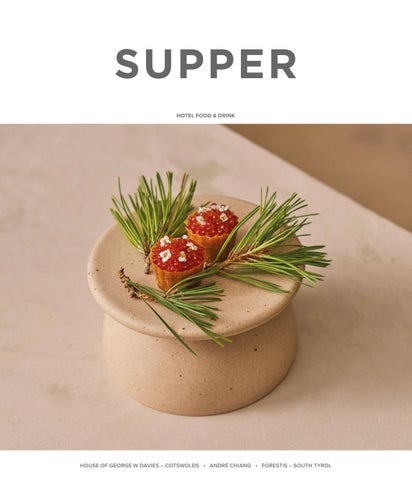
Create a flipbook