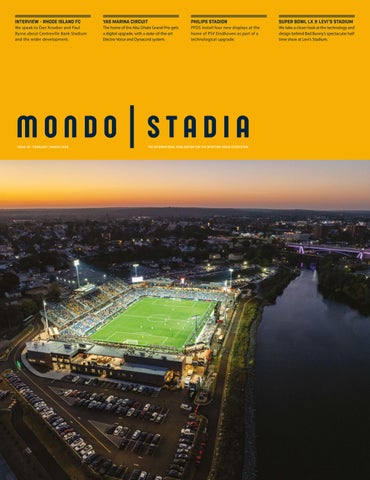
We speak to Dan Kroeber and Paul Byrne about Centreville Bank Stadium and the wider development.
YAS MARINA CIRCUIT
The home of the Abu Dhabi Grand Prix gets a digital upgrade, with a state-of-the-art Electro-Voice and Dynacord system.
PHILIPS STADION
PPDS install four new displays at the home of PSV Eindhoven as part of a technological upgrade.
We take a closer look at the technology and design behind
THE INTERNATIONAL PUBLICATION FOR THE SPORTING VENUE ECOSYSTEM
SUPER BOWL LX @ LEVI’S STADIUM
Bad Bunny’s spectacular half time show at Levi’s Stadium.
SCALABLE NETWORKING SIMPLIFIED.
Whether deploying a redundant or primary-only network topology, the MS8.2 Milan network switch is perfectly suited to simplify mobile, installed systems and spatial audio applications.
WELCOME
For our cover story, we dive into the ambitious Rhode Island FC project. We sat down with Dan Kroeber, Managing Partner at Fortuitous Partners, and Paul Byrne, General Manager at Centreville Bank Stadium, to discuss how the new venue serves as the vital anchor for a much wider urban development. It is a fascinating look at the stadium’s role in community regeneration.
Continuing that theme of urbanism, our Team Talk features Stuart Forbes, who explores ‘The Evolving City: Stadiums and the Urban Imagination’ - a must-read! From the East Coast of the US, we head West to Levi’s Stadium for a breakdown of the sheer technical scale of Super Bowl LX. We take a deep dive into the cuttingedge technology required to deliver Bad Bunny’s spectacular halftime show, a production that pushed the boundaries of live entertainment.
Our journey through venue technology continues at the Yas Marina Circuit, where Electro-Voice and Dynacord have completely revamped the audio landscape. There’s also a closer look at Philips Stadion, which has bolstered its visual impact with four impressive new displays from PPDS.
Our Full Time section features an insightful Q&A with Duncan Miller, Director of Global Marketing at Adder Technology. Definitely one to check out.
I’m also thrilled to introduce a new member of the team. Matt Johnson has joined us as an Editorial Assistant; many of you may have already crossed paths with him at ISE, but I’m sure you’ll see plenty more of him at future industry events. Finally, looking ahead, STADIA | SESSIONS #03 is fast approaching - May 12-15and it’s set to be another incredible event in Mykonos. If you’d like to get involved, please drop me an email at s.hughes@mondiale.co.uk.
Sam Hughes Chief Creative Officer & Editor-in-Chief
From Venue to Destination
Our award-winning team provides solutions for the most complex, large-scale, and immersive installations.
AV & Experiential Design
Digital Signage & IPTV
Large Venue Sound Broadcast Control Rooms
Chief Creative Officer & Editor-in-Chief Sam Hughes s.hughes@mondiale.co.uk
Editorial Assistant Matt Johnson m.johnson@mondiale.co.uk
Finance Director Amanda Giles a.giles@mondiale.co.uk
Credit Control ar@mondiale.co.uk
Group Chairman Damian Walsh
MONDO | STADIA is published by Mondiale Media Limited, Strawberry Studios, Watson Square, Stockport, SK1 3AZ, UK Tel: +44 161 476 8340
TEAM TALK
006 The Evolving City | Stuart Forbes
INTERVIEW
012 Dan Kroeber & Paul Byrne | Rhode Island FC
THE FULL PITCH
022 Super Bowl LX @ Levi’s Stadium | California, USA
030 Telekom Center | Athens, Greece
VENUE FOCUS
VIDEO
038 Philips Stadion | Eindhoven, Netherlands
AUDIO
046 Yas Marina Circuit | Abu Dhabi, UAE
FAN ENGAGEMENT
052 Honda Center & SAP Garden | California, USA & Munich, Germany
EXTRA TIME
058 Illuminating The Strip | Signify
060 How Personalised AI Could Reimagine the Venue
Experience | George Vaughan, The Digital Line
064 Full Time | Adder Technology
Cover Image: Centreville Bank Stadium
THE EVOLVING CITY: STADIUMS AND THE URBAN IMAGINATION
By Stuart Forbes FROM
THE ARCHITECTURE OF ISOLATION TO THE ARCHITECTURE OF BELONGING
Stadiums have long occupied an uneasy place in the urban landscape - capable of generating extraordinary collective emotion, yet standing dormant for most of the year. Today, however, a quiet transformation is reshaping how we design and understand these buildings. The real opportunity is not defined by scale, luxury, or spectacle, but by purpose: by how imaginatively we can use the resources available to create places that serve their communities every day, not just on matchdays.
This conviction - that architecture should foster belonging regardless of budget - sits at the heart of the projects explored here. Whether working at the expansive scale of Wembley Park or the more intimate, community-focused fabric of Fulham Pier, the ambition has been the same: to move stadiums from isolation to integration, from single-use venues to 365-day civic ecosystems. What follows is a reflection on that evolution, and on an enduring belief that the true power of stadium architecture is not measured in the spectacle it contains, but in the everyday life it enables within the city.
These two key projects represent a personal journey for me as I share with you the origins and comparisons of both these seminal projects.
Wembley: The Long Game of Urbanism
This quiet revolution began at the turn of the millennium as a facet of how architects and planners were beginning to imagine the modern city. The rigid zoning and functional segregation that had dominated post-war urbanism were giving way to something more fluid, connected, and humane - a city measured not by its monuments, but by the quality of its public life.
Few articulated this transformation more profoundly than Lord Richard Rogers, an architect who I had the privilege of working alongside in my early career, absorbing, and eventually contributing to, his philosophy of design as social infrastructure - an architecture not of separation, but of belonging.
These principles first found tangible form in the original Wembley masterplan, conceived in the late 1990s by Rogers. At the time, the area surrounding the national stadium was little more than a sea of car parks and warehouses - a landscape of isolation rather than community.
Our ambition was to imagine something radically different: a mixed-use urban quarter that could sustain life, commerce, and culture all year round. Rooted in Rogers’ principles of permeability, density, and civic continuity, the plan sought to transform a single-use
destination into a vibrant, lived-in districtan environment active 365 days a year, not just on matchdays.
Over the following twenty-five years, that vision evolved through multiple hands and iterations, eventually emerging as Wembley Park - one of London’s most successful examples of long-term, private-led urban regeneration. What began as an urbanist experiment has become a thriving community of housing, cafés, workplaces, and public spaces - alive with the rhythms of daily life, where the founding tenets of the early masterplan remain intact today, forming the backbone of a new civic quarter for London. While design teams have come and gone, the client’s commitment to a cohesive, connected narrative - where the whole is greater than any single building - has never wavered.
Fulham Pier and the Return of the River
Two decades after the Wembley masterplan was conceived, its urbanist heritage found a more intimate expression in the transformation of Fulham Football Club’s Craven Cottage. The idea of a new riverside stand evolved over many years, with multiple designs proposed and discarded - yet none truly addressed how to create a genuinely inclusive building. We aimed for more than a simple riverside walkway; we wanted a place
that celebrated the site’s unique character and connected directly with the life of the city and its neighbourhood.
Through an ongoing, open dialogue with the club, we began exploring how the building’s internal layout, design quality, and detailed fit-out could turn it into a social hub. We asked whether these elements could foster inclusivity in the same way a masterplan does: by choreographing spaces that invite encounters, create continuity, and nurture a sense of belonging.
Here, the new Riverside Stand extends far beyond the logic of sport. With restaurants, hospitality spaces, event venues, a boutique hotel and a spa woven together by a public riverside promenade, the project reopens a once-closed stretch of the Thames to Londoners. A community hub and a destination all year round.
If Wembley represents the macro-scale of urban renewal, Fulham Pier embodies micro-urbanism - the everyday fabric of community connection. Its success lies not in its spectacle, but in its ability to host a continuous, inclusive civic life.
This is architecture as social choreography: spaces designed for the flow of daily
encounters, the mingling of fans, locals, and visitors. In essence, it revisits the same question that shaped our thinking decades ago - how can architecture create a sense of belonging in an ever-evolving city?
The 365-Day
City
The idea of the “365-day stadium” builds directly on Rogers’ belief in the 24-hour city. The goal is to dissolve the old temporal boundaries of urban life. Where stadiums once lay dormant between events, today’s venues are conceived as living ecosystems - hubs for work, leisure, and community every day of the year and a stimulus for local regeneration. We see this idea gaining traction globally: from Tottenham Hotspur Stadium, whose public realm hosts markets and festivals throughout the week, to SoFi Stadium in Los Angeles, integrated within an expansive entertainment precinct.
At Wembley Park, that vision has matured into lived reality - residents overlook the same plazas that once filled only on matchdays. At Fulham Pier, the riverside is now animated daily by cafés, walkers, and social life, blending seamlessly into the matchday atmosphere.
The stadium has become a civic stage - not only a container for moments of collective emotion, but a catalyst for ongoing community engagement.
Sustainability and the Urban Consciousness
Beneath this evolution lies a deeper commitment to sustainability - a value central to Rogers’ notion of the “green city.” Stadiums are no longer conceived as isolated energy-hungry monoliths but as technological citizens within their urban ecosystems. They connect to renewable systems, digital infrastructure, and circular material strategies. Projects like Forest Green Rovers’ Eco Park or Qatar’s Stadium 974 show how design can reconcile spectacle with stewardship. Yet even in more conventional developments like Wembley or Fulham, sustainability reveals itself not only through technology, but through endurance - the capacity of a place to adapt, renew, and sustain public life over time.
The Urban Continuum
Viewed together, Wembley Park and Fulham Pier represent two chapters in a continuous dialogue spanning more than a generation of British design culture.
Ultimately, the relationship between Wembley and Fulham Pier is not merely one of chronology or shared authorship, but of intellectual and urban continuity. Wembley represents the macro-urban prototype: a national stadium reconceived as the anchor of a regenerated civic quarter. Fulham Pier represents the micro-urban refinement: a local club opened to its community through the generous reimagining of its architecture. Each project answers the same underlying question - how can architecture cultivate belonging in an evolving city? - but at different scales and with different tools.
Together, the projects form a narrative arc within contemporary British urbanism. They show how principles forged in the expansive realm of master planning can inform the most detailed aspects of building design, and how the stadium - once a symbol of isolation - can become a catalyst for social connection. By linking Wembley Park and Fulham Pier, I share
my view in an enduring belief that cities are defined not by their monuments but by the richness of the life they make possible.
As Fulham Pier welcomes the public back to the river and Wembley Park continues to thrive as a living district, these projects stand as twin testaments to an enduring ideal: that the future of our cities lies not in their buildings alone, but in the richness of life they make possible.
Both are acts of urban optimism - rooted in the belief that architecture’s true power lies in its ability to foster encounter, continuity, and belonging.
In Summary
Ultimately, the evolution of stadium architecture is not a story about ever-greater spectacle, nor about the budgets that so often define public perception of these projects. It is, instead, about purpose - about using whatever resources are available, whether expansive
or modest, to create places that enrich daily life. The work at Wembley and Fulham Pier demonstrates that the true measure of a stadium lies not in its price tag or its prestige, but in the imagination with which it serves its community: how it opens itself to the city, how it fosters belonging, and how it supports lives lived far beyond the thirty matchdays that first justify its existence. This is why our practice cannot be confined to the category of “luxury stadia.” The ambition runs deeper. It is about honouring context, stewarding budgets wisely, and designing buildings that are civic in both spirit and function. The quiet revolution that began decades ago continues in this belief: that stadiums can be catalysts for everyday urban life, and that architecture - at any scale and at any cost - has the power to transform isolation into integration, and spectacle into a lasting, lived sense of place.
INTERVIEW
“We are moving away from the outdated model of a stadium surrounded by acres of parking. We are building a ‘Community Living Room’ anchored by mixed-use development.”
Dan Kroeber Director of Development, Managing Partner Fortuitous Partners
DAN KROEBER & PAUL BYRNE
MONDO | STADIA sat down with Dan Kroeber, Managing Partner of Fortuitous Partners, and Paul Byrne, General Manager at Centreville Bank Stadium, to discuss the landmark project. The pair explore the intricacies of transforming a historic brownfield site into a high-tech, all-electric sporting hub, while detailing the “stadium-as-anchor” philosophy that underpins the wider Tidewater Landing masterplan. From community-aligned naming rights to multi-sport versatility, they outline a visionary approach to the sports-anchored development that knits professional infrastructure into the urban fabric of Rhode Island.
Why was a local institution like Centreville Bank the right naming partner to anchor this project, rather than a national brand?
Dan: We firmly believe that soccer clubs are, first and foremost, community assets. Because of that, finding a community-focused partner was our priority from day one. Centreville Bank was an exceptional fit; they are a local institution currently in a significant growth phase, looking to expand their brand across Rhode Island, Connecticut, and Massachusetts. We found a direct alignment between their mission - ‘progress on purpose’ - and our goal of making a lasting impact on local families. Whether through sport, youth development, or the economic uplift generated by this stadium project, we are both committed to driving growth in the region. We couldn’t have found a better partner to help us activate this project.”
Paul: “Centreville Bank is growing rapidly within the region, which created a perfect alignment for the stadium’s naming rights. As we work to expand our footprint across the state, partnering with a respected, well-known local institution felt natural. Beyond the business side, our organisations share a deep cultural synergy. We saw a direct parallel between how they treat their staff and volunteer in the community and how we manage our fan experience and personnel. Aligning with a partner that shares our commitment to service and community engagement made the announcement of Centreville Bank Stadium an incredible milestone for us - and one that will anchor our partnership for years to come.
How does that “local-first” philosophy translate into the stadium’s operations?
Paul: To Dan’s point, the economic impact here is significant; we’ve generated between 400 and 500 jobs within the community. Whether it’s our part-time match-day staff, our full-time front office, or our regional vendors and partners, the vast majority of our workforce is local.
From an operational standpoint, we are setting a new standard. We run a high-level, professional operation within a mid-sized stadium footprint, proving that you don’t need a massive venue to deliver a ‘prolevel’ experience. We’ve made a statement - not just in Rhode Island, but across New England - that our actions speak louder than words. In our first year, we’ve proven that we deliver on our promises.
When masterplanning the stadium, what were the “non-negotiables” for ensuring the layout supported a high-energy, authentic supporter culture?
Dan: We built this stadium with the evolving landscape of American soccer in mind. While we have an incredibly passionate ‘die-hard’ base in this region, we also recognise there are many newcomers to the sport. Our goal was to design a building that caters to everyone - from the high-energy supporters’ sections to families and retirees attending their first match. We identified a gap in the local market for premium hospitality, and we saw an opportunity to over-deliver. That started with the physical infrastructure: wide concourses and a diverse array of F&B experiences. We committed to a tech-forward approach, integrating ‘Just Walk Out’ markets and touchless technology as
non-negotiables. We wanted this 10,500-seat stadium to offer the sophisticated, modern experience usually reserved for much larger venues.
But technology is only half the story. Under Paul’s leadership, our staff ensures that every fan is met with a high-touch, welcoming experience. When people are blown away by both the tech and the service, they don’t just leave as stadium visitors - they leave as life-long Rhode Island FC fans.
Now that the gates are open, how are those design choices performing in terms of actual fan engagement and matchday feedback?
Paul: We didn’t rely on luck; we were intentional about every touchpoint. In Rhode Island - a state with a lot of pride and a healthy dose of scepticism - first impressions are everything. We took a proactive approach to communication, ensuring fans had ‘know before you go’ info long before they reached the neighbourhood.
Our goal was a ‘pro-level’ experience in an intimate setting. We integrated seamless transit options - from accessible parking to a train station less than a mile away - and partnered with Best Security and Levy Restaurants to elevate our service standards. Levy, in particular, helped us find that crucial balance between high-quality local fare and speed of service.
The results speak for themselves: we maintained a 96% approval rating in our first year. By utilising Amazon’s ‘Just Walk Out’ technology, we put the experience back in the fans’ hands. You can grab a drink and be back in your seat in under five minutes. In a 10,500-seat venue, every seat is intimate;
our second-tier front row is closer to the pitch than the front row of many MLS stadiums. We aren’t just building a stadium; we’re setting the standard for how a modern, midsized venue should operate.
Opening a 100% electric, soccer-specific stadium is a bold statement. Why was an all-electric approach prioritised from the very beginning of the project?
Dan: Sustainability was a day-one priority, and it started with the land itself. For over 50 years, this site - formerly a manufactured gas plant - sat dormant. It was a source of pollution for the river and the neighbourhood, a legacy of an industrial past that hindered local development. Our vision was to turn this into one of the most significant brownfield redevelopment success stories in the region.
That environmental ‘comeback’ served as our foundation. As we moved from remediation to construction, transitioning to an all-electric building was the natural next step. We partnered with Rhode Island Energy to leverage incentives that made sense for our business model and the climate. We are leaning into where the world is going - away from fossil fuels and toward a cleaner operational future. This project isn’t just about a stadium; it’s about healing the land and setting a new standard for mixed-use real estate.”
Paul: “The community’s feedback during our town halls was clear: they wanted a sustainable stadium that reflects the values of the ‘Ocean State.’ We’ve embraced that by using our platform to educate thousands of fans. Operationally, we’ve nearly eliminated single-use plastics - currently accounting for less than 1% of our waste - by switching to aluminium for
THE PERFECT MATCH LED CONTENT MANAGEMENT
ENGAGE YOUR FANS
With the SHOW CONTROL version, create an immersive experience by synchronizing lighting, LED displays, audio, fireworks, smoke effects, and more. Captivate your fans and turn every single match into a spectacular event.
ENRICH YOUR CONTENT
Benefit from the STATS PERFORM integration to save time preparing your match and showcasing specific players or team data. Stay connected with your community on social media via CURATOR and interact live with your fans.
MAXIMIZE YOUR SPONSORSHIP REVENUES
Easily transform any LED surface into advertising space with our new mapping option.
Manage sponsor ads and deploy unique special effects to deliver targeted messages, while automatically tracking ad exposure time for transparent reporting.
SELECT YOUR SERVICES
Choose the right level of support for commissioning, installation, and updates.
DELTACAST specialists are available to assist you remotely or on-site and ensure a high standard of execution.
EFFICIENT LIVE OPERATION
Use our sports-dedicated interface or connect directly to the referees’ scorepads to avoid missing any crucial game information.
Build custom playlists, configure dynamic sports dashboards, and export your own launchpads to operate live via your web browser or Stream Deck.
all beverage containers and using 100% compostable service ware for food.
We don’t just provide the bins; we manage the lifecycle. We partner with local Rhode Island organisations to turn our compostables into nutrient-rich soil and treat cardboard as a valuable commodity. Furthermore, our environmental stewardship extends beneath the pitch. We’ve integrated a sand-filtration system for stormwater; every drop that enters the nearby river is significantly cleaner than it was before it hit the site. In our first year, we’ve moved beyond just ‘being responsible’ to actively teaching our fans about sustainability through their game-day experience.
How did you design the stadium to be “revenue-ready” for non-soccer events like rugby, lacrosse, or concerts without compromising its identity as a soccer-specific home?
Dan: The field design was incredibly intentional. A professional soccer pitch provides a footprint large enough to accommodate American football, lacrosse, and even rugby, which sits right at the edge of the dimensions. We opted for a high-performance synthetic turf to ensure maximum flexibility. Crucially, the field is a clean green slate - every line is painted for the specific event rather than being permanently inlaid.
To facilitate these transitions, we installed specialised ‘sleeves’ for every sport. This allows us to switch from a soccer pitch on a Friday night to a full American football configuration by Saturday morning, as we did for the Governor’s Cup between Brown and URI. We achieved similar results for the Major League Rugby (MLR) Championship. From an investment standpoint, this flexibility is vital. A
10,500-seat stadium cannot survive on 20 match days alone; we have to diversify. Because of our ability to turn the venue around so quickly, we are now attracting premier events like the Premier Lacrosse League (PLL) and NWSL’s BOS Nation FC. We’ve built a high-activity hub that feels like a bespoke home for every league that walks through the door.
Paul: We’ve hit the nail on the head regarding versatility. There is truly nothing like our 10,500-seat footprint in this region. While there are collegiate stadiums of a similar capacity, they often lack the broadcast technology, operational infrastructure, and ‘pro-level’ atmosphere that we provide for major sports leagues.
We are now expanding beyond sports; this year, we will host our first concert. This involves a complex transitionprotecting the pitch with professional-grade floor covering and installing a full-scale stage and floor seating. It’s all about refining our operations to balance the logistical costs with the event’s return.
I’m bullish on our potential. My goal is to push the boundaries of this venue to ensure a sustainable operation. As Dan mentioned, filling dates is our lifeblood. The more diverse our programming - from soccer and rugby to live music - the more sustainable our business model becomes as we move forward.
What specific lessons did you draw from other USL developments to ensure this wasn’t a “one-size-fits-all” project, but one tailored specifically for Rhode Island?
Dan: My co-founder, Brett Johnson, is a firm believer that the success of a sports project comes down to three things:
Create the ultimate fan experience.
Streamline match-day production while delivering a truly immersive experience for fans with the Unified Venue Control solution from Ross.
Our tailored end-to-end production solutions combine the power of production control room technology with LED content management systems to enable sports venues to deliver the best possible fan experience.
Explore the solution by visiting: rossvideo.com/sports-venue
location, location, and location. We made a very deliberate decision with this site. It is highly visible from the major interstate, and that visibility is critical. When the lights are on, anyone driving by sees this building; it acts as a beacon for the entire region.
But beyond visibility, we believe stadiums must serve as anchors for broader economic and real estate projects. There is a significant trend where stadiums are no longer isolated structures surrounded by acres of parking - that model is outdated. Instead, we are creating a ‘Community Living Room.’
Our master plan for Tidewater Landing is a true liveentertainment district. We are moving into Phase Two, which includes over 650 residential units, a riverwalk, and a pedestrian bridge connecting both sides of the development. We’re building a neighbourhood where people can live with views of the pitch, walk to dinner, and enjoy public amphitheatres. By building into the natural topography, we’ve ensured the stadium fits the scale of the community while still providing that ‘wow’ moment when fans step
inside. It’s about knitting the stadium into the urban fabric to create a 365-day destination.
Paul: In stadium management, you always look for ways to improve. One future consideration for us is spectator coverage; currently, the building is quite open, and in a traditional ‘stadia’ sense, providing more protection from the sun and the elements is something we may look at down the line. For now, we embrace the New England seasons. We’re currently working through six inches of snow while preparing to host a match in three weeks - you simply figure it out.
We are also looking at how to embrace those seasons yearround, such as potentially installing an ice rink on the pitch during the winter months. It’s all about versatility. As Dan mentioned, the days of the four-hour tailgate and the 90-minute wait to exit a parking lot are fading. Modern fans value ease and accessibility. They want a frictionless journey: 15 to 20 minutes in, 15 to 20 minutes out. We’ve honed our operations to listen to those needs, ensuring that getting to the match is as enjoyable as the game itself.
The best way to sell out a place is by providing the best seating. That’s why Hussey has expanded its capabilities by adding Camatic. Our 190 years of problem-solving engineering combined with Camatic’s world-renowned design is about to take the seating game to a whole new level - whether that level’s the 100s or 400s. We can outfit your entire venue with an elevated seating experience and ensure effortless installation, unmatched durability and simple maintenance. Hussey Seating. Engineering elevated by design.
QUANTUM SERIES
SUPER BOWL LX @ LEVI’S STADIUM
California, USA
Images: ATK/Clair, PixMob
uper Bowl LX in the San Francisco Bay Area was a stunning display of how sports and technology can come together to create an epic spectacle for a worldwide audience.
Santa Clara’s Levi’s Stadium held 70,823 fans while approximately 128 million viewers tuned into broadcast coverage which saw the Seattle Seahawks crowned 2026 champions over the New England Patriots. The event included a variety of musical performances; Bay Area punks Green Day began opening ceremony proceedings with a medley of their greatest hits, followed by Brandi Carlile’s rendition of ‘America the Beautiful’, a National Anthem performance by Charlie Puth and a version of ‘Lift Every Voice and Sing’ from rising star, Coco Jones. However, it was one of the most talked-about halftime shows in recent memory, a 13.5-minute concert spectacular from six-time Grammy-winner, Puerto Rican megastar Bad Bunny, who made headlines as the first artist to sing entirely in Spanish throughout the Super Bowl’s 60-year history.
Game and entertainment audio was handled by veterans ATK Audiotek, overseen by Engineer in Charge, Kirk Powell, who has worked on the event for almost three decades. It’s a job that requires meticulous technical planning months before the musical acts are revealed.
Levi’s open-air construction called for total design flexibility this year; with no roof-hanging option, the audio team utilized both the stadium’s new JBL Professional house PA system - installed in 2025 by Clair Global Integration (CGI) - and a temporary L-Acoustics system. Both were crucial audio components.
Kirk comments: “The event is broken down into two parts: the game audio (commentary, sideline interviews, spoken word announcements), and the entertainment elements, including all musical performances. Essentially, we were working with two separate packages, the game audio used the house system, and the entertainment audio called for a bigger, portable, concert grade cart system that could be moved onto and removed from the field easily.”
The new in-house JBL bowl speakers are accompanied by new amplifiers, audio consoles, IEM systems and audio control room racks, as designed by technical design consultants, WJHW. This end firing system is situated at one end of the field behind the scoreboard and sits on custom rigging frames. The design consists of a mixture of VLA301Hi, VLA601Hi, and VLA901Hi models and Fulcrum CS218L-WR subs, powered by Powersoft Unica 12K and 16K amplifiers.
For the Super Bowl, these loudspeakers became extensions and delays for the entertainment sound, homing in on CGI’s ‘from construction to production’ capabilities, enabling venues to tie into high-performance event execution. Super Bowl 60’s temporary solution
Charged with tuning both PAs and the creating the cart design, Systems Engineer Johnny Keirle returned to take up the mantle. He says: “We spent a lot of time trying to find a solution that would really work in this unique environment, but we obviously faced some design limitations due to the nature of the roofless venue. The result was impressive, sounding bigger than most people expected.”
Johnny’s design featured 18 x cart positions around the field, each housing 2 x KS28 subs, 2 x K1SB subs, and either 4 or 5 boxes of K2, all powered by L-Acoustics’ LA12X amplified controllers running AVB Milan. He continues: “I pushed to have extra amplified controllers so that the system could run more efficiently. One of the challenges of working with a ground-based cart system is managing the high d-ratio of the shortest distance to the longest throw distance. With a typical stadium system, throw distances are usually around 60m to the furthest seat and 30m to the shortest, but by contrast, with a groundbased system, we’re throwing as short as 6m to the closest seat and 110m to the furthest. Having those additional amps and more processing granularity was important for this year’s design.”
A plus of a ground-based cart system is how fast it can be moved and positioned with ease. In this instance, with 8 x ATK ‘quad leaders’ and 100-strong crew who maneuvered the carts in groups of five. He continues: “We secured our ideal cart positions, but as football is the main event, there is a priority to protect the grass.”
Given the disparity of seats to speakers, auditory health
was another priority for both ATK and the NFL, as Johnny furthers: “We have a very real responsibility to make sure people have an enjoyable audio experience at all live events: delivering impact while considering and preserving auditory health. That’s a main reason I wanted the increased processing granularity; it means I have far better control of the SPL profile across the varied throw distances.”
An additional challenge with any Super Bowl is its secrecy, a far cry from the genre-led designs engineers typically work with: “When I design a new system, I decide on targets that the system must perform to, to meet the criteria for the music. That’s always my starting point. However, I can’t define those targets for this event because like everyone else, I don’t know what the music content is for a long time beforehand.”
This level of secrecy also means the audio team gets very little time to make any noise during rehearsals, especially in an open-air environment such as Levi’s.
“I design to what I think will be a good target, with a certain amount of low-end, low-end extension and contour, [dynamic changes in frequency, amplitude, and phase]. But the design still needs to work for the pre-game entertainment speeches,” he adds.
A United Culture
Bad Bunny performed from within thoughtful architectural set pieces, including sugar canes plants, local street vendors, and atop electricity pilons, paying homage to beloved Puerto Rico. The performance also gave fans perfectly choreographed dancers who laid way for his impactful reggaeton style which would surely have blown the roof off - if there was one. As promised, Bad Bunny got the world dancing, and better still, he got the world dancing to the beauty of Latin American culture.
With special guests Lady Gaga and Ricky Martin’s vocals adding to the energetic set, the 2026 audio design truly helped to bring the party to the playing field, as Johnny confirms: “The outcome sounded great, and not just for a ground-based cart system. All the way up at the very top of the stadium, the sound was immediate; good low frequency and sub coverage for a vibrant and high energy halftime performance.”
The show was mixed by FOH engineers Alex Guessard and Dave Natale and monitor mixers Tom Pesa and Chris Daniels. The entertainment portion was mixed through a DiGiCo Quantum 338 at FOH, and Quantum 5 for monitors, with SD Racks. The in-game sound was mixed through a pair of Yamaha PM5 Rivage consoles, (one for production, another for the house band). Utilizing a digital audio
signal path, ATK built a powerful Dante-networked audio infrastructure, which included the Focusrite RedNet D16R MkII, A16R MkII, and D64R range of audio converters and interfaces.
Communications in Santa Clara
Led by Matt Campisi of ATK Versacom, ATK’s dedicated comms brand, this team deployed sitewide communications entailing intercom systems for the halftime show, NFL Broadcast Executives, full stadium control and the production team. In addition, the crew also looked after the ‘tailgate’ area this year, a space located outside the stadium filled with TV network and music mixing trucks.
Matt begins: “We ran comms to the tailgate and had connecting comms to NBC’s truck for coordination lines, and the pre-show elements. We deployed a redundant network for our high profile and critical positions and worked with our in-house network team and Riedel Communications directly to devise the best result.
“We didn’t experience any issues with our main network but having that back-up plan is always comforting - working on one of the most watched events across the world can be intimidating, but when we have a great team like we do, it makes all the difference.”
Riedel worked with ATK to obtain additional frequencies, creating more space for the plethora of wireless intercoms. Matt continues: “With that in place and working in an open air stadium, it made a great outing for our wireless technology which is always the most challenging part of a comms system. This year we provided over 100 x matrix panels, 150 x Riedel Bolero wireless intercoms, 44 x Bolero antennas and 60 x hardwire belt packs.”
Reflecting on the success of Super Bowl 60, he adds: “It’s still the most challenging show I work on; I’ve been the Lead Comms Engineer & Project Manager for 27 years now, and as it grows, that experience really comes into play. There’s a huge amount of pre-production involved, but after all this time, this event remains the most gratifying accomplishment.”
Montreal-based SFX leader PixMob activated its 8th Super Bowl Halftime Show – its 7th in a row – debuting its brightest-ever, daylight-visible LED technology at Super Bowl LX. Invented to preserve high-impact special effects in broad daylight, the technology immersed fans in its most powerful LED visuals yet featuring custom animations synchronized with the halftime performance.
The moment marked a major milestone in PixMob’s longstanding work with Bad Bunny, an artist PixMob has worked with since his early rise—now commanding the biggest stage in the world. Seeing that relationship evolve and expand onto a global platform like the Super Bowl is a powerful testament to the investment Bad Bunny makes in his fans, and to the sustained creative support PixMob provides artists over time to help bring their visions to life.
The Halftime Show featured PixMob’s 9-LED daylight-visible badge worn by over 68,000 fans in the crowd. Combined with its “Human Video Screen” MVT controller technology, the activation enabled fully synchronized video effects that delivered high-impact moments – even under the dusk conditions of the game – bringing Bad Bunny’s performance to life at an unprecedented scale.
As it celebrates two decades of fan engagement innovation, PixMob continues to shape how the world’s largest live events are experienced. From its earliest experiments in fan-powered lighting effects to its “Human Video Screen” technology, PixMob’s LED innovations have set the fan experience standard for tens of millions of people at more than 10,000 events and 100 major ceremonies worldwide— including 8 Super Bowls and 3 International Games (Sochi, Paris, Milano Cortina), in addition to FIFA tournaments, Eurovision, Formula 1 races, global jubilees, and concerts & tours by the likes of Beyoncé, Coldplay, Bad Bunny, and more. That legacy evolves in 2026 at two of the world’s mostwatched sporting events, integrating PixMob’s groundbreaking technology into the live experiences at the Super Bowl LX Halftime Show and at the Winter Games Milano Cortina 2026 Opening Ceremony.
PixMob
EXPERIENCE MATTERS
When leaders at Ullevaal Stadium in Oslo, Norway, transitioned to LED stadium lighting, they entrusted the project to the firstever FIFA Preferred Partner for Floodlight Systems, Musco.
Because when it comes to quality, reliability, accountability, and assurance that you’re providing the best possible match night experience... you always know when it’s Musco .
SCAN HERE TO LEARN MORE
Ullevaal Stadium Oslo, Norway, Home of the Norway National Football Team
TELEKOM CENTER ATHENS
Athens, Greece
Images: Fandom Factory
In a groundbreaking collaboration at the Telekom Center Athens, Panathinaikos BC, Uber, Fandom Factory, and ASB GlassFloor have transformed the traditional halftime break into a high-octane, interactive digital experience. By turning a world-class basketball court into a virtual racetrack, this partnership signals a definitive shift in how brands and sports properties engage with modern audiences.
For decades, sports sponsorship was a game of visibility. Logos were plastered on jerseys, static boards lined the perimeter, and activations rarely extended beyond a mascot tossing t-shirts into the crowd. However, as digital-native fans demand more immersion and brands require measurable ROI, the industry is undergoing a radical transformation. At the heart of Athens, a city steeped in sporting history, a new standard has been set. During the halftime intervals of EuroLeague fixtures, Panathinaikos BC — one of Europe’s most decorated basketball clubs — has traded jump shots for gear shifts. Through the Uber City Race, the club’s home court at the Telekom Center Athens is no longer just a playing surface; it is a live, interactive gaming platform. The foundation of this innovation is the ASB GlassFloor.
Recently installed at the Telekom Center Athens, this revolutionary LED-mapped glass surface has replaced traditional hardwood, allowing the court to function as a giant, high-resolution screen. While its primary purpose is to provide a world-class playing surface with enhanced shock absorption and customisable line markings, its commercial potential is where the Uber City Race truly comes to life.
For Panathinaikos BC, the debut on the ASB GlassFloor marked a historic moment in the EuroLeague. It provided the canvas upon which Fandom Factory, a creative agency specialising in fan engagement, and REACH, a creative powerhouse, could paint a brand story for Uber Greece.
The Uber City Race is a high-energy activation inspired by the aesthetics of legendary gaming titles like Need for Speed. The premise is simple, yet technologically sophisticated: transforming the halftime break into a live virtual race that bridges the gap between the physical arena and the digital world.
The mechanic begins long before the halftime whistle. During the first half of the game, fans in the stands are prompted via the jumbotron and LED ribbon boards to scan a QR code. This takes them to a bespoke mobile interface where they register
with their email and vote for their favourite Panathinaikos player. In this virtual world, the players are reimagined as drivers behind the wheel of a branded Uber car.
Each fan vote acts as a ‘power-up’ for their chosen driver. By the time halftime arrives, the data is aggregated, and the race begins.
As the players head to the locker rooms, the Telekom Center Athens undergoes a complete digital transformation, with the ASB GlassFloor switching from a basketball layout to a vibrant, glowing racetrack. Simultaneously, the action is mirrored and expanded upon the arena’s giant screens.
The virtual Uber cars race across the floor, navigated through a track that features seven distinct checkpoints. These checkpoints are not arbitrary; they symbolise the seven cities where Panathinaikos has triumphed in EuroLeague finals, weaving the club’s rich heritage into a modern commercial activation.
The engagement is palpable - fans watch as the player they voted for battles for the lead, powered by the collective input of the participants using their smartphones in realtime. For those who backed the winning driver, the rewards are tangible: signed jerseys and Uber ride vouchers are
distributed, ensuring that the brand interaction ends on a high note of gratification.
According to Fandom Factory, the Uber City Race is the result of roughly 18 months of intensive development. It represents a move away from one-off promotions toward long-term, sustainable partnerships. The era of activations that live within the game itself is here, creating emotion and generating value far beyond the arena walls.
For a brand like Uber, the value is multi-faceted. Unlike a static logo, this activation provides direct lead generation by requiring email registration for participation. It also drives app utility by offering ride vouchers as prizes, creating a direct funnel to the Uber services. Most importantly, it creates emotional resonance by linking the brand to the fans’ favourite players and the club’s historic victories.
The success of the Panathinaikos-Uber collaboration offers a case study in modern sports marketing built on several critical pillars. This was not a plug-and-play solution; the activation was designed specifically for the Telekom Center Athens, taking full advantage of ASB GlassFloor’s technology.
Every element, from the 3D car models to the checkpoint locations, was bespoke to the Panathinaikos identity.
Furthermore, the project relied on flawless onsite execution.
The integration of the arena MC, the DJ’s soundtrack, synced lighting cues, and the technical LED team ensured that the race felt like a premium entertainment event. This was bolstered by a smart transition from onsite to online, with real-time content and post-event storytelling allowing the activation to live on through social media.
Finally, the focus remained on measurement. In an industry often obsessed with impressions, this project focused on actions. Across the series of games, thousands of new app registrations have been recorded, providing Uber with a clear and undeniable metric for success.
The scale of the project is significant. Spanning five EuroLeague games, the activation is expected to achieve a cumulative onsite reach of over 60,000 fans. However, the digital footprint - bolstered by engagement across Panathinaikos’ social channels - suggests a much larger audience.
The Panathinaikos–Uber collaboration proves that when technology like the ASB GlassFloor is used as an amplifier for
creative storytelling, the results are transformative. It turns the arena into a hybrid space where the boundaries between the physical game and digital entertainment blur.
The Telekom Center Athens has shown that the basketball court of the future is a versatile, revenue-generating asset that can host a EuroLeague game one minute and a branded City Race the next.
As Panathinaikos BC continues its campaign on the European stage, the Uber City Race concept is a reminder that in the battle for fan attention, the winner won’t be the one with the biggest banner, but the one who creates the most unforgettable experience. By merging heritage, technology, and interactive competition, Fandom Factory and ASB GlassFloor have defined the new standard for the modern sporting venue experience.
VENUE FOCUS
038 Philips Stadion | Eindhoven, Netherlands
046 Yas Marina Circuit | Abu Dhabi, UAE FAN ENGAGEMENT
052 Honda Center & SAP Garden | California, USA & Munich, Germany
PHILIPS STADION
Eindhoven, Netherlands
Images: PPDS
PSV Eindhoven are one of the most successful football clubs in Europe, boasting a trophy cabinet that contains over twenty-five domestic league titles, as well as several continental triumphs.
Founded in 1913 by employees of Philips, PSV has transformed into a giant of European football over the last one hundred years, helping to produce some of the world’s most iconic footballing stars along the way.
Despite the age of the club, PSV is not an institution that lives in the past, instead, thanks in part to its relationship with Philips, it strives to have to the most advanced and modern pieces of stadium technology at its home ground, providing a look into the future of what is possible for stadia across the globe.
For the latest technological upgrade at Philips Stadion, PSV has teamed up with PPDS, the provider of Philips Professional Displays, to install four new giant 8 metre Philips dvLED scoreboards.
Installation of the new displays was completed prior to the beginning of the 2025/26 Eredivisie season, with the stadium’s four existing P16 Philips LED walls being replaced with four new 8m x 4.5m Philips Urban LED 6000 Series displays.
Tailored to meet the exact needs of PSV Eindhoven’s AV/ IT, the Philips Urban LED 6000 Series boasts a 6.67 pixel pitch and 10,000 nits of brightness — an epic five times step up from the previous 16 pixel pitch, while also doubling the original 5,000 nits. Each wall delivers high contrast and high refresh rates of 7680hz for smooth visual reproduction
– including live broadcasting – with more colour subtlety, shading, and saturation.
The new displays have replaced video screens that were in place at Philips Stadion for over ten years, with their replacements boasting the latest in the way of video display technology, as the last decade has seen significant development in how the technology itself functions.
Each wall is strategically placed for fans with up to 30 metre viewing distances, rather than the more traditional two videowalls positioned at each end of the stadium. This ensures optimum viewing experiences for fans located anywhere in the stadium, significantly improving supporter experience and engagement.
With inclement weather in Europe, the Philips Urban LED 6000 Series walls inside the stadium can withstand anything
Mother Nature throws their way, with the reassurance of an IP65 rating – resistant to water and potentially hazardous or corrosive airborne pollutants – and uncompromised performance in subzero conditions down to -20°C (-4°F), or extreme temperatures of up to 50°C (122°F). Such design features emphasise the leap in technological development that has taken place since the stadium’s last video screens were installed.
“After more than a decade of service, our displays have made way for the new LED walls in the Philips Stadion, delivering a huge leap in image quality and brightness, which perfectly aligns with our ambitions for innovation. Fans now experience sharper visuals, while installations continue to support dynamic and impactful content,” said Sjors van den Boogaart, Director of Philips Stadion.
Aligned with PPDS’ own sustainability strategy, the new Philips Urban LED 6000 Series offers low power consumption of just 18kw, bringing immediate cost of ownership savings when compared to each of the original walls’ 23kw power consumption.
As Philips Stadion is located in a region of Eindhoven nicknamed ‘Philipsdorp’ (Philips Village), due to the factories and activity of the company in the area, there is no better place for PPDS’ latest screens to be showcased on an international stage with PSV having played in this seasons UEFA Champions League.
The company has implemented its displays across the European football scene also, and it plans to continue to do so. “Continuing PPDS’ enviable association and affiliation in designing and providing tailored dvLED solutions to some of the world’s leading professional teams – with FC Barcelona, Oracle Red Bull Racing and Harlequins RFC among those made public – we were delighted to be part of this exciting project,” said Koen Vroomen, Sales Manager Benelux at PPDS.
MYKONOS, GREECE | 12-15 MAY 2026
YAS MARINA CIRCUIT
Abu Dhabi, UAE
Images: Electro-Voice, Dynacord
Yas Marina Circuit has undergone a digital evolution to replace the analog backbone of its audio system with a fully digital architecture. The project was delivered against a tight timeframe by PKE Gulf, which called on equipment from Electro-Voice and Dynacord to ensure the circuit would meet modern international sports venue standards.
Yas Marina Circuit is home to the season-ending Formula One Etihad Airways Abu Dhabi Grand Prix. The decision to upgrade its sound reinforcement system was confirmed a couple of months before the race with a phased approach agreed. The first phase would see the replacement of its analog backbone which was installed when the circuit opened in 2010 and an upgrade to the main grandstand’s audio system. Further phases will cover the remaining north, south and west grandstands.
“Our objective was to move away from a system that had reached the end of its lifecycle and toward a robust, fully digital platform that could support current operational demands and future expansion,” states Omar Naiem, Smart Venues Senior Manager at Ethara, the venue management company for Yas Marina Circuit. “The phased approach
allowed us to upgrade critical areas ahead of the Formula One Etihad Airways Abu Dhabi Grand Prix while maintaining full operational continuity across the venue.”
PKE Gulf was selected to handle the phased project based on its experience in the sector and opted for equipment from Electro-Voice and Dynacord to help it achieve the results that the circuit required. “Electro-Voice and Dynacord were selected for their outstanding professional design and proven performance,” explains Gerald Zak, Senior Technical Manager at PKE Gulf WLL. “The large portfolio and scalability of the Electro-Voice solutions allowed the entire project to be covered with a single, coherent audio platform, ensuring consistent sound quality, reliability, and visual integration across all areas of the main grandstand. Combined with Dynacord’s powerful processing and amplification technologies, the solution delivers a robust, future-ready system that meets the highest standards expected at a modern international motorsport venue.”
“The circuit needed a complete digital evolution to meet international motorsport standards and deliver a premium audio experience,” adds Aju Antony, Sales Manager MEA for Electro-Voice and Dynacord. “By implementing our high-end
multichannel IPX series DSP amps combined with ElectroVoice EVH, EVF, and EVC point source loudspeakers, we provided the brain and power to deliver a premium, futureproof experience.”
The first phase of the project saw 155 weatherized loudspeakers and subwoofers powered by 30 amplifiers added to the main grandstand. Flown in vertical clusters from the front lip of the roofline, the new sound system is intended to ensure an optimal spectator experience during motorsports events held in the facility and delivers homogenous sound coverage to every seat.
While the new loudspeaker deployment was a key component, the primary objective of this phase of the project was the creation of a new digital infrastructure for the circuit. Dante was selected for audio distribution throughout the facility with professional audio electronics and software from Dynacord playing a critical role.
“The MXE5-64 Matrix Mix Engines and SONICUE Sound System Software were key enablers of the project’s success,” states Zak. “They formed the heart of the new digital backbone, allowing the legacy analog mixer infrastructure to be fully replaced while seamlessly integrating existing analog
amplifiers and loudspeakers across multiple buildings. This approach ensured a smooth transition to a modern, centrally controlled digital platform without disruption to ongoing operations, while significantly improving flexibility, control, and future expandability of the overall audio system.”
The combination of IPX amplifiers and MXE5 Matrix Mix Engines managed by SONICUE ensures effective production signal management for audio engineers at the track. A customized GUI allows instant signal selection, pre-listening, and routing to audience areas. SONICUE has also enabled a precise, application-specific control environment, not only replicating the old analog audio console but also providing extra features such as instantaneous delay control for lipsyncing with video displays in the public areas, or scene recalls during different event stages.
“We have a lot of different input sources based on different race series requirements, so SONICUE is used to combine them if required,” furthers Zak. “With this setup we can cover any local or international race series.”
“The transition to a Dante-based digital backbone has significantly improved system reliability, monitoring, and operational flexibility,” adds Naiem. “Centralized control,
improved signal routing, and application-specific workflows have enhanced both live event production and day-to-day venue operations, while also reducing dependency on manual interventions previously associated with the analog setup.”
A third element of phase one saw the installation of a Praesensa public address system which ensures that live and pre-recorded announcements can be broadcast across all zones of the circuit for effective communication. The system has been buffered from the rest of the audio network using a proprietary Dante gateway unit, to ensure overall system compatibility.
“From an operations and risk management standpoint, the upgrade delivered exactly what we were looking for, greater control, consistency, and scalability,” concludes Naiem.
“The system now aligns with international motorsport venue standards and gives us the confidence that audio performance will be consistent across different event formats, broadcast requirements, and crowd capacities. Equally important was the ability to future-proof the investment. The new digital architecture has been designed to seamlessly accommodate additional grandstands, zones, and technologies in upcoming
phases, ensuring that future expansions can be integrated efficiently without reworking the core infrastructure.”
With the new system and digital infrastructure deployed in time for the grand prix, Zak is happy to reflect on a successful first phase. “A defining moment was seeing the CEO’s smile when experiencing the sound quality for the first time. An instant, genuine reaction that perfectly reflected the success of the system and the impact of the upgrade.”
Don’t Create Legendary Content with Average Tools.
Create it with gear engineered by people who know what’s at stake in a live signal path. Every frame, every pixel, every packet—flawless. AJA is proud to unveil our latest trio of industry-defining innovations:
This new 4K/HD IP video receiver supports up to four SMPTE ST 2110 video streams, output to 12G-SDI and HDMI 2.0. With NMOS, PTP, and redundant SFP28 supporting 10/25 GigE, it plays nice in even the most mission-critical environments.
BRIDGE LIVE 12G-4
Now with multi-channel 4K/UHD I/O, this next-gen encoder/decoder unlocks pristine bidirectional streaming, transport layer flexibility, and multi-platform delivery in a rock-solid 1RU chassis. Low-latency. High fidelity. Broadcast-grade resilience.
Built to Perform. Engineered to Last. Trusted by Professionals. www.aja.com/whats-new
UDC-4K
The compact up/down/cross-conversion powerhouse does it all, including 12G-SDI and HDMI 2.0 signal conversion, frame synchronization, frame-rate conversion, and much more. From HD to 4K or anything in between. Small box. Big impact.
HONDA CENTER & SAP GARDEN
California, USA | Munich,
Germany
Images: Stage Precision
A
s sporting experiences become increasingly geared towards audience entertainment, leagues, teams and venues are under pressure to deliver experiences that go beyond the game itself. Today’s fans expect real-time data, broadcast-quality visuals, interactive storytelling and equal experiences whether they are in-venue or at home. Across the industry, technology manufacturers are actively addressing this shift. From stadiums adopting broadcast-style production pipelines to sports courts transforming into interactive, digital canvases, fan engagement is no longer optional.
SP Grid sits at the centre of this evolution, enabling production teams to unify tracking, automation, data and media control into a single scalable platform, which helps turn arenas, stadiums and esports venues into fully connected experience engines. Unlike single-point solutions that address only graphics, tracking or automation in isolation, SP Grid acts as the connective tissue between systems. It aggregates real-time positional data, timing and control signals and distributes them across the users’ desired control workflow. SP Grid is already
deployed on projects and venues involved in some of the highest levels of professional sport and entertainment.
“We have seen and are continuing to see many instances of SP Grid being used to create incredible fan experiences, especially in the world of sports,” explains Sarah Cox, CCO at Stage Precision. “These events require precision, accuracy and integration across various moving parts, such as lighting, audio, fan apps and more. With powerful timeline controls, automation features and real-time monitoring, SP Grid ensures that every aspect of the experience is perfectly timed and in sync.”
At the Honda Center, California, SP Grid was used to integrate tracking and control systems to support immersive inarena visuals, dynamic game stats integration and tightly synchronised show moments, including a bespoke ‘Frog Dash’ game, to encourage crowd participation and bring greater sponsor visibility.
Describing the system created using Stage Precision’s platform, Eric Gazzillo, Vice President of Innovation at Quince Imaging, says, “It sits at the centre of the operation,
managing data flow between the tracking system, game engine and media servers. We use active ID tags on players and SP handles the entire data communication network, from camera calibration through to real-time adjustments.”
For Red Bull’s next-generation arena at SAP Garden, Munich, SP Grid plays a critical role in coordinating complex, datadriven shows that blend sport, entertainment and brand storytelling. “No other software brings together a 3D stage tracking system with a user-friendly control interface like SP Grid,” confirms Leon Herche, Creative Producer at bright! studios, who were responsible for developing a workflow to enable tracking data to be transformed into engaging visual content for real-time gaming and audience participation. “The simplicity of the interface makes it super user-friendly. Even the arena team, without specific technical experience, can start and stop games and manage the system easily.” SP Grid’s custom UI feature enables simplified, branded controls to be presented on a tablet or touch panel, making everyday operation intuitive.
Drawing from SP Grid’s rich and versatile feature set, several
more tools and capabilities are particularly impactful in live sports environments. Take real-time data aggregation, for example. SP Grid can ingest data from tracking systems such as person and object tracking, enabling instant visualisation of gameplay moments, player movement or branded fan interactions in endless creative forms, from on-screen data feeds to digital floors or in-app updates for audiences.
Precision synchronisation of 3D data enables elements such as LED, lighting, audio, graphics and even AR elements to launch simultaneously and without manual operation, critical for high-impact fan moments. For the 2024 Super Bowl, SP’s tracking solutions emerged as the linchpin of operations for an augmented reality simulcast in collaboration with Nickelodeon featuring the alternate reality of SpongeBob SquarePants.
From single-arena deployments to multi-venue leagues, SP Grid also scales effortlessly, supporting consistent fan experiences across seasons or locations. The E-Sports World Cup 2025 was a testament to this when bright! studios used
SP Grid for multi-stage media control across seven venues and dozens of esports gaming titles.
Finally, by taking technical complexity and presenting data, workflows and complex device connections in a user-friendly way, SP Grid encourages creative teams to experiment with new fan engagement concepts and iterate existing set-ups over time to evolve as fan response is gauged.
“As many in our industry are highlighting the importance of fan engagement, SP Grid differentiates itself by focusing not on individual surfaces or effects, but on infrastructure-level orchestration of an experience,” concludes Cox. “Sports teams or organisations can adapt their fan experiences in an agile way, integrate emerging technologies over time and, most importantly, deliver compelling experiences.”
SP Grid empowers venues and broadcasters to turn every moment into a truly engaging audience experience in an era when sporting fans demand more than just a seat and a screen.
EXTRA TIME
EXTRA TIME
058 Illuminating The Strip | Signify
060 How Personalised AI Could Reimagine the Venue Experience | George Vaughan, The Digital Line
064 Full Time | Adder Technology
ILLUMINATING THE STRIP: HOW SIGNIFY POWERED THE LAS VEGAS GRAND PRIX
When the Las Vegas Strip transforms from a worldfamous tourist corridor into a high-speed FIA-standard circuit, the logistical challenges are immense. Central to this transformation is the challenge of visibility. For a night race where drivers exceed 300 km/h, the lighting is a critical safety infrastructure, and the backbone of the Las Vegas Grand Prix as a spectacle.
The Las Vegas Grand Prix spans a 6.2 km track featuring 17 turns and a long, high-speed blast down the iconic Strip. To ensure the safety of the drivers and the quality of the global broadcast, Signify installed 1,548 ArenaVision LED (gen 3.5) floodlights across the circuit.
Engineered for the rigours of professional sports, the ArenaVision system provides the precision required for Formula 1’s exacting standards. Each light is paired with a Lumisport driver, allowing for the fine-tuned control necessary to handle the varying geometry of the Las Vegas streets, which include overpasses, different wall heights, and multiple lanes.
For the engineers at Signify, the goal was to create a “daylight” environment in the middle of the night. The technical specifications of the installation are formidable:
• Colour Temperature: Set to 5700 Kelvin, mimicking natural daylight to keep drivers alert.
• Colour Rendering Index (CRI): A CRI of 90 ensures that colors are vivid and accurate, which is essential for both the drivers’ depth perception and the high-definition cameras used in broadcasting.
• Brightness: The system delivers up to 1,500 lux horizontally and 1,000 lux vertically, making the track roughly 75 times brighter than a standard city street.
Perhaps most importantly, the installation focuses on shadow minimisation. At 300 km/h, a shadow can be mistaken for a debris field or a change in track surface. Signify’s engineers carefully angled each floodlight to ensure a uniform wash of light, eliminating blind spots that could hinder braking distances and cornering precision. Despite the massive power output, the shift to LED technology has made the event more sustainable, with the ArenaVision gen 3.5 being 30% more energy-efficient than traditional metal-halide systems.
Signify’s influence extended beyond the track and into the hospitality sector. In the Signify suite, the company showcased the future of interior lighting with 3D-printed fixtures made from 75% recyclable materials. These lights were part of an immersive ecosystem; as action unfolded on the track, the suite’s lighting changed in colour and intensity to reflect the race’s mood, bridging the gap between the competitive arena and the fan experience. The Las Vegas Grand Prix represents the pinnacle of temporary sports infrastructure. By day, it is a functioning city; by night, it is a high-tech arena. Through the deployment of 1,548 specialised floodlights, Signify has not only set a new benchmark for night racing, but has also demonstrated how advanced lighting technology can integrate safety, sustainability, and spectacle into one seamless package.
Lighting that brings your stadium to life
Elevate every moment with high-performance sports luminaires and connected systems, engineered for flexible, multi-purpose venues.
Deliver broadcast-quality, uniform, shadow-free illumination with advanced light management, seamless scene transitions, and immersive, customizable light shows that captivate fans, broadcasters, and athletes. Smart controls optimize energy use, simplify operations, reduce maintenance, and support sustainability goals — all while creating unforgettable experiences and unlocking new revenue streams through sponsor branding and promotional opportunities.
Learn more about our sports lighting solutions www.signify.com/global/applications/sports
FROM APPS TO ASSISTANTS: HOW PERSONALISED AI COULD REIMAGINE THE VENUE EXPERIENCE
George Vaughan, The Digital Line
For more than two decades, our relationship with the digital world has been shaped by three dominant interfaces: browsers, websites and apps. They have defined how we search for information, buy products, access services and interact with organisations. They have created new ways to transact and new opportunities for engagement across global platforms. But the next layer may now be emerging.
Recent studies suggest that more than a third of consumers now begin information searches with AI tools rather than traditional search engines, indicating that conversational systems may already be reshaping how people access digital services. Many of you reading this article will have used tools such as ChatGPT to answer a question, sharpen an email or check what is showing at the local cinema. It might not be because you necessarily love artificial intelligence, but because you want something simpler that offers less friction, more relevance and faster access to the things you need.
This shift does not signal the end of apps or browsers but it could mark the beginning of a new interaction layer - one that sits above them. And crucially, that layer is likely to become a lot more personal. For industries built around live experiences like ticketing, arenas, stadiums and even cities, this change could reshape how audiences engage with services long before they arrive at the turnstile.
The Rule Behind Successful Digital Systems
To understand how this might unfold, it helps to look at how successful digital systems have evolved in the past. The most widely adopted platforms share three characteristics. They are familiar, portable and predictable.
Contactless payments are a good example. The same tap gesture works in London, Tokyo and New York. Consumers do not learn a new checkout process every time they enter a different supermarket. Merchants adapt to the payment network, not the other way around.
Passports follow the same principle. They are issued once, carried by individuals travelling overseas and recognised globally through standardised information structures.
Even gaming consoles demonstrate this pattern. A player’s controller settings, display preferences and accessibility configurations remain consistent. When a new game is inserted, the game adapts to the console environment rather than forcing the player to start again.
Platforms like Shopify also illustrate this model at scale. Millions of merchants do not build their own payment rails, checkout logic or commerce infrastructure. Instead, they plug into a shared platform where users can store payment information, addresses and checkout preferences once and reuse them across thousands of stores. These systems succeed because identity and preferences travel with the user.
Yet many digital services today still operate in a fragmented fashion. A visitor attending an event may be asked to download a venue app, create an account, configure preferences and learn a new process, even if they have already done something similar elsewhere. In other words, people repeatedly rebuild their identity across different platforms. This approach places the burden on the user rather than the system. In an era where convenience is expected, that friction is increasingly noticeable.
The Emergence of Personal AI
Early signs of this shift are already apparent. Apple, Google and Microsoft are embedding AI assistants directly into operating systems, hinting at a future where the assistant becomes the gateway and apps become the underlying infrastructure. This would mean that rather than interacting with dozens of independent applications, individuals may eventually carry a personal AI assistant that understands their preferences and adapts interactions accordingly.
This assistant would not belong to a brand. It would belong to the individual and over time, it could learn and store a wide range of contextual signals, including:
• Accessibility requirements
• Communication preferences
• Dietary needs
• Travel behaviour
• Device preferences
• Consent settings
Instead of downloading an app, businesses could provide experience templates that users connect to their personal AI, sharing only the data they choose to share with each brand.
For this model to work at scale, platforms would need to expose structured APIs that personal AI systems could interpret. In effect, any industry vertical would move from designing standalone apps to building interoperable experience frameworks.
In that scenario, when scanning my ticket, I would immediately be advised of the nearest F&B station to my seat (which would also match my food, drink and allergy information), the nearest toilets, merchandise “pop-ups” or any other services that might be applicable to me.
Why Mobile Wallets Matter
One of the most important building blocks for this future already exists: the mobile wallet.
Digital wallets are widely trusted. They provide secure credential storage, biometric authentication, payment infrastructure and pass distribution for services such as tickets, transport and loyalty cards. They have become a habitual interface for
millions of users and crucially, all the major handset manufacturers have made this technology a cornerstone of their development.
One evolutionary route could see the wallet act as the identity and trust layer, while the personalised AI becomes the context and intelligence layer. Together they create a powerful combination. A ticket stored in a mobile wallet could act as the binding asset that allows a visitor’s personal AI to interact with venue systems in a safe and controlled way.
What This Could Mean for Customers
Imagine arriving at a stadium or arena where the venue does not need to ask for your preferences because your AI, with your consent, already understands them and has shared them, meaning:
• Navigation routes could adapt to mobility requirements
• Food and beverage recommendations could adjust to dietary preferences
• Notifications could be calibrated to communication style
• Accessibility features could be activated automatically
• If travel patterns suggested that a visitor drove to the event, alcohol promotions could be suppressed and safe transport options highlighted instead
This is not intrusive if implemented responsibly. In fact, it represents a form of intelligent hospitality and a good example of empathetic data.
Why Ticketing Platforms Are Central
Ticketing companies sit at a unique intersection within this ecosystem. They already manage the binding asset — the ticket itself — and control several critical moments in the customer journey: purchase, identity verification, access and event engagement.
This places them in an ideal position to connect three emerging layers:
• Mobile wallet identity
• Personalised AI context
• Venue experience infrastructure
In the future, ticketing platforms may evolve beyond transaction processing to become orchestrators of intelligent live experiences.
Designing With Care
Of course, any system built on AI must be approached thoughtfully. Consumers are increasingly aware of issues around privacy, data ownership and algorithmic influence. Trust will depend on clear consent mechanisms, transparent data use and meaningful user control.
There is also a broader cultural consideration, given the fine balance we are increasingly trying to achieve between screen time and down time.
Artificial intelligence will undoubtedly streamline many operational processes across industries, but premium hospitality and memorable experiences will still depend on people.
Technology should support human engagement, not replace it.
The Next Step for the Industry
For stadiums, arenas and ticketing organisations, the opportunity is not to abandon existing systems but to prepare for greater interoperability. That means thinking about portable identity, structured experience templates and permissioned data exchange.
The same principles may also begin to shape the evolution of smart cities. As urban services become increasingly digital, solutions that recognise portable identity and personal preferences could allow transport, retail and public services to adapt seamlessly to the individual.
If the next interaction layer does arrive — and the early signs suggest there is every likelihood that it will — the organisations that succeed will be those that design systems around the human experience first. Because in the end, as history has shown us, the most successful platforms have always followed the same rule. They make the system adapt to the user, not the other way around.
Smart is today but human is tomorrow.
ADDER TECHNOLOGY
Q&A
| Duncan Miller, Director of Global Marketing
n live sports broadcasting, infrastructure is no longer just about performance. It is about flexibility, integration, and control in environments where latency, reliability, and coordination are non-negotiable.
Modern stadiums and production teams operate across distributed control rooms, Outside Broadcast (OB) trucks, centralized machine rooms, and remote production facilities. Workflows are increasingly IPbased, multi-vendor, and geographically dispersed. As these production models evolve, so too must the control systems that connect operators to critical equipment in real-time.
Adder Technology has built its reputation on enabling that control. As a global specialist in high performance IP KVM and connectivity solutions, Adder supports broadcasters and venue operators in designing resilient, scalable infrastructures that deliver uncompromising real-time performance across complex environments.
In the following Q&A, Duncan Miller, Director of Global Marketing at Adder Technology, discusses how infrastructure is adapting to modern sports production, the operational pressures facing broadcast teams, and why contextual evaluation is becoming increasingly important in high-stakes environments.
Live sport is built around moments that cannot be repeated. How does that intensity shape the way infrastructure and control systems need to perform behind the scenes?
Live sport is unforgiving. When a decisive goal is scored or a record is broken, that moment must be captured, processed, and delivered instantly across multiple platforms. There is no opportunity to recover from latency spikes, signal degradation, or system
failure.
What that means for infrastructure is simple: it cannot get in the way. Operators need immediate, pixelperfect access to replay systems, graphics engines, production servers, whatever they’re working on, and switching between sources has to feel effortless. In these environments, control systems should be invisible. If someone is thinking about latency or image quality, something’s already wrong. That’s where high performance IP KVM becomes critical. With solutions like ADDERLink INFINITY®, operators can access physical or virtual machines over standard IP networks without compromising performance, security, or responsiveness. It allows production teams to focus on the moment, not the technology.
Many venues operate across multiple control rooms, broadcast areas, and production spaces. What challenges does that create for operators?
Modern sporting venues are inherently distributed. Production functions may span OB trucks, centralized broadcast control rooms, media centers, editing suites, and increasingly, remote production hubs. Without flexible control infrastructure, this distribution can create operational silos. Hardware becomes duplicated, workflows become constrained, and operators may be tied to specific physical locations to access specific machines.
IP KVM decouples users from hardware. With an IP KVM matrix architecture computing resources can be centralized in secure machine rooms while operators access them from any authorized location across the network. This model enhances flexibility, simplifies cabling, and reduces the physical footprint of equipment within control spaces.
The ability to route video, keyboard, and mouse signals across IP infrastructure also supports rapid
reconfiguration of control positions during live events, an essential capability in dynamic production environments.
What are the common frustrations production teams experience when managing high-density live workflows?
High-density live workflows place significant pressure on infrastructure design. Production teams may be managing dozens of feeds, graphics channels, replay systems, and analysis tools simultaneously. In traditional point-to-point environments, this often results in complex cabling, limited scalability, and rigid control configurations.
As venues adopt higher resolutions and HDR workflows, the demand for reliable infrastructure increases further. Operators require consistent, highquality video performance without compression artifacts or input lag.
High performance IP KVM addresses these challenges by centralizing hardware and distributing control over the network. The ADDERLink INFINITY range supports high-resolution video delivery with minimal latency, enabling operators to work as though systems are local while benefiting from centralized infrastructure management.
This model reduces physical complexity, enhances scalability, and allows workflows to evolve without requiring complete infrastructure redesign.
As live sports production becomes more dynamic and distributed, where are traditional infrastructure models starting to fall short?
Traditional point-to-point infrastructure was built for a much more contained world. Live sports production isn’t like that anymore.
There are remote commentators, centralized
production hubs, cloud workflows, and all of it needs to connect seamlessly. Scaling a traditional model usually means significant hardware reconfiguration, more cabling, and more complexity. That works, but it isn’t flexible.
IP-based architectures change that dynamic. With an IP KVM matrix, you can scale incrementally, add users without redesigning the entire system, and build resilience into the network layer itself. For integrators and venue operators, that flexibility is increasingly non-negotiable.
With stadium real estate at a premium, how can infrastructure decisions impact space efficiency and long-term sustainability?
Space constraints are a constant consideration in stadium design. Control rooms, equipment racks, and technical spaces must be optimized for both operational efficiency and cost control. Centralizing computer resources while distributing access via IP KVM allows venues to reduce the amount of hardware required at operator positions. Equipment can be consolidated into secure machine rooms with improved cooling, power management, and physical security.
This approach not only improves space efficiency but also supports sustainability objectives by reducing duplicated hardware and optimizing energy consumption. As venues modernize and adopt IP-
based architectures, they gain the flexibility to scale without repeated physical expansion.
In a sector driven by live experience, how important is it for infrastructure decisions to be evaluated in environments that reflect operational realities?
Infrastructure decisions in sporting venues are highimpact and long-term. They influence collaboration, system resilience, and ultimately the viewer experience.
Historically, many of these decisions have been guided primarily by limited product demonstrations, technical specifications and architectural diagrams. While essential, these alone do not always capture how infrastructure behaves in operational conditions. Experiencing solutions in context provides a deeper level of assurance. When engineers, integrators, and production teams can evaluate workflows in representative environments, they can assess latency, integration behavior, and usability more effectively. This thinking is exactly what led us to create our new Customer Experience Center. This is a purposebuilt space that provides a structured environment where visitors can explore IP KVM solutions across industry-relevant scenarios, including broadcast, post-production, and mission-critical control room operations such as live events. Rather than presenting isolated demonstrations, the Customer Experience Center enables customers
to evaluate integration, assess workflow alignment, and validate system performance within contextual frameworks aligned to real-world demands.
In complex, high-stakes environments such as live sport, that level of contextual evaluation supports confident, informed decision-making.
Live sports broadcasting continues to evolve toward distributed, IP-based production models. As workflows grow more integrated and collaborative, the importance of resilient, flexible control infrastructure will only increase.
High performance IP KVM solutions such as ADDERLink INFINITY provide the foundation for that evolution, enabling secure, scalable, real-time control across the environments that power modern sport.
To learn more, visit: https://www.adder.com/en/ infinity
See Performance. Feel Certainty.
In live sports, there is no second chance. From replays and on-screen graphics, to fans is essential. Any delay, dropped frame or momentary loss of control can compromise the broadcast.
time so they can focus on the game and not the technology that powers it. Get connected and stay in control today.
Experience Adder IP KVM in action at our new state-of-the-art Customer Experience Center. Scan the QR code to discover more.
Scan me
MILLION LEDS AT THE FACILITY
A total of 37 LED displays create 7,154+ square meters of digital space throughout the stadium.
ROLLED OUT AND STOOD ON END, THE RING WOULD BE 693 METERS HIGH, MORE THAN 3.5 TIMES THE HEIGHT OF THE TALLEST BUILDING IN NASHVILLE.
(333 Commerce - 188 meters tall)
OFFICIAL LARGE DISPLAY
PARTNER OF THE TENNESSEE TITANS
RING OF FIRE RING OF FIRE
THERE’S A NEW IN TOWN
The Ring of Fire is the first of its kind ever made in professional football totaling