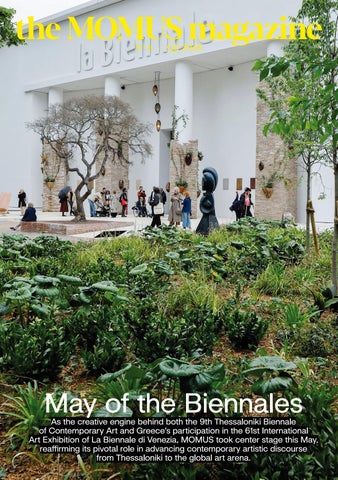
As the creative engine behind both the 9th Thessaloniki Biennale of Contemporary Art and Greece’s participation in the 61st International Art Exhibition of La Biennale di Venezia, MOMUS took center stage this May, reaffirming its pivotal role in advancing contemporary artistic discourse from Thessaloniki to the global art arena.
The MOMUS Magazine is a quarterly publication available free of charge at MOMUS museums in Thessaloniki and Athens, as well as at selected distribution points and online. Any reproduction, redistribution, or adaptation of the magazine’s content, whether in full, in part, summarized, paraphrased, or otherwise rendered by mechanical, electronic, photocopying, or recording methods is strictly prohibited without prior written consent from the publisher, in accordance with Law 2121/1993 and applicable international legal provisions in Greece.
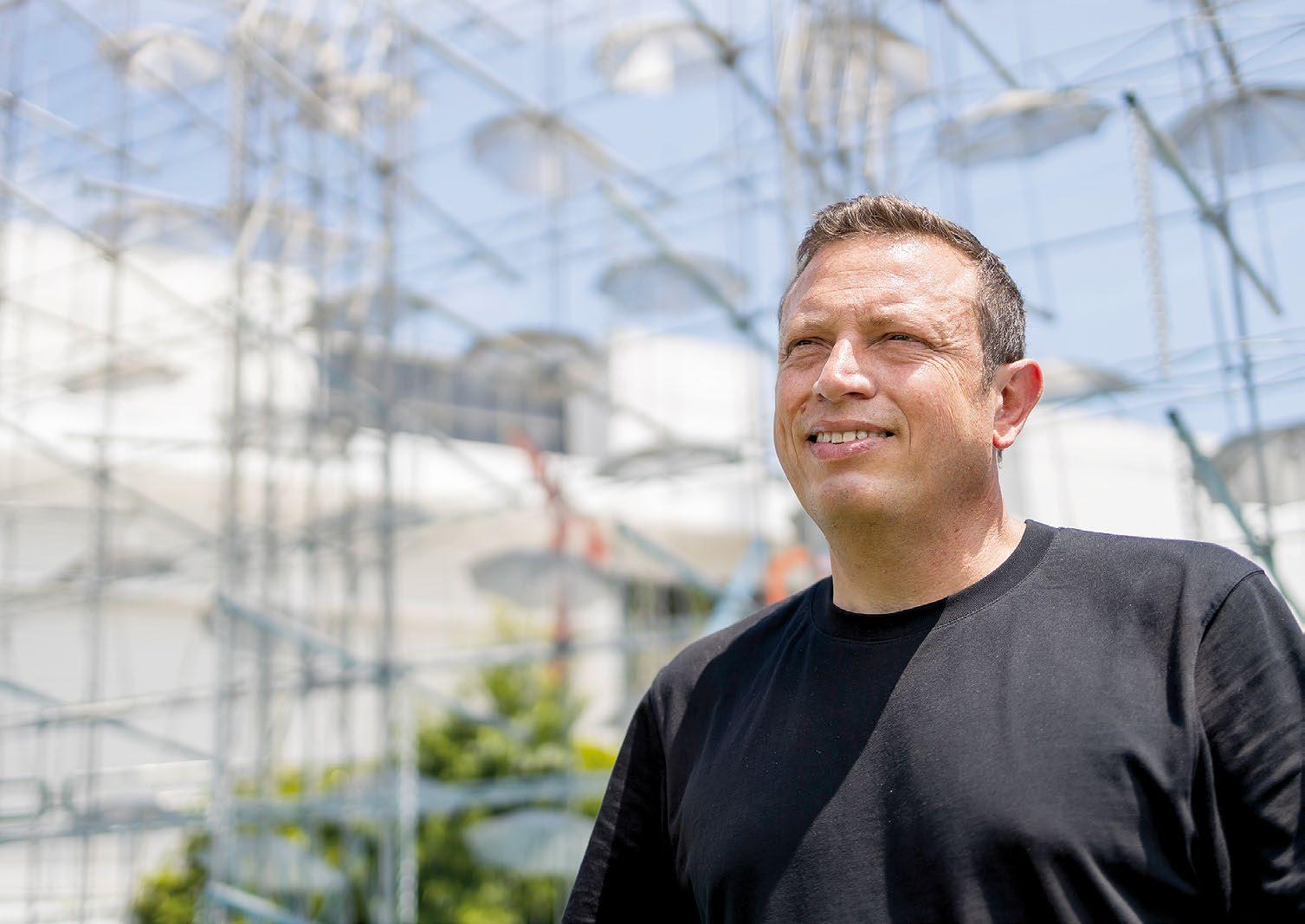
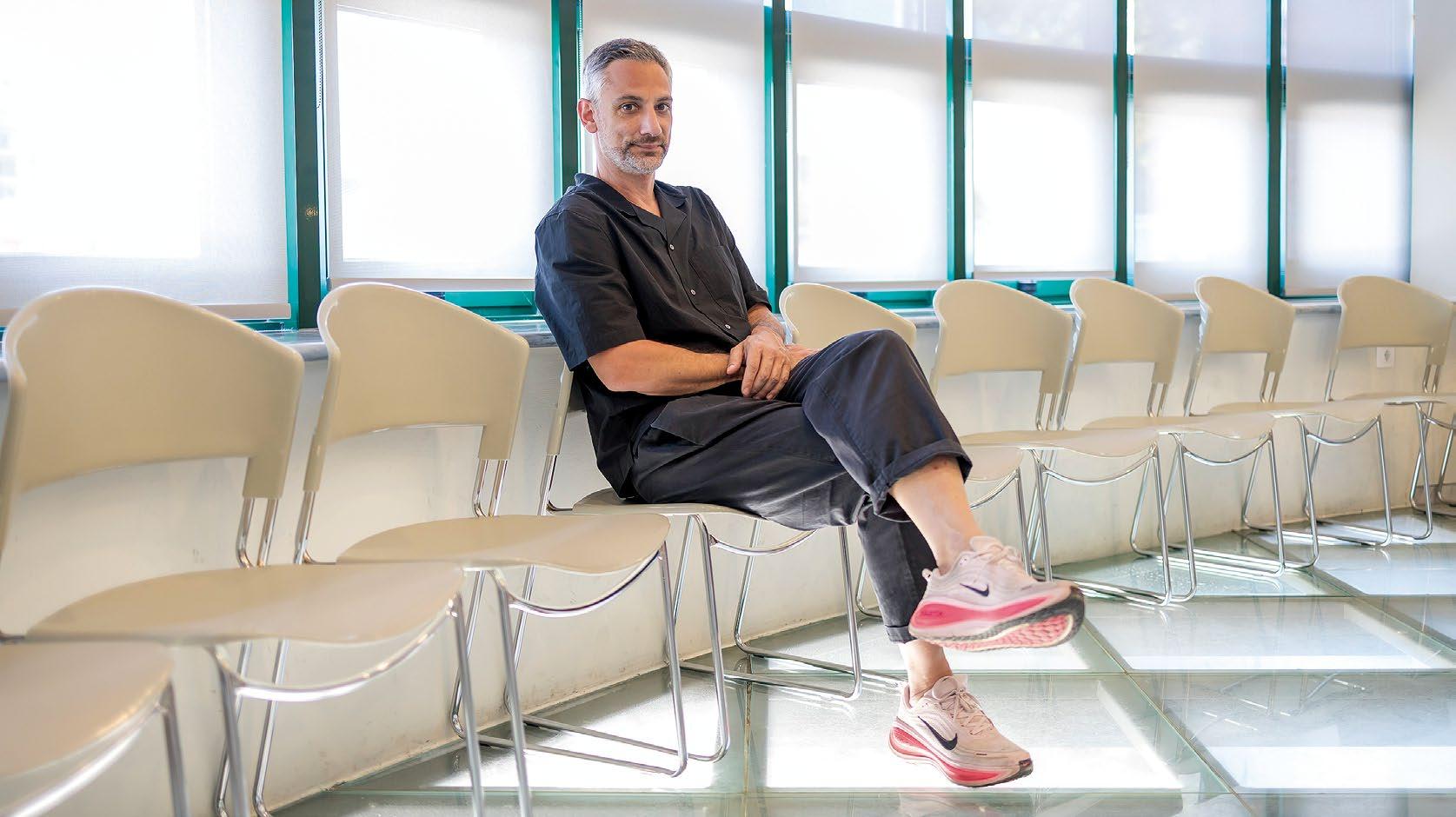
In my work, I learn something new every day. Admittedly, when I started out at MOMUS, my knowledge of contemporary and modern art was almost non-existent. I didn’t know there was even a difference between the two, and movements like Suprematism were just exotic, abstract words lacking content.
However, in my current role, and my previous ones as futurist, research policy consultant, or innovation and technology transfer consultant, I’ve always felt lucky. The reason is that I’ve had the opportunity to learn something new almost every day — from new clinical studies in the US on longevity to sustainable water purification practices in China that mimic natural ecosystems.
What we don’t know isn’t the problem. The problem is choosing not to keep learning.
Most of us know very little about contemporary art and that can be uncomfortable. It may even discourage us from visiting a museum. It’s never pleasant to admit, “I don’t know anything about this.” Yet, it’s worse to stop acquiring new knowledge: it shrinks our world, and limits us.
Here’s what I’ve learned. Modern art covers the late 19th century to about the 1970s, while contemporary art includes works created from the late 20th century to the present. I’ve also learned that Suprematism is one of the most radical movements in modern art; the first to liberate painting from the need to represent the natural world. It emerged in Russia in the early 20th century thanks to Kazimir Malevich, and we’re pleased to host impressive works from that period at the MOMUS-Museum of Modern Art.
Ultimately, though, it doesn’t really matter if you are, or aren’t, interested in learning about Popova or Warhol, and you certainly don’t need to feel guilty about that. The teaching side of a visit is not our priority. What we seek is something more substantial: to create spaces where people meet and talk, places where art is not merely explained but experienced. Because the value of a museum visit isn’t always the acquisition of knowledge. Sometimes the value lies in the experience, the feeling, that moment when a work moves you, without knowing exactly why. And that alone is worth the visit. n
Epaminondas Christophilopoulos
MOMUS president
Έκθεση «László Moholy-Nagy. Light Play»
«Η
«László Moholy-Nagy. Light Play», που παρουσιάζεται έως τις 15 Νοεμβρίου 2026. Πρωτοπόρος του Bauhaus και από τις σημαντικότερες μορφές του μοντερνισμού, ο Λάζλο Μοχόλι-Νάγκι
Fotografiska-The Contemporary Museum of Photography, Art and Culture και του The Moholy-Nagy Estate.
Exhibition “László Moholy-Nagy. Light Play”
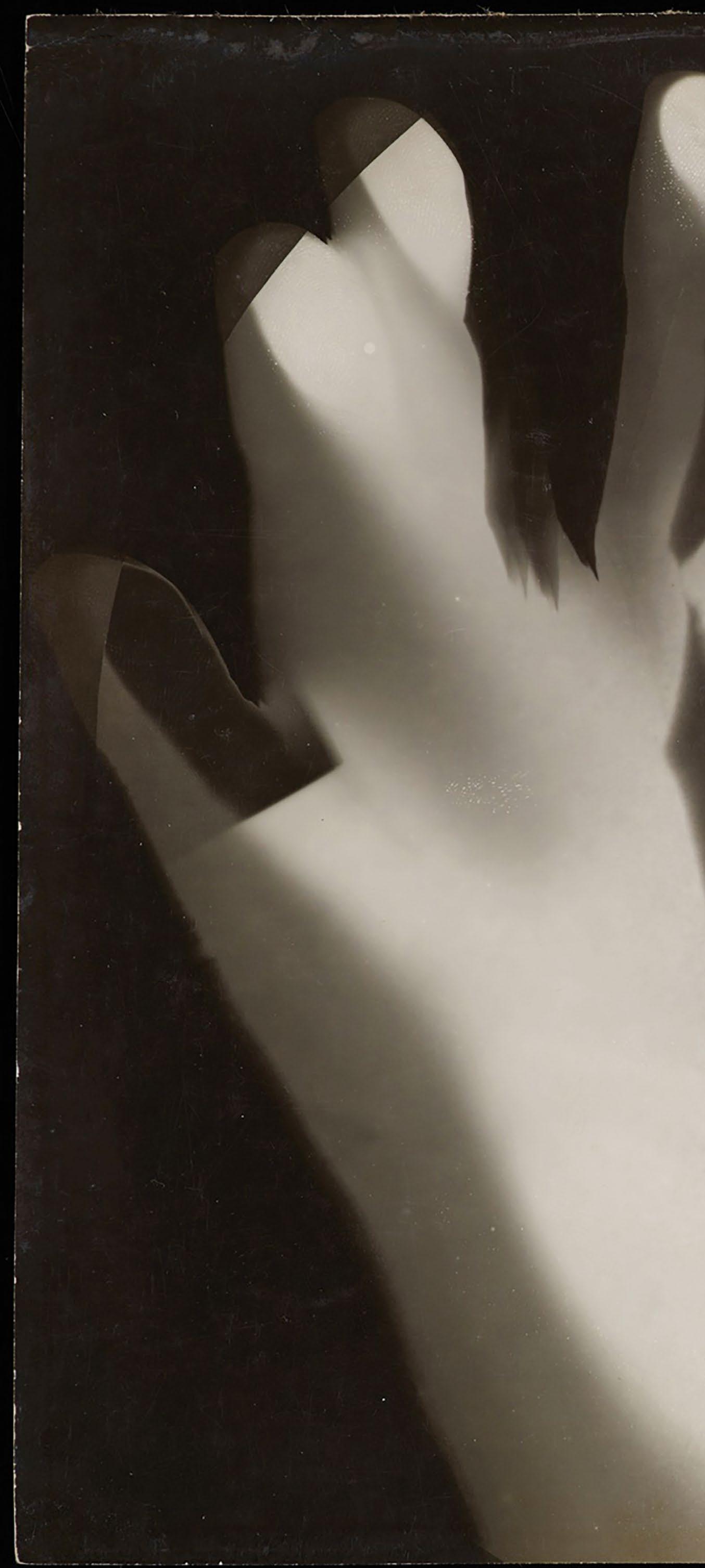
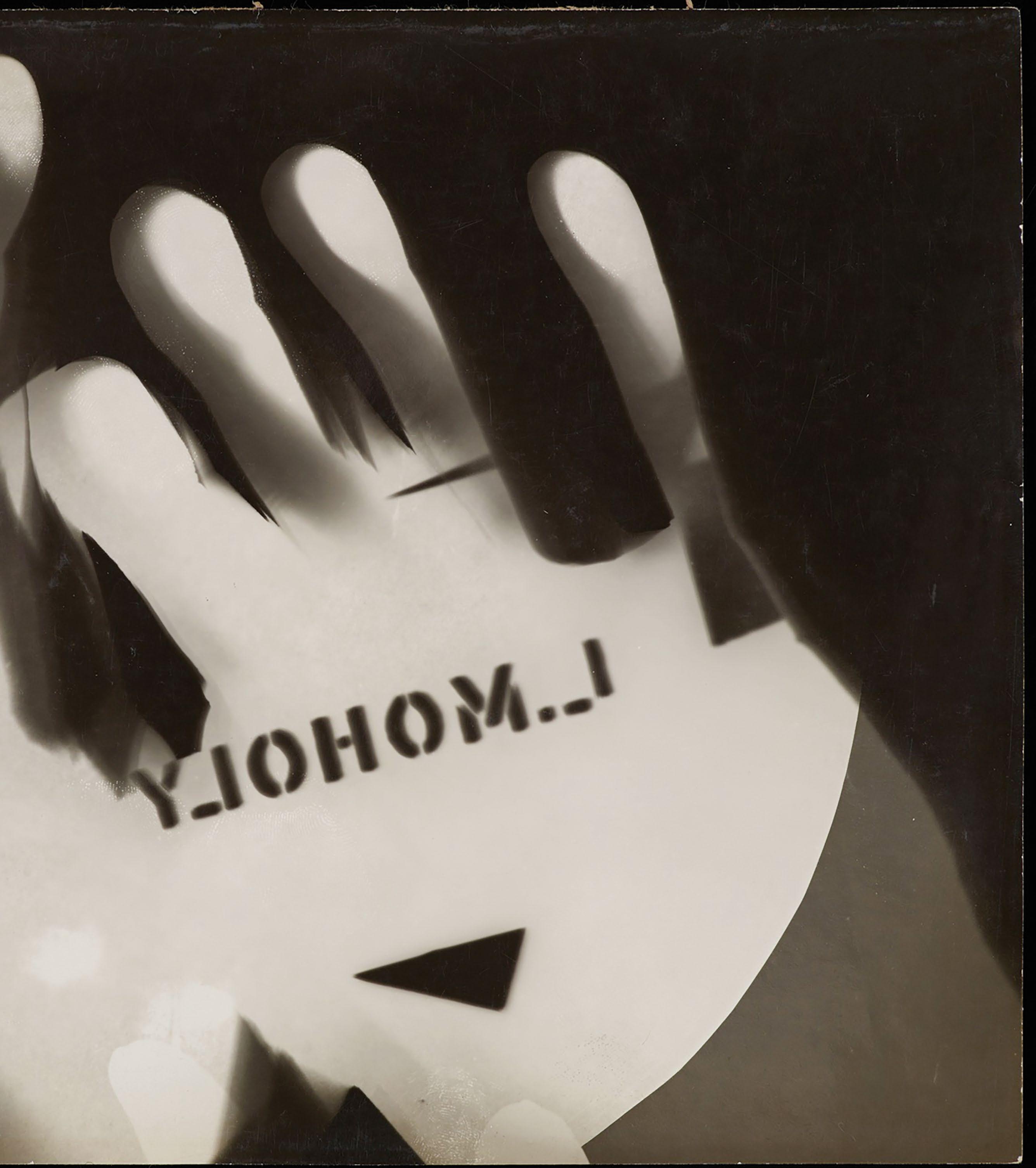
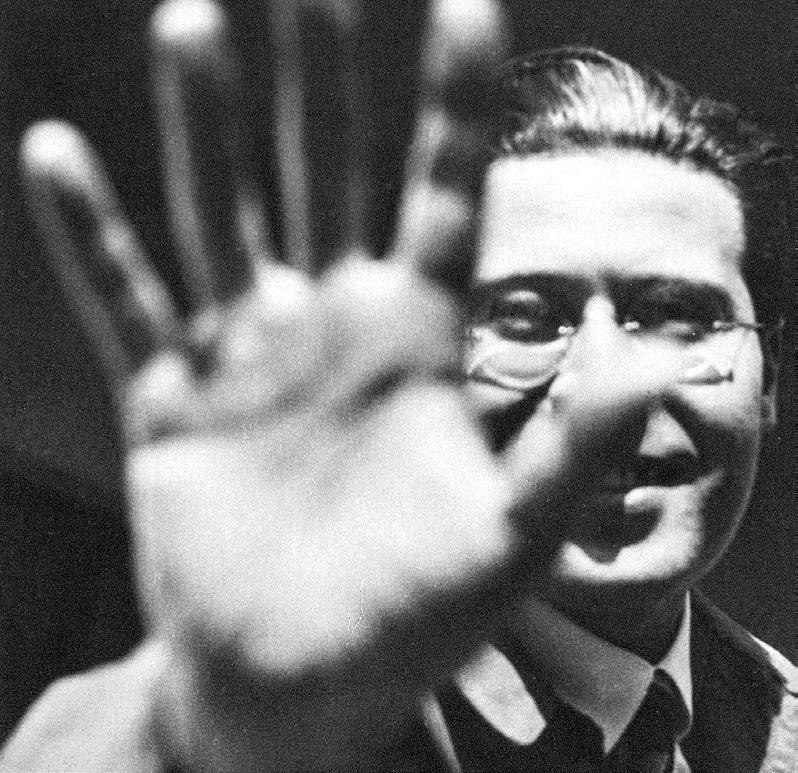
“A knowledge of photography is just as important as that of the alphabet. The illiterate of the future will be ignorant of the use of camera and pen alike.” With this enduring statement by László Moholy-Nagy (1895-1946), MOMUS-Thessaloniki Museum of Photography welcomes visitors to the major exhibition “László Moholy-Nagy. Light Play,” on view until November 15, 2026.
A pioneering figure of the Bauhaus and one of the most influential artists of modernism, Moholy-Nagy approached photography as a field of experimentation and discovery. Through photomontages, unusual viewpoints, photograms and innovative explorations of light, he developed a new visual language that profoundly influenced contemporary photography, design and film.
Bringing together 68 works from Europe and the United States, the exhibition highlights Moholy-Nagy’s radical approach and the enduring legacy of the Bauhaus. Educational programmes, guided tours and workshops further invite visitors to explore the creative potential of light and image through the work of one of the great innovators of photographic art.
The exhibition is co-organised by MOMUS-Thessaloniki Museum of Photography, Fotografiska-The Contemporary Museum of Photography, Art and Culture, and The Moholy-Nagy Estate.
Curator: Jessica Jarl, Global Director of Exhibitions/Fotografiska. Curatorial adaptation: Areti Leopoulou, deputy artistic director/MOMUS-Thessaloniki Museum of Photography, and Iraklis Papaioannou, curator. n
Estate of László Moholy-Nagy.
“Untitled Photogram (Hands),” 1925-1926. Exhibition print, courtesy of the Estate of the László Moholy-Nagy.
MOMUS
focus
Where & when:
At MOMUS-Thessaloniki Museum of Photography (Warehouse A, Pier A, Port of Thessaloniki), until November 15, 2026. Before your visit, please check the MOMUS website (www.momus.gr) for any updates or changes to opening hours and visitor information.
Exhibition “Behind the doors. Costakis meets Rubinstein”
In Moscow during the second half of the 20th century, two collectors, George Costakis and Yakov Rubinstein, assembled in parallel two of the most significant private art collections of their time. Working within an environment of strict constraints, they chose to follow intuition, passion and a firm belief in the value of artistic creation.
The exhibition “Behind the doors. Costakis meets Rubinstein,” presented at MOMUS-Museum of Modern Art until January 10, 2027, brings these two collecting trajectories into dialogue for the first time. Rather than presenting opposing narratives, it reveals two distinct perspectives on the same historical period, the same city and the same questions surrounding art and modernity.
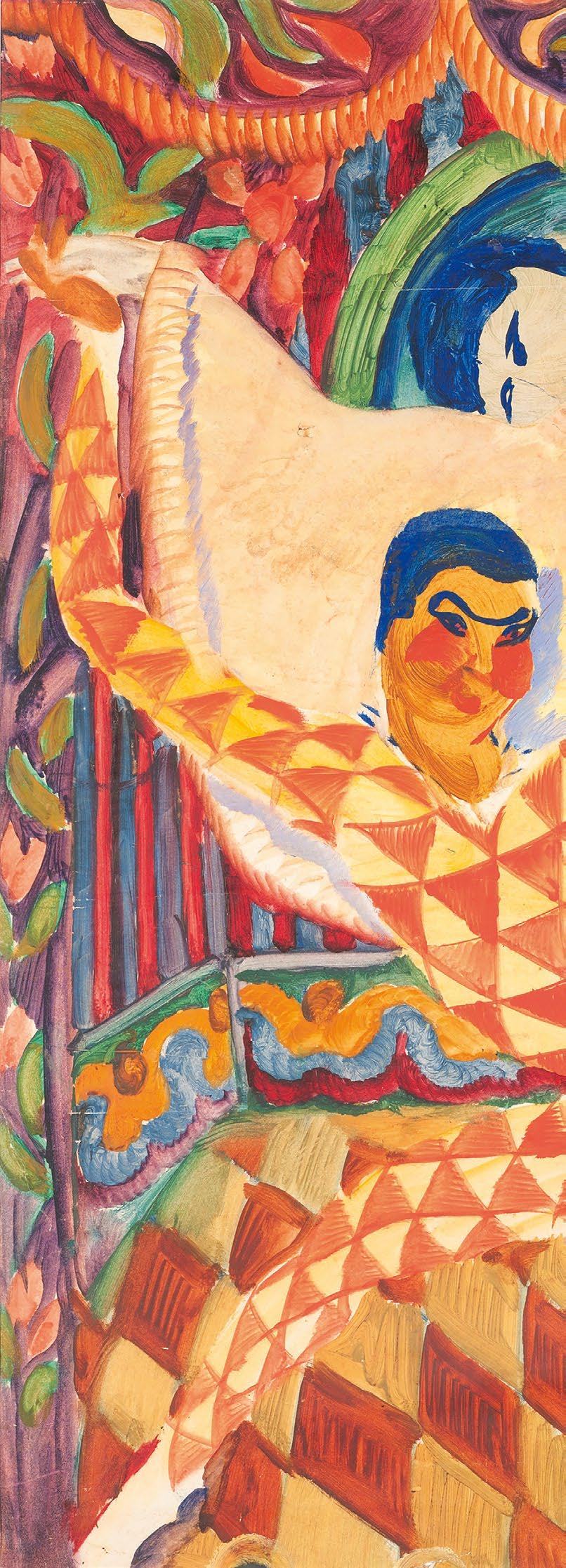
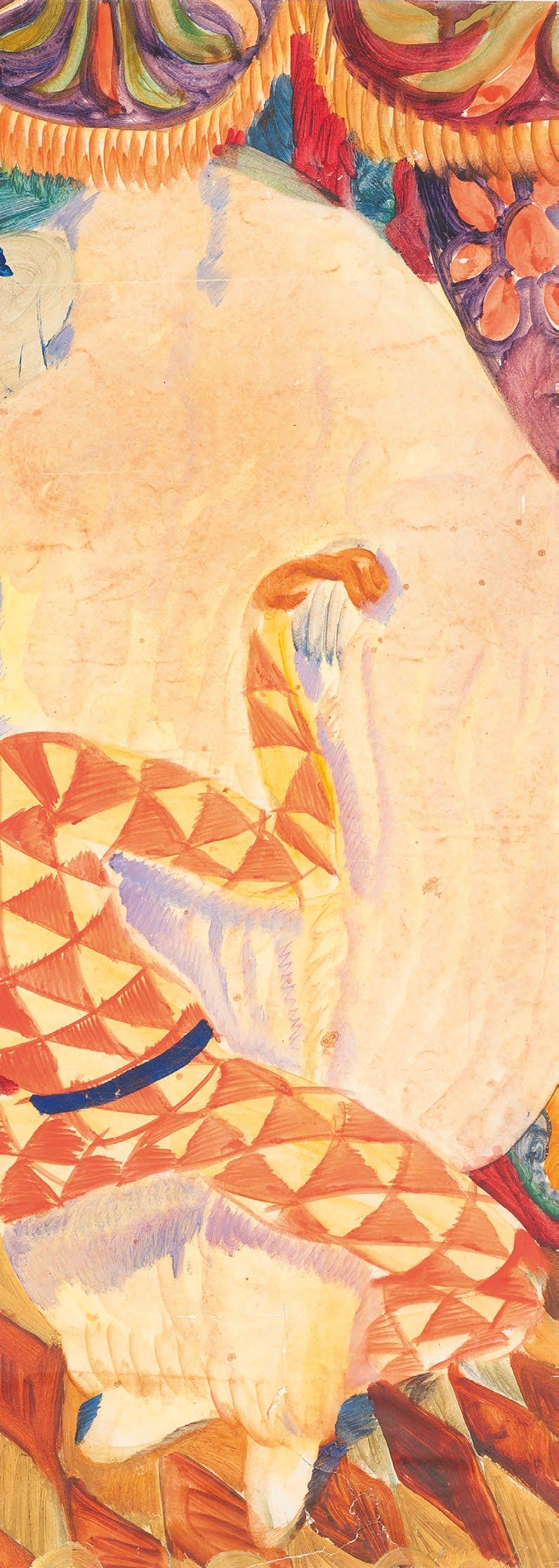
Of Greek origin, George Costakis became the world’s foremost collector of the Russian Avant-Garde, while Yakov Rubinstein focused on Modernism and Symbolism, theatre, stage and costume design, and the illustration of fairy tales and literary narratives. Female figures, fairy tales and literary stories, domestic interiors, marginal figures and a rare group of works created in the Gulags come together in an exhibition that highlights the enduring power of art and human creativity.
Curated by: Liubov Pchelkina. n
MOMUS focus
Αλεξάντερ Γιάκοβλεφ, «Αρλεκίνος και Πιερότος», 1914. Yδατογραφία και
Ρούμπινστάιν.
Alexander Yakovlev, “Harlequin and Pierrot,” 1914. Watercolor and gouache on paper. Yakov Rubinstein Collection.
Πού & πότε:
MOMUS (www.momus.gr)
Where & when:
At MOMUS-Museum of Modern Art-Costakis Collection (21 Kolokotroni Str., Moni Lazariston, Thessaloniki), until January 10, 2027. Before your visit, please check the MOMUS website (www.momus.gr) for any updates or changes.
Έκθεση
«Γελοιοποιώντας τον ΣοβιετικέςΜοντερνισμό.
Exhibition “Caricaturing Modernism: Soviet Cartoons on Art from the collection of Yuri Albert”
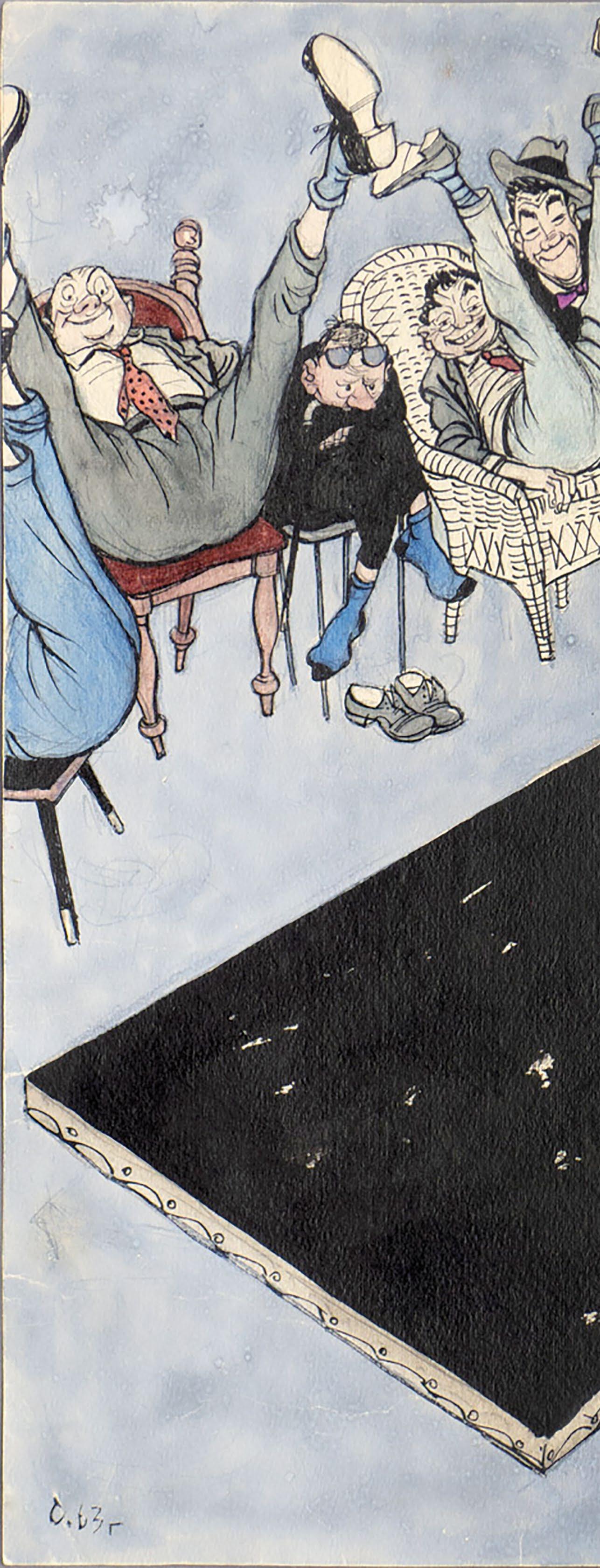
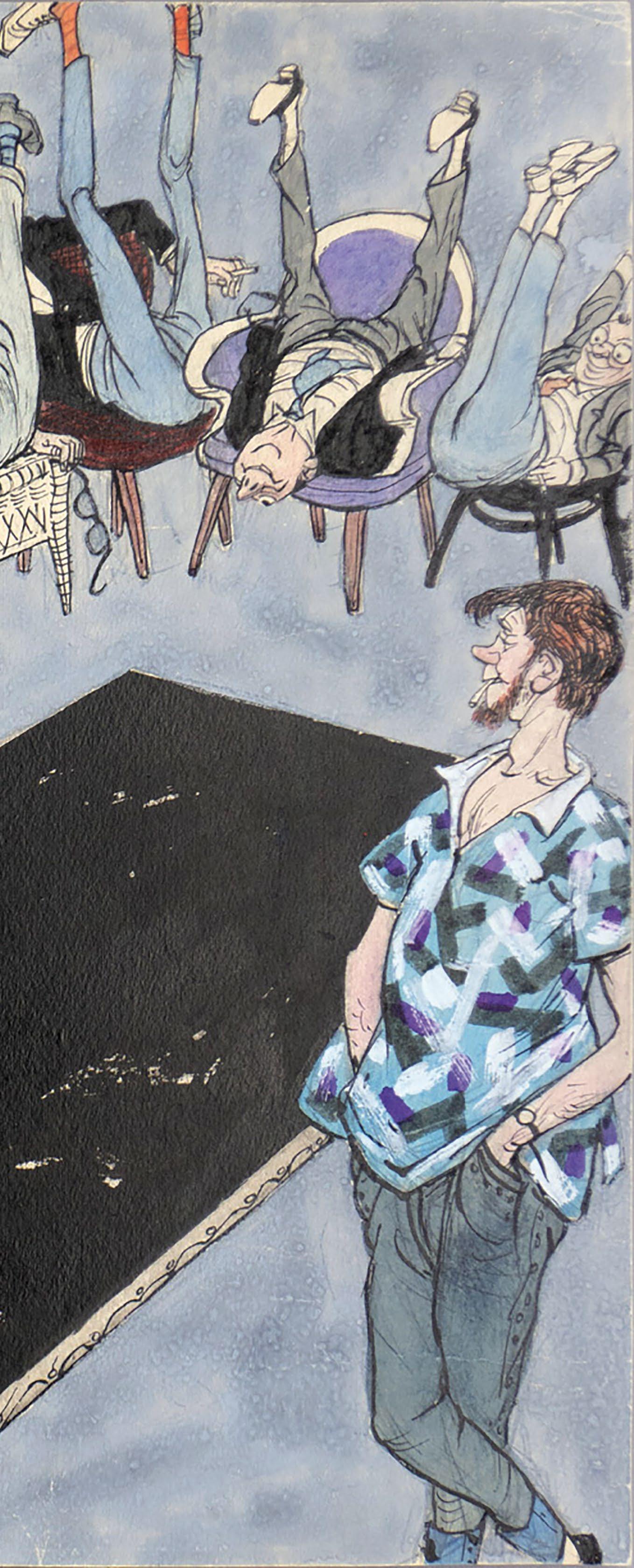
A peculiar, extremely interesting “war of images,” in which humour emerges as an ideological and timeless means of expression, reflected in the exhibition “Caricaturing Modernism: Soviet Cartoons on Art from the Collection of Yuri Albert,” presented at MOMUS-Museum of Modern Art-Costakis Collection until January 10, 2027. Through a rare set of 24 caricatures created between 1930 and 1970 and published in the magazine Crocodile and other publications, visitors discover the multi-layered everyday life of Soviet society, the relationships between artists and authority, the privileges and fears of creators, as well as the ideological “battle” of Socialist Realism against the “decadent” art of the West. The collection was assembled by the conceptual artist Yuri Albert, who became fascinated by these images because of their peculiar relationship to reality. At the same time, the exhibition enters into dialogue with works from the Costakis Collection, revealing not only a clash of aesthetic values but also the mechanisms through which ideology shapes the reception of art.
Curated by: Maria Tsantsanoglou, artistic director of MOMUS-Museum of Modern Art-Costakis Collection. n
MOMUS focus
Ιβάν Σεμιόνοφ, «Εγκρίθηκε ομόφωνα, με μία αποχή», 1963. Μελάνι και υδατόχρωμα σε χαρτί, 46,2x36,7 εκ. (παραλλαγή που δημοσιεύτηκε στο περιοδικό Κροκοντίλ αρ. 35, 1962).
Ivan Semenov, “Approved unanimously, with one abstention,” 1963. Ink, watercolour on paper, 46,2x36,7 cm (version published in Krokodil magazine No. 35, 1962).
Πού & πότε: Στο MOMUS-Μουσείο Μοντέρνας
MOMUS (www.momus.gr) για τυχόν αλλαγές.
Where & when:
At MOMUS-Museum of Modern Art-Costakis Collection (21 Kolokotroni Str., Moni Lazariston, Thessaloniki), until January 10, 2027. Before your visit, please check the MOMUS website (www.momus.gr) for any updates or changes.
The archivist’s eye
Angeliki Charistou is head of the Costakis Collection & Archive, and for twenty-five years has been involved with the Russian Avant-Garde. Active and widely traveled, she’s taken part, among others, in Contemporary Art Biennales and takes immense joy in the brilliant minds she encounters through her work.
interview: john papadimitriou
portrait: sakis gioumpasis
I was born and raised in Thessaloniki, as were my parents. I was a student at the Department of History & Archaeology of the Aristotle University of Thessaloniki, where I specialized in Archaeology and Art History. From my very first courses, I found myself especially drawn to Art History, and in 2001, during my third year as an undergraduate, I began an internship at the, then, relatively newly established State Museum of Contemporary Art (SMCA). There, I was introduced to the Russian Avant-Garde while working on the Collection’s first exhibition in Thessaloniki, and the museum’s legacy, “Masterpieces from the Costakis Collection.” This took place a few years after the now iconic 1995 exhibition at the National Gallery, curated by Anna Kafetsi.
The exhibition grounded my focus on the Russian Avant-Garde. Determined to pursue this field, I intensively studied the Russian language, as the subject wasn’t taught at any Greek university at the time. This eventually led me to Scotland, where I completed a postgraduate degree in the Department of Art History at the University of St. Andrews. There, I had the op-
MOMUS backstage
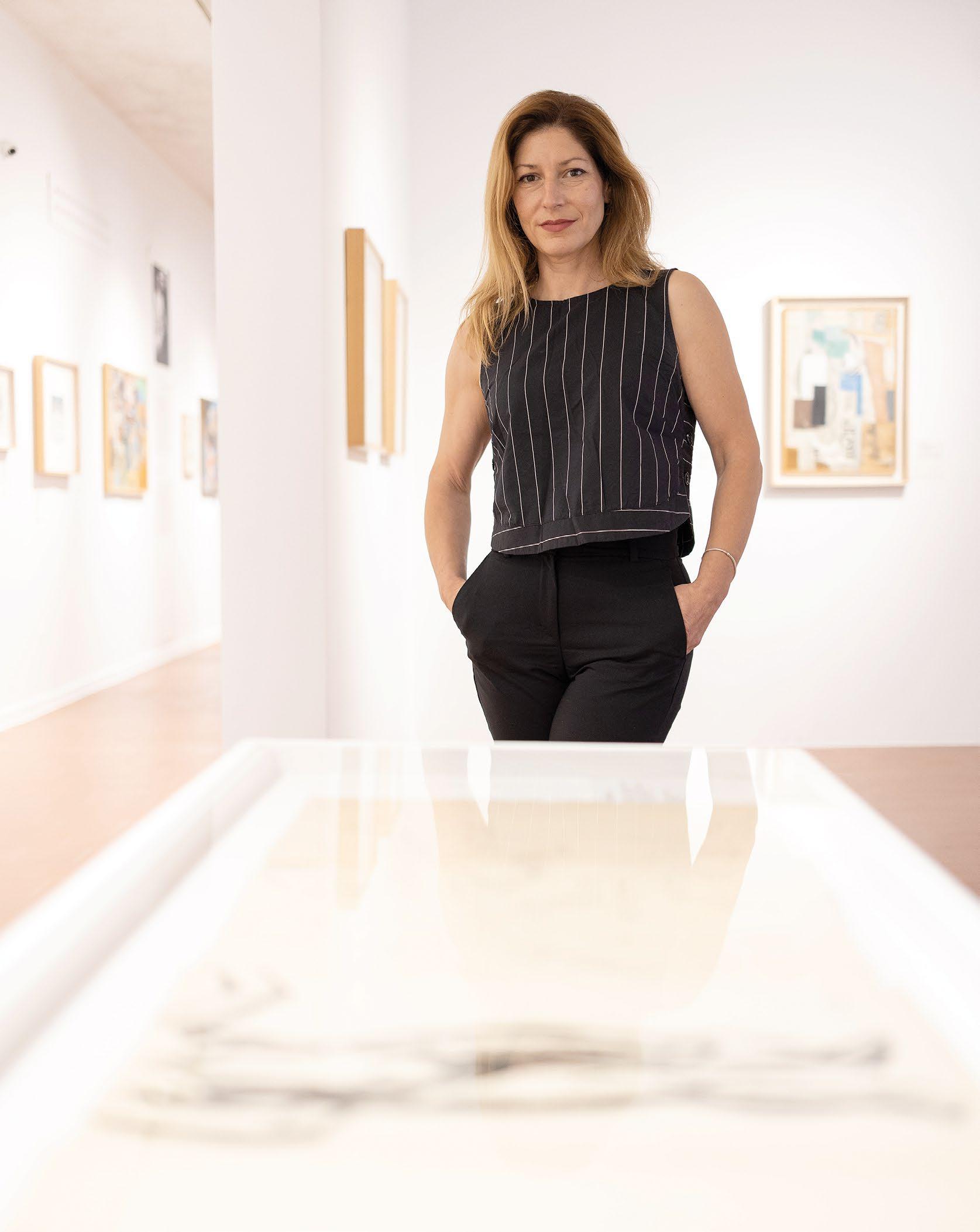
“The museum is regularly visited by researchers and students from all over the world, who come to study the Collection, and especially the Costakis Archive, which I consider to be its hidden treasure” states Angeliki Charistou during her discussion with the MOMUS magazine.
«Russian Constructivism» (1983).
«Rodchenko and Popova. Defining Constructivism» το 2009.
MOMUS backstage
portunity to be taught by Christina Lodder, author of the seminal Russian Constructivism (1983), among other influential works. Upon returning to Greece, I rejoined the State Museum of Contemporary Art and the Costakis Collection under the directorship of Maria Tsantsanoglou. Among the dozens of exhibitions and international collaborations that followed, one that remains particularly vivid in my memory is “Rodchenko and Popova: Defining Constructivism” (2009).
The collection’s mobility has positioned the museum among a global network of institutions, challenging us to create high-level exhibitions while maintaining a sense of moral responsibility toward the collector who devotedly preserved an entire era of art. We also feel responsibility toward the artists themselves. Exhibitions such as “Solomon Nikritin. Heeding Life” (2023) were more than original curatorial proposals. They played an important role in bringing attention to artists and aspects of the Russian Avant-Garde that had remained obscure until then. It often feels like a dream to work alongside distinguished researchers and curators whose writings once guided my own research, such as John E. Bowlt and Nicoletta Misler.
The museum is regularly visited by researchers and students from all over the world, who come to study the Collection, and especially the Costakis Archive, which I consider to be its hidden treasure. It’s an extraordinary collection of manuscripts, photographs, magazines, and prints that reveal its historical context and artistic everyday life in full dimension, but more importantly it documents the collector’s own effort to map the era as a tool for his research. Indicative of the value of the Costakis Archive is the collection of numerous manuscripts by artist Ivan Kliun, which is unique in the world.
A time that stands out in my own personal journey was my experience working on the National Pavilion of Armenia at the 56th Venice Biennale, curated by Adelina von Furstenberg. The exhibition took place on the islet of San Lazzaro degli Armeni, within the historic Armenian monastery, and brought together 16 Armenian diaspora artists. We were housed in the, then, semi-abandoned Palazzo Zenobio in Dorsoduro, which the artists collectively transformed and decorated. At midday, we would eat in the dining room alongside the monks. The culmination of this collective effort and almost magical experience was the Golden Lion award — and, on a personal level, the joy of observing Anna Boghiguian at work. Those of us who work in this field are often fortunate enough to encounter brilliant minds, and that’s the greatest reward of all. n
“A time that stands out in my own personal journey was my experience working on the National Pavilion of Armenia at the 56th Venice Biennale, curated by Adelina von Furstenberg.”
City of makers
In an interview with the MOMUS magazine, Vangelis Liakos, co-founder of Beetroot design studio, tells us about Thessaloniki’s creative energy, art’s encounter with design, and MOMUS’ role as a cradle of culture.
interview: john papadimitriou
portrait: sakis gioumpasis
What is your earliest memory of MOMUS? Do you remember your first exhibition or visit to one of its museums?
My first visit was in the late 1990s as an undergraduate, a time when I started exploring art, and its presence, in the city: collections, artists, installations, lighting, and the spaces themselves. I still recall my first encounter with the Costakis Collection, the magnificent sculptures of Niki de Saint Phalle, Adam and Eve, as well as the installations of Philolaos Tloupas. It was then that I realized what I feel inside a museum is the same as what some people feel inside a church. A few years later, in 2012, we presented our own exhibition, “The Greek Monsters,” at the Museum of Contemporary Art — a once-distant wish that became a reality.
If you could take home one work of art from any MOMUS collection, which one would it be and why?
Certainly, a work from the Russian Avant-Garde. The experience of the Costakis Collection was one of those moments that steered my professional journey.
What are your thoughts on this year’s 9th Thessaloniki Biennale of Contemporary Art? What impressions did it leave on you?
I’ve already visited twice, and intend to visit at least two more times, accompanying international creative professionals hosted by Beetroot within the framework of Tiny Walks Thessaloniki, because I feel it’s important to promote such initiatives beyond Greece. I believe that the existence and continuity of
my MOMUS
“Truth be told, the cultural field in our country is largely dominated by the ancient. This certainly holds non-negotiable value, but at times it can also strangle newer forms of creation.”
the Biennale institution —regardless of one’s opinion of each artistic proposal— demonstrates the city’s creativity and resilience, as it continues to produce culture against all odds.
In Greece, do you believe contemporary art and design enter in enough of a dialogue, or is there a gap that needs to be bridged?
Truth be told, the cultural field in our country is largely dominated by the ancient. This certainly holds non-negotiable value, but at times it can also strangle newer forms of creation. Taken from this angle, contemporary art and design share an eclectic affinity. Even through they’re different approaches, they essentially pursue the same goal: to create contemporary culture. There’s certainly room to broaden and deepen the interaction between art and design. It’s worth noting, however, that the cultural field is one
my MOMUS
of the largest employers of the design industry and one of its most sought-after “clients,” as it offers significant creative freedom and, precisely, the opportunity to engage with Greek art of every era.
Are designers the “last knight and shining armors” of culture in Thessaloniki, considering many artists are moving to Athens?
Quite the opposite. In recent years, I have observed a steadily growing creative energy across many fields. Exhibitions and events featuring visual works, installations, and new media art are hosted in both traditional and unconventional spaces. New venues are opening that support teaching, production, as well as theater, dance, and music performances, often with strong elements of experimentation and avant-garde practice. Design certainly has its place within this creative effervescence, but it’s encouraging that each new generation in the city continues to create across every medium. Music, however, has been and remains the leader of the city’s artistic production. From the era of rebetiko to modern Greek rap, Thessaloniki has given rise to and hosted musical artists across a wide range of genres, with an audience that embraces every kind of musical event — from neighborhood bouzoukia to Reworks.
What more would you like to see in Thessaloniki’s cultural landscape in the coming years?
I’d like to see more people participating in the city’s cultural events, and more meaningful investment in art. I’d like us to bring art into the streets with performances in public spaces, more sculptures integrated into the urban fabric, and greater recognition and visibility for street art. I’d like to see the creation of spaces for experimentation and exhibition, as well as the opening of communication channels that attract new audiences. I’d also like Thessaloniki’s cultural scene to secure substantial sponsors willing to support new, bold ideas, and to turn culture into an exportable product.
What do you believe is MOMUS’ role within the broader cultural ecosystem of Thessaloniki and the country?
It’s a vital institution for the flourishing and prosperity of culture in the city. It has earned public trust, and its signature now carries significant weight. This brings influence but also great responsibility, as it has the ability to educate and guide audiences in their engagement with art and culture. Perhaps the most important achievement is that MOMUS is no longer simply a venue or a space that hosts works of art. It’s now a cradle, a space that produces and cultivates culture.
To what extent do aesthetics and contact with culture influence the way we perceive and plan our daily lives? Can this be taught?
The quick answers are “to the greatest extent” and “certainly.” But realistically, it’s a question open for debate and, in a way, a great pity for those of us in the field. Unfortunately, for years we have been trapped in the fast and cheap, in a kind of contractor-driven design of everything, from consumer goods to the way we communicate and entertain ourselves, and even with food, where we now see a similar shift. Easy, fast, low-cost, uniform, without risk, originality, or experimentation. This contractor-led aesthetic of everything the same flattens our critical capacity and ability to appreciate what is aesthetically and culturally valuable.
On the flip side, I’m also observing a flourishing of the arts and, more broadly, within the field of creation: people who envision, experiment, dare, and create. A surplus value that occasionally emerges and, personally, gives me great optimism for the future. I feel confident that this renewed creative approach will highlight the value of aesthetics, allow it to permeate more widely, and ultimately help shape a new identity for the city. n
Draft culture
MOMUS releases its first beer.
text: john papadimitriou
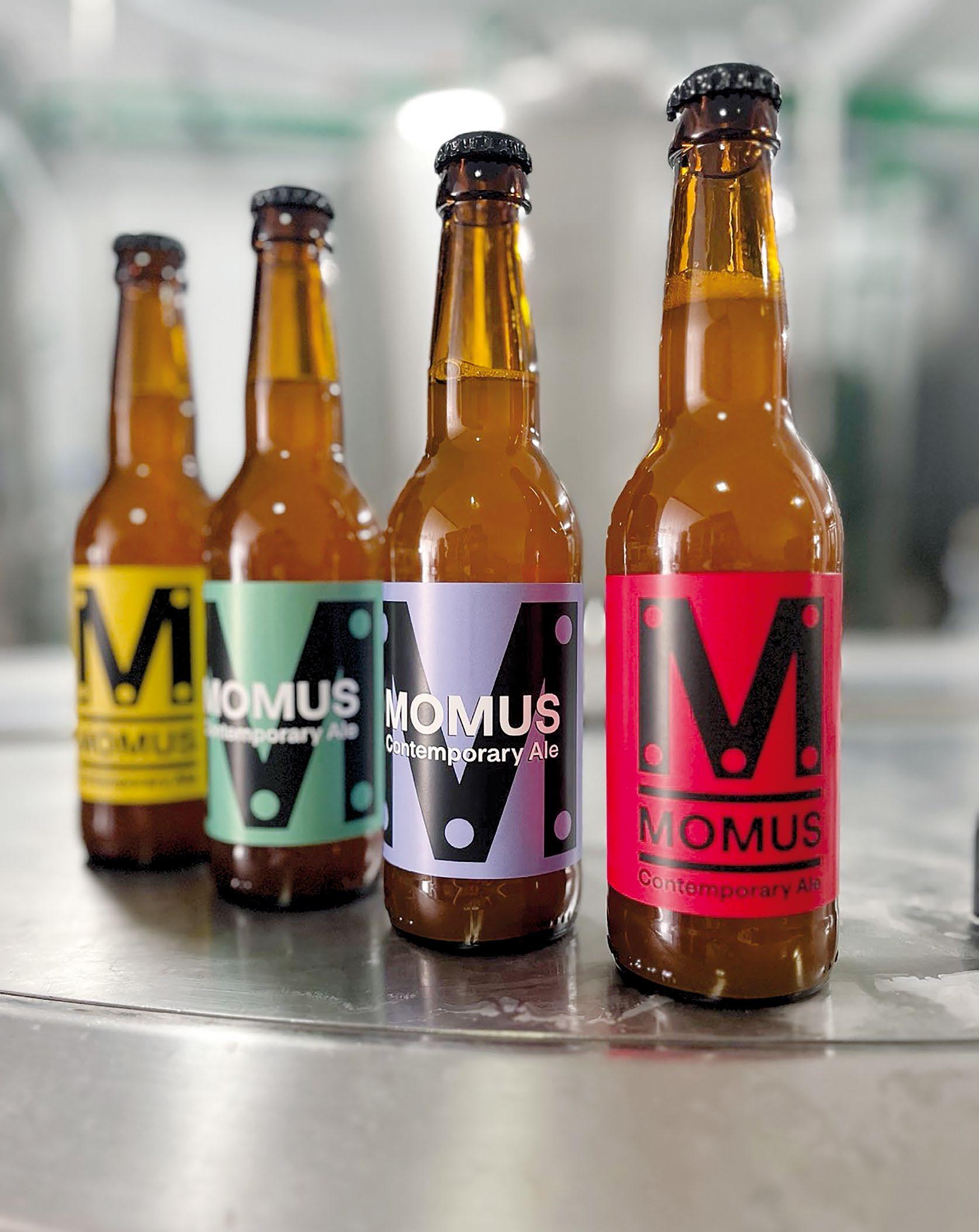
In mid-June, and in collaboration with Kavala-based Microbrewery Marmita, the Metropolitan Organisation of Museums of Visual Arts of Thessaloniki presented its first beer, released under four different labels. Its design was the brainchild of MOMUS’ creative team, aligning with the Organisation’s new visual identity while drawing inspiration from the aesthetics of Marmita: simple composition, bright colors (purple, red, green, yellow) and a dominant logo, capturing the modern and recognizable character of MOMUS.
“We’re always looking for ways to communicate with different audiences, and as an organisation we want to express an identity of innovation through offerings that differentiate us. And hence, the idea of a MOMUS beer came to life thanks to our excellent collaboration with Marmita. A new flavor with labels inspired by our philosophy. Additionally, it’s a new way to increase our revenue, as sales will only strengthen our operations and exhibition program,” says Epaminondas Christophilopoulos, president of MOMUS.
On his end, Vangelis Fakas, the brewery’s cofounder notes: “We brought together two worlds that share the same values: creativity, innovation and authentic expression. This is a beer that wasn’t created to accompany a cultural event, but, instead, offers a different way of approaching contemporary art through a product inextricably linked to socializing, meeting and exchanging experiences.”
It’s a New Age Pale Ale with 4.5% alcohol, light and easy to drink, with a bold character made of Azacca, Citra and Mosaic hops. Notes of tropical and citrus fruits combined with a discreet bitterness offer a balanced tasting experience. It’s initially available in MOMUS museum cafés and shops, with plans to expand distribution across Thessaloniki and the rest of Greece.
The Kavala Microbrewery was founded in 2017, to promote Greek unfiltered and unpasteurized high-quality craft beer. With an emphasis on know-how, raw ingredients, and the creation of products with a distinct identity, the Microbrewery insists on establishing partnerships that connect brewing, culture and local society — as it did with MOMUS. n
MOMUS tales
Soft revolt
The 9th Thessaloniki Biennale of Contemporary Art under the slogan “everything must change. Radical Intelligence. Saloniki 9,” examines the small, everyday acts of resistance (or discipline) as a stance towards life.
text: john papadimitriou
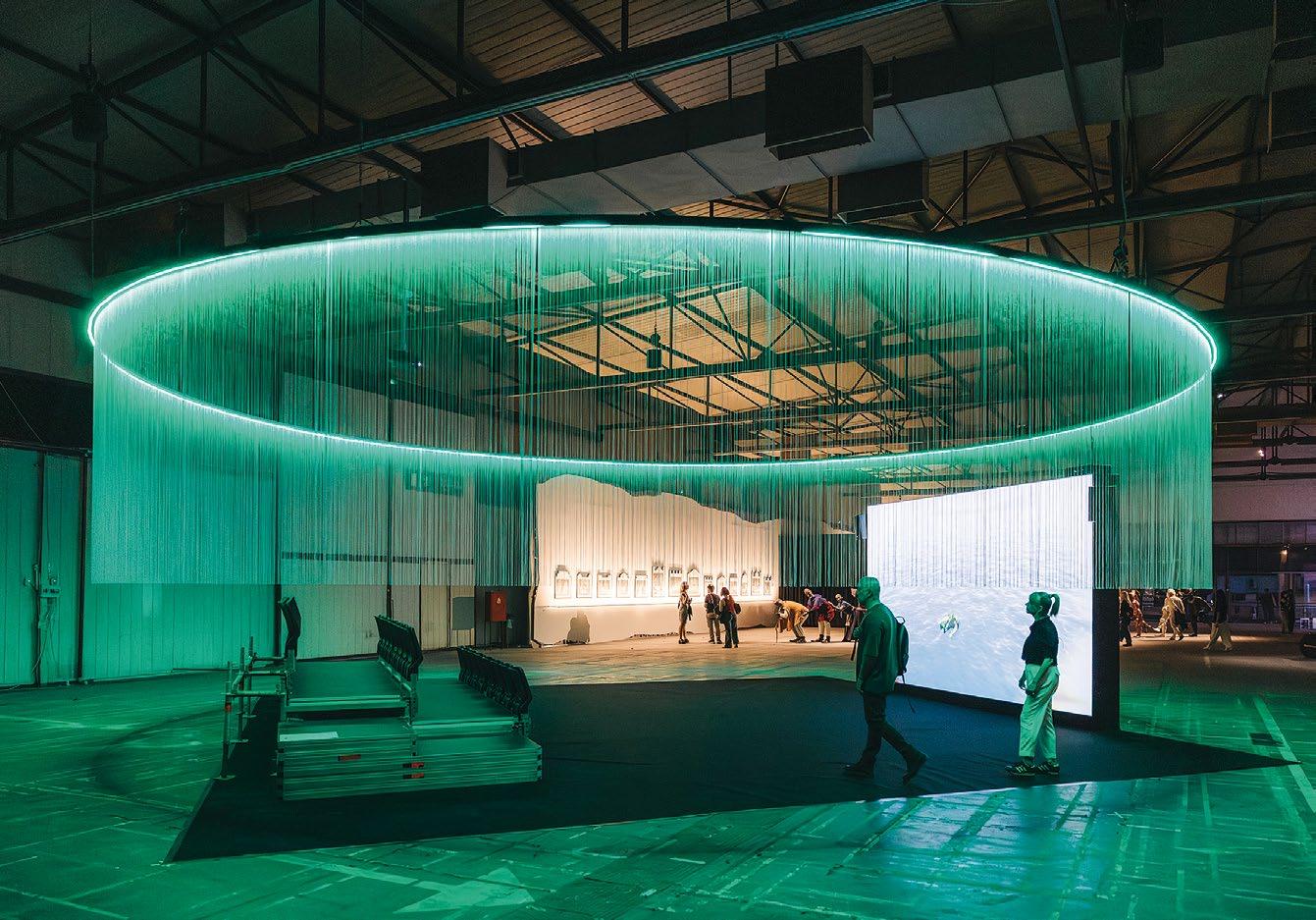
My two sons, five and nine years old, curiously cross the threshold of art installation “Last Resort,” observing with admiration an entrance that appears to be sewn from burlap. Over the gray canvas, crossed by vertical yellow and pink lines, black words such as “chaos” and “memory” are scattered. Is there another dimension over on the other side?
Holding hands, we peek inside: bright colors, a yellow net with neon letters announces the work’s title, and a mannequin from a clothing shop window resembles a human-robot. This is the work of artist and editor-in-chief of Bebabebo magazine, Marina Velisiotis, presented at the 9th Thessaloniki Biennale of Contemporary Art. It explores the notion of the last refuge: when the world collapses, what does shelter look like?
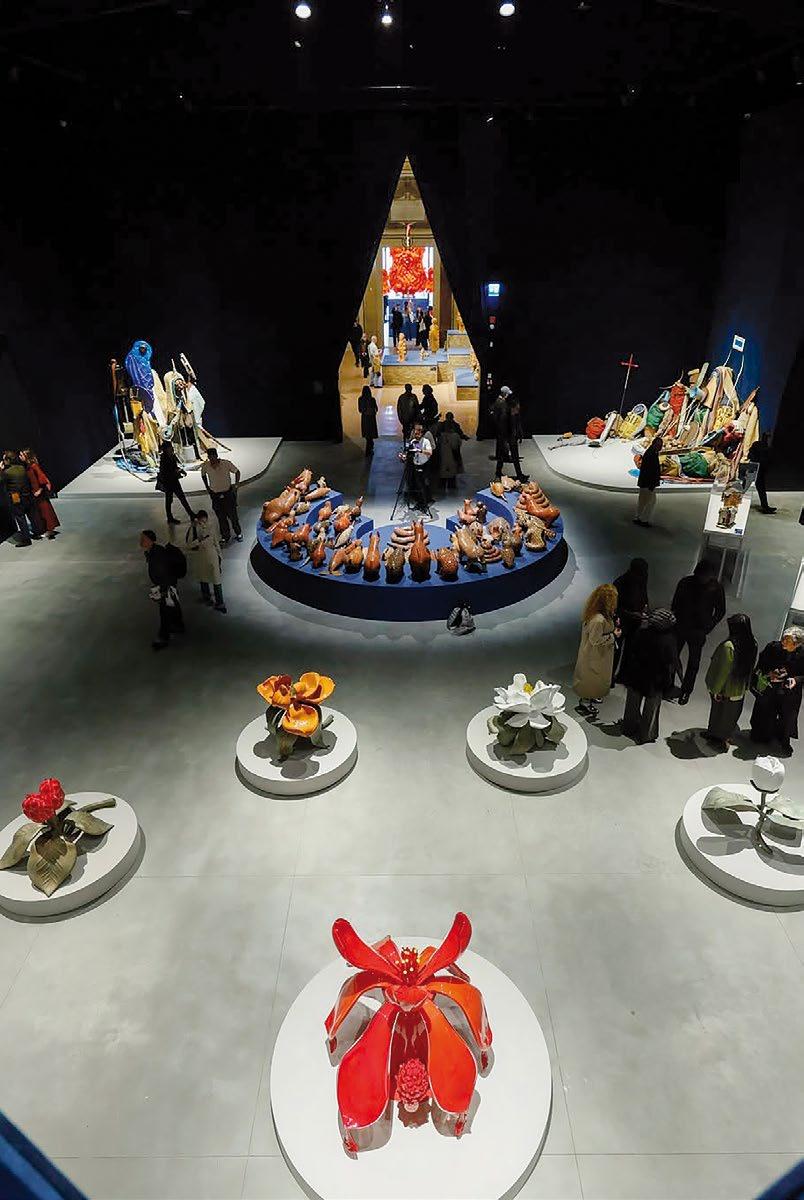
Regardless of the answer, the pioneering exhibition, installed in Pavilions 2 and 3 of the Thessaloniki International Fair and at MOMus-Museum of Contemporary Art, becomes a refuge of inspiration, reflection and creative thought. Free from stale clichés, common conventions, and oversimplistic interpretations, the ecosystem of works and actions at the 9th Thessaloniki Biennale of Contemporary Art is a field for collective and individual introspection. It’s no coincidence that the exhibition’s introductory text notes: “Revolution is like housework: it must be done daily.”
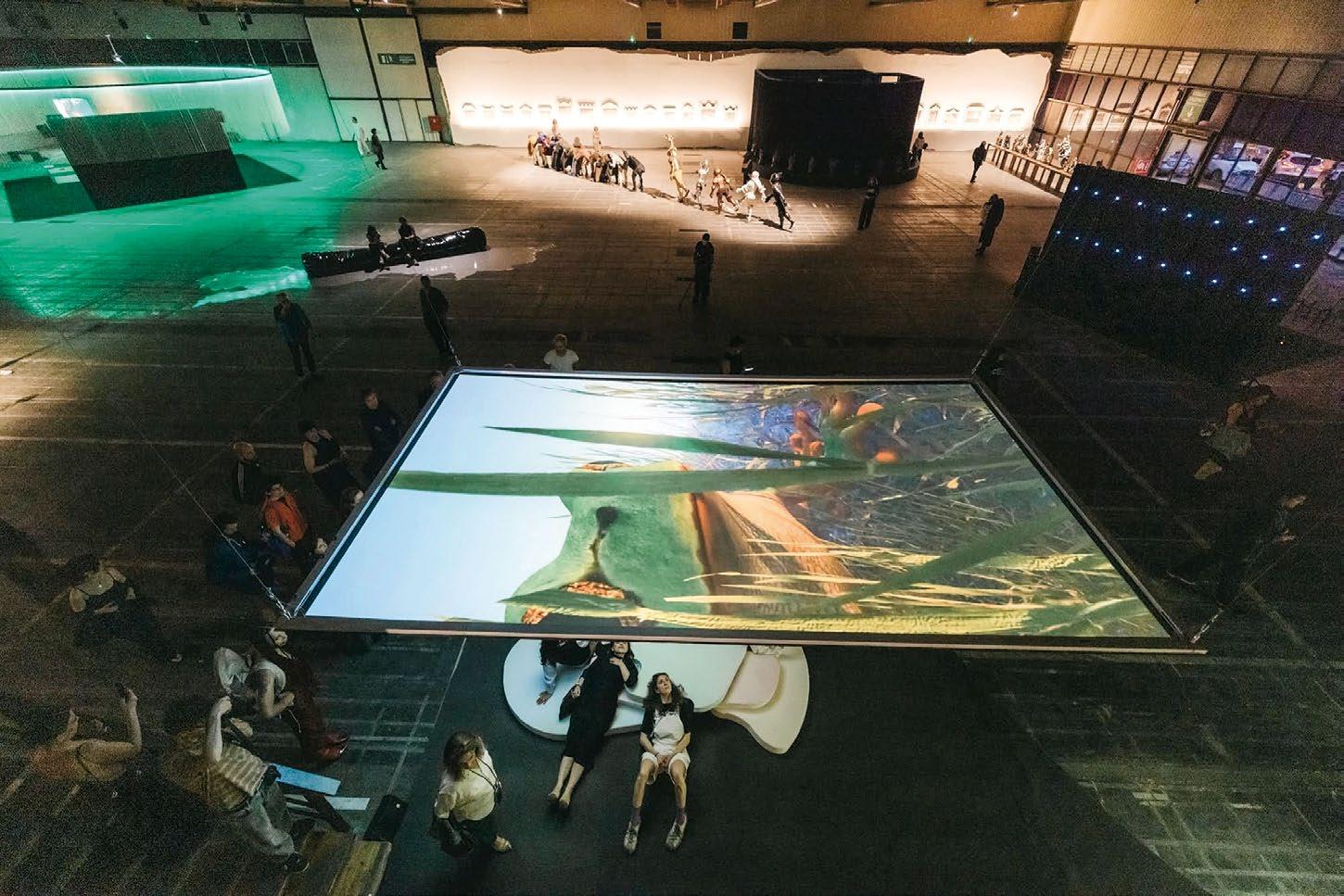
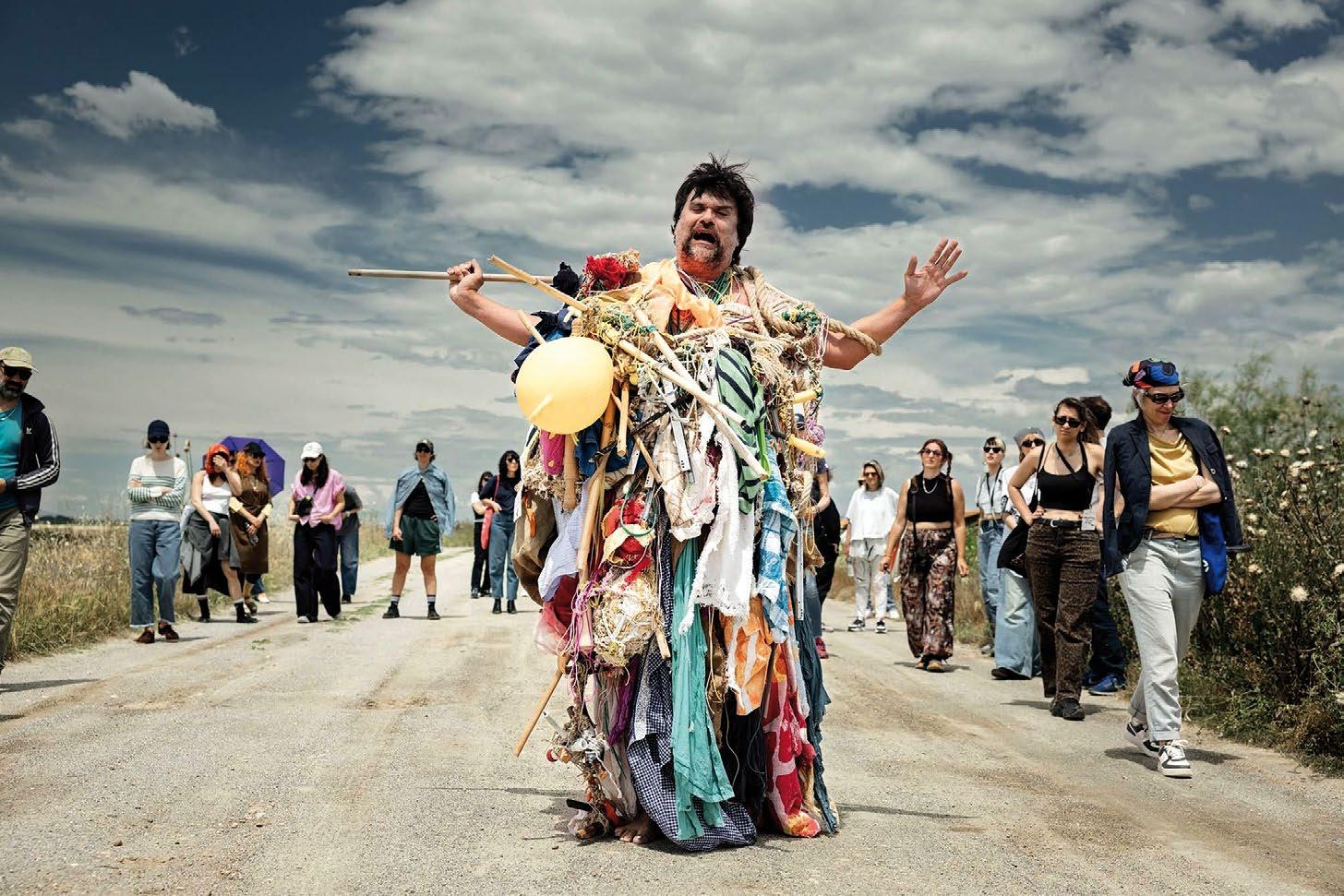
Walking through the exhibition’s multiple levels among “natural” gardens, futuristic installations, video screens, and shifting human figures, from canes to marching shoes, knights, and wizards, you’re left with a persistent sense of unease, as though the texture of modern life has been altered.
Multiple references. At one point I see Kyriakos, my youngest,
MOMUS journal
Αντιγόνη Τσαγκαροπούλου, «In The Wild», 2006.
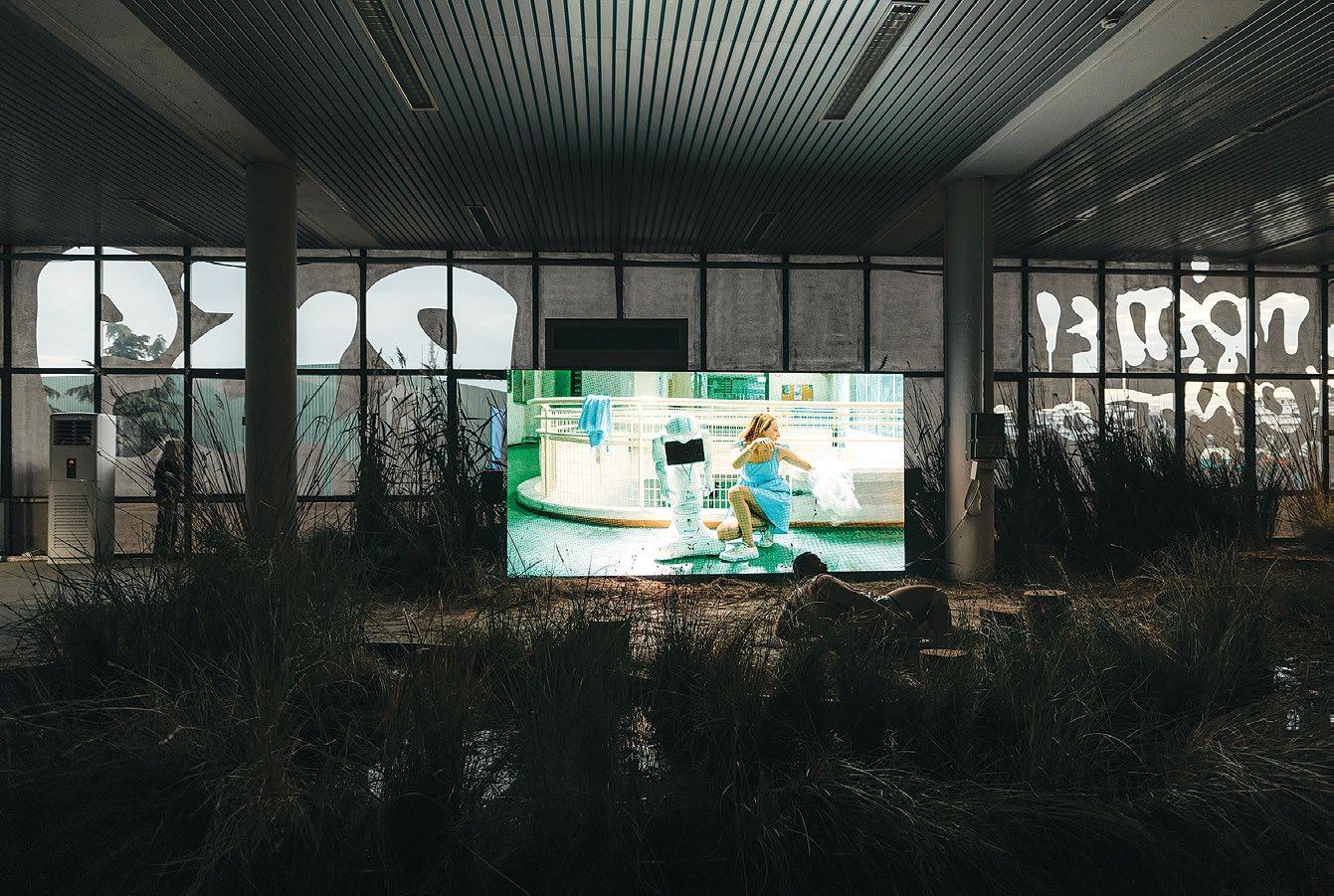
Antigone Tsagkaropoulou, “In The Wild,” 2006. Short film. Digital 4K, 16mm and 8mm, 19 min., color, sound. Greece/Los Angeles. Photography: Olga Deikou, Fotis Vlahakis.
Meriem Bennani, «Life on the CAPS», 2018-2022.
Francois Ghebaly (Λος
Lodovico Corsini (Βρυξέλλες)
Renaissance Society (Σικάγο)
Nottingham Contemporary (Ηνωμένο
Meriem Bennani, “Life on the CAPS,” 2018–2022. Single-channel video projection, 76 min. Courtesy of the artist and François Ghebaly (Los Angeles/New York), Lodovico Corsini (Brussels), and Sadie Coles (HQ, London). Commissioned by the Renaissance Society (Chicago) and Nottingham Contemporary (United Kingdom). Photography: Olga Deikou, Fotis Vlahakis.
«φυγές», σύμφωνα με τα λεγόμενα της επιμελήτριας, Νάντιας Αργυροπούλου, υποστηρίζουν και προτείνουν την ανάγνωση ως «επαναστατική πράξη», προωθώντας και το ίδιο το βιβλίο ως «πύλη» που, σε αντίθεση με τις οθόνες, τις ορίζουμε εμείς. «Επαναστατική» ήταν και η επιλογή της ΔΕΘ, αφού οι προηγούμενες εκθέσεις αξιοποιούσαν κατά κανόνα ένα μεγάλο μέρος του μνημειακού
running to sit on airplane seats scattered throughout. There are books on these seats and, occasionally, a small hanging lamp, like a bedroom light. These “escapes,” according to curator Nadja Argyropoulou, support and encourage reading as a “revolutionary act,” framing the book as a “gateway” that, unlike screens, we define.
“Revolutionary” is also choosing the Thessaloniki International Fair venue, as previous exhibitions generally drew extensively on Thessaloniki’s historical stock.
A bold undertaking, evident from the outset. The continuous pathway across the two Pavilions is without walls or distinct exhibition rooms and is marked instead by numerous posters and a strong element of illegal wheatpasted postering. Together with the movements and trends of the 20th century presented at MOMus-Museum of Contemporary Art, the visitor is immediately immersed in an environment of “effervescence,” or tension.
αίθουσες, με πολλές αφίσες και έντονο το στοιχείο της αφισοκόλλησης με βούρτσα, αλλά και τα κινήματα-τάσεις
— ή και σύγκρουσης. Βέβαια, η Μπιενάλε (που, στο σύνολό της, διέπεται από το στοιχείο της διερώτησης), εκτός
και η Ρωσική Πρωτοπορία, μέχρι τα έντυπα των Ελλήνων εκδοτών και σχεδιαστών (Λεωνίδας Χρηστάκης, Πάνος
The Biennale, taken together, is shaped by inquiry. Aside from the environment it creates, it also stands out because of these unique features: its impressive research depth and historical range. From pioneering visual explorations such as the Greek Surrealists and the Russian Avant-Garde, to printed issues by Greek publishers and designers (Leonidas Christakis, Panos Koutroumbousis, Minos Argyrakis), the curated sections construct a distinct narrative that is, admittedly, not widely known to the Greek public.
Secondly, several archives in print, illustration, and video form, as well as selected artworks, are exceptionally rare and presented to the Greek public for the first time. These include the photo-documentary performances of Maria Karavela, the first woman in Greece to work in this genre, Nanos Valaoritis’ Nanoscope, the cosmogenic-occult works of his wife, Marie Wilson, recently gaining recognition as an independent surrealist visual artist, and video “DAPHNI” by Angelos Prokopiou, part of a series of rare and pioneering films. Also notable is the painting work of Cuban artist Wifredo Lam, which blends Black culture, Surrealism, and Haitian artistic influences.
του Νάνου Βαλαωρίτη, τα κοσμογονικά-αποκρυφιστικά έργα της συζύγου του, Μαρί Γουίλσον (που πρόσφατα
All of this may have seemed strange or difficult to grasp for my boys, yet it caught their attention, much like most of the videos across the exhibition, and especially the seven-channel installation by Danish artist Steensen. But what captivated them the most was the rare post-Byzantine icon of the ThreeFaced Christ from the Loverdos Collection of the Christian and Byzantine Museum. They tried to understand it, to feel it. The image raises universal questions of depiction and representation. In the end, what the Biennale achieved wasn’t to ask whether everything should change, but to function as a catalyst for reflection, and that’s what I saw in my children’s faces. n
The Biennale, taken together, is shaped by inquiry. Aside from the environment it creates, it also stands out because of two unique features: its impressive research depth and historical range.
MOMUS journal
The 9th Thessaloniki Biennale of Contemporary Art engages with a common(place), yet (re)current, urgent, and plural demand that, with its punchiness, can feel like a revolutionary cry and echo like an empty slogan, ring like a rage bait and work like a charm. Τhere is something in it for everyone, and it does not belong to anyone.
The noise around silence
MOMUS journal
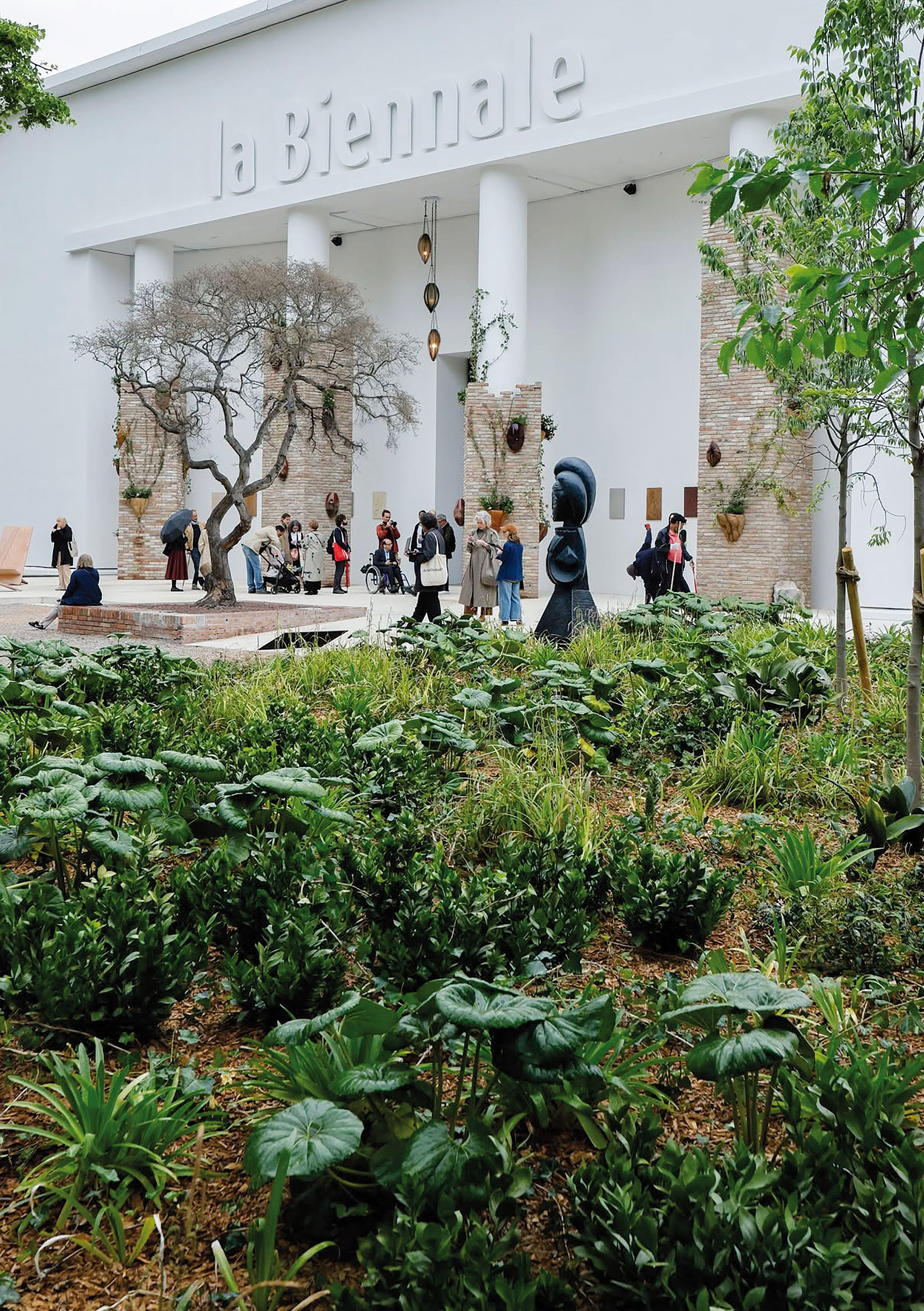
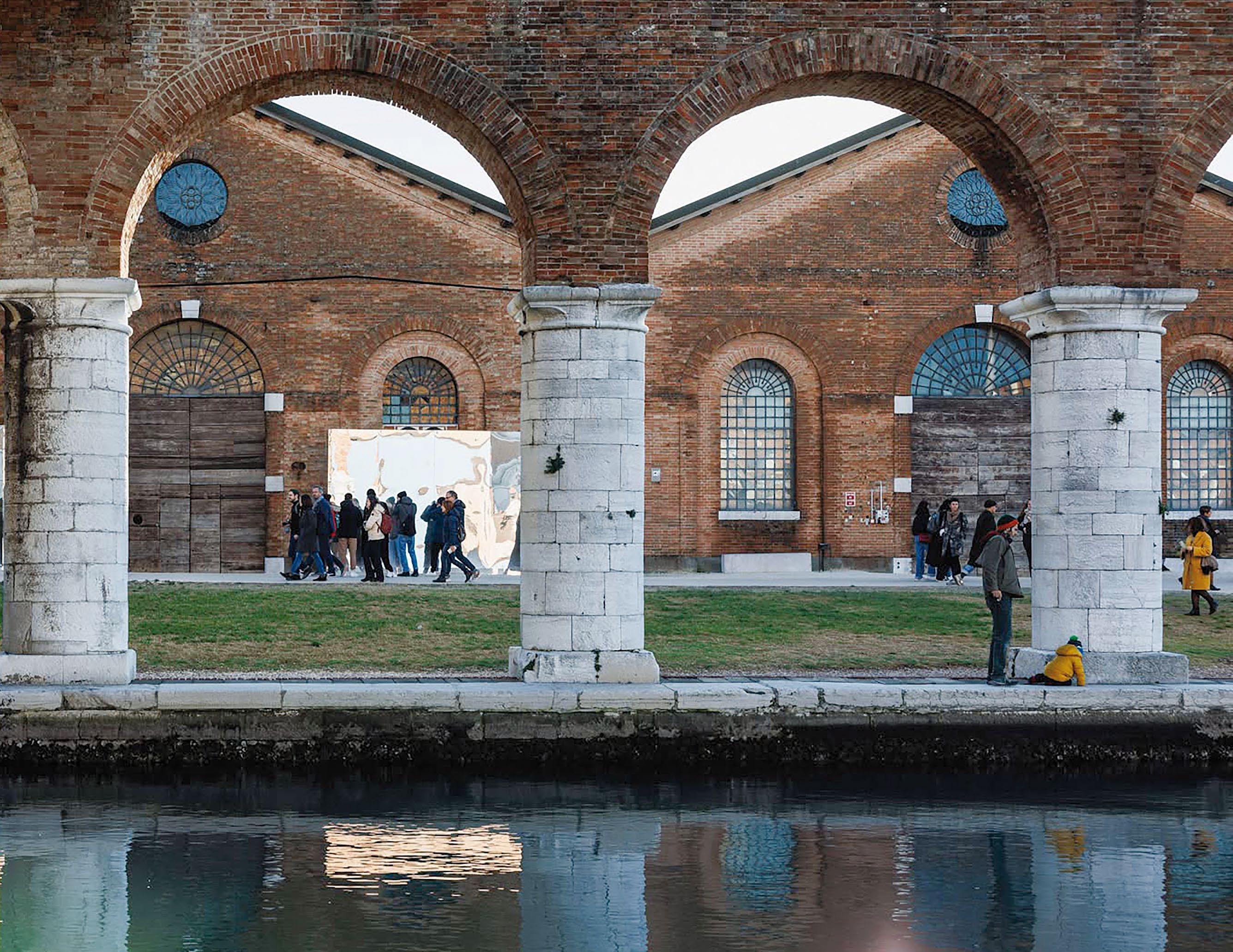
From the soft-spoken legacy of Koyo Kouoh to the geopolitical tensions that marked the opening of this year’s event, the 61st Venice Biennale offers a rare and honest reflection of the spirit of our times. Against this complex international backdrop, the Greek Pavilion stood out as one of the most sophisticated and widely discussed national presentations, reaffirming MOMUS’s pivotal role (as National Commissioner of the Greek participation in this year’s La Biennale di Venezia) in bringing Greek contemporary creation to the art world’s most influential stage.
Every May, Venice resembles a theater production just before its premiere: vaporettos fill with curators, collectors, artists, and journalists; queues at the Giardini form before dawn and the city takes on that well-known electric tension, as if something is about to happen that will —if only temporarily— define the language of contemporary art. Yet the 61st Venice Biennale, which officially opened on May 9, was unlike any before it. From its very first hours, it was clear that this edition would be remembered, not for its works, but for its historical heaviness.
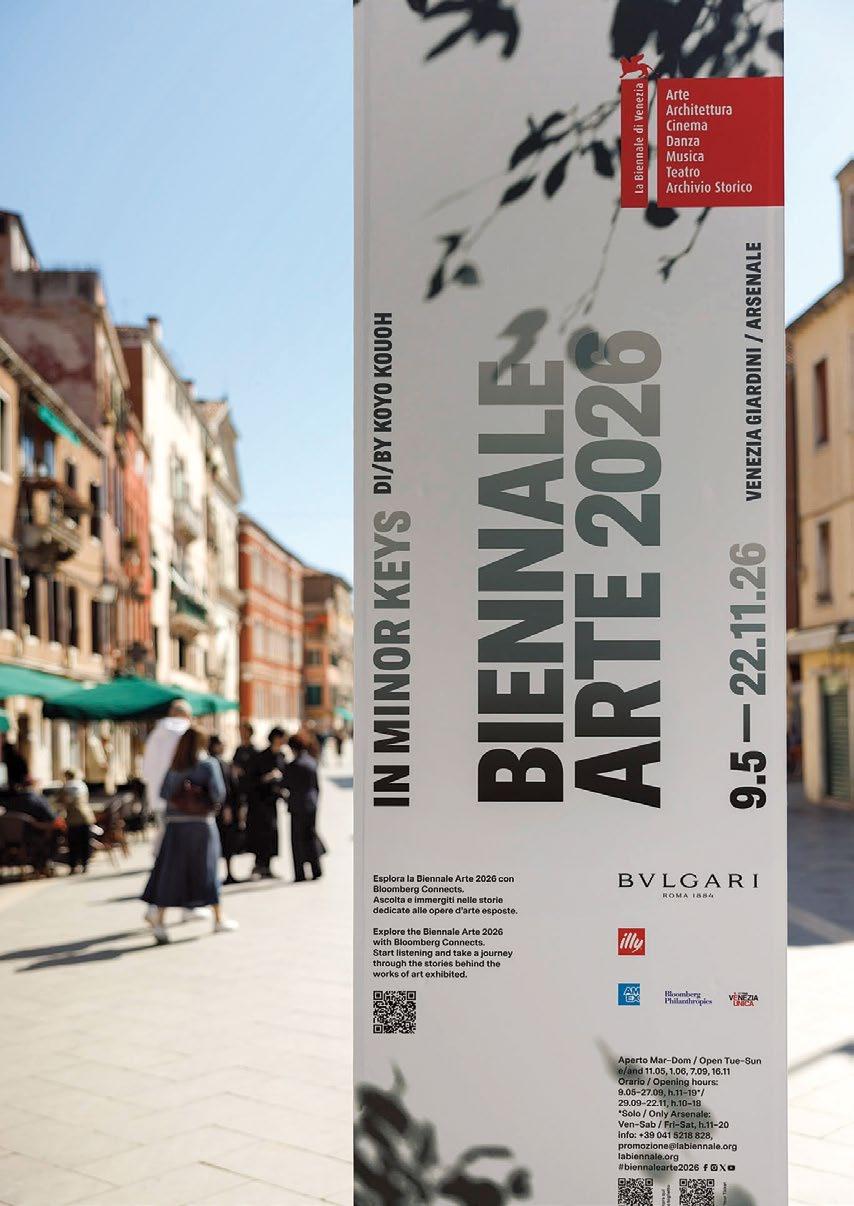
The main exhibition’s title (“In Minor Keys,” or perhaps, more precisely, “Soft-Spoken”) is a poetic statement of intent. The concept was elaborated by Koyo Kouoh, the first African curator in the history of the Biennale, who died suddenly in 2025 before she could see her vision realized; her absence permeates the entire exhibition like invisible melancholy. Her collaborators chose to proceed by faithfully following her curatorial plan, transforming this year’s Biennale into more than an international art exhibition, and into a posthumous dialogue with Koyo Kouoh herself.
Kouoh spoke of an art that doesn’t shout but whispers; works that operate “In Minor Keys,” above the noise of overproduction and spectacle. Ironically however, the Biennale itself has become one of the most politically charged cultural events of recent decades. The war in Gaza, Russia’s return following its suspension in 2022, accusations of selective morality, protests by artists and activists, and even the resignation of members of the awards jury have created a climate in which art and geopolitics have become almost impossible to separate.
Biennale
Venezia.
In the pre-opening days, several pavilions closed temporarily in protest of Israel’s participation, as demonstrations erupted inside and outside the Giardini. Venice became less of a cultural festival and more of a world parliament in crisis. Many questioned whether the Biennale could still exist as a neutral space. And perhaps the answer lies precisely there: it cannot.
And yet, within this dense political landscape, certain works manage to rise above the noise and assert themselves on purely artistic terms. This year’s edition features nearly a hundred country participations, including nations appearing for the first time, confirming the Biennale’s continued role as a global map of cultural shifts.
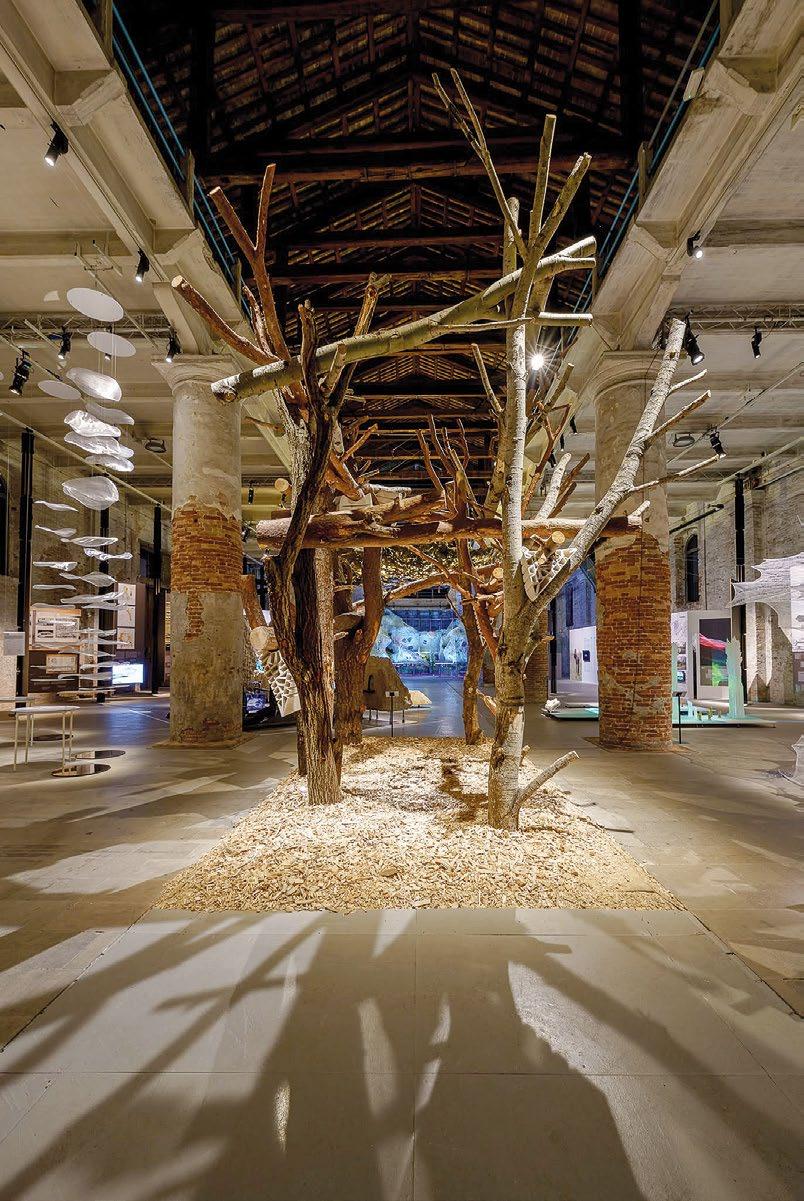
At the Arsenale, the main exhibition unfolds like a labyrinth of low tensions. Here, the easy images and photogenic Instagram moments of previous editions don’t dominate. Instead, something else does: a sense of fragility of the human experience. Many participating artists come from the so-called Global South — a curatorial choice deeply aligned with Kouoh’s thinking. Themes of colonialism, memory, migration, and spirituality flow through the exhibition like undercurrents.
Among the most talked-about works is Theo Eshetu’s installation of the rotating olive tree —an almost ritualistic symbol of peace and endurance— and Alfredo Jaar’s deeply political red chamber, where the visitor is literally immersed in an environment of alarm and loss, while the best moments of the exhibition do not seek to shock, but to slow you down.
And yet, the great contradiction dominating public debate at this year’s Biennale is precisely those works that chose to shock. The Austrian Pavilion by Florentina Holzinger became a viral phenomenon: naked bodies on jet skis, divers in tanks of filtered urine; an aesthetic where opera meets ritual meets post-industrial circus. Some spoke of genius, others of pure provocation. In any case, it’s impossible to ignore.
Equally strong reactions were triggered by the year’s most bizarre pavilions: Denmark with its high-tech dystopian “sperm bank,” Luxembourg with a work that literally sings, and, in an era where attention is the rarest currency, several artists seem to have accepted that exaggeration is the last available strategy for visibility.
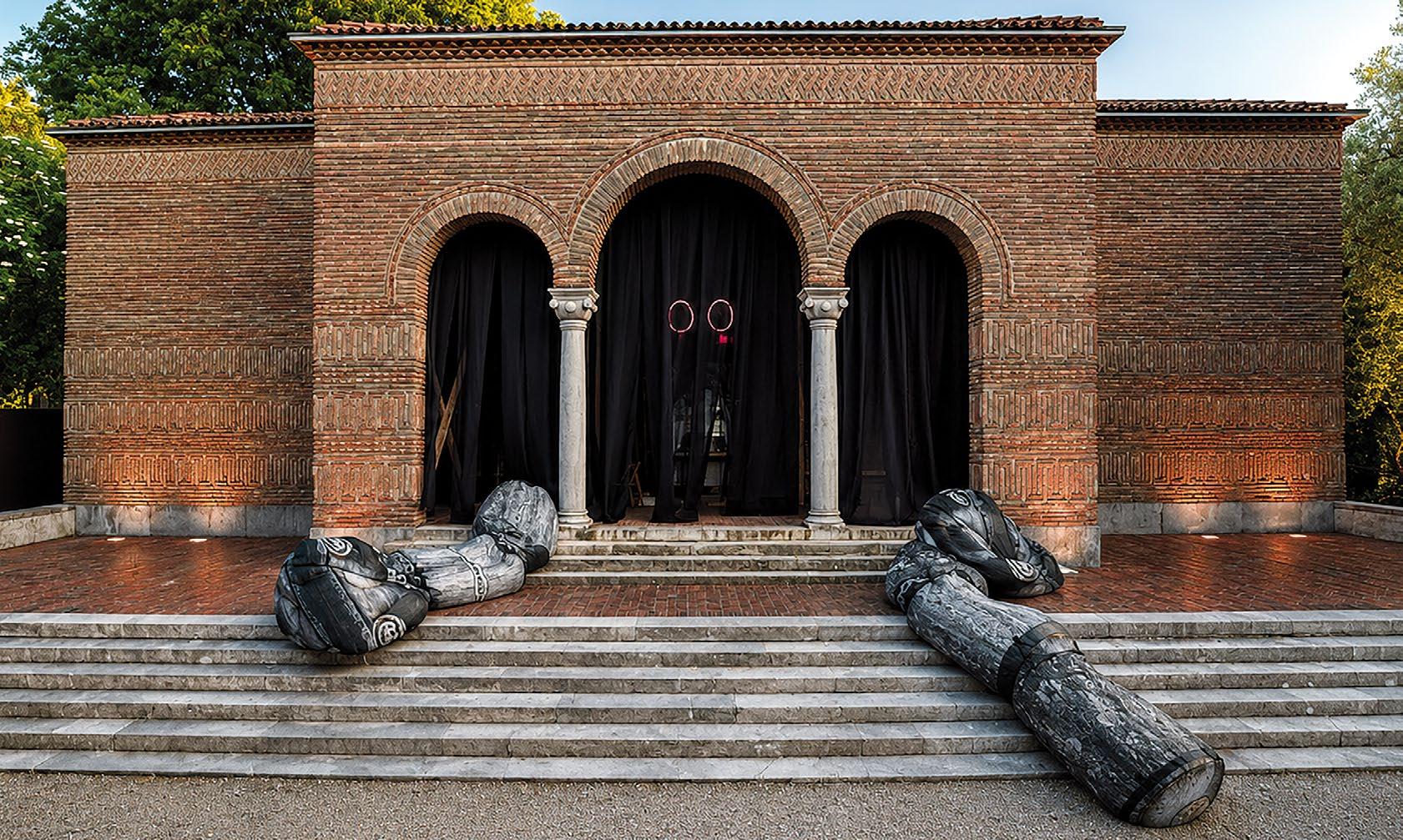
Amongst the chaos, Greece’s presence was one of the most substantial and sophisticated. The Greek Pavilion, with its “Escape Room” by artist and architect Andreas Angelidakis, offers a contemporary reading of Plato’s cave and the very notion of escape from a constructed reality. The space operates as a hybrid between escape game, architectural ruin, and digital illusion, reflecting on an era of images in which the real and the virtual are no longer clearly distinguishable. It’s no coincidence that several international critics ranked the Greek Pavilion as one of the most compelling entries this year.
Britain, with works by Lubaina Himid, chose a more poetic political language, while Japan presented a chilling installation with fake babies and artificial forms of care, touching on the anxieties of the technological age. Syria returned with intense symbolism, seeking to narrate a renewed cultural identity after the war.
The 2026 Venice Biennale
is not the happiest, but is perhaps the most honest.
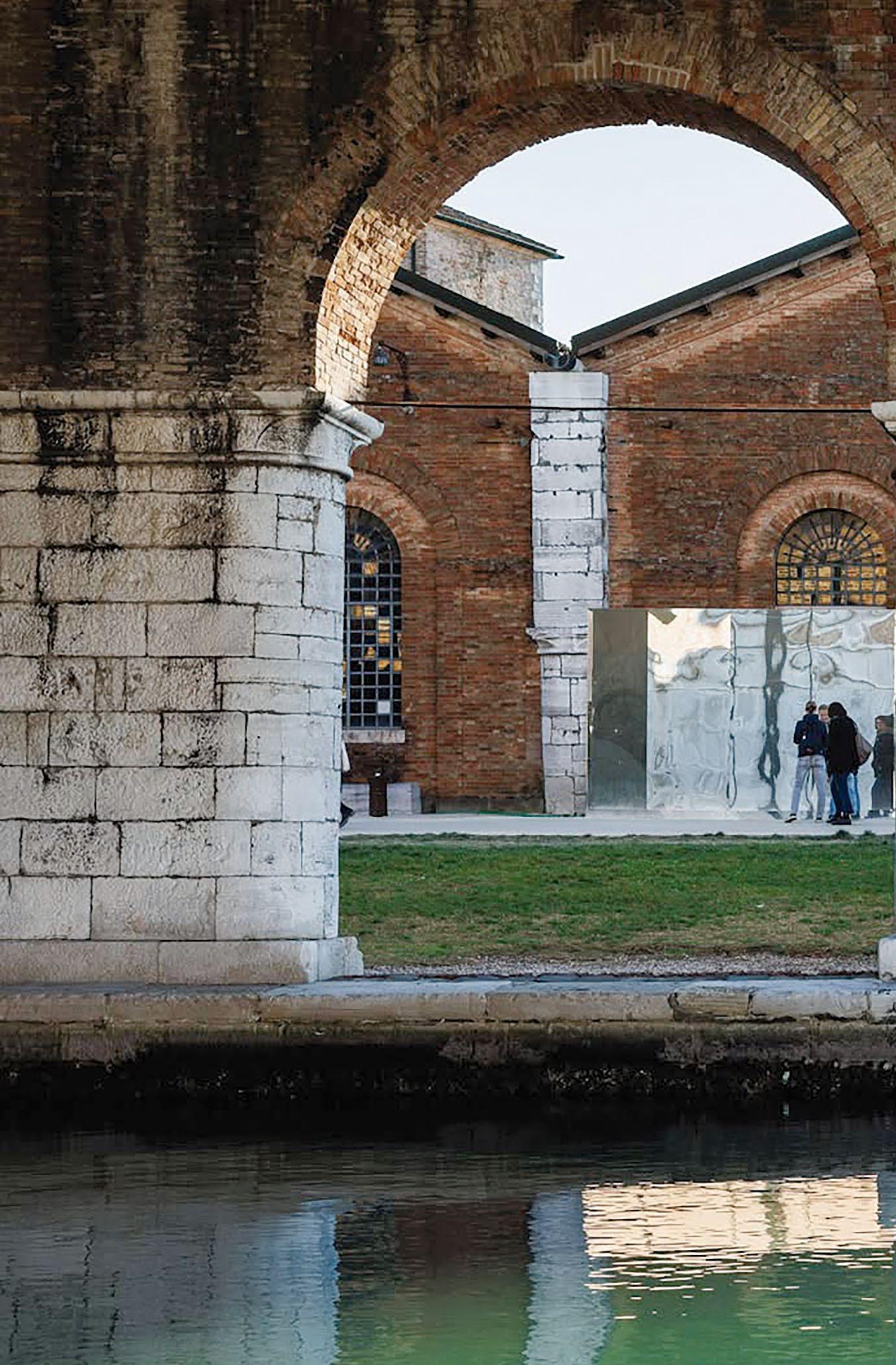
And then, there’s Venice itself, because the Biennale is never confined to the Giardini or the Arsenale. It spreads to the palazzi, churches, docks, and abandoned buildings, transforming the entire city into one vast exhibition space. Some of the most moving moments of this year’s edition lie outside the official program: Barry X Ball’s sculptures in the Church of San Giorgio Maggiore, Lawrence Abu Hamdan’s video installations, Gabrielle Goliath’s dark audio narratives.
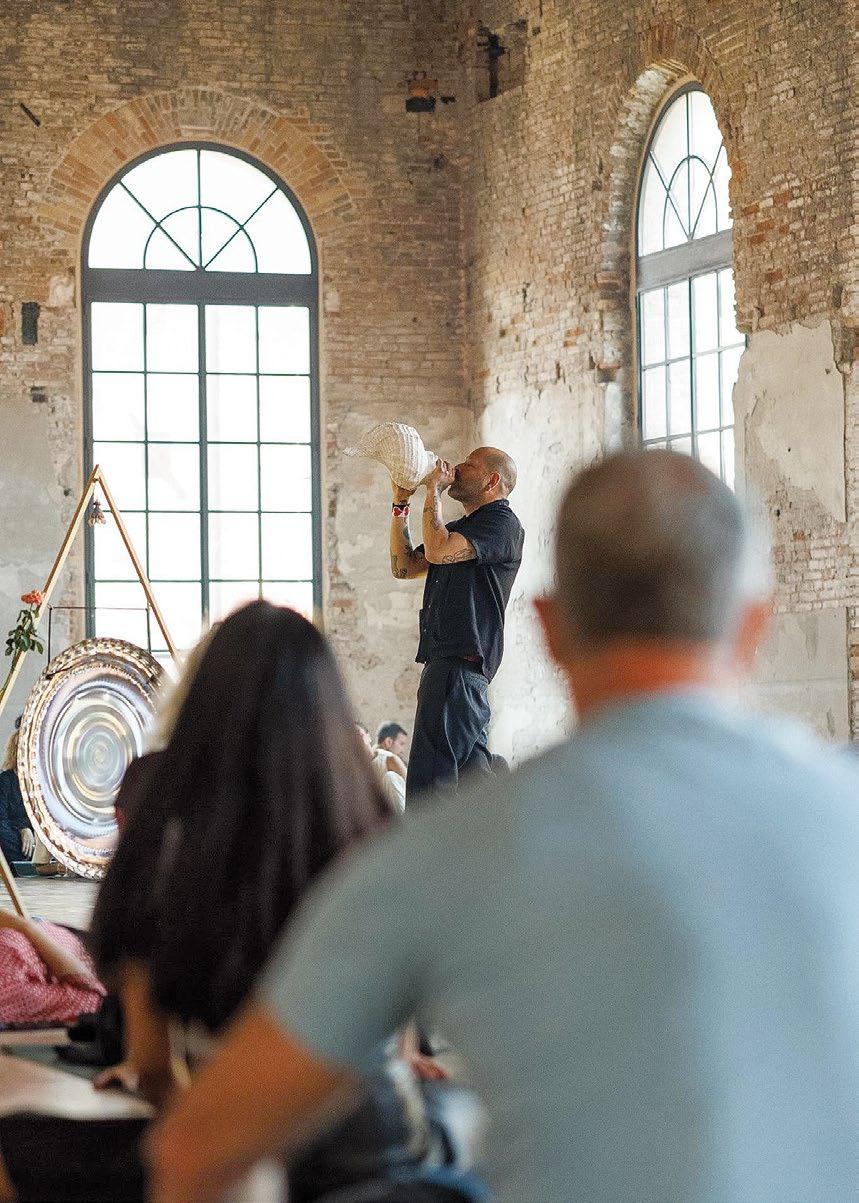
At night, after the pavilions close, the city continues to beat. At the bars of Dorsoduro and inside private institutional gatherings, conversations circle around the same question: what more can art achieve in a world that seems to be collapsing in real time? This year’s Biennale offers no easy answers, perhaps no answers at all.
What it offers, however, is a sense of time: a portrait of a planet weary, angry, overloaded with information and trauma, yet desperately thirsty for meaning. Koyo Kouoh had imagined an exhibition dedicated to the small frequencies of human experience — to what gets lost amidst the noise of history. Ultimately, that may be the greatest achievement of this year’s edition: that in a deafening world, it dared to defend the value of soft-spoken art.
The 2026 Venice Biennale is not the happiest or most spectacular of recent years, but is perhaps the most honest. n
No exit, only echoes
The 61st Venice Biennale presents Andreas Angelidakis’ “Escape Room,” transforming the Greek Pavilion into a labyrinth of memory, trauma and political ghosts. Behind this complex visual experience is MOMUS, the National Commissioner of Greece’s participation, which designed and delivered one of the most demanding and much discussed participations of this year’s edition.
reporting from Venice: angelos n. vassos
Iason Fotilas
Deputy Minister of Culture, responsible for Contemporary Culture
I’d rather not talk about the work’s artistic aspect, because there are others, more competent than me. Its structure is so impressive and robust that it speaks for itself; it speaks to everyone. I’ll focus instead on what’s invisible: all the work behind the Greek Pavilion carried out by our National Commissioner, the Metropolitan Organisation of Museums of Visual Arts of Thessaloniki-MOMUS. The interventions, the security systems, the constructions and infrastructure, enabling this work’s complete presentation, without limits. Its planning worked because you don’t see it, allowing the work and the artist to speak for themselves. The Minister of Culture, Lina Mendoni, and I personally have been and remain at the disposal of the Commissioner, the artist and his team, to showcase a proposal that I’m confident will provoke interesting dialogue. I’d like to thank its strategic supporter, the Onassis Foundation, as well as all other supporters behind Greece’s participation. n
Epaminondas Christophilopoulos
President of the Metropolitan Organisation of Museums of Visual Arts of Thessaloniki-MOMUS
A few months ago, we enthusiastically and with a sense of responsibility assumed the role of National Commissioner — an assignment that gave us the opportunity to deliver a particularly ambitious project and contribute substantially to Greece’s presence in Venice through Andreas Angelidakis’ “Escape Room.” With full support from the Ministry of Culture, we implemented an extensive and demanding project in an extremely short period of time. We stand our ground with the conviction that visitors to the Greek Pavilion will live an experience that touches on something essential. n
εικαστικό και αρχιτέκτονα Ανδρέα Αγγελιδάκη με το έργο «Escape Room/Δωμάτιο Απόδρασης», υπό την επιμέλεια του Γιώργου Μπεκιράκη. Το έργο παρουσιάζεται στο ιστορικό ελληνικό περίπτερο των Τζαρντίνι, το οποίο μεταμορφώνεται σε έναν βυθισμένο, σχεδόν θεατρικό λαβύρινθο: μαλακά αρχιτεκτονικά ερείπια, κατασκευές
φωτισμός, εικόνες που προβάλλονται σαν αναμνήσεις
In the Giardini of the “Serenissima” Republic of Venice, where every two years contemporary art is transformed into a geopolitical language, an aesthetic field of conflict as well as a global pressure point for ideas, the Greek Pavilion at the 61st Biennale (with the Metropolitan Organisation of Museums of Visual Arts of Thessaloniki-MOMUS being the National Commissioner of Greece’s participation) doesn’t feel like a national window display. Rather, it feels more like a memory trap, a psychological mechanism of entrapment and escape, and a space where Greek identity is exposed not as a narrative of pride, but as ruin, desire, trauma.
Greece is represented at this year’s edition by artist and architect Andreas Angelidakis with “Escape Room,” curated by George Bekirakis. The work is located in the historic Greek Pavilion in the Giardini, which has been transformed into a submerged, almost theatrical labyrinth: soft architectural ruins, structures that are simultaneously reminiscent of nightclub sets, archaeological sites and digital environments, low lighting, and images projected like memories on collapsing surfaces.
Angelidakis, who’s been exploring the relationship between architecture, the internet, popular culture and collective decline for years, has perhaps created the strongest political work of his career — not in the narrow sense of political denunciation, but within the anatomy of a national ghost. The Greek Pavilion becomes a place of entrapment within its own representations. An Escape Room, from which the exit is never certain.
The work’s starting point is 1934, a key year for the artist. The year when the Greek Pavilion in Venice is inaugurated, and the year when fascism is established as a dominant force in Europe, when Hitler meets Mussolini, marking a
Andreas Angelidakis
Artist, architect, creator of the Greek Pavilion
The Giardini national pavilions were designed to communicate the political beliefs of the governments that erected them at that historical juncture. Today they stand as frozen fascist and/or colonial caves, trapped in an environment that has become synonymous with the exploration of political choices and their consequences, as well as their subsequent transformation into art. Each pavilion constitutes a mechanism of truth —just like the mechanisms in the allegory of Plato’s cave— which today resembles a phantasmagoria of global Trumpism. If we replace the cave with a screen, what remains is every manifestation of MAGA (Make America Great Again) as a staging of fascism in the year 2025. n
MOMUS
journal
George Bekirakis
Curator of the Greek participation
“Escape Room” presents the viewer with an analogy of life under the shadow of capitalism. The traces are everywhere. The game from which we must escape isn’t a room, but a deep, dark cave, shielded from the hum of millions of images roaming our screens. Real and surreal realities collide on platforms that absorb our attention while simultaneously serve national agendas and commercial interests. In this work, Andreas Angelidakis inverts spatial hierarchies, creating the paradox of a habitable ruin within the digital panopticon. Ultimately, he offers the audience discreet clues that they can grasp or simply ignore. In essence, the viewer is called to decide how to exercise their capacity to act and where to direct their attention. After all, it’s simply a game. n
MOMUS journal
new historical zone of darkness. Angelidakis calls it “Year Zero.” From this point onwards, a journey begins through the history of Greek and Italian identity, and more so through the invisible paths of oppression, gender, sexuality and national self-image. It’s no coincidence that the memory of Zak Kostopoulos hovers at the core of the installation. International media note that the work serves as a tribute to the murdered activist and drag performer, converting the Greek Pavilion into a space of mourning, but also of resistance against the violence of normality. Angelidakis however doesn’t use Zak as a symbol. He brings him back as a ghost haunting a country that often prefers to export marble, sun and antiquity rather than look at the dark sides of its modern society.
This tension permeates the entire Pavilion. Visitors don’t follow a linear narrative; they wander in an environment where certainties seem dismantled. The soft ruins —a characteristic morphological motif of the artist— allow the body to sit, lie down, and get lost. The experience is simultaneously reminiscent of an ancient cave, an underground club, and a post-internet setting. The space itself serves as a Platonic allegory contaminated by algorithms, political propaganda, and exhausted national mythologies.
Curator George Bekirakis has spoken of an attempt “to read history through small incidents and lived experiences.” Here, in the Greek Pavilion, official History is presented as a trace, instead of a chronology. An atmosphere. An accumulated psychic tension. “Historical versions of Greek identity are placed alongside its urban and lived expressions,” he notes characteristically.
This year’s Biennale, which opened its doors on May 9, takes place during politically charged times. The lingering shadow of the war in Gaza, reactions to the participation of states involved in conflict and the resignation of the five-member jury created an explosive climate even before the opening. Considering the context, the Greek Pavilion acquires unexpected topicality: a work on fascism, body surveillance, the memory of violence and a failed European self-image seems to converse directly with the nervousness of the event itself.
To choose Angelidakis wasn’t safe. Where many national participations prefer impressiveness, spectacular technology or museum neutrality, the Greek proposal feels deliberately unstable. It doesn’t seek to impress with grandiosity or technological exhibitionism. It attempts something more difficult: to produce uncomfortableness. And perhaps that’s exactly why it stands out.
International critics speak of one of the most “psychological” pavilions at this year’s event. Others describe it as a “modern Platonic cave,” while several focus on the artist’s ability to connect the fascist architecture of national pavilions with the current culture of digital isolation and algorithmic manipulation. The Greek Pavilion doesn’t offer easy answers: it seems to persistently ask what it means today to represent a nation in a world that is collapsing aesthetically, politically, and morally.
But there’s something even more subtle, almost emotional. Amid the coldness of theory and the gravity of History, the work maintains a sense of human fragility. Angelidakis’ soft constructions are reminiscent of bodies that are tired of standing upright. Bodies that bend, but do not disappear. Perhaps that’s why the “Escape Room” doesn’t function as a place of escape, but as a place of stay: a place where you’re invited to stay long enough to hear the ghosts that hide beneath the narrative of national normality.
In the Venice of 2026, amidst noisy installations, geopolitical confrontations and endless visual overproduction, the Greek pavilion achieves something rare: it doesn’t shout. It whispers. And that’s exactly why it’s louder than others. n
From Bauhaus to runway
Bauhaus:
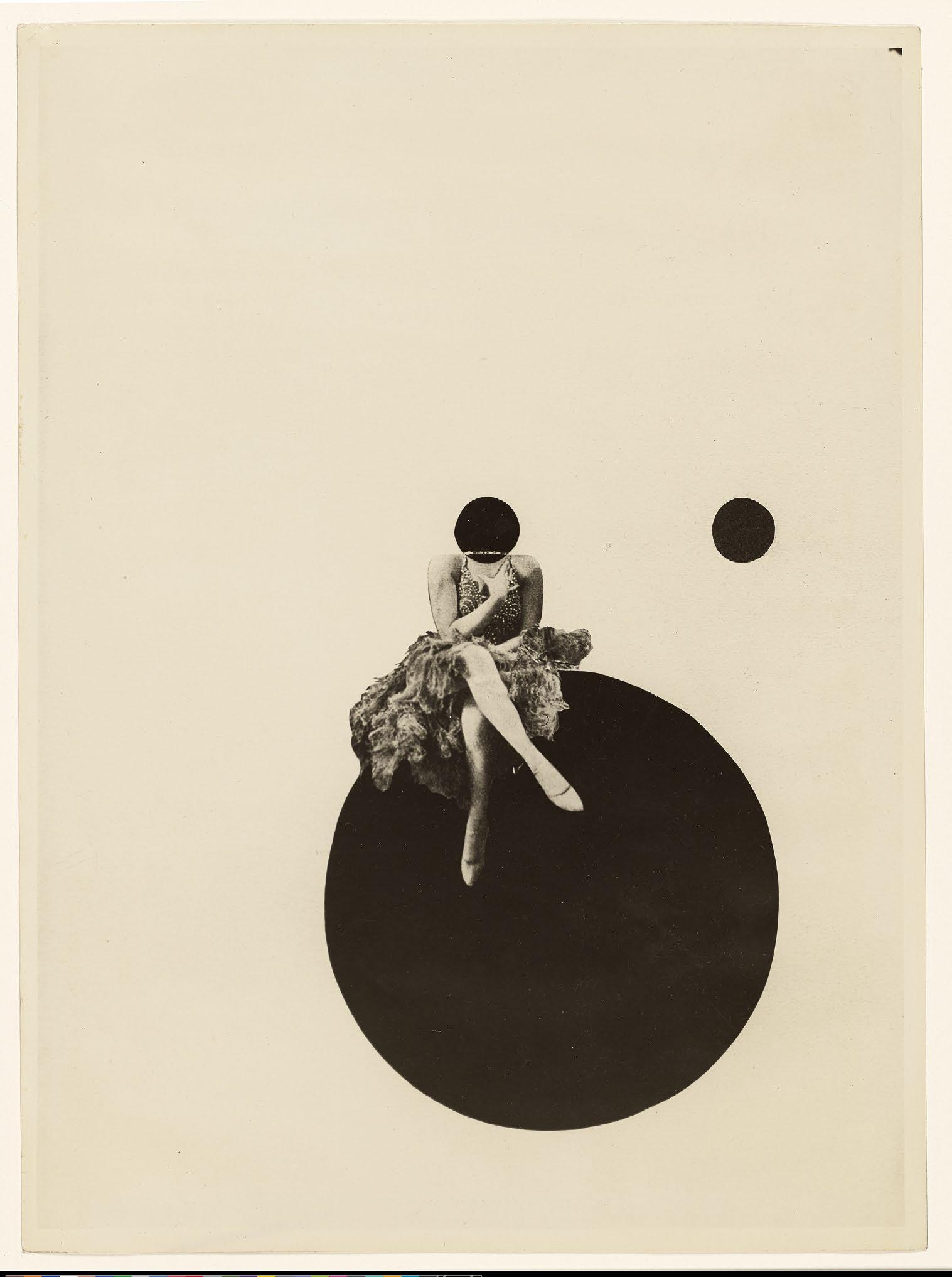
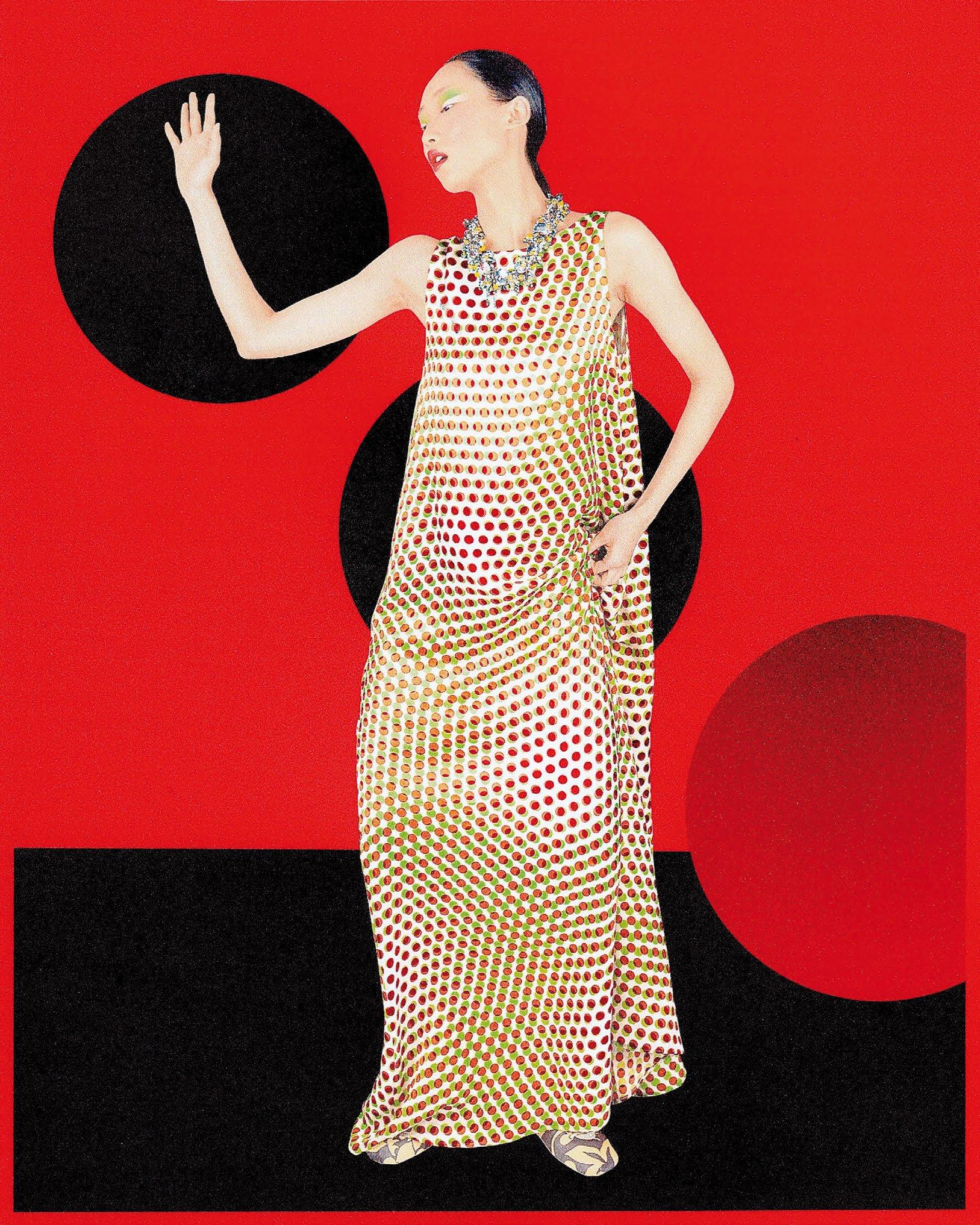
László Moholy-Nagy’s work epitomizes the Bauhaus ethos: reductive geometry, black discs that orbit like planets, and a compelling sense that the human figure is being transformed into an architectural composition. It is this very visual and intellectual framework that underpins the Dries Van Noten’s Spring/Summer 2026 womenswear collection — spirals, polka dots, circles, geometric forms, and optical illusions that reimagine the body as a dynamic graphic construct in motion.
curated by: angelos n. vassos
Ο Λάζλο Μοχόλι-Νάγκι (Ουγγαρία,
σχολής. Υπήρξε ενθουσιώδης δάσκαλος, ενώ συνέγραψε, μεταξύ άλλων, το επιδραστικό θεωρητικό έργο «Painting, Photography, Film» (1925).
Πειραματίστηκε με τα «φωτογράμματα» («photograms», δηλαδή φωτογραφία χωρίς κάμερα) μόλις το 1921, εξερευνώντας τις αφαιρετικές τους δυνατότητες, την ίδια χρονιά που ο Μαν Ρέι
MOMUS fashion
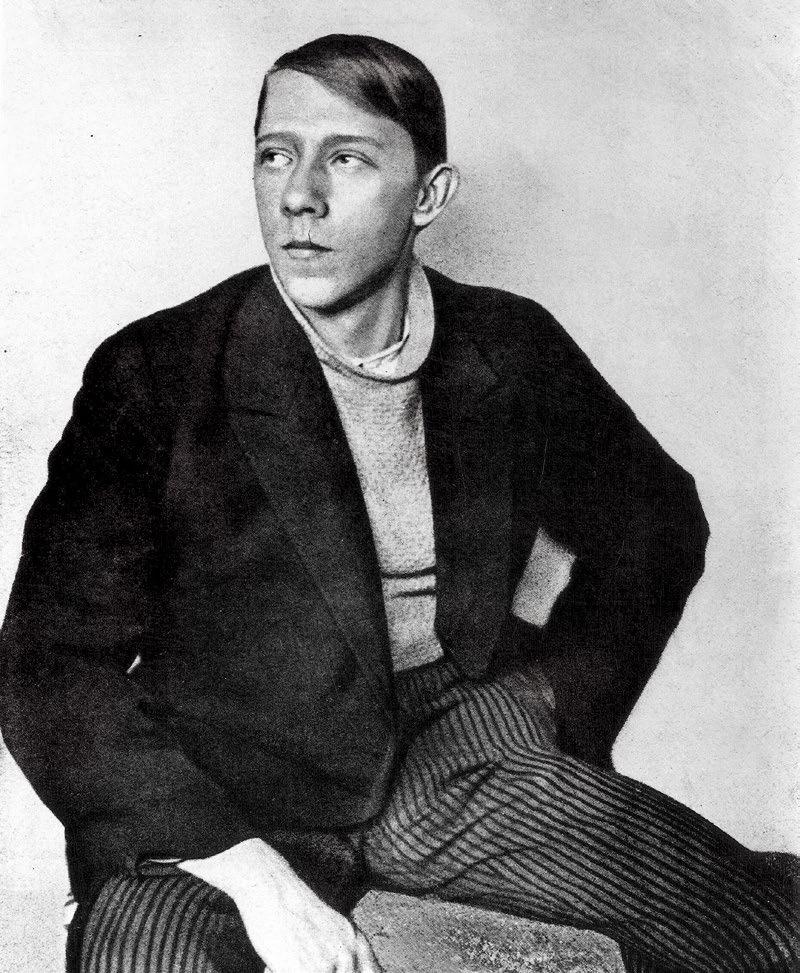
László Moholy-Nagy (Hungary, 1895-United States, 1946) was one of the most influential figures in the modernist avant-garde that transformed the arts during the first decades of the twentieth century. A remarkably versatile and pioneering artist, he worked across painting, photography, design, sculpture, film, typography, and stage design, while also creating books, exhibition installations, and shop-window displays.
A veteran of the Austro-Hungarian Army who was wounded during World War I, Moholy-Nagy became actively involved with the Berlin Dada movement and Constructivism. In 1923, he joined the Bauhaus, where he taught in the Metal Workshop and played a pivotal role in the development of photographic education until 1928. Together with Walter Gropius, he also oversaw the publication of the celebrated Bauhaus Books series, which became one of the movement’s most influential intellectual platforms. An inspiring and visionary educator, he authored several seminal theoretical texts, most notably “Painting, Photography, Film” (1925), a landmark publication in the history of modern visual culture.
Moholy-Nagy began experimenting with photograms —camera-less photographic images— as early as 1921, exploring their abstract and expressive potential. Significantly, this was the same year that Man Ray independently discovered the technique, later naming his works “rayographs.” In 1924, Moholy-Nagy developed his “photoplastics,” a distinctive form of visual montage that combined fragments of drawings, photographs, and text into elliptical, minimalist compositions that challenged conventional modes of narrative representation. n
Estate of László Moholy-Nagy. “Olly and Dolly Sisters,” 1925. Exhibition print courtesy of the Estate of the László Moholy-Nagy.
MOMUS fashion
A creation from the Dries Van Noten women’s collection for the Spring/Summer 2026 season, which was conceived in collaboration with artist Ann Vendi.
MOMUS fashion
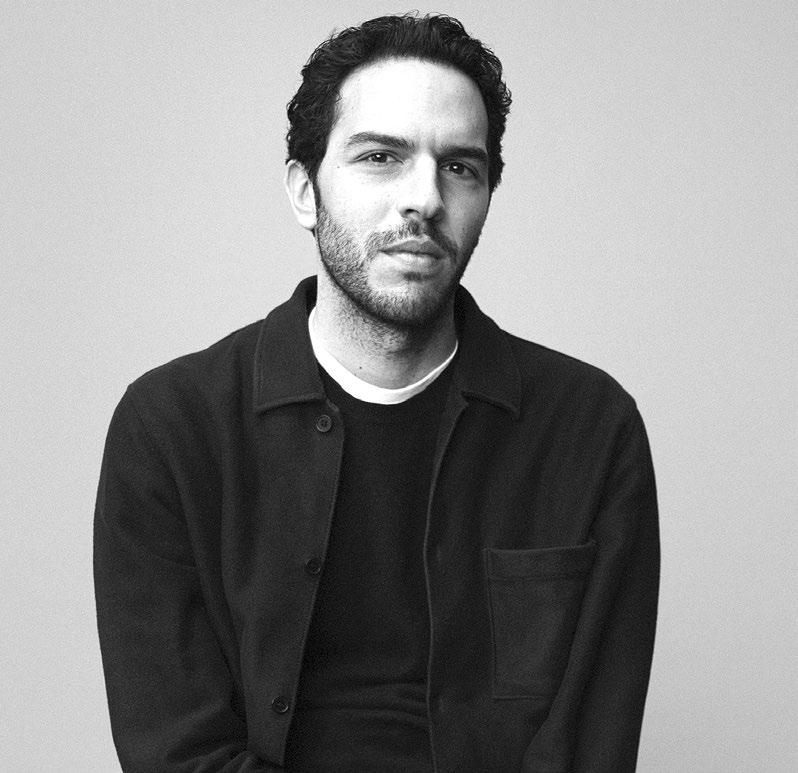
Julian Klausner is widely regarded as one of the most promising rising talents in contemporary European fashion and, since December 2024, has served as Creative Director of the storied Dries Van Noten fashion house. Born in Antwerp, Belgium, he studied Fashion Design at La Cambre (École nationale supérieure des arts visuels de La Cambre) in Brussels, earning both Bachelor’s and Master’s degrees in Fashion Design upon graduating in 2016.
In the early stages of his career, Klausner collaborated with several prominent international fashion houses, gaining invaluable experience alongside some of the industry’s most respected creative figures. In 2018, he joined Dries Van Noten, where he worked closely with the brand’s founder, contributing to the design and development of the womenswear collections. Over the course of six years within the house’s creative studio, he distinguished himself through a profound understanding of its aesthetic language, an exceptional sensitivity to color and texture, and a rare ability to balance artistic expression with wearability.
His appointment as Creative Director marked the beginning of a new chapter for the Belgian house, with Klausner assuming responsibility for both the menswear and womenswear collections. His selection was widely viewed as a natural continuation of Dries Van Noten’s legacy, reflecting a designer capable of honoring the house’s identity while bringing a contemporary, dynamic, and forward-looking creative vision to its future. Today, he is considered one of the most compelling representatives of a new generation of designers shaping the future of global fashion. n
MOMUS on a plate
Dinner with the artist
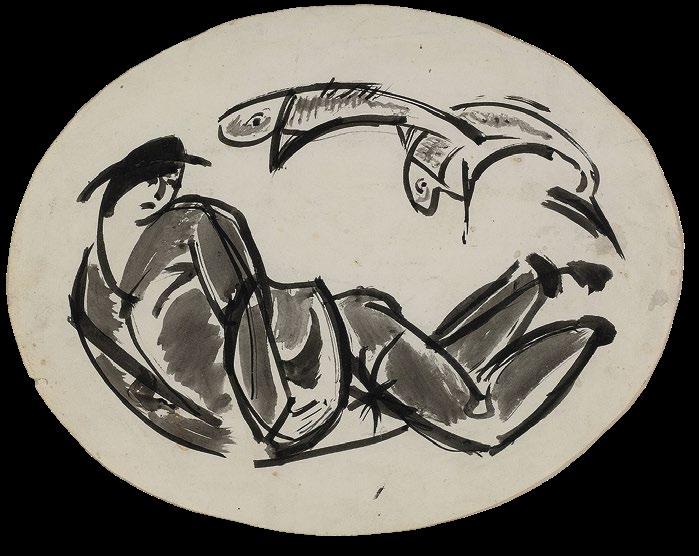
If you could invite a famous artist to dinner, with a top chef preparing the menu, who would you choose? And what would you serve? In this issue, MOMUS “invites” Vladimir Tatlin (1885-1953) to dinner, drawing inspiration from his painting “Young fisherman” — and taps into the creative imagination of Dimitris Fatisis, executive chef at Hyatt Regency Thessaloniki, to prepare the menu.
curated by: john papadimitriou
The artist: Vladimir Tatlin
Vladimir Tatlin (1885-1953) was a Ukrainian painter, sculptor, and architect remembered for his visionary “Monument to the Third International” in Moscow, 1920.
Tatlin was educated at the Moscow Academy of Fine Arts, graduating in 1910. Late in 1913 he went to Paris, where he visited Pablo Picasso, whose reliefs in sheet iron, wood, and cardboard made a deep impression on him. Returning to Moscow, Tatlin created constructions that he called “painting reliefs,” which he exhibited at a Futurist exhibition held in Petrograd (now St. Petersburg) in February 1915. He became the leader of a group of Moscow artists who tried to apply engineering techniques to the construction of sculpture. This developed into a movement known as Constructivism. n
Vladimir Tatlin, “Young fisherman,” 1912.
Black watercolor and ink on paper.
MOMUS-Museum of Modern Art-Costakis Collection.
MOMUS on a plate
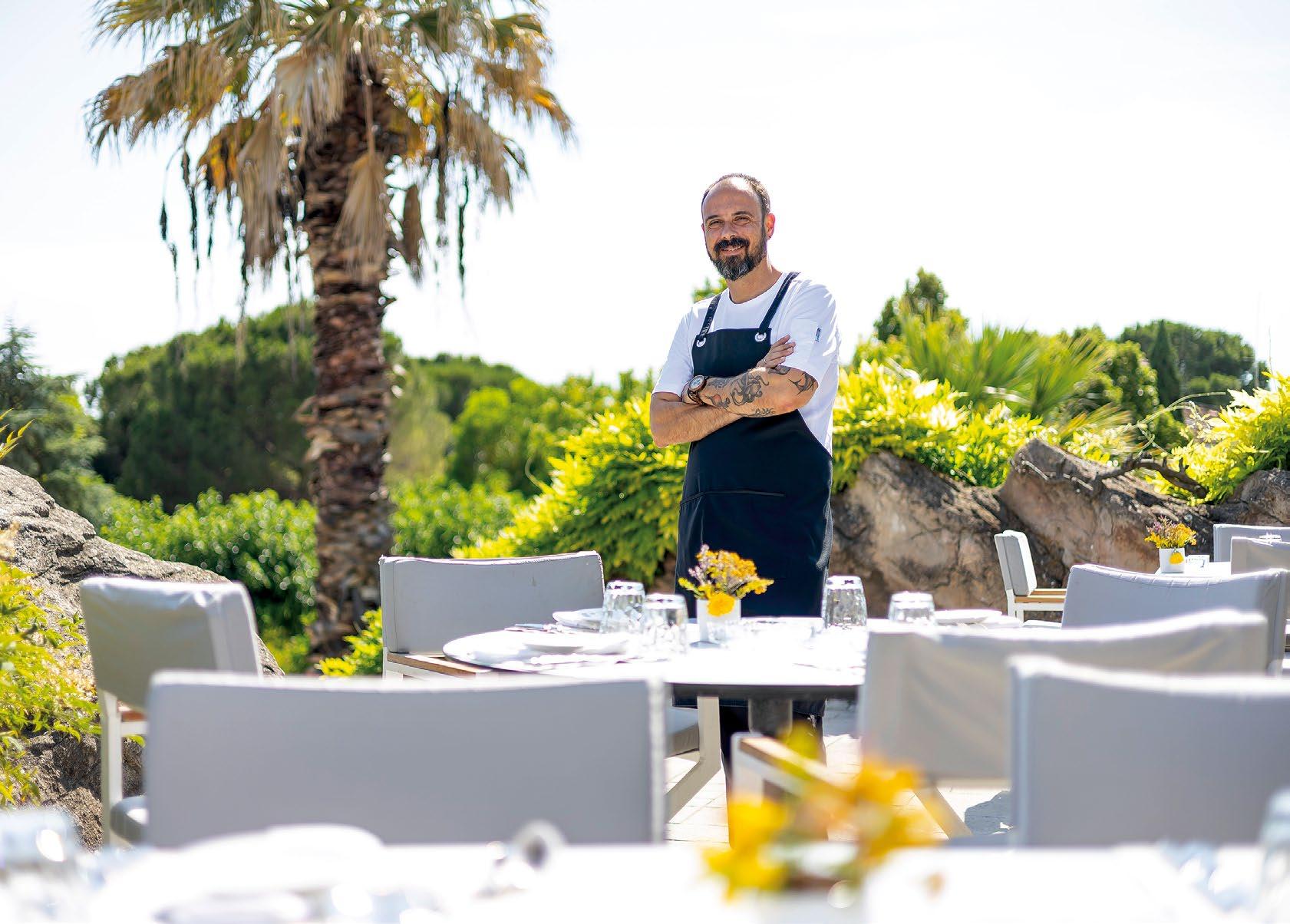
What would executive chef Dimitris Fatisis* make for Vladimir Tatlin?
I was charmed by Tatlin’s work because of its purity and structural simplicity. In the black-and-white sketch, the fish and the young fisherman define a balanced geometric composition without any excess. I followed the same principle in my recipe: the grilled sea bream is the primary element, while the red tomato carpaccio and black-eyed beans create the necessary constructivist-like contrasts on the plate. Only a few, high-quality Mediterranean ingredients compose a gastronomic architecture where nothing is in excess and nothing is missing. n
* Dimitris Fatisis is the executive chef at Hyatt Regency Thessaloniki hotel.
MOMUS on a plate
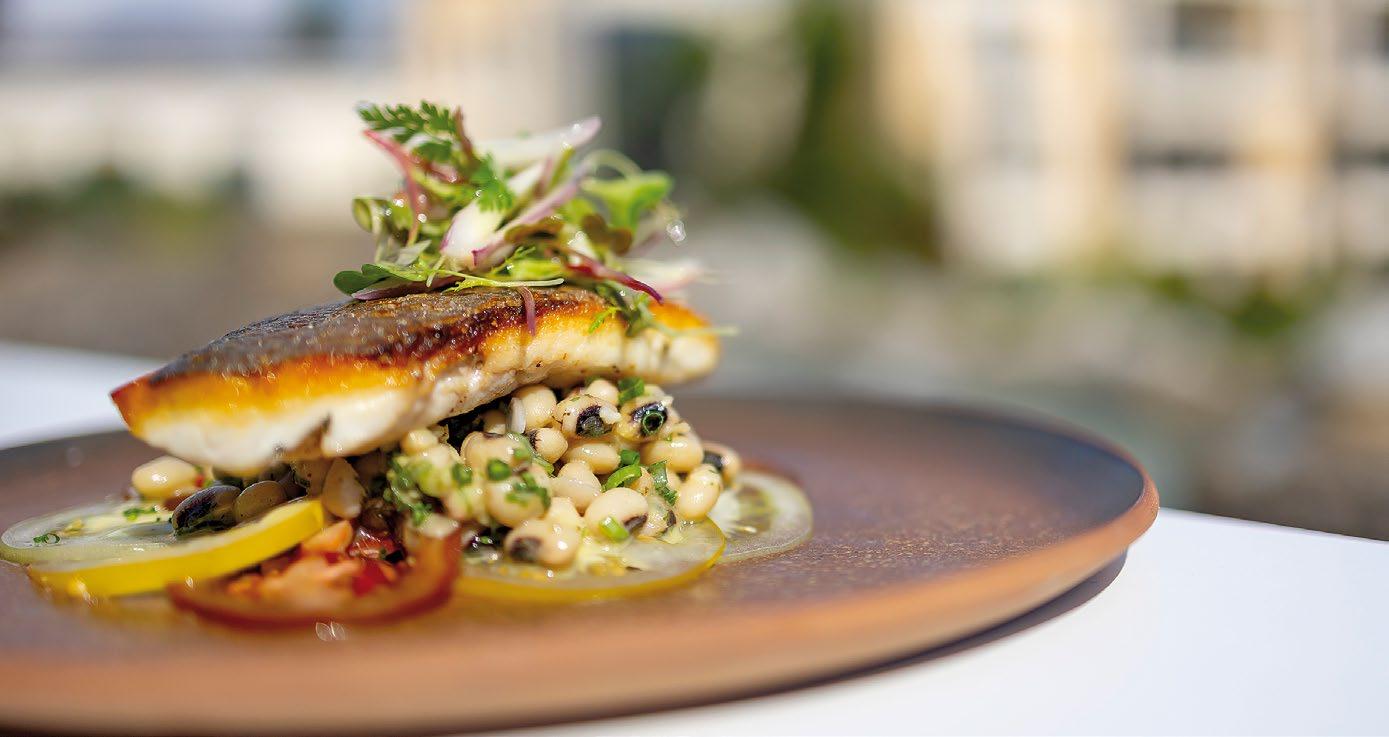
The recipe: Grilled sea bream with tomato carpaccio and black-eyed bean salad
Υλικά
2 φιλέτα τσιπούρας χωρίς κόκκαλο (περίπου 400 γρ.).
δάφνης. 15 γρ. ελαιόλαδο. 3 γρ. μηλόξυδο. Αλάτι. Πιπέρι. Για το καρπάτσιο ντομάτας: 2 κόκκινες
Ingredients
2 boneless sea bream fillets (about 400 g). 5 g olive oil. 2 g salt.
For the black-eyed bean salad: 150 g black-eyed beans.
3 g spring onion finely chopped. 3 g parsley chopped. 2 g dill chopped. 20 g carrot coarsely chopped. 15 g white onion coarsely chopped. 10 g celery coarsely chopped. 2 sprigs thyme. 1 bay leaf. 15 g olive oil.
3 g apple cider vinegar. Salt and pepper.
For the tomato carpaccio: 2 medium tomatoes. 5 g olive oil. 8 basil leaves. Salt and pepper. n
Instructions
Soak the black-eyed beans overnight. Place them in a saucepan with the coarsely chopped carrot, onion, celery, thyme, and bay leaf. Boil until tender but still holding their shape. Remove the vegetables, thyme, and bay leaf, then drain the beans and allow them to cool. Mix the beans with the spring onion, parsley, dill, olive oil, apple cider vinegar, salt, and pepper.
Brush the sea bream fillets with olive oil on both sides and season with salt. Grill until cooked.
Slice the tomatoes thinly and arrange them on serving plates. Drizzle with olive oil and season with salt and pepper. Place the black-eyed bean salad in the center of each plate, top with the grilled sea bream, and finish with the basil leaves over the tomatoes. n
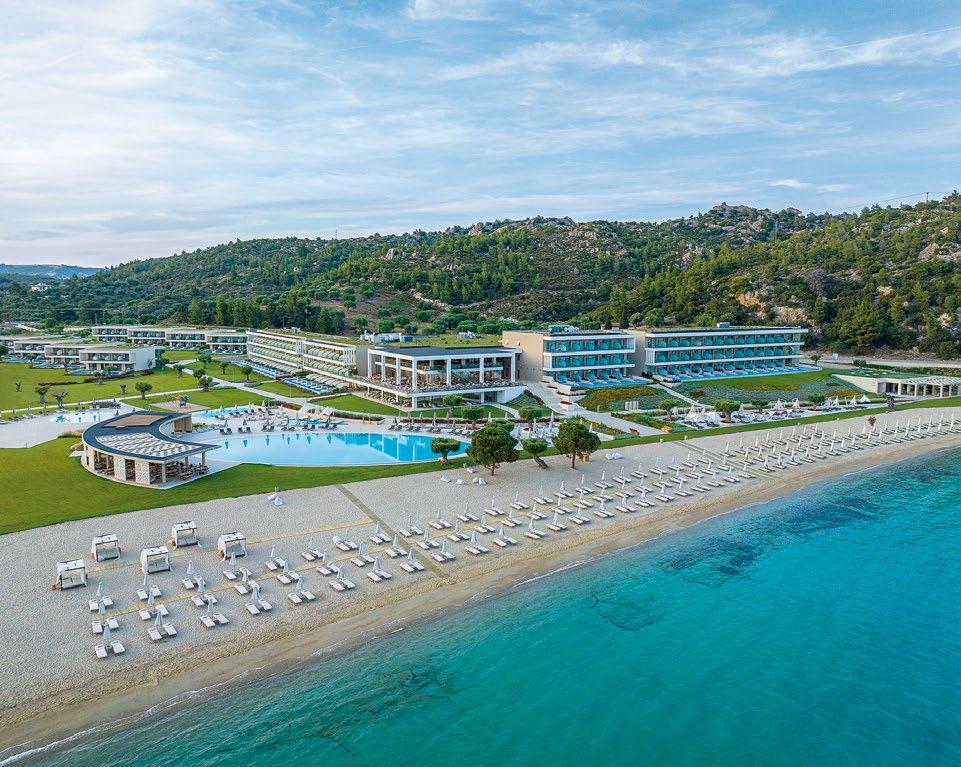
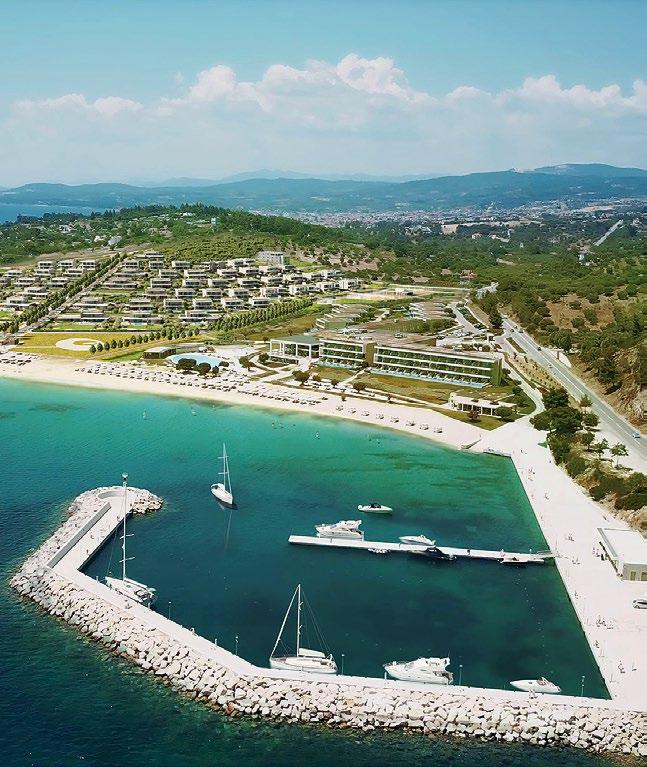
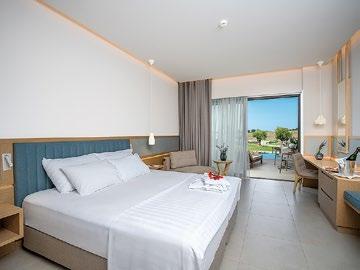
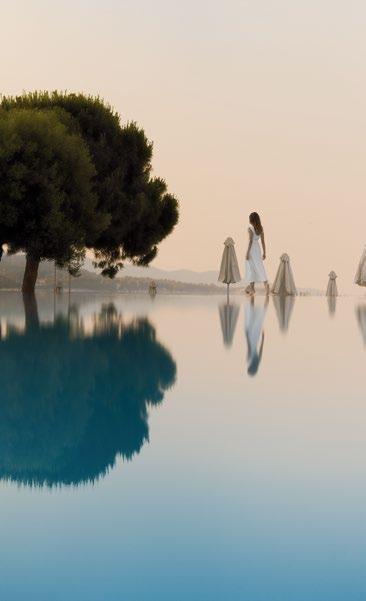
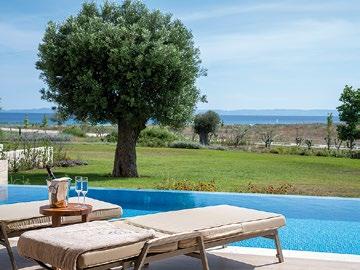
On the idyllic beach of Agios Ioannis in Halkidiki, AMMOA Luxury Hotel & Spa Resort returns for its fifth summer season, inviting guests to a world where sophisticated luxury meets utter relaxation Spacious rooms and elegant bungalows with private pools overlooking the turquoise waters of the Toroneos Gulf create an environment of serenity, high aesthetics, and understated luxury
AMMOA is an ideal destination for families and couples, balancing tranquility with a wide range of experiences, from engaging children’s entertainment programs to modern sports facilities. And for moments of wellness and rejuvenation, the Ethereal Spa by Idolo will nurture both body and spirit. Within the resort, restaurant KYMA is a refined gastronomic destination, serving fresh fish and seafood sourced from the region to hotel guests and outside visitors. The AMMOA Marina features new facilities designed for discerning sea travelers wishing to moor their boats, further enriching the overall hospitality experience.
Inspired by the natural beauty of Halkidiki and driven by an unwavering commitment to quality hospitality, AMMOA Luxury Hotel & Spa Resort continues to stand out as the ultimate destination for upscale summer getaways n Info: AMMOA Luxury Hotel & Spa Resort, Agios Ioannis Beach, Nikiti, Halkidiki.
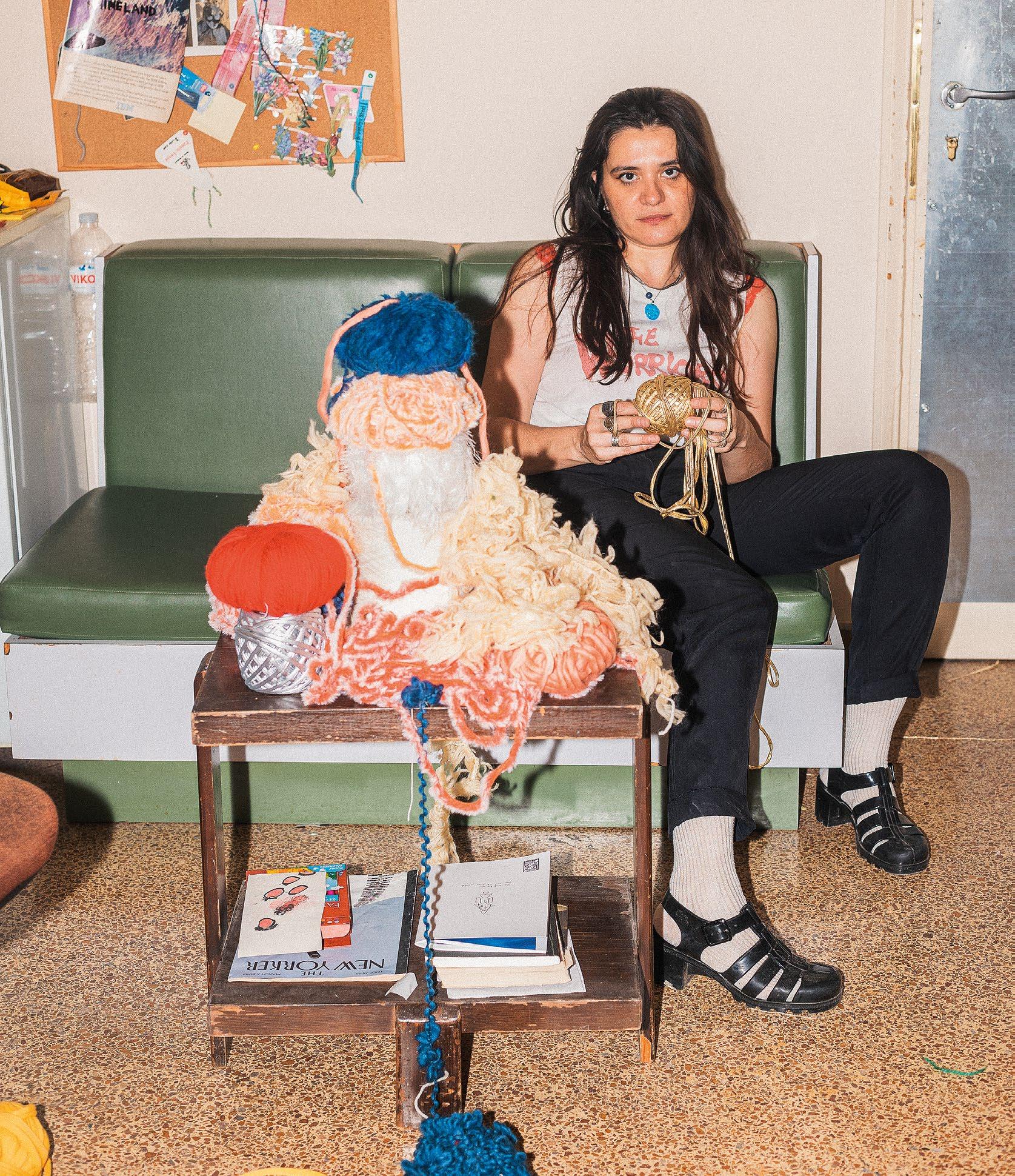
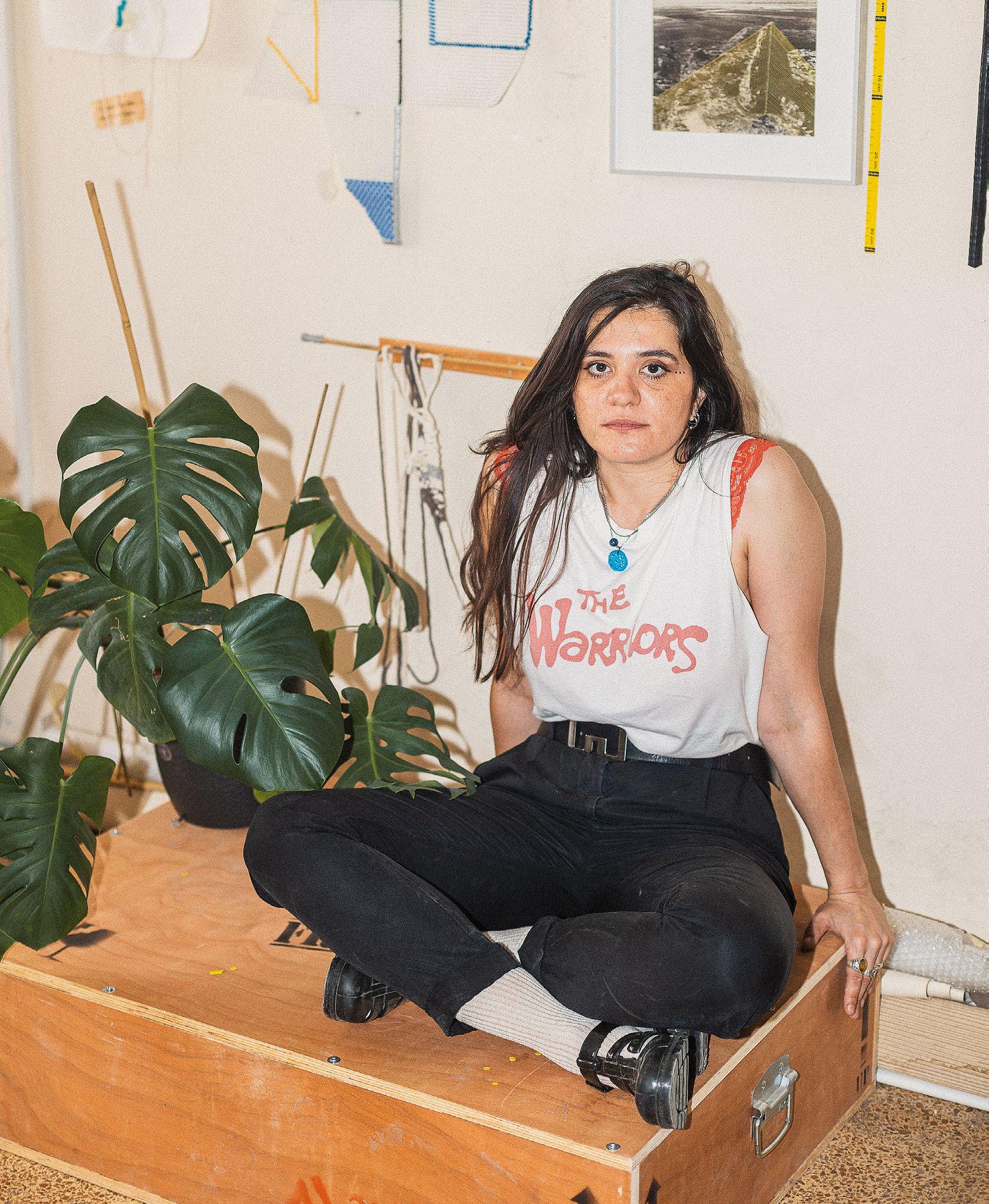
Creating other worlds through embroidery, sculpture, digital imagery, and collage, artist Marina Velisiotis exhibits her work at the 9th Thessaloniki Biennale of Contemporary Art and explains why working with multiple media and materials is essential to her self-expression.
interview: john papadimitriou
portrait: christina georgiadou
Your work feels as though you’re creating entire worlds, bordering on mythology or science fiction. What drives you to create these alternative realities?
For me, creating these worlds is how I tune my mind. I was born in the 1980s, an era where the aesthetic of space was intense, and growing up as an only child I would lose myself in building strange creatures and situations. Another formative influence were summers spent in a village just be -
MOMUS artist
“When I began incorporating weaving into my work, I learned how to work the loom from scratch. I believe you have to completely wear your hands down through the medium. The better you know its language, the more precisely you can communicate” explains artist Marina Velisiotis in an interview with the MOMUS magazine.
την κοινωνία, την αποξένωση και την πολυπλοκότητα της εποχής
hind Mount Olympus. That imposing, almost metaphysical silhouette was a constant presence in the backdrop of my childhood. The vivid night sky made me search for signals from distant galaxies.
Science fiction, however, is not a destination, but the lens through which I view the now. These allegorical universes act as a mirror rather than a refuge, for me to portray society, alienation, and the complexity of our time. Paradox is my tool for decoding reality.
In your practice, you powerfully combine handmade techniques like weaving and embroidery with digital imagery and collage. What does this combination provide you that a single medium does not?
The distinction between traditional and digital has lost its essence; boundaries are fluid. The purity of a medium doesn’t concern me; the sincerity of the message does. For it to feel real, I need to understand the material in depth. For instance, when I began incorporating weaving into my work, I learned how to work the loom from scratch. I believe you have to completely wear your hands down through the medium. The better you know its language, the more precisely you can communicate.
I use many different media simultaneously —from embroidery to digital collage to sculpture— because each carries its own distinct energy. Each material is like a word, and I choose to learn and use as many words as needed to clearly and precisely express what I want to say.
There is a strong sense of narrative in your work, as if each piece is a chapter. Do you begin with a story in mind, or does it emerge through the process of making?
Storytelling is everything. The idea exists before I begin. I create the first sketches, and then I enter my workshop where the initial design is overturned, and the work evolves through the process of making. I don’t simply illustrate an idea. That’s why my stories frequently break the two-dimensional plane, exceed the frame, and step into the real world. They demand to be experienced.
How important is the concept of memory —personal or collective— in your creative process?
Memory is at the core of my work. It’s where everything starts. A large part of my process is collecting: objects, articles, books, anything that’s left a strong imprint on me. These fragments are not inert documents; they are carriers of energy and stories.
When I speak of memory, I don’t imply a sterile nostalgia for what has passed. I’m equally interested in the memory of the past as I am in the memory of the future. The elements I collect may have come from what’s already taken place, but as I deconstruct and reweave them, I construct a new memory of what is yet to come. I do not separate the personal from the collective. What begins as my own obsessive need to rescue an object or piece of information becomes, through the work, a shared experience. I take stories already lived and force them to tell different ones, breaking the linearity of time.
Does Thessaloniki, as your place of birth, play a role in your outlook, or is it something that operates more subconsciously?
Thessaloniki is ground zero for my confrontation with memory. The work I created for the 9th Biennale made me realize that my roots are still there. Returning, I’m
MOMUS artist
MOMUS artist
confronted with the absence of a home and a family that no longer exists. The city becomes the reason behind materializing memory.
How do you experience the art scene in Greece today? Is there room for more experimental or hybrid practices like yours?
The domestic map is a very difficult field to navigate. Without institutional support or financial privilege, working independently in art can be extremely tough. Still, I believe meaningful work can be produced. What matters most is that everyone can express what they need to, in whatever medium they choose to, without being constrained by labels.
Share with us your experience of exhibiting at the 9th Thessaloniki Biennale of Contemporary Art...
The invitation from Nadja Argyropoulou to participate in the Biennale was a significant moment. I returned to Thessaloniki to present something meaningful in my hometown: a work that engages the past to speak about the future. Erecting an exhibition of this scale —especially in a landmark such as the Thessaloniki International Exhibition Centre— requires a great deal of coordination and shared vision. Collaboration with Nadja’s team was exemplary. They managed to bring a large project to life, supporting the concept at every stage. We’re aware of the limitations and difficulties of production in Greece, so the fact that something of this magnitude was achieved is truly profound. n
“The distinction between traditional and digital has lost its essence; boundaries are fluid. The purity of a medium doesn’t concern me; the sincerity of the message does. For it to feel real, I need to understand the material in depth. For instance, when I began incorporating weaving into my work, I learned how to work the loom from scratch. I believe you have to completely wear your hands down through the medium.”
Collectibles
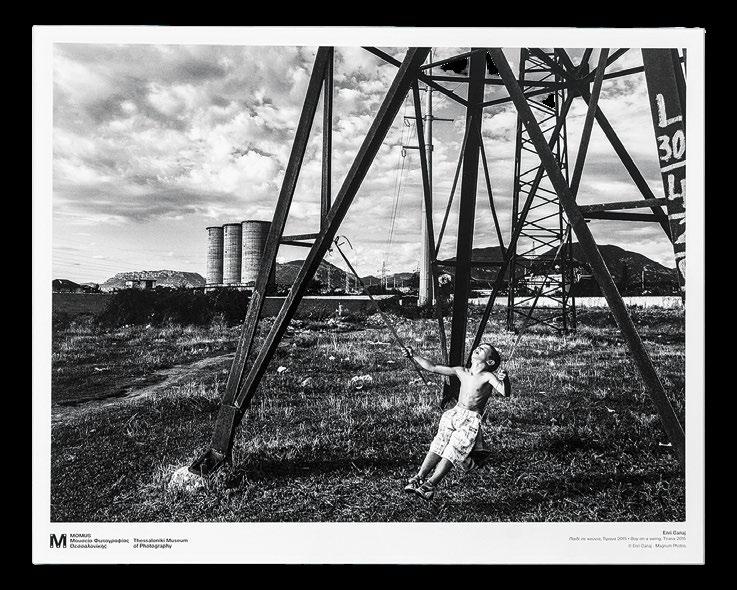
Take a piece of MOMUS with you. At the end of your visit, stop by our museum gift shops and discover gifts, publications, prints, office supplies, jewelery, ceramics, clothing, accessories, and collectible items, with high artistic value in every piece.
shop online: scan the qr code on the right and shop quickly and effortlessly
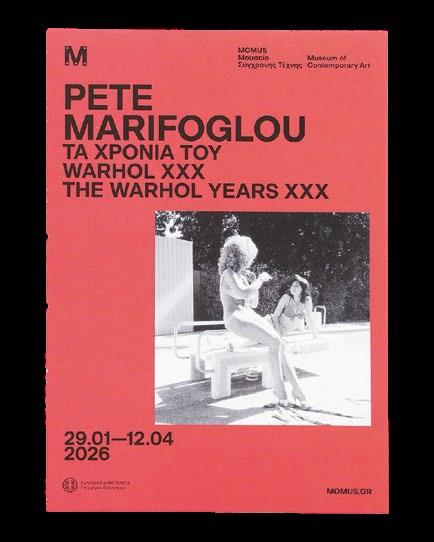
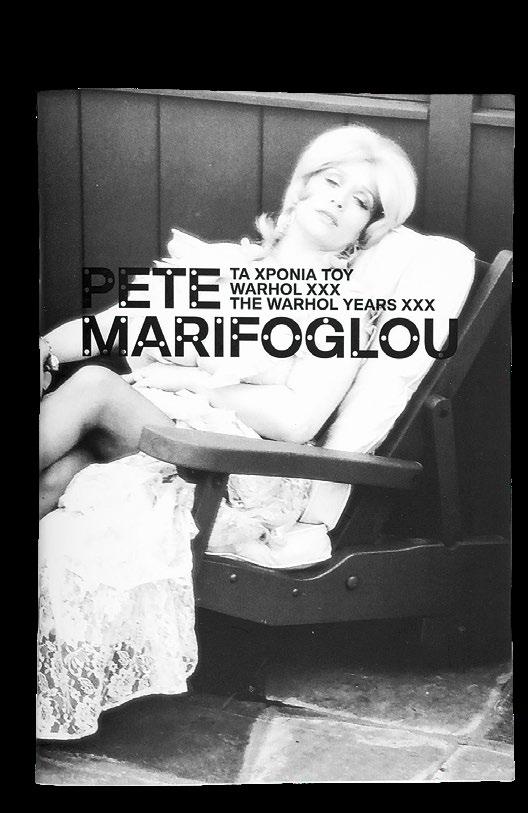
Postcard set Pete Marifoglou. Set of postcards featuring artworks from the exhibition Pete Marifoglou “The Warhol Years xxx,” held at MOMUS-Thessaloniki Museum of Contemporary Art. n
MOMUS. n MOMUS notebook. Hardcover notebook with strap MOMUS. n
Τιμή/Price: €10,00
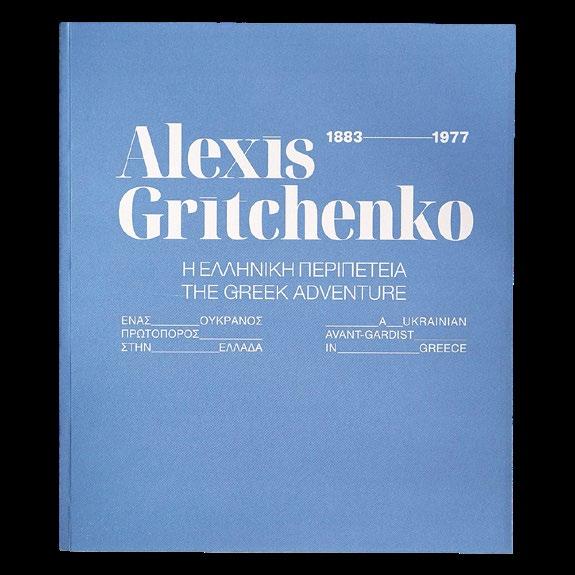
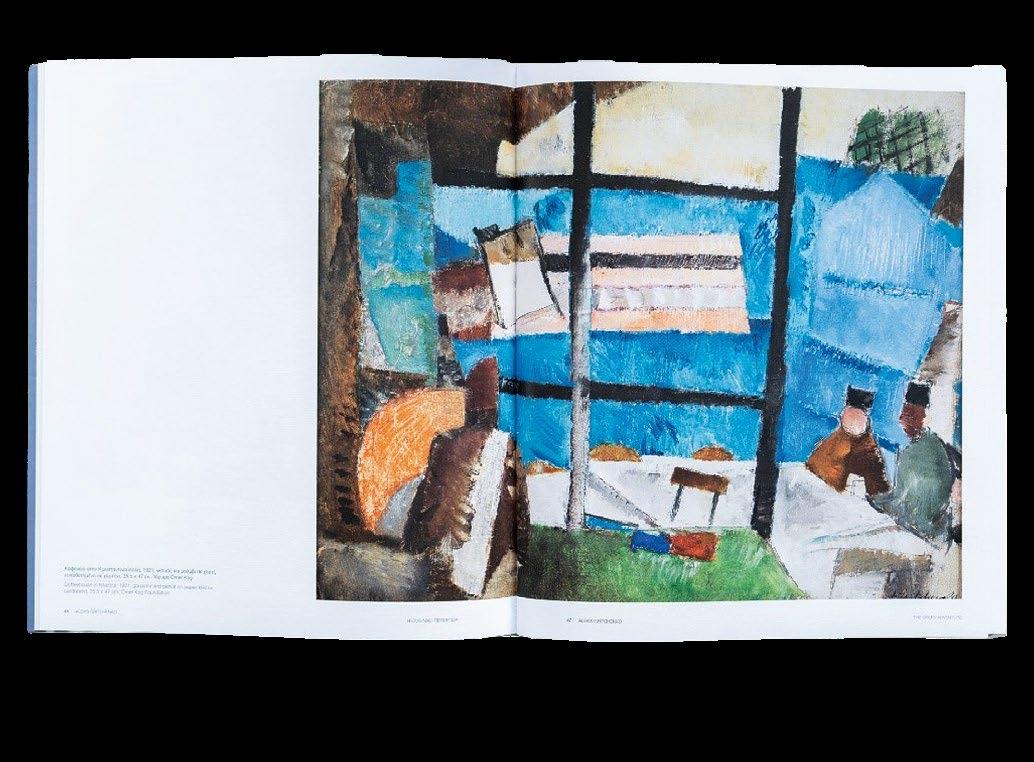
Alexis Gritchenko
alongside avant-garde artists, was a painter and art theorist who connected the power of Fauvism, Cubism, and Futurism with Byzantine tradition. His stay in Greece between 1921 and 1923 was pivotal for his artistic development. n
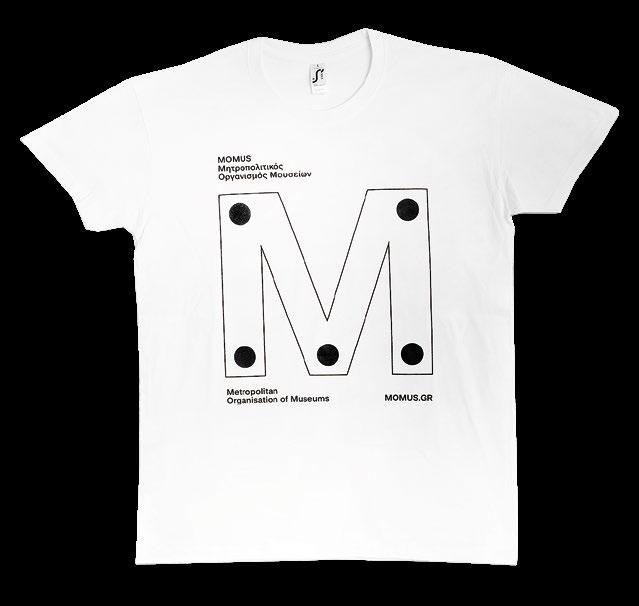
T-shirt MOMUS.
MOMUS.
T-shirt
n MOMUS T-shirt.
Cotton T-shirt featuring the MOMUS logo. Classic unisex T-shirt with a straight fit, printed logo on the front. Available in four sizes.
Τιμή/Price: €20,00
n
Alexis Gritchenko — The Greek Adventure. Catalogue includes works from the corresponding exhibition hosted at MOMUS–Museum of Modern Art. Alexis Gritchenko, born in Ukraine and trained in Kyiv and Saint Petersburg
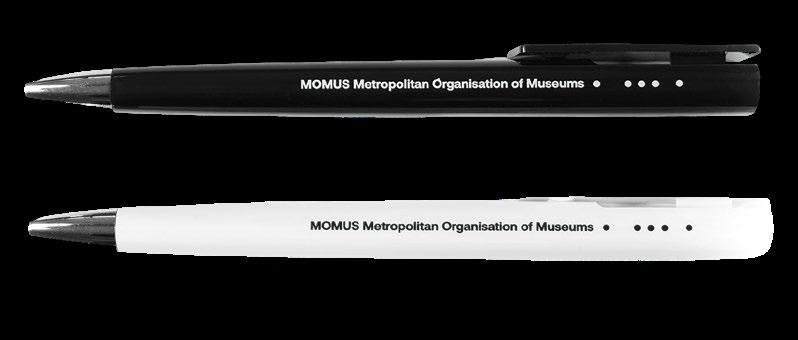
MOMUS pen. Pen ABS with rotating mechanism. Dimensions: 1,2x14,5 cm. n
€2,00
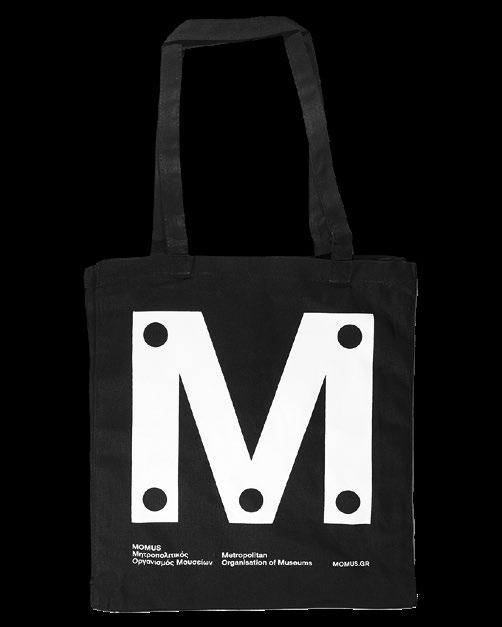
Tote bag MOMUS.
MOMUS Museums.
n MOMUS tote bag. Canvas bag with the MOMUS Museums logo. Ideal for any use.
Weight: 220 grams, with long handles and pleats.
Τιμή/Price: €10,00
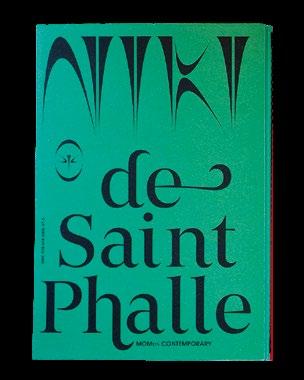
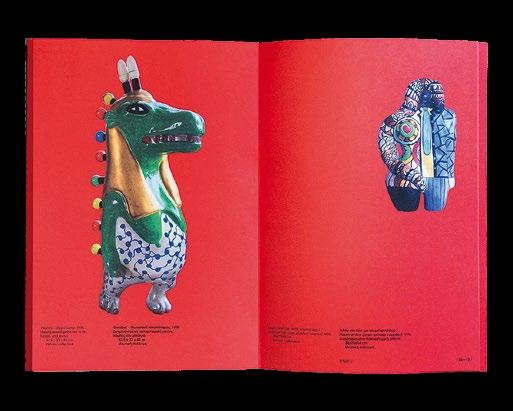
NIKI de Saint Phalle.
NIKI de Saint Phalle.
Catalogue of the exhibition of the same title. It includes works from the corresponding exhibition hosted at the MOMUS-Museum Alex Mylona. Niki de Saint Phalle was one of the most emblematic and disarmingly free artists of the 20th century. n
€20,00
Pete Marifoglou.
Warhol
Case studio#3.
MOMUS shop
n Pete Marifoglou.
The Warhol Years ΧΧΧ. Case studio#3. Catalogue of the exhibition of the same title. It includes works from
(1993). n
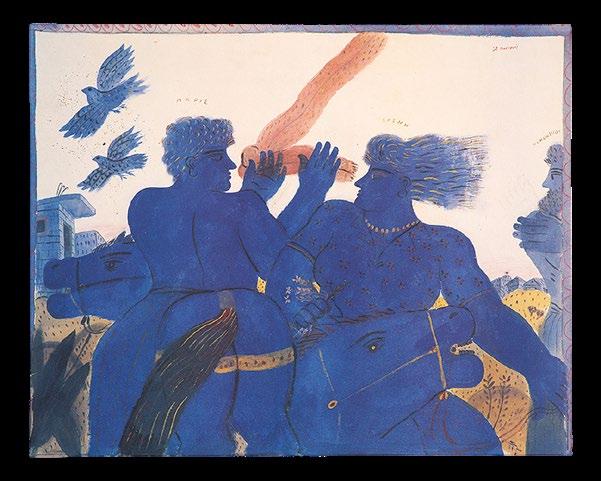
“Paris & Helen” Fassianos poster. Print on museum-quality paper of “Paris & Helen” (1993), Alekos Fassianos. n
the corresponding exhibition hosted at the MOMUS–Museum of Contemporary Art.
After seven decades in New York and across Europe —having worked in photography, film directing and production, having written poetry, music and theatre, and having presented his work in photography exhibitions around the world— Pete Marifoglou returns to his birthplace, Thessaloniki. Marifoglou focuses on analogue black-and-white photography and on people beyond their roles in films. n
Τιμή/Price: €12,00
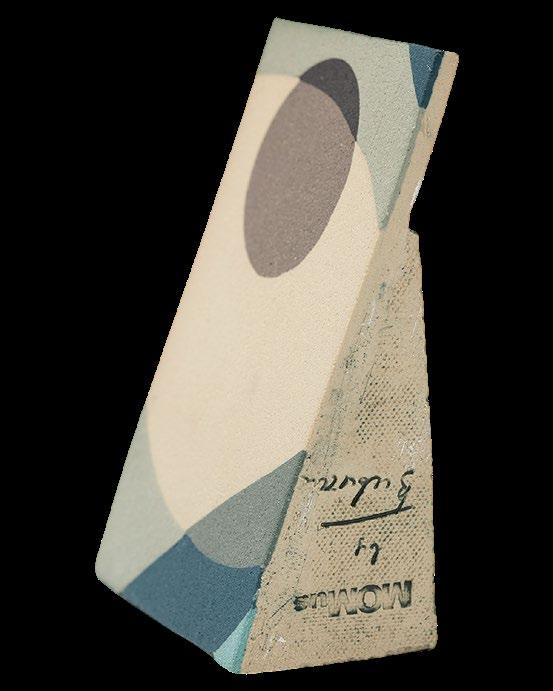
Ceramic pencil case. Handmade ceramic pencil holder inspired by the work of Ivan Kliun from the Costakis Collection of the MOMUS-Museum of Modern Art. Created by George Vavatsis. n
€30,00
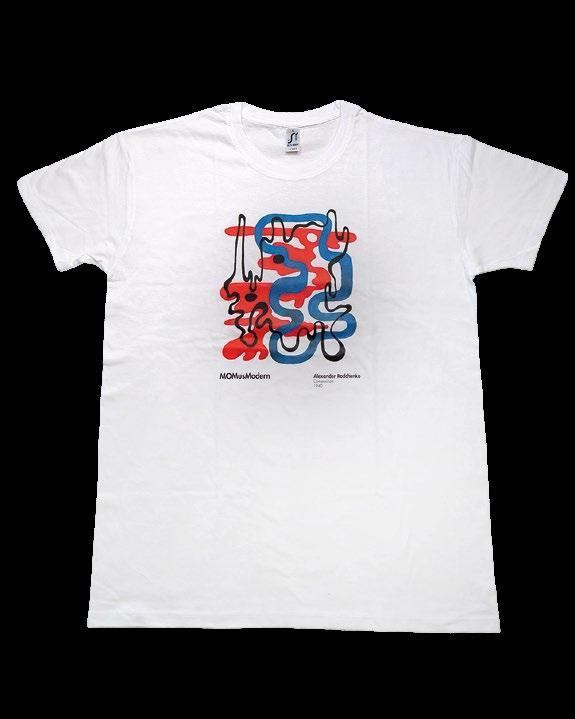
T-shirt
T-shirt Alexander Rodchenko, “Aerodynamic pattern” (1940). Cotton T-shirt inspired by the series “Aerodynamic Pattern” (1940) by Alexander Rodchenko, from the Costakis Collection of MOMUS -Museum of Modern Art. n