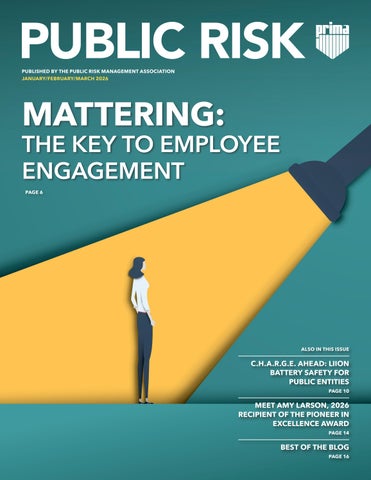

MATTERING: THE KEY TO EMPLOYEE ENGAGEMENT


JANUARY/FEBRUARY/MARCH 2026 | Volume 42, No. 1 | www.primacentral.org
CONTENTS

Mattering: The Key to Employee Engagement
By Dr. Michael Lacroix, PhD


The Public Risk Management Association promotes effective risk management in the public interest as an essential component of public administration.
PRESIDENT Steve M. LePock
Risk Manager
Virginia Beach City Public Schools
PAST PRESIDENT
Adam F. Maxwell, CLRP
Director of Administration
City of Grandview Heights, OH
PRESIDENT-ELECT
Jennifer Hood
Safety & Risk Director
Montgomery County (TN) Government
DIRECTORS
Cathie T. Chancellor, JD, MS, CRM
Risk Manager City of Norfolk, VA
Joe Costamagna
Risk Manager
Schools Insurance Authority
Chester Darden Director of Loss Control Public Entity Partners
Jamee Higgins
Safety & Risk Manager
City of Midland (TX)
Michelle Jordan HR Manager: Risk, Benefits and Compliance
Clayton County Water Authority
Robert Warren, CRM Risk Manager
Trinity River Authority of Texas
NON-VOTING DIRECTOR
Jennifer Ackerman, CAE
Chief Executive Officer
Public Risk Management Association
Alexandria, VA
EDITOR
Nick Baker
703.528.7701 nbaker@primacentral.org
ADVERTISING
Nick Baker
703.528.7701 nbaker@primacentral.org
Public Risk is published 4 times per year by the Public Risk Management Association, 700 S. Washington St., #218, Alexandria, VA 22314 tel: 703.528.7701 • fax: 703.739.0200 email: info@primacentral.org • Web site: www.primacentral.org
Opinions and ideas expressed are not necessarily representative of the policies of PRIMA.
Subscription rate: $140 per year.
Back issue copies for members available for $7 each ($13 each for non-PRIMA members). All back issues are subject to availability. Apply to the editor for permission to reprint any part of the magazine.
By Donna Settle, P.E.
POSTMASTER: Send address changes to PRIMA, 700 S. Washington St., #218, Alexandria, VA 22314. Copyright 2026 Public Risk Management Association
Video Telematics for Vehicle Loss Reduction & Employee Safety
APRIL 15 | 12:00 PM – 1:00 PM ET
SPEAKER:
Jerry Daddesi, Chief Revenue Officer, Konexial, Inc.
Learn how video telematics can dramatically reduce vehicle-related losses while improving driver and employee safety. This webinar will explore how combining video, GPS, and real-time data helps organizations understand the root causes of incidents, coach drivers more effectively, and protect both people and assets. We’ll walk through practical use cases, implementation tips, and how to turn insights into measurable results.
ATTENDEE TAKEAWAYS:
1. How video telematics reduces risk and loss
2. Ways to improve driver and employee safety
3. Key steps to successful implementation


APlaying the Long Game in Public Risk Management
new year naturally invites reflection and resolutions. In public risk management, our resolutions are not personal promises but professional commitments to be proactive rather than reactive, to anticipate risk rather than respond to crises, and to continuously strengthen the systems that protect our people, assets, and operations.
Public risk management is a long game. It requires preparation, patience, and the willingness to stay focused even when the outcome is not immediately clear. That reality was brought home to me when I attended Game 3 of the World Series last October with my wife and our five-month-old daughter. It was an unforgettable 18-inning game between the Los Angeles Dodgers and the Toronto Blue Jays at Dodger Stadium. Long after the excitement of the early innings faded, both teams stayed disciplined, relying on fundamentals, teamwork, and endurance to carry them forward, culminating in an exciting Freddie Freeman walk-off home run in the bottom of the 18th inning. Risk management is much the same. Success often comes not from a single decisive moment but from consistency, planning, and resilience over time. And yes… we stayed all 18 innings!
This year also brings opportunities to strengthen that commitment through upcoming PRIMA events. These gatherings offer valuable insight into emerging risks, innovative solutions, and proven best practices across the public sector. Participation in PRIMA programs helps ensure we remain informed, connected, and prepared for the challenges ahead.
PRIMA’s Emerging Tech and Risk Symposium was held January 27–29, 2026 and brought together more than 120 PRIMA members for a free, three-day virtual event. Each day featured two presentations from subject matter experts,
Participation in PRIMA programs helps ensure we remain informed, connected, and prepared for the challenges ahead.
followed by interactive breakout sessions that allowed attendees to continue discussions with speakers and peers. Participants gained valuable insights into timely topics, including emerging technologies in claims, AI governance frameworks, and privacy risk management. Overall, feedback was overwhelmingly positive.
As we look ahead to the summer, I hope you are making plans to attend PRIMA 2026, which will take place June 7–10 in Fort Lauderdale, Florida . As always, the conference will feature outstanding keynote speakers, a wide range of educational programming, and numerous opportunities to connect with colleagues across the public risk management community. If you haven’t already registered, please be sure to do so by April 10 to take advantage of Early Bird registration rates. Registration information is available at conference.primacentral.org
This year’s conference will feature a ton of great sessions. I’m looking forward to the “Award-Winning Ideas and Lessons from Public Risk Managers of the Year” session. This elite panel will offer valuable insights for risk professionals at every stage of their careers. Their diverse perspectives highlight how sound risk management principles can be successfully applied across all areas of the public sector. I hope you’ll consider joining us for this informative and engaging session.
On another note, PRIMA Institute (PI) will take place October 19–23 in Old Town Alexandria, Virginia . PI is widely regarded as the premier training program for public risk professionals at every stage of their career. Whether you are new to the field or bring years of experience, PI delivers current insights, best practices, and practical strategies designed to help you stay ahead in an evolving risk landscape. Registration for PI opens in June , so be sure to watch your inbox for additional details and registration information.
Finally, I’ve had the opportunity to attend several state chapter conferences over the past few months, and it’s been great to connect with so many dedicated public risk professionals. These events continue to highlight the strength of our chapters and the important work being done across the country. Plus, I’ve been able to bring back great ideas to my own state chapter.
I look forward to another year of teamwork, shared responsibility, and steady progress. If we stay focused, prepared, and committed, we will position ourselves for success, no matter how long the game lasts. I hope to see you in Fort Lauderdale this June!
Sincerely,
Steve M. LePock PRIMA President 2025-2026
NEWS Briefs
DEFIBRILLATORS IN NORTH DAKOTA LAW ENFORCEMENT CARS CREDITED WITH SAVING 90 LIVES
ambulance services are always on call, but can take dozens of minutes to respond to depending on the location.
“Having even that extra five minutes is huge,” said Hudkins, who credits McHenry County Deputy Adam McTaggart for saving her life.
McHenry County Sheriff Trey Skager said his department employs nine to 10 deputies to cover about 2,000 square miles. He said having deputies equipped and trained can save lives.
The devices were distributed to local, state, tribal and federal law enforcement agencies in North Dakota.
An estimated 90 lives have been saved in North Dakota since a grant five years ago equipped law enforcement across North Dakota with modern life-saving equipment.
Department of Health and Human Services officials gathered Wednesday in Bismarck to celebrate the success of a grant program that purchased 1,700 automated external defibrillators, often called AEDs.
The defibrillators, which deliver an electric shock to the chest of a person suffering a heart attack, can be essential in rural areas, said Sherry Adams, North Dakota’s state health officer.
The devices, purchased through the $4.3 million grant from the Leona M. and Harry
B. Helmsley Charitable Trust, have been used about 1,000 times since 2021, according to state health officials.
“They were able to train these law enforcement personnel as well to be ready in the event they might have to use them,” Adams said.
One woman who credits law enforcement for saving her life is Patsy Hudkins of Velva. Hudkins suffered a heart attack while working at a local bar in February 2023. A nearby sheriff’s deputy responded to the scene and used an AED from his patrol car to deliver the shock that saved her life.
“A lot of times the officers are the first ones on duty,” said Hudkins, who shared her story during a news conference. She said rural
About 30 North Dakota towns and cities are also part of the state’s Cardiac Ready Community Program, said Christine Greff, stroke and cardiac systems coordinator for the Department of Health and Human Services. The program supports bystander, emergency responder and public-private partnerships to improve responses for cardiac events and strokes.
Health officials urged more communities to get involved with the program by reaching out to the state’s Emergency Medical Systems Unit
“We’re calling on all of the communities of North Dakota to begin to prepare, to train, and ensure that AEDs are accessible,” Adams said. “We are really reminded today that action truly matters.”
The article appeared in Governing magazine and is reprinted with permission.
Michael Achterling, North Dakota Monitor
HOW CITIES HAVE IMPLEMENTED ‘CARE RESPONSE’ TEAMS ON 911 CALLS
By Sean McDonnell, cleveland.com, TNS
As Cleveland City Council presses Mayor Justin Bibb’s administration to advance Tanisha’s Law — a proposal to send unarmed clinicians to certain mental-health emergencies — lawmakers are pointing to other cities that already run the kind of programs they want to create here.
The three council representatives sponsoring Tanisha’s Law — Stephanie Howse-Jones, Rebecca Maurer and Charles Slife — pointed out four different cities as models in a presentation they gave to other council members last week.
Albuquerque, Allegheny County, Durham and Evanston each operate versions of “care response,” where behavioral-health experts, not police officers, are dispatched to some 911 calls involving mental illness, substance use or wellness checks.
Albuquerque created a civilian department, Albuquerque Community Safety, in 2021. The agency dispatches unarmed responders — including social workers, clinicians and trained outreach workers — to non-violent calls such as behavioral-health crises, welfare checks and intoxication.
After four years the new department has responded to more than 120,000 calls for service, with over 85% of them diverted away from Albuquerque Police Department (APD) and Albuquerque Fire Rescue, the city announced in September.
Last December, Allegheny County officials announced the launch of an Alternative Response program. It created a fourth branch of emergency services, referred to as the A-Team, that could respond to 911 calls either in tandem with police or as an alternative to law enforcement. It was initially launched in three Pittsburgh suburbs, according to the county.
In Pittsburgh itself, the city created a program in 2023 where police officers and mental health professionals were dispatched together in patrol cars to behavioral-health calls. But the
Evanston Roundtable reports that the team responded to 2,000 calls in its first year. The city was looking at expanding the team to provide 24/7 coverage.
city decided recently to overhaul the program, opting to send clinicians and cops separately.
The change is so that police or fire aren’t tied up on scene if they’re not needed.
Now, pairs of mental health professionals will form crisis response teams that can drive themselves to seeds, rather than buddying up with officers, WESA 90.5 reports. They would respond after police make sure a scene is safe. The program was set to relaunch in November.
Durham’s HEART program integrates clinicians directly into its 911 center. According to the city, clinicians triage calls involving mental health concerns and divert appropriate ones away from police.
11ABC in Durham reports that the HEART program had responded to more than 26,000 emergency calls between its launch in 2022 and March 2025.
Durham also deploys unarmed Community Response Teams — made up of clinicians, EMTs and peer-support staff — to certain non-violent emergencies. A co-responder model
pairs a clinician with a Crisis Intervention Team-trained officer for calls requiring police involvement, according to the city.
Evanston’s launched its own Alternative Response Team in 2024, and sends a mentalhealth clinician and community paramedic to 911 calls involving behavioral-health crises, substance use or welfare checks. Police join only when safety concerns demand it, the city says.
Evanston Roundtable reports that the team responded to 2,000 calls in its first year. The city was looking at expanding the team to provide 24/7 coverage.
Cleveland’s exact path forward is unclear, as some on city council want a standalone department, while Bibb would rather build out these services in an existing city department.
The legislation is expected to move ahead in early 2026.
The article appeared in Governing magazine and is reprinted with permission.
MATTERING: THE KEY TO EMPLOYEE ENGAGEMENT

BY DR. MICHAEL LACROIX, PhD, THE HARTFORD
THERE’S A NEW BUZZWORD GOING AROUND: MATTERING.
Actually, it’s not really new. Mattering has been studied by academic psychologists for a number of years now1, but a recent bestselling book by Zach Mercurio 2 has brought the concept to the attention of the public and it is the basis for this article. Mattering refers to knowing that your presence and contributions make a genuine difference. At a broad level, it turns out that people who feel that they (and their contributions) matter are more likely to lead a meaningful life.3 But at a more practical level, Mattering matters because when employees feel valued, seen, and heard, not only do they flourish, but so do their employers.

Mercurio argues that Mattering is a fundamental survival instinct that transforms into a psychological need. From infancy, babies reach out to others for evidence that they matter (initially, “Give me food!”), and this grows into a broader need for validation and recognition as significant.
It’s important to differentiate Mattering from a couple of related concepts. Belonging means feeling welcome and accepted. Inclusion means the ability to participate and to have a voice. Mattering runs deeper and broader. It means knowing that what you personally contribute makes a difference, that others see it and appreciate it, and that they appreciate you.

Mercurio cites research indicating that there is currently an epidemic of insignificance in workplaces, where many employees feel ignored and undervalued. A lack of mattering leads to disengagement, burnout and turnover. Just think about all the bickering surrounding the return-to-office policies throughout and following the COVID-19 pandemic. I think we can fairly characterize the process as chaotic overall, with significant pushback from both employers and employees, and this adversarial dynamic continues today.
According to The Hartford Future of Benefits Study, 27% of employees feel flat-out ignored, 65% feel lonely at work, and overall, three in five are experiencing some level of burnout at work.4 Former U.S. Surgeon General Dr. Vivek Murthy famously declared a loneliness epidemic in 2023: Feeling that you matter at work neutralizes the sense of loneliness and disengagement, and constitutes an essential element of a healthy organization. Research shows that lack of Mattering has been a major reason behind the return-to-office squabbling, surpassing financial incentives. According to McKinsey data, the biggest reason employees leave a job without another one in hand is not money (money is # 6 ); uncaring leaders (# 1), unreasonable work performance expectations (# 2), and lack of support (# 4) all rate as more important than compensation.5
Mercurio advocates for the NAN Framework to develop and strengthen Mattering. The Framework includes three pillars:
Noticing, Affirming, and Needing skills are eminently teachable.
Developing these skills does not require extensive (and expensive) programs or sophisticated engagement surveys.
• Noticed – feeling seen and heard
• Affirmed – recognition of unique strengths
• Needed – feeling indispensable
Noticing is more than casual recognition; it involves actively seeking to understand important aspects of a person’s life, such as how a team member’s child is adapting to a new school or how a spouse is doing in a new job. When practiced with authenticity, Noticing strengthens the bond between leader and team, as each member feels that they are seen as a whole person.
Affirming is more than casual praise. It focuses on specific, personal contributions that genuinely matter to the organization’s overall goals. When practiced with authenticity, Affirming enables team members to recognize and take pride in their unique roles and values.
Needing dispels the fear that most employees have of being replaceable. To quote, “When people feel replaceable, they act replaceable.” When practiced with authenticity, Needing does not simply notice and affirm, the practice fosters accountability, initiative, and dedication.
Noticing, Affirming, and Needing skills are eminently teachable. Developing these skills does not require extensive (and expensive) programs or sophisticated engagement surveys. They require heightened awareness by the leader of how they interact with their team, as well as ongoing self-monitoring. You
can’t phone this one in! Mattering happens through daily, sometimes momentary microinteractions with your team members.
Here are some practical examples of how to use the NAN framework:
1. NOTICING: MAKING PEOPLE FEEL SEEN AND HEARD
• Greet team members by name and acknowledge their presence each day.
• Pay attention to personal milestones (e.g., birthdays, work anniversaries) and celebrate them.
• Check in with employees about their wellbeing, not just their work tasks.
• Actively listen during conversations — maintain eye contact, avoid multitasking, and follow up on details previously shared.
• Keep notes on what matters to each person (e.g., family, hobbies, recent challenges) and reference these in subsequent interactions.
• If relevant and appropriate, consider reminding them of company resources that could be of assistance to them (e.g., EAP, wellness resources, FMLA, other benefits)
2. AFFIRMING: RECOGNIZING UNIQUE STRENGTHS AND CONTRIBUTIONS
• Give specific praise that highlights an individual’s unique skills or the impact of
their work (e.g., “Your attention to detail on this project prevented major cost overruns”).
• Publicly recognize achievements in team meetings and/or company communications.
• Express gratitude regularly, not just for outcomes but also for effort and attitude (e.g., “Thank you for your persistence through this especially stressful week”).
• Link strengths to purpose: Show how someone’s unique abilities contributed to the team or organizational goals.
3. NEEDING: DEMONSTRATING THAT PEOPLE ARE INDISPENSABLE
• Involve employees in decision-making and seek their input on important matters.
• Assign responsibilities that align with their strengths and communicate why their role is essential.
• Ask for help or advice in areas where they have expertise, reinforcing their value to the team.
• Celebrate not just “wins,” but the specific people and unique gifts that made those wins possible.
These and similar actions build trust and strengthen relationships. Mattering-centered leadership is more than a soft skill; it is foundational to successful leadership and organizational culture.
Employees expect to feel seen and heard, to have their unique strengths acknowledged, and their contributions appreciated as essential. These NAN experiences help foster trust and commitment. Active listening and showing appreciation by managers create a culture of affirmation. Conversely, anti-mattering behaviors, such as dismissiveness and lack of recognition, lead to learned helplessness and toxic work environments. Mattering is a leading indicator of organizational health, influencing culture and reducing attrition. Organizations that prioritize Mattering see improved engagement across the board. Gallup has found significant differences between organizations with high and low levels of

employee engagement across measures such as turnover, absenteeism, safety incidents, and employee theft, as well as derived measures, notably productivity, profitability, and customer loyalty.6
Mattering matters not only for organizational outcomes, but also for individual mental health and societal well-being. Mercurio argues that, broadly, Mattering is foundational to human flourishing — a state of optimal psychological and social functioning.7 When people feel noticed, affirmed, and needed, they feel valued and that they truly matter. When they feel that they matter, they more readily engage (with their work, with their lives), and they can more easily reach their potential. When they do not feel that they matter, they become disengaged, lonely, powerless, and unsuccessful — a condition psychologists characterize as languishing.7
This concluding quote from the book captures it in a nutshell: “To someone who doesn’t
believe they matter, it’s hard for anything to matter.”
Dr. Michael Lacroix is Medical Director with The Hartford.
REFERENCES:
1. Flett, Gordon. The Psychology of Mattering: Understanding the Human Need to be Significant. New York: Academic Press, 2018.
2. Mercurio, Zach. The Power of Mattering, Boston: Harvard Business Review Press, 2025.
3. “A Life Is Not Important Except in the Impact It Has On Other Lives”
4. The Hartford’s 2024 Future of Benefits Report
5. gone-for-now-or-gone-for-good-how-toplay-the-new-talent-game-and-win-backworkers.pdf
6. Gallup 2024 Q12 Meta-Analysis
7. Keyes, C.M. Complete mental health: An agenda for the 21st century. In Keyes, C.M. & Haidt, J. Flourishing. Washington: APA, 2013.
C.H.A.R.G.E. AHEAD: LiIon Battery Safety for Public Entities

BY DONNA SETTLE, P.E., GALLAGHER CLAIMS AND RISK CONSULTING
LITHIUM-ION BATTERIES (LIBS) have become indispensable in public operations. They power laptops in libraries, tools in maintenance shops, scooters in micro-mobility programs, and backup systems for critical services.
Their energy density and convenience make them essential, but they also introduce a hazard that moves faster than most people realize. When a cell fails, thermal runaway can escalate in seconds, producing flames, toxic gases, and intense heat. According to Underwriters Laboratories’ (UL) Fire Safety Research Institute (FSRI), escape time after the first warning signs can be less than one minute (FSRI, 2025). That reality underscores the need for public entities to adopt a structured approach to LIB safety, one that combines technical controls with behavioral discipline and public education.
The UL Research Institutes’ “Take C.H.A.R.G.E.” framework offers exactly that.
It distills battery safety into six actions:
Choose certified products
Handle with care
Always stay alert
Recycle properly
Get out quickly, and
E ducate others (FSRI, 2023).
This article translates those principles into a practical narrative for risk managers, aligning with NFPA, IFC, and EPA guidance while addressing the unique challenges of municipal environments.

WHY LIBS DEMAND SPECIAL ATTENTION
Thermal runaway is not a typical fire. It is a chemical chain reaction that accelerates internally, often without visible warning, until the device vents or ignites. Overcharging, physical damage, exposure to heat, or manufacturing defects can trigger the process. Once underway, the reaction can propagate to adjacent cells, making suppression difficult. Evacuation, not extinguishment, is the priority. LIB fires can reignite even after initial control, releasing gases that compromise air quality and visibility. These characteristics make LIB risk management a matter of life safety and operational continuity, not just property protection.
THE C.H.A.R.G.E. FRAMEWORK [UNDERWRITERS LABORATORIES (UL) RESEARCH INSTITUTES]
The six actions in UL’s framework are simple to remember but powerful when embedded in policy and daily routines.
C — Choose certified products. Procurement policies should require Nationally Recognized Testing Laboratory (NRTL) or UL listings for all devices, chargers, and battery packs. Verification at receipt and maintaining an approved equipment registry prevents
uncertified products from entering the system. Certified products incorporate safeguards against overcharging and short circuits, reducing the risk of failure. This discipline also simplifies recall management because certified devices are traceable through documented purchase channels.
H — Handle with care. Charging stations should be purpose-built, located on noncombustible surfaces, and kept clear of exits and combustible materials. Improvised charging in corridors or under stairwells is a recipe for blocked egress during an emergency. Staff should follow manufacturer instructions, avoid mixing chargers across brands, and store batteries away from heat sources. In maintenance shops, where tool packs and flammables coexist, simple layout changes— such as separate cabinets for batteries and metal-top charging benches—reduce compounding hazards.
A — Always stay alert. Warning signs— swelling, discoloration, unusual odor, heat, or hissing sounds—must trigger immediate isolation. Devices showing these symptoms should never be returned to service or placed on a charger. Training front-line staff to recognize and report these indicators is one of the simplest, most effective interventions.
A five-minute briefing repeated quarterly can refresh staff on what to watch for and how to respond.
R — Recycle properly. LIBs do not belong in trash or curbside recycling. Improper disposal has caused fires in collection vehicles and material recovery facilities. Public entities should establish secure drop-off points, partner with certified recyclers, and publish clear guidance for staff and residents. EPA’s universal waste provisions offer a compliance pathway for many LIBs (U.S. EPA, 2025).
G — Get out quickly. If a battery ignites, evacuation is the safest response. LIB fires can reignite, producing jets of flame and toxic gases. Plans should include isolation procedures, ventilation strategies, and coordination with local fire services. Incident drills should reinforce that life safety, not salvage, is the priority.
E — Educate others. Safety culture extends beyond employees. Municipalities can host workshops at libraries and community centers, share digital toolkits on city websites, and integrate LIB safety into school programs. FSRI and USFA provide free outreach materials that can be adapted for local use (USFA, 2023; FSRI, 2025).

Thermal runaway is not a typical fire. It is a chemical chain reaction that accelerates internally, often without visible warning, until the device vents or ignites.
Preventing LIBs from entering municipal waste is both a safety and sustainability imperative.
BEYOND THE BASICS: POLICY AND PLANNING
Embedding C.H.A.R.G.E. into governance means writing it into policy and operational plans. Policy defines the “what” and “why”— commitments to safe procurement, designated charging areas, and compliance with codes. Plans define the “how” and “when”—inspection routines, incident response steps, and recycling workflows. Referencing IFC Chapter 12 for energy systems and NFPA 855 for energy storage installations ensures alignment with recognized standards (ICC, 2025; NFPA, 2026).
HANDLING DDR BATTERIES: DAMAGED, DEFECTIVE, OR RECALLED
DDR batteries pose the highest risk. They should be isolated immediately in fire-resistant containers, stored in ventilated areas away from combustibles, and never recharged. Chainof-custody documentation—serial numbers, condition, removal date—supports accountability and compliance. Public entities should monitor CPSC recall alerts and communicate disposal instructions promptly to staff and residents (CPSC, 2025; CPSC, 2026).
KEEPING LIBS OUT OF SOLID WASTE STREAMS
Preventing LIBs from entering municipal waste is both a safety and sustainability imperative. Ordinances should explicitly prohibit disposal in trash or single-stream recycling. Haulers and MRF operators need training to identify LIB hazards and safely isolate them. Public drop-off programs and e-waste collection days, supported by certified vendors, make compliance easier for residents (U.S. EPA, 2023; U.S. EPA, 2025).
BUILDING A RECYCLING ECOSYSTEM
A resilient program depends on qualified partners. Contracts should require certified recyclers, include emergency pickup clauses for DDR batteries, and include audit documenta-
tion. Coordination with environmental staff ensures alignment with EPA’s universal waste rules. These steps reduce liability and demonstrate leadership in sustainability (FedCenter, 2023; EHSLeaders, 2023).
HIGH-RISK AREAS AND PRACTICAL CONTROLS
Libraries with device pools, maintenance shops with tool batteries, micro-mobility programs, and IT rooms all present unique challenges. While the specifics vary, the principles remain constant: segregate batteries from combustibles, provide noncombustible charging surfaces, enforce compatibility rules, and maintain detection systems. These measures, combined with staff training, reduce the likelihood that a minor oversight will escalate into a major incident.
RISK ASSESSMENT AND INCIDENT RESPONSE
Risk assessment should consider device density, proximity to egress, environmental conditions, and behavioral compliance. NFPA guidance supports a structured approach, while local audits keep data current. Incident response plans must be simple and actionable: recognize warning signs, isolate if safe, evacuate, notify responders, and document the event. Post-incident steps include ventilation, residue cleanup, and certified disposal.
Lithium-ion batteries are here to stay, and so are the risks they bring. By adopting UL’s C.H.A.R.G.E. framework and embedding it into policy, planning, and public education, municipalities can turn a complex technical hazard into a manageable operational challenge. Addressing DDR handling, vendor partnerships, and waste-stream prevention completes the picture: protecting people, property, and continuity while meeting modern expectations for safety and sustainability (FSRI, 2025).
Donna Settle, P.E., is Property Risk Engineering Leader for Gallagher Claims and Risk Consulting.
REFERENCES:
UL Research Institutes (FSRI). (2025). Battery Safety —Take C.H.A.R.G.E. https://batteryfiresafety.org/
FSRI (UL Research Institutes). (2023). Program: Take C.H.A.R.G.E. of Battery Safety. https://fsri.org/ programs/take-charge-battery-safety
U.S. Fire Administration (USFA). (2023). Learn to Take C.H.A.R.G.E. of Battery Safety. https:// www.usfa.fema.gov/blog/learn-to-take-charge-ofbattery-safety/
USFA. (2024). Battery Fire Safety—Outreach materials. https://www.usfa.fema.gov/prevention/ home-fires/prevent-fires/batteries/
USFA. (2025). Risks and response strategies for lithium-ion battery fires. https://www.usfa.fema. gov/a-z/lithium-ion-batteries/risks-andresponse-strategies/
International Code Council (ICC). (2025). IFC Chapter 12—Energy Systems. https://codes.iccsafe. org/content/IFC2021V2.0/chapter-12-energy-systems
National Fire Protection Association (NFPA). (2026). NFPA 855—Standard for the Installation of Energy Storage Systems. https://www.nfpa. org/codes-and-standards/nfpa-855-standarddevelopment/855
NFPA Research Foundation. (2023). Explosion prevention/control guidance for ESS—Phase 1. https:// www.nfpa.org/education-and-research/research/ fire-protection-research-foundation/projects-andreports/development-of-explosion-preventioncontrol-guidance-for-ess-installments-phase-1
U.S Environmental Protection Agency (EPA). (2025). Lithium-Ion Battery Recycling. https://www. epa.gov/hw/lithium-ion-battery-recycling
U.S. EPA (Regulations.gov). (2023). Used LithiumIon Batteries—Public guidance. https://downloads. regulations.gov/NHTSA-2022-0075-0024/attachment_134.pdf
FedCenter (EPA). (2023). Lithium Battery Recycling—Regulatory status and FAQs. https://www.fedcenter.gov/Bookmarks/index. cfm?id=41016
EHSLeaders. (2023). EPA issues guidance for lithium-ion battery waste. https://ehsleaders. org/2023/06/epa-issues-guidance-for-lithium-ionbattery-waste/
CPSC. (2025). DR Power battery pack recall— disposal instructions. https://www.cpsc.gov/ Recalls/2025/DR-Power-Recalls-Lithium-IonBattery-Packs-Due-to-Fire-and-Burn-Hazards
CPSC. (2026). Rad Power Bikes e-bike battery warning. https://www.cpsc.gov/Warnings/2026/ CPSC-Warns-Consumers-to-Immediately-StopUsing-Batteries-for-E-Bikes-from-Rad-Power-BikesDue-to-Fire-Hazard-Risk-of-Serious-Injury-or-Death
Meet Amy Larson
2026 RECIPIENT OF THE PIONEER IN EXCELLENCE AWARD

Each year, PRIMA recognizes a long-term PRIMA member who has made outstanding contributions to the association and the public risk field. PRIMA is proud to present the 2026 Pioneer Excellence Award to Amy Larson. Amy has been active in PRIMA at the national and state level for 25 years, and has served on PRIMA’s Board of Directors, has chaired or co-chaired several committees, spoken at conferences and more. She is currently the risk and litigation manager for the City of Bloomington (MN). Below is a Q&A PRIMA recently conducted with Amy.
HOW DID YOU END UP IN RISK MANAGEMENT?
Funny enough, it all started with a simple search. I was on the City of Bloomington’s website checking to see whether we needed a building permit to build a storage shed in our backyard. While browsing, I noticed a job posting for risk manager position. That was 25 years ago, and I’m still here.
Before joining the public sector, I worked as the risk manager and in-house counsel for a private company that rented hospital equipment nationwide—no risk there!
WHAT ARE THE THREE MOST SIGNIFICANT WAYS PUBLIC RISK MANAGEMENT HAS CHANGED SINCE YOU STARTED?
Back in the day, risk management was mostly about buying insurance and reacting after something went wrong. Over time, though, it’s become much more involved in the decision-making process. Including risk management at the table enables organizations to anticipate risks, address potential issues proactively, and make better-informed decisions. Risk managers also tend to view things differently from those running individual projects or programs. Instead of focusing on one department, we’re looking at the bigger picture and how decisions impact the organization as a whole.
WHAT ARE THE THREE TOP BENEFITS
PRIMA PROVIDES TO YOU?
PRIMA is my go-to resource for risk management questions. I regularly use PRIMATalk to see how other risk managers handle situations that arise in my organization. Sometimes I don’t even have to ask the question myself— someone else has already asked it for me.
PRIMA also offers excellent educational opportunities for risk management professionals at every stage of their careers. From the annual conference and PRIMA Institute to webinars, Public Risk magazine articles, and Let’s Talk Tuesdays, there’s no shortage of practical resources that both new and experienced risk managers can use on a daily basis.
Finally, PRIMA provides invaluable networking opportunities. As I often tell PRIMA Institute attendees, getting involved with PRIMA leads to lifelong friendships, mentoring relationships (both as a mentor and a mentee), and reassurance that you’re not losing your mind when certain projects or programs are proposed—like buying bounce houses for community engagement activities.
WHAT PRIMA BENEFITS DO YOU THINK BEST SERVE NEW RISK MANAGERS?
Whether it’s attending the five-day immersive PRIMA Institute or asking a question on PRIMATalk, the educational opportunities and resources that PRIMA provides to its members, especially new risk managers, are truly unmatched.
IF A NONMEMBER WAS ON THE FENCE ABOUT JOINING PRIMA, WHAT WOULD YOU SAY TO GET THEM TO JOIN?
Being a member of PRIMA gives you access to outstanding public risk management education and resources, but just as importantly, it connects you to a community of professionals facing many of the same challenges. PRIMA members include public risk managers—even if that isn’t their title—as well as insurance industry professionals who are always willing to share their experiences and expertise, so others don’t have to reinvent the wheel. Through shared insights, you learn from others’ experiences and make more informed decisions for your organization.

Being a member of PRIMA gives you access to outstanding public risk management education and resources, but just as importantly, it connects you to a community of professionals facing many of the same challenges.
IS THERE ANYTHING ELSE YOU’D LIKE TO ADD?
I would like to thank PRIMA for selecting me for this Pioneer Excellence Award. As I reflect on my career as a public risk manager, I can honestly say that PRIMA has played a significant role in helping me become the
effective and respected risk manager that I am today. I’m excited to see how risk management continues to evolve, and I’m confident that PRIMA will be there to support and guide public sector risk managers as we navigate new challenges and opportunities waiting for us in the future.
OF THE BLOG
DETOXIFYING SAFETY CULTURE: PRACTICAL ANTIDOTES FOR A HEALTHIER WORKPLACE, AND HIDDEN LIABILITY SCHOOLS CARRY WITHOUT REGULAR PHYSICAL SECURITY ASSESSMENTS
DETOXIFYING
SAFETY CULTURE:
PRACTICAL ANTIDOTES FOR A HEALTHIER WORKPLACE
BY MATT PHILLIPS, SAFETY & RISK MANAGER; HANOVER COUNTY GOVERNMENT & HANOVER COUNTY PUBLIC SCHOOLS, VIRGINIA
Every safety and risk professional eventually reaches a moment of reflection: What do I wish I had known when I started?
One key lesson stands out—safety culture isn’t automatic; it’s cultivated. While many leaders value safety, acknowledgment alone doesn’t sustain a resilient organization. A healthy safety culture is also the foundation of effective risk management. The same human factors that drive incidents—complacency, overconfidence, and resistance to change—also shape organizational exposure and fiscal risk. When safety becomes transactional or compliance-driven, it weakens enterprise risk management. True resilience emerges when safety is viewed not as a set of regulations to follow, but as a strategic discipline that protects people, performance, and reputation.
Across industries, recurring toxic mindsets— what I call the poisons of occupational safety—undermine engagement, accountability, and progress. The good news: each has an antidote.
COMMON
POISONS AND THEIR ANTIDOTES
“We’re OSHA Compliant.”
Poison: Many organizations believe meeting OSHA requirements is enough, but compliance is a baseline, not a benchmark. Focusing only on regulations creates a false sense of security that limits growth.
Antidote: Continuous Improvement – Track leading indicators like engagement and near-miss reporting—not just incident rates.
“We’ve Always Done It This Way.”
Poison: When long-standing habits are mistaken for best practices, tradition quietly resists innovation. This mindset prevents learning and blocks the use of safer, more innovative methods.
Antidote: Embrace Change – Reward innovation through recognition and open dialogue.
“Why Train for Hazards We Don’t Face?”
Poison: Some minimize the value of training for rare events, but preparedness looks unnecessary—until it’s not. Emergencies seldom follow the expected script.
Antidote: Proactive Learning – Make training scenario-based and practical, incorporating community partners.
“Safety Slows Production.”
Poison: This myth drives shortcuts and fatigue. In truth, unsafe operations cost more through downtime, claims, and turnover.
Antidote: Safety as a Productivity Booster –Use job hazard analyses to enhance both safety and efficiency.
“Safety Is Common Sense—and the Safety Department’s Job.”
Poison: Assuming safety is innate or isolated sidelines accountability. Safety is a shared responsibility.
Antidote: Shared Responsibility – Empower every employee to act as a safety leader and recognize proactive prevention.
“We Don’t Have the Budget.”
Poison: Budget constraints often push safety lower on the list, yet ignoring hazards is far more expensive over time.
Antidote: Risk Prioritization – Use a risk matrix to target limited resources where they matter most.
“Incidents Are Unavoidable.”
Poison: Accepting accidents as inevitable erodes learning and accountability. This fatalism stifles progress.
Antidote: Prevention Mindset – Encourage open discussion of near-misses and lessons learned to prevent recurrence.
“Acknowledging Risk Creates Liability.”
Poison: Some fear transparency invites blame, but denial breeds liability and damages trust.
Antidote: Accountability and Transparency –Train leaders to address issues decisively and document corrective actions.
FROM COMPLIANCE TO CULTURE
Safety and risk management are inseparable. The same cultural toxins that corrode safety also weaken fiscal stability and public trust. Each antidote strengthens organizational resilience—reducing insurance costs, supporting continuity, and aligning safety with Total Cost of Risk (TCOR) goals.
The poisons of safety—complacency, rigidity, undertraining, and blame—aren’t just cultural flaws; they’re barriers to resilience. When safety aligns with risk management, it becomes more than a moral duty—it becomes a strategic advantage.
A healthy safety culture is curious, accountable, and proactive, protecting people, mission, and reputation—one antidote at a time.
HIDDEN LIABILITY SCHOOLS CARRY WITHOUT REGULAR PHYSICAL SECURITY ASSESSMENTS
BY MASON WOOLDRIDGE, SUBJECT MATTER EXPERT, SIGMA 7
School districts across the country work hard to create safe and supportive learning environments. Yet, many carry a level of liability that often goes unrecognized: unassessed or under-assessed physical security risks on their campuses. While districts routinely update policies, training, emergency procedures, and the physical environment itself, lighting, access points, landscaping, camera coverage, sightlines, signage, and building layouts can pose predictable hazards that increase the likelihood and severity of insurance claims. For risk managers, these conditions represent not just safety concerns but clear areas of exposure that can be identified and mitigated through structured physical security assessments.
A physical assessment is a systematic evaluation of buildings and grounds that identifies vulnerabilities before they contribute to an incident. Act 55 in Pennsylvania, for example, requires school entities to use standardized assessment
criteria when evaluating physical security. This includes reviewing fencing, access control, visitor flow, building maintenance, emergency communication systems, surveillance visibility, and environmental factors that influence risk. Although the legislation is state-specific, the principles behind it apply nationally: schools that regularly conduct structured assessments reduce their exposure to preventable loss.
Much of the liability tied to school campuses is rooted in foreseeability. Poor lighting in parking lots, overgrown landscaping that obstructs lines of sight, malfunctioning door hardware, unsecured secondary entrances, blind spots in hallways, and unclear territorial signage all create conditions where incidents are not just possible, they are predictable. From a claims-management perspective, these environmental deficiencies often shape negligence arguments after the fact. A school that has not conducted a recent assessment may struggle to
demonstrate that it exercised reasonable care in identifying and addressing hazards.
Crime Prevention Through Environmental Design (CPTED) provides a valuable framework for understanding why physical deficiencies matter. CPTED principles, such as natural surveillance, natural access control, territoriality, and maintenance, directly support risk reduction. When campuses maximize visibility, clearly define boundaries, control access points, and maintain facilities, they reduce opportunities for trespassing, vandalism, assault, unauthorized entry, and property damage. These same factors also reduce everyday liability related to playground equipment failures, slip-and-fall incidents, and inadequate lighting. In short, CPTED principles are not just security concepts; they are loss-prevention tools.
Regular physical assessments also strengthen the defensibility of claims. When an incident occurs, assessors’ reports, tiered criteria, and documented corrective actions demonstrate that a district is proactively managing its risk environment. This documentation provides evidence that hazards were identified, prioritized, and addressed. For public-sector insurers and risk pools, this level of diligence can significantly reduce litigation exposure and loss severity.
Another benefit is improved coordination with local emergency responders. Many assessment standards recommend or require law enforcement walkthroughs of buildings and grounds every two years. These tours enhance shared situational awareness and improve emergency response times, both of which can reduce the severity of losses during high-risk incidents.
Ultimately, regular physical assessments are among the most cost-effective risk-reduction strategies available to school districts. They help identify hazards, prioritize improvements, reinforce safe design, and provide the documentation that municipalities and insurers need to manage liability. Encouraging and supporting these assessments is not only a best practice, but it is also a measurable way to protect students, staff, facilities, and the financial stability of the organizations they serve.
The High Cost of Delayed Workers’ Compensation Claims
MAY 20 | 12:00 PM – 1:00 PM ET
SPEAKER:
Mark Pew, Provost/Founding Partner, WorkCompCollege.com
Delayed reporting and slow initial action can turn a manageable injury into a costly, contentious workers’ compensation claim. This session will discuss common reasons for delay and the repercussions of those actions/ inactions, such as increased medical costs, indemnity exposure, and litigation risk, which complicate and prolong the return-to-work process.
ATTENDEE TAKEAWAYS:
1. Understand the common causes of delay in claims processing and medical treatment
2. Itemize the costs associated with delayed recovery and return-to-work
3. Describe watershed moments that can reveal themselves when earlier intervention is required
4. Identify communication tools and potential workflow adjustments to de-escalate tensions

ADVERTISER INDEX
HAS YOUR ENTITY LAUNCHED A SUCCESSFUL PROGRAM? An innovative solution to a common problem? A money-saving idea that kept a program under budget? Each month, Public Risk features articles from practitioners like you. Share your successes with your colleagues by writing for Public Risk magazine! For more information, or to submit an article, contact Nick Baker at nbaker@primacentral.org.
CALENDAR OF EVENTS
PRIMA’s calendar of events is current at time of publication. For the most up-to-date schedule, visit www. primacentral.org.
PRIMA WEBINARS
April 15
Video Telematics for Vehicle Loss
Reduction & Employee Safety
May 20


The High Cost of Delayed Workers’ Compensation Claims


June 17
Smarter Fleets, Safer Streets: Leveraging Telematics, Cameras and AI for Safety, Accountability and Cost Control
PRIMA ANNUAL CONFERENCE
June 7–10, 2026
PRIMA 2026 ANNUAL CONFERENCE Fort Lauderdale, FL Broward County Convention Center
PRIMA INSTITUTE
October 19–23, 2026 Old Town Alexandria, VA


PODCASTS

PRIMA INSTITUTE 2026
The Industry’s Premier Risk Management Educational Program

October 19–23 // Old Town Alexandria, VA
PRIMA Institute 2026 (PI26) is an innovative educational symposium comprised of fundamental risk management curriculum, outstanding faculty, and excellent networking opportunities. PI26 is aimed at new and seasoned risk management professionals who want to learn more about emerging trends and best practices.
REGISTRATION OPENS IN JUNE