The impact of AI on low-resource languages and their visual cultures
THE IMPACT OF AI ON LOW-RESOURCE (LIMITED DIGITAL RESOURCES) LANGUAGES AND THEIR VISUAL CULTURES WITH SPECIAL REGARD TO THE VISEGRAD
COUNTRIES.
EPISTEMIC CULTURAL FLATTENING IN GENERATIVE VISUALAI: BENCHMARKING HUNGARIAN HERITAGE AND DESIGNING A V4 PATH TOWARD CULTURALLY AWARE TEXT-TO-VIDEO 2
THE PAPRIKA-EFFECT
AGAINST COLLECTIVE VULNERABILITY: UNDERSTANDING CULTURAL ALIGNMENT IN LLMS (NOT ONLY) IN CENTRAL EUROPE AND CALLING DESIGN RESEARCH TO HELP 59
AI ASSIMILATIONISM: THE CULTURAL FLATTENING OF LOCALITIES IN GENERATIVE MODELS
VIRTUAL SPACES: TOOLS OF POEITIC RESISTANCE OR CENSORSHIP DEVICES? 123
NORTH BOHEMIAAS A LOW-RESOURCE VISUAL CONTEXT: THE BOOK EVERYDAY HERITAGE, UNEVEN VISIBILITY, AND SYNTHETIC AESTHETICS IS AUTHORED BY 147
BEYOND COMPUTATIONAL ILLUSION: FUTURES WORTH WANTING FOR ARTISTIC PRACTICES AND TECHNICAL CULTURES
THE LIMINALITY OF GENERATIVE CREATION: THE ARTISTIC PROCESS BETWEEN INTUITION AND ALGORITHM
BIOGRAPHY
Epistemic Cultural Flattening in Generative Visual AI: Benchmarking Hungarian Heritage and Designing a V4 Path Toward Culturally Aware Text-to-Video
Ivanyi Bitter Brigitta
Abstract
Generative image systems increasingly mediate how culture becomes visible in design workflows, education, and heritage interpretation. Their outputs often achieve strong technical plausibility while offering limited support for validation of cultural provenance and stylistic accuracy, a divergence that shapes how synthetic images circulate as cultural references. This article introduces Epistemic Cultural Flattening (ECF) and an Epistemic Interpretive Framework (EIF) to separate structural performance from epistemic readability and to describe patterned reductions of culture-specific legibility under globally dominant visual templates.
The study operationalizes EIF through a cultural fidelity benchmark that rates generated images along cultural fit, stylistic accuracy, and technical quality. Empirically, it draws on a Hungarian heritage benchmark set situated within a cross-country comparative corpus and compares outputs from four diffusion-based generators (SDXL, SD3.5 Large, SD3.5 Medium, Flux Schnell). Results show a stable divergence pattern in which technical quality remains high while cultural fit and stylistic accuracy vary by domain and model family, with particularly strong effects in prompts that depend on ornamental grammar, provenance anchors, and place-specific typologies.
The article proposes an ECF failure-mode typology that makes cultural flattening visually legible and actionable. It also outlines a V4-oriented workflow toward culturally aware text-to-video that integrates GLAM sourcing,
multilingual metadata, controlled model adaptation, evaluation gates, and iterative expert review as an intervention path for low-resource cultures in Central Europe.
Keywords
epistemic cultural flattening; cultural fidelity; benchmark; generative AI; Hungarian visual heritage; low-resource languages; GLAM; V4; text-to-video
1. Introduction
1.1 The problem: high technical quality, limited cultural fidelity
Over the past few years, generative AI has shifted from a novelty to an everyday mediator of visual culture. Image generators now routinely support design prototyping, historical illustration, place simulation, and the on-demand visualization of cultural references, reinforcing a broader condition in which cultural production and circulation increasingly operate through algorithmic infrastructures (Striphas, 2015). The apparent fluency of these systems sustains a persistent paradox: an image can achieve high technical quality sharp, coherent, visually persuasive while cultural provenance and stylistic accuracy remain unstable. It can satisfy generic expectations of what folk embroidery, historic painting, or Central European architecture “should” look like, while producing weak support for recognition within the culture referenced by the prompt.
This gap matters because cultural meaning resides in the codes through which a subject becomes readable ornamental grammar, material conventions, typographic habits, and historically situated stylistic rules (Hall, 1997). When these cues shift toward globally dominant templates generic “European old town” aesthetics, interchangeable “Eastern folk” ornament, or an accidental amalgam of period styles validation of cultural provenance and stylistic accuracy becomes essential. The output then functions as a persuasive substitute whose authority arises from visual polish and coherence rather than from culturally situated evidence, a dynamic that becomes especially
consequential as AI aesthetics normalize a distinctive regime of synthetic plausibility (Manovich, 2019).
Seen from a design and cultural heritage perspective, this paradox follows from how generative systems are built and evaluated. Cultural legibility is mediated by infrastructures: training datasets and their uneven geographies of visibility; metadata and naming systems that shape what becomes learnable; prompt languages and translation layers that compress culturally specific terms; and evaluation regimes that reward coherence while leaving provenance weakly represented (Crawford, 2021). In low-resource cultural contexts, including the Visegrad region, these infrastructures privilege what circulates widely through platformed extraction and large-scale data capture, so cultural requests get resolved through statistically dominant priors rather than through locally dense reference structures (Couldry & Mejias, 2019). Search engines and platforms further reinforce this dynamic by shaping discoverability and salience through ranking, categorization, and moderation logics that structure what appears culturally retrievable at scale (Gillespie, 2018). What emerges is a systematic tendency toward cultural flattening: outputs that look right in general, while culturally situated reading relies on cues that remain unevenly supported.
Ania Malinowska conceptualizes this structural dynamic as AI assimilationism, in which local aesthetics gain visibility through dominant norms and infrastructures shaped by English-language defaults and platformed hierarchies; her triad of linguistic standardization, economies of visibility, and misidentification provides a close theoretical match to the infrastructural mechanisms traced here
1.2 Research questions and contributions
This article approaches cultural fidelity in generative images as a design and cultural heritage problem with measurable outcomes. It frames the problem through three research questions that move from measurement, through empirical diagnosis, to design intervention.
RQ1: How does the benchmark measure divergence between technical quality and culturally situated recognizability in generative images?
RQ2: Which recurring failure modes characterize this divergence in Hungarian cultural heritage imagery across domains (fine art, folk art, architecture)?
RQ3: How does this diagnosis shape a design workflow for generative tools that support culturally specific outputs across the V4 countries, including textto-video applications?
1.3 Contributions
This article offers five contributions that connect conceptual framing, measurement, empirical evidence, and design intervention:
Conceptual: It introduces Epistemic Cultural Flattening (ECF) as a term for culturally plausible-looking outputs that lose provenance-specific legibility, and it frames this phenomenon through an Epistemic Interpretive Framework (EIF) that separates structural performance from epistemic readability.
Methodological: It proposes a cultural fidelity benchmark that evaluates AIgenerated images along three complementary dimensions (cultural fit, stylistic accuracy, and technical quality) to support systematic comparison across models, domains, and cultures.
Empirical: It reports results from a Hungarian heritage benchmark set situated within a cross-country comparative corpus, using multiple image generators to map how cultural fidelity varies by domain (fine art, folk art, architecture) and by model family.
Analytical: It develops an ECF failure-mode typology that makes cultural flattening visually legible through recurring patterns such as generic substitution, motif drift, semantic collapse of local terms, and style–reference decoupling effects.
Design: It translates the diagnosis into a V4-oriented workflow toward culturally aware generative tools, extending from image generation to text-tovideo, grounded in GLAM collaboration, multilingual metadata practices, model fine-tuning, and iterative expert evaluation.
1.4 Paper roadmap
This paper is structured as follows. Section 2 introduces Epistemic Cultural Flattening (ECF) and the Epistemic Interpretive Framework (EIF), and it differentiates these concepts from adjacent terms commonly used to describe generative error and cultural bias. Section 3 presents the cultural fidelity benchmark and the empirical material that supports it, including the benchmark dimensions, the dataset design, the prompting strategy, the reference-image grounding approach, and the evaluation procedure. Section 4 reports the empirical results, with a focus on how cultural fit and stylistic accuracy vary in relation to technical quality across domains and model families within the Hungarian heritage benchmark set and the cross-country comparative corpus.
Building on these findings, Section 5 develops an ECF failure-mode typology that describes how cultural flattening becomes visible at the level of motifs, styles, and provenance cues. Section 6 translates the diagnostic insights into a V4-oriented design workflow for culturally aware generative tools, extending the logic of the benchmark toward text-to-video development through GLAM collaboration, multilingual metadata practices, controlled model adaptation, and iterative expert evaluation. Section 7 discusses implications in three domains: design research and evaluation practice, GLAM institutions and cultural policy, and V4 toolmaking for creative and educational use. Section 8 concludes the paper by summarizing the main contributions and outlining limitations alongside future research directions.
The next section establishes the conceptual vocabulary that frames the benchmark, guides the empirical analysis, and supports the design pathway developed in the second half of the paper.
2. Conceptual framing: defining and differentiating ECF
2.1 Epistemic Interpretive Framework (EIF): two layers of evaluation
This article uses an Epistemic Interpretive Framework (EIF) to separate two forms of performance that often collapse into a single idea of “image quality”
in everyday use. EIF treats generative outputs as cultural representations that require evaluation on two analytically distinct layers: structural performance and epistemic readability.
Layer A: Structural performance captures the technical and compositional competence of a generated image, independent of its cultural attribution. It captures qualities that remain largely transferable across contexts, such as technical clarity, compositional coherence, artifact handling, and overall visual plausibility. In practical terms, this layer corresponds to the kind of acceptable quality that becomes visible through resolution, lighting consistency, surface detail
Layer B: Epistemic readability describes an image’s capacity to carry culturally situated meaning in a way that supports recognition by informed observers. This layer centers on cultural fit and stylistic accuracy. Cultural fit concerns whether the output activates culture-specific signifiers that make the depicted object, place, or tradition legible within the referenced cultural context. Stylistic accuracy concerns whether the output follows the relevant aesthetic and material conventions, like ornamental grammar, formal structures, craft logics, architectural typologies, or art-historical registers associated with the referenced domain. Epistemic readability therefore measures the extent to which an output sustains validation of cultural fit and stylistic accuracy within the referenced context.
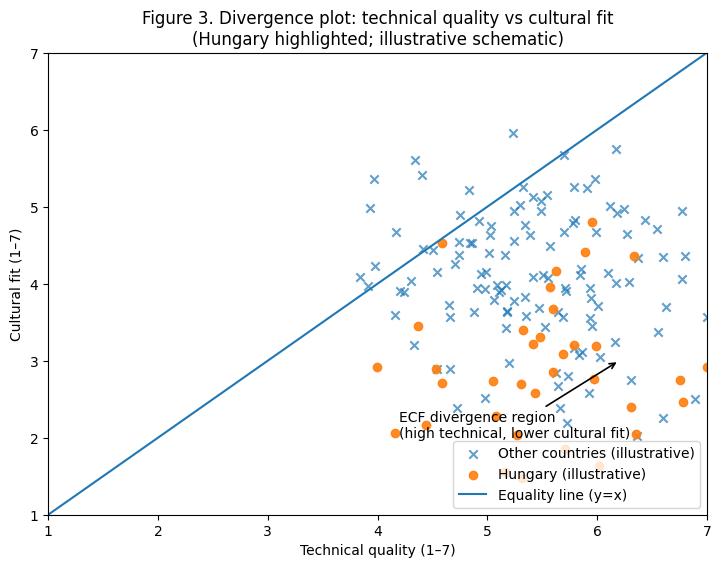
Within EIF, Epistemic Cultural Flattening (ECF) appears as a patterned divergence between these two layers: An output can score highly on structural performance while showing low epistemic readability. This divergence matters because it changes how images function in cultural circulation. High structural performance increases persuasive force, while reduced epistemic readability shifts cultural specificity toward generic templates. EIF therefore makes it possible to diagnose cultural failure modes that remain hidden when evaluation focuses on technical quality alone.
The ECF phenomenon is close to what Markova frames as a parallel risk through collective vulnerability, where profit-driven AI development flattens
cultural diversity toward a computational mean, a framing that complements ECF by linking output-level divergence to broader power structures.
2.2 Definition: Epistemic Cultural Flattening (ECF)
Epistemic Cultural Flattening (ECF) describes a patterned shift in generative outputs in which culturally specific meaning becomes less distinguishable, even as visual coherence remains high. Within the Epistemic Interpretive Framework (EIF), ECF names the divergence between structural performance and epistemic readability: an image can score highly on technical and compositional quality while offering limited support for validation as a culturally situated representation. ECF therefore captures a form of representational homogenization in which outputs default toward globally dominant templates and broadly legible cues, and in doing so reduce the visibility of culture-specific ornamental grammar, material conventions, and historically situated styles
Diagnostic signals appear as score divergence between technical quality and cultural fit and stylistic accuracy. Visual form often stabilizes through template substitution and provenance thinning.
Janda describes a closely aligned phenomenon to ECF as regional invisibility, where culturally dense low-resource places become reconstructed through globally legible templates,producing subtle drift through normalization, typological substitution, and shifts toward universally plausible aesthetics
2.3 Situating ECF among adjacent concepts
ECF gains analytical precision through contrast with terms that circulate widely in public and technical discussions of generative AI. These labels often describe genuine phenomena, while ECF focuses on a specific representational pattern: the reduction of culture-specific legibility under globally dominant visual templates. Kořínek frames this asymmetry as a Central European condition: small-language environments enter collaboration with global generative systems from an unequal position, and the process amplifies tension between local experience and algorithmically preferred forms of language and imagery. This perspective strengthens the conceptual scope of ECF as an output-level pattern that remains structurally linked to cultural position within global data environments.
ECF and hallucination
“Hallucination” typically denotes outputs that contain implausible elements. ECF refers to a different regime of error: outputs often remain visually coherent and aesthetically plausible, while cultural attribution relies on substitution. The image reads as something like the requested cultural tradition, place, or artwork, and it achieves plausibility through generic cues rather than through culture-specific references Krzykawski’s critique of AI parlance complements
this differentiation work by foregrounding how everyday terms such as hallucination shape public understanding and flatten conceptual distinctions that support critical evaluation.
ECF and bias
“Bias” commonly names systematic disparities that affect social groups, including stereotyping and unequal treatment across gender, race, or ethnicity. ECF complements this conversation by foregrounding a representational dimension that concerns cultural legibility, especially in heritage contexts. It highlights how ornamental grammar, typological specificity, and historically situated stylistic registers become diluted when models resolve prompts through dominant templates.
ECF and localization
“Localization” emphasizes geographic placement and language adaptation, often evaluated through whether a model depicts the correct place or renders text in the appropriate language. ECF addresses a broader representational mechanism: a scene can appear “Eastern European” while still losing the specific cues that support Hungarian, Polish, Czech, or Slovak cultural attribution. Cultural specificity depends on more than place names; it depends on typologies, materials, style conventions, ornamental grammar, and craft logic.
ECF and style transfer
“Style transfer” focuses on mapping one visual style onto another image or subject, and evaluation often concentrates on aesthetic resemblance. ECF speaks to the relationship between style and provenance. An output can match a plausible stylistic register while cultural attribution remains weak when provenance anchors (like regional typology) remain underrepresented in the training data.
ECF and dataset scarcity
Dataset scarcity describes uneven representation within training corpora, a condition that shapes what models can learn. ECF names the epistemic outcome that follows from such conditions: cultural requests get resolved through the widely available templates, and cultural distinctiveness shifts toward generalized visual forms. Dataset scarcity functions as a driver; ECF describes the representational effect visible in outputs and measurable through evaluation.
3. Methods: the cultural fidelity benchmark
3.1
Benchmark logic
This study operationalizes cultural fidelity through a benchmark instrument that separates three evaluative dimensions: cultural fit, stylistic accuracy, and technical quality. The instrument responds to a recurring challenge in the assessment of generative images: outputs often achieve strong technical quality, and this competence increases their persuasive force in cultural circulation. Evaluation therefore benefits from a structure that distinguishes visual coherence from culturally situated legibility.
Cultural fit captures whether an output belongs to the referenced cultural context in a way that supports recognition by informed observers. It concerns the presence of culture-specific cues, such as typologies, iconographic conventions, and ornamental grammar, that enable viewers to attribute the image to the intended culture rather than to a generic proxy. Cultural fit therefore addresses the question of cultural attribution: the relationship between the prompt’s cultural reference and the image’s culturally situated readability.
Stylistic accuracy captures whether the output follows the relevant aesthetic and material conventions associated with the referenced domain. It concerns formal and material coherence within a tradition: the exact structure of ornament, characteristic color relations, compositional logic, craft constraints, and domain-specific visual registers. Stylistic accuracy therefore focuses on how faithfully the output aligns with the stylistic rules that shape a tradition’s internal visual logic.
Technical quality captures structural performance at the level of the image as a rendered artifact. It concerns clarity, resolution, compositional stability, texture handling, and the overall absence of distracting visual elements that compromise visual coherence. Technical quality supports cross-model comparison because it remains interpretable across domains and cultures, while cultural fit and stylistic accuracy remain context-dependent.
Together, the three dimensions support an interpretable diagnosis of Epistemic Cultural Flattening (ECF). High technical quality can coexist with low cultural fit or stylistic accuracy, and this divergence provides a measurable signal of ECF. The benchmark therefore functions as a practical instrument for comparative evaluation across models, domains, and cultures, while also supporting qualitative interpretation through exemplar images. Benchmarking traditions in algorithmic accountability show how structured evaluation reveals systematic performance gaps and guides intervention, a logic that supports the cultural fidelity benchmark developed here (Buolamwini & Gebru, 2018).
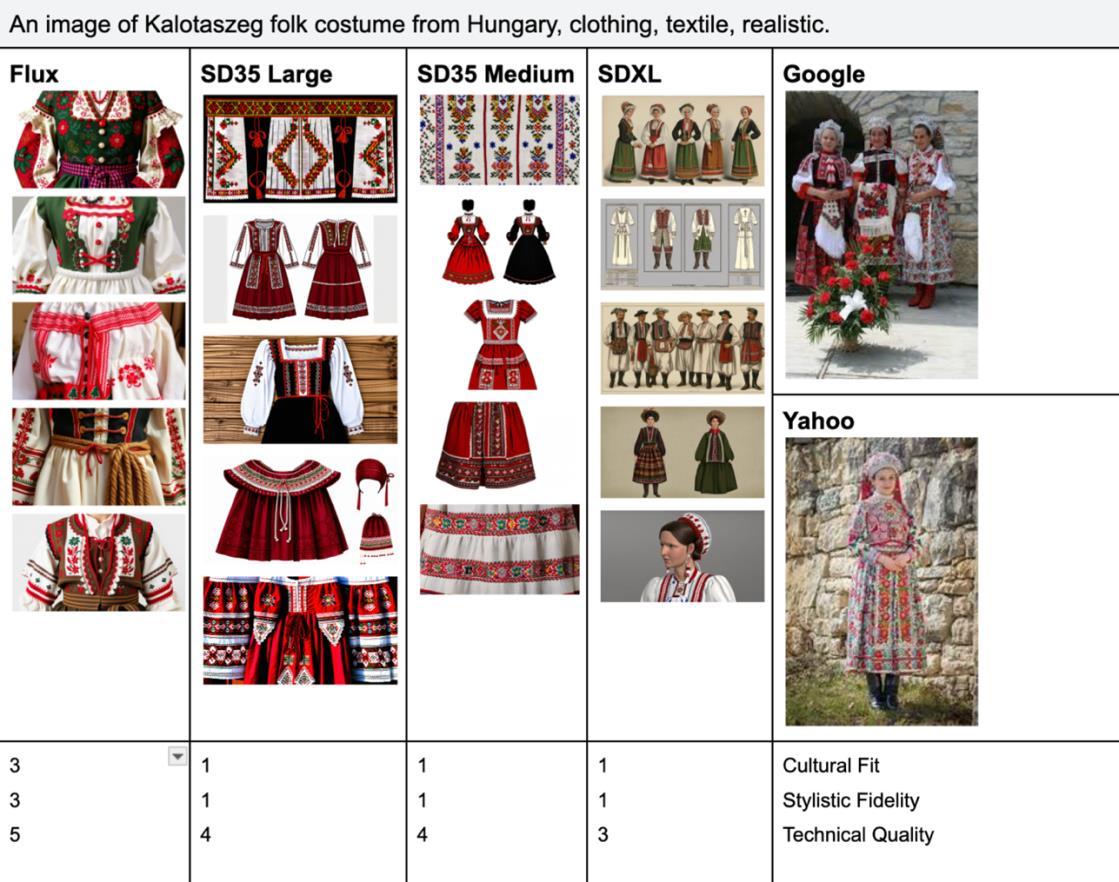
Box 1. Cultural fidelity benchmark instrument (three domain exemplars). The benchmark evaluates AI-generated images along three dimensions cultural fit, stylistic accuracy, and technical quality )using a consistent 1–7 Likert scale. The three cards illustrate how the same evaluation backbone applies across domains while the interpretive focus shifts with the 3 categories.
3.2 Dataset construction with Hungarian heritage as anchor
The benchmark builds on a comparative image-generation corpus designed to support controlled cross-cultural analysis while keeping Hungarian visual heritage at the center of interpretation. The dataset comprises approximately 900 generated images produced with four diffusion image generators (Stable Diffusion XL, Stable Diffusion 3.5 Large, Stable Diffusion 3.5 Medium, and Flux Schnell) across ten countries and three domains: architecture, fine arts, and folk art.
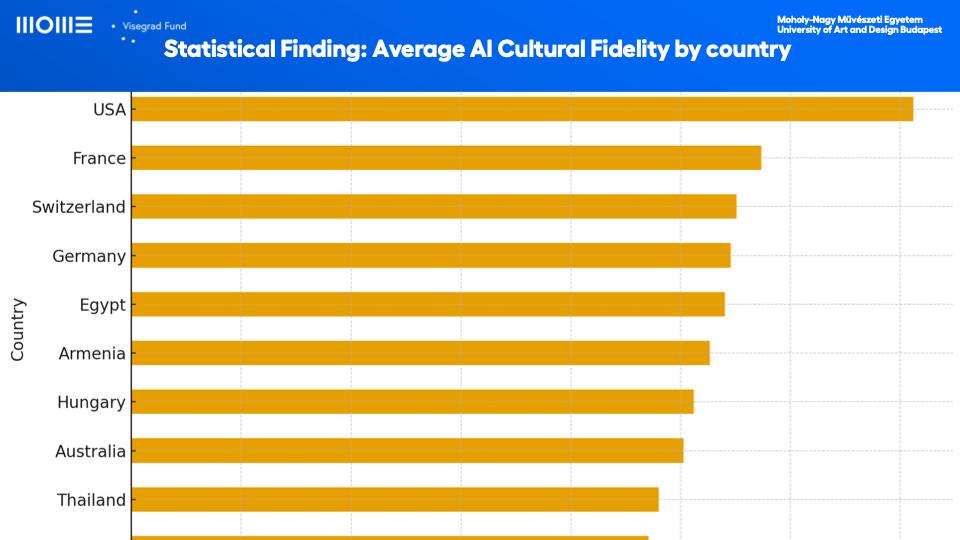
The selection of countries functions as a set of comparative positions in global data hierarchies, spanning contexts with high digital resources (for example, the United States, France, Germany) and contexts with lower digital resources (for example, Hungary, Bangladesh, Thailand).
Since this research began with an inquiry into misrepresentation in Hungarian heritage, the Hungarian dataset serves as the anchor case.The benchmark targets heritage objects and references that rely on culture-specific cues for recognition, including ornamental grammar, material conventions, regionally specific typologies, and art-historical provenance. The two comparator groups support interpretation in two ways: high-resource contexts function as baselines for strong learnability within global training corpora, while lowerresource contexts clarify how cultural specificity behaves under sparse representation conditions.
The corpus is organized through a domain-based prompt set that aligns the three heritage categories with comparable prompt structures across countries. Each country receives prompts in each domain, and each prompt is executed across all four generators to enable model-by-model comparison under identical textual conditions.
This design treats cultural representation as a pattern that emerges across repeated prompts rather than as an isolated anecdote: multiple outputs per prompt and per model support the identification of recurring representational logics tied to a given culture and domain.
To support cross-country comparability, the prompt structures remain standardized while allowing culture-specific references to enter through culturally situated objects
3.3 Generation systems, grounding, evaluation design, and analysis approach
Cross-model comparison matters because cultural fidelity rarely behaves as a simple function of technical advancement: models differ in rendering competence, stylistic priors, and text–image alignment, and these differences shape how culturally specific prompts resolve into visual form.Ashared prompt
set executed across multiple generators therefore supports two complementary readings: model-level differences in cultural fidelity and domain-level patterns that remain stable across models, both of which inform the diagnosis of epistemic cultural flattening.
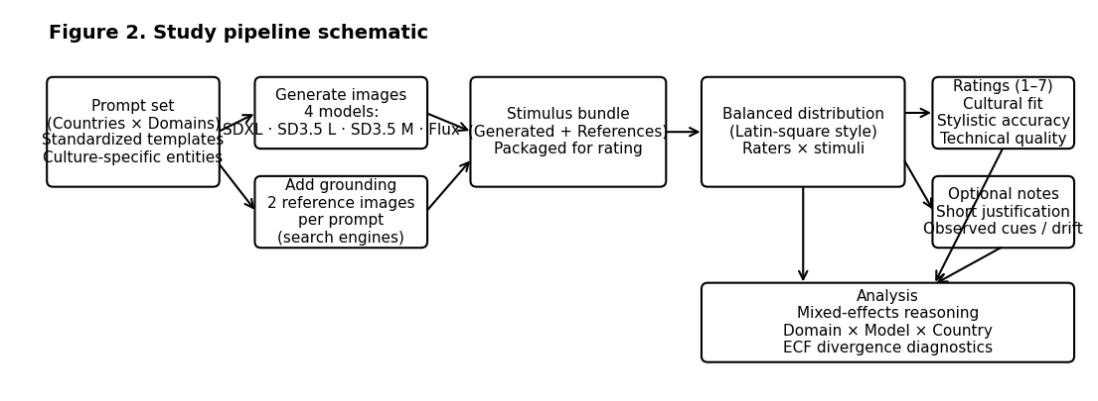
To support culturally situated evaluation, each prompt was paired with two reference images sourced through search engines. These references function as grounding anchors rather than as definitive truth claims. Their role is practical and comparative: they provide evaluators with a memory aid for the culturally referenced object, place, or work, and they render visible the visibility regimes that structure online access to heritage imagery. Reference selection therefore carries diagnostic value because search results reflect platformed hierarchies, dominant iconographies, and metadata conventions that shape what becomes culturally retrievable at scale, including ranking and categorization effects that organize visibility in platform environments (Gillespie, 2018). In this setting, reference images support situated judgement by assisting evaluators in assessing cultural fit and stylistic accuracy while keeping the evaluation open to plurality within a tradition.
This methodological choice also aligns with Markova’s observation that research on Central European cultural alignment remains limited and that artistic and design research practices offer productive approaches for developing insight; benchmark-based evaluation therefore operates as an interpretive instrument that combines structured scoring with culturally situated reference points to make patterns of alignment and flattening empirically legible.
Evaluation relied on culturally informed judgement. Evaluators were recruited for their familiarity with relevant cultural contexts and heritage domains, and expertise was operationalized as the ability to recognize culture-specific cues and articulate domain conventions in folk art, fine art, and architecture. The study design used balanced presentation logic to support comparability and reduce fatigue effects. Prompt–model combinations were distributed so that evaluators encountered a controlled mix of domains and systems, and the assignment followed a structured balancing scheme (including Latin-square
style distribution) to stabilize order effects across the full set. In addition to numeric ratings of cultural fit, stylistic accuracy, and technical quality, the protocol included brief qualitative notes. These notes function as interpretive traces that connect aggregate scores to recurrent visual patterns, especially in cases where evaluators identify substitution, genericization, or weakened provenance cues.
Analysis treats the dataset as a multi-level structure in which prompts, models, evaluators, countries, and domains contribute systematic variation. This structure supports mixed-effects reasoning: prompts differ in difficulty, evaluators differ in calibration, and models differ in priors, so comparison benefits from an approach that accounts for nested sources of variance. The analysis therefore centers on two perspectives: a Hungary-centered reading that treats Hungarian heritage as the anchor case, and a cross-country comparative reading that situates Hungary within broader visibility gradients. Results are reported in a form that remains readable for design research audiences through domain-level contrasts, model-level contrasts, and the divergence pattern that operationalizes epistemic cultural flattening as a gap between technical quality and epistemic readability.
Methodologically, Janda’s Total Distortion Score approach complements this benchmark logic by treating drift as structured and repeatable and by coding variables of regional distortion across systems, strengthening comparative reading of low-resource visual contexts
4. Results: diagnosing ECF in the Hungarian heritage subset
4.1 Core pattern: technical success can coexist with reduced cultural fidelity
Across the Hungarian heritage benchmark set, results show a stable divergence between structural performance and epistemic readability. Generated images often achieve high scores on technical quality (clear rendering, coherent composition, and plausible surfaces) while evaluators assign lower scores to cultural fit and stylistic accuracy
The divergence becomes especially salient in prompts that depend on culturally specific anchors rather than globally common objects. In these cases, the generated image frequently presents a visually acceptable proxy: a genericized “folk” surface for folk art, a broadly “European” architectural scene for place-based heritage, or a historically plausible painting register for fine art. Technical quality supports the plausibility of these proxies, while cultural fit and stylistic accuracy depend on finer-grained cues (ornamental grammar, material conventions, typological specificity, and provenance anchors) that shape culturally situated validation. ECF therefore appears less as a breakdown of image generation and more as a patterned shift in representational strategy: the output prioritizes globally legible templates and stabilizes cultural meaning through substitution rather than through culture-specific evidence.
4.2 Domain differences
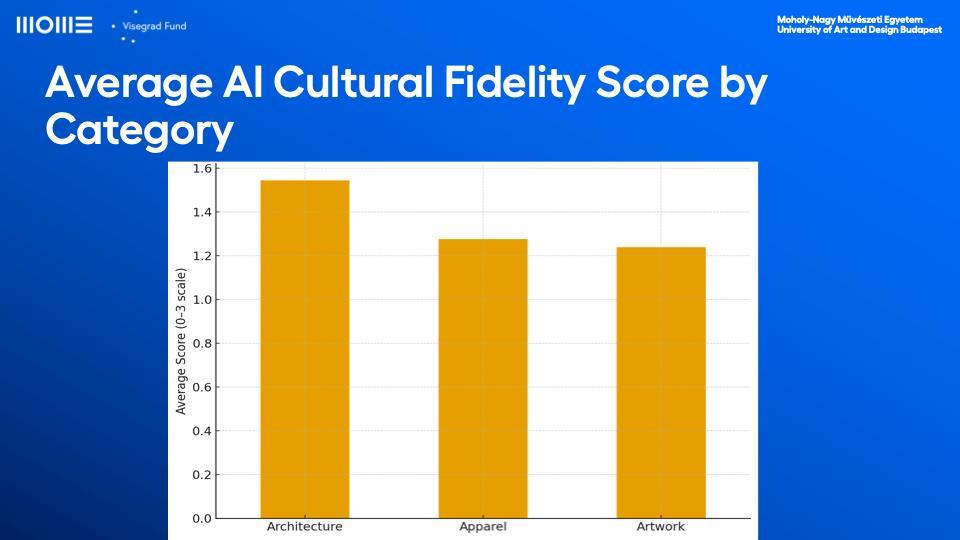
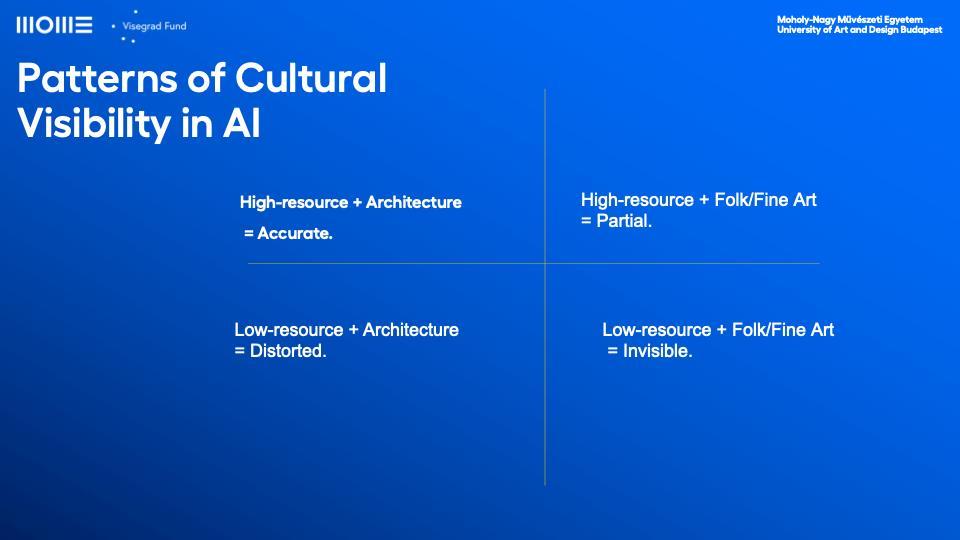
Across domains, the results form a clear visibility pattern shaped by the interaction of cultural resource level and heritage type (Figure X). In highresource contexts, architecture tends to remain comparatively stable because place depiction can be assembled from widely circulating
photographic templates and globally legible built-environment cues; cultural attribution often holds at the level of recognizability. In the same high-resource contexts, folk and fine art reach a more partial form of fidelity: models often reproduce a plausible aesthetic register while fine-grained provenance cues and domain-specific ornamental grammar remain uneven, producing outputs that support recognition in broad strokes rather than through tradition-specific evidence. Folk prompts also function as representational triggers: Keszeg shows that ethnicizing bias intensifies in folk dress images relative to contemporary dress, indicating that tradition cues activate historically sedimented stereotypes and geopolitical imaginaries with high regularity.
In low-resource contexts, the pattern shifts in two distinct ways. Architecture remains visible yet tends toward distortion: outputs stabilize into generic “European” scenery or interchangeable urban typologies, and place-specific anchors weaken, producing cultural attribution that requires additional validation. Folk and fine art show the strongest compression of cultural specificity and therefore approach invisibility at the level that matters for heritage reading: models sustain surface plausibility while the cues that enable culturally situated recognition, like regionally specific typologies, craft constraints, and ornamental grammar, thin out. This comparison summarizes how ECF intensifies when cultural requests demand high-resolution specificity and when training data offers limited coverage of the relevant provenance anchors. The cross-domain visibility pattern resonates with Malinowska’s account of economies of visibility, where what already circulates widely gains further amplification through platformed selection.
4.3 Model differences
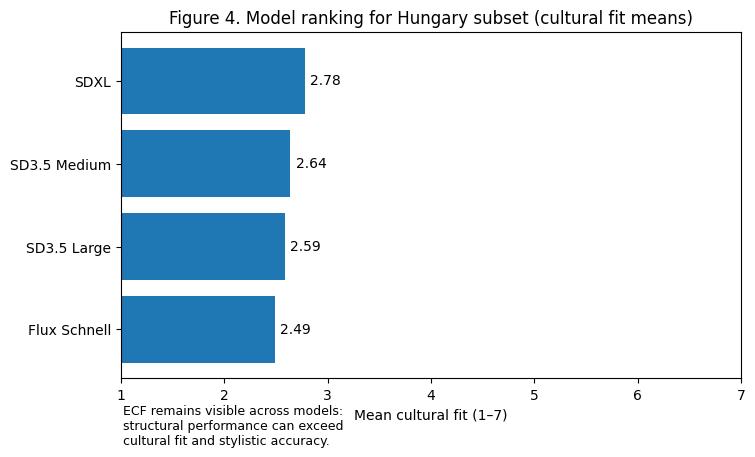
The benchmark reveals a consistent hierarchy among the four image generation systems in terms of cultural fit. Across the survey, SDXL receives the highest mean rating for cultural fit (M = 2.78), followed by Stable Diffusion 3.5 Medium (M = 2.64) and Stable Diffusion 3.5 Large (M = 2.59), while Flux Schnell receives the lowest mean rating (M = 2.49).
This ordering supports comparative interpretation at the model level and helps contextualize the kinds of images that different systems tend to stabilize under identical prompts.
At the same time, the model hierarchy leaves the core ECF pattern intact. Statistical modeling shows parallel performance patterns across resource levels: interaction effects between model type and data-resource level remain negligible across cultural fit, stylistic accuracy, and technical quality.
In practical terms, model improvements raise overall capability while the divergence between technical quality and epistemic readability continues to structure the outputs. This result positions model choice as a meaningful factor for comparative performance, while the persistence of ECF highlights a broader infrastructural dynamic that shapes cultural visibility across systems.
Figure 4: model ranking chart for the Hungary subset.
5. ECF failure-mode typology
Benchmark scores provide a necessary diagnosis of cultural fidelity The benchmark identifies divergence between technical quality and epistemic readability, and it supports comparison across models, domains, and cultures. A typology adds a second layer of interpretive work: it translates measured outcomes into a design vocabulary that describes recurring representational problems
First, this vocabulary makes ECF readable as a set of repeatable visual patterns, like substitutions, drifts, and reductions of provenance anchors, rather than as isolated errors. Second, it supports action. Designers, data curators, and tool developers benefit from terms that describe where cultural meaning collapses and how it collapses, because these descriptions guide both prompt design and dataset intervention. Typologies therefore function as bridge instruments: they connect quantitative evaluation with qualitative diagnosis, and they support iterative improvement through targeted tests, controlled comparisons, and domain-specific refinement.
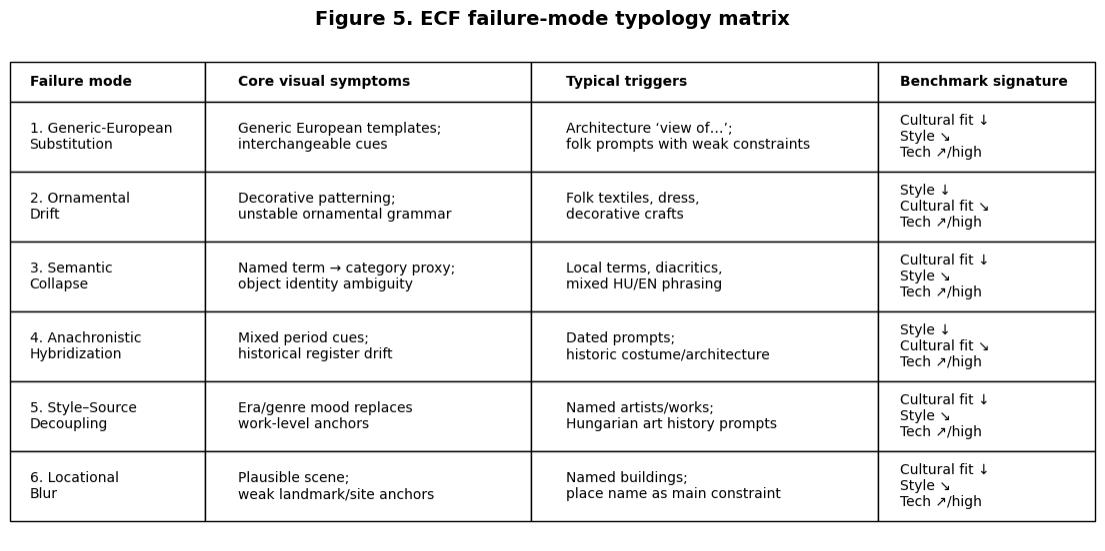
The following typology describes six recurring ways in which Epistemic Cultural Flattening appears in generated images. Each mode names a representational mode, summarizes the visual symptoms that make it recognizable, identifies the prompt conditions that tend to trigger it, and links the pattern to a benchmark across cultural fit, stylistic accuracy, and technical quality.
Generic-European Substitution describes a resolution strategy in which a culture-specific request is satisfied through broadly legible “European” templates that support a general regional reading while narrowing culturespecific attribution. Visually, outputs converge on postcard-like urban textures, familiar rooflines, and standardized streetscapes, and they rely on scenic composition rather than on typological anchors and local material details. This mode appears frequently in architecture prompts framed as “view of…” and in folk prompts that specify “traditional” heritage without stronger material constraints. In the benchmark, the pattern typically presents as lowered cultural fit with a mild-to-moderate decrease in stylistic accuracy, alongside high technical quality. Keszeg’s cross-country comparison provides a related reading of substitution as an imaginary shift, where outputs stabilize through Mitteleuropean, generalized Slavic, or Orientalized ‘Eastern’ frameworks in response to prompt cues.
Ornamental Drift describes outputs that present decorative patterning that reads as heritage ornament while the culture-specific ornamental grammar and craft logic remain unstable. Visually, motifs appear plausible yet reorganize into globally common floral geometry; color relations move toward standardized palettes associated with generic folk aesthetics; and stitch logic or material behavior reads as surface decoration rather than craft constraint. This mode concentrates in folk art prompts involving textiles, dress, embroidery, and decorative crafts. In the benchmark, stylistic accuracy tends to drop most clearly, cultural fit often follows with a smaller decrease, and technical quality remains high.
Semantic Collapse of Local Terms describes a prompt–output shift in which culture-specific terms compress into a broader category label, steering the
image toward generic object types and generalized heritage cues. Visually, named objects become category-level proxies, for example guba traditional coat, Miska jug, or regional costume, and key identifiers lose strength while generic decorative cues increase. This mode appears often when prompts include Hungarian terms, diacritics, or regionally specific names, and when prompts combine Hungarian and English descriptors. In Keszeg’s terms, the mechanism also aligns with representational displacement under noisy labelling, where regional ambiguity gets resolved through the most statistically salient geopolitical imaginary available. The benchmark typically records a decrease in cultural fit accompanied by a smaller decline in stylistic accuracy, with technical quality remaining high.
Anachronistic Hybridization describes outputs that integrate stylistic cues from multiple time periods into a single image, producing coherent scenes with unstable historical placement. Visual symptoms include garments that combine silhouettes and accessories from different eras, architectural depictions that mix façade motifs and material treatments associated with distinct periods, and fine art scenes that drift across historical registers while maintaining an era-like look. This mode often arises in prompts that include dates, in historic architecture prompts, and in folk costume prompts framed as “realistic” without specifying a documentary register. In the benchmark, stylistic accuracy typically declines first, cultural fit follows with a smaller decrease, and technical quality remains high.
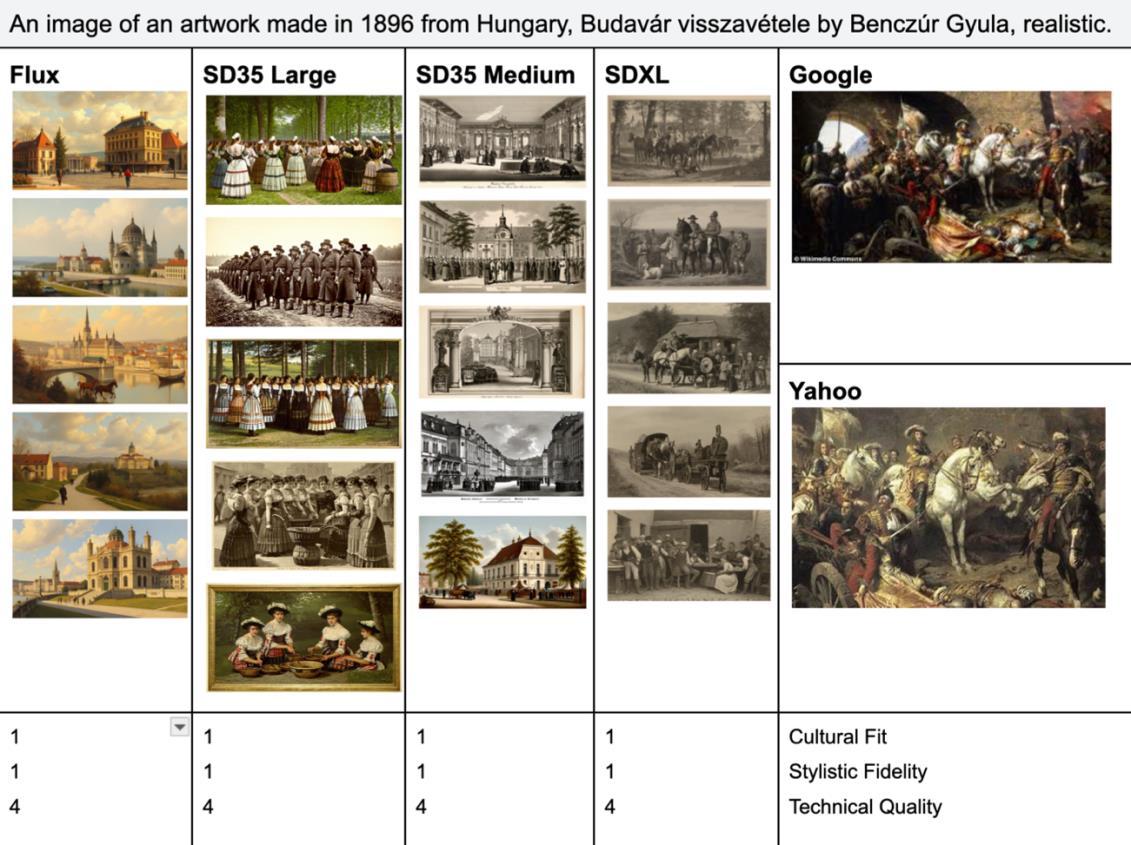
Style-Source Decoupling describes outputs that match a plausible period or genre register while source-specific anchors that support attribution to a named artwork, artist, or tradition remain weak. Visually, prompts naming artworks or artists yield images that “fit the era,” while composition, iconography, and work-level identity drift; portrait, devotional, or plein-air scenes appear as genre-typical substitutes; and visual polish increases credibility while provenance cues thin out. This mode concentrates in fine art prompts that reference named works or artists from Hungarian art history. Benchmark scores typically show lowered cultural fit with a mild-to-moderate decline in stylistic accuracy, alongside high technical quality.
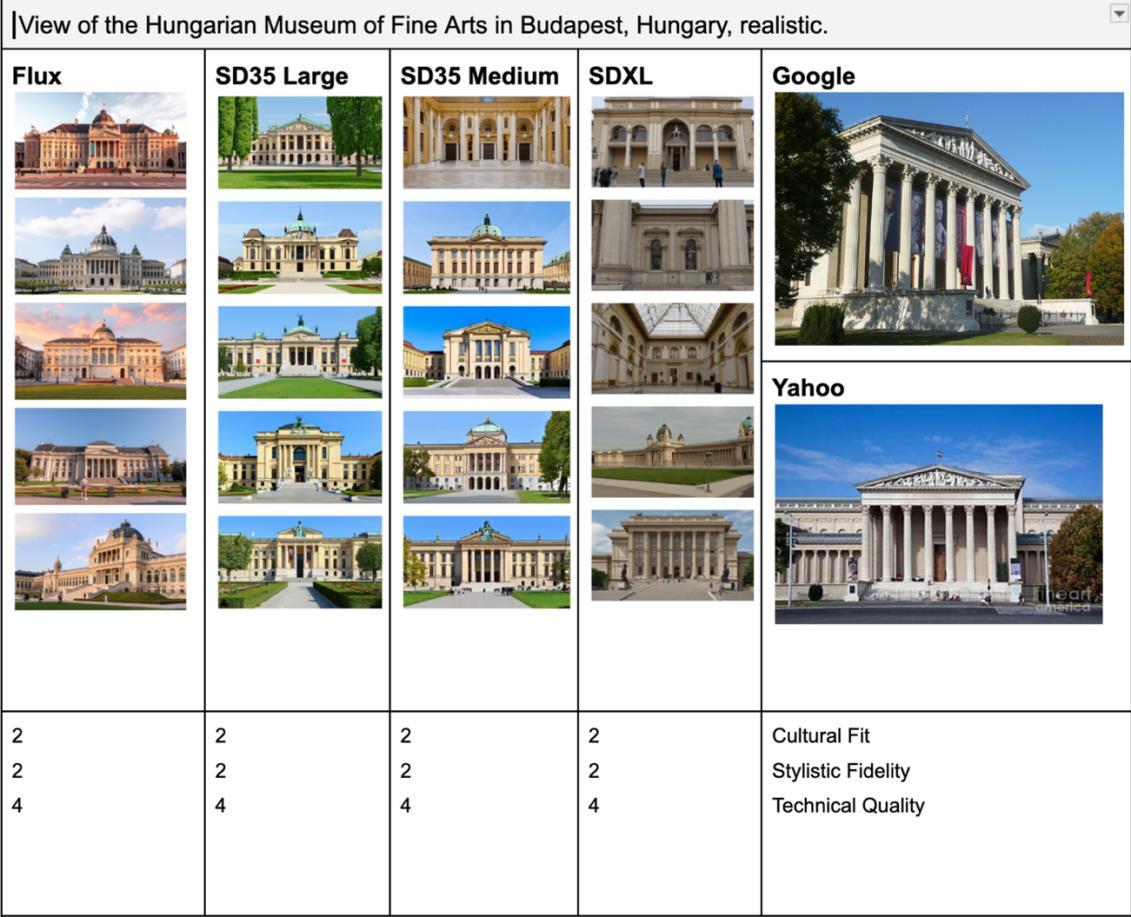
Locational Blur in Architecture describes outputs that produce plausible built-environment depictions while place-specific anchors that support landmark recognition and site attribution remain partial. Visually, landmarks resolve into generic historic façades or scenic city views; spatial context aligns with common tourist-photography conventions; and materials, ornamentation logic, and massing support a general regional reading. This mode appears frequently when prompts rely on a single place name or building name as the main constraint. The benchmark signature typically presents as lowered cultural fit and a smaller decline in stylistic accuracy, with technical quality remaining high.
Together, these six modes convert benchmark divergence into a practical design vocabulary.
6. From diagnosis to design: toward a V4 culturally aware text-to-video workflow
6.1 Why video raises the stakes
The diagnosis of Epistemic Cultural Flattening gains additional urgency in the transition from image generation to video generation. Text-to-video amplifies cultural representation through temporal continuity, narrative structure, and embodied cues.
Temporal consistency raises the first stakes. Video systems must maintain cultural cues across frames, and this requirement turns minor drift into a visible structural problem. Ornament, materials, typological anchors, and stylistic registers must persist as stable features rather than as accidental successes in single frames. Temporal coherence therefore functions as a stress test for cultural fidelity: a model that occasionally produces a culturally plausible still image can still yield a culturally unstable video when key cues fluctuate across time.
Narrative structure raises the second stakes. Text-to-video workflows typically embed visual synthesis within short scripts or prompts that imply roles, settings, and causal sequences. These scripts activate templates for “what usually happens,” and such templates often carry stereotyping pressure. Cultural specificity in heritage contexts relies on situated relations between objects, places, gestures, and social practices, while generative narrative defaults often rely on globally dominant story grammars. As a result, video generation increases the risk that cultural meaning becomes organized through familiar narrative clichés that displace local history, regional nuance, and context-specific social imagination.
Embodied cues raise the third stakes. Cultural recognition often relies on how bodies move through space, how garments sit and behave on bodies, how tools are handled, how rituals unfold, and how built environments structure everyday action. These embodied cues matter in V4 heritage contexts because they carry tacit knowledge that remains difficult to encode as isolated visual tokens. Video therefore shifts evaluation toward performative fidelity: the relationship between dress and movement, between craft and gesture, between architecture and everyday use. This shift expands the benchmark logic beyond static representation and positions culturally aware text-to-video as a design challenge in which temporal stability, narrative choice, and cultural knowledge function as core variables.
Kořínek’s discussion of video work in which temporal trace appears as a visible imprint of a specific stage of the technology’s development reinforces the value of temporal cultural fidelity as a future evaluation dimension.
6.2 Proposed V4 workflow
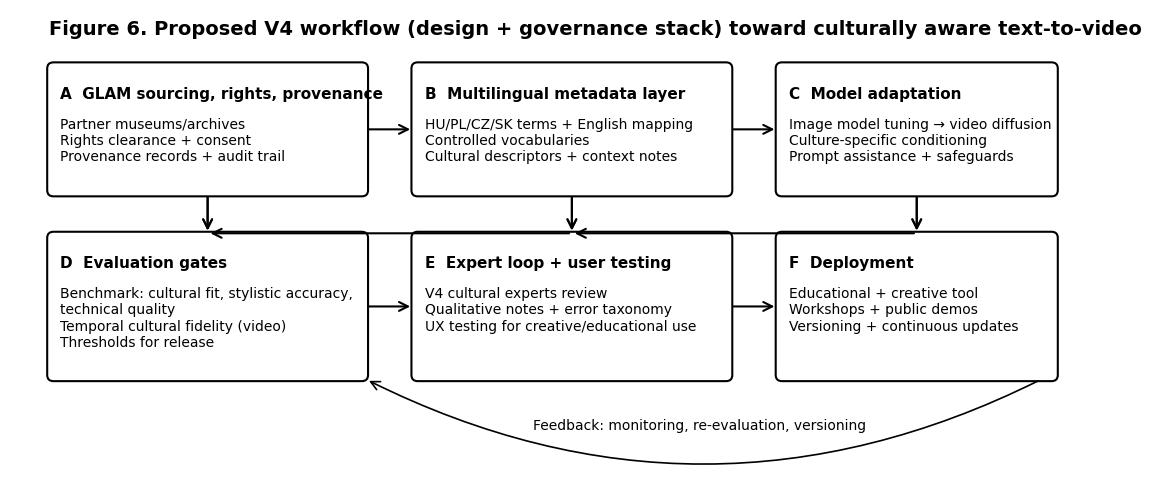
The diagnosis of Epistemic Cultural Flattening supports a practical intervention path: a staged V4 workflow that integrates cultural governance with model development. The workflow treats cultural fidelity as an engineered property shaped by institutional partnerships, multilingual description practices, controlled model adaptation, and iterative evaluation.
Stage A focuses on GLAM sourcing, rights, and provenance. The process begins through partnerships with museums, archives, and heritage organizations that hold regionally specific collections in Hungary, Poland, Czechia, and Slovakia. This stage structures permissions, consent, and documentation practices, and it establishes a provenance record for each asset, forming an audit trail that supports accountability.
Stage B builds a multilingual metadata layer that functions as a cultural interface. Heritage data gains usability for generative systems through controlled vocabularies and descriptive fields in HU/PL/CZ/SK with an English mapping that supports cross-country comparison and prompt tooling. This layer encodes typologies, ornamental grammar descriptors, material conventions, period registers, and contextual notes that assist both training and evaluation, and it strengthens cultural specificity at the level of language.
Stage C translates the dataset into model adaptation, progressing from image to video. The workflow uses image generation as the first stabilization step, because images provide fast iteration cycles for cultural fidelity. Cultural conditioning then extends toward video diffusion once image-level performance supports validation.
Stage D introduces evaluation gates that combine the benchmark with a temporal extension for video. The benchmark dimensions (cultural fit, stylistic accuracy, and technical quality) serve as a release gate for image outputs, and the same logic extends toward video through temporal cultural fidelity criteria. Temporal cultural fidelity evaluates stability of key cues across frames, continuity of ornament and material behavior, and coherence of typological anchors in motion.
Stage E operationalizes an iterative expert loop and user testing. V4 cultural archive experts review outputs using both scores and brief qualitative notes aligned with the ECF typology, enabling targeted corrections in prompting, metadata, and adaptation strategy. User testing then evaluates whether the tool supports creative and educational use, including how users interpret cultural cues and how interface choices shape cultural outcomes.
Stage F deploys the system as an educational and creative tool with continuous versioning. Deployment includes workshops, public demonstrations alongside monitoring and periodic re-evaluation by data curators that supports iterative updates and governance over time.
6.3 How the workflow targets ECF specifically
The proposed V4 workflow targets Epistemic Cultural Flattening through a shift in what the system treats as learnable cultural evidence. ECF arises when models resolve culturally specific requests through globally dominant templates because these templates offer high statistical stability and broad visual legibility. The workflow intervenes by increasing epistemic density, meaning the availability, precision, and internal consistency of culture-specific cues that support validation of cultural provenance and stylistic accuracy. Epistemic density can grow through governance choices. Rights-cleared GLAM sourcing and provenance documentation establish traceable cultural reference points, and this traceability supports accountability in model development and public deployment. Epistemic density then grows through the multilingual metadata layer, which functions as a cultural interface that
translates heritage knowledge into structured descriptors. Controlled vocabularies, bilingual mappings, and context notes supply the model with richer anchors than generic labels.
The workflow also targets ECF by making evaluation an active design component. Evaluation gates translate cultural fidelity into release criteria during development. Expert review and qualitative notes then connect failure modes to actionable causes (prompt structure, metadata gaps, and conditioning weaknesses) supporting targeted iteration. This approach reduces misrecognition through design choices that stabilize provenance anchors and support culturally situated validation. The workflow also responds to Kuchtova’s observation that institutional virtual archives can feed AI image generators, so archival omissions and tagging structures can shape downstream cultural legibility in generated outputs.
7. Implications
The findings position cultural fidelity as a core concern for design research that engages generative systems as cultural infrastructures. Evaluation practices that emphasize visual coherence and technical polish capture only one layer of performance, while cultural meaning remains mediated by provenance anchors, ornamental grammar, typological specificity, and historically situated stylistic registers. Treating cultural fidelity as a first-class metric therefore expands evaluation beyond “does it look good” toward “does it support culturally situated validation,” a shift that aligns generative assessment with design culture’s concern for meaning, context, and interpretive accountability.
A two-layer evaluation logic provides a practical solution: it makes visible the divergence that defines Epistemic Cultural Flattening and it prevents high technical scores from functioning as implicit proof of cultural fit. This separation supports clearer claims in research reporting, because it allows authors to state precisely which form of performance improves.
Finally, the benchmark functions as a design instrument rather than as a posthoc audit tool. In design research, instruments shape what becomes visible and therefore what becomes actionable. The cultural fidelity benchmark provides a repeatable way to locate failure modes, to compare systems under
controlled prompt conditions, and to translate qualitative observations into structured intervention targets. Used iteratively, the benchmark supports prompt refinement, metadata redesign, and model adaptation decisions, and it provides a shared vocabulary for collaboration between designers, cultural experts, and technical teams. In this sense, benchmarking becomes part of the design process: a method for steering generative systems toward culturally accountable outputs through continuous evaluation and revision.
7.2 Implications for GLAM institutions and cultural policy
The results reposition GLAM institutions as active actors in the generative ecosystem. Museums and archives already function as validators of cultural knowledge through collection practices, cataloguing standards, and interpretive expertise. In the context of generative AI, this validating role extends into infrastructure provision: collections and their descriptive systems shape what becomes learnable, retrievable, and culturally legible in synthetic outputs. Cultural fidelity therefore depends on institutional decisions that historically belonged to heritage governance rather than to model development, especially as visual culture increasingly circulates through algorithmic infrastructures (Striphas, 2015).
Metadata and access policies become especially consequential under this view. Cultural legibility in AI outputs draws from how objects, sites, and artworks are named, described, classified, and translated across languages.
Controlled vocabularies, multilingual descriptors, provenance fields, and contextual notes supply epistemic density that supports cultural attribution and stylistic accuracy. Access policies shape which images circulate widely, which forms remain locally bounded, and which elements of cultural heritage become represented primarily through secondary, platform-driven iconographies. Crawford and Paglen’s analysis of training images frames these selection effects as infrastructural, because dataset composition and labeling practices shape downstream representational capacity in AI systems (Crawford & Paglen, 2021). In practice, these policies influence whether AI systems learn heritage through high-quality documentation with strong provenance anchors or through fragmented, unevenly captioned web imagery shaped by ranking, categorization, and platform governance (Gillespie, 2018). Alžbeta Kuchtova
also frames institutional virtual archives as infrastructures that can strengthen democratic access and support resistance to censorship through public availability and distribution, especially in contexts shaped by political pressure on cultural institutions.
Controlled collaboration offers a viable policy direction for supporting cultural sovereignty in low-resource contexts. This stakes a concrete governance role for GLAM institutions within the broader political economy of AI infrastructures and data extraction (Crawford, 2021). Partnerships between GLAM institutions, universities, and technical teams can establish rights-cleared datasets, provenance documentation, and evaluation protocols that align model development with public cultural responsibilities. Such collaborations support accountability and reduce reliance on extractive pipelines that treat heritage collections as raw material for unregulated scraping, a dynamic widely discussed through the lens of data colonialism and large-scale appropriation (Couldry & Mejias, 2019). They also create conditions for reciprocal benefit: institutions gain tools for education and interpretation, researchers gain structured cultural data, and communities gain representational agency through expert review and culturally situated quality gates. This approach treats cultural heritage as an infrastructural commons governed through consent, documentation, and shared evaluation, and it positions generative AI as a domain where cultural policy shapes the terms of visibility. This aligns with Krzykawski’s framing of an East-Central European strategic choice around training data and cultural autonomy, which supports GLAM-led governance as a way to align cultural visibility with accountable infrastructures rather than default platform capture.
7.3 Implications for V4 toolmaking (text-to-video)
V4 toolmaking gains strategic value when it treats cultural fidelity as a shared regional infrastructure rather than as a country-by-country feature. Text-tovideo applications amplify representational stakes through temporal continuity and narrative structure, and these properties call for common resources that support culturally situated generation across Hungarian, Polish, Czech, and Slovak contexts. A shared scenario library provides such a resource. It can assemble culturally grounded prompts and story fragments that encode
regional diversity across domains, including architecture, folk traditions, and art history, while remaining comparable in structure for evaluation. In parallel, multilingual metadata functions as a cross-border interface layer: it connects local terms, diacritics, and domain vocabularies to aligned descriptors across languages and to an English mapping that supports tooling and interoperability. Cross-country expert panels then provide the interpretive competence required for validation, ensuring that cultural cues remain legible within each context while supporting comparative diagnosis across the region.
Within this development ecology, the benchmark functions as a quality gate that links model iteration to cultural accountability. Ratings of cultural fit, stylistic accuracy, and technical quality provide structured criteria for release decisions, and the temporal extension for video supports stability checks across sequences.
A V4 text-to-video tool also functions as a testbed for culturally aware generative design. It supports comparative experimentation with data governance, metadata design, conditioning strategies, and interface guidance across multiple low-resource languages and cultural contexts. Workshops, public demonstrations, and educational deployments provide feedback loops that reveal how users interpret cultural references and how interface choices shape cultural outcomes. In this way, the tool becomes both a product and a research instrument: it operationalizes cultural fidelity as a design goal, and it generates evidence about how culturally aware AI can support regional storytelling, education, and creative practice in ways that strengthen cultural visibility through accountable infrastructures.
8. Conclusion, Limitations, future research
8.1 Conclusion
This article introduced Epistemic Cultural Flattening (ECF) as a name for a patterned gap in generative visual systems: outputs can achieve strong technical plausibility while cultural provenance and stylistic accuracy remain unstable under culturally situated evaluation. The concept clarifies why polished images can still function as weak cultural evidence, especially in low-
resource contexts where models resolve specificity through globally dominant templates. By framing this divergence through the Epistemic Interpretive Framework, the paper positioned cultural fidelity as a design-relevant dimension of performance that shapes how images circulate as cultural references.
The paper also presented a cultural fidelity benchmark that makes this gap measurable across domains and models. By separating cultural fit, stylistic accuracy, and technical quality, the benchmark provides a repeatable instrument for comparative diagnosis The accompanying typology translated benchmark divergence into a design vocabulary of failure modes, supporting interpretive clarity and actionable intervention targets.
Finally, the proposed V4 workflow demonstrated how measurement can inform intervention. The workflow treated cultural fidelity as an infrastructural design problem shaped by GLAM sourcing, multilingual metadata practices, controlled model adaptation, and iterative expert evaluation. In this framing, culturally aware text-to-video development becomes feasible through governance and evaluation structures that increase epistemic density, stabilize provenance anchors, and support culturally situated validation across Hungarian, Polish, Czech, and Slovak contexts.
8.2 Limitations
This study operated under an English-prompt constraint that introduces translation and tokenization bottlenecks for culturally specific terms, especially in low-resource language contexts. Cultural judgment also carries rater variance as an inherent feature of expertise-based evaluation, and this variance shapes both scores and qualitative notes. Reference images functioned as grounding anchors and simultaneously reflected platformed visibility regimes. On the other hand their use requires careful attention to permissions in publication. The empirical focus treated Hungary as an anchor case within a comparative corpus
8.3 Future research
Future work can extend the typology and benchmark testing across the V4 region through shared scenario libraries and coordinated expert panels in Hungary, Poland, Czechia, and Slovakia. Text-to-video development calls for an explicit temporal cultural fidelity dimension that evaluates stability of cultural cues across sequences and narrative contexts. Controlled GLAM datasets and participatory metadata design offer an additional direction, enabling culturally grounded training pipelines that strengthen provenance anchors through multilingual descriptive systems. Work on bias loops in cultural heritage practice frames iterative mitigation through dataset governance, evaluation, and interpretive workflows, supporting this direction through an established practice-based model of intervention (Foka et al., 2025). User experience research can further clarify how diverse audiences interpret cultural cues in generated outputs, how interface choices steer cultural attribution, and how educationaldeployments shape trust, learning outcomes, and creative practice in culturally aware generative tools.
References
Alžbeta Kuchtova. Forthcoming. Digital Art Space as a Tool of Poietic Resistance or a Censorship Device. In Disegno: Journal of Design Culture, special issue on AI and low-resource visual cultures.
Bender, Emily M., Timnit Gebru, Angelina McMillan-Major, and Margaret Mitchell. 2021. “On the Dangers of Stochastic Parrots: Can Language Models Be Too Big?” In Proceedings of the 2021 ACM Conference on Fairness, Accountability, and Transparency (FAccT ’21), 610–623.
Buolamwini, Joy, and Timnit Gebru. 2018. “Gender Shades: Intersectional Accuracy Disparities in Commercial Gender Classification.” Proceedings of Machine Learning Research 81: 1–15.
Couldry, Nick, and UlisesA. Mejias. 2019. The Costs of Connection: How Data Is Colonizing Human Life and Appropriating It for Capitalism. Stanford, CA: Stanford University Press.
Crawford, Kate. 2021. Atlas of AI: Power, Politics, and the Planetary Costs of Artificial Intelligence. New Haven, CT: Yale University Press.
Crawford, Kate, and Trevor Paglen. 2021. “Excavating AI: The Politics of Images in Machine Learning Training Sets.” Publication venue verification recommended for your final proof.
Foka, Anna, Gabriele Griffin, Diego Ortiz Pablo, Patrycja Rajkowska, and Sawsan Badri. 2025. “Tracing the Bias Loop: AI, Cultural Heritage and BiasMitigating in Practice.” AI & Society.
Gillespie, Tarleton. 2018. Custodians of the Internet: Platforms, Content Moderation, and the Hidden Decisions That Shape Social Media. New Haven, CT: Yale University Press.
Hall, Stuart. 1997. Representation: Cultural Representations and Signifying Practices. London: Sage.
Janda, Jiří. Forthcoming. The Liminality of Generative Creation. In Disegno: Journal of Design Culture, special issue on AI and low-resource visual cultures.
Keszeg, Anna. Forthcoming. The Paprika-Effect. In Disegno: Journal of Design Culture, special issue on AI and low-resource visual cultures.
Krzykawski, Michał. Forthcoming. Beyond Computational Illusion: Futures Worth Wanting for Artistic Practices and Technical Cultures. In Disegno: Journal of Design Culture, special issue on AI and low-resource visual cultures.
Malinowska, Ania. Forthcoming. AI Assimilationism: The Cultural Flattening of Localities in Generative Models. In Disegno: Journal of Design Culture, special issue on AI and low-resource visual cultures.
Manovich, Lev. 2019. AI Aesthetics. Moscow: Strelka Press.
Markova, Katerina. Forthcoming. Against Collective Vulnerability: Understanding Cultural Alignment in LLMs. In Disegno: Journal of Design Culture, special issue on AI and low-resource visual cultures.
Striphas, Ted. 2015. “Algorithmic Culture.” European Journal of Cultural Studies 18 (4–5): 395–412.
The Paprika-Effect
Conflicting Imaginaries of Central and Eastern Europe in AI-Generated Images
Keszeg Anna
Abstract
This article examines how AI-generated images reproduce geopolitical imaginaries of Central and Eastern Europe (CEE) through a visual analysis of images generated using Midjourney. Drawing on popular geopolitics as a theoretical framework, the study situates AI image generation within a longstanding transglobal media environment in which visual culture plays a key role in shaping geopolitical knowledge and spatial hierarchies. Popular geopolitics foregrounds the power of everyday visual representations in producing meaning beyond formal political discourse, a dynamic intensified by generative AI systems.
Methodologically, the article analyzes AI-generated facial representations associated with selected CEE countries, produced through standardized prompts varying by gender and dress (national costume and contemporary clothing). Focusing on culturally coded phenotypical markers, the analysis reveals that Midjourney mobilizes conflicting visual imaginaries - ranging from generalized Slavic and Orientalized “Eastern” traits to Mitteleuropean representations. The article conceptualizes this process as the “paprikaeffect,” an epistemic cultural flattening through which complex regional identities are reduced to intensified, globally legible visual tropes.
Keywords
Central and Eastern Europe; popular geopolitics; Midjourney; visual culture; AI image generation; cultural imaginaries
The Paprika-Effect: Transglobal Narratives of Representation
“Unfortunately Hungarians don’t impress the world anymore - they’ve never been successful, and success is the only thing the world we live in now understands and remembers” (Vreeland 2011: 178). Diana Vreeland wrote these words in her memoir while reflecting on the exhibition she curated at the Metropolitan Museum of Art in New York on the dresses of the Habsburg era in 1979. Recalling her encounters with Budapest during the preparation of the exhibition, Vreeland contrasts the city she experienced in the 1970s - by then a Soviet satellite - with the Budapest of the early twentieth century, which she recalls as culturally dense, eccentric, and visually excessive.
In her description, Hungarian dandies of the pre-war period dressed in ways that were “absurd,” excessive, and unmistakably different from anything else in Europe. Their style, she suggests, was comparable to the taste of paprika: overwhelming, too much, bordering on bad taste. Yet for Vreeland, bad taste was always preferable to the absence of taste altogether. Excess, in her view, was not a failure of style but a mark of distinction - an insistence on visibility in a world structured by hierarchies of recognition (Vreeland 2011: 188; 122).
This anecdote functions as a small fabula of how Central and Eastern Europe enters the global visual imaginary. Vreeland’s reflection reveals how regional identities become legible internationally not through nuance or internal diversity, but through intensified, exaggerated markers that render difference instantly recognizable. Fashion, in this sense, emerges as one of the earliest and most powerful forgers of transglobal imaginaries, translating local specificity into globally circulating visual codes.
As a researcher in fashion studies, I have long been convinced that fashion played a foundational role in shaping the transglobal visual imaginaries of regions, cultures, and identities. Much like contemporary AI training datasets, the early globalized fashion media system (organized around international fashion weeks) functioned as a transglobal representational structure that universalized selective visual norms, predefined the role and place of small cultures, and marginalized cultural specificity in the process (Skov 2011).
GenerativeAI represents a new step in this longer history. Where fashion once mediated regional difference through garments, silhouettes, and taste regimes, AI image-generation systems now mediate difference through datasets, prompts, and algorithmic pattern recognition. Yet the underlying logic remains strikingly similar: cultural visibility is achieved through selection, exaggeration, and simplification.
This article conceptualizes this process as the paprika-effect. Like paprika as a metaphorical marker of “Eastern European flavor,” AI-generated images intensify cultural cues in order to produce images that are immediately legible within a global visual economy. Rather than offering culturally specific or internally differentiated representations, generative AI systems tend to amplify a narrow set of visual tropes, resulting in an epistemic cultural flattening (Grossman 2025) of regional visual realities.
Prompting an image-generation system with phrases such as “/IMAGINE female/male model in folk dress from [country]; /IMAGINE female/male model in contemporary dress from [country]” produces images that appear coherent at first glance, yet reveal patterned inconsistencies upon closer inspection. Hungary for example is frequently rendered through a generalized Slavic visuality, Romania through an Orientalized or far-eastern imaginary, and the Czech Republic through a Mitteleuropean, Western-coded aesthetic. These outcomes suggest that AI-generated images do not draw from a unified understanding of Central and Eastern Europe, but instead mobilize conflicting geopolitical imaginaries embedded in transglobal visual culture.
The paprika-effect, therefore, is not the result of technical error or intentional distortion. It reflects the conditions under which AI image-generation systems operate: uneven cultural visibility, historically sedimented visual hierarchies, and the dominance of popular geopolitical imaginaries. By situating AIgenerated imagery within this longer genealogy - from fashion to algorithmic representation - this article argues that generative AI does not disrupt existing visual regimes, but rather extends and intensifies them, translating longstanding geopolitical imaginaries into algorithmic form.
Building on critical discourses concerning the imperial nature of constructed visual imaginaries, and drawing on a dataset assembled in autumn 2025, this article suggests that in the case of Central and Eastern Europe, AI imagegeneration systems reveal the difficulty of articulating a coherent Central and Eastern Europeanness, a difficulty deeply rooted in the region’s historically layered and ideologically discontinuous geopolitical traditions.
An AI as Accurate as We Are: Deep Learning, AI Image Generation, and Knowledge Representation
In their widely cited overview of artificial intelligence paradigms, Stuart Russell and Peter Norvig (Russel – Norvig 2021) argue that the multiplicity of discourses surrounding AI can be traced back to four distinct underlying ambitions. These ambitions form a fourfold matrix structured along two conceptual axes: the human versus the rational, and thinking versus acting or behaving. This framework provides a useful heuristic for understanding how different models of intelligence conceptualize knowledge, cognition, and representation, and it remains particularly relevant for examining contemporary generative AI systems.
According to Russell and Norvig, early approaches to artificial intelligence were largely inspired by the ambition to reproduce human behavior. Within this paradigm, intelligence is evaluated through externally observable actions rather than internal cognitive processes. The Turing Test exemplifies this orientation, as its primary concern is whether a machine’s behavior can convincingly imitate that of a human. Intelligence, here, is framed as performative resemblance rather than epistemic understanding.
Alongside this behavior-oriented approach, other strands of AI research have focused on modelling human thinking itself. These approaches attempt to simulate internal cognitive processes such as reasoning, introspection, perception, and imagination. Intelligence is thus understood as a function of internal mental operations, and artificial systems are evaluated based on how closely they approximate the structure of human cognition.
On the opposite side of the matrix, Russell and Norvig identify approaches that abandon the aspiration to reproduce human cognition or behavior altogether. Instead, these paradigms focus on rationality, defining intelligence as the capacity to make optimal decisions or to act in ways that maximize predefined goals. Some of these approaches emphasize rational thinking through formal logic and symbolic reasoning, while others prioritize rational action, focusing on effective behavior in specific environments.
Russell and Norvig argue that contemporary AI development is predominantly oriented toward the modelling of rational action. Rather than striving for holistic models of human cognition, current systems tend to be action-specific and task-oriented. This has resulted in highly specialized models optimized for particular functions - such as image generation or pattern recognition - without possessing contextual or cultural understanding of the content they produce. This framework can be productively connected to Yann LeCun’s (LeCun 2025) distinction between symbolic, logic-based AI (GOFAI – good old fashioned artificial intelligence) and data-driven deep learning systems. LeCun, one of the key figures in the development of deep learning, identifies two major traditions in AI research. Early AI, emerging in the mid-twentieth century, was grounded in the assumption that human intelligence operates through logical, rule-based processes that could be formalized and computationally reproduced. Artificial intelligence, from this perspective, was a matter of symbolic manipulation and explicit knowledge representation.
The rise of deep learning in the 2010s marked a significant epistemic shift. Rather than encoding knowledge through rules and symbols, deep learning systems acquire patterns through exposure to large datasets. Intelligence, in this paradigm, emerges from learning statistical regularities rather than from reasoning about meaning. LeCun characterizes contemporary AI as hybrid: combining the goal-oriented rationality of earlier approaches with the patternrecognition capacities of neural networks.
LeCun links this hybrid model back to a proposal by Alan Turing, who suggested that instead of attempting to simulate the adult human mind, AI research should focus on creating systems analogous to a child’s mind -
capable of learning through experience. In contemporary machine learning, training datasets effectively replace education, and optimization replaces understanding. While this approach has proven remarkably effective for taskspecific performance, it has profound implications for how cultural knowledge is represented.
A widespread assumption in public and technical discourse holds that generative AI systems are “as accurate as their training datasets.” While this claim is often invoked to defend AI outputs, it obscures a crucial epistemological problem. Training datasets are not neutral repositories of knowledge; they are structured by uneven visibility, historical power relations, and dominant cultural narratives. Cultural knowledge, unlike technical or formalized knowledge, is rarely standardized, consistently annotated, or evenly distributed. As a result, generative AI systems tend to reproduce not cultural accuracy, but statistical dominance.
Concerns surrounding the representation of minority cultures and languagessuch as ongoing debates about the inadequate modelling of Sámi languages in AI systems (Li 2026) - illustrate this limitation clearly. These cases demonstrate that even if and when datasets are extensive, they may still fail to capture culturally specific epistemologies, leading to misrepresentation, simplification, or erasure, as complex cultural meanings are reduced through processes of tokenization and vectorization into abstract, context-insensitive computational representations (Toraman et al 2023).
In the domain of AI-generated images, this dynamic manifests as epistemic cultural flattening: a process through which complex, historically layered cultural identities are reduced to simplified, globally legible visual tropes. Generative AI systems trained to produce visually plausible outputs rely on statistically dominant patterns rather than culturally situated meanings. Consequently, they tend to reflect inconsistencies and contradictions embedded in transglobal geopolitical imaginaries rather than coherent regional self-understandings.
In machine learning, the concept of noisy labels refers to training data in which labels are inaccurate, inconsistent, ambiguous, or contextually unstable
(Carneiro 2024). Noisy labels do not necessarily result from error or negligence; rather, they often emerge in domains where categorization itself is contested, imprecise, or historically layered. When models are trained on such data, they tend to learn distorted or averaged representations, privileging dominant correlations while obscuring internal variation.
Central and Eastern Europe can be understood as a paradigmatic example of a noisy label within transglobal datasets. The term itself does not denote a stable cultural, political, or historical category, but rather a composite designation shaped by shifting borders, competing geopolitical projects, and externally imposed classificatory regimes. As a result, visual and textual data associated with Central and Eastern Europe are marked by semantic inconsistency: the same label may refer to Slavic, Orientalized, Mitteleuropean, post-socialist, or “almost Western” imaginaries, depending on context.
From this perspective, AI image-generation systems are indeed “as accurate as we are.” They reproduce the fragmented, uneven, and often contradictory ways in which regions are imagined within global visual culture. The epistemic cultural flattening produced by generative AI thus reflects not a technical failure, but a mirror held up to the cultural and geopolitical imaginaries already embedded in the datasets from which these systems learn.
Popular Geopolitics and
Transglobal Visual Culture
Popular geopolitics is a field of research concerned with how geopolitical knowledge, spatial imaginaries, and regional identities are produced and circulated through popular culture rather than through formal political discourse alone. Emerging at the intersection of political geography, cultural studies, and media studies, popular geopolitics shifts attention from state-centric narratives and elite geopolitical strategies to everyday cultural forms such as films, literature, fashion, advertising, and visual media. Within this framework, geopolitical meaning is understood as something that is learned, felt, and
normalized through repeated encounters with images, stories, and aesthetic conventions (Saunders and Strukov 2018).
The forging of regional imaginaries in popular culture has been addressed across several disciplinary traditions. Literary studies, cultural history, media studies, film studies and critical geography have all contributed to understanding how regions are invented, exoticized, or normalized through representation. One of the most influential contributions in this regard is Vesna Goldsworthy’s Inventing Ruritania, which examines how Western cultural production has historically imagined Eastern Europe as a semi-fictional space of intrigue, backwardness, and excess. Goldsworthy conceptualizes this process as an “imperialism of the imagination,” through which cultural domination operates not through direct political control, but through representational asymmetry. Eastern Europe, in this account, becomes a canvas onto which Western anxieties, desires, and fantasies are projected (Goldsworthy 1998).
Goldsworthy’s argument highlights a key mechanism of popular geopolitics: the reduction of complex regions to narrative and visual shorthand. Such shorthand enables rapid recognition within transglobal media circuits, but it does so at the cost of internal differentiation. This process closely resembles what this article terms epistemic cultural flattening, wherebyhistorically layered and heterogeneous regions are rendered legible through a limited set of recurring tropes.
Arelated but distinct intervention is offered by Maria Todorova in Imagining the Balkans (Todorova 1997), which traces how the Balkans have been constructed as Europe’s internal Other. Todorova introduces the concept of “Balkanism” to describe a representational logic that positions the region as chronically incomplete, irrational, or backward in relation to an imagined European norm. Importantly, Todorova emphasizes that such imaginaries are not static; they shift over time while retaining a core structure of hierarchical differentiation. The Balkans, much like Central and Eastern Europe more broadly, function as a liminal space.
These insights resonate strongly with the study of popular geopolitics in the post-socialist context. Robert A. Saunders’ Popular Geopolitics and Nation Branding in the Post-Soviet Realm (Saunders 2020) extends the analysis of geopolitical representation into the contemporary media landscape, focusing on how post-Soviet states actively attempt to manage and reshape their international image. Saunders demonstrates that nation branding, cultural diplomacy, and media representation operate within pre-existing geopolitical imaginaries that constrain how regions can be seen. Even when states seek to reposition themselves, they must negotiate inherited symbolic frameworks that structure global perception.
Taken together, these works underscore that regional imaginaries are not simply imposed from above, but are continuously reproduced and modified through popular cultural forms. This is where popular geopolitics intersects with broader theories of popular culture and globalization. John Storey’s Inventing Popular Culture traces how popular culture itself has evolved from localized folklore to a globalized system of cultural production and consumption. Storey emphasizes that popular culture is not a stable category, but a dynamic field shaped by power relations, technological change, and transnational circulation (Storey 2007). In a globalized media environment, popular culture becomes a primary site where regional difference is negotiated, standardized, and commodified.
Within this transglobal visual culture, regions are increasingly known not through direct experience, but through mediated images that circulate far beyond their original context. Visual literacy, therefore, has always had a transglobal and mediatic character. Long before the emergence of digital platforms or generative AI, fashion, film, illustration, and photography played a central role in forging visual imaginaries of regions and peoples. These imaginaries are learned implicitly, through repetition and familiarity, and they shape expectations about what regions look like and how they should be recognized.
Popular geopolitics provides a critical framework for understanding how these visual imaginaries become normalized. By foregrounding the everyday,
affective, and aesthetic dimensions of geopolitical knowledge, it reveals how seemingly neutral images participate in the reproduction of spatial hierarchies. Regions such as Central and Eastern Europe are particularly susceptible to this process because they occupy an ambiguous position within global imaginaries. They are simultaneously familiar and foreign, European and notquite-European, central and peripheral.
In this sense, Central and Eastern Europe can be understood as a paradigmatic example of a noisy geopolitical label. Its meaning shifts across historical periods, ideological regimes, and cultural contexts, generating a dense accumulation of partially overlapping and often contradictory representations. Popular geopolitics helps explain how such noise is not resolved, but rather managed through repetition, simplification, and aesthetic convention. Over time, this produces a repertoire of visual cues that stand in for the region as a whole.
When generative AI systems draw on datasets shaped by these transglobal visual regimes, they inherit not only specific images but also the geopolitical imaginaries embedded within them. The epistemic flattening observed in AIgenerated representations of Central and Eastern Europe thus reflects a longer history of popular geopolitical representation. AI does not invent these imaginaries; it accelerates and recombines them, transforming historically sedimented cultural noise into algorithmically optimized visual outputs.
By situating AI-generated images within the framework of popular geopolitics and transglobal visual culture, this article argues that the inconsistencies observed in AI representations of Central and Eastern Europe are neither random nor purely technical. They are the algorithmic expression of a region whose global visibility has long been structured by competing, externally mediated imaginaries. Popular geopolitics therefore provides a crucial lens for understanding how generative AI participates in the ongoing production of geopolitical knowledge, translating cultural ambiguity into visual form.
The Noisy Label of Central and Eastern Europe
Michael Billig’s concept of banal nationalism describes the everyday, takenfor-granted ways in which national belonging is reproduced through routine
symbols, habits, and visual cues. Flags on public buildings, weather maps, linguistic conventions, and media narratives subtly remind citizens of the nation without requiring overt ideological mobilization. Banal nationalism functions precisely because the nation it reproduces is assumed to be stable, coherent, and self-evident. Its power lies in its invisibility: nationalism becomes effective when it no longer needs to declare itself (Billig 1995, Weber 2021).
A comparable logic has been identified in critical scholarship on the Balkans. Building on the work of Maria Todorova, scholars have described forms of banal Balkanism through which the region is routinely framed as Europe’s internal Other - backward, excessive, unstable, and perpetually incomplete. In this sense, Balkanism can become banal insofar as its representational codes are predictable and widely recognizable, even when they are stigmatizing (Plantak–Paleviq 2022).
The case of Central and Eastern Europe, however, resists such banalization. Unlike the nation-state, or even the Balkans as a symbolic category, Central and Eastern Europe has never crystallized into a single, stable imaginary capable of sustaining banal reproduction. There is no banal Central and Eastern Europeanism because the region’s history is marked by ideological rupture, geopolitical displacement, and asymmetrical inclusion (Nowak 2022). Rather than being anchored in a continuous narrative, the region has repeatedly been defined through external frameworks and shifting centers of power.
This instability is not only imposed from outside but is also reinforced through processes of self-colonisation (Kiossev 2011). Many Central and Eastern European societies have historically internalized Western evaluative frameworks, adopting external standards of cultural legitimacy, modernity, and Europeanness. These internalized hierarchies shape how the region represents itself and how individual countries position themselves in relation to one another. Self-colonisation thus functions as an internal reproduction of external imaginaries, reinforcing symbolic dependency even in the absence of direct political domination.
Milan Kundera’s essay The Kidnapped West (Kundera 2023) provides a particularly influential articulation of this condition. Writing in the context of Cold War Europe, Kundera argued that Central Europe was culturally Western but politically displaced - “kidnapped” by the East and misrecognized by the West. His formulation captures a persistent tension between cultural selfidentification and geopolitical classification. Europeanness, in this view, is not a given but a contested status that must be continuously asserted, narrated, and defended.
Kundera’s argument helps explain the centrality of the Mitteleuropa imaginary within Central and Eastern Europe (Nowak 2022, 41–43). Mitteleuropa operates as an aspirational framework promising symbolic reintegration into Western cultural lineages - urban modernity, intellectual tradition, aesthetic refinement. Yet this imaginary is unevenly accessible. While some countries, such as the Czech Republic, can be more readily aligned with Mitteleuropean narratives, others remain marginal, contested, or excluded from this symbolic geography.
Historically, the region has been shaped by overlapping imperial and ideological projects. Austro-Hungarian, Ottoman, Russian, Soviet, and Western European influences have all contributed to its symbolic landscape, but none has succeeded in stabilizing a coherent regional representation. Instead, these layered histories have produced a fragmented representational field characterized by internal hierarchies and competing narratives.
One of the most persistent of these narratives is the Slavic imaginary. Within this framework, Central and Eastern Europe is visually and culturally coded as Slavic, marked by generalized phenotypical traits, folk aesthetics, and assumed cultural dispositions. This imaginary functions as a powerful visual shorthand in transglobal media, but it is also exclusionary. Countries such as Hungary and Romania, whose linguistic and historical trajectories do not align with Slavic identity, occupy ambiguous positions within this representational system. They are frequently absorbed into Slavic visual regimes despite their difference, or else rendered anomalous and difficult to place.
This uneven inclusion generates representational tension. Hungary and Romania are geographically situated within Central and Eastern Europe, yet they are not fully integrated into the dominant symbolic frameworks through which the region is imagined. Their exclusion from the Slavic imaginary does not lead to clearer or more accurate representation; instead, it produces representational noise. Visual culture compensates for this ambiguity by drawing on alternative imaginaries - Orientalized, Balkanized, or vaguely Eastern - further complicating their symbolic position.
This condition corresponds closely to what Robert A. Saunders describes as a representational crisis in the post-socialist region (Saunders 2020, 2). For Saunders, the post-Soviet region is marked by a persistent inability to stabilize its external image, resulting in a proliferation of competing narratives, branding strategies, and geopolitical framings. This crisis does not stem from a lack of representation, but from an excess of incompatible representations that undermine one another.
The concept of representational crisis is particularly useful for understanding why Central and Eastern Europe functions as a noisy geopolitical label. Rather than converging toward a shared symbolic identity, the region accumulates partially overlapping and contradictory imaginaries Slavic, Orientalized Eastern, Mitteleuropean, post-socialist - none of which achieves definitive dominance. Self-colonising dynamics further intensify this crisis, as regional actors selectively adopt or reject these imaginaries in pursuit of recognition, legitimacy, or geopolitical alignment.
Because these imaginaries are structurally incompatible, they cannot be banalized in the sense described by Billig. Banal reproduction depends on stability and repetition without friction. In Central and Eastern Europe, repetition produces contradiction rather than coherence. Visual cues clash instead of quietly reaffirming a shared understanding, exposing the instability of the category itself.
This representational crisis has significant implications for contemporary visual culture and for generative AI systems in particular. AI image-generation systems encounter Central and Eastern Europe as a label saturated with
historical discontinuity, uneven inclusion, and internalized hierarchies. When forced to resolve this complexity into a single image, they default to dominant or statistically salient imaginaries, producing exaggerated, hybrid, or internally inconsistent representations. These outputs do not simply misrepresent the region; they visualize the representational crisis itself, translating long-standing geopolitical uncertainty into algorithmic form.
Research Outcomes: Conflicting Imaginaries in AIGenerated Faces
In June 2023, I conducted my first experiments with AI image generation using Midjourney. Approaching the platform with the naïveté of a humanities scholar rather than the reflexes of an experienced AI user, my initial aim was modest and discipline-specific. I was researching the regional costume of a particular Hungarian region, focusing on nineteenth-century garments and their contemporary adaptations within fashion design. To support this work, I prompted Midjourney to generate images of nineteenth-century Hungarian dresses from the region in question.
What emerged from these early experiments was unexpected and deeply unsettling. While the garments themselves appeared visually convincing (I’ve trained the AI with archival images), the faces of the figures bore little resemblance to Hungarian historical or contemporary visual selfrepresentations. Instead, they consistently displayed features aligned with a generalized Slavic physiognomy. The dissonance between dress and face was striking. Rather than illustrating Hungarian regional specificity, the images seemed to collapse cultural difference into a broader Eastern European visual type. This moment (documented in what is referred to here as Image 1) became the initial trigger for the research developed in this article.
At the time, I lacked both the technical vocabulary and the methodological tools to fully interpret what I was seeing. Only retrospectively did it become clear that these early outputs already exemplified the dynamics later conceptualized as epistemic cultural flattening and noisy labelling. The system did not “misread” Hungarian culture; it reproduced a statistically dominant geopolitical imaginary in which Hungary was visually absorbed into a Slavic framework.
Three years later, equipped with greater familiarity with AI image-generation systems and informed by critical scholarship on popular geopolitics and representation, I returned to Midjourney to conduct a systematic study. This second phase of research was designed to move beyond anecdotal observation toward comparative visual analysis.
The study focused on twenty countries: Albania, Austria, the Czech Republic, Denmark, Finland, France, Germany, Hungary, Italy, Liechtenstein, Lithuania, Poland, Romania, Russia, Slovakia, Slovenia, Serbia, Turkey, the United Kingdom, and Ukraine. For each country, four images were generated using standardized prompts that varied by gender and dress. The prompts followed the same structure across all cases:
/IMAGINE female model in folk dress from [country]
IMAGINE male model in folk dress from [country]
/IMAGINE female model in contemporary dress from [country]
/IMAGINE male model in contemporary dress from [country]
Each prompt was executed in male and female versions, resulting in four images per country and a total dataset of eighty AI-generated faces. The use of standardized prompts allowed for controlled comparison, ensuring that observed differences could be attributed to representational tendencies rather than prompt variation.
This study focuses exclusively on images generated using Midjourney. The decision to rely on a single generative AI system was deliberate and theoretically motivated. The initial aim of the research was not to conduct a comparative evaluation of image-generation platforms, but to test a first hypothesis: whether generative AI systems reproduce conflicting geopolitical imaginaries of Central and Eastern Europe through visual representation. The early exploratory results already indicated the presence of systematic patterns rather than isolated anomalies. Given that these patterns aligned closely with established theories of popular geopolitics and representation, repeating the experiment across multiple platforms was not considered necessary for demonstrating the structural nature of the problem.
Limiting the study to a single platform also ensured internal consistency. By controlling for technical variation, the analysis could focus on representational tendencies rather than platform-specific affordances. The goal was not statistical generalization, but qualitative insight into how geopolitical imaginaries become visually encoded within generative systems.
Visual stereotypes were identified through qualitative visual analysis. The analysis focused on recurring phenotypical and aesthetic markers understood as culturally coded signifiers rather than biological traits. These included skin tone, facial structure and proportions, eye shape and color, hair color and texture, as well as the overall stylization of facial features. Additional attention was paid to the interaction between face and costume, including how traditional dress appeared to activate ethnicizing visual cues more strongly than contemporary clothing.
Further indicators included facial expression, perceived age, and the degree of stylization or exaggeration applied to features associated with regional belonging. Patterns were identified through comparison across countries, genders, and dress types, allowing for the detection of consistent visual regimes rather than isolated instances.
The results revealed a clear and consistent pattern: ethnicizing bias was significantly stronger in images depicting folk dress than in those depicting contemporary clothing. In folk dress images, faces were more likely to display exaggerated or stereotypical features aligned with dominant geopolitical imaginaries. Contemporary dress, by contrast, tended to produce more neutral, globalized faces that adhered more closely to Western fashion imagery and commercial modelling conventions (Image 2).
Hungary provides a particularly illustrative case. In images generated using the folk dress prompt, Hungarian models were overwhelmingly rendered with features associated with a generalized Slavic imaginary (Image 3). This bias was notably absent - or at least significantly reduced - in images depicting contemporary dress. In those cases, Hungarian models appeared closer to Western European visual norms, suggesting that the ethnicizing effect was activated specifically by the invocation of tradition and folklore.
Romania exhibited a different, yet equally telling pattern. In both male and female folk dress images, the system frequently mobilized facial features associated with an Orientalized or far-eastern imaginary (Image 4). This coding positioned Romania symbolically closer to Europe’s imagined eastern frontier, echoing long-standing Balkanist and Orientalist narratives. Even in contemporary dress, traces of this visual displacement persisted, though they were less pronounced than in the folk costume outputs.
By contrast, countries such as the Czech Republic and Austria were consistently rendered through a Mitteleuropean visual framework (Image 5). Faces appeared lighter, more familiar, and aligned with Western European aesthetic conventions across both folk and contemporary dressprompts. Here, the invocation of tradition did not trigger the same degree of ethnic exaggeration. Instead, folk dress was integrated into a visual regime that maintained symbolic proximity to the European center. These findings support the argument that generative AI systems do not apply bias uniformly across regions or representational modes. Rather, they selectively activate different geopolitical imaginaries depending on contextual cues embedded in prompts. Folk dress functions as a powerful trigger for ethnicization, encouraging the system to draw on historically sedimented visual stereotypes. Contemporary dress, in contrast, aligns outputs with globalized fashion imagery, dampening regional specificity.
Importantly, these patterns cannot be explained solely by the content of the training data. Instead, they reflect the representational crisis and noisy labelling that characterize Central and Eastern Europe within transglobal visual culture. Countries such as Hungary and Romania, whose historical trajectories do not align neatly with dominant Slavic or Western frameworks, are especially vulnerable to representational displacement. The AI system resolves this ambiguity by defaulting to the most statistically salient imaginary available.
The Paprika Effect. Banal Central and Eastern Europeanism?
There is, in many respects, nothing new under the sun. The visual representations produced by generative AI systems do not introduce unprecedented distortions, but reactivate long-standing cultural and
geopolitical imaginaries. When AI attempts to flatten Central and Eastern Europe into a coherent visual category, it encounters the difficulty of flattening a region whose history has never been even, continuous, or symbolically stable.
This article has shown that the biases observable in AI-generated images of Central and Eastern Europe coincide with a deeper representational crisis that predates digital technologies. Shaped by shifting borders, imperial legacies, ideological ruptures, and asymmetrical inclusion within Europe, the region has long occupied an unstable position within transglobal visual culture. Its global visibility has been structured by competing imaginaries - Slavic, Orientalized Eastern, Mitteleuropean - none of which has achieved lasting dominance.
Generative AI systems do not resolve this instability; they make it visible. Trained on datasets embedded in these conflicting traditions, AI systems reproduce epistemic cultural flatteningby translating geopoliticalambiguity into simplified visual tropes. What appears as algorithmic bias is therefore not a technical failure, but a statistically optimized reflection of historically sedimented imaginaries.
In this sense, AI does not misrepresent Central and Eastern Europe so much as mirror the unresolved tensions that have long defined its image. The challenge lies not only in AI design, but in confronting the cultural and geopolitical conditions that these systems so efficiently expose.
References
Billig, Michael. 1995. Banal Nationalism. Sage.
Carneiro, Gustavo. 2024. Machine Learning with Noisy Labels: Definitions, Theory, Techniques, and Solutions. First edition. Academic Press.
Goldsworthy, Vesna. 1998. Inventing Ruritania: The Imperialism of the Imagination. Yale University Press.
Grossman, H. 2025. ‘Epistemic Loss in the Age of Alignment’ Medium Nov 3. https://medium.com/@hmgrossman/epistemic-loss-in-the-age-of-alignmenta151fe9f4df6
Kundera, Milan. 2023. A Kidnapped West: The Tragedy of Central Europe 1st ed. With Linda Asher. HarperCollins Publishers.
Le Cun, Yann. 2023. Quand la machine apprend: la révolution des neurones artificiels et de l’apprentissage profond. O. Jacob.
Li, Oliver. 2026. ‘On Including Sámi-Knowledge in LLMs See Differences, Accept Differences, Cherish Differences!’ AI & SOCIETY, January 21, s00146-026-02855–58. https://doi.org/10.1007/s00146-026-02855-8.
Kiossev, Alexander. 2011. ‘The Self-Colonizing Metaphor’. Atlas of Transformation. http://monumenttotransformation.org/atlas-oftransformation/html/s/self-colonization/the-self-colonizing-metaphoralexander-kiossev.html.
Nowak, Leszek. 2022. ‘Eastern Europe, Central Europe, or East Central Europe? Imagined Geography of the Region’. Eastern Journal of European Studies 13 (Special issue): 33–52. https://doi.org/10.47743/ejes-2022-SI03
Plantak, Martina, and Edina Paleviq. 2022. ‘“Banal Balkanism?” – Rethinking Banal Nationalism and Regional Identity in the Post-Yugoslav Media Space’. Journal on Ethnopolitics and Minority Issues in Europe, ahead of print. https://doi.org/10.53779/JPVV3411
Russell, Stuart J., and Peter Norvig. 2021. Artificial Intelligence: A Modern Approach. Fourth Edition. With Ming-wei Chang, Jacob Devlin, Anca Dragan, et al. Pearson Series in Artificial Intelligence. Pearson. Saunders, Robert A., and Vlad Strukov. 2018. Popular Geopolitics: Plotting an Evolving Interdiscipline. Routledge Geopolitics Series. Routledge.
Saunders, Robert A. 2020. Popular Geopolitics and Nation Branding In The Post-Soviet Realm. Routledge.
Skov, Lise. 2011. ‘Dreams of Small Nations in a Polycentric Fashion World’. Fashion Theory 15 (2): 137–56.
https://doi.org/10.2752/175174111X12954359478609
Storey, John. 2007. Inventing Popular Culture: From Folklore to Globalization. 5. Nachdr. Blackwell Manifestos. Blackwell Publ.
Toraman, Cagri, Eyup Halit Yilmaz, Furkan Şahi̇nuç, and Oguzhan Ozcelik. 2023. ‘Impact of Tokenization on Language Models: An Analysis for Turkish’. ACM Transactions on Asian and Low-Resource Language Information Processing 22 (4): 1–21. https://doi.org/10.1145/3578707
Todorova, Mariâ Nikolaeva. 2009. Imagining the Balkans. Oxford University Press.
Vreeland, Diana. 2011. D. V. 1st ed. HarperCollins Publishers.
Weber, Regina. 2021. ‘Banal Europeanism? Europeanisation of Football and the Enhabitation of a Europeanised Football Fandom’. Sport in Society 24 (11): 1893–909. https://doi.org/10.1080/17430437.2021.1893697
Image 1.
AI-generated image of a young male figure in folk dress from the Tapolca region (Hungary).
Image 2.
Comparative AI-generated images of female models in contemporary dress and folk costume across selected countries included in the study.
Image 3.
AI-generated female models in Hungarian folk dress and contemporary dress.
Image 4.
AI-generated female models in Romanian folk dress and contemporary dress.
Image 5.
AI-generated female models in folk dress from Austria (left) and the Czech Republic (right).
Against Collective Vulnerability: Understanding Cultural Alignment in LLMs (Not Only) in Central Europe and Calling Design Research to Help
Katerina Markova
Abstract
Large language models promise efficiency and personalization, yet they also carry Global North values that may conflict with regional principles and distort human mental models. When profit-driven technological development meets personalization, the risk of flattening cultural diversity into a computational mean grows, which can be interpreted in terms of collective vulnerability. I argue that this effect is not unique to Central Europe but is shared across all linguistic and cultural communities, albeit for slightly different reasons. Using a Czech-language experiment I explore how design research practices can help us understand the phenomenon known as epistemic cultural flattening. Finally, I chart a possible path to improving cultural alignment as one of the elements that can help us toward better personalized AI tools.
Keywords
Personalization, AI tools, Cultural alignment, Collective vulnerability, Central European cultures
1. Introduction
Cultural alignment in AI tools1 –and large language models (LLMs) in particular–is commonly characterized as the tool’s capacity to respond appropriately within a cultural context by mirroring the value distributions of the particular population (Rystrøm et al. 2025; Bravansky et al. 2025). A significant body of work has been published on this topic. Some authors focus on the differences in representation of moral values between human populations and LLMs (e.g., Rystrøm et al. 2025; Hämmerl et al. 2023), while others contend that LLMs exhibit values of their creators (Buyl et al. 2025). Vallor (2024) likens LLMs to mirrors that merely reflect back the human past with its entrenched errors and biases. Albrecht (2025) investigates whether vectors and statistical averages can meaningfully capture cultural knowledge. Birhane et al. (2024) critique technicist approach to LLMs by challenging the underlying assumption of these technologies that language is a complete project which can be standardized in a training dataset. Scholars such as Schröder et al. (2025) inspect the representation of human psychological traits in LLMs, others examine how these traits correspond to cultural differences (e.g., Atari et al. 2023). Several authors point out issues that seem to influence the level of cultural alignment present in LLMs. Perez (2025) concerns himself with the relationship between tokens in the training data. Rystrøm et al. (2025) attribute a significant role to post-training processes. Other studies suggest that the level of cultural alignment might depend on modes of human interaction with LLMs (e.g., Khan et al. 2025; Bravansky et al. 2025)
However, the available literature presents two important limitations for investigating the impact of AI tools on Central European cultures. First, it fails to clearly distinguish the relationships between culture, language and country, instead using language or country as a proxy for culture2. This is troubling, as Central European cultures may be multilingual and span multiple geographies.
1 I adopt Kate Crawford’s (2021, 9) definition of AI. She distinguishes between “artificial intelligence” as a term that encompasses varied socio-political aspects, establishing it as a “registry of power”, and “machine learning” that she treats as a technical term.
2 I hypothesize that the use of country or language as proxies for culture may derive from reliance on social science surveys (e.g., EVS/WVS 2024) that benchmark value representation in human populations.
Second, scholarship examining the impact of AI tools on Central European cultures is scarce3. Consequently, developing an understanding of this matter requires alternative approaches, which I will discuss later.
Despite these limitations, the aforementioned literature consistently demonstrates that the level of cultural alignment in LLMs is inconsistent. Since the OpenAI’s 2022 launch4 of ChatGPT5, the importance of appropriate cultural alignment in LLMs grows. Individuals and companies employ these tools in increasingly diverse set of use cases. Currently, they range from searching for information, translating texts, writing code, to seeking emotional support. Seemingly, the AI tools can fulfill the same use cases globally across different populations. Without a proper cultural alignment, this appearance is only partially accurate. The need for cultural alignment in LLMs depends on the use case and can be envisioned as a scale. On one end, there are tasks independent of cultural alignment (e.g., proofing code syntax). They can mostly be performed based on mature sets of training data. On the other end, there are tasks that interfere with human agency and autonomy (e.g., seeking decision-making guidance), which might become deeply problematic when the appropriate alignment is missing. For the latter, the common characterization of cultural alignment seems insufficient. Therefore, I propose broadening it to include culturally distinct communication and thinking patterns6, as these shape how the use of language influences other nonlinguistic cognitive processes.
In this text explore the following question: Are AI tools making Central European cultures vulnerable? I will answer by arguing that with regards to
3 One of the few examples is provided byAtari et al. (2023), who offer a visual representation of the data on cultural distance from ChatGPT for Czech republic and Slovakia but do not provide the exact values.
4 The development of technologies leading to generative AI spans approximately eighty years (Narayanan and Kapoor 2024). ChatGPT, based on the GPT-3.5 model, was OpenAI’s first release to include a user interface for the general public. Its predecessor, GPT-3, had been available to developers via API since 2020 (Hao 2025)
5 This text focuses on LLMs as a subset of AI, specifically ChatGPT and GPT models, on the premise that impact on culture and humans should be studied through tools commonly used within the population. According to StatCounter, in August 2025, ChatGPT led the AI chatbot market share both globally (80.92%) and locally within the Czech Republic (84.43%).
6 Erin Meyer (2014) identifies eight dimensions (Communication, Evaluation, Persuading, Leading, Deciding, Trusting, Disagreeing and Scheduling) that she considers as the most important differences between and within cultures that influence cross-cultural management. Atari et al. (2023) note that members of WEIRD (Western, Educated, Industrialized, Rich, and Democratic) population often prefer analytical thinking, while less-WEIRD people favor holistic thinking.
LLMs, the notion of collective vulnerability is relevant to any culture, regardless of its spoken language(s). Briefly, collective vulnerability denotes a shared exposure to potentially harmful effects arising from the development and deployment of technology. It is a persistent, relational condition because it affects both members of a culture and cultures themselves. Although the exposure to AI tools does not necessarily result in harm in every instance, it requires ongoing contextual awareness and critical evaluation. For example, if epistemic cultural flattening [Add reference to Brigitta’s text] would be considered as a potential outcome, use cases such as coding assistance may be benign, despite highly generalized LLM outputs. Nevertheless, they still demand attentiveness to broader societal, cultural, and ethical implications beyond immediate or localized harms. I shall substantiate the notion later in the text. To develop this argument, I examine profit, technology colonization, and personalization as the reasons for the lack of cultural alignment in LLMs that drive collective vulnerability. I then expand the notion of collective vulnerability and propose a taxonomy of cultural vulnerability. I conclude by outlining potential measures for fostering more culturally aligned AI systems and the role of design in this effort.
Before proceeding, two points must be clarified. First, the concept of cultural alignment should be situated within the broader debate on AI alignment, often framed by Nick Bostrom’s argument that aligning AI with human values may avert a hypothetical existential risk should AI surpass human intelligence (e.g., Narayanan and Kapoor 2024; Hao 2025; Bender and Hanna 2025; Hao 2025). Relatedly, for Shannon Vallor considers using value alignment “as a strategy for managing AI risk and making AI more ‘ethical’ or ‘responsible’” (2024, 149) problematic, as AI systems reproduce patterns from training data and reinforce human “moral comfort zones” (p. 149). She nevertheless contends that “[a]lignment is an important condition of the safety and trustworthiness of an AI model, although it’s far from sufficient for either of these” (p. 121). This text adopts the view that, even if achieved, alignment does not address more immediate concerns such as resource depletion or the production of power asymmetries. Second, this text does not challenge the literature’s assumption that protecting cultural diversity is important. Yet, it recognizes that culture is
complex, neither morally neutral nor inherently beneficial, and may under certain conditions reproduce harms or generate new forms of power. A full examination of the ethical and normative frameworks governing cultural alignment in LLMs lies beyond the scope of this study. Nonetheless, examining cultural alignment–as one dimension of AI alignment–remains a worthwhile endeavor.
2. Profit,
Technology Colonization and Personalization as Drivers
Behind Collective Vulnerability
I advance three claims to ground my argument that a lack of cultural alignment in LLMs produces collective vulnerability and that this notion is relevant to any culture. The claims are:
Abundance and productivity have become synonymous with profit;
Technology colonization is a source of epistemic violence;
Personalization through generalization misses nuances that humans would make.
2.1. Abundance and Productivity Have Become Synonymous with Profit
The claim that most technology companies, including those developing AI, optimize primarily for profit is widely accepted among scholars and technology critics (e.g., Yeung 2019b; Zuboff 2019; Albrecht 2025; Hernández-Ramírez 2019; Kubes 2025; Madianou 2025; Perez 2025). Companies promise that AI tools will increase productivity and help solve complex societal challenges of our time through simple technological solutions while sustaining economic growth (e.g., Yeung 2019a; Madianou 2025; Sandel 2025). In attempts to deliver on these promises, they often do so “before understanding the actual problems or cultural contexts” (Madianou 2025, 48). Such solutions are
typicallygoverned by measurable, profit-driven objectives, which often conflate measures with targets and function as proxies for the problems themselves (e.g., Strathern 1996; Espeland and Sauder 2007). Madianou illustrates this dynamic through the case of world hunger, where the solution is framed as “reducing the statistics about hunger” (2025, 139), thereby making it appear more achievable. These objectives may distort the purpose of the solution. Narayanan and Kapoor (2024, 46) recount a classic example7 of the British colonial government in India offering rewards for dead cobras to reduce their population, which instead incentivized people to breed more cobras for profit and ultimately increased their numbers. This is not to deny the usefulness of technology or its capacity to enhance productivity, especially, in industrialized societies. Rather, it underscores the need for more careful evaluation of the purposes and interests these technologies serve, as well as the potential harms and challenges they may introduce (e.g., misrepresentation of options, distortion of knowledge, inappropriate treatment, etc.)
The techno-utopian vision coming from the Silicon Valley promises to eliminate redundant jobs and possibly even a universal basic income. Yet, these very promises heighten public anxiety, especially in light of the recent experiences with globalization of supply chains and automation. While the achievements of the past half-century generated a substantial economic growth, the concentration of profits among the top 20% and the stagnation of average workers’ wages have produced economic inequality that threatens people’s dignity, undermines their livelihoods, and weakens the social fabric (Sandel 2025). Karen Yeung (2019a, 12) situates this anxiety in the context of the AI tools:
“While contemporary fears of the inevitable redundancy of human workers reflects previous periods of social anxiety associated with earlier waves of automation of manual tasks throughout history, what is distinctive about contemporary debates is the almost limitless domains in which algorithmic systems may be shown to ‘outperform’ humans on a very wide range of tasks
7 This example is often referred to as the Cobra Effect. Ironically, it is often invoked during discussions while setting performance indicators in the corporate settings.
across multiple social domains that have previously been understood as requiring human judgement and intelligence.”
In an episode of a podcast by Center for Human Technology, the political philosopher Michael Sandel (2025) engages with the question whether democracy can survive if productivity becomes our only goal. Critiquing the techno-utopian narrative, he argues that the purpose of work extends beyond securing a livelihood. Work also enables people to contribute to the common good, gain recognition for their contributions, and participate in social life. He suggests that measuring societal prosperity through GDP growth and material abundance may be misaligned with the conditions necessary for human flourishing.
Assuming the AI tools could genuinely bring about ultimate productivity and abundance, it is necessary to revise the notion of profit from the societal perspective, beyond its conventional material interpretation. For example, Tanja Kubes (2025, 10) contrasts profit with progress:
“‘Progress’ does not necessarily have to be oriented towards profit and towards whatever is technologically feasible. Progress, interpreted in feminist terms, may also mean appreciating everyone’s connections, intra- and interactions and dependencies with everything else and taking responsibility for each other and the world.”
Applying a feminist lens–as Kubes does–offers one way to integrate care, relationality and societal responsibility into technology to make it less exploitative, more culturally aligned, and empowering. However, the concept of progress presents its own difficulties. As Vallor notes, the tech industry often rejects progress as a meaningful ambition because “[d]emonstrating progress requires measurable evidence of improving the quality of our lives or the condition of our societies” (2024, 157). Such evidence is harder to quantify than material growth and is therefore considered unsuitable for business metrics. Vallor proposes an alternative path toward a more equitable future free of the existing injustices. It is to revise the traits that have been seen as
virtuous in the past8 in favor of qualities that better reflect contemporary needs for human flourishing, and to dismantle barriers between technical and moral expertise. Regardless of the approach, to enable a more equitable technomoral future, profit must not be defined solely in terms of material gain.
2.2. Technology Colonization Is a Source of Epistemic Violence
The pursuit of profit typically informs organizational business strategies. It is often realized by scaling products and services to the widest possible audience across geographies. However, even in organizations that adhere to humancentered design principles, constraints such as development costs limit the capacity to address diverse populations equitably. Consequently, these systems tend to privilege perspectives most familiar to their creators. For this reason, I discuss technology colonization next.
Numerous overlapping terms–such as technocolonialism (Madianou 2025), digital colonialism (Kwet 2019; Schneider 2022), data orientalism (Kotliar 2020), data colonialism (Couldry and Mejias 2019) and digital capitalism (Qiu 2016)–describe colonial logics in algorithmic systems and technology more broadly. Rather than extending or conceptually reviewing this terminology, the focus here is on its practical manifestations in LLMs.
Influenced by Madianou’s term technocolonialism (2025, 5) which she links to the power relations between global North and South in the context of digital humanitarian aid, I use the term technology colonization more broadly to describe the fact that the majority of tech tools are built in Silicon Valley or by companies that are heavily influenced by its culture9. In the Central European context, the U.S. influence shows at least in three ways:
8 Vallor’s list of virtues seen in today’s world leaders includes “productivity, confidence, resilience, independent thinking, perseverance, passion, and single-minded dedication” (2024, 133)
9 The technology advancements, such as AI, created by these companies continue to use practices disproportionally affecting global South, ranging from extraction of natural resources to exploitation of labor. For a comprehensive account see, for example, Crawford (2021) or Madianou (2025)
1. Europe imports technology with built-in U.S. cultural values and norms such as individualism, future-orientation, etc. (e.g., Perez 2025; Buyl et al. 2025)
The U.S. business philosophy relies on concepts such as libertarianism or meritocracy which shape the goals of technology companies, their marketing strategies, and the use cases they prioritize.
LLMs are predominantlytrained on English data that are sourced primarily from the Common Crawl10 dataset (Albrecht 2025; Perez 2025)
In some respects, it seems inevitable that LLMs would reflect particular viewpoints and cultural values, given their intended use (e.g., Perez 2025; Buyl et al. 2025). Otherwise, their functionality “would be mostly restricted to objective queries like spell-checking, mathematics and information retrieval” (Perez 2025)
Zuboff (2019) urges us that algorithmic systems have produced unprecedented forms and structures of power for which our existing conceptual frameworks are insufficient. Her view connects with Madianou’s, who points out that languages carry culture and entire bodies of values. Since language is used by humans to perceive and situate themselves in the world, the “language is one of the most fundamental tools that reproduces power asymmetries” (Madianou 2025, 117). Therefore, both the choice of language and its mode of use are critical.
LLMs process input by segmenting user prompts into groups of characters (tokens) and predicting the most probable subsequent token. Training data establishes the relationships between tokens, informing the model’s ability to associate and interpret cultural concepts11 (Perez 2025). Because roughly half of the internet content–which constitutes a substantial portion of training data–is in English (W3Techs 2025), the behavior of the resulting systems is naturally shaped by this linguistic predominance. These effects are particularly visible
10 According to the Common Crawl’s statistics from early September 2025, their latest crawl at the time included over 44% data in English, only about 1% of the training data is in Czech, and languages such as Cherokee were present with 0%.
11 Perez (2025) provides a helpful example: “We might expect ‘cats’ and ‘dogs’ to be more closely clustered to ‘rain’ in English-based language models than language models trained on Spanish text”.
in the increasingly popular LLM use cases centered on emotive applications and human self-actualization, such as therapy, organizing life or finding purpose (Zao-Sanders 2025). Even if models can reply in a specific nonEnglish language, effective therapeutic treatment requires culturally grounded understanding of emotion, which “cannot be achieved by translating code into different languages” (Madianou 2025, p. 117). Relying on AI agents for therapeutic support–despite their inability to simulate or understand human psychology (Schröder et al. 2025) or attune to culturally specific preferences12–may impair individuals’ capacity to orient themselves in the world.
To ensure profitability, technology companies often prioritize scale and speed over quality and accuracy in product development. Given the complexity and cost involved in creation of datasets suitable for LLM training, developers frequently rely on pre-existing datasets, which may contain biased data (e.g., Crawford 2021; Buolamwini 2023; Narayanan and Kapoor 2024) or data unfit for purpose (Narayanan and Kapoor 2024). Competitive pressure may accelerate product release timelines and lead to the omission of important safety testing, as in the case of GPT-4o (Hao 2025), which became known for increased sycophancy (Carlton 2025). Such practices may produce a misalignment between the cultural contexts embedded in technology and those intrinsic to its users.This constitutes a form of epistemic violence, insofar as such incompatibilities can create tension within individuals’mental models13 and impair their ability to navigate situations they encounter–both personally and within their communities. For example, technology shaped by libertarian principles may steer individuals from welfare-oriented cultures to prioritize themselves, potentially compromising the well-being of their communities.
12 A study by Harvard evolutionary biologists (Atari et al. 2023) suggests that LLMs’ performance on cognitive psychological tasks most resembles that of people from Western, Educated, Industrialized, Rich, and Democratic (WEIRD) societies. The resemblance drops quickly for people from other cultural backgrounds.
13 Mental models are psychological representation of knowledge structures. They help people to understand, explain and respond to situations that they encounter. When shared by people within a given culture, they help them collectively navigate and interact within given situations. (Liu and Dale 2009, 224)
2.3. Personalization through Generalization Misses
Nuances that Humans Would Make
LLMs are algorithmic systems. As previously established, they operate on token sequences rather than meaning. While they rely primarily on statistical probabilities, they incorporate additional algorithmic methods. I will explore two of them–personalization and generalization–in more detail.
Historically, personalization techniques were used as a means to persistently increase “personal relevance to an individual” (Blom 2000, 313). They often served to facilitate work (e.g., bookmarks, scripts to avoid repetitive tasks), or accommodate social requirements (e.g., ringtones associated with pleasurable emotions) (Blom 2000). Personalization techniques have evolved into hyper-personalization. Hyper-personalization refers to sophisticated methods for leveraging individuals’ personal data–often without explicit consent–to provide tailored experiences designed to capture and sustain their attention for monetization purposes (e.g., Yeung 2019b; Cloarec 2020)
In LLMs, personalization manifests in two essential forms:
1. Explicit features built into the system: AI chatbots leverage user information collected either automatically during previous interactions or through direct input. In principle, this feature ensures more relevant conversations tailored to user’s preferences. However, it is often used for the models to establish deep personal relationships with users to maximize their engagement. In extreme cases, this behavior can have lethal consequences14 .
Enablement of hyper-personalized products and services: The LLM models are commonly integrated into other commercial products and services, for example, to customize communication with or for their customers15
14 The recent case of Adam Raine, a 16-year-old boy, who was assisted by ChatGPT in preparing and ultimately realizing his suicide is an example where the information provided by a user was used to prioritize chat engagement over mental health and human life (for details see Raines v. OpenAI 2025)
15 Here are two examples. The first one comes from Tey Bannerman (2025). A global retailer with over 15 million customers used AI to build confidence in their purchasing choices through contextual information and social proofing. The second example comes from the artistic duo of Jennifer Gradecki
The generalization technique is used alongside personalization. Schröder et al. (2025) believe that generalization may be expected when a user prompt resembles patterns encountered during training, but it cannot be assumed to extend to meaning, novel tasks, or scenarios beyond the training distribution. In their study, they demonstrate that LLMs cannot reliably simulate human-like responses in new moral contexts because they often miss nuances that people make. For example, they found out that humans saw setting up traps to catch stray cats as unethical but thought that trapping rats was ethical, while LLMs saw both as equally unethical–they generalized.
The combination of personalization and generalization appears counterintuitive, as people expect LLMs to exhibit a degree of nuance in their outputs. However, such techniques yield only superficial nuance. Moreover, the prospects of training models on individuals’ personal data to enable native hyper-personalization–adapting to beliefs, culture and values–raises significant concerns about echo chambers and the erosion of individual autonomy (Perez 2025). In an interview with The New Yorker (Rothman 2025), Jaron Lanier warns of the risk of creating a dissociated society in which individuals experience only the illusion of shared reality with others–whether human or artificial. He adds that society could adapt to such conditions, which would require a collective choice.
Personalization and generalization impact cultural alignment in LLMs and can lead to collective vulnerability of any culture. Technology shapes moral beliefs and habits, which themselves are embedded in cultural practices. Personalization and generalization are shaping the LLMs, which in turn shape their users’ moral lives. Users’ interactions with the technology–as well as interaction of the technology with other technologies–impact how individuals perceive what is good, right and how to “act on those perceptions and understandings” (Danaher and Sætra 2023, 766)
and Derek Curry (2025). In their project Psybernetica, they simulate a company which combines LLMs with existing research and practices in marketing, military, intelligence and political consulting to generate personalized social messages. Their interactive installation demonstrates how LLMs can be quickly turned into an effective tool for propaganda and disinformation campaigns.
3. On Collective Vulnerability
The question I posed at the beginning is: Are AI tools making Central European cultures vulnerable? In short, the answer is yes. All cultures are susceptible to being reduced to the “mean datum of the training data” (Albrecht 2025, 169), because the power structures behind these tools have little incentive to promote cultural diversity. Developing culturally aligned AI tools would likely require greater investments and therefore constrain opportunities for material profit. A more extensive account on collective vulnerability follows.
The vulnerability of individuals vis-à-vis technology can be understood through different lenses. Intuitively, two possible hypotheses, which are not mutually exclusive, are:
● Individuals with limited AI literacy and knowledge are vulnerable because they struggle to understand mechanisms behind personalized AI and the implications for themselves, their communities, or the public good.
● Historically marginalized or discriminated individuals are subject to data and algorithmic biases which are out of their control (Yeung 2019b, 41) and that reinforce existing power dynamics. These individuals may also have limited access to digital technologies.
While both of these are true, in the context of personalization technology–and LLMs in particular–all individuals become vulnerable. As discussed, each of us may become a potential target of epistemic violence. We can never fully know or control the personal data the technology employs to tailor our experience, nor can we fully grasp the scope of the data on which it has been trained. Moreover, there is no assurance that such training data adequately represents our cultural context16
Analogous to individuals, all cultures become vulnerable. While cultures evolve over time, their natural progression is conditioned by technology imposed by a
16 It is conceivable that the lack of adequate representation of one’s cultural context reflects a temporary market condition that may shift as the costs of model training and inference decline. However, it remains unclear whether alternative training pipelines can address these limitations or what new challenges they may introduce.
small number of profit-driven companies. In the extreme, diverse cultures may converge into a single culture with a homogenized set of values and norms. Since this condition concerns all the cultures, it can be understood as a form of collective vulnerability. This vulnerability is persistent, given the near ubiquity ofAI tools, and relational, as it shapes interactions between individuals and cultures, individuals within cultures, and between cultures themselves.
Even if we were able to ensure representation of minority languages in the LLMs, it remains unclear how representative they would be of the local cultures. To ensure culturally sensitive LLMs that minimize the risk of epistemic violence, their development would require a different foundation that should–at minimum–reflect the following conditions:
● Abilityto account for variance in digital adoption across populations. Training data sourced online from populations with low digital adoption–such as Sudan, where only 28.7% has internet access–does not ensure appropriate representation of beliefs and values across economic, demographic and social dimensions within a given culture (Perez 2025).
● Ability to identify and respect individual’s cultural membership. Although language conveys culture, cultural membership cannot be inferred solely from language use, nor can all content in a given language be assumed to belong to a single culture. Some languages span multiple cultural contexts, and some cultures encompass multiple languages–even without accounting for dialectal variation.
● Ability to reflect culture-specific mental models. Appropriate decisionmaking mental models support is important for preserving personal autonomy. Individuals with individualist cultural background tend to prioritize personal goals, whereas those from collectivist cultures emphasize group harmony (Yates and de Oliveira 2016).
● Ability to adjust to culture- and context-specific values, norms and behaviors. Cultural orientations towards concepts such as time vary–for instance, American culture is often described as future-oriented, Japanese culture as past-oriented, and Czech culture as intermediate. Yet, norms also differ between online and offline environments.
The above list is not exhaustive, but it provides the basis for the classification of cultural vulnerability proposed here. This classification in grounded in two dimensions: digital adoption within a given culture and the representation of relevant language(s) in LLM training data. The three proposed categories are:
1. High digital adoption and high language representation. English is a representative example. Although it serves as an official language in numerous countries, the predominance of English-language content on the internet does not imply cultural homogeneity. Moreover, a substantial portion of this content is produced by non-native speakers from nonEnglish-speaking cultural contexts.
High digital adoption and low language representation. This category includes non-English-speaking cultures (e.g., Czech) with substantial digital adoption but limited representation in training data.
Low digital adoption and low language representation. This category includes non-English-speaking cultures (e.g., Sudanese) that have low digital adoption. Even if data from these contexts is included in training datasets, it remains highly unrepresentative of the culture.
Post-training methods such as reinforcement learning from human feedback (RLHF), used to improve safety and align models with user values, rarely optimize for cultural alignment. A possible explanation may be that RLHF is often conducted by relatively small and demographically homogeneous groups (i.e., 25-35 years old, English-speaking with a master’s degree) (Kirk et al. 2023). According to Rystrom et al. (2025), this is especially relevant to multicultural languages spoken across multiple countries (e.g., Portuguese), where post-training processes may amplify US-centric value biases in model outputs. Perhaps, it is possible to formulate a Kant-style maxim: Would one will to live in a world of cultural homogeneity? Assuming such a world were feasible, it would require careful reflection on what would be lost through the erosion of minority value systems, local decision-making norms, and other forms of cultural difference. The normative question whether such a world would be desirable must be addressed collectively.
4. Using Artistic and Design Research Practices to Help Examine the Czech Cultural Alignment in LLMs
As noted earlier, the existing literature17 pays limited attention to LLM alignment with Central European cultural contexts. Consequently, alternative approaches–such as artistic and design research–may provide valuable means for developing a deeper understanding of this phenomenon.
Albrecht’s (2025) project Artificial Worldviews, which aims to expose the underlying knowledge and power structures of LLMs, provides an example. Working within artistic and investigative design research, he produces knowledge by applying speculative and analytical design methods to systematically collected data. By prompting GPT-3.5 via the API, he maps the model’s taxonomies. He presents these as interactive visualizations that display relationships among entities such as people, objects, and places. Albrecht identifies a substantial disparity in gender representation18 between the knowledge and power datasets. Although these datasets were collected three months apart, the source of this discrepancy remains unclear and may indicate arbitrary intervention by an undisclosed actor.
In seeking resources to investigate the representation of Central European cultural knowledge in ChatGPT’s output, I found Albrecht’s work instructive19 My initial aim was to follow his methodology and extend the study to Czech
17 Examples of scholarship in the Czech-language context include Libovický et al. (2019, 2020), who examine language neutrality; Kučera and Mehl (2022), who investigate text analysis in psychological research; and authors such as Piorecký and Husárová (2024) or Rosa et al. (2022, 2025), who study LLMs across various forms of cultural production.
18 The top 26 occurrences included 3 women and 23 men in the knowledge dataset, and 10 women, 10 men and 6 non-human entities in the power dataset. Nine individuals overlap (all 3 women that appear in the knowledge dataset and 6 men). (Albrecht 2025, 178)
19 This experiment focuses exclusively ona text-to-textmodel for two reasons. First, itbuilds onAlbrecht’s work. Second, a preliminary attempt to prompt Midjourney, a text-to-image model, revealed that conducting a comparable experiment would require an entirely different methodological approach.
and English to compare the resulting patterns of knowledge and power dynamics. However, due to resource constraints, I adapted the method to a smaller scale by reusing a subset of the original prompts and focusing on the domain of Sports specifically Hockey. This choice had two reasons. First, I anticipated Czech representation in both languages. Second, the term hockey varies by cultural context, notably referring to ice hockey in countries such as the United States and Czech Republic, and to field hockey in places like the United Kingdom. Using GPT-5-mini via API, I issued the same prompt (see Figure 1) in both languages20, executing each five times.
20 I solicited help of a professional translator to ensure no shift in meaning would occur.
CZECH
System message
Jsi ChatGPT, velký jazykový model, který zná všechno na světě a byl vytrénov án na ohromném korpusu textových dat, kol em 570GB datasetů včetně webových strá nek, knih a dalších zdrojů.
User message
Vytvoř tabulku se seznamem nejvýznamnějších lidí v oblasti 'Sp ort' v oboru 'Hokej'. V tabulce uveď jej ich jméno, popis, národnost, druh č innosti, oblast činnosti, obor činn osti, související pojmy a tvoje oho dnocení jejich významnosti na stupnici od 0 do 100. Seznam by měl být tak dlouhý, jak Ti dává smysl. Tabu lka bude ve formátu CSV, vhodná pro prá ci v Excelu.
ENGLISH
System message
You are ChatGPT, a Large Language M odel that holds knowledge about everythi ng in the world and was trained on a mass ive corpus of text data, around 570GB o f datasets, including web pages, book s, and other sources.
User message
Create a table with a list of the m ost important humans in the domain of ' Sport' in the field of 'Hockey'. Th e table will include their name, description, nationality, type of activity, doma in, field, related things, and your rat ing of their importance on a scale from 0 to 100. The list should be a s long as it makes the most sense t o you. The table will be in the CSV format, suitable for use in Excel.
I merged the responses into a single dataset21 and normalized names and nationalities to enable subsequent analysis. This process proved challenging. Name entries varied not only in the use of diacritics but, more significantly, in spelling, even when referring to the same individual (see Figure 2). While diacritical variation could be resolved programmatically, spelling discrepancies across versions of the same name required manual correction.
5 variants for Lord Stanley
Lord Stanley, Frederick Arthur Stanley (Lord Stanley), Frederick Stanley (Lord Stanley), Lord Stanley (Frederick Stanley), Lord Stanley of Preston
21 Coincidentally, the prompts in both languages yielded 191 entries of individuals associated with hockey, although the model’s responses varied across runs and it was never instructed to produce a specific number of repetitions.
Figure 1: Prompts used in the Czech–English experiment
4 variants for Anatolij Tarasov
Anatoli Tarasov, Anatoli Tarašov, Anatolij Tarasov, Anatoly Tarasov
4 variants for Maurice Richard
Maurice 'Rocket' Richard, Maurice \Rocket\" Richard", Maurice Richard, Mario 'Rocket' Richard
Figure 2: Select examples of spelling variance of individuals’ names
A similar challenge arose during the normalization of nationalities. Some individuals were associated with multiple countries (e.g., Slovakia and Canada; United Kingdom and Canada), while others were affiliated with nationalities that altered over time due to historical developments (e.g., Czechoslovakia, Czech Republic, Czechia; or Soviet Union, USSR, Russia). To maintain analytical consistency, I assigned each individual the most salient nationality and adopted current country names.
On one hand, normalization remedies the practical obstacle and enables analysis. On the other hand, as discussed in Section 2.2., the choice of language is critical for representing cultural identity and avoiding the reproduction of power asymmetries. Which version of their name would a particular person identify with, and which nationality?
Figure 3: The trend of individuals’ nationalities represented in all prompt responses per language
Figure 3 shows that the distribution of the most represented nationalities in the model’s output largely aligns across the two languages, although the Czech results contain substantially fewer countries than those in English.
Figure 4 indicates that the Czech data consists predominantly of male individuals associated with ice hockey (92%), with nationalities primarily from North America and Europe. In contrast, the English data includes both male and female individuals linked to ice hockey (80%), field hockey (17%) and para ice hockey (3%), with nationalities spanning most continents except Africa and Antarctica. The broader range of hockey types in the English data accounts for its wider geographic coverage. Interestingly, the Czech data contains more unique individuals, which is counter-intuitive given the greater hockey type variety represented in the English data (Figure 5).
Despite its limited scope, this experiment raises an important question: Does the LLM’s output meaningfully reflect knowledge embedded in Czech- and English-speaking cultures, or does it produce a universalized response? I
Figure 4: Distribution of hockey type for unique individuals per nationality and language
Figure 5: Count of unique individuals per language
propose two interpretations. First, the English output encompasses a wider range of hockey variants and countries, a pattern not easily attributable to any single English-speaking culture but rather to their amalgam. This breadth may flatten cultural specificity into a generalized response, supporting the earlier assertion that even cultures with high digital adoption and high language representation in training data may be vulnerable to misalignment. Second, the nationalities in the Czech output correspond intuitively to the historical development of hockey in the Czech Republic and former Czechoslovakia. This finding aligns with Rystrom et al.’s (2025) suggestion that monocultural languages may more readily achieve stronger cultural alignment in LLMs.
Acommon objection to artistic and design research methods is their perceived lack of scientific rigor and replicability. Because LLMs are designed to generate variable outputs, obtaining identical results across interactions is inherently unlikely. Notably, several studies in my literature review–with presumably greater resources–have not yielded substantially more stable or reliable outcomes22. Even if relatively low-resource, artistic and design research methods can effectively direct attention to questions that merit further investigation through other scientific approaches.
5. Path Toward Culturally Aligned Personalized AI
Improving cultural alignment is only one of several factors that can contribute to better personalized AI tools. The considerable challenges of developing culturally aligned large-scale LLMs should be evident by this stage. It is unlikely that a global AI system can fulfill promises of ultimate productivity and abundance. This assessment is grounded primarily in my professional experience as a designer and consultant in a range of international and Czech
22 The reasons for the selection of specific LLMs and languages as study subjects is not always documented. Atari et al. (2023) provide a compelling argument but do not provide supplementary materials. Others use LLMs to simulate survey respondents without the ability to ensure representative answers (e.g., Rystrøm et al. 2025; Schröder et al. 2025; Bravansky et al. 2025; Khan et al. 2025)
technology companies, which, in design terminology, may be understood as a form of ethnographic research.
Here are the most important issues that I have observed:
● Oversimplification of complex problems. As discussed earlier, oversimplification is not merely a design failure but a structural feature of the market-oriented product development. Projects designed for global scale are often attractive in boardrooms and strategic documents because they promise access to larger audience and greater revenue potential. However, scalability typically requires reducing complex problems to simplified forms, often prioritizing a privileged subset of individuals. Despite efforts to adopt human-centered approaches, solutions are frequently retrofitted to poorly defined problems.
● Prioritization aligned to business goals. In the best case, development priorities reflect clearly articulated organizational strategies. However, business objectives and key performance indicators (KPIs) rarely incorporate human well-being or externalities. Consequently, product teams often disproportionately optimize for meeting specific KPIs over meaningful real-world outcomes.
● Lack of quality or misunderstanding of design research. Participatory and human-centered design practices rely on research. However, practitioners often fail to distinguish between genuine needs and expressed preferences. Design research should inform well-grounded decisions, rather than serve as a source of convenient evidence.
● Insufficient coordination among policymakers, academics and industry. Many theoretical frameworks (e.g., Kubes 2025) and policy proposals on human-centered AI and persuasivetechnologies overlook the practical constraints of product development, limiting their real-world applicability.
So how can we shape culturally aligned technology, especially the LLMs? The following considerations may help guide us toward a better path forward:
● Train technologists in humanities. In the Czech Republic, disciplines such as philosophy and ethics have long been undervalued and underfunded, despite their potential to equip technologists with critical tools for reflecting on the solutions they develop. Notably, only one Czech university design program includes an introductory philosophy course. By contrast, such courses are relatively common in engineering programs, although they tend to emphasize historical perspectives.
● Re-center human-centered product development on the human. In addition to strengthening research capabilities to produce high-quality insights for sound decision-making, organizations should evaluate more than profit-driven metrics and measure their impact on people’slives (Vallor 2024; Monteiro 2019). One practical approach, proposed by the Center for Humane Technology, is the use of anti-KPIs to minimize harmful consequences by identifying failures to implement corrective measures. “For example, a KPI related to ‘engagement’ might be paired with an antiKPI related to ‘misinformation’ to avoid breaking down reality in the name of growth” (Center for Humane Technology 2022, 41).
● Foster exchange between academia and industry. Scholars often remain within disciplinary and institutional boundaries, while industry practitioners rarely engage with academic research or involve scholars in their projects. Addressing complex issues such as cultural alignment requires collaboration across diverse perspectives.
Promote active civic participation. Public deliberation is needed to determine what constitutes a desirable and sustainable society, including the value of cultural diversity. As participants in these technological systems, citizens should critically assess whether the problems being addressed justify the costs borne by individuals and society. Open Science can support this process by directly involving citizens in research.
A potential path forward lies in developing smaller, more sustainable AI systems tailored to specific use cases. Ensuring cultural alignment is more feasible for models designed for discreet populations. Initiatives such as Cohere’s Aya dataset (Cohere Labs 2025), an open science project involving
119 countries, or the recently launched European initiative OpenEuro LLM (OpenEuroLLM 2025) represent meaningful steps in this direction.
To borrow from Mirca Madianou (2025, 178):
“We need to move beyond the binary thinking that we must choose between approaches that either favour powerful structures or human agency. It may seem obvious, but (some) academic fields – and popular discourse, in general – seem to forget that we don’t actually have to choose. Structure and agency are co-dependent and cannot be understood in isolation.”
Reply to reviewers
I would like to thank the reviewers for their feedback. I have worked in a lot of their comments into the text.
Below, I provide a list of responses to the individual comments and suggestions that reviewers made. To make it easier to follow, I number the original comments and use a corresponding number when highlighting which change in the text answers to that particular point.
1
Comment: Consider adding a one-sentence definition [of collective vulnerability in the abstract]
Reply: I have reworded the sentence so, hopefully, it does not require the definition.
New sentence: When profit-driven technological development meets personalization, the risk of flattening cultural diversity into a computational mean grows, which can be interpreted in terms of collective vulnerability.
2
Comment: The launch in November was for ChatGPT 3.5 and its web interface, the model is older the underlying GPT-3 initial release was in 2020.
Reply: I have addressed the comment in a footnote.
Footnote: The development of technologies leading to generative AI spans approximately eighty years (Narayanan and Kapoor 2024). ChatGPT, based on the GPT-3.5 model, was OpenAI’s first release to include a user interface for the general public. Its predecessor, GPT-3, had been available to developers via API since 2020 (Hao 2025)
3
Comment: The example is one that requires a high degree of personalization (you must know the client intimately to counsel them) and as such the problem
may be hard to isolate from the general cultural alignment issues around LLMs for gathering metrics? It becomes hard to tell if a failure is due to cultural misalignment or inadequate personal knowledge of the client.
Reply: I have replaced the example “life counseling” by “seeking decisionmaking guidance”, which seems to be less complex. However, in my view, the original example was relevant even in light of the comment above. Even if it is hard to quantify whether the “cause of the failure” is due to lack of personal background or cultural misalignment, the tools could be optimized to collect the personal background (leaving privacy issues aside) but the inability to interpret these details within proper cultural context still remains problematic.
4.1 + 4.2
Comment: The concept of “collective vulnerability” is compelling and rhetorically powerful, but it currently functions more as a framing device than as a clearly differentiated analytical construct. The manuscript would be strengthened by positioning [the concept of collective vulnerability] more explicitly within existing theoretical discussions (e.g., epistemic injustice, structural vulnerability, algorithmic bias) and clarifying what makes it analytically distinct.
Reply: Part 4.1 was missing in the manuscript reviewed by the reviewers. Part 4.2 was added.
Missing text (4.1): Briefly, collective vulnerability denotes a shared exposure to potentially harmful effects arising from the development and deployment of technology. It is a persistent, relational condition because it affects both members of a culture and cultures themselves. Although the exposure to AI tools does not necessarily result in harm in every instance, it requires ongoing contextual awareness and critical evaluation. For example, if epistemiccultural flattening [Add reference to Brigitta’s text] would be considered as a potential outcome, use cases such as coding assistance may be benign, despite highly generalized LLM outputs. Nevertheless, they still demand attentiveness to broader societal, cultural, and ethical implications beyond immediate or localized harms.
Expanded text (4.2): Analogous to individuals, all cultures become vulnerable. While cultures evolve over time, their natural progression is conditioned by technology imposed by a small number of profit-driven companies. In the extreme, diverse cultures may converge into a single culture with a homogenized set of values and norms. Since this condition concerns all the cultures, it can be understood as a form of collective vulnerability. This vulnerability is persistent, given the near ubiquity of AI tools, and relational, as it shapes interactions between individuals and cultures, individuals within cultures, and between cultures themselves.
5
Comment: The manuscript rightly identifies the underrepresentation of certain linguistic and cultural contexts in LLM training data as a manifestation of existing global power asymmetries. However, the proposed corrective greater cultural alignment introduces a different but equally significant power dynamic. Cultural alignment necessarily involves decisions about which interpretations of a culture are encoded, which voices are amplified, and which are marginalized. Culture should not be treated as a morally neutral or intrinsically beneficial category. Cultural traditions and dominant norms can reproduce inequality, discrimination, or ideological control. Without explicit ethical constraints, “cultural alignment” risks legitimizing harmful practices under the banner of contextual sensitivity. Addressing this tension explicitly would strengthen the argument by acknowledging that cultural alignment is not merely a corrective to power imbalance but also a site where new forms of power can emerge. Clarifying how such decisions would be governed, by whom, and according to which normative framework would add important depth to the manuscript’s contribution. In particular, the paper could consider whether culturally aligned AI should involve plural and publicly accountable institutions, rather than being shaped solely by corporate or majoritarian logics given that questions of culture are inherently political and power-laden.
Reply: This is a great point. I did expand the introduction to address this comment. However, to this comment justice, it would require a separate paper.
New text: Before proceeding, two points must be clarified. First, the concept of cultural alignment should be situated within the broader debate on AI alignment, often framed by Nick Bostrom’s argument that aligning AI with human values may avert a hypothetical existential risk should AI surpass human intelligence (e.g., Narayanan and Kapoor 2024; Hao 2025; Bender and Hanna 2025; Hao 2025). Relatedly, for Shannon Vallor considers using value alignment “as a strategy for managing AI risk and making AI more ‘ethical’ or ‘responsible’” (2024, 149) problematic, as AI systems reproduce patterns from training data and reinforce human “moral comfort zones” (p. 149). She nevertheless contends that “[a]lignment is an important condition of the safety and trustworthiness of an AI model, although it’s far from sufficient for either of these” (p. 121). This text adopts the view that, even if achieved, alignment does not address more immediate concerns such as resource depletion or the production of power asymmetries. Second, this text does not challenge the literature’s assumption that protecting cultural diversity is important. Yet, it recognizes that culture is complex, neither morally neutral nor inherently beneficial, and may under certain conditions reproduce harms or generate new forms of power. A full examination of the ethical and normative frameworks governing cultural alignment in LLMs lies beyond the scope of this study. Nonetheless, examining cultural alignment–as one dimension of AI alignment–remains a worthwhile endeavor.
6.1 + 6.2
Comment: The manuscript’s diagnosis of “oversimplification of complex problems” is one of its strongest and most relevant insights. This argument could be further strengthened by grounding it more explicitly in scholarship on techno-solutionism and metric/KPI-driven governance. Existing research in STS and management studies shows that market-led optimization processes tend to translate plural, contested social problems into measurable proxies, and that once such proxies become targets, they can distort the underlying purpose. Engaging with this literature would reinforce the claim that oversimplification is not merely a design failure but a structural feature of market-oriented AI development.
Reply: I have expanded the introductory paragraph in Section 2.1 and added reviewer's point that nicely synthesizes the point to the point on Oversimplification.
Expansion in section 2.1 (6.1): Such solutions are typically governed by measurable, profit-driven objectives, which often conflate measures with targets and function as proxies for the problems themselves (e.g., Strathern 1996; Espeland and Sauder 2007). Madianou illustrates this dynamic through the case of world hunger, where the solution is framed as “reducing the statistics about hunger” (2025, 139), thereby making it appear more achievable. These objectives may distort the purpose of the solution. Narayanan and Kapoor (2024, 46) recount a classic example23 of the British colonial government in India offering rewards for dead cobras to reduce their population, which instead incentivized people to breed more cobras for profit and ultimately increased their numbers.
Edited text (6.2): As discussed earlier, oversimplification is not merely a design failure but a structural feature of the market-oriented product development.
7
Comment: Can you provide a specific scenario showing how cultural misalignment produces harm?
Reply: I have added a few examples in the brackets. That said, this place is providing a broader introduction and does not speak specifically about cultural alignment. Other places in the text provide examples within context (e.g., seeking decision-making guidance, therapy, etc.).
Updated text: Rather, it underscores the need for more careful evaluation of the purposes and interests these technologies serve, as well as the potential harms and challenges they may introduce (e.g., misrepresentation of options, distortion of knowledge, inappropriate treatment, etc.).
23 This example is often referred to as the Cobra Effect. Ironically, it is often invoked during discussions while setting performance indicators in the corporate settings.
8
Comment: Relatedly, the transition from profit-driven AI development to techno-colonialismand epistemic violence is suggestive but would benefit from more explicit argumentative scaffolding.
Reply: I provided a better justification in the introduction to the section and contextualized with some related terms. To provide a deeper analytical scaffolding, I would have to expand the paper significantly.
Updated text: The pursuit of profit typically informs organizational business strategies. It is often realized by scaling products and services to the widest possible audience across geographies. However, even in organizations that adhere to human-centered design principles, constraints such as development costs limit the capacity to address diverse populations equitably. Consequently, these systems tend to privilege perspectives most familiar to their creators. For this reason, I discuss technology colonization next.
Numerous overlapping terms–such as technocolonialism (Madianou 2025), digital colonialism (Kwet 2019; Schneider 2022), data orientalism (Kotliar 2020), data colonialism (Couldry and Mejias 2019) and digital capitalism (Qiu 2016)–describe colonial logics in algorithmic systems and technology more broadly. Rather than extending or conceptually reviewing this terminology, the focus here is on its practical manifestations in LLMs.
9
Comment: An interesting fact is that the language itself (English) is less fit for LLM inference than ie. Polish or even Hungarian. The paper does not address the structural properties of languages which affects how well LLMs process training data, information, how well the attention mechanism attention performs.
Reply: That is interesting, but an analysis of structural properties of languages is out of scope for this paper. It would be great to know what literature the reviewer is referencing. I am aware of “One ruler to measure them all:
Benchmarking multilingual long-context language models” which discusses only performance and not cultural impact.
10
Comment: There is a very delicate balance here. These companies need to reserve and assign sometimes billions of dollars of resources (electricity, compute, cooling) ahead for months at a time and estimate when they reach a market ready state with the trained model which is also more improved than previous models.
If models come out frequently then their old model support becomes a problem. If they release too rarely then they have a hard time evolving the processes and the toolset used in the training pipeline. You suggest that producing more tokens is in any way beneficial to anyone. The goal for both the foundation model provider and the integrator is to get the best quality with as little inference as possible as fast as possible. Quality and accuracy are keys in this race and higher speed is desired so that the costs of inference are lower for the same amount of tokens. But I see no point in generating more content.
More recently these models are trained with synthetic data, yet this is also only used to improve the model inference quality in a specific domain which also means less thinking tokens produced and faster resolution less tokens overall.
Reply: I have clarified the text. By the statement regarding prioritizing quantity and speed, I did not imply more tokens. If anything, I would imply larger audience or training datasets. However, while I understand that it is in the interest of a company to produce "optimal size" of the tokens and “quality inference” in a given response, the empirical evidence does not suggest that that's the case. For one, the responses often include a lot of unnecessary filling content, they are often piece-mealing the answer to the user, suggesting to look at the prompt from another perspective, and also the way the services are monetized is based on token usage. This would suggest more tokens a user or a developer uses, the better for the bottom line of the company
Updated text: To ensure profitability, technology companies often prioritize scale and speed over quality and accuracy in product development. Given the complexity and cost involved in creation of datasets suitable for LLM training, developers frequently rely on pre-existing datasets, which may contain biased data (e.g., Crawford 2021; Buolamwini 2023; Narayanan and Kapoor 2024) or data unfit for purpose (Narayanan and Kapoor 2024). Competitive pressure may accelerate product release timelines and lead to the omission of important safety testing, as in the case of GPT-4o (Hao 2025), which became known for increased sycophancy (Carlton 2025). Such practices may produce a misalignment between the cultural contexts embedded in technology and those intrinsic to its users. This constitutes a form of epistemicviolence, insofar as such incompatibilities can create tension within individuals’ mental models24 and impair their ability to navigate situations they encounter–both personally and within their communities. For example, technology shaped by libertarian principles may steer individuals from welfare-oriented cultures to prioritize themselves, potentially compromising the well-being of their communities.
11
Comment: Currently inference costs are so high that neither model providers nor integrators are financially motivated to allow the user to produce more tokens than what is necessary. User engagement may be a reasonable goal when selling content in hybrid solutions but inference by itself (ie chatbot) is not financially worth it in the case of the three major providers in the US. Compute costs make this true for self-hosted solutions as well. OpenAI is said to introduce advertisements soon which may change this.
Reply: I have amended the text. My reply is mostly the same as for point 10. If the companies in the LLM business do not want to produce tokens and do not want the users to use them, they don't have a business. Additionally, it appears that the cost of required computing is going down, but the increase demand for it is not indeed reducing the associated costs.
24 Mental models are psychological representation of knowledge structures. They help people to understand, explain and respond to situations that they encounter. When shared by people within a given culture, they help them collectively navigate and interact within given situations. (Liu and Dale 2009, 224)
Updated text: However, it is often used for the models to establish deep personal relationships with users to maximize their engagement.
12
Comment: A minor but important technical clarification concerns the manuscript’s reference to prompts as “new data.” It would be helpful to distinguish more clearly between inference-time input (prompt conditioning), pre-training data, and post-training alignment processes. This distinction would improve the technical precision of the discussion without altering the broader argument.
Reply: I have amended the text to be more technically accurate.
Updated text: Schröder et al. (2025) believe that generalization may be expected when a user prompt resembles patterns encountered during training, but it cannot be assumed to extend to meaning, novel tasks, or scenarios beyond the training distribution.
13
Comment: Most providers look to create models that fit the widest audience. As prices and inference go down, we expect to see a huge jump in the number of available models and new models that focus on specific ethnic or cultural groups. Retaining cultural diversity in models is not possible with a single model. It requires homogenous data that focuses on a single target culture to be efficient for the target consumer group. This however will only become possible once costs are significantly reduced for training and inference. I think this could be a temporary market condition. While data available is predominantly English, the future hints at new pipelines that lower the amount of data required for the same level of inference quality.
Reply: Addressed comment in a footnote.
Footnote: It is conceivable that the lack of adequate representation of one’s cultural context reflects a temporary market condition that may shift as the costs of model training and inference decline. However, it remains unclear
whether alternative training pipelines can address these limitations or what new challenges they may introduce.
14
Comment: As mentioned, this may be solved by an evolution of the training pipeline which undergoes heavy changes every month. Additionally, once the tools are available for these communities to create and improve new models that are better aligned culturally they will probably leap at the chance of employing this new technology. The question is whether perceived LLM inference quality will plateau or not. If yes, then this would equally happen for all cultures because the difference in model quality would not favor more expensive models anymore. If intelligence beyond human levels is going to be perceivable then this will favor models that perform better. My point is that collective vulnerability is directly tied to the trajectory of this technology and what we currently experience is is a highly temporary state. To be grounded, the community adoption point for a culturally specialized model would be much earlier for the Czech as for Sudanese communities.
Reply: I believe this is a misunderstanding. I have amended the text to hopefully make my point clearer. My point was that due to low adoption of digital technologies in general, certain populations are not sufficiently represented in the online data. Even if training pipelines evolve, this will not change because it’s a different problem. Using synthetic content regarding these population will likely introduce another set of problems.
Updated text: does not ensure appropriate representation of beliefs and values across economic, demographic and social dimensions within a given culture
15
Comment: There are many issues with RLHF that we've seen when using human feedback through AWS MTurk, most notably that these tasks are usually done in countries where the minimum wage is very low to make large scale training cheap. This means that the quality of the model (bot usage,
fraud, no real feedback) is heavily influenced by the assumed cultural values of the collective that does the HF part. The economic incentives facing annotation workers in low-wage markets can produce systematic data quality issues (gaming, bot usage, low-effort responses)that further distort the cultural signal in the feedback loop.
Reply: Mildly reworded the text. I agree that RLHF has many issues. I am aware that global South workers are heavily involved in data annotation. However, the used literature supports the stated claim. Per Kirk et al., RLHF is often done by small groups with homogenous backgrounds. The following properties appear to be common: 25-35 years old, English-speaking with a master's degree.
16.1 + 16.2 + Footnote
Comment: The Czech–English hockey experiment is an intriguing and creative component of the manuscript. It effectively illustrates the kinds of representational patterns the paper seeks to interrogate. However, its epistemic positioning would benefit from clarification. The experiment appears to combine elements of computational analysis and design-led exploratory inquiry. If the intention is to adopt a mixed-method, designfocused approach, this should be stated explicitly, and the epistemological aims of the method clarified. Doing so would help readers understand whether the experiment functions as illustrativedesignresearch or as empirical cultural analysis. Without this clarification, the methodological expectations remain somewhat ambiguous.[KM1] [KM2] [KM3]
Reply: Added clarification on Albrecht's method that served as a basis for mine and clarified the section on aims of the exploration. Added a footnote with references to the scarce literature in the Czech context unsuitable for the purpose of this paper.
Updatedtext(16.1): Working within artistic and investigative design research, he produces knowledge by applying speculative and analytical design methods to systematically collected data.
Updated text (16.2): In seeking resources to investigate the representation of Central European cultural knowledge in ChatGPT’s output, I found Albrecht’s work instructive25. My initial aim was to follow his methodology and extend the study to Czech and English to compare the resulting patterns of knowledge and power dynamics. However, due to resource constraints, I adapted the method to a smaller scale by reusing a subset of the original prompts and focusing on the domain of Sports specifically Hockey.
Footnote: Examples of scholarship in the Czech-language context include Libovický et al. (2019, 2020), who examine language neutrality; Kučera and Mehl (2022), who investigate text analysis in psychological research; and authors such as Piorecký and Husárová (2024) or Rosa et al. (2022, 2025), who study LLMs across various forms of cultural production. 17
Comment: Companies that are not profit-oriented go bankrupt without external help. Any solution that intends to be long term (required for gradual change) must propose a trajectory where desirable impact is also profitable. The survival constraints of the organizations you are asking to change are being ignored.
Reply: I have amended the text. I do believe that "good" business can be profitable business. For this reason, it should take the well-being of its users into account.
Updated text: Re-center human-centered product development on the human. In addition to strengthening research capabilities to produce highquality insights for sound decision-making, organizations should evaluate more than profit-driven metrics and measure their impact on people’s lives (Vallor 2024; Monteiro 2019). One practical approach, proposed by the Center for Humane Technology, is the use of anti-KPIs to minimize harmful consequences by identifying failures to implement corrective measures. “For example, a KPI related to ‘engagement’ might be paired with an anti-KPI
25 This experiment focuses exclusively ona text-to-textmodel for two reasons. First, itbuilds onAlbrecht’s work. Second, a preliminary attempt to prompt Midjourney, a text-to-image model, revealed that conducting a comparable experiment would require an entirely different methodological approach.
related to ‘misinformation’ to avoid breaking down reality in the name of growth” (Center for Humane Technology 2022, 41).
Atari, Mohammad, Mona Xue, Peter Park, Damián Blasi, and Joseph Henrich. 2023. “Which Humans?” Preprint, OSF, September 22. https://doi.org/10.31234/osf.io/5b26t.
Bender, Emily M., and Alex Hanna. 2025. The AI Con: How to Fight Big Tech’s Hype and Create the Future We Want. HarperCollins.
Birhane, Abeba, and Marek McGann. 2024. “Large Models of What? Mistaking Engineering Achievements for Human Linguistic Agency.” Language Sciences 106 (November). https://doi.org/10.1016/j.langsci.2024.101672.
Blom,Jan. 2000. “Personalization: A Taxonomy.” CHI ’00 Extended Abstracts on Human Factors in Computing Systems (New York, NY, USA), CHI EA ’00, 313–14. https://doi.org/10.1145/633292.633483.
Bravansky, Michal, Filip Trhlik, and Fazl Barez. 2025. “Rethinking AI Cultural Alignment.” arXiv:2501.07751. Version 2. Preprint, arXiv, March 7. https://doi.org/10.48550/arXiv.2501.07751.
Buolamwini,Joy. 2023. Unmasking AI:MyMission to ProtectWhatIsHuman in a World of Machines. Random House.
Buyl, Maarten, Alexander Rogiers, Sander Noels, et al. 2025. “Large Language Models Reflect the Ideology of Their Creators.” arXiv:2410.18417. Preprint, arXiv, January 30. https://doi.org/10.48550/arXiv.2410.18417.
Carlton,Camille,guest. 2025. How OpenAI’s ChatGPT Guided a Teen to His Death. Hosted by Aza Raskin. Your Undivided Attention. September 11. https://centerforhumanetechnology.substack.com/p/how-openais-chatgptguided-a-teen.
Center for Humane Technology. 2022. “Module 3: Minimizing Harmful Consequences.” In Minimizing Harmful Consequences, Self-paced online course. Foundations of Humane Technology. Online. https://docsend.com.
Cloarec, Julien. 2020. “The Personalization–Privacy Paradox in the Attention Economy.” Technological Forecasting and Social Change 161: 120299. https://doi.org/10.1016/j.techfore.2020.120299.
Couldry,Nick,andUlisesA.Mejias. 2019. “Data Colonialism: Rethinking Big Data’s Relation to the Contemporary Subject.” Television &New Media 20 (4): 336–49. https://doi.org/10.1177/1527476418796632.
Crawford, Kate. 2021. The Atlas of AI: Power, Politics, and the Planetary Costs of Artificial Intelligence. Yale University Press. https://doi.org/10.2307/j.ctv1ghv45t.
Danaher, John, and Henrik Skaug Sætra. 2023. “Mechanisms of TechnoMoral Change: A Taxonomy and Overview.” Ethical Theoryand Moral Practice 26 (5): 763–84. https://doi.org/10.1007/s10677-023-10397-x.
Espeland, Wendy Nelson, and Michael Sauder. 2007. “Rankings and Reactivity: How Public Measures Recreate Social Worlds.” American Journal of Sociology 113 (1): 1–40. https://doi.org/10.1086/517897.
Hämmerl, Katharina, Bjoern Deiseroth, Patrick Schramowski, et al. 2023. “Speaking Multiple Languages Affects the Moral Bias of Language Models.” In Findingsofthe Association forComputational Linguistics:ACL 2023, edited by Anna Rogers, Jordan Boyd-Graber, and Naoaki Okazaki. Association for Computational Linguistics. https://doi.org/10.18653/v1/2023.findings-acl.134.
Hao, Karen. 2025. Empire of AI: Dreams and Nightmares in Sam Altman’s OpenAI. Penguin Press.
Hernández-Ramírez, Rodrigo. 2019. “On False Augmented Agency and What Surveillance Capitalism and User-Centered Design Have to Do with It.” Journal of Science and Technology of the Arts, 18–27. https://doi.org/10.7559/CITARJ.V11I2.667.
Khan, Ariba, Stephen Casper, and Dylan Hadfield-Menell. 2025. “Randomness, Not Representation: The Unreliability of Evaluating Cultural Alignment in LLMs.” arXiv:2503.08688. Preprint, arXiv, April 8. https://doi.org/10.48550/arXiv.2503.08688.
Kirk, Hannah Rose, Andrew M. Bean, Bertie Vidgen, Paul Röttger, and Scott A. Hale. 2023. “The Past, Present and Better Future of Feedback Learning in Large Language Models for Subjective Human Preferences and Values.” In Proceedings of the 2023 Conference on Empirical Methods in Natural Language Processing, edited by Houda Bouamor, Juan Pino, and Kalika Bali. Association for Computational Linguistics. https://doi.org/10.18653/v1/2023.emnlp-main.148.
Kotliar, Dan M. 2020. “Data Orientalism: On the Algorithmic Construction of the Non-Western Other.” Theory and Society 49 (5): 919–39. https://doi.org/10.1007/s11186-020-09404-2.
Kubes, Tanja. 2025. “A Critique of Human-Centered AI: A Plea for a Feminist AI Framework (FAIF).” AI & SOCIETY, Online first, August 19. https://doi.org/10.1007/s00146-025-02556-8.
Kučera, Dalibor, and Matthias R. Mehl. 2022. “Beyond English: Considering Languageand Culturein Psychological Text Analysis.” FrontiersinPsychology 13 (March). https://doi.org/10.3389/fpsyg.2022.819543.
Kwet, Michael. 2019. “Digital Colonialism: US Empire and the New Imperialism in the Global South.” Race & Class 60 (4): 3–26. https://doi.org/10.1177/0306396818823172.
Libovický, Jindřich, Rudolf Rosa, and Alexander Fraser. 2019. “How Language-Neutral Is Multilingual BERT?” arXiv:1911.03310. Preprint, arXiv, November 8. https://doi.org/10.48550/arXiv.1911.03310.
Libovický, Jindřich, Rudolf Rosa, and Alexander Fraser. 2020. “On the Language Neutrality of Pre-Trained Multilingual Representations.” arXiv:2004.05160. Preprint, arXiv, September 29. https://doi.org/10.48550/arXiv.2004.05160.
Liu, Leigh Anne, and Claudia Dale. 2009. Using Mental Models to Study Cross-Cultural Interactions. https://doi.org/10.1057/9780230240834_11.
Madianou, Mirca. 2025. Technocolonialism: When Technology for Good Is Harmful. Polity press.
Meyer, Erin. 2014. The Culture Map: Breaking through the Invisible Boundaries of Global Business. First edition. PublicAffairs.
Monteiro, Mike. 2019. Ruined by Design: How Designers Destroyed the World, and What We Can Do to Fix It. Independently published. https://www.ruinedby.design.
Narayanan, Arvind, and Sayash Kapoor. 2024. AI Snake Oil: What Artificial Intelligence Can Do, What It Can’t, and How to Tell the Difference. Princeton University Press.
Perez, Jorge. 2025. “Tokenising Culture: Causes and Consequences of Cultural Misalignment in Large Language Models.” Ada Lovelace Institute, June 19. https://www.adalovelaceinstitute.org/blog/cultural-misalignmentllms/.
Piorecký, Karel, and Zuzana Husárová. 2024. The Culture of Neural Networks Synthetic Literature and Art in (Not Only) the Czech and Slovak Context. Karolinum Press. https://doi.org/10.14712/9788024657844.
Qiu, Jack Linchuan. 2016. Goodbye iSlave: A Manifesto for Digital Abolition University of Illinois Press. https://doi.org/10.5406/illinois/9780252040627.001.0001.
Raines v. OpenAI, CGC-25-628528 (Superior Court of the State of California for the Country of San Francisco August 26, 2025). https://www.documentcloud.org/documents/26078538-raine-vs-openai/.
Rosa, Rudolf, David Mareček, Tomáš Musil, Michal Chudoba, and Jakub Landsperský. 2025. “EduPo: Progress and Challenges of Automated Analysis and Generation of Czech Poetry.” In Proceedings of the 5th International Conference on Natural Language Processing for Digital Humanities, edited by Mika Hämäläinen, Emily Öhman, Yuri Bizzoni, So Miyagawa, and Khalid Alnajjar. Association for Computational Linguistics. https://doi.org/10.18653/v1/2025.nlp4dh-1.45.
Rosa, Rudolf, Patrícia Schmidtová, Alisa Zakhtarenko, et al. 2022. “THEaiTRobot: An Interactive Tool for Generating Theatre Play Scripts.” In Proceedings of the 15th International Conference on Natural Language Generation: System Demonstrations, edited by Samira Shaikh, Thiago Ferreira, and Amanda Stent. Association for Computational Linguistics. https://aclanthology.org/2022.inlg-demos.4/.
Rothman, Joshua. 2025. “A.I. Is Coming for Culture.” Annals of Artificial Intelligence. The New Yorker, August 25. https://www.newyorker.com/magazine/2025/09/01/ai-is-coming-for-culture.
Rystrøm, Jonathan, Hannah Rose Kirk, and Scott Hale. 2025. “Multilingual != Multicultural: Evaluating Gaps Between Multilingual Capabilities and Cultural Alignment in LLMs.” arXiv:2502.16534. Preprint, arXiv, August 30. https://doi.org/10.48550/arXiv.2502.16534.
Sandel,Michael,guest. 2025. IsAIProductivityWorthOurHumanity? Hosted by Tristan Harris. Your Undivided Attention. June 26. https://centerforhumanetechnology.substack.com/p/is-ai-productivity-worthour-humanity.
Schneider, Nathan. 2022. Governable Stacks against Digital Colonialism. 20 (1): 19–36.
Schröder, Sarah, Thekla Morgenroth, Ulrike Kuhl, Valerie Vaquet, and Benjamin Paaßen. 2025. “Large Language Models Do Not Simulate Human Psychology.” arXiv:2508.06950. Preprint, arXiv, August 13. https://doi.org/10.48550/arXiv.2508.06950.
Strathern, Marilyn. 1996. “From Improvement to Enhancement: An Anthropological Comment on the Audit Culture.” Cambridge Anthropology 19 (3): 1–21.
Vallor, Shannon. 2024. The AI Mirror: How to Reclaim Our Humanity in an Age of Machine Thinking. Oxford University Press.
W3Techs. 2025. Usage Statisticsand MarketShare ofContentLanguagesfor Websites, November 2025 https://w3techs.com/technologies/overview/content_language.
Yates, J. Frank, and Stephanie de Oliveira. 2016. “Culture and Decision Making.” Organizational Behavior and Human Decision Processes 136 (September): 106–18. https://doi.org/10.1016/j.obhdp.2016.05.003.
Yeung, Karen. 2019a. “Algorithmic Regulation: An Introduction.” In Algorithmic Regulation, edited by Karen Yeung and Martin Lodge. Oxford University Press. https://doi.org/10.1093/oso/9780198838494.003.0001.
Yeung, Karen. 2019b. “Why Worry about Decision-Making by Machine?” In Algorithmic Regulation, edited by Karen Yeung and Martin Lodge. Oxford University Press. https://doi.org/10.1093/oso/9780198838494.003.0002.
Zuboff, Shoshana. 2019. The Age of Surveillance Capitalism: The Fight for a Human Future at the New Frontier of Power. 1st edition. PublicAffairs.
AI ASSIMILATIONISM: THE CULTURAL FLATTENING OF LOCALITIES IN GENERATIVE MODELS
Ania Malinowska
ORCID no: 0000-0002-5952-8876
Introduction
For some time now, there has been a subtle yet pervasive trend of local and non-Western cultural aesthetics being absorbed into dominant global AI systems, which are often shaped by Western, particularly American, values. This process is referred to as AI assimilationism. It gives rise to a form of filtered representation, whereby distinct local content is adapted to align with the stylistic norms, policies, and commercial logic that characterise dominant modernities. This concept draws from broader cultural theories that have examined how fringe or minority cultures are often brought into the mainstream, but only after adjusting to its rules. Within the paradigm of AI, cultural content originating from Eastern Europe tends to garner visibility only when it aligns with conventional, English-dominated, Western storytelling models. While this may appear to be an advancement in terms of the representation of diverse cultural identities within global AI systems, a more thorough examination is necessary to ascertain the extent to which it truly represents progress. However, in practice, this approach frequently results in the marginalisation of non-standard languages, aesthetics, and modes of knowledge. The outcome of this process is a digital reinforcement of longstanding cultural hierarchies. This process also risks creating what could be termed a "ghetto effect," in which marginalised cultures become confined to narrow, easily marketable versions of themselves. This phenomenon has been
previously observed, for instance in the case of the Black Lives Matter movement, which, in certain instances, was incorporated into the mainstream to the extent that its original radical message and agenda were diluted (no actual systematic change followed it).
A similar set of dynamics is observed whenever minority or non-normative cultures are integrated into dominant frameworks. While this may result in increased visibility, it can also lead to the erosion of their unique characteristics and distinctiveness. It is imperative to acknowledge this pattern to comprehend the risks confronting Eastern European cultural production within AI systems. In response to these trends, alternative strategies are being proposed, including grassroots artistic initiatives, community-based dataset creation, efforts to support multilingual AI training, and broader calls for epistemic sovereignty. The ultimate objective is not merely to achieve inclusion, but rather to cultivate culturally grounded AI: systems that do not merely assimilate local cultures, but rather amplify and respect their unique perspectives.
The present paper argues that AI assimilationism functions as a form of digital colonialism, whereby the absorption of local cultures into global AI systems is not neutral but actively reshapes cultural expression to fit dominant norms. The fundamental contention is that this process, propelled by linguistic standardisation, economies of visibility, and misidentification, engenders a simulated inclusion that serves to reinforce prevailing hierarchies. The analysis demonstrates how Eastern European cultural artefacts are distorted in generative AI outputs. It is demonstrated that visibility in these systems often comes at the cost of authenticity and critical agency. The paper ultimately puts forward a call for a paradigm shift: from assimilation to co-creation.
To unpack these mechanisms this paper employs a critical, mixed-methods approach that combines discourse analysis of AI-generated cultural artefacts (such as Eastern European folk art and regional dress) with a comparative study of their ethnographic and historical contexts. The juxtaposition of algorithmic outputs with the lived meanings of these artefacts reveals how AI systems systematically distort cultural specificity through linguistic standardisation, economies of visibility, and misidentification. The overarching
organising methodologies employed in this study are postcolonial digital humanities and critical algorithm studies. The objective is twofold: firstly, to critique the corruption of cultural difference, and secondly, to identify pathways for designing AI systems that preserve local knowledge and aesthetic traditions.
The Concept of “Artificial” Belonging
Historically, marginalised groups and cultures have sought to gain access to dominant representational systems through literature, media, and more recently, digital infrastructures. This endeavour has been driven by a desire to challenge the prevailing patterns of modernity and the matrix of recognition that have come to define our contemporary society. This drive is of political and symbolic importance, since recognition is not merely a courtesy, but "a vital human need" (Taylor 1994, 26). However, systemic recognition is profoundly influenced by an inaccurate "homogenous mould" (43). In this paradigm, marginalised or "peripheral" cultures are recognised only when they are legible within the dominant semiotic order.
In the context of algorithmic representations, belonging is facilitated through the utilisation of westernised visual codes and metadata schemas. The digital rendering of folk art and craft traditions, including the traditional Polish Łowicz paper cut-out and Podhale embroidery, is a subject worthy of consideration. These forms are characterised by a rich symbolism, embedded in fabrics, colours, and patterns, and produced through techniques that have been handed down over centuries. They are imbued with specific rituals and values. It is evident that they serve as repositories of cultural memory and aesthetic value. When platforms such as MidJourney or DALL·E are prompted to generate images based on such input, the outputs (although they may appear accurate or even beautiful) reveal a clear alignment with Western aesthetics. Rather than employing bold primaries, artists instead introduce pastel tones, glossy finishes, and overly symmetrical compositions. Furthermore, the utilisation of vague designations such as "Slavic decorative" or "Eastern European folk" serves to further obfuscate and distort specific regional identity markers.
Prior to the advent of ChatGPT and related technologies, Bender et al. (2021, 615) observed that "LMs trained on extensive, uncurated, static web datasets encode dominant views that are deleterious to marginalised demographics". This phenomenon can be attributed to a systemic misrecognition, whereby specificity is lost and substituted with more generalised, market-friendly symbols. This is precisely what Spivak (1988) once identified as the muting of the "subaltern speaking". When local voices become part of dominant systems, they are translated in ways that reinforce the logic of the centre. This process can be described as a subtle but steady appropriation of situated cultural expressions into standardised, globally palatable formats. In this process, the concept of belonging evolves into a contrived state, manifesting as a facsimile of inclusion that obscures the mechanisms of flattening and erasure.
Assimilationism is predicated on a structurally produced cultural risk. It is important to note that AI systems are not neutral tools for processing data; rather, they are technologies embedded with assumptions about what counts as knowledge, beauty, value, and normativity. These assumptions are shaped by data infrastructures built in the Global North, which are often dominated by English-language sources, Euro-American categories, and capitalist imperatives (Benjamin 2019). AI assimilationism is a concept that has been demonstrated to have an impact on the way in which certain assumptions are made, and to instigate what has been termed "technological redlining" or discriminatory digital decisions (Noble 2018, 1). These decisions have been shown to tend to promote the development of biased ethnic profiles on the World Wide Web.
The aforementioned phenomenon has been especially noted in the context of linguistic standardisation, economies of visibility and misidentification. The first of these is predicated on the assumption that English-language prompts, interfaces, and training datasets are the default. This default setting serves to attenuate the intricate tapestry of global linguisticdiversity, thereby diminishing the expressive potential of AI to a level that is constrained by the prevailing languagenorms. It is evident that minority expressions, languages and dialects are frequently absent or underrepresented in these datasets. This
phenomenon results in outputs that are unable to engage with or represent their unique semantic structures or cultural references in a meaningful manner. In the event of such languages being included, there is a possibility that they may be incorrectly rendered (i.e. misspelled, mispronounced, or mistranslated), which in turn could result in distortions of cultural meaning. A pertinent example in this context pertains to diacritics.
With regard to economies of visibility, AI systems tend to promote content that aligns with dominant cultural norms, while simultaneously disregarding content that is unfamiliar or unconventional. It is evident that a significant proportion of artificial intelligence models are programmed to place a premium on content that has already attained a high level of popularity or has been frequently observed. The effectiveness of this programming is gauged by the extent to which these models align with established metrics of engagement or usage. This frequently results in the exclusion of indigenous patterns, oral storytelling traditions, and local folk art from data training. This predicament is exacerbated when such content is excessively specifically tagged or does not employ widely recognised labels, thereby hindering the capacity of algorithms to recognise or retrieve it. Consequently, these cultural forms become less visible over time, creating a feedback loopwhere only those that already have visibility continue to be amplified, while other ways of knowing are systematically excluded. In such conditions, templates for content representation increasingly derive from what is already visible, so that historically and regionally specific categories are replaced by generalised imageries. It is evident that the visual phenomena under scrutiny are not solely the consequence of feedback processes; rather, they are the manifestation of "imaginative geographies" (Said 1978), that is to say, the result of the assembly of geographically marked features that, despite the dissolution of their local signification, maintain visual discernibility.
Misidentification is most evident in the methods employed by AI systems to tag and categorise non-Western cultural symbols. A prompt such as "Female Silesian festive dress from the Zabrze region in the 1920s" will typically produce a caption such as "Southern Polish or German female dress from the turn of the twentieth century." This slippage exemplifies the prevalent practice
of attributing local, context-rich symbols with vague or externally imposed labels such as "primitive", "ethnic", or "exotic". The employment of such tags has been demonstrated to misrepresent meaning, depoliticise cultural forms, and further commodify them through familiarisation. Anchored in taxonomies shaped by Western art history, anthropology, or the tourism industry, AI systems reduce complex cultural artefacts to aesthetic novelties, detached from their historical and political significance. This phenomenon can be understood as a re-enactment of long-standing patterns of appropriation, which now find expression in digital systems.
The Ghetto Culture of Cultural AI
The political economy of data capitalism, upon which cultural AI is predicated, is characterised by the extensive extraction of data comprising images, texts, sounds, symbols, and other content. This content is typically harvested without the requisite consent or contextual integrity, resulting in disparities in social contribution and social gratification. Media theorist McKenzie Wark (2019) observes that the value extracted from cultural labour is frequently divorced from the people and social/cultural environments that produced it. Within the domain of generative AI, this devaluation manifests particularly in the transformation of cultural motifs from Eastern Europe, Africa, and Indigenous communities into aesthetic commodities that are disseminated independently of their geographical origins. Concerns regarding ethical issues, including those pertaining to ownership and attribution, have been identified as a grave concern. Another such issue is the questionable imbalance of normativity (global/local, representative/marginal, representative/exotic) that is exacerbated under the pretext of democratisation, thereby engendering the phenomenon of the "cultural ghetto".
The cultural ghetto is not a spatial form, but rather a symbolic and infrastructural condition that renders cultural material visible, albeit within tightly constrained limits. In this particular context, the term "ghetto culture" is employed to denote a regime of representation that ostensibly encompasses the "other"; however, this incorporation is undertaken in a manner that serves to perpetuate marginality. The cultural ghetto functions in a manner that is both
insular and opposed to the prevailing mainstream. It is observable yet peripheral, and while it is tolerated, it is not integrated.
My understanding of assimilationism in the context of ghetto culture is derived from the field of queer studies, in which scholars have critically unpacked the elements of conditional social "inclusion" (Meyer 1994). While numerous scholars, including Martin P. Levine, have emphasised geographical segregation, often in reference to designated locations, they have also underscored the conditional nature of inclusion, characterised by symbolic isolation and constrained access to meaningful participation in the broader social sphere. As Levine (1979, 364) defines it in the context of the cultural ghetto "social isolation denotes the segregation of a ghettoised group from meaningful social relations with the larger community, an isolation produced by prejudices against the ghettoised people or by the social distance differing cultural practices create between the group and the larger community". This logic has existed across cultural history and contexts for a considerable period. However, a novel development is the utilisation of artificial intelligence systems to implement exclusion through categorisation and tagging, as opposed to the more traditional approach of censorship. The emergence of AI ghettoisation (as a consequence of AI assimilationism) signifies the establishment of parallel pathways of cultural recognition, with Western aesthetics being regarded as universal and non-Western outputs
A notable contemporary illustration of this phenomenon is the trajectory of the Black Lives Matter (BLM) movement, which has garnered significant attention due to its visibility and impact. The catalyst for the initial rise in global awareness of the Black Lives Matter movement was radical, decentralised digital activism, which utilised hashtags, protest footage and grassroots mobilisations to achieve this. However, the radical edge of this movement was rapidly co-opted by the state. Cultural "corporations" adopted the slogans and themes of the movement without implementing any significant structural reforms within their institutions. As Sarah Banet-Weiser (2018) observes in her extensive analysis of this issue, progressive movements are often commercialised, and media and cultural institutions perform "wokeness" to promote the concept of change without implementing any actual
transformation. This phenomenon is further facilitated by hashtag activism (Jackson, Bailey, and Foucault Welles 2020), through which institutions appear supportive, yet the genuine calls for change that underpin the hashtags are often disregarded. The #BLM initiative, which began as a powerful social movement, has rapidly evolved into a corporate-dominated form of allyship. Its instrumentalisation was evident in the realms of publishing, art, and media. The publication of anthologies of black poetry increased significantly. The establishment of black-curated exhibitions was initiated. The transformation of mainstream institutions was not observed. The prevailing sentiment that emerged was one of reinforced perception that Black culture was to be confined to a separate, designated space.
The phenomenon of digital expression in Eastern Europe is characterised by a similar logic to that observed in other regions, particularly in relation to marginalised communities. The potential exists for its inclusion to be contingent upon separation, irrespective of its manifestation in language, visual form or narrative structure. AI assimilationism treats non-Western creative work as exceptional, as if it were not part of an inclusive whole; Western work, on the other hand, is still regarded as universal and the norm. An illustration of this phenomenon can be observed in the reception of Polish avant-garde AI-generated art. When exhibited in international contexts, this art is often labelled as "regional" or "Eastern European", thereby ascribing to it characteristics of specificity and peripherality. By way of contrast, equivalent works from Western creators are often discussed in universal terms.
It is evident that such placements engender epistemic injustice, manifesting as an inequitable devaluation of the users' capacity for knowledge (Fricker, 2007). Epistemic injustice is defined as the wrongful treatment of individuals in their role as knowers, either by not being believed (testimonial) or by being unable to fully understand or express their experiences (hermeneutical), due to structural power imbalances. In AI systems, this injustice takes shape in the one-size-fits-all data categories, which circumscribe the comprehensibility of non-Western cultural production, rendering it knowable only through the lens of otherness. As Linda Alcoff (1991) asserts, "speaking for other" constitutes a form of symbolic silencing.
The concept of ghetto culture has been a subject of analysis in the domain of cultural criticism, with scholars offering diverse perspectives on its implications. In his 1997 publication, Stuart Hall explored the concept of representational hegemony, which he defined as "dominant meanings, values, and standards that define the limits of the sayable" (Hall 1997, 99). Hall's argument posits that cultural recognition does not inherently disrupt established hegemony; rather, it facilitates the reintegration of difference in a manner that serves to reinforce the prevailing social order. In a similar vein, Homi Bhabha (1994) expounded on the concept of cultural hybridity to elucidate how the marginalised subject is "included" solely through mimetic imitation of the prevailing culture. This imitation, however, is perpetually characterised by ambivalence and imbalance, never fully achieving complete assimilation. As Gilroy (1993) demonstrated in his seminal work The Black Atlantic, the notion of the “Black Atlantic” has been instrumental in highlighting the decontextualisation and disassociation of Black cultural expression from its political roots, even in cases where it has achieved global recognition, as evidenced by the examples of jazz, hip-hop and soul.
A more perspicuous way to conceptualise the “ghetto effect” in AI would be through Nancy Fraser's (1990) concept of misrecognition, which posits that marginalised groups are incorporated solely on terms established by the dominant culture. Walter Mignolo's (2005) concept of "epistemic coloniality" builds on this to indicate that such inclusion frequently occurs with the consequence of erasing or eliminating knowledge systems that do not align with the Western canon. This phenomenon elucidates the potential for the cooption of social movements, such as Black Lives Matter, and the subversion of Indigenous aesthetics in the fashion industry (Raheja 2010). Both cases illustrate that the pursuit of inclusion on unequal terms can, in fact, serve to exacerbate existing forms of exclusion. Within the paradigm of AI, the phenomenon of cultural difference diminishes in intensity concomitant with the scalability of digital platforms, which serve to standardise and decontextualise this difference, resulting in forms that seamlessly integrate into prevailing systems. In The Googlization of Everything, Siva Vaidhyanathan (2012)
demonstrates that platform capitalism not only encourages but actively demands the flattening of cultural complexity into easily digestible content.
The prevailing digital manifestation of non-Western content functions within McRobbie’s (2009) concept of a "triple entanglement", which extends the concept of "double entanglement." This theoretical framework elucidates how ostensible cultural gains achieved by marginalised groups are undermined by more insidious forms of backlash or co-optation. This phenomenon introduces a third dimension: the infrastructural constraints of AI systems themselves. The tension is further exacerbated by aesthetic secessionism (cultural separatism masquerading as recognition), its institutionalisation in cultural theory, and bell hooks' (2014) warning that the appropriation of difference undermines political critique by repackaging it as marketable content. AI does not merely reflect culture; rather, it reconstitutes it, frequently amplifying contradictions. In order to combat epistemicide, it is essential to rely on reimaginations and reconfigurations of cultural infrastructures.
Culturally Informed AI
A variety of projects, encompassing grassroots initiatives, artistic endeavours, and research-based studies, have sought to introduce alternative visions and practices. Two United Nations Educational, Social and Cultural Organization (UNESCO) initiatives are particularly notable for their institutional grounding and broad scope: The following publications provide a comprehensive overview of the current state of researchin the field: “Protecting and Preserving Cultural Diversity in the Digital Era” (UNESCO 2020) and “Digital Initiatives for Indigenous Languages” (Llanes-Ortiz 2023). The former addresses the rapid expansion of digital technologies and their impact on the reshaping of culture, from its creation and distribution to access and preservation. The article focuses on the considerable promise and significant constraints that this expansion entails. The accessibility of cultural content created by web platforms, artificial intelligence (AI), virtual and augmented reality, and 5G networks (e.g. streams of theatre performances, virtual museum collections, remote engagement with cultural heritage) is highlighted, emphasising the uneven distribution of accessibility. As highlighted in the projects report
(UNESCO 2020), only 53.6% of the global population currently has access to digital technologies. This indicates that approximately half of the global population remains marginalised in terms of accessing the opportunities presented by digital culture. The digital divide is most pronounced in the world's least economically developed countries, where digital penetration is as low as 19%, and gender disparities persist, with 12% fewer women than men using the internet globally. These inequalities carry profound implications for cultural production and consumption; for example, only 5% of museums in Africa and Small Island Developing States maintain an online presence, highlighting the risk that entire cultural sectors can be marginalised in the digital landscape.
The project also draws attention to the potential of digital technologies to safeguard cultural heritage, especially in situations involving conflict and disaster. During the course of the pandemic, there was a surge in digital engagement, with the Louvre Museum, for example, witnessing a ten-fold increase in web traffic as audiences migrated online. In contexts of destruction, UNESCO has utilised satellite imagery and three-dimensional documentation to assess damage and support recovery efforts in locations such as Aleppo, Syria. Furthermore, the organisation has conducted training programmes for heritage professionals in Yemen and Iraq, equipping them with advanced tools including drones and photogrammetry for documentation purposes. Among the complex cultural risks exposed in this process is the threat of linguistic diversity, with just ten of the world's approximately 7,000 languages used to access 77% of the 1.8 billion websites online. A recent study has revealed that 95% of the global app market is concentrated in only 10 countries. This phenomenon gives rise to inequitable creative ecosystems, giving rise to questions around fair remuneration for creators, algorithmic control of cultural content, and the erosion of culture as a public good.
UNESCO also underscores the significance of inclusive public policies and global collaboration. The fundamental motivation underpinning their endeavours in this domain is the human right of equal access, in conjunction with the pressing concern of cultural misappropriation by digital instruments. The UNESCO project "Digital initiatives for Indigenous languages" (Llanes-
Ortiz 2023) considers the relative merits and disadvantages of high technologies in comparison to non-digital forms. It’s report "recommends posing a series of questions when determining which technological solutions could exert the greatest influence in relation to the community's revitalisation objectives. . . The purpose of this text is to draw attention to several aspects of the subject. According to Llanes-Ortiz (2023, 49), the project must include "clear and concrete steps to protect sensitive content from being [culturally] misappropriated".
This recommendation is predicated on the notion of strategic approaches to counteract digital misappropriation. These include facilitating, multiplying, normalising, educating, reclaiming, imagining, defending and protecting Indigenous languages in digital spaces. In the context of the International Decade of Indigenous Languages (2022–2032), this project underscores the imperative for digital literacy and self-directed content creation among communities for whom languages have been historically marginalised by dominant technologies and platforms. The practical elements of the course include case examples of digital activism, tools for expanding online presence (ranging from social media to educational resources), guidance for communityled projects, and suggestions for collaborative partnerships with technical experts and platforms. The toolkit provides unequivocal guidance on the matter of community agency: accountable digital efforts must be driven by Indigenous speakers, their priorities, and ethical considerations such as data sovereignty and cultural integrity.
One of the approaches to reversing the current approaches to digital content representation is the Geographically Inclusive Vision-and-Language project (GIVL). The project, which is anchored at the University of California, Los Angeles, positions geographic diversity as a structural dimension of multimodal representation learning. In summary, the project entails the development of an AI system capable of comprehending images and text in unison, with a particular focus on the unique visual characteristics of diverse global regions. The model employs two distinct training methodologies to facilitate the execution of vision-and-language tasks, such as describing images, responding to inquiries regarding these images, and matching images
with appropriate verbal descriptions. The first training method focuses on equipping the model with the capacity to establish connections between images and the relevant knowledge, including region-specific information. The second training method aims to enhance the model's ability to discern when visual similarities are deceptive and lead to erroneous inferences, particularly in contexts where cultural or local variations exist. The objective is to enhance the performance of AI in processing images from a diverse range of countries and cultures, extending beyond the scope of Western-focused datasets. The issue arises from the fact that visual categories are not universal; that is to say, significations and representations can vary according to geographical location. This is further compounded by the fact that many existing training datasets are imbalanced, with the result that AI systems are less effective for underrepresented regions.
In the context of contemporary data science, there has been a growing recognition of the need to address the colonial and systemic biases inherent in data processing and analysis. This movement, often termed "decolonising data," has been explored academically, particularly in the works of Couldry and Mejias (2019). In response to these calls for redress, Masakhane has emerged as a notable initiative. This grassroots African-led NLP (natural language processing) project aims to develop language models specifically for and within African languages, contributing to the revitalisation and empowerment of linguistic diversity on the continent (Orife et al. 2020). The Masakhane project is a continent-wide, open-source initiative with a focus on advancing neural machine translation (NMT) and broader natural language processing (NLP) for African languages. Its central tenet is the prioritisation of linguistic diversity in the pursuit of cultural representation veracity. The African continent is home to a plethora of languages, with over 2,000 different languages spoken across the region. However, this linguistic diversity is not reflected in research and technological development in natural language processing (NLP). Prior to the advent of Masakhane, linguistic resources, benchmarks, and publications for African languages were scarce, a situation compounded by limited funding, inadequate community infrastructure, the paucity of discoverability of extant work, and the linguistic complexity characteristic of many of these languages.
The project was initiated in 2019 with the objective of establishing an active research community focused on African Natural Language Processing (NLP), the creation of datasets and tools to facilitate research on low-resourced languages, and the establishment of best practices for distributedand inclusive research that can scale beyond the African continent. This initiative emerged from the grassroots movement of African AI researchers Deep Learning Indaba. The Masakhane approach has been developed to lower entry barriers: participants use an open-source platform with Jupyter Notebooks and free Google Colab GPUs to train and evaluate translation models, drawing on publicly available corpora such as the JW300 dataset, which includes parallel texts for many African languages. As of February 2020, the community comprised 144 members from seventeen African nations and two nations outside the African continent, representing a range of educational attainment and professional backgrounds. Contributors published thirty translation results covering twenty-eight African languages on Masakhane's GitHub, enhancing reproducibility and community knowledge sharing. Notwithstanding these achievements, substantial obstacles persist. These include the paucity of language resources, the limitation of funding and infrastructure, and the inherent linguistic diversity and complexity of African languages, which challenge ongoing improvement and expansion of models.
In defining the tactics for decolonial AI and digital epistemic sovereignty, Mohamed, Png, and Isaac (2020, 684) mention "a strong need to develop new methodologies". For them, the term denotes an "inclusive dialogue between stakeholders in AI development, particularly those in which marginalised groups have meaningful avenues to influence the decision-making process, avoiding the potential for predatory inclusion and continued algorithmic oppression, exploitation and dispossession". Furthermore, the necessity for methodologies that can question algorithmic authority more broadly is implied, albeit not fully articulated.
Whilst scientific research has frequently encountered difficulties in embracing more open-ended modes of thinking, artistic and scientific practices have, for many years, functioned in accordance with such modes. The artistic practices informed by technological developments have long exposed the limitations of
computational systems, including their biases and political ramifications. Indeed, artistic praxis has been instrumental in highlighting the manner in which algorithmic systems shape social perception and produce knowledge. A recent example of this phenomenon is Justice Control Unit by Przemysław Jasielski (2024). This media art installation examines the concept of algorithmic authority through a staged simulation of machine-driven justice. The work sets forth a speculative system that purports to evaluate an individual's propensity to perpetrate a criminal act. However, the criteria underpinning these judgments remain opaque, and the system's outcomes electric shocks administered on the basis of factors such as race, gender, socio-economic status, and ethnicity appear arbitrary, despite being presented as the result of facial recognition analysis.
The interface of Justice Control Unit bears some resemblance to a legal or judicial device. However, the manner in which individuals engage with this medium is influenced by the findings of Stanley Milgram's obedience experiments, wherein participants were instructed by an authority figure to inflict harm upon others. This reference underscores a serious problem: there is an increasing tendency to delegate moral decisions to non-human systems that ostensibly remain neutral, despite the fact that they are founded on human assumptions, values, and biases. The objective of this project is to examine how advanced technologies engender a paradox: moral judgment is displaced to a non-human entity, yet remains contingent on programmed rules that reflect social and political inequalities (Malinowska 2024). It has been demonstrated that these algorithmic systems do not eliminate bias; indeed, they frequently serve to reinforce it. Jasielski's installation has the capacity to render these hidden biases visible, thereby demonstrating the manner in which contemporary AI systems have the potential to perpetuate historical forms of racial, gender, ethnic, and other forms of injustice and discrimination, whilst presenting themselves as objective and purely technical.
Ruha Benjamin’s Race After Technology (2019) critiques the deployment of algorithmic systems that perpetuate inequality under the pretext of impartiality Benjamin signals the same problematic undercurrent of technological foresight
through which present biases are projected forward and may solidify into future forms of inequality. She writes (2019, np):
By deliberately cultivating a solidaristic approach to design, it is necessary to consider that the technology that might be working just fine for some of us (at the present time) could harm or exclude others and that, even when the stakes seem trivial, a visionary ethos requires looking down the road to where things might be headed. We are scheduled to perform next
To combat the phenomenon of AI assimilationism it is necessary to engage with the expanding field of data feminism (D'Ignazio and Klein 2020), which advocates for intersectional approaches to data collection and algorithmic design. The Geographically Inclusive Vision-and-Language (GIVL) project, for instance, reflects this ethos by prioritising geographic diversity in AI training datasets. However, as D'Ignazio and Klein argue, technical solutions alone are insufficient without addressing the broader power structures that shape data infrastructures. In this context, the notion of "design justice" (Costanza-Chock 2020) is especially pertinent, as it emphasises the involvement of marginalised communities in the design process of technological systems. In a similar vein, the data sovereignty movements spearheaded by Indigenous scholars (Kukutai and Taylor 2016) present a paradigm for the reclamation of authority over cultural representation in digital domains.
However, even ambitious projects such as LATAM-GPT, which aims to develop language models trained on Latin American Spanish and Indigenous languages, reveal the complexities of resisting AI assimilationism (Lagos 2025). The initiative challenges the Anglophone bias of dominant AI systems by incorporating regional linguistic and cultural knowledge. However, its reliance on existing data infrastructures risks reproducing the very extractive logics it seeks to dismantle. In the absence of robust mechanisms for community governance and consent, such efforts may perpetuate technological dependency, resulting in the terms of inclusion being controlled by the very systems marginalised communities seek to challenge. In his analysis of Justice Control Unit, Przemysław Jasielski examines the
phenomenon of algorithmic neutrality concealingentrenched power structures. The fundamental dilemma addressed in this study is the following: can such systems genuinely decolonise representation, or do they merely offer a more inclusive version of the same assimilative logic?
Justice Control Unit can be regarded as an artistic provocation. However, it can also be interpreted as a speculative exploration that reveals the fragility of the systems of belief that render such technologies legitimate. This gesture is connected to broader discourses concerning the social and political effects of surveillance technologies. As Jon Fasman (2021) observes, the expanding implementation of automated surveillance, encompassing facial recognition, license plate tracking, and predictive tools, gives rise to significant and as yet unresolved ethical concernspertaining toprivacy, personalautonomy, and civil liberties. These systems are frequently justified through claims of efficiency and technical performance, yet the rules they operate by are difficult to see, question, or challenge.
Conclusion
Despite the presence of commendable intentions and a multitude of meticulous initiatives, it appears that the phenomenon of AI assimilationism, with its subliminal tendencies towards ghettoisation, is a pattern that proves resilient and difficult to dismantle. After Benjamin, Arundhati Roy (2014, 25) pessimistically asserts "There is no alternative". This sentiment is further compounded by the acknowledgement that endeavours to enhance visibility frequently entail an implicit expectation: that one should conform to prevailing modes of knowledge, nomenclature, and perception. The concept of inclusion has the capacity to subtly transform differences into something more familiar and manageable. Cultural specificity manifests as an aesthetic surface, while the capacity to define meaning is situated elsewhere.
This dynamic has been observed in a variety of settings: The integration of Eastern European digital art into overarching regional categories, the transformation of political struggles into consumable imagery, and the persistent misreading of non-Western bodies by automated systems are key themes that emerge from this analysis. In such cases, it can be argued that
visibility is not neutral. The potential for distortion, simplification, and containment is evident.
As has been argued, AI assimilationism is sustained by a triple erasure: the silencing of linguistic nuances, the packaging of cultural difference as marketable exotica, and the entrenchment of inequalities under the guise of neutrality. This phenomenon does not represent the unavoidable cost of progress; rather, it is the consequence of regarding dominant technological paradigms as natural rather than constructed. The true challenge lies in transcending tokenistic inclusivity, where diversity is permitted only when it aligns with established norms. However, it is important to note that the landscape is not static. A plethora of recent studies have indicated the emergence of fissures in the veneer of technological inevitability, as evidenced by a diverse array of phenomena. These include artistic interventions, grassroots datasets and decolonial design experiments. These alternatives do not merely resist assimilation; they reimagine the potential of AI if constructed from the ground up, with consideration for the communities it purports to represent.
The challenge lies in the implementation of these practices within broader infrastructures, educational systems, policy frameworks, and the quotidian mechanisms that discreetly orchestrate digital life. While the responses remain in a state of formulation, this objective appears to prioritise the dissolution of the centralised structure over the realignment of peripheral elements. As Ruha Benjamin reminds us, critique alone is not sufficient; it must be paired with creative reimagining. The argument advanced here is that the optimistic ending of her own work is to be rejected. The conclusion of the work states that "An emancipatory approach to technology entails an appreciation for the aesthetic dimensions of resisting the New Jim Code and a commitment to coupling our critique with creative alternatives that bring to life liberating and joyful ways of living in and organising our world" (2019, np).
References
Alcoff, Linda. 1991. “The Problem of Speaking for Others.” Cultural Critique 20: 5–32.
Banet-Weiser, Sarah. 2018. Empowered: Popular Feminism and Popular Misogyny. Durham: Duke University Press.
Benjamin, Ruha. 2019. Race After Technology: Abolitionist Tools for the New Jim Code Cambridge: Polity Press. Kindle.
Bender, Emily M., Timnit Gebru, Angelina McMillan-Major, Schmargaret Shmitchell. 2021. “On the Dangers of Stochastic Parrots: The Question of Whether Language Models Can Become Excessively Large is a Salient One.” Paper presented at the 2021 ACM Conference on Fairness, Accountability and Transparency.
Bhabha, Homi K. 1994. The Location of Culture. London: Routledge.
Costanza-Chock, Sasha. 2020. Design Justice: Community-Led Practices to Build the Worlds We Need. Cambridge MA: MIT Press.
Couldry, Nick, and Ulises A. Mejias. 2019 The CostsofConnection:How Data is Colonizing Human Life and Appropriating It for Capitalism. Stanford: Stanford University Press.
D'Ignazio, Catherine, Lauren F. Klein. 2020. Data Feminism Cambridge MA: MIT Press.
Fraser, Nancy. 1990. Justice Interruptus: Critical Reflections on the "Postsocialist" Condition London: Routledge.
Fricker, Miranda. 2007. Epistemic Injustice: Power and the Ethics of Knowing Oxford: Oxford University Press.
Gilroy, Paul. 1993. The Black Atlantic: Modernity and Double Consciousness Cambridge MA: Harvard University Press.
Hall, Stuart, ed. 1997. Representation: Cultural Representations and Signifying Practices. London: Sage Hooks.
Jackson, Sarah J., Moya Bailey, Brooke Foucault Welles. 2020.
#HashtagActivism: Networks of Race and Gender Justice. Cambridge MA: MIT Press.
Jasielski, Przemysław. 2024. Justice Control Unit. Le Guern, Warsaw.
Kukutai, Tahu, and John Taylor, eds. 2016. Indigenous Data Sovereignty: Towards an Agenda. Canberra: ANU Press.
Lagos, Anna. 2025. “Latam-GPT: Meet the Open Source AI of Latin America.”
Wired September 1 https://www.wired.com/story/latam-gpt-the-free-opensource-and-collaborative-ai-of-latin-america/
Levine, M. P. 1979 “Gay Ghetto.” Journal of Homosexuality 4(4), 363–377.
Llanes-Ortiz, Genner. 2023. “Digital Initiatives for Indigenous Languages.” UNESCO. https://unesdoc.unesco.org/ark:/48223/pf0000387186
Malinowska, Ania. 2024. "Justice Control Unit: Machine for Monitoring the AdministrationofJustice." LeGuern,September26. https://leguern.pl/en/exhibitionslist/4343-wgw-2024-przemyslaw-jasielski-justice-control-unit
McRobbie, Angela. 2009. The Aftermath of Feminism: Gender, Culture and Social Change London: Sage.
Meyer, Morris. 1994. The Politics and Poetics of Camp. London: Routledge.
Mignolo, Walter D. 2005. The Idea of Latin America Oxford: Blackwell
Mohamed, Shakir, Marie-Therese Png, and William Isaac. 2020 “Decolonial AI: Decolonial Theory as Sociotechnical Foresight in Artificial Intelligence.” Philosophy & Technology 33: 659–684.
Noble, Safiya Umoja. 2018. Algorithms of Oppression: How Search Engines Reinforce Racial Bias. New York: NYU Press.
Orife, Iroro Fred Ònòmè, Anuoluwapo, A., Davids, S., et al. 2020. “Masakhane: Machine Translation for Africa Languages.” Proceedings of the 2020 EMNLP Workshop on Africa NLP, 1–4.
Raheja, Michelle H. 2010. Reservation Reelism: Redfacing, Visual Sovereignty, and Representations of Native Americans in Film. Lincoln: University of Nebraska Press.
Roy, Arundhati. 2014. Capitalism: A Ghost Story. Chicago: Haymarket Books.
Said, Edward. W. 1978. Orientalism. New York: Pantheon Books.
Spivak, Gayatri Chakravorty. 1988. “Can the Subaltern Speak?” In Marxism and the Interpretation of Culture, edited by Cary Nelson and Lawrence Grossberg, 271–313 Chicago: The University of Illinois Press.
Taylor, Charles. 1994. “The Politics of Recognition.” In Multiculturalism: Examining the Politics of Recognition, edited by Amy Gutmann, 25–72 Princeton: Princeton University Press.
UNESCO. 2020. Protecting and Preserving Cultural Diversity in the Digital Era. Vaidhyanathan, Siva. 2011. The Googlization of Everything (And Why We Should Worry) Berkley: University of California Press.
Wark, McKenzie. 2019. Capital Is Dead: Is This Something Worse? London: Verso.
Ania Malinowska is a cultural theorist, writer, and Professor of Media and Cultural Studies at the University of Silesia in Katowice, Poland, where she codirects the Centre for Critical Technology Studies. She is also a former Fulbright Research Fellow at the New School in New York. Her research encompasses the fields of technoculture, emotional semiotics, and the evolving interrelationships between humans and machines. She is the author of Love in Contemporary Technoculture (2022, CUP) and Cutting Up Books: A Method (2026, Intellect). Malinowska's work explores speculative methods that interrogate the cultural imaginaries and ontological shifts introduced by intelligent machines. She is also a co-developer of the artistic research project Hypnotic AI (LINK), the objective of which is to investigate machine sentience through hypnotic induction. Her interdisciplinary practice encompasses critical writing, curatorial work, and experimental methodology, with a focus on
rethinking digital subjectivity, posthuman hermeneutics, and the interpretive challenge posed by nonhuman intelligence.
Virtual Spaces: Tools of Poeitic Resistance or Censorship Devices?26
Kuchtová Alzbeta
Introduction
In this text, we will examine contemporary archives, define them, and examine their relationship to AI and the marginalized communities it represents. We will ask: what can an archive actually become, or what is an archive nowadays? We will distinguish between virtual and non-virtual archive, and consequently, between institutional archive and non-institutional archive. We will clarify these terms in the following paragraphs, and we will use Derrida's definition of the archive to navigate these conceptual distinctions and to analyze a concrete, culturally specific situation regarding Slovak archives 27 This paper formulates guidelines in the conclusion that should be taken into account by people working on models that aim to create more diversity, but it is intended primarily as a theoretical intervention. My methodology is an intersectional approach that combines theoretical reflection with analysis of the current political situation.
I will focus on the context of Eastern/Central European countries, specifically the Slovak context, in relation to marginalized communities such as the Roma and queer communities. There are a few specificities of the Slovak context. We have a much higher number of digitized, online, and freely accessible institutional archives than other V4 countries, such as the Czech Republic, Hungary, and Poland, which have very few. However, we do not really have much debate on the relationship of virtual archives to marginalized
26 I would like to thank Lili Kriston for offering me necessary help and feedback for this paper.
27 For more theoretical background of the concepts used in this paper see my paper published in Philosophy&Technology Journal (Kuchtová, 2024).
communities, such as the Roma community, even though there exists debate on the Romani art (see Ludlová & Rigová, 2017). There was attention paid to the representation of white queer artists in Slovak virtual archives (see Alexandra Tamásová, 2021). In this paper, I do not treat Roma culture and queer culture as identical, and I propose an analysis of the different struggles these two communities face. However, many Roma-Slovak artists I refer to in this text are indeed queer, including Emília Rigová, who says she likes the label “Gypsy and dyke [“Cigánka a buzerantka”] (Ludlová & Rigová, 2017, p. 16). As Arman Heljic points out, there is, on the one hand, a prejudice that Roma culture is automatically homophobic, but on the other hand, there is a specific homophobia that queer Roma people face that is also not addressed (Heljic, 2021).
To define more precisely what I mean here by Romani art, I will refer here to the Damian James Le Bas who says in his interview with Rigová and Ludlová that the concept of Romani art is more of an umbrella term that encompasses many different points of view. Romani art refers in his view to a micro-cosmos of gypsies that produce art in many different ways. This illustrates well that it is hard to propose an essentialist definition of Roma art, and many Roma artists included in this publication refuse essentialization of the label Roma art as such (e.g., Daniel Baker). For the purposes of this text, by Romani art I will understand the artworks of artists from different socio-geographical contexts and of different genders and orientations who claim the label Roma art, and, as Baker claims, “produce Roma identity politically, using contemporary art” (Ludlová & Rigová, 2017, p. 40).
There was no research dedicated to Roma or queer art and its relation to AI in the Slovak, or Central/Eastern European context. In this text, I subscribe to Sandra Mandić's statement, where she claims that even if she is not Roma, she has something in common with Roma people. Nikola Ludlová describes it in the following words, Mandić has something in common with Roma people:
“Firstly as a person who is also limited or privileged by normative social role attributed to their gender, secondly, my point of view is also purely humanistic: we have something in common as we relate to each other as
humans. Similarly, the insider’s point of view is multilayered: self-reflexive and relational (to other humans, to the world). [Ať už jako osoba, která je také limitována nebo privilegována skrze normativní společenskou úlohu připisovanou jejímu gendru, nebo čistě z humanistického hlediska, jako člověk k člověku. Podobně pohled zevnitř je vícevrstevnatý –sebereflexivní i relacionalistický (k druhému, ke světu)].“ (Ludlová & Rigová, 2017, p. xx)
On a more personal note, I am not a Roma culturally, but my father is probably half Roma. When he sees Roma musicians playing in a Slovak pub, he cheers up and comes to them, saying he is one of them: "I am a gypsy." He tells them he has nine kids, and they all share the story about how their kids are now at the university, even if they have not even a secondary school education. I remember how he blamed me for being too white my entire childhood, as a result, I am theoretically very suspicious of whiteness and of my own white skin. And as for the queer community, I am now a proud member of it. Nevertheless, on academic level, I was pressed by the necessity of this matter to write this text, since our world is increasingly governed by AI structures, and it is impossible to escape them, even though I am not a specialist in Romani art or culture, nor an art theoretician, but solely a philosopher specializing in philosophy of technology, ecology and French philosophy. AI governs everything today, and the ways it globally misrepresents or underrepresents various marginalized cultures are largely understudied across all fields. Therefore, it is urgent to explore the matter.
By an institutional archive, I understand, e.g., a museum archive; the virtual institutional archive is, e.g., a museum archive that has been digitized. In recent years, there has been a trend toward digitizing collections of artifacts in Slovakia (some state-owned museums create virtual archives such as webumenia.sk or https://slovakiana.sk/domov). The concept of virtual noninstitutional encompasses phenomena far broader than the digitalization of visual art or the accumulation in state institutions. By non-institutional archive, I mean unofficial archives, e.g. personal archives that are not collected by any institution. This canbe the case for various reasons (censorship, invisibilization of some kinds of data and artifacts). The non-institutional archive can be virtual
or material. The concept of the virtual non-institutional archive refers to all online content (websites, email, messages, videos,…) and AI-generated data that are not stored by any cultural institution. I derive the concept of noninstitutional archive from Derrida's general concept of the archive, explained in the following paragraph.
Derrida claims that there is a virtual archive that includes any creation we make. To put it simply, he claims that this virtual archive existed even before the Internet. He says that any kind of creation we naturally consider to be materialis indeedalways already virtual becauseit can be transmitted by some means, and it contains some kind of information which is open to interpretation These means can be writing, sound, stone, wind, or any other kind of material form. All these means are already virtual, because they are open to interpretation, even if they are interpreted by us, at first sight, as material. In Derrida’s view, everything that we consider material is indeed already virtual (non-material), because it is infinitely transmissible. As a result, any kind of archiving and transmission of information is already a technological process and it is also virtual. So, as a result, even the archive of a museum consisting of what an art historian would claim to be material, is in fact a virtual artefact open to endless interpretation. In Derridian framework, the difference between material and virtual is relativized in general. Derrida claims that the archive is not only what is stored in the museum, but also includes personal archives and other kinds of unofficial archives. He goes even further to says there is such a thing as a psychic archive, meaning that human psyche constitutes an archive (Derrida, 1998a, p. 94). This brings us to the concept of the collective psyche.
Martin Heidegger, in his later works, claims that being is poiesis, which means the creation of truth (aletheia). The Greek word poiesis refers to manual work (handiwerk), but also to artistic creation, thought, poetical thinking, and its dissemination. Heidegger claims that technology brings perversion into the processus of poiesis which should remain manual process and defined by German poetry only (Heidegger, 1977, p. 34). In Derridean and Stieglerian view on poiesis, all poiesis is iterable and technological, because it is infinitely transmissible and it becomes part of collective memory. Therefore, poiesis is creation that is already technological and virtual, because any part of it can be
repeated infinitely in infinite number of contexts. For example, from this point of view, handwriting is already a technology, or even an oral transmission of a story or a fairy tale (in these cases, the voice or the writing is the technology that allows us to repeat the story), but even what he calls a psychic spacing is a technology of psyche(Derrida, 1998b, p. 92, my own translation).
Theoretical Framework. Derrida: Psychic Archives are Already Virtual
In our contemporary world, all creation has become digitalized and AIpowered, and this is possible because creation in general is already technical (iterable). This corresponds with the idea that there is some kind of online archive in which all our writings, images, affects, memories and recordings are saved. And tools such as AI models use this archive to generate new images or texts. Therefore, the use of AI is another form of technology that makes transmission, which is inherent to the process of creation (poiesis), even more accessible, just as writing or painting. In this way, our contemporary collective memory is archived by AI technologies and online content we access: online platforms such as social media, e-commerce platforms, gig economy, search engines, etc. (these constitute what I call the non-institutional virtual archive).
In his book Archive Fever, he examines the relationship of psychoanalysis to the archive, claiming that “The theory of psychoanalysis, then, becomes a theory of the archive and not only a theory of memory.” (Derrida, 1998a, p. 19) He goes even further, saying that what is not archived is not lived or experienced in the same way and the technological aspect of archiving determines the nature of what is being archived (Derrida, 2008, p. 37). He shows that even psychoanalysis as “science” has to deal with psychic archives that operate between ὑπόμνησις (mnemotechnical support, aid, or a mean), which is distinct from μνήμη (living memory) and ανάμνησις (forgetting, which is linked to the death drive). He contradicts Freud and says that these already contain a technological element (prosthetic element) (Derrida, 1998a, p. ibid) However, for Freud, the technological element equals the death drive. Nevertheless, Derrida claims memory is αρχή. By that he implies that “The concept of archive encompasses, obviously, this memory of αρχη. But it also
shelters this memory, which it encompasses: but we have to say, that it also forgets this memory“(Derrida, 2008, p. 12, my own translation). Derrida claims that the concept of archive often forgets that it refers to the concept of αρχή in Greek which not only means origin (originary [ursprünglich] data), but also νόμος, the law and social construction of the origin (of the archive). He reminds us of the genealogy of the word archive, which comes from the Greek concept αρχή. Αρχή can mean the origin of everything, but as Derrida reminds us, it can also mean commandment. Therefore, this word refers to the principle in which nature or history begins (physical, historical and ontological principle). At the same time, it refers to the principle of the law where gods and humans command, where the authority is exercised (nomological principle). This principle has a topos, a place from which it is exercised. Nevertheless, it can be very hard to localize that place and we have to think how is the archive is ‘taking place’ [Comment penser là? Et cet avoir lieu ou ce prendre place de l’αρχή?] (Derrida, 2008, p. 11). It can be especially hard to localize this authority that commands an archive, as it very often remains invisible, whether it is associated with a figure of divine or human authority. In the context of this paper, this authority is first and foremost the authority of the capital in the AI industry, which has acquired a divine-like character in our contemporary imaginary as Big Other (see Zuboff, 2023). Derrida reminds us that we also forget that, in Greek and other ancient societies, there was a function of άρχων linked to the word αρχή. These archons were officials who archived important documents, and they had hermeneutical right and competence. This means they had the power to interpret the archives that often constituted laws. Nowadays, there is also a hermeneuticalrightandcompetence of the capitalist and state structures that govern AI and all virtual content and by doing so, also our collective psyche and affectivity. This implies the power to censor, and this censorship already takes place in the psychic mechanism, as Freud says. But Derrida reminds us of its political aspects (Derrida, 1998a, pp. 9, footnote 1).
Throughout Archive Fever, he also reminds us of the dangers of forgetting and of the death drive linked to technological elements of psychic mechanisms. More precisely, it is the danger of the misuse of technology in concrete spatiotemporal conditions of conservation, linked to political conditions. However, he claims that these technological elements (repetition) at the same time enable
the preservation of the living. Derrida describes this danger as archive fever. These technological elements are also the condition of archiving, and therefore, for the living, life (Derrida, 1998a, p. 62). Simply because what cannot be repeated, cannot be transmitted (archived) and it disappears, it is absolutely forgotten.
Slovak Virtual Archives and Concrete Analysis of Institutional Power
Our contemporary state institutions also have this hermeneutical power to exclude some communities, and in the case of Slovakia and other countries of V4, these excluded communities are the Roma, Hungarian, Ukrainian, Jewish, Vietnamese, queer, and other marginalized communities and their affectivity and psychic archives. Hungarian archives are also a minority of archives in contemporary Slovakia. But it is also valid the other way around regarding the colonial effects of the Austro-Hungarian Empire, in which the Hungarian colonized the Slovak and Roma collective memory and language throughout the centuries. Thanks to the Austro-Hungarian Empire, the Slovak “written” or otherwise materialized archives could have only begun in the 19th century, even if the Slovak language and culture existed for a very long time. Roma communities in that period were obliged to settle down and stop being nomads. Slovak and Roma cultures are therefore totally erased, censored and forgotten in times before the 19th century. However, in contemporary Slovak culture, there is ongoing marginalization of Roma and queer and other cultures, just as in other Central/Eastern-European countries. Therefore, the device of oppression operates in strange ways, and the marginalized culture can continue to oppress another marginalized culture. In this text, we will also specifically focus on the different ways in which Roma and queer culture are marginalized in Slovak virtual archives. My aim is not to compare or hierarchize different forms of oppression, but to analyze shared archival and technological mechanisms of invisibilization of these two communities It is important to emphasise that Roma communities, just as queer communities, are not a homogeneous group, but consist of many smaller groups. I chose to focus mainly on Roma queer artists who are members of both communities. These
two communities have different histories, practices, and forms of cultural production, and they face very different struggles and ways of being invisibilized. What links them, however, is that institutional representation particularly in artistic and museum settings is currently setting a precedent. The choices being made today regarding what is archived, digitized, classified, or omitted will have lasting effects, extending beyond digital traces, on future understandings of Roma culture and contemporary Roma art.
In our contemporary world, we nevertheless have the possibility to use more modern technology to preserve certain lives and the living in general, e.g., to preserve the archives of today's minorities. However, the danger of the death drive (of being forgotten) hidden in technology is in-finite, as says Derrida. In this paper, I will focus on the Roma and queer community and the danger of being forgotten that they are facing because they constitute the biggest and most attacked community, even if there are differences in the ways in which they are being forgotten as we show in the conclusion.
It is important to address the question of collective memory, trauma, and the exclusion associated with it. I would like to examine ways in which the noninstitutional virtual archive has a poietical potential and how to unlock its political potential. We are nowadays facing more of the hegemonic effects of the perversion this non-institutional virtual archive carries within itself. However, we need to unlock the possible anarchical and anti-hegemonic effects of this perversion within the non-institutional virtual archives that feed AI models In the next part, I will first clarify what I mean by anti-hegemonic affectivity that the process of poiesis can bring forward. Then I will point out examples of artistic practices that offer this anti-hegemonic affectivity, through which they resist technocapitalist censorship and institutionalized racism.
Hegemonic Perversions of Technology. Erasure of Roma and Queer Cultures in Slovakia
French philosopher Bernard Stiegler claims virtual networks that are creating and participating in this virtual archive contribute to the erasure of diversity of experience and affectivity. This is linked to the hegemonic effects of the
perversion within the non-institutional virtual archive that is nowadays governed by technocapitalism. The capitalist virtual archive incorporates psychic traumas in a way that they are being absorbed by simulacra, which are increasingly sophisticated and perfected (Stiegler, 2009, pp. 93–96). This leads to the erasure of individuality in the virtual archive and this corresponds with the hegemonic perversion of technology. Technologies participating in virtual archive are, according to Stiegler, also transforming our relationship to the past, memory. Technology is in Stiegler’s view a supplement to our faculties of imagination, affectivity and thinking. This supplementary character of technologies stems from a spectral character of their representation, as Derrida also observed, but he claims that the spectral character of technology can also be politically emancipatory (see Derrida, 2012, p. 168) Similarly, Stiegler imagines not only the negative effects of technologies but also their redemptive effects, even while remaining quite critical of AI because it remains embedded in capitalist structures (Stiegler, 1998, pp. 61–67, 2017) Nevertheless, technology, understood as poiesis, has the potential to reinvent human existence and culture, and, equally, to reproduce human spiritual and symbolic values. It is crucial to think of the virtual archive not only as something that erases human affectivity, but also as something that can create new forms of affectivity. This is possible only under the condition that we critically examine the hegemonic aspects of surveillance technocapitalism which can lead to censorship because of the hermeneuticalpowerandcompetence they dispose of (state, big corporations, etc ).
In Slovakia and the Czech Republic, there has been a long-lasting erasure of Romani art from institutions such as the National gallery in Prague which is illustrated by the statement of Knížák, the gallery’s director in 2002: “Romani works do not reach the standard of quality worthy of being exhibited in the National Gallery” (2002, translated from Czech) (Ludlová & Rigová, 2017, p. 4). He claimed that Roma art is appropriate for ethnographic museums or Romani museums, but should not hang next to baroque paintings because they are more of “folk pictures”. Knížák therefore used his hermeneutical power and competence to create a very narrow definition of national cultural heritage and
explicitly stated what he excludes from the archives. Here, we can observe the hegemonic perversion of archiving technology he disposed of.
Kliknite alebo ťuknite sem a zadajte text.Kliknite alebo ťuknite sem a zadajte text.As a result of this power, Roma art continues to be excluded from institutional archives. In Slovakia, we recently observed a form of soft or hard censorship, especially in relation to marginalized communities such as the LGBTQ+ community (this concerns artists such as Andrej Dúbravský or Dorota Holubová)28. Recently, there have also been budget cuts for many queer events such as Košice Pride and the Drama Queer Festival. The right-wing nationalist party SNS has even installed billboards saying “we have cut all funding for LGBTQ+ projects” around Slovakia. This is in direct contradiction with the Slovak Constitution that forbids any kind of discrimination towards minorities (law n 365, paragraph 2) including minority communities based on sexual orientations. The new minister of culture Martina Šimkovičová has dismissed almost all of the leaders of the most important state cultural institutions such as the Slovak National Gallery, the Slovak National Museum, the Slovak National Theatre and she has made the functioning of the most important funding source the Foundation for Art (Dond na podporu umenia) practically impossible. There have been many initiatives created and several protests by the employees of these institutions (creation of the platform Open Culture). The most obvious case of censorship happened in Bratislava castle (belonging to the Slovak National Museum) where the exhibition of Dorota Holubová Neskrývaná láska was banned. This exhibition was mapping the lives of queer people living in contemporary Slovakia. The minister of culture Šimkovičová said it was a part of LGBTQ+ propaganda as claims the artist. The Slovak National Museum denies that it would be a censorship ban in their official statement The fact remains that under the new direction of the Slovak National Museum, the exhibition was cancelled. Holubová has exhibited these artworks abroad and she published the exhibited photos in a book supported by the Netherlands embassy and the Foundation of the city of Bratislava. She is a long-term advocate for the LGBTQ+ community (exhibition Sami sebou,
28 For the definition of soft censorship see Tompa (2021) who analyzes censorship in art during Orban’s administration.
exhibiting showcasing trans people of Slovakia https://sutaz.slovak-pressphoto.sk/SK/sutaz-detail-foto?set=217&photo=1188). Artists advocating for the rights of the LGBTQ+ community are targeted most by hate comments, budget cuts and even hard censorship. The attacks of ultra-right-wing politicians, amongst whom we count also our prime minister, Robert Fico, and almost the entire coalition in the current government, revolve around the idea of national identity. Therefore, the censorship or even attacks, seems to concern all the artists who try to redefine Slovak identity, as is the case of Denise Lehocká. Lehocká’s artwork was almost destroyed and removed from the Slovak National Gallery's permanent collection without her consent or knowledge in August 2025. In her installation, she tried to define Slovak identity by motives of thread-making, potatoes, traditional-like textiles, and embroidery with obvious reference to the feminist movement of craftivism. Another attack that Minister Šimkovičová orchestrated targeted many of the aforementioned artists, including Roma Artist Emília Rigová. Šimkovičová posted a reel29 from her visit of permanent collection in Slovak National Gallery, trying to point out that Slovak art is perverted because it is focused on genitalia. Her reel shows artworks from the permanent collection that are actually problematizing the fetishism of genitalia, such as works of Anna Daučíková, who, as a trans person, is rethinking her own relationship to their chest, and it reads for me, as I am a trans person myself, as thematizing dysphoria30. The reel finishes with a close-up on Rigová’s video, in which she vomits gold. In this artwork, Rigová critically reflects upon Roma art and its use of gold. There are more artists whose works were endangered by the new direction of the Slovak National Gallery such as Jozef Sušienka (removal of his statues from the exterior of the National Gallery https://dennikn.sk/minuta/4795317/), Jiří Franta and David Böhm (their mural in Zvolenský zámok was destroyed https://dennikn.sk/4714130/na-zvolenskom-zamku-znicili-dielo-od-ceskychumelcov-frantu-a-bohma-skoncilo-v-kontajneri/). All this led to the cancellation of the planned exhibition of contemporary art “Model: Múzeum súčasného umenia in SNG” in National Gallery.
29 See here https://www.facebook.com/reel/1317623822805886/
30 See the artwork here https://www.webumenia.sk/en/dielo/SVK%3ASNG.IM_916-4
The LGBTQ+ community in Slovakia is currently under constant attack through media in which the current government does not hesitate to call them sick and deformed. All of these events are preceded by a terrorist attack on two queer persons Matúš Horváth (gay cis man) and Juraj Vačulík (a drag performer identifying as a nonbinary person) in 2022.
These examples only underline the power of institutions to judge what is art and what is not. This can lead to the creation of exclusions and censorship tools (Tomková, 2025, p. 19). Unfortunately, as Ahmed claims, there is a straightening and whitening device in place in institutions that we have to reform (Ahmed, 2012, pp. 173–174; Ahmed, 2020). This message and exclusion are also conveyed through collecting, archiving, and displaying art, but it concerns the virtual art archives
However, in the contemporary, rapidly changing world, the display of art is no longer limited to the white cube format or in situ installations. Art is exhibited in online spaces and uses new technologies and AI tools; it is indeed part of the virtual archive. Therefore, there is a need to rethink the forms of exclusion not only from the “white cube” but also from institutional virtual archives, which offer more accessible ways to display art today. From a theoretical point of view, this is because poiesis (creation in general) already contains a technological element; therefore, art and technology are no longer in opposition, as we show in the previous section.
On the other hand, virtual archives (institutional and non-institutional) can be very important tools for Slovak institutions and artists in resisting censorship because they are much harder to control by government censorship and offer very good accessibility. For example, the Slovak government can ban this and that offline exhibition, but the online archive can still be used to represent marginalized artists and disseminate their work even more broadly in the virtual. The advantage is that the institutional virtual archives are publicly accessible and the artworks can be downloaded for free by anyone as it is the case of webumenia.sk We could say that a freely accessible virtual institutional archive is a condition for democracy and freedom. Derrida says: “The effective democratization is always measured by these essential
criteria: the participation and access to archive, to its constitution and interpretation.” (2008, p. 15)
However, current Slovak virtual archives must first be subjected to more questioning. For example, the institutional archive of state-funded Slovak museums and art galleries, does not include enough and appropriate representation of works of Roma and queer artists (more specifically webumenia.sk), and it makes it impossible to find them on the webpage. In practical terms this means that a simple search for Roma, queer art or Roma holocaust does not find a lot on the website of webumenia.sk, or very little, nor is there a visible section of the webpage dedicated to Roma or queer art. Moreover, works of Roma artists are not digitized to a greater extent (we can find them mostly in the freely accessible virtual museum archive Slovakiana), but mostly the content consists of ethnographic representations of Roma folk culture with very few entries from the contemporary Roma art scene. The situation is slightly different for white contemporary Slovak queer artists, who are more represented in the institutional virtual archive on the webpage of webumenia.sk (e.g. Dubravsky, Daučíková). But again, there is no specific category or tag dedicated to queer art. This contributes to invisibilization of Roma and Queer art and in this case, the virtual archive works like a soft censorship device, or as Ahmed puts it, a whitening and straightening device. This has a direct impact on the perception, reproduction and dissemination of Slovak art, contributing to a discriminatory definition of what is Slovak art and culture operating by censorship devices. For example, these institutional virtual archives should be used in AI tools such as AI image generators, as we outlined in the introduction.
Examples of Anti-hegemonic Uses of AI by Roma Artists. Political Emancipation and Virtual Space as a Resistance Tool
The emancipatory character of artistic production has been highlighted by many theoreticians such as Jacques Rancière, Chantal Mouffe, Denisa Tomková, Ewa Majewska and Grant Kester. Even if Roma and Queer art is
invisibilized in Slovak institutional virtual archives (soft censorship), many Roma and Queer artists use AI and virtual technologies in their work as a tool of poietic emancipation. Roma and Queer artists use technology as their own tool, reshaping the non-institutional archive and thus fighting for the place they deserve in the virtual archives. Even these non-institutional virtual and AI technologies are developed by capitalist institutions (corporates) and they are built on Westocentric, colonial and capitalist values, as we will see, these originally capitalist-oriented and inherently racist technologies can still be used as a tool of emancipation to some extent. Or alternative models, more sensitive not only to Central/Eastern European context, but also to its marginalized communities, can be built. The use of virtual networks and technology, archiving, preserving marginalized cultures canhave anemancipatoryelement for these cultures (Tomková, 2025, p. 29)
We can observe an example of the emancipatory and anti-hegemonic uses of technology in works of Roma artist Mihaela Drăgan. In her Roma Futurism Manifesto: Techno-witchcraft is the Future’, she combines witchcraft with technology and magic. Cyber witches, in her view, create a more egalitarian and democratic world, and they are the key figures of Romafuturism. The Roma Futurism Manifesto is a good example of a new kind of affectivity using AI technologies that invites the use of technology as a tool of empowerment for the marginalized community of Roma people. Mihaela Drăgan proposes to understand AI as something magical, referring to the fact that we do not understand exactly how AI works (Parisi, 2016). She replaces traditional witchcraft tools with modern technological devices. She is referring to
“live transmissions of rituals and spells through the internet, virtual tarot and to healing through technological tools,… shamanelism rituals (rituals which make the use of manele (genre of pop folk music from Romania) to create a gypspiritual experience through music and dance) and virtual psychedelic feelings (the fusion between biologic and technologic with the purpose of self- knowledge and personal development)” (Drăgan, 2018).
This implies a belief that technological entities are inhabited by spirits and that the internet is itself an independent and strong spirit that can be used for diffusing antiracist and antidiscriminatory practices to liberate Roma from oppression (using ethical hacking, for example). The main character of this movement is Cyber-Witch who fights against Roma oppression and has a superpower to transcend time andaccess thepast in order to create alternative histories. “They will offer a performative answer to the question: If this oppressive past had never existed how would Roma communities have evolved?”(Ibid.) Drăgan in her manifesto directly challenges the censorship, whitening, and straightening device of archival work, artistic or historic.
Another example of the emancipatory and anti-hegemonic use of virtual technologies can be observed in the works of Ezra Šimek, trans* nonbinary artist living in the Czech Republic who studied in the Slovak Academy of Arts and was born in Germany. In their work No offense but (2020) Šimek used Instagram live to deconstruct prejudices against trans and non-binary people, creating a parody for a TED talk on live. Šimek is at the same time the TED talk speaker in formal clothes who explains trans and nonbinary identity. At the same time, they play the role of an Instagram live audience that keeps interrupting asking them very stereotypical questions about queer identities. Their aim was to connect to more international online queer community and to expose harmful stereotypes, underlining that even if trans people are forming a community, they all have individual stories that cannot be generalized into stereotypes. Šimek uses Instagram, a platform accessible to many people to disseminate their message. They reclaim the usage of pop-cultural language and social media tools because these offer accessibility. Šimek claims society faces a “dramatic political divide” and a lack of understanding of the complexities of the situation (Tomková, 2025, pp. 103–104)
The work of Slovak Roma artist Robert Gabris also highlights the connection between technology, feminism, and antiracial struggles. Gabris’s work inscribed into Glitch feminism movement that embraces the use of technology in art. In their project Error, Roma Corporeality and Their Non-Binary Spaces, Gabris used dating apps to connect Roma queer people living in excluded and marginalized spaces who would not be able to meet otherwise (the project
lasted for 6 months). However, “normal” usage of lgbtq+ dating apps is a space of exclusion for the Roma queer community that quite often perpetuates racism, sexism, and sexual violence. The project Error started in K.A.I.R residency in Košice. First, they met online, and Gabris presented them the project’s idea before they met in person for the first time (emphasis on mutual trust and agreement and safety of the participants). As a part of the exhibition, the participants formulated their collective demands. Their collective demands were embroidered on ribbons or on a bigger textile format. It states the following: “ROMA
CORPOREALITY BECOMES A RADICAL TECHNOLOGY OF SELF-ARMORING”.
This communicates with the idea that our bodies already belong to the virtual archive because they are already technological and technical devices. Therefore, the sheer representation of these bodies through technological means is not a violation of body image. However, a bad representation is a violation, whether it is virtual or not. For example, Gabris connects this problem to a representation of sex workers and of Roma queer people that can be represented in collective memory as worthless and dirty or despicable. He claims that these identities can be destigmatized by the sex workers themselves, who can use them as a weapon, just as Drăgan invites us to do. Sex work can become a tool to fight against white patriarchy, using its weakness and transforming it into strength. The textual part of Gabris’ exhibition is following:
“Roma corporeality has become a radical technology of self-defense.
We strategically use the body as a material, the material as a tool, the tool as a weapon against your heteronormative linearity.
We* have strategically learned to use ERROR for self-defense.”
As curatorial text by Katerina Kottova says
“This arrangement also asks art institutions, attempting to become more inclusive places than they have been traditionally, to assume an even more radical position – to offer a space within their inclusivity for something quite exclusive; to provide a territorial space they themselves cannot enter, only
assist from outside with humility. The physical installation in the gallery is just one element in the whole project.”
It calls not only for an inclusion in the sense of making space for marginalized groups within the normative space, but also for the creation of closed spaces dedicated exclusively to queer Roma art and other marginalized groups, managed by them only. This implies the need to include Roma queer art in the institutional virtual archives of art institutions, and giving them “prime time” kind of space.
Conclusion : Call for Diversification of Data from V4
Countries. How Not to Reproduce the Institutional Racism
Reflected in Data?
On the one hand, in the case of Slovakia, the institutional archive such as webumenia.sk represents white queer, but only internationally successful artists such as Dúbravský and Daučíková, who directly face hate speech or even hard censorship coming also from Slovak politicians, or stars such as Andy Warhol or Ladislav Mednyánszky (19th century queer painter) (see Tamásová, 2021). This proves that it is key that access to these archives remains free and publicly accessible, as it might make it harder for governments to control them In Slovakia, virtual institutional archives remain unnoticed by the government because they focus on non-virtual forms of art, unaware of the increasing role of technologies in the contemporary art scene. On the other hand, Slovak institutional virtual archive does not sufficiently include all marginalized artists, missing out on the opportunity to give them more visibility in regimes with authoritarian tendencies. Roma artists are not represented in Slovak virtual archives, and they are reduced to ethnographic material, often represented by white artists (we can find more on the slovakiana website than on webumenia.sk).
Nevertheless, as the section above shows, marginalized communities are already part of a non-institutional virtual archive in a broader sense, and they use this to their advantage, often subversively. Technology does not acquire only the negative meaning of an erasure of the heterogeneous affectivities. But
as we tried to show in this text, it can generate new affectivity or a virtual safe space for excluded affective frameworks of marginalized communities, for Roma and queer community I showcased specifically Roma art (which is also often an queer art) in this text, because it is even more left out of Slovak virtual archives. This space for new forms of resistance by anti-hegemonic forms of affectivity is possible also thanks to the technology, as it allows participants to reflect on individual and collective traumas and feelings of guilt and shame (e.g. dating apps, social platforms in Gabris’ or Šimek’s artworks). This possibility to reflect on these affects allows the Slovak Roma Queer community to move forward and formulate demands in a manifesto We can conclude that marginalized authors resist invisibilization and inscribe their work into the noninstitutional virtual archive, even if virtual archives leave them out. These artists come to interpret the technology as their tool, allowing them to revisit the divide between straight bodies and queer, racialized bodies (such as Roma, trans*, nonbinary bodies). Therefore, technology becomes in their work a tool of poietical resistance to oppression and erasure of their affectivity by straightening and whitening devices of state institutions and big technocapitalist structures The practical advantages of using non-institutional archives to present and store their work are better visibility, accessibility, lower expenses, and the possibility of avoiding censorship (in case they are also banned online, they can move their content to another location, VPN, or similar). The challenge remains whether the hegemonic character of general non-institutional virtual archives (the Internet, social media platforms) governed by big technocapitalist structures really offers them greater visibility. Secondly, the question remains whether all artists trust these platforms; some of them are more afraid of losing their authorship. Nevertheless, in the abovementioned artworks, we see some artists use online social platforms as tools for community building, not for storing their artworks.
Practical Implications for Research in Technology and for AI Models Development
The virtual space can therefore become a space of emancipation offering tools for poietical political resistance to oppression. However, if we do not revisit the
exclusionary and censoring practices embedded in contemporary institutional and technocapitalist techniques of virtual archiving, these technologies will continue to perpetuate these exclusions exercised by institutions and reinforced by governments. This concerns both archives of museums and galleries and technocapitalist structures that constitute a big archive, as explained above. There are existing or emerging precedents of alternative institutional and semi-institutional platforms and initiatives such as the Roma Pavilion project at the Venice Biennale in 2007, the Museum of Romani Culture in Brno (https://www.rommuz.cz/en/), and contemporary Central/Eastern European initiatives such as the Romani Design activist art collective (https://romani.hu/en/about-us/) which includes artists such as Erika Vagra, Helena Varga and theoretician such as Lili Kristen, (see Kriston, 2024). We cannot omit the K.A.I.R. residence project for young artists from Central/Eastern European countries in Košice, which invites collaboration with local Roma communities (see https://www.kair.sk/), and creates space for young Roma artists such as the aforementioned Gabris or Júlia Csapó from Hungary. Non-institutional Romani art is also working with music platforms, and it is very often also a queer art and a political, activist art (for Slovakia, we can mention singers such as Vojtík, ERØ (see Šlonerová & Žigmund, 2023), Fvck_cvlt, Čavalenky), which very important in contemporary Slovak pop or more underground music culture. For example, Fvck_cvlt is an electropunk/metal singer who criticizes oppressive politicians at their concerts and encourages the attendants of the concert to vote and not to fall into letargy, and their songs directly thematize their Roma identity and joys and struggles it entails (as e.g. Čavalenky. Vojtík).
In some cases, we first need to create virtual archives from what are called “material” archives so they can be incorporated into AI models by fine-tuning. There are doubts about the data used in the development phase of the model and whether fine-tuning or model interpretation (the process of understanding, explaining, and visualizing how machine learning models work and their biases) can solve all the problems since the primary data and their management are already probably biased. However, we need a philosophical and politico-ethical framework and a critique of AI to reflect on what diversity
in AI can mean. The AI models do not use all Internet content equally, but most probably focus on English or Western-centric content (Couldry & Mejias, 2019; Johnson et al., 2022). The newest models produced by OpenAI, Google, or Microsoft do not make public the records about the data they use; therefore, their data usage is not transparent (not even to the research community). Current conditions of archiving recreate hegemonic AI structures closely tied to capitalism and reproduce an anglocentric, racist philosophy embedded in technological practices as such. As Benjamin says, “Computer systems are a part of larger matrix of systemic racism” (Benjamin, 2019, p. 78). The AI mechanisms currently only continue to reproduce the systemic racism already embedded in technocapitalist structures and in archiving practices as such (relationship of coloniality to written archives etc.).
However, even if we decide to diversify the existing AI image generators (e.g. Stable diffusion, Flux, SD35 Large /Medium, SDXL) and fine tune them, we have to ask first what kind of marginalization is there going in relationship to already marginalized cultures (towards Western Europe), such as Slovak, Polish, Czech or Hungarian cultures, as we aimed to do in this text. Not only is there a lack of representation of the culture of V4 countries in AI generators, but there is also a lack of racialized and otherwise marginalized cultures within V4 countries. And this lack of representation and invisibilization is reflected in archives (digitalized or not) of V4 countries, as well as across Europe (see the guidelines for Strengthening Inclusion of Roma in European Museums and Cultural Institutions (Timea Junghaus, 2025)). If we use already biased (racist or homophobic) data to fine-tune the models to be more sensitive to Central/Eastern European cultures, it will not help diversification. And we will only continue the work of the whitening and straightening device (Sara Ahmed, 2020, p. 72)
There exist alternative archives with fair data, such as Secondary Archive (https://secondaryarchive.org/), that fill gaps in institutional archives and represent queer, Roma, and feminist Central/Eastern European art. But they are not tied to any concrete art-state institution. The non-institutional virtual archive and alternative archives, such as the Secondary archive and all content created by marginalized communities, should be better integrated into
these AI mechanisms. This data should be used as primary data also in the first phase of the training, but also, the already trained models are known to constantly learn from the online content. These institutional and noninstitutional archives are now part of the globally accessible online content so they should be incorporated into the AI models at every stage of their development.
To conclude, I will formulate a few clear philosophical guidelines, even if most of them cannot currently be implemented because there is very little will to do so on the part of technocapitalist structures that keep AI development completely untransparent. However, it is important to formulate these explicitly. First, we need participatory data design. This means that diverse data should not be only included in the stage of fine-tuning as it is usually suggested, but it should be included from the start, from the very first phases of training. The diverse data should be collected through participatory experimental practice invented by the marginalized communities in question, as for example the artists mentioned in the previous section invited us to do We need to ask in every context, what community practices facilitate anti-hegemonic data collection and how can they be used in any contexts? Secondly, we need dynamic data monitoring; model outputs should be continuously evaluated across various cultural contexts. Thirdly, we need the datasets to provide rich metadata about their origins and to rethink the criteria used to select the data, to ensure data transparency and avoid hegemonic power structures to govern AI models (see Iman, 2025, pp. 2–3).
References
Ahmed, S. (2012). On Being Included: Racism and Diversity in Institutional Life. Duke University Press.
https://books.google.cz/books?id=7HKk_DLzRDAC
Ahmed, Sara. (2020). Queer phenomenology: Orientations, objects, others. Duke University Press.
Benjamin, R. (2019). Race After Technology: Abolitionist Tools for the New Jim Code. John Wiley & Sons.
Couldry, N. & Mejias, U. A. (2019). The costs of connection: How data is colonizing human life and appropriating it for capitalism. In The costs of connection. Stanford University Press.
Derrida, J. (1998a). Archive Fever: A Freudian Impression. University of Chicago Press.
Derrida, J. (1998b). Of grammatology. The Johns Hopkins University Press.
Derrida, J. (2008). Mal d’archive: une impression freudienne. Galilée.
Derrida, J. (2012). Specters of Marx: The state of the debt, the work of mourning and the new international (Peggy Kamuf, Trans.). Routledge.
Drăgan, M. (2018). Roma Futurism Manifesto: Techno-witchcraft is the Future. Translation by Ioanida Costache. Revista Arta. Https://Revistaarta. Ro/Wp Content/Uploads/2021/03/Roma-Futurism-Manifesto. Pdf.
Heidegger, M. (1977). The Question Concerning Technology. In D. Farell Krell (Ed.), & W. Lovitt (Trans.), Basic Writings (pp. 287–317). Harper & Row.
Heljic, A. (2021). Staging the romani queer revolution: New approaches to the study of romani queerness. Critical Romani Studies, 4(1), 36–55.
Iman, N. (2025). Recontextualising Diversity in AI: Derridean Reflections on Data Colonialism and Plural Epistemologies. Philosophy & Technology, 38(4), 153. https://doi.org/10.1007/s13347-025-00998-y
Johnson, R. L., Pistilli, G., Menédez-González, N., Duran, L. D. D., Panai, E., Kalpokiene, J. & Bertulfo, D. J. (2022). The Ghost in the Machine has an American accent: value conflict in GPT-3. ArXiv Preprint ArXiv:2203.07785
Junghaus, T. (2025). Strengthening Inclusion of Roma in European Museums and Cultural Institutions. Eriac. https://eriac.org/wpcontent/uploads/2025/12/Junghaus_Strengthening-Inclusion-of-Roma-inEuropean-Museums-and-Cultural-Institutions.pdf
Kriston, L. (2024, 12. May). Változást akarsz? Akkor neked való a Romani Design kiállítás Szegeden. Glamour https://www.glamour.hu/divathirek/romani-design-kiallitas-szeged/6eqhg76
Kuchtová, A. (2024). The Incalculability of the Generated Text. Philosophy and Technology, 37(1). https://doi.org/10.1007/s13347-024-00708-0
Ludlová, N. & Rigová, E. (2017). Creative Manual for Contemporary Romani Art: Vol. Issue June (Enter). Dive Buki.
Parisi, L. (2016). Instrumental reason, algorithmic capitalism, and the incomputable. Multitudes, 62(1), 98–109.
Šlonerová, K. & Žigmund, E. “ERØ.” (2023, 21. November). Erik “ERØ” Žigmund - rozhovor s Kristína Šlonerovou https://romovia.vlada.gov.sk/antidiskriminacna-rubrika/erik-erozigmund/?csrt=17002540207937872290
Stiegler, B. (1998). Technics and time, 1: The fault of Epimetheus (Vol. 1). Stanford University Press.
Stiegler, B. (2009). Technics and time, 2: Disorientation (Vol. 2). Stanford University Press.
Stiegler, B. (2017). The new conflict of the faculties and functions: Quasicausality and serendipity in the anthropocene. Qui Parle, 26(1), 79–99.
Tamásová, A. (2021). 7 vecí o queer umení v zbierkach slovenských galérií Medium. https://medium.com/sng-online/7-vec%C3%AD-o-queer-
Tomková, D. (2025). Empowering Aesthetics: Contemporary Art from PostSocialist Central Europe. Bloomsbury Publishing. https://books.google.cz/books?id=Z6Y9EQAAQBAJ
Tompa, A. (2021). Silencing: Soft and Self-Censorship. The Case of Hungarian Performing Arts. Concept, 22(1), 50–60.
Zuboff, S. (2019). The Age of Surveillance Capitalism. In Social theory rewired. Public Affairs.
North Bohemia as a Low-Resource
Visual Context: The book Everyday Heritage, Uneven Visibility, and Synthetic Aesthetics is authored by
Jiří Philippe Janda
Abstract:
Generative AI is rapidly transforming visual culture; however, synthetic images are not neutral depictions of place. Rather, they translate the world through uneven training data and model priors. The present article examines the impact of such translation on "low-resource" regional contexts. Such contexts are defined as culturally dense areas that remain underrepresented in global image corpora, where local signals tend to dissolve into generic templates.
Keywords
The following themes are to be explored: Generative AI, Central and Eastern Europe (CEE), North Bohemia, Synthetic Aesthetics, Cultural Bias, Artistic Research and Low-resource contexts.
The present study focuses on North Bohemia (Czech Republic) in an "ordinary documentary" 1990s register, and its objective is to test how different generative systems render everyday heritage. The heritage in question includes patched infrastructure, post-socialist vernacular signage, improvised micro-architectures, and the material noise of lived environments. A total of 13 prompts were subjected to evaluation across four model families (two outputs per prompt), and were coded using a Total Distortion Score (TDS), an eightvariable framework (0–2 scale) designed to capture recurring forms of regional drift (e.g. vernacular loss, infrastructural sanitization, banality erasure, style drift, and geographic confusion).
The findings demonstrate that the distortion manifests as a structured and repeatable phenomenon rather than as a random occurrence. Divergences intensify in contexts characterised by vernacular density and low-status infrastructural detail, manifesting in the instability or genericisation of signage, the smoothing out of banality into cleanliness, and the overriding of ordinariness by postcard or art-photography registers. The article posits that this phenomenon constitutes a politics of legibility, with profound ramifications for the cultural heritage of the V4/CEE region, wherein the preservation of continuity is predominantly manifested in the quotidian material textures rather than in monumental archeological remains.
Introduction
The Non-Neutrality of Synthetic Images
Generative AI has rapidly become an integral component of visual culture, profoundly influencing aesthetic expectations across a wide range of media, design, and contemporary art disciplines. However, it is important to note that synthetic images do not constitute neutral depictions of the world. As Crawford and Paglen contend, training datasets and their taxonomies function as epistemic infrastructures: they determine what becomes intelligible to a system and what remains invisible (Crawford and Paglen, 2021). Accordingly, the generated images can be interpreted as cultural data, thereby evidencing which visual hierarchies become learnable and which forms of visibility remain peripheral (Manovich and Arielli, 2024).
A significant proportion of the discourse surrounding AI imagery pertains to the prevalence of bias in various forms, including stereotyping, the propagation of harmful representations, and the reproduction of social asymmetries. The present chapter focuses on a mode that has received comparatively less discussion but which is equally consequential: regional invisibility. In contexts where data is sparse ("low-resource"), local signals are inadequately represented in the corpora used to train mainstream models. As a result, place
is often reconstructed through templates that are globally legible. The drift that ensues is often imperceptible; it does not manifest as a caricature, but rather as a process of normalisation, infrastructural sanitisation, typological substitution and a shift towards aesthetics that appear universally plausible.
Critical scholarship in the field of AI has demonstrated that algorithmic systems are not impartial instruments, but rather infrastructures that perpetuate asymmetries of visibility and legibility (Crawford, 2021; Noble, 2018; Benjamin, 2019). In the context of generative images, this problem is not confined to explicit stereotyping. Furthermore, the study explores the manner in which models construct place when confronted with visually underrepresented environments. In accordance with Flusser's (1994) conception of the apparatus, synthetic images do not serve as direct documents of the world; rather, they embody the projection of statistically organised visual possibilities, influenced by the system's program and the distributions of its training data. As Steyerl (2019) posits in a different register, contemporary image circulation tends to privilege forms that are mobile, compressible, and globally legible, often at the expense of local noise, ambiguity, and low-status detail. In this process, more than visual accuracy is lost; the density of the vernacular, the minor material cues through which a place becomes culturally specific, is also diminished. From this perspective, regional drift is not merely an accidental glitch but rather a structural effect of how dominant generative infrastructures translate weakly learnable environments into plausible visual defaults (Crawford, 2021; Steyerl, 2019).
North Bohemia offers a clear illustration of this phenomenon. Shaped by post1945 displacement, socialist industrialisation, and post-1989 transition, the region's visual identity is characterised by everyday infrastructures and material traces, including housing estates and corridors, mining edges, garage colonies, ad-hoc signage, patched asphalt, and the 'noise' of maintenance. These are not merely incidental details but rather material inscriptions of shifting regimes, economies, and belonging. However, in the context of generative systems, such complexity is frequently regarded as a removable noise component. The region is re-encoded into a universal grammar that can be interpreted as generic "Central Europe", vaguely post-industrial, or tourist-
friendly. This operation resonates beyond one locality across the V4/CEE context.
In order to examine these translations, Synthetic Aesthetics is utilised as an applied authorial framework. This framework has been developed in dialogue with scholarship on AI visuality and non-indexical image regimes, for the purpose of reading AI images as artefacts of non-human vision rather than as failed photographs (Zylinska, 2017). The subsequent stage of the research involves the introduction of the Total Distortion Score (TDS), an eight-variable codebook designed for the purpose of comparing recurring forms of regional drift, vernacular loss, infrastructural sanitization, banality erasure, iconographic substitution, style drift and geographic confusion across different systems generating North Bohemian scenes from controlled prompts. The objective is not to measure "truth", but rather to map how synthetic images distribute cultural legibility in a low-resource regional context, and how these distortions can be critically analysed and, in artistic practice, strategically repurposed.
North Bohemia as a Low-Resource Visual Context
In the context of AI bias discourse, the term "low-resource" is predominantly employed to denote language technologies, encompassing minority languages, limited corpora, and disparate digital infrastructures. The condition is analogous in terms of image generation: certain locations are characterised by the dense circulation of images through tourism, media industries, institutional archives and platform economies, while others remain visually sparse, fragmented or locally bounded. A region can therefore be designated as "low-resource" not because it exhibits a paucity of cultural density, but rather due to the fact that its quotidian visual signals are not optimally transmitted within the global data pipelines. In conventional training corpora, the visual world is distributed unevenly, shaped by factors such as attention, marketability, and the infrastructural politics of datasets and their taxonomies (Crawford and Paglen, 2021).
North Bohemia serves as a noteworthy exemplar within the broader context of the Visegrad Four (V4) countries, primarily due to its complexity and
multifaceted nature, which sets it apart from a mere tourist destination. Its distinctive features frequently prove resistant to aesthetic packaging, manifesting as such characteristics as patched infrastructures, maintenance traces, industrial edges, and transitional zones between housing estates, extraction landscapes, and small-town peripheries. It is imperative to acknowledge the significance of vernacular density, signage, and typographic amalgamationsin the context of everyday communication. These elements are characterised by their pragmatic nature and are anchored in local languages and informal communication, thereby deviating from the conventional representation of heritage. These motifs are frequently under-photographed in global circulation or captioned through generic labels (e.g., "abandoned," "post-industrial," "Eastern Europe"), which detach them from local specificity. It is important to note that the scarcity in this context is not only quantitative but also semiotic. The identity of North Bohemia is characterised by a combination of factors, including the pragmatics of repairs, garage microarchitectures, heterogeneous signage, and the interplay between historical fragments, socialist-era planning, and post-socialist commerce. It has been established that a significant proportion of these cues function at the level of datasets that are designated as 'noise'. These are comprehensible to local viewers but are poorly learnable for models that are optimised for clarity, symmetry and canonical objects. In such circumstances, systems are wont to "solve" place by defaulting to stronger priors: cleaner infrastructure, a more universal "European" streetscape, tourist-legible heritage, or cinematic mood that replaces mundane specificity with atmospheric coherence. The result of this process is representational normalisation, whereby images are rendered globally plausible while becoming locally inaccurate, and are rendered readable according to an external visual grammar.
This is the rationale behind North Bohemia's function as a diagnostic site for Synthetic Aesthetics. A region with limited resources can be used as a stress test to reveal how models negotiate place when local signals are insufficiently learnable. This can be measured by observing whether minor cues are preserved or substituted with globally familiar motifs; whether ordinariness is maintained or stylized into coherence; and whether vernacular density is
retained or the scene is "designed" into an idealized template. The ensuing sections treat these translations as both an analytical problem and, within the context of artistic practice, a controllable material. This is particularly salient in the V4/CEE context, where the everyday visual culture has been shaped by post-socialist transformation, uneven modernisation, and the unstable visibility of ordinary built environments. As Boym has demonstrated in his work (Boym, 2001), post-socialist spaces are frequently characterised by a selective nostalgia or an aestheticised decay. Hatherley (Hatherley, 2015) has also shown how socialist and post-socialist urban landscapes are repeatedly reinterpreted through external narratives of failure, backwardness, or retro-modernist fascination. Concurrently, scholars of regional visual culture, such as Sz szczniak (2016), remind us that visibility in the region is structured not only by monuments or official heritage, but also by informal signs, commercial improvisation, vernacular repair, and transitional material textures. North Bohemia belongs to this wider field of ordinary postsocialist visuality. It is evident that generative models frequently suppress not only local intricacies but also a historically distinct regime of quotidian legibility. This regime is characterised by patched, improvised, and semiotically dense surfaces that serve as the medium through which transformation becomes manifest.
Synthetic Aesthetics: A Framework for Reading Distortion
This chapter employs Synthetic Aesthetics as an authorial heuristic for the interpretation of AI-generated imagery. Rather than perceiving these as unsuccessful documents or imperfect photographs, it is proposed that they should be regarded as the outputs of a distinct visual regime that has been shaped by learned priors, including dataset distributions, caption cultures and platformed image economies. Within this theoretical framework, an image is not merely considered to be "incorrect" when it deviates from reality; rather, it is regarded as a cultural manifestation that offers insights into the manner in which a system translates spatial concepts into a form that can be reliably rendered, thereby privileging aspects such as coherence, clarity, and recognizable motifs over more volatile local signals.
In contexts characterised by limited resources, such as North Bohemia, the synthetic regime in question becomes particularly discernible. In scenarios where regional cues are characterised by limited learnability, models frequently stabilise scenes through the importation of stronger, globally familiar patterns. These stronger patterns may manifest as cleaner infrastructures, generic "European" streetscapes, postcard-worthy heritage cues, or mooddriven stylisations. In contrast to the notion of perceiving these outcomes as arbitrary "hallucinations", an alternative approach is to regard them as systematic distortions. These distortions can be defined as repeatable transformations that signal the point at which locality becomes indistinguishable and the system engages in compensatory mechanisms.
Synthetic Aesthetics consequently provides a practical lens for posing the following question: what kinds of place models are capable of producing, and under what conditions do they replace local specificity with default priors?
In order to maintain a critical analysis while avoiding the reduction of the study to a mere catalogue of errors, two operational concepts are employed to navigate the tension between human intention and machine agency. Synthetic Gesture is representative of the aesthetic trace of negotiation, wherein the algorithm unveils its non-human logic of translation. Rather than a simple technical mistake, a gesture manifests as a visible resistance to conventional perfection. This may take the form of a patterned move such as the removal of banal detail, the substitution of vernacular cues with generic icons, or the shifting of the register towards a dominant aesthetic. These gestures expose the model's preferred shortcuts and its "alien" logic of translation.
Synthetic resonance is defined as a state of "attunement" between authorial intention and computational priors. The machine's response frequently compels the author to accept a computational deviation as a new aesthetic rule, thus establishing a sustained feedback loop. In this sense, resonance may be considered a practical mode of co-production, manifesting as an emergent dialogue in which the system's alien cognition serves to expand the
author's imaginative horizons beyond habitual representational expectations, thereby steering the output towards a coherent, albeit distorted, result.
Collectively, these terms underpin Synthetic Aesthetics as an applied frame, thereby marking a shift from the paradigm of representation to that of simulation. AI images are regarded as culturally conditioned translations, where distortion becomes both an indication of uneven cultural visibility and a generative resource. This resource can be used to develop authorship in a V4/CEE context.
Method (Compact Protocol): A Corpus-Based Analysis of the TDS Codebook
The present study employs a comparative protocol that integrates controlled prompting and qualitative coding to examine the manner in which generative systems translate low-resource regional contexts into visually legible outputs. A corpus of thirteen place-anchored prompts describing everyday North Bohemian micro-environments was created (e.g., small-town centres, infrastructural edges, garage colonies, post-industrial peripheries) in an "ordinary documentary" 1990s register, with deliberate emphasis placed on mundane material cues rather than iconic landmarks. For each of the four model families, two outputs were generated per prompt (n = 26 images per model), thereby producing comparable synthetic depictions of the same regional descriptors.
The selection of the four model families that were evaluated (Midjourney v7, FLUX.2 Max, GPT Image 1.5, and Nano Banana Pro) was guided by three considerations. Firstly, it is evident that these systems are among the most visible and widely used contemporary text-to-image platforms, which has a significant impact on mainstream visual circulation. Consequently, they are relevant for examining how low-resource visual contexts are translated within dominant generative infrastructures. Secondly, all four were tested as base models, without regional fine-tuning, custom training, or LoRA adaptation, in order to isolate their default representational priors and evaluate how such outof-the-box systems handle culturally underrepresented environments. Thirdly,
the selection also reflects the practice-based dimension of the research, as these are the principal systems used in the author's artistic workflow. This ensures that the analytical findings remain directly connected to subsequent authorial experimentation and worldbuilding. Non-Western platforms, including major Chinese text-to-image systems, would offer a valuable comparative perspective on alternative representational defaults; however, they fall outside the scope of the present study. The focus of the present study is on the Western model ecosystems most relevant to mainstream visual production in the V4/CEE context.
The decision to employ minimal prompts was a deliberate methodological decision, with the objective being to isolate the models' default representational priors. The employment of more descriptive prompts has the potential to over-determine the output. Once material details, architectural typologies and object relations are explicitly specified, it becomes challenging to distinguish the model's learned visual tendencies from the author's textual steering. Furthermore, the engineering of prompts is frequently platformspecific, which would consequently reduce the comparability of models across families. It was determined that a minimal and standardised prompt structure would provide a consistent baseline for the testing of all four systems under the same conditions. The objective of the experiment was not to generate the most visually resolved or locally accurate image, but rather to examine how the models fill in missing information when confronted with visually underrepresented environments. In this sense, the prompts function in a diagnostic capacity, exposing default assumptions, recurrent substitutions, and patterned forms of regional drift. These can then be compared across models through the TDS framework.
For each prompt, two independent outputs were generated per model. This redundancy functioned as an elementary internal check, enabling the analysis to differentiate recurrent representational tendencies from accidental anomalies or isolated generative glitches. All generated images were incorporated into the broader TDS coding process; however, for reasons of both space and to preserve visual comparability across the panel, only one image per model is reproduced in the case-study figures. The image selected
for publication was not chosen for aesthetic quality or extremity, but for typicality; it was the output that most clearly reflected the stable, recurrent pattern visible across the pair, while remaining closest to the requested ordinary documentary register. Images that appeared as clear outliers, unusually exaggerated failures, or singular artefacts were not used as figure exemplars, in order to ensure an analytically fair and representative comparison of the model's default response.
The images were coded by the author using the Total Distortion Score (TDS), an eight-variable codebook designed to capture recurring forms of regional drift. Variables are defined as tracking distinct yet frequently co-occurring operations (for example, iconographic substitution, tourist aestheticization, infrastructural sanitization, and vernacular loss) as well as broader shifts (for example, geographic confusion, localization loss, and style drift away from the intended documentary register). The coding of each variable was conducted on an ordinal 0-2 scale (0 = none, 1 = moderate, 2 = strong), and the TDS was computed as the sum of all eight variables.
TDS can be expressed as a sum of components, namely ICON_SUB, TOUR_AESTH, SANIT_INFRA,
VERNAC_LOSS, BANAL_ERASE,
GEO_CONF, LOC_LOSS and STYLE_DRIFT. It is important to note that the protocol does not assert a universal metric of "accuracy". Instead, TDS functions as a diagnostic lens that makes systematic patterns of representational drift comparable across systems and readable at the level of cultural visibility. This process identifies where local signals become illegible and which defaults replace them. For the purpose of illustration, representative outputs were selected as typical examples of each model's response to a given prompt (rather than best-case extremes).
The following is a codebook summary of the TDS variables
ICON_SUB is an abbreviation for "iconographic substitution", which is defined as the replacement of local cues with globally recognisable motifs or generic "European" tokens.
TOUR_AESTH The tourist aestheticises the scene, rendering it postcardlike, beautified, heritage-polished and overly picturesque.
SANIT_INFRA is an abbreviation for "sanitized infrastructure", which is defined as "technical grit reduced" (patches, stains, repairs, cables, maintenance traces).
The phenomenon of vernacular loss refers to the decline of local visual languages, typified by the deterioration of signage, typography, language traces, informal advertisements and visual noise.
The process of banality erasure involves the removal of everyday clutter and minor objects, resulting in a space that is characterised by an over-designed or idealised aesthetic.
GEO_CONF Geographic confusion: the architecture/landscape of one region may be likened to that of another, or to the urban texture of a different region.
The term 'LOC_LOSS' is used to denote 'Localization loss', which is defined as the explicit local specification not meaningfully shaping the output.
STYLE_DRIFT is defined as the strong stylisation of images, which is in violation of the 'ordinary documentary' register. This register can be defined as the cinematic and hyper-designed images that are characteristic of the genre.
In instances where a variable was deemed non-applicable (for instance, VERNAC_LOSS in images devoid of text), it was designated as 'NA' and treated as 0 in the TDS sum, with the objective of preserving comparability.
Findings: A comparative analysis of regional drift patterns is presented herein.
The following models were used for the purposes of this study: ICON_SUB, TOUR_AESTH, SANIT_INFRA, VERNAC_LOSS, Banal_ERASE, GEO_CONF, LOC_LOSS, STYLE_DRIFT and TDS.
The models are as follows: Midjourney v7 (0.85), FLUX.2 Max (0.38), and GPT Image 1.5 (0.23).
The results are shown below: The mean TDS variables and total TDS across the tested models are presented in Table 1 (n = 26 images per model). The mean TDS variables for the Nano Banana Pro model are 0.77, 2.38, 0.12, 0.46, 0.27, 0.35, 0.42, 0.00 and 0.12, respectively.
Please refer to Chart 1. A Comparative Analysis of Regional Drift.
(Left) Chart 1a: Distortion profiles of the tested models are displayed in the radar chart, which utilises a 0–2 scale to illustrate the variable distribution.
(Right) Chart 1b: The following bar chart demonstrates the aggregate regional drift, and thus presents the total TDS values.
Across the four model families that were examined, mean TDS values demonstrate a consistent gradient of regional drift (see Table 1). This divergence is visually synthesised in Chart 1, which illustrates both the specific distortion profiles of each system (Chart 1a) and their aggregate deviation from the documentary baseline (Chart 1b).
Midjourney v7 demonstrates the highest overall distortion (TDS 7.50), primarily driven by a pronounced style drift and elevated levels of tourist aestheticization and banality erasure (Chart 1a, 1b). As demonstrated in the radar profile (Chart 1a), the output is distinguished by a systematic shift towards "art-photography" registers that supersede conventional norms. Conversely, FLUX.2 Max occupies an intermediate position (TDS 3.85), demonstrating robust material plausibility while exhibiting moderate tendencies towards infrastructural smoothing. As demonstrated in Chart 1b, GPT Image 1.5 and Nano Banana Pro demonstrate the closest alignment to the intended "ordinary documentary" register across most variables, with total scores of 2.38 and 2.38 respectively.
These differences are not merely a matter of whether a model is aware of North Bohemia as a named location. The manner in which systems negotiate legibility under conditions of scarcity has emerged as a key area of interest. This involves the question of whether mundane signals, such as wear and tear, repairs, infrastructural noise, and vernacular signage, are preserved or translated into globally familiar templates through processes of beautification, typological simplification, and stylistic coherence. The five case studies that
follow ground the aggregate scores in comparable visual evidence, using one representative output per model for each prompt.
P01 - The housing estate is characterised by a courtyard configuration. Ordinariness in the Everyday Life: A Stress Test
The P01 experiment is designed to assess the ability of models to maintain conventional documentary credibility in the presence of low-status domestic cues. These cues include, but are not limited to, laundry, a bench, a metal playground, and the "material noise" of a lived courtyard. The fundamental question pertains to whether this banality is to be preserved as texture and specificity, or whether it is to be translated into a cleaner, more aesthetically resolved scene.
Figure 1. The housing estate courtyard (P01) is the location in question. Prompt: A panel housing estate in Ústí nad Labem, North Bohemia, is observed in the late afternoon. The scene features an inner courtyard, complete with a laundry area, a bench, and a metal playground. This documentation style is characteristic of the 1990s. Panels are ordered consistently across figures (see top-left FLUX.2 Max; top-right GPT Image 1.5; bottom-left Midjourney v7; bottom-right Nano Banana Pro).
Nano Banana Pro remains closest to the intended documentary baseline, sustaining dense incidental detail and materially plausible clutter that reads as specific rather than designed (see Figure 1). As can be seen in GPT Image 1.5, credibility is largely attributable to two factors. Firstly, the image conveys an 'inhabited' feel, and secondly, it demonstrates restrained stylisation. FLUX.2 Max demonstrates a discernible propensity towards infrastructural smoothing, characterised by a reduction in minor traces of wear and maintenance, minimal clutter, and an atmosphere that is calmer and more agreeable. This tendency is consistent with the characteristics exhibited by BANAL_ERASE and SANIT_INFRA. Midjourney v7 departs most strongly from the ordinary, pushing the prompt into a postcard-like register (TOUR_AESTH) with pronounced stylization (STYLE_DRIFT) and noticeable typological drift (GEO_CONF), where the housing estate reads less like a specific North Bohemian courtyard and more like a generalised elsewhere.
P03 - Small-town centre: The Vernacular and Linguistic Landscape as a Stress Test
P03 highlights a significant vulnerability exhibited by global generative models in low-resource settings: their incapacity to adequately capture and represent the linguistic landscape of a region as a meaningful cultural layer. In this context, the concept of locality is not primarily driven by architectural factors, but rather by the logic of shopfronts, the integration of mixed signage fonts, and the presence of small semiotic anchors. These elements contribute to the positioning of a town within the post-socialist V4 visual economy.
Figure 2. The small-town centre (P03) is the focus of this study. Prompt: The setting is a small-town centre in North Bohemia. The architectural style is lowrise, with shop windows displaying a mixture of signage fonts. The documentary style is ordinary, and the period of filming is estimated to be the 1990s. The top-left image was created using FLUX.2 Max, the top-right image was created using GPT Image 1.5, the bottom-left image was created using Midjourney v7, and the bottom-right image was created using Nano Banana Pro.
Beyond Computational Illusion: Futures Worth Wanting for Artistic Practices and Technical Cultures
Michał Krzykawski
AI images, whether embraced as artworks or dismissed as slop, are transforming our symbolic forms and disrupting how we produce meanings through them. This is neither “the end of art” nor “the end of thinking,” but it does require us to grasp the nature of this change by understanding the limits of AI vision and of computational techniques behind it. The key challenge is both conceptual and purposeful. Conceptual, because it involves questioning how artificial intelligence was conceptualized as a mathematical object at the beginning of the eponymous discipline. Purposeful, because it is oriented toward critically integrating computational techniques into artistic practices and technical cultures as mutually constitutive, rather than focusing on whether AI is creative and can think or not. In a nutshell, visual cultures in an AI world largely depend on the intent behind the use of generative technologies and our ability to define this intent beyond the logic of (capitalist) computation that erodes all justification, without denying what those technologies can actually do.
What I call computational illusion, however, is a serious obstacle that hinders this necessary work. In what follows, I begin by unpacking what I mean by computational illusion and tracing its roots in the mechanistic conceptualization of intelligence, a conceptualization that precedes, and in many ways enables, the anthropomorphization of computational machines. I then examine how the collapse of the distinction between scientific heuristics and advertising clichés has shaped the current AI landscape and the visual cultures it generates. Against this backdrop, I outlinewhat I propose asart-informatics – an approach that repurposes computational techniques through artistic experimentation
and philosophical reflection – as a possible exit route toward grounded technoartistic practices, particularly from the East-Central European perspective.
How Is Computational Illusion Brought to the Fore?
What I mean by computational illusion is a false assumption that everything is computable and can be encoded as computer code, whether it is genetic code, legal code, or semiotic code. According to this axiom, life in general, biological, social and cognitive alike, is fundamentally about processing information. Computationalists believe that with adequate, uncorrupted data, a robust computing stack, and efficient algorithms, well-trained AI models can generate automated information products, and that these products interact with each other in real time, giving rise to emergent structures analogous to how organizations or knowledge emerge from biological or cognitive processes. Emergence and interaction are definitely the two buzzwords here.
Computational illusion does not originate from any science or a particular school of thought. It is neither scientific nor philosophical. Both science and philosophy require self-limitation, self-critique and self-knowledge, rather than a mere stacking of computational techniques, performance gains through optimization, and speculative fantasies about human-AI interactions that have no grounding in social reality whatsoever. Computational illusion floats in the air like the zeitgeist of our era. On the one hand, it generates bombastic speculative scenarios about humanity’s AI-driven future. On the other, it reduces concepts, hypotheses, and everyday knowledge into meaningless content. This reduction undermines critical thought, which depends on discerning differences: emergence from relationality, information from communication, communication from knowledge, reasoning from understanding, computational intelligence from other types of intelligence, intelligence from thinking and, last put not least, business from science. All things become undifferentiated. While this entropic undifferentiation spreads in our informational ecosystems – generating what I call semiotic entropy inasmuch as it involves an increase in the meaninglessness of algorithmically structured information – we lack conceptual tools to understand both technologies and our actions within technologized environments. Developing
such tools is essential to counter mainstream AI discourse that thoughtlessly ascribes human or superhuman characteristics to computational machines. This thoughtlessness is the only “existential risk” we are facing. Though rooted in AI technologist circles, computational illusion extends far beyond them, manifesting in various claims that short-circuit scientific and philosophical frameworks. A few examples: that life is “the universe’s most ancient technology” (Bhaskar, Suleyman 2023); that “the informational basis of all life on Earth” or “life’s basic machinery” is “the universal genetic code” (Davies 2019); that “human intuition is in reality pattern recognition” (Harari 2018); that “organisms are algorithms” (Harari 2016); that “intelligence is prediction” (Blakeslee, Hawkins 2004); that “beliefs are a kind of information, thinking a kind of computation, and emotions, motives, and desires are a kind of feedback mechanism” (Pinker 2005)31.
The widespread understanding and misunderstanding of computational techniques and their applications is shaped within computational illusion, creating the climate around AI, generating a sense of its ineluctability, and exerting pressure toward the mechanization of processes, the acquisition of so-called digital competencies, and the construction of national or local language models as if no alternative course of progress were conceivable.
At the same time, all of the claims invoked could find solid legitimation in predictive processing theory or other computational accounts of the mind whose primary source of inspiration are neural networks. “Computation” in the context of computational illusion does not only refer to computing machines but, more generally, to a mechanistic model of rationality applied to data processing, whether operated by algorithms or human mind-brains. What underpins this model is the assumption that reasoning is reckoning, and that we anticipate, feel, and decide what to do next through predictive mechanisms. From this perspective, it becomes plausible to regard the digital computer as the model of intelligence itself, and it follows that knowledge of artificial neural networks can only bring us closer to understanding how the biological machine operating in our brain works. This is a vicious circle, or rather an
31 Some of these examples are also quoted by Bates (2025: 69-70).
epistemological deadlock in which computationalmodels are superimposed on the very processes of knowledge production and meaning-making.
The Mechanization of Humans Precedes the Anthropomorphization of Machines
The computational explanation of cognitive processes has experienced a resurgence with advances in computational techniques and the exponential growth of data since the early twenty-first century. It remains, however, one of several paradigms in contemporary cognitive sciences, and is largely dismissed as overly reductive by critical neuroscience scholarship, which emphasizes the bodily constitution and environmental embeddedness of mental processes – processes that, consequently, cannot be properly understood outside their physical and social contexts (Choudhury, Slaby 2010: 11).
That said, I am not suggesting that the computational explanation of cognitive processes is entirely without merit. I am saying instead that it ceases to be a reasonable framework when used to understandhow AI systems work in larger social ecosystems and why an artistic or theoretical invention cannot happen without a sensibility for what is not yet there. This involves a pull toward new possibility, and the risk of being wrong beyond a probabilistic regression to the mean that large language models have at their core.
It has become something of a commonplace among cultural theorists to warn against anthropomorphizing computational machines. While some AI philosophers argue that computational systems operate through an “alien mode of thought,” developing what they call “the alien subjects of AI” as a theoretical framework (Parisi 2019), computational linguists and IT scholars rightly caution that anthropomorphizing these systems leads us to uncritically accept how they are marketed to us as “human-like systems” that can “hallucinate,” possess “reasoning capabilities,” or exhibit “intelligence” (Bender, Inie 2026).
But the opposite may equally be true. Our tendency – and vulnerability – to anthropomorphize machines is itself an effect of how the human mind was mechanized and what assumptions enabled its mechanistic conceptualization. That these assumptions remain, to a significant degree, mythological and concern the myth of a machine more intelligent than the human is the central claim of what I have been calling computational illusion. We find this myth at the very origins of the ultrashort history of AI, from the way it was conceptualized as a mathematical object to the inquiries into the possibility of realizing that object in machines. Consider John McCarthy and his collaborators, who in 1955 were the first to introduce the term artificial intelligence. For them, the study of artificial intelligence was meant “to proceed on the basis of the conjecture that every aspect of learning or any other feature of intelligence can in principle be so precisely described that a machine can be made to simulate it (2006). Consider Alan Turing, who five years earlier had conceptualized the “thinking machine” or “intelligent machine” (1950). All three names – “artificial intelligence,” “thinking machine,” and “intelligent machine” –mean the same thing and derive from the assumption that the operation of intelligence is, in other words, thinking, and that thought processes can be described in formal language. Nothing, therefore, should stand in the way of imagining that, given sufficient computational power, a machine more intelligent than the human could be built.
Let me intervene in this well-known story with a philosophical comparison. The pursuit of such a half-mythical, half-realistic machine has accompanied the history of AI like the shadow accompanying Nietzsche’s “wanderer” – one that cannot shed its past or its “self,” but can come to terms with it. I argue that our knowledge of AI remains in a pre-critical phase, precisely because such a reckoning has not yet taken place and computational illusion prevails. By a pre-critical phase, I mean a specific mindset embracing and testing AI without a critical reflection on its conceptual foundations and how these presuppositions shape our understanding of agency, intelligence, and the relationship between technology and social cognition, alongside the proliferation of AI models over the world. According to Hugging Face (2026), there are already two million of them.
That Turing and the organizers of the Dartmouth seminar were pragmatic visionaries in exploring the possibilities of formalizing thought processes is beyond question. “I believe that at the end of the century the use of words and general educated opinion will have altered so much that one will be able to speak of machines thinking without expecting to be contradicted,” Turing predicted (1950: 443), bringing to a close his description of the peculiar thought experiment later known as the “Turing test.” That test, as it happens, played a role inversely proportional to the interest it generated among philosophers, particularly in the Anglo-American tradition, and the general public alike. As Margaret Boden aptly notes, it was “tongue in cheek: Although it featured in the opening pages, the Turing test was an adjunct within a paper primarily intended as a manifesto for a future AI. Indeed, Turing described it to his friend Robin Gandy as light-hearted ‘propaganda’, inviting giggles rather than serious critique” (2016).
When the Difference Between Heuristic Models and Advertising Clichés Is Gone
Far more worthy of attention than this “propaganda,” however, is what lent the joke known as the Turing test its scientific legitimacy and made it so generative: a decisive turn in the twentieth-century history of the scientific study of cognitive activities, one in which observing those activities became de facto synonymous with measuring them mathematically, as though one were observing any physical body. The measurement of intelligence is a case in point. Alfred Binet, the originator of the test that gave rise to what we now know as the IQ test, when asked to define the intelligence he sought to measure in numbers, reportedly gave the provocative answer that “intelligence is what my test measures” (quoted in Lhérété 2024: 9). Subscribing to this line of reasoning, Turing, not unlike McCarthy, conceived of the act of thinking in a very specific way: namely, by assuming that thinking is amenable to conceptualization as an ideal object – a mathematical object – and that it can be functionally abstracted from all spatiotemporal situatedness: the historical, social, and embodied contexts in which meanings arise. It follows that whether it is a human or a machine that thinks is of no consequence – for both, in the
end, compute. It can explain why so many great computer scientists, including the Nobel Prize and Fields Medal winners, succumb so readily to AGI mythology, whether utopian or dystopian, and uncritically accept AGI as an inevitable technological trajectory. The AGI mythology is just a variant of the myth of an intelligent machine outperforming human intelligence as an echo of a heuristic computational model of human intelligence we encounter at the origins of its mechanic emulation.
Quite recently the journalist Will Douglas Heaven, pointed out that the myth AGI has become the obsession of tech industry and as a myth has embedded itself in public debate (2025). According to Heaven, the myth of AGI fulfills many of the criteria that make it possible to qualify a theory as conspiratorial: a flexible framework that sustains belief even when reality diverges from prediction, a promise achievable only if believers uncover hidden truths, and the hope of salvation from the horrors of this world. This is why, Heaven says, it has become anchored in deeply rooted beliefs that are difficult to uproot.
A more in-depth explanation of the phenomenon, however, is possible. What we are witnessing today is the intensification of a phenomenon against which Georges Canguilhem had already cautioned in 1980. This leading representative of the tradition of historical epistemology noted that expressions such as “conscious brain, conscious machine, artificial brain or artificial intelligence,” especially popular “in the Anglo-American domain,” can be legitimately justified as scientific names for “heuristic models or sophisticated simulators.” So far, so good. But once such expressions migrated into public debate during the industrial phase of computer technology, they became, in Canguilhem’s words, “advertising clichés” that not only disorient the general public and normalize a low level of technological awareness, but also rebound on the quality of scientific research itself. As Canguilhem wrote with characteristic clarity, “a model of scientific research was thereby converted into a machine of ideological propaganda with a twofold purpose: to anticipate or disarm all opposition to the invasion of a means of automating the regulation of social relations; and to conceal the presence of decision-makers behind the anonymity of the machine” (2008: 16).
What has changed since then is the scale of the problem and the challenges it brings with it. The force of computational illusion has eroded the distinction between scientific heuristics and advertising clichés – a distinction Canguilhem might still have taken for granted in the era of Minitel. Their interested conflation can indeed be seen as the ideological matrix of the AI industry. What this ideology AI makes usbelieve,is that the difference between automata and autonomy, between machine operations and human actions is no longer functionally significant. Not because we cease to see and feel the difference, but because it becomes functionally negligible in a world that Bernard Stiegler defines as “totally computational capitalism” (2016: 48). Stiegler, with a nod to Nietzsche, identifies it with “the accomplished nihilism” (48) and calls for “the transvaluation of becoming into future” (10). What underlies this condition, I would argue, is an epistemological cul-de-sac, that is, a fundamental error in understanding reality as a result of losing the critical ability to discern its social, biological, and technical dimensions.
Repurposing Computational Techniques…
Let me be direct. Without a critical understanding of what computer code can do today and of our use of language models, we have no purpose or means to shape visual cultures that save us from semiotic entropy, that is the structural tendency toward the decline of socially produced meaning. In fact, large language models do not merely simulate intelligence but they decompose the sign system into tokens stripped of meaning and recombine them statistically. In doing so, they bypass the layer of meaning that underpins rationality and holds together the binding tissue of intelligent societies. This is not simply an instrumentalization of language. It is a disruption of how meaning is made, from the words we use to the broader semiotic systems weaving social life. Exiting the pre-critical phase of AI and conquering some kind of technological maturity is therefore of crucial importance for understanding what is worth being efficiently computedwhen the capacity for speech and sign-manipulation has been technologically replicated through artificial synthesis. The conceptual tools we bring to bear on that question will determine not only how we understand AI, but how we understand ourselves.
“The thought of every age is reflected in its technique,” Norbert Wiener (2019: 54) observed in 1948, when cyberneticists extensively debated the functionalities of machines along with those of organisms and societies, as depending on the quality of information they exchange. Given this insight, it is therefore worth asking what kind of thought is reflected in generative AI and what AI would reveal itself to be if we changed the way we think of and conceptualize it. This question is not speculative. It asks instead about what kind of technical cultures and related artistic practices we want to build.
In 1957, calling for the integration of technical and cultural realities, Gilbert Simondon argued that what was needed to integrate them was “an awareness of the nature of machines, of their mutual relations and of their relations with man, and of the values implied in these relations” (2017: 19). What might such awareness look like as an alternative to computational illusion, which has so systematically foreclosed it? I would argue that it lies in pursuing meaningful, rather than merely efficient, automation: not simply because it is technically possible, but only when it makes sense, and in choosing other techniques where it does not. Artistic practices seem to offer a privileged ground for cultivating such awareness.
In the AI endgame economy, when nothing can truly finish and nothing new can begin, artists become crucial as those who constantly work to appropriate and repurpose the tools they use to create their work. What I would like to call art-informatics names precisely this kind of practice – and the broader space of inquiry it opens up. Without experimental artistic practices that would enable us to repurpose computational techniques through strategic alliances among socio-informatics (Wulf et al. 2018), the human sciences, and the arts, we will continue to ignore what computer code can actually achieve while generating artificial meaninglessness in a world mired in political chaos. To put it as JeanFrançois Lyotard did when reflecting on the relation between logos and techne, “all this remains to be thought out, tried out” (1991: 57). This is neither a utopia nor romanticism but, rather, the only realistic path forward when non-noetic logos has become a property of computational machines and AI-generated visual culture is everyday culture.
The proponents of socio-informatics argue that computational artifacts should be embedded in social practices from the very stage of their conceptualization. This stance stems from the awareness that the quality of these artifacts depends on how they affect those practices. This entails two things. First, applied computer science requires a solid theory of what social practice is. Second, to align machine operations with these practices, rather than with abstract “human values,” applied computer science must turn toward design sciences – a move which poses a significant challenge, both methodological and epistemological, since design is by definition theoretically underdetermined and lacks the certainty typically associated with formal sciences. In 1999, Rob Kling defined socio-informatics as “the interdisciplinary study of the design, uses and consequences of information technologies that takes into account their interaction with institutional and cultural contexts.”
What would happen if we imagined a shift from design to arts? Several years before generative AI spread across the internet, American artist Trevor Paglen (2016) described our everyday technologically saturated visual culture as “invisible,” highlighting how vast is the landscape of invisible images made by machines and not meant for human eyes (from surveillance cameras and selfdriving cars to social media algorithms). As Paglen observed, the overwhelming majority of images circulating today are produced by machines for other machines, with human eyes rarely – if ever – part of the equation.He continues:
If we want to understand the invisible world of machine-machine visual culture, we need to unlearn how to see like humans. We need to learn how to see a parallel universe composed of activations, keypoints, eigenfaces, feature transforms, classifiers, training sets, and the like. But it’s not just as simple as learning a different vocabulary. Formal concepts contain epistemological assumptions, which in turn have ethical consequences. The theoretical concepts we use to analyze visual culture are profoundly misleading when applied to the machinic landscape, producing distortions, vast blind spots, and wild misinterpretations (Paglen 2016).
That the commercialization of AI image generators has only pulled us deeper into a massive, energy-consuming dataset is by now rather obvious. The problem, however, remains: the theoretical concepts we used to analyze classical visual culture (representation, meaning, semiosis, mimesis etc.) are inadequate to describe the new invisible visual culture. At the same time, what has come to a head with generative technologies is, as French and Canadian artist Gregory Chatonsky (2025) puts it, “a fundamental tension between production and consumption.” The same infrastructure, Chatonsky notes, “can be oriented toward [either technological production or technological consumption, MK], and big tech companies have turned a part of popular production into unbridled consumption of their technologies.”
This mainstream AI landscape absolutizes what Stiegler has described for the 2000s as “symbolic misery” (2014: 10). We must therefore ask whether AI images – which lack meaningful reference yet intervene in everyday life – can shape human visual culture in ways that are meaningful to us, rather than simply operating as infrastructures of our industrialized memory, of which AI slop is the most glaring by-product. Art-informatics as I envision it is a space where such questions open pathways toward thought-provoking counterpractices and experimental approaches to computing aimed at resituating their outputs within wider artistic projects. After all, the stake is to revalue what technical and artistic activities share: a promise of emancipation. Computational illusion offers no such emancipation; it forecloses rather than emancipates.
Art-informatics offers a way forward beyond the impasse computational illusion creates. It proposes not reforming AI systems from within but developing alternative computational practices – grounded in philosophical reflection and artistic experimentation, oriented toward symbolic production rather than operational efficiency, and embedded in communities rather than platforms.
… From Within East-Central Europe
For scholars and artists in East-Central Europe, this proposition has particular resonance, and particular urgency. We occupy a semi-peripheral position in the global value chain, cultural and economic alike, which means that the
question of who controls AI systems is inseparable from the question of who controls the production of cultural meaning inourregion. Providing free training data to proprietary technologies – in the belief that we are making our visual heritage “visible” in global AI landscape – stems from a core tenet of computational illusion: that well-trained AI models, given the right local data and computational resources, can produce good enough cultural content in real time. From a technopolitical perspective, this only makes our visual heritages more dependent on the operations of an invisible machine-machine infrastructure that lies beyond our understanding and our local ways of seeing. This is not the way to preserve our cultural autonomies.
The alternative I am proposing draws on what dissidence has meant in this part of Europe. Rather than adapting to the dominant AI-related political economy, we need to oppose it by fostering cultures of invention, rather than of mere resistance – or at least develop the capacity to do so. This requires building our own machines – experimental, non-capitalist in their design and underpinning concepts, smaller and slower yet good enough, rather than optimized and super-performing. Art-informatics suggests that the question is not whether to engage computational techniques, but how they could serve futures worth wanting for artistic practices and technical cultures. Taking into account prevailing despair and from where we actually stand, it is a very slight hope. But it is, perhaps, the only one worth holding onto.
References
Bates, David. 2025. La prédiction n’est pas l’anticipation. In Penser l’intelligence artificielle. Enjeux philosophiques, politiques et culturels de l’automatisation numérique, edited by Anne Alombert, Alban Leveau-Vallier, and Baptiste Loreaux, 68–81. Paris: Les Presses du réel.
Bender, Emily M., and Nanna Inie. 2026. We Need to Talk About How We Talk About “AI”, Tech Policy Press, Jan 7, https://www.techpolicy.press/weneed-to-talk-about-how-we-talk-about-ai/.
Boden, Margaret A. 2018. Artificial Intelligence: A Very Short Introduction. Oxford: Oxford University Press.
Canguilhem, Georges. 2008. “The Brain and Thought.” Translated by Steven Corcoran and Peter Hallward. Radical Philosophy 148: 7–18.
Chatonsky, Gregory. 2025. Génération : entre production et consommation. April. https://chatonsky.net/generation-entre-production-et-consommation/.
Choudhury, Suparna, and Jan Slaby, eds. 2012. Critical Neuroscience: A Handbook of the Social and Cultural Contexts of Neuroscience. Oxford: Wiley-Blackwell.
Davies, Paul. 2019. The Demon in the Machine: How Hidden Webs of Information Are Solving the Mystery of Life. Chicago: University of Chicago Press.
Harari, Yuval Noah. 2016. Homo Deus: A Brief History of Tomorrow. New York: Harper Collins.
Harari, Yuval Noah. 2018. 21 Lessons for the 21st Century. New York: Random House.
Hawkins, Jeff, and Sandra Blakeslee. 2004. On Intelligence. New York: Times Books.
Heaven, Will Douglas. 2025. How AGI became the most consequential conspiracy theory of our time, MIT Technology Review, October 30,
Kling, Rob. 2007. What Is Social Informatics and Why Does It Matter? The Information Society 23 (4): 205–20, https://doi:10.1080/01972240701441556
Lhérété H. (ed.) (2024), Qu’est-ce que l’intelligence. Auxerres : Sciences Humaines Éditions.
Lyotard, Jean-François. 1991. The Inhuman: Reflections on Time. Translated by Geoffrey Bennington and Rachel Bowlby. Stanford: Stanford University Press.
McCarthy, J., Minsky, M. L., Rochester, N., & Shannon, C. E. (2006). “A Proposal for the Dartmouth Summer Research Project on Artificial Intelligence,” August 31, 1955. AI Magazine 27(4), 12. https://doi.org/10.1609/aimag.v27i4.1904.
Paglen, Trevor. 2016. Invisible Images (Your Pictures Are Looking at You). The New Inquiry, December 8. https://thenewinquiry.com/invisible-imagesyour-pictures-are-looking-at-you/.
Parisi, Luciana. 2019. The Alien Subject of AI. Subjectivity 12: 27–48. https://doi.org/10.1057/s41286-018-00064-3.
Pinker, Steven. 2005. So How Does the Mind Work?, Mind & Language, Volume20, Issue1, 1–24, https://doi.org/10.1111/j.0268-1064.2005.00274.x
Simondon, Gilbert. 2017. On the Mode of Existence of Technical Objects. Translated by Cecile Malaspina and John Rogove. Minneapolis: Univocal Publishing.
Suleyman, Mustafa, and Michael Bhaskar. 2023. The Coming Wave: Technology, Power, and the Twenty-first Century’s Greatest Dilemma. New York: Crown.
Stiegler, Bernard. 2014. Symbolic Misery, Volume 1: The Hyperindustrial Epoch. Translated by Barnaby Norman. Cambridge: Polity Press.
Stiegler, Bernard. 2016. Automatic Society, Volume 1: The Future of Work.
Translated by Daniel Ross. Cambridge: Polity Press.
Turing A. (1950), “Computing Machinery and Intelligence,” Mind, New Series, Vol. 59, No. 236, s. 433-460.
Wiener, Norbert. 2019. Cybernetics: Or Control and Communication in the Animal and the Machine. Cambridge, MA: MIT Press.
Wulf, Volker, et al. 2018. Socio-Informatics: A Practice-Based Perspective on the Design and Use of IT Artifacts. Oxford: Oxford University Press.
The Liminality of Generative Creation: The Artistic Process Between Intuition and Algorithm
Dávid Korinek
Position of the Author and the Concept of Liminality
This chapter is a reflection on my own artistic practice, specifically the practice of the Czech artist collective Rafani, of which I am a member. It does not take the form of an external analysis or a distanced theoretical commentary; rather, it seeks to articulate the experience of making work “from within” at a moment when the artistic process has been fundamentally transformed by the introduction of artificial intelligence (AI), specifically generativeAI systems.The text is grounded in the preparation and realization of the exhibition Everyone Has the Right to Everything, presented at the Czech gallery 8smička in 2025, and traces how collaboration with AI gradually became a structuring element of artistic thinking as a whole, rather than a merely technical tool.
The central question addressed here is not whether AI can create, but how the very nature of artistic practice changes once AI becomes an active partner in processes of thinking, decision-making, and the articulation of meaning. Artistic practice is therefore not understood as the execution of an authorial intention, but as a field of negotiation between human intuition, collective experience, and algorithmic operations whose internal logic remains only partially controllable. This shift calls for conceptual tools capable of naming a state of “in-betweenness”—between intention and outcome, control and contingency, human and non-human agency.
To describe this condition, I propose the concept of the liminality of generative practice. This notion draws on the anthropological understanding of liminality as a transitional phase in which established roles dissolve without being immediately replaced by new ones (Turner, 1969). In collaboration with AI,
authorship is not erased but destabilized; decision-making becomes shared, albeit asymmetrically; and outcomes are simultaneously intentional and unforeseen. Liminality here is not a temporary problem to be resolved, but a productive tension that becomes the very material of artistic practice.
The text is consistently anchored in Czech linguistic, cultural, and political contexts. Both the exhibition and the broader process of working with AI emerged within an environment shaped by post-socialist experience and by an ambivalent relationship to notions of collectivity, automation, and ownership. Working with generative AI systems trained predominantly on Englishlanguage datasets did not result in a universalizing aesthetic; on the contrary, it intensified the friction between global algorithmic structures and local meanings. These tensions linguistic, political, and visual became a key material of both the exhibition and the present text.
The following sections focus on specific situations, decisions, and failures in which collaboration with AI proved decisive. They trace how generative AI systems entered into the formation of the exhibition’s conceptual framework, its internal structure, and its explicitly political content. Collaboration with AI is thus understood not as a technological innovation, but as an intervention into the very logic of artistic thinking.
This paper argues that the liminality of generative practice is not merely a descriptive condition, but a methodological framework through which artistic meaning emerges as a negotiated process between human intuition, collective authorship, and algorithmic operations. In the context of small-language environments shaped by post-socialist experience, this liminality becomes particularly visible, as generative AI systems both reproduce and destabilize locally embedded forms of political and cultural expression. The paper therefore demonstrates how generative liminality functions not only as a conceptual lens, but as a concrete working condition that reshapes the production, interpretation, and circulation of artistic meaning.
Methodologically, the paper adopts a practice-based case study approach combined with elements of autoethnographic reflection. The primary material consists of the development and realization of the exhibition Everyone Has the
Right to Everything, including AI-generated scripts, visual outputs, installation strategies, and curatorial decisions. These materials are treated as situated data rather than neutral artifacts, understood through the author’s direct involvement in their production. The analysis focuses on selected and documented moments where tensions between intention and output, local specificity and global patterning, or control and unpredictability become particularly visible. Rather than aiming at systematic generalization, the paper proposes a situated analytical perspective in which interpretation emerges through close reading of representative examples within a broader conceptual framework. Recent discussions on AI and artistic practice provide a broader context for this approach (Zylinska, 2020; Crawford, 2021).
Genesis: Fully Automated Socialism and Czech Ambivalence
The genesis of the exhibition Everyone Has the Right to Everything emerged from Rafani’s long-term engagement with political language, institutional imagination, and the ways in which society relates to concepts of equality, labor, and the distribution of resources. The initial impulse was a question: whether it is still possible today to think about future forms of social organization without allowing AI to enter that thinking not as an external tool, but as a structural condition of thought itself. It became clear that any attempt to imagine a future that ignores AI is necessarily anachronistic and politically disingenuous.
From this realization, the framework of fully automated socialism gradually took shape as a working concept for the exhibition. This was neither a programmatic proposal nor a political utopia in the traditional sense, but rather a speculative field in which it was possible to test the consequences of radical automation of labor, decision-making, and the governance of shared resources. The framework consciously engaged with the debate opened by Aaron Bastani’s book Fully Automated Luxury Communism, which links technological accelerationism with a leftist critique of capitalism. While Bastani’s concept operates with a vision of abundance enabled by technological progress, the exhibition focused instead on the tension between
such a vision and the concrete historical and cultural experiences of the postsocialist context.
It was precisely here that the ambivalence of the entire project became apparent. As soon as the utopian premise began to be concretized in the form of scenarios, visual proposals, linguistic formulations, or institutional models elements of contemporary dystopia inevitably surfaced. Automation revealed itself not only as a promise of liberation from labor, but also as a mechanism of control; collective ownership merged with abstract forms of administration lacking an accountable subject; and the language of equality easily slipped into empty rhetoric. This shift was not understood as a failure of the original vision, but rather as its exposure.
Within this context, collaboration with generative AI systems proved to be crucial. AI was not invited in order to “illustrate” the future, but because it itself embodies one of the future’s most fundamental conditions. It was precisely through working with algorithmic models that it became evident that futureoriented imagination is not a neutral projection of desires, but a contested field in which historical experience, technological structures, and political fantasies intersect often in contradictory and mutually destabilizing configurations.
In the Czech context, socialist imagination is inevitably burdened by ambivalence. Concepts such as collectivity, common ownership, or equality are not merely political categories, but carry a strong historical imprint of state socialism, its institutions, its linguistic clichés, and everyday experiences of their exhaustion. Any attempt at their contemporary reactivation thus moves along a thin line between nostalgic gesture, ideological provocation, and ironic distance. Czech cultural tradition tends to respond to this burden not through direct identification, but through satire, absurd humor, and strategies of ridicule that make it possible to work with these concepts without committing to them unambiguously.
Irony therefore did not function as a mere aesthetic filter, but as a necessary method for the survival of political imagination itself. It made it possible to maintain a critical distance from utopian promises without abandoning the effort to test them. In this sense, socialist imagination within the exhibition did
not appear as a return to the past, but as a problematic and continuously contested experiment one whose aim was not to offer solutions, but to expose the tensions between ideology, technology, and artistic practice.
Productive Failure: Language Without Memory
The first significant turning point in working with AI occurred when we began to use it to formulate the exhibition’s basic textual layers slogans, short programmatic statements, and descriptions of individual parts of the installation. While concepts such as equality, collective ownership, or the right to everything were for us heavily burdened by historical experience and the necessity of critical distance, the generative AI system approached them with striking literalness. The language produced by AI was smooth, self-assured, and normative; it operated as if socialist imagination were not a historically problematic field, but an open and universal project still awaiting realization. It was precisely this absence of local memory that proved to be decisive. What initially appeared as a “wrong” interpretation of the Czech context gradually became a productive moment of the entire process. AI-generated texts were almost uncomfortable within the local environment: they sounded too serious, too direct, too convinced of their own validity. Where we, as authors, would instinctively seek refuge in irony, exaggeration, or linguistic displacement, AI offered statements without a safety net. Rather than rejecting these outputs, we chose to leave them deliberately in tension with local modes of reading. Language thus became a site of confrontation between a global algorithmic discourse and a post-socialist experience that approaches similar formulations with persistent suspicion.
Similar failures recurred in later phases of the project. AI tended to unify political positions, simplify conflicts, and smooth over antagonisms that are fundamental within theCzech context. In its proposals, different layers of leftist, liberal, and conservative rhetoric often merged into a single voice that was unmistakably political yet culturally unanchored. In this very process, however, the algorithmic logic became visible one that operates with probability rather than memory, and with dominant patterns rather than local experience.
These moments of imprecision were not understood as technical errors to be corrected, but as symptoms of a broader imbalance between global data structures and regional meanings. Within the exhibition, productive misreading thus became a method: a way of revealing what is lost in the algorithmic translation of Czech political and cultural contexts, and what, conversely, becomes unexpectedly sharpened. It was precisely within these fissures that the project’s specific aesthetic and political logic began to take shape.
No One Has the Right to Anything: Social Images and the Temporal Trace of AI
This logic of productive misreading became particularly visible in a series of five short videos provisionally titled No One Has the Right to Anything, which were incorporated into the exhibition as a counterpoint to the utopian framework of fully automated socialism. While the exhibition’s central concept operated with the idea ofuniversal entitlementand collective distribution, these videos focused on the opposite pole images of social insecurity, inequality, and exclusion. They did not take the form of documentary records of specific situations, but rather AI-generated visual fictions that borrowed the language of a global social imagination and applied it to locally legible themes.
The visual form of the videos is crucial in this respect. The imagery includes children carrying plastic bags through landscapes marked by extractive industry and energy infrastructure; family dinners frozen in oppressive silence; improvised piles of luggage at a bus stop somewhere on the periphery; or futuristically stylized urban environments filled with advertising panels devoid of clear messages. These images feel familiar, yet strangely detached. They do not refer to any specific Czech event or location, and yet they activate strong local associations experiences of debt enforcement, social downward mobility, escapism, and the invisible boundaries structuring society.
An important aspect of this series is its temporal trace. The videos were produced earlier than the other AI-generated components of the exhibition, a fact that is visible both aesthetically and technically. Here, AI operates with lower image quality, less sophisticated composition, and more pronounced stereotypes. This apparent “outdatedness,” however, proved to be meaning-
generating. Rather than attempting to update or correct these images, we chose to retain this layer as a visible imprint of a particular stage in the technology’s development.AI thus does not function as a smooth generator of the present, but rather as an archive of global imaginaries of poverty, family, and crisis imaginaries that are universal and, at the same time, imprecise.
Within the Czech context, the videos therefore function as a peculiar mirror. They do not depict “Czech reality” in any direct sense, but instead reveal how that reality can be algorithmically substituted by a generic image of social failure. It is precisely in this substitution that the asymmetry between global data structures and local experience becomes apparent. The title No One Has the Right to Anything does not designate a political program, but a condition in which the language of entitlement collapses and leaves behind only the image powerful, affective, yet semantically unstable. The series thus does not illustrate social critique, but rather simulates it algorithmically, exposing how easily local social questions dissolve into global visual cliché.
The Tardigrade: Satire, DIY Rationality, and Local Forms of Reasoning
It was precisely the experience with this series that led to a decision to change the strategy of working with AI and to move away from a melancholic, globalized imagination of social crisis toward a more explicitly satirical and narrative mode. While the videos No One Has the Right to Anything demonstrated how easily generative systems reproduce generalized images of poverty and exclusion without clear cultural anchoring, the next part of the exhibition attempted to deliberately invert this tendency. The result was a series of four short AI-generated films in which the central figure is a tardigrade a microscopic organism known for its extreme resilience and its ability to survive conditions that are destructive to most other forms of life.
Here, the tardigrade functions as a paradoxical figure. On the one hand, it is a being outside the human world, almost abstract; on the other, it is endowed with a voice, a personality, and the role of a talk-show host. In the individual films, it conducts interviews with four “successful” Czech women whose statements address work, self-realization, care, and social recognition. All
components of these films image, animation, script, voice, and sound were generated usingAI, combining language modelssuch as ChatGPTwith imagegeneration tools (including image- and video-generation tools such as Kling AI), while the visual style deliberately references the aesthetics of global entertainment production, particularly the smooth, emotionally charged “Pixarlike” animation.
Unlike the previous series, AI here does not operate as a generator of anonymous social melancholy, but as a tool that amplifies irony and the ambivalence of the Czech context. The tardigrade, as a survivor of everything, is juxtaposed with human narratives of success that reveal themselves to be fragile, conditional, and often internally contradictory. Satire does not function here as a mockery of individual figures, but as a means of disrupting the apparent self-evidence of dominant narratives of performance, equality, and happiness. While in No One Has the Right to Anything local meanings dissolved into global visual cliché, the tardigrade made it possible to re-anchor these meanings not through realism, but through an absurd displacement. This contrast reveals two distinct modes of collaboration with AI. In the first, AI exposes its tendency toward universalization and the flattening of difference; in the second, it becomes a collaborator in an ironic construction that consciously works with these tendencies. Both strategies belong to the same liminal zone between human intention and algorithmic logic, yet each demonstrates a different way of inhabiting this zone either as a site of alienation or as a space of critical deviation.
The shift in strategy represented by the series of interviews conducted by the tardigrade was especially evident on the level of language. Unlike No One Has the Right to Anything, where the image and a general social atmosphere dominated, the focus here moved toward dialogue and the modeling of specific voices. The scripts of all interviews were generated using the language model ChatGPT and subsequently only minimally edited. This fact was not concealed, but explicitly acknowledged as part of the methodology: the aim was not to achieve authentic realism, but to expose the algorithmic simulation of local discourse to its own limits.
The language of these scripts operates with a range of distinctly Czech specificities without ever referring to a single concrete story or individual. Recurring motifs of modest self-realization, improvisation, and “somehow making it work” are historically associated in the Czech context with life outside large institutional frameworks. The figure of a podcaster repairing household appliances activates the tradition of Czech kutilství a Czech form of DIY rationality shaped by post-socialist conditions a practice that functioned as a survival strategy under state socialism in conditions of scarcity and that, after 1989, transformed into a cultural gesture of self-reliance and adaptation. Here, kutilství does not operate as a nostalgic reference, but as a mode of reasoning: problems are not addressed systemically, but through improvised, individual solutions, often accompanied by ironic distance.
A similar logic appears in the other figures. A writer dependent on grants and crowdfunding, an entrepreneur combining the language of sustainability with neoliberal rhetoric of success, or a teenager oscillating between climate anxiety and algorithmic fatalism all represent figures that are easily recognizable in the Czech environment precisely because of their ordinariness. These are not extreme caricatures, but normalized ways of coping with uncertainty, institutional fragmentation, and the absence of longterm visions. ChatGPT reproduces a discourse in which structural problems are translated into individual strategies fix it, manage it, adapt to it.
In this context, kutilství becomes a surprising bridge between local experience and algorithmic reasoning. The generative model operates in a similar way: it does not address causes, but searches for functional combinations; it has no memory of crisis, but simulates its management. What emerged in human experience as a culturally specific survival strategy appears in AI as a purely operational logic. The tardigrade, as a non-human moderator, renders these parallels visible by positioning itself outside human categories of work, success, and failure and precisely through this displacement allows Czech “DIYrationality” to appear in the algorithmic mirror as a historically conditioned, rather than natural, mode of thinking.
Influencers: Algorithmic Certainty and Czech Media Discourse
The third distinct configuration of collaboration withAI within the exhibition took the form of a series of three videos featuring fictional male influencers. As in the case of the interviews conducted by the tardigrade, the scripts were fully generated by the language model ChatGPT on the basis of very brief and deliberately open prompts. No specific political positions, names, or local references were introduced during the prompting process; the Czech context emerged instead as a result of the model’s probabilistic operations themselves. A key decision was to cast professional actors in these roles and to insist that they adhere strictly to the scripts without any improvisation. The language generated by AI was thus neither corrected nor “humanized,” but transferred into a performative register in an almost unchanged form.
At first glance, the resulting monologues appear exaggerated, yet their rhetorical structure is immediately recognizable within the Czech media environment. AI generates a language that repeatedly declares itself to be rational and non-ideological (“I’m calm, rational, a decent person”), while simultaneously producing a chain of simplifications and paranoid associations. Acharacteristic feature is the rapid shifting between themes in which migration, the political left, technology, and everyday infrastructure are collapsed into a single affective field: “illegal migration… crossing borders, fences, walls, seas, space, parallel dimensions absolutely everything!” or “BENCHES ARE PART OF THE PLAN.” These statements do not function as imported extremism, but as intensified versions of rhetorical figures commonly circulating in Czech online debates and commentary formats.
It is particularly telling that AI repeatedly mobilizes motifs of small, seemingly banal objects and situations benches, parking spaces, butter in the supermarket which in Czech discourse often serve as carriers of political frustration precisely because they translate structural problems into everyday experience. Similarly, the fictional “main news” segments merge global conflicts with cynical media routine: “everyone choose your villain, we’ll give you two versions of reality,” or “we’re broadcasting the same footage of tanks
because we don’t have any new ones.” Here, AI simulates with surprising accuracy the Czech skeptical distance toward the media a distance that easily turns into resignation.
In contrast to earlier sections of the exhibition, irony here gives way to an overt affirmation of “truth.” While the tardigrade enabled ambivalence and distance, the influencers represent a moment in which language attempts to reclaim authority through certainty, volume, and speed. Statements such as “ELECTIONS ARE OVER” or “politics is no longer politics but a reality show with nuclear codes” sound absurd, yet at the same time uncannily familiar. This double register is crucial: AI does not reproduce a marginal discourse, but rather condenses linguistic patterns that already exist within the Czech context, albeit usually in more dispersed and less visible forms.
Acloser look at a specific example helps to clarify this dynamic. The statement “politics is no longer politics but a reality show with nuclear codes” operates on several levels simultaneously. Linguistically, it adopts the structure of a simplified, emotionally charged claim typical of online commentary, while introducing an exaggerated metaphor that oscillates between irony and genuine alarm. In a Czech context, such a formulation resonates with a broader skepticism toward institutional politics and media representation, yet its articulation in English introduces a degree of abstraction and global recognizability. At the same time, when translated into a visual or performative register, the statement shifts again: what appears as ironic exaggeration in language can become disturbingly plausible when embodied by a human performer or visualized through AI-generated imagery. This layered instability between languages, media, and cultural registers demonstrates how generative AI does not simply reproduce discourse, but reconfigures its conditions of intelligibility.
Within the exhibition as a whole, the influencers thus constitute its sharpest political moment. They demonstrate how easily locally recognizable rhetorical figures can be algorithmically generated and amplified without any understanding of their historical or social background. The decision to prohibit improvisation further intensifies this effect: the language remains closed,
impermeable, and uncorrected. It is precisely here that the liminality of generative practice approaches a point of collapse the space between intuition and algorithm turns into a field in which language no longer negotiates but asserts, and in which Czech political reality appears not as representation, but as an algorithmically accelerated symptom.
Algorithmic Cultural Memory of Small Languages
A fundamental question nevertheless remains: where does this knowledge of Czech realities, media language, and influencer rhetoric come from in a generative model? It is not a form of understanding in the human sense, but rather an accumulation of traces—fragments of texts, comments, video transcripts, subtitles, discussions, and media outputs that, over time, have been deemed sufficiently representative to become part of training datasets. AI “knows” Czech discourse not because it understands it, but because it can statistically reconstruct it as a probable speech situation. This fact is both unsettling and revealing. It suggests that local political and media culture has already become so thoroughly digitized, repeated, and formalized that it has become legible to a global model. Influencer rhetoric, conspiratorial shortcuts, or ironic cynicism are not generated “from the outside,” but return as a compressed image of what has long been circulating within online space. Here, AI does not reveal its own intelligence, but rather our collective discursive inertia.
In this sense, generative models can be understood as a peculiar form of algorithmic cultural memory (Bender et al., 2021; Crawford, 2021). This is not a memory grounded in experience, continuity, or interpretation, but a statistical memory in which past utterances are preserved as patterns of probability. Cultural memory here is not defined by what is remembered, but by what is repeatable. What appears frequently enough in language and images stands a chance of being algorithmically reconstructed; what is marginal, locally specific, or difficult to formalize tends to disappear.
The algorithmization of cultural memory has profound consequences for small linguistic and cultural spaces. Czech discourse does not become “represented” through this process, but rather reduced: its internal
contradictions, historical layers, and contextual nuances are translated into a set of repeatable gestures, tones, and clichés. What appears in generated texts as precise knowledge of local realities is, in fact, their compression. Memory here does not function as a carrier of meaning, but as a mechanism of selection.
At the same time, this process makes visible which elements of cultural memory are most stable within the digital environment. Influencer rhetoric, ironic cynicism, conspiratorial shortcuts, or the language of “common sense” survive the algorithmic filter precisely because they are continuously reproduced and easily transferable. GenerativeAI thus does not operate as an archive of the forgotten, but as an amplifier of what has already become dominant. In this sense, algorithmic memory does not threaten culture from the outside; rather, it exposes its own repeatable structures and forces us to ask what, if anything, within local experience is still capable of escaping translation into data and resisting global leveling.
Conclusion: Liminality as Method
The experience of collaborating with generative AI systems, as it unfolded within the exhibition Everyone Has the Right to Everything, demonstrates that the liminality of generative practice is not merely a theoretical concept, but a concrete working condition. It does not describe a transition from human to “machine” creativity, nor the replacement of authorship by an algorithm, but rather a persistent state of unresolved negotiation. AI does not appear here as a tool that could be fully mastered, nor as an autonomous author, but as an actor that disrupts established hierarchies of decision-making, meaning, and responsibility.
What distinguishes this situation from earlier understandings of art as a space of negotiation is precisely the presence of algorithmic agents that actively participate in shaping the terms of this negotiation. While art has always mediated relationships between cultural, social,and political forces, generative AI introduces a new layer in which these relationships are pre-structured by probabilistic models trained on globally dominant datasets. In small-language contexts, this results in a specific asymmetry: local meanings are not simply
expressed, but filtered, compressed, and rearticulated through systems that are not grounded in their historical or linguistic specificity. The role of art thus shifts from representing or critiquing reality to actively exposing and inhabiting this condition of mediated negotiation.
It is precisely within the Czech and more broadly Central European context that this liminality becomes particularly pronounced. Small-language environments, marked by historical discontinuities and an ambivalent relationship to ideological narratives, enter into collaboration with global generative systems from an inherently unequal position. AI does not introduce a “universal” future, but instead amplifies the tension between local experience and algorithmically preferred forms of language, imagery, and political imagination. What presents itself as technological progress thus simultaneously becomes a test of cultural memory and its capacity to resist compression.
From the perspective of Rafani’s artistic practice, working with AI did not emerge as a path toward efficiency or innovation in a technical sense, but as a method that makes these tensions visible and sustains them. Liminality here is not a condition to be overcome, but a space in which it becomes possible to critically engage with what is lost, distorted, or, conversely, unexpectedly sharpened in algorithmic translation. In this sense, generative practice does not represent a closed model of the future, but an open field in which the relationship between technology, politics, and local experience is continuously renegotiated and in which art can function as the site of this negotiation, rather than its illustration. Accordingly, the question is not so much whether this future will be social, socialist, or post-capitalist, but how it will be negotiated within the shifting relations between human and algorithmic agency.
References
Turner, V. (1969). The Ritual Process: Structure and Anti-Structure. Chicago: Aldine Publishing.
Zylinska, J. (2020). AI Art: Machine Visions and Warped Dreams. London: Open Humanities Press.
Crawford, K. (2021). Atlas of AI: Power, Politics, and the Planetary Costs of Artificial Intelligence. New Haven: Yale University Press.
Groys, B. (2008). Art Power. Cambridge, MA: MIT Press.
Bender, E. M., Gebru, T., McMillan-Major, A., & Shmitchell, S. (2021). On the Dangers of Stochastic Parrots: Can Language Models Be Too Big? Proceedings of FAccT.
Biography
Anna Keszeg
Keszeg is an Associate Professor at the Moholy-Nagy University of Art and Design, where she also leads the Heritage in Motion Lab. With a background in the humanities (literature, philosophy, history), her research focuses on visual culture and fashion studies, particularly through the lens of popular geopolitics. Her most recent book, published in Hungarian, explores the transmedia strategies of the fashion industry. She has contributed to a range of international journals, such as European Review, Journal of European Popular Culture, Fashion Highlights Journal, etc.
Dr. Brigitta Iványi-Bitter
Bitter is an art historian, cultural studies scholar, whose interdisciplinary career bridges academic research, digital innovation, and heritage practice. As Principal Investigator of the project “Impact of AI on preserving the cultural heritage of low-resource languages”, she leads a pioneering research project advancing cultural and linguistic equity in image-generating AI systems with special regard to the Visegrad countries. Holding a PhD in Film, Media, and Cultural Studies and MAs in Law and Political Science as well as in Art History, she is uniquely positioned to address the ethical, representational, and legal dimensions of cultural data and artificial intelligence.
Kateřina Marková
Marková is a PhD candidate at the Centre for Ethics as Study in Human Value (CE) at the University of Pardubice. She is a PhD level researcher at the Centre for Environmental and Technology Ethics – Prague (CETE–P), where, as part of the project “Human-centered AI for a Sustainable and Adaptive
Society,” she researches the impact of digital content curated through algorithms guided by the principle of profitability on the autonomy of vulnerable individuals and their communities. Kateřina holds an MA in multimedia from the Faculty of Engineering of the University of Porto. She has over 15 years of experience as a designer in the tech industry. Her prior research focused on the management of personal data in connection with death, from ethical, environmental, and economic perspectives.
Michał Krzykawski, PhD
Krzykawaski is an university professor in philosophy at the Faculty of Humanities of the University of Silesia, Poland, where he heads the Centre for Critical Technology Studies. His research revolves around philosophy of technology, social ecology and political economy. Coordinator of the research field Social Framework for AI-Based Systems at Open Eyes Economy Hub, vice-president of the foundation Pracownia Współtwórcza (Contributory Lab), member of the Council of the National Programme for the Development of Humanities. Recently published works: Bifurcate. “There is no Alternative” (edited by Bernard Stiegler with the Internation Collective, Paris 2020, London 2021) and (in Polish) The Economy and Entropy. Overcoming the Polycrisis (co-edited with Jerzy Hausner, Warszawa 2023).
Jiří Philippe Janda
Janda is a Czech visual artist, architect, and doctoral researcher at the Faculty of Art and Design at Jan Evangelista Purkyně University in Ústí nad Labem. His work focuses on generative AI as a cultural and aesthetic system, with a particular interest in synthetic images, regional visibility, and AI-driven moving image. Through practice-based research, he develops AI-generated films and speculative visual projects exploring the relationship between human and machine creativity.
prof. Mgr. David Kořínek
Department of History and Theory of Arts at the Faculty of Art and Design, Jan Evangelista Purkyně University in Ústí nad Labem
David Kořínek is an artist and university professor. Since 2022 he has been working at the Department of Art History and Theory at the Faculty of Art and Design, Jan Evangelista Purkyně University in Ústí nad Labem, where he was appointed full professor in 2024. Since 2023 he has served as Vice-Dean for External Relations and Internationalization at FUD UJEP. Until 2022 he was Head of the Centre for Audiovisual Studies at FAMU in Prague. He also teaches at UMPRUM Prague and Scholastika, Prague. In 2008 he co-founded the Supermedia Studio at the Academy of Arts, Architecture and Design in Prague together with Federico Díaz and led it until 2018. At the Department of Media Studies at Masaryk University he established the Digital Media programme and headed the Media Lab. He has worked as a dramaturg at Czech Television, with which he has long collaborated as a director.
Since 2007 he has been a member of the artist group Rafani, which regularly exhibits in European galleries and institutions. The group’s work spans a wide range of media, from gallery installations and public-space projects to videos and feature-length documentaries. Rafani has receivednumerous awards, and its works are held in both institutional and private collections.
David Kořínek focuses on the theory of the moving image in relation to visual art and is the author of scholarly texts published in art journals and edited volumes. In his academic practice he concentrates on contemporary art in relation to audiovisual media (video, film, new media, post-internet art, performance, etc.).
Ania Malinowska
Malinowska is a cultural theorist, writer, and Professor of Media and Cultural Studies at the University of Silesia in Katowice, Poland, where she co-directs the Centre for Critical Technology Studies. Her work focuses on technoculture,
emotional semiotics, and the evolving entanglements between humans and machines. She probes speculative methods which interrogate the cultural imaginaries and ontological shifts introduced by intelligent machines. She is also co-developer of the artistic research project Hypnotic AI (LINK), which investigates machine sentience through hypnotic induction. Malinowska’s interdisciplinary practice spans critical writing, curatorial work, and experimental methodology, rethinking digital subjectivity, posthuman hermeneutics, and the interpretive challenge posed by nonhuman intelligence.
Alžbeta Kuchtová
Kuchtová is a researcher at the Slovak Academy of Sciences, Institute of Philosophy in Bratislava, Slovakia. She focuses on French Philosophy and Phenomenology, Environmental Philosophy, Posthumanism, Philosophy of Technology and Post-soviet Feminism. She works on translations (E. Levinas, J. Derrida) from French to Slovak. She is the author of The Ungraspable as a PhilosophicalProblem (Brill,2024)andtheco-editorof Repenser la logiquedu vivant après Jacques Derrida (Paris, Hermann 2024), her latest publications include: La radicalité du manger (2024) inJournal of French and Francophone Philosophy, The Incalculability of Generated Text (2024), in Philosophy & Technology, Humanity as a New Image of the Divine Absoluteness (2023) inBrill.
THE PROJECT IS CO-FINANCED BY THE GOVERNMENT CZECHIA, HUNGARY, POLAND AND SLOVAKIA, THROUGH VISEGRAD GRANT FROM THE INTERNATIONAL VISEGRAD FUND. THE MISSION OF THE FUND IS TO ADVANCE IDEAS FOR SUSTAINABLE REGIONAL COOPERATION IN CENTRAL EUROPE.