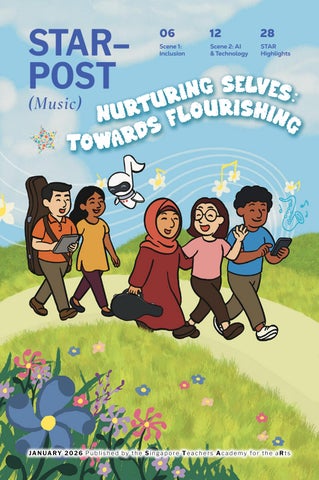
06
12
28
Scene 1: Inclusion
Scene 2: AI & Technology
STAR Highlights
Selves: g n i r urish u t ing Nur Flo s d r Towa
STAR-POST (MUSIC) JANUARY 2026
Contents
04
Overture
06
12
08 An Inclusive Approach to Learning Music from Different Cultures
14 Rising Above Challenges
10 More than Music: Building Character Through Collaborative Musicking
16 Music-Making In The Digital Age
Scene 1: Inclusion
Scene 2: AI & Technology
15 A Music Teacher’s AI Journey
18 Capturing The Spectrum Of Students’ Musical Activities
Editorial Team Dr Kelly Tang Master Teacher, Music
Seah Cheng Tat Academy Officer, Music
Felicia Toh Sze Hui Senior Academy Officer, Music
Disclaimer: No part of this publication may be reproduced in whole or part without the prior consent of STAR. All rights reserved.
2
20
28
Scene 3: Towards Flourishing
STAR Highlights
30
We’d Love to Hear from You...
22 Leadership As Caring for People 24 Continuously Energised By Music 26 Music, Teaching, and Well-being
Published by 2 Malan Road Singapore 109433 star.moe.edu.sg
instagram.com/ starmusicators
vimeo.com/moestar
3
STAR-POST (MUSIC) JANUARY 2026
Overture “In a world where education is rapidly reshaped by technology and shifting expectations, how might we, as music educators, rediscover and nurture the inner resources that empower us to adapt and flourish?”
The role of the teacher today differs vastly from that of the past. With the rapidly evolving educational landscape shaped by technological acceleration and the emergence of artificial intelligence (AI), the work of music educators calls for renewed focus, not only on what and how we teach, but also on who we are as teachers. Teachers need to constantly learn and navigate global changes to effectively impart knowledge and develop key competencies that prepare students for their futures. Structured like an operatic performance, this issue of STAR-Post serves the community of music educators. Scene 1 showcases practical classroom strategies on inclusion, while Scene 2 explores the use of AI and technology in music classrooms. In these two scenes, the rose (key highlights), thorn (emerging challenges), and bud (opportunities for growth) are shared to invite deeper reflection on our own teaching practices and to inspire us to try new approaches and possibilities with confidence.
4
Scene 3 presents stories and advice on different aspects of well-being, offering insights towards flourishing as educators. It invites us to embrace what it means to flourish as educators and to explore the boundless potential that unfolds when we learn, teach, and share ideas. Together, through shared purpose and collaboration, we cultivate a sustained and empowering community of music educators and learners who can navigate the future. As we look ahead, we are delighted to welcome Mr Loo Teng Kiat, Master Teacher (Music), to the STAR team, whose expertise and passion for music education will enrich our collective journey and further strengthen our community of music educators. We hope these stories and insights resonate with you and spark new possibilities in your own practice as we nourish ourselves and flourish together! Lee Ley Har Deputy Director, Music Singapore Teachers' Academy for the aRts
5
1 e n e e c n S e c S l c n l I c n I
11:: n o i n s o i u s l clu
STAR-POST (MUSIC) JANUARY 2026
An Inclusive Approach to Learning Music from Different Cultures Ms Grace Lee, Casuarina Primary, prioritises differentiating resources to address the diverse learning needs in the music classroom. Her Primary 3 Thai Music Ensemble Module leverages technology to support students’ learning. One of the tasks in the module involves students’ learning to sing and play “Chang Chang Chang”, a Thai folk song about elephants, as an ensemble using ukuleles and Orff instruments. The module encourages teachers to practise differentiated instruction by modifying tasks to allow students of different readiness levels to participate in ensemble playing.
Grace’s students creating a short melody using the Song Maker on the iPads
Grace’s Rose Thorn Bud
Technology and Differentiated Learning Support
Student Autonomy and Peer Collaboration
· Technology and differentiated instruction effectively supported diverse learners in forming a musical ensemble.
· Student autonomy in music creation led to engaging musical conversations during group discussions. Students provided instrumental guidance by helping peers play accurately and suggesting manageable patterns for cohesive performances.
· Padlet enabled students to track progress and access revised lyrics and introductions created in Song Maker throughout the module. · Song Maker enhanced aural learning by enabling students to hear their four-bar melodic introductions for accompaniment on ukulele or xylophone.
· Students demonstrated inclusive behaviour and compassion towards peers with special educational needs during group rehearsals.
· The module supported visual learners through video tutorials and visual guides for instrument learning.
8
Scene 1: Inclusion
Future implementation · Enhance the module by introducing varied teaching strategies for diverse learners. · Exploring repertoire from other Southeast Asian countries and applying the improved pedagogical strategies when teaching other folk songs.
Managing Multiple Resources and Safety Considerations
· The goal is to cultivate an inclusive music classroom that celebrates all musical traditions, empowering students to develop instrumental mastery alongside cross-cultural understanding and musical appreciation.
· Students required time to adapt to managing multiple learning resources simultaneously whilst playing instruments. · Ensuring the safety of students, equipment (iPads), and musical instruments remained critical throughout activities.
Audio Challenges and Technical Solutions · Students struggled to hear backing tracks through iPad speakers whilst playing instruments. · To address this challenge, teachers played the backing track for each group through the room’s speakers during group rehearsals.
Grace Lee, Casuarina Primary
· The department plans to purchase small portable speakers to address this challenge.
Click here to access Grace’s Thai Music Lesson Module
9
STAR-POST (MUSIC) JANUARY 2026
More than Music: Building Character Through Collaborative Musicking “Music isn’t just about playing together — it’s about feeling together.” Why does Ms. Nur Atika Binti Mohamed Naim, Victoria School, say that?
“Over time, I have come to realise that before I am a music teacher, I am first a teacher of character. In the music classroom, students learn to practise empathy and teamwork through sound —listening, supporting, and growing with one another. Sometimes, it happens quietly: a student adjusting his tempo so his friend can catch up or a simple thumbs-up for that “you good” moment of affirmation. These moments remind me that our teaching transcends chords and lyrics — it is more than music, we create a harmony of empathy and teamwork that prepares our students for life.” Atika teaching music to her students
As such, collaborative music-making requires more than just continuous negotiations amongst bandmates to achieve shared musical goals. Students need to initiate these negotiations through empathy, understanding emotions, identifying perspectives, and clarifying problems (Hashim, Chan & Md Dawam, 2019). Educators play a crucial role in modelling social and emotional competencies that directly influence classroom climate, teacher-student relationships, and students’ social, emotional, and academic outcomes (Jennings & Greenberg, 2009). This demonstrates how teachers’ inclusive practices can create safe environments where musical collaboration becomes a vehicle for developing essential life skills, fostering both artistic growth and 21st Century Competencies. Atika shares her practices and insights on approaches that include all learners in a pop band module. Atika’s strategies for Inclusive Practices in Music Classroom Designed multi-tiered tasks for keyboard, guitar, and pop band to give all learners of different interests and readiness levels equitable access to creative success. Incorporated Design Thinking (Empathise, Define, Ideate, Prototype, Test) enabling students to identify peers’ challenges and collaboratively co-design solutions. Implemented Praise-Polish-Ponder feedback routines to foster respectful and constructive critique, emphasising that empathy extends beyond music-making to communication and peer interactions.
10
Scene 1: Inclusion Atika’s stories of Classroom Practices and Lesson Ideas that encourage inclusive growth Record & Review: Introduced after personal experimentation with TikTok duets. Implemented across performance-based activities, such as keyboard, guitar, and songwriting. This practice allows students to record, rewatch, and reflect on their performances, identifying strengths and areas for improvement. It promotes self-awareness and ipsative growth as students learn to measure progress against their past selves rather than against others. Song Maps: Developed templates inspired by her involvement in Friends in Concert. These maps help students of different learning profiles to visualise structure and arrangement ideas before rehearsing - transforming abstract musical concepts into concrete planning tools for more effective collaboration. Tutorial Videos: Created short videos (e.g., BandLab tutorials) to support different readiness levels, self-directed learning, and to demonstrate effective independent practice habits. Real-World Tools: Ultimate Guitar and Transpose (a browser extension that can be installed to transpose any video in the Chrome browser, including YouTube videos). Encouraged students who are interested to explore chord changes and transpositions. These resources extend learning beyond the classroom, helping students discover the relevance of musical knowledge in their personal playlists and interests.
Atika’s Rose Thorn Bud
· Joy in designing self-directed lessons that provided differentiated entry points, empowering every student to succeed. · The classroom became a safe space for peer learning students naturally turned to one another for support and feedback.
· Balancing self-directed learning with discipline remained an ongoing challenge. · The same devices that empowered learning could also distract. Guiding students to stay focused and use technology purposefully took time and patience.
· Continue fostering a culture of peer mentoring where students guide one another both musically and socially. · Integrate purposeful singing to help students develop vocal confidence and personal expression, learning to communicate their identities through sound rather than merely playing notes.
Final thoughts Atika’s differentiated tasks, reflection protocols, and structured peer feedback demonstrate how inclusive music teaching develops both musical skills and collaborative competencies. When students learn to support peers musically, they practice empathy and teamwork applicable beyond the classroom.
11
: 2 e n Sce n h c e T AI &
y g o l o hn
STAR-POST (MUSIC) JANUARY 2026
Rising Above Challenges
Melvin teaching music to his students
A Mu
For Ms. Noraini A challenges in teac
Mr Melvin Chan, a music teacher at Qifa Primary School, explores the use of AI in music composition by working with a group of students to discover how AI tools can support them in writing songs.
Melvin’s Rose Thorn Bud His Journey: From Thorn to Rose…. · An exploratory approach to songwriting requires students to depend on their own initiative. Students were equipped with musical tools such as Musicca, ChordPlayer, and Chordify and empowered to explore musical solutions (e.g. listening to generated accompanimental styles and making changes to chord progressions, changing words to generated lyrics, etc.) by themselves. · This requires the music teacher to relinquish control over the musical outcomes, the students felt, at times, unsure how to proceed. This was a Thorn or a challenge at first as it created uncertainty for Melvin’s students, but it drove them to depend on their inner sense of musicality, which became a positive aspect of their development. It was this same “Thorn” that enabled Melvin to develop his faith and confidence in his students. · The music students created brought together the affordances of AI and the ingenuity of human creativity, exploding in an unimaginable and impressive result, blooming into a “Rose”. Looking Ahead…. · Based on this transformative experience, Melvin hopes there will be other opportunities for educators to leverage AI, and to incorporate AI in their teaching. This is the “Bud” Melvin wishes to nourish. · Undoubtedly, AI will be an indispensable part of the students’ future, a constant companion in the accumulation and generation of knowledge.
A Symphony · Noraini shares,
“The mos incorporat into musi witnessin enthus These tool lessons int experience meaningful
· Isle of Tunes and primary digital t former allows st composition by making abstract and accessible.”
· On GarageBand serves as our ga Students explor Smart Instrume traditional instru fusion pieces, de
· Noraini’s most a her using SUNO generate the sch demonstrating t human creativit
· As such, teachers need to embrace AI and consider how it can enhance their role as educators and guide students in the correct use of this digital tool. · Educators must consider not only the current state of technology, but also prepare for the rapid changes and unexpected developments of the future.
Melvin’s students using computers and AI to give voice to their songs
14
Scene 2: AI & Technology
usic Teacher’s AI Journey
Amin, a music teacher at Chongfu School, the digital age presents exciting opportunities and unique ching music.
Noraini’s Rose Thorn Bud
y Of Highlights
Navigating The Challenges · Noraini recognises that “unlimited technological access poses risks without proper supervision.”
st rewarding aspect of ting AI and technology ic education has been ng students’ genuine siasm for learning. ls transform our music to eagerly anticipated es, where gadgets serve l educational purposes.”
d GarageBand are Noraini’s teaching tools, where the tudents to explore musical building virtual islands, t musical concepts tangible ”
d, Noraini notes, “GarageBand ateway to music production. re features like Remix FX and ents while experimenting with uments to create musical emocratising music creation.”
ambitious project involved O with fellow colleagues to hool’s 110th anniversary song, the collaboration between ty and AI.
· With the help of the Classroom computer app, installed on every iPad, she meticulously monitors student website activity. · Noraini wisely states, “Not all AI and technology applications are beneficial. As educators, we serve as filters, determining what’s appropriate for digital learning environments.” · Noriani emphasises,
“AI cannot replace the human element in education. Educators remain irreplaceable in guiding students towards meaningful learning experiences. AI serves to complement our teaching, but human connection and judgement remain central to effective education.”
Cultivating Future Growth · In 2026, Noraini proposes to use Chrome Music Lab to combine interactive tools that allow exploration of rhythm and melody creation in innovative digital ways, to complement traditional physical ways of making and notating music. Conducting the Future · Noraini reflects, “My journey with AI in music education continues to evolve, guided by the principle that technology amplifies human creativity, rather than replacing it.” · “Digital tools open new pathways for musical expression, making composition accessible to all students whilst maintaining the essential human elements that make music education meaningful and transformative.”
“As we embrace this digital symphony, let’s remember that we are the conductors orchestrating the perfect harmony between tradition and innovation.”
Noraini teaching music with Isle of Tunes
15
STAR-POST (MUSIC) JANUARY 2026
Music-Making In The Digital Age Ms. Adeline Tan, HOD Aesthetics at Yusof Ishak Secondary School, uses AI as a creative collaborative tool to teach music to students. This complements her students’ collaboration with their peers. In this way, her students experience how technology enhances their personal creativity, rather than taking over their creative process. This is how Adeline harnesses AI tools to empower her students to ideate, refine, and create their own songs:
AI / Tech Tool
Purpose
Lyric Creation
Adeline presents her lesson ideas on AI at SNEF
How It’s Used In Class Students learn the importance of relatable and meaningful lyrics. They choose a theme which inspires 10 words, which they input into ChatGPT, and refine their lyrics through a series of suggested prompts and critical thinking questions.
ChatGPT Adeline’s Prompts for Songwriting
Create Melodies
Students choose a four-chord structure that they input into MelodyStudio, which generates a suggested melody for them to audition and adjust, before exporting it to GarageBand.
Arrangement and Recording
Students decide on the style, instrumentation, tempo and structure that suit the rhythm and chordal structure of their song.
Melody Studio
iOS GarageBand
Adeline’s students refining their lyrics with Chat GPT
16
Scene 2: AI & Technology
Why AI Tools Work As a skilled and experienced music teacher, Adeline finds AI tools useful for these reasons:
Increase Motivation
Build Future-Ready Skills
· To address “blank page” syndrome, these tools serve as a welcome “primer” when students have no idea how to go about writing a song.
· This process mirrors realworld creative practices, as professionals routinely use AI to accelerate idea generation. · This process encourages students to evaluate, edit, and make creative decisions, developing critical thinking and discernment.
· These tools lower barriers for students who may be less confident in language or musical expression.
Encourage Creativity and Engagement · This frees up mental space for students to create. · Students experience joy and ownership in music-making.
Adeline’s students composing songs in Garage Band
Adeline’s Rose Thorn Bud
AI helps students start the songwriting process, overcoming initial creative blocks and building confidence.
AI-generated melodies often sound awkward and artificial, with unnatural leaps or robotic phrasing. The challenge for music teachers is to guide students to go beyond these automatic, raw and surface outputs — to think musically, critically, and contextually, and to phrase the music accordingly.
G MUSIC MAKIN A NEW SOUND: E AG L TA GI DI IN THE AESTHETICS
- MUSIC
ADELINE
17
Adeline’s ultimate goal is for students to analyse and critique AI-generated music to deepen both their creativity and musical understanding.
TAN LI JEN
Adeline’s songwriting ideas shared at 2025 Smart Nation Educator Fellowship (SNEF)
STAR-POST (MUSIC) JANUARY 2026
Capturing The Spectrum Of Students’ Musical Activities To capture the myriad ways students participate musically at Evergreen Secondary School, the school’s Senior Teacher, Mr. Samuel Soong, created the P.R.I.S.M. Passport App to ensure every student’s contribution —no matter how small— is noticed, recorded and valued. Mr Samuel Soong (right) with his students at Evergreen Secondary School
P.R.I.S.M. Stands for “Powering Real-World Interdisciplinary Student Music Experiences” Samuel explains the inspiration behind the app:
“P.R.I.S.M. stands for ‘Powering Real-World Interdisciplinary Student Music Experiences.’ The app captures students’ musical contributions that traditional grading systems miss— from helping peers during rehearsals to volunteering for community performances to organizing equipment after school.”
He adds,
“I created the P.R.I.S.M. Passport App to meaningfully acknowledge the many moments when students step up, contribute, and shine—moments that often slip through the cracks of traditional recognition.”
How Did Samuel Build P.R.I.S.M.? Samuel used Vibe Coding, an AI-powered platform, and built the entire P.R.I.S.M. Passport App without any formal programming skills. With the aid of Vibe Coding, Samuel tailored the app to meet his students’ precise needs. P.R.I.S.M. shows how teachers can use AI purposefully to make student development more personalised and engaging, making the teacher’s role both more efficient and creative.
The P.R.I.S.M. App profile page, where student’s badges are prominently displayed
18
Scene 2: AI & Technology
How P.R.I.S.M. Works The P.R.I.S.M. Passport App enables students to: Earn points, collect badges, and unlock industry internship and partnership opportunities. Submit mission reports and receive validated recognition. Gather peer signatures like an e-passport. Browse a live noticeboard of upcoming opportunities.
The P.R.I.S.M. bulletin board shows upcoming arts opportunities that students can sign up for
The app highlights each student’s authentic acts of service, creativity, consistency and courage. Over the long term, it helps students build a real-world portfolio that reflects their authentic strengths and potential. This is invaluable for Direct School Admission (DSA) or Polytechnic Early Admissions Exercise (EAE) opportunities, painting a more complete picture of who each student is becoming and who they could be in the future.
The P.R.I.S.M. Star chart tracks each student’s progress. At different milestones (planets), they unlock incentives like testimonials, portfolios, badges and internships
Unleashing The Power of P.R.I.S.M. Why use P.R.I.S.M.? Student Ownership: The P.R.I.S.M. app lets students manage their own accounts, track their progress, and take responsibility for documenting their learning.
Gamifying Self-Development: Students feel motivated and excited to earn points, ranks and badges through their achievements.
Real-World Relevance: Through each contribution, students build their personal portfolios and accumulate testimonials and validated records that they could use for DSA/EAE applications to educational institutions and future employment prospects.
Building Community: The collection of e-passport signatures connects the student community, celebrates teamwork, and cultivates pride.
Samuel sums it up,
“When teachers use AI intentionally, we amplify the human side of education. The P.R.I.S.M. Passport App is my way of doing that.”
19
The educational Power of P.R.I.S.M.
3 e 3 n e e c n S e Sc r a r w a o T w o T u o l u F o l F
: 3 3: s d r rds g n i g h n s i i h u ris ur
STAR-POST (MUSIC) JANUARY 2026
Leadership As Caring for People Mrs. Rebecca Chew, the Principal of Holy Innocents’ High School (HIHS), sees stewardship as a key part of being a school leader.
“Stewarding people to collaborate shapes my work like a curator. Curare, the Latin word for curate, means to take care of. Seeing school leadership as caring for people transforms students and creates possibilities for them in a dynamic and changing world.”
Mrs. Rebecca Chew, Principal of Holy Innocents’ High School
Choral Conducting and Leadership Mrs. Chew attributes her training as a choral conductor for shaping her approach as a school leader. Leadership and conducting share a common purpose, which is to synthesise individual parts into a coherent whole. Like how a conductor curates a choir, a school leader takes care of the entire school community and brings people together with a common purpose. Leadership involves bringing together separate jigsaw pieces to form a complete picture. For Mrs. Chew, this unity is the crucial factor that maximises collaboration and team dynamics at HIHS.
“To impact the lives of students,” Mrs. Chew says,
Mrs. Rebecca Chew with Staff Members of Holy Innocents’ High School
“HIHS staff members see deep meaning and purpose in designing lessons and creating school processes. They see their work as life-giving because it plays a major role in nurturing the lives of students.”
22
Scene 3: Towards Flourishing
Balancing Work With Life
Education That Changes Lives
As a caring school leader, Mrs. Rebecca Chew sees the importance of fostering open dialogue and thoughtful planning with each staff member, supporting them through the various stages of their lives. According to Mrs. Chew,
“While managing time, teams and resources is everyone’s daily commitment, our ongoing conversations with each staff member create flexible arrangements such as adaptable work hours and spaces.”
“In this way, staff members align their personal practices with the rhythms, realities and requirements of school life, in ways that respect both their personal and professional needs.”
Mrs. Chew reflects, “When teachers celebrate why they chose to become educators in the first place, this personal choice becomes part of the fabric of the HIHS community.” This transformative decision to become part of a larger whole anchors the teacher’s desire to channel their energies into a meaningful purpose. Because each teacher comes from a unique discipline, their diversity creates a collective synergy that contributes magnificently to the development of every child. As a principal, Mrs. Chew is convinced,
“Knowing my staff well gives me the insight to lead the HIHS community with clarity. Having the heart to listen and to decide wisely, in conjunction with fellow school leaders who work closely with these staff members on a daily basis, is what builds a community that truly supports the education of our students, and shapes the teaching and learning so that they are specifically geared towards their needs.”
Words of Wisdom for Music Teachers To the fraternity of music teachers, Mrs. Rebecca Chew has these words of wisdom to share:
“Enjoy your music-making! Make music instead of letting the music make you. Music is always an adventure to create space for teaching and learning.” “Give space and time for yourself to grow and learn beyond your subject area. That brings new perspectives to reframe your own thinking, and to reflect on the pulse, tempo and differentiated phrasing for every turn. In teaching music, always play, imagine and design!”
23
Mrs. Rebecca Chew, then Academy Principal of STAR, at Arts Education Conference
STAR-POST (MUSIC) JANUARY 2026
Continuously Energised By Music Ms Tan Shi Ying, Subject Head (Aesthetics) at Red Swastika School, shares:
“Music constantly fascinates me, because it connects hearts and minds beyond words. A simple melody can spark joy, confidence, and creativity in my students. It reminds me that music is more than performance — music nurtures empathy, teamwork, and self-expression.”
Shi Ying (extreme right) teaches her Primary One students using Chinese drums
Embracing Others Through Music Shi Ying’s deep curiosity about different musical styles shapes her music teaching. Her passion to learn instruments from diverse cultures, for example, Western instruments like the ukulele, flute and violin, or Asian instruments like the Chinese drum or the hulusi, helps her bridge different musical worlds to design lessons that celebrate Singapore’s multi-cultural identity. Shi Ying declares,
A bamboo hulusi , like the one Shi Ying plays
“Music also helps my students grow as global citizens, rooted in their own ways of life, and yet open to other cultures. As they explore songs and traditions from around the world, they learn to appreciate diversity, build understanding and celebrate our shared humanity.”
Well-being and Music Shi Ying’s endless curiosity to discover music sustains her physical and emotional well-being, keeping her captivated, reflective and open to new experiences. For her, challenges are opportunities to learn and grow, allowing her to stay balanced, renewed and energised even through busy school terms.
24
Scene 3: Towards Flourishing
Harmonising with Colleagues Shi Ying shares,
optimism “I pass on my upbeat ring to colleagues by sha sical my excitement and mu we so m, the h wit es eri discov our ate ebr cel and nt experime er. eth tog successes
“We motivate one another to stay healthy, inspired and connected — reminding ourselves that caring for ourselves enables us to care better for our students.”
Shi Ying enjoys collaborating with colleagues from different departments, as each person brings unique strengths and perspectives that enrich the kaleidoscope of the school’s arts culture. She particularly enjoys working with teachers with little or no music background. By helping them to sing and play simple musical parts, she helps them gain confidence and experience the joy of music-making together.
Balancing Work and Family Shi Ying believes balancing between work, personal interests and family is essential for sustained creativity and joy. “I plan my time carefully so that I can give my best at school while still enjoying meaningful moments with my loved ones,” she says. Shi Ying often shares music with her family, turning simple moments into opportunities for connection and joy. “These experiences remind me why I teach,” says Shi Ying, “to pass on the love of music.”
Shi Ying (front-left) with school colleagues, performing for Mid Autumn Festival 2024
From Language to Music Shi Ying was a Mother Tongue (Chinese) teacher before becoming a music teacher in 2018. She unites her love for Chinese culture with her musical passion. She shares,
“My Chinese teaching background enriches my music lessons with bilingual and cultural depth — especially in a bilingual Special Assistance Plan (SAP) school where language and music intertwine beautifully.”
Through her unique blend of Chinese language expertise and musical passion, Shi Ying embodies what it means to flourish as an educator—bridging cultures, staying curious, and continuously energised by the rich connections between language, music, and the students she serves.
Shi Ying (2nd from right) performing with her band Our Class at STAR’s Friends In Concert (FIC) 2025, Esplanade Concourse
25
Shi Ying beautifully exemplifies how music teachers can harmonise and fuel their professional teaching and school duties with their own musical passions, family life and unbridled curiosity to discover more about music.
STAR-POST (MUSIC) JANUARY 2026
Music, Teaching, and Well-being Mr Muhammad Nur Azman Shah B Jumahat, a music teacher at New Town Secondary School, declares,
“Music has always fascinated me because it reflects the fabric of our different cultures and communities.” As someone who also teaches Geography, I see the interdependence between place, identity, and sound.
“Whether it’s Gamelan from Indonesia or traditional Malay music, each musical style tells a unique story about people and their environment. For me, learning never ends.”
Azman (leftmost) with other music teachers at ISTP (International Summit on the Teaching Profession) - Gardens by the Bay, 2024
Music Empowers Teaching Performing in the 20th WASBE (World Association of Symphonic Bands and Ensembles) International Conference in Korea, 2024, Azman was inspired by the fertile exchange of ideas between conductors, composers, and educators from various parts of the world. WASBE reinforced Azman’s convictions about lifelong learning and the importance of exposing students to diverse musical perspectives. Azman shares,
“My artistic passion and involvement with the Philharmonic Wind Orchestra sharpens my musicianship, discipline, awareness and expressiveness, which I apply to my teaching practice.”
Drawing from his ensemble experience, Azman applies these strategies to rehearse his school band for performances.
Azman with the Philharmonic Wind Orchestra at WASBE 2024
Azman’s immersion in the Philharmonic Wind Orchestra also equips him to impart life skills to his students that transcend any discipline, such as balance, blend, punctuality, teamwork, mutual respect for others and seeing the whole picture.
26
Scene 3: Towards Flourishing
Musical Well-Being For Azman, being creatively engaged helps him stay grounded and reflective, especially during the busy school terms. He shares,
“Music is an important form of self-care for me. Playing instruments or just jamming with students during and after school helps me unwind in critical ways.”
Azman debriefs students for New Town’s Got Talent
In Harmony With Colleagues Azman believes that collaboration with colleagues begins with careful listening to what each person has to say. This is what listening to music teaches us. He strives to find each colleague’s strengths so he can complement them. For example, this year, he introduced ArtSync, an initiative that brought together the school’s Visual and Performing Arts Co-Curricular Activity (CCA) groups for a National Day showcase. This involved discussion and brainstorming with colleagues to bring together each discipline’s unique contribution.
Work-life Balance Azman keeps clear boundaries between work and personal time. He stays organised and plans ahead, so he can stay focused on work priorities and avoid feeling overwhelmed. For Azman, weekends are dedicated to family and personal musical pursuits, like rehearsing with the Philharmonic Wind Orchestra or unwinding through café-hopping. These moments allow him to recharge, stay inspired, and return to school refreshed and ready to give his best.
For Azman, it was truly rewarding to see how music, dance, and visual arts came together to tell a cohesive story, resonating with students and staff.
Towards Flourishing Azman’s teaching draws on multiple dimensions of his expertise—his love for music, his understanding of geography and cultures across the world, and his commitment to lifelong learning. Whether performing with the Philharmonic Wind Orchestra, introducing initiatives like ArtSync, or jamming with students after school, he creates spaces where everyone can contribute their unique voice—building a department culture where students and teachers support one another’s growth.
27
Azman at Esplanade Concert Hall
STAR-POST (MUSIC) JANUARY 2026
STAR HIG
Catch up with the latest happenings our July 2025 issue of STAR-Post and Professional Le
9
GHLIGHTS
s that have taken place at STAR since d some exciting upcoming events and earning in 2026!
1. 2. 3. 4. 5. 6. 7. 8. 9. 10. 11.
Friends in Concert 2025 culminated with a concert at Esplanade Concourse STAR Champions (Pri) STAR Champions (Sec) ICT-based Music-Making Module 6: AI in the Music Curriculum Musical Futures Developing musicianship skills and understanding of music concepts through experiential learning at the Orff Plus workshop Engaging With Songs (Sec) Creating for Winds Workshop Engaging With Songs: Prologue to Singing Kodály Plus (Upper Primary) Inclusive Music Classrooms – Supporting Diverse Learners (Proficient Level)
Discover exciting professional learning opportunities awaiting you in 2026! Refer to the STAR Music Professional Learning Listing for all programmes available, including developmental programmes, such as Orff-inspired Strategies for Teaching, Five Part Creating Module, and Kodály workshops.
WE'D LOVE TO HEAR FROM YOU
Lee Ley Har Deputy Director (Music) Lee_Ley_Har@moe.gov.sg +65 6664 1493
Li Yen See Chua Siew Ling Master Teacher (Music) Principal Master Teacher (Music) Chan_Yen_See@moe.gov.sg +65 6664 1499 Chua_Siew_Ling@moe.gov.sg +65 6664 1554
Suriati Bte Suradi Master Teacher (Music) Suriati_Suradi@moe.gov.sg +65 6664 1498
Kelly Tang Master Teacher (Music) Kelly_Tang@moe.gov.sg +65 6664 1561
Loo Teng Kiat Master Teacher (Music) Loo_Teng_Kiat@moe.gov.sg +65 6664 1562
Leong Su Juen Academy Officer (Music) Leong_Su_Juen@moe.gov.sg +65 6664 1494
Seah Cheng Tat Academy Officer (Music) Seah_Cheng_Tat@moe.gov.sg +65 6664 1497
Felicia Toh Sze Hui Senior Academy Officer (Music) Toh_Sze_Hui@moe.gov.sg +65 6664 1555
Teo Li Chin Academy Officer (Music) Teo_Li_Chin@moe.gov.sg +65 6664 1495