Bf 110G-4 GERMAN WWII NIGHTFIGHTER
1/72 SCALE PLASTIC KIT P r o f i P A C K
#7094
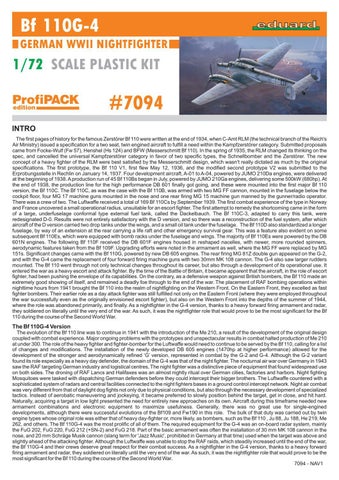
INTRO The first pages of history for the famous Zerstörer Bf 110 were written at the end of 1934, when C-Amt RLM (the technical branch of the Reich's Air Ministry) issued a specification for a two seat, twin engined aircraft to fulfill a need within the Kampfzerstörer category. Submitted proposals came from Focke-Wulf (Fw 57), Henshel (Hs 124) and BFW (Messerschmitt Bf 110). In the spring of 1935, the RLM changed its thinking on the spec, and cancelled the universal Kampfzerstörer category in favor of two specific types, the Schnellbomber and the Zerstörer. The new concept of a heavy fighter of the RLM were best satisfied by the Messerschmitt design, which wasn't really dictated as much by the original specifications. The first prototype, the Bf 110 V1, first flew May 12, 1936, and the modified second prototype V2 was submitted to the Erprobungsstelle in Rechlin on January 14, 1937. Four development aircraft, A-01 to A-04, powered by JUMO 210Da engines, were delivered at the beginning of 1938. A production run of 45 Bf 110Bs began in July, powered by JUMO 210Ga engines, delivering some 500kW (680hp). At the end of 1938, the production line for the high performance DB 601 finally got going, and these were mounted into the first major Bf 110 version, the Bf 110C. The Bf 110C, as was the case with the Bf 110B, was armed with two MG FF cannon, mounted in the fuselage below the cockpit floor, four MG 17 machine guns mounted in the nose and one rear firing MG 15 machine gun manned by the gunner/radio operator. There was a crew of two. The Luftwaffe received a total of 169 Bf 110Cs by September 1939. The first combat experience of the type in Norway and France uncovered a small operational radius, unsuitable for an escort fighter. The first attempt to remedy the shortcoming came in the form of a large, underfuselage conformal type external fuel tank, called the Dackelbauch. The Bf 110C-3, adapted to carry this tank, were redesignated D-0. Results were not entirely satisfactory with the D version, and so there was a reconstruction of the fuel system, after which aircraft of the D version carried two drop tanks under the wings, and a small oil tank under the fuselage. The Bf 110D also standardized a longer fuselage, by way of an extension at the rear carrying a life raft and other emergency survival gear. This was a feature also evident on some subsequent Bf 110Es, which were equipped with bomb racks under the fuselage and wings. The majority of Bf 110Es were powered by the DB 601N engines. The following Bf 110F received the DB 601F engines housed in reshaped nacelles, with newer, more rounded spinners, aerodynamic features taken from the Bf 109F. Upgrading efforts were noted in the armament as well, where the MG FF were replaced by MG 151s. Significant changes came with the Bf 110G, powered by new DB 605 engines. The rear firing MG 81Z double gun appeared on the G-2, and with the G-4 came the replacement of four forward firing machine guns with two 30mm MK 108 cannon. The G-4 also saw larger rudders mounted. The Bf 110 went through not only technical changes throughout its career, but also through a development of its operational use. It entered the war as a heavy escort and attack fighter. By the time of the Battle of Britain, it became apparent that the aircraft, in the role of escort fighter, had been pushing the envelope of its capabilities. On the contrary, as a defensive weapon against British bombers, the Bf 110 made an extremely good showing of itself, and remained a deadly foe through to the end of the war. The placement of RAF bombing operations within nighttime hours from 1941 brought the Bf 110 into the realm of nightfighting on the Western Front. On the Eastern Front, they excelled as fast fighter bombers. Their earlier role as a day attack fighter was still fulfilled not only on the Eastern Front (where they were employed throughout the war successfully even as the originally envisioned escort fighter), but also on the Western Front into the depths of the summer of 1944, where the role was abandoned primarily, and finally. As a nightfighter in the G-4 version, thanks to a heavy forward firing armament and radar, they soldiered on literally until the very end of the war. As such, it was the nightfighter role that would prove to be the most significant for the Bf 110 during the course of the Second World War.
The Bf 110G-4 Version The evolution of the Bf 110 line was to continue in 1941 with the introduction of the Me 210, a result of the development of the original design coupled with combat experience. Major ongoing problems with the prototypes and unspectacular results in combat halted production of Me 210 at under 300. The role of the heavy fighter and fighter-bomber for the Luftwaffe would need to continue to be served by the Bf 110, calling for a list of changes and modifications. The installation of the newly developed DB 605 engines (1470hp at higher performance) allowed for the development of the stronger and aerodynamically refined ‘G’ version, represented in combat by the G-2 and G-4. Although the G-2 variant found its role especially as a heavy day defender, the domain of the G-4 was that of the night fighter. The nocturnal air war over Germany in 1943 saw the RAF targeting German industry and logistical centres, The night fighter was a distinctive piece of equipment that found widespread use on both sides. The droning of RAF Lancs and Halifaxes was an almost nightly ritual over German cities, factories and harbors. Night fighting Mosquitoes were tasked with dispatching German defenders before they could intercept their bigger brothers. The Luftwaffe countered with a sophisticated system of radars and central facilities connected to the night fighters bases in a ground control intercept network. Night air combat was very different from that of daylight dog fights not only due to physical conditions, but also through the necessary development of specialized tactics. Instead of aerobatic maneuvering and jockeying, it became preferred to slowly position behind the target, get in close, and hit hard. Naturally, acquiring a target in low light presented the need for entirely new approaches on its own. Aircraft during this timeframe needed new armament combinations and electronic equipment to maximize usefulness. Generally, there was no great use for single-engined developments, although there were successful evolutions of the Bf109 and Fw190 in this role. The bulk of that duty was carried out by twin engine types whose original role was either that of heavy day-fighter or, more likely, as bombers, such as the Bf 110 , Ju 88, Ju 188, He 219, Me 262, and others. The Bf 110G-4 was the most prolific of all of them. The required equipment for the G-4 was an on-board radar system, mainly the FuG 202, FuG 220, FuG 212 (+SN-2) and FuG 218. Part of the basic armament was often the installation of 30 mm MK 108 cannon in the nose, and 20 mm Schräge Musik cannon (slang term for 'Jazz Music', prohibited in Germany at that time) used when the target was above and slightly ahead of the attacking fighter. Although the Luftwaffe was unable to stop the RAF raids, which steadily increased until the end of the war, the Bf 110G-4 and their crews deserve great respect for their combat success. As a nightfighter in the G-4 version, thanks to a heavy forward firing armament and radar, they soldiered on literally until the very end of the war. As such, it was the nightfighter role that would prove to be the most significant for the Bf 110 during the course of the Second World War. 7094 - NAV1
ATTENTION
UPOZORNĚNÍ
INSTRUCTION SIGNS
BEND OHNOUT
OPTIONAL VOLBA
PARTS
ACHTUNG
INSTR. SYMBOLY
OPEN HOLE VYVRTAT OTVOR
ATTENTION
INSTRUKTION SINNBILDEN
SYMETRICAL ASSEMBLY SYMETRICKÁ MONTÁŽ
DÍLY
REMOVE ODŘÍZNOUT
TEILE
SYMBOLES
REVERSE SIDE OTOČIT
APPLY EDUARD MASK AND PAINT POUŽÍT EDUARD MASK NABARVIT
PIECES
PLASTIC PARTS
A>
B>
7080A
C>
7080B
K> E>
J>
7080E
D>
7080C
L>
7080K
7080D
7080L
7080J
eduard
M> 7080M
COLOURS
BARVY
FARBEN
PEINTURE
GSi Creos (GUNZE)
2
AQUEOUS
Mr.COLOR
AQUEOUS
Mr.COLOR
H2
C2
BLACK
H 77
C137
TIRE BLACK
H 11
C62
FLAT WHITE
H 85
C44
SAIL COLOR
H 12
C33
FLAT BLACK
H 90
C47
CLEAR RED
H 33
C81
RUSSET
H 94
C138
CLEAR GREEN
H 37
C43
WOOD BROWN
H 414
C114
RED
RLM23
H 47
C41
RED BROWN
H 416
C116
BLACK GRAY
RLM66
H 65
C18
BLACK GREEN
RLM70
H 417
C117
LIGHT BLUE
RLM76
H 68
C36
GRAY
RLM74
Mr.METAL COLOR
H 69
C37
GRAY
RLM75
MC214
DARK IRON
H 70
C60
GRAY
RLM02
MC219
BRASS
A
B
C
3 pcs.
A ; C ; D ONLY
A15, L10 - MARKINGS
3 pcs.
K16
L10
PE1
H 416 C116
A5
RLM66
B11
MC214 DARK IRON
PE3
PE16
PE4
H 416 C116
PE17, 13
RLM66
PE7
H 416 C116
H 12 C33
PE18, 13 PE21
RLM66
FLAT BLACK
H 416 C116
PE8
PE20
PE19, 13
B11
K6
H 416 C116 RLM66
RLM66
H 12 C33
PE6
FLAT BLACK
K13
H 85 C44 SAIL COLOR
A15 A15
H 416 C116
H 12 C33 FLAT BLACK
RLM66
H 416 C116
K15 K12
H 85 C44
RLM66
K14
B24
SAIL COLOR
A29
D
A15 - MARKINGS A ; C ; D ONLY
B
H 12 C33
H 416 C116
FLAT BLACK
RLM66
A15
C
A15
C
B
J1
H 416 C116 RLM66
H 416 C116 RLM66
PE12
B30
B21 H 416 C116
PE10
RLM66
H 12 C33 FLAT BLACK
B13 PE30
PE27
H 416 C116 RLM66
OPTIONAL: decal K
PE11
PE9 PE9
A B
B12 H 416 C116 RLM66
H 12 C33 FLAT BLACK
C B21
B29
H 416 C116
H 416 C116
RLM66
RLM66
E
B35
PE40
PE28
PE40 MC214 DARK IRON
H 416 C116
J5
PE34
RLM66
B35 J5 J13
A30
A30
MC214 DARK IRON
J13
H 416 C116 RLM66
B23
H 416 C116 RLM66
3
- 0,3 mm
- 0,5 mm
- 0,3 mm
C1
C1 B17
C3
B17 A1, A2
CROSS - SECTION
C2
H 94 C138
J19
CLEAR GREEN
A23
C1
A21
J18 H 90 C47 CLEAR RED
K1
K24 B27
B28
K20
K20
K5
K5 K2
K25 MC219 BRASS
4
MC219 BRASS
L17
PE31 L17
H 416 C116
A28
RLM66
D
H 416 C116 RLM66
K11
H 416 C116 RLM66
A4 H 416 C116 RLM66
PE5
OPTIONAL: decal L
L1
PE33
A3 L1
PE22
PE32 PE25 H 416 C116
J20
MARKINGS
A ;C;D
PE26
RLM66
MC214 DARK IRON
G
MARKING
L7
B
L6
E18
L14 A8
E5 MC214
E17
A22
MC214
A22
E
L9
K8 A6
fill
L11
H 416 C116 RLM66
K9 H 12 C33 FLAT BLACK
K9 PE15 PE29 H 416 C116 RLM66
J21
G
D9
J1
H 47 C41
H 12 C33
RED BROWN
FLAT BLACK
5
eduard D1
J18
J19
D4
J18
D11
J19
D7
D8
B31 2 pcs.
B32 2 pcs.
D12 D5
D3
D10 D2
D1
K7 D11
PE14
H 12 C33
D5
FLAT BLACK
PE24 PE23 OPTIONAL: decal O
D12
D3 - MARKING
D3
OPEN D5
CLOSED D5
B
ONLY
D10
CLOSED D12
D3 - MARKING
OPEN D11
D12
D3
B
ONLY
D10
D11
D11 CLOSED
D5 D7
D4 D8
D8
D7 D1
D1
OPEN
D4
D5
D11
D3 D3 - MARKING
D12 D4 D7 D1 6
D8
D10 B
ONLY
B4
H 70 C60
B1
RLM02
MC219 BRASS
A10
H 70 C60 RLM02
A9
MC219
MC219
BRASS
BRASS
A12 A11 MC219 BRASS
decal A
decal I
decal I B14
decal A
B18
B8 H 47 C41
B19
B19
H 70 C60 RLM02
H 47 C41
RED BROWN
RED BROWN
H 70 C60 RLM02
B33
H 70 C60 RLM02
PE42 H 70 C60 RLM02
PE42 B15
B15
H 70 C60 RLM02
B18 H 70 C60
B14
RLM02
H 70 C60 RLM02
SIDE VIEW
REAR VIEW 7
H 77 C137
H 77 C137
TIRE BLACK
TIRE BLACK
B31
B32
H 77 C137
H 77 C137
B3
TIRE BLACK
TIRE BLACK
B2
B31
H2 C2
H2 C2
BLACK
BLACK
H 70 C60
B32
RLM02
B3 B2
H 70 C60 RLM02
B16 H 70 C60 RLM02
B16 H 70 C60 RLM02
H2 C2 BLACK
H 77 C137 TIRE BLACK
M15
H 70 C60
K17
RLM02
K17 MARKING
C
ONLY
M15
PE41 PE41
0,9 mm A14 PE43
- 0,3 mm
- 0,3 mm 8
5o
PE36
A20
A20
PE44
A20
A20 L8
A21
A23
PE36
C1, C3
L8 C1, C2
PE44 A19
D2 PE37
L2, L5, L16
PE38 K22
PE35
A13 H 33 C81
J12
RUSSET
E8
PE35
L5 L15 L3
PE35 PE35 H 33 C81 RUSSET
L3 2pcs. L4 2pcs. PE35 H 33 C81
THE CROSS - SECTION
RUSSET
L4 L3 L15
FRONT
H 33 C81
H 33 C81
RUSSET
RUSSET
H 33 C81
J6
RUSSET
L16
2 pcs.
E10
H 65 C18
K21
RLM70
J6
H 33 C81
L4
RUSSET
E9 H 33 C81
H 65 C18
RUSSET
L2
MC214 DARK IRON
RLM70
E7 L2, L5, L15, L16 - MARKINGS E7, E8, E9, E10 - MARKING H 65 C18
K4
L3, L4 - MARKING
A ;D
B
C
RLM70
9
A1
H 417 C117 RLM76
A1 A7
A2 B17
B17
A2
H 417 C117 RLM76
B17
MARKING
C
ONLY
PE39
MARKING
A M15 - 0,8mm
2,7mm L11 M8 17,4mm M7 M14
M9 M10
M12
M13 10
B17
MARKINGS
C,D
DO NOT GLUE! NELEPIT!
TEMPLATE 7094-LEPT2 Bf 110G-4 antenna tool
M3
eduard
M4 M3 M3
M4
P
M4
P © EDUARD 2017
L
Made in Czech Republic
M1
L
M2
M1
M1
M2
M2
M11 M11
MARKING
C
M11 M11
MARKING
D
11
A
W.Nr. 720260, Oblt. Heinz-Wolfgang Schnaufer, Stab IV./ NJG 1, St. Trond, Belgium, April 1944
Heinz Wolgang Schnaufer, the most successful night fighter ace, served with night fighter units from the very beginning of his aviation career. He is credited with 121 victories, most of them being British four-engined bombers. He was wounded only once during WWII, and no member of his crew was ever wounded in action. Schnaufer was awarded the Knight´s Cross with Oak leaves, Swords and Diamonds. Schnaufer survived the war and worked at his family winery. He died on June 15, 1950, two days after a fatal collision involving his car and a truck in Cestas, close to Bordeaux, France. Schnaufer was dubbed 'The Spook from St. Trond', and he flew this aircraft in the spring 1944 after taking command of IV. Gruppe, NJG 1. The aircraft wore the standard camouflage scheme of RLM 74/75/76 colors but the upper surfaces were oversprayed with RLM 76. The darker blotches of RLM 74 and RLM 75 were partially visible. The right wing undersurface was painted black.
ČESKOU VERZI TEXTU NALEZNETE NA www.eduard.com/s/7094
12
WOOD
H37 C43
RLM 23
H414 C114
BLACK
H12 C33
WHITE
H11 C62
RLM 74
H68 C36
RLM 75
H69 C37
RLM 76
H417 C117
RLM 66
H416 C116
eduard
B
Maj. Helmut Lent, the CO of Stab NJG 3, Stade, Germany, September 1944
Helmut Lent joined the Luftwaffe in 1936. He enlisted as a fighter pilot and served with II./JG 141. On May 1, 1939, II./JG 141 was redesignated I./ZG 76 and equipped with Bf 110 fighters. In battles over Poland, Norway and France, Lent downed seven enemy aircraft, and 101 victories were added to his credit while serving with NJG 1, NJG 2 and NJG 3. On August 1, 1943, when he was 25 years old, Maj. Lent was appointed CO of the entire NJG 3. He led the Geschwader until October 5, 1944 when his Ju 88G-6 crashed during landing after port engine failure. The entire crew succumbed to their injuries within two days. Lent was awarded the Knight´s Cross with Oak Leaves, Swords and Diamonds. Lent´s Bf 110G-4 wore a standard day fighter camouflage scheme of RLM 74/75/76. The starboard wing undersurfaces were painted black. Note the Geschwader CO marking on the fuselage, quite an unusual practice for night fighter units.
ČESKOU VERZI TEXTU NALEZNETE NA www.eduard.com/s/7094
WOOD
H37 C43
BLACK
H12 C33
RLM 74
H68 C36
RLM 75
H69 C37
RLM 76
H417 C117
eduard 13
C
Hptm. Wilhelm Johnen, 7./NJG6, Neubiberg, Germany, 1945
Messerschmitt Bf110G-4, 7./NJG6 was among the aircraft found by the Allies in the spring of 1945 in Neubiberg. Despite wearing the codes of 7. Staffel, the aircraft in question was the personal mount of the CO of III./NJG 6, Hauptmann Wilhelm Johnen. This aircraft is not as well known as another one of the aircraft flown by Johnen, C9+EN, in which he was persuaded to conduct an emergency landing following engine damage in Switzerland, on the night of 27/28 April, 1944. The aircraft was his last, from a later series production block, and equipped with the FuG 220 SN-2d antenna system, with the dipoles angled at 45o, exhausts of the Eberspacher type, and equipped with the Schräge Musik cannon arrangement. The camouflage scheme consisted of RLM 76 on the bottom and side surfaces, and RLM 75 on upper surfaces. The upper surface colors were lightened with an irregular snake pattern of RLM 76, such that only traces of the original darker grey color were visible. The vertical fins carried a meticulously rendered Knight's Cross, with 32 bars denoting kills. In total, Wilhelm Johnen claimed 34 kills, the last of which was gained on the night of 15/16 March, 1945.
ČESKOU VERZI TEXTU NALEZNETE NA www.eduard.com/s/7094
14
RLM 66
H416 C116
WOOD
H37 C43
RLM 75
H69 C37
RLM 76
H417 C117
eduard
D
Stab II./NJG1, Bad Langensalza, Germany, 1945
This aircraft was equipped with FuG 220 SN-2c with vertical dipoles. The camouflage scheme consisted of irregular fields of RLM 74 and 75 on upper surfaces, and RLM 76 on lower, similar to the scheme carried by day fighters. The colors by this time already had less contrasting tones, but the scheme still consisted of three colors. Later, the use of RLM 74 on the upper surfaces was discontinued, and the aircraft began to acquire a simplified scheme of one color on the upper surfaces. G9+DC carried, besides the codes on the fuselage, also a single chevron, indicating rank within the unit. The pilot is recorded as Lt. Dr. Leo Baro.
ČESKOU VERZI TEXTU NALEZNETE NA www.eduard.com/s/7094
WOOD
H37 C43
RLM 23
H414 C114
WHITE
H11 C62
RLM 74
H68 C36
RLM 75
H69 C37
RLM 76
H417 C117
eduard 15
Bf 110G-4
STENCILING POSITIONS X
S
B
D
U
87
150 atu
1
F C
1 87
M 150 atu
J
H
Z1 ? Z2
W
N
150 atu
G
R
Z1 ? Z2
P
Glykol Wasser 50/50
A
U Z3 ? Z4
Glykol Wasser 50/50
T
Rotring
Z5 ? Z6
Rotring
A
S
S
N
87
U
87
U
87
87
87
N
87
I
Rotring
I
A
V
X
T
Rotring
V
Q U E
S
Y 24 Volt
87
24 Volt
1
N C H
M
1
87
eduard 16
© EDUARD M.A. 2017
www.eduard.com
Printed in Czech Republic