Fw 190A-5 GERMAN WWII FIGHTER
1/72 SCALE PLASTIC KIT P r o f i P A C K
#70116
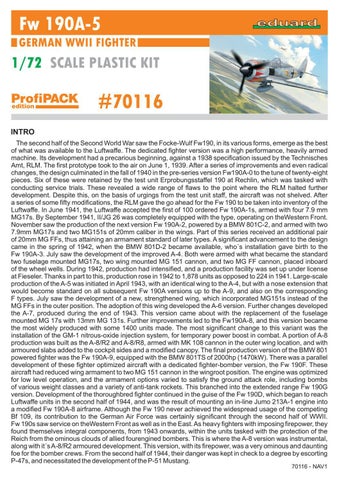
INTRO The second half of the Second World War saw the Focke-Wulf Fw190, in its various forms, emerge as the best of what was available to the Luftwaffe. The dedicated fighter version was a high performance, heavily armed machine. Its development had a precarious beginning, against a 1938 specification issued by the Technisches Amt, RLM. The first prototype took to the air on June 1, 1939. After a series of improvements and even radical changes, the design culminated in the fall of 1940 in the pre-series version Fw190A-0 to the tune of twenty-eight pieces. Six of these were retained by the test unit Erprobungsstaffel 190 at Rechlin, which was tasked with conducting service trials. These revealed a wide range of flaws to the point where the RLM halted further development. Despite this, on the basis of urgings from the test unit staff, the aircraft was not shelved. After a series of some fifty modifications, the RLM gave the go ahead for the Fw 190 to be taken into inventory of the Luftwaffe. In June 1941, the Luftwaffe accepted the first of 100 ordered Fw 190A-1s, armed with four 7.9 mm MG17s. By September 1941, II/JG 26 was completely equipped with the type, operating on theWestern Front. November saw the production of the next version Fw 190A-2, powered by a BMW 801C-2, and armed with two 7.9mm MG17s and two MG151s of 20mm caliber in the wings. Part of this series received an additional pair of 20mm MG FFs, thus attaining an armament standard of later types. A significant advancement to the design came in the spring of 1942, when the BMW 801D-2 became available, who´s installation gave birth to the Fw 190A-3. July saw the development of the improved A-4. Both were armed with what became the standard two fuselage mounted MG17s, two wing mounted MG 151 cannon, and two MG FF cannon, placed inboard of the wheel wells. During 1942, production had intensified, and a production facility was set up under license at Fieseler. Thanks in part to this, production rose in 1942 to 1,878 units as opposed to 224 in 1941. Large-scale production of the A-5 was initiated in April 1943, with an identical wing to the A-4, but with a nose extension that would become standard on all subsequent Fw 190A versions up to the A-9, and also on the corresponding F types. July saw the development of a new, strengthened wing, which incorporated MG151s instead of the MG FFs in the outer position. The adoption of this wing developed the A-6 version. Further changes developed the A-7, produced during the end of 1943. This version came about with the replacement of the fuselage mounted MG 17s with 13mm MG 131s. Further improvements led to the Fw190A-8, and this version became the most widely produced with some 1400 units made. The most significant change to this variant was the installation of the GM-1 nitrous-oxide injection system, for temporary power boost in combat. A portion of A-8 production was built as the A-8/R2 and A-8/R8, armed with MK 108 cannon in the outer wing location, and with armoured slabs added to the cockpit sides and a modified canopy. The final production version of the BMW 801 powered fighter was the Fw 190A-9, equipped with the BMW 801TS of 2000hp (1470kW). There was a parallel development of these fighter optimized aircraft with a dedicated fighter-bomber version, the Fw 190F. These aircraft had reduced wing armament to two MG 151 cannon in the wingroot position. The engine was optimized for low level operation, and the armament options varied to satisfy the ground attack role, including bombs of various weight classes and a variety of anti-tank rockets. This branched into the extended range Fw 190G version. Development of the thoroughbred fighter continued in the guise of the Fw 190D, which began to reach Luftwaffe units in the second half of 1944, and was the result of mounting an in-line Jumo 213A-1 engine into a modified Fw 190A-8 airframe. Although the Fw 190 never achieved the widespread usage of the competing Bf 109, its contribution to the German Air Force was certainly significant through the second half of WWII. Fw 190s saw service on theWestern Front as well as in the East. As heavy fighters with imposing firepower, they found themselves integral components, from 1943 onwards, within the units tasked with the protection of the Reich from the ominous clouds of allied fourengined bombers. This is where the A-8 version was instrumental, along with it´s A-8/R2 armoured development. This version, with its firepower, was a very ominous and daunting foe for the bomber crews. From the second half of 1944, their danger was kept in check to a degree by escorting P-47s, and necessitated the development of the P-51 Mustang. 70116 - NAV1
ATTENTION
UPOZORNĚNÍ
ACHTUNG
ATTENTION
Carefully read instruction sheet before assembling. When you use glue or paint, do not use near open flame and use in well ventilated room. Keep out of reach of small children. Children must not be allowed to suck any part, or pull vinyl bag over the head. Před započetím stavby si pečlivě prostudujte stavební návod. Při používání barev a lepidel pracujte v dobře větrané místnosti. Lepidla ani barvy nepoužívejte v blízkosti otevřeného ohně. Model není určen malým dětem, mohlo by dojít k požití drobných dílů.
INSTRUCTION SIGNS
BEND OHNOUT
OPTIONAL VOLBA
PARTS
INSTR. SYMBOLY
OPEN HOLE VYVRTAT OTVOR
INSTRUKTION SINNBILDEN
SYMETRICAL ASSEMBLY SYMETRICKÁ MONTÁŽ
DÍLY
NOTCH ZÁŘEZ
SYMBOLES
REMOVE ODŘÍZNOUT
TEILE
APPLY EDUARD MASK AND PAINT POUŽÍT EDUARDS MASK NABARVIT
PIECES
PLASTIC PARTS
A>
D>
70110 A
70110 D
J> 70110 J
G>
70110 G
-Parts not for use. -Teile werden nicht verwendet. -Pieces a ne pas utiliser. -Tyto díly nepoužívejte při stavbě. -
COLOURS
BARVY
FARBEN
PEINTURE
GSi Creos (GUNZE) AQUEOUS
2
Mr.COLOR
AQUEOUS
Mr.COLOR
H77
C137
TIRE BLACK
H413
C113
YELLOW
RLM04
C114
RED
RLM23
H416
C116
BLACK GRAY
RLM66
H417
C117
LIGHT BLUE
RLM76
H2
C2
H11
C62
FLAT WHITE
H12
C33
FLAT BLACK
H414
H33
C81
RUSSET
H47
C41
RED BROWN
H64
C17
DARK GREEN
RLM71
Mr.COLOR SUPER METALLIC
H65
C18
BLACK GREEN
RLM70
SM06
H68
C36
DARK GRAY
RLM74
Mr.METAL COLOR
H69
C37
GRAY
RLM75
MC213
STAINLESS
H70
C60
GRAY
RLM02
MC214
DARK IRON
BLACK
CHROME SILVER
IF YOU USE PARTS PE2 AND PE7, THEN YOU MUST USE PARTS A7 AND A8. A9 A10 A8
H416 C116
A
H416 C116 RLM66 BLACK GRAY
PE1
PE2
PE18
RLM66 BLACK GRAY
A7 PE17 PE18
PE7
PE6 H416 C116 RLM66 BLACK GRAY
H416 C116
A53
A1
B
C
PE12
H416 C116 RLM66 BLACK GRAY
PE13
H416 C116
BLACK
PE21
RLM66 BLACK GRAY
A58
H2 C2
A68
RLM66 BLACK GRAY
H416 C116 RLM66 BLACK GRAY
H2 C2 BLACK
H416 C116 RLM66 BLACK GRAY
PE4
PE3
A57
B
PE5
A87
D
C
H416 C116 RLM66 BLACK GRAY
2 pcs. PE19, PE20
A29
A
H416 C116 RLM66 BLACK GRAY
decal 17 H416 C116 RLM66 BLACK GRAY
A8
A9 A7 A10
PE10
PE11 3
G2
PE22 G2 H416 C116 RLM66 BLACK GRAY
E
D
A80
H33 C81
H416 C116
RUSSET
RLM66 BLACK GRAY
A33 H33 C81
A34
RUSSET
G1
E
D4 MC213 STAINLESS
H47 C41
A2
RED BROWN
A19
H2 C2
PE8
BLACK
H416 C116 RLM66 BLACK GRAY
D4 H47 C41 RED BROWN
A77
PE9
H416 C116 RLM66 BLACK GRAY
A66 H70 C60
decal 18
RLM02 GRAY
A67
MARKINGS
C ;D;E
G14 G14 - MARKINGS J14 - MARKINGS
4
J14 C ; D; E A ;B
H70 C60 RLM02 GRAY
MARKINGS
C ;D;E
A20
PE24
PE25 90°
A90 180°
PE24 H70 C60 RLM02 GRAY
H70 C60
H33 C81
90°
RLM02 GRAY
RUSSET
A71
PE25
MARKINGS
C ;D;E
G13 G13
G15
A30 H70 C60
G15
RLM02 GRAY
A71
H70 C60
A59
RLM02 GRAY
H33 C81
A59
RUSSET
G14
J14 A43 MC214 DARK IRON
MC214 DARK IRON
A41 5
H416 C116 RLM66 BLACK GRAY
A51
G12
G5
G9
G8
G6
G10
G7 A3 A4
H70 C60 RLM02 GRAY
6
7
SM06
A17
BLACK
H2 C2
TIRE BLACK
H77 C137
CHROME SILVER
H70 C60
A26
A28
BLACK
H2 C2
BLACK
H2 C2
A28
A27
PE16
RLM02 GRAY
RLM02 GRAY
H70 C60
L
A21
A21
A70
A69
A72
R
A22
A69
RLM02 GRAY
H70 C60
H2 C2 BLACK
TIRE BLACK
A17
A27
H77 C137
A26
A70
RLM02 GRAY
H70 C60
A22
CHROME SILVER
SM06
H70 C60 RLM02 GRAY
RLM02 GRAY
H70 C60
PE16
A73 A23
H77 C137
H2 C2 BLACK
RLM02 GRAY
H70 C60
TIRE BLACK
8
H70 C60
RLM02 GRAY
A38
H70 C60
C ; D; E
A40
DARK IRON
A38
RLM02 GRAY
MC214
A35
A40 - MARKINGS
A36
A40 - MARKINGS
PE15
MC214
C ;D
C ; D; E
A42
DARK IRON
A40
A55
A55 ? PE15 - MARKINGS H70 C60
A37
RLM02 GRAY
PE23
PE14
PE14, PE23 - MARKING
E ONLY
A24
A76
RLM70 BLACK GREEN
H65 C18
RED BROWN
H47 C41
decal X
G
9
H65 C18
A25
RLM70 BLACK GREEN
A11
BLACK
H2 C2
D7 - closed
D3 - open
A14
CHROME SILVER
SM06
RLM66 BLACK GRAY
H416 C116
D8
G open
eduard
70116
D8
D8
D3 D7
D3 D7
10
A W.Nr. 2594, Maj. Hermann Graf, CO of JGr Ost, Bordeaux, France, Spring 1943 Hermann Graf was credited with 212 kills, 202 of them over the Eastern Front. He was awarded the Knight Cross with Oak Leaves, Swords and Diamonds on September 16, 1942 for 172 kills. Graf flew this colorful aircraft in the spring of 1943 when he served as the CO of Jagdgruppe Ost, a training unit. The unit crest – a bird teaching fledglings - is painted on the right side of the fuselage. The numeral on the rudder represents Graf´s score. He would add ten more while serving with JGr 50 and JG 11. The appearance of this aircraft gradually changed and even included the U7 kit. ČESKOU VERZI TEXTU NALEZNETE NA www.eduard.com/s/70116
RLM 23
H414 C114
RLM 76
H417 C117
WHITE
H11 C62
RLM 75
H69 C37
BLACK
H12 C33
RLM 04
H413 C113
RLM 74
H68 C36
RLM 70
H65 C18
11
B
Hptm. Walter Nowotny, CO of I./JG 54 Grünherz, Orel, Fall 1943
An Austrian, Walter Nowotny, joined JG54 in 1941. He commanded the 1st Staffel from October, 1942, and in August of 1943 was nominated to command I./JG 54. He achieved 256 aerial victories on the Eastern Front, with another 20 unconfirmed. From early 1944, he commanded JG 101, a training unit in France. In September 1944, he was tasked with forming Erprobungskommando Nowotny (III./JG 6), a test unit equipped with the new Me 262 jet fighters. Flying an Me 262, he was killed in action on November 8th, 1944. He flew 442 combat missions, and was awarded the Knight's Cross with Oak Leaves, Swords and Diamonds. Flying this aircraft, Oblt. Otto Vincent, commander of 2./JG 54, went missing in action on January 4th, 1944, after combat with Il-2s. The aircraft wore an unusual upper wing camouflage, seen on some of the aircraft produced by the AGO works plant in Oschersleben. ČESKOU VERZI TEXTU NALEZNETE NA www.eduard.com/s/70116
12
RLM 23
H414 C114
RLM 76
H417 C117
RLM 04
H413 C113
BLACK
H12 C33
RLM 75
H69 C37
RLM 70
H65 C18
RLM 71
H64 C17
C
W.Nr. 410055, Uffz. Bernhard Kunze, 2./JG 1, The Netherlands, October 1943
The black-white checker pattern appeared on aircraft flown by I./JG 1 for a short period in 1943. As depicted, the aircraft was flown between October 4 and October 17 when Kunze achieved his sixth and seventh kills, both B-17s. Bernhard Kunze is credited with nine kills in total – seven B-17s, one P-47 and one B-24. He died on January 5, 1944 when downed by friendly AA fire during a combat mission against US four-engined bombers…just three days prior to his son's birth.
RLM 23
H414 C114
WHITE
RLM 76
H417 C117
RLM 75
H11 C62 H69 C37
RLM 04 RLM 74
H413 C113 H68 C36
BLACK RLM 70
H12 C33 H65 C18
13
W.Nr. 7328, Hptm. Dietrich Wickop, CO of II./JG 1, Woensdrecht, The Netherlands, D May 1943 Dietrich Wickop led the II. Gruppe of JG 1 for roughly a month, from April 17, 1943 until his death on May 16. He is credited with 13 kills. On May 3, 1943, he took part in a combat mission against RNZAF No. 487 Squadron Venturas that hit a power station in Amsterdam. All but one were downed and Wickop himself destroyed two Venturas. The personal marking – a bird – was based on a similar marking used by Max Buchholz. Tatzelwurm, depicting a mythical alpine creature, and on the cowling there was also the II./JG 1 crest. ČESKOU VERZI TEXTU NALEZNETE NA www.eduard.com/s/70116
14
RLM 23
H414 C114
RLM 76
H417 C117
WHITE RLM 75
H11 C62 H69 C37
BLACK
H12 C33
RLM 04
H413 C113
RLM 74
H68 C36
RLM 70
H65 C18
E
Hptm. Egon Mayer, CO of III./JG 2 Richthofen, France, Spring 1943
Egon Mayer spent his entire military career with JG 2, starting in 1939. He was especially successful during the RAF summer offensive in 1941, as well as through the spring of 1942. He took over command of III./JG 2 in November 1942, and became a pioneer in the development of the fight against four engined heavy bombers. He was Kommodore (Wing Commander) of JG 2 from July 1943. He was killed in action in a dogfight with P-47D Thunderbolts on March 2nd, 1944 over Montmedy. In early February 1944, he reached the 100 aerial victory mark, the first to do so on the Western (Channel) Front. He flew 353 combat missions, gaining 102 air to air victories, and was awarded the Knight's Cross with Oak Leaves and Swords. Lt. Hans-Werner Zajonz of 9./JG 2 was shot down during combat with heavy bombers in this machine on June 28th, 1943. ČESKOU VERZI TEXTU NALEZNETE NA www.eduard.com/s/70116
15
Fw 190A-5
STENCILING POSITIONS D
G
B1 ? B2 ? B3 B4 ?
Hier aufholen
Nicht Verstel len
Hier aufholen
C
Hier aufbocken
L ? I N1
?
N2
N2 A7b
?
M
N1
A7a
A7d
A7d A7c
B1 B2 B3 B4
? ? ?
J
L ? I
A7c
B1 B2 B3 B4
? ? ?
P
0
B1 B2 B3 B4
? ? ?
B1 B2 B3 B4
? ? ?
K N1
D Hier aufholen
V
F
H1 ? H2
N2
Q
R
K Q
R
S E1 ? E2
N1
?
N2
T
292l
B1 ? B2 ? B3 B4 ?
232l
Nicht Verstel len
Hier aufholen 292l
232l
C
Hier aufbocken
J
16
© EDUARD M.A., 2017
www.eduard.com
Printed in Czech Republic