Albatros D.III OEFFAG 153
eduard
8241
AUSTRO-HUNGARIAN WWI FIGHTER
1:48 SCALE PLASTIC KIT Albatros D.III (Oef) Over the second half of 1916, the German air force began to introduce into production new D.I, D.II and D.III fighters. These aircraft, at the very, least equaled their allied counterparts, and pilots flying them were able to command the skies over the Western Front into the spring of 1917. The situation of the air force of the AustroHungarian Empire (LFT) was considerably worse. They entered combat on the Hansa-Brandenburg D.I. Their performance could not match that of the Italian air force, and their poor flying qualities proved dangerous to less experienced pilots. Despite this, their presence was invaluable to the LFT, and its pilots were able to rack up a score of some 78 enemy aircraft. The head of the LFT realized the need for new machines, and acquired a production license from Albatros, and then placed an order for 20 D.IIs and 30 D.IIIs with Oesterreichische Flugzeugfabrik AG (Oeffag) in December, 1916. The aircraft were to be delivered in the first quarter of 1917, and the LFT designated the aircraft type as 531. Subsequently, the order was changed to 16 D.IIs (53.01 to 53.16) and 34 D.IIIs, and to a further eleven D.IIIs in March. In all, 45 D.IIIs (53.20 to 53.64) were ordered. Austro-Hungarian aircraft differed from German production. First and foremost came an engine change, where the Mercedes D.III gave way to the excellent Austro-Daimler rated at 180hp. Changes were also seen in the armament, that saw the internal installation of Austrian Schwarzlose machine guns, the cockpit interior and radiator were changed, and, above all, the D.III had strengthened wings. Thanks to this, through their service life, Austro-Hungarian aircraft suffered no lower wing collapses, as was the case with their German counterparts. Series 53 aircraft were delivered to the LFT through May to July, 1917. They appeared on the front after trials at the beginning of June. The aircraft were enthusiastically greeted, and their performance was greater than anything else flying, friendly or not. Furthermore, they demonstrated good flight characteristics, and were easy to contol. On October 6, 1917, the first kill was achieved with Feldwebel Julius Kowalczyk of Flik 24 at the controls, downing an Italian Caproni. The delivery of 64 Series 53 aircraft was not the end of production, and on the basis of a February, 1917 order, production continued with a further 61 Series 153 aircraft. The main difference between this production block and the preceding one was the installation of a Austro-Daimler engine rated at 200hp. Also, the exhaust system was
modified from a collector pipe to six individual stacks. With the more powerful engine came an increase in weight, as well as maximum speed to some 190 km/h. A major improvement also came in the aircraft’s climb rate. On the heels of this series, delivered between August and September, 1917, came another run, aircraft 153.62 to 153.111 against a June order. These were identical to that preceding order, and were delivered by Oeffag between August and November. Even that wasn’t the end of the production run, as a further 100 (153.112 to 153.211) were ordered in October, 1917, followed by another seventy (153.212 to 153.281). Aircraft from the final two orders were delivered by June, 1918. Aircraft from 153.112 to 153.281 differed with a more rounded front end, boosting the top speed to 198km/h. Starting in June, 1918, new aircraft acquired a new Austro-Daimler 225hp engine. These aircraft were part of Series 253, on the basis of two orders for a total of 330 aircraft. By the end of the war, the LFT accepted 186 Series 253 aircraft, while there remained 74 airframes in various states of assembly that were completed after the war. The already excellent performance was again improved by the installation of an even more powerful engine, that, for example, pushed the top speed to over 200km/h, and the climb rate was also bettered compared to the Series 153 aircraft. Physically, they differed little from Series 153 aircraft. The trailing edge of the tailplanes were wired as opposed to the original wooden strips. From aircraft 253.31, there was also a change in the cowl, that had deeper engine cut-out. Series 253 planes also had the armament placed mostly on top of the fuselage, as was the case on German aircraft. Despite being of 1916 vintage, the Albatros D.III (Oef) was able to maintain a spot on the leading edge of fighter technology up to the end of the war, thanks to constant improvements and the installation increasingly powerful engines. Pilots of the Austro-Hungarian air force were able to gain at least 320 victories. Oeffags were used in combat even after the war, namely with the Polish air force. The Poles bought 38 aircraft from 253.212 to 257 in 1919, and pressed them into service against Bolshevik Russia.
Note 1: In the system of LFT designation, the numeral 5 was allocated to the Oeffag factory. This was followed by a sequential production type. If, within the production run, there was a major modification to the type, such as the installation of a new engine, there appeared a prefix number (with the second variant it was a '1', with the third, it was a '2', and so on). The series number of each aircraft was composed of the type number, which was followed by a period, and the sequential unit number of the aircraft within the line of a production block. For example, Albatros D.III (Oef) 153.140 designates the 140th aircraft of the third variant of the third type manufactured by Oeffag.
D
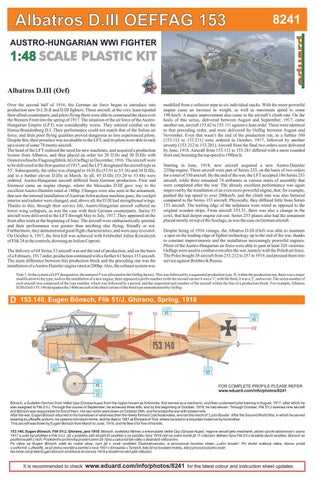
153.140, Eugen Bönsch, Flik 51/J, Ghirano, Spring, 1918 30
10
H37 43
H85 45
22
H301 301
H37 43
18 H85 45 H53 13
FOR COMPLETE PROFILE PLEASE REFER www.eduard.com/info/photos/8241
Bönsch, a Sudeten German from Velká Upa (Grosse Aupa) from the region known as Krkonoše, first served as a mechanic, and then underwent pilot training in August, 1917, after which he was assigned to Flik 51/J. Through the course of September, he achieved three kills, and by the beginning of October, 1918, he had eleven. Through October, Flik 51/J downed nine aircraft and Bönsch was responsible for five of them. His last victim went down on October 29th, and he ended the war with sixteen kills. After the war, Eugen Bönsch returned to his hometown in what was then the newly formed Czechoslovakia, and ran the resort of ‘Luèn?Bouda’. After the Second World War, in which he served wearing a Luftwaffe uniform, he opted to not return home, and he died in 1951 at Ehrwald of Tirol, where he lived in a mountain hotel run by his brother. This aircraft was flown by Eugen Bonsch from March to June, 1918, and he flew it for five of his kills. 153.140, Eugen Bönsch, Flik 51/J, Ghirano, jaro 1918. Bönsch, sudetsk? Nìmec z krkonošské Velké Úpy (Grosse Aupa), nejprve sloužil jako mechanik, pilotní výcvik absolvoval v srpnu 1917 a poté byl pøidìlen k Flik 51/J. Již v prùbìhu záøí dosáhl tøí sestøelù a na zaèátku øíjna 1918 mìl na svém kontì již 11 vítìzství. Bìhem øíjna Flik 51/J dosáhla devíti sestøelù, Bönsch se podílel na pìti z nich. Posledního protivníka poslal k zemi 29. øíjna a zakonèil tak válku s šestnácti vítìzstvími. Po válce se Eugen Bönsch vrátil do rodné obce, nyní již v novì vzniklém Èeskoslovensku, a provozoval horskou chatu „Luèní bouda“. Po druhé svìtové válce, kterou prožil v uniformì Luftwaffe, se již domù nevrátil a zemøel v roce 1951 v Ehrwaldu v Tyrolích, kde žil na horském hotelu, který provozoval jeho bratr. Na tomto stroji létal Eugen Bönsch od bøezna do èervna 1918 a dosáhl na nìm pìti vítìzství.
It is recommended to check
www.eduard.com/info/photos/8241
for the latest colour and instruction sheet updates.
ATTENTION
UPOZORNÌNÍ
ACHTUNG
ATTENTION
GB
Carefully read instruction sheet before assembling. When you use glue or paint, do not use near open flame and use in well ventilated room. Keep out of reach of small children. Children must not be allowed to suck any part, or pull vinyl bag over the head.
CZ
Pøed zapoèetím stavby si peèlivì prostudujte stavební návod. Pøi používání barev a lepidel pracujte v dobøe vìtrané místnosti. Lepidla ani barvy nepoužívejte v blízkosti otevøeného ohnì. Model není urèen malým dìtem, mohlo by dojít k požití drobných dílù. Iire soigneusement la fiche d´instructions avant d´assembler. Ne pas utiliser de colle ou de peinture `a proximité d´une flamme nue, et aérer la piece de temps en temps. Garder hors de portée des enfants en bas âge. Ne pas laisser les enfants mettre en bouche ou sucer les pièces, ou passer un sachet vinyl sur la tete. Von dem Zusammensetzen die Bauanleitung gut durchlesen. Kleber und Farbe nicht nahe von offenem Feuer verwenden und das Fenster von Zeit zu Zeit Belüftung öffnen. Bausatz von kleinen Kindern fernhalten. Verhüten Sie, daß Kinder irgendwelche Bauteile in den Mund nehmen oder Plastiktüten über den Kopf ziehen.
F D
JP
INSTRUCTION SIGNS
INSTR. SYMBOLY
BEND OHNOUT PLIER SIL VOUS PLAIT BITTE BIEGEN
OPTIONAL VOLBA FACULTATIF NACH BELIEBEN
PARTS
INSTRUKTION SINNBILDEN
SYMETRICAL ASSEMBLY SYMETRICKÁ MONTÁŽ MONTAGE SYMÉTRIQUE SYMMETRISCHE AUFBAU
OPEN HOLE VYVRTAT OTVOR FAIRE UN TROU OFFNEN
DÍLY
A>
TEILE
REMOVE ODØÍZNOUT RETIRER ENTFERNEN
APPLY EDUARD MASK AND PAINT POUŽÍT EDUARD MASK NABARVIT
PIECES
PLASTIC PARTS
B>
2
NOTCH ZÁØEZ L INCISION DER EINSCHNITT
SYMBOLES
C>
2
3
1
3
1
1 7 4
8
8
4
6
5
6
5
9 10
12
11
10
14 15
21
20
19
15
18
17
16
12
11
14
13
9
13
16
17
18
3
2
7
4
5
6
7
20
19
21 9
21 23
22
22
8
28
24
26 23 24
25
25
28
27
26
10
D>
X>
5
PE - PHOTO ETCHED DETAIL PARTS
2 1
1
3
6 8 7
2 10
10
11
11
12
9 3 4
13 5 6
eduard
7 8
COLOURS
BARVY
2
Mr.COLOR
H4
C4
H 12
C33
H 13
C3
PEINTURE
AQUEOUS
GSi Creos (GUNZE) AQUEOUS
FARBEN Mr.COLOR
H 85
C45
SAIL COLOR
YELLOW
H 301
C301
GRAY
FLAT BLACK
H 344
FLAT RED
RUST
Mr.METAL COLOR
H 37
C43
WOOD BROWN
MC214
DARK IRON
H 47
C41
RED BROWN
MC218
ALUMINIUM
H 53
C13
NEUTRAL GRAY
MC219
BRASS
H 67
C115
LIGHT BLUE
H 73
C23
DARK GREEN
Mr.COLOR SUPER METALLIC
SM01
SUPER CHROME
MARKING
B,C ,D
ONLY
X6 MC218 ALUMINIUM
X8
MC218 ALUMINIUM
X9
PE15
MC218 ALUMINIUM
X12
MC218
X11
X1
ALUMINIUM
B17
MC218 ALUMINIUM
H 37 C43
B2
MC218 ALUMINIUM
WOOD BROWN
X11
PE28 MC218
H 12 C33
ALUMINIUM
FLAT BLACK
X13
PE14
X7 FLAT BLACK
ALUMINIUM
X10
MC218 ALUMINIUM
H 12 C33
PE30
PE13
X3
FLAT BLACK
PE31
MC218 ALUMINIUM
X2
FLAT BLACK
H 12 C33
X5
MC218
H 12 C33
X3 X5
X10
X13
DON´T PAINT NEBARVIT
PE34
PE1
PE17
H 47 C41
PE1
H 301 C301
RED BROWN
PE2
GRAY
PE27
PE3 DON´T PAINT NEBARVIT DON´T PAINT NEBARVIT
PE20
PE16
decal 49
PE4
A20
PE10
PE3 PE4 H 301 C301 GRAY
A9 H 37 C43
H 37 C43 WOOD BROWN
WOOD BROWN
A13
B18
H 301 C301
A17
GRAY
A23
MC214
PE38
DARK IRON
H 301 C301 GRAY
H 301 C301
PE38
H 301 C301 GRAY
PE25
PE9 decal 48
PE12
H 12 C33 FLAT BLACK
MC214
GRAY
DARK IRON
A23
decal 51 3
C1 MC214 DARK IRON
C1 B10
H 37 C43 WOOD BROWN
H 37 C43
A17
B18
WOOD BROWN
A19 A18
H 301 C301 GRAY
A14 A13
A1 H 301 C301
A4
H 37 C43 WOOD BROWN
A16 H 12 C33
H 37 C43
FLAT BLACK
WOOD BROWN
PE19 PE18 decal 53
GRAY
B7
H 37 C43
C10
B11
decal 52
WOOD BROWN
PE5 C10 H 301 C301 GRAY
A16
A2
MC218 ALUMINIUM
MC214 DARK IRON
H 37 C43 WOOD BROWN
B27 A25
H 37 C43
MC218
WOOD BROWN
ALUMINIUM
B7
H 301 C301 GRAY
B9 H 301 C301 GRAY
B16
PE37
DON´T PAINT NEBARVIT
H 37 C43
PE11
WOOD BROWN
MC214 DARK IRON
C3 MC214 DARK IRON
B19
MC218 ALUMINIUM
C3
MARKING
A ;B
LIKE OVERAL CAMOUFLAGE JAKO CELKOVÉ ZBARVENÍ
H 301 C301 GRAY
PE21 4
B8
MARKING
C ;D;E B21
C3
B20
H 47 C41 RED BROWN
A10
MARKING
E
ONLY
X6
MARKING
A
ONLY
X6 MC218
MC218
ALUMINIUM
ALUMINIUM
C4
C6
B23 H 344 RUST
C2
D7
D6
C8 MARKING
PE29
E
ONLY
H 12 C33 FLAT BLACK
D8
SM01 SUPER CHROME
H 12 C33 FLAT BLACK
PE29
H 12 C33 FLAT BLACK
PE22
D1
D4
D3
DECAL 45
D4 D4
D5
DECAL 23+ 24 5
MARKING
D4
B
ONLY
H 12 C33
B4
FLAT BLACK
A6, B6
PE41 PE40
H 12 C33 FLAT BLACK
A8 A12
B6
MC219 BRASS
A6
MC219 BRASS
A11
LONGER AHEAD
FWD B4 A8, B4
H 301 C301 GRAY
H 53 C13
A7
B15
NEUTRAL GRAY
H 37 C43 WOOD BROWN
A15
PE33
H 301 C301 GRAY
B5
A21
B26
H 301 C301 GRAY
H 37 C43 WOOD BROWN
H 301 C301 GRAY
A21
PE33 H 301 C301 GRAY
PE24 PE35 H 301 C301 GRAY
PE35 H 301 C301 GRAY
6
PE36
PE26+ PE39
PE26 H 301 C301 GRAY
MARKING
C;D ;E
PE39 H 301 C301
A3
GRAY
PE32 PE23 H 301 C301 GRAY
MARKING
A;B A3
B3
PE26+ PE39
7
A
153.27, Georg Kenzian, Flik 55/J, Pergine, Winter, 1917
This aircraft was accepted by the air force in September, 1917, and attached to Flik 55/J, where it became the personal plane of Georg Kenzian von Kenzianshausen. On this aircraft, he gained his fourth and fifth victories on the 18th and 27th of November, 1917. This plane was damaged on landing and stricken off charge in January, 1918. Kenzian began his flying career as an observer with Flik 24. His first victory was gained with his pilot, Rudolf Forst on June 16th, 1916, the victim being a Farman, and four days later came the next victory, with the pilot being Josef Kiss. However, at the end of July, the crew of Alois Jezek and Georg Kenzian were shot down by a group of Italian fighters. After recovering, service at a flight school, and pilot training, Kenzian was transfered to Flik 55/J as a deputy commander in August, 1917. Here, he scored further kills, and by March, 1918, he would raise his tally to nine. At the end of the war, he served as Co of Flik 68/J and 42/J. 153.27, Georg Kenzian, Flik 55/J, Pergine, zima 1917. Tento stroj pøevzalo letectvo v záøí 1917 a pøidìlilo jej k Flik 55/J, kde se stal osobním strojem Georga Kenziana von Kenzianshausen. Ten na nìm 18. a 27. listopadu 1917 dosáhl svého ètvrtého a pátého vítìzství. Avšak v prosinci byl stroj poškozen pøi pøistání a následnì v lednu 1918 zrušen. Kenzian zahájil svou bojovou kariéru letce - pozorovatele u Flik 24. Prvního vítìzství dosáhl spolu se svým pilotem Rudolfem Forstem 16. èervna 1916, kdy mu padl za obì nepøátelský Farman, úspìch si ètyøi dny nato zopakoval, tentokráte byl pilotem Josef Kiss. Ovšem na konci èervence osádku Alois Ježek – Georg Kenzian sestøelila skupina italských stíhaèù. Po léèení, službì v letecké škole a pilotním výcviku byl Kenzian v srpnu 1917 zaøazen k Flik 55/J jako Chefpilot (zástupce velitele). Zde ke svým dvou dosavadním vítìzstvím pøidával další a jeho skóre se zastavilo v bøeznu 1918 na èísle devìt. Na konci války sloužil jako velitel Flik 68/J a 42/J.
40
41
1
H73 23
?
26b
H301 301
25
? 45
H73 23
H37 43 H73 23
H73 23 H53 13
H37 43
45 H67 115
25
23 ? 27 23 ? 27
H73 23
42
43
1 26b
ALUMINIUM
LIGHT BLUE
8
H67 115
WOOD
H37 43
GREY
H53 13
DARK GREY
H301 301
DARK GREEN
H73 23
eduard
B
153.52, Godwin Brumowski, Flik 41/J, Passarella, February, 1918
Godwin Brumowski, with 39 kills, was the most successful Austro-Hungarian pilot. Often, his aircraft were adorned with colorful markings. This applies to aircraft 153.52, in which he downed two opponents, and in which he was himself shot down. Red paint was applied over the lacquered natural surface. The application was fairly thick, and it gave the impression of a monotone color application. Onto this background were applied light colored "tresses". The skull became a personal marking of Brumowski’s airplanes in later stages of the war. Also worth noting is the horseshoe for luck on the interwing strut, which was quite common installation within Flik 41/J’s Oeffags. 153.52, Godwin Brumowski, Flik 41/J, Passarella, únor 1918. Godwin Brumowski byl s 39 sestøely nejúspìšnìjším stíhaèem rakousko-uherského letectva. Jeho letadla èasto nesla pestré zbarvení. Ani jeho stroj èíslo 153.52, v nìmž dosáhl dvou vítìzství a v nìmž byl také 4.února 1918 sestøelen, nebyl výjimkou. Na lakovaný pøírodní povrch stroje byla na všech plochách natupována èervená barva. Tupování bylo velmi husté, takže tvoøilo zdání jednolitého povrchu. Na tento èervený podklad byly pak namalovány svìtlé „lokýnky“. Umrlèí lebka byla v pozdìjším období války Brumowského osobním symbolem. Za pozornost také stojí podkova pro štìstí na levé mezikøídelní vzpìøe. U Flik 41/J se nejednalo o neobvyklý doplnìk.
34?38 4
H13 3
26a
H301 301
37
H37 43
25
H13 3
H4 4
45 28
H53 13
H37 43
VNITØNÍ STRANA INNER SIDE
45 25 H13 3
27 27
H13 3
4
39
26a
H13 3 H4 4 ALUMINIUM
WOOD
28 H37 43
RED
H13 3
YELLOW
H4 4
GREY
H53 13
DARK GREY
H301 301
eduard 9
C
153.137, Josef Novak, Flik 41/J, Torresella, January, 1918
This aircraft was flown by Josef Novák, native of Dobøichov u Kolína. He came to Flik 41/J in June, 1917, and the unit CO, Godwin Brumowski, handpicked him as his wingman. By the end of summer, 1917, Novák had five kills to his credit (four of which were achieved flying a Hansa-Brandenberg D.I). It is possible that Novák had more kills than that. František Šimek, Brumowski’s mechanic, noted in his memories that Novák handed some of his kills to the CO for material compensation. It’s unlikely that Josef Novák gained any other confirmed kills by the end of hostilities. After the war, Novák served in the Czechoslovak Air Force, and from August 1921, he served as factory pilot for Aero company. In 1930, he crashed flying an Aero A-31. Although he survived serious injuries from this incident, it did contribute to his early death in January, 1934. 153.137, Josef Novák, Flik 41/J, Torresella, leden 1918. Na tomto stroji létal Josef Novák, rodák z Dobøichova u Kolína. K Flik 41/J pøišel v èervnu 1917 a velitel jednotky, Godwin Brumowski, si jej vybral jako svého wingmana. Na konci léta 1917 mìl Novák na svém kontì již pìt potvrzených sestøelù (ètyøi z nich v kabinì Hansa-Brandenburg D.I). Je možné, že ve skuteènosti Novák sestøelil více nepøátel. František Šimek, Brumowského mechanik, ve svém deníku píše, že Novák nìkterá vítìzství pøenechával za materiální náhradu svému veliteli. Do konce bojù již Josef Novák pravdìpodobnì žádné další potvrzené vítìzství nezískal. Po válce sloužil Novák u èeskoslovenského letectva a od srpna 1921 byl zamìstnán jako tovární pilot u továrny Aero. V roce 1930 však pro závadu na øízení letounu Aero A-34 havaroval. By se z tìžkého zranìní zotavil, následky této nehody byly pøíèinou jeho pøedèasné smrti v lednu 1934.
35
7
H37 43
H85 45
22
H301 301
24
18 45 H37 43
H37 43
H85 45
H85 45
H53 13
29
33 45 H85 45
24
H37 43
23 H37 43
23
H85 45
7
36
22
18 ALUMINIUM DOPPED LINEN H85 SAIL COLOUR 45
10
WOOD
H37 43
GREY
H53 13
DARK GREY
H301 301
eduard
D
153.186, Flik 55/J, Pergine, May, 1918
It was initially thought that this aircraft was flown by Josef Kiss, the most successful Hungarian ace with 19 kills to his credit. The reason for this was the large white letter ‘K’ and the symbol resembling a medal on the fuselage. However, Kiss, at the very least, flew Phonix D.IIa 422.10 in the latter half of May, and even died in it. Kiss’s personal marking on the Phonix was a white stripe around the rear fuselage, and no similar markings were worn on Albatros 153.186. It’s possible that this aircraft belonged to one of the other Flik 55/J pilots who verifiably flew it – Josef Kos or Oto Kullas. Both survived the war with no victories. This aircraft was destroyed on August 5th, 1918, when it crashed into the water during a mock attack on a target, claiming the life of Karl Greischberger.It is possible that the light blue color on the lower surfaces extended considerable farther up the fuselage, and even covered the vertical tail surfaces, and then had the application of camouflage colors onto this. 153.186, Flik 55/J, Pergine, kvìten 1918. Pùvodnì se soudilo, že tento stroj patøí Josefu Kissovi, nejúspìšnìjšímu stíhacímu uherskému esu s 19 sestøely na kontì. Dùvodem bylo velké bílé písmeno „K“ a symbol pøipomínající medaili na trupu. Kiss však minimálnì v druhé polovinì kvìtna létal na Phönixu D.IIa 422.10, na kterém i zahynul. Kissovým osobním markingem na Phönixu byl bílý pruh pøes záï letounu a ani další Kissovy stroje nenesly symboly podobné tìm na Albatrosu 153.186. Je tedy možné, že stroj patøil nìkterému z dalších pilotù Flik 55/J, kteøí na nìm prokazatelnì létali - Josefu Kosovi nebo Oto Kullasovi. Oba válku pøežili bez jediného vítìzství.Tento letoun podlehl zkáze 5. srpna 1918, kdy s ním pøi cvièné støelbì na cíl s fatálními následky narazil na vodní hladinu Karl Greischberger. Je možné, že svìtle modrá barva spodních ploch byla na trupu vytažena mnohem výše a pokrývala i SOP. Teprve na tento podklad pak byly natupovány kamuflážní barvy.
H73 23
H73 23
31 ?32
H37 43
H73 23
H37 43
26a
H73 23
45
25
H67 115
H73 23
H37 43 H73 23
H85 45
H85 45
H53 13
H37 43
45 H67 115
25
23
H73 23 H37 43
23 H73 23
H73 23 H85 45
31 ? 32
26a
ALUMINIUM
LIGHT BLUE
H67 115
DOPPED LINEN H85 SAIL COLOUR 45
Green camouflage mottles were painted over the natural surfaces (wood, metal, linen).
WOOD
H37 43
GREY
H53 13
DARK GREY
H301 301
DARK GREEN
H73 23
eduard 11
E
153.140, Eugen Bönsch, Flik 51/J, Ghirano, Spring, 1918
Bönsch, a Sudeten German from Velká Upa (Grosse Aupa) from the region known as Krkonoše, first served as a mechanic, and then underwent pilot training in August, 1917, after which he was assigned to Flik 51/J. Through the course of September, he achieved three kills, and by the beginning of October, 1918, he had eleven. Through October, Flik 51/J downed nine aircraft and Bönsch was responsible for five of them. His last victim went down on October 29th, and he ended the war with sixteen kills. After the war, Eugen Bönsch returned to his hometown in what was then the newly formed Czechoslovakia, and ran the resort of ‘Luèn?Bouda’. After the Second World War, in which he served wearing a Luftwaffe uniform, he opted to not return home, and he died in 1951 at Ehrwald of Tirol, where he lived in a mountain hotel run by his brother. This aircraft was flown by Eugen Bonsch from March to June, 1918, and he flew it for five of his kills. 153.140, Eugen Bönsch, Flik 51/J, Ghirano, jaro 1918. Bönsch, sudetsk? Nìmec z krkonošské Velké Úpy (Grosse Aupa), nejprve sloužil jako mechanik, pilotní výcvik absolvoval v srpnu 1917 a poté byl pøidìlen k Flik 51/J. Již v prùbìhu záøí dosáhl tøí sestøelù a na zaèátku øíjna 1918 mìl na svém kontì již 11 vítìzství. Bìhem øíjna Flik 51/J dosáhla devíti sestøelù, Bönsch se podílel na pìti z nich. Posledního protivníka poslal k zemi 29. øíjna a zakonèil tak válku s šestnácti vítìzstvími. Po válce se Eugen Bönsch vrátil do rodné obce, nyní již v novì vzniklém Èeskoslovensku, a provozoval horskou chatu „Luèní bouda“. Po druhé svìtové válce, kterou prožil v uniformì Luftwaffe, se již domù nevrátil a zemøel v roce 1951 v Ehrwaldu v Tyrolích, kde žil na horském hotelu, který provozoval jeho bratr. Na tomto stroji létal Eugen Bönsch od bøezna do èervna 1918 a dosáhl na nìm pìti vítìzství.
30
10
H37 43
H85 45
22
H301 301
24
18
H85 45
H85 45
45
H37 43
H53 13
H37 43
45 H85 45
24
H37 43
23
30 H37 43
23 H85 45
10
30
22
18 ALUMINIUM DOPPED LINEN H85 SAIL COLOUR 45
WOOD
H37 43
GREY
H53 13
DARK GREY
H301 301
eduard
STENCIL VARIANTS 18 13
21
2
13
2+3
19
5+6 8+9 2 11+12
13
13 13 13
2
13
13
14
13
13 2
2
2 18
13
2
20
13 2
2 3
2
13 13
14
13
13 13
13
13
18 13 2
TOP SIDE
15
16
2
2
TOP SIDE
2
2
BOTTOM SIDE
eduard 12 c
EDUARD M.A.,2010
www.eduard.com
Printed in Czech Republic