Bf 109F-2 GERMAN WWII FIGHTER
1/48 SCALE PLASTIC KIT P r o f i P A C K
#82115
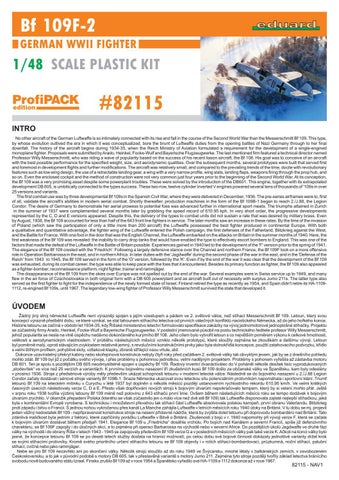
INTRO No other aircraft of the German Luftwaffe is so intimately connected with its rise and fall in the course of the Second World War than the Messerschmitt Bf 109. This type, by whose evolution outlived the era in which it was conceptualized, bore the brunt of Luftwaffe duties from the opening battles of Nazi Germany through to her final downfall. The history of the aircraft begins during 1934-35, when the Reich Ministry of Aviation formulated a requirement for the development of a single-engined monoplane fighter. Proposals were submitted by Arado, Heinkel, Focke-Wulf and Bayerische Flugzeugwerke. The last mentioned firm featured a technical director named Professor Willy Messerschmitt, who was riding a wave of popularity based on the success of his recent liason aircraft, the Bf 108. His goal was to conceive of an aircraft with the best possible performance for the specified weight, size, and aerodynamic qualities. Over the subsequent months, several prototypes were built that served first and foremost in development flights and further modifications. The aircraft was relatively small, and compared to the prevailing trends of the time, docile with revolutionary features such as low wing design, the use of a retractable landing gear, a wing with a very narrow profile, wing slats, landing flaps, weapons firing through the prop hub, and so on. Even the enclosed cockpit and the method of construction were not very common just four years prior to the beginning of the Second World War. At its conception, the Bf 109 was a very promising asset despite some powerplant troubles. These were solved by the introduction of the DB601. This engine, together with its extrapolated development DB 605, is umbilically connected to the types success. These two-row, twelve cylinder inverted V engines powered several tens of thousands of '109s in over 25 versions and variants. The first combat use was by three developmental Bf 109s in the Spanish Civil War, where they were delivered in December, 1936. The pre-series airframes were to, first of all, validate the aircraft's abilities in modern aerial combat. Shortly thereafter, production machines in the form of the Bf 109B-1 began to reach 2./J.88, the Legion Condor. The desire of Germany to demonstrate her aerial prowess to potential foes was advanced further in international sport meets. The triumphs attained in Zurich in the summer of 1937 were complemented several months later by grabbing the speed record of 610.95 kph. In very short order, the progressive developments represented by the C, D and E versions appeared. Despite this, the delivery of the types to combat units did not sustain a rate that was desired by military brass. Even by August, 1938, the Bf 109 accounted for less than half of the 643 front line fighters in service. The later months saw an increase in these rates. By the time of the invasion of Poland (which saw the participation of only a little more than 200 aircraft) the Luftwaffe possessed the best fighter produced in continental Europe. With both a qualitative and quantitative advantage, the fighter wing of the Luftwaffe entered the Polish campaign, the first defenses of the Fatherland, Blitzkrieg against the West, and the Battle for France. With one foot in the door that was the English Channel, the Luftwaffe embarked on the attacks on Britain in the summer months of 1940. Here, the first weakness of the Bf 109 was revealed: the inability to carry drop tanks that would have enabled the type to effectively escort bombers to England. This was one of the factors that made the defeat of the Luftwaffe in the Battle of Britain possible. Experiences gained in 1940 led to the development of the 'F' version prior to the spring of 1941. The elegance of the Bf 109 crested with the 'Friedrich'. Following a largely defensive stance over the Channel and northern France, the Bf 109F took on a more offensive role in Operation Barbarossa in the east, and in northern Africa. In later duties with the 'Jagdwaffe' during the second phase of the war in the east, and in the 'Defense of the Reich' from 1943 to 1945, the Bf 109 served in the form of the 'G' version, followed by the 'K'. Even if by the end of the war it was clear that the development of the Bf 109 was exhausted, during its combat career, the type was able to keep pace with the foes that it encountered. Besides its primary function as fighter, the Bf 109 also appeared as a fighter-bomber, reconnaissance platform, night fighter, trainer and rammjäger. The disappearance of the Bf 109 from the skies over Europe was not spelled out by the end of the war. Several examples were in Swiss service up to 1949, and many flew in the air force of Czechoslovakia in both original form with a DB 605 powerplant and as aircraft built out of necessity with surplus Jumo 211s. The latter type also served as the first fighter to fight for the independence of the newly formed state of Israel. Finland retired the type as recently as 1954, and Spain didn't retire its HA-11091112, re-engined Bf 109s, until 1967. The legendary low-wing fighter of Professor Willy Messerschmitt survived the state that developed it.
ÚVODEM Žádný jiný stroj německé Luftwaffe není výrazněji spojen s jejím vzestupem a pádem ve 2. světové válce, než stíhací Messerschmitt Bf 109. Letoun, který svou koncepcí výrazně předběhl dobu, ve které vznikal, se stal tahounem stíhacího letectva od prvních válečných konfliktů nacistického Německa, až do jeho hořkého konce. Historie letounu se začíná v období let 1934-35, kdy Říšské ministerstvo letectví formulovalo specifikace zakázky na vývoj jednomotorové jednoplošné stíhačky. Projektu se zúčastnily firmy Arado, Heinkel, Focke-Wulf a Bayerische Flugzeugwerke. V poslední jmenované působil na postu technického ředitele profesor Willy Messerschmitt, jehož popularita se nesla na vlně úspěchu nedávno dokončeného kurýrního Bf 108. Jeho cílem bylo vytvořit letoun s co největším poměrem výkonu k celkové hmotnosti, velikosti a aerodynamickým vlastnostem. V průběhu následujících měsíců vzniklo několik prototypů, které sloužily zejména ke zkouškám a dalšímu vývoji. Letoun byl poměrně malý, oproti stávajícím zvyklostem relativně jemný, s revolučními konstrukčními prvky jako byla dolnokřídlá koncepce, použití zatahovacího podvozku, křídlo s velmi štíhlým profilem, pohyblivé sloty, vztlakové klapky, zbraně střílející osou vrtule, atd. Dokonce uzavíratelný překryt kabiny nebo skořepinová konstrukce nebyly čtyři roky před začátkem 2. světové války tak obvyklým jevem, jak by se z dnešního pohledu mohlo zdát. Bf 109 byl již z počátku svého vývoje, i přes problémy s pohonnou jednotkou, velmi nadějným projektem. Problémy s pohonem vyřešila až zástavba motoru DB 601. Ten je spolu s pozdějším DB 605 neodmyslitelně spojen s úspěchy Bf 109. Řadový invertní dvanáctiválec do V poháněl několik desítek tisíc vyprodukovaných „stodevítek“ ve více než 25 verzích a variantách. K prvnímu bojovému nasazení tří zkušebních kusů Bf 109 došlo za občanské války ve Španělsku, kam byly odeslány v prosinci 1936. Stroje z předsériové výroby měly především ukázat schopnosti letounu v moderní letecké válce. Následně se do bojového nasazení u 2./J.88 Legion Condor začaly dostávat i sériové stroje varianty Bf 109B-1. Snaze Německa ukazovat svou leteckou sílu potenciálním protivníkům napomáhala i sportovní klání. Triumf letounů Bf 109 na leteckém mítinku v Curychu v létě 1937 byl doplněn o několik měsíců později ustanovením rychlostního rekordu 610,95 km/h. Ve velmi krátkých časových úsecích následovaly verze C, D a E. Přesto však doplňování nových strojů k bojovým útvarům nepokračovalo tempem, který by si velení mohlo přát. Ještě v srpnu roku 1938 tvořila výzbroj letouny Bf 109 méně než polovinu z 643 stíhačů první linie. Ovšem během následujících měsíců roku se tempo dodávek k bojovým útvarům zrychlilo. V okamžik přepadení Polska (kterého se však zúčastnilo jen o málo více než dvě stě Bf 109) tak Luftwaffe disponovala zajisté nejlepší stíhačkou, jaká byla v kontinentální Evropě vyrobena. S technickou i množstevní převahou tak stíhací část Luftwaffe absolvovala polskou kampaň, první obranu Vaterlandu, Blitzkrieg proti západu i bitvu o Francii. S jednou nohou vykročenou přes kanál La Manche zahájila Luftwaffe v letních měsících roku 1940 útoky na Británii. V tu dobu se mj. projevil jeden vážný nedostatek Bf 109 - nepřipravenost konstrukce stroje na nesení přídavné nádrže, která by zvýšila dolet letounu při doprovodu bombardérů nad Británii. Tato zdánlivá maličkost byla jedním z faktorů, které zapříčinily porážku Luftwaffe v Bitvě o Británii. Zkušenosti z bojů v r. 1940 napomohly při vývoji verze F, která se začala k bojovým útvarům dostávat během předjaří 1941. Elegance Bf 109 u „Friedricha“ dosáhla vrcholu. Po bojích nad Kanálem a severní Francií, spíše již defenzivního charakteru, se Bf 109F zapojily i do útočných akcí, a to zejména při operaci Barbarossa na východě nebo v severní Africe. Do pozdějších úkolů Jagdwaffe ve druhé fázi války na východě i do obrany Říše v letech 1943 - 1945 se zapojovaly především Bf 109 verze G a v posledních měsících války pak také verze K. Ačkoli na konci války bylo jasné, že koncepce letounu Bf 109 se po deseti letech služby dostala na hranici možností, po celou dobu své bojové činnosti dokázaly jednotlivé varianty držet krok se svými stíhacími protivníky. Kromě svého prioritního určení stíhacího letounu se Bf 109 objevily i v rolích stíhací-bombardovací, průzkumná, noční stíhací, palubní stíhací, cvičné nebo jako rammjäger. Nebe se pro Bf 109 nezavřelo ani po skončení války. Několik strojů sloužilo až do roku 1949 ve Švýcarsku, mnohé létaly v balkánských zemích, v osvobozeném Československu, a to jak v původní podobě s motory DB 605, tak v přestavěné variantě s motory Jumo 211. Zejména tyto stroje později tvořily základ letectva bránícího svobodu nově budovaného státu Izrael. Finsko zrušilo Bf 109 až v roce 1954 a Španělsko vyřadilo své HA-1109 a 1112 dokonce až v roce 1967.
82115 - NAV1
ATTENTION
UPOZORNĚNÍ
INSTRUCTION SIGNS
BEND OHNOUT
OPTIONAL VOLBA
ACHTUNG
INSTR. SYMBOLY
OPEN HOLE VYVRTAT OTVOR
PARTS
ATTENTION
INSTRUKTION SINNBILDEN
SYMETRICAL ASSEMBLY SYMETRICKÁ MONTÁŽ
DÍLY
REVERSE SIDE OTOČIT
REMOVE ODŘÍZNOUT
TEILE
SYMBOLES
APPLY EDUARD MASK AND PAINT POUŽÍT EDUARD MASK NABARVIT
PIECES
PLASTIC PARTS
H>
I>
82110 H
82110 I
R>
Q>
Z>82110 Z
82110 Q
K>
82110 K
COLOURS
82110 R
BARVY
FARBEN AQUEOUS
GSi Creos (GUNZE)
2
AQUEOUS
Mr.COLOR
H2
C2
H6 H8
PEINTURE Mr.COLOR
H 70
C60
BLACK
H 77
C137
C6
GREEN
H 80
C54
KHAKI GREEN
C8
SILVER
H 90
C47
CLEAR RED
H 11
C62
WHITE
H 94
C138
CLEAR GREEN
H 12
C33
FLAT BLACK
H 413
C113
YELLOW
RLM04
H 25
C34
SKY BLUE
H 414
C114
RED
RLM23
H 47
C41
RED BROWN
H 416
C116
BLACK GRAY
RLM66
H 51
C11
LIGHT GULL GRAY
H 417
C117
LIGHT BLUE
RLM76
H 65
C18
BLACK GREEN
RLM70
Mr.METAL COLOR
H 68
C36
DARK GRAY
RLM74
MC213
STAINLESS
H 69
C37
GRAY
RLM75
MC214
DARK IRON
GRAY
RLM02
TIRE BLACK
H35, H36
H 416 C116
H35
RLM66 GRAY
PE36
PE35 H36
PE35
H1
PE36 MC213 STAINLES
H 416 C116
H1
RLM66 GRAY
H 416 C116 RLM66 GRAY
H 12 C33
H 12 C33
FLAT BLACK
FLAT BLACK
H 413 C113
H44
H51
H 416 C116 RLM66 GRAY
YELLOW
H 12 C33
Z2
FLAT BLACK
H 416 C116
H 413 C113
RLM66 GRAY
YELLOW
A
B
Z2 THE LATEST PART TO ASSEMBLE
PE3 PE4
PE5 PE5
A H 47 C41
H45
H 416 C116
RED BROWN
RLM66 GRAY
H50 H 416 C116 RLM66 GRAY
H34
H 416 C116 RLM66 GRAY
H34
2 pcs. PE40
H29
B
PE1
PE2
H 416 C116 RLM66 GRAY
H2
PE32 MC213 STAINLES
3
OPTIONAL: decal 23
PE16
H 25 C34
H 416 C116
BLUE
RLM66 GRAY
H16
R1
PE15
H33
H 416 C116 RLM66 GRAY
H33
H 416 C116 RLM66 GRAY
H32
H15
H 416 C116 RLM66 GRAY
H32
H15
H15
H 25 C34 BLUE
decal 25
PE19
decal 34 R14
PE20
PE12 OPTIONAL: decal 22
PE18
decal 20
PE14
R14
H 416 C116
H3
RLM66 GRAY
H 416 C116 RLM66 GRAY
H 416 C116 RLM66 GRAY
H4
PE8 H 12 C33
PE7 PE21 PE6
PE9
FLAT BLACK
I6
decal 33
MC214 DARK IRON
R14
R1
R1 H54
H53
R14 I18
MC214
I3
MC214
DARK IRON
I16
H 77 C137
DARK IRON
I44
TIRE BLACK
H8 C8
H2 C2
H67
SILVER
BLACK
I2 4
MC214 DARK IRON
I42
H 70 C60 RLM02 GRAY
I46
H 416 C116 RLM66 GRAY
H41 PE17
I50 I53
H52
I52
I2
PE51 PE51 with I2 only
PE50 PE50 with I3 only
I30
I77
I3
I29
I28
I32 I58
I31
PE41 PE41
5
H55
H11 H56
H 77 C137 TIRE BLACK
H23 H24
H12 step 2
step 2
H64
H 70 C60 RLM02 GRAY
H63
H 77 C137 TIRE BLACK
step 1 step 1 MARKING
E
ONLY
step 3
Q2
MARKING
E
ONLY
K3
H 70 C60 RLM02 GRAY
Q1
K3
6
H 94 C138 CLEAR GREEN
I76
I72
I79
I78
H 90 C47 CLEAR RED
FRONT VIEW I36
PE48
I1
I11
H 70 C60 RLM02 GRAY
MC214 DARK IRON
PE24 PE22
I34
I1
I11
MC214 DARK IRON
MC214 DARK IRON
PE23
I36
MC214 DARK IRON
PE25 I35 I33 FRONT VIEW
H 70 C60 RLM02 GRAY
I35
H 70 C60 RLM02 GRAY
I10 H 70 C60
PE31
RLM02 GRAY
MC214 DARK IRON
PE47 I40
I39
PE30 H 70 C60
MC214 DARK IRON
RLM02 GRAY
H 70 C60
I74
RLM02 GRAY
7
I59 I25 CORRECT POSITION OF RADIATOR FLAPS I59
I62 H 70 C60
I61
RLM02 GRAY
I61 H 70 C60 RLM02 GRAY
I8
I62 I64 I64
H5 - MARKINGS B ,C ,D,E H6 - MARKINGS B ,C ,D,E
H 77 C137
H40
TIRE BLACK
H39
H5
H69 SILVER
H8 C8
BLACK
H2 C2
SILVER
H2 C2
BLACK
H6
decal S66
BLACK
H69
H70
H39
H 77 C137
H13
H40
TIRE BLACK
H 70 C60
H 70 C60
H2 C2
RLM02 GRAY
H14
RLM02 GRAY
BLACK
decal S66
H39, H69
H70
H40
H31
PE52
H31
8
H70
H8 C8
H2 C2
C
Z3
Z1
H 47 C41 RED BROWN
H 12 C33
FLAT BLACK
H 416 C116 RLM66 GRAY
H 47 C41
I80
PE13
H42
RED BROWN
Z1 H 12 C33 FLAT BLACK
H 416 C116
H42
Z1
RLM66 GRAY
plastic - 0,2 mm l - 0,5 mm
Z6 I47 H 416 C116 RLM66 GRAY
Z4
PE45
PE38 PE38
H 416 C116
Z1
RLM66 GRAY
Z6
C
PE10
OPENED CANOPY PE33
I21
MC214 DARK IRON
H 65 C18 RLM70 GREEN
H68 Z4
decal S57
Z1
H 65 C18
Z1
RLM70 GREEN
PE33 Z4
H 65 C18 RLM70 GREEN
H66
H7
9
eduard
inner side Z4
inner side Z4
82115 Z4
Z1
Z6
Z4 I44 Z1
Z6
4 pcs. H58
H 12 C33
H 51 C11
H 70 C60
H 80 C54
BLACK
GRAY
RLM02 GRAY
KHAKI GREEN
PE53
PE54 PE53
PE53
H57 PE55
PE53
MC214 DARK IRON
MC214 DARK IRON
H 417 C117
MARKING
E
H10 ONLY
decal 43 decal 43
10
H10
H 417 C117 RLM 76
RLM 76
Bf 109F-2, flown by Hptm. Hans Philipp, CO of I./ JG 54, Krasnogvardeysk, Soviet Union, A March 1942 Hans 'Fips' Philipp, an ace with 206 kills to his credit over the course of some 500 sorties, was born on March 17th, 1917 in Meissen. He joined the Luftwaffe in 1936. At the beginning of the Second World War, he served with I./JG 76, redesignated II./JG 54 in July 1940. As a member of this unit, he participated in the fighting over Britain, the Balkans and Operation Barbarossa. In April 1943, he was named CO of JG 1, and in this capacity he was shot down on October 8th, 1943, and did not survive his attempt to take to his parachute. For his combat successes, he was awarded the Knight's Cross with Oak Leaves and Swords. The aircraft flown by Hans Philipp was camouflaged with white over the upper and side surfaces to better suit the conditions of the winter of 1943 around Leningrad. The Gruppe Commander marking was carried on the fuselage, as were the II.Gruppe and JG 54 (Green Heart) identifiers. Both sides of the rudder carried Philipp's kill markings. The landing gear covers were removed due to their tendency to accumulate snow.
GREEN
H6 C6
RLM 04
H413 C113
RLM 74
H68 C36
RLM 70
H65 C18
RLM 23
H414 C114
RLM 76
H417 C117
WHITE
H11 C62
eduard 11
Bf 109F-2, W. Nr. 9553, flown by Oblt. Siegfried Schnell, CO of 9./ JG 2, Théville, France, B June 1942 Siegfried ‘Wumm‘ Schnell, a native of today’s Polish Sulecin (then Zeilenzig in Brandenburg) joined the ranks of the Luftwaffe in 1936 and at the beginning of the Second World War he served with 4./JG 2. His first kill was in combat over France on May 14th, 1940, others followed over Britain and against English and American pilots over western Europe. After being assigned to JG 54, he first served with its III. Gruppe and was on February 1st, 1944 made CO of IV. Gruppe. While serving in this function, he was shot down on February 25th, 1944 over Narva by a Soviet fighter, this proving to be a fateful encounter. For his combat results, he was awarded on July 9th, 1941 the Knight’s Cross with Oak Leaves. In Second World War downed 93 enemy aircraft. Siegfried Schnell’s aircraft was camouflaged in the standard Lufwaffe fighter scheme using RLM 74/75/76. Both sides of the fin were decorated with the Knight’s Cross with Oak Leaves and markings symbolizing his victories.
12
BLACK
H12 C33
RLM 04
H413 C113
RLM 74
H68 C36
RLM 23
H414 C114
RLM 70
H65 C18
RLM 75
H69 C37
RLM 76
H417 C117
eduard
Bf 109F-2, flown by Lt. Horst Buddenhagen, 5./ JG 3, Darmstadt – Griesheim, Germany, C April 1941 In the middle of February 1941, II./JG 3 was sent from the French coast back to Germany for some R and R and to re-equip with the more modern Bf 109F. In April, the new Bf 109F-2 was received at Darmstadt sporting the standard RLM 74/75/76 camouflage scheme to which the ground crew added yellow rudders and engine cowls. Lt. Buddenhagen’s aircraft also received the inscription Schluck=Specht 3. At the end of April 1941, II. Gruppe moved to France and after a month at Monchy-Breton was organised into units that were assigned to take part in Operation Barbarossa, the attack on the Soviet Union. Aircraft of the 5. Staffel were given bomb racks for the ocassion. Lt. Buddenhagen was killed by ground fire on a bombing mission on June 25th, 1941.
RLM 04
H413 C113
RLM 74
H68 C36
RLM 23
H414 C114
RLM 75
H69 C37
BLACK
H12 C33
RLM 76
H417 C117
eduard 13
Bf 109F-2, W. Nr. 9538, flown by Lt. Hans Beißwenger, 6./ JG 54, Ostrow, Soviet Union, D July 1942 Hans ‘Beißer‘ Beißwenger was first assigned to an anti-aircraft gun unit after enterring the Wermacht in 1937, and went through pilot training in 1938. After completion, he taught flying. In the winter of 1940, he was assigned to 6./JG 54, and while serving with this unit he shot down a Yugoslav Hurricane on April 7th, 1941. Other victories came against Soviet pilots, and he eventually accummulated 152 kills. On March 6th, 1943, his Bf 109G-2 was the victim of a taran attack conducted by Ivan Kholodov of the 32nd GIAP, from which the latter was able to bail out, while in the wreck, Beißwenger met his death. ‘Yellow 4‘ was camouflaged in the standard Luftwaffe RLM 74/75/76 scheme, and the sides received an additional squiggle pattern of RLM 75 bordered with irregular lines of RLM 74. Some sources say that the squiggles were in RLM 02 and the linework in RLM 71. The yellow wingtips and fuselage bands were applied to aircraft operating on the Eastern Front.
14
RLM 04
H413 C113
RLM 74
H68 C36
RLM 23
H414 C114
RLM 75
H69 C37
RLM 70
H65 C18
RLM 76
H417 C117
WHITE
H11 C62
eduard
E Bf 109F-2/b, flown by Oblt. Wilhelm Hachfeld, 2./ JG 51, Kiev, Soviet Union, Summer 1941 Even in combat over the plains of the Soviet Union, the Luftwaffe leadership planned on using Bf 109F-2 fighters equipped with bombs to attack ground targets. The entire Jagdgeschwader 51 under the leadership of Werner Molders was from the start of Oeration Barbarossa assigned the task of supporting Panzergruppe 2 over the central section of the front, with the final objective being Moscow. Future Knight’s Cross holder Wilhelm Hachfeld, born on September 20th, 1914 in Dessau, was appointed the 2. Staffel CO on October 8th, 1940. Bomben Willi, as he was known, led the unit until August 25th, 1941, at which point he took over the entire I. Gruppe JG 51 and served in that capacity until the end of April 1942. In May 1942, he became the CO of III./ZG 2, in who’s service he fell in Tunisia on December 2nd, 1942. The aircraft, equipped with ETC50/VIIId was camouflaged in RLM 74/75/76 and, as an aircraft serving in the Eastern Front, gained yellow wing tips and fuselage band.
RLM 04
H413 C113
RLM 74
H68 C36
RLM 23
H414 C114
RLM 75
H69 C37
RLM 70
H65 C18
RLM 76
H417 C117
WHITE
H11 C62
eduard 15
Bf 109F-2
STENCILING POSITIONS
eduard 16
© EDUARD M.A. 2017
www.eduard.com
Printed in Czech Republic