Bf 110F GERMAN WWII HEAVY FIGHTER
1/48 SCALE PLASTIC KIT P r o f i P A C K
#8207
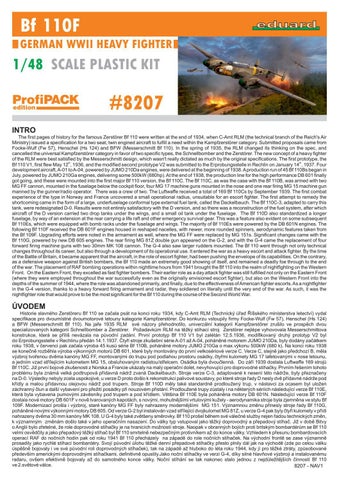
INTRO The first pages of history for the famous Zerstörer Bf 110 were written at the end of 1934, when C-Amt RLM (the technical branch of the Reich's Air Ministry) issued a specification for a two seat, twin engined aircraft to fulfill a need within the Kampfzerstörer category. Submitted proposals came from Focke-Wulf (Fw 57), Henschel (Hs 124) and BFW (Messerschmitt Bf 110). In the spring of 1935, the RLM changed its thinking on the spec, and cancelled the universal Kampfzerstörer category in favor of two specific types, the Schnellbomber and the Zerstörer. The new concept of a heavy fighter of the RLM were best satisfied by the Messerschmitt design, which wasn't really dictated as much by the original specifications. The first prototype, the Bf 110 V1, first flew May 12th, 1936, and the modified second prototype V2 was submitted to the Erprobungsstelle in Rechlin on January 14th, 1937. Four development aircraft, A-01 to A-04, powered by JUMO 210Da engines, were delivered at the beginning of 1938. A production run of 45 Bf 110Bs began in July, powered by JUMO 210Ga engines, delivering some 500kW (680hp). At the end of 1938, the production line for the high performance DB 601 finally got going, and these were mounted into the first major Bf 110 version, the Bf 110C. The Bf 110C, as was the case with the Bf 110B, was armed with two MG FF cannon, mounted in the fuselage below the cockpit floor, four MG 17 machine guns mounted in the nose and one rear firing MG 15 machine gun manned by the gunner/radio operator. There was a crew of two. The Luftwaffe received a total of 169 Bf 110Cs by September 1939. The first combat experience of the type in Norway and France uncovered a small operational radius, unsuitable for an escort fighter. The first attempt to remedy the shortcoming came in the form of a large, underfuselage conformal type external fuel tank, called the Dackelbauch. The Bf 110C-3, adapted to carry this tank, were redesignated D-0. Results were not entirely satisfactory with the D version, and so there was a reconstruction of the fuel system, after which aircraft of the D version carried two drop tanks under the wings, and a small oil tank under the fuselage. The Bf 110D also standardized a longer fuselage, by way of an extension at the rear carrying a life raft and other emergency survival gear. This was a feature also evident on some subsequent Bf 110Es, which were equipped with bomb racks under the fuselage and wings. The majority of Bf 110Es were powered by the DB 601N engines. The following Bf 110F received the DB 601F engines housed in reshaped nacelles, with newer, more rounded spinners, aerodynamic features taken from the Bf 109F. Upgrading efforts were noted in the armament as well, where the MG FF were replaced by MG 151s. Significant changes came with the Bf 110G, powered by new DB 605 engines. The rear firing MG 81Z double gun appeared on the G-2, and with the G-4 came the replacement of four forward firing machine guns with two 30mm MK 108 cannon. The G-4 also saw larger rudders mounted. The Bf 110 went through not only technical changes throughout its career, but also through a development of its operational use. It entered the war as a heavy escort and attack fighter. By the time of the Battle of Britain, it became apparent that the aircraft, in the role of escort fighter, had been pushing the envelope of its capabilities. On the contrary, as a defensive weapon against British bombers, the Bf 110 made an extremely good showing of itself, and remained a deadly foe through to the end of the war. The placement of RAF bombing operations within nighttime hours from 1941 brought the Bf 110 into the realm of nightfighting on the Western Front. On the Eastern Front, they excelled as fast fighter bombers. Their earlier role as a day attack fighter was still fulfilled not only on the Eastern Front (where they were employed throughout the war successfully even as the originally envisioned escort fighter), but also on the Western Front into the depths of the summer of 1944, where the role was abandoned primarily, and finally, due to the effectiveness of American fighter escorts. As a nightfighter in the G-4 version, thanks to a heavy forward firing armament and radar, they soldiered on literally until the very end of the war. As such, it was the nightfighter role that would prove to be the most significant for the Bf 110 during the course of the Second World War.
ÚVODEM Historie slavného Zerstöreru Bf 110 se začala psát na konci roku 1934, kdy C-Amt RLM (Technický úřad Říšského ministerstva letectví) vydal specifikace pro dvoumístné dvoumotorové letouny kategorie Kampfzerstörer. Do konkurzu vstoupily firmy Focke-Wulf (Fw 57), Henschel (Hs 124) a BFW (Messerschmitt Bf 110). Na jaře 1935 RLM své názory přehodnotilo, univerzální kategorii Kampfzerstörer zrušilo ve prospěch dvou specializovaných kategorií Schnellbomber a Zerstörer. Požadavkům RLM na těžký stíhací stroj Zerstörer nejlépe vyhovovala Messerschmittova konstrukce, která se příliš nevázala na původní zadání. První prototyp Bf 110 V1 byl zalétán 12.5.1936, modifikovaný druhý prototyp V2 byl do Erprobungsstelle v Rechlinu předán 14.1.1937. Čtyři stroje zkušební série A-01 až A-04, poháněné motorem JUMO 210Da, byly dodány začátkem roku 1938, v červenci pak začala výroba 45 kusů série Bf 110B, poháněné motory JUMO 210Ga o max.výkonu 500kW (680 k). Na konci roku 1938 se konečně rozběhla výroba výkonných motorů DB 601, které byly montovány do první velkosériové verze C. Verze C, stejně jako předchozí B, měla výzbroj tvořenou dvěma kanóny MG FF, montovanými do trupu pod podlahou prostoru osádky, čtyřmi kulomety MG 17 lafetovanými v nose letounu, a jedním vzad střílejícím kulometem MG 15, obsluhovaným radistou/střelcem. Osádka byla dvoučlenná. Do září 1939 dostala Luftwaffe 169 strojů Bf 110C. Již první bojové zkušenosti z Norska a Francie ukázaly na malý operační dolet, nevyhovující pro doprovodné stíhačky. Prvním řešením tohoto problému byla známá velká podtrupová přídavná nádrž zvaná Dackelbauch. Stroje verze C-3, adaptované k nesení této nádrže, byly přeznačeny na D-0. Výsledky nebyly zcela uspokojivé, u verze D proto došlo k rekonstrukci palivové soustavy, po které stroje řady D nesly dvě přídavné nádrže pod křídly a malou přídavnou olejovou nádrž pod trupem. Stroje Bf 110D měly také standardně prodloužený trup, v nástavci za ocasem byl uložen záchranný člun a další vybavení pro přežití posádky při nouzovém přistání. Prodloužené trupy zůstaly i na některých sériích následující verze Bf 110E, která byla vybavena pumovými závěsníky pod trupem a pod křídlem. Většina Bf 110E byla poháněna motory DB 601N. Následující verze Bf 110F dostala nové motory DB 601F v nově tvarovaných kapotách, s novými, mohutnějšími vrtulovými kužely - aerodynamika stroje byla zjemněna ve stylu Bf 109F. Modernizací prošla i výzbroj, staré kanóny MG FF byly nahrazeny modernějšími MG 151. Významnou změnu přinesly stroje řady Bf 110G, poháněné novými výkonnými motory DB 605. Od verze G-2 byl instalován vzad střílející dvojkulomet MG 81Z, u verze G-4 pak byly čtyři kulomety v přídi nahrazeny dvěma 30 mm kanóny MK 108. U G-4 byly také zvětšeny směrovky. Bf 110 prošel během své válečné služby nejen řadou technických změn, k významným změnám došlo také v jeho operačním nasazení. Do války typ vstupoval jako těžký doprovodný a přepadový stíhač. Již v době Bitvy o Anglii bylo zřetelné, že role doprovodné stíhačky je na hranicích možností stroje. Naopak v obranných bojích proti britským bombardérům se Bf 110 velmi osvědčily a jako přepadový těžký stíhač byl Bf 110 smrtelně nebezpečným protivníkem až do konce války. Vzhledem k přesunu bombardovacích operací RAF do nočních hodin pak od roku 1941 Bf 110 přecházely na západě do role nočních stíhaček. Na východní frontě se zase významně prosadily jako rychlé stíhací bombardéry. Svojí původní úlohu těžké denní přepadové stíhačky přesto plnily dál jak na východě (zde po celou válku úspěšně bojovaly i ve své původní roli doprovodných stíhaček), tak na západě až hluboko do léta roku 1944, kdy jí pro těžké ztráty, způsobované především americkými doprovodnými stíhačkami, definitivně opustily.Jako noční stíhačky ve verzi G-4, díky silné hlavňové výzbroji a instalovanému radaru, ovšem efektivně bojovaly až do samotného konce války. Noční stíhání se tak nakonec stalo jednou z nejdůležitějších činností Bf 110 ve 2.světové válce. 8207 - NAV1
ATTENTION
UPOZORNĚNÍ
INSTRUCTION SIGNS
INSTR. SYMBOLY
BEND OHNOUT
OPTIONAL VOLBA
OPEN HOLE VYVRTAT OTVOR
PARTS
A>
ACHTUNG
INSTRUKTION SINNBILDEN
SYMETRICAL ASSEMBLY SYMETRICKÁ MONTÁŽ
DÍLY
B>
8200 A
ATTENTION
REVERSE SIDE OTOČIT
REMOVE ODŘÍZNOUT
TEILE PLASTIC PARTS
D>
E>
G>
R>
8200 G
J>
S>
8200 T
8200 S
eduard
8200 D
8200 E
F>
8200 F
8200 R
8200 J
V>
T>
8200 V
PE - PHOTO ETCHED DETAIL PARTS
COLOURS
BARVY
FARBEN
PEINTURE AQUEOUS
Mr.COLOR
H 69
C37
GRAY
RLM75
BLACK
H 70
C60
GRAY
RLM02
C5
BLUE
H 77
C137
TIRE BLACK
GSi Creos (GUNZE) AQUEOUS
Mr.COLOR
H2
C2
H5
C6
GREEN
H 81
C55
KHAKI
H7
C7
BROWN
H 413
C113
YELLOW
RLM04
H 11
C62
WHITE
H 414
C114
RED
RLM23
H 12
C33
FLAT BLACK
H 416
C116
GRAY
RLM66
H 37
C43
WOOD BROWN
H 417
C117
LIGHT BLUE
RLM76
H 47
C41
RED BROWN
H 65
C18
BLACK GREEN
RLM70
MC214
DARK IRON
H 68
C36
DARK GRAY
RLM74
MC218
ALUMINIUM
H6
2
APPLY EDUARD MASK AND PAINT POUŽÍT EDUARD MASK NABARVIT
PIECES
C> 8200 C
8200 B
SYMBOLES
Mr.METAL COLOR
PE39 2 pcs. PE60 PE36
H 12 C33 FLAT BLACK
PE81
G53
PE3
PE43
PE4
H 12 C33 FLAT BLACK
G55
J29
A B17
PE57
H 416 C116
PE40 2 pcs.
GRAY RLM66
H 416 C116 GRAY RLM66
H 12 C33
J40
A
3 pcs.
B
FLAT BLACK
3 pcs.
B
PE5
C7
PE24
H 416 C116 GRAY RLM66
PE16 PE17
G22 H 416 C116
PE52 H 413 C113
G66
GRAY RLM66
PE56
YELLOW RLM04
H 416 C116 GRAY RLM66
PE63
PE51
H 414 C114 RED RLM23
H 12 C33
PE10
FLAT BLACK
PE29 PE56
S7 - MARKINGS
C29
H 416 C116 H 416 C116
GRAY RLM66
R16
H 416 C116
R16
ONLY
S7
GRAY RLM66
D C
D;E
R17
C
GRAY RLM66
OPTIONAL: decal 27, 28, 49 2 pcs. PE61 PE2
H 416 C116
R17
GRAY RLM66
PE1
PE61
PE82
PE46
PE61 H 416 C116
H 416 C116
GRAY RLM66
GRAY RLM66
PE34 PE33
J28 3
J2 G54 J13
H 70 C60
DO NOT GLUE!
GRAY RLM02
J19
J19
J3 J31
E
6 pcs.
H 70 C60 GRAY RLM02
PE73
H2 C2
G20
H 70 C60 GRAY RLM02
H 70 C60
BLACK
GRAY RLM02
B6 - MARKINGS ONLY
B ; C ; D; E H 70 C60
H2 C2
B6
GRAY RLM02
BLACK
G32
MARKING
A
ONLY
MARKING
E
A
ONLY
R13
S9
H 70 C60 GRAY RLM02
C5
E
S40
G2 G2 G7
J1 H 70 C60 GRAY RLM02
J1 H 70 C60 GRAY RLM02
G7 4
J4
A
H 70 C60
B
GRAY RLM02
G5
G38 H 70 C60
J14
GRAY RLM02
H 70 C60 GRAY RLM02
E J14 H 70 C60 GRAY RLM02
J4
H 70 C60
G77
GRAY RLM02
H 70 C60 GRAY RLM02
B12
H 70 C60
B12
GRAY RLM02
H 416 C116 GRAY RLM66
H 416 C116
G12
GRAY RLM66
G68 G12
PE20
G68 PE42
PE42
G13
G83 PE21
PE42
H 416 C116
PE27
E
E
PE25
GRAY RLM66
PE42
PE26
H 416 C116 GRAY RLM66
PE22
PE23
G36
G36 H 70 C60 GRAY RLM02
A H 70 C60 GRAY RLM02
G61
B E
H 70 C60 GRAY RLM02
G77 5
MARKINGS
B ; C ; D; E
ONLY
PE64 H2 C2 BLACK
C12 G58 5 pcs. B5 G24, G65 H 70 C60
H 70 C60
GRAY RLM02
GRAY RLM02
PE37
PE41
H 70 C60 GRAY RLM02
B11
F C12 H 70 C60 GRAY RLM02
G59
G59 - MARKINGS B ; C ; D ; E ONLY H 70 C60 GRAY RLM02
C18
F
G D
H 416 C116
J25
GRAY RLM66
H
MARKINGS
D;E
ONLY
I
MARKINGS
D;E
ONLY
MARKINGS
A ;B;C
ONLY
H 416 C116 GRAY RLM66
J25
H 416 C116
PE18
PE19
J27
GRAY RLM66
PE74
RLM02 GRAY
PE30 H 70 C60 RLM02 GRAY
T14
H 416 C116
PE78
H 70 C60
C22 G46
H 416 C116 GRAY RLM66
6
J25
GRAY RLM66
C22
OPTIONAL: decal 29
C28 H 416 C116
B2
H 416 C116 GRAY RLM66
GRAY RLM66
PE15
PE9
PE14
B2
G I
H
B16 H 70 C60 GRAY RLM02
B9 B1
H 416 C116
B1
PE47
GRAY RLM66
H 70 C60 GRAY RLM02
PE77 PE11
PE71
H 416 C116
GRAY RLM66
G58, PE64 PE12 PE7
H2 C2 BLACK
PE13
PE8
H 416 C116 GRAY RLM66
G84 G31
G78
H 416 C116
PE80
PE6
GRAY RLM66
PE35
J
H2 C2 BLACK
PE28 MARKING
A
ONLY
PE62
S32 B8 PE69
MC214 DARK IRON
H 70 C60 GRAY RLM02
G76 H 70 C60
S35
C21 G21
G76
H 70 C60 GRAY RLM02
GRAY RLM02
PE70 7
J
H 70 C60 GRAY RLM02
H 416 C116 GRAY RLM66
F4 F4
G43
H2 C2
G35
BLACK
H2 C2
G43
H2 C2 BLACK
G25
MC214
G33
H2 C2 BLACK
BLACK
G34
G34
C10
DARK IRON
H2 C2
G25
BLACK
H 70 C60
G4 G4
GRAY RLM02
H 70 C60
MC214
GRAY RLM02
DARK IRON
G63
G63 H 70 C60
C30
GRAY RLM02
H 70 C60 GRAY RLM02
C9
G79 G79
G82
H 70 C60 GRAY RLM02
H 70 C60 GRAY RLM02
2 pcs. G2
G67
C19
H5 C5 BLUE
MC214 DARK IRON
H 70 C60
H5 C5
G8
GRAY RLM02
BLUE
G2 2 pcs.
MC214 DARK IRON
B7
H 70 C60 GRAY RLM02
G9
B7
B10 H 70 C60 GRAY RLM02
8
H 70 C60 GRAY RLM02
LIQUID MASK
J12 F5
C1 2 pcs.
F3
E3
C2 2 pcs.
F2
F1
E4
F7
F6
E2
E2
ONLY FOR
A1
0,8mm
H 70 C60 GRAY RLM02
J20
A3
A1
0,6mm
0,8mm
J18
A1
H 70 C60
A2 A1
GRAY RLM02
A1
A2
A2
H 413
C113 J6 YELLOW RLM04 H 70 C60 GRAY RLM02
J22
A4
J16
A3
9
R3
R4
RIGHT -
C16 H 70 C60
C24
GRAY RLM02
LEFT -
J5
R3+C36 R14+C35 R4+C25 R15+C26
C16+J5+R1 C24+J11+R1
MC219
J11
BRASS
R1 H 70 C60
R14
GRAY RLM02
R15
C36
C25
H 70 C60 GRAY RLM02
C35
C17
C26
C23
H 70 C60
PE76
GRAY RLM02
C31
C33
C32
PE68
C34
PE66 MC218 ALUMINIUM
C31
C33 C32
MC218 ALUMINIUM
PE67 10
PE65
C34
H 77 C137
H 70 C60
TIRE BLACK
J12
GRAY RLM02
R2
R7
C14
H2 C2
B3
BLACK
J37
H 70 C60 GRAY RLM02
G14 G15
B4
R11
C13
A5
J23
2 pcs.
J30
H 77 C137 TIRE BLACK
BLACK
RED BROWN
GRAY RLM02
J15
H2 C2
H 47 C41
H 70 C60
C1
J9 H 70 C60
H 70 C60
MC218 ALUMINIUM
GRAY RLM02
C2
GRAY RLM02
H 70 C60 GRAY RLM02
J34
J26
J38
J8
J7
J34, J8
H 70 C60 GRAY RLM02
J38, J7
J35
H 70 C60 GRAY RLM02
J35
J22
J20
J16
J18 11
G30
J10
PE48 - MARKINGS ONLY
B ; C ; D; E PE48
C15
PE48
C11
H 70 C60 GRAY RLM02
C15
C11
H 70 C60 GRAY RLM02
J17
J21 H 70 C60 GRAY RLM02
G48
G48 PE79 A2, A3
F8
A1, A4
WE RECOMMEND TO GLUE J24/ J32 EXHAUST BESES TO ENGINE NACELLES FIRST, NEXT GLUE THE EXHAUST PIPES TO THE BASES. DOPORUČUJEME NEJPRVE NALEPIT ZÁKLADNY VÝFUKŮ J24/ J32 DO MOTOROVÝCH GONDOL, TEPRVE POTÉ VLEPOVAT JEDNOTLIVÉ VÝFUKY.
K
A ; B ; C ONLY G18 G19 G17
MARKINGS
L
M J32
N
6 pcs. G69
J32
G71
G16
G70 G16 6 pcs.
J24 MARKINGS
D;E T12
G72
J24
G69
ONLY
T20
J32
T25
T12
T20
T12
T20
T20
V3 T15 T6 T5 12
T15
V10
V12 T6 J24 T5
T15 T12
T15 T26
V1
T6 J24 T5
J32
T6 T5
H 416 C116 GRAY RLM66
O
S37, PE31, PE32 MARKINGS D ; E ONLY
S37
PE72
H 416 C116
PE31
H 416 C116
PE55
PE55
PE32
GRAY RLM66
H 416 C116
F6
E4
GRAY RLM66
GRAY RLM66
H 416 C116
F7
GRAY RLM66
G85
E4
J33 H 416 C116
G45
D;E
GRAY RLM66
step 2
E3
E2 MARKINGS
H 416 C116
G52
GRAY RLM66
step 1
ONLY
H 416 C116
PE38
GRAY RLM66
PE50 E3
PE44
OPEN
PE50 E3
E2
PE58
CLOSED PE49
J33
H 416 C116 GRAY RLM66
F5
O
OPEN E2
PE75 PE45
H 416 C116
PE54
GRAY RLM66
H 47 C41 RED BROWN
PE54 CLOSED
F5
O
F3 F1 F2 H 416 C116
PE59
GRAY RLM66
P
K
decal V
L
M
2 pcs.
P R6
N S8
R12
R5
S21 S21 - MARKING
E
ONLY
13
2 pcs.
2 pcs. D12
D12
D13, D16
D13, D16
H 81 C55
H 81 C55
KHAKI
2 pcs.
KHAKI
2 pcs.
D11
D15
MARKINGS
D11
D14
A ;B;C
ONLY
B13
MARKINGS
A ;B;C
ONLY
decal K
MARKINGS
decal V
4 pcs.
MARKINGS
D;E
ONLY
S14 S14 S14
S19
S14 PE53 14
S14
A ;B;C
ONLY
A Bf 110F-2 flown by Oblt. G. Tonne, CO of II./ZG 1, Belgorod, Soviet Union, June 1942 Gunther Tonne was born on May 21st, 1916 in Frankfurt and in 1935 he joined the German Navy (Kriegsmarine). In 1937 he stepped into the ranks of the Luftwaffe. After undergoing training on Bf 110 heavy fighters, he was assigned to ZG 1. In 1940 he shot down seven British aircraft in combat over the English islands and added a British Blenheim to his score in April 1941 while serving as CO of 6./SKG 210. On January 4th, 1942 this unit was redesignated as 6./ZG 1 and from February 4th, 1942 Tonne commanded its entire II./ZG 1. In December 1942 he took over command of the newly formed SKG 10 armed with Fw 190 fighter-bombers. Engine failure on take off cost him his life while flying an Fw 190A-5 out of Reggio di Calabria on July 15th, 1943. In combat during the Second World War he shot down some twenty enemy aircraft and for his success he was awarded the Knight's Cross on October 5th, 1941, to which were posthumously added Oak Leaves on October 24th, 1944. While serving with II./ZG 1 in 1942 over the Russian plains, Oblt. Tonne flew several Bf 110F-2s. Zerstoregeschwader 1 was named 'Wespe' (Wasp) and the noses of their aircraft carried artwork depicting these aggressive insects. The standard camouflage scheme was sprayed over with squiggles of RLM 70 or 71 on the upper and side surfaces while the yellow surfaces denoted service on the Eastern Front.
RLM 04
H413 C113
RLM 74
H68 C36
RLM 70
H65 C18
RLM 75
H69 C37
GREEN
H6 C6
RLM 76
H417 C117
DARK IRON MC214 WOOD
H37 C43
eduard 15
B Bf 110F-2 W. Nr. 5080, flown by W. Frost, 13.(Z)/JG 5, Kemijärvi, Finland, Winter 1942/ 1943 In preparation for the invasion of the Soviet Union, 1.(Z)/JG 77 was moved to northern Norway, a unit equipped with Bf 110 heavy fighters. Their main task was to attack the strategically important railway line to the port of Murmansk. In the spring of 1942 it was moved under the command of JG 5 and at first redesignated 6.(Z)/JG 5 in June 1942 and then as 13.(Z)/JG 5. During the winter period, the upper surfaces of both warring sides' aircraft were sprayed over with a white washable paint for obviously better concealment. This applied also to this Bf 110F-2 who's code letters were also partially painted over by the ground crew (except the individual aircraft letter). The yellow wingtips indicated service on the Eastern Front.
16
RLM 04
H413 C113
RLM 74
H68 C36
RLM 70
H65 C18
RLM 75
H69 C37
WHITE
H11 C62
RLM 76
H417 C117
DARK IRON MC214 WOOD
H37 C43
eduard
C Bf 110F-2 flown by Ofw. T. Weissenberger, 6.(Z)/JG 5, Kirkenes, Norway, June 1942 German fighter ace with 208 kills to his credit and holder of the Knight's Cross with Oak Leaves Theodor Weissenberger was involved in flying from an early age on gliders. He joined the Luftwaffe in 1936. After completing fighter training, he became an instructor and in 1941 he was assigned to 1.(Z)/JG 77 (on March 16th, this unit was redesignated 10.(Z)/JG 5). In September 1942 Weissenberger was transferred to 6./JG 5, where he flew single engined Bf 109s. On October 24th, 1944 he took over command of the newly formed I./JG 7, equipped with the Me 262. On January 1st, 1945 he took over the entire JG 7 and remained in this function up to the end of the war. He was killed on June 11, 1950 during an automobile race in Nurnburgring. Weissenberger's Bf 110F was sprayed RLM 74/75/76, the standard used to camouflage fighter aircraft. The sides of the fuselage received a heavy and irregular overspray of RLM 74 and 75. The aircraft carries his kills depicted on the tail surfaces and on the nose is the Zerstorer unit's of JG 5 emblem, a dachshund with an I-16 in its mouth.
RLM 04
H413 C113
RLM 74
H68 C36
RLM 70
H65 C18
RLM 75
H69 C37
BLACK
H12 C33
RLM 76
H417 C117
DARK IRON MC214 WOOD
H37 C43
eduard 17
D Bf 110F-4 flown by Oblt. M. Bauer, CO of 11./NJG 6, Zilistea, Romania, June 1944 After the completion of pilot training in March 1941 Martin Bauer continued in blind flying instruction, and was subsequently assigned to Nachtjagdgeschwader 1. At the beginning of June he was transferred to NJG 6, with which he would serve out the war. His final tally of aerial victories is not precisely known, and historians place it at between seven and nine. Night fighter Bf 110s of NJG 6 from the beginning carried a monotone RLM 76 scheme on all surfaces and gradually, the starboard wing bottom began to be painted black.
18
RED
H414 C114
BLACK
H12 C33
RLM 76
H417 C117
WOOD
H37 C43
eduard
E Bf 110F-4 flown by Ofw. R. Kollak, 7./NJG 4, Juvincourt, France, June 1943 Reinhard Kollak enterred the ranks of the Reichswehr in 1932 and after the formation of the Luftwaffe he transferred to this service and in 1935 he began his training as a fighter pilot, after which his home became ZG 1. After completing blind flying training, he was assigned to the newly formed NJG 1 in October 1940. While serving with this unit, he shot down his first aircraft, a British Whitley, on June 17th, 1941. On May 1942 was 1./NJG 1 redesignated 7./NJG 4. His score steadily grew, and on August 29th, 1943 he was awarded the Knight's Cross for his 29 kills. His final score at the end of the war was 49. He joined the newly formed Luftwaffe and served until his retirement. He passed away on February 6th, 1980. Kollak's aircraft carried the standard Luftwaffe Bf 110 day fighter camouflage scheme. The RLM 76 on the sides of the fuselage were oversprayed with irregular patterns of RLM 74 and 75 for better concealment. The NJG 4 unit insignia was painted under the windscreen and kill marks were painted on the tail surfaces. It is possible that these also bore the national insignia of the aircraft he shot down.
RLM 70
H65 C18
WOOD
H37 C43
BLACK
H12 C33
RLM 74
H68 C36
RLM 75
H69 C37
RLM 76
H417 MC214 C117 DARK IRON
eduard 19
Bf 110F
STENCILING POSITIONS B
A
J
D
E
87
150 atu
1
H I
1 87
K 150 atu
R
U
L
M
150 atu
F
T Glykol Wasser 50/50
S
E
Rotring
O
Rotring
Glykol Wasser 50/50
87 87
E
N
N
Rotring
M
E
87
87
87
M
A
87
A
O
Rotring
B
P A
C
E
Q 24 Volt
87
24 Volt
1
M I
L
K
1
87
eduard 20
© EDUARD M.A. 2017
www.eduard.com
Printed in Czech Republic