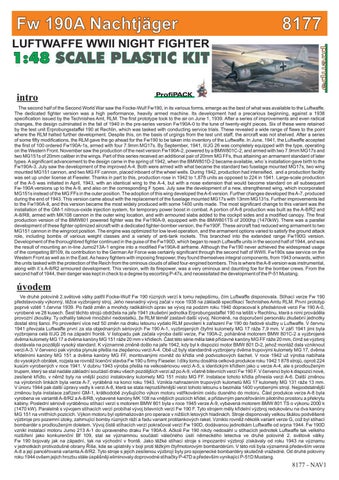
Fw 190A Nachtjäger
8177
LUFTWAFFE WWII NIGHT FIGHTER
1:48 SCALE PLASTIC KIT intro The second half of the Second World War saw the Focke-Wulf Fw190, in its various forms, emerge as the best of what was available to the Luftwaffe. The dedicated fighter version was a high performance, heavily armed machine. Its development had a precarious beginning, against a 1938 specification issued by the Technishes Amt, RLM. The first prototype took to the air on June 1, 1939. After a series of improvements and even radical changes, the design culminated in the fall of 1940 in the pre-series version Fw190A-0 to the tune of twenty-eight pieces. Six of these were retained by the test unit Erprobungsstaffel 190 at Rechlin, which was tasked with conducting service trials. These revealed a wide range of flaws to the point where the RLM halted further development. Despite this, on the basis of urgings from the test unit staff, the aircraft was not shelved. After a series of some fifty modifications, the RLM gave the go ahead for the Fw190 to be taken into inventory of the Luftwaffe. In June, 1941, the Luftwaffe accepted the first of 100 ordered Fw190A-1s, armed with four 7.9mm MG17s. By September, 1941, II/JG 26 was completely equipped with the type, operating on the Western Front. November saw the production of the next version Fw190A-2, powered by a BMW801C-2, and armed with two 7.9mm MG17s and two MG151s of 20mm caliber in the wings. Part of this series received an additional pair of 20mm MG FFs, thus attaining an armament standard of later types. A significant advancement to the design came in the spring of 1942, when the BMW801D-2 became available, who´s installation gave birth to the Fw190A-3. July saw the development of the improved A-4. Both were armed with what became the standard two fuselage mounted MG17s, two wing mounted MG151 cannon, and two MG FF cannon, placed inboard of the wheel wells. During 1942, production had intensified, and a production facility was set up under license at Fieseler. Thanks in part to this, production rose in 1942 to 1,878 units as opposed to 224 in 1941. Large-scale production of the A-5 was initiated in April, 1943, with an identical wing to the A-4, but with a nose extension that would become standard on all subsequent Fw-190A versions up to the A-9, and also on the corresponding F types. July saw the development of a new, strengthened wing, which incorporated MG151s instead of the MG FFs in the outer position. The adoption of this wing developed the A-6 version. Further changes developed the A-7, produced during the end of 1943. This version came about with the replacement of the fuselage mounted MG17s with 13mm MG131s. Further improvements led to the Fw190A-8, and this version became the most widely produced with some 1400 units made. The most significant change to this variant was the installation of the GM-1 nitrous-oxide injection system, for temporary power boost in combat. A portion of A-8 production was built as the A-8/R2 and A-8/R8, armed with MK108 cannon in the outer wing location, and with armoured slabs added to the cockpit sides and a modified canopy. The final production version of the BMW801 powered fighter was the Fw190A-9, equipped with the BMW801TS of 2000hp (1470kW). There was a parallel development of these fighter optimized aircraft with a dedicated fighter-bomber version, the Fw190F. These aircraft had reduced wing armament to two MG151 cannon in the wingroot position. The engine was optimized for low level operation, and the armament options varied to satisfy the ground attack role, including bombs of various weight classes and a variety of anti-tank rockets. This branched into the extended range Fw190G version. Development of the thoroughbred fighter continued in the guise of the Fw190D, which began to reach Luftwaffe units in the second half of 1944, and was the result of mounting an in-line Jumo213A-1 engine into a modified Fw190A-8 airframe. Although the Fw190 never achieved the widespread usage of the competing Bf109, its contribution to the German Air Force was certainly significant through the second half of WWII. Fw190s saw service on the Western Front as well as in the East. As heavy fighters with imposing firepower, they found themselves integral components, from 1943 onwards, within the units tasked with the protection of the Reich from the ominous clouds of allied four-engined bombers. This is where the A-8 version was instrumental, along with it´s A-8/R2 armoured development. This version, with its firepower, was a very ominous and daunting foe for the bomber crews. From the second half of 1944, their danger was kept in check to a degree by escorting P-47s, and necessitated the development of the P-51 Mustang.
úvodem Ve druhé polovině 2.světové války patřil Focke-Wulf Fw 190 různých verzí k tomu nejlepšímu, čím Luftwaffe disponovala. Stíhací verze Fw 190 představovaly výkonný, těžce vyzbrojený stroj. Jeho nesnadný vývoj začal v roce 1938 na základě specifikací Technishes Amtu RLM. První prototyp poprvé vzlétl 1.června 1939. Po řadě změn a mnohdy radikálních úprav se vývoj na podzim roku 1940 dopracoval k předsériové verzi Fw 190 A-0, vyrobené ve 28 kusech. Šest těchto strojů obdržela na jaře 1941 zkušební jednotka Erprobungsstaffel 190 na letišti v Rechlinu, která s nimi prováděla provozní zkoušky. Ty odhalily takové množství nedostatků, že RLM téměř zastavil další vývoj. Nicméně, na doporučení personálu zkušební jednotky dostal stroj šanci. Po provedení více než 50 změn na draku letounu vydalo RLM povolení k zařazení Fw 190 do řadové služby u Luftwaffe. V červnu 1941 převzala Luftwaffe první za sta objednaných sériových Fw 190 A-1, vyzbrojených čtyřmi kulomety MG 17 ráže 7,9 mm. V září 1941 jimi byla vyzbrojena celá II/JG 26 na západní frontě. V listopadu pak začala výroba další verze, Fw 190A-2, poháněné motorem BMW 801C-2 a vyzbrojené dvěma kulomety MG 17 a dvěma kanóny MG 151 ráže 20 mm v křídlech. Část této série měla také přídavné kanóny MG FF ráže 20 mm, čímž se výzbroj dostávala na pozdější vysoký standard. K významné změně došlo na jaře 1942, kdy byl k dispozici motor BMW 801 D-2, jehož montáž dala vzniknout verzi A-3. V červenci pak výroba plynule přešla na zlepšenou verzi A-4. Obě už byly standardně vyzbrojeny dvěma trupovými kulomety MG 17, dvěma křídelními kanóny MG 151 a dvěma kanóny MG FF, montovanými rovněž do křídla vně podvozkových šachet. V roce 1942 už výroba nabíhala do vysokých obrátek, rozjela se rovněž licenční stavba Fw 190 u firmy Fieseler. I díky tomu dosáhla celková produkce roku 1942 1 878 strojů, oproti 224 kusům vyrobených v roce 1941. V dubnu 1943 výroba přešla na velkosériovou verzi A-5, s identickým křídlem jako u verze A-4, ale s prodlouženým trupem, který se stal nadále základní součástí draku všech pozdějších verzí až po A-9, včetně bitevních verzí Fw 190 F. V červenci bylo k dispozici nové, zesílené křídlo, v němž byly na vnější pozici instalovány kulomety MG 151 místo MG FF. Instalace tohoto křídla přinesla verzi A-6. Další změnou na výrobních linkách byla verze A-7, vyráběná na konci roku 1943. Vznikla nahrazením trupových kulometů MG 17 kulomety MG 131 ráže 13 mm. V únoru 1944 pak další úpravy vedly k verzi A-8, která se stala nejrozšířenější verzí tohoto letounu s bezmála 1400 vyrobenými stroji. Nejpodstatnější změnou byla instalace zařízení GM-1, krátkodobě zvyšujícího výkon motoru vstřikováním oxidu dusného do motoru. Část produkce verze A-8 byla vyrobena ve variantě A-8/R2 a A-8/R8, vybavené kanóny MK 108 na vnějších pozicích křídel, a přídavným pancéřováním pilotního prostoru a překrytu kabiny. Poslední sériově vyráběnou stíhací verzí s motorem BMW 801 byla v roce 1945 verze A-9, vybavená motorem BMW 801 TS o výkonu 2000 k (1470 kW). Paralelně s vývojem stíhacích verzí probíhal vývoj bitevních verzí Fw 190 F. Tyto strojem měly křídelní výzbroj redukovánu na dva kanóny MG 151 na vnitřních pozicích. Výkon motoru byl optimalizován pro operace v nižších letových hladinách. Stroje disponovaly velkou škálou podvěšené výzbroje pro pozemní útoky, zahrnující bomby různých ráží a řadu variant protitankových raket. Vzniklo rovněž několik variant verze G, což byl stíhací bombardér s prodlouženým doletem. Vývoj čistě stíhacích verzí pokračoval verzí Fw 190D, dodávanou jednotkám Luftwaffe od srpna 1944. Fw 190D vznikl instalací motoru Jumo 213 A-1 do upraveného draku Fw 190A-8. Ačkoli Fw 190 nikdy nedosáhl u stíhacích jednotek Luftwaffe tak velkého rozšíření jako konkurenční Bf 109, stal se významnou součástí válečného úsilí německého letectva ve druhé polovině 2. světové války. Fw 190 bojovaly jak na západní, tak na východní v frontě. Jako těžké stíhací stroje s impozantní výzbrojí získávaly od roku 1943 na významu v jednotkách protivzdušné obrany Říše, kde se uplatnily v boji proti těžkým čtyřmotorovým bombardérům. V této roli byla významná především verze A-8 a její pancéřovaná varianta A-8/R2. Tyto stroje s jejich zesílenou výzbrojí byly pro spojenecké bombardéry skutečně vražedné. Od druhé poloviny roku 1944 ovšem jejich hrozbu stále úspěšněji eliminovaly doprovodné stíhačky P-47D a především vynikající P-51D Mustang.
8177 - NAV1
ATTENTION
UPOZORNĚNÍ
INSTRUCTION SIGNS
BEND OHNOUT
OPTIONAL VOLBA
PARTS
ACHTUNG
INSTR. SYMBOLY
OPEN HOLE VYVRTAT OTVOR
INSTRUKTION SINNBILDEN
SYMETRICAL ASSEMBLY SYMETRICKÁ MONTÁŽ
DÍLY
ATTENTION
REVERSE SIDE OTOČIT
REMOVE ODŘÍZNOUT
TEILE
SYMBOLES
APPLY EDUARD MASK AND PAINT POUŽÍT EDUARD MASK NABARVIT
PIECES
PLASTIC PARTS
C>
A>
E>
8170 E
F>
8170 C
8170 A
8170 F
J> H> 8170 H
I>
8170 J
8170 I
M>8170 M K>
L>
8170 K
N>
8170 N
8170 L
eduard
PE - PHOTO ETCHED DETAIL PARTS
COLOURS
BARVY
FARBEN
PEINTURE
GSi Creos (GUNZE)
2
AQUEOUS
Mr.COLOR
AQUEOUS
Mr.COLOR
H1
C001
WHITE
H 70
C060
RLM02 GRAY
H2
C002
BLACK
H 77
C137
TIRE BLACK
H3
C003
RED
H4
C004
YELLOW
H6
C006
GREEN
H 12
C018
FLAT BLACK
H 13
C003
RED
MC214
H 47
C041
RED BROWN
MC218
ALUMINIUM
H 65
C018
RLM70 BLACK GREEN
MC213
STEEL
H 68
C036
RLM74 DARK GRAY
H 69
C037
RLM75 GRAY
H 344
RUST
H 417
C116
RLM66 BLACK GRAY
C117
RLM76 LIGHT BLUE
Mr.METAL COLOR DARK IRON
Mr.COLOR SUPER METALLIC SM01
SUPER CHROME
C116
PE18
RLM 66 BLACK GRAY
PE37 2 pcs.
C116
PE18
RLM 66 BLACK GRAY
J43, J44
plastic
plastic
C116
PE1
PE3
RLM 66 BLACK GRAY
J43
I17
J44 L18
H16 MARKINGS
A ,D
MARKINGS
C116
B,C
RLM 66 BLACK GRAY
J23 PE46 - MARKING
A
ONLY
PE47
C116 RLM 66 BLACK GRAY
PE18
C116 RLM 66 BLACK GRAY
PE46
H22
plastic
J17
C116 RLM 66 BLACK GRAY
L15
C116 RLM 66 BLACK GRAY
H16
I17 I17 C116 RLM 66 BLACK GRAY
PE48
H22
PE17 J68
PE24 PE11
PE15
PE16
PE4
PE7
PE24 PE21
PE11
OPTIONAL: decal 30
PE6
PE14
PE35
PE2 H22
MARKINGS
PE25
L15
A ,D
MARKINGS
PE34
PE26
B,C
PE26 - MARKINGS A , D PE25 PE26 - MARKINGS
PE27 PE28
B,C
PE31
PE29 PE9
J22
C116 RLM 66 BLACK GRAY
PE31 PE12
K28
J19
C116 RLM 66 BLACK GRAY
PE13 C116 RLM 66 BLACK GRAY
J59 J59
2 pcs. PE44
C116 RLM 66 BLACK GRAY
3
I21 H6
H5
I21
L19 L4
L16 H3 H19
H18
L10
L14
DARK IRON
I4
DARK IRON
H 70 C060
H 70 C060
RLM02 GRAY
MARKINGS
MC214 DARK IRON
MC214
H20 MC214
I4
L10
H21
MC214 DARK IRON
A ,D
MARKINGS
RLM02 GRAY
B,D C116
C3
RLM 66 BLACK GRAY
PE8
PE51
PE36
C1
C116 RLM 66 BLACK GRAY
PE5 C116 RLM 66 BLACK GRAY
C116 RLM 66 BLACK GRAY
C116 RLM 66 BLACK GRAY
C116 RLM 66 BLACK GRAY
A2 K22
K15
H 77 C137 TIRE BLACK
A1
K14 H2 C002 BLACK
H 70 C060 RLM02 GRAY
H 70 C060 RLM02 GRAY
K13 4
C3
C1
A B,C ,D
C1, C3 - MARKING A1, A2 - MARKINGS
IF K23/ K2 DROP TANK RACK IS TO BE INSTALLED
ANTENNA
JEN POKUD BUDETE INSTALOVAT ZÁVĚSNÍK K23/ K2
I16
- 0,6 mm
H 70 C060
MARKING
RLM02 GRAY
A
ONLY
J18 MARKINGS B ,C ,D ONLY
I16
MARKINGS A ,D ONLY
K20
J18
J24 ANTENNA
H344 RUST
- 0,6 mm MARKING
A
ONLY H 70 C060 RLM02 GRAY
E
F
E - MARKING
MARKINGS B ,C ,D ONLY
A B;C ;D
F - MARKINGS
J56 J65 H 70 C060
J66
RLM02 GRAY
J9
J57 H 70 C060 RLM02 GRAY
H 70 C060
H 70 C060 RLM02 GRAY
RLM02 GRAY
J9
E
F
5
J4
H 70 C060 RLM02 GRAY
H12 H 70 C060 RLM02 GRAY
J4
H 70 C060 RLM02 GRAY
MC214
J62
DARK IRON
J27 J63 MC214 DARK IRON
J27 DON’T USE PART J3 IF CANNON BAY HATCH I18/ I19 IS TO BE CLOSED POSITION NEINSTALUJTE DÍL J3 POKUD MÁ BÝT KRYT KANÓNU I18/ I19 ZAVŘENÝ
OPEN
H 70 C060 RLM02 GRAY
J10
ANTENNA
J3
- 0,6 mm MARKING
A
H 70 C060
ONLY
MC214
RLM02 GRAY
DARK IRON
H 70 C060 RLM02 GRAY
C2 - MARKING
A B;C ;D
A3 - MARKINGS
A3
C2
CLOSED HATCH I18/ I19 ONLY JEN PRO ZAVŘENÝ KRYT I18/ I19
H 70 C060 RLM02 GRAY
I14
ANTENNA MARKINGS
B,C ,D
ONLY
OPEN DON’T USE PART J3 IF CANNON BAY HATCH I18/ I19 IS TO BE CLOSED POSITION NEINSTALUJTE DÍL J3 POKUD MÁ BÝT KRYT KANÓNU I18/ I19 ZAVŘENÝ
C4 - MARKING
J10
A B;C ;D
A4 - MARKINGS
C4
A4
MC214 DARK IRON
J3 ANTENNA MARKINGS
I15
H 70 C060 RLM02 GRAY
H 70 C060
6
RLM02 GRAY
CLOSED HATCH I18/ I19 ONLY JEN PRO ZAVŘENÝ KRYT I18/ I19
B,C ,D
ONLY
C4 - MARKING
A A4 B;C ;D
C4
A4 - MARKINGS
C2 - MARKING
A A3 B;C ;D
A3 - MARKINGS
C2
MARKINGS
A ,D
PE19
PE22
PE30 PE32 E
PE33
F OPTIONAL: decal 29
A F - MARKINGS B ; C ; D E - MARKING
MARKINGS
H27
B,C
PE20
PE23
C116 RLM 66 BLACK GRAY
H7
H 47 C041 RED BROWN
C116 RLM 66 BLACK GRAY
N4 C116 RLM 66 BLACK GRAY
K6
PE30 PE32
PE33
H 47 C041 C116 RLM 66 BLACK GRAY
N4
RED BROWN
K6
OPTIONAL: decal 29 GLUE PART H27 INTO PART K6 FIRST, THEN GLUE PHOTO-ETCHED PARTS PE17/PE18 ONTO PART H27 VLEPTE NEJPRVE DÍL H27 DO DÍLU K6, POTOM VLEPTE KOVOVÉ DÍLY PE17/PE18 NA DÍL H27
K16
K9
7
J31 J50
H 12 C033 FLAT BLACK
H 12 C033 FLAT BLACK
MC213
J36
STEEL
MC213 STEEL
K3
K4
H 12 C033 FLAT BLACK
K1 J38 J29 K5 MC218 ALUMINIUM
H 12 C033
MC218
FLAT BLACK
ALUMINIUM
H 12 C033 H 12 C033 FLAT BLACK
FLAT BLACK
K21 H23
TEMPLATE ONLY! DO NOT GLUE! I2
THIS SERVES TO ATTAIN EXACT EXHAUST POSITION AND IS DISCARDED AFTERWARDS
ŠABLONA! NELEPIT! SLOUŽÍ K USAZENÍ VÝFUKŮ DO SPRÁVNÉ POZICE. PO NALEPENÍ VÝFUKŮ SE ODSTRANÍ
H 344 RUST
J33
J42 J55 H 344 RUST
J51
H 344 RUST
J16 J2 J15 J13 H 344 RUST
K27
I2 H 12 C033
FLAT BLACK
8
J35 I4
J34
J34
H 70 C060 RLM02 GRAY
J35 K18 STEP 1
J34 H 70 C060
I4
J25
DON’T USE IF CANNON BAY HATCH I18/ I19 IS TO BE CLOSED POSITION NEINSTALUJTE POKUD MÁ BÝT KRYT KANÓNU I18/ I19 ZAVŘENÝ H 70 C060 RLM02 GRAY
J47
J25
RLM02 GRAY
STEP 3
H 70 C060
H25
H4
STEP 2
RLM02 GRAY
J46 H13
MARKING
L3
L12
A
L17
MARKINGS
H10
H14
B;C
H26
MARKING
D
K25 K26
J11 J58 J53
L4
J53 H5
J53 MC218 ALUMINIUM
L19
J58 H6
J58 9
K11
J28
K10
H 70 C060 RLM02 GRAY
H 70 C060 RLM02 GRAY
SM01 SUPER CHROM
H 70 C060
K7
RLM02 GRAY
K17
H 77 C137 H2 C002
TIRE BLACK
BLACK
L5
J14
L20
H 77 C137
H 70 C060
J28
J1
TIRE BLACK
RLM02 GRAY
J1
J14 - MARKINGS
A ;D
L5
L20 - MARKINGS
B;C
H2 C002 BLACK
H 70 C060 RLM02 GRAY
J1
L5
J14
L20
SM01 SUPER CHROM
K8
L6
H1
H 70 C060 RLM02 GRAY
L7
H2
H 70 C060 RLM02 GRAY
J1 L5
J14 - MARKINGS L20 - MARKINGS
8o
H 70 C060 RLM02 GRAY
A ;D
H2 - MARKINGS
A ;D
H1 - MARKINGS
A ;D
B;C
L7 - MARKINGS
B;C
L6 - MARKINGS
B;C
PE41
J37
H8
MARKINGS
A ;D
J37
J30
ONLY H 70 C060 RLM02 GRAY
PE41
J30
10
K7 K8
H 70 C060 RLM02 GRAY
MARKING A ONLY
H8
J40
J32
I12
C117 RLM 76 LIGHT BLUE
I11 K24 K2 C117 RLM 76 LIGHT BLUE
C117 RLM 76 LIGHT BLUE
PE42 J60 MARKING
B,D ONLY
PE42 J60 J61 J52 J52 - MARKINGS A , D ONLY
J26
J26
J41 J41 - MARKINGS
B,C
ONLY
11
C116 RLM 66 BLACK GRAY
J45
C116 RLM 66 BLACK GRAY
J67 C116
K12
RLM 66 BLACK GRAY
N1
PE10
H 47 C041
PE49
N7
N1 - OPEN CANOPY N7 - CLOSED CANOPY
RED BROWN
N5
H 65 C018 RLM 70 BLACK GREEN
I1
H 65 C018 RLM 70 BLACK GREEN
I8
12
L8
H17 - MARKINGS
A ;D
L8 - MARKINGS
B;C
H17
I18 I19
CLOSED HATCH ONLY JEN ZAVŘENÝ POKLOP
PE38
L8
H17
H17 - MARKINGS
A ;D
L8 - MARKINGS
B;C
H 70 C060 RLM02 GRAY
H 70 C060 RLM02 GRAY
I18 I19 H 70 C060 RLM02 GRAY
13
MARKINGS
A
B
C
PE50
PE43
PE45
A , D ONLY
PE39
PE39
H17
PE40 MARKINGS
A
B
B C D ,
,
PE40
ONLY
C
MARKINGS
A MARKINGS
B , C , D ONLY
4 pcs.
B , C , D ONLY
A B C M1 - MARKINGS A , B ONLY MARKING
A
ONLY
M1
M3
M2 M2 - MARKINGS A , B ONLY
A MARKINGS
B
MARKING
A
ONLY
M3 2pcs.
14
B , C , D ONLY
6 pcs.
MARKING
M3
A
ONLY
PE40
eduard
8177
N5
N1
J1
L5
J14
L20
K14
N7
METAL COLOR
CAMOUFLAGE COLOR
15
A
A-8/R11 'Neptun' Fhj. Ofw. Gunter Migge, 1./NJGr. 10, Werneuchen, 1944
The Fw 190A-8/R11 'Neptun' was also used in the night fighting role by Nachtjagdgruppe 1 (formed January 1st, 1944, from a part of JG 300), operating primarily from fields east of Berlin. The unit, formed with only three Staffel with a very wide variation of types in service (including Bf 109, Bf 110, Ju 88, He 219 and Ta 154 besides the Fw 190), was tasked with the defense of important German cities. Above all, the unit tested new equipment for Luftwaffe night fighters under combat conditions, including Fw 190 versions from A-5 to A-8, including this machine from January to July, 1944 when they began to switch to the Bf 109G-6. With them, they transformed into a Mosquito hunting unit. In February, 1945, the unit became 2./NJG 11. One of the pilots of 1. Staffel NJGr. 10 was Fhj. Ofw. Gunther Migge, a former night fighter pilot of JG 300. His Fw 190 carried the Wilde Sau emblem, and also carried the inscription 'Kognak pumpe' and a glass of Migge's favorite poison. The border of the emblem, as well as the noted inscription, were in all probability, red. However, black cannot be ruled out. The aircraft carried the standard camouflage scheme of RLM 74/75/76, with the only attempt to darken the scheme being the less common, for this timeframe, the 'Adlerflugel' in the form of the black wedge behind the exhaust stacks. The spinner was black. The bottom white segments of the fuselage balkenkreuz were subdued. The often quoted W.Nr. of 29210 is probably incorrect, but is supplied on the decal sheet, just in case. The kill marks on the rudder are in the form of simple white bars. The tally includes victories achieved by the pilot when flying with JG 300. Even so, Gunther Migge, with JGr. 10, achieved several kills flying this aircraft. Additional Sources: Luftwaffe at War: Nightfighters over the Reich; Classic Colours: Luftwaffe Night Fighter Units; Kagero: Fw 190, Vol. 1,3.
ČESKOU VERZI TEXTU NALEZNETE NA www.eduard.com/s/8177
H12 33
H69 37
48 ? 47
22
H68 36
41
7
H69 37
H68 36
39 13 ? 10 H3 3
Y1 ? Y2 H417 117 H3 3
1
H69 37
Y1 ? Y2
H417 117 H3 3
AB
1
H68 36
Achtung! Kraftstoffbehalter
Z1 ? Z2
H417 117 H3 3
H3 3
H3 3
H69 37
H68 36
H3 3
2
H3 3
H69 37
7
H68 36
41
2
H68 36
16
H69 37
H12 33
39 13 ? 10 H3 3
H417 117 H417 117
16
BLACK
H12 33
RED
H3 3
RLM 76
H417 117
RLM 75
H69 37
RLM 74
H68 36
RLM 70
H65 18
eduard
B
A-6/R11, W.Nr. 550143, Flown by Oblt. Fritz Krause, 1./NJGr 10, Werneuchen Airfield, Germany, January, 1944
NJGr 10 was formed as a nightfighter unit on January 1, 1944. It was equipped with various types of aircraft, the 1st Staffel flew Bf 109Gs and Fw 190As. The FuG 217 Neptun radar was installed in NJGr. 10 aircraft to test its efficiency under combat conditions. A total of 48 Fw 190As were converted to the nightfighter configuration. Fritz Krause flew the aircraft depicted for a short period only as in the early summer of 1944, the NJGr 10 Fw 190As were handed over to fighter schools and were replaced with the Bf 109G-6/AS. The Messeschmitts were more capable in intercepting Allied bombers and Mosquitos. The origins of the badge on the cowling can be found with JG 300, as NJGr 10 was formed using JG 300 pilots.
ČESKOU VERZI TEXTU NALEZNETE NA www.eduard.com/s/8177
H65 18
H69 37
H68 36
6
31
9
12 H68 36
7 4 ? 8+8 H13 3
H417 117
H69 37
H4 4
H417 117
H13 3
H68 36
1
1
H417 117
H13 3
H13 3
H68 36
H69 37
H4 4
2 H13 3
H13 3
32 H68 36
7
2
H68 36
H69 37
H65 18
9
12
4 ? 8+8 H13 3
H417 117
RED
H3 3
YELLOW
H4 4
RLM 76
H417 117
RLM 74
H68 36
RLM 75
H69 37
RLM 70
H65 18
eduard
17
C
A-6/R-11 'Neptun' II./JG 300, Lobnitz, Fall, 1943
Jagdgeschwader 300 'Wilde Sau' was formed from JG Herrmann (hence 'B' marking) in July, 1943 with the main task allotted it being the perfecting of single-engined aircraft night fighting tactics. Besides the visual acquisition of targets, testing was initiated using on-board radar systems. The Fw 190 was equipped with 'Neptun', along with associated radar antennae. The illustrated Fw 190A-6 'Black 8', field modified R-11 for night fighting, was one of the Neptun equipped aircraft of JG 300. What makes this aircraft even more interesting is its camouflage application. The search for effective camouflage schemes gave rise to interesting color variations. The pictured Fw 190 received a lighter spray of RLM 76 over the top portions of the fuselage that blended into the darker sides of RLM 75 and 74 and into the RLM 76 bottom. Known photographs of this aircraft have been interpreted as the sides of the fuselage being composed of sharply demarked RLM 76 and 74. Closer inspection reveals that the contrast between the darker and lighter shades were not so strong, and further research leads to the presentation here. The top and bottom camouflage colors are RLM 74/75/76. The Wilde Sau emblem is in its classic style as used by JG 300 on a yellow background and as per the usual practice of the unit, appeared only on the left side. Version of the landing gear bay is not determined for this particular plane. There could be used two alternatives for the lower wing area – frame F (late style) or frame G (early style). In case of applying the F part, the tire J1 or J14 (and doors H1 and H2) should be used. In case of applying the G part, the tire L5 or L20 (and doors L6 and L7) should be used. Additional Sources: Classic Colours: Luftwaffe Night Fighter Units, pg 120; Eduardo Soler & Aurelio Gimmeno: Fw 190 and Ta152
ČESKOU VERZI TEXTU NALEZNETE NA www.eduard.com/s/8177
H65 18
H69 37
46
H417 117
H69 37
21
H417 117
42
6
H69 37 H417 117
14 ? 11 H3 3 H68 36
H68 36
H4 4 H3 3
1
H69 37
H417 117 H3 3
1
H68 36
H417 117 H3 3
H3 3
H3 3
H69 37
H68 36
H4 4 H3 3
5
H3 3
H69 37
6
H69 37
5
42
H417 117
15
H69 37
H65 18
H417 117
14 ? 11 H3 3 H68 36
H68 36
H417 117
18
YELLOW
H4 4
RED
H3 3
RLM 76
H417 117
RLM 75
H69 37
RLM 74
H68 36
H4 4
RLM 70
H65 18
eduard
D
A-7/R-11 'Neptun' Lt. Klaus Bretschneider, 6./JG 300, Rheine, March, 1944
Holder of the Knight's Cross, Oblt. Klaus Bretschneider was certainly one of JG 300's more formidable personalities. By the time of his death on December 24, 1944, as CO of 5. Staffel JG 300, he had amassed 34 victories, among which were 14 at night. Among his day and night victims were thirty four-engined heavy bombers. Although his fateful mount would prove to be a 'Sturmböck' (Fw 190A-8/R2), specially equipped to counter day bombings by American bomber formations, he had been involved in the development of tactics for 'Wilde Sau' operations on R11 modified Fw 190s, which were radar equipped for night intercepts. The illustrated Fw 190A-7/R11 featuring antennae for the FuG 217 radar, was flown by Klaus Bretschneider in the pre-spring, 1944, period, achieving several of his night victories. The standard camouflage scheme of RLM 74/75/76 was adorned with a red fuselage band, an identifier of JG 300 within the Defense of the Reich system. The yellow horizontal marking betrays its II. Gruppe affiliation. Known reconstruction of this aircraft lack the yellow segment, but the use of this is confirmed by recent documentation. The engine cowl is lighter (lacking the RLM 74 overspray). The effective II. Gruppe / JG 300 emblem is, in all likelihood, applied to both sides. The application of the kill markings on both sides is speculative at this point. Photographic evidence indicates that at different times, the pilot armor plating was missing. Additional Sources: Lorant Jean-Yves, Goyant Richard: JG 300 / June, 1943 – September, 1944 (vol.1) ČESKOU VERZI TEXTU NALEZNETE NA www.eduard.com/s/8177
H69 37
H65 18
H68 36
38
31
36
7
H69 37
H68 36
26 45 13 ? 10 H3 3
35
H4 4 H3 3
1
H69 37
H417 117 H3 3
1
H68 36
H417 117 H3 3
H3 3
H3 3
H69 37
H68 36
H4 4 H3 3
2
H3 3
H68 36
H69 37
7
31
2
36
H68 36
37
H69 37
H65 18
26 45 13 ? 10 H3 3 H69 37
H417 117
YELLOW
H4 4
RED
H3 3
RLM 76
H417 117
RLM 75
H69 37
35
RLM 74
H4 4
H68 36
RLM 70
H65 18
eduard
19
Fw 190A
STENCIL VARIANTS D
U
G
Hier aufholen
?
B1 ? B2 ? B3 B4 ?
?
Nicht Verst ellen
Hier aufholen
C
Hier aufbocken
J
L ? I N1
? ? ?
?
A1a ? A1g
A4d ? A4j
M
L ? I
N2
B1 B2 B3 B4
A2b ? A2h
B1 B2 B3 B4
A5e ? A5k A3c ? A3i
A6f ? A6l
? ? ?
VARIANTS
P
0
B1 B2 B3 B4
? ? ?
B1 B2 B3 B4
? ? ?
K N1
D Hier aufholen
V
F
H1 ? H1
N2
Q
R
K Q
R
S E1 ? E2
N1
?
N2
T
292l
B1 ? B2 ? B3 B4 ?
232l
ellen
Nicht Verst
Hier aufholen 292l
232l
C
Hier aufbocken
J
eduard 20
© EDUARD M.A., 2014
www.eduard.com
Printed in Czech Republic