Spitfire Mk.IXe BRITISH WWII FIGHTER
1/72 SCALE PLASTIC KIT ProfiPACK
#70123
INTRO
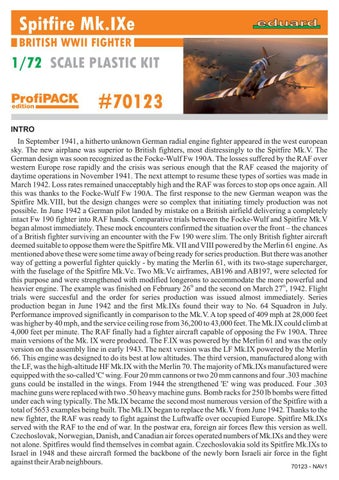
In September 1941, a hitherto unknown German radial engine fighter appeared in the west european sky. The new airplane was superior to British fighters, most distressingly to the Spitfire Mk.V. The German design was soon recognized as the Focke-Wulf Fw 190A. The losses suffered by the RAF over western Europe rose rapidly and the crisis was serious enough that the RAF ceased the majority of daytime operations in November 1941. The next attempt to resume these types of sorties was made in March 1942. Loss rates remained unacceptably high and the RAF was forces to stop ops once again. All this was thanks to the Focke-Wulf Fw 190A. The first response to the new German weapon was the Spitfire Mk.VIII, but the design changes were so complex that initiating timely production was not possible. In June 1942 a German pilot landed by mistake on a British airfield delivering a completely intact Fw 190 fighter into RAF hands. Comparative trials between the Focke-Wulf and Spitfire Mk.V began almost immediately. These mock encounters confirmed the situation over the front – the chances of a British fighter surviving an encounter with the Fw 190 were slim. The only British fighter aircraft deemed suitable to oppose them were the Spitfire Mk. VII and VIII powered by the Merlin 61 engine. As mentioned above these were some time away of being ready for series production. But there was another way of getting a powerful fighter quickly - by mating the Merlin 61, with its two-stage supercharger, with the fuselage of the Spitfire Mk.Vc. Two Mk.Vc airframes, AB196 and AB197, were selected for this purpose and were strengthened with modified longerons to accommodate the more powerful and th th heavier engine. The example was finished on February 26 and the second on March 27 , 1942. Flight trials were succesful and the order for series production was issued almost immediately. Series production began in June 1942 and the first Mk.IXs found their way to No. 64 Squadron in July. Performance improved significantly in comparison to the Mk.V. A top speed of 409 mph at 28,000 feet was higher by 40 mph, and the service ceiling rose from 36,200 to 43,000 feet. The Mk.IX could climb at 4,000 feet per minute. The RAF finally had a fighter aircraft capable of opposing the Fw 190A. Three main versions of the Mk. IX were produced. The F.IX was powered by the Merlin 61 and was the only version on the assembly line in early 1943. The next version was the LF Mk.IX powered by the Merlin 66. This engine was designed to do its best at low altitudes. The third version, manufactured along with the LF, was the high-altitude HF Mk.IX with the Merlin 70. The majority of Mk.IXs manufactured were equipped with the so-called 'C' wing. Four 20 mm cannons or two 20 mm cannons and four .303 machine guns could be installed in the wings. From 1944 the strengthened 'E' wing was produced. Four .303 machine guns were replaced with two .50 heavy machine guns. Bomb racks for 250 lb bombs were fitted under each wing typically. The Mk.IX became the second most numerous version of the Spitfire with a total of 5653 examples being built. The Mk.IX began to replace the Mk.V from June 1942. Thanks to the new fighter, the RAF was ready to fight against the Luftwaffe over occupied Europe. Spitfire Mk.IXs served with the RAF to the end of war. In the postwar era, foreign air forces flew this version as well. Czechoslovak, Norwegian, Danish, and Canadian air forces operated numbers of Mk.IXs and they were not alone. Spitfires would find themselves in combat again. Czechoslovakia sold its Spitfire Mk.IXs to Israel in 1948 and these aircraft formed the backbone of the newly born Israeli air force in the fight against their Arab neighbours. 70123 - NAV1
ATTENTION
UPOZORNĚNÍ
ACHTUNG
ATTENTION
Carefully read instruction sheet before assembling. When you use glue or paint, do not use near open flame and use in well ventilated room. Keep out of reach of small children. Children must not be allowed to suck any part, or pull vinyl bag over the head. Před započetím stavby si pečlivě prostudujte stavební návod. Při používání barev a lepidel pracujte v dobře větrané místnosti. Lepidla ani barvy nepoužívejte v blízkosti otevřeného ohně. Model není určen malým dětem, mohlo by dojít k požití drobných dílů.
INSTRUCTION SIGNS
INSTR. SYMBOLY
BEND OHNOUT
OPTIONAL VOLBA
OPEN HOLE VYVRTAT OTVOR
PARTS
A>
SYMETRICAL ASSEMBLY SYMETRICKÁ MONTÁŽ
DÍLY
NOTCH ZÁŘEZ
SYMBOLES
REMOVE ODŘÍZNOUT
TEILE
B>
70120 A
INSTRUKTION SINNBILDEN
APPLY EDUARD MASK AND PAINT POUŽÍT EDUARDS MASK NABARVIT
PIECES
PLASTIC PARTS
C>
70120 B
70120 C
eduard
E>
D> 70120 D
I>
70120 E 70120 I
-Parts not for use. -Teile werden nicht verwendet. -Pieces a ne pas utiliser. -Tyto díly nepoužívejte při stavbě. -
COLOURS
BARVY
FARBEN
PEINTURE
GSi Creos (GUNZE) AQUEOUS
Mr.COLOR
H4
C4
YELLOW
H326
C326
BLUE
H 11
C62
FLAT WHITE
H327
C327
RED
H 12
C33
FLAT BLACK
H330
C361
DARK GREEN
H 33
C81
RUSSET
H335
C363
MEDIUM SEA GRAY
H 51
C11
LIGHT GULL GRAY
C74
BLUE
H 52
C12
OLIVE DRAB
C362
OCEAN GRAY
H72
C22
DARK EARTH
C364
H74
C368
SKY
H 77
C137
TIRE BLACK
AQUEOUS
2
Mr.COLOR
H 90
C47
CLEAR RED
H 94
C138
CLEAR GREEN
H306
C306
GRAY
AIRCRAFT GRAYGREEN
Mr.METAL COLOR MC214 MC218
DARK IRON ALUMINIUM
Mr.COLOR SUPER METALLIC SM01
SUPER FINE SILVER
C364
PE1
AIRCRAFT GRAY GREEN
A
PE22
PE26
C364 AIRCRAFT GRAY GREEN
B40
H 33 C81
PE25
RUSSET
A34
B3 H 12 C33 FLAT BLACK
B52
B4
H 33 C81 RUSSET
C364
B53
C364
PE10
AIRCRAFT GRAY GREEN
AIRCRAFT GRAY GREEN
H 33 C81 RUSSET
MC218
B
OPTIONAL: decal 32
ALUMINIUM
A34
H 12 C33
H 12 C33
FLAT BLACK
FLAT BLACK
MC218 ALUMINIUM
H 12 C33
PE20
B47
FLAT BLACK
C364 AIRCRAFT GRAY GREEN
C
H 12 C33
PE19
FLAT BLACK
C364
B49
AIRCRAFT GRAY GREEN
B39
B41
OPTIONAL: decal 51
A29
C364 AIRCRAFT GRAY GREEN
PE6
PE24
H 12 C33
C364 AIRCRAFT GRAY GREEN
PE7
FLAT BLACK
PE12
B39 PE9
C364 AIRCRAFT GRAY GREEN
C364 AIRCRAFT GRAY GREEN
MC218
H 12 C33
ALUMINIUM
C
FLAT BLACK
B38
B6
A38
H 51 C11 LIGHT GULL GRAY
B41
step 2
H 12 C33 FLAT BLACK
A
C14
C364 AIRCRAFT GRAY GREEN
C364 AIRCRAFT GRAY GREEN
step 1
B6
B
MARKING
A
MARKINGS
C14
C ,D,E
ONLY
C1
C364 AIRCRAFT GRAY GREEN
MARKING
B
- NO GUNSIGHT
H 12 C33 FLAT BLACK
H 12 C33 FLAT BLACK
C364 AIRCRAFT GRAY GREEN
3
D
H 12 C33
C364 AIRCRAFT GRAY GREEN
PE21
FLAT BLACK
A39
A18
H 12 C33 FLAT BLACK
MC218 ALUMINIUM
FOR CLOSED CANOPY ONLY
MC218 ALUMINIUM
I31 C364
B2
AIRCRAFT GRAY GREEN
I32
MC218 ALUMINIUM
C364 AIRCRAFT GRAY GREEN
MC218 ALUMINIUM
I32
B37
I10
A32 H 12 C33 FLAT BLACK
D
I31 B9 B8 A6 I9 I31
MC218 ALUMINIUM
C364 AIRCRAFT GRAY GREEN
PE3 4
A43
A44
A42
- 0,8 mm MARKINGS ONLY
A ,C ,E
for ext. fuel tank (parts B12 or B15)
I34
- 0,8 mm
for ext. fuel tank (subassembly I)
- 0,8 mm
I33
- 0,8 mm MARKINGS ONLY
A ,C ,E
A45 A47
I35 A46 A48
5
I3, I4 - MARKINGS
I1
A ,C
ONLY
I3 C364 AIRCRAFT GRAY GREEN
I2
B21
I4
B21
B37
D19 - MARKINGS A , C , E ONLY
D19 H 94 C138 CLEAR GREEN
C7 H 94 C138
I12
E29
CLEAR GREEN
E30
D20 - MARKINGS A , C , E ONLY H 90 C47
6
CLEAR RED
D20
H 90 C47 CLEAR RED
C6
I11
I14
H 77 C137 TIRE BLACK
I13 - MARKINGS B , D ONLY
D23
MC218 ALUMINIUM
A13
I13
UNDERSURFACE COLOR
D24
I16
E
PE5
PE8
PE18
UNDERSURFACE COLOR
PE5
I15, I16
PE8 UNDERSURFACE COLOR
I15
I34
B51 UNDERSURFACE COLOR
B35 UNDERSURFACE COLOR
B50 B48 UNDERSURFACE COLOR
B35 MC218 ALUMINIUM
PE14
UNDERSURFACE COLOR
MC218 ALUMINIUM
PE15 B46 MC218 ALUMINIUM
MC218 ALUMINIUM
PE17
E PE16
MC218 ALUMINIUM
7
A26
A4
A3
A24
H 77 C137
A4
A3
TIRE BLACK
B10
MC218
UNDERSURFACE COLOR
ALUMINIUM
A26
A24
H 77 C137 TIRE BLACK
UNDERSURFACE COLOR
PE28
PE28
MC218
B20
MC218
MC218
ALUMINIUM
B27
ALUMINIUM
ALUMINIUM
B7
B20
B28 B16 Use if B12 and B15 is installed
UNDERSURFACE COLOR
B16
PE11 2 pcs. B16 C3 UNDERSURFACE COLOR
B16 UNDERSURFACE COLOR
MARKING B ONLY
fill UNDERSURFACE COLOR
MC214 DARK IRON
B31
B33
B31, B32 - MARKINGS A ,C ,E B33, B34 - MARKINGS B,D
UNDERSURFACE COLOR
MC214 DARK IRON
B32
8
B34
fill
MARKING B ONLY
F
G A5 MC218 ALUMINIUM
C15
C364 AIRCRAFT GRAY GREEN
C5 A19 A20
H
I C2
B13
B11
C13
B14
C364
C364
AIRCRAFT GRAY GREEN
AIRCRAFT GRAY GREEN
PE4 H 12 C33 C364 AIRCRAFT GRAY GREEN
J
K
C364 AIRCRAFT GRAY GREEN
2 pcs. MARKINGS ONLY
A ,C ,E
A28 A9
PE27
decal 39 ? 40 ? 41 ? 42 (70120)
FLAT BLACK
A11
A14
A28
A17
A7
9
10
MC214
A12
DARK IRON
A35
F
MC214 DARK IRON
A35
A12
A37
B14 - open canopy & open door B13 - open canopy & closed door
G
H
C12
C13
A21
A36
B14 I
B13 I
11
MC214
A12
DARK IRON
A35
F
MC214 DARK IRON
A35
A12
A37
B11 - closed canopy & closed door
G
H
C12
C2
A21
A36
B11 I
12
ALUMINIUM
MC218
A31
J
A49
UNDERSURFACE COLOR
B17
A49, B17, B18 - MARKINGS A , C , E ONLY
OLIVE DRAB
H 52 C12
B18
PE2
UNDERSURFACE COLOR
UNDERSURFACE COLOR
I
B17
B24
FWD
A49
UNDERSURFACE COLOR
PE23
- 0,3 mm
A49, B17, B18 - MARKINGS A , C , E ONLY
J
UNDERSURFACE COLOR
B18
OLIVE DRAB
H 52 C12
B24
13
B12 UNDERSURFACE COLOR
B15
C2
C5
C12
C13
14
A
PL124, No. 312 Squadron RAF, B-10 Airfield Plumetôt, France, June 1944
Czechoslovak pilots flew the Spitfire Mk.IXe for the first time during the Normandy landings. Czechoslovak RAF squadrons were re-armed with low-altitude Merlin 66 Spitfires because these had underwing bomb racks and were more suitable for operations over the Normandy beachhead. The first unit to get the new Spitfires within No. 134 Wing was No. 312 Squadron, which received the aircraft on June 11th, 1944. The E-type wing Spitfires served with the wing till July 3rd, 1944 when the F and HF.IXc machines arrived and the LF Mk.IXe were passed on to other units. Photos of PL124 show that the quick identification black & white bands were not fully painted on the fuselage. The black stripes are missing. Note the dark, probably blue, rudder tip.
SM 26, Vorderings Vliegschool/Ecole de Pilotage Avancé,
B Brustem Air Base, Belgium, 1952
SM 26, ex RAF serial PV189, was used by the Advanced Flying School (in Dutch: Vorderings Vliegschool (VVS), in French: Ecole de Pilotage Avancé (EPA)) at Brustem Air Base between November 1948 and June 1952. All VVS/EPA Spitfires had their guns removed. The standard painting for the VVS/EPA Spitfires was silver doped with the black anti-glare panel on the nose, black serial numbers on the fuselage and below the wings. This Spitfire was considered as the "parade" aircraft of the unit, had the VVS/EPA insignia on the left side of the engine cowling, the propeller hub was painted light blue with a thin red spiral. SM 26 was writen off after fatal crash at Overrepen on June 25th, 1952, after mid-air collision with another Spitfire designed SM 23.
C SM147, No. 73. Squadron RAF, Prkosh Airfield, Yugoslavia, April/ May 1945 In April 1945 No.73 Squadron moved from Greece, where it helped in the fight against local communists, to Yugoslavia. The Prkosh Airfield (now Croatia) became its new home and the squadron used it to support ground forces. The squadron's Spitifres wore an unusual marking – the colored chevron - on the fuselages, more typical for the post-war era. The exact colors of the chevron are not known. A variety of colors were used, as can be seen in b&w photos. In the case of SM147, black and red are thought to have been used. Note the C-type roundels on the upper side of the wings.
D 2003 (ex TE531), 105th Tayeset, Ramat David Air Base, Israel, September 1953 This aircraft belonged to a group of three that managed to fly to Israel under Operation Velveta I in September 1948. It served in the Cheyl Ha’Avir with the 101st Tayeset and later with the 105th. It appeared as it is shown here after repairs in 1953 and carries the final form of Israeli Spitfire camouflage (consisting of upper surfaces in dark grey and brown with light grey lowers). The aircraft carries full unit markings, including the unit emblem on the engine cowl, a yellow spinner and a black and yellow rudder. Spitfire 2003 was heavily damaged during landing on December 25th, 1953 by a 107th Tayeset pilot and was written off in March of the following year.
E
RK856, flown by Maj. C. Golding, CO of No. 3 Squadron SAAF, Italy, 1945
A very interesting marking – the red tail band - was applied to the Spitfires flown by SAAF No. 3 Squadron during a specific time period in 1945. The personal mount of the squadron CO, Maj. Cecil Golding, wore this band as well. Golding joined combat ops in 1942 and fought as a Curtiss Tomahawk pilot against German forces in Libya. He managed to shoot down two Ju 87 Stukas and one Bf 109F singlehandedly and shared one Ju 87 with another pilot. He also damaged an Italian FIAT Br.20 bomber. Cecil Golding was shot down on June 3rd, 1943 by a Bf 109F pilot. He is noted as being a victim of Hans Joachim Marseille in some studies. After his return from hospital, he served with other South African squadrons. On December 27th, 1944 he was promoted to Major and became the CO of SAAF No. 3 Squadron. His unit was tasked with the support of ground units and flew Spitfires in the fighter-bomber role.
Spitfire Mk.IXe
STENCILING POSITIONS
38
30
28
43
8
2
?
?9
? 29
3
43
36 10 6 44 12 ? 13
34
25 ? 24 32
23
23
32
31
33
16 6
5 ?4 6 14 25 ? 24
26
36
6
21 15
6
13
6 7 6 7
17
26
44
27
22 27
14
6 7 6 7 10 6
10
19 27
27
36 20
18 11
11 37
39 43
43
6 10
20
© EDUARD M.A., 2017
www.eduard.com
Printed in Czech Republic