Harrier GR.7/9 BRITISH FIGHTER
1/48 SCALE PLASTIC KIT
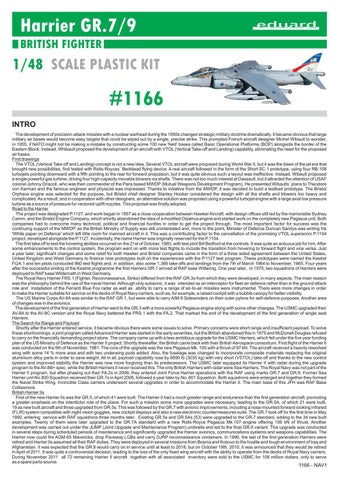
#1166 INTRO The development of precision-attack missiles with a nuclear warhead during the 1950s changed strategic military doctrine dramatically. It became obvious that large military air bases would become easy targets that could be wiped out by a single, precise strike. This prompted French aircraft designer Michel Wibault to wonder, in 1955, if NATO might not be making a mistake by constructing some 100 new 'field' bases called Basic Operational Platforms (BOP) alongside the border of the Eastern Block. Instead, Whibault proposed the development of an aircraft with VTOL (Vertical Take-off and Landing) capability, eliminating the need for the proposed air bases. First drawings The VTOL (Vertical Take off and Landing) concept is not a new idea. Several VTOL aircraft were proposed during World War II, but it was the dawn of the jet era that brought new possibilities, first tested with Rolls-Royces´ Bedstead flying device. A real aircraft followed in the form of the Short SC.1 prototype, using four RB.108 turbojets pointing downward with a fifth pointing to the rear for forward propulsion, but it was quite obvious such a layout was ineffective. Instead, Wibault proposed a single powerful gas turbine, driving four high-capacity movable blowers via shafts. There was not too much interest at Dassault, but it attracted the attention of USAF colonel Johnny Driscoll, who was then commander of the Paris based MWDP (Mutual Weapons Development Program). He presented Wibaults´ plans to Theodore von Karman and the famous engineer and physicist was impressed. Thanks to initiative from the MWDP, it was decided to build a testbed prototype. The Bristol Orpheus engine was selected for the purpose, but Bristol chief designer Stanley Hooker considered the design with all the shafts and blowers too heavy and complicated. As a result, and in cooperation with other designers, an alternative solution was proposed using a powerful turbojet engine with a large axial low pressure turbine as a source of pressure for vectored uplift nozzles. This proposal was finally adopted. Road to the Harrier The project was designated P.1127, and work began in 1957 as a close cooperation between Hawker Aircraft, with design offices still led by the memorable Sydney Camm, and the Bristol Engine Company, which shortly abandoned the idea of a modified Orpehus engine and started work on the completely new Pegasus unit. Both companies had to overcome many technical, political and financial hurdles in order to get the project through. The most important factor for success was the continuing support of the MWDP, as the British Ministry of Supply was still uninterested and, more to the point, Minister of Defence Duncan Sandys was writing his 'White paper on Defence' which left little room for manned aircraft in it. This was a contributing factor to the cancellation of the promising VTOL supersonic P.1154 project, developed alongside the P.1127. Incidentally, the name Harrier was originally reserved for the P.1154. The first take off to test the hovering abilities occurred on the 21st of October, 1960, with test pilot Bill Bedford at the controls. It was quite an arduous job for him. After some enhancements to the control system, the program went on with more test flights to include the transition from hovering to forward flight and vice versa. Just a year later, significant changes and some relief for both Hawker and Bristol companies came in the form of a three sided agreement between the United States, United Kingdom and West Germany to finance nine prototypes built on the experiences with the P.1127 test program. These prototypes were named the Kestrel FGA.1 and ten pilots conducted 960 test flights and, in addition, also some 1,366 take offs and landings from the 7th of March 1964 to November, 1965. Four years after the successful ending of the Kestrel programme the first Harriers GR.1 arrived at RAF base Wittering. One year later, in 1970, two squadrons of Harriers were deployed to RAF base Wildernath in West Germany. The Royal Navy Harrier FRS.1 (Fighter, Reconnaissance, Strike) differed from the RAF GR.3s from which they were developed, in many aspects. The main reason was the philosophy behind the use of the naval Harrier. Although only subsonic, it was intended as an interceptor for fleet air defence rather than in the ground attack role and installation of the Ferranti Blue Fox radar as well as ability to carry a range of air-to-air missiles were instrumental. There were more changes in order to make the Harrier suitable for service on the decks of Royal Navy carriers, such as, for example, a raised cockpit with a bubble canopy for better visibility. The US Marine Corps AV-8A was similar to the RAF GR.1, but were able to carry AIM-9 Sidewinders on their outer pylons for self-defence purposes. Another area of changes was in the avionics. The development of the first generation of Harrier went to the GR.3 with a more powerful Pegasus engine along with some other changes. The USMC upgraded their AV-8A to the AV-8C version and the Royal Navy bettered the FRS.1 with the FA.2. That marked the end of the development of the first generation of single seat Harriers. The Search for Range and Payload Shortly after the Harrier entered service, it became obvious there were some issues to solve. Primary concerns were short range and insufficient payload. To solve these shortcomings, a joint program called Advanced Harrier was started in the early seventies, but the British abandoned this in 1975 and McDonell Douglas refused to carry on the financially demanding project alone. The company came up with a less ambitious upgrade for the USMC Harriers, which fell under the five year funding plan of the US Ministry of Defence as the Harrier II project. Shortly thereafter, the British came back with their British Aerospace consortium. First flight of the Harrier II was conducted on the 5th of November, 1981. The core of the upgrade was the new Pegasus Mk. 105 with a thrust of 97 kN. The aircraft received a heavily reworked wing with some 14 % more area and with two underwing pods added. Also, the fuselage was changed to incorporate composite materials replacing the original aluminium alloy parts in order to save weight. All in all, payload capability rose by 6690 lb (3035 kg) with very short (VSTOL) take off and thanks to the new control system and improved stability the Harrier was now more forgiving than its predecessors. The USMC later equipped its Harrier II with radar during the upgrade program to the AV-8B+ spec, while the British Harriers II never received this. The only British Harriers with radar were Sea Harriers. The Royal Navy was not part of the Harrier II program, but after phasing out their FA.2s in 2006, they entered Joint Force Harrier operations with the RAF using marks GR.7 and GR.9. Former Sea Harrier unit No.800 Squadron received their GR.7s in April 2006, followed a year later by No. 801 Squadron. Both squadrons were enlarged and together they formed the Naval Strike Wing. Invincible Class carriers underwent several upgrades in order to accommodate the Harrier II. The main base of this JFH was RAF Base Cottesmore. British Harrier IIs First of the new Harrier IIs was the GR.5, of which 41 were built. The Harrier II had a much greater range and endurance than the first generation aircraft, promoting a greater emphasis on the interdictor role of the plane. For such a mission some more upgrades were necessary, leading to the GR.5A, of which 21 were built, 19 as new built aircraft and three upgraded from GR.5s. This was followed by the GR.7 with avionic improvements, including a nose-mounted forward-looking infrared (FLIR) system compatible with night vision goggles, new cockpit displays and also a new electronic countermeasures suite. The GR.7 took off for the first time in May 1990, entering service with RAF squadrons three months later. Existing GR.5s and GR.5As (53) were upgraded to the GR.7 standard, adding to the 34 new built examples. Twenty of them were later upgraded to the GR.7A standard with a new Rolls-Royce Pegasus Mk.107 engine offering 106 kN of thrust. Another development was carried out under the JUMP (Joint Upgrade and Maintenance Program) umbrella and led to the final GR.9 variant. This upgrade was conducted in several steps during scheduled periods of maintenance and significantly upgraded the Harrier avionics, communications systems and weapons capabilities. The Harrier now could fire AGM-65 Mavericks, drop Paveway LGBs and carry DJRP reconnaissance containers. In 1996, the last of the first generation Harriers were retired and Harrier IIs assumed all their RAF duties. They were deployed in several missions from Bosnia and Kosovo to the hostile and tough environment of Iraq and Afghanistan. It was expected that the GR.9 would carry on in service until at least to 2018, but on October 19th, 2010, it was announced that they would be retired in April of 2011. It was quite a controversial decision, leading to the loss of the only fixed wing aircraft with the ability to operate from the decks of Royal Navy carriers. During November 2011 all 72 remaining Harrier II aircraft together with all associated inventory were sold to the USMC for 108 million dollars, only to serve as a spare parts source.
1166 - NAV1
ATTENTION
UPOZORNĚNÍ
INSTRUCTION SIGNS
OPTIONAL VOLBA
BEND OHNOUT
INSTR. SYMBOLY
DÍLY
D>
SYMBOLES
REVERSE SIDE OTOČIT
REMOVE ODŘÍZNOUT
TEILE
A>
B>
ATTENTION
INSTRUKTION SINNBILDEN
SYMETRICAL ASSEMBLY SYMETRICKÁ MONTÁŽ
OPEN HOLE VYVRTAT OTVOR
PARTS
ACHTUNG
APPLY EDUARD MASK AND PAINT POUŽÍT EDUARD MASK NABARVIT
PIECES
PLASTIC PARTS
W>
2 pcs.
E>
C>
F>
G>
X>
V>
T>
J>
COLOURS
BARVY
2
FARBEN
PEINTURE AQUEOUS
GSi Creos (GUNZE)
Y>
P>
K>
Mr.COLOR
AQUEOUS
Mr.COLOR
H 86
C68
RED MADDER
H8
C8
SILVER
H 309
C309
GREEN
H 12
C33
FLAT BLACK
H 312
C312
GREEN
H 25
C34
SKY BLUE
H 316
C316
WHITE
H 76
C61
BURNT IRON
H 317
C317
GRAY
H 77
C137
TIRE BLACK
H 320
C320
DARK GREEN
H 79
C39
SANDY YELLOW
H 331
C331
DARK SEAGRAY
H 80
C54
KHAKI GREEN
H 335
C335
MEDIUM SEAGRAY
H 82
C31
C127
COCKPIT COLOR
DARK GRAY
Z>
H 317 C317
PE37
PE40
GRAY
PE40
OPTIONAL: decal 97 H 317 C317 GRAY
PE21
F7
H 12 C33 FLAT BLACK
film A H 317 C317
PE18
GRAY
A2
PE24 PE15
PE17 OPTIONAL: PE14 decal 102 OPTIONAL: decal 101
PE37 PE26
H 317 C317 GRAY
PE27
A2 OPTIONAL: decal 93
PE28
H 12 C33
OPTIONAL: decal 94, 95, 96, 100
PE20
PE12
FLAT BLACK
H 317 C317 GRAY
film A
film B
PE23
PE22 OPTIONAL: decal 98 PE13
PE25 PE12, PE25, film B MARKINGS
H 12 C33 FLAT BLACK
OPTIONAL: PE16 decal 99
H 12 C33
A ,F
ONLY
A
FLAT BLACK
X7 H 317 C317
B
GRAY
H 12 C33
X2
H 12 C33
FLAT BLACK
FLAT BLACK
X9
X5 A2
C X4
B1 X1 do not glue! P1
P1
C B
do not glue!
P1
do not glue!
B4
P1
A1
H 316 C316 WHITE
A5 H8 C8 SILVER
3
D
E
F
open canopy PE43
open canopy H 12 C33
PE44
D
FLAT BLACK
H 12 C33 FLAT BLACK
C1
C1 PE19 C8 H 12 C33 FLAT BLACK
E
H 317 C317 GRAY
H 317 C317
A
PE34
GRAY
PE32
H 317 C317 GRAY
PE36
C8
PE33
H 317 C317 GRAY
G
H
I
J
V4
G10
W14
W12
A3
G11
K
G9 G9
V3 V5
W11
A4
W13
V5
L
M
PE50
PE59 PE47 3 pcs.
PE52
PE53 V3, V4 V3, V4
PE45
H 76 C61
H 76 C61
BURNT IRON
D5
BURNT IRON
K J H8 C8 SILVER
H
do not glue! D2
H 316 C316
H 76 C61
WHITE
BURNT IRON
L G F Z4 4
K
do not glue!
M
H 316 C316
H8 C8
WHITE
SILVER
I
J
H 76 C61 BURNT IRON
F9 D3 T9
E3 J1, J2 - MARKINGS
N
J1
F8
J2
T8
B,F
ONLY
K5
K4 E2
B3
N
H 12 C33 FLAT BLACK
C7
O
K2
O
P
K1
P D1 G1 F2
PE31 PE30
PE42
PE30 PE31 D4
Z8 T5
T7
T4
B2
2 pcs. PE58
T1
PE60
H8 C8 SILVER
PE54
H8 C8 SILVER
PE57 PE49
H8 C8 SILVER
5
2 pcs.
RP6
RP5
H 77 C137
RP7 H 77 C137
H 316 C316
TIRE BLACK
WHITE
H 77 C137
TIRE BLACK
TIRE BLACK
H 316 C316
RP9
WHITE
F6
PE39
RP8
X24 H 316 C316
WHITE
H 316 C316 WHITE
X21
H 316 C316
H 316 C316
RP10
decal 146 WHITE
WHITE
H 316 C316
H 77 C137
H 316 C316
WHITE
TIRE BLACK
WHITE
F5
Y4
PE38 Y3
decal 147
F3
H 316 C316
decal 150
decal 147
WHITE
H 316 C316 WHITE
decal 146
C3 decal 151 CAMOUFLAGE COLOR
C3
W4
H8 C8
C6
SILVER
X10
C5
H 316 C316
CAMOUFLAGE COLOR
H 316 C316 WHITE
H 316 C316
WHITE
WHITE
G8
X12
C4
H8 C8
H 316 C316
SILVER CAMOUFLAGE COLOR
WHITE
H 316 C316
G5
F10
F11
WHITE
F10
H 316 C316 WHITE
CAMOUFLAGE COLOR
H 316 C316 WHITE
H 316 C316 WHITE
CAMOUFLAGE COLOR
R
S
T W1
T14
T17
W19 T16
T15 W7
U
V
W5
W
2 pcs.
W19
H 316 C316
W6
WHITE
V2 H 12 C33 FLAT BLACK
W15 H 12 C33 FLAT BLACK
6
W6
V1 H 316 C316
W1
W5
WHITE
W7
F11
C127 YELLOW GREEN
S
E1
E1
R
E4
T6
E4
T6
T13 X16 PE48 X14
PE51
X13
U T V
X15
T2
T6
G3
F4 F1
W
T3
U
G4
V
T2 T3
Y
X
Z decal 152
Y2
Y1
Y7
H 12 C33 H 12 C33 FLAT BLACK
FLAT BLACK
H 12 C33
Y2
FLAT BLACK
PE56 PE55
PE29 H8 C8 SILVER
PE41
H 12 C33
C2
Y6
FLAT BLACK
H 12 C33
FLAT BLACK
7
decal 145 H 12 C33
PE7
FLAT BLACK
RP15 RP16
PE1
H 12 C33
decal 141 H 80 C54
FLAT BLACK
wire - 0,3 mm
decal 142
KHAKI GREEN
H 79 C39
H 80 C54
SANDY YELLOW
decal 143
H 12 C33
KHAKI GREEN
PE63
PE2
FLAT BLACK
PE61
RP18 RP17 PE6
PE9 H 12 C33
PE9
FLAT BLACK
H 12 C33 FLAT BLACK
RP14
H8 C8 SILVER
wire - 0,2 mm
RP14 MARKINGS
Y
A ;B;E;F
PE46
2 pcs.
PE62 PE3
a
H 12 C33
W10
FLAT BLACK
X18 W9
PE4
PE35
Z
W8
PE10 W8
H 12 C33
PE10
X
FLAT BLACK
G12
Y5 PE5
decal 144
a
PE8
Z2
PE11 RP5
RP5 T7
RP61, RP8
RP61, RP9
T7 Y2
Y9
Y4
R7
RP7
RP7 Y6
8
Y1
Z8
A Harrier GR.9, ZD 406, Royal Navy Naval Strike Wing, RAF Station Cottesmore, 2009 In 2009, the Royal Navy celebrated a century of UK Naval aviation. For that memorable anniversary, the fin of ZD 406 was painted in a striking three colour design with the inscription 'Fly Navy 100 1909 - 2009'. Apart from the fin, all surfaces were in Medium Sea Grey, except the canopy fairing, which was Dark Sea Grey. The aircraft ended up as a USMC spare parts source in the 'Boneyard'.
RED DARK SEA GRAY
H86 DARK CAM. GRAY H82 31 68 H331 331
MEDIUM SEA GRAY
H335 335
BLACK
H12 33
YELLOW GREEN
127
DARK GREEN
H320 320
WHITE
H316 316
eduard 9
GR.7, ZG 479/69A, IV (AC) Squadron, Operation Telic, Ahmed al Jaber Air Base, B Harrier Kuwait, spring 2003 With the small zig-zag style sharkmouth, this Harrier II served during Operation Telic, based at Jaber Air Base in Kuwait as a part of specially formed No. IV (AC) Squadron. The 30 Harriers were pooled from all four RAF Harrier squadrons (1st, 3rd, 4th and 20th). On the Port side there were black silhouettes of seven Paveway attacks plus two iron bombs attacks. Additionally, there was also a small silhouette of a MiG-29 painted just under the canopy (still unknown why). This Harrier II ended up at the 'Boneyard' as a spares donor for USMC AV-8Bs.
DARK SEA GRAY
10
H331 DARK CAM. GRAY H82 331 31
BLACK
H12 33
YELLOW GREEN
127
DARK GREEN
H320 320
WHITE
H316 316
eduard
C Harrier GR.7, ZD 464/54, 20 (R) Squadron, RAF Wittering Air Base, 2002 This Harrier served with No. 20 Squadron RAF, which was from September 1992 until March 2010 the OCU (Operational Conversion Unit) for the BAE Harrier GR.9 and T.12. The aircraft selected for air shows had the vertical fin painted in light blue with a double X, the Roman numeral 20 and with the emblem of the squadron, a black eagle against a background of the rising sun. ZD 464 was lost during an airshow at Lowestoft on August 2nd, 2002. In front of spectators watching from the beach, the Harrier lost power while hovering some 90 ft above sea level and crashed into the water. The pilot managed to eject, but broke his ankle when landing on the debris of his aircraft.
WHITE DARK SEA GRAY
H316 316
SKY BLUE
H25 34
H331 DARK CAM. GRAY H82 331 31
BLACK
H12 33
YELLOW GREEN
127
DARK GREEN
H320 320
eduard 11
D Harrier GR.7, ZD 379/27, 1(F) Squadron, Barduffoss, Norway, January 2004 Painted in the so-called 'Arctic camouflage scheme' consisting of Dark Sea Gray and Dark Camouflage gray oversprayed white color, this Harrier took part in Snow Falcon military exercises in Norway during January 2004. The aircraft was later upgraded to GR.9 standard and is one of many sold to the USMC after being retired from service with the RAF and Royal Navy. As many others, ZD 379 ended up with the 39th Maintenance and Regeneration Group (AMARG) at the famous 'Boneyard' near Tucson, Arizona.
DARK SEA GRAY
12
H331 DARK CAM. GRAY H82 331 31
BLACK
H12 33
YELLOW GREEN
127
DARK GREEN
H320 320
WHITE
H316 316
eduard
E Harrier GR.7, ZG 501, SAOEU Boscombe Down, 1996 This was one of the Harriers serving during 1996 at Boscombe Down as part of Strike Attack Operation Evaluation Unit (SAOEU). The plane was camouflaged in NATO IRR Green and Medium (Lichen) Green during this period. On the vertical fin there was a unit badge (sword with three wings) on a blue wedge-shaped field. Originally, ZG 501 was part of No. 4 Squadron, but was transferred to No. 41 Squadron in 2010. There, it was repainted in Dark Sea Gray, obtaining the new code EB-Q. This Harrier was upgraded to GR.9 standard and later was sold as a spare parts source to USMC.
FOR THIS CAMOUFLAGE SCHEME USE STENCILS IN SECTION A ON DECAL SHEET
RED DARK GREEN
H86 DARK CAM. GRAY H82 31 68 H309 LICHEN GREEN H312 309 312
WHITE
H316 316
BLACK
H12 33
YELLOW GREEN
127
DARK GREEN
H320 320
eduard 13
F
Harrier GR.9A, ZG 478/68, No. 41 (R) Squadron, RAF Coningsby Air Base, March 2006
This Harrier II of No. 41 (R) Squadron based at Coningsby wore, during 2006, this anniversary scheme celebrating 90 years of the Squadron. On the probably white vertical fin (some sources insist on silver) with black leading edge there was a red Cross of Lorraine, the Squadron´s symbol. This plane was heavily damaged in Afghanistan when attempting to land at Kandahar Air base on 14th May 2009. Throughout the approach, the rate of descent was too high and although Hover Stop was selected with full vertical thrust in the final stage, the plane struck the ground heavily, and the undercarriage collapsed. The aircraft caught fire and slid with all the underwing stores still attached along the runway for some 4,000 ft. During the trek down the runway the pilot turned the aircraft away from a formation of four aircraft waiting to take off, then ejected. The wreck ended in private hands and currently ZG 478 is undergoing restoration to static display condition.
H320 320
H331 331
H82 31
H86 68
45 75 7
78
H82 31
127
45 75
44
H86 68
78 127
H316 316
7 H331 331
43 ČESKOU VERZI TEXTU NALEZNETE NA
31 40
25
www.eduard.com/s/1166
127 H316 H12 316 33
86
64
12
32
34
26
4
57
30
WG CDR G WATERFALL
45 RED DARK SEA GRAY
14
19
154 65
7
41
41
127
H86 68 H331 DARK CAM. GRAY H82 331 31
BLACK
H12 33
YELLOW GREEN
127
DARK GREEN
H320 320
WHITE
H316 316
eduard
Harrier GR.7/9
STENCILING POSITIONS
Left Side Nose Gear
Right Side Nose Gear
Front Nose Gear
67
66
61
Outboard of the Right Side Fuel tank Pylon
59
62
155
Outboard of the Left Side Fuel tank Pylon
155
Central Pylon Right Side 155
129 138 127
Outboard of the Right Side 3rd Pylon
130 127 131
155
155 129
Outboard of the Left Side 3rd Pylon
130
Central Pylon Left Side 155
Outboard of the Right Side 4th Pylon 155
138
127
127
131 155
129
130
138 127
127 131
Right Side Fuel tank
Left Side Fuel tank
116
68
132
Fuel tank Top View
Outboard of the Left Side 4th Pylon
132
72
72
72
72
72
72
72
72
132
Fuel tank Bottom View
81
82
AIM-9L Sidewinder Left Side Outrigger
60
Right Side Outrigger
73
52
58
54
60 B A L 6 8 0I
55
51
24
56
eduard 15
Harrier GR.7/9
STENCILING POSITIONS 109
57
117 122
110 111 111
91
77
65 70 65
107
118
71
123
53
83
92
70
115
124
128 128 118 80
80 91
38
71 128
128 128
112
80 113 128
80
74
91 128 118
80
91 119 84
91
120
119
126
80
128 125
111
84
74
121 126
108 91
57
111 110
79
117
92
70 65 70
69
83 111
71
76
65
114
eduard 16
© EDUARD M.A. 2016
www.eduard.com
Printed in Czech Republic