

![]()


Tampere is a vibrant mix of relaxation, culture, and adventure. Stroll through its iconic red-brick quarters, breathe in the laid-back atmosphere, and feel the city’s creative spirit everywhere you go.
Whether you’re seeking a relaxed weekend getaway or an action-packed holiday, this Finnish gem has something for everyone.
Dive into outdoor fun by the two surrounding lakes, explore fascinating museums, and savour local flavours in the welcoming eateries and top-tier restaurants across the city. Here, urban buzz meets peaceful nature in a way that feels effortlessly unique.
Tampere’s charm shines through its rich culture, including the world’s only Moomin Museum and a vibrant events scene, as well as its proud title as the Sauna Capital of the World, embodying peace and relaxation year-round.

Embark on a culinary journey
Savour local flavours at the Tampere Market Hall, or sit down for a delicious meal or drinks at one of the city’s many atmospheric restaurants.
Find cultural experiences for every taste
Known for its lively cultural scene, with everything from theatre and live music to a rich calendar of festivals, Tampere is also arguably Finland’s most fascinating city for museum - goers, offering an impressive range of themed museums on subjects such as the police, espionage, and the history of labour.
Enjoy the city views from Moro Sky Bar, or head to the Näsinneula and Pyynikki observation towers for unforgettable panoramas.
Explore architectural sights
Tampere Cathedral, the Main Library Metso, and the Tampere Main Fire station offer a beautiful introduction to Finnish architectural history and the city’s evolving identity. For a look at Tampere’s more contemporary side, head to Nokia Arena and Tammela Stadium, where modern design takes center stage.
Visit The Finnish Labour Museum Werstas in the Finlayson area, then step into the charming atmosphere of the Tallipiha Stable Yards. Don’t forget to explore Museum Milavida to discover the fascinating lives of the factory owners who shaped Tampere’s past.
Since 2018, Tampere has proudly held the title of the Sauna Capital of the World. Experience it for yourself at Sauna Restaurant Kuuma in the heart of the city, the lakeside sauna Kaupinoja, or Rajaportti, the oldest public sauna still in use. With these – and many others – you can discover the authentic Finnish sauna tradition and the unique atmosphere of each one!
Spend a summer day unwinding on Viikinsaari Island, take a scenic cruise across the lakes, or rent a SUP board or canoe for your own adventure. You can also hop on the tram to reach beautiful nature right outside the city or take the Outdoor Express shuttle bus, which brings you directly to the region’s national parks.
Discover second-hand, vintage and designer finds Tampere has a lot of charming boutiques offering vintage treasures and unique second-hand pieces. And don’t miss the city’s inspiring design shops, perfect for uncovering local gems.
Särkänniemi Theme Park offers a fantastic range of attractions, from thrilling rides to gentler attractions for those who prefer a calmer experience. The fun continues at the Vapriikki Museum Centre, where the whole family will find something to enjoy: explore the Finnish Museum of Games, the Hockey Hall of Fame, and many other engaging exhibitions.
Visit the world’s only Moomin Museum at Tampere Hall and step into a truly magical world. Here, you can admire Tove Jansson’s original Moomin artworks exactly as she created them – a rare experience and an absolute must when visiting Tampere!


The pool is located near the city centre and easy to reach by tram, bus or car. Facilities include changing rooms and showers. There is a cafè where you can enjoy hot and cold beverages, ice cream and snacks.
Warmly welcome!
@finlaysonin.alue
finlaysoninalue.fi/en


Step


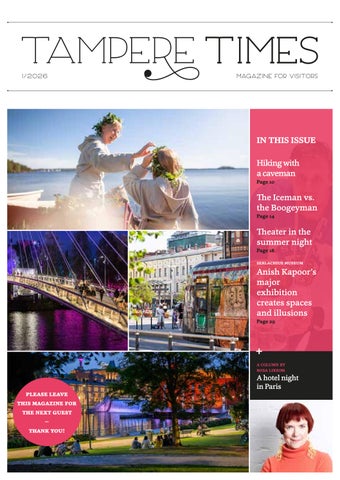
Tampere – Destination for sauna and Moomins 8
Hiking with a caveman 10
The Iceman vs. the Boogeyman 14
Theater in the summer night 18
Tampere in a nutshell 22
Map of Tampere 24
Hotels providing Tampere Times 26
Anish Kapoor’s major exhibition creates spaces and illusions at Serlachius 29
Life in a new language
Captain Finland: How to make it in Finland, Part 3
Something for everyone: Moomin philosophy never gets old
A hotel night in Paris – Column by Rosa Liksom


Tampere Times
Magazine for Visitors Issue 1/2026
Summer www.tamperetimes.fi
ISSN 2343-3817 (print)
ISSN 2669-8293 (online)
Graphic design & layout
Petteri Mero
Mainostoimisto Knok Oy
Editor in chief Roope Lipasti
Sales manager Raimo Kurki
raimo.kurki@aikalehdet.fi
Tel. +358 45 656 7216
Sales manager
Kari Kettunen
kari.kettunen@aikalehdet.fi
Tel. +358 40 481 9445


Published by Mobile-Kustannus Oy Betaniankatu 3 lh FI-20810 Turku, Finland
Member of Finnish Magazine Media Association (Aikakausmedia)
Publisher Teemu Jaakonkoski
Printed by Newprint Oy
Cover photos
Sauna by the lake
Photo: Laura Vanzo / Visit Tampere
Summer night in Tampere.
Photo: Mikko Vares / Visit Tampere
Tampere city center
Photo: Laura Vanzo / Visit Tampere
Tammerkoski
Photo: Mikko Vares / Visit Tampere Rosa Liksom.
Photo: Pekka Mustonen

Located in the heart of Tampere, Tullintori brings together a vibrant mix of the city’s best restaurants, local cafés, specialty shops and wellness services. You’ll also find everyday essentials, including grocery stores, a pharmacy and ATMs, all under one roof.
With entertainment and activities for all ages, Tullintori offers something for everyone. Whether you’re a local or visiting Tampere for the first time, there’s always a reason to stay a little longer – every visit is an experience.
Opening hours
Mon–Fri 7 am – 9 pm Sat 9 am – 9 pm Sun 12 pm – 9 pm
Tullikatu 6 | tullintori.fi
Please note that some shops are closed on Sundays.


Hello traveler, and a warm welcome to Tampere, the most loved city in the happiest country in the world!
Our city is loved by those who visit it and not without reason. Tampere has been ranked as the most attractive city in Finland, and once you’re here, you’ll quickly understand why. Life here moves at a pleasantly human pace, so take your time to explore and enjoy.
Nature is always close by in Tampere. The beautiful Pyynikki ridge begins right next to the city centre, offering scenic trails and stunning lake views. Even the national parks are easy to reach with the Outdoor Express shuttle bus.
Did you know that Tampere is the European Capital of Smart Tourism 2026? This recognition, awarded by the European Commission, highlights cities that lead the way in sustainable and innovative tourism. In Tampere, this means practical, visitor-friendly solutions from our accessible tram system to digital services like the Tampere.Finland mobile app. We are also proud to be home to the world’s only Moomin Museum and to carry the title of Sauna Capital of the World.
There is always something happening in Tampere. The city’s vibrant event scene offers experiences for every taste. And speaking of taste: don’t miss our restaurants, where local ingredients meet creative cuisine. A visit to the over 120-year-old Tampere Market Hall is a perfect way to experience local life, and no stay is complete without enjoying the famous doughnuts at Pyynikki Observation Tower.
One of the most authentic ways to connect with local culture is through sauna. In the Tampere region, you’ll find over 70 public saunas, ranging from traditional wooden saunas to modern lakeside
experiences with panoramic views. And in many places, you can step straight from the heat of the sauna into the refreshing lake.
One of the most authentic ways to connect with local culture is through sauna.
If you’re looking for my personal favorites, I warmly recommend a visit to Viikinsaari island. It’s a charming summer oasis just a 20-minute boat ride from the city centre. Another must is Laukontori marketplace by Lake Pyhäjärvi, perfect for a relaxed coffee or lunch by the water. For culture lovers, Tampere Hall summer exhibition is a highlight. This year the playful and nostalgic Game On exhibition is on display. While in Tampere Hall, I also recommend visiting the Moomin Museum. It is a unique place that brings Tove Jansson’s stories to life and delights visitors of all ages.
I hope you enjoy your stay in Tampere as much as we enjoy sharing it with you.
WelcoMe again, and make yourself at home.
Jari Ahjoharju ceo, viSit taMpere

The Tampere Philharmonic Orchestra’s symphony concerts are held on Fridays, and a monthly chamber music series on Sunday afternoons at the Tampere Hall. You’re invited.
Concerts, tickets, offers and news at tamperefilharmonia.fi


Vapriikki’s Ancient DNA: A Key to the Past exhibition takes visitors on a journey through time into the lives of people from the past, using the latest scientific research. The exhibition reveals the traces that ancient people have left on us and how they relate to people living today.

The exhibition texts are available also in Swedish, Japanese, French and German.


Tuomo Kesäläinen has a list of the hundred best geological sites in Finland. He reminds us we have the Ice Age to thank for the uniqueness of Finnish nature.
When nonfiction writer and nature guide Tuomo
Kesäläinen visits the forest, he generally isn’t looking for berries or even at the views. Instead, he’s looking for something more exciting: caves, ravines, giant’s kettles, and the inland shingle beaches known as “devil’s fields.” The places where Finland’s Ice Age history can be seen most plainly.
Kesäläinen, a Naantali native, has spent years mapping Finland’s geological curiosities, places that tell the story of a time when an ice sheet shaped the landscape in a way that is rarely seen elsewhere in Europe:
“There is nowhere where the Ice Age is as visible as it is in Finland – well, maybe in Sweden,” Kesäläinen says.
His interest in unusual natural places arose early in his childhood. Kesäläinen’s family were caravanners and spent their vacations traveling around Finland, Sweden, and Norway.
“Whenever we stopped, we always hiked a nature trail. Or if there was an interesting giant’s kettle or cave somewhere, we went to see it. When I got my driver’s license, I started heading out on my own. First, I worked through all the known sites, and when I ran out of those, I started to think that there must be more. That’s when the real search began.”
One major source of inspiration for Kesäläinen was caver Aimo Kejonen , who had spent decades mapping Finland’s caves and collecting folklore about them. Kesäläinen became Kejonen’s man in the field, as Kejonen was already elderly. Kesäläinen searched for and checked sites, documented them, and collected stories. The collaboration resulted in several books.
It turned out that there were plenty of stories to tell. Many of Finland’s unusual natural sites are linked to stories about devils, giants, and other supernatural creatures.
“When you see a devil’s field, which is actually an old seabed and just filled with heaps of rocks, it’s no wonder that people have thought them supernatural. It’s simply hard to comprehend how all those stones got there.”
Some of these unusual places were considered sacred in pagan times. The devil stories may have been linked to them later, when Christianity arrived, so that the old worship practices would be forgotten. Similarly, many churches were built on the sites of former sacred groves.
“And obviously, giants and devils are much more interesting explanations than a boring old Ice Age,” Kesäläinen says with a laugh.

Giants and devils are much more interesting explanations than a boring old Ice Age.
In his latest book, Suomen kauneimmat retkikohteet – 100 geologista erikoisuutta, Kesäläinen presents one hundred of his own favorite nature spots in Finland. The sites are divided into categories: caves, ravines, devil’s fields, ridges, and kettle holes created by the Ice Age.
“For each site, I give a scientific explanation and a QR code to help you locate it. I wanted to make the book as comprehensive as possible: it covers the whole country, from Åland to Koli and the northernmost reaches of Lapland. Ostrobothnia, too, which is often left empty on nature maps.”
So, what is it that’s special about Finnish nature?
“Our landscapes aren’t ostentatious, like in Norway. They’re more restrained. But the traces of the Ice Age are unique. I would want foreign visitors to see the big bogs and lakes – and of course the midnight sun.”
If you’re exploring the forest without a specific destination, Kesäläinen has a simple tip: climb up onto the exposed bedrock.
“The higher, the better. A typical Finnish forest is often dense and hard to navigate, but it’s easier to move around on the rocks, and the views are better. Plus, old trees and twisted pines often grow there.”
Another underappreciated and sometimes even slightly feared destination is a bog:
“You don’t have to be afraid of sinking in up to your neck. Boots are good enough. It’s also interesting that a completely normal Finnish forest is a place that can make people nervous. I’ve had visitors from Central Europe who found the silence and untouched nature of the forest even frightening. An exotic experience is surprisingly close by.”
According to Kesäläinen, one of the greatest treasures of Finnish nature is Everyman’s Rights.
“Anyone can go almost anywhere in nature. That’s unique. In Finland, you won’t find much nature you have to pay for.” s
Helsinki area: “There too, I would direct my gaze toward the sea. From on the water, you can also get a view of a beautiful national landscape, the skyline of Helsinki, which is worth seeing. There are several islands designated for recreational use, and they can be reached by ferry from the Market Square. Some of the islands are on the UNESCO World Heritage List.
Again, if the sea doesn’t interest you, it’s not a long way to Nuuksio National Park, which is another place you can get to by bus. There you can experience the Finnish forest and lake landscape. It’s a reliable and easy attraction, for both foreigners and Finns.”
Jyväskylä: “The lake view is also worth seeing in Jyväskylä. The Kanavuori nature trail is one great option. It starts quite close to the city center, and the scenery is stunning. It’s sometimes even compared to Koli. And there are plenty of other nature trails in Jyväskylä, too.”
Tampere: “Pyynikinharju is a stunning natural attraction right in the city center. The ridge reaches 80 meters high, with a beautiful lake on either side, and of course, the old wooden houses are idyllic.
By tram, you can get to a different sort of destination: the Hervantajärvi hiking trail. It’s a beautiful and interesting trail, where you can easily walk 10 kilometers. You can even go swimming while you’re at it.”
Turku: “The obvious choice is the sea. The rugged archipelago, with its thousands of islands, is unique, and you can get there right from the center of Turku. Even just the water bus ride to Ruissalo is nice. You can get further out by taking a ferry. For example, the island of Seili is great.
If you’re not interested in water, I recommend a bog. Kurjenrahka National Park can be reached by bus from the Market Square in 45 minutes. The scenery is beautiful, and there’s no danger of getting lost.”
Saimaa: “The whole area is special, of course, but if I have to be more specific, Punkaharju is my personal favorite. It’s a unique geological formation, and it has all the recreational amenities you could hope for, from bicycles to SUP boards and boats. Punkaharju also has the country’s best scenic road, which you can travel by car. Imatrankoski is another impressive and easily accessible destination. It’s one of the largest rapids in Europe, and when the dam is opened, it’s a sight to behold. It’s also a geologically interesting place, with many giant’s kettles, for example.”
Tuomo Kesäläinen: Suomen kauneimmat retkikohteet – 100 geologista erikoisuutta. (Readme.fi, 2026)

Kehräsaari stefanssteakhouse.fi

A terrace, live music, a wide selection of drinks and happy service fills the shores of Tammerkoski!

Hämeenkatu 15 rubyandfellas.fi
Authentic Neapolitan pizzas from the best ingredients.
Welcome to one of the best terraces of Tampere.

Laivaravintola
Enjoy summer water in an idyllic
Laukontori suvilaiva.fi


Laivaravintola Suvi summer days by the idyllic setting.


LIVE MUSIC, JAZZ AND BLUES ALMOST EVERY DAY OF THE WEEK
OPEN ALL NIGHT
Koskikatu 9 paappa.fi

YOUR COZY CENTRAL EUROPEAN LIVING ROOM IN THE HEART OF TAMPERE.
COFFEE, COCKTAILS, AND BEATS FROM AFTERNOON TILL LATE.

Hämeenkatu 13 henkkatampere.fi

Perfect pizza, ice-cold drinks and the best summer vibes on three decks.
Come for the food, stay for the views.

Finnish sports history is full of legends with equally legendary nicknames
Written by Matti MäkeLä
by Christina saarinen


Let’s start with the one that’s been used most often. Of those who have been called “The Flying Finn”, the most famous – and, in the opinion of many, the only true – bearer of the name was 1920s running legend and nine-time Olympic champion Paavo Nurmi However, the same nickname had already been used for Finnish running star Hannes Kolehmainen, who predated Nurmi and won three gold medals at the 1912 Stockholm Olympics and the marathon in Antwerp eight years later. Since Nurmi, the name has been used ad nauseam for countless Finnish runners, not to mention Formula and rally drivers. The most recent runner to earn the title was Lasse Virén, who won the 5,000 and 10,000 meters at both the 1972 Munich and 1976 Montreal Olympics. Anyone who knows anything about athletics knows that using the word “flying” to describe Finnish long-distance runners today wouldn’t even pass for a bad joke.
Due to his sullen and quiet nature, Nurmi was also called “The Great Silent One,” which as a nickname goes, is pretty clumsy; it even sounds a bit North Korean (which is rarely a good thing). Its clumsiness is all the more apparent when compared to “The Iceman,” the nickname that Formula team principal Ron Dennis gave Kimi Räikkönen for exactly the same character traits. Räikkönen earned the nickname, of course: his Garbo-esque response to his race engineer on team radio has gone down in Formula history: “Just leave me alone. I know what to do.” What elevates the story to Casablanca level (as is well known, neither Bogart nor anyone else ever said, “Play it again, Sam,” in the film) is that Räikkönen is often misquoted as saying, “I know what I’m doing,” instead.
World Championships in 1995. He wasn’t called “The Giant” or “The Colossus of Kemi” (a small town in Northern Finland), but instead, “The Fairy of Kemi.”
Similarly, the best ski jumper of all time, Matti Nykänen, was known early in his career as “Masa the Mouse,” which referred to his small stature and was also a twist on the given name of Japanese ski jumper Masahiro Akimoto (“Masa the Mouse” is Masa-hiiri in Finnish, and Masa is a common nickname for Matti). This not-so-cool name was abandoned at the 1982 World Championships in Oslo when Nykänen earned the first elite gold medal of his career by jumping by far the longest jump in the competition, in an almost impenetrable fog. Mice don’t jump like that.
He scored his goals by smashing them into the net from right in front of the goal, after sneaking past the defenders as if from out of nowhere.
The young players that led Finland to its first World Ice Hockey Championships win in 1995, Saku Koivu, Ville Peltonen, and Jere Lehtinen , were nicknamed the “Huey, Dewey, and Louie Line” after Donald Duck’s nephews. Koivu’s and Lehtinen’s successful NHL careers earned them cooler nicknames in North America: with his all-around skills, Lehtinen was known as “Mr. Fix-It,” and Koivu, who played as captain of the Montreal Canadiens for many years, was known simply as “Captain K” (which you might also interpret as having a certain comic-book quality). When Koivu returned to Finland and his hometown club, TPS, during the NHL lockout season, he was greeted at his first home game with a huge "Return of the King" banner, a reference to the Lord of the Rings trilogy.
Alongside “The Iceman,” another contender for coolest nickname is world motorcycle road racing champion Jarno Saarinen’s “The Baron.” The name is based on a nickname Saarinen’s mother gave him, “The Cat Baron,” after he brought home a stray cat he found somewhere as a child. It’s fitting of this aristocratic style that statues of Saarinen, who died tragically at the 1973 Grand Prix race in Monza, have been erected both in Assisi, Italy, and in his hometown of Turku. Abroad, Saarinen was also known as – surprise, surprise – “The Flying Finn.”
Royal nicknames are particularly popular in football: among many others, Pelé (“Rei Pelé”) and Michel Platini (“Le Roi”) are called kings, while Franz Beckenbauer is an emperor (“Der Kaiser”). In Finland, too, the best football player of all time, Jari Litmanen , has been unimaginatively titled “The King,” but in general, people here seem to prefer more humorous – and sometimes even slightly mean – nicknames (like those given in Mexican drug cartels, whose hard-nosed bosses have been given nicknames like “Shorty” and “Chicken Little”). Take, for example, Mika Halvari, a 190-centimeter-tall shot-putter who weighed 140 kilos when he was competing and won silver at the
A top candidate on the list of strangest-sounding nicknames is definitely that of 1985 World Rally champion Timo “Slack” Salonen. For a long time, the nickname was said to have come from Salonen’s habit of driving rally with only one hand on the steering wheel. However, Salonen himself later corrected the story, explaining that he had called Erkki Pitkänen, who had driven the same kind of car as Salonen in Finnish rally races in the 1970s and whom Salonen had squarely beaten, “Slack Pitkänen.” The jeer came back to bite him, however, and became Salonen’s own nickname.
Hockey player Marko Anttila got his nickname “The Boogeyman” already in his school days, based on his large size and first name (which sounds similar to mörkö, meaning boogeyman in Finnish), but he only truly lived up to his nickname at the 2019 World Championships. During the tournament, he scored four crucial goals in the playoff rounds: first a last-minute equalizer against Sweden in the quarterfinals, then the winning goal against Russia in the semifinals, and finally two goals in Finland’s 3–1 championship victory over Canada. He scored his goals by smashing them into the net from right in front of the goal, after sneaking past the defenders as if from out of nowhere – just like the father of all boogeymen, Michael Myers, in the Halloween movies. s


Where Tokyo meets Hawaii
Tuomiokirkonkatu 40 aloharamen

Karaoke, Nightclub & Sauna
Laukontori 12 kaijakka
Postmodern Divebar
Hämeenkatu 10 riskybusinessbar
Local Brews & Bites
MAJA/TALO
Pirkankatu 1 majatalotre
Terrace Bar & Restaurant
DAM
Valssipadonraitti 2 dambar.fi


Art, and especially theater, doesn’t take itself too seriously in Finland. Or at least not in the summer, when Finns swap their jeans for track pants and decamp to summer cottages in remote villages with practically nothing to offer: just a shop, a seasonal farmer’s market, a gas station, and a local history museum with old plows on display.
And a summer theater!
Finland has more summer theaters relative to population than anywhere else in the world. No one even knows exactly how many there are, but estimates hover somewhere around 600. And they’re popular, too: over a million people attend summer theater performances each year, which is quite an impressive figure in a country of five million people.
Summer theaters perform outdoors, so a hat might be useful, and a windbreaker will help with the mosquitoes. It’s a good idea to
bring along a blanket and a seat pad. An umbrella too, if the seating isn’t covered.
Standards of behavior are also looser. It’s not unheard of for there to be a group of people in the audience who have had enough drinks before the show that they find everything really funny – to the extent that the rest of the audience thinks they find everything too funny. So it’s well-advised to moderate your intake, at least during the show.
Every Finn knows more or less what to expect when they buy tickets to a summer theater performance in cottage country. More likely than not, there will be humor, some of it off-color, as well as plenty of funny hats and wigs. The genre is farce – or “bush farce,” as we say in Finland. The actors are for the most part amateurs: the local
shopkeeper, the bus driver, and a few others. If there’s money, a real actor will play the main role. The sets are a volunteer effort, as are the concessions sold at intermission. The director’s uncle provides security.
As an alternative to humor, the theater might offer local history or a well-known classic of Finnish literature.
To be honest, that’s an overblown caricature of summer theater. Summer theater is also put on by professionals. Especially in larger cities, all the theater companies also produce their own summer theater, in which case the end result is just as professional as it is indoors in the winter, down to the same actors. But it’s still summer theater.
So what’s really the essence of summer theater? Let’s ask Satu Rasila. She’s one of Finland’s most popular playwrights and the dramaturg of Turku City Theatre.
Rasila points out that it isn’t actually the content that makes a summer theater, because it can be anything, as mentioned earlier.
“The common factor must be something else. And it’s probably the circumstances, the summer. The performances are outdoors, and the weather could be anything: oppressively hot, or then again, snowing. And maybe a squirrel will decide to come and take part. Things going on outside the play are present in a very concrete way, and the conditions can affect the performance in all kinds of ways.”
Summer theater audiences are also in some ways more forgiving than at a regular theater. They tend to be more tolerant of double-entendres and drunken humor.
“Summer theater features a kind of communal camp humor, an aesthetic of bad taste. And the audience agrees to go along with the idea that now it’s okay to laugh at stupid things. The audience puts up with a lot of other things too, like sitting on hard wooden benches in the rain! I remember one performance where the audience had covered seating, but the actors were out in the open. It started raining so hard that you couldn’t make out anything the actors were saying in the midst of all the noise. Eventually, lightning struck the sound booth. At that point, they finally stopped the performance.”
According to Rasila, summer theater is also a very communal form of theater, for both the creators and the audience. It’s theater from the heart, and Finns love it:
“Perhaps it’s where Finns’ love of so-called normal theater also stems from. People in Finland go to the theater about 3.5 million times a year, which is really a lot,” says Rasila.
Rasila notes that summer theater is often associated with a certain old-timiness or nostalgia, sometimes also with a homespun feel:
“My own grandfather once gave me the advice, when he was performing, that if you forget a line in summer theater, you can always just say, ‘So, anyway,’ which gives you a little time to think. To this day, the aesthetics of summer theater still often spring from that kind of ‘So, anyway’ world!”
Nonetheless, a successful summer theater succeeds for the same reason as any other theater:
“It has to be exciting. The performance has to somehow give you a nudge, strike a nerve, make you laugh or cry. A lukewarm effort doesn’t cut it in summer theater either.”
The play is written to be completely impossible for an actor - in one case, Miska is on stage in two roles at the same time.
Summer theaters generally have some kind of specialty: some do only comedy, some do classics, some do musicals.
Rasila has written summer theater plays for Emma Teatteri in Naantali, which is a comedy theater. Comedy is more difficult as a genre today than in the past, as perceptions of what is appropriate to laugh at have been changing. Many old comedies don’t resonate with audiences of today because of the way they portray people.
“On the other hand, comedy and summer theater give you the opportunity to do practically anything. For example, we once did a show called Hockey Night. Ice hockey at the summer theater on a summer evening! It was completely ridiculous, but audiences liked it,” Rasila recalls.
One audience favorite has been comedies that have many more roles than there are actors. These generally involve attempting something “impossible,” such as telling the eight-hundred-year history of Turku in two hours (and the program promised to present the history of Helsinki and Tampere as well!).
“Quick role changes make for good comedic pace and tension. For example, in one play, the actor Miska Kaukonen, who has done a lot of these, had just six seconds to change his whole outfit. Your foot had better land in your shoe on the first try, or it’s all over. Audiences have also learned to enjoy seeing how an actor manages – or whether he can manage – to pull off his seemingly impossible task.”
Kaukonen will have the chance to show off his clothes-changing skills this summer as well:
“We have a play at Emma Teatteri called Loistojuttu (A Brilliant Idea). It’s an award-winning French comedy that centers around the idea that everyone has a doppelganger. Miska Kaukonen plays three different characters, and the play is written to be completely impossible for an actor – in one case, Miska is on stage in two roles at the same time. It’s going to be fun!” s


In Nokia, you can enjoy nature, events and culture all in one day. Walk along forest trails and pause by lakeside views. Along the way, stop by the charming Up and Under earthwork by Nancy Holt.

8000 BC
The connection to ocean from the Tampere region was cut when the ice age was finally over. As the ice melted, the land rose up and the lakes were born – also Näsijärvi and Pyhäjärvi, and little later the Tampere Rapids. A must see attraction from the ice age is Pyynikki, a 90 hectare ridge area, which is almost in the centre of the city. From here there are marvellous views to lake Pyhäjärvi. It is also a beautiful place for other outdoor activities.
Tampere was an ideal place to build a village, because there were good waterways to both north and south. The first signs of permanent living in the area are from the 7th century.
By the 13th century Tampere region had grown, and it was an important market place. It was inhabited by the Pirkka tribe and even today the Tampere province is called Pirkanmaa, “The land of the Pirkka”.

Tampere was not yet an actual city, but in 1638 Finland’s governor Per Brahe ordered two yearly fairs to be held at the the Tampere Rapids. That’s why Turku – the then capital of Finland – and Tampere have got a special connections of fates, for when the whole city of Turku burned in 1827, the damage was so severe partly because all the men from Turku happened to be at the Tampere fair.
The King Gustav III of Sweden finally granted Tampere the full township status. And no wonder, because Tampere was huge: 3.2 square kilometres with population of no less than 200!
1824
The beautiful old church of Tampere was built. The architect was Charles Bassi.
1820
A Scotsman called James Finlayson set up a cotton factory near the Tampere Rapids. It was the first but not last major factory in the remarkable industrial history of Tampere. Finlayson still is a brand every Finn knows. Also from that time on, the use of waterpower from Tampere Rapids became important.
From the 1840’s Tampere became the most industrialised city in Finland. Soon there were factories that made iron, paper, machinery, clothes, shoes and many other things. Even to this day Tampere is sometimes called “Manse”, which comes from the saying that Tampere is the Manchester of Finland.
Tampere is also a vibrant theatre city. The first one, Tampereen Työväen Teatteri – The Tampere Workers Theatre – was established 1901. In 2020 there are over 10 professional theatres in the area.
In 1918 Finland was torn by a civil war with two sides: the “reds” and the “whites”. As a working class city, Tampere sided with the reds (who lost). Tampere saw severe battles, thousands died in war efforts and even more in prison camps.
Finland was in war against Russia, and Tampere was an important centre of war industry. For example Tampella made mortars and cannons. Tampere was also bombed, but luckily there was little damage.
Näsinneula, the high tower that Tampere is famous for, was built. Few years later The Särkänniemi Amusement Park opened its doors.
During the 90’s the heavy industry of Tampere was in trouble. One reason was the collapse of Soviet Union, but all and all the world was changing. The chimneys were no longer active, and the factories shut down. Nowadays they are renovated for apartments, museums and such. Industry in today’s Tampere in mostly high tech.

Tampere is the third biggest city in Finland, with 264,000 inhabitants in the city. It has four universities and a very vivid cultural life. Tampere is also a city of vision and courage: the brand new tramway is a good example of that! s
01 courtyard by Marriott
taMpere city hotel
Yliopistonkatu 57, 33100 Tampere
Tel. +358 29 357 5700 www.marriott.com
02 dreaM hoStel taMpere
Åkerlundinkatu 2, 33100 Tampere
Tel. +358 45 236 0517 www.dreamhostel.fi
03 hotel hoMeland
Kullervonkatu 19, 33500 Tampere
Tel. +358 3 3126 0200 www.homeland.fi
04 hotel kauppi
Kalevan puistotie 2, 33500 Tampere
Tel. +358 3 253 5353 www.hotelli-kauppi.fi
05 lapland hotel taMpere
Yliopistonkatu 44, 33100 Tampere
Tel. + 358 3 383 0000 www.laplandhotels.com
06 lillan boutique hotel
Kurjentaival 35, 33100 Tampere
Tel. +358 10 200 7305 www.lillan.fi
07 norlandia taMpere hotel
Biokatu 14, 33520 Tampere
Tel +358 50 3844400 www.norlandiahotel.fi
08 original SokoS hotel ilveS
Hatanpään valtatie 1, 33100 Tampere
Tel. +358 20 123 4631 www.sokoshotels.fi
09 original SokoS hotel villa
Sumeliuksenkatu 14, 33100, Tampere
+358 20 123 4633 www.sokoshotels.fi
10 radiSSon blu
grand hotel taMMer
Satakunnankatu 13, 33100 Tampere
Tel. +358 20 123 4632
www.radissonblu.com
11 Scandic eden nokia
Paratiisikatu 2, 37120 Nokia
Tel. +358 3 4108 1627
www.scandichotels.fi
12 Scandic poStitalo
Rautatienkatu 21, 33100 Tampere
Tel. +358 3 0030 8486 www.scandichotels.fi
13 Scandic roSendahl
Pyynikintie 13, 33230 Tampere
Tel +358 3 244 1111 www.scandichotels.fi
14 Scandic taMpere city
Hämeenkatu 1, 33100 Tampere
Tel. + 358 3 244 6111 www.scandichotels.fi
15 Scandic taMpere häMeenpuiSto
Hämeenpuisto 47, 33200 Tampere
Tel. +358 3 4108 1628
www.scandichotels.fi
16 Scandic taMpere koSkipuiSto
Koskikatu 5, 33100 Tampere
Tel. +358 3 4108 1626
www.scandichotels.fi
17 Scandic taMpere Station
Ratapihankatu 37, 33100 Tampere
Tel +358 3 339 8000 www.scandichotels.fi
18 Solo SokoS hotel torni taMpere
Ratapihankatu 43, 33100, Tampere
Tel. +358 20 123 4634
www.sokoshotels.fi
19 Spa hotel holiday club taMpereen kylpylä
Lapinniemenranta 12, 33180 Tampere
Tel. +358 30 687 0000 www.holidayclub.fi


Anish Kapoor’s major exhibition creates spaces and illusions at Serlachius
One of the world's leading contemporary artists, Anish Kapoor, evokes eternal questions with a new monumental sculpture and paintings exhibited at Serlachius Museum in Mänttä.
Kapoor is renowned for his bold, sensual sculptures that hold a relationship with the viewer in the spaces they inhabit and create. Often using scale as a tool, his works are both intimate and architectural in their reach.
“His art can be eye-tantalizingly beautiful, and almost immaterial, as if its forms had been created without the touch of a hand. But it can also be intensely physical, even brutal. It is an art of powerful contrasts,” says exhibition curator Timo Valjakka
Kapoor explores the borderland between our inner world and external reality. He makes skilful use of visual archetypes and metaphysical opposites, the eternal questions of being and non-being, destruction and birth.
”Anish Kapoor has already had several retrospectives during his career. When we look at his career now, we
can see that despite almost fifty years of active work, he is living a very intense creative period. That is why we have not put together an overview of Kapoor’s entire career, but have instead focused on more recent works”, says Pauli Sivonen, director of Serlachius.
New artwork takes over the largest exhibition hall
The museum’s largest exhibition space features a site-specific monumental work designed and created by Anish Kapoor especially for the Mänttä exhibition.
”The artwork is an immersive experience that utilises the potential of our 600-square-metre, 11-metre-high contiguous exhibition hall”, says Sivonen.

As we approach these large paintings and their intoxicating attraction begins to affect us, we almost drown in their thick masses of paint.
It is difficult to talk about the dimensions of Kapoor’s art without resorting to big, overblown words. In fact, the economics of scale in his works have simply grown over the years, while their essentials approach those of architecture.
The scale of the artwork is also indicated by the fact that the gallery floor had to be reinforced to withstand the weight of the sculpture. Thirteen lorries are needed to transport the Mänttä exhibition.
The exhibition also features Kapoor's latest Non-Objects, which use Vantablack. Since 2014, Kapoor has been working with this innovative nanotechnology-based material, which has commercial applications in areas such as space technology.
For an artist who has explored the concept of void space throughout his career, Vantablack – a material that absorbs nearly 100 % of visible light – has opened up new possibilities for examining this condition.
Kapoor’s Non-Objects are a good way to start off the exhibition: they show in various ways how the artist has played with illusion and immateriality during his creative process.
From black holes, we move on to blood and lava. Next, visitors to the exhibition encounter Kapoor’s glowing red, bloody, or even carnal paintings.
”At the same time, visitors have already taken another step into Kapoor’s beloved immersive experience. As we approach these large paintings and their intoxicating attraction begins to affect us, we almost drown in their thick masses of paint”, says Sivonen.
The year 2026 is an important one for Anish Kapoor. In June, he will open his exhibition in London’s Hayward Gallery, where he also had a major solo show in 1998. The new exhibition at this much-loved institution in the heart of London’s South Bank is like a homecoming for Kapoor, who has worked out of London throughout his career.
In addition, Kapoor has an exhibition at Palazzo Manfrin this summer during the Venice Biennale, presenting his architectural models alongside new immersive mirror works and sculptures.
”At Serlachius, we are delighted that Kapoor is in such a bright spotlight just as we are opening his major show in Mänttä. We hope that as many art lovers as possible will be able to see the exhibitions in London, Venice and Mänttä”, says Pauli Sivonen.
Born in Mumbai (formerly Bombay) in 1954, the artist began building his international career in the 1970s. At the age of 18, he moved to London to study art, first at Hornsey College of Art and then at the Chelsea School of Art and Design.
Pigments played a central role In Anish Kapoor’s early works. Later he also developed an interest in stone. Through these sculptures he gradually moved to larger works, which became increasingly part of the architecture. As the works became more architectural in scale,
viewers were able to enter them and were frequently rewarded with illusions, bafflement and wonder.
The artist rose to world fame in the early 1990s. In 1990, he was selected the best young artist at the 44th Venice Biennale. The following year, he won the Turner Prize, considered Britain’s most important art award.
Today, Kapoor is arguably one of the world’s most celebrated contemporary artists. His works are regularly exhibited in major art museums and are included in the collections of, for instance, the Museum of Modern Art in New York, Tate Modern, and the Guggenheim.
Anish Kapoor’s art has been exhibited in Finland before, especially in the early stages of his career. The exhibition curated by Timo Valjakka at Kunsthalle Helsinki in 2001 was a landmark event at the time, attracting interest among art lovers and the general public alike.
The Anish Kapoor exhibition is on show at the Serlachius Manor from May 23, 2026 to April 4, 2027. s


Serlachius – An art destination in the cultural landscape of Mänttä
At Serlachius, surrounded by stunning Finnish lake nature, you can enjoy art, history, architecture as well as culinary and sauna experiences.
The exhibitions showcase intriguing contemporary art as well as Finnish and European masterpieces from the Serlachius Art Collection. We also tell you about the history of the Serlachius family and the paper industry in Mänttä.
The award-winning Serlachius Art Sauna creates a unique setting for relaxation and socialising. We organise sauna days open to the public throughout the year. We recommend booking your sauna session in advance online.
Restaurant Gösta offers pure Nordic flavours under the direction of award-winning restaurateur Henry Tikkanen. Your museum
visit continues with delicious flavors in our restaurant, located in the middle of a beautiful park landscape.
Serlachius Art & Sauna Express shuttle bus runs summertime (June 12–August 30) daily from Tampere directly to the museums.
Serlachius Manor, Joenniementie 47, Mänttä
Serlachius Headquarters, R. Erik Serlachiuksen katu 2, Mänttä
OPENING HOURS
summertime Jun 1–Aug 31 daily from 10 am to 6 pm
wintertime Sep 1–May 31 Tue–Sun from 11 am to 6 pm
MORE INFORMATION serlachius.fi/en


Say the code “We met at the hotel” to get free Agent Test for the kids!!
presents the ways and means of espionage
The world’s first spy museum in the city center introduces you to the world of real life James Bonds where a single device can change the world more than governments. World of eavesdropping, hidden cameras and microphones, secret weapons, hacking, code breaking, picking locks...
Translation books in 12 languages!
Museum is open Monday-Sunday 12-18
Admission ‘26: 11€ / 6€ Agent Test 5€
www.vakoilumuseo.fi Satakunnankatu 18, Finlayson
CONTEMPORARY DANCE FOR ALL AGES


Mariankatu 40, Tampere
Emil Aaltonen museum of industry and art. The permanent collection represents Aaltonen’s life and displays some of his art collection. The exhibited artists are masters of older Finnish painting. Temporary exhibitions.


Ever heard of an inkfish, river horse, salmon snake, wash mushroom, or peeing boy? No? Well, they are literal translations of Finnish words into English. The words actually mean octopus, hippopotamus, dragon, sponge, and windshield washer nozzle. And they are also examples of how Alicia Iredale makes her followers laugh on her popular Instagram account, @britinfinland, where she talks about learning Finnish.
moved from the UK to Finland to be with her boyfriend about six years ago and decided to learn this difficult language. A little more than a year ago, she started making videos on Instagram in which she speaks Finnish and wonders
The videos have become hugely popular, and a single video might get five million views. And it’s no wonder: Iredale’s pronunciation is exceptionally good, and she’s a natural performer, as if she were born in front of a camera. And
Moving to a new country was also interesting, as Iredale knew hardly anything
“For example, I didn’t really understand that there’s a proper summer here! It’s actually a rather common misconception: people think that there’s always snow in Finland, though in fact, the summer is often warmer here than in England. In the same vein, when we were at a cottage for the first time in the winter, I was told that it would be by a lake, and I wondered where the lake was. I didn’t
Iredale has training as an early childhood educator, so when she came to Finland she thought she would work at an English-speaking daycare center. But then she spotted a year-long language course for foreigners and decided to dedicate the
“I discovered that I really enjoyed studying and learning new words. I’d never studied languages before, so it was something new. And I learned a lot in a year. Of course, at first, I understood a lot more than I could actually speak. After studying for a year, I went to work at a Finnish-speaking daycare, which was great for language immersion. I was with one- to three-year-olds, and they don’t speak very well yet either. The sentences are short and the
From the children, Iredale also learned that the most important thing is to be understood, regardless of whether the grammar is perfect. It was
“It was only through work that I really started to become fluent in the Because of course there are many differences there: while a task may be

In Finland, almost everyone speaks English, so you can get by here without knowing Finnish. But on the other hand, language opens many doors:
“At first, we lived with my boyfriend’s parents, and I didn’t want everyone to always have to switch to English because of me. I wanted to learn at least enough to understand what everyone was talking about. These days, I understand maybe 95 percent. Thanks to knowing the language, I was also able to participate in staff conversations at the daycare. And people in Finland definitely appreciate it when someone even tries to learn the language! It’s sort of an icebreaker.”
On the other hand, it’s often a problem that Finns can be quick to switch to English if they notice someone is fumbling with the language:
“For example, if I asked something in a store, they would immediately answer in English because they wanted to be helpful. That doesn’t happen anymore. The other side of the coin is when people assume I speak perfect Finnish, and then they use complicated sentences and speak quickly, as if speaking to a Finn.”
Finnish is also not the easiest language. Compared to English, for example, Finnish is completely the same – except for the vocabulary, grammar, structure, and pronunciation...
Iredale finds the different noun forms particularly tricky. There are 15 of them.
“When I ask for a cup of coffee, is it kuppi kahvia or kupin kahvia? But on the other hand, I don’t really care anymore if I make mistakes. I would never say anything if I always had to speak perfectly.”
Another tricky thing is the way consonant sounds change in Finnish. Iredale has even made a video about this: how Finns delete letters in the possessive form of words.
“For example, the possessive form of the word ‘Turku’ is ‘Turun.’ Of course, there are rules about when to delete letters, but there are quite a few exceptions. Sometimes the inflected form of a word can look so different that it can easily be mistaken for a completely different word. For example, the negative form of the phrase sataa vettä [which means ‘it’s raining’] isn’t ei sataa vettä, it’s ei sada vettä. And that word looks completely different!”
Though we could also point out that in English, a person who lives in Liverpool is called, against all logic, “Liverpudlian,” so other languages are guilty of it, too…
When you change countries, you also encounter many oddities and differences in everyday life:
“For example, a dish brush is something we don’t have in Britain. We also don’t have cheese planes. Cheese is either cut with a knife or comes ready sliced. Once, when I had just started working at the daycare, I was asked to get the cheese plane from the kitchen, which was tricky because I didn’t know what it was. And to top it all off, the Finnish word has ä and ö in it.”
Or how about Finnish interior design culture:
“Every single kitchen in Finland has Fiskars scissors and Moomin mugs. And there will usually be something from Marimekko somewhere in the home. The UK doesn’t have such a homogeneous culture.”
And even the cultural clichés are true:
“People’s personal space is so important that they will wait for the bus a long way from the stop so that they don’t get too close to anyone else. Personally, I don’t want to be that far away, so I just rudely go right up to the stop. And the funny thing is that it’s usually

1) Understanding language begins with speech. Don’t focus on written language alone because it won’t help in everyday communication. If you only read the written language, you won’t understand anything in ordinary speech situations.
2) Practice in different ways: by listening, writing, and thinking. For example, podcasts have been good for me. Even though you listen to them, they also help a lot with speaking. You can learn different phrases and structures – and words, of course. I also often talk to myself in Finnish.
3) Write down new words so they’ll be easier to remember. And if you can somehow contextualize them, that will also help you remember.
the same people waiting there at the same time for the bus every weekday morning!”
Accessing culture through language
Iredale has been making content about her life in Finland on Instagram for quite some time, but when she started making videos in which she speaks Finnish and shares her observations about the language, a little more than a year ago, her social media blew up.
The most popular seem to be videos that have some kind of “learn with me” angle, where Iredale wonders about or teaches some quirk of the Finnish language – and most of the students are Finns.
“They always give me a lot more examples. I suspect that the videos lead Finns to discover things about their own language that they might not have thought about.”
Another hit product has been various direct translations. For example, the Finnish word rautatie, meaning railroad, would translate to “iron road” in English. Or animals: if you translate the Finnish words for raccoon and anteater directly into English, you get “wash bear” and “ant bear,” which is admittedly funny.
“Learning the language is also always a key to the culture. If you don’t know the language, there are essential things you won’t understand. For example, Finns are very matter-of-fact people, they go straight to the point, and even sound a bit blunt to outsiders. And when a Finn speaks English, that Finnish abruptness often carries over into their English, but that’s not how English people speak! We like to mince words and sugar-coat things. But when you learn to speak Finnish, you realize that it’s not that they’re rude, it’s a way of thinking.” s
Tampere centre 15 min
Peaceful nature 0 min

visitylojarvi.

THE MOST STYLISH CLOTHING FOR WOMEN THIS SEASON!
Enjoy timeless fashion and the comfort of natural materials. Explore our wide selection and find your favourite look!

Lovely shop with Tampere and Suomi souvenirs, Finnish design, handicrafts and clothes

Taito Shop Tampere
Vuolteentori 2


Kuninkaankatu 30, 33200 Tampere kauppa.wilhelmiina.net
Open Mon–Fri 10–18, Sat 10–16

Explore contemporary art exhibitions and purchase local artworks through our art lending service

Mon–Fri 10–18 Sat 10–16
tel. +358 50 598 4367 taitopirkanmaa.fi free entrance / fritt inträde ART LENDING SERVICE
Kuninkaankatu 2 / Tampere maltinranta fi


Hiedanranta is home to exciting experiences, vibrant art and events, just 12 minutes by tram from Keskustori. Step into an enchanting new city district. See you in Hiedanranta!


DISCOVER RESTAURANTS, DESIGN BOUTIQUE, EVENTS AND ATTRACTIONS


Just 20 minutes from Tampere, the city of Kangasala invites you to explore scenic landscapes, peaceful lakes and unforgettable views. Famous for its national landscapes, it blends natural beauty with cultural heritage, offering stunning scenery, charming attractions and relaxing nature experiences. Easy to reach, hard to forget. Just hop on Nysse, Tampere Region


Tove Jansson loved yellow roses. Though actually, she loved everything beautiful and pleasurable: dancing, parties, flowers, laughing. And that side of her personality also shines through the Moomins, who have gradually become loved all around the world. It remains a great injustice that Tove never received the Nobel Prize in literature.
But Tove’s lightheartedness and zest for life are not the whole picture. Underlying her joy in everyday life were weighty and important values that can also be found in her Moomin books, values like courage, love, and freedom. Or friendship, nature, and tolerance, which are also supporting pillars of the Moomin universe.
Although the Moomins are timeless, there are certainly many similarities between the present and the time 81 years ago, when the first book was published.
Tove wrote the book The Moomins and the Great Flood in 1939, but it was published only after the war, in 1945. As at the time of the book’s writing, we are once again in a situation where freedom is not self-evident. The wars in Europe and the Middle East have made people remember what is ultimately most important: their friends and loved ones.
The Moomin books are also current in the sense that different personalities and views on life are all given a voice, but everyone is united by the values of equality and
If you’re not afraid, how can you really be brave?
- Moominpappa

diversity. Everyone is always welcome at the Moominhouse, and its door is never locked, even at night, as the theme song of the Finnish version of the animated series says.
The characters of Moominvalley are allowed to be exactly who they are, different and unique. Sniff is greedy but fearful. Moominpappa is the head of the family, but rather irresponsible. Moominmamma takes care of everyone, to the point of exhaustion. Snufkin is a good friend, but despite that he always leaves. And so on. The inhabitants of Moominvalley have many sides, just like people. They also evolve.
The characters’ multidimensionality is also their charm. They have annoying features, but also loveable ones. Children may see one side of the Moomin characters, but adults see something else, which is probably one of the reasons for their popularity – everyone finds something in them. For Finns, there’s also an element of nostalgia: since most Finns have read the books as children, the Moomins unite them.
The Moomins are universal and deeply human. One of the distinctive features of the Moomins is their positivity. There’s not a single bad character in all of Moominvalley. The Groke is undeniably
scary, but at the heart of it, she’s just lonely, like many people who seem scary in real life probably are. As for Stinky... well, he tries to be a bandit, but nothing really comes of it.
Everyone in Finland recognizes the tall blue Moominhouse, but few know that it was inspired by a real-life building, the now-demolished Glosholm Lighthouse near Porvoo. Tove and her partner, Tuulikki Pietilä, had their summer place near Porvoo, on a barren cliff without any comforts.
The sea was an important element for Tove, both in real life and in the Moomin books: it’s a symbol of freedom and a place for swimming and sailing, but also something that no one can control.
The sea is also apparent in the work of artists Tove was inspired by. In illustration, she admired the Swedish artists John Bauer and Elsa Beskow, but she was also influenced by other artists, such as the famous seascape painters J. M. W. Turner from England and Hokusai from Japan.
Tove considered herself first and foremost a painter, and she was an excellent artist. But she will always be remembered above all for the Moomins. They are so beloved that since 2020, the Finnish flag is flown in Tove’s honor on her birthday, August 9th. s
Tove Jansson (1914–2001) was an artist, writer, caricaturist, and cartoonist who is best known as the creator of the Moomin characters. She published thirteen beloved Moomin books, which have been translated into more than 50 languages. Tove Jansson is Finland’s most translated author.

All things are so very uncertain, and that’s exactly what makes me feel reassured. - Too-Ticky
THE MOOMIN MUSEUM IN TAMPERE: Tue – Fri 10am – 6pm Sat – Sun 9am – 5pm

In the courSe of the trip from Charles de Gaulle Airport to central Paris, the grumpy, middle-aged taxi driver managed to curse the city’s system of roads, the government, the president, and elderly care. I looked out the backseat window at late autumn’s black Seine, where I had once swum, in the intoxication of youth; at Pont Neuf, where a few years earlier I had photographed women dressed in blue burqas.
The hotel was near the Saint Denis metro station, down the side street. The receptionist, an old man, stumbled wearily out of the back room. I apologized for my late arrival and explained that my flight from Helsinki to Paris had been delayed by several hours.
I climbed the narrow, creaky stairs to the third floor. The stairwell smelled of a bygone century, of dust, cigarettes, and 4711 Eau de Cologne. My room key hung on a heavy keychain carved from walnut wood. I wondered how many people had held this key before I was born. I threw my small backpack on the bed and opened the thick drapes. The large window looked out on a rainy street that was lit by dim street lamps. The dark windows of the tired old house next door stared back at me.
The mahogany bed creaked as I slipped under the heavy blanket. For a moment, I counted reindeer, until I fell into a deep sleep.
Early in the morning, I woke up to the strange feeling that I wasn’t alone in my room. I flicked on the bedside lamp and saw a suitcase with a big Pikachu sticker on the side. Someone was sleeping in
the armchair. He had hidden his face inside the hood of his white sweatshirt, but from the sticker on the suitcase and the sleeper’s childlike hands and slim torso, I deduced he was a Japanese teenager. I didn’t get up, out of fear that I would wake him. I wondered what I should do. I decided to lie in bed until the boy woke up.
At seven o’clock, the boy was still sleeping. I got out of my bed, took a shower, got dressed, and opened the window. The boy woke up, jumped from his chair, pulled the hood off his head, and without looking at my face, apologized in a quiet, shy voice.
“Sorry! I’m so sorry.”
“It’s okay,” I said.
“I’m very sorry, but this is my room,” the boy said. He explained that he had come from the airport during the night, found me, an older woman, in his bed, and been too exhausted to start straightening things out.
“What’s your room number?” I asked.
The boy answered: number six.
I said that couldn’t be because my room number is six.
When I handed him my room key, I realized that my room number was actually nine. It was my turn to apologize. The boy covered his mouth with his hand and said that he could take room nine.
I sat alone at a table by the window in the breakfast room and looked down at the street. The morning was sunny, the sky turquoise.

The mahogany bed creaked as I slipped under the heavy blanket. For a moment, I counted reindeer, until I fell into a deep sleep.
A stout wind carried dry maple leaves over the street. Over there, someone was hurrying along; over there, cheek kisses were being exchanged; over there, some people were chatting while their dogs peed on the autumn leaves. The boy sat at the next table and smiled at me sympathetically. I asked what had brought him to Paris.
“Long story short,” he said, looking at me ruefully, “a year ago, the week after my mother was buried, I was at a sushi bar with my friend when an older, middle-aged French woman came up to me and asked if I was interested in modeling. The woman seemed nice, but I said I wasn’t interested in modeling. I thought she would turn out to be a scam artist. Or maybe even a pervert, luring depressed young people into prostitution. After a short conversation, the woman handed me her business card and said to call if I changed my mind. A few months later, when I had finished school and life with my father was really hard, I called the number, and now I travel between Tokyo and Paris. What about you? Why are you in Paris?” the boy asked.
I told him I was an author and on my way to a literary festival in Normandy. He said he had only ever read a single novel in his life and still wondered how he managed to finish it. We chatted, laughed, and ordered more coffee, and when it was time to move on, the boy asked if I would like to come see a fashion show in the evening; he would be modeling accessories by Alexandre Mattiussi
“I would love to,” I said, “but Normandy is calling.”
When I gave the boy my email address, he smirked and said, “Don’t forget to lock your hotel room door.”
The next fall, I received an email from the boy. He said that he was living in Milan and had seen my book Scompartimento n. 6 in a bookstore window. s

Rosa Liksom is an author whose works have been translated into many languages. Hytti numero 6 (Compartment No. 6) won the prestigious Finlandia Prize and was made into a film that won the Grand Prix at Cannes.


lempaala.ideapark.fi
