parikkalan patsaspuisto finland`s most famous object of outsider art
VEIJO RÖNKKÖNEN (1942–2010) built a remarkable outsider art park in Koitsanlahti, Parikkala. His hard work of nearly 50 years resulted in about 560 concrete statues and a magnificent garden.
We have a shop in the park where you can get coffee, ice cream, t-shirts, canvas bags, mugs and many other statue park products. The shop is open in June, July and August daily from 10 am to 17 pm.
Discover 200 years of industry in Varkaus at the History Museum, the Art Museum and the playful Children’s Factory. Located in the charming Old Varkaus district beside a working mill environment. An easy and inspiring stop for all ages!
Tehtaan koulu Satakunnankatu 1, Varkaus konsti@varkaus.fi varkaus.fi/konsti
Local Food at TeaHouse of Wehmais
Pattoi Heritage House and Nature Trail
Outdoor Activities Hiking and Biking
Local Flavours by the Riverside at Rapio Mill
Saimaa Times
Magazine for Visitors Issue 2026
www.saimaatimes.fi
ISSN 2814-4651 (print)
ISSN 2814-4813 (online)
Graphic design & layout
Petteri Mero
Mainostoimisto Knok Oy
CONTENTS
From the editor: There is something for everyone on Lake Saimaa 6
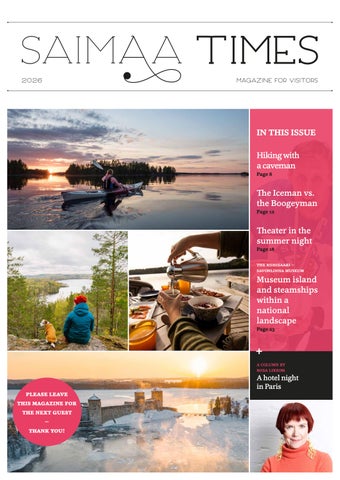
Hiking with a caveman 8
Saimaa area in a nutshelll 10
The Iceman vs. the Boogeyman 12
Map of Saimaa region 14
Hotels providing Saimaa Times 16
Theater in the summer night
Life in a new language
Museum island and steamships within a national landscape
A hotel night in Paris – Column by Rosa Liksom
Editor in chief Roope Lipasti
Sales manager Raimo Kurki raimo.kurki@aikalehdet.fi Tel. +358 45 656 7216
Sales manager Kari Kettunen kari.kettunen@aikalehdet.fi Tel. +358 40 481 9445
Published by Mobile-Kustannus Oy Betaniankatu 3 LH FI-20810 Turku, Finland
Member of Finnish Magazine Media Association (Aikakausmedia)
Publisher Teemu Jaakonkoski
Printed by Newprint Oy
Cover photos Kayaking at sunset. Photo: Visit Saimaa View from Neitvuori Hill. Photo: Visit Saimaa Lakeside breakfast. Photo: Visit Saimaa Olavinlinna Castle in Savonlinna. Photo: Visit Saimaa Rosa Liksom. Photo: Pekka Mustonen
Discover the Lakeland Peaks in Finland
Top Experiences in Northern Lakeland
The journey starts: Gateway to Northern Lakeland
Begin your journey in Joensuu, the lively gateway to North Karelia, where culture and creativity are part of everyday life. Discover the brand new Eliel Museum and Botania’s tropical garden, enjoy local flavors at Kerubi or Filipof, stay at the welcoming Lietsu Boutique Aparthotel, and explore the craft-filled Taitokortteli.
With vibrant summer events, atmospheric winters, and easy access from Helsinki by car, train, or plane, Joensuu is a smooth and inspiring starting point for your Northern Lakeland adventure.
Into the Mythical: The heart of Karelia & Kalevala
Iconic and deeply rooted in Finnish heritage, Koli is all about breathtaking landscapes and experiencing the age-old call of the wild. Hike the famous Koli Peaks Trail to achieve the Mythical Peak of the journey and immerse yourself in Finland’s national scenery. Visit the Ukko Nature Centre to learn about the region’s geology and stories.
From Koli, continue to Nurmes and Bomba, where Karelian tradition and tranquility come together. Join a handson pastry workshop, savor local cuisine, enjoy seasonal activities from kick sledding to e-fatbiking, and unwind at the Kalevala-inspired Bomba Spa.
Journey into North Karelia’s mythic landscapes by Lake Pielinen. Visit Pielinen Museum and Paateri, where heritage, art, and nature come together.
The Lakeland Peaks tour takes you to five destinations, including Joensuu, Koli, Nurmes, Tahko, and Vuokatti, blending culture, nature, wellness, and adventure.
Finish with a bang: The Peaks of Adventure & Activities
For those hungry for speed and more action packed adventures, Vuokatti is the playground for outdoor enthusiasts. Feel the thrill of a husky ride or explore rugged terrain on an off road SUV safari. The list just goes on: snowmobile adventures, hiking fells, speedboat cruising, and unforgettable bearwatching evenings elevate Vuokatti’s appeal. Enjoy local cuisine at Restaurant Kippo or Haapala, and settle into welcoming hotels or cabins to cool down after the day filled with activities.
End your journey in Tahko, where year-round adventure blends seamlessly with relaxation. Experience reindeer safaris in winter, ice karting, ziplines from the summit, and peaceful paddling to Kammonluoto Island. Savor meals at Havu, Pehku, or Hillside, stay in scenic hotels or cabins, and unwind at the atmospheric Forest Spa surrounded by nature.
Explore the full journey!
visitlakelandfinland.com
There is something for everyone on Lake Saimaa
Lake SaiMaa is Finland’s largest and most beautiful lake. It has about 14,850 kilometers of coastline when its 13,700 islands are taken into account, so visitors to the area will find no shortage of things to do and see.
The cities of Lappeenranta, Joensuu, Mikkeli, Imatra, Savonlinna, and Varkaus are all located on the shores of Lake Saimaa, so you can justifiably say that Lake Saimaa defines Eastern Finland.
In summer 2026, visitors can enjoy opera within castle walls, the silence of pristine lake nature, historic landmarks, and family-friendly festivals. The clear waters and stunning lake scenery connect the highlights of South Karelia and South Savo into one unforgettable destination.
For example like this:
Lappeenranta – the sandcastle and the vibrant harbor
For many travelers, Lappeenranta serves as a gateway to Lake Saimaa. In summer, the harbor area comes alive with activity: restaurant boats, cruises, and market events invite visitors to stay longer and soak in the atmosphere. The traditional Sandcastle rises once again near the historic Fortress, where visitors can combine a museum tour with a relaxing coffee break in the charming old barracks buildings. In the evenings, the waterfront boulevard fills with live music.
Savonlinna – Opera and the magic of Olavinlinna Castle
The medieval Olavinlinna Castle provides a spectacular stage for the Savonlinna Opera Festival. The 2026 program features both international performers and leading Finnish opera stars. Alongside the opera evenings, Savonlinna’s summer is filled with smaller concerts, lively market squares, and lake cruises that reveal the city’s unique island character.
Imatra – Roaring rapids and traces of the Ice Age
The legendary Imatrankoski rapids come alive on summer evenings with dramatic water releases, drawing spectators to the surrounding bridges and parks. Nearby nature trails reveal fascinating reminders of the Ice Age, including numerous giant’s kettles carved into the rock by ancient glacial forces.
Mikkeli and ancient rock paintings
Mikkeli combines culture and nature in a unique way. From the harbor, visitors can take a boat trip to the Astuvansalmi rock paintings, which tell stories of life on the shores of Saimaa thousands of years ago. In summer 2026, the city will also host several food festivals focusing on fresh local fish and traditional Savonian dishes. The garden setting of Kenkävero offer a peaceful place to relax during a day in the city.
Linnansaari and Punkaharju – At the heart of lake nature
For those seeking silence and pure nature, Linnansaari National Park is an ideal destination. The park is famous for the endangered Saimaa ringed seal, and guided kayaking and boat tours offer a chance to see this rare animal in its natural habitat.
Punkaharju, known for its scenic ridges, offers one of the most beautiful scenic routes in Finland. The narrow ridge road runs between two lakes, and stops along the way offer postcard-perfect views of the surrounding waters and forests.
Varkaus – In the heart of Saimaa
Varkaus is an excellent base for day trips on Lake Saimaa. Boating, kayaking, or stand-up paddleboarding are perfect ways to spend a summer day. The Kämäri–Ämmäkoski area offers a memorable nature experience: trails pass through lush forests, cross rapids on beautiful wooden bridges, and provide perfect spots for a picnic or simply to admire the flowing water. For museum lovers, the Konsti Museum Centre in Varkaus is also well worth a visit!
Have a nice trip!
Roope Lipasti is the editor in chief of Saimaa Times.
Photo: Riikka kantinkoski
Olavinlinna Castle in Savonlinna.
Boat
Fishing
&
.
LakelandGTE brings the magic of Lake Saimaa to life with nature tours and outdoor adventures all year round. From quiet electric boat cruises to seal safaris, fishing charters and winter eScooter experiences. Book your experience online and get ready for unforgettable moments in one of Finland’s most beautiful natural playgrounds in Puumala.
Hiking with a caveman
Tuomo Kesäläinen has a list of the hundred best geological sites in Finland. He reminds us we have the Ice Age to thank for the uniqueness of Finnish nature.
When nonfiction writer and nature guide Tuomo
Kesäläinen visits the forest, he generally isn’t looking for berries or even at the views. Instead, he’s looking for something more exciting: caves, ravines, giant’s kettles, and the inland shingle beaches known as “devil’s fields.” The places where Finland’s Ice Age history can be seen most plainly.
Kesäläinen, a Naantali native, has spent years mapping Finland’s geological curiosities, places that tell the story of a time when an ice sheet shaped the landscape in a way that is rarely seen elsewhere in Europe:
“There is nowhere where the Ice Age is as visible as it is in Finland – well, maybe in Sweden,” Kesäläinen says.
His interest in unusual natural places arose early in his childhood. Kesäläinen’s family were caravanners and spent their vacations traveling around Finland, Sweden, and Norway.
“Whenever we stopped, we always hiked a nature trail. Or if there was an interesting giant’s kettle or cave somewhere, we went to see it. When I got my driver’s license, I started heading out on my own. First, I worked through all the known sites, and when I ran out of those, I started to think that there must be more. That’s when the real search began.”
Caves and devil’s fields
One major source of inspiration for Kesäläinen was caver Aimo Kejonen, who had spent decades mapping Finland’s caves and collecting folklore about them. Kesäläinen became Kejonen’s man in the field, as Kejonen was already elderly. Kesäläinen searched for and checked sites, documented them, and collected stories. The collaboration resulted in several books.
It turned out that there were plenty of stories to tell. Many of Finland’s unusual natural sites are linked to stories about devils, giants, and other supernatural creatures.
“When you see a devil’s field, which is actually an old seabed and just filled with heaps of rocks, it’s no wonder that people have thought them supernatural. It’s simply hard to comprehend how all those stones got there.”
Some of these unusual places were considered sacred in pagan times. The devil stories may have been linked to them later, when Christianity arrived, so that the old worship practices would be forgotten. Similarly, many churches were built on the sites of former sacred groves.
“And obviously, giants and devils are much more interesting explanations than a boring old Ice Age,” Kesäläinen says with a laugh.
Written by roope Lipasti transLated by Christina saarinen
Old seabed, often called a Devil's field.
Giants and devils are much more interesting explanations than a boring old Ice Age.
Everyman’s Rights are an invitation
In his latest book, Suomen kauneimmat retkikohteet – 100 geologista erikoisuutta, Kesäläinen presents one hundred of his own favorite nature spots in Finland. The sites are divided into categories: caves, ravines, devil’s fields, ridges, and kettle holes created by the Ice Age.
“For each site, I give a scientific explanation and a QR code to help you locate it. I wanted to make the book as comprehensive as possible: it covers the whole country, from Åland to Koli and the northernmost reaches of Lapland. Ostrobothnia, too, which is often left empty on nature maps.”
So, what is it that’s special about Finnish nature?
“Our landscapes aren’t ostentatious, like in Norway. They’re more restrained. But the traces of the Ice Age are unique. I would want foreign visitors to see the big bogs and lakes – and of course the midnight sun.”
If you’re exploring the forest without a specific destination, Kesäläinen has a simple tip: climb up onto the exposed bedrock.
“The higher, the better. A typical Finnish forest is often dense and hard to navigate, but it’s easier to move around on the rocks, and the views are better. Plus, old trees and twisted pines often grow there.”
Another underappreciated and sometimes even slightly feared destination is a bog:
“You don’t have to be afraid of sinking in up to your neck. Boots are good enough. It’s also interesting that a completely normal Finnish forest is a place that can make people nervous. I’ve had visitors from Central Europe who found the silence and untouched nature of the forest even frightening. An exotic experience is surprisingly close by.”
According to Kesäläinen, one of the greatest treasures of Finnish nature is Everyman’s Rights.
“Anyone can go almost anywhere in nature. That’s unique. In Finland, you won’t find much nature you have to pay for.” s
Tuomo Kesäläinen's easy daytrip tips
Helsinki area: “There too, I would direct my gaze toward the sea. From on the water, you can also get a view of a beautiful national landscape, the skyline of Helsinki, which is worth seeing. There are several islands designated for recreational use, and they can be reached by ferry from the Market Square. Some of the islands are on the UNESCO World Heritage List.
Again, if the sea doesn’t interest you, it’s not a long way to Nuuksio National Park, which is another place you can get to by bus. There you can experience the Finnish forest and lake landscape. It’s a reliable and easy attraction, for both foreigners and Finns.”
Jyväskylä: “The lake view is also worth seeing in Jyväskylä. The Kanavuori nature trail is one great option. It starts quite close to the city center, and the scenery is stunning. It’s sometimes even compared to Koli. And there are plenty of other nature trails in Jyväskylä, too.”
Tampere: “Pyynikinharju is a stunning natural attraction right in the city center. The ridge reaches 80 meters high, with a beautiful lake on either side, and of course, the old wooden houses are idyllic.
By tram, you can get to a different sort of destination: the Hervantajärvi hiking trail. It’s a beautiful and interesting trail, where you can easily walk 10 kilometers. You can even go swimming while you’re at it.”
Turku: “The obvious choice is the sea. The rugged archipelago, with its thousands of islands, is unique, and you can get there right from the center of Turku. Even just the water bus ride to Ruissalo is nice. You can get further out by taking a ferry. For example, the island of Seili is great.
If you’re not interested in water, I recommend a bog. Kurjenrahka National Park can be reached by bus from the Market Square in 45 minutes. The scenery is beautiful, and there’s no danger of getting lost.”
Saimaa: “The whole area is special, of course, but if I have to be more specific, Punkaharju is my personal favorite. It’s a unique geological formation, and it has all the recreational amenities you could hope for, from bicycles to SUP boards and boats. Punkaharju also has the country’s best scenic road, which you can travel by car. Imatrankoski is another impressive and easily accessible destination. It’s one of the largest rapids in Europe, and when the dam is opened, it’s a sight to behold. It’s also a geologically interesting place, with many giant’s kettles, for example.”
Lake Saimaa is the largest lake in Finland – and the fourth largest in the whole Europe. It is not one big lake though, but rather consists of many smaller ones that are interconnected. Roughly measured, Lake Saimaa is 200 kilometres long and 100 kilometres wide. It is one of the most popular summer cottage areas in Finland and has about 25,000 holiday homes.
The best-known and at the same time rarest animal living in the lake is saimaannorppa – the Saimaa ringed seal – which became isolated from other ringed seal populations of the Baltic Sea about 8000 years ago, just after the ice age ended. Sadly, it is a highly endangered species today.
The largest cities in the Saimaa area are Lappeenranta, Mikkeli, Savonlinna, Imatra and Varkaus.
Lappeenranta
Lappeenranta is the 13th biggest city in Finland and has a population of about 73,000. It was founded as early as 1649 and its history can be seen, for example, in the Lappeenranta fortress area, which has many museums, galleries and much more to see. The nearby city harbour is also beautiful and offers access to Saimaa cruises.
Mikkeli
The history of Mikkeli, with a population of 52,000, is quite belligerent. The city is mentioned in various peace treaties since the 14th century
and has often been involved in war battles. During the last war, the headquarters of Finnish army was there. That is why the city has, among other things, the Headquarters Museum. Mikkeli is also Finland’s second most popular summer cottage location: there are about 10,000 cottages there.
Savonlinna
Savonlinna is especially known for its beautiful medieval castle called Olavinlinna, as well as the famous Opera Festival that the castle hosts every summer. The city is home to 32,000 people and its surroundings are full of beautiful sights and landscapes – for example, one of Finland’s national landscapes, Punkaharju, the narrow seven-kilometer-long ridge formed during the ice age. Tsar Nicholas I of Russia fell in love with it so much that in 1843 he ordered the area to be protected.
Imatra
Imatra is home to 24,000 people. The main industries are the paper industry and tourism: the city is located right next to the Russian border. Imatra is known for its exceptionally magnificent rapids, which is the oldest tourist attraction in Finland, and for the State Hotel on its shores. Dating back to 1903, the building reminiscent of a fairytale castle is well worth a visit.
Varkaus
The first mention of Varkaus dates back to 1323, when it was just a village as a border marker for a peace treaty. Since then, it developed into a significant center of the wood and paper industry thanks to its excellent location along the waterways. Today, the paper industry has waned even in Varkaus, but nature and wonderful landscapes remain, such as the beautiful Taipale canal or the unique Kämäri nature reserve. The city of around 20,000 inhabitants is also a city of naïve art and many museums. s
Finnish sports history is full of legends with equally legendary nicknames
Written by Matti MäkeLä
by Christina saarinen
transLated
Let’s start with the one that’s been used most often. Of those who have been called “The Flying Finn”, the most famous – and, in the opinion of many, the only true – bearer of the name was 1920s running legend and nine-time Olympic champion Paavo Nurmi However, the same nickname had already been used for Finnish running star Hannes Kolehmainen, who predated Nurmi and won three gold medals at the 1912 Stockholm Olympics and the marathon in Antwerp eight years later. Since Nurmi, the name has been used ad nauseam for countless Finnish runners, not to mention Formula and rally drivers. The most recent runner to earn the title was Lasse Virén, who won the 5,000 and 10,000 meters at both the 1972 Munich and 1976 Montreal Olympics. Anyone who knows anything about athletics knows that using the word “flying” to describe Finnish long-distance runners today wouldn’t even pass for a bad joke.
Due to his sullen and quiet nature, Nurmi was also called “The Great Silent One,” which as a nickname goes, is pretty clumsy; it even sounds a bit North Korean (which is rarely a good thing). Its clumsiness is all the more apparent when compared to “The Iceman,” the nickname that Formula team principal Ron Dennis gave Kimi Räikkönen for exactly the same character traits. Räikkönen earned the nickname, of course: his Garbo-esque response to his race engineer on team radio has gone down in Formula history: “Just leave me alone. I know what to do.” What elevates the story to Casablanca level (as is well known, neither Bogart nor anyone else ever said, “Play it again, Sam,” in the film) is that Räikkönen is often misquoted as saying, “I know what I’m doing,” instead.
World Championships in 1995. He wasn’t called “The Giant” or “The Colossus of Kemi” (a small town in Northern Finland), but instead, “The Fairy of Kemi.”
Similarly, the best ski jumper of all time, Matti Nykänen, was known early in his career as “Masa the Mouse,” which referred to his small stature and was also a twist on the given name of Japanese ski jumper Masahiro Akimoto (“Masa the Mouse” is Masa-hiiri in Finnish, and Masa is a common nickname for Matti). This not-so-cool name was abandoned at the 1982 World Championships in Oslo when Nykänen earned the first elite gold medal of his career by jumping by far the longest jump in the competition, in an almost impenetrable fog. Mice don’t jump like that.
He scored his goals by smashing them into the net from right in front of the goal, after sneaking past the defenders as if from out of nowhere.
The young players that led Finland to its first World Ice Hockey Championships win in 1995, Saku Koivu, Ville Peltonen, and Jere Lehtinen, were nicknamed the “Huey, Dewey, and Louie Line” after Donald Duck’s nephews. Koivu’s and Lehtinen’s successful NHL careers earned them cooler nicknames in North America: with his all-around skills, Lehtinen was known as “Mr. Fix-It,” and Koivu, who played as captain of the Montreal Canadiens for many years, was known simply as “Captain K” (which you might also interpret as having a certain comic-book quality). When Koivu returned to Finland and his hometown club, TPS, during the NHL lockout season, he was greeted at his first home game with a huge "Return of the King" banner, a reference to the Lord of the Rings trilogy.
Alongside “The Iceman,” another contender for coolest nickname is world motorcycle road racing champion Jarno Saarinen’s “The Baron.” The name is based on a nickname Saarinen’s mother gave him, “The Cat Baron,” after he brought home a stray cat he found somewhere as a child. It’s fitting of this aristocratic style that statues of Saarinen, who died tragically at the 1973 Grand Prix race in Monza, have been erected both in Assisi, Italy, and in his hometown of Turku. Abroad, Saarinen was also known as – surprise, surprise – “The Flying Finn.”
Royal nicknames are particularly popular in football: among many others, Pelé (“Rei Pelé”) and Michel Platini (“Le Roi”) are called kings, while Franz Beckenbauer is an emperor (“Der Kaiser”). In Finland, too, the best football player of all time, Jari Litmanen, has been unimaginatively titled “The King,” but in general, people here seem to prefer more humorous – and sometimes even slightly mean – nicknames (like those given in Mexican drug cartels, whose hard-nosed bosses have been given nicknames like “Shorty” and “Chicken Little”). Take, for example, Mika Halvari, a 190-centimeter-tall shot-putter who weighed 140 kilos when he was competing and won silver at the
A top candidate on the list of strangest-sounding nicknames is definitely that of 1985 World Rally champion Timo “Slack” Salonen. For a long time, the nickname was said to have come from Salonen’s habit of driving rally with only one hand on the steering wheel. However, Salonen himself later corrected the story, explaining that he had called Erkki Pitkänen, who had driven the same kind of car as Salonen in Finnish rally races in the 1970s and whom Salonen had squarely beaten, “Slack Pitkänen.” The jeer came back to bite him, however, and became Salonen’s own nickname.
Hockey player Marko Anttila got his nickname “The Boogeyman” already in his school days, based on his large size and first name (which sounds similar to mörkö, meaning boogeyman in Finnish), but he only truly lived up to his nickname at the 2019 World Championships. During the tournament, he scored four crucial goals in the playoff rounds: first a last-minute equalizer against Sweden in the quarterfinals, then the winning goal against Russia in the semifinals, and finally two goals in Finland’s 3–1 championship victory over Canada. He scored his goals by smashing them into the net from right in front of the goal, after sneaking past the defenders as if from out of nowhere – just like the father of all boogeymen, Michael Myers, in the Halloween movies. s
YOU ARE HERE! Hotels providing Saimaa Times are marked on the map with numbered red dots. The number of your hotel can be found from the list on page 16.
Saimaa Times is available in these high standard hotels
01 holiday club PunkahaRJu
Hiekkalahdentie 128, 58430 Kulennoinen
Tel. +358 43 825 4531 www.holidayclubresorts.com
02 holiday club saiMaa
Rauhanrinne 1, 55320 Lappeenranta
Tel. +358 300 870 900 www.holidayclubresorts.com
03 hotel hosPitz
Linnankatu 20, 57130 Savonlinna
Tel. +358 15 515 661 www.hospitz.com
04 hotel lähde
Ainonkatu 17, 53100 Lappeenranta
Tel. +358 44 766 5005 www.hotellilahde.fi
05 hotel oscaR
Kauppatori 4, 78250 Varkaus
Tel. +358 29 320 0520 www.hoteloscar.fi
06 hotel Rakuuna
Mannerheiminkatu 8, 53900 Lappeenranta
Tel. +358 10 340 2040 www.rakuunahotelli.fi
07 hotel saiMa
Linnankatu 11, 57130 Savonlinna
Tel. +358 15 515 340 www.kahvilasaima.fi/hotelli
08 hotel vanha Postitalo
Wahlinkatu 8, 78250 Varkaus
Tel. +358 41 730 5349 www.vanhapostitalo.fi
09 iMatRan valtionhotelli
Torkkelinkatu 2, 55100 Imatra
Tel. +358 010 230 5700
www.imatranvaltionhotelli.fi
10 oRiginal sokos hotel
seuRahuone savonlinna
Kauppatori 4-6, 57130 Savonlinna
Tel. +358 10 764 2200 www.sokoshotels.fi
11 oRiginal sokos hotel
vaakuna Mikkeli
Porrassalmenkatu 9, 50100 Mikkeli
Tel. +358 10 764 2100 www.sokoshotels.fi
12 saiMaaholiday oRavi Kiramontie 27, 58130 Oravi
Tel. +358 44 274 7078 www.oravivillage.com
13 scandic Mikkeli
Mikonkatu 9, 50100 Mikkeli
Tel. +358 30 030 8456 www.scandichotels.fi
14 scandic PatRia Kauppakatu 21, 53100 Lappeenranta
16 suMMeR hotel tott Satamakatu 1, 57130 Savonlinna
Tel +358 10 764 2250 www.sokoshotels.fi
17 vesilePPis sPoRt & sPa hotel
Vokkolantie, 79100 Leppävirta
Tel. +358 29 170 0170 www.vesileppis.fi
Tee löytöretki savolaisuuteen
Joroisissa saat lomalle aitoa sisältöä. Tervetuloa maaseudun rauhaan – hyvien palveluiden äärelle! Katso käyntikohteet, ravintolat ja majoituspaikat: visitjoroinen.fi
M/S LAKE STAR M/S LAKE SEAL
Maisema- ja tilausristeilyt
Tunnin maisemaristeilyllä voit nähdä ja kokea Savonlinnan kaunista saaristomaisemaa. Risteilyllä reittiselostus suomeksi, englanniksi, venäjäksi ja saksaksi.
Tickets online or straight from aboard/ship. Route guidance in English, Russian, German. Lähtöajat 1.6.–31.8.:
M/S Lake Seal (1.6.–31.8.)
10:30 12:00 13:30 15:00 16:30 (18:00)*
M/S Lake Star (extralähdöt 1.7.–1.8.) 11:15 12:45 14:15 15:45 (17:15)* (19:30)* (*varmista saatavuus etukäteen)
Mainitsemalla lippua (laivalta) ostaessasi
Saimaa Times saat 3€ alennuksen!
Osta liput verkkokaupasta tai suoraan laivoilta!
Tiedustelut ja varaukset: Sapha Oy
GO ON A CRUISE IN
! LÄHDETÄÄN RISTEILEMÄÄN ! GO ON A CRUISE SAVONLINNA! LÄHDETÄÄN RISTEILEMÄÄN!
Savonlinna sightseeing cruise Risteily kaupungin ympäri
Sa vonlinn a sightseeing cruise
R isteily k a upungin ympäri
Risteilyt Savonlinnassa Cruises in Savonlinna
RISTEILYT SINISELLÄ SAIMAALLA CRUISES TO PUNKAHARJU
m/s Katrilli
m / s
IEVA
m/s IEVA
11.00, 12.30, 14.00, 15.30, 17.00
11 . 00 , 12 . 30 , 1 . 00 , 1 . 30 , 17 . 00
1.7.-31.7. extra 9.30, 18.30, 20.00
1 . 7 . 31 . 7 . extr a 9 . 30 , 1 . 30 , 20 . 00
C ruise to the Sa vonlinn a a rchipel a go
Cruise to the Savonlinna archipelago
Maisemaristeily saaristoon m/s ELVIIRA
Ma isem a risteily s aa ristoon
m / s ELVIIRA
10.00, 11.30, 13.00, 14.30, 16.00
10 . 00 , 11 . 30 , 13 . 00 , 1 . 30 , 1 . 00
1 . 7 . 31 . 7 . extr a 17 . 30
1.7.-31.7. extra 17.30
See more information and by ticets
S ee more inform a tion a nd by ti ets
Ka tso lisää j a ost a li t :
www . s a vonlinn a risteilyt . fi
Katso lisää ja osta liput: www.savonlinnaristeilyt.fi
+358 50 5173 040
+ 358 50 5 3 040
Reittiristeilyt Punkaharjulle
Maisemaristeilyt Punkaharjulla
Cruises to Punkaharju
Cruises in Punkaharju
Katso lisää | See more: www.saimaanlaivamatkat.fi info@saimaanlaivamatkat.fi +358 15 250 250
Theater in the summer night
Finland is the promised land of summer theater.
Art, and especially theater, doesn’t take itself too seriously in Finland. Or at least not in the summer, when Finns swap their jeans for track pants and decamp to summer cottages in remote villages with practically nothing to offer: just a shop, a seasonal farmer’s market, a gas station, and a local history museum with old plows on display.
And a summer theater!
Finland has more summer theaters relative to population than anywhere else in the world. No one even knows exactly how many there are, but estimates hover somewhere around 600. And they’re popular, too: over a million people attend summer theater performances each year, which is quite an impressive figure in a country of five million people.
Summer theaters perform outdoors, so a hat might be useful, and a windbreaker will help with the mosquitoes. It’s a good idea to
bring along a blanket and a seat pad. An umbrella too, if the seating isn’t covered.
Standards of behavior are also looser. It’s not unheard of for there to be a group of people in the audience who have had enough drinks before the show that they find everything really funny – to the extent that the rest of the audience thinks they find everything too funny. So it’s well-advised to moderate your intake, at least during the show.
Amateurs and professionals
Every Finn knows more or less what to expect when they buy tickets to a summer theater performance in cottage country. More likely than not, there will be humor, some of it off-color, as well as plenty of funny hats and wigs. The genre is farce – or “bush farce,” as we say in Finland. The actors are for the most part amateurs: the local
Gabriel, tule takaisin, Mika Waltari's popular comedy from 1945, will be seen at Imatra Summer Theatre in summer 2026.
Written by roope Lipasti transLated by Christina saarinen
shopkeeper, the bus driver, and a few others. If there’s money, a real actor will play the main role. The sets are a volunteer effort, as are the concessions sold at intermission. The director’s uncle provides security.
As an alternative to humor, the theater might offer local history or a well-known classic of Finnish literature.
To be honest, that’s an overblown caricature of summer theater. Summer theater is also put on by professionals. Especially in larger cities, all the theater companies also produce their own summer theater, in which case the end result is just as professional as it is indoors in the winter, down to the same actors. But it’s still summer theater.
So what’s really the essence of summer theater? Let’s ask Satu Rasila. She’s one of Finland’s most popular playwrights and the dramaturg of Turku City Theatre.
Uncontrollable weather
Rasila points out that it isn’t actually the content that makes a summer theater, because it can be anything, as mentioned earlier.
“The common factor must be something else. And it’s probably the circumstances, the summer. The performances are outdoors, and the weather could be anything: oppressively hot, or then again, snowing. And maybe a squirrel will decide to come and take part. Things going on outside the play are present in a very concrete way, and the conditions can affect the performance in all kinds of ways.”
Summer theater audiences are also in some ways more forgiving than at a regular theater. They tend to be more tolerant of double-entendres and drunken humor.
“Summer theater features a kind of communal camp humor, an aesthetic of bad taste. And the audience agrees to go along with the idea that now it’s okay to laugh at stupid things. The audience puts up with a lot of other things too, like sitting on hard wooden benches in the rain! I remember one performance where the audience had covered seating, but the actors were out in the open. It started raining so hard that you couldn’t make out anything the actors were saying in the midst of all the noise. Eventually, lightning struck the sound booth. At that point, they finally stopped the performance.”
Lukewarm isn’t good enough
According to Rasila, summer theater is also a very communal form of theater, for both the creators and the audience. It’s theater from the heart, and Finns love it:
“Perhaps it’s where Finns’ love of so-called normal theater also stems from. People in Finland go to the theater about 3.5 million times a year, which is really a lot,” says Rasila.
Rasila notes that summer theater is often associated with a certain old-timiness or nostalgia, sometimes also with a homespun feel:
“My own grandfather once gave me the advice, when he was performing, that if you forget a line in summer theater, you can always just say, ‘So, anyway,’ which gives you a little time to think. To this day, the aesthetics of summer theater still often spring from that kind of ‘So, anyway’ world!”
Nonetheless, a successful summer theater succeeds for the same reason as any other theater:
“It has to be exciting. The performance has to somehow give you a nudge, strike a nerve, make you laugh or cry. A lukewarm effort doesn’t cut it in summer theater either.”
The play is written to be completely impossible for an actor - in one case, Miska is on stage in two roles at the same time.
Mission impossible
Summer theaters generally have some kind of specialty: some do only comedy, some do classics, some do musicals.
Rasila has written summer theater plays for Emma Teatteri in Naantali, which is a comedy theater. Comedy is more difficult as a genre today than in the past, as perceptions of what is appropriate to laugh at have been changing. Many old comedies don’t resonate with audiences of today because of the way they portray people.
“On the other hand, comedy and summer theater give you the opportunity to do practically anything. For example, we once did a show called Hockey Night. Ice hockey at the summer theater on a summer evening! It was completely ridiculous, but audiences liked it,” Rasila recalls.
One audience favorite has been comedies that have many more roles than there are actors. These generally involve attempting something “impossible,” such as telling the eight-hundred-year history of Turku in two hours (and the program promised to present the history of Helsinki and Tampere as well!).
“Quick role changes make for good comedic pace and tension. For example, in one play, the actor Miska Kaukonen, who has done a lot of these, had just six seconds to change his whole outfit. Your foot had better land in your shoe on the first try, or it’s all over. Audiences have also learned to enjoy seeing how an actor manages – or whether he can manage – to pull off his seemingly impossible task.”
Kaukonen will have the chance to show off his clothes-changing skills this summer as well:
“We have a play at Emma Teatteri called Loistojuttu (A Brilliant Idea). It’s an award-winning French comedy that centers around the idea that everyone has a doppelganger. Miska Kaukonen plays three different characters, and the play is written to be completely impossible for an actor – in one case, Miska is on stage in two roles at the same time. It’s going to be fun!” s
Dramaturg of Turku City Theatre Satu Rasila.
You can find information about the local summer theater (kesäteatteri in Finnish) on the internet.
Life in a new language
Ever heard of an inkfish, river horse, salmon snake, wash mushroom, or peeing boy? No? Well, they are literal translations of Finnish words into English. The words actually mean octopus, hippopotamus, dragon, sponge, and windshield washer nozzle. And they are also examples of how Alicia Iredale makes her followers laugh on her popular Instagram account, @britinfinland, where she talks about learning Finnish.
moved from the UK to Finland to be with her boyfriend about six years ago and decided to learn this difficult language. A little more than a year ago, she started making videos on Instagram in which she speaks Finnish and wonders
The videos have become hugely popular, and a single video might get five million views. And it’s no wonder: Iredale’s pronunciation is exceptionally good, and she’s a natural performer, as if she were born in front of a camera. And
Moving to a new country was also interesting, as Iredale knew hardly anything
“For example, I didn’t really understand that there’s a proper summer here! It’s actually a rather common misconception: people think that there’s always snow in Finland, though in fact, the summer is often warmer here than in England. In the same vein, when we were at a cottage for the first time in the winter, I was told that it would be by a lake, and I wondered where the lake was. I didn’t
Iredale has training as an early childhood educator, so when she came to Finland she thought she would work at an English-speaking daycare center. But then she spotted a year-long language course for foreigners and decided to dedicate the
“I discovered that I really enjoyed studying and learning new words. I’d never studied languages before, so it was something new. And I learned a lot in a year. Of course, at first, I understood a lot more than I could actually speak. After studying for a year, I went to work at a Finnish-speaking daycare, which was great for language immersion. I was with one- to three-year-olds, and they don’t speak very well yet either. The sentences are short and the
From the children, Iredale also learned that the most important thing is to be understood, regardless of whether the grammar is perfect. It was
“It was only through work that I really started to become fluent in the Because of course there are many differences there: while a task may be
Written by roope Lipasti transLated by Christina saarinen
Let me speak Finnish!
In Finland, almost everyone speaks English, so you can get by here without knowing Finnish. But on the other hand, language opens many doors:
“At first, we lived with my boyfriend’s parents, and I didn’t want everyone to always have to switch to English because of me. I wanted to learn at least enough to understand what everyone was talking about. These days, I understand maybe 95 percent. Thanks to knowing the language, I was also able to participate in staff conversations at the daycare. And people in Finland definitely appreciate it when someone even tries to learn the language! It’s sort of an icebreaker.”
On the other hand, it’s often a problem that Finns can be quick to switch to English if they notice someone is fumbling with the language:
“For example, if I asked something in a store, they would immediately answer in English because they wanted to be helpful. That doesn’t happen anymore. The other side of the coin is when people assume I speak perfect Finnish, and then they use complicated sentences and speak quickly, as if speaking to a Finn.”
Difficult grammar
Finnish is also not the easiest language. Compared to English, for example, Finnish is completely the same – except for the vocabulary, grammar, structure, and pronunciation...
Iredale finds the different noun forms particularly tricky. There are 15 of them.
“When I ask for a cup of coffee, is it kuppi kahvia or kupin kahvia? But on the other hand, I don’t really care anymore if I make mistakes. I would never say anything if I always had to speak perfectly.”
Another tricky thing is the way consonant sounds change in Finnish. Iredale has even made a video about this: how Finns delete letters in the possessive form of words.
“For example, the possessive form of the word ‘Turku’ is ‘Turun.’ Of course, there are rules about when to delete letters, but there are quite a few exceptions. Sometimes the inflected form of a word can look so different that it can easily be mistaken for a completely different word. For example, the negative form of the phrase sataa vettä [which means ‘it’s raining’] isn’t ei sataa vettä, it’s ei sada vettä. And that word looks completely different!”
Though we could also point out that in English, a person who lives in Liverpool is called, against all logic, “Liverpudlian,” so other languages are guilty of it, too…
The bewildering cheese plane
When you change countries, you also encounter many oddities and differences in everyday life:
“For example, a dish brush is something we don’t have in Britain. We also don’t have cheese planes. Cheese is either cut with a knife or comes ready sliced. Once, when I had just started working at the daycare, I was asked to get the cheese plane from the kitchen, which was tricky because I didn’t know what it was. And to top it all off, the Finnish word has ä and ö in it.”
Or how about Finnish interior design culture:
“Every single kitchen in Finland has Fiskars scissors and Moomin mugs. And there will usually be something from Marimekko somewhere in the home. The UK doesn’t have such a homogeneous culture.”
And even the cultural clichés are true:
“People’s personal space is so important that they will wait for the bus a long way from the stop so that they don’t get too close to anyone else. Personally, I don’t want to be that far away, so I just rudely go right up to the stop. And the funny thing is that it’s usually
1) Understanding language begins with speech. Don’t focus on written language alone because it won’t help in everyday communication. If you only read the written language, you won’t understand anything in ordinary speech situations.
2) Practice in different ways: by listening, writing, and thinking. For example, podcasts have been good for me. Even though you listen to them, they also help a lot with speaking. You can learn different phrases and structures – and words, of course. I also often talk to myself in Finnish.
3) Write down new words so they’ll be easier to remember. And if you can somehow contextualize them, that will also help you remember.
the same people waiting there at the same time for the bus every weekday morning!”
Accessing culture through language
Iredale has been making content about her life in Finland on Instagram for quite some time, but when she started making videos in which she speaks Finnish and shares her observations about the language, a little more than a year ago, her social media blew up.
The most popular seem to be videos that have some kind of “learn with me” angle, where Iredale wonders about or teaches some quirk of the Finnish language – and most of the students are Finns.
“They always give me a lot more examples. I suspect that the videos lead Finns to discover things about their own language that they might not have thought about.”
Another hit product has been various direct translations. For example, the Finnish word rautatie, meaning railroad, would translate to “iron road” in English. Or animals: if you translate the Finnish words for raccoon and anteater directly into English, you get “wash bear” and “ant bear,” which is admittedly funny.
“Learning the language is also always a key to the culture. If you don’t know the language, there are essential things you won’t understand. For example, Finns are very matter-of-fact people, they go straight to the point, and even sound a bit blunt to outsiders. And when a Finn speaks English, that Finnish abruptness often carries over into their English, but that’s not how English people speak! We like to mince words and sugar-coat things. But when you learn to speak Finnish, you realize that it’s not that they’re rude, it’s a way of thinking.” s
Alicia Iredale’s three tips for learning a language:
A festival week full of stars and unforgettable concerts!
FRIDAY 7.8. at 19 Parish Church, Mikkeli, tickets 129/109/69 €
PHILHARMONIA ORCHESTRA: FINLANDIA
Santtu-Matias Rouvali, conductor & Silja Aalto, soprano
Jean Sibelius: Finlandia op. 26
Richard Strauss: Vier letzte Lieder op. 150
Camille Saint-Saëns: Sinfonia no 3 c-Minor, op. 78
SATURDAY 8.8. at 19 Mikaeli, Mikkeli, tickets 49/119 €
PHILHARMONIA ORCHESTRA: VIOLIN VIRTUOSO
Erkki Lasonpalo, conductor
Lilja Haatainen, viulu
N. Paganini: Violin concerto nro 1
J. Sibelius: Sinfonia no 2
See the whole festival programme and buy tickets: www.mikkelinmusiikkijuhlat.fi
Museum island and steamships within a national landscape
Riihisaari – Savonlinna Museum is a unique and award-winning museum that has, for over forty years, presented museum steamships, the inland waterway traffic of Lake Saimaa, regional culture, cultural history, and art, while also hosting a wide range of events. Its location in the centre of Savonlinna, in the heart of Lake Saimaa, is both magnificent and exceptional. Right next door stands the world’s northernmost medieval fortress, Olavinlinna Castle, which celebrated its 550th anniversary in 2025. The castle and its surroundings form one of Finland’s 27 officially designated national landscapes. In Savonlinna, water is everywhere—for the simple reason that the town is built on islands. The protected museum island of Riihisaari is one of the islands on which Savonlinna was originally founded.
Last year, Riihisaari – Savonlinna Museum celebrated its 40th anniversary. Much has taken place over these
decades. The museum has developed into a versatile and influential cultural destination that evolves with the times and offers diverse experiences throughout the year. It features permanent exhibitions showcasing the museum’s own collections, as well as several temporary cultural-historical exhibitions and art exhibitions annually.
In summer 2026, the museum presents, among others, the exhibition The Ghost and the Sailor, which explores the history of tattooing, as well as a comprehensive display of the art of the Finnish Expressionist master Jalmari Ruokokoski (1886–1936). In Savonlinna, the year 2026 is celebrated as the Dream Year of Culture. Riihisaari will take part in it with special events and initiatives. The museum steamship s/s Mikko offers unique and memorable museum cruises throughout the summer season. The cruises provide a rare opportunity to experience an authentic steamship and to enjoy the beautiful archipelago of Savonlinna.
text:
riihisaari – savonLinna MuseuM
The histoRy of Riihisaari is closely intertwined with that of Olavinlinna Castle. In the 16th century, it served as the port for the castle’s war boats, known as kavassi. For this reason, it was formerly called Kavassisaari, the word saari meaning island. Although originally an island, it was connected to the mainland by a bridge in 1582. In 1617, the border between the empires competing over Finland shifted east, rendering the castle’s large navy and port unnecessary. The island then became home to several grain-drying kilns, known in Finnish as riihi. The name Riihisaari has persisted since then.
At the beginning of the 19th century, the Grand Duchy of Finland entered its Age of Autonomy under Russian rule. During this time, Riihisaari island housed military barracks, a smithy, warehouses, and several vegetable gardens. A new bridge was built in 1850 after it was decided that Riihisaari would be the site of a new Crown granary. Designed by the German-born architect Ernst Lohrmann, the building was completed in late 1852 and served as a granary until 1921. After that, the island was mainly used for storing boats and firewood. In the 1930s, the old granary became the central storehouse for the Military District of Savonlinna.
In 1963, ownership of Riihisaari was transferred to the city of Savonlinna. Two years later, the old granary and its surroundings became the first site in Finland to be legally protected as a structure of cultural and historical significance. After a period of varied use – including as a summer restaurant and art gallery – the city museum was established in Riihisaari in the 1980s.
Museological activity in Savonlinna began in 1924 with the founding of St. Olaf’s Guild, an association dedicated to preserving Olavinlinna Castle and establishing a museum in town. Over the
With the exception of one, all of the museum steamships are still operational woodfired steamships.
decades, the guild collected thousands of items that later formed the foundation of the museum’s collection, which now includes approximately 29,000 artifacts and 170,000 photographs. In the early 1980s, the old granary was transformed into a museum, and in 1985, its doors opened to the public. Riihisaari serves as the regional responsibility museum in South Savo and consistently develops more activities and opportunities for cooperation throughout the area. In 2023, Riihisaari – Savonlinna Museum was selected as Museum of the Year in Finland in recognition of its dynamic development, networking, and community impact.
Like all MuseuMs, Riihisaari plays a vital role in the society’s collective memory, passing knowledge from past generations to future ones. The museum preserves, studies, and exhibits regional heritage while also generating new, reliable insights into local history. Its expertise covers the history of ships and sailing on Lake Saimaa, as well as the local culture of the people living on its many islands.
Riihisaari is home to one of Finland’s largest steamer fleets, featuring representatives of Lake Saimaa’s most notable steamship types: the passenger ship Savonlinna, the world’s last true wooden-hulled tar steamer Mikko, and the steam schooner Salama. Savonlinna carried people on Lake Saimaa, Mikko transported firewood not only on its home waters but also on the Baltic coastal route, and Salama sailed to St. Petersburg and Lübeck. The steam tugboat Ahkera from 1870 and the pilot vessel and presidential cruiser Saimaa are also based in Riihisaari during the summer months when the museum pier is open to visitors. With the exception of one, all of the museum steamships are still operational wood-fired steamships. Even by
The engine room of s/s Mikko.
international standards, it is exceptional for a museum to be able to present floating cultural heritage through fully functioning authentic steamships that are more than a hundred years old.
In Recent yeaRs, Riihisaari has expanded its activities by publishing several popular books on the history of Savonlinna. One of these, Bird Villas in Savonlinna Created by Grave Digger Ruuskanen, has become a true phenomenon. The book presents the heartfelt project of the local grave digger Marko Ruuskanen, who has over many years now been crafting birdhouses modelled on lost buildings, hanging them around the city in places where the original houses once stood. Bird Villas also serves as a guidebook to the historical townscape, as it includes a map marking the locations of the birdhouses. In fact, a fun and popular way to explore Savonlinna is to take the book along and tour the city, spotting dozens of Ruuskanen’s skilfully built and architecturally accurate birdhouses.
In addition to its exhibitions and museum ships, Riihisaari hosts a wide range of events throughout the year. Concerts, lectures, and other events of varying scale are popular and bring people together in the museum’s atmospheric setting. The museum also offers facilities for private events by arrangement. Constantly evolving, Riihisaari seeks to explore new roles and possibilities for museums. One of its distinctive specialities is its own blues music festival, Riihisaari Blues, held annually in November and taking place for the sixth time this year. The idea for the festival arose from the thought that, as timeless and beautiful forms of heritage, traditional blues and steamships go perfectly well together – and never go out of style! s
RIIHISAARI – SAVONLINNA MUSEUM www.riihisaari.fi/en
Opening hours and tickets
Open Tue–Sun from 10 am to 5 pm.
In May–August, daily from 10 am to 5 pm.
The Riihisaari Museum Ships are open to visitors in the summer during the museum’s regular opening hours.
EUR 11 / 7 / 6 / Museum Card
Free admission for children under 18
Combined ticket to Riihisaari and Olavinlinna Castle EUR 19 Museum Card EUR 86
Customer Service Riihisaari Tel. +358 44 417 4466 riihisaari@savonlinna.fi
Wooden-hulled tar steamer Mikko.
Marko Ruuskanen's bird house.
The museum's exhibition space.
SAIMAA TIMES COLUMN
A hotel night in Paris
In the couRse of the trip from Charles de Gaulle Airport to central Paris, the grumpy, middle-aged taxi driver managed to curse the city’s system of roads, the government, the president, and elderly care. I looked out the backseat window at late autumn’s black Seine, where I had once swum, in the intoxication of youth; at Pont Neuf, where a few years earlier I had photographed women dressed in blue burqas.
The hotel was near the Saint Denis metro station, down the side street. The receptionist, an old man, stumbled wearily out of the back room. I apologized for my late arrival and explained that my flight from Helsinki to Paris had been delayed by several hours.
I climbed the narrow, creaky stairs to the third floor. The stairwell smelled of a bygone century, of dust, cigarettes, and 4711 Eau de Cologne. My room key hung on a heavy keychain carved from walnut wood. I wondered how many people had held this key before I was born. I threw my small backpack on the bed and opened the thick drapes. The large window looked out on a rainy street that was lit by dim street lamps. The dark windows of the tired old house next door stared back at me.
The mahogany bed creaked as I slipped under the heavy blanket. For a moment, I counted reindeer, until I fell into a deep sleep.
Early in the morning, I woke up to the strange feeling that I wasn’t alone in my room. I flicked on the bedside lamp and saw a suitcase with a big Pikachu sticker on the side. Someone was sleeping in the armchair. He had hidden his face inside the hood of his white sweatshirt, but from the sticker on the suitcase and the sleeper’s childlike hands and slim torso, I deduced he was a Japanese teenager. I didn’t get up, out of fear that I would wake him. I wondered what I should do. I decided to lie in bed until the boy woke up.
At seven o’clock, the boy was still sleeping. I got out of my bed, took a shower, got dressed, and opened the window. The boy woke up, jumped from his chair, pulled the hood off his head, and without looking at my face, apologized in a quiet, shy voice.
Rosa Liksom is an author whose works have been translated into many languages. Hytti numero 6 (Compartment No. 6) won the prestigious Finlandia Prize and was made into a film that won the Grand Prix at Cannes.
“Sorry! I’m so sorry.”
“It’s okay,” I said.
“I’m very sorry, but this is my room,” the boy said. He explained that he had come from the airport during the night, found me, an older woman, in his bed, and been too exhausted to start straightening things out.
“What’s your room number?” I asked.
The boy answered: number six.
I said that couldn’t be because my room number is six.
When I handed him my room key, I realized that my room number was actually nine. It was my turn to apologize. The boy covered his mouth with his hand and said that he could take room nine.
I sat alone at a table by the window in the breakfast room and looked down at the street. The morning was sunny, the sky turquoise. A stout wind carried dry maple leaves over the street. Over there, someone was hurrying along; over there, cheek kisses were being exchanged; over there, some people were chatting while their dogs peed on the autumn leaves. The boy sat at the next table and smiled at me sympathetically. I asked what had brought him to Paris.
“Long story short,” he said, looking at me ruefully, “a year ago, the week after my mother was buried, I was at a sushi bar with my friend when an older, middle-aged French woman came up to me and asked if I was interested in modeling. The woman seemed nice, but I said I wasn’t interested in modeling. I thought she would turn out to be a scam artist. Or maybe even a pervert, luring depressed young people into prostitution. After a short conversation, the woman handed me her business card and said to call if I changed my mind. A few months later, when I had finished school and life with my father was really hard, I called the number, and now I travel between Tokyo and Paris. What about you? Why are you in Paris?” the boy asked.
I told him I was an author and on my way to a literary festival in Normandy. He said he had only ever read a single novel in his life and still wondered how he managed to finish it. We chatted, laughed, and ordered more coffee, and when it was time to move on, the boy asked if I would like to come see a fashion show in the evening; he would be modeling accessories by Alexandre Mattiussi
“I would love to,” I said, “but Normandy is calling.”
When I gave the boy my email address, he smirked and said, “Don’t forget to lock your hotel room door.”
The next fall, I received an email from the boy. He said that he was living in Milan and had seen my book Scompartimento n. 6 in a bookstore window. s
Written by rosa LiksoM transLated by Christina saarinen
Lunchanddine inLappeenranta
The Kitchen is an easygoing restaurant in center of the city. Charcoal grill, hand made food and excellent ingredients. ravintolakitchen.fi
On our restaurant's beautiful terrace, on the shores of Lake Saimaa, you can enjoy our diverse and delicious lunch menu. ravintolakasino.fi
Enjoy the unique atmosphere of a historic building and the authentic delicacies of our kitchen. ravintolawanhamakasiini.fi
Culinary Experiences in Rakuunamäki
Rakuunamäki’s historic military garrison area is on e of the most atmospheric places in Lappeenranta. In this building, over 130 years old, once operated the soldiers’ canteen – Sotku . Today the same building offers culinary experiences on two floors:
Lunch during the day at Rakuunamäen Juhlatila. A cozy bistro and wine cellar in the evening at Sot kunen Kellari.
Diverse lunch buffet on weekdays 11:00–14:30 www.rakuunamaki.fi/lounas
Mannerheiminkatu 10
Rakuunamäki, Lappeenranta only a 10-minute walk from the city centre
DISCOVER THE HIDDEN TREASURES OF LAKE SAIMAA
Saimaa is a treasure of Eastern Finland known for its beautiful landscapes, pure nature, lively towns and idyllic villages. The Saimaa UNESCO Global Geopark brings together Saimaa's magnificent natural and historic cultural sites, charming hiking trails and a variety of cycling routes in the Saimaa archipelago. Through all this surrounding nature, Saimaa Geopark tells a unique story of Lake Saimaa from its inception to the present day.
The Saimaa UNESCO Global Geopark features 65 different geosites, combining geology and cultural heritage.In addition to geosites, you will also find 52 unique natural and cultural sites in the Geopark.
The treasures of Lake Saimaa are open to everyone 24/7