Fireflies’ Light
A Magazine of Short Poems
Issue 33 April 2026
Missouri Baptist University
Issue 33 April 2026
Missouri Baptist University
Editor: John J. Han
Editorial Assistant: Susannah Cerutti
Editorial Consultants: Mason Arledge, Ben Gaa, C. Clark Triplett
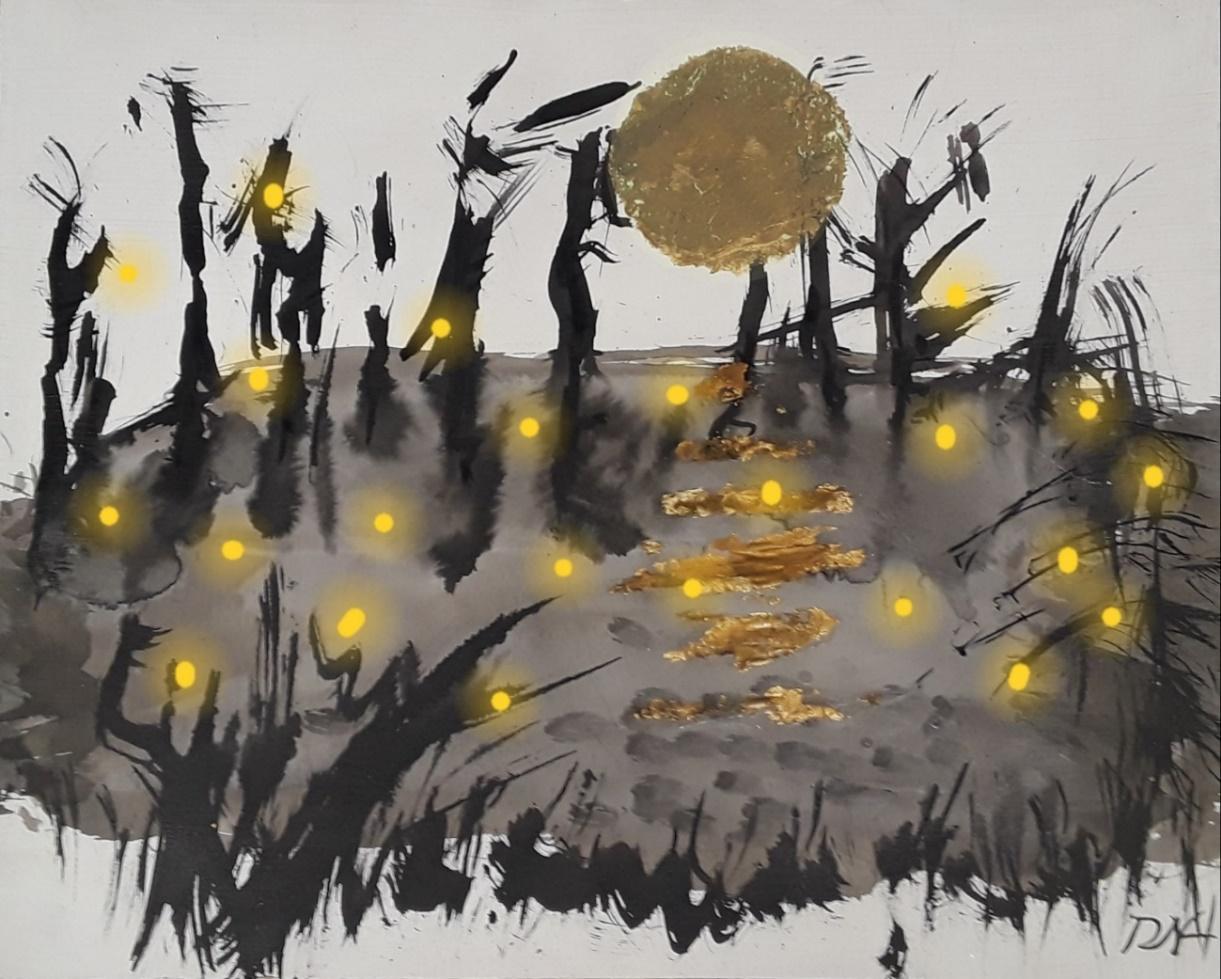
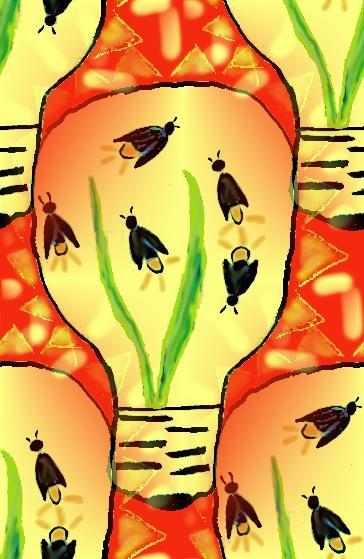
Front Cover Art: Terrie Jacks
Back Cover Art: Donald W. Horstman
Webmaster: Joel Lindsey
Fireflies’ Light is an online magazine showcasing short poems, essays on poetry and poetics, and book reviews. It is published once a year in April by the Department of English at Missouri Baptist University, One College Park Dr., St. Louis, MO 63141. Interested poets may submit unpublished manuscripts, not currently under consideration elsewhere, to john.han@mobap.edu. We consider up to ten poems (including collaborative ones), up to two essays on poetry and poetics (150-1,000 words), and up to two book reviews (500-1,000 words) during the reading period. Write “FL - your name” in the subject line (example: “FL - Erin Smith”). Paste your poems, book reviews, and essays into the body of an email. Submit haiga and other artwork as email attachments.
Along with your work, we require a 100-word author bio written in the third person and complete sentences (no sentence fragments or listing, please). Begin the bio with your name.
Below is the reading period and target publication date:
Reading Period
Target Publication Date March April 15
Submissions received outside the reading period will be neither acknowledged nor considered.
Short poetic forms include but are not limited to haiku, senryu, tanka, kyoka, sedoka, sijo, somonka, haibun, gembun, lanterne, ABC, cinqku, cinquain, couplet, Etheree, fibonacci (fib), free verse, limerick, lune, octet, quatrain, and triolet. A poem should follow the rules for the chosen form, and the author must identify the form used in the poem parenthetically after the title.
Missouri Baptist University reserves the right to publish accepted submissions in Fireflies’ Light; upon publication, copyrights revert to the authors. By submitting, authors certify that the work is their own. All submissions are subject to editing for clarity, grammar, usage, and Christian propriety. The views expressed in this publication do not necessarily reflect the views of Missouri Baptist University.
Issue 33, April 2026
© 2026 Missouri Baptist University
The fireflies’ light. How easily it goes on How easily it goes out again.
Chine-jo (late 17th century) [Trans. Kenneth Rexroth]
* though wrapped in tissue paper… a firefly’s light
Kobayashi Issa (1763-1828) [Trans. David G. Lanoue]
* what on the other shore tugs at its heart so? in the evening dusk over the Mogami River a lone firefly
Mokichi Saitō (1882–1953) [Trans. Makoto Ueda]
84
Marilyn Humbert
85 Chen-ou Liu
86 Gavin Austin
87 Curt Pawlisch
Tanka Art
88 Debbie Strange
Kyoka
92 Terrie Jacks
93 Chen-ou Liu
Haiga (including Photoku)
94 Richard West
100 John Zheng
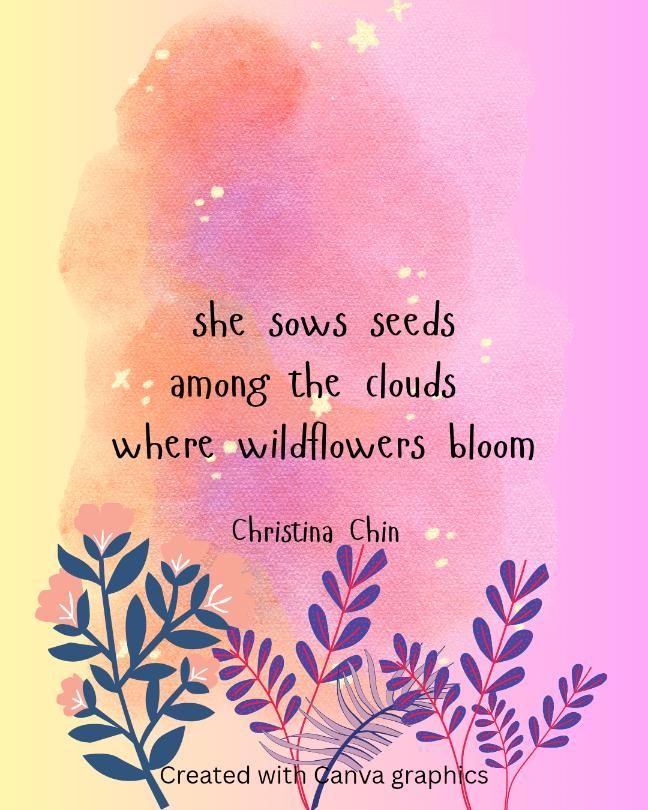
103 Christina Chin
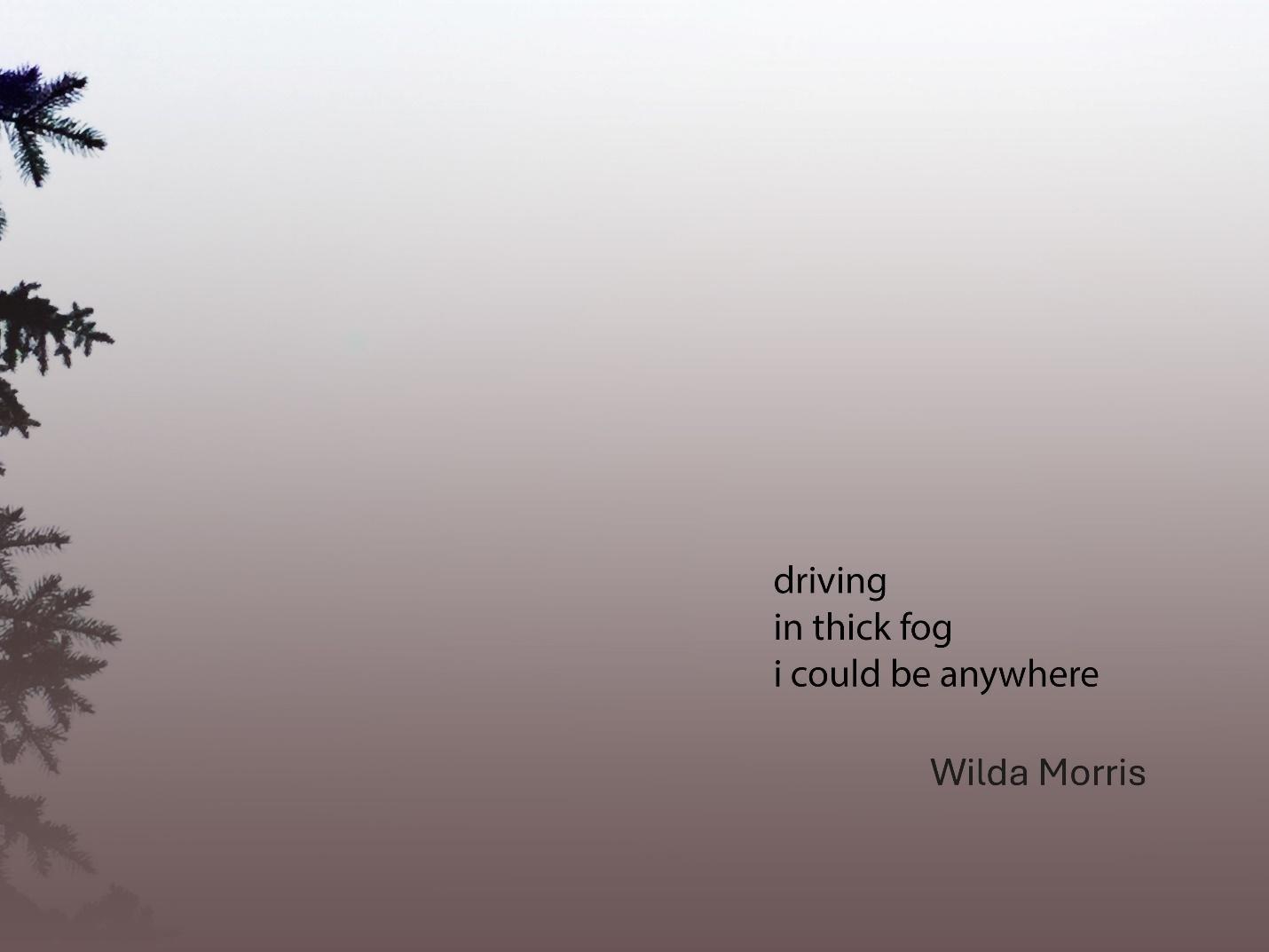
104 Wilda Morris
105 Elliot Diamond
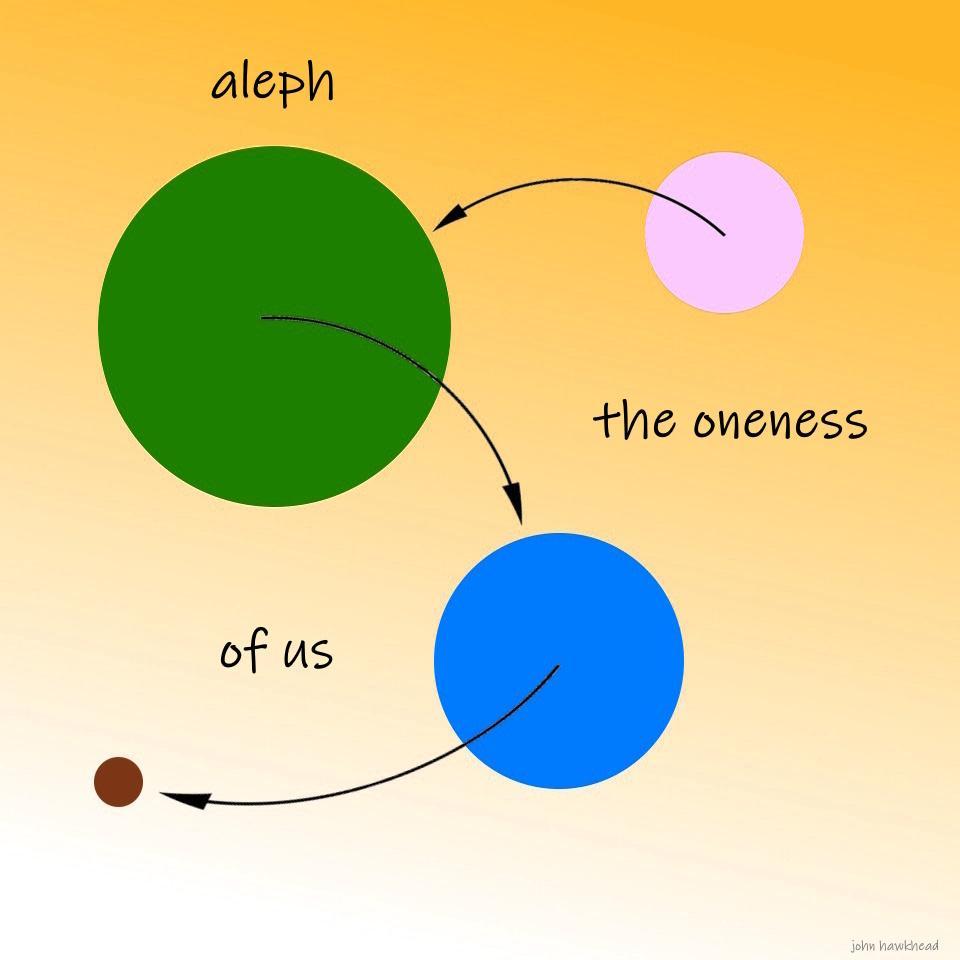
106 John Hawkhead
107 Tsanka Shishkova
108 Elaine, Joshua, and Sarah Wilburt
109 Elaine and Joshua Wilburt
110 Biswajit Mishra
111 Mary Oishi and Cynthia Shoemaker Haibun
112 Timothy Daly
113 Joshua St. Claire
114 Colleen M. Farrelly
116 Susan Burch
Hainka Prose
117 Colleen M. Farrelly Septolet
119 Todd Sukany Gembun
120 Joanna Ashwell
122 Chen-ou Liu
Free Verse
124 Phillip Howerton
126 Philip C. Kolin
127 John Grey
128 Terrie Jacks
131 Diane Webster
132 Todd Sukany
134 Rachel L. Redman
136 Tim Dwyer
137 Georgie Herz
138 MarthaMaggie Miller
139 Darrell Petska
140 Elaine Wilburt
Quatrain
142 Phillip Howerton
Rengay
143 Melissa Dennison & Jerome Berglund
145 Jo Balistreri & Wilda Morris
Ekphrastic Poetry
146 Jane Blanchard
148 Darrell Petska and B.D. Skinner
Clerihew
150 Elaine Wilburt
Gogyōka
151 John Zheng
Triolet
153 David Pickering
Eintou
154 MarthaMaggie Miller
Cherita
155 Susan Burch
Cheribun
157 Colleen M. Farrelly
Essays on Poetry and Poetics
158 Phillip Howerton’s The History of Tree Roots: Poems (Golden Antelope Press, 2015) By C. Clark Triplett
163 William Ferris and Jianqing Zheng’s Soulful Dancer: Photographs and Poems (Blue Horse Press, 2025)
By C. Clark Triplett
169 Jane Blanchard’s Furthermore: Poems (Kelsay Books, 2025) By C. Clark Triplett
175 Philip C. Kolin’s Evangeliaries: Poems (Angelico Press, 2024)
By Matthew Bardowell
179 Georgie Herz’s Outcome Unknown: Poetry & Art (Jor-G Publishing, 2025)
Susannah Cerutti
182 Jianqing Zheng’ s Dreaminations: Prose Poems (Madville Publishing, 2026)
C. Clark Triplett
187 Star Poets of the St. Louis Walk of Fame (A Photo Essay)
John J. Han
199 Brief Guide to Short Poetic Forms
208 Notes on Contributors
sunup
the silence of mountains next to each other
out of our hands our daughter’s own hands gusty winds
When the world turns from winter toward spring
the night sky! half-moon over my orange tree light on bare birch branches shimmering gold springtime! pink petals in muddy water
white-crowned sparrows the wind and the fire of another world yellow daisies on a dark green bush the sound of birds
anchored by wild artichokes fieldstone wall
in a hurry to go nowhere tailfeathers
daily constitutional now for that porch nap in February light
the length of a caracal’s hunger clawing at tree-high feathers
soaring beyond a dorado’s dreams flying fish
cawing crows a gargle of stones
pentimenti a dandelion seed through the dry stream bed
heartland walk through a kissing gate late sun in the watchful eyes of a peacock watermelon sky
a royal greeting in the breeze pine boughs bow
harvest moon yard shadows as footprints fade
dream bells only the snowdrop to listen
coloured tarpaulins
apples being herded into coloured crates
sliding down the slate roof kittens in the fog
crocuses across the field the last time I hugged my parents broken branches after the storm the heaviness of silence
late winter wind a swirling whip of blackbirds a basket of cut grapes amethyst sunset the farm cat takes a roll in the hay February sunshine spring rain I move an earthworm to high ground
family gathering–the braided rivulets of a creek bed
fallen leaf an excerpt from a longer work childhood home my old compass still points north frozen lake we skate our names across the sky trash day an aquarium fills with snow
JOHN HAWKHEAD
a kingfisher
skirting a waterfall’s edge
rainbow season
winter dawn a blue-tit makes chinks in the light
among brambles the snowdrop’s sharp white
birch bark curls of sun
petals opening early... a silence of bees
morning breeze a yellow swallowtail unfurls Spring spring cloud the heifer’s nose tinged with clover ripe peaches a child's fingers sticky with sunlight
the bitter sweet of remembering you lemon bars
holding the spoon that you once held I touch the past
westerly chill the slow somersault of an oak leaf orange peel sunset spanning the river the arch bridge silhouette
after the rain
a pigeon drinks from a gap in the cobbles
foreclosure–a rusting cattle crush full of thistles
watering the foxgloves she says sorry to every bee
JOHN ZHENG
(A sequence) memories deep footprints in the mud of mind
* winter wind cuts through mudwall cracks a homesick hiss
* icy night body coils consciously in the straw bed
* mealtime feeding steamy bran to pigs oinking my silence
* rice planting mulling over self-seeding
* eager to leave soul stretches its neck to crow aloud
* looking back a trail crooking to the village
* those bitter years fallow land in the heart
* airing in the sun memories exude the scent of new crop
JOSEPH P. WECHSELBERGER
spreading compost my father takes a break to roll a cigarette
cut sunflowers
droop at a self-serve stand early autumn
orha lottery tickets the hope of winter unscratched a pile of kindling
noon heat the asphalt smells of old rain
dry thistle clinging to the wind one seed at a time
open moor the rolling heather sea-bound
silver glint in the sea shallows fish long gone
one cheek chill the other cheek warm
April
thomas david
starlit sky the fireflies decide to clock off early
cold spring the stork’s nest still empty mist falling hyacinth scent still lingers
she-oak breeze the whispered language of night
water music the damselflies connected in flight
a pigeon comes to visit hospital window
frozen stream a deer leaps through the silence a sips worth in a curled leaf winter rain
moonlit snow along the tree line coyote eyes its sound entering the fissure this little stream
loons calling the morning broadcast in black and white
house finch at the playground
flock of stay-at-home moms
burning incense . . . the robin’s chest throbs while we recite a chant resonating in freshly washed hair . . . the temple bell a mayfly tangled in the sweater . . . old friend meetup
stray rowboat on white water
broken moonlight
AJ JOHNSON
placid farm pond
my son chooses not to skip his rock
spring watercress
I wade the cold creek shoes in hand
temple pond among the stars blooming lilies
evening solitude dune after dune the desert moon river wind through the bent reed hu mantra kintsugi sunlight drifts through the forest canopy deep furrows on the farmer’s forehead drought field
boxing match the brown moth escapes her paw
winter solitude a high-pitch whistle in my breath
turning to the last page of my calendar red-apple sun
unexpected rain waxed Amaryllis bulbs in the orphanage
raising a claw two hermit crabs bid for the same shell
riding a thermal above the treetops
grocery bag
in the grass by the empty house basketball the crying above the grave seagulls
fluttering curtains her fingers brush against my cheek
closed captioning the raspberry tongue I can't hear
cross country drive her critique of every song on my playlist
horse muffin treats the way to get a nuzzle in a hustle
daylight saving
I'd rather have Fred Flintstone's sundial watch
JOHN H. DROMEY
biting his nails a bad habit for a carpenter
pouring rain a bedraggled huntsman on my windscreen
slow murder he threads the wriggling worm on his fish hook
green fingers
mom’s gift I have not my sister's amaryllis
girl blows kiss from a bullet train
love in a blink of the eye
vacation surprise on a Colorado highway tire blowout
surgical bruises the mirror is not my friend
a radiant fan the hens discussing the weather
birthday celebration the phone pings a death notice
5G towers all I can see from mother’s hospital bed
unsilent night…
Santa freezes on the squeaky stair
JOSEPH P. WECHSELBERGER
the barber shapes what little’s left... first cut after chemo a coffee stain in the old photo album creeping sepia
bitter coffee the distance between us measured in spoons
old coat still holding the shape of my father’s shoulders night bus faces lit by blue screens
first job interview
I make a great impression on the leather chair
old computer slow at start up my kindred spirit
gentle door knock a smiling woman shares Jesus
thomas david bubble wrap he finally pops the question first sip she wipes the moustache off my moustache
morning express the smile doesn’t reach her eyes
silent night
kids have a sleepover at their grandma’s
recycling day unwrapping the purse I gifted my mother-in-law last year
optical illusion the past in black & white
the static in the newsreader’s voice distant bombing
this old age bird watching on an app insomnia puss’s lion eyes sizing me up
sepia family photo year after year the smiles fade
honoring twenty percent off Memorial Day fighting words two grackles beak to beak
cafe patio fighting for my donut with a wasp
in the soup retired dad eats into mom’s sanity
among my tea leaves for reading one cat hair
fall cleanup a sippy cup in the giveaway pile
crossing the chicory meadow the shifting borders of sun and shadow war news a crescent of cadmium orange slipping below an arc of mars black late winter night
MICHAEL SHOEMAKER
crawling red-eye flight
Wyoming drags it out
Nebraska pushes back South Dakota pulls all on a digital map
on the path we seldom go the first shoots perhaps life flickers more when unseen
I rehearse the words I need to tell you
I see no future for us beyond our summer days
flipping through family reunion photos our faces frozen in plastic smiles… the gaps between us
The Last Duel (A sequence)
hospice in twilight… my gray-haired friend wakes curls his hands to fists and strikes at a phantom foe then exhales into the dark
in the moonlit dark
Death and I stare, unmoving with thoughts miles apart ... silence stretches between us and who will blink first
trying to put yesterday back in the bottle he settles in shadows beneath the rail bridge a withered leaf from dusky branches quietly settling this winter gloom gathers between us
from the river leap two sturgeon man-sized and ancient as gravity
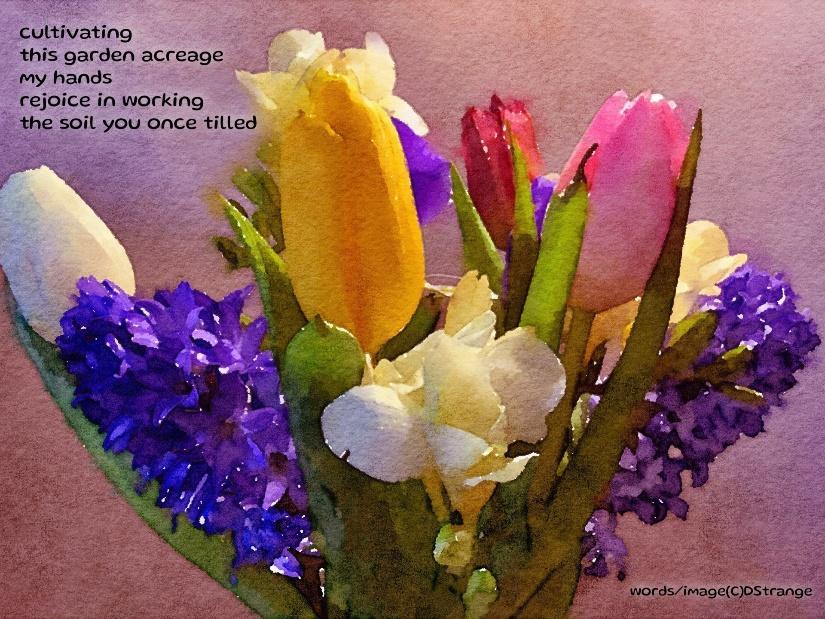
uncork my bottle
receive He! He! He! three wishes maybe
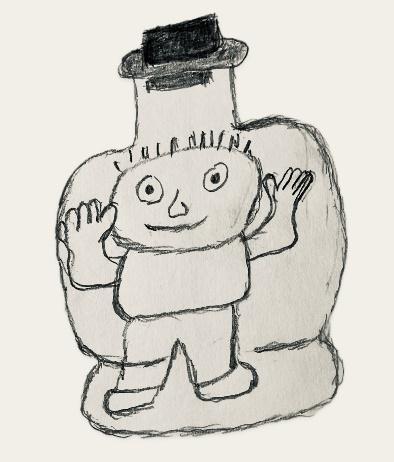
rumble, rumble of fast garbage can wheels around midnight my John-Wayne neighbor (lately fired) sleepless again
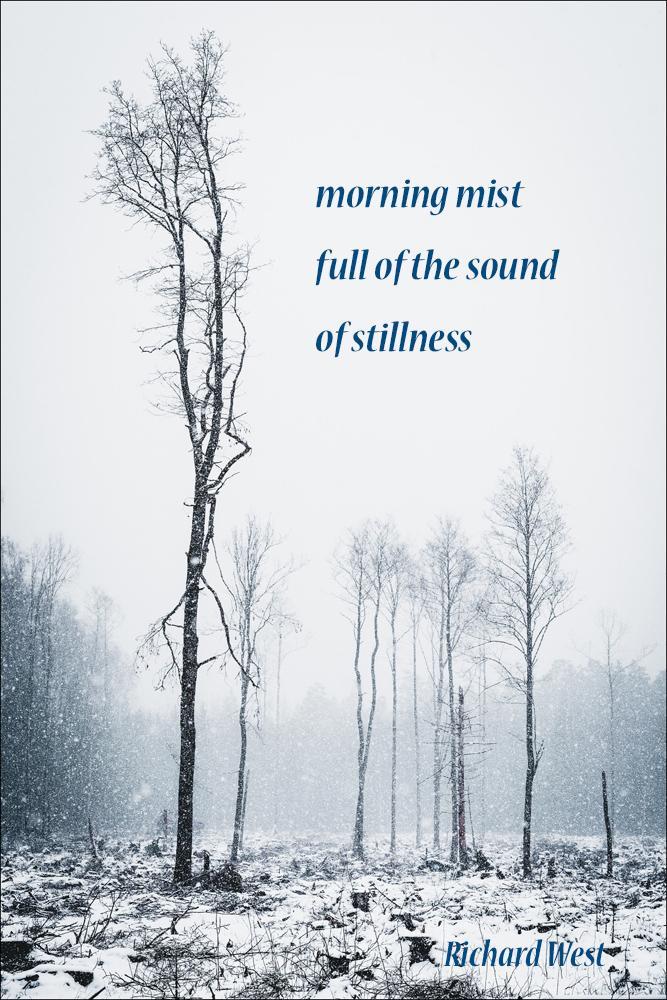
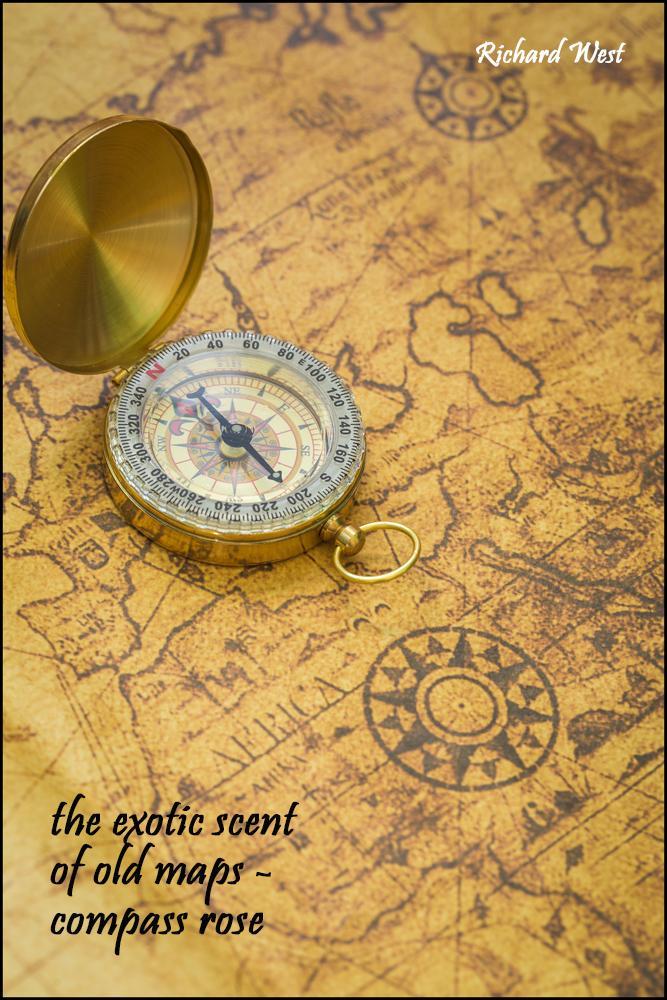
JOHN ZHENG
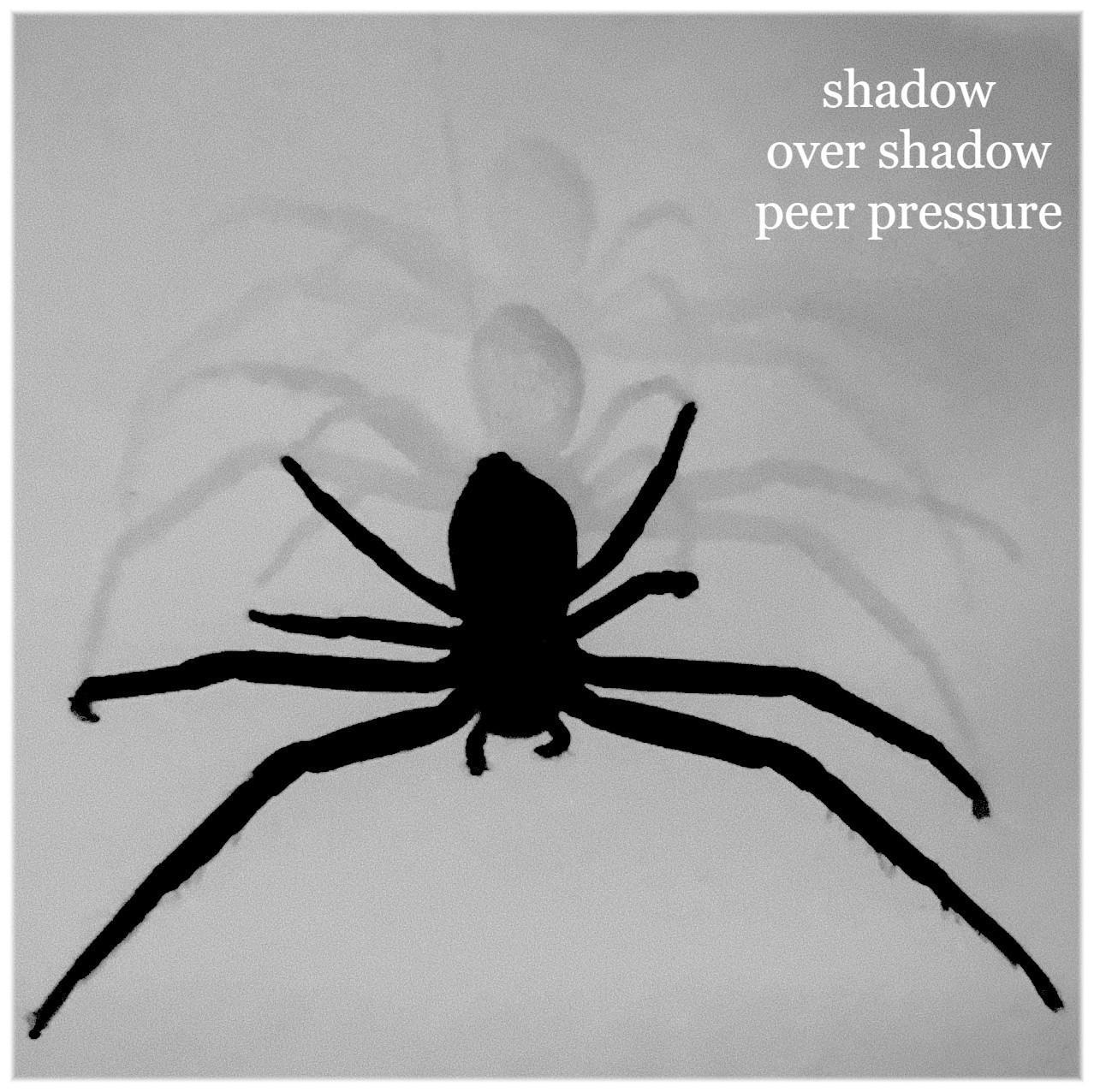
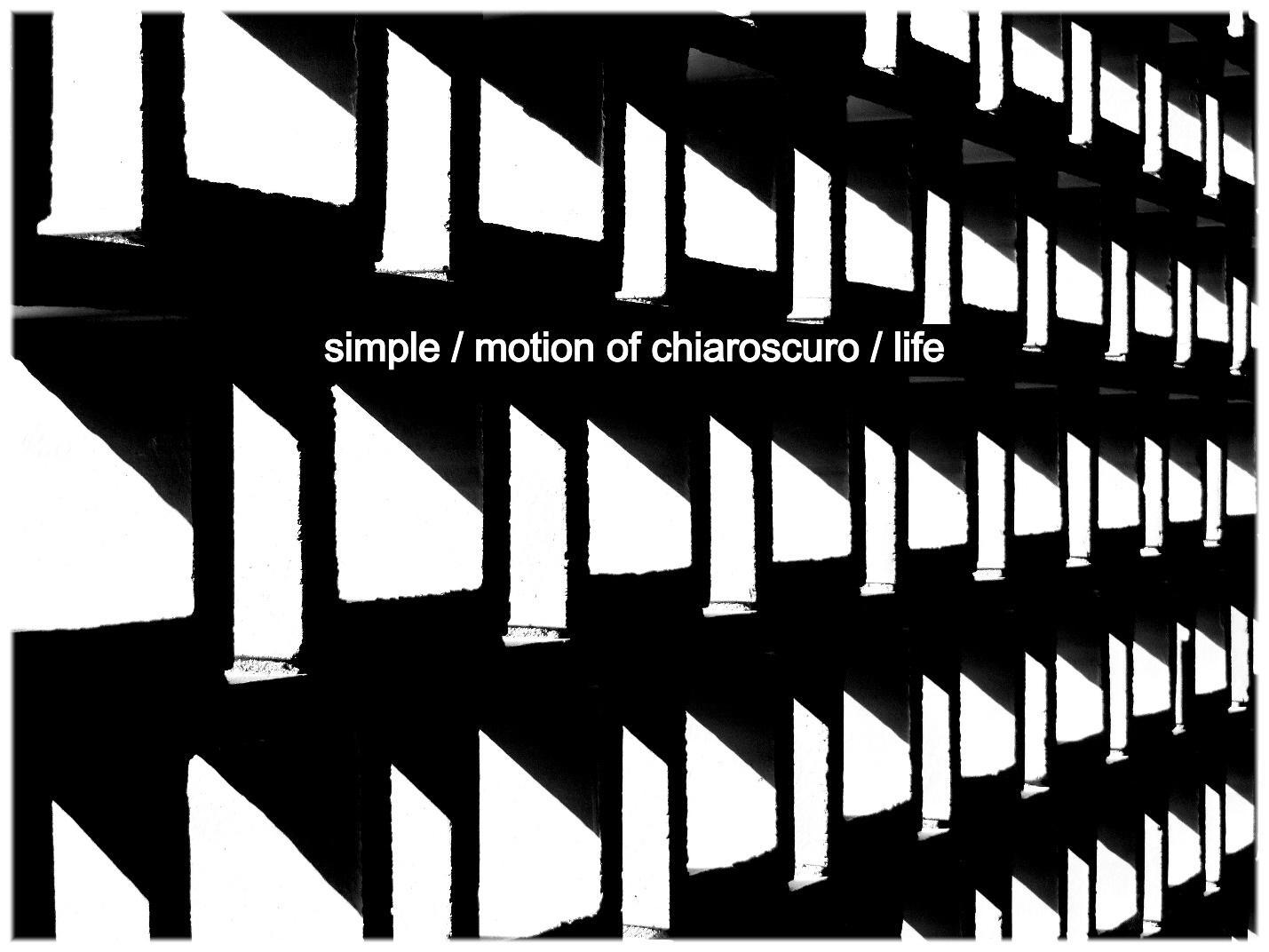

JOHN HAWKHEAD
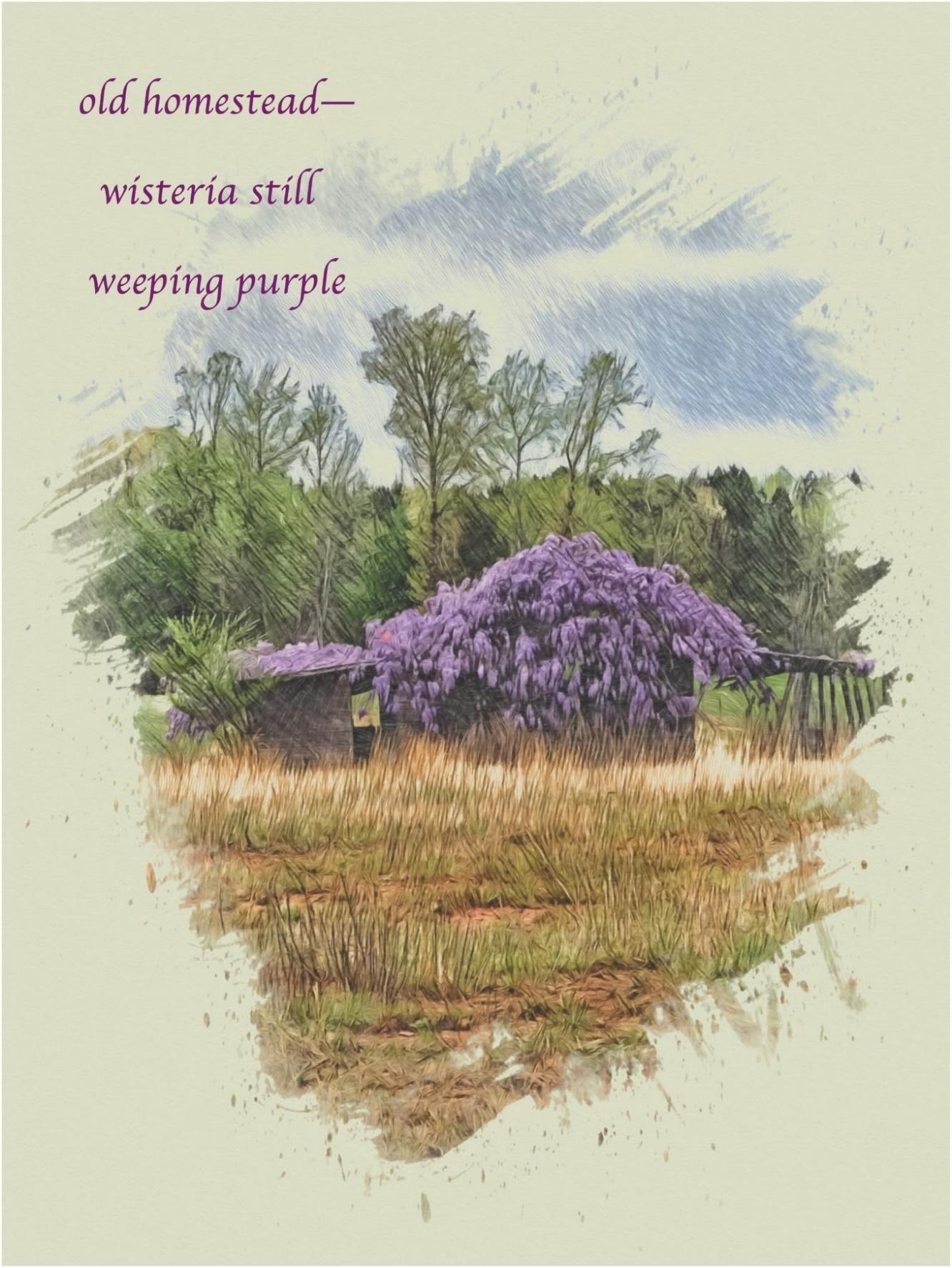
In his book Living to Tell the Tale, Gabriel García Márquez wrote: “Life is not what one lived, but what one remembers and how, so as to tell it.” Having wanted to become a doctor in Caracas, the city of her childhood and adolescence, she finally obtained a scholarship to study medicine. But her family, for economic reasons, decided to move to Europe to follow her father, who had settled in France. With shattered dreams, she had to rebuild herself: she learned French, earned another diploma, and discovered the beautiful city of Paris. She was so grateful to no longer be afraid of hunger or staying out late in the neighborhood where she lived for so many years. But economic migration doesn't heal certain wounds, and she longed for those fun afternoons of her childhood and adolescence and the warmth of her people back home. She held onto so many memories of those innocent times.
last call the paper cut from the visa page
JOSHUA ST. CLAIRE
On Pieter Breughel’s Landscape with the Fall of Icarus (Ekphrastic haibun)
Summer deepens. A storm has been brewing all afternoon. Above the distant mountains, the clouds billow up up up into the intractable heat. It is the rose hour, and the sun touches everything with its fire. The cyan sea sizzles as the rays of the setting sun strike it. The port city glints in fiery pinks. Its shadows lengthen to the infinite. An exhausted shepherd slumps on his crook as he dissolves in the heat. His dog long beyond panting droops by his side. The sheep are scattered, looking for a patch of grass whose green could resist the heat. A farmer and his horse press against the incandescent air. A burning fisherman tugs on his nets desperate to catch some wriggling coolness. In the harbor, the downdrafts from the coming storm swell the sails of ships bound for cooler water. Still, everything contends with the endless heat. When will the faraway rains bring relief? What infinity of heat holds back the storm? Somewhere beyond, a lightning bolt without a thunderclap slips from above the cloudtops silently into the sea.
higher and higher the sound of the sun color of white ibis wings
Reference Work: Landscape with the Fall of Icarus attributed to Pieter Brueghel the Elder (now disputed). Oil on canvas, c.1560. Oldmasters Museum, Brussels, Belgium.
Dusk descends. I fish out my keys only to find the lock broken (again). The lights inside flicker. Caution tape limns the only elevator door (again), so I trudge the four flights to my office. The sooner I finish grading term papers, the sooner I can drive home, nuke a leftover casserole, and draw a warm bath.
As I reach my floor, I spot the maintenance note: fresh paint… we cover up another Monday
Genbaku-shi
As I study haiku, I read my way from Bashō to contemporary haijin. I relate to Bashō’s samurai poems, his conjuring of eerie stillness years after the last battle. On the contemporary side, Shigomoto Yasuhiko’s modern haiku arrest me mid-thought, freezing me in a pika don moment as if I’m in Hiroshima for decades before my birth.
building shadows
I wonder who they were
I first hear of Hiroshima in children’s church. A songwriter details the life and death of a girl my age, a hibakusha who survived the blast unscathed as a toddler. I look up leukemia and ask my grandfather if he knew about Sadako Sasaki or even about Hiroshima while he was still stationed in the South Pacific. He mentions malaria and training for Operation Olympic.
V-J Day… graves there graves here
Dallas Cowboys Cheerleaders Training Camp Week 6 (hybrid haibun and tanka prose)
hearing them say, “tonight will be your last night…” a bright star in the sky loses its shine
The pressure is on. Anyone could be cut for even the slightest mistake. We’ve learned 50 dances and we have to perform them flawlessly, while looking effortless and fun. Even a low kick on the kick-line could be a dealbreaker, and we have to land the jump-split. Every night the names of cheerleaders are called to go into the office and talk to Kelly and Judy. We never know if it’s just something to correct or if we’re going home, so we just pray they see we’re doing our best and cross our fingers.
end of summer what happens to a dream deferred
Ingrained a flock of geese squawks at a rising tide and shoreline prints of them and of us
He and I stroll in silence, scuffing sand with our toes and skipping an occasional rock across the glassy sea. He wants me to follow in his footsteps, but I prefer the arts. A group of geese etch the slate horizon as a north wind kisses a distant berm. My little feet sink into his footprints wordlessly as the sea pulls away.
ebb tide the shore’s sunset sways me
a duck flock paddles by the bank the pond ripples as children laugh and give chase
Dusk settles across the pond, a blanket of fog and shadows. I jog a worn path half-hidden by leaves. Childless, save my students. Will they remember me?
pond ripples the autumn breeze leaves a fingerprint
on the plane
the flight attendant cackles on through safety information we all hope never to use
close inspection the moonbeam within the loop of a shadow
* lightning seeds the ocean roll back and forth within moonset
*
shepherd’s purse
hanging on the grasses of a light breeze spare gold
* moonless a sky without dreams
A blanket of wet snow on the roof; the urge to escape these four walls of my basement rental. this ladder to the midsummer moon edge of my dream
“Pa,” softly at first; then a little louder, “Pa, Pa...”
paper-thin skin so tight across his chest ... Pa's last smile
Worm, 2026
He was ensconced on a stone in my back lawn on a 78-degree January day, dressed all in black, silently predicting a severe winter. I was troubled by his untimely presence and the absurdity of his claim, but he was an old believer, who, in the face of evidence, insisted on his folk wisdom, enjoyed telling youngsters how cold and snowy winters once were and prognosticating hard times, all while wrapped in his wool blanket with his fourteen tiny feet propped up on the great hearth of the winter sun.
Occasional in cultivated and idle fields . . . a native of tropical America.
Ron Kurtz
Ozark Wildflowers
She’s from far south of here, and as I survey my drought-dead garden she steps forth from the rustle of dry cornstalks, her face aglow with morning dew and tropical skies.
The deepest rivers Run inside us Mapping our course
From youth’s rapid years To age's bending reeds. They keep the body’s
Secrets whether victories Unsung or defeats, Moaning droughts.
They inscribe how well We have traveled through life, A diary in bright red.
As fog slowly lifts, we await the arrival of what was here all along
In the Blackout she lit the candles to look at him blew them all out once she’d seen enough
outback in the back of the yard
I buried a secret a secret I wanted to keep keep safe from prying eyes I buried it in a box a strong box of cardboard then immediately forgot what the secret was I did this last week before the rain this morning wanting to know what the secret was I dug up that box that strong box of cardboard I discovered a mushy mess and the secret had washed away.
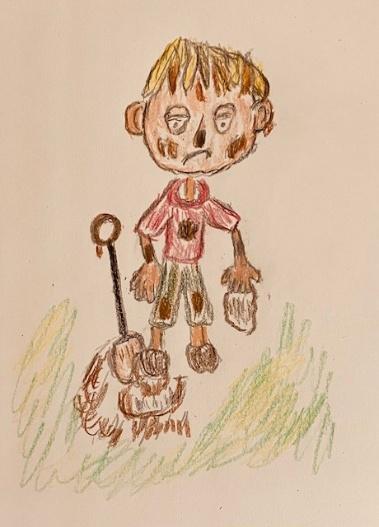
That’s me strutting down the street in orange and pink orange and pink
Me thinks those colors are mighty neat orange and pink orange and pink
Now even if you think orange and pink stink don’t inform me about what you think
For my fist may turn you black and blue not orange and pink orange and pink
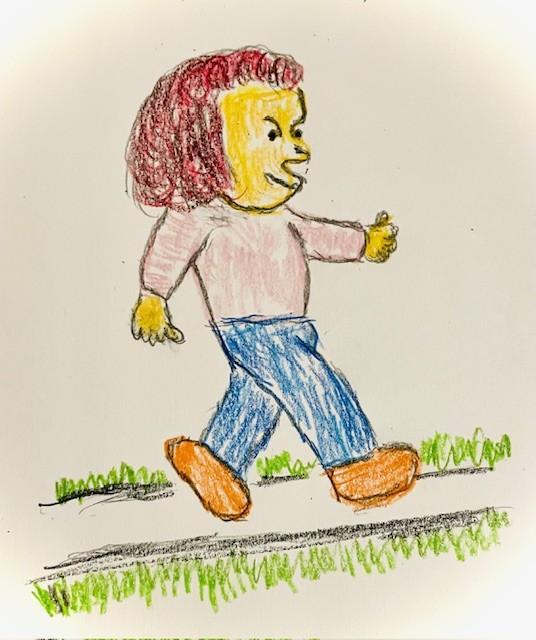
A wannabe player who can’t catch a ball nor kick it all and if he runs he trips over his feet - Oof but cheering is his thing Rah! Rah! Rah! Go team go! OOPS! OOF!
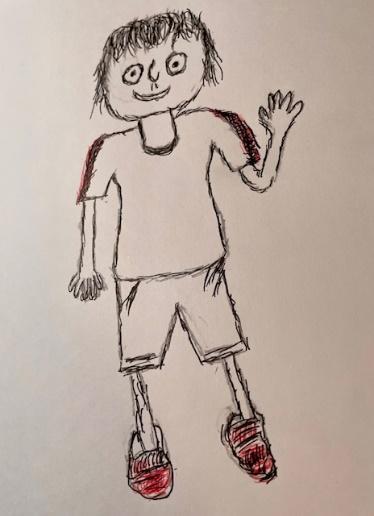
Strata of the hillside mimic ripples on the river as both unite in reflection.
Fractured when a stone’s flight is snatched by gravity’s hunger.
Wrought iron railing bars the window in vertical shadows locked in until the sun reprieves the pane at the last hour.
Thinking as a child, I, well, I’m not sure “thinking” is a best choice. Mostly gut-
level stuff. Climbing the outside of the staircase. Somersaults off a neighbor’s couch. Driving while examining a work permit. Loading a traffic sign into the van. Stomping. Always stomping.
As twilight appears and I’m in the last 5K, I see my steps in the dirt raise less dust.
When contemplating the meaning of life, I focus on the squirrel. Not any squirrel but the one using a flower pot on my deck as a storehouse for oak seeds.
I look past the clouds swirling “mare’s tails” not knowing precisely whom to grill . . . should squirrels have green thumbs.
Each little slip of a fingernail, like the waxing and waning of the moon fragmented mother of pearl, slivers of kaleidoscopic brilliance lodged in each of us
Coursing, pulsing through me as if ichor filled my veins mirrored a thousand times over, radiating out in flashes The gash of sun on fish scales under a ripple
Huey Long
if i could sing of the trees that swing with the feet of many men
—many men
—hated men
i’d be a’lyin’ through my teeth
if i should raise my head with the pride of a wild garlic bulb wire stem flaming head
i’d bow my head in prayer
the religious men ought not to sermonize and the political men ought not to radicalize but each breaks his promise
pinning, with steely eyes, each victim on a piece of cork a finely needled insect
The name of the brown bird that scampers in the garden, never venturing beyond the storage shed.
Smaller than a blackbird, larger than a sparrow it appears mid-afternoon when the others have gone. A ground feeder, I spread seed along the bird’s frontier.
It pecks with a steady rhythm, then flies into the neighbor’s hedge beyond my fence, perching beyond what I see.
Is that it?
I thought there’d Be more.
* Remembering alone is not where it’s at. Would you say, “Yes, I remember that”?
Silent and sneaky does the gloaming creep shadowing the sun like a stormy day tinting the horizon soft lilac and pink as winter’s frigid wind with chimes has its way. Their singing serenades oncoming twilight bidding sleepy sunbeams a poignant good night. Shadows grow bolder cradling the sun as it glows golden on the edge of the sky painting its blush with coral and deep plum. Like the drooping lid over a dragon’s eye the sun winks out and that liminal space holding between day and night fades with grace.
Wait!
Everything depends upon Grandma inching her walker to the family meal.
For CS & LE
A mote of dust tumbles through a shaft of light. Glittering flares flash, gutter like falling stars, tails crisscrossing the sky. The downdraft shifts, the mote
suspended stops, sun-seared, then rises, dancing swirl on swirl, a silver spark.
seven
the perfect number our family minus one whose apple tree withers in the backyard whose name
I will one day read tattooed on God’s palm
Tree House, 1975
In old age I sit a spell where my tree house rotted, fell. Pleased I once rose above care to build a small castle in the air.
Science Highlights
great solar flash too cloudy for astronomy explosions to get at the crude methane one brussel sprout too many
white bread for the elite…high john the conqueror
horse chestnut welcomes leaf miners
rose adagio dangerous conditions in the south west
outrageous amounts of water almonds require funny farming
old fashioned preferring dairy with my coffee
valhalla the day we get groceries
a grinning fossil from northumberland ancient sea creature
triangle carved in wet concrete
following bird prints a different direction to go
Day’s End
evening on the deck songs in surround sound cicadas
pink haze across the field hawk perched on a hay bale
incense of a sunbaked day white moon
baby’s breath tickles my neck I hum Brahms’ lullaby
amber lights of fireflies in the evergreens
a cooling breeze stirs the sunflowers Venus rising
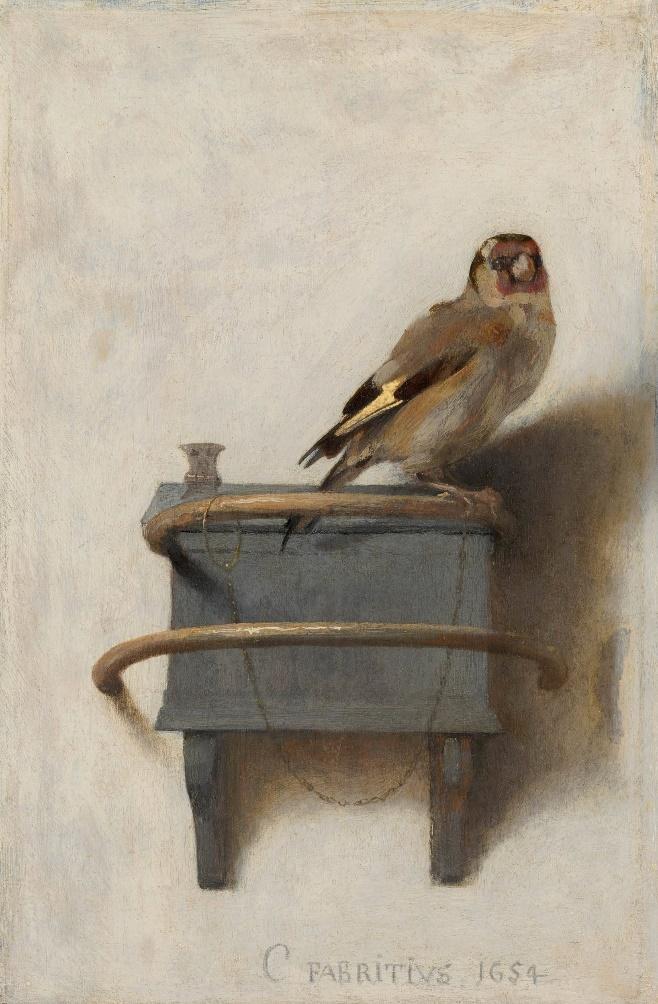
The Goldfinch by
Carel Fabritius, 1654
This lifelike bird allegedly survived the Thunderclap in Delft which killed the man who painted it, an image once contrived to captivate each viewer for a span.
And so it does today, positioned in the Mauritshuis where people, one by one, pause to admire it, shift to look again, and marvel how the trompe l’oeil was done.
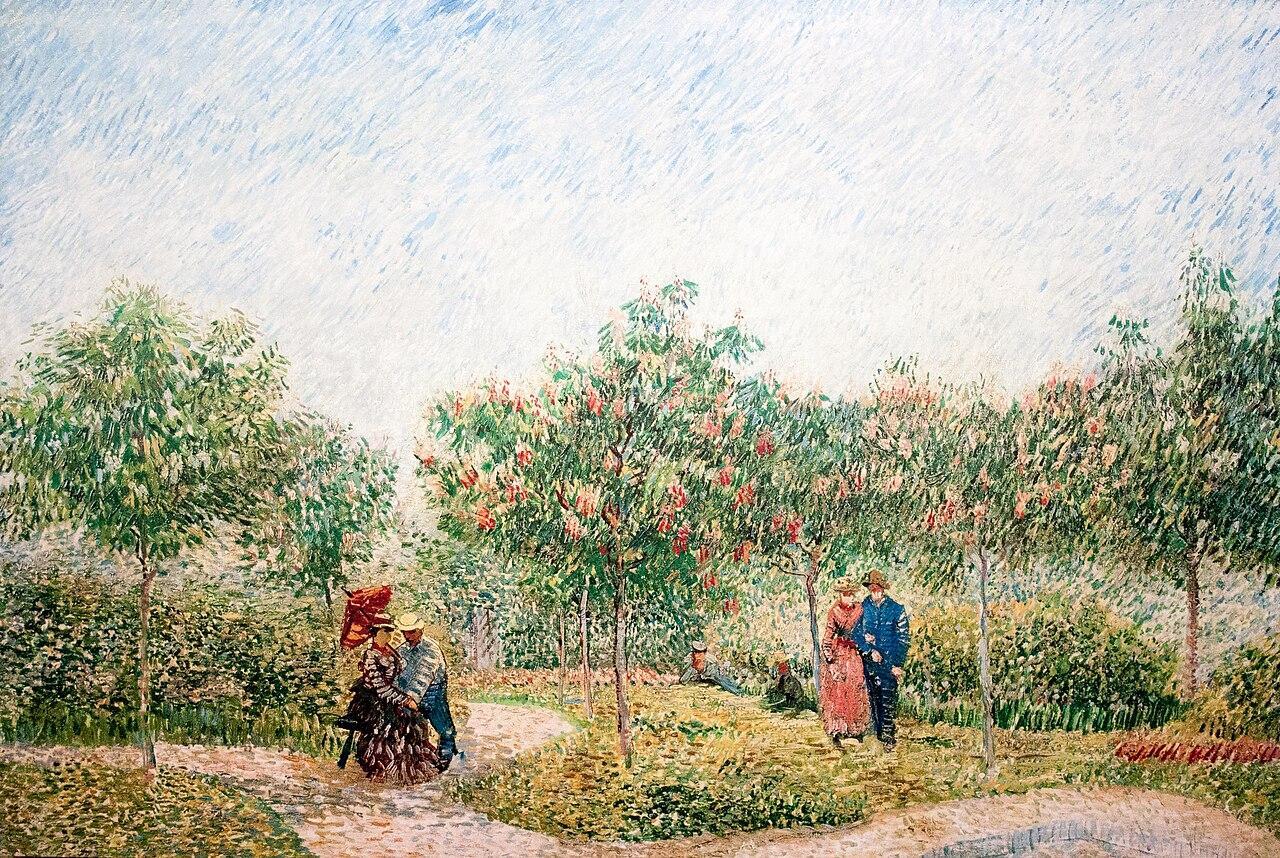
by Vincent van Gogh, 1887
How many little strokes of paint make up this vivid scene of love? There is a tension of restraint in many little strokes of paint for passion’s poses ever quaint. Such green around, much blue above, so many little strokes of paint make up this vivid scene of love!
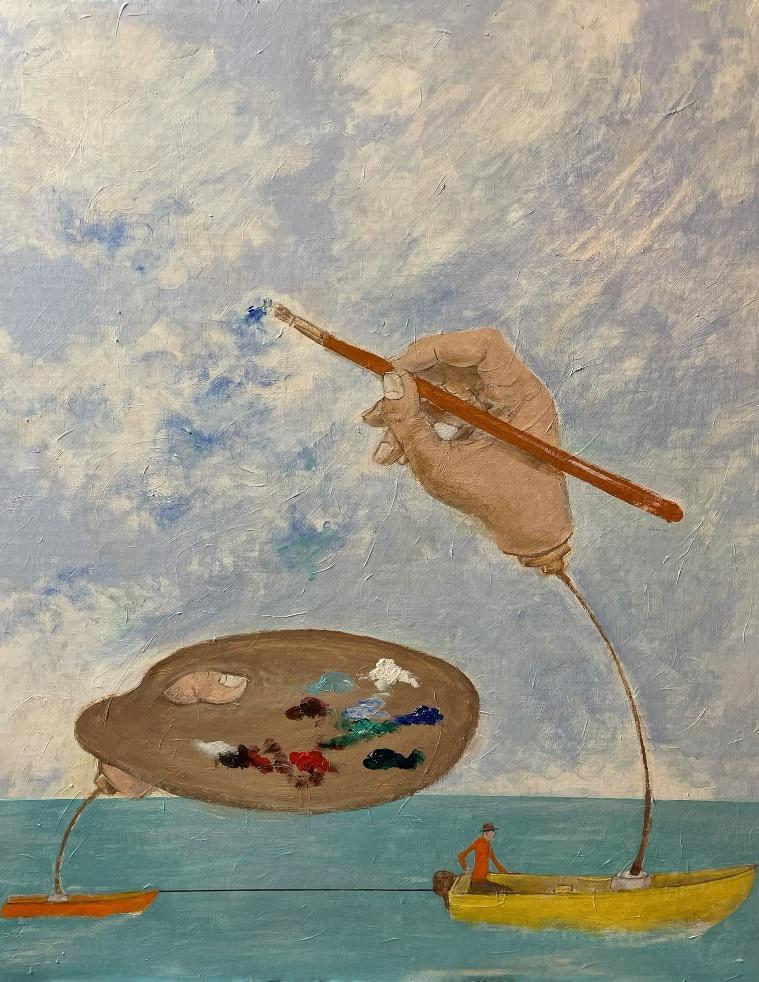
DARRELL PETSKA (poem) B.D. SKINNER (painting)
Human grew tired of so much blue sky, so God said, Very well, go paint up a storm.
What is this storm you speak of? asked Human. What is paint? And how do I go about it?
Did I not give you imagination? said God. Seek there. Everything you need, you have.
Human searched within, finding storm’s means: a palette of colors, a doing hand, and power.
But my hand and my palette are too small, complained Human, and sky beyond my reach.
Let my hands and my paints teach you, said God, bringing sky closer that Human might succeed.
And power? asked Human. Can you help with that? You've had it all along, said God, but use it wisely.
Thus Human added power, dark and forceful. Thunder crashed. Earth trembled. Human reveled, so taken with power, and wielded it flagrantly upon the Earth leaving the sky to God.
Jane Austen
flirted saucily in Chawton. A husband with sufficient ground, alas, poor girl, she never found.
JOHN ZHENG
departing boat my parents stand on the riverside while my heart flaps like a gull
* sleepless night at boarding school scouring the sky to look for my zodiac sign * sent down for reeducation a transplant to a strange land in peasants’ eyes
*
rugged road to the village
weariness
crunches with ice under feet
* chat and wine by an oil lamp
in a peasant’s kitchen…
night fades into fish belly white
* agitated by red sunrise
a plow left by the field
blinks a dull shine
Summer came to town that Sunday; While you smile, it never leaves. Somehow we have found a way; Summer came to town that Sunday. Swifts in skies of home at play, Nests safe hidden in the eaves. Summer came to town that Sunday; While you smile, it never leaves.
berries ripen on vines
eaten by hungry birds
droppings fall onto fertile soil seedlings sprout for the sun berries ripen on vines.
a hawk with a bluejay in its mouth we always think we have more time than we do
* MRI the alien in her brain camouflaged it takes her over with no one the wiser
*
winding his way through everything to get to his phone
silly girl
did you think it was to get to you
COLLEEN M. FARRELLY
I love the fog and drizzle of late autumn lakes not for the hiking or scenery but for curling up with my cabin’s books. I fluff the pillows and stash a stack of spooky novels for unseasonably cool with a chance of foghorn tonight.
musty pages
the petrichor drifts through a window screen
I flip on a lamp and glimpse a flutter of brown bat wings
Howerton, Phillip. The History of Tree Roots: Poems. Golden Antelope Press, 2015. ISBN 9781936135189. 90 pages, $22.89.
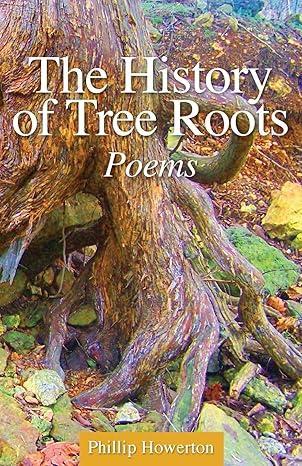
This retrospective review of Phillip Howerton’s The History of Tree Roots: Poems initially seeks to situate the collection within the broader arc of the poet’s career, particularly in relation to his more recent volume, Gods of Four Mile Creek: Poems, Photographs, Essays (2023), previously reviewed in this periodical. Whereas Gods of Four Mile Creek emphasizes disruption, artificial authority, and the consequences of human greed and pride upon the landscape, The History of Tree Roots turns instead toward continuity, inheritance, and the natural rhythms of time. Throughout the collection, Howerton employs recurring agrarian imagery sawmills, fencerows, sage bushes, workbenches, and barns fashioned from lumber to evoke the “hardscrabble” and “thorny” life of the land (xii). These images function as metaphors for family memory and for the enduring bonds that tie families to place through quiet persistence.
The tone of the poems invites readers to imagine history not as a linear sequence of events but as a lived, enduring presence, one in which the past presses vertically into the present, sustaining it as tree roots sustain the visible tree.
The poems in this collection unfold gradually, mirroring the organic growth patterns of the images they describe. The vocabulary of the poems tends toward accumulation and accretion, marked by patient endurance rather than urgency. By contrast, Gods of Four Mile Creek, with its focus on human contamination and moral failure, adopts a sharper, more unsettling tone, exposing the distance between human ambition and environmental dissolution. Despite these differences, however, both collections share the author’s enduring concern for place as a moral and historical consideration. Each insists that the land remembers what humans attempt to ignore, whether through quiet persistence or visible damage. Together, they offer complementary visions of ethical responsibility to the land.
These introductory comments aim to establish a context for a review of several representative poems from The History of Tree Roots. As in the previous review, close analysis of these selected poems will draw out recurring themes that distinguish the collection. Throughout the volume, Howerton’s poems articulate a thematic terrain and ethical stance grounded in the humble, often accidental settlement of the land by people who “[…] put down roots so deep / that they become the identity of this place” (“History” lines 4-5). From the opening poems, the collection establishes a sense of ancestry, place, and endurance shaped by land formed through accident, erosion, and continual resistance.
The opening poem of The History of Tree Roots establishes the topology for the entire collection, functioning as a kind of ars poetica that frames the book’s central concerns. Its opening lines present settlement not as an act of conquest but as a contingent occurrence: “My ancestors […] settled / […] by accident, delivered here / by high winds or high water” (1-3). The poem’s diction draws on the language of natural processes, seeds dispersed by wind or water, casting immigration as an ecological event rather than a conquering enterprise. Instead of advancing a mythic narrative of origin, Howerton offers a more precarious vision in which belonging is shaped by chance and struggle. As the poem suggests, roots are not always planted by intention; they are sometimes imposed haphazardly by circumstance.
Despite this accidental settling, the ancestors set down deep roots that helped establish the identity of the place. That identity is not primarily personal but geographical, shaped by the land itself and by what it remembers. However, the poem ultimately undercuts any sense of permanence: few locals “[…] now know the name / of this stream” (6-7). History begins to dissolve even as it claims to anchor the place, for “[…] its seasonal rise / wears away the course of the past” (7-8). Time, the poem suggests, steadily erodes what once seemed enduring.
The first-person narrator in the poem appears to inherit disequilibrium rather than stability: he “remain[s] misshapen by my seeking / of fissures, by my grasping of stones” (9-10). Survival, here, requires a contortion of the self; the acts of seeking and grasping suggest a body under constant tension as it adapts to an unstable environment. Under such pressure, the self becomes root-like, twisted, exposed, and shaped by resistance. This process of distortion results in resilience, but one that is explicitly unromanticized. Resilience is figured as an activity of discomfort and opposition, “becoming the contours of resistance / the contortions of my resilience” (11-12). The
parallelism of these lines emphasizes resilience as a physical shaping that leaves lasting marks. The narrator’s task, then, becomes one of preservation, “holding in place what little remains / of a soil that once held me secure” (13-14). In this reversal, the soil no longer sustains the self; instead, the self must sustain the soil.
In the poem “The Fencerow,” Howerton consistently treats the landscape as a repository of lived experience and historical memory. The poem fits squarely within the thematic focus of The History of Tree Roots by offering a concrete account of how human lives are inscribed upon the land through labor and necessity. Resisting abstraction, the poem grounds meaning in specific acts splitting posts, stretching wire, and walking the fence line that accumulate into a durable history. Throughout the collection, Howerton invokes the idea of roots, both literal and figurative, which are rarely planted by design alone. “The Fencerow” embodies this principle by charting a life not through interior reflection but through the changing material elements along a boundary.
The boundary marked by the fencerow in the poem functions as a material chronicle of a life. The poet uses the gradual deterioration of fenceposts, wire, and staples to trace the arc of a farmer’s economic, physical, and moral history. The poem begins with a clear framing gesture: “the history of his farm / is chronicled on this fencerow” (“Fencerow” lines 1-2). The earliest fenceposts, “[…] remnants of ancient white oak / posts posts he split when he / was young and too poor / to afford any other” (3-6), embody an ethic of necessity and endurance. The language of frailty and erosion becomes increasingly prominent, underscoring the erosion of what once signified strength and self-reliance. These posts, now “gray and shrunken,” remain barely intact, held together by “rusted staples” and “brittle two-barbed wire” (7, 12, 21). The fence thus emerges as an image of survival rather than triumph. The poem functions simultaneously as an archive and narrative device, offering a sober meditation on the limits of human endurance set against the persistence of the natural world.
As time moves forward, the fencerow becomes the product of others’ labor. Posts are “added a decade later” by “[…] a young neighbor / who had a family and needed work” (10-12). Over time, the farm’s history is no longer isolated but embedded within a communal economy of labor and necessity. Despite the ongoing care provided by different generations, the posts “have also rotted from the ground” (13), reinforcing the poem’s insistence that human effort cannot ultimately escape decay. Labor is acknowledged and honored, but it is not preserved.
Steel posts are introduced at “midlife,” when the owner can afford them. The “heavy gauge barbed wire” (19) appears to endure for a time, retaining the shine “of galvanization upon them” (22). Yet the poem ultimately abandons the language of construction altogether. In a blunt turn, the speaker announces, “then came death along the fencerow” (23). The boundary is eventually overrun with sumac, multiflora rose, and cedar, “some of which are now thicker / than his arms when he died” (26-27). This closing image binds the farmer’s life to the fate of the land. Nature does not erase the human story; rather, it absorbs and reframes it.
Throughout “Fencerow,” Howerton personifies the landscape as a witness. The fence does not merely create boundaries; it records poverty, community, meagre progress, decline, and death. In The History of Tree Roots, boundaries show the provisional nature of ownership and control. So, the fencerow here stands as a kind of
living book of accounts, where human intention and activity is visible but never permanent, where the land ultimately assumes authorship of its own story.
The last poem to represent the thematic trajectory of The History of Tree Roots is “Jigsaw Puzzle.” Howerton continues to carry forward the themes that labor, contingency, and the limits of human effort underpin life working the land. In this poem, however, he stages a moment of reprieve from hard work that remains shaped by the “hardscrabble” pressures of labor and life’s contingencies. The poem opens with an exception: “Only during that winter storm / did you take time from laboring” (“Jigsaw” lines 1-2). These lines seem to frame the rest of the poem not in terms of leisure, but as something that occurs because of the weather. Here, as in the rest of the collection, nature dictates the conditions under which human intention can proceed, reminding the reader that even moments of stillness are contingent rather than earned.
The activity in the poem itself, assembling a jigsaw puzzle, becomes a metaphor for broader concerns. The image on the puzzle, “a photograph of an aristocratic garden” (6), represents an ideal order and a cultivated beauty completely removed from the narrator’s lived reality. The photograph’s “[…] manicured beds of tulips” and “a bridge over a plotted stream” evoke a tradition of land as a spectacle rather than sustenance. This image stands in sterile but sharp contrast to the working farm where the land resists such control and stillness.
Despite this momentary reprieve, the poet does not allow the puzzle to remain a harmless fantasy. The image is interrupted by a reminder of the many failures that are catalogued in the poem: “but as with so many of our projects ” (11), things are derailed, or fate brings loss. As in other poems in the collection, effort does not guarantee success. What matters is how these contingencies are handled. Yet even though there is a flaw in the puzzle, “a piece missing near the center” (16), a decision is made to glue it and frame it. The work is finished, however, only by accepting its flaw.
The final lines claim a certain moral ground by “[…] allowing / that jigsaw pothole in the cobblestones / to trouble all fine folks who loitered there” (17-19). The framed image of the puzzle, which seemed so sophisticated and refined, is permanently flawed. In the end, the poem reverses the image of power implicit in the garden photograph. The poem is not necessarily a failure, but it does expose the artificiality of the ideal. This reversal reinforces the message of the book, that rootedness is never seamless. Like fences, roots, and inherited land, meaning comes together from partial materials, shaped by what is missing as much as by what remains. The overall vision of the poem, in the end, is one of endurance rather than perfection.
The three poems selected for this review of The History of Tree Roots are not necessarily presented as the strongest or most definitive pieces in the collection. Rather, they are representative examples among many poems that could just as easily sustain close critical attention. Their selection is, to some extent, incidental; however, taken together, these poems clearly reflect the thematic and formal trajectory of the whole collection. Each engages central concerns that recur throughout the book labor, place, memory, and inheritance, making them useful lenses through which to consider Howerton’s broader poetic project.
Taken as a whole, The History of Tree Roots advances a poetics of endurance that resists both nostalgia and moral absolutism. Howerton’s work consistently situates meaning not in triumph or mastery but in sustained engagement with the material world. His poems acknowledge the inevitability of the erosion of land, labor, memory,
and bodies without surrendering to despair. Instead, the poems insist upon the value of attention: careful witnessing of what remains, what decays, and what must be continually repaired or reimagined. In this sense, the collection offers an ethic rooted in humility, one that understands responsibility as an ongoing practice rather than a completed act.
Across the volume, boundaries, whether fences, property lines, family histories, or inherited identities, are revealed as provisional constructions. They hold for a time, accumulate meaning, and eventually yield to natural and historical forces beyond human control. Yet Howerton does not frame this yielding as loss alone. Rather, it becomes a necessary condition for continuity, allowing the land to absorb human effort and transform it into something that exceeds individual intention. The poems suggest that belonging is not secured through ownership or permanence but through participation in a cycle of use, decay, and renewal.
Like Gods of Four Mile Creek, the poems in this collection affirm that meaning is never seamless or complete. While Gods of Four Mile Creek gives a sharper critique and alarm about the conditions of the land, this volume is more meditative. Its power lies in restraint and precision, in its refusal to dramatize suffering or elevate endurance to the level of myth. This restraint strengthens the book’s vision, inviting readers to recognize how deeply history is embedded in ordinary acts and familiar landscapes.
Ferris, William (Photographer), and Jianqing Zheng (poet). Soulful Dancer: Photographs and Poems. Blue Horse Press, 2025. ISBN 9798218653262. 69 pages, $14.00.
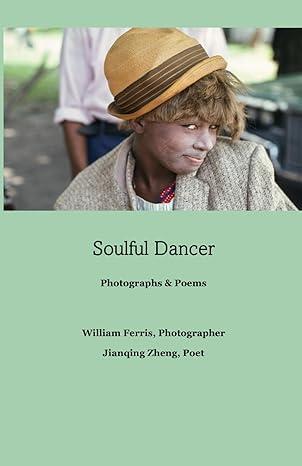
Soulful Dancer is part of an ambitious cycle of poetry published throughout 2025 that places poetry in sustained conversation with visuality, perception, and embodied sensory experience. This cycle includes Still Motion: Poems and Photographs, Visual Chords, Dreaminations: Prose Poems, and Soulful Dancer: Photographs and Poems, all released within the same year and unified by a shared aesthetic inquiry. Except for Dreaminations, which privileges introspection and reflective insight to cultivate an immersive meditative space, the other collections explicitly engage visual media or draw upon multiple sensory and perceptual sources. Together, these works underscore Zheng’s ongoing effort to test the boundaries between image and language, positioning poetry as both a responsive and interpretive act within a broader visual field.
Soulful Dancer pairs William Ferris’s photography with Jianqing Zheng’s poetry in a collaborative meditation on the Mississippi Delta’s cultural memory and lived landscape. Ferris’s longstanding engagement with Southern vernacular culture and
Zheng’s poetic attention to place and history converge in both documentary and lyrical work. While Ferris’s images register gesture, labor, and performance within the Delta’s visual field, Zheng’s poems respond by translating those scenes into reflective, often musical language. The volume’s interplay of image and text situates the Delta not as a static region but as a resonant cultural soundscape shaped by movement, tradition, and survival. Rooted in a specific geography, Soulful Dancer presents the Delta as an ongoing act of expression rather than a preserved artifact.
While this review focuses primarily on Zheng’s poetry, it consistently references Ferris’s photographs to situate the poems within their visual context. As indicated earlier, Soulful Dancer is deeply rooted in the culture and landscape of the Mississippi Delta, specifically, its music (blues and jazz), backroads, and distinctive rhythms. In this collaborative work, poems and photographs appear to dance together, emphasizing movement, sound, and place. Images and words alike evoke both visual and auditory experiences, from patchwork quilts to one-string guitars. Encountering the photographs alongside the poems functions as an entryway into the Delta itself, with its tempo, stillness, and cadences. The result is both a duet and an ongoing dialogue between image and text.
This review considers several representative poems from the volume to assess the rhythmic and thematic emphasis of the collection. The selected poems foreground a rich sensory engagement with the Delta landscape, alongside the varied instruments, tonalities, and soundscapes evoked through poetic rhythm. Each poem is analyzed in relation to its paired photograph and interpreted considering the collection’s overarching concerns, with particular attention to the creative dialogue between image and text. The discussion further examines how individual poems evoke a sense of place understood not merely as geography, but as the emotional and cultural resonance of life in the Delta.
The opening poem under review, “Reflection on the Lake,” responds to an image of tall trees and dense brush gathered in a glade and mirrored in the still surface of a small pond or lake. Puffy clouds hover in the background and are likewise reflected in the water, forming a landscape that will seem familiar to readers acquainted with the Delta region. The poem unfolds as a meditation on reflection, using the doubled image to interrogate perception and temporality. Although it originates as a response to a photograph of trees, clouds, and water, the poem gradually loosens its tether to the visual field, redirecting the reader’s attention toward the instability of seeing itself.
In the opening lines, mutability is established as an underlying principle. Reflection is described not as a mirror but as “[…] a ripple of light and shadow / that deforms something / or nothing in a breeze” (“Reflection” lines 1-3). There is an ambiguity in these lines that destabilizes the image’s reflection, distorting reality. The breeze somehow assists in this process of undoing the form, suggesting the fragility of visual certainty.
Clouds, which traditionally symbolize transcendence, are here humanized as they “need a moment to immerse / their white robes in water (5-6). This anthropomorphism slows time and the poem’s pace, inviting contemplation. The interesting language of clouds immersing in water suggests a confusion between two realms of sky and lake anticipating a collapse of conceptual boundaries that are mentioned later in the poem such as existence and nonexistence, time and timelessness.
A transition occurs as the narrator becomes self-aware as a photographer: “Snapping shots by the lake, / I catch a moment of reflection / on the lake of the mind” (7-9). Here the poet/photographer introduces another reflective surface; the mind itself. Photography, usually associated with clarity about reality, has limitations: “What’s visual may not be / what’s seen by the mind’s eye” (11-12). The poem reframes the camera or photograph as an imperfect instrument, unable to capture the mind’s perception of deeper metaphysical truths.
This interrogation of perception, even within the seemingly objective frame of a photograph, culminates in a philosophical paradox in which being is articulated through negation: “[…] existence / is a state of nonexistence, / time is timeless, / and root is rootless” (12-15). Such assertions evoke aspects of Zen and Daoist thought, where meaning emerges from emptiness and identity from fluctuation rather than fixity. Within the context of the Delta, a landscape shaped by sedimentation, erosion, and recurrent flooding, the image of “rootless” roots acquires both physical and metaphysical resonance. The poem thus remains grounded in a specific geography even as it gestures toward a more expansive meditation on impermanence and the instability of perception.
The closing image returns to the lake, though its reflected light now fades: “The reflection on the lake / dims out when the sun dips / into its reflection, into darkness” (16-18). The sun’s loss of its own image completes the poem’s recursive logic. Light extinguishes itself by merging with its reflection, and darkness emerges not as annihilation but as resolution. Vision may cease, yet contemplation endures.
Within the collection Soulful Dancer, this poem exemplifies Zheng’s broader artistic project: employing photography not merely as illustration, but as a catalyst for philosophical inquiry. Rather than privileging the immediacy of visual perception, the poem suggests that the most perceptive truths of a landscape such as the Delta emerge through sustained contemplation.
The poem “Long Standing” is a specifically descriptive response to a photograph of a mature African American woman who is dressed and ready for church. The title sets the stage for the rest of the poem. While on the surface it seems to refer to the woman’s posture, it also suggests a life of endurance and resilience. So, the poem is about more than just a moment captured on a church porch; it is about a life which has stood strong through time.
The opening image is one of dignity and presentation. She is immediately presented in a ritual space: “The old woman in her Sunday best / stands on the church porch:” (“Long Standing” lines 1-2). Sunday best is a culturally loaded phrase. It signals self-respect and participation in communal life. The church porch is a threshold which stands between a sacred interior and the secular world.
The poem then lists details that mimic a photograph, inviting viewers to scan the details: “a white dress, a pearl necklace, / a blue handbag in her left hand, / a straw hat adorned with white flowers” (3-5). The white dress and pearls evoke a kind of purity and simple dignity; the blue bag adds a touch of individuality and color contrast. The straw hat with white flowers softens the image; it is very practical but also beautiful. Nothing is extravagant in this description, rather, it suggests modest elegance.
In the next stanza the poem shifts from catalog to metaphor: “As calm as the land /under the Mississippi sun, / she looks like a weathered totem pole” (6-8).
The simile does significant work. A weathered totem pole suggests endurance: endurance against the elements, cultural memory carved into the wood, and sacred or communal significance. The Mississippi sun grounds the image geographically. The calmness of the land mirrors this stalwart lady’s composure. She is not just individual; she is emblematic and representative. At the same time, she is weathered and wears time visibly. The poem does not erase age; it dignifies it.
There is an interesting reversal in the next three lines: “Her walking cane, / almost invisible by her dress, / reveals her inner strength:” (9-11). A cane usually suggests weakness, but here it reveals inner strength. The fact that it is almost invisible signifies that what supports or assists her is subtly understated, just like her resilience. The colon at the end of the stanza opens the poem to deeper meaning than what seems evident in the photograph.
The photograph of the African American woman shows what is going on presently; however, the poem opens the story to what her inner strength really means:
washing clothes in a tin basin in front of her shanty which has resisted falling in the storms of hard times. (12-15)
This stanza reaches back in time. The image of washing clothes in a tin basin evokes the hard work of manual labor, poverty, and domestic endurance. The shanty parallels the woman’s own body which has resisted falling. The house stands and so does she.
The last line, “in the storms of hard times,” (15) works literally and metaphorically. Zheng does not specify actual details or her suffering (economic, racial, and generational); instead, he uses weather images to make his point. This subtlety gives the poem dignity despite the actual details.
The placement of “Long Standing” within the collection underscores the significance of bodies that carry and embody history, particularly within Southern culture. The poem demonstrates how a single photographic image can serve as a portal to generational memory, situating the human body as both part of the landscape and as a witness within time. The dancer presented in both photograph and verse is not merely a figure of movement but one whose stillness itself suggests rhythm. The power of the image and the poem lie in their restraint. Ultimately, both forms reveal that this figure stands not only on a literal porch but also within the broader continuum of time itself.
The final representative poem “Delta Blues” is deceptively simple on the surface, but it is a culturally and structurally serious work. You can almost hear the poem before reading it. It is built on repetition: “The farmhand sits on the porch” (“Blues” line 1). This line returns as a refrain in each stanza. Structurally it echoes the AAB pattern of traditional blues lyrics with a statement, repetition, and variations in each stanza:
Dancing corn dancing corn (3)
Bending rice bending rice (7)
Blooming cotton blooming cotton (11)
Flat life flat life (15)
Whining blues whining blues (19)
There is a lyrical doubling, the same way a blues singer repeats a line before changing it. The poem thus plays the blues rather than merely describing it.
The farmhand occupies every stanza. He remains motionless even as everything around him moves: the wind whistles, the corn dances, lightning strikes, rice bends, cotton blooms, evening falls, and the blues begin to wail. The landscape is animated, while the human figure is fixed in stillness. This contrast evokes the Delta blues tradition, in which the singer often appears physically stationary, on a porch, in a juke joint, or along the roadside, yet remains emotionally and imaginatively in motion. The world seems to pass through the singer like breath through an instrument. In this sense, the place of performance becomes a liminal space, neither fully inside nor entirely outside, but suspended between presence and moving on.
The poem traces a sensory progression from one element to another: wind (touch and sound), lightning (sound and sight), sunshine (sight and warmth), and finally music (sound and emotion). This movement suggests a gradual shift from external, natural phenomena to an interior, emotional experience. By the fourth stanza, the landscape takes on an existential dimension: “flat life flat life / flat life of the flatland” (15–16). Here, geography becomes metaphor. The physical flatness of the Delta mirrors a perceived flatness of existence itself. The repetition of the phrase carries weight and resignation that contrasts sharply with the earlier tonal lightness and rhythmic energy of the poem’s opening stanzas.
The final lines alter the poem’s stillness as the farmhand picks up a self-fashioned instrument: “playing a self-made diddley bow” (18). The diddley bow, a homemade, onestring instrument typically stretched across a wooden board with a wire and improvised resonators such as glass bottles or cans, has been central to the development of the blues in the American South, particularly for musicians who could not afford manufactured instruments. The photograph paired with the poem visually reinforces this history: a single wire runs along the porch steps, tensioned between a nail and a rock to produce and amplify a steady tone. A hand reaches downward, poised to pluck the string.
The diddley bow in the poem symbolizes both material scarcity and the transformation of poverty into creative expression. The blues performed on this rudimentary instrument is therefore not abstract; it emerges from specific cultural practices rooted in lived experience. As the speaker describes, “whining blues whining blues / whining blues through night” (19-20). The repetition emphasizes persistence, while the sound carrying “through night” suggests endurance amid darkness. Night here functions as a metaphor for uncertainty and prolonged suffering, yet the music continues, articulating resilience in the face of hardship.
In the broader context of Soulful Dancer, where photography and poetry operate in deliberate dialogue, “Delta Blues” becomes a meditation on the interior life that lies behind the photographed subject while simultaneously serving as a tribute to a distinct cultural tradition. The poem reinforces Zheng’s recurring premise that apparent stillness contains emotion, that flatness conceals depth, and that silence carries sound. As in other poems within the collection, expressions of pain and hardship are rendered with restraint and dignity rather than overt melancholy. This measured tone mirrors the conventions of traditional blues, in which suffering is often understated and conveyed through repetition rather than direct complaint. Consequently, the poem’s closing image does not leave the reader in despair but in resonance with the lingering presence of music rather than silence.
In Soulful Dancer, Jianqing Zheng demonstrates how poetry and photography can enter a sustained dialogue, transforming visual images into temporal, resonant moments. Through poems such as “Reflection on the Lake,” “Longstanding,” and “Delta Blues,” Zheng explores perception, memory, and the Mississippi Delta’s cultural landscape, showing how meaning emerges at the intersection of stillness and motion, silence and sound. Ferris’s photographs do not merely illustrate the poems; they provoke reflection, allowing the poems to extend beyond the frame into rhythm, history, and lived experience. By attending to endurance, labor, music, and subtle gestures, Zheng positions human figures and landscapes as both witnesses to and carriers of cultural memory. Ultimately, the collection affirms that reading and seeing are intertwined acts of attention, revealing that poetry can illuminate not only what is observed but also what is felt, remembered, and imagined.
Blanchard, Jane. Furthermore: Poems. Kelsay Books, 2025, ISBN 9781639807109. 86 pages, $20.00.
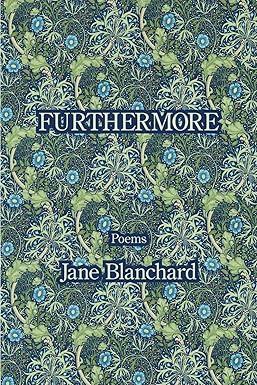
Furthermore is a collection of poetry by Jane Blanchard, a seasoned writer based in Georgia who demonstrates a precise command of traditional forms such as the sonnet, villanelle, and rondeau. This volume continues her commitment to formal structure while infusing it with humor and wit. Though adhering to established poetic patterns, Blanchard expresses a wide range of emotions and vitality through the lens of everyday experience. The poems reveal technical mastery alongside the rhythms of the ordinary world. Throughout the collection, Blanchard invites readers to attend closely to the details of animals, landscapes, and familiar human behaviors. At the same time, these carefully crafted verses engage larger questions of meaning, reflecting on loss, spirituality, and the complexities of human relationships. This collection continues Blanchard’s steady literary output, following earlier volumes such as Metes and Bounds (2023), Sooner or Later (2022), and Never Enough Already (2021), among others. Across her oeuvre, she consistently explores both personal and universal themes through carefully measured verse. The poems in Furthermore form a rich tapestry of formally crafted work that reflects a sustained engagement with everyday experience, emotional complexity, and poetic structure,
making the collection a rewarding read for admirers of both traditional and contemporary poetry.
Although poems from this volume have not been widely excerpted in reviews, those that have appeared consistently highlight Blanchard’s technical mastery of traditional forms, her closely observed and contemplative tone, and her attention to small but revealing moments of human interaction. In a brief review of Furthermore in New Verse Review, Steven Peterson observes that Blanchard “shows how the most common forms of poetry, some of them used for centuries, still have the power and flexibility to enchant us when the poet expertly matches subject and feeling to forms” (np).
This review considers three representative poems from Furthermore that exemplify Blanchard’s metaphysical and theological reflections, her attention to personal relationships, and her keen observational precision rooted in the natural world. Although the collection ranges widely in tone, structure, and subject matter, this discussion privileges depth over summary by focusing on poems that illuminate these central concerns. Without diminishing the richness of the entire collection, close readings of selected works demonstrate the formal consistency, thematic depth, and conceptual coherence that characterize the collection. These poems are not presented as superior to others in Furthermore; rather, they serve as particularly clear expressions of the collection’s most important ideas.
Although Blanchard employs traditional forms with notable precision, she is not so rigidly bound to structure that she cannot introduce creative variations. The opening poem, “Seen and Unseen,” is a deceptively simple yet highly structured lyric written in the form of a viator, in which a repeating line “travels” through four nonrhyming quatrains. This movement of the refrain creates continuity and resonance across the poem, allowing repetition to shape meaning while maintaining formal flexibility.
“Seen and Unseen” is representative of Jane Blanchard’s central philosophical concerns in Furthermore. The poem functions as a descriptive lyric grounded in a specific location, St. Simons Island, yet it simultaneously operates as a meditation on perception itself. Although the setting is rendered with concrete, coastal detail, the poem’s deeper preoccupation is epistemological: the tension between what is visibly present and what is only implied. The repetition within the poem mimics natural cycles tide, wind, and drifting clouds so that formal structure reinforces thematic inquiry. On the surface, the poem appears primarily descriptive; however, its layered imagery gradually accumulates, guiding the reader toward a conclusion that is subtler and less immediately apparent than the opening scene suggests.
In “Seen and Unseen,” the recurring line “[w]ind from the east drives cloud by cloud toward shore” (“Seen and Unseen” lines 1, 6, 11, 16) functions as a refrain that emphasizes an irresistible natural force. The verb “drives” conveys insistence and sustained pressure, underscoring the wind’s agency. Throughout the poem, nature acts while humans respond. Each stanza registers the consequences of this movement: clouds alter the ocean’s color, the tide rises, the sandbar disappears, pelicans feed, swimmers retreat, and even the “dragon” kite strains against the current. The repetition of the refrain unifies these developments, suggesting that all visible action originates in the steady, cyclical motion of the wind.
The title’s thematic claim culminates in the final stanza: “[…] string being held by someone not in view” (15). This line functions as a hinge after the preceding stanzas,
which emphasize visible phenomena and concrete description. With the introduction of the unseen figure holding the string, the poem shifts from observation to implication, suggesting hidden agency and an obscured human presence behind the motion described. The “someone” parallels the wind itself, imperceptible to the eye yet unmistakably active in its effects. In this way, the poem draws a sustained analogy between the unseen wind, the invisible kite holder, and the intangible forces that shape human behavior: fear of the approaching storm, instinct, appetite, and habit. What begins as a coastal tableau thus broadens into a meditation on the unseen influences that govern both nature and human experience.
It is essential for readers to attend to the poem’s progression: nature acts with impersonal inevitability, while human beings respond with only mild urgency. Despite the vividness of its imagery, the poem contains no true drama or catastrophe; instead, it depicts adaptation. Blanchard deliberately resists melodrama: “[…] pelicans / routinely glide, then dive-bomb schools of fish” (7-8), and even potentially threatening elements, rising tides and the approach of storms, are rendered as ordinary features of the coastal environment. This emphasis on routine aligns with Blanchard’s broader poetic method in Furthermore: the everyday moment becomes the site of subtle revelation. Yet she refrains from prescribing interpretation. Rather than drawing explicit conclusions, Blanchard invites an active readerly response, allowing meaning to emerge through attentive engagement with what is seen and, equally, what remains unseen.
In “To Carolyn,” Blanchard shifts from the perceptual, coastal meditations found in the previous poem to a more intimate and emotionally charged tone. The poem is an elegiac sonnet, yet it also reads as an obituary composed under palpable tension. Its disciplined rhyme scheme provides formal containment that sharply contrasts with the narrator’s emotional volatility. The sonnet bears the weight of anger, guilt, resentment, and compassion, but the restraint imposed by its traditional structure prevents the poem from descending into invective. Across its fourteen lines, the speaker remains morally self-aware, allowing complexity rather than accusation to shape the elegy. The tension between inherited familial injury and the speaker’s effort toward ethical clarity generates the poem’s dramatic force. In this way, the sonnet form becomes not merely a container for grief but an instrument of moral reckoning, shaping raw emotion into measured reflection.
The poem opens with a heading that signals shared origin: “On whose birthday I was born” (74). This phrasing establishes the thought that the poem concerns more than sisterhood; it suggests a mirrored existence. To be born on another’s birthday implies a doubling that hints at identity entanglement from the outset. The line also gestures toward a fate in which their lives are bound together even before they possess agency. Yet the first lines immediately introduce estrangement: “I learned of your last illness, then your death, / through lawyers” (“Carolyn” lines 1-2). The news arrives not through familial intimacy but through legal mediation. This detail carries significant implications. Beyond suggesting estrangement, it intimates unresolved conflict, framing the death within a history of dispute or bitterness. Thus, the poem begins not with overt grief but with emotional distance.
After the poem’s initial emotional distancing, there is a tentative attempt to connect across that separation: “How I hope you had no fears / of leaving” (2-3). Rather than foregrounding her own grief, the speaker focuses on Carolyn’s state of mind at the moment of death, expressing the hope that her sister did not die in fear. The emotional
register deepens in the lines, “How I pray your final breath / was not a rant against someone with years, / months, days remaining namely Jane” (3-5). Here, guilt and anxiety surface. The speaker worries that she herself may have been the object of Carolyn’s final anger. The self-conscious shift to the third person, “namely Jane,” creates a renewed distance, perhaps as a protective gesture against being emotionally overwhelmed. The phrasing carries a legal resonance, echoing the diction of a will or formal document. In this way, death becomes not only an awareness of personal loss but also a moment of moral reckoning, which is difficult to bear.
In the next lines, the previously implied conflict between the sisters is reframed because of parental abuse: “Our lives / were bound by common parents who misused / us willfully” (5-7). The word “willfully” is crucial because it suggests deliberate harm rather than mere neglect or accident. The adverb intensifies the accusation; it removes any possibility of misunderstanding and instead attributes conscious agency to the parents. By shifting the source of tension away from individual grievance and toward shared trauma, the poem complicates any simple reading of sisterly hostility. The sisters are “bound” not only by blood but by injury, their connection shaped as much by damage as by kinship. The estrangement between them is thus not purely personal but emerges as the lingering consequence of intentional parental harm, a legacy that distorts intimacy and fosters resentment rather than solidarity.
This recognition gives rise to a pronounced sense of vulnerability: “One daughter yet survives / mere me, the younger one […]” (7-8). The phrase “mere me” is devastating in its restraint and self-accusation. It carries the weight of regret, survivor’s guilt, and even a trace of irony. The narrator defines herself in relation to the sister who is now gone, as though her identity persists only in the context of that absence. Yet she is also the one “who long refused / to bow to power for better, not for worse” (8-9). These lines complicate and partially reframe the narrator’s self-understanding. If the parents “misused” their authority, then resistance becomes a moral stance rather than mere defiance. Still, the qualification “for better, not for worse” introduces uncertainty. The tone is not triumphant but ambivalent; moral conviction does not erase the possibility that such resistance contributed to estrangement. The speaker’s integrity may have come at the cost of intimacy with her sister, and the poem allows that painful ambiguity to remain unresolved.
There is much more that could be said about this psychologically complex poem, but the final lines crystallize its emotional intricacy. Echoing one of the central concerns of Furthermore, the tension between what is seen and unseen within this troubled family inheritance shapes generational choices and relationships over time: “[…] however hard / is left the effort to escape the curse / of any generation” (10-12). The word “curse” carries a distinct metaphysical and theological resonance, suggesting not only trauma passed down but also the repetition of destructive patterns and the persistent difficulty of breaking such cycles. In this way, the poem expands beyond personal grief into a broader meditation on inherited damage and the enduring consequences of fractured family bonds.
The final turn in the closing lines of the poem is both brilliant and chilling: “So, on guard / as always, never mind the customary, / I offer this as your obituary” (12-14). Despite the passage of time, the relationship remains tense; the speaker is still “on guard,” suggesting that emotional vigilance has become habitual. The phrase “never mind the customary” signals a deliberate rejection of social convention, particularly the
expectation that death softens or sanctifies memory. Instead, the speaker chooses candor over courtesy. The poem thus becomes a corrective to polite remembrance. Whereas traditional obituaries often smooth over conflict in favor of reverence, this testament refuses falsification, honoring truth rather than decorum.
The final poem, “Marsh View,” in Furthermore, articulates Jane Blanchard’s sustained attention to the natural world as a marsh landscape unfolds in carefully observed detail. Formally, it is a lyrical poem composed in regular meter, arranged in two quatrains with a patterned rhyme scheme of ABBA CDDC. This tight structure lends the poem symmetry and a sense of closure. Although the tone initially appears light and even playful, the compact design and subtle ironic detachment invite reflection on both animal instinct and human behavior.
The opening line establishes a tone of mild irony: “Ducks do not seek to be admired” (“Marsh” line 1). The poem is anthropomorphic from the outset; animals do not consciously pursue admiration. Yet the poet immediately qualifies the claim: “Except by their own kind, of course” (2). The phrase “of course” gently undercuts the apparent denial, introducing a wry acknowledgment of social dynamics. Ducks may not care about human approval, but they are invested in recognition within their own species. This shift moves the poem beyond simple nature description toward a meditation on social validation, subtly aligning animal behavior with human concerns.
The phrase in line 3, “[…] side long glances,” suggests both flirtation and scrutiny, implying an awareness of being seen as well as an interest in observing others. These glances, the narrator notes, “[…] reinforce / the primal need to be desired” (3-4). The adjective “primal” frames desire as instinctual rather than self-conscious, emphasizing its biological and evolutionary roots. Desire here is not a superficial longing but a fundamental drive, one that governs behavior without deliberate intention. At the same time, the words complicate this purely instinctive reading: words such as “admired” and “desired” introduce the language of choice and social evaluation. In this way, Blanchard subtly blurs the boundary between instinct and intention, inviting readers to recognize parallels between the ducks’ behavior and human forms of courtship.
In the second quatrain, Blanchard emphasizes the idea of performance: “What follows is a feathered show” (5). The word “show” recasts the ducks’ behavior as theatrical spectacle, suggesting that courtship unfolds before an implied audience. This display is inseparable from competition: “Where one plus one is not enough” (6). By considering mating in mathematical terms, the poem reduces instinct to calculation, implying excess, escalation, and accumulation. The male duck must assert his superiority: “The male proves that he is up to snuff” (7). The colloquial phrase “up to snuff” introduces a note of wit, yet it also carries evaluative weight, underscoring that even in the natural world, worth is measured, tested, and publicly confirmed.
The final image functions as both a literal observation of animal behavior and a subtle form of social commentary: “By having two females in tow” (8). On the surface, this reflects a common reproductive strategy in nature. At the same time, it suggests a display of status, as if desirability must be proven through visible accumulation. The male’s worth is measured externally, validated by public evidence of attraction rather than by any intrinsic quality. The phrase “in tow” carries a faintly humorous tone, gently hinting at possessiveness or showmanship, as though the females are part of a spectacle. By presenting this behavior so plainly, the poem invites readers to recognize that such
competitive displays are not unique to ducks but recur across the animal world, including, implicitly, human society.
Together, these three poems, “Seen and Unseen,” “To Carolyn,” and “Marsh View,” provide a concentrated view of central themes in Jane Blanchard’s poetry. “Seen and Unseen” serves as the conceptual anchor of the collection, explicitly engaging the tension between visibility and invisibility, material and spiritual reality, and dramatizing the limits of empirical perception. The poem suggests that meaning exceeds what can be verified by the senses. In contrast, “To Carolyn” grounds these abstract concerns in a lived human relationship, presenting intimacy and vulnerability while demonstrating how endurance, affection, and gratitude are embodied in ordinary experience. Here, the unseen becomes tangible through fidelity and memory. Finally, “Marsh View” turns to the natural world, where landscape is neither merely sentimental nor purely symbolic but becomes a field of perception in which the visible and invisible converge; the marsh itself functions as a contemplative space, holding together physical specificity and meditation in a delicate balance.
The representative poems in this collection illuminate the coherence and ambition of Furthermore as a whole. In different ways, via coastal meditation, familial elegy, and natural observation, Blanchard returns persistently to the interplay between outward form and inward force. The visible scene in “Seen and Unseen,” the formal sonnet structure in “To Carolyn,” and the tightly patterned quatrains of “Marsh View” all reinforce the same artistic conviction: structure does not confine meaning but clarifies it. Blanchard’s adherence to traditional forms is not nostalgic imitation; rather, it is a disciplined means of exploring questions that remain urgent questions of inheritance, agency, desire, and loss, as well as the unseen influences that shape both private and communal life.
Moreover, the collection demonstrates that formal poetry retains not only technical viability but emotional and philosophical range. Blanchard’s command of rhyme and meter allows her to modulate tone with precision, moving from irony to grief, from theological implication to gentle satire, without sacrificing coherence. The everyday settings that populate these poems shorelines, marshes, family histories, and fleeting human interactions become sites of contemplative depth. In this sense, Furthermore affirms that lyric poetry does not need to rely on spectacle or fragmentation to achieve resonance. Instead, it achieves power through attentiveness, compression, and moral clarity.
Blanchard’s work resists simplification. She does not sentimentalize nature, sanitize memory, or flatten spiritual inquiry into easy affirmation. The poems invite readers into acts of perception that are at once careful and self-critical. What is “seen” is rarely sufficient on its own and what is “unseen” is never wholly accessible. By sustaining this tension across varied subjects and forms, Furthermore achieves a conceptual unity that strengthens its individual pieces. The collection rewards slow reading and thoughtful return, revealing additional layers with each encounter.
Peterson, Steven. “A Review of Furtherance by Jane Blanchard. New Verse Review, 28 July 2025, www.newversereview.substack.com/p/a-review-of-furthermore-byjane-blanchard.
Kolin, Philip C. Evangeliaries: Poems. Angelico Press, 2024. ISBN 979-8892800617. 112 pages, $14.95
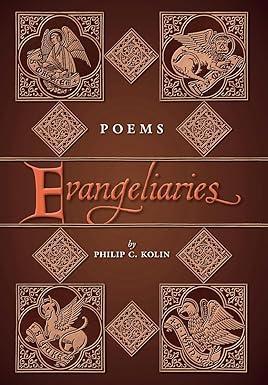
Reviewed by Matthew Bardowell
Philip C. Kolin’s collection of poems in Evangeliaries is a meditation on the human condition the human lifespan, really. Kolin’s vision of human life and thriving hews closely to the vision of time we, as Christians, receive in the lectionary. Like Augustine’s Confessions, Kolin aligns the human span with the constant and everpresent love of God. Our breath is caught up in the endless rhythm of God’s love and our praise. That life, as presented in Kolin’s poetry is also caught up with the life of Christ. This much is evident from the structure of Kolin’s collection. Poems are grouped under the following headings: Beginnings, Holy Books & Theological Virtues, Metaphors & Keys, Oremus, and, finally, Life’s Last Country.
In this way, Kolin’s book offers a kind of poetic liturgy in which readers can position themselves, and this is a welcome break from the typical rhythms of modern life. It can be so easy to hum along with the beats of the Hallmark calendar, in which we move from one holiday to another New Year’s Day leads to Valentine’s Day, which leads to St. Patrick’s Day, etc. By and large, these dates often lose any connection to the sacred and simply become the rhythms of our materialistic consumption. Kolin’s book, like the lectionary, offers an alternative way to engage with the cyclical flow of daily life.
In Kolin’s first section, “Beginnings,” the poem “Stars” illustrates Kolin’s view on the recursive nature of time. “Stars” explores the rich symbolism behind these celestial bodies and our complex connection with them. They are “bright mysteries [...] reflected in water mirrors […] [that] invite encounters with eternity” (9). But stars are also more than this. They are the generations of Abraham. They are the “golden incense” that lead the Magi (9). They are found in the “Virgin’s twelve-star halo” (9) of Revelation. Kolin’s imagery reveals that the stars are all these things at once. This realization cuts across our ordinary concept of time to unite present, past, and future. Similarly, Kolin’s poem “Water” spans centuries to show us the unifying current of this element in our lives. Water joins us in our flesh, the Nile, that which gushes forth from the rock Moses struck, and that in which Naaman plunges himself to be healed of his leprosy. These images culminate in the final lines:
Our lives are written in water. The womb’s sea brings us into the world and holy water sprinkled over our grave carries us out, out into the deep. (13)
Kolin’s collection opens with stirring reminders of connectedness to these elemental forces and the way God’ grace reaches us in our present moment just as it has reached our ancestors and will reach our descendants. Using imagery from mundane experience as well as Biblical scripture, Kolin’s poems have an almost riddle-like quality. The answers are given in the titles, and yet the reader is still invited to identify the subjects. It is as if the poems says to the reader: I have told you the answer; can you see it? The poem “Parables,” found in Kolin’s second section, “Holy Books & Theological Virtues,” illustrates this riddle-like quality well. Kolin writes:
Lost coin. Lost sheep. A lost son, feeding on pig pods, come home now to his longing father gifting him with a robe, a ring, a fatted calf. Avoid enlarging the sawdust speck in your elder brother’s eye while ignoring the plank in yours. (25)
The reader identifies the subject of these references with the poem’s title, “Parables,” but hidden in these lines are wise urgings. Things explicitly to avoid, yes, but also synesthetic lessons for those who have the “ears to see, eyes to hear” (25). In this brief second section, Kolin offers similar treatments in poems titled “The Psalms,” “The Prophets,” “Grace,” “Faith,” “Hope,” and “Charity.”
The third section, “Mysteries & Keys,” extends this riddle-like treatment of subjects to urge readers to perceive the mysteries of the Christian faith. Kolin’s poems are always showing us the connection between symbol and sacrament, with a special focus on how the symbols accrue meaning over time. These poems show that meaning is always gained but never replaced. The one and the many are drawn together in unity. Take his poem, “Bread,” as an example. The poem begins:
Down long aisles to the altar with bent heads, we open our mouths to receive mystery (34)
In this poem, worshippers consume mystery which in turn “consumes us” (34). The poem draws together the Incarnation of Christ with the incarnation He enacts during the taking of communion. The poem reads:
In every particle Christ enters, putting on the flesh that covers us as Spirit becomes substance. (34)
These lines encourage the faithful to wonder at the mysteries of Christ’s presence. Each line develops fresh meaning until the reader is overwhelmed by the multiplicity of significance. Kolin’s verses gather meaning like stones of remembrance. In one of my favorite poems from this section, “Stones,” the reader is urged to “Carry stones in your shepherd’s sack / on your pilgrimage” (39). In Kolin’s hands the rocks in David’s shepherd’s pouch undergo several poetic transformations. We are encouraged to listen to the stones, to hear their clacking and scraping as “Hosannas” (39). They morph into “Golgotha’s cruel rock” and finally resolve into the stone that is rolled away to reveal the empty tomb (39).
The poems collected in Kolin’s next section, “Oremus” (in Latin, “let us pray”), reflect the disorienting and re-orienting experience of communing with God through prayer. One striking poem, “Epiphany,” reads like a shape poem composed in three vertical columns, read top to bottom. The columns individually make sense to the reader in a linear sense, but I felt compelled to consider whether adjacent words may also be significant. I confess that I do not know if this was the author’s intention. This was simply my experience upon reading it. I am still not sure if any of the associations I made between ideas across columns were intentional, but the experience felt fresh to me. The form of “Epiphany” is a welcome mystery hidden amid other poems about mysteries. In this way, Kolin’s poems are both deeply tied to tradition and are still innovative.
The preceding sections of Kolin’s book are characterized by mystery and the multiplicity of meaning inherent in all things. The final section, “Life’s Last Country” is different. It is an unflinching look at mortality, as brave and honest as any poetry I have read on the subject. The poems collected here must have demanded courage from their poet, and it is fitting that they should likewise require courage from their reader. I do not know if I was up to the task, but these poems made me wish that I was. “An Old Man Reflects on Job” and “Your Last COVID Words” quite simply hurt to read and to feel. And yet, bound up in all this pain is also love, as is always the case, I suppose. Poems like “We Are Awaited” mingle pain and love quite beautifully, and “Monkey Grass, for Margie Parish” is an elegy to rival Gerard Manley Hopkins’s “Felix Randal.” Perhaps the most hopeful poem in this section is “Rain on the Pond,” which envisions the rain falling on the water’s surface as tears shed
for so much pain in the world. Scars and scandals. Tombs (86)
The poem reflects upon those lost in the forgetfulness of time or the forgeries of despair (86)
Despair as forgery is so apt an observation, so keen and incisive, that the reader begins to feel a sense of healing. These lost ones are abandoned except for our prayer circles our eyes say (86)
Grief as a kind of prayer born from the mingling of loss and love reveals grace. Kolin’s Evangeliaries has these and many other things to say. It will be of interest to those who have the patience for meticulously constructed poetry. And, like the liturgical calendar, this book of verses cannot say all that needs to be said in one moment or even one year. As Kolin gathers meaning together in simple, elemental subjects like stones, bread, and monkey grass, he shows us that significance is made across moments and across lifetimes, all of which culminate in the life and body of our Savior, Jesus Christ. He too has much to say. So much, Saint John tells us, that “if every one of them were written down, I suppose that even the whole world would not have room for the books that would be written” (John 21:25).
Holy Bible, New International Version®, NIV® Copyright ©1973, 1978, 1984, 2011 by Biblica, Inc.® Used by permission. All rights reserved worldwide.
Herz, Georgie. Outcome Unknown: Poetry & Art. Jor-G Publishing, 2025. 109 pages.
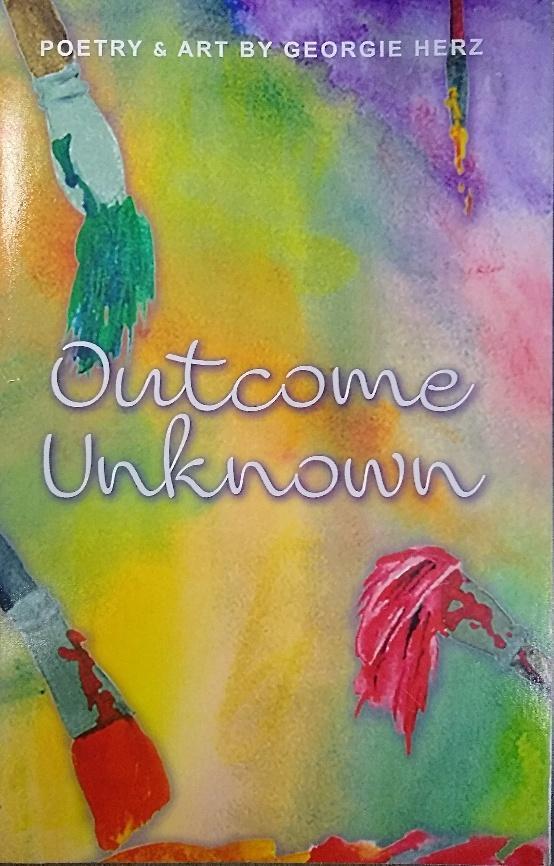
Poetry is often introduced to students through canonical works such as Shakespeare’s “Sonnet 18,” a poem admired for its craft but often too complex for many students today. Reading the sonnet can feel like encountering a sentence written in another language. The words may be clear, yet the meaning seems elusive. Reading the poem itself is not the difficult part; discovering its meaning is. High school teachers and college professors frequently assign works like this to encourage students to search for deeper significance.
At first glance, one might assume that “Sonnet 18” is simply about a summer day. However, the poem’s enduring value lies beneath that surface, a depth that many students find intimidating. Works like this are often perceived as difficult because of their language and complexity. While professors assign such poems to cultivate critical thinking and interpretive skills, students often come to associate poetry, especially Shakespeare, with obscurity and frustration. This perception reinforces the stereotype that poetry must be dense and difficult to decipher.
Outcome Unknown challenges that assumption. Rather than imitating canonical models, the collection embraces clarity of language and immediacy of voice. It explores everyday struggles perfectionism, self-doubt, competition, harmful habits, and changing family traditions through concise lyric forms. Poems such as “Chores,” “InBetween,” “Can’t Catch Up,” “You’re Wrong Coach (some quitting develops winners),” and “Hold on to What We Can” demonstrate that poetry can draw meaning from ordinary experience without relying on elaborate metaphor or obscure allusion.
“Chores” displays the feeling of having a list of things to do and not wanting to do them. The second stanza reads,
Daily stuff always awaits, No one wants the meal served late. I start one, then go to another. Overwhelming for me, “Oh brother!” (27)
This stanza illustrates the reluctance to complete chores while recognizing that neglecting them affects others. The last two lines, “Done quickly not all correct, / Done is better than perfect” (27), illustrate the satisfaction of finishing tasks, even if they are completed imperfectly.
Similarly, “In-Between” explores the mindset of a perfectionist, the anxiety of ending up in the middle and the gradual acceptance that being last can be acceptable. The first stanza reads,
Taught to be the best
Stand out among the rest
Give 110 percent
No failing, is what they meant. (48)
These lines reflect the pressure to always excel. Midway through the poem, an internal dialogue emerges: one voice fears mediocrity, “What if I’m in-between? / Is the middle ever seen?” (48), while another voice offers reassurance. Lines such as “I’m still a winner if I fall” and “First, even second is not the only success / Some of us in the middle are the best” (48) suggest a healthier perspective. By the end, “If I’m last, it’s okay / I could be in-between another day” (48), the anxiety softens. The poem ultimately teaches that effort matters more than outperforming others.
This theme of pressure continues in “Can’t Catch Up,” which portrays the anxiety and frustration of falling behind. Lines such as “Training strength and speed / What is it that I need?” and “What’s holding me back, / Is it confidence I lack?” (51) show the speaker questioning personal ability. The repeated self-interrogation, “Time has taken hold, / Am I just too old?” (51), intensifies the sense of urgency as the metaphorical race nears its end: “The stopwatch ticks away / I see the goal, is this the day?” (51). Although the desire for recognition appears, “It’s the award I want one of those” (51), the poem suggests that effort, not victory, defines success. From this idea emerges the possibility that stepping away from one pursuit may open the door to another.
That concept is developed more directly in “You’re Wrong Coach (some quitting develops winners),” which argues that quitting can, in certain circumstances, be an act of strength. By listing harmful habits self-injury, negative self-talk, smoking, and
drinking the poem reframes quitting as courageous rather than weak. Abandoning destructive behaviors “take[s] the most / strength” (50), particularly when doing so restores health and relationships. In this way, quitting becomes not a failure but a turning point.
Finally, “Hold on to What We Can” shifts from competition and selfimprovement to memory and loss. The poem reflects on changing holiday traditions and the inevitability of absence. Lines such as “Great Grandma’s not here, our dog’s gone” and “Can’t hold on to all the traditions” (87) acknowledge that time alters even cherished rituals. The poem gently suggests that while not everything can be preserved, what remains still carries meaning.
Through these varied themes, Outcome Unknown defies the stereotype that poetry must be difficult to comprehend. The poems are relatable and accessible, often reading like a conversation with the reader. As a result, the collection offers an encouraging model for aspiring writers, demonstrating that poetry can be clear, honest, and emotionally resonant without sacrificing depth.
Zheng, Jianqing. Dreaminations: Prose Poems. Madville Publishing, 2026. ISBN 9781963695496. 83 pages, $19.95.
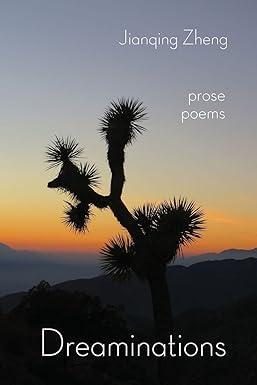
Dreaminations is the latest installment in an impressive series of poetry collections that Jianqing Zheng has published over the past two years. Across this body of work, Zheng consistently experiments with multisensory or synesthetic approaches to poetry, inviting readers to experience language as an interweaving of words, images, sounds, and textures. His recent books, including Delta Landscapes: Photoku (2025), Still Motion: Poems and Photography (2025), Soulful Dancer: Photographs and Poems (2025), and Visual Chords (2025), explore aesthetic experience, spirituality, poetic form, imagination, and selfhood while probing the dynamics of language itself. Rather than offering static texts, Zheng fuses visual, musical, and tactile modes of perception, expanding poetic images through juxtaposition and layering, thereby transforming the act of reading into a richly immersive experience.
Whereas Zheng’s recent poetry collections emphasize outward interactions among images, tones, and words, Dreaminations turns inward, favoring introspection and association. The prose poems and lyric pieces, often drawing on the Japanese traditions of haiku and tanka, offer moments of insight that transform or illuminate the
shifting dynamics between self and world. Dreamlike imagery opens these poems to layered and resonant meanings. Rather than foregrounding external relationships among visual and tonal elements, the poems in Dreaminations are inward-looking, lyrical, and philosophical. Collectively, they invite readers on an interior journey of perception, exploring the self’s sensory engagement with nature, memory, and the surrounding world.
This review analyzes several poems in the collection to illustrate how Zheng’s perceptual and imaginative experience shapes an understanding of the relationship between the self, nature, and the outer world. In the opening prose poem, “Looking Out the Window,” the title immediately establishes a mediated act of seeing. The poem does not simply describe nature, “[…] a sky-high pine tree in the backyard years ago” (“Window” 3), but presents a remembered image, filtered through temporal distance and reflection. The act of looking outward occurs from within the poet’s imagination. The window itself is implicit rather than literal, positioning the reader in a liminal space between interior and exterior, wakefulness and dream. This framing embodies the logic of Dreaminations, where perception is often indirect and the external world becomes a screen upon which interior thoughts and emotions are projected. The pine tree thus emerges as a monumental presence, “sky-high,” before being reduced to a dream-image subject to time and erosion: “it died after years of persistence to stand on our guard” (3).
Even though Dreaminations moves, to some extent, away from the explicitly synesthetic premise of Still Motion and Visual Chords, sound remains central to the imagery of its prose poems. In “Looking Out the Window,” the pine tree functions “like a bagpipe of autumn wind to blow ‘Amazing Grace’” (3). The hymn’s cultural association with mourning and transcendence establishes an elegiac tonal frame. As the poem develops, this tonal register darkens: “[…] cones thudded […] like […] metal drum[s],” a “chainsaw” creates “farewell blues,” and “crows” cry “a mournful song” (3). The poem thus progresses musically, with sonic movement replacing linear narrative**, mirroring** the tree’s life cycle. Throughout, the tree is persistently humanized, so that nature appears as a fellow sufferer enduring a “slow death” (3).
The final three lines shift abruptly into haiku form: “autumn dawn / a reishi mushroom by the stump” (3). After the extended prose elegy, the poem resolves into stillness and regeneration. The reishi mushroom, medicinal and slow-growing, quietly contradicts the tree’s destruction. Death has not ended life; it has transformed it. Such an ending creates a lucid moment, a brief awakening in which the dream discloses a deeper meaning.
Continuing the theme of the interior journey projected onto the external world, the poem “A Way of Watching” follows a similar trajectory. The poem takes perception itself as its primary subject. Recuperating from a broken leg, the speaker is physically immobilized, and this enforced stillness creates the conditions for an intensified attentiveness to the natural world. Watching birds from the window is not merely an act of observation but a means of reorienting the self in response to vulnerability, limitation, and time. The poem is less concerned with what is being watched than with how it is observed; it explores the cultivation of a perceptual posture shaped by injury and forced patience.
Sound plays a central role in this process. The birdsongs are not simply atmospheric details but sources of emotional sustenance. Their calls “hearten” the speaker, who participates in what he observes in the only way available to him given his
disability: he “[…] whistles at them delightfully” (“Watching” 9). This delight is not naïve or unreflective; rather, it functions as a conscious, even defiant, affirmation of presence. Sound thus becomes a substitute for motion, a means of engagement that compensates for physical constraint.
The speaker’s condition of dependence stands in sharp contrast to the vitality of the birds. The window functions as a threshold between interior consciousness and the external world, mediating the speaker’s experience of nature. Yet this limitation paradoxically expands perception, enabling him to distinguish the tonal qualities of individual birdcalls: “[…] a warbler’s chirp, a blue jay’s squawk, a mockingbird’s tonguetwister, a mourning dove’s coo” (9). Physical restriction becomes a catalyst for perceptual richness, as meaning emerges through contemplation rather than action.
“A Way of Watching” concludes with a forceful cheer that contrasts with the subdued circumstances of injury and recovery. This cheer is not triumphant in a conventional sense; instead, it is described as “a joyful view” that arises from a momentary but intimate connection with nature. The joy is provisional rather than resolutive, emerging briefly in the image of “[…] a cardinal shining bright red among fresh green” (9). Its credibility lies precisely in the fact that it coexists with pain and limitation rather than transcending them.
In the poem “Dreamination,” Zheng offers a distinctive treatment of a dream sequence by assembling a range of cultural archetypes, including Popeye, Olive Oyl, and Brutus, alongside historical and cultural figures such as Mao Zedong, Confucius, and Franz Kafka. The poem unfolds in a nonlinear, associative, dreamlike fashion. It opens with a storm “[…] a strong shelf cloud, a rolling squall, the darkening sky” (“Dreamination” 56), that functions as an externalization of psychic turbulence. This storm quickly gives way to a surreal, cinematic sequence in which Popeye, a cartoon character, drives into a darkness that “[…] swallows him at once into a symphony of thunder, lightning, and hail” (56). The accumulation of sound imagery transforms the storm into an orchestra, signaling that the setting is not a literal landscape, but a dreamscape shaped by heightened perception.
The poem’s high drama soon collapses into slapstick when the car “[…] crawls like a snail” and its muffler “toots like a squelching fart” (56). The poem resists emotional or intellectual stability; its characters do not interact rationally but instead resemble latent symbols emerging during psychoanalytic free association, each jostling for dominance. Mao’s command to counterattack, followed later by the order to “flog that cur!” (56), satirizes the internal consistency and brutality of totalitarian authority. Confucius’s brief appearance underscores the ineffectiveness of moral order within the dream, while Kafka’s sudden intrusion quickly gives way to Brutus, who flees the scene, dramatizing the instability and fragmentation of identity. The result is a vision of a global unconscious in which Eastern philosophy, revolutionary politics, and American cartoon mythology coexist in grotesque parody. This hodgepodge of characters, ideas, and symbols reflects Zheng’s ongoing effort to explore perception and meaning within the human imagination.
At the psychological core of this dream poem lies sexual jealousy and wounded masculinity. The image of a newborn in Olive Oyl’s arms triggers Popeye’s rage: “He feels like a man wearing a green hat, his fist squeezing shock and anger, and veins popping out of his arms” (57). In Chinese culture, the green hat signifies cuckoldry, suggesting Popeye’s suspicion that the child belongs to another man. His exaggerated
masculine posturing exposes a deep fragility and anxiety beneath his outward toughness. Throughout the poem, the dream stages repeated episodes of violent dramatics fists clench, spinach is consumed, authority figures issue contradictory commands, yet none of this exertion leads to resolution. This persistent futility ultimately prepares the way for the poem’s abrupt awakening.
There is a sudden shift at the poem’s conclusion that recontextualizes the entire narrative as a projection of the sleeping mind: “The dreamer’s wife rolls up […]” (57). This moment of concrete domestic calm contrasts sharply with the preceding chaos of the dream, as though the poem has abruptly moved into another dimension of experience. The dreamer mutters “Wwwwhat?” before returning to sleep, treating the dream as something wholly disconnected from waking reality, perhaps because his consciousness cannot integrate its excesses or contradictions. This disengagement underscores the dream’s status as a psychic eruption rather than a message capable of immediate interpretation. In conjunction with this final prose sequence, the tanka that follows introduces an even more radical tonal and conceptual shift:
on the round belly of the laughing Buddha a bright moon empty shine of silence (57)
After the cacophony and cultural collision of the prose poem, the tanka offers stillness, simplicity, and spiritual composure. The laughing Buddha, traditionally associated with abundance, contentment, and release, stands in stark contrast to Popeye’s aggression and frustration. The image of the “bright moon” resting on the Buddha’s belly evokes a luminous emptiness: radiant yet ungrasping, complete without striving. This distilled clarity functions as a quiet counterbalance to the dream’s ideological conflict, cultural noise, and masculine anxiety. By setting these aside, the poem gestures toward an alternative mode of awareness; an “empty shine of silence” that neither judges nor resolves but simply exists.
These three poems exemplify Zheng’s method in Dreaminations: the blending of prose poems with short Japanese lyric forms, high culture with popular culture, and humor with philosophy to present consciousness itself as a field of diverse ideas and interactions. The poems do not advance a single, unified worldview; rather, they enact the associative workings of the mind as it moves through culturally heterogeneous material. Within this process, a silent interior space emerges in which the imagination can envision and momentarily inhabit new worlds, forging unexpected connections. At times, such a mental posture requires withdrawal into quietness, a space from which moments of joy can suddenly break through experiences easily overlooked amid the routines of everyday life.
Taken as a whole, Dreaminations affirms Jianqing Zheng’s sustained commitment to exploring perception as an active, productive process rather than a passive reflection of reality. Across its prose poems and lyric forms, the collection demonstrates how consciousness continuously shapes, distorts, and reconstitutes experience through memory, sensation, and cultural inheritance. Dreams, windows, and moments of enforced stillness, and sudden awakenings all function as thresholds
through which the self mediates its relationship to the world. Rather than resolving these negotiations into stable meanings, Zheng allows them to remain fluid and openended.
One of the collection’s most distinctive achievements is the relationship between its more expansive prose and compressed Japanese forms. The prose is often emotional and expansive, then gives way to terse and muted lyrical poetry. The noisy, narrative, and turbulent excess of the prose ends with moments of silence and stillness. However, the haiku and tanka sequences do not necessarily solve the problems posed by the prose poems but instead pause the action, creating moments in which perception seems to clarify itself, albeit briefly.
Throughout Dreaminations, sound operates as a crucial medium through which this perceptual story unfolds. Whether through birdsong, storm noise, musical metaphor, or comic distortion, sound frequently replaces the linear narrative as the framework for organizing each poem. Sound becomes a way of illustrating vulnerability, loss, and joy, particularly when physical motion is limited or when rational coherence collapses, as in dream states. In this sense, Zheng’s work continues his broader synesthetic project while adapting it to a more inward, introspective register.
Ultimately, Dreaminations invites readers to reconsider the value of attentiveness itself. In moments of injury, loss, or psychic upheaval, the poems suggest that heightened perception, rather than action or explanation, offers a sustaining mode of engagement with the world. The quiet joy that emerges in these poems is neither naïve nor remedial; it is fragile, temporary, and inseparable from limitation. Yet it is precisely this modest, hard-won clarity that gives Dreaminations its emotional and philosophical weight. Dreaminations stands as a thoughtful and formally nuanced contribution to contemporary poetry, one that invites readers not only to interpret dreams but to recognize the dreamlike structures already shaping waking experience and to find, within that recognition, moments of luminous stillness.
John J. Han
St. Louis, Missouri, has been home to many celebrated poets. T. S. Eliot (18881965), winner of the 1948 Nobel Prize in Literature, was born and lived in St. Louis for the first sixteen years of his life. Maya Angelou (1928-2014), author of And I Still Rise (1978) and other volumes of poetry, was also a native of St. Louis. More recently, Michael Castro (1945-2018), founder of River Styx and the first Poet Laureate of St. Louis (2015-17), taught at the University of Missouri-St. Louis (UMSL) and later at Lindenwood University. I remember meeting him at an acupuncture clinic soon after I moved to St. Louis in 1999. Michael mentioned that he was teaching creative writing at Lindenwood, and I introduced myself as a new English professor at Missouri Baptist University (MBU). Due to the medical setting, that brief exchange was the extent of our conversation.
Today, many poets help make St. Louis a hub of creative activity. Some are associated with the St. Louis Poetry Center, the St. Louis Writers Guild, the Shirley Bradley LeFlore Foundation, or the On the Edge Chapter of the Missouri State Poetry Society. Institutions such as Washington University in St. Louis, UMSL, and Lindenwood University offer an MFA in creative writing. Poetry magazines produced in St. Louis include River Styx, Boulevard, Natural Bridge (now part of Boulevard), Litmag (UMSL), The Lindenwood Review, Cantos: A Literary and Arts Journal (MBU), and Fireflies’ Light: A Magazine of Short Poems (MBU).
This essay features nine poetic luminaries honored on the St. Louis Walk of Fame in the Delmar Loop district of University City and the City of St. Louis, close to the campus of Washington University. Founded in 1988, the Walk of Fame stretches approximately two-thirds of a mile and honors nearly 150 figures from various fields, including writers, poets, sports stars, and entertainers. It takes 30-45 minutes to read all the bronze stars and accompanying biographical plaques. I last visited the Walk in April 2024 with Dr. Danica Čerče, Professor and Head of English at the University of Ljubljana, Slovenia, who was visiting St. Louis for a week of research.
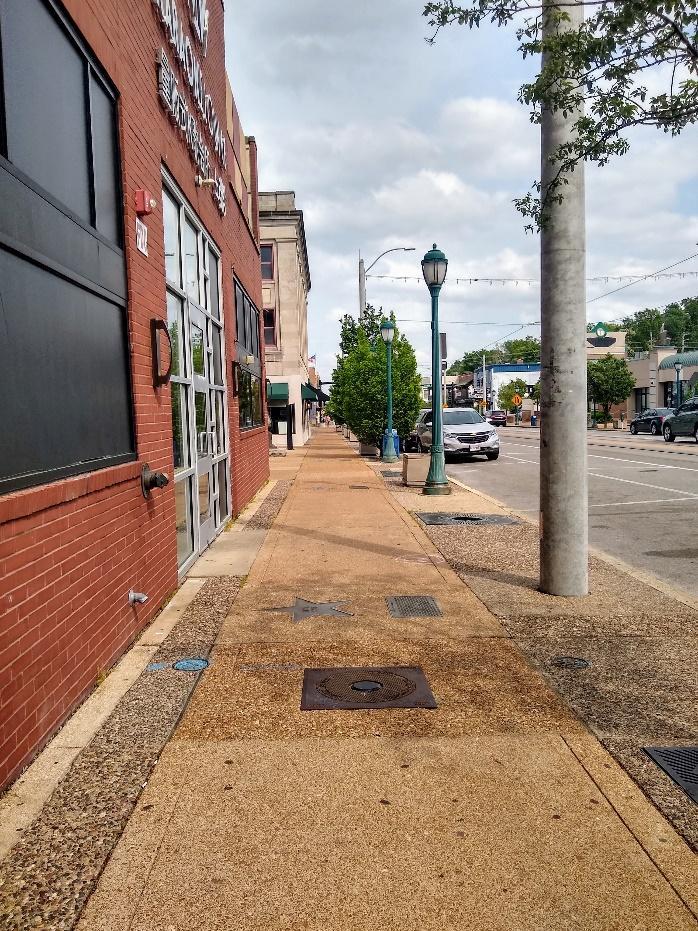
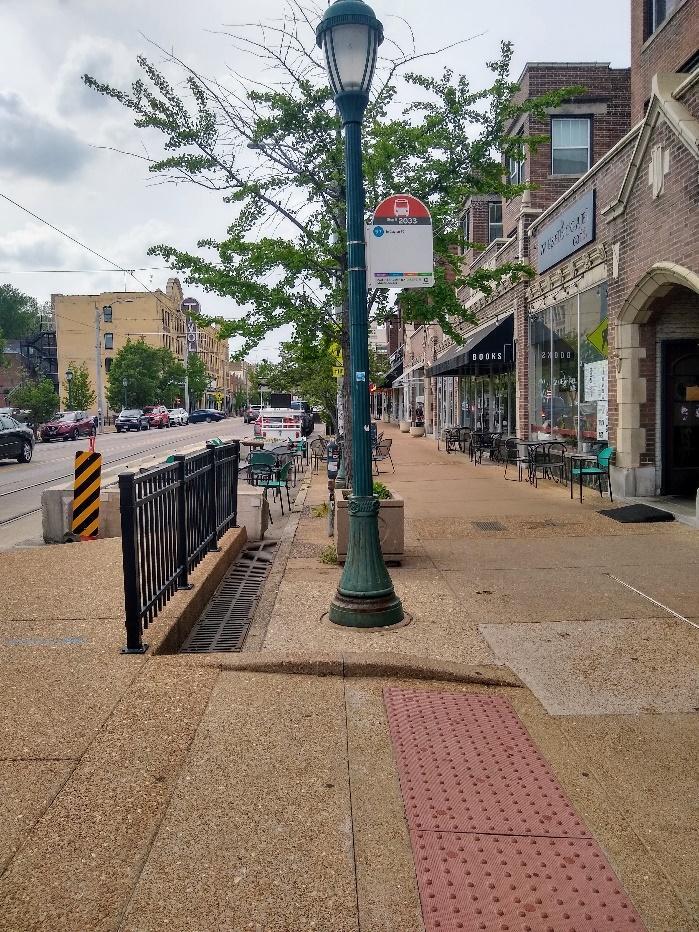
The St. Louis Walk of Fame runs along both sides of Delmar Boulevard in the Delmar Loop area of University City and the City of St. Louis.
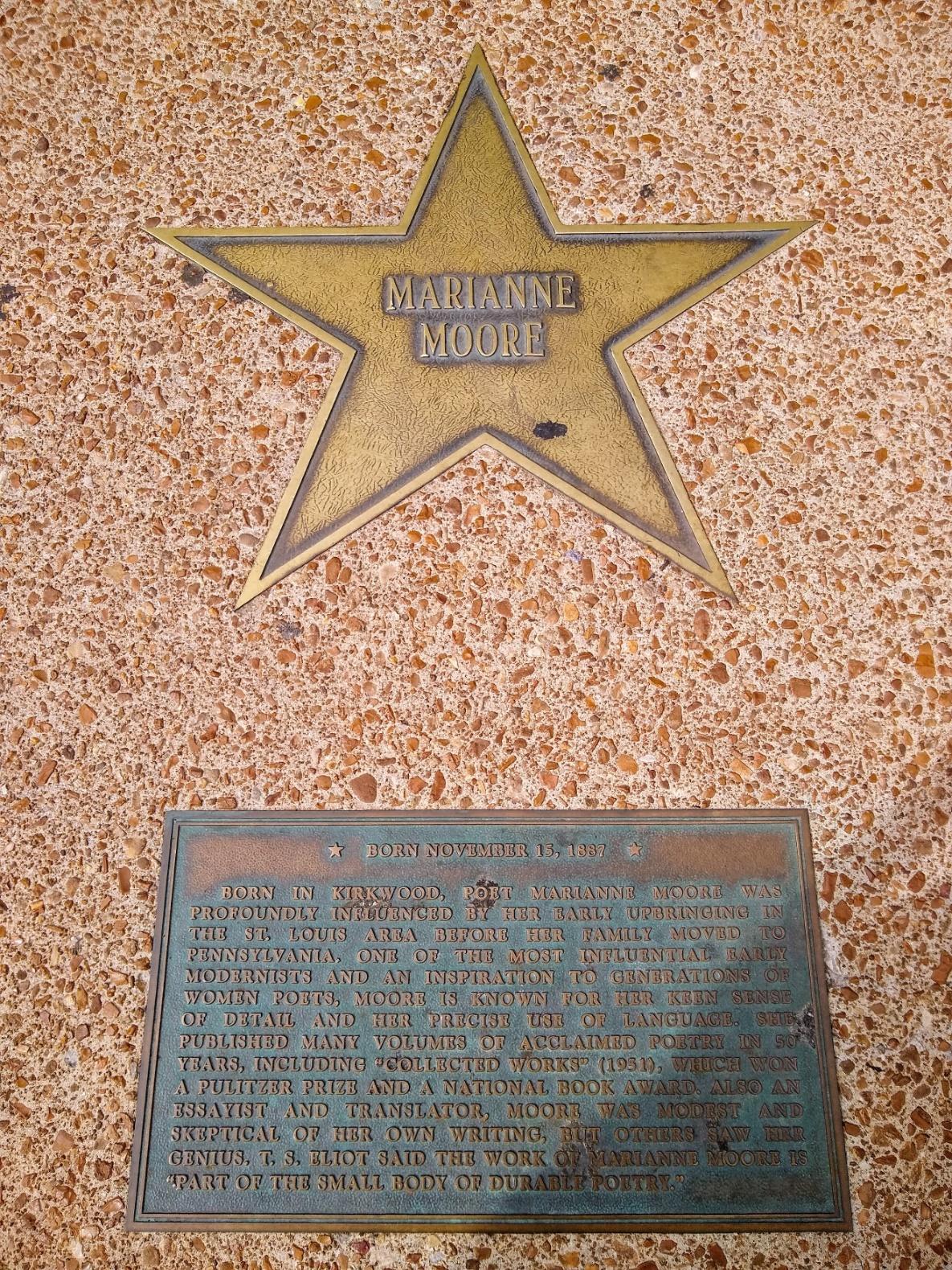
Marianne Moore (1887-1972), a poet and literary critic born in Kirkwood, MO, won the National Book Award (1951), the Pulitzer Prize (1951), the Bollingen Prize (1951), and other prestigious awards. She is celebrated for her meticulously crafted poetry and keen critical insights, with well-known collections including Observations (1924) and Collected Poems (1935, introduction by T.S. Eliot), which showcase her innovative use of language and sharp attention to detail.
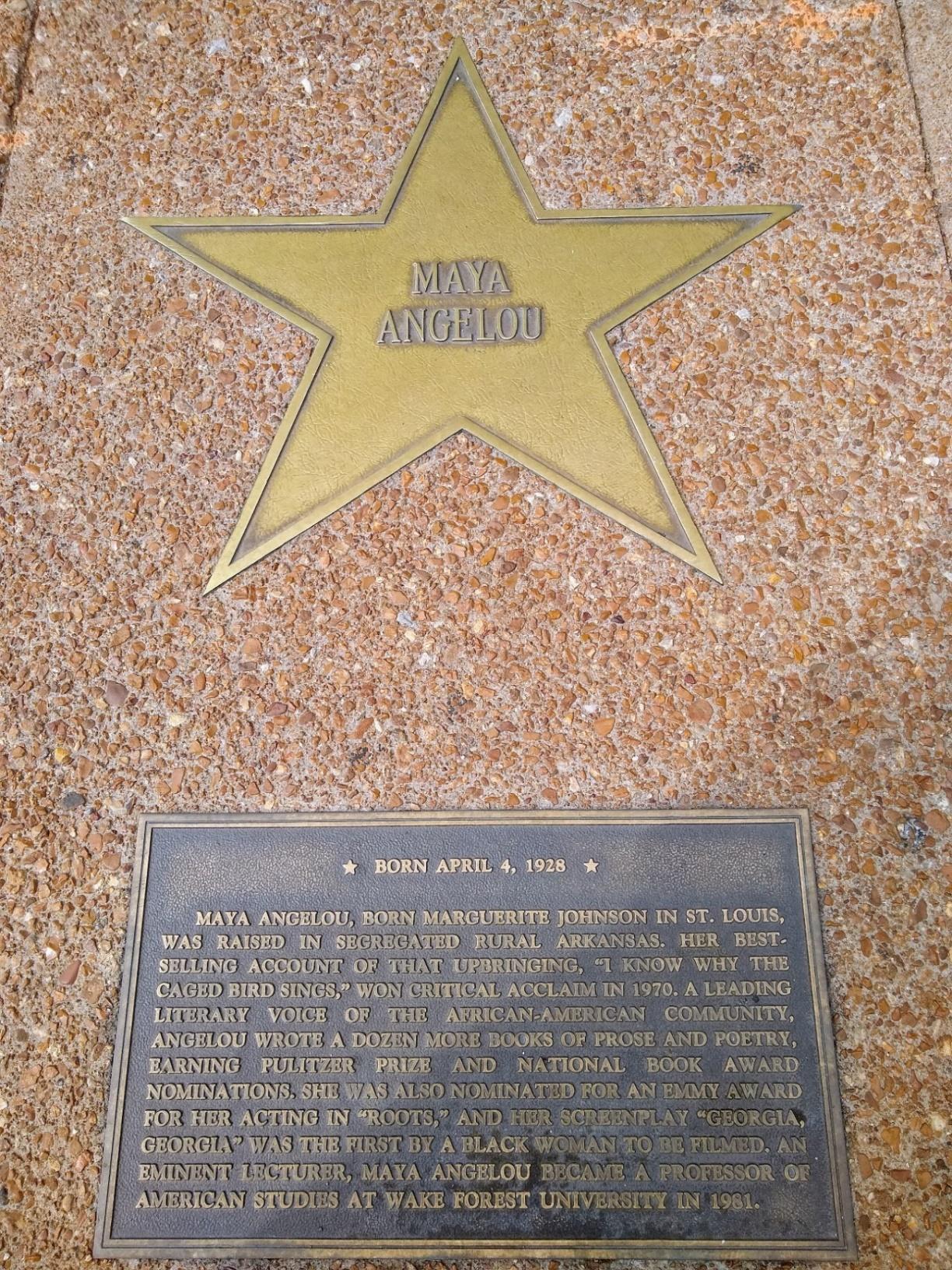
Maya Angelou (1928-2014) was born in St. Louis, but at the age of three, she was sent to her grandmother’s house in Stamps, Arkansas, following her parents’ divorce. In addition to being a celebrated memoirist and essayist, she was an accomplished poet, known for collections such as And Still I Rise (1978) and Phenomenal Woman: Four Poems Celebrating Women (1995).
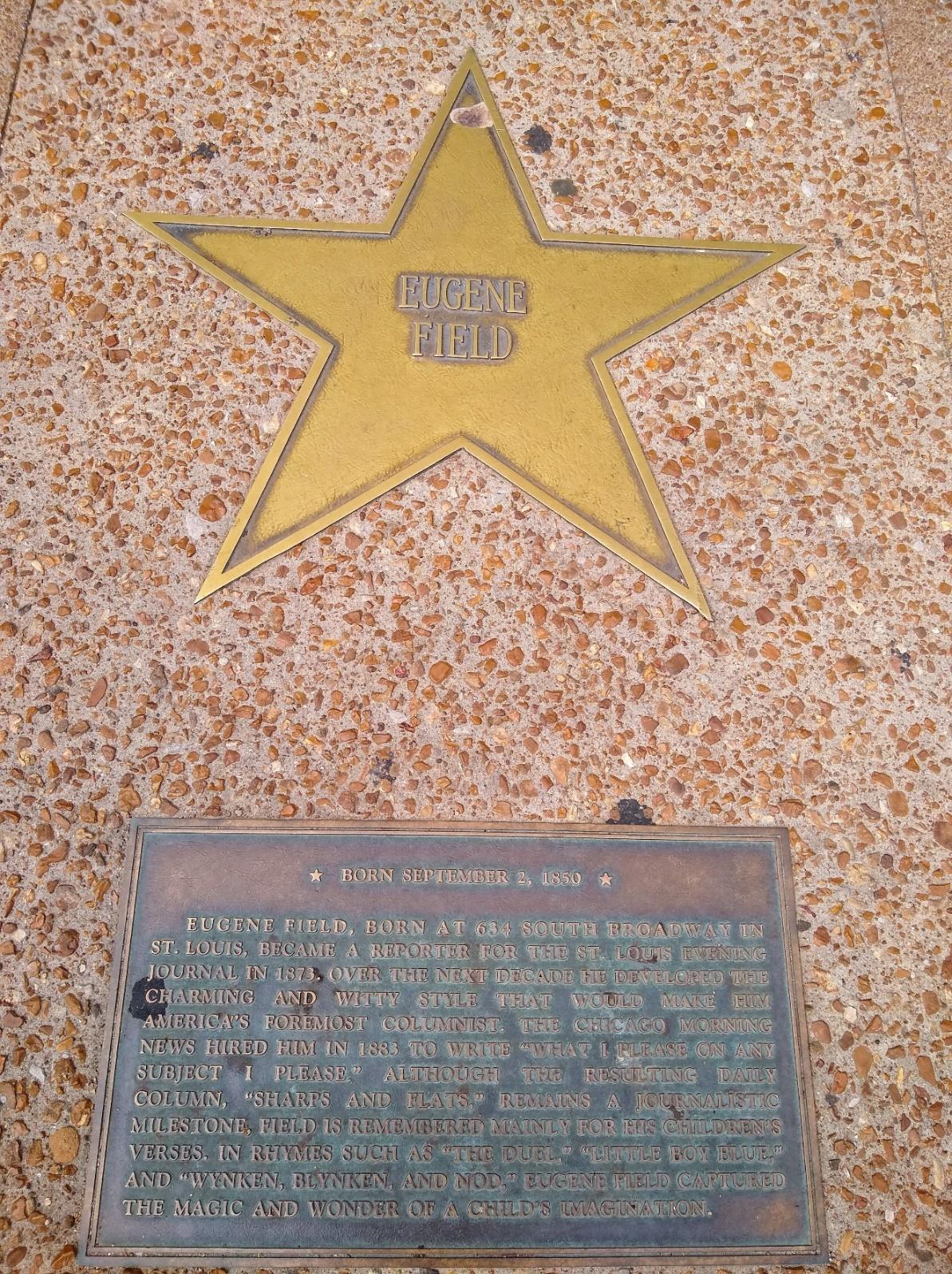
Eugene Field (1850-1895), often called the “poet of childhood,” wrote many charming and whimsical verses for children. Among his most well-known poetry collections are The Little Book of Western Verse (1892), Love Songs of Childhood (1895), and Poems of Childhood (1898). His childhood home in St. Louis, near the Mississippi River, is preserved today as the Eugene Field House. Many elementary schools in the Midwest are named after him.
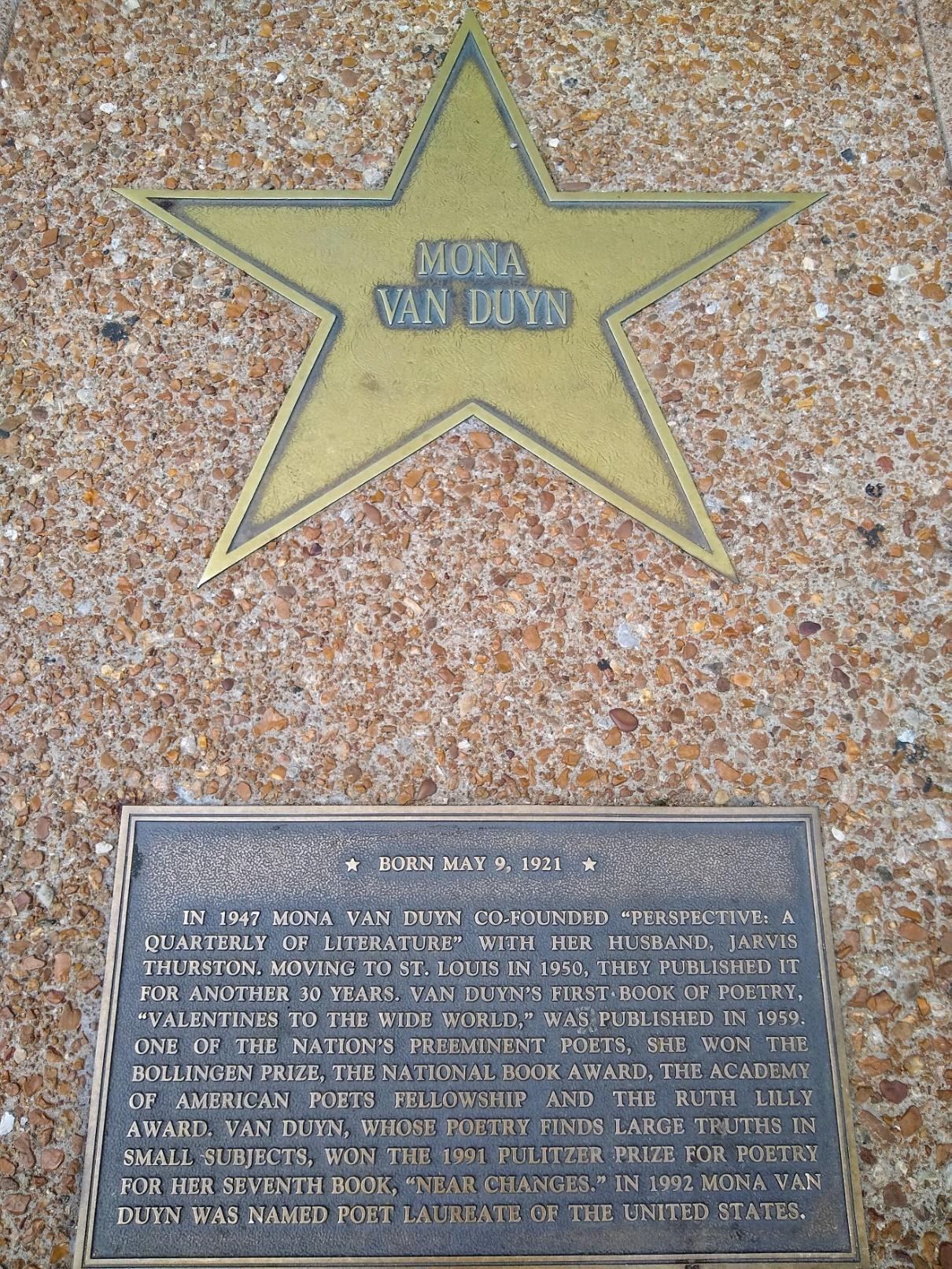
Mona Van Duyn (1921-2004), born in Waterloo, Iowa, had a long and influential connection to the St. Louis poetic community. After moving to the area in 1950, she taught English at Washington University in St. Louis and helped build a vibrant circle of writers and critics in the city. She lived in nearby University City for many years and remained active in the region’s literary life until her death in 2004.
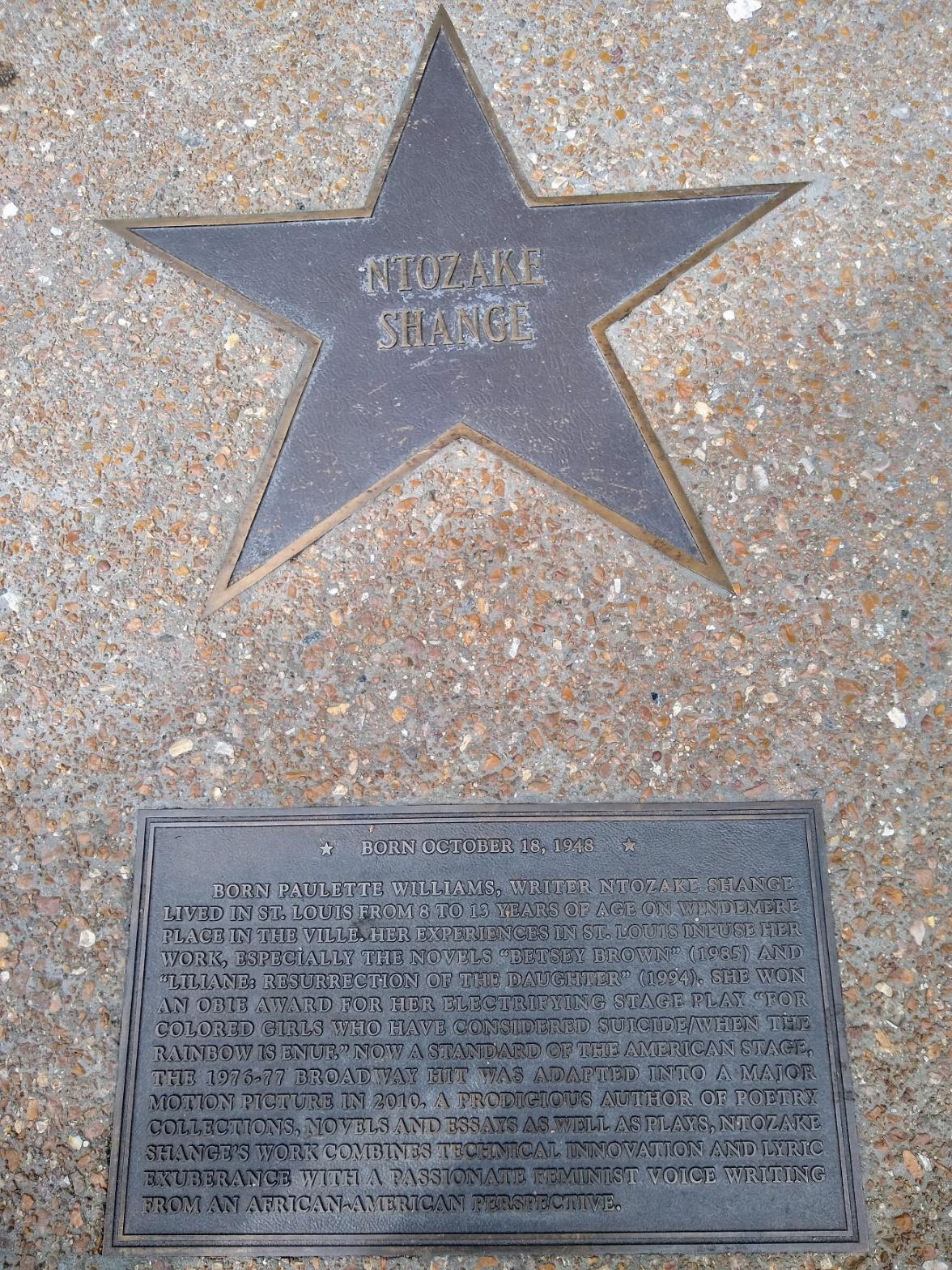
Ntozake Shange (1948-2018) a poet, novelist, and playwright had an early connection to St. Louis after her family moved there in 1956 when she was a child. While attending a newly integrated school in the city following the Brown v. Board of Education, she experienced racism and harassment that deeply shaped her later writing. Over the course of her career, she received numerous honors, including the Los Angeles Times Book Prize for Poetry, the Pushcart Prize, and the Langston Hughes Medal.
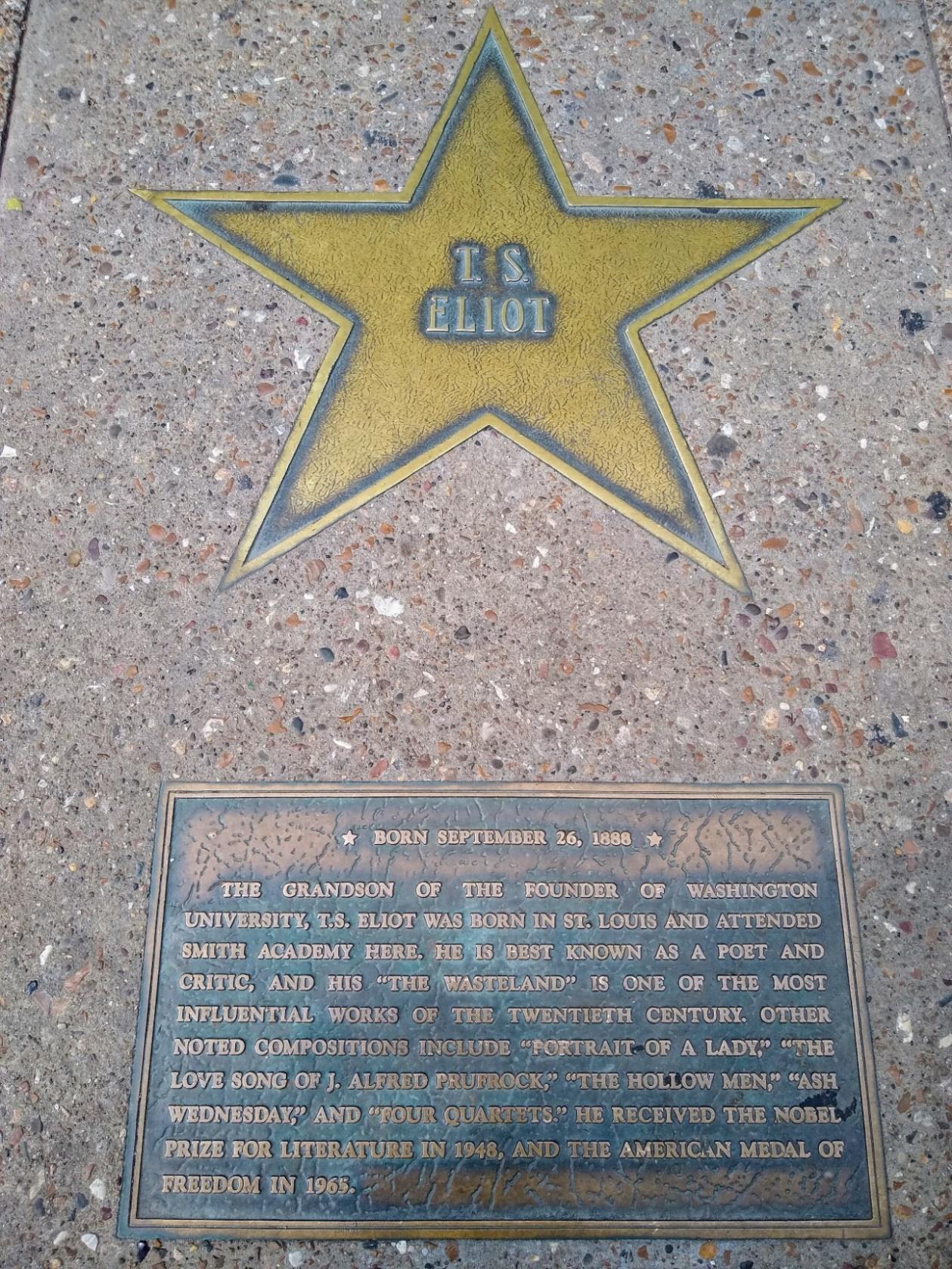
T.S. Eliot, the most famous poet from St. Louis, profoundly reshaped modern poetry by publishing The Waste Land in 1922. His grandfather, William Greenleaf Eliot (181187), was a Unitarian minister who co-founded in 1853 Washington University in St. Louis, originally called “Eliot Seminary.”
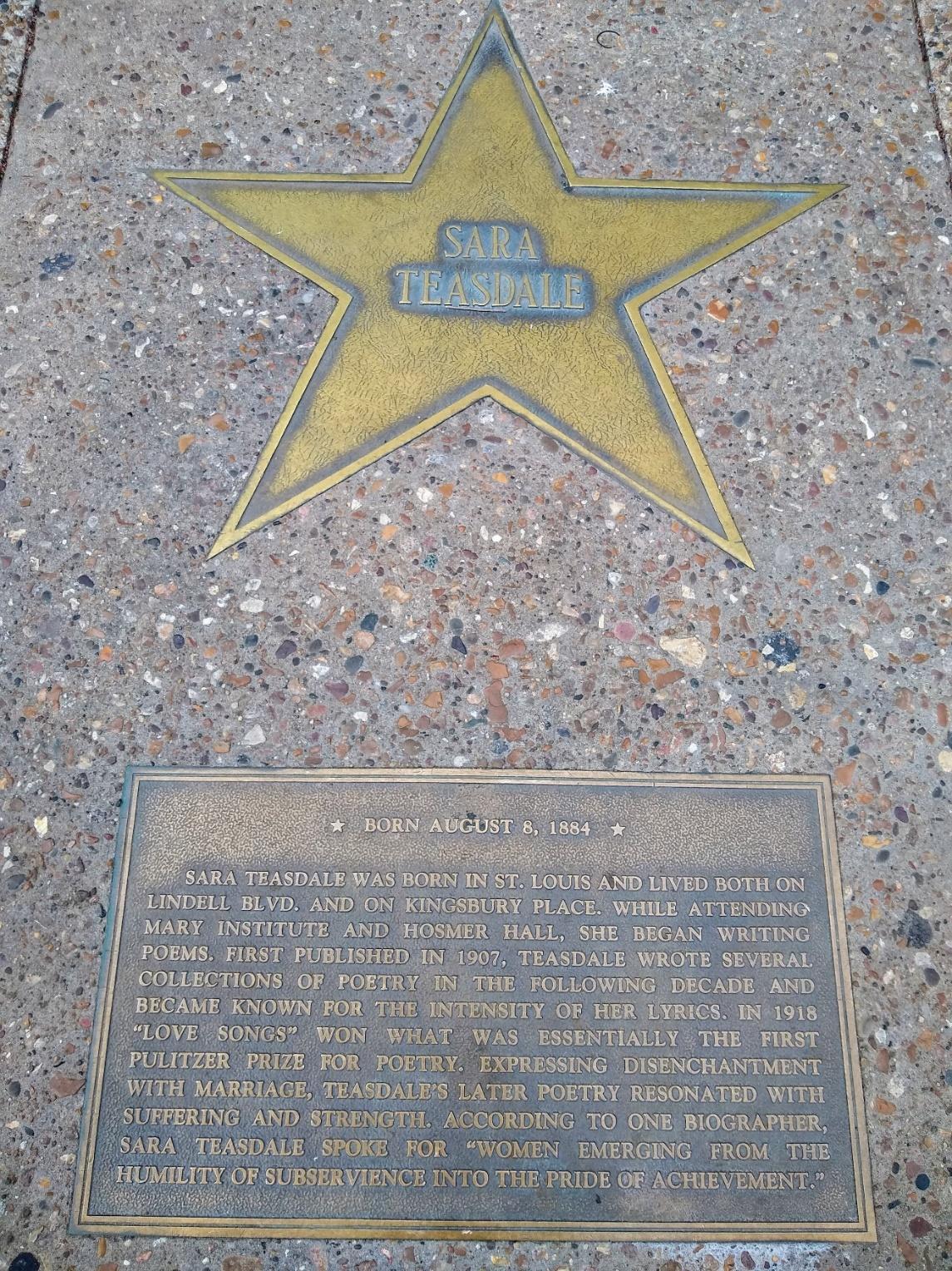
Sara Teasdale (1884-1933) was born and raised in St. Louis, where she spent her childhood and early adulthood. She was active in the city’s literary scene, joining a group of young women artists called the Potters and publishing some of her earliest poems in local publications. Although she later moved to New York City, her ties to St. Louis remained strong, and she was ultimately buried in the city at Bellefontaine Cemetery. Her notable poetry collections include Love Songs (1917), which won the Pulitzer Prize for Poetry, and Flame and Shadow (1920).
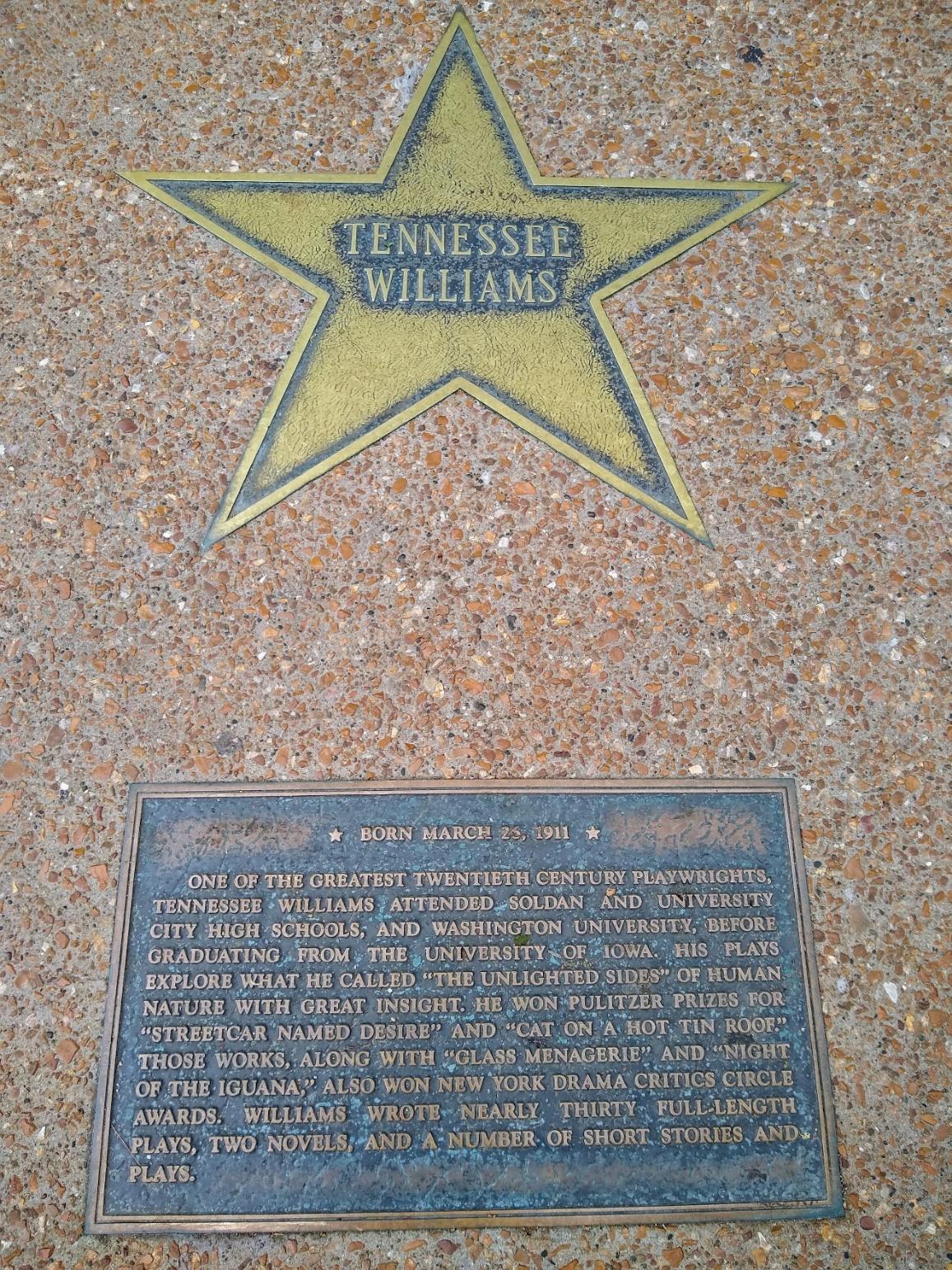
Although known primarily as a playwright, Tennessee Williams (1911-83) was also a prolific poet whose work appeared in such well-known venues as Esquire and the New Yorker. He had a significant connection to St. Louis, where his family moved when he was eight years old. He attended school in the city and later studied at Washington University in St. Louis, experiences that influenced his early writing. Elements of his St. Louis life including memories of his family and neighborhood also inspired his breakthrough play The Glass Menagerie.
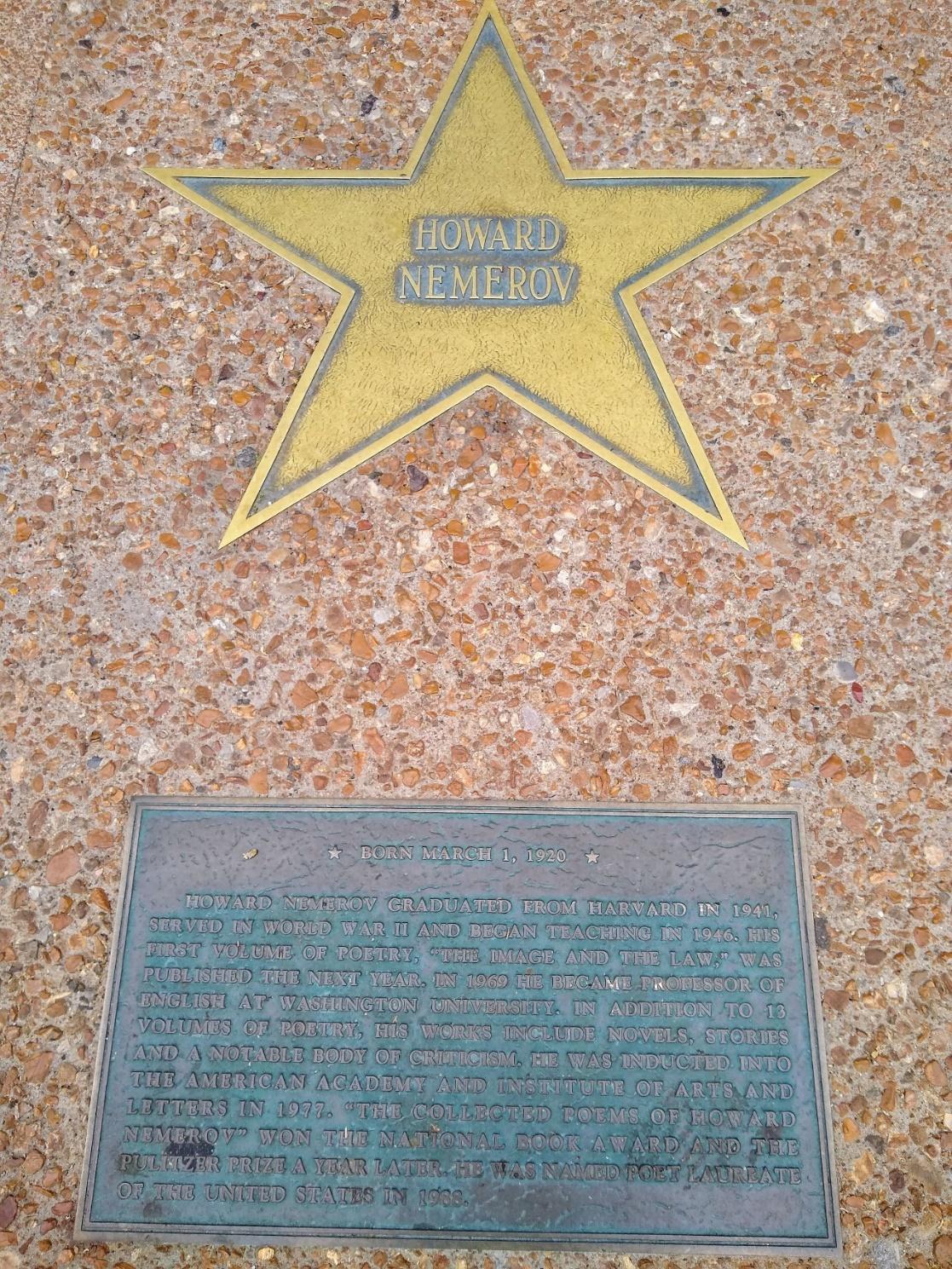
Howard Nemerov (1920-91) was an influential American poet known for his formal style, wit, and carefully crafted verse. His collection The Collected Poems of Howard Nemerov won the Pulitzer Prize for Poetry, the National Book Award for Poetry, and the Bollingen Prize in 1978. Nemerov had a strong connection to St. Louis, serving as Distinguished Poet in Residence and professor of English at Washington University in St. Louis from 1969 until his death. During his time in the city, he played an important role in shaping its literary culture and mentoring generations of writers.

Top: Delmar Boulevard near the University City Public Library, home to the St. Louis Poetry Center’s “Observable Readings.”
Bottom Left: Sitting beside the T. S. Eliot star. My PhD dissertation (1998) examined T. S. Eliot and Flannery O’Connor as Christian writers, thinkers, and literary critics.
Bottom Right: With Professor Danica Čerče at an ice cream shop in University City. A former president of the International Society of Steinbeck Scholars, she is the author of Reading John Steinbeck in Eastern Europe (University Press of America, 2011) and John Steinbeck in East European Translation: A Bibliographical and Descriptive Overview (Cambridge Scholars Publishing, 2017). Supported by grants from the Research Agency of the Republic of Slovenia (ARRS), we collaborated on academic papers, and I served as a visiting scholar at her university in 2018.


Acrostic: A poem in which the first letter of each line forms a word or phrase when read vertically. A fine example is Edgar Allan Poe’s “Elizabeth” (c. 1829), a 16-line poem written for his cousin Elizabeth Rebecca Herring. The first letters of the respective lines are E, L, I, Z, A, B, E, T, H, R, E, B, E C, C, and A.
Boketto: A Japanese-style poem consisting of two stanzas. The first stanza contains five lines with a syllabic pattern of 7-7-7-4-5 (30 syllables in total). The second stanza is three lines with a syllabic pattern of 7-7-3 (17 syllables altogether). Variations of this form exist.
Cento: An original poem comprising lines borrowed from the works of other authors. After arranging the lines coherently, the poet identifies the source of each line. The cento is somewhat different from found poetry, which also uses outside texts.
Cheriga: A cherita combined with simple visual art.
Cheribun is a hybrid form that combines brief prose with a cherita section, creating a layered narrative that moves from prose reflection to poetic compression.
Cherita: A six-line narrative poem that usually consists of a single line, a couplet, and a tercet (3 lines). A cherita terbalik (inverted cherita) takes the form of 3–2–1, 2–1–3, 1–3–2, 2–3–1, or 3–1–2 lines. The cherita is an unrhymed, freestyle form and, like the tanka, is not titled.
Cinqku: A 17-syllable poem that has five lines of 2-3-4-6-2 syllables, respectively.
Cinquain: An unrhymed, five-line poetic poem that has a 2-4-6-8-2 syllable count. Some poets use iambic feet (an unaccented syllable followed by an accented one) in a cinquain. A related form is the didactic cinquain, which aims mainly to teach schoolchildren parts of speech. Below is the structure:
Line 1: a one-word noun (the subject of the poem)
Line 2: two adjectives that describe Line 1
Line 3: a three-word verbal phrase that further describes Line 1
Line 4: a four-word phrase that shows a feeling toward Line 1
Line 5: a one-word noun synonymous with or relate to Line 1.
The word cinquain is pronounced sing-kayne.
Clerihew: A humorous, often whimsical four-line poem about a real person, typically using a light, conversational tone and an irregular meter. The first line usually ends with the subject’s name, and the rhyme scheme is aabb.
Clogynrach: A six-line Welsh poetic form with a syllable pattern of 8-8-55-3-3 and a rhyme scheme of aabbba.
Couplet: A two-line poem that has an end rhyme scheme and usually has the same meter for both lines.
Didactic cinquain: See Cinquain.
Eintou: A seven-line African American poetic form with exactly 32 syllables arranged 2/4/6/8/6/4/2. It reflects the idea that we come from, move through, and return to our origins.
Ekphrastic poetry: Poetry inspired by visual art. Ekphrastic poems began in classical times as a tool for describing artwork. Ekphrastic poetry as written today is not merely a verbal representation of a visual art. Rather, it is a critical, subjective response to it. Regardless of the artist’s supposed intention, poets may come up with their own understanding of a work of visual art based on their life experiences, perspectives on life, and preoccupations. As in reader response literary criticism, ekphrastic poetry approaches the same work from different but equally valid angles.
Epitaph: An epigrammatic poem commemorating or epitomizing a dead person and short enough to fit a headstone. Epitaphs can be either serious or humorous. Humorous epitaphs, which are available as Google images, include “I Told You I Was Sick” and “Here Lies Clyde / His Life Was Full / Until He Tried to Milk a Bull.” Some poets and writers compose their epitaphs before their deaths. The word epitaph comes from the Greek word epitaphios (ἐπιτάφιος, “funeral oration”).
Etheree: The Etheree consists of ten unrhymed lines of 1-2-3-4-5-6-7-8-910 syllables. Etheree can also be reversed and written 10-9-8-7-6-5-4-3-2-1. It is attributed to an American poet, Etheree Taylor Armstrong of Arkansas. The Etheree is a highly flexible poetry form and lends itself to the writer's creativity. An Etheree should focus on one idea or subject. Double Etheree is two Etherees that make up one poem; the syllable count is 1-23-4-5-6-7-8-9-10-10-9-8-7-6-5-4-3-2-1.
Fibonacci (or Fib): A math-based poem that follows the Fibonacci sequence (1, 1, 2, 3, 5, 8, 13, etc.); most fib poems today are written in six lines of 1, 1, 2, 3, 5, and 8 syllables each. It can also be written in reverse order: 8, 5, 3, 2, 1, and 1.
Found poetry: A type of poetry that creates something new and meaningful out of borrowed texts. Unlike the cento, it does not list the sources used.
Free verse: A poem written without meter or an external rhyme. Many free verse poems, however, use internal rhymes and other rhythmic devices.
Gembun: A poetic form created by ai li in 1997. The gembun (pronounced gem boon) consists of either a one-word first link or anything up to one sentence, to be capped by a haiku of up to four lines. A gembun poem must include an element of suggestion in the opening sentence, in the haiku, or both.
Gogyōka (五行歌): A Japanese poetic form consisting of five lines, typically written without a fixed syllable count or rhyme scheme. It emphasizes natural phrasing, emotional expression, and brevity, allowing the poet freedom in line length while focusing on a single moment, image, or feeling.
Haiku: A Japanese poetic form from the 17th century, the haiku portrays the beauty and wonders of nature and human emotions as reflected in nature. It used to be written in a 5-7-5 syllable structure, but nowadays, it generally consists of three short lines in which the poet uses up to 17 syllables altogether. The plural of haiku is haiku, not haikus.
Haiga: A haiku combined with simple visual art (traditionally brush painting but currently any type of painting, drawing, or photography). A photo haiga is sometimes called a photoku.
Haibun (“haiku writings”): A form that combines prose and haiku. Instead of being a mere summary of the prose, the haiku must be fresh and insightful enough to stand alone as a poem. Among the best-known haibun writers is Matsuo Bashō (1644-94), who wrote the travelogue Oku no Hosomichi (Narrow Road to the Interior).
Hainka prose: A prose-poetry hybrid in which the haiku and tanka are linked by a shared, exact, or similar line. Pravat Kumar Padhy invented the haika form (linked tanka-haiku); this is a hybridization with prose that extends the form.
Imayo: A Japanese poetic form consisting of four lines, each with 12 syllables. A caesura (pause) separates the first seven syllables from the final five syllables in each line.
Joseph’s Star: An eight-line poem consists of 1-3-5-7-7-5-3-1 syllables each and is generally center-aligned. It can have either a single stanza or a set of stanzas.
Jueju (Chinese quatrain): A Chinese poetic type that flourished in the Tang Dynasty (618-907), it was used by the literati not only in China but also those in Korea, Japan, and Vietnam for thousands of years. A jueju poem consists of couplets, each of which has either five characters (wujue) or seven characters (qijue).
Kyoka (“mad poem”) is to tanka what senryu is to haiku. Kyoka is identical to tanka in form but is comic and parodic in tone. Contemporary tanka and kyoka are written in free style, without exceeding 31 syllables altogether.
Lanterne (also spelled lanturne): A five-line poem that uses 1-2-3-4-1 syllables in five respective lines. Rhyming is optional, and a title may or may not be used in a lanterne.
Limerick: A nonsense poem based on wordplay. It usually consists of five lines and has the end rhyme scheme of a-a-b-b-a. The first line typically
includes a person and a place name. Some limericks have the syllabic pattern of 8-8-5-5-8. Other patterns include 8-8-6-6-8 and 9-9-6-6-9. An 8-8-6-6-8 limerick follows the stress pattern of da DUM da da DUM da da DUM da DUM da da DUM da da DUM da DUM da da DUM da DUM da da DUM da DUM da da DUM da da DUM.
The first line usually serves as the title of a limerick.
Loop poem: A four-line, titled poem in which the last word of the first line becomes the first word of line two, the last word of line 2 becomes the first word of line 3, and the last word of line 3 becomes the first word of line 4. The rhyme scheme is a-b-c-b. A loop poem can have either a single stanza or a set of stanzas, and there are no restrictions on the number of syllables for each line.
Lune: An American-style haiku that has three lines of 5-3-5 syllables, respectively.
Nonet: A titled poem consisting of nine lines of 9-8-7-6-5-4-3-2-1 syllables, respectively. Rhyming is optional.
Octave: An 8-line poem with various rhyme schemes, including
Octave: An eight-line stanza or section of a poem. It can follow various rhyme schemes, such as a-b-a-b-a-b-c-c, a-b-a-b-c-c-d-d, a-a-b-b-c-c-d-d, or the classic a-b-b-a-a-b-b-a (common in Petrarchan sonnets). Octaves may function as standalone poems or as part of larger poetic structures.
Photoku: See Haiga.
Pirouette: A 10-line poem without meter or rhyme. In addition to having six syllables in each line, lines 5 and 6 have the same words and, combined, constitute a turnaround.
Quatrain: A four-line stanza or complete poem that rhymes. There are more than a dozen possible rhyme schemes, including a-b-a-c and a-b-c-b.
A quatrain usually has a regular rhythm to the lines. Samuel Taylor Coleridge’s The Rime of the Ancient Mariner is a well-known ballad quatrain. The second stanza of the poem reads,
The Bridegroom’s doors are opened wide, And I am next of kin; The guests are met, the feast is set: May’st hear the merry din.”
Here, the rhyme scheme is a-b-c-b, and iambic tetrameter (an 8-syllable line) alternates with iambic trimer (a six-syllable line).
Rengay: A six-verse sequence of collaborative poems in which three-line and two-line haiku alternate. Composed by two or more poets, a rengay has a controlling theme.
Renku: A linked-verse poem in the haikai style, typically composed by two or more poets, in which verses are connected (linked) and shifted in topic, tone, or season. In Japanese, renku is the modern equivalent of haikai no renga, and it often alternates between three-line and two-line stanzas, producing a gentle long-short rhythm that echoes the original Japanese verse structure. Typical renku can be quite long eighteen (han-kasen), thirty-six (kasen), or more stanzas but shorter forms have become popular, including the twelve-verse junichō, which is highly flexible and allows for creative variation in stanza arrangement, themes, and seasonal progression.
Rondeau: A medieval French poetic form that consists of a rhyming quintet (a five-line stanza), quatrain (a four-line stanza), and sestet (a sixline stanza). Altogether, a rondeau poem has 15 lines, each of which contains 8-10 syllables. The rhyme scheme is AABBA AABR AABBAR. (“R” represents the refrain.) The plural form of rondeau is rondeaux.
Sedoka: An ancient Japanese poetic form that consists of two three-line katauta (5-7-7, 5-7-7 syllables, respectively). The two sets of the 5-7-7 katauta constitute a conversation in Japanese sedoka. (The 5-7-5 katauta constitutes the first three lines of a traditional tanka.) The Manyoshu (“Collection of Ten Thousand Leaves”), an anthology compiled around 759, includes 62 sedoka poems.
Senryu: A three-line unrhymed Japanese poetic form structurally similar to the haiku but dealing satirically and humorously with human foibles. It arose as part of Edo (Tokyo) culture in the eighteenth century.
Septolet: A seven-line, 14-word poem that consists of three lines, a line break, and four lines.
Shape poem: A poem in which the lines are arranged in a way that represents the subject of the poem. It is also called a visual poem or concrete poem.
Sijo: A vernacular Korean poetic form whose basic structure requires approximately forty-five Korean characters (syllabic blocks) arranged in three unrhymed lines. Similar to contemporary haiku and other Japanesestyle short-form poems, Korean sijo are now written in freestyle.
Somonka: An ancient Japanese poetic form consisting of two love tanka, each representing one of the two respective lovers. A somonka can be written by two poets or by a single poet who adopts two voices. Below is John J. Han’s somonka that appeared in Elder Mountain: A Journal of Ozarks Studies, 9 (2019), p. 85:
how much I desired an embrace in your strong arms that cold wedding night the fire that caught my dress, alas, reduced me to char
how much I miss you! at night people run away when they hear you scream come and scream at me, my love, for not saving you in time
Note: This poem is based on the legend of a young bride who was burned to death on her wedding night. The story can be found in Ozark Tales and Superstitions (by Phillip W. Steele, Pelican, 2003), “Arkansas History’s Mysteries—Ghost Hollow”
(http://arkansasstatearchives.blogspot.com/2015/10/arkansashistorys-mysteries-ghost-hollow.html), and other sources.
Sonnet: A 14-line poem with a variable rhyme scheme originating in Italy and brought to England by Sir Thomas Wyatt and Henry Howard, earl of Surrey, in the 16th century. Traditionally, the sonnet (a “little song”) reflects upon a single sentiment, with a clarification or “turn” of thought (volta) in its concluding lines.
The Petrarchan (Italian) sonnet, perfected by the Italian poet Petrarch, divides the 14 lines into two sections: an eight-line stanza (octave) rhyming ABBAABBA, and a six-line stanza (sestet) rhyming CDCDCD or CDEEDE. John Milton’s “When I Consider How my Light Is Spent” and Elizabeth Barrett Browning’s “How Do I Love Thee” employ this form.
The Shakespearean (English) Sonnet: A sonnet with 14 lines consisting of three quatrains and a couplet, with a rhyme scheme of ABAB CDCD EFEF GG. George Herbert’s “Love (II),” Claude McKay’s “America,” and Molly Peacock’s “Altruism” are Shakespearean sonnets.
Most sonnets are about love and romance, and the tone of a sonnet can be either serious or humorous.
The Split Sequence: A twelve-line linked haiku form, plus title, written solo or collaboratively. A sequence is started by the poet splitting the 3-line haiku into 3 separate lines. Next, the poet writes a haiku for each line –first, second, and third, making it a 1-3-1-3-1-3 format. If it is a collaborative sequence, each poet alternates in writing the haiku. This form was invented by Peter Jastermsky in 2017. (Definition by Christine L. Villa, 5 March 2022)
Strombotto Tuscano: An eight-line Italian poetic form characterized by an ABABABCC rhyme scheme, where the first six lines alternate rhymes followed by a rhymed couplet. Each line contains 10 syllables, adhering to iambic pentameter, which comprises five metrical feet with an unstressed syllable followed by a stressed syllable.
Tan-Renga (“short linked verse”): A collaborative tanka written by two poets. Typically, one poet composes three lines, and the other poet adds two lines. A solo tan-renga, written by a single poet, leaves a blank line space between the first three lines and the two capping lines to distinguish the poem from a tanka.
Tanka: An aristocratic poetic form from ancient Japan, it is popular in both Japan and the English-speaking world. The traditional tanka consists of five lines of 5-7-5-7-7 syllables, respectively; the most common themes of traditional tanka are love (especially unrequited love) and nature. Most contemporary English-language tanka poets tend to use five short lines of various syllable counts without exceeding 31 syllables altogether.
Tanka art: Illustrated tanka. It is akin to a haiga except that it generally has five short lines.
Tanka prose: A form that combines prose and tanka. Instead of being a mere summary of the prose, the tanka must be fresh and insightful enough to stand alone as a poem.
Terce: A three-line poem in which the lines can vary in length. A tercet may follow a specific meter and rhyme scheme or be written in free verse.
Triptych: A poem of three stanzas, the second of which tends to be longer than stanzas 1 and 3. In visual art, a triptych (“three-fold”) means a threesectioned painting or carving. Similar to the three panels that constitute a thematic whole, the three stanzas in a triptych poem should work together to create a theme.
J.J.H.
Sheikha A. is from Pakistan and United Arab Emirates. She has received two Pushcart and one Rhysling nominations for her poetry and has been translated into nine languages so far. More about her works can be found at sheikha82.wordpress.com.
Hifsa Ashraf is an award-winning multilingual poet, author, editor, and social activist based in Rawalpindi, Pakistan. She is the author of 6 individual and 4 collaborative micropoetry books. She received the Touchstone Award for Individual Poems (2021) from The Haiku Foundation (USA) and was again shortlisted for the award in 2022. Her poetry collection Her Fading Henna Tattoo earned Honourable Mentions in the Touchstone Distinguished Books Award (2020) and the Haiku Society of America Merit Book Award (2021). Her latest collaborative collection, Beyond Emptiness, is co-authored with Jacob D. Salzer and Nicholas Klacsanzky.
Joanna Ashwell is a writer from the UK. Her published collections include a volume of contemporary poetry (Flarestack Publishing), a haiku collection (Hub Editions), a tanka collection (Every Star, available on Amazon), and a combined haiku and tanka collection (Book Patronus, available on Amazon), as well as three cherita collections River Lanterns, Moonset Song, and Love’s Scriptures (all available on Amazon). She has won several competition awards and was shortlisted for the Touchstone Award for Individual Haiku in 2020 and longlisted for the Touchstone Award for Haibun in 2025. Her work also appears in telling the bees: The Red Moon Anthology of English-Language Haiku 2024. Her short-form poetry haiku, tanka, haibun, and cherita appears widely in both print and online journals.
Gavin Austin lives in Sydney, Australia. His work has been widely published, and he has been recognised in literary competitions. In 2016, Gavin was awarded a Writing Fellow of the FAW NSW Inc. and was the Featured Poet in the January 2016 issue of cattails. Also, he was the Poet in Focus 57, Presence #72, March 2022. He has two published poetry collections: Shadow Play, Dragonwick, Aus., and changing light, Alba Publishing, UK. Gavin was shortlisted for a Touchstone Award 2022 for
Individual Poem, and long-listed in 2023 for haibun. He is currently compiling a collection of haibun and haiku.
Jo Balistreri began her creative life as a pianist and harpsichordist. In 2005, she began writing free-verse poetry after losing her hearing and her ability to play music, and in 2015 registered for a mentoring program through the Haiku Society of America. She has since published widely and, in 2019, was included in A New Resonance 12. Her books include Still and Gathering the Harvest. Visit her at http://maryjobalistreripoet.com/.
Matthew Bardowell is Associate Professor of English at Missouri Baptist University, where he teaches classes from composition to British Literature. He specializes in Old English and Old Norse poetry and the work of J. R. R. Tolkien and C. S. Lewis. He is co-editor of Certainty and Ambiguity: Essays on the Moral Imagination of Mystery Fiction (Bloomsbury Academic, 2024). His recent work appears in From Rus' to Rímur: Norse History, Culture, and Literature East and West published by Cornell University Press. He has a chapter on G. K. Chesterton in Handbook of Literary Apologetics: The Imagination’s Journey to God (De Gruyter, 2025). Bardowell holds a PhD in English from Saint Louis University.
Jane Beal is Professor of English Literature at the University of La Verne in Southern California. She holds a BA, MA, and PhD in English from the University of California, Davis, and an MFA in Creative Writing. Beal regularly publishes poetry, fiction, and creative nonfiction. Her poetry collections include Sanctuary, Rising, and Song of the Selkie, along with eight haiku micro-chaps. She has also produced three audio projects combining poetry and music: Songs from the Secret Life, Love Song, and The Jazz Bird (co-created with her brother, saxophonist and composer Andrew Beal).
Lori Becherer is an artist, poet and life-long resident of southern Illinois and is inspired by the solitude and beauty of her rural life. She is a member of the Haiku Society of America and the Mississippi Mud Daubers haiku group. Her haiku have been published in numerous English-language haiku journals.
Mona Bedi is a medical doctor in Delhi, India. She has been writing poetry since childhood, but a few years ago she began writing the Japanese form haiku. She has two poetry books, They You and Me and Dancing
Moonlight. She lives with her husband, two children, and a dog. Her haiku and senryu have been published in Failed Haiku, Haiku in Action, The Haiku Dialogue, and Cold Moon Journal.
Jerome Berglund has worked as everything from a dishwasher to a paralegal, from a night watchman to an assembler of heart valves. His haiku, haiga, and haibun have appeared or are forthcoming in online and print journals, including Bottle Rockets, Circle of Salt, and Presence. His full-length poetry collections have been published by Setu, Meat for Tea, and Mōtus Audāx Press. A mixed-media chapbook featuring his fine art photography is available from Fevers of the Mind.
Jane Blanchard, a native of Charlottesville, Virginia, lives and writes in Augusta, Georgia. She studied English at Wake Forest University before earning a doctorate from Rutgers University. Her dissertation examined divisions of diction, character, and narrator in Edmund Spenser’s The Faerie Queene. She has taught students at the preparatory and collegiate levels and has published literary criticism in venues such as Pacific Coast Philology, Renascence, and South Atlantic Review. She favors formal verse, with recent ekphrastic work appearing in Amethyst Review, Pulsebeat Poetry Journal, Snakeskin, and Wild Court. Her eighth and latest collection of poetry is Furthermore (Kelsay Books, 2025).
Jacob Blumner writes haiku and has been published in numerous journals, including Frogpond, Modern Haiku, and Failed Haiku. When not reading and writing, he prefers to wander in the woods or kayak down a river. To support his hobbies, he teaches English and directs the Marian E. Wright Writing Center at the University of Michigan-Flint. He lives in Flint, Michigan with his family and a perfect dog.
Boryana Boteva lives in Sofia, Bulgaria. She started writing short poetry recently, at the end of 2024. In 2025, she won three international haiku awards and had about 50 haiku published in online and print journals and anthologies. Due to her active presence within the international haiku community, she was awarded a certificate as one of the top 100 most creative European haiku authors for 2025. She continues her creative work, and her haiku have recently been published in Tzuri-Doro, Asahi Haikuist Network, Wales Haiku Journal, Cold Moon Journal, and Haiku Dialogue with The Haiku Foundation, among others.
Dr. Randy Brooks is Professor of English Emeritus at Millikin University in Decatur, Illinois, where he teaches courses on haiku, tanka, and Japanese poetics. He and his wife, Shirley Brooks, are publishers of Brooks Books and co-editors of Mayfly haiku magazine. His most recent books include Walking the Fence: Selected Tanka, The Art of Reading and Writing Haiku: A Reader Response Approach, and HAIKU DECK: A collection of playing cards.
Ingrid Bruck lives and writes in the Amish country that inhabits her poetry. A retired public library director, she is a committed lifelong learner. Bruck writes haiku and short poems, grows wildflowers, and makes jam. She has one chapbook, Finding Stella Maris (Flutter Press), and has received four Pushcart Prize nominations and two Best of the Net nominations. She participates in the Rat’s Ass Review Workshop and is a co-presenter with Laura DeBernardi of The Shinkokinshū group readings at ModPo. Some of her recent work appears in Verse-Virtual, Cold Moon Journal, Cantos 2026, and Wales Haiku Journal. More of her published poetry can be found on her website: www.ingridbruck.com.
Susan Burch is a writer of short Japanese forms. She is the former Vice President of the Tanka Society of America and writes mostly from the comfort of her couch. When not writing, she likes to read, do jigsaw puzzles, watch TV, and listen to music. She loves coca cola ices and birdwatching. If you ask her, she will send you her terrible pictures of the birds that come to her yard. Frequent visitors are crows, bluejays, mockingbirds, robins, finches, sparrows, hummingbirds, and woodpeckers. Occasionally she sees hawks, wrens, bluebirds, nuthatches, chickadees, cardinals, robins, grackles, cowbirds, starlings, and tufted titmice.
Susannah Cerutti, a junior at Missouri Baptist University, serves as president of the campus Creative Writing Club. She is from Washington, Missouri, a small city west of St. Louis. She is double majoring in English and Human Services, with hopes to be a developmental disabilities social worker so she can help children like her. Susannah has always had a gift for spelling; she would get a 100% on every spelling test. However, she did not discover she had a thing for creative writing until seventh grade when she took speech class. Even though she is good at writing, Susannah plans to stick to being a social worker.
Christina Chin is a painter and haiku poet from Malaysia. She is a fourtime recipient of the top 100 in the mDAC Summit Contests, exhibited at the Palo Alto Art Center, California. She has won 1st prize in the 34th Annual Cherry Blossom Sakura Festival 2020 Haiku Contest and 1st prize in the 8th Setouchi Matsuyama 2019 Photohaiku Contest. She has been published in numerous journals, multilingual journals, and anthologies, including Japan’s prestigious monthly Haikukai Magazine.
Timothy Daly lives in Italy, where he researches, writes, and co-edits Cold Moon Journal.
Maya Davena is a Bulgarian-born Canadian and a computer scientist at a Dutch university. Her haiku have been published in more than 20 journals worldwide, including Blithe Spirit, Hedgerow, Acorn, Haiku Presence, Canada Haiku Review, Frogpond, NOON, Tiny Words, Prune Juice, Time Haiku, and Wales Haiku Journal. Her haiku and senryu have also been featured in anthologies such as Jar of Rain: The Red Moon Anthology of English-Language Haiku 2020, Red Moon Press’s Annual Best of EnglishLanguage Haiku, and Shining Winds.
thomas david is from West Sussex in the United Kingdom. His haiku and senryū have appeared in Failed Haiku, tsuri-dōrō, Wales Haiku Journal, Cattails, Cold Moon Journal, and The Heron’s Nest.
Melissa Dennison is a writer of Japanese short-form poetry. Her verses take shape through her daily observations of the natural world and the changing seasons. She has an interest in natural history and nature conservation. Her poems are published widely in journals including Presence, Blithe Spirit, Cattails, Leaf, Failed Haiku, Under the Bashō, and The Bamboo Hut, and are featured in many anthologies. Dennison has been nominated for a Touchstone Award and was recently awarded a Golden Pea Award for excellence in writing senryu. She is also an assistant editor for re:Virals at The Haiku Foundation. Her origami chapbook, A Prayer of Birds, is available in print, and her book Caravan: A trail of haiku is available on Amazon.
Elliot Diamond is a retired doctor/acupuncturist, with most of his past acupuncture training from the “Blind Acupuncture Association of Japan.” After years of studying Japanese acupuncture, his haiku/haiga expression began. Other passions and joys include being a musician, focusing on
ethnographic and avant-garde jazz compositions. There is true joy in boiling down the essence of thought and feeling to a haiku poem and then possibly merging it with visuals steeped in nature and the imagination.
John H. Dromey was born in northeast Missouri. Years ago, he contributed light verse and brief, humorous items to magazines, newspapers, and trade journals. His flash fiction and short stories have appeared in over 200 venues, including numerous anthologies. Recently, he’s had speculative poetry published in Scifaikuest (print and online), Eye to the Telescope, Star*Line, The Lorelei Signal, Lothlorien Poetry Journal, View From Atlantis, the Dwarf Stars 2022 anthology, and elsewhere.
Tim Dwyer was raised in Brooklyn by Irish immigrant parents, and now lives in Bangor, Northern Ireland. He was a psychologist in New York State prisons. His Japanese form and longer poetry appear regularly in European, US and international journals and anthologies. His debut full collection of longer poetry, Accepting The Call (templarpoetry.com), won the Straid Collection Award. His previous chapbook is Smithy Of Our Longings (Lapwing). In 2025 he was among the Europe Top 100 Haiku Authors. Commendations include Peggy Willis Lyles 2nd Place Award 2025, Ama Pearls International Waka Contest 2025 Honorable Mention, Eucalypt Journal Scribbler Award 2023.
Keith Evetts is a retired British diplomat. His publications include scientific papers, history articles, long-form poetry, and over a thousand haiku and related short forms in international journals. His work has been nominated for the Pushcart Prize and Touchstone Awards, and anthologized in the Red Moon, Contemporary Haibun, Modern Haiku, and Dwarf Stars anthologies. Evetts is an administrator of Facebook’s largest haiku group, managing editor of the haiku commentary feature at The Haiku Foundation, and one of ten editors worldwide of the annual Red Moon Anthology. He has also been a guest editor of Drifting Sands Haibun.
Colleen M. Farrelly is a computational mathematician and haikai prosimetra poet currently living in Coral Gables, FL. She's a 2025-2026 confluence fellow, a multiple Pushcart nominee, and a 2026 guest editor at Contemporary Haibun Online. Her first full collection, The Haibun Laboratory, is forthcoming with Cuttlefish Books, and her recent/forthcoming poems appear in Rattle, Modern Haiku, Consequence,
About Place Journal, MacQueen's Quinterly, petrichor, streetcake, Presence, Kokako, and Frogpond, among many others. She mentors graduate mathematics students and postdocs in Sub-Saharan Africa, and she works on applications of computational geometry/topology to solve epidemiological, literary compositional, sociological, and gamingbased computer vision problems.
Goran Gatalica was born in Virovitica, Croatia, in 1982 and currently resides in Zagreb, Croatia. He completed degrees in both physics and chemistry at the University of Zagreb and proceeded directly to a PhD program after graduation. He has published poetry, haiku, and prose in literary journals and anthologies. Gatalica has received many honors for his poetry and haiku, including the Dragutin Tadijanović Award, the Croatian Academy of Sciences and Arts award for the poetry book Kozmolom (2017), the “Haiku Master of the Month” honor (Rikugien Gardens and Biei, NHK WORLD TV, Japan, 2016 and 2017), the Bashō-an Award (Japan, 2018, 2019, and 2023), the Katanogahara Monogatari Award (4th Star Haiku Contest, Japan, 2023), and the John Bird Dreaming Award (Australia, 2025). He is a member of the Croatian Writers’ Association.
Mark Gilbert is based in the UK and enjoys writing short prose and poetry (including hybrid forms). His work regularly appears in on-line and print journals and anthologies, and his haiku have won the Trailblazer contest, a Touchstone Award for Individual Poem, and the Polish International Haiku Competition. He is author of Ribbons & Rainbows (Yavanika Press, 2021), Nano Haiku (Origami Poems Project, 2022), and Variations on the Planets, an astronomical poetry chapbook cowritten with Eavonka Ettinger (Nun Prophet Press/Amazon, 2025).
John Grey is an Australian poet based in the United States. Her recent work appears in Midnight Mind, Novus, and Calliope. His latest books Bittersweet, Subject Matters, and Between Two Fires are available through Amazon. New work is forthcoming in Levitate, White Wall Review, and Willow Review.
Jennifer Gurney lives in Colorado where she teaches, paints, writes, and hikes. Her poetry is widely published, two of her poems have won international contests and one was turned into a choral piece. Jennifer has 11 books of poetry.
John J. Han, PhD, is Professor of English and Creative Writing and Associate Dean of the School of Humanities and Theology at Missouri Baptist University. He is the author, editor, co-editor, or translator of 35 books. His forthcoming book, Echoes from the Hills: Critical Essays on Ozarks Literature, co-edited with C. Clark Triplett, will be published by the University of Arkansas Press. Han has also published nearly 3,000 poems in journals and anthologies, such as Cave Region Review (featured poet of the year 2012), Failed Haiku, Frogpond, Modern Haiku, Simply Haiku (chosen as the world’s sixth-finest English-language haiku poet for 2011), Valley Voices (Pushcart-nominated), and Wales Haiku Journal (nominated for the Touchstone Award).
John Hawkhead is a writer and artist from the south-west of England. His work has been published globally over the last 30 years, including three books of haiku/senryu: Small Shadows, Bone Moon (Alba Publishing), and Four Horse Parable (Nun Prophet Press). He has published over 2,000 short-form poems around the world, winning many awards and competitions, and has been shortlisted four times for the Touchstone Award for individual poems.
Georgie Herz, a retired P.E. teacher, is the author of Outcome Unknown: Poetry & Art (2025). She refuses to let arthritis keep her from her daily walks. Rhyming poetry is her favorite form, and she enjoys sharing her work at open mic events. An accomplished watercolor artist, she has illustrated three books. Children, nature, and the challenges of aging inspire her writing and art. She lives in Ballwin, Missouri, where she feeds the birds and loves watching the sunrise.
Gary Hotham was the 2022-2023 Honorary Curator of the American Haiku Archives at California State University Sacramento. He started writing and publishing haiku in 1966 and since then his haiku have appeared in many journals and anthologies. In 1976, his first chapbook collection was published and over 20 chapbooks and larger collections of haiku have appeared since. His most recent collection, Our Backs to the Wind: Selected Haiku, was published by Brooks Books. He is currently serving as the 1st VP of the Haiku Society of America.
Phillip Howerton has taught English at colleges and universities in the Ozarks for more than twenty-five years. He is a co-founder and co-editor of Cave Region Review, and his poetry, essays, and book reviews have
appeared in numerous magazines and journals. Golden Antelope Press published his poetry collection, The History of Tree Roots in 2015 and his Gods of Four Mile Creek in 2023. The University of Arkansas Press released his anthology, The Literature of the Ozarks, in 2019, a project for which he received the 2019 Missouri Literary Award from the Missouri Library Association.
Marilyn Humbert lives on Darug and GuriNgai land in Berowra, NSW Australia. Her tanka and haiku appear in many International, Australian journals, anthologies and online. Her free verse poems have been awarded prizes in competitions, published in anthologies, journals and online.
Terrie Jacks is a former president of the Missouri State Poetry Society. She graduated from the University of Missouri with a B.S. in Education. Having lived in several different states and spent several years in England, Jacks has had her poems published in Cantos, Fireflies’ Light, The Oasis Journal, Spare Mule, Grist, Cattails, Failed Haiku, Tanka Origins, and Galaxy of Verse. Some of her stories have appeared in The Right Words and Flash! For several years, she illustrated Korean folktales retold by John Han, which were published in the Korean-American Journal and later in the book Spousal Competition and Other Tales from Korea (2021) by Han. Jacks continues to write and illustrate poems and has occasionally entered them in local art exhibits.
Roberta Beach Jacobson is a Midwestern poet, author, and editor. A woman of few words, she writes flash fiction and Japanese short form poetry.
AJ Johnson is a Japanese-English translator and foreign affairs analyst. He has been writing haiku, senryu, and haibun for about four years. His work has appeared in several haiku journals over the past two years. AJ lives in Virginia’s Shenandoah Valley with his wife and children. He enjoys bird watching and fly fishing.
Keitha Keyes lives in a tiny house in Sydney, filled with her husband’s model ships and her many antique irons and trivets. She enjoys reading and writing short form poetry. Her work is published in many print and online journals in Australia and overseas.
Nicholas Klacsanzky is an editor for Frogpond journal and the blog Haiku Commentary. He has been published widely in journals and magazines, and his work has also been featured in books that include his haiku, tanka, and link-verse poetry. He has also won several awards for his poetry, including the Touchstone Awards for Individual Poems from The Haiku Foundation. Nicholas lives in Seattle, Washington, USA.
Philip C. Kolin is the Distinguished Professor of English Emeritus at the University of Southern Mississippi. He has published more than 40 books, including 17 collections of poems, the two most recent being White Terror, Black Trauma: Resistance Poems about Black History (Third World Press, 2023) and Evangeliaries (Angelico Press, 2024).
Douglas J. Lanzo is an award-winning author and poet whose debut novel The Year of the Bear was a 2023 Hawthorne Prize finalist and 2023 Ames YA Book of the Year, and whose novella I Have Lived was named American Book Fest 2024 Novella of the Year. Fifty-two of Doug’s poems won contests last year, and 575 have been published in 78 literary journals, nine anthologies, and two books in the U.S., Canada, the Caribbean, England, Wales, Austria, Mauritius, India, Japan, and Australia. He and his wife and twin sons reside in Chevy Chase, Maryland, and enjoy nature, fishing, and basketball.
Chen-ou Liu lives in Ajax, Ontario, Canada. He is the author of five books, including Following the Moon to the Maple Land (First Prize, 2011 Haiku Pix Chapbook Contest) and A Life in Transition and Translation (Honorable Mention, 2014 Turtle Light Press Biennial Haiku Chapbook Competition). His tanka and haiku have been honored with many awards.
Rituparna Maji is an engineer and MBA with two decades of varied work experience, including service in the Indian Air Force, co-ownership of a cookie shop, and work in productivity roles for corporate organizations. Her writing began with published technical papers before she transitioned to creative writing, releasing an e-book of reflections titled Infinite Musings. In early 2025, she found her focus in micro-poetry, and since then has had nineteen poems published across nine journals, including Modern Haiku and Prune Juice. She is also interested in fitness and learning classical music. She is based in Bangalore, India.
Jacek Margolak, born in Rzeszów and currently residing in Kielce, Poland, works as a printing technologist. His poetry has been featured in numerous international journals dedicated to haiku and other short Japanese forms. He has received awards in haiku competitions in both Poland and Japan.
MarthaMaggie Miller is a retired Army veteran and current Army environmental professional with a Bachelor of Arts degree. She published Heartfelt Snippets with Moments of Magic (2022) and is included in Shadow of the Soul; The Endeavor series Maiden Voyage, Smooth Sailing, Stormy Weather, Making Waves, Helms Alee, Any Old Port Will Do, Anchors Aweigh, Hoist the Colors, Rough Waters, and Surfing the Swells (Vols. I–X); A Poetic Field Filled with Wildwood Flowers; Inscribed Reveries; Carnival of Sins; Shattered Reflections; Wheelsong Anthology 5 and 6; Invisible Poets Anthology 2 and 3; Cantos 30/31/32; and Fireflies’ Light 29/30/31/32.
Biswajit Mishra is a bilingual poet writing mostly in English and occasionally in Odia. His poems have been published in magazines including Frogpond, Modern Haiku, Heron’s Nest, Canada Haiku Review, Presence, The Other Bunny, One Art Haiku Anthology, Cattails, Asahi Haiku Network, and Triveni Haiku Katha. Born in India and having lived in Kenya, Mishra and his wife Bharati currently live in Calgary, Canada.
Wilda Morris, past president of both the Illinois State Poetry Society and Poets & Patrons of Chicago, has published numerous poems in anthologies, webzines, and print publications. She has won awards for formal and free verse and haiku, including the 2019 Founders’ Award from the National Federation of State Poetry Societies. Her three books are Szechwan Shrimp and Fortune Cookies, Pequod Poems: Gamming with Moby-Dick, and At Goat Hollow and Other Poems.
Gareth Nurden was born in Newport, Wales, and has been writing poetry since his teenage years and has spent his more recent years creating haiku, senryu and haiga. Gareth has had several pieces nominated for Haiku Foundation Touchstone Award for Individual Poem in 2024 and 2025 and was recently named in the European Top 100 Most Creative Haiku Authors in 2025. Gareth has also had several hundred pieces published in twenty countries worldwide such as Wales, England, USA, Canada, Russia, New Zealand, Poland, and more.
David Oates is the host of Wordland, a program of stories, comedy, and poetry that streams on WUGA-FM’s wuga.org. He emcees Athens Word of Mouth Poetry Open Mic. His books include Night of the Potato (fiction and poetry), Shifting with My Sandwich Hand, The Deer’s Bandanna, Drunken Robins, and only thunder: a family journey (the last four haiku and senryu). This year, he started Only Human, a senryu journal, with AJ Wentz. He enjoys introducing people to all aspects of haikai literature not typically taught in elementary school, including presentations at conferences, libraries, and schools.
Mary Oishi, Albuquerque Poet Laureate (2020–2022), is the author of Sidewalk Cruiseship (University of New Mexico Press, 2024) and two other collections. Her two most recent collections were finalists for the New Mexico/Arizona Book Award for poetry in 2018 and 2024. She is also the editor of the 2023 New Mexico/Arizona Book Award–winning One Albuquerque, One Hundred Poets: Poets in the Libraries Anthology. Her work has been published in journals and anthologies in thirteen countries and six languages, including Spanish, German, Romanian, Arabic, and Hindi. She is currently working on a memoir and, with a translator, a bilingual English–Spanish poetry collection.
Ben Oliver lives in the Cotswolds, Gloucestershire, with his wife, Michelle, and two children, Aurelia and Linden. As a child, he grew up on (and in) the River Thames, where he developed a deep affinity with nature. Having studied biology at the University of Manchester, he works at Westonbirt National Arboretum, helping people engage with the majesty of trees. He has been fortunate to have had poems published in many haiku journals, including Frogpond, Heron’s Nest, Modern Haiku, Presence, Kingfisher, and Failed Haiku.
orha is the joy of a shadow. it is the heckling of the stars. it is a Nobody traversing the remnants of a familiar place. it seeks solace in the creatures of tradition. it finds only letters on a page. you can find its work in chrysanthemum, frogpond, kokako, and other planes of existence. orha was made possible by contributions to your PBS station from readers like you. thank you.
John Pappas is a poet and teacher whose haiku have earned numerous honors, including a Touchstone Award from The Haiku Foundation, a 2023
Trailblazer Award, a silver medal in the 2023 Ito En New Haiku Grand Prix, and multiple awards in the Vancouver Invitational and Heliosparrow Haiku Frontier Awards. His chapbook dimes of light was published in 2024 by Yavanika Press. His work appears in off the main road and New Resonance 14. Also a drummer and lyricist, John has toured with his punk band, Heather Hates You. He lives in Boston with his wife and two daughters.
Curt Pawlisch, a native of Madison, Wisconsin, began reading and writing poetry in high school. In college, he set aside these interests, graduating with degrees in political science and law. As an attorney, he represented the interests of electric ratepayers before the Public Service Commission of Wisconsin and later served as local counsel to several wind energy companies. Upon retirement, Curt returned to his love of poetry, forming a reading group modeled after the MOOC “ModPo” on the Coursera platform. As fortune would have it, haiku master Lee Gurga gave a presentation to the group, and since then Curt has never looked back. He has been published numerous times in journals for his haiku, senryu, tanka, haibun, and haiga. He is married with two adult daughters.
M. R. Pelletier lives in Kansas, but his haiku poetry travels the world. He has published in multiple journals including Creatrix, Cold Moon Journal, Presence, and Failed Haiku, among others.
Darrell Petska is a retired university engineering editor and three-time Pushcart Prize nominee. His poetry appears in Amethyst Review, Soul Poetry, Prose & Arts Magazine, 3rd Wednesday Magazine, Modern Haiku, and widely elsewhere (conservancies.wordpress.com). Father of five and grandfather of seven, he lives near Madison, Wisconsin, with his wife of more than 50 years.
David Pickering lives near Oxford, England, and works in a partacademic, part-training role. In his youth he wrote a lot of poetry, stopped for a long time, then started again three years ago. Since then, his poetry has been published in Cantos, The Dawntreader, Ekstasis, and The Clayjar Review. His theological writing has been published in The Harvard Theological Review, Theology, The Journal of Inklings Studies, The Journal of Newman Studies, The Political Quarterly, The Chesterton Review, and other journals.
Vishal Prabhu, educated as a chemical engineer in Bombay, Cleveland, and briefly at Georgia Tech in Atlanta, has long attempted to evade writing a bio. He now lives several fathoms up in the Himalayas, attempting to string together the song of his heart.
Geethanjali Rajan teaches Japanese and English in Chennai, India. She is the author of a book of haikai poetry longing for sun longing for rain (Red River, 2023, longlisted for The Wise Owl Literary Awards, 2025) and coauthor with Sonam Chhoki, Bhutan of the e-book of haikai collaborative rengay Unexpected Gift (Éditions des petits nuages, Canada, 2021, shortlisted for the Touchstone Award, 2021). Her poems have been published and anthologised widely. She edits haiku at cattails and at Café Haiku. Her interests include Japanese calligraphy and music.
Rachel L. Redman is a sophomore at Missouri Baptist University studying history and political science. In the future, she would like to pursue law with an emphasis on constitutional issues, possibly working with a nonprofit. In her spare time, she enjoys listening to the Beatles, debating theology, and discussing medieval British lore. Her poetry tends to highlight these interests, reflecting themes of royalty, philosophy, and the divine. She also dabbles in prose and has written a few short stories. She is currently working on a novel based on the life of Elizabeth Woodville. This will be her first publication in Fireflies’ Light.
Bryan Rickert, president of the Haiku Society of America (2023–2024), has been published in many journals. He was the editor of Failed Haiku: A Journal of Senryu (2022–2024) and editor of The Living Senryu Anthology (2019–2025). Rickert is the author of Fish Kite (Cyberwit Publishing) and co-author, with Peter Jastermsky, of Just Dust and Stone (Velvet Dusk Publishing). His work was selected for inclusion in A New Resonance, Volume 12, and he received the Touchstone Award for Individual Poems in 2023.
Joshua St. Claire is an accountant from a small town in Pennsylvania. His haiku and related poetry have been published broadly including in Frogpond, Modern Haiku, Mayfly, Fireflies’ Light, and Cantos and had received recognition in several contests and awards.
Tsanka Shishkova has a Ph.D. in Computer Science. She has published haiku, senryu, and haiga in The Asahi Shimbun, ESUJ-H English Haiku,
NHK Haiku Master, Stardust Haiku, THF, Cold Moon Journal, The Mainichi, The Mamba Journal, Under the Bashō, Urban Fantasist, Wild Lilacs, Wild Plum, World Haiku Association, Haiku in Action, Daily Haiga, Black and White Haiga/Haisha, Failed Haiku, and HaikUniverse, among others. She has been selected for the Euro Top 100 Most Creative Haiku Authors for eight consecutive years since 2017. She is a member of the Bulgarian Haiku Union.
Michael Shoemaker is an award-winning author, poet, haikuist, photographer, writer, editor, and from Magna, Utah. He is the author of four poetry/photography collections, including Sky Mountain Rain Stars, a collection of short poems. (Kelsay Books, forthcoming 2026) His book, Sacred Strains of Praise is a 2025 ChristLit winner. Michael’s work has appeared in Boundless (2024, 2025, 2026), The Journal of the International Poetry Festival of the Rio Grande Valley, Tranquility: An Anthology of Haiku, Blue Lake Review, The High Window, and Poetry Pacific. He is a multiple nominee for the Pushcart Prize and Best of the Net.
Neena Singh is a banker turned poet. She was shortlisted for a Touchstone Award for Individual Poems in 2021. Her haiku and other short forms of poetry are regularly featured in international journals (online and in print). Neena's haiku have won awards in popular contests. Her collaborative rengay won the HSA’s second prize in 2021, Third Place in 2023 and 2025. Neena has published three books: Whispers of the Soul, One Breath Poetry and A Peacock’s Cry. She is on the Editorial team of The Wise Owl and Triveni Haikai India. She runs a non-profit for underprivileged children in Chandigarh, India.
Thomas Smith is a physician and former University Professor. He spent 18 years on medical school faculties and has over 65 articles and book chapters published in the scientific literature. He began writing poetry seriously after his book in verse The Search for King: A Fable was published in 2022. He since has free verse and rhymed poems as well as Japanese short form poems (including haiku, senryū, tanka, kyōka, haibun and shahai) published in a number of literary journals. He lives in Austin, Texas, with his family.
Debbie Strange (Canada) is a chronically ill short-form poet, haiga artist, and photographer whose creative passions connect her more closely to the world, to others, and to herself. Thousands of Strange’s poems and
artworks have been published in leading journals worldwide. Her most recent book, Random Blue Sparks (Snapshot Press, 2024) received 3rd Place in the 2025 Haiku Society of America Merit Book Awards and was shortlisted for the 2024 Haiku Foundation Touchstone Awards. Debbie maintains a publications and awards archive at: https://debbiemstrange.blogspot.com/ and you are welcome to follow her on Twitter/X @Debbie_Strange and on Instagram @debbiemstrange.
Todd Sukany, a two-time Pushcart nominee, lives in Pleasant Hope, Missouri, with his wife of over forty years. His work has appeared in Cantos: A Literary and Arts Journal, Cave Region Review, The Christian Century, Intégrité: A Faith and Learning Journal, eMerge Magazine, and The Ekphrastic Review. Sukany authored Frisco Trail and Tales as well as co-authored four books of poetry under the title Book of Mirrors with Raymond Kirk. A native of Michigan, he stays busy running, playing music, and spending time with his family, including three children, their spouses, seven grandchildren, as well as caring for a rescued dog and four rescued cats.
C. Clark Triplett is Emeritus Dean of Graduate Studies and Professor of Psychology at Missouri Baptist University. He served as co-editor of The Final Crossing: Death and Dying in Literature (Peter Lang, 2015), a coeditor of Worlds Gone Awry: Essays on Dystopian Fiction (McFarland, 2018), and a co-editor of Certainty and Ambiguity in Global Mystery Fiction: Essays on the Moral Imagination (Bloomsbury Academic, 2024). Triplett’s poems have appeared in Cantos, Fireflies’ Light, and the Asahi Haikuist Network. He earned a BA from Southwest Baptist University, an MDiv from Covenant Theological Seminary, an MSEd from Southern Illinois University at Edwardsville, and a PhD from Saint Louis University.
Tuyet Van Do lives in Australia. She loves poetry and writes whenever inspiration strikes. Her work has appeared in various journals and anthologies. She was nominated for the Touchstone Award for Individual Poems (2022, 2025) and the winner of The Irmo Cherry Blossom Festival Haiku Contest (2025).
Diane Webster lives in western Colorado. Her poetry has appeared in North Dakota Quarterly, New English Review, Studio One and other literary magazines. Her haiku/senryu have appeared in failed haiku, Kokako, Enchanted Garden Haiku. Five micro-chaps have been published
by Origami Poetry Press. Diane has been nominated for Best of the Net and three times for a Pushcart. Diane retired in 2022 after 40 years in the newspaper industry. She was a featured writer in Macrame Literary Journal and WestWard Quarterly. Her website is: www.dianewebster.com.
Joseph P. Wechselberger resides in Browns Mills, New Jersey, and has been writing haiku since 2018. His work has been nominated for the Touchstone Award in 2021, 2022, 2023 (longlisted), 2024, and 2025, and has appeared in 54 journals, Haiku 2022, The Red Moon Anthology of English-Language Haiku (2020, 2022, 2023, and 2024), as well as other anthologies and blogs.
Richard West was Regents’ Professor of Classics in a large public university and has published numerous books and hundreds of articles and poems; his haiku and haiga have appeared in more than thirty literary journals. Now living in the American Desert Southwest, he enjoys a number of outdoor activities, learning to cook, and attempting to add flavor to his poems.
Elaine Wilburt is a mother and writer whose work has appeared in various online and print journals. Joshua Wilburt loves math, photography and speed cubing. He often generates electronic images of math problems, like Generation Loss (see Contemporary Haibun Online). He plans to study astrophysics in college. Sarah Wilburt is an artist and graphic designer whose artwork has previously appeared in Akitsu Quarterly, Daily Haiga and Edify Fiction as well as all designs at facebook.com/wechoosethisday.
Amber Winter is a married mother of three boys. In addition to writing poetry, she enjoys puzzles, her cats, playing Wingspan, and homeschooling her children. Her poetry has been published in Fireflies’ Light, tsuri-dori, and Autumn Moon Haiku Journal, and her work has appeared in the Dwarf Stars Anthology.
John Zheng is a professor, poet, critic, and editor. His recent poetry collections include Dreaminations (Madville, 2026), Visual Chords (Broken Tribe, 2025), and Soulful Dancer (Blue Horse, 2025), which is coauthored with William Ferris. He has received three poetry fellowships from the Mississippi Arts Commission. His recent collection of haiku and photographs is One Hundred Views of the Moon (free downloading).