PRST STD U.S.POSTAGE PAID TWIN CITIES MN PERMIT NO. 6391
To Subscribe Scan Here
THE VOICE OF BLACK MINNESOTA SINCE 1934 July 9 - 15, 2026
Vol. 92
Phone: 612-827-4021 www.spokesman-recorder.com
No. 49
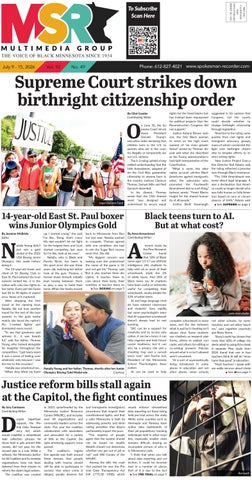
Supreme Court strikes down birthright citizenship order By Clint Combs Contributing Writer
Legal Defense Fund
14-year-old East St. Paul boxer wins Junior Olympics Gold By Jasmine McBride Editor
up, I started crying,” she said. back to Minnesota from Bos“I’m like, ‘Dang, that’s crazy.’ ton last year, Natalia pushed My dad wouldn’t let me fight to compete. Thomas agreed, atalia Young didn’t for the longest time, and I just with one condition: she had just win a gold started competing last year. to win the Sugar Bert tournament first. She did. medal at the 2026 So I’m like, look at me now.” “My biggest concern was Natalia, who is Black and USA Boxing Junior Olympics. She made history Puerto Rican, has been in making sure she understood the sport since she was three the name of the game is hit doing it. The 14-year-old boxer and years old, watching her father and not get hit,” Thomas said. client of Sir Boxing Club in train at the gym. Thomas, a “But it also teaches them disEast St. Paul entered the tour- former boxer himself, initially cipline. It teaches them to nament ranked No. 2 in the kept boxing between them care about their body, their nation with only two fights to as play, a way to build their nutrition. It teaches them so ■ See BOXING on page 5 her name. Every girl she faced bond. When the family moved had 20 to 30 fights of experience. None of it mattered. After dropping the first round of her opening bout, Natalia did not lose another round for the rest of the tournament. In the gold medal match, she faced the nation’s No. 1-ranked fighter and dominated every round. “To see that greatness and witness it… it was beautiful,” said her father, Thomas Young, who trained alongside his daughter throughout the competition. “I got teary-eyed. It was a sense of feeling overwhelmed, only because I saw her rise to the occasion.” Natalia was emotional too. Natalia Young and her father, Thomas, shortly after her Junior “When they lifted my hand Olympics Boxing Gold Medal win. Courtesy
rights for the freed blacks but has instead been repurposed for political projects that the n June 30, the Su- Reconstruction Congress did preme Court struck not support.” Justice Ketanji Brown Jackdown President Donald Trump’s son, the first Black woman executive order declaring that to serve on the high court, children born in the U.S. to warned of “an even greater parents who are in the coun- threat” posed by Thomas’ distry illegally or temporarily are sent and what she described as the Trump administration’s not U.S. citizens. The 6-3 ruling upheld a long- bad-faith interpretation of the settled understanding that the Constitution. “What is more, this alter14th Amendment, adopted afnative account pitches Black ter the Civil War, guarantees Americans against immigrants citizenship to anyone born in when the advocates who the country. Justices Clarence promoted the Fourteenth Thomas, Samuel Alito and Neil Amendment did no such thing,” Gorsuch dissented. Jackson wrote. “Freed Blacks In his dissent, Thomas fought for the shared humanwrote that the 14th Amendment “was designed and ity of all people.” Justice Brett Kavanaugh understood to secure equal
suggested in his opinion that Congress, not the courts, could decide whether to change birthright citizenship through legislation. Reaction to the ruling came quickly from civil rights and immigrant advocacy groups, many of whom connected the fight over birthright citizenship to broader efforts to restrict voting rights. New Justice Project Executive Director Rod Adams said the ruling reflected a promise won through Black resistance. “The 14th Amendment was never about legal language. It was a declaration that America could no longer decide who was fully human or fully American based on race or circumstances of birth,” Adams said. ■ See SUPREME on page 5
Black teens turn to AI. But at what cost? By Anya Armentrout Contributing Writer recent study by the Pew Research Center found that 18% of Black teens ages 13-17 use artificial intelligence (AI) chatbots to help with all or most of their schoolwork, triple the 6% of white teens. And 38% of Black teens say AI chatbots have been useful or extremely useful for completing their schoolwork, nearly double the 22% of white teens. AI and large language models have entered classrooms and students’ lives rapidly, but some psychologists warn that AI-supported schoolwork doesn’t always lead to real learning. “[AI] can be a support for creativity and to access education, it can be a tutor, it can help organize and help future career readiness, but it can also be a privacy risk and a cheating trap and a surveillance tool,” said Tascha Just, President of the Minnesota School Psychologists Association. AI can be used to help
cottonbro studio complete schoolwork in many ways, and the line between what is and isn’t cheating isn’t always clear. Some students use chatbots as research platforms, others to explain concepts, and others for editing or co-writing answers. Policies around what is or isn’t allowed aren’t consistent. “AI is sort of asymmetrically being introduced in some places in education and not other places, some schools,
not other schools, by some teachers and not other teachers,” said cognitive psychologist Brian Stone. Stone’s work has shown that more than 60% of college students admit to using AI to cheat. A separate Pew study from 2024 found that one in four teachers think AI will do “more harm than good” in education. “Most teachers I speak with are really nervous about cheat■ See AI on page 5
Justice reform bills stall again at the Capitol, the fight continues By Izzy Canizares Contributing Writer espite bipartisan support, the Pretrial Data Transparency Act, which would establish a streamlined data collection process for those held in jails around Minnesota, did not pass for the second year in a row. While a setback, the Minnesota Justice for All Coalition and its member organizations have not been deterred from their mission to reform the state’s legal system. The coalition was created
in 2023, spearheaded by the Minnesota Justice Resource Center (MNJRC), and includes over 40 organizations and community leaders across the state. This year the coalition collaborated with lawmakers and advocated for a variety of bills at the Capitol. Despite promising support, none passed. The coalition’s legislative agenda was built around three themes: that people dealing with trauma should still be able to participate in society; that when crime is alleged, people deserve fair
and transparent investigatory procedures that respect their constitutional rights; and that a safer Minnesota is built by addressing poverty and eliminating penalties that disproportionately impact the poor. “The majority of people agree that the system should not be based on wealth. Wealth should not determine whether you get out of jail or not,” said Will Cooley of the MNJRC. Among the bills the coalition pushed for was the Pretrial Data Transparency Act (HF 1775/SF 1908), which
would enforce streamlined data reporting on those being held pre-trial across the state. While some counties such as Hennepin and Ramsey have online data dashboards of their jail populations, tracking individuals held in other counties, especially smaller ones, remains difficult, leaving an incomplete picture of who is in Minnesota’s jails. “I think that when you talk about data reporting and collection, it could be inconsistent in a number of places. Part of it is due to the fact ■ See PRE-TRIAL on page 5
Ron Lach