PRST STD U.S.POSTAGE PAID TWIN CITIES MN PERMIT NO. 6391
To Subscribe Scan Here
THE VOICE OF BLACK MINNESOTA SINCE 1934 May 7 - 13, 2026
Vol. 92
Phone: 612-827-4021 www.spokesman-recorder.com
No. 40
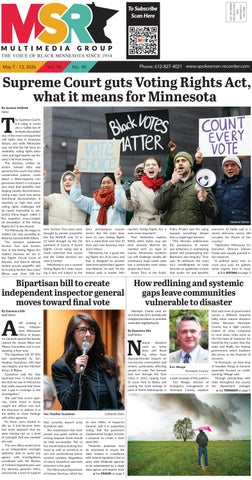
Supreme Court guts Voting Rights Act, what it means for Minnesota By Jasmine McBride Editor he Supreme Court’s 6-3 ruling in Louisiana v. Callais has effectively dismantled one of the most consequential civil rights laws in American history, and while Minnesota may not feel the full force immediately, voting rights advocates and legal experts say the state is far from immune. The decision, written by Justice Samuel Alito and joined by the court’s five other conservative justices, invalidated a Black-majority congressional district in Louisiana and ruled that plaintiffs challenging racially discriminatory voting maps must now prove intentional discrimination. A standard so high that most voting rights challenges will be nearly impossible to win. Justice Elena Kagan called it “the majority’s now-completed demolition of the Voting Rights Act” in her dissent. For Minnesota, the impact is toric Section Two cases were indirect but real, according to brought by private nonprofits Attorney General Keith Ellison. like the NAACP, only 12 or “The decision weakened 13 were brought by the DeSection Two, and Section partment of Justice. A recent Two of the Voting Rights Act Eighth Circuit ruling had almatters because we are in ready restricted that access, the Eighth Circuit Court of and the Callais decision narAppeals, and they’ve already rows it further. Minnesota is not a covered limited private plaintiffs’ ability to bring Section Two cases,” Voting Rights Act state, meanEllison said. Over 100 his- ing it was not subject to the
Edmond Dantes law’s preclearance requirements. But the state does have its own Voting Rights Act, a state-level tool that Ellison said now becomes even more critical. “Minnesota has a good Voting Rights Act of its own, and that is designed to provide state-level protections against vote dilution,” he said. “As the federal path is harder, Min-
Bipartisan bill to create independent inspector general moves toward final vote By Damenica Ellis Staff Writer bill creating a new, independent Minnesota Office of Inspector General passed the Senate, cleared the House Ways and Means Committee and is now awaiting a floor vote. The bipartisan bill, SF 856, was spearheaded by Sen. Heather Gustafson, DFL-Vadnais Heights, and Sen. Michael Kreun, R-Blaine. Gustafson said the idea stemmed from “a fraud problem that we saw in Minnesota that really exposed that there was a gap in coverage in the investigation.” She said that across agencies, some fraud is being caught but offices may lack the resources to address it or the ability to share findings with other agencies. “As these cases started to pile up, it just became more and more apparent that we were missing out on a level of oversight that was needed,” she said. The new office would serve as an independent oversight authority able to assist any agency with investigations, coordinate with the Bureau of Criminal Apprehension and the attorney general’s office, and provide a level of support
nesota’s Voting Rights Act is even more important.” That distinction matters. While other states may see their minority districts dismantled with no legal recourse, Minnesota residents can still challenge racially discriminatory maps under state law, a protection most states simply don’t have. James Trice of the Public
Policy Project said the ruling exposes something deeper than a single legal decision. “This decision underscores the persistence of racism and whiteness in maintaining power and perpetuating antiBlackness and inequity,” Trice said. “It reinforces the country’s unwillingness to truly become an egalitarian society that works for and benefits
everyone. As Eddie said in a recent interview, racism still occupies the throne of the country.” TakeAction Minnesota CoExecutive Director Elianne Farhat was equally pointed in her response. “A political party tries to court your vote. An authoritarian regime tries to keep ■ See VOTING on page 5
How redlining and systemic gaps leave communities vulnerable to disaster that each level of government carries a different responsibility when natural disasters strike. Because Hennepin County has a high concentration of cities compared By Damenica Ellis to rural areas, cities serve as Staff Writer the first layer of response, followed by the county, then the atural disasters state and finally the federal such as tornagovernment, which traditiondoes and floodally serves as the financier of ing often have recovery. disproportionate impacts on “In Hennepin, we have kind low-income communities and of tweaked things to become renters, particularly affecting Eric Waage people of color. The tornado Hennepin County especially focused on public warning,” Waage said. that tore through the Twin Cities in 2011, ripping from a stark example of this pattern. Through partnerships with Eric Waage, director of cities throughout the county, St. Louis Park to Blaine and causing the most damage in emergency management at the department manages parts of North Minneapolis, is Hennepin County, explains ■ See TORNADO on page 5 Hennepin County used lessons from the 2011 tornado and changed procedures to prioritize vulnerable neighborhoods.
Sen. Heather Gustafson that currently doesn’t exist, Gustafson said. She emphasized that both private and public entities receiving taxpayer funds should be held accountable. The office would help by looking into fraud as well as technical errors and unintentional administrative mistakes. Regardless of intent, Gustafson said early detection is the goal. The Minnesota Department of Human Services, which has
Catherine Davis its own Office of Inspector General, said it is supportive, noting that the governor’s supplemental budget includes a proposal to create a statewide OIG. “However, proposals must be structured to ensure the state remains in compliance with federal regulations that require state Medicaid agencies to be administered by a single state agency and require state ■ See FRAUD on page 5