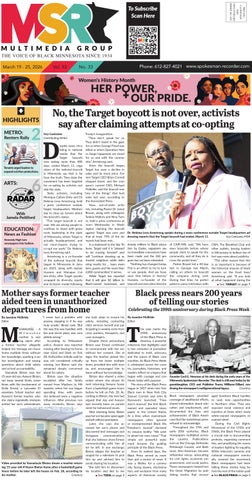
No, the Target boycott is not over, activists say after claiming attempts at co-opting
Trump’s inauguration.
With Jamela Pettiford
Izzy Canizares Contributing Writer
espite news circu-
lating in national media that the Target boycott, now lasting more than 400 days, ended March 11, organizers of the national boycott in Minnesota say that is far from the truth. They claim the movement has been targeted for co-opting by activists outside the state.
State activists, including Monique Cullars-Doty and Dr. Nekima Levy Armstrong, held a press conference outside Target headquarters Wednesday to clear up rumors about the boycott’s status.
“They don’t speak for us. They didn’t stand in the gaps for us when George Floyd was killed or when Operation Metro Surge happened; we stood for us and with the community,” Armstrong said.
Since the boycott began, Target has seen a decline in sales and its stock price. Former Target CEO Brian Cornell stepped down, and the company’s current CEO, Michael Fiddelke, said the boycott was “one of the things” that hurt sales last year, according to the Associated Press.
EDUCATION:7
News as Fashion
Kennedy High turn newspapers into fashion.
“This target boycott is not over. We are asking people to continue to stand with grassroots leadership in the state of Minnesota, where Target is actually headquartered, and not clout-chasers trying to co-opt our work,” Dr. Nekima Levy Armstrong said.
Armstrong is a co-founder of the national boycott that began in Minnesota in January 2025, along with Jaylani Hussein and Monique Cullars-Doty, after Target quickly scrapped its diversity, equity and inclusion model following
Now, out-of-state activists, including Pastor Dr. Jamal Bryant, along with colleagues Tamkia Mallory and Nina Turner, held a press conference at noon Wednesday in Washington claiming the boycott against Target was over and that at least 75% of the demands had been met.
In a statement to the Star Tribune, Target said it is “pleased to be moving forward” and will “continue showing up as trusted neighbors while delivering results for ... team members, guests and the more than 2,000 communities” it serves.
While Target has reported that it will give $2 billion to Black-owned businesses and
Mother says former teacher aided teen in unauthorized departures
By Jasmine McBride Editor
ILWAUKEE – A Milwaukee mother is raising alarm after a former teacher allegedly helped her teenage son leave home multiple times without her knowledge, sparking a police investigation and raising questions about child safety and school accountability.
Vannatyie Binion says her 15-year-old son, Aveyon Binion, ran away several times, sometimes with the involvement of Emily Ernest, a Lancaster Elementary School teacher and Aveyon’s former teacher, who she claims repeatedly misrepresented her son’s whereabouts.
from home
“I never had a problem with anyone stepping in if he was truly unsafe,” Binion said. “But the way this was handled, with lies and secret plans, was completely wrong.”
According to Milwaukee police, Aveyon was reported missing after leaving his home near 62nd and Stark on Feb. 28. Authorities initially said he was not considered critically missing, but Binion said she remained deeply concerned about his safety.
Binion says the situation escalated after her family moved from Madison to Milwaukee, when her son began spending time with peers she believed were a negative influence. After previous runaway incidents, Binion says
she took steps to ensure his safety, including contacting child services herself and participating in weekly visits from crisis workers, therapists, and case managers.
Despite those precautions, Binion says Ernest continued to communicate with her son without her consent. She alleges the teacher picked him up from her home multiple times, provided him with money, and encouraged him to leave without her knowledge.
Binion also shared a video online where she shows Ernest returning Aveyon home from a basketball game hours before he left on Feb. 28. According to Binion, the two had argued that day and Aveyon had recently been on punishment for behavioral issues.
After returning home, Binion says her son became upset again and left without permission.
Later, she says she accessed her son’s phone and discovered text messages and Instagram communications that she believes show Ernest communicating with him after he left. In one exchange, Binion alleges the teacher arranged for a rideshare to pick him up and advised him to avoid sharing his location.
“She told him to disconnect his location and lied to me
■ See TEEN on page 5
Dr. Nekima Levy Armstrong speaks during a news conference outside Target headquarters addressing reports that the Target boycott had ended, March 11. Izzy Canizares/MSR
donate millions to Black education by Easter, organizers say no immediate concessions have been made and the DEI program has not been reinstated.
Pastor Bryant led a 40-day fast in Georgia last March, calling on others to boycott the company during Lent.
During that time, he participated in press interviews with
“Nothing has changed today. This is an effort to try to turn or use people. And we have seen that before in history,” Hussein, co-founder of the boycott and executive director of CAIR-MN, said. “We have seen boycotts before where people claim to speak for the community, and all they do is cross the picket lines.”
CNN, The Breakfast Club and other outlets, leaving leaders in Minnesota to believe the effort was more about publicity.
“The other reason that this is so important is because of the historical erasure of black women on the front lines,” Armstrong said. “If you look at what happened during the
■ See TARGET on page 5
Black press nears 200 years of telling our stories
Celebrating the 199th anniversary during Black Press Week
By Jasmine McBride Editor
his year marks the 199th anniversary of the Black Press in America, a powerful milestone that highlights nearly two centuries of journalism dedicated to truth, advocacy, and the voices of Black communities. As Black Press Week is celebrated across the country, journalists, historians, and readers reflect on a legacy that began with courage and continues today with purpose.
The story of the Black Press began in 1827 when two free Black men in New York City, Samuel Cornish and John B. Russwurm launched “Freedom’s Journal,” the first Blackowned and operated newspaper in the United States. At a time when mainstream newspapers often ignored or misrepresented Black life, “Freedom’s Journal” declared its mission boldly: “We wish to plead our own cause.” That simple yet powerful statement became the guiding principle of the Black Press.
From its earliest days, the Black Press served as more than just a source of news. It was a lifeline for a community facing slavery, discrimination, and exclusion from many aspects of American society.
Founder Cecil E. Newman at his desk during the early years of the Minnesota Spokesman-Recorder. The desk is still used today by his granddaughter, CEO and Publisher Tracey Williams-Dillard, continuing the newspaper’s multigenerational legacy. Courtesy
Black newspapers provided coverage of abolitionist efforts, shared information about education and employment, and documented the lives and achievements of Black Americans that the mainstream press refused to acknowledge.
Throughout the 19th and early 20th centuries, Black newspapers multiplied across the country. Publications such as the Chicago Defender, Pittsburgh Courier, and Baltimore Afro-American became influential voices advocating for civil rights, economic empowerment, and social justice. These newspapers helped fuel the Great Migration by publishing stories that encour-
aged Southern Black families to seek new opportunities in Northern cities. They also exposed racial violence and injustice at times when many white-owned newspapers remained silent.
During the Civil Rights Movement of the 1950s and 1960s, the Black Press played a crucial role in documenting protests, organizing communities, and amplifying the voices of leaders fighting for equality. While television cameras and national newspapers eventually covered the movement, Black newspapers had been telling those stories long before the rest of the nation paid
■ See BLACK PRESS on page 5
Tenants urged leaders to expand eviction protections.
Video provided by Vannatayie Binion shows a teacher returning 15-year-old A’Veyon Binion home after a basketball game hours before he later left the house on Feb. 28, according to his mother. Courtesy
Metro
Renters rally after Frey vetoes Minneapolis eviction notice extension
By Clint Combs Contributing Writer
Frida Tellez Mercado carried the weight of her entire apartment building when she stood inside the Hennepin County Government Center on Wednesday, March 12.
The daughter of a single mother, she came with a translator and another story to tell, this one from a neighbor who could not risk being there herself.
“I’m the daughter of a single mother, and my mother, my brother and I live in an apartment together. We’ve lived there for three years,” Mercado said. “I’m currently involved in delivering food to my neighbors because these have been very difficult times for me, my family, and my community.”
Speaking through translator Rebecca Song, Mercado also read a statement from Laura Perez, a 10-year resident and mother of five.
“The other concern is not being able to pay our rent, and the worry of losing that one place that has afforded us protection and kept us safe during this occupation,” Mercado said, reading Perez’s words.
Across the river in St. Paul, Alibella Rodriguez, a mother of three who has lived in her neighborhood for 24 years, made a similar plea to law
makers considering a $45 million emergency rental assistance bill.
“I’m a mother of three chil
dren during these months of our lives that have changed everything,” Rodriguez said through a translator. “My husband has not been able to go to work for fear of being kid-
napped. My daughter is fearful of losing her parents.”
Her husband has since sold his work truck.
Rodriguez and Mercado spoke a day after Jacob Frey, mayor of Minneapolis, vetoed an ordinance that would have temporarily expanded the city’s pre-eviction notice period from 30 to 60 days.
Nearly 100 people testified at a city committee meeting, many speaking on behalf of neighbors who were too afraid to leave their homes.
Supporters of the ordinance argued it would give renters more time to find housing or stabilize their finances before facing eviction court.
The veto came the same day the all-women city council in St. Paul voted 7–0 to advance an ordinance that would temporarily extend its pre-eviction notice period from 30 to 60 days through the end of the year.
“Yesterday, Jacob Frey vetoed the policy,” said tenant organizer Farhan Badel. “After
three months of living under occupation, we stand here today as tenants in Minneapolis with absolutely zero eviction protections in place to keep our families safely in their homes.”
Eric Hauge, co-executive director of HOME Line, a renter advocacy nonprofit, said eviction filings have already surged.
Lyft settles service animal discrimination complaint in Minnesota
By Clint Combs Contributing Writer
Lyft left Tori Andres and her service dog Alfred stranded seven times.
“I travel pretty much everywhere with my guide dog,” said Andres, who has also been a guide dog handler for seven years. “He is my eyes. He is my freedom, and he is why I am able to live independently.”
Andres filed a complaint against Lyft with the Minnesota Department of Human Rights (MDHR). MDHR Commissioner Rebecca Lucero announced a settlement on March 11, 2026.
“After a thorough investigation, we found that Lyft did violate the Minnesota Human Rights Act. We found that Lyft drivers… repeatedly canceled rides because Tori was traveling with her service animal,” said Lucero.
Lyft will notify rideshare contractors that they must provide services to customers with service animals. Drivers who violate the policy will have their contracts deactivated and will no longer be allowed to drive for Lyft.
“It has benefits that will impact people across the country, because Lyft has made several changes to its policies across the board, and its training,” said Lucero. “Then they updated
their app pretty substantially.”
Under the settlement, the Minnesota Department of Human Rights will monitor Lyft’s compliance with disability laws for three years.
“They have to report to the Department of Human Rights every single time the rides are denied, so we can track what’s going on there and why and what additional accommodations were provided at that time,” said Lucero.
Sources inside the company deny this, writing that the settlement does not “require Lyft to provide individual ride cancellation notices to the State.” Lyft framed the settlement as reinforcing existing policies in a statement.
“I’m
“Lyft has maintained a strict service animal policy for nearly a decade, and independent drivers who violate that policy face serious consequences, including permanent deactivation,” the statement reads.
“The commitments reflected in this agreement reaffirm the robust practices Lyft has already had in place to help ensure that riders who rely on service animals are treated
with the respect they deserve.”
However, Lucero noted that prior policies were not consistently enforced, and the company’s drivers repeatedly denied service. While Lyft may have had policies on paper, MDHR said they found gaps in real-world application. Drivers often refused rides for reasons such as “the animal sheds” or incorrectly request-
In Minneapolis, there were 123 eviction filings in the first 10 days of this month, compared to just 43 during the same period last year.
Frey defended his veto in a social media post, saying homeless shelters and affordable housing providers favored direct rental assistance rather than what he called “blunt measures that put people further into debt.”
The mayor argued that allocating $1 million in city funding to rental assistance would be a more effective way to help residents behind on rent.
Hauge pushed back, saying data from HOME Line show that a large portion of recent eviction filings have come from the Minneapolis Public Housing Authority and other nonprofit housing providers.
Tenant activists rallied inside the Government Center and called on the five council members who voted against the ordinance, six including Jamison Whiting, who abstained to flip their votes when the council considered
this during the news conference.
“A driver or transportation provider should only ask two questions, is this animal required because of disability, and what task or work has that animal been trained to perform?” said Wilson. “That’s it.”
Despite Lyft’s Service Animal Policy, Andres was denied service multiple times. It is not clear whether Lyft had consistent enforcement or if drivers were properly trained to accommodate customers with service dogs.
Ride-hailing companies Uber and Lyft have long faced documented cases of denying service to riders with disabilities and service animals. Lyft
a veto override on March 24.
Minneapolis Council Member Robin Wonsley said the veto reveals the mayor’s priorities. While residents organized food drives, donated to GoFundMe campaigns, and monitored federal enforcement activity, she said Frey was making national media appearances.
“It’s very sad that we even have to be here asking five council members to override a veto that did not need to happen,” Wonsley said. “Our own mayor spent months touring around the country saying he was fighting for Minneapolis. But what we didn’t know was he was fighting for Minneapolis landlords, not workingclass people.”
Organizer Badel echoed that criticism, pointing to campaign finance records.
“It’s no secret that Jacob Frey is a dream come true for the real estate industry,” Badel said. “Their donations tell the story.”
Meanwhile, at the Minnesota State Capitol, the Min-
Council on Disability, said the agency is frequently contacted about these rights.
“It’s easily top five, if not the biggest, for phone calls and emails that we get. There’s a lot of misunderstanding and a lot of challenges that people with disabilities experience around this,” said Dively.
There are many transportation options available for people with disabilities. Metro Mobility rides must be scheduled one to four days in advance.
Metro Mobility’s Premium OnDemand service offers short trips that can be requested the same day for eligible riders.
Metro Transit is still behind on maintenance that would make
ing documentation.
Neither the Americans with Disabilities Act (ADA) nor the Minnesota Human Rights Act requires travelers to provide documentation like medical records, training certificates or ID cards to ride with a service animal in rideshares, taxis or on public transit. Chad Wilson, an attorney with the Minnesota Disability Law Center of MidMinnesota Legal Aid, echoed
customers who use wheelchairs had a wait time of nine minutes, more than the fourminute wait time for non-accessible rides, according to a 2019 NYPL study. The same data shows Uber customers waited four minutes for wheelchair-accessible service compared to two minutes for non-accessible vehicles.
David Dively, executive director of the Minnesota
nesota Senate passed a $40 million emergency rental assistance bill on a 35–32 partyline vote Wednesday, with Sen. Lindsey Port, DFL-Burnsville, serving as chief author.
The bill would distribute funds to counties and tribal governments to help renters struggling in the aftermath of Operation Metro Surge.
“For renters being pushed to the brink by the rising cost of food, gas, utilities, and health care, this support could be the help they need to get back on their feet,” Port said. “Our communities are being pushed to the brink by the Trump administration and the billionaires who pull their strings.”
Port called on Republican House Speaker Lisa Demuth to bring the bill to the House floor. But that path appears steep. Republicans flipped the House in 2024 and now hold a one-seat majority.
House Minority Leader Harry Niska, R-Ramsey, has already expressed opposition, saying Republicans are “not really interested in a bailout” for residents forced to shelter in place during Operation Metro Surge.
Back in Minneapolis, Rodriguez spoke plainly about what is at stake if neither the city council nor the legislature acts.
“Without support, many families will be evicted,” she said. Minneapolis will consider overriding the veto Tuesday, March 24 at 9:30 a.m. during the Committee of the Whole meeting at Minneapolis City Hall. St. Paul’s pre-eviction extension ordinance is scheduled for a final vote Wednesday, March 18 at 3:30 p.m. at St. Paul City Hall.
Clint Combs welcomes reader responses at combs0284@ gmail.com.
cal,” said Dively. Service dogs assist people with a wide range of disabilities by performing tasks that help them live more independently. Some are trained to interrupt panic attacks or wake handlers from nightmares for people with post-traumatic stress disorder. Others assist people with multiple sclerosis by picking up dropped items or providing balance support while walking. Service dogs can also detect blood sugar changes in people with diabetes, alerting their handlers before a medical emergency occurs. Those interested in service dogs can apply to Can Do Canines, an assistance dog placement program in New Hope, Minnesota, or Helping Paws, an assistance dog and volunteer trainer program in Eden Prairie, Minnesota. Pawsitivity Service Dogs for Veterans in St. Paul focuses on veterans with post-traumatic stress disorder, mobility challenges and other service-connected disabilities.
Lyft denied violating the Minnesota Human Rights Act. When asked whether progress on compliance would be publicly available, Lucero deferred to Lyft.
public transit more accessible.
For example, a long overdue renovation to escalators at the Lake Street/Midtown Station will not begin until April 2027.
Despite these options, Dively said services provided by Uber and Lyft remain critical for riders with service animals.
“That’s not always practical or feasible for people, so having real, dependable, functional transportation is criti-
“I’m not sure I would defer to Lyft to see if their policies will be publicly posted,” Lucero said.
Lyft did not respond directly to whether those reports would be made public.
Lyft said the company will provide data on alleged violations of its service animal policy to MDHR twice a year.
Clint Combs welcomes reader responses at combs0284@ gmail.com.
Protesters rally at the Hennepin County Government Center in Minneapolis on March 12.
Photos courtesy of Clint Combs/MSR
Attorney Chad Wilson (center) speaks to reporters during a news conference announcing a settlement between the Minnesota Department of Human Rights and Lyft. Clint Combs/MSR
Minneapolis City Council Member Robin Wonsley speaks at a press event March 12, criticizing Mayor Jacob Frey’s veto of a temporary pre-eviction notice extension.
Health
A clinical perspective on common health conditions affecting Black women
Women’s health research has historically been underfunded, and the numbers tell a sobering story. In 2023, the National Institutes of Health (NIH) invested less than 8% of its total grant funding in women’s health, about $3.4 billion out of a $43.7 billion budget. While that may sound substantial, it represents only a small share of the resources devoted to understanding half the population. Research specifically focused on Black women’s health is even more limited.
Estimates suggest that only about 2% of U.S. health research is dedicated to studying the health needs of Black women. Organizations such as the Black Women’s Health Imperative are working to change that. With support from a $1.2 million grant from the W.K. Kellogg Foundation, the organization has launched initiatives to address these disparities, including the largest menopause and perimenopause survey ever conducted specifically for Black women.
Still, the overall level of research focused on Black women’s health remains deeply inadequate. This means there is limited information about how conditions uniquely affect Black women, how symptoms present differently in our bodies, and what treatments may be most supportive for our population.
As the only Black naturopathic doctor actively practicing in the state of Minnesota, I am particularly aware of these gaps, I see them reflected in my patients’ experiences every day.
Learning how your body works is one of the most pow-
erful first steps toward protecting your health. Because large institutions have yet to fully prioritize research in this area, I’m sharing insight from the clinical side. Below are three of the most common conditions I see among my Black women patients, along with a brief look at both conventional and naturopathic approaches.
Fibroids
What it is:
Also known as leiomyomas, fibroids are common benign growths made of uterine muscle and connective tissue. They affect many women during their reproductive years but occur significantly more often in Black women.
Although fibroids are noncancerous, they can cause problems depending on their size, number, and location. Some women live their entire lives without realizing they have fibroids, while others experience severe symptoms. These may include:
• Heavy or prolonged menstrual bleeding
• Bleeding between cycles
• Severe menstrual cramping
• Pain during sexual intercourse
• Constipation
• Frequent urination or difficulty emptying the bladder
• Abdominal fullness or distention (many women say they look several months pregnant)
Conventional approach:
Depending on severity, conventional medicine offers several treatment options, including:
• Hormonal medications such as leuprolide to suppress estrogen
• Surgical removal of fibroids (myomectomy)
• Procedures such as uterine artery embolization or MRI-guided therapies
Dr. Q’s approach: In naturopathic medicine, the focus is on addressing underlying causes. In my clinical experience, fibroids often correlate with chronic stress and hormone imbalance. One of my preferred diag-
nostic tools is a salivary cortisol and hormone panel, which helps us understand how a patient’s stress hormones and reproductive hormones interact. From there, we create a personalized protocol that may include:
• Stress management strategies
• Nutrition and eating habit adjustments
• Sleep optimization
• Targeted supplementation, such as phytoestrogens or adrenal adaptogens
While naturopathic medicine does not surgically remove fibroids, I have seen cases where fibroids shrank significantly, sometimes to the point that they were no longer visible on imaging.
Perimenopause and Menopause
What it is:
Globally, an estimated 1.2 billion women are currently transitioning through menopause, the largest number in human history. In recent years, perimenopause and menopause have received increased attention as more women share their personal and clinical experiences. Perimenopause and menopause are not diseases or signs that the body is failing. They are natural biological transitions as the body moves from one hormonal phase of life to another. However, because estrogen is one of the body’s most biologically active hormones, the transition can feel overwhelming for many women.
Common symptoms include:
• Hot flashes
• Mood change
• Sleep disruption
• Brain fog
• Irregular menstrual cycles Fortunately, once hormones stabilize, many of these symptoms improve.
Conventional approach:
Conventional medicine uses several tools to manage symptoms. Hormone replacement therapy (HRT), once widely feared, is now being used more thoughtfully with
improved safety protocols. Some physicians also prescribe antidepressants to help manage mood-related symptoms.
Dr. Q’s approach:
My approach to menopause is highly individualized. Some patients use HRT in collaboration with their medical providers. Others prefer botanical options such as black cohosh, chaste tree berry, or passionflower to help support symptom management.
Equally important are lifestyle foundations, particularly stress management and healthy sleep patterns during this transition.
PCOS (Polycystic Ovarian Syndrome)
What it is:
Polycystic ovarian syndrome, or PCOS, is a complex hormonal condition that affects an estimated 10% to 23% of women worldwide. It is not defined by a single symptom but
by a cluster of related issues that may include:
• Irregular menstrual cycles
• Ovarian cysts
• Acne
• Excess facial hair
• Fertility challenges
Many women with PCOS also experience complications such as insulin resistance, weight gain, hypertension, and elevated cholesterol.
Conventional approach:
Conventional treatment often focuses on managing symptoms and may include:
• Birth control pills to regulate menstrual cycles
• Medications to improve insulin sensitivity
• Surgery if ovarian cysts cause complications
Dr. Q’s approach:
Although the precise cause of PCOS is still being studied, research shows that insulin regulation, hormonal imbalance, and stress all play im-
portant roles. My approach focuses on restoring balance in these areas. This may include:
• Stabilizing eating habits to support blood sugar balance
• Supporting insulin regulation with nutrients such as inositol
• Using phytoestrogenic botanicals to help modulate hormone activity
While the research world continues to catch up, one thing remains clear: knowledge is power. Understanding how your body functions, how it responds to stress and how it signals imbalance, can transform the way you approach your health.
Until research truly reflects the needs of all women, sharing knowledge within our communities and clinics will remain one of our most powerful tools.
Learn more about Dr. Ayanna Quamina and her practice at www.drayannaq.com. Email her directly at info@drayannaq.com.
By Dr. Ayanna Quamina, ND Columnist
AIM Credit Repair LLC
Black Business SPOTLIGHT
By Jasmine McBride Editor
When Carlos Hawkins launched AIM Credit Repair LLC, the inspiration came from a moment that stuck with him. After picking up his brother from jail, Hawkins took him to get a phone so he could reconnect with the world. Despite being released, his brother wasn’t able to get on a phone plan due to his credit.
“I just felt so bad… I had to get him a prepaid phone,” Hawkins recalled. “That’s what started my thought process about credit repair, because I said I need to help these inmates. There are other people like him, and I would hate for them to have to go through additional barriers within the re-entry process.”
That experience pushed Hawkins to learn everything he could about credit and how it affects people’s ability to rebuild their lives. AIM Credit Repair LLC has now been op-
erating for nearly a decade, though Hawkins notes the first two years were spent navigating licensing requirements before the company could fully launch.
The early years of the business were far from easy.
“It was a lot of learning,” Hawkins said. “It was hard. People don’t really trust credit repair, so that was a barrier within itself.”
To build credibility, he invested in courses, studied the industry and continued refining his approach. Along the way, he admits he made mistakes, but he stayed persistent.
Despite the challenges, the business began to grow quickly. In its first year, the company generated about $4,000 in revenue. By the second year, that number had jumped to about $55,000.
“It just took off from there,” Hawkins said. Over time, the work has proven to be about much
Turning setbacks into comebacks through credit repair
more than numbers on a credit report. Hawkins recalls one experience that showed him the deeper impact of the business when he began helping a Somali family that believed they would never qualify for credit or homeownership.
“It started with two people,” he said. “Then I ended up helping the whole family through the rebuilding process.”
“I want to become that preferred vendor for financial literacy for inmates,”
There were setbacks along the way, but the family stayed committed. Eventually they were able to move forward with their goals.
“My heart was so full after that,” Hawkins said. “To see a family rejoice and send their kids, nieces and nephews to me to help with their credit made me realize how I play a big part in some people’s family tree.”
Through his work, Hawkins often shares practical advice for people trying to rebuild or strengthen their credit. One
of the most common mistakes he sees is people closing accounts too quickly.
“Don’t close any accounts right away,” he said. He also advises people to be mindful of how much of their available credit they use.
“If you’re making a big purchase, split the purchase among multiple credit cards so you’re not utilizing the full balance on one card,” Hawkins explained. “If you use too much of it, your score is going to drop.”
While AIM Credit Repair LLC is based in Minnesota, the company primarily works with clients online rather than in person, allowing Hawkins to assist people across different communities.
Looking ahead to 2026, Hawkins hopes to take his work even further by partnering with correctional facilities to provide financial education for people preparing to return home.
“My goal is to somehow break into the jail system,” he said. “I want to become that preferred vendor for financial literacy for inmates who have about a year left on their sentence and are transitioning back into the real world.”
For Hawkins, that mission brings his business back to the moment that started it all, helping people rebuild their financial foundation and giving them a fair chance to move forward.
“I just want to be that person for those guys,” he said. For more information, visit www.aimcreditfix.com.
Jasmine McBride welcomes reader responses at jmcbride@ spokesman-recorder.com.
Elam named 40 Under 40, B Suite for Black professionals in Minnesota
By Alaysia Lane
Contributing Writer
When Jhaelynn Elam first moved to Minnesota in 2021, she arrived with ambition. What she did not predict was how isolating the experience would feel.
Elam, who came from Grand Rapids, Michigan, and grew up in Dayton, Ohio, was used to being surrounded by Black community. A graduate of Tuskegee University, a historically Black university, she mainly experienced environments where cultural familiarity was the norm rather than the exception. In the Twin Cities, that familiarity was missing.
She noticed Black professionals across corporate and social settings but rarely found a consistent, intentional community. The experience, she said, is common among Black professionals who relocate for career opportunities. That gap eventually became The B Suite, a professional and social hub designed for Black professionals in Minnesota. Just three years after officially launching the organization, Elam has been named a 2026 40 Under 40 honoree by the Minneapolis/St. Paul Business Journal, recognition she describes as both affirming and humbling.
“I’ve really only been here not even five years yet,” Elam said. “To be acknowledged for what we’ve built in that time feels good, because it’s not easy.”
The idea for The B Suite came from Elam’s participation in the Josie R. Johnson
Leadership Academy, part of the African American Leadership Forum, in 2022. Fellows were assigned to develop leadership projects that addressed real community needs. Elam quickly knew which issue to tackle. Through focus groups and conversations with other Black professionals, many of whom were recruited to Minnesota’s Fortune 500 companies, she repeatedly heard that their time in the Twin Cities was temporary, with a set timeline for leaving. A lack of community consistently surfaced as one of the main reasons professionals of color left Minnesota. Elam decided to build something that could make staying feel valuable.
The B Suite officially launched in 2023, purposely at the intersection of professional development and social well-being. Elam wanted to create a space where someone could attend a panel discussion, connect with an executive mentor, and build relationships, all without the burden of code-switching or feeling like the only one in the room.
“To
“It’s about having somewhere to replenish,” Elam said. “Somewhere that feels familiar.”
The B Suite has hosted more than 50 events since its launch. Programming includes
its “9 to Thrive” professional development series, mentorship-centered conversations such as “A Seat at Her Table,” and informal networking gatherings known as “The Link Up.” The events center Black professionals, particularly Black women, and provide direct access to senior leaders who might feel out of reach to newcomers.
ganization’s mission, Elam measures success beyond titles and promotions. She frequently hears from attendees who have formed close friendships through The B Suite, sometimes unaware that she even founded the organization. For Elam, those stories represent the deeper meaning of the work.
“That’s success,” she said. “People finding their people.”
ing that she feels she is building alongside Elam rather than working beneath her.
pose and who it serves. On difficult days, she returns to the stories of newcomers who say The B Suite was the first place they felt connected in Minnesota, or professionals who credit the space with amplifying their networks and confidence.
That clarity has shaped her definition of leadership. For Elam, it’s less about the titles and more about taking action.
“If we don’t do it, it won’t get done,” she said.
“Sometimes it’s just who you know and being in the right room,” Elam said. “We’re trying to close that gap.”
While career advancement remains essential to the or-
Shakirah Edwards, The B Suite’s lead event host, first encountered Elam at an event in August 2024. A Burnsville native who previously lived in Los Angeles, Edwards said coming into the space felt welcoming, but most importantly, familiar. She later joined the team and now works closely with Elam. Edwards describes her leadership style as collaborative and transparent, add-
That approach extends across Elam’s eight-person team, all Black women, most of them originally connected with The B Suite as attendees or collaborators. Elam emphasizes flexibility and psychological safety, aiming to create an environment where team members feel supported and comfortable taking risks.
Building The B Suite has not been without its obstacles.
Securing funding remains one of the organization’s most persistent challenges, compounded by broader pushback surrounding race-centered initiatives. Elam said continuously advocating for the importance of the work can be exhausting but remains clear about the organization’s pur-
Being named to the Business Journal’s 40 Under 40 list marks a milestone, but Elam views it as motivation rather than a finish line. She sees her work becoming part of a broader narrative of collective progress, and her longtime vision is for The B Suite to reflect the Black professional experience in Minnesota, something newcomers can find before deciding to relocate.
“I hope Black professionals aren’t intimidated by moving here,” she said. “I want them to know there’s a space for them.”
Reflecting on her journey, Elam said she would offer her younger self a clear reminder: keep dreaming, stay curious, and be bold enough to bet on yourself. A true mindset that moved isolation to community, and community to recognition.
For more information on the B Suite, visit www.b-suite.co/.
Alaysia Lane is a multimedia freelance journalist and commerce writer based in Minneapolis.
Carlos Hawkins, founder and CEO of AIM Credit Repair LLC. Courtesy
From left, The B Suite’s Administrative Lead Lelandra Ross, Founder and CEO Jhaelynn Elam, Sustainable Events Coordinator J’ianna Cagers, and Lead Events Host Shakirah Edwards. Courtesy
TARGET
Continued from page 1
civil rights movement, it was the black women organizing behind the scenes that helped it become an actual movement. Their faces we don’t know, their stories we don’t know, because they’ve been effectively erased by the media and men in charge.”
Armstrong and her cofounders said they were never consulted before the “decision” to end the boycott and believe Bryant is attempting to co-opt a movement that
predated his involvement. “What did he get? I don’t believe he did it for nothing; he didn’t do it out of goodwill,”
Cullars-Doty, founder of Black Lives Matter Minnesota, said.
“What would motivate him to end the target boycott, knowing that we would respond, knowing he’s going to look like a fool. He’s an attention whore.”
News of the announcement spread quickly, with both national and local media outlets covering the development, including the Minnesota Star Tribune.
Organizers said the coverage initially failed to acknowledge the Minnesota leaders as founders of the movement and used
a photo of Armstrong’s 8-yearold daughter as the main image, a decision that has since been corrected.
“I saw the headline, I saw the story. I saw my daughter’s picture holding this sign and I was livid.”
Armstrong said she contacted Star Tribune CEO Steve Grove to share concerns, noting she had previously spoken with the reporter who wrote the story and believes the omission was intentional.
“She lacked journalistic ethics and integrity by writing that article and not including the founder. She referenced us in passing as if we were ir-
relevant.”
In response to questions about the coverage, the Minnesota Star Tribune said it attempted to contact Armstrong shortly after publishing its initial breaking news story about Pastor Jamal Harrison Bryant’s announcement that the boycott had ended.
“The Minnesota Star Tribune attempted to contact Nekima Levy Armstrong immediately after we and other national outlets posted a breaking news story about Jamal Harrison Bryant’s call to end the national boycott against Target,” the newsroom said in a statement to the Minnesota
Spokesman-Recorder. “We updated our story, as we often do on breaking news events, to reflect the differing views of Ms. Levy Armstrong shortly after conducting an interview with her. We are continuing to report on this story.”
The newspaper also addressed concerns about a photo used in the original article that showed Armstrong’s daughter at a protest. The Star Tribune said the image was taken at a public demonstration and the child was not identified in the caption, noting that consent is not required to publish such photos. However, the outlet said it re-
placed the image after speaking with Armstrong. The Minnesota Spokesman-Recorder has reached out to Pastor Bryant and Target for comment but has not yet received a response.
“We’re not going to let a 2-bit, fake pastor hijack a movement built on the blood, sweat, and tears of the people of the state of Minnesota,” Armstrong said. “Pastor Jamal Bryant is not the leader of the nationwide target boycott.”
Izzy Canizares is a freelance journalist and contributing writer for the Minnesota Spokesman-Recorder.
about where he was,” Binion said. “That’s almost kidnapping.”
The incidents, captured on video and documented through screenshots, show a chaotic series of events. On one occasion, Binion says Aveyon pushed her during a confrontation before leaving the home. Police were called, but she says officers told her they could not immediately respond due to higherpriority calls.
BLACK PRESS
Continued from page 1
attention.
In Minnesota, that legacy has been carried forward for more than nine decades by the Minnesota SpokesmanRecorder, the state’s oldest continuously operating Black newspaper and one of the longest-running Blackowned businesses in Minnesota. Founded in 1934 by civil rights leader and publisher Cecil E. Newman, the paper began as two publications, the Minneapolis Spokesman and the St. Paul Recorder, serving the Twin Cities’ grow-
“I gave them everything… videos, messages, screenshots, but they didn’t take immediate action,” Binion said. Binion also alleges Ernest misled her about Aveyon’s location multiple times. In one instance, she says Ernest claimed she had not seen him, but Binion later learned he had been at Ernest’s home, at a McDonald’s restaurant, and transported to a game by her.
“She actively interfered in my parental authority and misled me about my son’s activities,” Binion said.
Adding to the complexity,
ing Black community. From its earliest days, the newspaper committed itself to speaking out against discrimination and inequality. Newman used the pages of the publication to challenge racial barriers in employment, housing, and public life while also celebrating the achievements and everyday lives of Minnesota’s Black residents. The newspaper documented local and national civil rights struggles and connected community members with resources, forums, and leaders advocating for change.
The Minnesota Spokesman-Recorder also helped launch the careers of influential Black journalists and
Binion says Ernest provided her son with money without her approval. “I told her to stop giving him money because I didn’t know what he was doing with it. She continued anyway,” she said.
The Milwaukee Police Department confirmed the case was under investigation while Aveyon was missing. On March 13, police later confirmed the teen had been located safely.
Binion says her home is a safe environment and that her family has cooperated fully with child services to demonstrate that. “I am 100% sure
creatives. Among them was renowned photographer Gordon Parks, who worked for the newspaper early in his career before becoming the first Black staff photographer for “Life” magazine. For generations, the publication has served as both a news source and a historical record of Black life in Minnesota, documenting everything from civil rights activism and political progress to community celebrations, churches, businesses, and cultural milestones. Today, the Minnesota Spokesman-Recorder continues that mission as a multimedia organization reaching readers across the state through print, digital platforms, and commu-
my home is safe. This investigation will show that,” she said.
Binion says Ernest and another parent involved in the situation should face legal consequences for harboring a runaway and interfering with parental authority.
When asked why she went public, Binion said she felt law enforcement was slow to act. “I had to go live on social media because nobody was hearing me. If the police had acted properly, I wouldn’t have had to,” she said.
She also says Ernest filed a restraining order against her shortly after she confronted
nity engagement.
“The Black Press has always been the voice of our communities, telling our stories with truth, context, and purpose when others would not,” said Tracey Williams-Dillard, CEO and publisher of the Minnesota Spokesman-Recorder.
“As we celebrate 199 years of the Black Press, we honor the pioneers who built this legacy and recommit ourselves to ensuring that our communities remain informed, empowered, and represented for generations to come.”
Black Press Week provides an opportunity not only to celebrate history but also to support the future of Black journalism. Community lead-
the teacher about the messages found on her son’s phone.
Milwaukee Public Schools said in a statement that it is aware of the allegations and has opened an internal investigation but cannot comment on personnel matters. The district says it will take appropriate action once the review is complete.
Binion says the case highlights broader concerns about child safety and accountability in schools.
“This isn’t just about my son,” she said. “It’s about making sure parents’ rights are respected and that adults who
ers encourage readers to subscribe to local Black newspapers, share their stories, and support independent Black media institutions that remain essential voices in American democracy.
As the nation approaches the 200th anniversary of the Black Press in 2027, this year’s observance carries special meaning. Nearly two centuries after the publication of Freedom’s Journal, the mission to “plead our own cause” still resonates. The Black Press remains a testament to the power of independent journalism and the enduring importance of telling our own stories. From printed pages in the 19th century to digital plat-
overstep boundaries are held accountable.”
As the investigation continues, Binion says her focus remains on protecting her family and ensuring similar situations do not happen to other children.
“I want justice,” she said. “My son was manipulated by adults, and that should never be allowed to happen.”
Aveyon is no longer missing and was returned to his mother’s home on March 13.
Jasmine McBride welcomes reader responses at jmcbride@ spokesman-recorder.com.
forms today, the Black Press continues to inform, inspire, and advocate. Its legacy reminds us that journalism is not only about reporting the news, it is about preserving truth, strengthening communities, and ensuring that every voice has the opportunity to be heard.
As Black Press Week honors 199 years of dedication and determination, the message is clear: the Black Press is not just history, it is a living, evolving force that continues to shape the narrative of America and the communities it serves.
Jasmine McBride welcomes reader responses at jmcbride@ spokesman-recorder.com.
NIL … to find kids that want to be at Grambling.”
Alcorn State’s Jake Morton bluntly explained the numbers: “When that portal opens, there will be 6,000 kids trying to get scholarships. No one explains that math, but that’s real math — 350 schools and there were 3.2 scholarships available on average last year. It’s really bad math.”
A first year at FAMU Ronald Foxx just completed his first year as Florida A&M women’s basketball operations director.
“My first year has been amazing,” Foxx told MSR. “I’ve
Continued from page 10
“I think it’s important to have persons who look like us not only communicate with our players but also understand and help them grow,” said Alabama State Women’s Basketball Coach Johnetta Hayes. Unlike in Minnesota or at most predominantly White institutions, seeing Black female
basketball in general.”
Vendors at the SWAC tournament
MSR spoke with two Black vendors selling merchandise on opposite sides of Gateway Center Arena.
“I’m licensed for all the schools in the league,” said Forrest Sigler, attending his first SWAC tournament. “The name of the clothing brand is Black Renaissance Clothing.”
grown a lot as a person and as a coach. Our head coach Bridgette Gordon has a wealth of knowledge. Her history and her resume speak volumes. To be able to coach and work under her will help me grow in
coaches on the sidelines at a Black college is as normal as breathing.
“It is very important to have that representation for other girls that look like us,” Arkansas-Pine Bluff’s Erica Leak said after her Golden Lions lost to Hayes’ Alabama State squad last week in the SWAC semifinals.
“We have so much love and respect for one another. Coach Hayes and I played
“I’ve been in business over 15 years,” reiterated Sed Easterling. “I don’t have a best-selling item.”
Finally…
Nina Thorson (Duluth, Minn.), the MIAC’s only Black women’s hockey player this season, scored the game-
against each other in college, she was at Rice and I was at Louisiana Tech. You see so many of us representing that are part of this basketball game, teaching young ladies and molding them,” stressed Leak, who is in her first college head coaching job after several years coaching girls’ high school basketball.
“So, I think it is very important that we are on those sidelines,” she added. “We coaches
winner in Hamline’s 3–0 victory over Endicott to advance to the NCAA Division III quarterfinals on March 21. She also became the first Black women’s hockey player to win the MIAC Women’s
work extra hard so we won’t be in the hot seat. I hate it. It’s unfortunate because there are some great coaches that are being relieved. You have injuries or things that are out of control.”
Finally, Advancing Beyond in Sports (ABIS) last week released its annual Black Head Coach/Assistant Coach Watchlist. Nearly 50 currently employed Black male and female coaches at major and
Hockey Rookie of the Year award.
Thorson, whom MSR featured earlier this season, led all first-year players with 19 points, 11 goals and four game-winners, and is the
Charles Hallman welcomes reader responses at challman@ spokesman-recorder.com.
mid-major programs, as well as HBCUs, are listed as potential prospects for head coaching vacancies.
“I’m happy to be part of the SWAC right now, and doing the very best I can to represent the University of ArkansasPine Bluff … and create a winning culture,” Leak concluded.
Charles Hallman welcomes reader responses at challman@ spokesman-recorder.com.
first Hamline Piper to win the award since the league established it in 2022–23.
Alcorn State head coach Jake Morton shared his concerns about the growing impact of the transfer portal on college basketball.
Florida A&M women’s basketball operations director Ronald Foxx recently completed his first season working under head coach Bridgette Gordon.
Forrest Sigler, owner of Black Renaissance Clothing, sold licensed SWAC merchandise during the conference tournament at Gateway Center Arena.
Vendor Sed Easterling, who has been in business for more than 15 years, sold merchandise during the SWAC men’s and women’s basketball tournaments.
CWB
Arts
Through Song and Stage, Minnesota singer builds confidence, courage and legacy
On The Radar: New podcast spotlights
Minnesota’s Black creatives
From emerging talent to established artists, “On The Radar” shines a spotlight on Minnesota’s Black creatives, sharing their stories, inspirations, and impact on the arts community.
The Minnesota Spokesman-Recorder is proud to launch its newest podcast, “On The Radar,” a multi-platform series highlighting artists across music, visual arts, literary arts, and more.
Every Thursday, a new episode will debut alongside an article and video feature. Through in-depth interviews, listeners, viewers and readers will discover each artist’s journey, creative process, inspirations, and insights for the next generation of makers.
“On The Radar” elevates the voices of artists, makers and storytellers whose work shapes cultural life and community identity across Minnesota. The series aims to connect, inform and inspire the Black arts community while offering practical ways for audiences to engage with performances,
studios, and creative spaces.
Community involvement and voting
A unique feature of “On The Radar” is community participation. Artists featured on the series are nominated by the public, who can also vote for the creatives they feel should be recognized.
Eligible artists must live in Minnesota, be between ages 16 and 65, actively pursue a creative practice, and be willing to participate in interviews, filming and promotion. Disciplines include but are not limited to music, visual arts, writing and poetry, filmmaking, photography, design, fashion, pottery, and other crafts.
Tune in every Thursday to hear the latest episode, meet Minnesota’s talented Black creatives, and cast your vote to help celebrate and support the next generation of artists.
Jamela Pettiford had what she describes as a “performance mom.” Beginning when she was four, everywhere they went, she said, her mother would ask her to sing on the spot.
“For the longest time as a child I really resented it because I’m like, we’re at McDonald’s, why do I gotta sing ‘His Eye Is on the Sparrow’ right now?” Pettiford remembered.
It wasn’t until she watched the 1959 film “Imitation of Life” around age 10 that singing became something she truly wanted to pursue. When gospel legend Mahalia Jackson, who appeared in the film as a church choir soloist, began to sing in her rich, resonant voice, Pettiford thought, “I want to sing. This is what I want to do and I want to do it for real.”
From that moment on, Pettiford began taking singing seriously. She realized she could move and touch people through song.
Over the years, she has performed with several bands and music groups, including the Big John Dickerson Blues Band, which was inducted into the Minnesota Blues Society Hall of Fame in April 2007. She also writes music and plays, and has performed
Spring brings new jazz sounds and festival anticipation
By Robin James
in numerous stage productions.
Pettiford credits her mom for preparing her for the profession. Today, she can memorize lyrics quickly and freestyle verses with ease.
In addition to performing, Pettiford is an educator who is passionate about enhancing, enriching and encouraging others to reach their full potential. She incorporates the performing arts into curriculum for both adults transitioning out of poverty and youth.
The performing arts, she said, allow Black community members and children to be their full selves without shame. Through music and theater, she teaches self-worth, courage and confidence.
One place she works with children is at Children’s Defense Fund Freedom Schools in Saint Paul, a summer program that nurtures leadership and literacy. Kids are among the most challenged and beautiful populations, Pettiford said.
“I’m
honored to be able to use the gift that I’ve been given to really enhance and encourage and enlighten our community.”
Each summer, she teaches music and helps facilitate song creation and leadership during Harambee, where students and staff begin the day with songs, chants and a read-along. Recently, a group of children
performed “Something Inside So Strong,” and it was a powerful moment, she said.
The children absorb the words they sing. Lyrics such as, “The higher you build your barriers / The taller I become / The further you take my rights away / The faster I will run,” and “There’s something inside so strong. I know that I can make it,” become affirmations of resilience.
Pettiford also participates in community events, singing for the Minnesota Timberwolves, as well as at weddings and funerals.
“I’m honored to be able to use the gift that I’ve been given to really enhance and encourage and enlighten our community,” she said.
Standing inside Golden Thyme Restaurant and Bar on Selby Avenue, in front of a framed photo of Ella Fitzgerald, Pettiford reflected on the community that shaped her. The restaurant sits in the heart of the Rondo neighborhood, where she is from. Rondo formed her through community, family, church and music.
“I’m here at Golden Thyme … a beautiful restaurant that really represents our culture, our music, our legacy, our heritage, and that’s truly what I feel I represent.”
Pettiford will be releasing an album May 1 with featured artists and songs that blend neo soul, hip-hop, gospel and something new to her: classical trap. For more information, visit Jamela Pettiford’s Website at https://jamelapettiford.com/.
Damenica Ellis welcomes reader responses at dellis@ spokesman-recorder.com.
Spring is in the air, and with it comes anticipation for the many jazz happenings on the horizon, along with some new music to enjoy along the way.
Jazz fans will be happy to know that the lineup for this year’s Twin Cities Jazz Festival has been announced, and it’s an impressive one. The free festival takes place Friday and Saturday, June 19–20, in downtown St. Paul at Mears Park and surrounding venues.
Who am I most excited to see? That would have to be the trio led by pianist Sullivan Fortner, joined by bassist Tyrone Allen and drummer Kayvon Gordon. They perform Saturday, June 20 at 6 p.m. at Mears Park.
Fortner’s reputation in the jazz world has grown steadily in recent years, and deservedly so. At the 2026 Grammy Awards, he won Best Jazz Instrumental Album for “Southern Nights,” recorded with bassist Peter Washington and drummer Marcus Gilmore.
For more than a decade, Fortner has dazzled audiences worldwide not only with his dynamic piano style but also as a composer, bandleader, collaborator, and educator. His trio earned recognition from DownBeat Magazine as a Rising Star Jazz Group in 2024.
The New Orleans native has also earned a 2025 Grammy for Best Jazz Performance for his work on Samara Joy’s recording of “Twinkle Twinkle Little Me,” as well as a 2019 Grammy alongside Cécile McLorin Salvant for her album The Window, which Fortner both performed on and produced.
Fortner’s other studio collaborations include work with Theo Croker, Donald Harrison, and Etienne Charles. His music honors jazz tradition while weaving in influences from a variety of musical styles.
Festival-goers can also expect an exciting lineup on the main stage, including Yellowjackets, the JazzMN Orchestra with vocalist Michael Mayo, the Yogev Shetrit Trio, the Selby Avenue Brass Band with Thomasina
Petrus, Lucia Sarmiento, and the Zacc Harris Group. For the full schedule, visit the festival website.
Looking ahead, I’m also excited to report on performances at The Brownstone Jazz Club, a new music venue in Uptown co-owned by vocalist Johnnie Brown and business manager Hernitta Moore. The club held a soft opening in December and can accommodate about 110 guests. Expect a grand opening this spring featuring weekly local and national acts along with food and cocktails.
When it comes to jazz that feeds the soul, trumpeter Jeremy Pelt delivers on his new album “Our Community Will Not Be Erased,” released Feb. 27 on HighNote Records.
All nine compositions are by Pelt and feature an outstanding lineup: pianist Orrin Evans, bassist Buster Williams, drummer Lenny White, and keyboardist Lasse Corson.
In the album notes, Pelt explains that the recording is not a protest record but rather “a love recording,” one meant to affirm the value and contributions of community in a divided time. The result is a collection of music filled with beauty, strength, and lyrical power.
Pelt opens the album at the piano before the nine tracks unfold in a blend of musical poetry and grace. He has come a long way since his early days, including his 2003 debut “Close to My Heart,” yet his trumpet still speaks directly from the heart. Bravo.
Robin James welcomes reader responses at jamesonjazz@spokesman-recorder.com.
Jamela Pettiford Emmanuel Duncan/MSR
Courtesy
Education
Kennedy High students turn newspapers into fashion design project
By Jasmine McBride Editor
Students in a Family and Consumer Science class at John F. Kennedy High School recently discovered that newspapers can do more than tell stories, they can become works of art.
Under the guidance of teacher Mikayla Titcomb, students designed and constructed dresses made entirely from newspaper as part of a handson fashion and design project. The assignment encouraged creativity while introducing students to the design process from concept to completion.
The project took students through multiple stages: sketching ideas, drafting designs, building garments, and making final adjustments. For one ninth-grade student, the process was as rewarding as the finished piece.
LET THEM RISE: A Blueprint for Educating Black Boys
“I loved this whole project, the sketches, designing, drafts, building (and rebuilding), and especially the final,” the student said. “I think I connected with the project most when we were putting everything together at the end, pinning all the pieces on the bodice, and making sure everything was symmetrical.”
That stage, the student said, allowed the team to see the results of their work come together.
“I appreciated and connected with this part so much because I’m really a perfectionist. My favorite part of everything
I do, whether it’s a project, performance, or really anything, is the final result,” the student said. “When we got to put the finishing touches on this dress after putting so much time and effort into it, I got to see and like the outcome. It’s even more special when you know it was a team effort and can see all the work each of us put into it.”
The project also carried personal meaning. The same student said the experience reminded them of time spent learning to sew with a family member.
“I think this project represents how much I value the things I’ve learned from my family,” the student said. “My grandma taught me how to sew and design when I was young.
Seeing the innocence and leadership
student behavior while nurturing and protecting their dignity.
At the heart of this framework is a simple but powerful question: What is the student “good?’ Not what they are good at, but how they show up in their environment. Are they seeking connection? Leadership? Acceptance? Care?
in Black boys
“Every Black boy deserves the freedom to explore, learn, grow, and make mistakes,”
We would make things like this out of real fabric, and I always had so much fun with her.”
Working on the newspaper dress brought those memories back.
“I loved this whole project, the sketches, designing, drafts, building (and rebuilding), and especially the final.”
“Doing this project let me find those memories and that part of me that I loved and reminds me of her,” the student said. “I showed her what we made after it was finished and it was so special to be able to
opportunities.
When a Black boy sees himself as a leader, his confidence grows, his sense of purpose strengthens, and his relationship with school transforms.
talk to her about the process and relate it to things we had done together.”
A tenth-grade student who worked on another dress said they connected most with shaping the skirt and train.
“The part I connected to the most was the skirt and the train, because of the way it was formed and the overall shape of the skirt,” the student said. “I love the length and style, and I was really glad to create something in that style.”
For that student, the project also reflected a growing interest in design.
“It represents the passion I have for design and that flamboyant style,” the student said.
According to Titcomb, projects like this help students combine practical skills with artistic expression. By transforming everyday materials into wearable designs, students practice problem-solving, collaboration, and attention to detail.
Two of the dresses highlighted in the project included a design featuring a pleated waist with a darker contrast belt and another inspired by the flowing shape of a peacock’s feathers.
While the dresses were created using simple materials, the project offered students an opportunity to explore creativity, teamwork, and the possibilities of design, one newspaper page at a time.
Jasmine McBride welcomes reader responses at jmcbride@ spokesman-recorder.com.
leadership in your school?
2. How can you teach and guide them as children with both innocence and leadership potential?
Here are a few ways to affirm innocence and cultivate leadership among Black boys in your school:
1. Learn their stories and backgrounds.
2. Provide meaningful and accessible leadership opportunities.
By Richard D. Terrell Columnist
By Richard Terrell Columnist
Before diving into this column, I want to be clear: this is not a critique of any one school, district, or institution. Rather, it is a broader reflection. A blend of research, observation, and personal experience on the current state of education for Black boys in America.
Over the past 15 years in education, I have witnessed and participated in numerous frameworks and interventions designed to enhance student engagement, strengthen family partnerships, and elevate school culture. These include Positive Behavioral Interventions and Supports (PBIS), Building Assets Reducing Risk (BARR), CheckIn/Check-Out, Check & Connect, and Culturally Responsive Teaching, just to name a few.
One framework I often lean into is ‘The Innocent Classroom.” Its founder, Alexs Pate, author of “The Innocent Classroom: Building Relationships that Undermine Bias,” emphasizes the importance of restoring students, especially students of color, through strong relationships. This approach focuses on understanding the positive motivations behind
In many school environments, Black boys carry the weight of stereotypes, assumptions, lowered expectations, and doubt. Too often, they are not seen as typical students. If we are truly committed to cultivating their brilliance and leadership, we must begin by restoring what society frequently overlooks: seeing them as children, not as problems to manage, but as young people to nurture.
One of the most important shifts we can make is in how we see Black boys when they walk through our doors each day. When we recognize both their innocence and their leadership potential, we create the conditions for them to rise within our learning environments.
Every Black boy deserves the freedom to explore, learn, grow, and make mistakes without being unfairly judged. Like all children, they are evolving, trying new things, changing their minds, and learning through experience. It is the responsibility of the village: schools, families, communities, and faith institutions to guide and protect them along the way.
When that guidance and protection are absent, we risk removing the nurturing environment necessary for their emotional, spiritual, physical, mental, and intellectual growth. Seeing the innocence in Black boys does not mean expecting perfection; it means recognizing that they are still learning and developing. They need patience, understanding,
When we see the innocence in Black boys, we unlock the leader within them.
and consistent support. At the same time, Black boys possess powerful lead
als,
3. Speak to their “good” in meetings and among colleagues.
4. Create spaces where their voices are heard, valued, and validated.
5. Maintain high expectations, because they can meet them.
These practices send a powerful message: You belong here. You matter. You are capable. You can rise.
Think about this:
1. How can you intentionally create more opportunities for Black boys to demonstrate
3. How might our schools and communities change if every Black boy were seen as both deserving of grace and as a leader in the making?
Let’s Rise Together, Richard D. Terrell
Richard D. Terrell is a native of Minneapolis, MN. He is the father of three; Zyree, Raymond and Vivian. Richard has a passion for community, education, and youth development. He has served as the senior pastor of God’s Revelation MBC in south Minneapolis, and for the last 20 years, he has served at various schools working with and supporting students, families, and teachers. He currently serves as an Assistant Principal with Saint Paul Public Schools. For more information on Richard D. Terrell or to purchase his book “Letters to my Young Brothers: There is Hope!” visit his website at https://mrrichardterrell.com.
Newspaper dresses created by students in a Family and Consumer Science class at John F. Kennedy High School showcases creativity and design skills as part of a classroom project led by teacher Mikayla Titcomb. All photos courtesy of Kennedy Highschool
but entire communities of students who begin to see themselves reflected in those
Opinion
DevSecOps Engineer: Plymouth, MN
IT Company seeks DevSecOps Engineer to integrate security practices into DevOps workflows, automate security checks, and ensure the safety of cloud infrastructure. Work closely with development and security teams to enhance the security posture of applications and systems. Build and Configure delivery environments by using CD/CI, Agile delivery methodologies. Create and assist in performing various types of tests. Perform troubleshooting. Generate customized reports. Offered Salary: $116,480.00 to $116,500.00/yr. Send resumes to: HRD, VITS Consulting Corp., 14264 23rd Ave N, Plymouth, MN 55447. Minnesota Spokesman-Recorder July 10, 2025
By Eric Morrissette
On Saturday, Feb. 28, Americans woke to breaking news that the United States had joined Israel in a military operation against Iran. The human toll mounted quickly: within a week, reports indicated more than 1,300 people killed in Iran, along with casualties in Israel, Gulf states, and several American soldiers.
But for many Americans already navigating an affordability crisis, another question emerged just as quickly: What will this war cost their families?
The costs of war are not limited to government budgets. They also show up in everyday prices. Within days of the conflict’s escalation, oil prices surged above $100 per barrel.
$178.40
Please
By Sagirah Shahid
Last week, I spent several hours at City Hall waiting to testify in favor of a City of Minneapolis ordinance that would extend the pre-eviction deadline. It was strange to hear leaders who understand the harmful impacts of evictions argue against a measure designed to prevent them.
Research makes clear why eviction prevention saves lives.
A 2024 article in the field of Housing Studies detailed the consequences that the threat of eviction has on tenants and their families. Among the documented impacts were increased mortality risk, mental health challenges, financial insecurity, and long-term barriers to accessing future housing. For families with schoolaged children, the disruption caused by eviction can have lifelong consequences.
Evictions are not simply a condition of poverty; many studies suggest they actually cause poverty. A 2024 study by Yale University economists titled “Eviction and Poverty in American Cities” found that the economic consequences of eviction compound the health impacts. Across the board, Black women are disproportionately affected.
The problem is not new in Minneapolis. A 2019 report from the University of Minnesota, funded in part by the City of Minneapolis Innovation Team, examined the social
crisis of eviction among Black women on the city’s Northside. In “The Illusion of Choice: Evictions and Profit in North Minneapolis,” researcher Brittney Lewis documented how eviction filings were concentrated in predominantly Black neighborhoods. Between 2013 and 2015, approximately 50% of Northside renters experienced at least one eviction filing, about 25% higher than nearby areas of the city. The report humanized the eviction process by engaging tenants, landlords, and community members, and the university’s Center for Urban and Regional Affairs recommended extending the eviction timeline as a policy response.
many Black women out of employment. The unemployment rate for Black women rose sharply in 2025. In Minneapolis, the crisis became so severe that Black women began organizing job fairs and even rent raffles to help one another stay afloat.
Local enforcement initiatives have also had consequences. Operation Metro Surge has disproportionately affected the livelihoods of Black immigrant and refugee women. Small businesses owned by Black women have been destabilized by coordinated harassment from rightwing influencers targeting industries such as childcare, as well as by aggressive federal enforcement actions that intimidate workers and customers alike. Employees in these sectors have seen reduced hours, and many immigrantowned businesses are struggling simply to break even.
Recent history offers a sobering reference point. According to the Costs of War Project at the Brown University Watson Institute, the United States spent or obligated roughly $8 trillion on post-9/11 wars between 2001 and 2022. That total includes about $5.8 trillion in direct military costs and at least $2.2 trillion in future veterans’ care through 2050.
Supporters of the current conflict argue this war will be different, shorter and more targeted. But even limited operations carry significant price tags. Recent regional military actions, including airstrikes and naval deployments tied to escalating tensions with Iran, have already cost billions of dollars. Every dollar spent on military operations is a dollar not spent addressing domestic priorities like infrastructure, health care, or the rising cost of living.
Gasoline prices quickly followed, rising nationwide from roughly $2.92 per gallon earlier this year to about $3.48. For households, the connection is simple. Economists estimate that every $10 increase in crude oil typically adds about 25 cents per gallon at the pump. Fuel prices ripple across the economy, raising transportation costs for goods and pushing up prices on everything from groceries to household supplies.
“The
The geography of the conflict makes these pressures even more likely. Nearly 20% of the world’s oil supply moves through the Strait of Hormuz, a narrow waterway bordering Iran. Even the threat of disruption there can send global energy markets into turmoil. In other words, Iran does not need to win a war to impose economic costs, it only needs to create uncertainty in global energy markets. What makes this moment particularly difficult is timing.
The conflict arrives during a period when many Americans were already struggling with rising costs. Inflation has cooled but remains above the Federal Reserve’s target, while new tariffs and supply-chain pressures have already pushed household expenses higher.
For families, those pressures add up quickly. Higher fuel prices increase commuting costs. Transportation costs raise grocery bills. Inflation squeezes wages that have already struggled to keep pace with rising prices.
History offers a few consistent lessons. First, wars in the Middle East rarely end as quickly as promised. Second, the financial costs of war almost always exceed early projections. And third, the burden of those costs falls most heavily on ordinary people: those filling their gas tanks, buying groceries, and trying to keep up with rising bills. Americans understand the need for national security. But many are still waiting for policymakers to confront the economic battle unfolding at home.
The war many families want to see fought right now is the war on affordability. And on that front, the country still appears to be waiting for action.
This op-ed appeared first in Word in Black. It has been edited for style and length. For the original, visit www.wordinblack. com/2026/03/war-iran-costus-families/.
Reconsidering Minnesota’s value: When external forces shape the market
By Thaddaus E. Dawson Jr., CG
The crisis has only worsened since then. During the years examined in that report, eviction filings in Hennepin County were roughly half of what they were in 2025, when filings reached nearly 10,000 according to county dashboards. At the same time, broader economic pressures have made housing instability even more acute. Federal crackdowns on diversity, equity, and inclusion programs had ripple effects in the labor market, excluding or pushing
Layered on top of this is Minneapolis’ long history of housing inequality. Tenant advocacy organizations such as Inquilinxs Unidxs Por Justica argue that the growing dominance of corporate and private-equity landlords has accelerated the housing crisis since the 2009 recession.
Given these realities, it is nonsensical to argue that preventing evictions harms our communities. The threat of eviction destabilizes families and damages the health and well-being of our most marginalized neighbors. Extending the pre-eviction timeline is not a radical proposal, it is a modest step toward stability.
A temporary pause or extension in eviction timelines is a minimal act of justice that gives families the breathing room they need to stay housed.
As public servants who benefit from the labor of women, Black, Latino, immigrant, and working-class residents, our elected officials have a responsibility to prioritize policies that support the people who actually live in Minneapolis. The luxury preferences of wealthy landlords and nonprofit leaders who do not call this city home can wait.
The people who voted you into office cannot. Minneapolis residents need breathing room, and they deserve it now.
Sagirah Shahid is an awardwinning poet and was a finalist for the city of Minneapolis’ position of poet laureate. You can find more about Shahid’s writing at www.https://sagirahshahid.com.
The Reconsideration of Value (ROV) process asks a simple question: Have all relevant factors affecting a property’s value been considered? Appraisers use this framework across property types, from homes and commercial buildings to churches and farmland. But what happens when the forces affecting value operate not at the neighborhood level, but across an entire state?
Minnesota offers a compelling case study. Historical policy decisions, repeated civil rights crises, and current economic disruptions have combined to create forms of external obsolescence that ripple through real estate markets. For appraisers, these conditions are not political talking points; they are market realities that influence risk, investment decisions, and ultimately value.
Any analysis of Minnesota’s property market must begin with history. In the 1960s, the construction of Interstate 94 cut directly through the Rondo neighborhood in St. Paul, once a thriving center of Black homeownership and entrepreneurship. Hundreds of homes and businesses were demolished, and families were displaced through eminent domain. The destruction of Rondo mirrored a broader national pattern in which highway construction often divided and dismantled Black communities.
The economic consequences of such policies compound over time. Homes taken decades ago lost the opportunity to appreciate, build equity, and transfer wealth across generations. The result is not only a social loss but also a measur-
able economic one: lost property value, lost tax revenue, and lost neighborhood investment.
History, however, is only one layer. Market perception also matters. Minnesota has experienced several high-profile civil rights tragedies in recent years that brought global attention and local unrest. Events that disrupt neighborhoods, close businesses, and damage property inevitably influence investor behavior, insurance costs, and lending decisions. From an appraisal standpoint, recurring instability can function as a form of external obsolescence, an outside force that reduces property value regardless of the property’s physical condition.
“Ignoring these factors risks producing opinions of value that fail to reflect reality.”
More recent developments add another layer of uncertainty. Federal enforcement actions and policy disputes have created visible tension between federal authorities and state leaders, generating protests, business disruption, and uncertainty about future funding for programs tied to housing, infrastructure, and agriculture. When markets face uncertainty, transactions slow. Buyers hesitate, sellers delay listing, and investors reassess risk. These pressures affect different property types in distinct ways. Residential markets may see fewer showings and reduced buyer pools. Commercial properties can suffer from declining foot traffic and lower
tenant revenue. Churches and community institutions may experience disruptions in participation and programming. In rural areas, agriculture, an essential part of Minnesota’s economy, faces its own challenges, including labor instability and supply-chain pressures that affect farm income and land values.
What makes Minnesota unique is the compounding nature of these forces. Historical disinvestment, public safety concerns, policy disputes, and economic disruptions do not operate independently. They reinforce one another, shaping how buyers, sellers, lenders, and investors perceive risk. For appraisers, the professional obligation is clear. Credible valuations require acknowledging all relevant external conditions that influence market behavior. Ignoring these factors risks producing opinions of value that fail to reflect reality.
Reconsideration of Value ultimately demands intellectual honesty. Markets are shaped not only by square footage, location, and comparable sales, but also by the broader conditions in which communities live and work.
Minnesota’s property market deserves that full reconsideration, and so does the profession responsible for valuing it.
Thaddaus E. Dawson, Jr. is the founder of 10KBA Inc. and the 10,000 Appraisers Foundation, which operates the only U.S. Department of Labor-certified appraisal apprenticeship program in America. He is nationally known as The ROV Appraiser for his pioneering work in Reconsideration of Value methodology.
Employment & Legals
Delight Home, Residential Home Supervisor Brooklyn Park, MN
Seeks Residential Home Supervisor, Multiple Positions. Coordinate group home operations and personnel; Program documentation at a high level, ensuring extensive daily documentation and that all documentation is up to date. Train and oversee the staff’s data collection, and regularly review and collect and monitor the program data collection; Regular responsibility to be the On-Call
as needed; Performs related duties as assigned. Provide support and oversight as needed. Develop skills in critical areas and train staff in these skills as assigned by the Residential Service Administrator. Provide periodic training and oversight to compliance-related tasks. Minimal Requirement: B.A or B.SC. Email resumes to: info@delighthomehealthcare.com
Principal Systems Engineer - Product DNA Validation Medtronic, Inc. Minneapolis, MN.
Duties: Responsible for the design, development, user validation and implementation of a complex PLM (including PDM Capabilities) across the enterprise and its integration with other systems like SAP. Coordinate the Product DNA initiative across the Medtronic enterprise, aimed at simplifying the creation, management, and utilization of product data. Salary: $154,000 - $192,000 per year. For details of benefits and to apply, visit https://medtronic.wd1.myworkdayjobs.com/MedtronicCareers/, select Req. R61275. No agencies or phone calls please. Medtronic is an equal opportunity employer. All individuals are encouraged to apply.
The Minnesota Spokesman-Recorder, Minnesota’s oldest Blackowned newspaper, is seeking a self-motivated Independent Sales Representative to drive advertising and sponsorship sales. This entrepreneurial, commission-only role is ideal for a results-driven professional who enjoys building relationships and securing new business. Responsibilities include prospecting and securing new clients, managing existing accounts, and selling print and digital advertising, podcast placements, event sponsorships, and corporate partnerships while maintaining records through CRM tools. Qualified candidates should have at least two years of proven sales experience, strong prospecting, negotiation, and presentation skills, and the ability to work independently in a performance-based environment. Media, advertising, or sponsorship sales experience is preferred. MSR offers a flexible schedule, remote work options, and unlimited earning potential while representing a respected, mission-driven publication. To apply, submit your resume and cover letter (PDF format) to sgenosky@spokesman-recorder.com. No phone calls, please.
after his postgame conference about the low seeding:
bids into this week’s NCAA tournament, where historically Black schools are often seeded low. Both Howard University basketball teams captured their MEAC tournament crowns last weekend and also will suffer a similar fate.
“It’s not just HBCUs” that get the NCAA annual snub,” explained Commissioner McClelland, a former selection committee member.
Southern makes its second consecutive NCAA appearance. Coach Carlos Funchess told us after his team won the title, “It’s going to be tough to get a real high seed unless you beat some Power 4 schools. You got to win games…beat better programs to get a 13th seed or something like that to get a true opportunity to beat someone” in the big tournament, he pointed out.
The Prairie View A&M Panthers men are making their first NCAA appearance since 2019. Coach Byron Smith said
“I think mainstream media controls a lot of the narratives in college athletics. I think if they could be a little bit more objective and not subjective, if they could be more open-minded and look at the Southwestern Athletic Conference and the MEAC, I think they will see that we have quality young people. We have great coaches in our league.”
HBCU Sports reported Sunday that several mainstream outlets such as ESPN and The Sporting News projected Prairie View A&M and Howard (MBB), and Southern and Howard (WBB), as No. 16 seeds. If successful, these teams would then play the top seeds in their regions.
Howard is No. 16 (Midwest) and plays UMBC on Tuesday, while Prairie View A&M, also a No. 16 seed (South), plays Lehigh on Wednesday in the men’s First Four play-in games (final results were not available at press time).
The women’s HBCU
From Ads Department/MN Spokesman-Recorder
Phone: 612-827-4021
FOR BILLING INQUIRIES & TEARSHEETS PLEASE CONTACT ACCOUNTING DEPT
BILLING@SPOKESMAN-RECORDER.
EMPLOYMENT DISPLAY
SIZE
Please proof, respond with email comfirma
tion to ads@spokesman-recorder.com
From Ads Department/MN
Spokesman-Recorder
EMPLOYMENT DISPLAY
SIZE: 2 COL X 2.5 INCH
RATE: $44.60 PER COL. INCH
TOTAL: $223
State of Minnesota Certificate of Assumed Name
Minnesota Statutes Chapter 333 ASSUMED NAME: Ignite Media Consulting PRINCIPAL PLACE OF BUSINESS:
Please proof, respond with email comfirmation to ads@spokesman-recorder. com
From Ads Department/MN Spokesman-Recorder
EMPLOYMENT DISPLAY
The MSR handles billing digitally. This means you will get e-tears and emailed invoices unless you specifically request a hard copy.
By typing my name, I, the undersigned, certify that I am signing this document as the
SIZE: 2 COL X 2.5 INCH
Phone: 612-827-4021
RATE: $44.60 PER COL. INCH
TOTAL: $223
FOR BILLING
INQUIRIES & TEARSHEETS
PLEASE CONTACT
SIGNED BY: Anna Kruse MAILING
ACCOUNTING DEPT
From Ads Department/MN Spokesman-Recorder Phone: 612-827-4021 FOR BILLING INQUIRIES & TEARSHEETS PLEASE CONTACT ACCOUNTING DEPT BILLING@SPOKESMAN-RECORDER. COM
ASSUMED NAME FLAT RATE: $215 2 WEEK RUN
Please proof, respond with email comfirma tion to ads@spokesman-recorder.com
The MSR handles billing digitally. This means you will get e-tears and emailed invoices unless you specifically request a hard copy.
BILLING@SPOKESMAN-RECORDER.COM
Please proof, respond with email comfirmation to ads@spokesman-recorder. com
The MSR handles billing digitally. This means you will get e-tears and emailed invoices unless you specifically request a hard copy.
champions: No. 14 Howard plays Ohio State on Saturday, and Southern plays Samford in the No. 16 play-in game.
Phone: 612-827-4021
Grambling women’s basketball coach Courtney Simmons bluntly told us, “I don’t think it will ever change. I think the best thing the NCAA could have done for low majors like SWAC and MEAC is to give us a play-in game. Now that gives us the opportunity to be able to play against teams that are equally as talented as us.
“Then you go on to play South Carolina and it gives you an opportunity (to advance),” she stressed.
“That should be a conversation,” concurred Smith.
“I’m proud of Prairie View and Southern University,” surmised McClelland after the men’s tournament title game. “On the women’s side, two great teams, Southern University and Alabama State,” he pointed out on the WBB title game played earlier that Saturday.
Charles Hallman welcomes reader responses at challman@ spokesman-recorder.com
View A&M men’s basketball team photo. Photo courtesy of the SWAC
TLANTA — March is typically when college basketball wraps up its season, but it is also the time when schools fire coaches. As a result, keeping track of departing Black coaches has become an annual MSR ritual.
However, never in our more than four decades in sports journalism have we seen anything like what happened on March 8, “Black Sunday,” the day four Black head coaches were dismissed by their respective schools.
Following is the most recent timeline of axed Black coaches (years of service in parentheses):
Mar. 2 — Coquese Washington (four seasons)
Mar. 6 — Dionnah JacksonDurrett (four seasons)
Mar. 8 — Earl Grant (five), Dwayne Stephens (four), Damon Stoudamire (three), Stan Heath (five)
Mar. 9 — Doshia Woods (six seasons), Alex Simmons (three seasons)
By Charles Hallman Sports Columnist
tlanta, Ga. – The Southwestern Athletic Conference (SWAC), founded by eight Black men from six colleges in Texas in 1920, is considered one of the premier HBCU conferences in the country.
“I think we are taken for granted a lot,” reiterated Southern University senior guard Olivia Delaney of St. Petersburg, Fla., in defending her conference. Her coach Carlos Funchess added, “This league
Sports
Fab Five photos - Rosemount, Benilde-St. Margaret’s capture state titles
his week’s Fab Five photos feature images from the Class 4A and Class 3A girls’ basketball state tournaments held last weekend at Williams Arena. The No. 2-seed Rosemount Irish, behind Ashna
Ramlall ’s 16 points, defeated the top-seeded Hopkins Royals 63-62 to win the Class 4A championship. A misha Ramlall added 12 points and Gianna Carpentier 10 for the winners. Jaliyah Diggs led the Royals with 20 points, and Erma Walker added 14.
The Benilde-St. Margaret’s Knights, the No. 3 seed, captured their fourth consecutive Class 3A girls’ title with a 7563 victory over the No. 1-seed Stewartville Tigers.
Sydney Friedly led the Knights with 24 points. Zaida Jenkins had 16, Mira Wismer added 12 and Alivia Bell chipped in 11.
Audrey Shindelar and Danika Shindelar led the Tigers with 29 and 18 points, respectively.
A wave of firings raises questions about equity in college coaching
Mar. 10 — Adrian Autry (three seasons)
Mar. 11 — Octavia Blue (four years), Jeremy Ballard (eight seasons)
Mar. 13 — Kim English (three seasons)
These dozen Black head coaches represent a combined 52 years, more than a half-century, of head coaching experience. Of course, White coaches also get fired each year, and this year is no exception. But as we have often said, Black coaches on average have a much shorter shelf life and re-
ceive less benefit of the doubt than their White counterparts.
“We coaches work extra hard so we won’t be in the hot seat."
Black head coaches at HBCUs also get fired. Corey Thompson was dismissed at Winston-Salem State in February while the season was still in progress. He had been there for less than two seasons. Janell Crayton Del Ro-
sario was let go last Saturday after five seasons as BethuneCookman’s women’s basketball coach.
We won’t waste time discussing whether the aforementioned Black coaches deserved their fate, but rather let the facts speak for themselves.
Coaching basketball is a fishbowl experience, with fans and media serving as self-appointed know-it-alls when evaluating a coach’s performance. With NIL and the transfer portal, the current win-now-or-go-home mentality is prevalent and has placed all coaches, regardless of race, in a pressure cooker.
But for Black coaches, who too often have waited years for their first head coaching opportunity, the pressure can become doubly intense.
Getting the ultimate ziggy for coaches of color can sometimes be unfairly warranted. And for Black coaches now back on the coaching carousel in hopes of another chance, the ride may be longer than it would be for Whites in a similar unemployment situation.
hoops put on a show in Atlanta, seeding debate remains
is tough. We have quality players and coaches in this league.”
“It’s not about A&M but the entire HBCU culture,” reiterated Alabama A&M women’s basketball coach Dawn Thorn-
ton. “What we are doing at our HBCUs right now deserves to be celebrated. Every school in the conference deserves to be celebrated.”
This was only my first SWAC postseason tournament coverage in person, a six-day S&A (survive and advance) gauntlet.
“Night in, night out, great crowds,” reported SWAC Commissioner Dr. Charles McClelland. “It was one of our better tournaments.”
The games were very competitive and, as March Madness annually presents, whether it’s an HBCU tournament or a PWI, being the top seed is no guarantee or a bye into the championship game.
Bethune-Cookman men’s basketball won the SWAC
regular-season title by three games but fell to Prairie View A&M in the quarterfinals last Wednesday.
“I don’t know how many times someone has clinched the top spot with three games to go,” head coach and athletic director Reggie Theus pointed out afterwards. “We accomplished stuff that never happened at this school.”
Alabama A&M women’s basketball also was the tournament’s top seed and reached the semifinals before falling to Southern last Friday.
Southern (WBB) and Prairie View (MBB) won their respective tournament championships last Saturday and both earned the SWAC automatic
Dr. Mitchell Palmer McDonald welcomes reader comments to mcdeezy05@gmail.com.
McDonald.
tlanta, Ga. – Ariel Bland’s final stat line in his collegiate career: 17 minutes, 8 points, 2 blocks and a team-high 7 rebounds.
Bland:
“In totality, he was one of our best players in the second half of the season. He was amazing. I am so pleased and excited for him. We knew he was good, but he did things better than we anticipated.”
The Wildcats finished atop the SWAC regular-season standings and reached the quarterfinals before losing to Prairie View.
“It’s been a blessing, really,” said Bland about playing for Theus, a former NBA All-Star and assistant coach for several teams, including the Minnesota Timberwolves. “Just picking his brain as much as I can, practicing with him every day and watching film with him. I like learning how he saw the game.” Bland earned a degree in organizational leadership and said he is anxious to see what’s next.
The 6-7 Bland (Eden Prairie) is one of two Minnesotans playing in the Southwestern Athletic Conference (SWAC) this season. He transferred to BethuneCookman after four seasons at UC Santa Barbara (2021–25).
Southern University guard/ forward Puoch “PJ” Dobuol (St. Cloud) is the other Minnesotan.
“I think I got more comfortable in what we were doing,” said Bland. “I always felt I had a passive way of playing, but I became more comfortable in what I do and in myself personally.”
Why Bethune-Cookman?
“Maybe playing a little bit professionally, but my main goal is to be a GM of an NBA team,” he pointed out, “and whatever it takes to get there.” Transfer portal realities
Several SWAC coaches spoke about the ever-present transfer portal.
“Everything is a one-year deal,” reaffirmed Theus, who also serves as Bethune-Cookman’s athletic director.
“That’s the change in men’s and women’s basketball right now,” added Jackson State women’s basketball coach Margaret Richards, a 19-year coaching veteran. “You try to keep and retain your players so you have continuity going into the next year. You’ve got to do the best you can to recruit kids who fit your system, your program and your culture.”
“It was really a tough decision because I was at Santa Clara for so long. I wanted a new experience. I talked to Coach Reggie (Theus) and Coach Pat (Eberhart), and I felt they had a good roster coming in and that I could fit in nicely. We had a chance to win our conference in the regular season,” said Bland. Theus, the 2026 SWAC Coach of the Year, said of
Coaching While Black By Charles Hallman
This occasional series highlights Black coaches at all levels of sport.
Alivia Bell (Benilde-St. Margaret’s) Zaida Jenkins (Benilde-St. Margaret’s)
Grambling coach Courtney Simmons pointed out, “For us, we’ve got to find that diamond in the rough. Find
Bethune-Cookman head coach and athletic director Reggie Theus was named the 2026 SWAC Coach of the Year after leading
Erica Leak (l) and Johnnetta Hayes (r) Charles Hallman/MSR
Grambling State head coach Courtney Simmons discussed the challenges of recruiting in the era of
and the transfer portal.
Southern University women’s basketball team. Charles Hallman/MSR
(l-r) SWAC Commissioner Dr. Charles McClelland, Southern Women’s Basketball Coach Carlos Funchess, and Prairie View A&M Men’s Coach Byron Smith. Charles Hallman/MSR