PRST STD U.S.POSTAGE PAID TWIN CITIES MN PERMIT NO. 6391
To Subscribe Scan Here
THE VOICE OF BLACK MINNESOTA SINCE 1934 March 12 - 18, 2026
Vol. 92
No. 32
Phone: 612-827-4021 www.spokesman-recorder.com
Status of Women & Single mothers shine at Girls in Minnesota Jeremiah Program’s SummitX HIGHLIGHTS
By Anya Armentrout Contributing Writer
$1 million for Black, Latina, and Native American women. On Wednesday, March 4, omen in Min- the Women’s Foundation of nesota still face Minnesota (WFM) highlighted persistent pay these trends at a press cond i s p a r i t i e s , ference at the State Capitol with the average woman earning Building, unveiling the 2026 just 81 cents for every dollar “Status of Women & Girls in earned by a man, figures un- Minnesota” report. The bianchanged since 2016. The gap nual study, the most comprehensive of its kind since 2009, helps guide public policy and public/private partnerships across the state. Minnesota ranks as the second-best state in the nation for women’s representation in the workplace, with 51 percent of jobs held by women. But researchers warn that these numbers mask deeper inequalities. “Wages relate to the here and now, but if you aggregate over years and decades and generations, the disparities in wealth are massive,” Minnesota Department Long-time journalist and re- of Employment and Economic cently appointed Vice President Development Commissioner of Communications & Strategic Matt Varileck said. “It is a fact that women, Initiatives of the Women’s Foundation of Minnesota, Rox- when in power, will more often center the community, cenanne Battle. Anya Armentrout/MSR ter children, center our next generation and center what’s is even wider for women of best for the collective good,” color: Black women make 61 Senator Alice Mann (D-50) cents, Asian American women added. “Women are less likely 72 cents, Hmong women 59 to prioritize personal financial cents, and Somali women 58 gains or uphold unfair power cents for every dollar earned structures, and yet we are still by white men. Over a 40- fighting to be in the room.” Even when accounting for year career, these disparities can cost women hundreds of different career paths, there is ■ See WOMEN on page 5 thousands of dollars, and over
METRO:
Good riddance to Kristi Noem
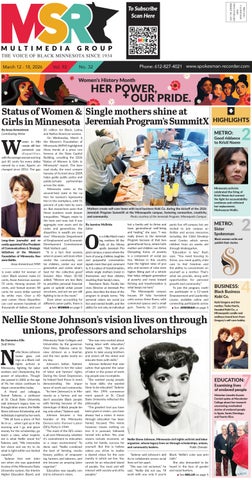
Mothers create self-care items with local business Kobi Co. during the kickoff of the 2026 Jeremiah Program SummitX at the Minneapolis campus, fostering connection, creativity, and community. Photo courtesy of the Jeremiah Program, Minneapolis Campus By Jasmine McBride Editor n a chilly March morning, mothers fill the halls of the Minneapolis Jeremiah Program campus, a space where the hum of young children, laughter, and purposeful conversation signals more than just community. It is a place of transformation, where single mothers invest in themselves and their children, rewriting their family’s story. Raevhann Rush, Family Services Director at Jeremiah Program, describes the draw of the program in simple terms: “My personal values are social justice and mental health, and the ability for not only an individual
but a family unit to thrive and have generational well-being and healing,” she says. “I was really drawn to the Jeremiah Program because of that twogenerational focus, where both mother and children can thrive. Disrupting forms of poverty is a component of social justice. Women in this country have the highest rates of poverty, and women of color even higher. Being part of a vehicle that helps mitigate generational poverty and move toward thriving and transformation is what keeps me here.” The Minneapolis campus houses 39 fully furnished units across three floors, with communal spaces and a small gym. Twenty to 25 partici-
pants live off-campus but are invited to join campus activities and access resources, including the Child Development Center, which serves children from six weeks old through kindergarten. “Education is key,” Rush says. “You need housing to thrive, you need quality child care to feel freedom and the ability to concentrate on yourself as a mother. That’s what we provide, along with opportunities for personal growth and community.” To join the program, mothers participate in a 12-week Empowerment and Leadership course, available online and connecting participants across ■ See JEREMIAH on page 5
Nellie Stone Johnson’s vision lives on through unions, professors and scholarships By Damenica Ellis Staff Writer ellie Stone Johnson broke glass ceilings as a Black civil rights activist in Minnesota, fighting for labor workers and championing the power of education. Though she passed in 2002 at the age of 96, her vision continues to shape communities today. A friend and colleague, Tamrat Tademe, a professor at St. Cloud State University, said Johnson’s legacy lives on through labor unions, the Nellie Stone Johnson Scholarship, and individuals inspired by her work. “We all have a piece of Nellie in us … when I get up in the morning and I go and place money for the scholarship, go teach a class, what inspires me is what Nellie stood for,” Tademe said. “We internalize her vision and we try to do what is right within our limited capacity.” Tademe first met Johnson when she was appointed trustee of the Minnesota State University system, the Interim Higher Education Board, and
“She was very excited about Minnesota State Colleges and Universities by the governor. fusing labor with education,” Over time, Tademe came to Tademe said. “She built proview Johnson as a teacher, grams to take young brothers and the two spoke nearly ev- and sisters off the street and educate them with skills.” ery day. Johnson believed that eduJohnson’s father, Tademe said, instilled in her the value cation that ignored the value of labor and farmers’ rights. of labor or the power of workDuring the Great Depression, ing people was incomplete. “She wanted young people he helped feed those in need, demonstrating the impor- to have skills; she wanted tance of work and community. them to be educated,” Tademe “So here [Johnson] is in Min- said. Her 1995 commencenesota as a farmer, and we ment speech at St. Cloud don’t associate Black people State University reflected this with farming because of the philosophy: “The greatest tool you have stereotype of Black people bebeen given is vision…you have ing only urban,” Tademe said. Johnson became a key always had a vision. A vision founder of the Minnesota through education has been Democratic-Farmer-Labor honed, focused. This vision, however, means nothing un(DFL) Party in 1944. “The mark of the DFL vision less it is pursued, followed, is all over Minnesota, whether turned into action. Yes, your it’s commitment to education visions include economic seor a clean environment,” Ta- curity for family, success for deme said. “Nellie combined yourself. But this is hollow the best of farming, revolu- unless you strive to realize tionary politics of empower- a shared vision for the coming farmers and laborers, and munity in which we live. You she became an amazing labor cannot be an educated island of people. You must and will organizer.” Education was equally cen- interact with society and all its peoples.” tral to Johnson’s vision.
2
Minnesota activists celebrated the firing of Kristi Noem but warned the fight for accountability continues and criticized her replacement, Markwayne Mullin.
METRO:
Sister Spokesman
2
Black women write and publish their stories
BUSINESS:
Black Business Kobi Co.
4
Kobi Gregory and her mother, Tasha Harris, founded Kobi Co., a Minneapolis candle and wellness brand born from Gregory’s self-care hobby.
7
EDUCATION:
Examining lives of enslaved people
Historian Lissette Acosta Corniel spoke at Macalester College about her research uncovering overlooked stories of enslaved people in Spain, Santo Domingo, and Puerto Rico.
Nellie Stone Johnson, Minnesota civil rights activist and labor organizer, whose legacy lives on through scholarships, unions, and community leaders. Public Domain Tademe said Johnson’s ability to collaborate across racial lines set her apart. “She was not sectarian,” he said. “Nellie did not say, ‘I’ll work with you only if you’re
Black.’ Nellie’s color was principle.” She also demanded to be heard in the face of gender and racial barriers. ■ See NELLIE on page 5