PRST STD U.S.POSTAGE PAID TWIN CITIES MN PERMIT NO. 6391
To Subscribe Scan Here
THE VOICE OF BLACK MINNESOTA SINCE 1934 August 13 - 19, 2026
Vol. 93
Phone: 612-827-4021 www.spokesman-recorder.com
No. 2
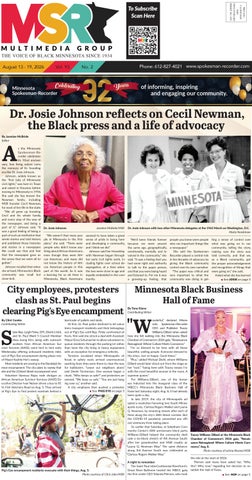
Dr. Josie Johnson reflects on Cecil Newman, the Black press and a life of advocacy By Jasmine McBride Editor s the Minnesota Spokesman-Recorder celebrates its 92nd anniversary, few living voices carry the memory of its founding era like Dr. Josie Johnson. Johnson, widely known as the “first lady of Minnesota civil rights,” was born in Texas and raised in Houston before moving to Minnesota in 1956. She said she has known the Newman family, including MSR founder Cecil Newman, for most of her life in the state. “We all grew up knowing Cecil and his whole family, and every step of the way of the newspaper, and being a part of it,” Johnson said. “It was a good feeling of being a part of such an institution that wrote stories and told history and published those histories and stories in a newspaper. We could see that and feel that the newspaper gave us the sense that we were all together.” Johnson recalled that when she arrived, Minnesota’s Black community was small but close-knit.
Dr. Josie Johnson “We weren’t that many people in Minnesota in the first place,” she said. “There were people who didn’t know anything about African Americans, even though they were African American, and many did not know the history of African American people in this part of the world. So it was a learning for us all. Here in Minnesota, Black Americans
Jasmine McBride/MSR seemed to have taken a great sense of pride in being here and developing a community, and I think we did.” Johnson said her friendship with Newman began through her early civil rights work, including fights over school desegregation, at a time when the two were close in age and equally embedded in the community.
City employees, protesters clash as St. Paul begins clearing Pig’s Eye encampment By Clint Combs Contributing Writer tate Rep. Leigh Finke, DFL-District 66A, and St. Paul Ward 5 Council Member Hwa Jeong Kim, along with outreach workers from African American Survivor Services (AASS), went tent to tent early Wednesday offering unhoused residents rides out of Pig’s Eye encampment during phase one of Mayor Kaohly Her’s sweep. Most residents are moving to the Randolph Avenue encampment. The city plans to sweep that site and the L’Orient Street encampment next. Volunteer Vanessa Rojas rode shotgun as African American Survivor Services (AASS) Executive Director Ivan Nelson drove a bus to 81 N. Fish Hatchery Road on Aug. 5. They arrived at Pig’s Eye to find protest marshals behind a
barricade of pallets and skids. At first, St. Paul police declined to let volunteers transport residents and their belongings out of Pig’s Eye until Rep. Finke confronted officers. Kim said she struck a deal with Assistant Mayor Erica Schumacher to allow volunteers to queue residents through the parking lot rather than have the city bring in heavy equipment, with an exception for emergency vehicles. Tensions escalated when Minneapolis officials in safety vests arrived unannounced, sparking fears they were there to clear the way for bulldozers. “Leave our neighbors alone,” said Derek Torstenson. One woman began a chant, “Who keeps us safe?” and protesters answered, “We keep us safe.” “You are just barging over us,” another said. A city employee then pushed a protester. ■ See PIGS EYE on page 5
Pig’s Eye encampment residents evacuate with their things, Aug. 5. Photo courtesy of Chris Juhn/MSR
Dr. Josie Johnson with two other Minnesota delegates at the 1963 March on Washington, D.C. Marty Nordstrom “We’d been friends forever because we were around the same age, geographically, emotionally, mentally, and involved in the community,” she said. “It was a feeling that you had some right and authority to talk to the paper person, and that you were being heard and listened to. For me it was a growing-up feeling, that
people you knew were people who ran important things like a newspaper.” She said the SpokesmanRecorder played a central role in her decades of advocacy by giving the Black community control over its own narrative. “The paper was critical and very important to what the community was doing in get-
ting a sense of control over what was going on in our community, telling the story, making sure the story was told correctly, and that we, as a Black community, got the proper acknowledgement and recognition of things that were going on,” she said. Asked what she has learned ■ See JOSIE on page 5
Minnesota Black Business Hall of Fame By Tony Kiene Contributing Writer onderful,” declared Minnesota Spokesman-Recorder CEO and Publisher Tracey Williams-Dillard when asked how she felt walking into the Minnesota Black Chamber of Commerce’s 2026 gala, “Renaissance Reimagined: Where Culture Meets Commerce.” “I’m so blessed to be here with all these beautiful, smiling people. Everyone dressed to the nines. Just so happy. Good times.” “Plus,” added Michael Diehl, whom WilliamsDillard would later shout out from the stage as her “rock,” “being here with Tracey means I’m with the most beautiful woman in the room. A supreme queen.” For Williams-Dillard, one of the honorees inducted into the inaugural class of the MBCC’s Minnesota Black Business Hall of Fame last Saturday night, Aug. 8, it had already been quite a day. In late 2019, the city of Minneapolis adopted a resolution honoring two South Minneapolis icons, Clarissa Rogers Walker and Launa Q. Newman, by renaming streets after each of them along the city’s 38th Street corridor. But the COVID-19 pandemic prevented any official ceremony from taking place. So earlier that Saturday, at Sabathani Community Center’s 60th anniversary block party, Williams-Dillard helped the community dedicate a six-block stretch of 4th Avenue South after her grandmother and MSR royalty as “Launa Q. Newman Way.” The same distance along 3rd Avenue South was celebrated as “Clarissa Rogers Walker Way.”
Tracey Williams Dillard at the Minnesota Black Chamber of Commerce’s 2026 gala, “Renaissance Reimagined: Where Culture Meets Commerce,” Aug. 8. Photo courtesy of Leticia Alvarez/MSR
the role at the start of 2026. Pierson said many have asked her, “Why A night to remember this? Why now,” regarding her decision to esThe Saint Paul InterContinental Riverfront’s tablish the Hall of Fame. Great River Ballroom hosted the MBCC gala, the first under CEO Yolanda Pierson, who took ■ See HOF on page 5