tivist Nekima Levy Armstrong and organizer Satara Strong-Allen, were unknowingly under constant surveillance as federal agents circled an undisclosed hotel in the early hours of Tuesday, Jan. 20. Despite hotel staff asking the agents to leave, they lingered in the lobby.
Around 3 a.m. the agents misidentified Strong-Allen as Armstrong and tackled her. Armstrong, who wanted to turn herself in, did not know where to go. “No one in Minnesota knew about the case because it was being handled in Washington, D.C., by political operatives,” said Armstrong’s attorney, Jordan Kushner.
Eight people were charged, and at least four — Armstrong, St. Paul School Board Member Chauntyl Allen, activist William Kelly, and Monique Cullars Doty — were arrested on Jan. 22 in connection with a protest at Cities Church in St. Paul, Attorney General Pam Bondi announced on social media with AI-generated photos.
“This is not a legitimate prosecution. This is political persecution,” Kushner said.
Armstrong, Allen and Kelly
were booked into Sherburne County Jail on Thursday night.
A judge ordered their release Friday, calling the Justice Department’s evidence “simply speculative.”
Civil rights activists called for St. Paul ICE Field Director David Easterwood to resign as
pastor of Cities Church during a press conference in downtown Minneapolis on the eve of Martin Luther King Jr. Day. Easterwood did not appear when Armstrong, an ordained minister, arrived at the church with a dozen activists and two
agents snatching children from their schools
By Izzy Canizares
Contributing Writer
utrage over the presence of Immigration and Customs Enforcement (ICE) officers in Minneapolis has intensified after multiple minors, including a five-yearold boy, were detained by ICE agents over the past two weeks.
As President Trump’s administration and the Department of Homeland Security attempt to justify the recent detainments, commu-
nity members in Minnesota and across the country are condemning the actions and warning of the lasting harm being inflicted on children in Minneapolis.
On Jan. 20, preschooler Liam Conejo Ramos was detained by ICE agents in the driveway of his Minneapolis home, allegedly used as “bait” to draw his family outside, according to Zena Stenvik, superintendent of the Columbia Heights Public Schools. The five-year-old and his father were taken into custody and quickly transferred to an ICE
detention facility in Texas.
“Another adult living in the home was outside and begged the agents to allow them to care for the small child, but that request was refused,” Stenvik said the following day during a press conference.
Ramos’ detention sparked nationwide outrage, and he is not the only minor taken into custody in recent weeks. Stenvik said at least four additional students in her district have been detained by ICE, some reportedly taken directly from their schools.
“The onslaught of ICE activity in our community is inducing trauma and taking a toll on our families, our staff, and our community members,” Stenvik told reporters Thursday. “The young boy Liam and his father, who were taken yesterday, have documentation. I saw it with my own eyes when I visited the home.”
The response from families and educators across the Twin Cities metro area reflects a broader reckoning with the impact of ICE operations on children and schools.
“I am angry, I am scared, and I am devastated by what we are doing to our babies,” said Amanda Otero, co-executive director of Take Action Minnesota, at a press conference earlier this month. “Places
Feds arrest Mpls activists for church protest U.S. AG Bondi threatens “more will come’
By Izzy Canizares Contributing Writer
inneapolis community leaders and residents rallied at the federal courthouse in downtown Minneapolis the morning of Jan. 22 in support of local activists arrested by the FBI for their alleged involvement in a St. Paul church protest that has drawn national attention.
Civil rights attorney Nekima Levy Armstrong and activist Chauntyll Allen were arrested by federal law enforcement earlier that morning and are currently being held in connection with a protest at Cities Church. The demonstration took place after it was revealed that the church’s pastor also serves as Minnesota’s Immigration and Customs Enforcement (ICE) director. Activist William Kelly was also arrested for his role in the protest but is being tried at a separate courthouse.
U.S. Attorney General Pam Bondi acknowledged the arrests in a post on X, writing that “more will come.” Homeland Security Secretary Kristi Noem also shared multiple photos of the three activists in custody saying they would be
charged with “federal crimes” and asserting that
“there is no First Amendment right to obstruct someone from practicing their religion.”
The arrests prompted immediate backlash from elected officials and community
members. Minneapolis Mayor Jacob Frey publicly called for Armstrong’s release.
“I’m 61 years old, and it feels like everything is going backward,” said community member Michael Palmer, a
See ARREST on page 5
ICE memo on warrantless home entry called ‘unlawful, morally repugnant’
By Jasmine McBride Editor
n internal Immigration and Customs Enforcement memo asserting that agents may enter private homes using only administrative warrants has alarmed civil rights attorneys, lawmakers, and immigrant advocates, who warn the guidance could violate long-standing constitutional protections and escalate fear in immigrant communities.
The memo, dated May 12 and signed by ICE Acting Director Todd Lyons, directs officers that residential arrests of people with final orders of removal may proceed without warrants signed by a judge, a sharp departure from traditional Fourth Amendment practice.
The implications of the guidance are not theoretical.
A Minneapolis federal judge ruled that immigration agents violated a Liberian man’s constitutional rights by forcibly entering his home without a judicial warrant and ordered his release. In that case, agents used only an administrative warrant, signed by ICE officials rather than a judge, to break down the door of the North Minneapolis home. U.S.
ICE guidance asserting that agents may enter private homes without a judicial warrant has drawn constitutional objections from legal experts and immigrant advocates. Motion Law
District Judge Jeffrey Bryan wrote that agents “forcibly entered … without consent and without a judicial warrant,” and that the arrest violated the Fourth Amendment.
“This is a blatant constitutional violation,” said Gibson’s attorney, Marc Prokosch, after the ruling in federal court describing how enforcement unfolded in the Minneapolis raid.
The ICE guidance marks a departure from decades of law enforcement practice.
Traditionally, administrative warrants, known formally as Form I-205, authorize only an arrest and do not permit forcible entry into a private residence without consent or
specific judicial authorization. Advocacy groups and legal aid organizations have long advised immigrant communities that they should refuse entry to ICE agents who do not present a court-signed warrant.
Fred Tsao, senior policy counsel at the Illinois Coalition for Immigrant and Refugee Rights, said it remains constitutionally troubling that the memo appears to assert authority for warrantless home entry. “The Fourth Amendment protects everyone residing in the U.S. from illegal searches and seizures, regardless of their status,”
■ See MEMO
Civil rights attorney Nekima Levy Armstrong speaks to reporters as the Minneapolis City Council discusses a federal consent decree on Jan. 6, 2024. Armstrong was later arrested by federal agents following a protest at a St. Paul church. Ben Hovland/MPR News
Marquise Armstrong, husband of civil rights attorney Nekima Levy Armstrong, speaks outside the federal courthouse in St. Paul following her arrest, Jan. 22. Izzy Canizares/MSR
Valley View Elementary School student Liam Conejo Ramos as he is detained Tuesday, Jan. 20, by ICE agents Ali Daniels/ courtesy of Columbia Heights school officials
ICE surge rekindles trauma at George Floyd Square
By Izzy Canizares Contributing Writer
Since the Jan. 7 shooting that killed Renee Good, the increased presence of immigration enforcement officers across Minnesota has left many communities shaken.
The shooting occurred just six blocks from where George Floyd was murdered in 2020, and for residents and business owners in George Floyd Square, the proximity has reopened deep wounds and revived unresolved trauma.
“It brought back memories. We thought there was going to be a riot, that the city was going to burn again,” said Richard, an employee at the Giant Express Laundromat in George Floyd Square. Richard, who has worked at the laundromat for eight years, said Good’s shooting came as a shock.
“It was shocking because this is what we talk about amongst ourselves. When a white woman gets shot, that lets you know times are changing.”
For many in the area, Good’s killing has produced a sense of déjà vu, particularly as the attorneys who led George Floyd’s case are now representing Good’s family.
George Floyd Square, which has been rebuilding since the unrest following Floyd’s mur-
der, sits just minutes from the site of the shooting. Workers and residents report frequent ICE sightings since then, heightening fear in a neighborhood already carrying the weight of collective trauma.
“I’ve had a lot of conversations with people who were out here during the George Floyd uprising, and I’m hearing more about collective trauma, and about never really having healed from what they experienced back then,” said Valerie Quintana, executive editor of “The Real Minneapolis.”
“When people live with collective trauma, they can never really breathe. It’s constant discomfort, fear, and jumpiness. I haven’t talked to many people who aren’t infuriated,” said Quintana.
“As
Founded in May 2020, “The Real Minneapolis” provides weekly meals and employment opportunities to unhoused residents and frequently operates out of George Floyd Square.
Quintana said that despite her anger and fear surrounding the current ICE presence, she remains committed to continu-
ing mutual aid efforts in the community.
For community leader and MN Agape Movement cofounder Marquise Bowie, Good’s death is tragic, but not surprising.
“There are no winners in this situation,” Bowie said. “As a person of color who has lived here my whole life, not a lot has changed since Floyd’s murder. These things have been happening forever. The only difference now is that a white woman got killed.”
The MN Agape Movement works to build safer communities by providing resources related to housing, educa-
‘There is power in these pies’ It’s the power to connect, unify, honor and inspire
By Damenica Ellis
Contributing Writer
Sweet Potato Comfort Pie
held its 11th annual Dr. Martin Luther King Jr. Holiday of Service over the commemorative weekend, bringing together community members for reflection, service, and, of course, sweet potato pie.
As snow fell outside, volunteers, students, visitors and award recipients filled the Country Club at Golden Valley, welcomed by a performance from Soul Drum Academy. Each table was set with sweet potato pie and surrounded by a photo exhibit highlighting community and connection. Each pie featured a letter written by Harold and Mickey Smith Jewish Academy students.
love, home and resilience, said Niila Hebert, chair of Sweet Potato Comfort Pie’s board.
“It represents the labor of hands that have tilled the soil and the warmth of kitchens that have served as sanctuaries,” Hebert said. “Baking and gifting pies to members of our community demonstrates our commitment to what Dr. King called the beloved community.
We are saying, ‘We see you. Your struggle is mine, and your joy is mine.’”
The afternoon featured a range of performances and activities. Golden Valley Mayor Rosalyn Harmon opened the program with a moment of silence honoring Renee Good and others lost to injustice.
“Although we are here to be celebratory, remembering
“We consider Sweet Potato Comfort Pie to be a catalyst for building and caring for the community,” said Rose McGee, who founded the nonprofit in 2014. With 97 pies symbolizing the age King would have turned, the event also marked the 40th anniversary of the federal MLK holiday.
“There is power, we believe, in these pies,” McGee said. “But there’s even greater power in unity when people of likeness come together.”
Sweet potato pie sits at the center of the organization’s mission and Sunday’s event because of its deep roots in African American culture as a symbol of
the injustices and celebrating all that we have been through with the Civil Rights Movement, we recognize that we are still going through it,” Harmon said.
“Baking and gifting pies to members of our community demonstrates our commitment to what Dr. King called the beloved community.”
Black national anthem. Spoken word, singing, dance, awards and conversation followed.
In addition to the pie served at each table, guests were given an extra pie and asked to collectively decide who in the community should receive it. Some chose to gift their pie to someone in the room, while others planned to deliver it to neighbors or community members.
Several awards were presented during the program.
Winners of the City of Golden Valley’s MLK Contest included 5-year-old Malikai Goens and Nelson Queitzsch for artwork, and siblings Steven, Rita and Owen Ruzicka for poetry. Students were asked to reflect King’s values, including courage and compassion, in their submissions.
The Batter That Matters Award, honoring individuals who embody service as a way of life, was presented to Tamuriel Grace, education influencer; Jackie Trotter, legacy educator; Jawad Towns Jr., youth in action; King Arthur Baking Company, baking a difference; Annie Anderson, legacy educator; and Angela Davis, voice with impact.
“Their actions remind us that what we pour into our communities truly shapes what rises,” said Ashlee Deleon, project manager for Sweet Potato Comfort Pie. “These recipients are steady hands, trusted hearts, and intentional leaders who understand that transformation happens when care, commitment and community are mixed with purpose.”
Another honor, the Upholding Our Beloved Community Award, recognized Anthony Galloway, Omar McMillan, the Minnesota Spokesman-Recorder, Shirley Purvis, the city of Golden Valley, Normandale Lutheran Church, the University of Minnesota Liberal Arts Engagement Hub, and Westopolis.
“Dr. King spoke of the beloved community as a vision rooted in justice, equity, compassion and collective responsibility,” Deleon said. “We don’t
tion, mental health and employment. Through that work, Bowie says George Floyd Square has continued to experience what he describes as “tragedy tourism” since 2020. While some visitors arrive with good intentions, he fears the recent shooting will further fuel the phenomenon as national media and out-oftown observers descend on Minneapolis. “I don’t see a lot of real change,” Bowie said.
“I saw a lot of people show up during Covid, and once the cameras and the glitz and glamour left, so did they. Now more than ever we have to
see it as an abstract idea but as something we actively build through relationships and love in action.”
“These honorees show us that community is not just something we belong to, it is some-
work on our humanity. We need to work together, for everybody.”
Ini Augustine, owner of Mystic Healing Stones, said the recent ICE escalation has triggered PTSD flashbacks and negatively impacted her business. Augustine, who opened her shop last February, grew up in South Minneapolis and has witnessed the neighborhood’s cycles of unrest firsthand.
“I feel like a battered wife. I feel like we are being abused wholesale by a crazed man who’s angry about our governor daring to run against him,” Augustine said. “It’s been re-
thing we protect, cultivate, and pass forward,” she added.
For organizers, the gathering extended beyond celebration.
“It’s about mutuality,” Hebert said. “We’re not just here to give time or remembrance. We’re here to
ally difficult. The protests have been nonstop, and it doesn’t put you in a shopping mood when you feel like your way of life is under attack.”
Despite the unrest, Augustine has kept her shop open, grounding her decision in a commitment to community healing. “It’s incomprehensible. It’s a betrayal of everything we were raised to believe as Americans, and it’s happening right in front of us,” she said.
“I’m not a protester. But if I can create a space where people can find healing and a little peace in this chaos, then that’s what I’m going to do.”
Protests against ICE operations have intensified over the past week, with hundreds taking to the streets and confronting federal agents, often met with flashbangs and chemical irritants.
“The spirit of the people in Minneapolis is just different,” Quintana said. “The courage and strength of the youth is unbelievable. Seeing 17- and 18-year-olds who are deeply informed about the political climate and willing to stand up, it’s incredible. I’m just very, very proud of them.”
Izzy Canizares is a freelance journalist and contributing writer for the Minnesota Spokesman-Recorder.
connect. We’re breaking down walls and building bridges.”
Damenica Ellis is a freelance journalist and contributing writer for the Minnesota Spokesman-Recorder.
a person of color who has lived here my whole life, not a lot has changed since Floyd’s murder.”
George Floyd Square on Tuesday, Jan. 14, where residents and business owners say recent ICE activity has reopened trauma tied to the 2020 murder of George Floyd. Izzy Canizares/MSR
Following a land acknowledgment recognizing the Dakota people, saxophonist Jerome Richardson performed the
A few of the 97 pies given to community members who gathered in Golden Valley for Sweet Potato Comfort Pie’s 11th annual Dr. Martin Luther King Jr. Holiday of Service Damenica Ellis/MSR
In Minnesota, we know how to WINter. Remote starters. Warm drinks. Scratch games from the Minnesota Lottery. Grab some today to get the most out of the season.
By Lizzy Nyoike Contributing Writer
Minnesota Department of Corrections (DOC) officials are pushing back against claims made by the U.S. Department of Homeland Security (DHS), which allege that the state has failed to honor Immigration and Customs Enforcement (ICE) detainers. The dispute follows accusations from the Trump administration that Minnesota Gov. Tim Walz and Minneapolis Mayor Jacob Frey have been “actively organizing” resistance to ICE operations.
The response comes after recent DHS statements asserting that Minnesota is currently holding 1,360 non-U.S. citizens in state custody, including individuals described as “violent criminal illegal aliens,” and that nearly 470 people without legal immigration status have been released back into communities since President Donald Trump took office. State corrections officials say those claims misrepresent both how Minnesota’s prison system operates and who is actually in its custody.
In a press release, the Minnesota Department of Corrections disputed the DHS statements, saying they do
not align with department records or with the structure of the state’s correctional system. According to DOC data, Minnesota’s total state prison population is approximately 8,000 individuals. Of those, 207, less than 3%, are nonU.S. citizens.
In 2025, the DOC released 84 individuals who had ICE detainers. In each instance, corrections officials say ICE was notified in advance and department staff coordinated with federal authorities to facilitate custody transfers when requested.
Corrections officials argue that DHS’s public claims are misleading because they blur the distinction between state prisons, county jails, and federal immigration custody systems, each of which operates under different authorities.
The Minnesota DOC oversees state prisons, which house individuals convicted of felony offenses and sentenced to more than one year. The department does not have jurisdiction over county jails, which are run by local sheriffs and typically hold individuals serving short-term sentences or awaiting trial.
Officials said many of the individuals cited by DHS and
Metro
“When
referenced in media reporting as examples of people allegedly “released” from custody were never housed in state prison. Instead, they were held in county jails, under ICEonly custody, or in correctional systems operated by other states.
Minnesota law requires the DOC to notify ICE when an individual in DOC custody is not a U.S. citizen, a requirement corrections officials say the department complies with.
ICE then issues a detainer and is responsible for arranging pickup once the individual is released from state custody.
“The Minnesota Department of Corrections has always coordinated with ICE agents when individuals in our custody have detainers and will continue to do so,” said DOC Commissioner Paul Schnell. “Public safety depends on facts, not fear. When federal agencies make claims that are demonstrably
Turning survival into service
By Jasmine McBride Editor
Tameeka Russell was 14 years old when the state stepped into her life. By then, instability had been her norm. She had experienced homelessness, family substance abuse, and frequent displacement, moving between unsafe environments with little protection or consistency. This proved only the beginning of the obstacles she would overcome to discover the work she was meant to do.
Russell entered foster care after severe abuse within her family, abuse she said was not initially believed when she reported it. She became pregnant as a teenager as a result of that abuse, a reality that further exposed the instability and failure of the adults meant to protect her.
The state intervened only after her son was born, placing Russell and her child into foster care together. That decision, she said, saved both of their lives.
For the first time, Russell experienced stability. She and her infant son were taken in by a foster parent who provided safety, structure and encouragement at a moment when Russell’s future felt uncertain.
“She completely changed the trajectory of my life,” Russell said. “She didn’t just tell me I mattered. She showed me.”
Until then, Russell had nev-
er been told she had potential. When her foster mother used the word casually in conversation, Russell did not even know what it meant.
and graduated high school on time despite being significantly behind when she entered foster care. She enrolled at Saint Paul College, later trans-
came turning points.
In 2016, Russell left Minnesota for Southern Illinois, seeking space to heal and distance from environments tied to trauma. There, she worked in corrections, first as a substance abuse counselor and later as a correctional officer.
“What I saw inside the system stayed with me,” Russell said. “It didn’t make sense, and I knew I wanted to be part of changing it.”
She enrolled in law school while working full time and raising her children independently. During her studies, she interned with a public defender’s office before finding her calling through a juvenile justice clinic focused on child welfare.
“That’s where I knew,” she said. “This was the work I was meant to do.”
Russell graduated from law school in 2023 and began working in child welfare, eventually becoming a foster care supervisor. The work was deeply meaningful but emotionally demanding. After returning to Minnesota in 2024, logistical challenges and burnout forced another difficult decision.
REUTERS/Tim Evans
false, it undermines trust and disrespects the dedicated professionals who work every day to keep Minnesotans safe.”
Corrections officials said the department reviewed cases cited by DHS and found that many involved individuals who were never under DOC authority. In some cases, officials said, individuals were already in state prison custody when ICE requested transfers.
The dispute comes amid a heightened political climate
center, emergency shelter, and residential facility designed to serve youth from birth to age 17. Her vision includes trauma-informed care, stability, education, and long-term residential support for children navigating foster care involvement and housing instability.
Russell plans to locate the facility in Hennepin County, where youth homelessness remains a growing concern. She is currently studying
“But once she explained it,” Russell said, “something clicked. I realized I didn’t have to become what I came from. I could create something different.”
Russell caught up academically, earned strong grades,
ferring to Hamline University, all while raising her son. Her life was not without setbacks. A failed marriage and a house fire that destroyed nearly everything she owned could have stalled her progress. Instead, they be-
Rather than viewing it as a setback, Russell saw it as confirmation. “I didn’t survive everything I went through for nothing,” she said. “It was time to build what I wish had existed for me.”
She founded Inspirations for Aspirations LLC, a developing juvenile rehabilitation
for the Minnesota bar exam, which she plans to take in 2026, while raising funds, securing licensing, and finalizing operational plans.
“Eagles don’t avoid storms,” Russell said. “They use them to rise higher. That’s what I
surrounding immigration enforcement, with federal officials criticizing state and local leaders in Minnesota for what they describe as “resistance to ICE operations.” DHS statements have framed Minnesota as failing to cooperate with federal immigration enforcement efforts.
Beyond rejecting the federal claims, the Minnesota DOC characterized DHS’s public statements as “categorically false, unsupported by facts, and deeply irresponsible.” Officials reiterated that the department honors all federal and local detainers, including those issued by ICE.
The DOC also said DHS has not identified which jurisdictions, correctional systems, or timeframes were used to produce its claims.
Officials emphasized that the figures released by DHS do not align with DOC records or Minnesota’s prison system, reiterating that the department’s jurisdiction is limited to individuals in state prison custody and does not extend to county jails or federal immigration detention facilities.
Lizzy Nyoike is a Hubbard School of Journalism & Mass Communication student.
want these kids to learn.” Her motivation is deeply personal. Her oldest son, once considered medically fragile as an infant, is now 22 years old and pursuing creative and faith-based work. Her daughters, ages 16 and 10, are growing up in a home grounded in stability Russell never had as a child.
Russell remains estranged from her biological parents, a boundary she says is necessary for her own well-being and that of her children. The woman she calls her true mother is the foster parent who took her in as a teenager.
“She showed me what love looks like through action,” Russell said. “Everything I’m building comes from that example.”
Russell acknowledges that the road ahead will not be easy. The need is vast, the resources limited, and the work emotionally heavy. Still, she is unwavering in her commitment.
“If we do not intervene,” she said, “these children will carry instability for a lifetime. I refuse to accept that.”
For Russell, the work is not charity. It is responsibility.
“Someone stood in the gap for me,” she said. “Now it’s my turn.” For more information, contact Inspirationsforaspirationsllc@gmail.com. Russell is also raising funds to support her business. If you would like to donate, visit https://gofund. me/05b382d4b.
Jasmine McBride welcomes reader responses at jmcbride@ spokesman-recorder.com.
Tameeka Russell (left) during graduation at Southern University Illinois (SIU) Simmons Law School Courtesy
Continued from page 1
journalists.
“Dear Lord, we pray as part of this prayer that you will chasten us and that you will help us to get our house in order,” Pastor Jonathan Parnell said to his City Church congregation.
Armstrong pressed Parnell: “Well, help me understand, how is David Easterwood both a pastor and an ICE agent?”
Protests had erupted following the shooting of Renée Good by ICE agent Jonathon Ross, with activists demanding an investigation into the killing. Six prosecutors from the U.S. Attorney’s Office for the District of Minnesota
Continued from page 1
longtime friend of Armstrong, who became emotional while speaking to reporters. “I read about this in the ’50s and ’60s, and now it’s like we’re reliving it. [Armstrong and Allen] always showed up for us… always. Now it’s time for us to show up for them.”
Community activist Rosemary Nevils echoed those sentiments, urging supporters to remain visible. “People need to know there is power in numbers,” Nevils said. “It’s important people show up early, by the thousands, to let them know nobody is fearful.” Nevils, who is close to both women, said Armstrong called her the night before the arrest and sounded “distressed.” “Nobody is running away,” she added. “We’re going to get justice in this city.”
resigned in protest after the Justice Department refused to launch a probe. Protesters chanted: “Justice for who? Renée Good!”
“ICE should have no business in churches, schools, clinics, or hospitals.”
Former CNN anchor Don Lemon and Black Press journalist Georgia Fort had no advance knowledge of the church demonstration. They responded to a graphic circulated online reading: “ICEOUT Action in honor of Dr. Martin Luther King, Jr. Memorial Weekend #OPER-
ATIONPULLUP.”
“This is unacceptable,” Parnell told Lemon, criticizing the interruption of a worship service. Lemon, citing First Amendment protections, continued interviewing activists and church members.
“He looked like a deer caught in the headlights,” Armstrong said of Pastor Parnell. She clarified that Toussaint Morrison and Michelle Gross were not part of the demonstration.
Morrison criticized the use of churches for federal enforcement. Gross added, “ICE should have no business in churches, schools, clinics, or hospitals,” and called attention to what she said were inconsistencies in federal investigations of religious-targeted violence.
Minneapolis City Council
Members Soren Stevenson and Robin Wonsley condemned what they described as a retribution campaign by the Trump administration. “This is fascism showing up in our communities. They are taking people for political speech. It’s totally wrong. It’s totally unAmerican,” Stevenson said.
Wonsley described Armstrong as “a consistent civil rights champion” and said the arrests demonstrate “the escalation of intimidation tactics … now picking up political prisoners.”
Activists highlighted a double standard: The DOJ prosecuted church protesters while federal agents operate inside religious sites with minimal oversight. Kelly, who attended the demonstration, dared the Justice
torney Jordan Kushner, who represents Armstrong, said the woman was released after agents realized the error and confirmed she is safe.
“This is not a legitimate prosecution. This is political persecution,” Kushner said during a press conference outside the courthouse. “I’ve been practicing law for 34 and a half years. I’ve seen unjust prosecutions, but nothing on the scale of what we’re seeing here.”
Armstrong and Allen appeared for their first court hearings that Thursday morning. A judge initially ruled to dismiss specific charges and ordered their release. However, the Department of Justice filed an appeal, and the case was reassigned to a new judge.
Department to pursue charges. “Pam Bondi, you want to come and arrest me. You want to give me charges,” he said.
Easterwood defended agents’ use of chemical irritants at earlier protests in a Jan. 5 court filing, asserting officers faced heightened threats. Kelly and Armstrong described receiving numerous death threats following the demonstration.
Armstrong recounted a threatening email implying the shooting of Renée Good was justified: “You’re very lucky I wasn’t in church when you idiots came in. Good deserves what she got, and you would have gotten the same dumb b****.”
Other incidents cited by activists included the death
activists’ release. The warrants did not clearly outline specific charges and included several redacted names. Kushner said the documents referenced journalist Don Lemon in connection to his coverage of the Cities Church protest, language the judge ultimately refused to approve.
of Victor Manuel Diaz while in ICE custody and the coma of Fadumo Cusman Mohamed at HCMC after being detained. One family reported a sixmonth-old was hospitalized after federal agents threw a teargas canister under their SUV. “Their proceedings went on a recess because the opposition didn’t have a warrant present when they took them,” said Angel Smith-El. “Now they’re trying to gather up the warrant quickly so they can proceed.”
As of this writing, activists said they were unsure whether other demonstrators had been detained.
Clint Combs welcomes reader responses at combs0284@ gmail.com. other community.
are the same people Nekima and Chauntyll would show up for,” said community activist Touissant Morisson at the press conference. “If they took any of us this morning, Nekima would be here by the next hour. We’re here because they would be here for us.”
“I’ve seen unjust prosecutions, but nothing on the scale of what we’re seeing here.”
According to Armstrong’s husband Marquise, both women were taken from the A Lofts Hotel early Thursday morning after federal agents entered through the back of the building. “We’ve received so many phone calls and messages filled with love and support, and I want to say thank you from the bottom of my heart and the top of my feet,” Marquise said.
Continued from page 1
where children should not only be safe, but cared for and nurtured to learn and grow, are being made unsafe.”
“We are witnessing state violence escalate,” Otero added. “It is not abstract. It is not theoretical. It is not something anyone can pretend to ignore. It is deadly, and it is everywhere on our streets.”
Concerns that ICE is deliberately targeting children have intensified following reports this week from Sullivan Elementary School, which
from page 1
Tsao said, adding that relying on administrative warrants without independent judicial review undermines basic constitutional safeguards.
Homeland Security officials have defended the memo’s legal footing. In a written statement attributed to Department of Homeland Security spokeswoman Tricia McLaughlin, the department said that people served with administrative warrants “have already received full due process through immigration court proceedings and a final order of removal.”
McLaughlin argued that officers issuing administrative warrants have found probable cause and cited long-standing
“Please continue to pray for us, but understand, this
warned families about flyers distributed by ICE offering “food support and delivery to families.” School officials cautioned parents not to engage. “For your safety, do not respond to these offers,” the email read. “If your family is in need of support, please contact the school, and we will connect you with one of our school social workers.”
Despite mounting criticism, federal officials have defended their actions. ICE Commander Greg Bovino said during a press conference in Minneapolis on Friday that Ramos’ father entered the United States illegally more than 20 years ago, a claim that
recognition by courts and Congress of administrative warrants in immigration enforcement.
Legal scholars and civil liberties advocates dispute that interpretation, noting that administrative warrants are not equivalent to judicial warrants and have historically not been used to justify home entries absent consent or exigent circumstances. “Administrative warrants do not authorize entry into a private residence without consent,” said Tsao. Sen. Richard Blumenthal (D-Conn.) has spoken publicly about the issue, calling for congressional oversight hearings over the ICE memo and emphasizing that administrative warrants “do not rise to the level of a judicial warrant permitting entry into a home.”
In remarks reported by Forbes, Blumenthal described the
is not our first rodeo. We’ve received threats on our lives since we began this work.”
Attorneys said federal officers had been surveilling the hotel since the night before and mistakenly tackled and arrested an unidentified woman, believing she was Armstrong. Minneapolis civil rights at-
contradicts statements from the family’s attorneys and Stenvik, and emphasized that the father and child were detained together.
One of the central flaws cited by the initial judge was prosecutors’ failure to produce arrest warrants, either at the time of the arrests or during the initial hearing. After the judge granted prosecutors one hour to comply, a heavily redacted warrant was produced. The judge nonetheless continued to demand the
Following the DOJ appeal, a new judge was assigned and is currently reviewing the case. Dozens of supporters remained at the courthouse throughout the day until security officers cleared the lobby, telling both demonstrators and members of the media they had to leave under a U.S. Marshals Service order. Supporters continued to wait across the street for updates on the activists’ status.
“What you’re seeing here
As of Jan 23, both women were ordered to be released by the newly appointed judge, and were let out of Sherburne County Jail. The announcement of the two’s release was made public by the Racial Justice Network, which also showed video of Armstrong’s arrest, where she remains calm while handcuffed and being recorded by the arresting officer’s phones.
Izzy Canizares is a freelance journalist and contributor to the Minnesota Spokesman-Recorder.
“Places where children should not only be safe, but cared for and nurtured to learn and grow, are being made unsafe.”
“That family has not been separated,” Bovino said.
“Many American citizens are separated when they are arrested by the Minneapolis Police Department.
“Take a look at what’s happening here with this par-
policy as “unlawful & morally repugnant” in its conflation of civil enforcement authority with constitutional protections.
Immigrant advocates say confusion and fear are growing in communities that have relied on “know your rights” messaging, guidance that traditionally advised residents to only allow entry if a judgesigned warrant is produced. Legal clinics and community groups report increased calls from residents concerned about early-morning immigration enforcement and whether refusal to open the door might now lead to forced entry.
The Garrison Gibson case in Minnesota has become a focal point of the debate. Video and social media livestreams from the scene showed heavily armed agents using a battering ram on Gibson’s front
ticular case,” he added. “They are not being separated. That child is in the least restrictive setting possible. Border Patrol and ICE are experts in immigration cases involving children, probably the most experienced anywhere in the United States.” While Bovino is correct that detaining children alongside their parents has been a longstanding ICE practice,
door while relatives inside demanded to see a judicial warrant. The judge’s written order noted procedural issues with the arrest and underscored the constitutional violation.
advocates argue that the scale and frequency of family detentions are escalating.
As of the start of this year, an estimated 6,000 family units are currently being held in ICE detention. In 2025 alone, more than 1,300 children were reportedly held for longer than 20 days, exceeding established benchmarks.
As ICE continues operations at schools, grocery stores, and homes across Minneapolis, community members have mobilized to support families who are afraid to leave their houses. Mutual aid efforts have expanded to provide food, transportation, hygiene supplies, and other essential resources.
“Here in Minnesota, we are people who take care of one another,” said Jennifer Arnold, a South Minneapolis mother of a second grader. “I’ve been working with other families at my son’s school to make sure kids can get to school safely and have the food they need.
“I do this work because I believe in my community,” Arnold said. “I want a world where all of our children are safe and can receive the care they deserve.”
Izzy Canizares is a freelance journalist and contributing writer for the Minnesota Spokesman-Recorder.
“The Fourth Amendment protects everyone residing in the U.S. from illegal searches and seizures, regardless of their status.”
Civil rights organizations, including the American Civil Liberties Union and National Immigration Law Center, have said they are preparing legal challenges to confront attempts by ICE to use administrative warrants as the basis for warrantless home entries.
cials have framed aggressive enforcement as necessary for public safety, while advocates counter that such policies disproportionately impact nonviolent individuals and destabilize families.
Immigrant rights groups continue to advise that, under current law, individuals generally have the right to refuse entry to ICE agents who do
The ACLU’s legal team has argued that internal agency guidance cannot override constitutional law. The controversy comes amid a broader expansion of federal immigration enforcement operations in multiple states. Administration offi-
not present a judicial warrant, with narrow exceptions for exigent circumstances that do not appear to be addressed by the memo itself. Attorneys caution that enforcement encounters can be unpredictable and urge residents to seek legal counsel if approached by federal agents. As debate over the memo intensifies, legal experts say courts will ultimately determine whether ICE’s interpretation of its authority can withstand constitutional scrutiny. Until then, advocates warn the policy risks eroding fundamental protections tied to the sanctity of the home and leaving families uncertain about their rights in the face of federal enforcement actions.
Jasmine McBride welcomes reader responses at jmcbride@ spokesman-recorder.com.
Jordan Kushner, attorney for civil rights lawyer Nekima Levy Armstrong, said he has never seen this level of unjust persecution in his 34-year career. Izzy Canizares/MSR
Hundreds of businesses across Minnesota are participating in a statewide general strike Jan. 23, urging residents not to shop, work or attend school in protest of Immigration and Customs Enforcement operations in the state. A peaceful march was held at 2 p.m. in downtown Minneapolis, and several Black-owned and Black-led businesses chose to stand in solidarity by closing their doors.
“We cannot continue to act
like any of this is normal,” said Nicole Nfonoyim-Hara, owner and founder of Griot Arts in downtown Rochester. “We cannot do business as usual.
Being able to have a collective call and show our collective power in the face of statesanctioned violence is one of the most powerful things we can do right now.”
The bookstore, art gallery and community space remained closed. NfonoyimHara said participating in the shutdown is a way to use economic power as a form of protest.
“Every business has some power,” she said. “And everyone has the ability to not contribute to the economy.”
As a Black business owner, Nfonoyim-Hara said she sees herself as part of a lineage of spaces rooted in solidarity and community, making participation in the strike an easy decision.
The shutdown, she said, also offers a moment for reflection and truth-telling.
“This is a moment of reckoning,” Nfonoyim-Hara said. “Systems want us participating and not thinking about the
Black Business SPOTLIGHT The Curl District
By Damenica Ellis Contributing Writer
In middle school, Aubriana Jackson’s English teacher wrote her a pass excusing her from class so she could style her friends’ hair for their eighth-grade graduation.
Jackson said she knew then that hair was her passion.
She began doing her own hair and the hair of her five sisters at 10 years old. Growing up in St. Paul’s Rondo neighborhood, Jackson remembers walking down Grand Avenue past Aveda Juut, a salon and spa, and thinking, “That’s how I want my salon to look.” She was also familiar with Black-owned salons filled with Black women and lively conversation.
However, Jackson said both spaces had aspects she wanted to steer away from. On one side, she didn’t see people who looked like her. On the other, there was overbooking and long hours.
“Growing up, there was always just this disconnect,” Jackson said. “I was never like, ‘Oh, I only want to do this type of hair or that type of hair.’ I just loved hair. And I never saw someone do hair to the level of excellence, servicewise and atmosphere-wise until I created my own salon.”
By combining the luxury aesthetic she admired in white-owned salons with the comfort and familiarity of Black-owned salons, Jackson created The Curl District.
Today, Jackson specializes
in natural hair and coloring, services she said she was often told Black people could not do healthily while growing up. The Curl District’s mission is to revolutionize the beauty industry by setting new standards for all hair types through services, client education and regulation.
Jackson, a licensed cosmetology instructor, previously worked at St. Paul College, where she obtained her license. She later stepped away from teaching to dedicate more time to her salon.
“I market myself not as a hairstylist, but as a hair coach,” Jackson said. “I’m focused on helping Black women and women with curly hair understand that when we know our hair and begin to love our hair, we can have long, healthy hair.”
She said the Twin Cities still lack natural hair salons compared to cities like Atlanta, Detroit or Chicago. “The market for natural hair salons or natural hairstylists here is really slim,” Jackson said. “That’s part of why I specialize in what I do.”
Developing the local beauty market also means building relationships with other professionals, including braiders, barbers and nail artists, she said.
“I’m very intentional about connecting with other people in the industry so we can do referrals,” Jackson said. “But I always tell people I don’t believe in having any style at the expense of
violence that’s happening or the ways our communities are living in fear.”
Rise & Remember, an organization formed after the killing of George Floyd to preserve stories of resistance to racial injustice and create spaces for grief and healing, also participated in the shutdown.
Austin said the decision was made to stand in solidarity with immigrant communities and U.S. citizens affected by ICE operations.
“This is a civil rights issue. It’s a humanitarian issue,” Austin said. “Our organization was birthed out of a justice movement, so justice is at the core of what we do.”
Austin said the organization’s pilgrimages, which have taken place for nearly four years, provide visitors with space to reflect on their role in advancing justice. Pausing that work, she said, was intentional.
photos “Some would say this is the time to open your doors, but more importantly, this is the time to stand up and march side by side with our brothers and sisters.”
The organization helps steward George Floyd Square and offers guided visits and pilgrimages to the site. On Jan. 23, those services were paused.
Executive Director Jeanelle
“Some would say this is the time to open your doors,” Austin said. “But more importantly, this is the time to stand up and march side by side with our brothers and sisters.”
Rather than hosting official programming, Austin said she protested alongside clergy
members, mentors, youth and community members from across the state and country.
Despite frigid temperatures, Austin said showing up physically matters.
“We have to demonstrate. We have to peacefully protest and enact our right to be heard,” she said. “Otherwise, we’re not going to see change.”
Nfonoyim-Hara said she supported the strike by connecting people to resources, contacting members of Congress and attending rallies in the Rochester area. Later in the evening, Griot Arts opened its space for a poetry gathering.
“After a day of rallying and striking, people needed a place to land,” she said. “Rest entangled with the arts feels powerful.”
Organizations including ICE Out of MN are calling for ICE to leave the state, legal accountability for the ICE agent who killed Renee Good, an investigation into alleged constitutional violations, an end to federal funding increases for the agency and for companies to sever economic partnerships with ICE.
Damenica Ellis is a freelance journalist and contributing writer for the Minnesota Spokesman-Recorder.
healthy natural hair.” Jackson opened her St. Paul salon two years ago, but she said it will not be her last. Her long-term goal is for The Curl District to become the first Black-owned franchise or chain salon. Inspired by Aveda Juut, Jackson envisions multiple locations offering the same level of excellence and expanding options for people with curly hair.
The salon’s tagline, “Homegirl Energy, Luxury Experience,” reflects the atmosphere Jackson aimed to create. Inside the salon, neutral tones fill the space, from the floors Jackson laid herself to the walls she painted. The goal, she said, is for clients to feel both elevated and welcomed.
“I want people to know you
can come in and still have old-school beauty shop vibes,” Jackson said. “We’re talking, I’m asking about your kids, we’re building real relationships. But I also want people to know those days of setting aside your entire day for a hair appointment are over.”
“I want people
hopes to fully staff her salon and open a second location in Brooklyn Park or Brooklyn Center, where The Curl District began five years ago when she rented a chair at Glam Luxe Studio. Many of her clients still travel from those areas.
Finding people who share her passion, however, has been a challenge. “I have a good problem,” Jackson said.
“I’ve been booked and busy since opening, but I’m tired. Finding people who truly want to be part of The Curl District vision and help expand the industry has been difficult.”
That reality has also made marketing and securing funding more challenging. “I’m usually working in the business instead of on the business,” she said.
Looking ahead, Jackson’s 10-year goal is to open her own cosmetology school, change laws, and establish regulations that incorporate natural hair styling into formal education. Graduates of the school would have the opportunity to work in Curl District salons.
Other priorities include time management, customer service, and ensuring every client, ranging from 3 years to 100 years old, feels comfortable. “I don’t want to change the music based on who’s walking in,” Jackson said.
“There might be gospel, there might be R&B, but it’s always family-friendly. It sets a tone of welcome.”
She wants clients to understand that their hair matters. “Especially in the Black community, hair can feel like such a task,” Jackson said. “I want people to know this is a necessity. When you look better, you feel better.” Jackson said what sets her salon apart is transparency and communication, from explaining the products she uses to walking clients through each service. “I don’t really believe in having a shampoo assistant,” she said. “The experience starts with me. I should be the one assessing, conversing, and building that trust.”
In the coming year, Jackson
“I want the Curl District to be a starting point,” Jackson said. “I want young women fresh out of school, people who want to be part of a team and have some stability while they build their clientele. That step from school to ownership is something our industry is losing, and I think it’s vital.”
For more information, visit www.thecurldistrict.com.
Damenica Ellis is a freelance journalist and contributing writer for the Minnesota Spokesman-Recorder.
Aubriana Jackson at her front desk
Damenica Ellis/MSR
Griot Arts, located in Rochester, MN.
Jeanelle Austin, executive director of Griot Arts.
Courtesy
Signing up for your first credit card is a rite of passage into independence.
While it’s tempting to see dollar signs in credit offers that come your way, choosing the right card is not a decision to take lightly. How you use that card can have a big impact on your long-term financial wellness.
But don’t be intimidated: When used correctly, credit cards are a great way to start cultivating a credit score. That number will come in handy when you want to make a larger purchase, such as a home or a car. With all of the credit card options available, use the following steps to determine the best choice for your wallet.
1. Examine your finances
No matter what you’ve been told, a credit card is not “free money.” Before you submit a credit application, you need to be honest with yourself about your financial wellness. Do you have a job and the money to cover the full amount you charge to your card every month? Credit card companies don’t typically verify income through pay stubs or tax returns. However, you will be asked to state how much you make on your ap-
plication, and providing false information is illegal.
2. Consider your options As a first-time credit card applicant, card choices will be limited, but options exist to begin building your credit. The simplest method may be to have your parents add you as an authorized user to their credit card account. As you accumulate a credit history, your parents can monitor purchases and teach you how to properly use the card. While this is especially beneficial for those under 18, who aren’t eligible for their own card, there is no maximum age restriction on becoming an authorized user. If this isn’t realistic, consider getting started with a se-
cured card. This type of credit card determines your credit limit based on a deposit made from your checking or savings account. For creditors, this is important because it means that you’ll be more likely to have the money to pay off your balance.
3. Evaluate annual fees
Some credit cards have an annual fee – basically, a membership cost that can range from $0 to $500. In general, the higher the annual fee, the greater the benefits. Think: travel insurance, more cash back or points, and no foreign transaction fees, to name a few. As a first-timer, those perks might not outweigh the yearly cost for the card, especially with so many $0-annual-fee options.
4. Understand APR
The annual percentage rate is perhaps the most
important element to understand when it comes to credit cards. Simply put, this interest number is the cost you pay to charge purchases to your card.
Let’s say you carry a balance of $1,000 on your card and your APR is 25%. That means you’ll be charged $250 (1,000 x .25) in interest alone over the course of a year. Pay off your balance in full every month, and you won’t have to worry about interest charges. However, allowing those charges to build can spell trouble for your financial wellness.
5. Consider the rewards One perk of using a credit card for purchases, as op -
posed to a debit card,
Opinion
DevSecOps Engineer: Plymouth, MN
IT Company seeks DevSecOps Engineer to integrate security practices into DevOps workflows, automate security checks, and ensure the safety of cloud infrastructure. Work closely with development and security teams to enhance the security posture of applications and systems. Build and Configure delivery environments by using CD/CI, Agile delivery methodologies. Create and assist in performing various types of tests. Perform troubleshooting. Generate customized reports. Offered Salary: $116,480.00 to $116,500.00/yr. Send resumes to: HRD, VITS Consulting Corp., 14264 23rd Ave N, Plymouth, MN 55447. Minnesota Spokesman-Recorder July 10, 2025
By Steve Forti
When it comes to health care, Americans increasingly pay more for less. One in five patients now waits over two months to see a primary care physician or specialist.
At its core, this crisis stems from a growing mismatch between patient demand and provider supply. In the wake of pandemic-era delays, demand for physicians has skyrocketed, while the health care workforce has shrunk by tens of thousands since 2020.
What needs fixing in Minnesota’s prison system
By Keith Hapana Crow
Serious and ongoing prob-
lems within the Minnesota Department of Corrections, particularly at Rush City Correctional Facility, deserve public attention.
One of the most troubling issues is staff misconduct.
A Minnesota Department of Corrections employee at Rush City has reportedly been investigated four times for sexual misconduct. Despite those investigations, the Correctional Officers Union successfully advocated for the employee’s return to work.
In one documented case, a female correctional officer wore a wire and recorded being coerced into sexual acts. She has since resigned. Situations like this raise serious concerns about accountability and safety for both staff and incarcerated people.
Economic conditions inside Minnesota prisons also demand scrutiny. In July 2025, canteen vendor Canteen Charlie increased prices without any corresponding increase in prisoner wages. Incarcerated workers earn pennies per hour while relying on the canteen to purchase food, hygiene items and email access.
If labor is required, compensation should reflect basic dignity. A reasonable starting point would be increasing all prison jobs to at least $2 per
hour, as is done at MCF Stillwater, or moving closer to minimum wage to help people maintain family connections and prepare for reentry.
Creative outlets have also been restricted. In 2024, the Department of Corrections limited hobby craft beadwork, citing concerns about contraband hidden in finished pieces. While security is important, the alternative provided, beading foundation, significantly diminishes artistic quality.
A better solution already exists through hobby craft permits, which allow completed work to be inspected and mailed. Art plays a critical role in mental health and rehabilitation and should not be unnecessarily curtailed.
Hawaii’s prison system, rather than outsourcing the process.
Access to communication has steadily declined. Tablets, once used for education, programming and connection, are no longer available for purchase or repair. The failed GTL tablet rollout suffered from inadequate Wi-Fi infrastructure, but removing tablets entirely is not the answer. Allowing incarcerated people to purchase existing JPay tablets with clear disclaimers would restore vital access while longer-term contracts are resolved.
A major driver of this exodus is exhaustion. In the US, employee burnout costs the health care system billions each year in lost productivity and staff turnover. Each departure increases the burden on those who remain, creating a vicious cycle similar to what I have witnessed in Army Special Operations.
Why have we allowed the health care workforce to reach such a breaking point? The answer lies in a workplace culture that prioritizes daily endurance over sustainable schedules. For decades, health care systems tacitly celebrated martyrdom — praising those who worked the longest, slept the least, and sacrificed the most.
Patients need nurses and doctors who aren’t exhausted. But we can’t just tell health care workers — who are used
to putting others’ needs before their own — to get better at maintaining their own health.
Health care is a calling for many providers, and asking them to put themselves first can feel at odds with their deeply ingrained sense of service.
Instead, health care organizations must fulfill their moral obligation to support their workers — physically, mentally, and emotionally — and insist on self-care as a line item for evaluation. Neglecting this responsibility doesn’t just harm individual employees; it erodes institutional culture, damages public trust, and ultimately compromises patient care.
A nurse is unable to provide compassionate care while running on empty. A physician’s judgment is clouded by the fog of constant fatigue.
To protect our talent, our institutions, and ultimately our patients, we need to reimagine how we support employee wellbeing. Some innovative health systems are demonstrating a better path.
For example, at Ohio State University, the MINDBODYS-
TRONG program equipped new nurses with cognitive strategies through weekly group sessions, yielding sustained improvements in mental health and job satisfaction. And at my institution, the Hospital for Special Surgery in New York City, physicians reported a threefold reduction in burnout symptoms over 12 weeks who fully engaged with our comprehensive wellness effort. The Resiliency Project combined the use of a wearable device with professional coaching. These success stories share common elements. They’re evidence based, integrated into schedules rather than piled on top of already heavy workloads, fully funded, and supported by leadership. And the implementers recognize that while individual resilience matters, it can’t compensate for the inherent stress that has become a cultural norm in health care.
We now have the tools and knowledge to make this transformation. Now we need the will to turn them into standard practice. It’s time to build a system that cares for caregivers as much as they care for us.
Steve Forti is a U.S. Army Special Forces combat veteran and former critical care nurse. Currently, he serves as the Chief Wellness and Resiliency Officer at the Hospital for Special Surgery. This piece originally ran in The Well News.
Mail restrictions have further isolated incarcerated people. All personal mail is now processed by TextBehind, an out-of-state company, resulting in prisoners receiving photocopies instead of original letters.
During times of loss, even obituaries are reduced to copies. Minnesota could invest in on-site mail screening or modern scanning technology, such as X-ray machines used in
submissions@spokesman-recorder.com
submissions@spokesman-recorder.com
ads@spokesman-recorder.com
submissions@spokesman-recorder.com.
Recreation options have also been mishandled. In 2024, game consoles were briefly offered, then removed after culturally insensitive games were discovered. Rather than banning consoles outright, Minnesota could follow other states by properly vetting content and recognizing the role structured recreation plays in reducing violence.
Visitation policies have become increasingly restrictive.
In 2025, Rush City began enforcing a rule requiring both prisoners and visitors, including those with disabilities, to keep their feet flat on the floor at all times. Prison photography services have also been eliminated, depriving families of meaningful keepsakes despite adequate staffing.
Minnesota made phone calls free in 2023, but frequent modified lockdowns at Rush City severely limit access.
Corrections Commissioner Paul Schnell has said most violence at Rush City stems from phone-related tension. Solutions are straightforward: Install additional phones and expedite tablet contracts with calling capabilities.
The punishment for committing a crime is the loss of freedom, not exposure to unsafe, degrading conditions. Meaningful reform requires accountability, humane policies, and attention to voices from inside Minnesota’s prisons.
Keith Hapana Crow is currently serving at Rush City Correctional Facility and submitted this commentary through the Twin Cities Incarcerated Workers Organizing Committee. For more information, visit www. mniwoc.org.
By Fredrick C. Ingram
To say education is under attack in the age of President Donald Trump is both an understatement and a familiar refrain. That reality is even more pronounced for Black education, which has rarely known reprieve from sustained assault. In recent years, those attacks have only intensified.
From Florida Gov. Ron DeSantis rejecting the nation’s first Advanced Placement African American Studies course, to the federal government pushing to remove exhibits from the Smithsonian National Museum of African American History and Culture, to the Department of Defense Education Activity banning books that explore and celebrate Black life, the pattern is unmistakable.
None of it is surprising. We have been here before.
A familiar assault
Since our arrival on these shores, Black education has been deemed illegal longer than it has been considered acceptable. To secure our humanity, and our future, we were forced to create our own pathways to literacy and learning.
Whether we hid books from enslavers and learned in secrecy, or found allies who recognized our humanity and our right to educate our minds, Black people have always found a way. We learned early that education was not only a means of survival, but a tool for liberation, one worth pursuing by any means necessary.
Our own schools
One of the most powerful
examples of this legacy emerged in 1911, amid the post-Reconstruction backlash that ushered in Jim Crow laws designed to strip Black Americans of hard-won progress.
That year, Booker T. Washington, then president of Tuskegee Institute, invited philanthropist Julius Rosenwald, part owner of Sears, Roebuck & Co., to join the school’s board.
Rosenwald was deeply concerned about the condition of Black education in the segregated South, where underfunding was used as a weapon to suppress advancement. Together, Washington and Rosenwald helped establish more than 5,000 public schools across the South, later known as Rosenwald Schools, serving Black communities deliberately shut out of educational opportunity.
largely disappeared as Black families migrated from rural areas during the Great Migration, but they remain enduring symbols of collective resolve and homegrown solutions.
Education rooted in community That spirit lives on today in programs like the Red Hawks Rising Teaching Academy, a “Grow Your Own” initiative supported by the American Federation of Teachers. Developed by the Newark Board of Education in partnership with Montclair State University, the Newark Teachers Union and the AFT, the program allows high school students to earn college credits as they prepare to return as educators in their own communities.
Though Washington died shortly after the program began, he enlisted George Washington Carver to design school landscapes and Robert R. Taylor, the nation’s first licensed Black architect, to draft the school plans. These schools were not simply built for Black communities; they were built by them.
Despite receiving philanthropic support, Black families contributed nearly $5 million of their own money to fund construction. This was not charity. It was self-determination. The Rosenwald Schools
When I see those students, I see echoes of Washington, Rosenwald, Carver and Taylor. These programs affirm a truth Black communities have long understood: Empowerment is collective. Progress is shared. As 2026 unfolds, we must remind ourselves and others that Black history is not only a record of struggle, but also a chronicle of resilience and victory passed from generation to generation like a torch, lighting the path forward.
This commentary appeared
Employment & Legals
IT Manager – Identity and Access Management Medtronic, Inc., Mounds View, MN.
Req. Bach. Degree or foreign equiv. in Computer Information Systems, Computer Science, Electronics and Communication Eng. or rel. eng. or tech. field & 5 yrs of progressive post-baccalaureate exp. as an IT Cybersecurity specialist/consultant or rel. occup. Salary: $148,000-$199,200/yr. Apply at https://medtronic.wd1. myworkdayjobs.com/MedtronicCareers, Req. #R57394. No agencies or phone calls. Medtronic is an equal opportunity employer.
All individuals are encouraged to apply.
VIEW - BLUE
Continued from page 10
just as good as me or better.
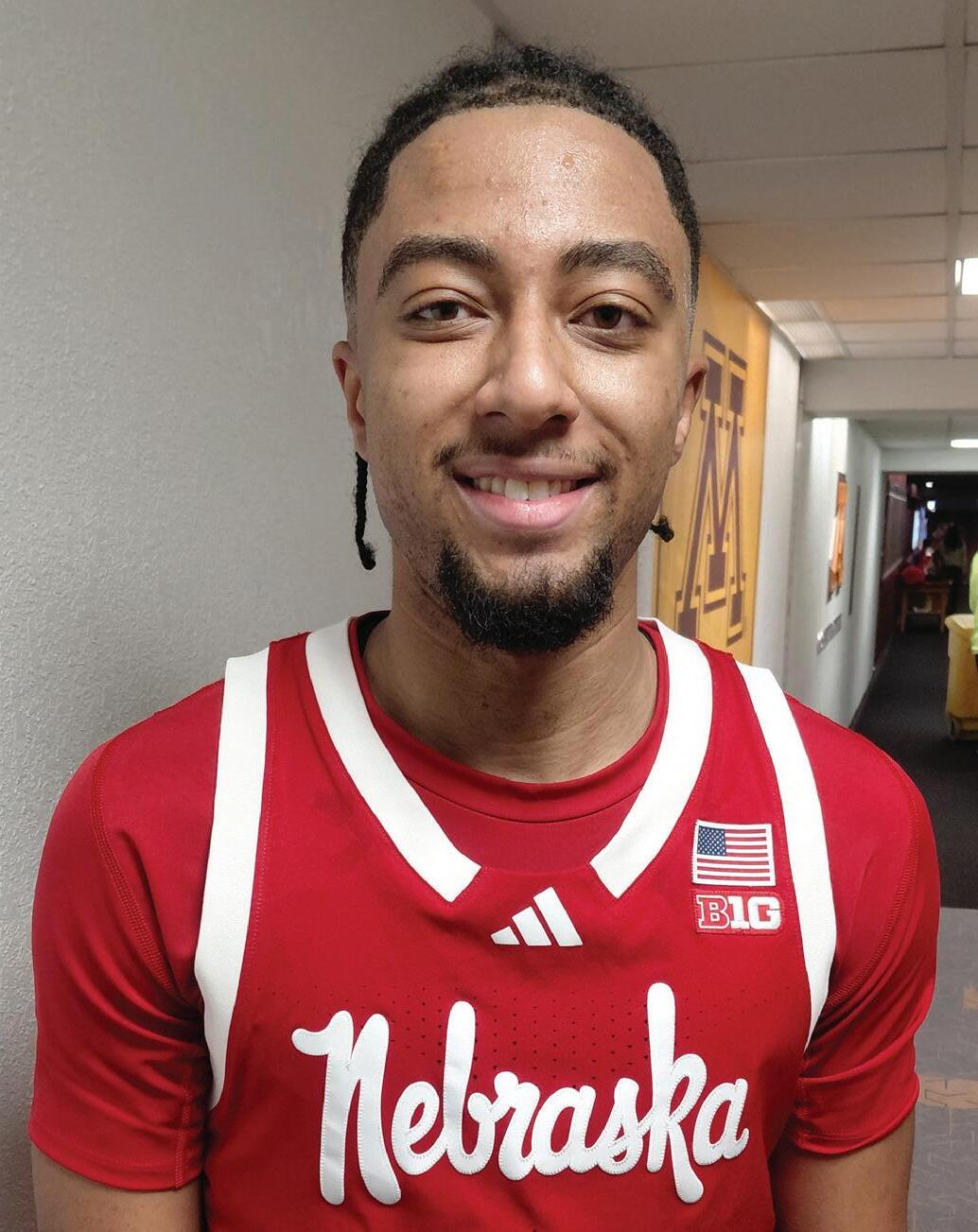
“It’s been a good adjustment,” he continued. “Everything’s just great down there.” Nebraska is off to a historic start, the best in program history, as the Huskers notched their 20th win last Saturday against the Gophers and remain unbeaten this season.
“Winning
is fun.”
Blue is the only Minnesota native on the roster. “Winning is fun,” he admitted.
“He’s managing through this challenge … but he’s do-
VIEW - PORTER
Continued from page 10
best choice.”
Porter plans to graduate in May with a degree in social work, human development, and family studies.
Finally…
It was alumni weekend at Minnesota as many former MBB and WBB Gophers were recognized at halftime of both MBB and WBB contests on successive days. MSR talked to several of them.
ing an excellent job of managing it, maybe even better than his mama,” declared Lissimore.
Blue graduated last spring from St. Thomas as a communication major with a minor in family science. This is his final year of college eligibility — “hoping to play professional, whether it’s overseas or the G-League, whatever the best option for me and my agency,” surmised Blue.
We didn’t ask why he left St. Thomas as a starter to being a non-starter at Nebraska. “Just living day-byday, and just give thanks to Almighty God above, and my family, my parents and all along those lines,” said Blue.
Charles Hallman welcomes reader comments to challman@ spokesman-recorder.com.
“It’s always a sisterhood,” said Kim Bell (1998-2002).
Kathie Eiland-Madison (1976-78) added, “To come back with our teammates, particularly teammates of color” is exciting as well, added Kathie Eiland-Madison (1976-78).
“A good time to see players from different decades,” stressed Joe Coleman (2005-08).
“It’s just a blessing” to be recognized among so many former Gophers, concluded Bakary Konate (2015-18).
Charles Hallman welcomes reader comments to challman@ spokesman-recorder.com.
From Ads Department/MN Spokesman-Recorder
Sr. Reliability Engineer, Medtronic, Inc., Brooklyn Center, MN
Req. Master’s Degree in Mechanical Engr., Electrical Engr., Industrial Engr., or Biomedical Engr. Or
EMPLOYMENT DISPLAY
medtronic.wd1.myworkdayjobs.com/MedtronicCareers, Req. #R56984. No agencies or phone calls. Medtronic is an equal opportunity employer All individuals are encouraged to apply.
SIZE: 2 COL X 2.5 INCH
RATE: $44.60 PER COL. INCH
TOTAL: $223
SOE
Please proof, respond with email comfirmation to ads@spokesman-recorder. com
The MSR handles billing digitally. This means you will get e-tears and emailed invoices unless you specifically request a hard copy.
Phone: 612-827-4021
as “The State of Hockey,” and Blacks have played an overlooked but significant part in the sport for decades, as early as the turn of the 20th Century.
FOR BILLING
Bobby Marshall, Minnesota’s first Black superstar, is regarded as the state’s first hockey star as a member of the 1908 Minneapolis Wanderers Burton Cup winning team. Charles “Chuck” Logan is the first Black player to have participated in the state high school hockey tournament in 1942. Tony McGee was the first Black hockey head coach in 1999 for a Minneapolis co-op hockey team.
INQUIRIES & TEARSHEETS
PLEASE CONTACT
ACCOUNTING DEPT
BILLING@SPOKESMAN-RECORD ER.COM
Longtime physician Dr. Joel Boyd was the first Black team doctor in the NHL and for the 1998 USA Olympic team.
Nikki Nightengale was the only Black Minnesotan on the first Minnesota PWHL championship team in 2024. Minneapolis native Kensie Malone was an all-MIAC women’s hockey player at Augsburg (2021-23) before transferring to the University of New York at Oswego for her final two college seasons. Duluth’s Nina Thorson is in her first year at Hamline.
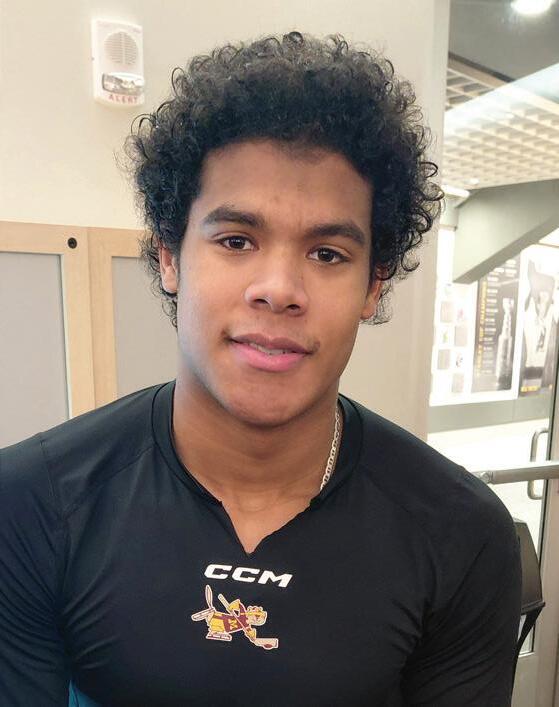
“I’m just an athletic guy,” stressed the 6’4” 210-pound Moore, a forward from Carver, Minn. “Both of my parents play basketball; my grandpa played hockey growing up, and I was skating around in rollerblades in the house when I was younger.
“So, I fell in love with that, and always was watching
BILLING@SPOKESMAN-RECORDER. COM EMPLOYMENT DISPLAY SIZE: 2 COL X 2
hockey,” he pointed out.
At Minnetonka High School, Moore was a Minnesota Mr. Hockey finalist in 2023-24 and made third team All-Metro. His three years on the team included playing on the school’s state championship team in his junior season and leading the team in scoring his sophomore year.
Last season, Moore opted not to come to Minnesota but rather play in the USHL for Sioux Falls. He played there three seasons (three games in 2023-24, and five games in 2022-23) at the end of his prep hockey seasons. He finished fourth in scoring last season.
Both he and Gopher Coach Bob Motzko felt spending his “gap year” in Sioux Falls between graduating from Minnetonka and enrolling at Minnesota greatly helped him as he transitioned to D1 college hockey.
“I feel [it’s] just another year to develop and find my game even more,” said Moore, “and
that league prepares you for here and not rushing things.”
Added Motzko, “The big thing for him is because he’s young. We’re already seeing it from the start of the year to now as his body starts to mature. He’s kind of got a freshman body — he’s sturdy, but it breaks down a little bit.”
Earlier this season Moore scored the overtime game winner, a multi-point game for him vs. Denver in November. The performance earned him Big Ten Second Star of the Week (Dec. 2).
Off the ice, Moore is studying business marketing. But he aspires to play in the NHL — he was selected in the fourth round by Ottawa in the 2024 NHL Draft. If he makes it, Moore will be only the sixth Black Minnesotan to play in the league.
“He’s got a chance to play in the National Hockey League for a long time,” Motzko pointed out. “I love him.”
Moore knows he’s unique, and not for his height — he’s Black playing in the virtually
all-White sport of hockey.
“I feel like it starts with yourself just being comfortable playing the sport that’s not common for your color,” he said. “I feel like these guys are really welcoming, and every team I’ve been on so far have been really welcoming and I just feel like one of them.”
“I feel like it starts with yourself just being comfortable playing the sport that’s not common for your color.”
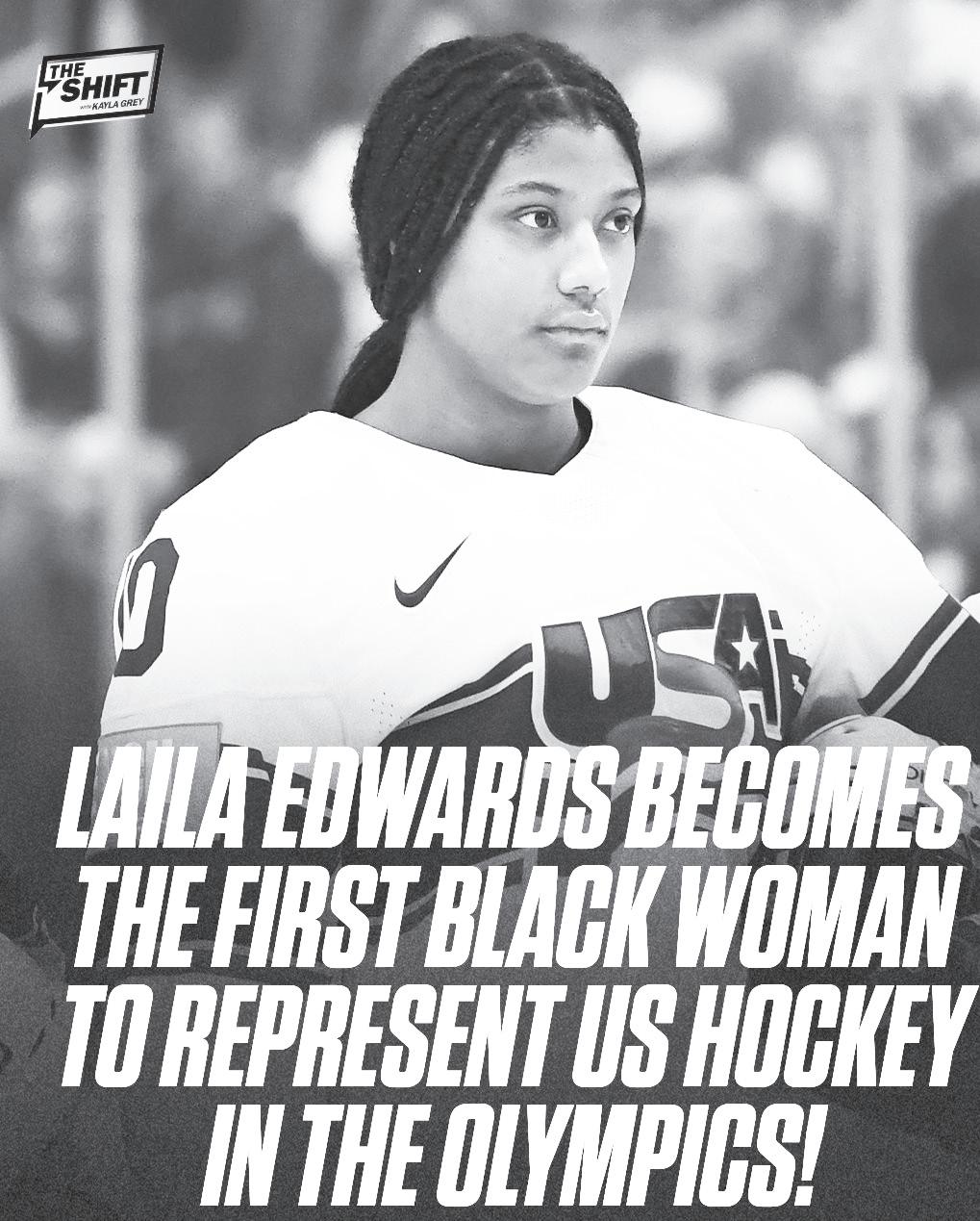
An Olympic first Laila Edwards will be the first U.S. Black player on the U.S. Olympic hockey team when the Winter Olympics begin next month. Sarah Nurse and Sophia Jaques, two of three Blacks in the PWHL, are playing for Hockey Canada.
Charles Hallman welcomes reader responses to challman@ spokesman-recorder.com.
year St. Scholastica men’s basketball head coach. “I believe that God put me on this earth to be a disciple,” he stressed on his second collegiate head coaching opportunity.
Drake’s father nonetheless served as an inspiration: “God gave me the opportunity to use my platform to help show people the way,” said Jared on being a Black HC, “and show people that we don’t have to be the normal narrative.”
He started coaching after playing college and pro ball (Robert Morris College and Southern University; three developmental league teams) at his high school alma mater, James Whitcomb Riley (South Bend, Ind.) High School where he won a city championship.
Then he was a head coach at three different high schools before getting his first collegiate job as men’s head coach at Southeastern Illinois College.
Later Drake accepted the associate head coach position at Philander Smith
(Ark.) College. Before his hiring at Duluth-based St. Scholastica last spring, Drake served as assistant coach at the University of Arkansas-Fort Smith. He is the MIAC’s only Black head basketball coach.
“It was something that for about a month and a half I really pondered,” said Drake on the Saints’ job. “I just felt like it was a fit. I came to the interview and St. Scholastica welcomed me in, and they showed me that they would give me an opportunity to grow as a coach, but also be able to make my imprint.”
This season is an adjustment. We recently watched St. Scholastica snap an eightgame losing streak and earn its first MIAC win of the season, a four-point victory at Macalester Jan. 14.
“I believe that we’re seeing the fruits of our labor,” explained the Saints HC.
“We’ve had to fight through a lot of trials and tribulations this year, but any culture isn’t real unless it comes alive through the players.
“We have a culture document that we use, that our guys have had the opportunity to study throughout the year. But unless it comes alive, it’s just words on a piece of paper. I think
the guys are starting to figure that out now. So, you’re starting to see a little bit of difference.”
Being a Black coach, Drake said he doesn’t take that for granted.
“I would like to thank all of those before me. I would like to thank [former Macalester] Coach Abe Woldeslassie, who reached out to me when I took the job,” said Drake. “There’re other gentlemen like Cuonzo Martin and Shaka Smart and Dennis Gates. Those gentlemen allow me to call them and ask questions. And I appreciate those times.”
A Black coaches’ coach
Mike Tomlin earlier this month stepped down as Pittsburgh Steelers head coach after 19 seasons. He never had a losing season and won the Super Bowl in 2008.
“I can’t thank him enough,” North Carolina Central MBB Coach LeVelle Moton told MSR during last week’s MEAC coaches media call. Moton is good friends with Tomlin, and the two chatted prior to his scheduled Zoom appearance.
“I’ve said this so, so many times: He’s probably one of the main reasons I was hired
[in 2009], and not only me but he also ushered in a new wave of young Black coaches when he won that Super Bowl,” said Moton. “Because he made it, he popularized it for young Black coaches to
be cool and given that opportunity.
“He’s the best and he’s given so much back to Black coaches such as myself,” concluded Moton. “And not only on the football side, but also
the basketball side. Man, I love him. That’s my brother for life.”
Charles Hallman welcomes reader comments to challman@ spokesman-recorder.com.
CWB
Local prep standouts return home as seniors
Two former local prep stars, now college seniors, played last weekend at Williams Arena as visiting team members. Kendall Blue (Nebraska) and Ronnie Porter (Wisconsin) arrived at their current schools taking totally different routes to get where they are today. MSR spoke exclusively to each player after their respective contests.
Former St. Thomas guard finds happiness with Huskers
Como Park grad has no regrets
“We’ve got over 20 people here, friends and family coming out to support Kendall,” said Kendall’s mom Lisa Lis-
e only played the last three minutes of Nebraska’s 76-57 road victory last Saturday, but Woodbury native Kendall Blue was the only Husker to go perfect on the court, hitting a big three in his only shot attempt. It drew loud cheers, especially among those in the season-high 11,339 in attendance, including family, friends and others. It came at the 24 second mark and finished his team’s scoring for the contest.
his week’s Significant Six photos feature boys basketball, players from every team, who participated in the first-ever MLK Classic at St. Paul Johnson High School.
Dr. Mitchell Palmer McDonald welcomes reader comments to mcdeezy05@gmail.com.
All
Mitchell Palmer McDonald
The event was held to honor the legacy of civil rights leader Dr. Martin Luther King Jr. South St. Paul defeated St. Cloud Tech 70-52 in the first game. The second contest had No. 1-ranked Totino-Grace outscoring No. 2 Richfield 80-66. Minnehaha Academy upended No. 6 St. Paul Jouhnson 85-71. Jaylan Hynes (Totino-Grace)
simore after the game. She played on the same raised floor at The Barn during her one season as a Gopher (1979-80). Last Saturday, she and her husband, Kendall’s dad Dennis Blue, watched their son play his first and only time at Williams Arena.
“It’s a great, great opportunity for him to be on this floor, and to finally play and to bust a three at the end,” Lissimore pointed out.
The 6’6” guard transferred to Nebraska after three seasons at St. Thomas, where he scored 1,013 points, averaging double figures in each of his final two seasons, a starter of 88 games out of 100. But after arriving in Lincoln, his minutes have greatly decreased from starter minutes to barely playing. Coming into last Saturday’s matinee game, Blue played 12 games, 4.4 minutes per game, and 0.6 ppg.
“It was different at first, just like being homesick,” said Blue after the game, “far away from my parents and stuff like that. But as time went on, I just adjusted. The game is a lot faster, a lot stronger, physical, high ranking guys, so everybody’s
n her freshman season at Wisconsin, 5’2” guard Ronnie Porter from St. Paul scored her season-high seven points against the Gophers. Last season as a senior she poured in a career-high 23 points vs. Minnesota.
The Como Park graduate, who scored 2,174 points, averaging nearly 23 points a game, a four-time all-conference performer and twotime all-stater, went from being a freshman walk-on to play 27 games as a full-time starter with two-time All-Big Ten Honorable Mention the last two seasons. Porter also led the Badgers in assists two consecutive seasons and among the team leaders in scoring, rebounding and steals.
“I would do it all over again.”
“No regrets at all. I would do it all over again,” said Porter last Sunday after her fourth and final time playing as a visitor at Williams Arena. Despite her team’s 88-53 defeat to the host Gophers — Porter finished with nine points, three assists and a rebound — “It’s always great to come back home and play your hometown school,” the squad’s only
Minnesotan pointed out afterwards. “I appreciate everyone that came out. You don’t get that crowd in Wisconsin, everybody who cheered anytime I did something.”
Originally recruited and signed by former UW coach Malisa Moseley, Porter opted to stay after the coach resigned after last season and play for first-year HC Robin
Pingeton, her first non-Black coach. Porter’s high school coach was her mother, Olanda England.
“Coach P is an amazing woman,” noted the senior guard on Pingeton. “She showed me life outside basketball, and that was someone who I wanted to lead me in my last season. I think I made the