PRST STD U.S.POSTAGE PAID TWIN CITIES MN PERMIT NO. 6391
To Subscribe Scan Here
M
M
U
L
T
I
M
E
D
I
U
L
T
I
M
E
D
I
A
A
THE VOICE OF BLACK MINNESOTA SINCE 1934
December 18 - 24, 2025
Vol. 92
No. 20
Phone: 612-827-4021 www.spokesman-recorder.com
Nonprofits struggle As ICE actions heat up, to fill gaps left by leaders limit federal housing cuts city’s cooperation
By Sommer Wagen Contributing Writer
espite extensive affordable housing programming in both Minneapolis and St. Paul, housing remains out of reach for many families, especially Black ones.
A Minnesota Demograph- gains, according to the report, ic Center report published those gains have not been this March found that the made by U.S.-born Black comBlack homeownership rate is munities or Somalis. St. Paul Housing Director less than half of the overall statewide rate — 26% versus Jules Atagana pinned the city’s 72% — and has decreased by housing issues on longstanddouble-digits since the 1980s. ing racial wealth gaps, with While newer Black immigrant mean housing costs taking up communities have made some ■ See AFFODABLE on page 5
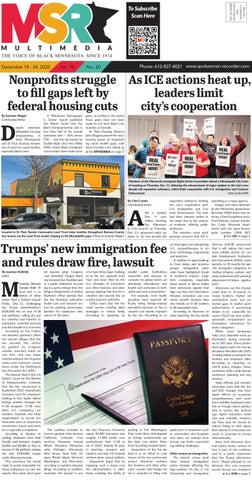
Members of the Minnesota Immigrant Rights Action Committee attend a Minneapolis City Council meeting on Thursday, Dec. 11, following the advancement of major updates to the city’s twodecade-old separation ordinance, which limits cooperation with U.S. Immigration and Customs Enforcement. Clint Combs/MSR By Clint Combs Contributing Writer
Located in St. Paul, Rondo Community Land Trust helps families throughout Ramsey County buy homes via the Land Trust model, helping to fill affordability gaps. Photo by Sommer Wagen
fter a packed Dec. 9 committee meeting, the Minneapolis City Council on Thursday, Dec. 11, advanced major updates to its two-decade-old
Trumps’ new immigration fee and rules draw fire, lawsuit By Jasmine McBride Editor
innesota Attorney General Keith Ellison and a coalition of other states filed a federal lawsuit Friday, Dec. 12, challenging the Trump administration’s $100,000 fee on new H‑1B visa petitions, calling the policy unlawful and harmful to employers, essential services, and the broader U.S. economy. According to the California attorney general’s office, the lawsuit alleges that the fee exceeds the authority granted by Congress, violates statutory limits on visa fees, and was implemented without the required notice‑and‑comment procedures under the Administrative Procedure Act (APA). The lawsuit, filed in the U.S. District Court for the District of Massachusetts, contends that the fee, announced in September 2025, dramatically increases costs for employers seeking to hire highly skilled foreign workers through the H‑1B program. H‑1B visas allow U.S. companies, universities, hospitals and other organizations to recruit professionals such as physicians, researchers, nurses and teachers in specialty occupations. According to Reuters reporting, employers have traditionally paid between roughly $2,000 and $5,000 in fees to process H‑1B petitions, making the new $100,000 charge vastly disproportionate. “This enormous fee would make it nearly impossible for these institutions to hire the experts they need, and it goes
far beyond what Congress ever intended,” Oregon Attorney General Dan Rayfield said in a public statement. According to a press release from the Oregon Department of Justice, Rayfield’s office warned that the fee threatens education, health care and research sectors by creating unnecessary barriers for employers who rely on H‑1B talent.
of at least three legal challenges to the fee; separate suits have also been filed by the U.S. Chamber of Commerce and other business and labor groups arguing that the fee is unlawful and beyond the executive branch’s authority. Critics warn that the fee could worsen existing labor shortages in critical fields. According to reporting by
smaller public institutions, nonprofits and startups to compete for global talent, undermining educational and health care outcomes in both urban and rural communities. For example, rural health providers have reported difficulty hiring foreign‑trained specialists because of the increased cost barrier imposed by the fee. According to re-
The coalition includes attorneys general from Arizona, California, Colorado, Connecticut, Delaware, Hawaii, Illinois, Maryland, Massachusetts, Michigan, Minnesota, New Jersey, New York, Oregon, Rhode Island, Vermont, Washington and Wisconsin, according to publicly released filings. According to coalition materials, this lawsuit is one
the San Francisco Chronicle, nearly 30,000 educators and roughly 17,000 health care professionals held H‑1B visas in 2024, helping fill gaps in teaching, research and medical care that U.S.-trained workers alone cannot address. Opponents argue that by imposing such a steep cost, the administration is effectively curtailing the ability of
porting in The Washington Post, rural clinics that depend on foreign professionals say the high cost deters them from recruiting needed talent. Supporters of the fee defend it as an effort to curb misuse of the visa system and protect American workers, but business and labor advocates counter that foreign talent is essential to filling criti-
separation ordinance limiting the city’s cooperation with U.S. Immigration and Customs Enforcement. The vote had been delayed earlier in the week due to the volume of residents offering public testimony. The revisions come amid growing concerns that ICE is
operating as a rogue agency. Images and video obtained by the Minnesota SpokesmanRecorder (MSR) show two vehicles, a Ford Expedition and a Ford Explorer, parked outside the Cedar Riverside Apartments with the same license plate number: FWK 387. ■ See ICE on page 5
Services (USCIS) announced that it will reduce the maximum validity period for certain Employment Authorization Documents (EADs), work permits, to 18 months for specific immigrant categories, including refugees, asylees, and many individuals with pending adjustment‑of‑status applications. Advocates say the change could lead to increased renewal burdens, higher administrative costs, and potential gaps in lawful work authorization if processing delays occur, especially because USCIS has also ended automatic employment authorization extensions for many categories. While some temporary rules once extended work authorization during renewals up to 540 days, those protections largely expire for new applications filed after late 2025, creating added uncertainty for workers and employers alike. According to reporting on USCIS policy changes, these combined shifts could disrupt workforce planning and key services. State officials and industry advocates warn that the fee and EAD changes may have ripple effects on economic competitiveness and workforce stability. Employers who rely on foreign talent, particularly in sectors like technology, higher education, medicine and scientific research, say they may be forced to reduce hiring or shift operaapply even to employers such tions abroad if it becomes too as universities and hospitals costly or uncertain to recruit that often are exempt from internationally. annual cap limits, exacerbatNew York Attorney Gening staffing challenges. eral Letitia James, whose office is part of the coalition, Other strains on immigration said in a public statement The lawsuit comes amid that the Trump administraother federal immigration tion’s “illegal attempt to unpolicy changes affecting for- dermine this visa program eign workers. On Dec. 5, U.S. would disrupt our children’s Citizenship and Immigration ■ See H1B on page 5 cal shortages and maintaining U.S. competitiveness in science, technology, engineering and medicine. In addition to legal challenges from states and business groups, immigration advocates have highlighted broader workforce impacts. Large tech companies, especially those based in Silicon Valley, have previously argued that high visa fees and restrictions threaten innovation and economic growth because they rely heavily on H‑1B workers to fill specialized roles. According to Business Insider reporting, the fee would