PRST STD U.S.POSTAGE PAID TWIN CITIES MN PERMIT NO. 6391
To Subscribe Scan Here
M
M
U
L
T
I
M
E
D
I
U
L
T
I
M
E
D
I
A
A
THE VOICE OF BLACK MINNESOTA SINCE 1934
December 11 - 17, 2025
Vol. 92
No. 19
Phone: 612-827-4021 www.spokesman-recorder.com
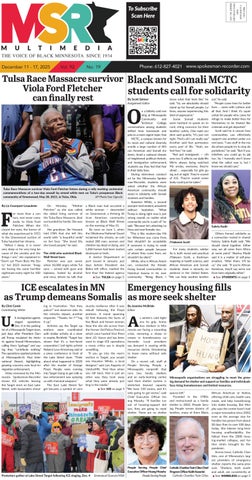
Tulsa Race Massacre survivor Black and Somali MCTC Viola Ford Fletcher students call for solidarity can finally rest By Scott Selmer Assignment Editor
know what that feels like,” he said. “So, we absolutely should stand up for Somali people, Latinos, anyone experiencing this kind of oppression.” Some Somali students were hesitant to speak on record, citing concerns for their families’ safety. One male student said quietly, “It’s just not right. That’s all I can really say.” Another said fear permeates every part of life. “Yeah, we feel fear,” he said. “Not just immigrants — citizens too. It affects our daily life. We’re always being watched. My uncles, everyone, they’re afraid … especially for girls going out at night. They’re scared of ICE. They’re scared somebody could just be taken.”
n a bitterly cold evening at Minneapolis Community and Technical College, conversations among students drifted from homework and jobs to a more urgent topic: fear. MCTC, a campus known for its racial and cultural diversity, enrolls a large number of African American and Somali students. Amid a national climate of heightened political rhetoric and immigration enforcement, students say they feel that fear in their daily lives. During interviews conducted by the Minnesota Spokesman-Recorder, students were asked whether the African Tulsa Race Massacre survivor Viola Ford Fletcher listens during a rally marking centennial American community should commemorations of a two-day assault by armed white men on Tulsa’s prosperous Black stand in solidarity with Somali community of Greenwood, May 28, 2021, in Tulsa, Okla. AP Photo/Sue Ogrocki students and families. Kameron White, a secondOn Monday, “Mother a Black man had accosted a year pre-med student, answered By Liz Courquet-Lesaulnier Fletcher,” as she was called, white woman — descended without hesitation. “What or more than a cen- the oldest living survivor of on Greenwood, a thriving Af- Trump is doing right now is just tury, rest never came the Tulsa Race Massacre, died rican American community wrong overall, no matter what easily to Viola Ford surrounded by family. She was known as Black Wall Street, community you’re a part of,” he on the evening of May 31. Fletcher. When she 111. said. “Because he’s attacking LaBy noon on June 1, when tinos and now Somalis, too. Her grandson, Ike Howard, closed her eyes, the horror of what she experienced in 1921 told CNN that she left this the Oklahoma National Guard “This is like modern-day Hitin the Greenwood section of world with “a beautiful smile” reclaimed the streets, an esti- ler. Wherever you come from, on her face. “She loved life, mated 300 men, women and that shouldn’t be acceptable. J’Hakeem Scott Tulsa haunted her dreams. children lay dead or dying, and If someone is trying to eradi“When I sleep, it is never she loved people,” he said. 1,200 homes had been looted, cate certain people because very deep or for very long beFor many students, solidarcause of the anxiety and the The child who watched Black destroyed or both. of where they come from, we ity is both moral and practical. A Justice Department re- shouldn’t be silent.” things I see,” she explained in Wall Street burn J’Hakeem Scott, a freshman Fletcher was just seven port issued in January, just “Don’t Let Them Bury My StoWhite, who is African Ameri- majoring in health science, said ry,” her 2023 memoir. “Imag- when 10,000 angry white Tul- days before President Joe can, connected the threats African American and Somali ine having the same horrible sans — armed with guns and Biden left office, marked the facing Somali communities to students share a minority exnightmare every night for 100 biplanes, fueled by alcohol first time the federal agency historical trauma in his own perience in the United States. and envy, driven by talk that years.” ■ See TULSA on page 5 community. “Being Black, I “We can help another brother
out,” he said. “People come here for better lives … same with Latinos and all that. And I think it’s super unfair for people who came for refuge to make better lives for themselves to be treated like criminals and get deported.” Scott said he is unsure how communities can effectively support one another under current laws. “I see stuff in the media where people try to stop deportations,” he said. “But if you interfere, you could go to jail, too. So, I honestly don’t know what the safest way is, but I know we should care.”
Sabria Kadir Others framed solidarity as a connection rooted in shared history. Sabria Kadir said, “We should stand together. Either way, we all came from Africa at some point.” Sharina Mudd said it is a matter of self-preservation. “After them, it’ll be us,” she said. “If you’re African American, they’ll say we’re not from here originally either.” ■ See STUDENTS on page 5
ICE escalates in MN Emergency housing fills as Trump demeans Somalis as more seek shelter By Clint Comb Contributing Writer .S. immigration agents staged operations Dec. 4 in the parking lot of a Minneapolis Target store, just days after President Donald Trump escalated his rhetoric against Somali Minnesotans, calling them “garbage” and saying they “contribute nothing.” The operations sparked protests at Minneapolis-St. Paul International Airport, highlighting growing concerns over local immigration enforcement. Video reviewed by the Minnesota Spokesman-Recorder shows ICE vehicles leaving the Target store on East Lake Street, with bystanders shout-
ing in frustration. “Are they police?” one observer asks. As the vehicles depart, another responds: “Thanks for f***ing it up.” Activists say the Target operations were coordinated with similar activity at a store in nearby Richfield. “Target has shown that it’s a two-faced corporation,” civil rights activist Nekemi Levy Armstrong said at a press conference in front of the Lake Street store. “Think about what happened in 2020 after the murder of George Floyd. People were running into Target trying to get milk as law enforcement was spraying us with chemical weapons.” The East Lake Street Target became a symbol of com-
munity resilience after it was By Jasmine McBride rebuilt following the Floyd Editor protests. A mural spanning 52 feet features the faces of s winter’s cold tightfive Black and brown women. ens its grip, homeNow the site sits across from less shelters in Minthe former 3rd Police Precinct, nesota are facing a mounting which once hosted Vice Presi- crisis, mirroring a sharp indent J.D. Vance and has been crease in homelessness naused to stage ICE operations, tionwide. Local providers a move critics say is deeply say demand is soaring while unsettling. resources shrink, threatening “If you go into the men’s to leave many without safe section in Target, you would shelter. see Houston White, a local On a recent call, staff at designer,” said Luis Argueta of People Serving People, a UnidosMN. “And then when Minneapolis nonprofit that you roll back, that is just an- runs two family shelters other way they took away and an early‑learning center, what they were already put- said their shelter system is ting in the media.” stretched beyond capacity. ■ See ICE on page 5 “We have 150 rooms, and it’s only going to get worse,” said Chief Executive Officer Hoang Murphy. “If families run out of housing‑support dollars, they are going to need shelter. There are no shelter
spaces left.” Founded in the 1980s and restructured as a family shelter in 2002, People Serving People serves dozens of families, many of them Black,
People Serving People Chief Executive Officer Hoang Murphy People Serving People
Catholic Charities Twin Cities Chief Program Officer Keith Kozerski Catholic Charities Twin Cities
Protesters gather at Lake Street Target following ICE staging, Dec. 4
Emmanuel Duncan/MSR
Minneapolis organizations are struggling to meet the growing demand for shelter and support as families and individuals face rising homelessness and limited resources. African American or Native, offering child care, health care, meals, and help transitioning into stable housing. But Murphy says the center hasn’t had a major renovation since 2002, even as the average stay for families has grown from about 30 days then to over 100 days today. She blames long‑term housing unaffordability, the fallout from the 2008 housing‑market collapse, and further strain brought by the pandemic. Across town, Catholic Charities, one of Minnesota’s largest providers of emergency shelter, reports the same pressure. “Shelters, both youth and adult, are consistently at ■ See HOMELESS on page 5