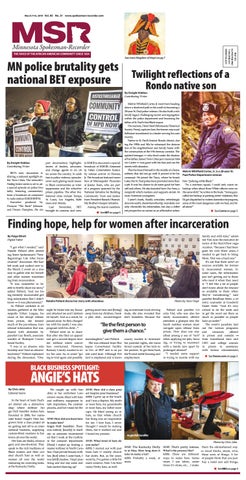
March 7-13, 2019 Vol. 85 No. 31 www.spokesman-recorder.com
PRST STD U.S.POSTAGE PAID TWIN CITIES MN PERMIT NO. 6391
THE VOICE OF THE AFRICAN AMERICAN COMMUNITY SINCE 1934
MN police brutality gets national BET exposure
See more Kingdom of Hayti on pg 7
Twilight reflections of a Rondo native son
By Dwight Hobbes Contributing Writer
part documentary highlights stories of leaders, advocates and change agents in six citBET’s new docuseries is ies across the country. In addishining a national spotlight on tion to police violence, episodes the Twin Cities. The network’s cover such glaring racial issues Finding Justice series is set to air in Black communities as voter a special episode on police bru- suppression and the school-totality featuring commentary prison pipeline. The other five from a broadcast on communi- featured cities include Tampa, ty radio station KMOJ 89.9FM. St. Louis, Los Angeles, BaltiExecutive produced by more and Atlanta. Dwayne “The Rock” Johnson Last November, BET and Dream Hampton, the six- brought its cameras and crew By Dwight Hobbes Contributing Writer
to KMOJ to document a special broadcast of KMOJ’s Community Values Conversations hosted by veteran activist Al Flowers, Jr. The broadcast featured members of Minneapolis’ Procedural Justice Team, who are part of a program spawned by the National Initiative for Building Community Trust and Justice from President Barack Obama’s My Brother’s Keeper initiative. Among the team’s members ■ See BET on page 5
Melvin Whitfield Carter, Jr. went from heading down a dead-end path in his youth to becoming a 28-year St. Paul police veteran. He also built a rich family legacy challenging racism and segregation within the police department and becoming the father of St. Paul’s first Black mayor. His memoir, Diesel Heart (Minnesota Historical Society Press), captures how the former wayward hellraiser transitioned to a leader serving his community. Native to St. Paul’s historic Rondo district, during the 1950s and ‘60s he witnessed the destruction of his neighborhood and family home with the construction of the I-94 freeway corridor. The spirited teenager — who lived under the shadow of his father, famed Twin Cities jazz musician Melvin Carter — was good with his fists and ran the streets with abandon. Then he found himself in the middle of a home robbery that did not go well. It proved to be his crossroad. He joined the Navy, where he boxed. Later, the St. Paul police force provided more than a job. It was his chance to do some good for himself and others. He also founded Save Our Sons, a nonprofit which mentors and supports at-risk African American youngsters. Carter’s frank, fluidly articulate, refreshingly down-to-earth, shoot-from-the-hip mainfesto not only chronciles his reformation, but also a different perspective on racism as an affirmative action
Melvin Whitfield Carter, Jr. is a 28-year St. Paul Police Department veteran hire: “policing while Black.” “As a one-man squad, I could only count on backup when about three White officers were on the same shift,” he writes in the book. “Some guys called for backup at parking meter violations. But I’d get dispatched to violent domestics-in-progress, some of the most dangerous calls we had, and be all alone.” ■ See CarTEr on page 5
Finding hope, help for women after incarceration By Paige Elliott Digital Editor “I got what I needed,” said Natalie Pollard after attending Sister Spokesman’s “New Beginnings: Life After Incarceration” discussion. She had left work and rushed over to the March 2 event on a mission to gather info for herself and other women transitioning from incarceration. “It was wonderful to be able to briefly share my story,” added Pollard, “and me being formerly incarcerated getting information that I didn’t know — it was phenomenal.” As Pollard confided to attendees gathered at the Minneapolis Urban League, because of her abrupt release from prison, she missed much of the pre-release, transitional information that was shared with attendees by panelist Guy Bosch, associate warden at Shakopee Correctional Facility. “I was in an abusive relationship and I had an abusive boyfriend,” Pollard explained during the discussion. “One
Photos by Steve Floyd
Natalie Pollard shares her story with attendees night he broke into my house and attacked me and I defended myself. And as a result, he passed away. So they charged me with his death; I was also pregnant with his child…” Pollard went on to share that after she filed an appeal and got a second-degree murder without intent conviction overturned. However, Ramsey County wanted to retry her case. So, to avoid “going to trial again and possibly
getting more time and [being] away from my children, I took a plea deal... second-degree
Pollard and panelist Cecelia Viel, who was also formerly incarcerated, offered attendees a glimpse into the harsh realities women must navigate upon release from prison. How does one stay afloat among a sea of “no’s” county wanted to terminate when applying for jobs, housher parental rights, she trans- ing, or trying to reconnect ferred custody of her kids to with a family torn apart by her parents. To get them back, prolonged absence? “I needed some support she’ll need stable housing and in trying to reunite with my employment. ing an interstate truck driving trade, she also revealed that she’s homeless. Because the
“Be the first person to give them a chance.” manslaughter,” said Pollard. She was released from Shakopee Correctional Facility in Oct. of 2017 and is on parole until June. Although Pollard is employed and is learn-
family and with kids,” admitted Viel, now the executive director of the StartANew organization. “Because I had been gone for over three years...I needed to get back to being Mom. That was a hard one.” It’s not that there aren’t resources available for formerly incarcerated women. In some cases, the information just isn’t getting out to those who need it when they need it. “I feel like a lot of people don’t know about the resources available to them when they’re transitioning,” said panelist Betalham Benti, a reentry counselor at Goodwill Easter Seals. “And it’s very critical to do the work and to get the word out there as much as possible so people have an outlet.” The event’s panelists laid out the various programs and resources offered in prison and outside — from transitional fairs and GED and college courses in prison to assistance with license reinstatement, ■ See Finding hopE on page 5
BLACK BUSINESS SPOTLIGHT:
ANGIE’S HATS We caught up with Sandifer in her sixth-floor Lowertown studio filled with hats In the heart of Saint Paul’s and millinery equipment to art district sits a distinctive talk inspiration, the creation shop where milliner An- process, and her vision for the gie Hall Sandifer makes hats. future. Founded in 2006, her namesake brand Angie’s Hats has MSR: How did you learn how grown from a class project af- to make hats? ter getting laid off to an inter- Angie Hall Sandifer: There national business, supplying was nobody [locally] to teach custom-fitted creations to hat me, so someone recommendlovers all over the world. ed that I work at the Guthrie Her hats are flashy, extrava- in the costume department. gant, and one-of-a-kind. They [Then] I ended up finding a speak to the rich traditions of master milliner in North CaroBlack women and their cov- lina. I had private lessons with eted church hats as well as her, [but] when I came back, I women all over the world was [still] clueless. I kept pracclamoring for crowning looks ticing and one day some real at the Kentucky Derby. hats started showing up!
By Chris Juhn Editorial Intern
MSR: How did a class project inspire your business? AHS: I grew up in the South and I was a Baptist. My mother wore hats, my grandmother wore hats, my father wore caps. He liked seeing us in hats, so that whole church hat thing was an inspiration for me. I love hats, I never thought I would be making them, but it worked out and I found my passion. MSR: What kind of hats do you make? AHS: I started out with just basic hats — mostly church hat styles. But, as the years went by, I’ve gotten a little bit more creative. Now I do Kentucky Derby hats, as well.
Angie Hall Sandifer Photos by Chris Juhn MSR: The Kentucky Derby MSR: That’s pretty intense. is in May. How long does it What’s the process like? AHS: There are different take to make a hat? AHS: Probably a week, at ways to make hats. Sometimes I use fabric, somemost. times it’s straw, etc… I make
them the old-fashioned way — wood blocks, steam, wire, those sorts of things. A lot of people think that you just buy a mold and add things, ■ See BBS on page 5