March 22-28, 2018 Vol. 84 No. 33 www.spokesman-recorder.com
— See “Designer makes magic with costumes” on pg. 7
PRST STD U.S.POSTAGE PAID TWIN CITIES MN PERMIT NO. 6391
THE VOICE OF THE AFRICAN AMERICAN COMMUNITY SINCE 1934
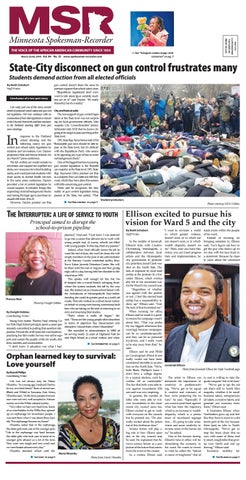
State-City disconnect on gun control frustrates many
Students demand action from all elected officials By Keith Schubert Staff Writer Conclusion of a two-part story Last week, part one of this story covered details of proposed school safety and gun control legislation. Part two continues with an examination of how that legislation is viewed at the City and State levels and how reactions to the Parkland shooting differ from past mass shootings.
In
response to the Parkland school shooting and the following outcry for gun control and school safety legislation by students and lawmakers, Gov. Dayton proposed a Safe and Secure Schools Act at a March 7 press conference. The $21 million act would include intervention and support for expelled students, new resources for school building safety, and would provide students with more access to mental health services. In the same press conference, Dayton provided a list of control legislation he would support. It included things like expanding criminal background checks and raising the legal age to purchase an assault rifle from 18 to 21. However, Dayton pointed out that
gun control doesn’t share the same bipartisan support that school safety does. “[Republican legislators] don’t even want to talk about [gun control], much less act on it,” said Dayton. “It’s really shameful, but it’s a reality.” City and State at odds The non-support of gun control legislation at the State level was not surprising for local government officials. Minneapolis City Councilmember Jeremy Schroeder told MSR that he knows it’s going to be tough to pass anything at the State level. DFL State Rep. Rena Moran told MSR, “Reasonable gun laws should be able to pass at the State level, but it’s difficult with the Republican Party who seems to be opposing any type of ban or criminal background check.” One of the biggest barriers to passing gun control legislation is the Republican majority at the State level. DFL State Rep. Raymond Dehn pointed out that as a majority they can table any bill they want, which they have done this session with bills concerning gun control. Dehn said he recognizes the slim reality of gun control legislation being passed at the State, but added, “That ■ See Gun control on page 5
Student protesters
Photo courtesy MGN Online
The InTerrupTer: a lIfe of servIce To youTh Ellison excited to pursue his Principal aimed to disrupt the school-to-prison pipeline
planned,” Neal said. “I just knew I was destined to go into a career that allowed me to work with young people and, of course, schools are filled with young people. To this day, that’s my passion.” Indeed, when Neal officially leaves the job toward the end of June, she won’t be done; she will simply transition to the post of site administrator at the Ramsey County residential facility, Boys Town Totem Juvenile Detention Center. She will be there until the end of August and then grudgingly call it a day, having held her shoulder to the wheel since 1979. This speaks well enough for her, but Neal stepped into a crucial breach, salvaging those whom the system routinely lets fall by the wayside. She started out as a home-school liaison with the Archdiocese of Minneapolis-St. Paul before deciding she could do greater good as a youth adTheresa Neal vocate. Then she worked as a school social worker Photo by Dwight Hobbes on behalf of young men leaving correctional facilities who are taking on the task of returning to society and resuming their studies. By Dwight Hobbes “That’s where it really all began,” she Contributing Writer said. “Those are the young people often described Young lives matter. Theresa Neal, retiring Coin terms of adjectives like disconnected and mo Park High School principal, spent a career pasdisruptive. I found that’s where I flourished.” sionately committed to putting that assertion into She ascended to administration in 2000 afpractice. For just shy of 40 years she was hands-on ter serving nearly 22 years at Highland Park Sepracticing her life’s motto: Service over self to supnior High School as a social worker, and when port and sustain the quality of life for youth, children, families, and communities. ■ See intErruptEr on page 5 “I don’t know if education was what I had
Orphan learned key to survival: Love yourself By Brandi Phillips Contributing Writer Life was not always easy for Maria Nhambu. “At a young age, I realized I had to be my own best friend.” Born of mixed race (Black and White) in Tanzania, East Africa, Nhambu said, “At the time, people of mixed race were not very well accepted in African society or in the White colonist society. “Very often we had very hard lives. Some of us were hidden. In the 1930s, they opened up an orphanage for mixed-race people. I was sent there when I was about three days old. The orphanage became my home.” Nhambu noted that in the orphanage, the older girls took care of the younger girls. “Life in the orphanage was hard because the older girls who took care of some of us younger girls abused us a lot of the time. They were very tough and very cruel, and we were beaten almost every day.” Nhambu attended school until the ■ See lovE on page 5
Maria Nhambu
Photo from Maria Nhambu
vision for Ward 5 and the city By Keith Schubert Staff Writer In the middle of Jeremiah Ellison’s time with Creative CityMaking Minneapolis, a collaboration between local artists and the Minneapolis city government to promote city priorities, Jamal Clark was shot on the North Side. The lack of response by local leadership at the protests lit a fire under Ellison, which eventually led to his successful run for the Ward 5 city council seat. “Regardless of whether you agreed with the protest or not…I feel like elected leadership has a responsibility to show up,” Ellison said. “And the lack of that frustrated me.” When running for office, Ellison said he made it a point to ensure his campaign wasn’t about him. “That was probably my biggest reluctance [for running], because campaigns can be so candidate-specific and they can be so personality-driven, and I really wanted to stay away from that,” he said. Ellison said he and Phillipe Cunningham (Ward 4) normally would not have been considered electable in an election on the North Side. “We’re both Black. Phillipe’s trans. I don’t have a college degree. In a typical election, we’d be written off as unelectable.” The fact that both were able to win against incumbents Ellison said was very inspiring. In general, the number of folks who were able to win over incumbents in the most recent city council races has Ellison excited to get to work with everyone on the council, but he pointed out, “I’m also really excited about the potential of this freshman class.” Science fiction will play a big role in how Ellison operates in his city council seat, he said. He explained that he views science fiction as a projection of the future that comes from the mind of the creator. As a creator, Ellison said,
“I want to envision a world in which gender violence doesn’t exist, or in which racism doesn’t exist, or in which wealth disparity doesn’t exist.” Then, once you have this vision, you can insert pragmatism and implementation, he said.
ready exists within the people of his ward. Instead of focusing on bringing outsiders in, Ellison said, “Let’s figure out how to get the guy who shows up every day with his taco truck in a storefront. Because he clearly cares about the communi-
Jeremiah Ellison Photo from Jeremiah Ellison for Mpls Facebook page The artist in Ellison understands the importance of creativity in problem-solving. “We’ve got to be equally creative and visionary of how we’re projecting the future,” he said. “Especially if you want to push back against what has been the trajectory, which is an increase in wealth disparity, which is a persistence of race-based segregation… It’s going to take some vision and some creativity to reverse some of the harms done,” he added. One of the focuses during Ellison’s time in office will be stimulating the economy in his ward. He wants to invest in what he called the “bakedin sense of toughness” that al-
ty and is willing to take the quote-unquote ‘risk to be here.’ “We’ve got to tap the talent that’s still in North Minneapolis, whether it be small business talent, entrepreneurial talent, a creative talent, and generate our economy from there,” Ellison said. It frustrates Ellison when Northsiders grow up and feel like they have to move to a different part of the city because there [are] no jobs in North Minneapolis. “We’ve got to stop the brain drain that occurs with some of these really smart, tough folks that grow up over North and end up leaving,” Ellison said. Economic mobility for ■ See Ellison on page 5
2
March 22-28, 2018
Parents are the First Teachers and Home the First School
Five reasons pre-school years are a prime time for learning By Alise McGregor Contributing Writer
M
uch of the discussion about education focuses on the K-12 years, but some early childhood education experts suggest serious learning can start even earlier and pay dividends for the child in years to come. “Young children have the capacity at a very young age to be academically challenged, and we need to educate them strongly during those years instead of waiting until they are older,” says Alise McGregor, founder of Little Newtons, an early education center with locations in Minnesota and Illinois. “Children’s minds are like sponges when they are very young. Under age five is the most important time for development and our best opportunity to set up children for success. If we strongly educate children at a very young age, while their brains are so pliable, by the time they reach kindergarten, their brain capacity is much higher.” Recent research confirms that the first five years of life are particularly important for the development of the child’s brain. Harvard University’s Center on the Developing Child reports that in the first few years, more than 1 million new neural connections are formed every second, building the brain’s architecture. This growth of the brain’s network establishes a fertile foundation for learning, thus an opportunity to be better prepared for grade school and beyond, experts
say. One analysis of several studies, “Impacts of Early Childhood Education on Medium- and Longterm Education,” showed that children exposed to high-quality prekindergarten education performed better academically in later years. Early education also led to higher graduation rates, fewer special education placements and less grade retention. McGregor suggests five reasons parents should consider ramping up their pre-K child’s education: Socialization Socialization with people other than the child’s family in a safe environment is an essential foundational element. “It’s important to introduce our children to other children and support their transition into their own friendship groups, and the earlier we do this, it helps children overcome shyness and gain self-confidence,” McGregor says. Personal experiences These assist the brain’s organizational development and functioning in many situations, helping children develop learning skills as well as social and emotional abilities. “A good early-education center creates an environment where imagination, love and innovation all come together for a daily adventure,” McGregor says. Enthusiasm for Learning Lessons can be given in a fun and exciting way that will encourage children to be effective learners. “Feeling inspired and excited to learn takes root in preschool,”
Photo courtesy of Bigstock
McGregor says, “and can last a lifetime.” Learning respect for others A fundamental building block for happiness, friendships and success in life starts early by learning how to share, cooperate, take turns and be nice. “By carrying on conversations, following rules, listening, accepting consequences of actions, the child learns early how to start getting along in the world,” McGregor says.
Resilience It’s important that early childhood educators and parents work together to develop resilience in children as early as possible. “By creating a consistent and stable environment with clear expectations and predictable consequences, children can develop skills in managing themselves and their emotions,” McGregor says. “They may experience bumps, bruises or losing a game, but this is the foundation for building coping strategies for greater challenges in life.” “The first five years of life are the most critical,” McGregor says.
“It is far easier to train a child than it is to fix a broken adult.” Alise McGregor is the founder of Little Newtons (www.littlenewtons. com), an exceptional child care center focusing on early childhood education with four locations in Minnesota and one in Illinois. She is the author of an upcoming book, Creating Brilliance.
EVERY SECONDS SOMEONE IN THE U S DEVELOPS ALZHEIMER’S
I AM DRIVEN TO FIND THE CURE
Karen Hsiao Ashe, Professor
We all grow older each day. How can you stay healthy as long as possible and enjoy your later years? Teams of researchers at the University of Minnesota are tackling this challenge from every angle. From finding a cure for Alzheimer’s disease, to designing neighborhoods that meet our needs as we age, to improving the quality of life in nursing homes, we’re solving the world’s biggest challenges. Learn more at discover.umn.edu
The University of Minnesota is an equal opportunity educator and employer.
March 22-28, 2018
3
A good childhood can prepare us for a good life A troubled childhood increases risk of a troubled life
S
By Charles E. Crutchfield III, MD ome childhoods are filled with wonderfully amazing and happy times. Other childhood experiences are downright nightmares. As suspected by psychologists and other social scientists for years, a study by the Centers for Disease Control has confirmed that whether a childhood is magnificent or terrible, the traumatic adverse events during these formative years can have profound, lifelong effects on a person’s social, mental and physical health. When I was in college, I tried to learn a language. Much to my surprise, I found learning a second language extraordinarily difficult. I wondered why it is so easy, as a child, to learn a language and so difficult as an adult. Psychologists, doctors and researchers have come to understand that there are certain windows of opportunity to acquire and perfect different elements of learning, self-esteem, and knowledge for the human mind. When it comes to acquiring a language, the time for optimal learning is childhood. Sure, anyone can learn a different language at any time, but as an infant and small child, learning a language is almost effortless. When it comes to developing a sense of self-worth, self-esteem, and limitless social skills, a safe and nurturing childhood is essential. Social development is optimal in this “frame” of time, too. The rougher your childhood, the likelier one is to have significant behavioral, health, social and psychological problems later in life. In fact, many researchers say that when a child, adolescent or young adult is acting out or having significant problems, or if a person is having problems in school, work or with relationships or finds themselves in trouble with the law or substance abuse, the old question was “Why are you behaving this way?” The new way of approaching a problem person is to ask, “What has
happened to you in your life that causes you to behave this way?” This is a very subtle yet powerfully important change in the way troubled people should be understood and evaluated. Psychologists, other social scientists and doctors have come to understand that traumatic or adverse events that happen to a child can have profoundly devastating effects on a person that can last a lifetime. “A rough childhood dramatically increases the risk for a rough life.” The list of adverse or traumatic events includes three areas: abuse, neglect, and household dysfunction. Psychologists have developed a test to score these traumatic events called the ACE (Adverse Childhood Events) examination, though a landmark study by the Centers for Disease Control and Kaiser Permanente, called the Adverse Childhood Events Study. The ACE test specifically screens these factors: • Physical abuse • Sexual abuse • Emotional abuse • Physical neglect • Emotional neglect • Homelessness or housing insecurity • Mother treated violently • Household substance abuse • Household mental illness • Parental separation or divorce • Incarcerated household member Screening test questions Here are the 10 questions of the ACE (Adverse Childhood Events) screening test: 1. Before your 18th birthday, did a parent or other adult in the household often or very often swear at you, insult you, put you down, or humiliate you? Or act in a way that made you afraid that you might be physically hurt? 2. Before your 18th birthday, did a parent or other adult in the household often or very often push, grab, slap, or throw something at you? Or ever hit you so hard that you had marks or were injured? 3. Before your 18th birthday, did an adult or person at least five years older than you ever touch or fondle you or have you touch their body in a sexual way? Or attempt or actually have oral, anal or vaginal intercourse with you? 4. Before your 18th birthday, did you often or very often feel that no one in your family loved you or thought you were important or special? Or
5.
6.
7.
8.
9.
10.
your family didn’t look out for each other, feel close to each other, or support each other? Before your 18th birthday, did you often or very often feel that you didn’t have enough to eat, had to wear dirty clothes, and had no one to protect you? Or your parents were too drunk or high to take care of you or take you to the doctor if you needed it? Before your 18th birthday, was a biological parent ever lost to you through divorce, abandonment, or other reason? Before your 18th birthday, was your mother or stepmother often or very often pushed, grabbed, slapped, or had something thrown at her? Or sometimes, often, or very often kicked, bitten, hit with a fist, or hit with something hard? Or ever repeatedly hit over at least a few minutes or threatened with a gun or knife? Before your 18th birthday, did you live with anyone who was a problem drinker or alcoholic, or who used street drugs? Before your 18th birthday, was a household member depressed or mentally ill, or did a household member attempt suicide? Before your 18th birthday, did a household member go to prison? Although not specifically in the orig-
inal list of questions, psychologists also believe that housing insecurity or homelessness is also a major traumatic event that plays a huge role in the development of a child. An elevated ACE score is certainly not a crystal ball on one’s future. However, elevated ACE scores are associated with social, emotional, behavioral and cognitive impairment that can have long-term and profound effects. High-scoring people are more prone to engage in high-risk behaviors such as: • Smoking • Alcohol abuse • Drug abuse • Sexual promiscuity High-scoring people also have an increased incidence of: • School drop-out • Incarceration • Anti-social and criminal behavior • Physical confrontations or abuse • Inability to maintain healthy relationships • Failure to keep steady jobs • Cancer development • Suicide • Lung disease • Heart disease • Stroke • Obesity • Early death The ACE study’s results suggest that neglect, insecurity, maltreatment and
household dysfunction in childhood can contribute to health, social, and behavioral problems that can be devastating and, without help, last a lifetime. For many people, this new understanding can open doorways to addressing and overcoming obstacles that can be life-changing. In a recent CBS news segment related to the issue of adverse traumatic childhood events and the way they affect subsequent human behavior, the correspondent, Oprah Winfrey, commented that this new way of looking at and understanding human behavior was “absolutely lifechanging and will influence all of her future relationships.” If you or a loved one have an elevated ACE score, talk to your doctor about your results and develop a well-designed and thoughtful plan for a better life. The good news is that it can be done at any age. Charles E. Crutchfield III, MD is a board-certified dermatologist and Clinical Professor of Dermatology at the University of Minnesota Medical School. He also has a private practice in Eagan, MN. He has been selected as one of the top 10 dermatologists in the United States by Black Enterprise magazine and one of the top 21 African American physicians in the U.S. by the Atlanta Post. Dr. Crutchfield is president of the Minnesota Association of Black Physicians.
March is Problem Gambling Awareness Month Minnesotans encouraged to ‘Have the Conversation’ about problem gambling
The Minnesota Department of Human Services (DHS) is encouraging Minnesotans to make use of its resources on problem gambling as they “Have the Conversation” this month. Now in its 14th year, National Problem
Gambling Awareness Month is designed to help raise awareness of the prevention, treatment and recovery services available for those adversely affected by gambling. Its 2018 theme, “Have the Conversation,” attempts to bring this often-hidden addiction to light. About two million U.S. adults are estimated to meet criteria for pathological gambling, and another four to six million would be considered problem gamblers. Especially affected are college students; nearly six percent of college students in the U.S. have been estimated to have a serious gambling problem. DHS’ Just Ask MN campaign works to raise awareness among these young people about the risks associated with gambling. Just Ask MN includes a website and social media outreach that connects this younger, at-risk de-
go green!
mographic to educational resources and information about gambling activities, the consequences associated with risky gambling behavior, and how to better understand the signs of a problem in order to get help. “No Judgement” is an ongoing DHS campaign that focuses on problem gambling education and intervention. The website offers resources for individuals and families affected by this issue. Individuals in need of help, as well as affected others, can also call the Minnesota gambling helpline at 1-800-333-HOPE or text HOPE to 61222. Problem Gambling Awareness Month is a national initiative spearheaded by the National Council on Problem Gambling. DHS’s participation is part of its ongoing efforts to raise awareness and reach out to those affected by
Stay Informed on envIronmental and SuStaInabIlIty topIcS!
problem gambling. Problem gambling information and resources are available at: • Getgamblinghelp.com • Justaskmn.org • @NoJudgment (Facebook) • @MNGamblingHelp (Twitter) • @JustAskMN (Facebook) • 1-800-333-HOPE -- Information provided by the Minnesota Department of Human Services
4 March 22-28, 2018 The Minnesota Spokesman-Recorder (MSR) welcomes and values commentary and feedback from the community. The articles found here are edited for clarity and/or space, but the opinions are the author’s own and do not reflect the views of the MSR.
Low-wage workers willing to take ‘consequences’ of higher wages Trying My Best By Frank Erickson Contributing Commentator St. Paul City Council President Amy Brendmoen told members of ISNow, ”We need to pause and take the time to answer basic questions about how a wage increase would affect workers before making any decisions.” Yet, why doesn’t the councilwoman tell the healthcare industry, landlords, colleges, and universities — those that are swimming in profits — that they need to pause and answer some basic questions before raising their premiums, rents, and tuition? Brendmoen calls on another study to assess the impact that higher wages will have on low-wage workers, but she never advocates for a study to see the impact high-
er wages will have on low-wage workers. Low-wage workers are more than willing to take the risk and endure all the ”negative” consequences that higher wages will bring. Brendmoen needs to stop dragging her feet, catering to the capitalists, and implying that higher wages will be bad for workers. At this point, who needs more money, more cash flow doctors, hospitals, health insurance providers, landlords, colleges, and universities or low-wage workers? Our elected officials need to stop protecting the rich and their ability to change more endlessly and start looking out for the poor. It is time we are financially civilized. Healthcare CEOs in our state are making over $30 million a year and the St. Paul City Council tells ISNow that they need to ”pause.” Frank Erickson lives in Minneapolis
New Black women leaders stake claim to the future By Julianne Malveaux Contributing Commentator All too often, our “history” month turns into a tribute to the past. And while the past is an important place to lift up it is, indeed, a tributary, a stream that flows into the larger stream of an unbounded future. The future must always be greater than the present, or there has been no progress. And, in the words of Frederick Douglass, “progress concedes nothing without a demand.” I spend much of Women’s History Month thinking of those who have come before me; I stand on their shoulders. I claim Women’s History Month for Black Women and love to call our roll of luminaries that, for me, includes Dr. Sadie Tanner Mossell Alexander, the first Black woman to get a Ph.D. in economics; Dr. Phyllis Ann Wallace, the first Black woman to get a Ph.D. in economics from Yale, and the first to attain tenure at MIT. There are more, but I also want to speculate about the future role of luminaries and reflect on the fact that many Black women have
made it possible for us to bask in a new generation of leadership. The past has laid a foundation, but the future is far more important than the past. Thus, Leah Daughtry (who managed the 2016 Democratic National Convention), Minyon Moore (who had a key role in the Clinton campaign), and Yolanda Caraway (an amazing political operative who has worked for Rev. Jesse Jackson, former President Bill Clinton, and candidate Hillary Clinton), put a footprint in the sand for future leadership with their Power Rising conference in Atlanta last month. They gathered more than a thousand Black women from around the country to develop a “Black Women’s Agenda,” deliberately mixing up the seasoned with the sassy, established leaders who are eager to make their mark. Symone Sanders, the CNN commentator who made her mark supporting Bernie Sanders, and who does not back down from a fight around principles and issues, led a panel of young women who spoke of the challenges in their work. Amanda Brown Lierman, a new
MAKE YOUR VOICE HEARD THROUGH THE MSR. Send story ideas, news tips and opinions to Judith Hence at: jhence@spokesmanrecorder.com Send sports, community news, and health stories to Jerry Freeman at: jfreeman@spokesmanrecorder.com
Send entertainment stories, events you want posted, and notices exclusively for our website to Paige Elliott at: pelliott@spokesmanrecorder.com
LETTER TO THE EDITOR POLICY The MSR welcomes letters to the editors. Letters should be typed, double-spaced, in 12 point font and must be signed. Anonymous letters will not be printed. A telephone number or email address must be included for verification. Letters of 250 words or less are more likely to be published. The editor reserves the right to edit letters for length.
SEND LETTERS TO: Minnesota Spokesman-Recorder- Letters to the Editor P.O. Box 3558 * Minneapolis, MN * 55408-0558 Or email your letters/commentary to jhence@spokesman-recorder.com
READER SERVICE • Circulation Department/Billing Department If you have any questions regarding your invoice or subscription, call 612-827-4021. 9 am to 5 pm, Monday through Thursday. • News Department To report a news event, call 612-827-4021 or email to jhence@spokesman-recorder.com • Advertising Department To reach our advertising departments call 612-827-4021 or email to: display@spokesman-recorder.com
CORRECTION POLICY If we make an error, we want to correct it. If you believe that an error has been made email jhence@spokesman-recorder.com. If a correction is warranted, it will be printed the next week.
mom and the political director of the Democratic National Committee, was among those on another panel about life in politics. Others on that panel included LaDavia Drane, who led Black outreach for Hillary Clinton and is now chief of staff for Congresswoman Yvette Clark (D-N.Y.) and Boston City Councilor Ayanna Pressley, who is now running for Congress. These young women aren’t playing! They are calling out their elders, but also calling out the rules. They aren’t trying to toe a line, they are trying to make a difference. Ayanna Pressley, as an example, is challenging an incumbent Democrat in a Congressional primary. Tired of being told to ”wait her turn,” she has decided that now is her time. Even though she has always garnered support from Emily’s List, the fact that she is challenging a pro-choice Democratic man in Boston has not won her support from the political establishment. Yet, the 42-year-old sister says she will not be constrained by tradition. The Power Rising conference represented an example of that unfettered and
passionate energy. One of the most promising young leaders is Tamika Mallory, one of the four co-leaders of the Women’s March. Tamika is a protégé of Rev. Al Sharpton (her parents were among the founders of the National Action Network, and she served as its executive director for several years). Because of her amazing work, Mallory earned a Phoenix Award from the Congressional Black Caucus Foundation in 2017. With appropriate humility, she accepted her award “for the people,” and the most important thing that one gets from Tamika Mallory is that she loves humanity, loves Black people, and especially Black women. She, like the others mentioned, is a leader for our future. She is the future of Black Women’s History. We all know that because she is a leader, she will attract negative energy and still she rises, walking through life with her shoulders back, head held high, an unapologetic lover of her people. The Akan (Ghanaian) word SANKOFA translates as “go back
and get it.” It is associated with the proverb Se wo were fi na wosankofa a yenkyi, which means “It is not wrong to go back for that which you have forgotten.” The Adinkra symbol for Sankofa is either that of a bird with its head turned backward carrying a precious egg in its mouth, or a stylized heart shape. The precious egg is the history of our leadership, the women like Mary McLeod Bethune and Dorothy Height and Sadie Alexander and Phyllis Wallace. Even while looking backward, though, the Sankofa bird is moving forward, just like Tamika Mallory, LaDavia Drane, Amanda Brown Lierman, and so many others. In the paraphrased words of the poet Mari Evans, “Look on them and be renewed.” Julianne Malveaux is an author, economist and founder of Economic Education.
Whites comprise nation’s highest number of teachers Students of color need to see more educators of color.
By Nate Bowling Contributing Commentator I spent most of my first year of grad school sitting in the back row of class with my hood up. There were nearly 40 of us in the cohort. Two were Black. My hoodie was an act of silent dissent. Today, I completely understand when my students want to do the same, even with me in front of the room. Academia and public schools are spaces where people of color often feel underrepresented, unwelcome and unheard. From third grade through high school, I was a student in a series of neighborhood public schools. Afterward, I went to community college and then on to a public liberal arts college where I earned my bachelor’s and eventually my master’s degree. Each phase of my educational journey shared two characteristics: 1. The further I progressed, the fewer Black and Brown classmates I had. 2. As I progressed, regardless of the demographics of the student population, the faculty and administrators were uniformly nearly all White. That needs to change.
An organization I am part of, the National Network of State Teachers of the Year, recently released videos designed to provoke conversations that will lead to this kind of change. Called Courageous Conversations About Race in Schools, the videos provide an effective starting point for real discussions that should be happening in schools — particularly in colleges and universities across this country. Research tells us that upwards of 80 percent of U.S. teachers are White. Different research tells us that nearly 80 percent of teachers are female. Obviously, those Venn diagrams overlap in a largely White and female workforce. At the same time, because of higher birth rates among immigrant populations and the ”mysterious phenomenon” of disproportionately high numbers of White children in private schools, a majority of the population of students in public school are students of color, and those numbers are headed even higher, based on enrollment numbers in lower grades. Schools systems need to do a better job of attracting and retaining effective teachers of color. Students of color need to see more people
of color in positions of expertise and authority, and teachers need to be conversant and literate in the cultural traditions that are present in their classrooms. None of these statements should be controversial. The lack of representation is an equity issue, and to resolve it we can look to lessons elsewhere in our society. During the Vietnam War, the Pentagon realized that majority Brown platoons of soldiers and Marines wouldn’t take life-or-death orders from a uniformly White officer corps. The Pentagon thus underwent an intentional effort to diversify the officer corps. Since then, the Pentagon has submitted amicus curiae briefs in every major affirmative action case before the U.S. Supreme Court because they understand that representation matters. Time for a representation disruption. The word ”disruption” gets hurled around frequently in business and increasingly in education. Usually, it’s about handing Silicon Valley tech bros a metric ton of venture capital to sprinkle the #EdTech™ fairy dust of the moment. But I’m going to argue that when it comes to
teacher diversity and representation in schools, we actually need disruption. In my neck of the woods, the numbers are especially grim: There are only about 800 Black teachers in all of Washington State. In my 12-year teaching career, I have never worked with another Black male general education teacher. There’s no reason for me to be alone. We see talented students of color all over higher education because universities know how to recruit them. As Jeff DuncanAndrade says, ”Look at any college football or basketball team and tell me colleges don’t know how to recruit Black talent. When I was a kid I thought Georgetown was an HBCU.” But it can’t just be student athletes. We need to bring in students who can increase teacher diversity. It’s imperative-and it’s well within our power. Nate Bowling is a high school government teacher in Tacoma, Washington, who was named the 2016 Washington State Teacher of the year and a finalist for National Teacher of the Year.
March 22-28, 2018
Gun control Continued from page 1
doesn’t mean we shouldn’t try.” Violence and school shootings won’t stop “unless elected officials at every level of government step up and act to regulate guns,” Rep. Keith Ellison (DMN) told MSR. He added the cost of inaction on policies like an assault weapons ban and universal background checks would be loss of lives. City Councilmember Steve Fletcher and Schroeder recognize that the resolution passed at city hall encouraging state and federal lawmakers to ban assault weapons, silencers, bump stocks and extended magazines does not do a thing about who can own a gun. “The City is pretty limited around what they can do around gun control,” Schroeder said. Fletcher pointed out that the gun lobby has been effective in passing laws that limit the City’s authority over gun control. All the proposal did was authorize the city council’s lobbyists to advocate for gun control and work with legislators who support sensible gun control legislation, Fletcher explained. “We’re looking at everything we can, but it’s pretty difficult between the state and federal to do anything on a city level,” Schroeder said. Despite the fact there is some movement on the state and federal levels, Schroeder said Minneapolis doesn’t have time to wait. “Every one of us in elected office needs to be pushing for gun control,” he said. After meeting with students at Patrick Henry High School, Frey said, “[The students] have all the confidence in each other, but they don’t have the confidence in our state legislators to pass common sense laws that will keep them safe when they’re in school.” At his press conference, Dayton said
Interrupter Continued from page 1
she made it to the top of the ladder it was as principal of correctional academic programs. She oversaw Boys Totem Town as well as the juvenile detention center. In all, there were 17 special programs over the course of nine years. To say she found this rewarding understates the case. “It was life-changing. I realized the energy and effort I put into the lives of [students] is a dividend to me.” This goes for both the special settings and the traditional post she’s now vacating. “If I can make a positive impact and they can go out and make an impact in the world, I’m served by their work. It’s ex-
Keith Ellison
Photo from Keith Ellison’s Facebook
gun control legislation needs to be put up for a vote so people can see “whose priority is the NRA and whose priority is students’ lives.” If legislators keep voting to defend the ownership of assault rifles and continue to vote against keeping our children safe, Fletcher said he hopes that voters will take action and hold them accountable.
Lucky Rosenbloom
MSR file photo
Going forward It’s not uncommon for mass shootings to dominate the news cycle for a few weeks and then dissipate into the background, but this time it feels different, said Fletcher. “The hundreds of stu-
tremely important to me as a servant leader that we have belief in all of our young people. That we don›t assume decisions they have made or situations they have found themselves in define them. “I certainly like to think experience turns into wisdom, and that as young people grow, mature and develop that I’ve had some hand in that. That I’ve helped them to strive and thrive.” A cruelly common fact of life is often the decried pipeline that virtually funnels kids of color who get off on the wrong foot in life straight into a career of incarceration. Intervention is “part of the job,” she stated. «My role is to be a change agent. To be an interrupter. My role is to disrupt that pipeline to prisons. It’s important to me, though it seems so clichéd, to build healthy, positive relationships with my stu-
love Continued from page 1
fourth grade. “I always knew that education would be my savior and get me out of the orphanage. I struggled and found it hard to finish the fourth grade with everyone else. After a while, I was chosen to go to another school outside of the orphanage. It was an all-African school.” Life was hard for her at her new school, too. Although she was African, the children in the new school ostracized her because she was of mixed heritage. By 1959, she was chosen to go to the first secondary school for African girls run by Americans. The school was different than the orphanage. “They were very supportive of us, and this was something I was not used to.”
of education being the stepping dents, with the young people I scores of unsuspecting youth. Neal posed the question, stone to prepare them for the encounter, both within the four walls and outside the four walls “How are we providing all the world.» Determinedly dedicated as necessities for young people to of Como Senior High School. she is to look after those who are our future, Neal accepts she can’t go on forever. “It’s time to turn this over to other committed educators and pass the torch. Thirty-nine years. There “The obligation doesn’t begin thrive? With babies, we hear of are some…colleagues who’ve at 7:30 am and end at 2:30 pm. As the failure to thrive.” She con- been doing this for 45, 50-plus a professional, but also as a com- tinued, “That failure to thrive years, and I idolize them, the munity member, the role is to doesn’t stop at a toddler, you shoulders I stand on, in parbe a champion, a spokesperson, know, or an infant. [It] can per- ticular female educators of coland an advocate for how we in- meate its way through life far or who have paved the way for me.” terrupt that pipeline, what real- beyond their primary years. Neal reflected on the com“So when you assume the role ly happens from birth to prison. “It doesn’t begin when they of building principal, you recog- munity where she has giventer school. It really begins nize the multiple hats that you en back: “I’m a child of Rondo, when young people come in- wear. How you welcome young [where] I was born and raised to this world.” History certain- people into your school. How in St. Paul and I still reside.” In ly correlates that statement. Be- you relate to them in a way that addition to serving on multiple tween the police, the courts, and helps them have a sense of be- boards, including the JK Movethe ever-increasing enterprise longing. [It’s] how you nurture ment, which is a youth-serving of penitentiary construction, a them…mind, body, and soul, nonprofit organization that is fate behind bars readily awaits certainly with the foundation the brainchild of one of her for-
“I love my kids. I love my job, but I really love my kids.”
three years old, I realized that if I was to survive the orphanage, I really had to love myself more than anyone else. Very early, I learned to love myself unconditionally, to take care of myself. I created a twin, an alter ego. Her name was Fat Mary.” Nhambu was bigger than other girls in the orphanage, so they named her Fat Mary. “I hated that name. So I took that name and created a twin — my inner soul. She was my counselor, my consoler; she gave me many ideas. She was the part of me that people did not see. “So my advice to people is to just start loving themselves. Do something that you really enjoy. For me, it was education and dance.” The girls in the orphanage were forbidden to dance. “But I had to do something physical to satisfy myself and make myself happy. I used to sneak out and go to the villages to dance with African tribal dancers.” Katherine Mama, the American woman who helped her move to Minnesota, “really helped me. When you love yourself, you cannot lose. A lot of people have material things, but they do not love themselves and uments her life in America, specifically in are not happy.” Her overall message to readers is, “Even Minneapolis. She said, “If you read my second book, when things get tough, and you’re feeling and you are from Minneapolis, you will all alone, if you love yourself, you can do anything.” recognize some of the places.” For those who are dealing with life’s obBrandi Phillips welcomes reader responses to stacles and setbacks, Nhambu said she can only give recommendations from what she bphillips@spokesman-recorder.com. had learned in her own life. “When I was
sity in St. Paul. She graduated with a major in French and became a teacher at Washburn High School in South Minneapolis. She has now been living in the United States for 35 years. Along her life’s journey, she developed an aerobics program called Aerobics with Soul. She explained, “I used the dances I learned while growing up in Tanzania. I trained instructors to teach the program, which is based on African dance. I used African music, and we talked about the cultural and spiritual aspect of the culture and dances.” Nhambu spends summers in Minnesota (about four months out of the year). During winter months she lives in Florida, where she is currently writing her third book, Drum Beats and Heart Beats. Her first book, Africa’s Child, is about her childhood growing up in the orphanage until age 19. The second book, America’s Daughter, doc-
“When you love yourself, you cannot lose.” One of her high school teachers, Catherine Murray, whom she had for only one class, noticed that Nhambu was homeless. During winter and spring breaks and summer vacations, Nhambu returned to the orphanage. Murray adopted Nhambu and took her to America, where Nhambu earned a scholarship and attended St. Katherine’s Univer-
versary of the Parkland shooting, students across the country walked out of class for 17 minutes, one minute for every person who died. Moving forward there are more nationwide youth-led organized protests planned. On March 24, students from Marjory Stoneman Douglas High School organized a March For Our Lives event. The main event will take place in Washington, D.C., but there are over 700 March For Our Lives events planned throughout the world, including three in Minnesota. Darnella Wade, founder of Black Truce, a St. Paul-based nonprofit aimed at improving community relations, is hosting one of the March For Our Lives events in Minnesota. Wade said hosting the March For Our Lives event is an effective way to keep the youth involved and to keep gun control a hot topic. Students also have an event planned for April 20, the 19th anniversary of the Columbine shooting. Aside from the mobilization of youth activists, another noticeable difference in the reaction to Parkland compared to other mass shootings comes from private companies. Companies like Enterprise, Delta Air Lines and MetLife insurance, along with over a dozen other companies, have canceled discounts and perks that came with being an NRA member. Both Walmart and Dick’s Sporting Goods have stopped selling AR-15’s in stores and require that customers be 21 to purchase any type of weapon. The first four words of the Second Amendment are “A well-regulated militia,” said Dehn, noting that the decisions by Walmart and Dick’s show they recognize the need for better regulation. “They don’t need a law to tell them to do what is common sense and what is the right thing to do,” Rosenbloom said about Dick’s and Walmart’s decision.
try and lead and move this forward as much as possible,” he said. “I think the youth have really taken the mantle of this debate and really sparked it with a renewed level of vigor, and I’m really proud of what they’re doing,” Ellison said. “Something about the direct victims of this attack being able to speak in large numbers has really driven this conversation to a higher level,” he added. “Those kids aren’t playing,” said Lucky Rosenbloom, a former military officer and St. Paul resident who teaches conceal and carry classes from a “Black perspective.” The power from the youth who have been protesting scares politithis point how many decades later, and cians and people running for office because they are the next generation of something needs to happen.” The difference between current and votes, Rosenbloom said. “Those kids are past efforts, according to communi- letting the politicians know their intent ty leaders and politicians, is the youth. and how they are going to vote.” Dehn agreed and said that he thinks “[Students and young people] are the gun lobbies’ worst nightmare,” Frey the youth movement has really put the said, adding that they have built a lot of legislature on notice. “The youth have momentum for commonsense gun vio- a different way of approaching safety, and more guns is not the way,” he noted. lence laws. In Minnesota, there have already Dehn has enjoyed seeing the youth movement. “I think it’s really beginning been multiple school walkouts to show to change how we’re talking about gun support for school safety and gun conKeith Schubert welcomes reader response regulation, and I hope they continue to trol. On March 14, the one-month anni- to kschubert@spokesman-recorder.com. dents walking out and the energy they brought feels much more determined to make something happen,” he explained. The belief that legislation like an assaults weapons bans and universal background checks should have been passed a long time ago is popular with local government officials. “It should have passed with Columbine, but it didn’t,” Schroeder said. “We’re at
“The youth have a different way of approaching safety, and more guns is not the way.” Watching necessary bills get voted down and tabled is frustrating, said Eva Goldfarb, a junior at St. Louis Park High School, who spoke at Dayton’s press conference. She said she won’t stop fighting until “thoughts are replaced with action and prayers are replaced with laws.”
5
mer Highland Park High students, John Allen, Neal is a lifelong member of Camphor Memorial United Methodist Church as well as current chairperson of the Church Council Leadership Team. Neal sums up how it has been for her since earning her undergraduate, graduate, and post-graduate degrees that propelled her to embark on her calling and life’s work. It was always more about doing the work than being seen doing it, preferring to work, as it were, behind the scenes. “I love my kids. I love my job, but I really love my kids. When they walk into the building, each and every one of them are my children.” Dwight Hobbes welcomes readers’ responses to P.O. Box 50357, Minneapolis, MN 55403.
“We’ve got to tap the talent … We’ve got to stop the brain
ellIson Continued from page 1
ing monthly events and larger quarterly town hall study session-type events. “I think there’s a need for engagement so people can see what their votes yield,” Ellison said. “Then that gives them a purpose to vote.” Both of Ellison’s parents have run successful campaigns for elected office. His dad, Keith Ellison, is a U.S. Representative for Minnesota’s fifth district and his mom, Kim Ellison, won a citywide school board election. Their path towards public service is something that Ellison internalized at young age. “That interest in other people and improving other people’s lives was sort of baked in,” he said.
Northsiders will lead to positive change in other aspects as well, Ellison said. He knows that there are violence and drug problems in his ward, and he said it is critical to provide new and creative ways to address those issues. “We’ve tried to arrest away homelessness. It didn’t work. We tried to arrest away drug use. It didn’t work. We tried to arrest away drug selling. It didn’t work. You’ve got to be able to create some alternative options for people,” Ellison explained. Another thing that Ellison Keith Schubert welcomes wants to focus on during his reader response to kschubert@ four-year term is making him- spokesman-recorder.com. self accessible and accountable to his constituents, and it’s hard to have one without the other, he said. Ellison said, once a week he plans on working from a coffee shop in his ward, hold-
6
March 22-28, 2018
Shut up and listen:
African and African Americans dialogue inspired by Black Panther lationship with Africa. Look at our churches for example. With all the mission work the Black churches provide to parts of Africa and the aide they send over and all the infrastructure they help to build, it’s been very positive. SB: Well then where did I get this idea from? I know I didn’t dream it up or pull it out of the sky… MEK: We are muddleheaded about this. I think we are mutually ignorant for the most part. The mother of it is ignorance. Europeans have been ruling our lives and have put these images out there, oh
God, since forever. Europeans always have a new fantastic tale since the days he called Africa the “Dark Continent.” Not because he was talking about the people, but he was in the dark about Africa and that’s when the myths began. This all goes back to the institution of slavery. They put these images out there that were naked savages living in the jungle. We know why that was done: to justify slavery. It’s propaganda to further White supremacy. That caused all the myths and lies and misperceptions about Africans and African Americans.
Brother El-Kati currently works with young people who want to help push back against the White supremacy movement in this country. The group is called Solidarity. They offer a free workshop on the fourth Friday of every month called The New School of African American Thought. Everyone is welcome to attend. For more info, go to www.mahmoudelkati.com. Sheletta Brundidge welcomes reader responses to shelettab@ gmail.com.
Photo credit Marvel/Disney By Sheletta Brundidge Contributing Writer Sheletta Brundidge has made a living talking — from TV, radio and as a standup comedian, you name it, she’s done it. But after being blown away by Black Panther, Brundidge decided to enlist other voices in the community to unpack the power and reach of the blockbuster film — hence, she must shut up and listen. Conclusion of a four-part series
L
et me tell y’all something about me: I LOVES ME SOME MESS! Any time there is a rumor about the hottest actor or a juicy tidbit about a chart-topping singer, honey, I am all over it. It’s sad, I know. Try not to judge me too harshly. It’s just the news woman in me, I guess.
My husband waved me off, as he often does when he sees the messy part of me coming out and mumbled, “Woman, you’re crazy.” Wanting to prove I wasn’t totally bonkers, I went out and found the foremost authority on African and African American culture: Mahmoud El-Kati. He’s a lecturer, writer and commentator on the African and African American experience. He’s also a professor emeritus at Macalester College in St. Paul where a distinguished leadership scholarship bears his name. In other words, he is one of ‘dem, as my grandmother would say, “deep thinkers.” El-Kati’s daughter-in-law, Sylvia Williams, is a good girlfriend of mine. When she heard about the final installment of this series, and how I wanted to tackle this topic of African and African American relations as brought up through the characters of King
Now Black Panther is setting records at the box office. But the most important thing about Black Panther is that it put Africa on our minds for a minute. It’s been 41 years between Roots and Black Panther. That’s a long time. SB: What do you see as the fundamental difference between Roots and Black Panther when it comes to the portrayal of the African culture? MEK: We’re having serious conversations now about Africa beyond disease, disaster, and all of the ways we see Africa in mainstream media. This movie has replaced the image of Africans as naked savages in the jungle boiling food. That stereotype has dominated our image of Africa for the longest of time and this movie, this Black Panther movie, has changed that and causes us to talk about something else, even though it’s fiction. SB: So the reason I called you
(l-r) Sylvia Williams, Mahmoud El-Kati and Shawn Brundidge help Sheletta Brundidge "shut up and listen." Photo by Arion-Brasil Williams
"We’re having serious conversations now about Africa beyond disease, disaster, and all of the ways we see Africa in mainstream media." You see, I spent 20 years in the television media business trying to find out stuff that city officials and government leaders were trying to hide. I dug up dirt on politicians and shined the spotlight on crooked contractors. That was my THING. When I watched Black Panther, as great as the movie was, I looked for some mess. I immediately leaned over during the closing credits and told my husband Shawn, “You see that? This movie tackles the nasty relationship between Africans and African Americans. You know, they think they better than us; and we feel like they ain’t good enough to be us.”
T’Challa and Erik Killmonger in Black Panther, she insisted that I interview him. I’m gone shut up and listen as Brother El-Kati (MEK) breaks it down for me. SB: What was your impression of the Black Panther movie? MEK: This is maybe the second time nationally that Hollywood has focused on Africa in a big budget production. The ABC television mini-series Roots was the first time it happened, which was a huge phenomenon when it aired in 1977. When I say that, I mean to say that with both of these shows, Roots and Black Panther, Africa got all the attention. We were proud of Roots and it set ratings records back then.
is I was talking to Sylvia, your daughter-in-law, and telling her my suspicions that this movie is tackling the issue of the messy relationship between Africans and Black Americans… MEK: That’s a myth. There is nothing to that. People talk that way and that conversation always comes up. Somehow someone has tried to force us to believe that there is an antagonistic relationship between Africans and African Americans which is superficial. We don’t mostly know what we are talking about when we say that. The Africans I have met in Africa adore us, they don’t dislike us. And Blacks in this country have a meaningful re-
Small Friends. Big fun.
SAVE THE DATE! AUGUST4TH
farm babies | mar 24 - Apr 30
All the cute happens daily, with special family activities each weekend.
SAVE THE DATE for the Legacy Boat Cruise TODAY & join us on the Majestic Star! 1st deck : Jazz Lounge • 2 deck : Games Lounge 3rd deck : Q-Bear Lounge • Top Deck : Reggae Lounge SATURDAY, AUGUST 4, 2018; 5 PM —9 PM ST. CROIX BOAT AND PACKET - STILLWATER, MN
CALL (612) 827-4021
BUS TRANSPORTATION AVAILABLE!
Join our year-long celebration by posting your favorite photos while visiting with #40YearsofAmazing and plan your next visit at mnzoo.org Sponsored By:
March 22-28, 2018
7
Designer creates magic through costumes
Trevor Bowen with costumes
Photos by Khymyle Mims
world premiere at the Children’s Theater Company. Leading up to the debut, the MSR was able to catch up with Trevor Bowen, the show’s costume designer. Bowen hails from Oklahoma, and came to the Twin Cities to work as a design assistant with the Guthrie Theater about five years ago. His original plan was to stay for the ninemonth season. But he stayed to take on his first run as designer with Pillsbury Theatre’s production of The Road Weeps, The Well Runs Dry, directed by local theater veteran Marion McClinton. After taking that critical step in his career, Bowen began to develop
By Khymyle Mims Contributing Writer
H
ave you ever stopped to think about how important clothes are? Have you ever wondered what causes someone to wear a certain sweater or dress? What would you wear when spending the day with someone special? These are just a few questions that costume designers think of when creating the looks for characters we see on stage. Friday, March 9, Corduroy, a play about a teddy bear named Corduroy who searches a department store for his missing button, made its
more relationships and sharpen his craft. “Especially with Marion,” he says, “it wasn’t just about doing this play together. We were learning so much — I think from each other — and I learned a ton from him…about how to tell the story, how to put it together.” It’s that very trait that Bowen brings to the production of Corduroy. Without giving away too many behind-the-scenes tricks, Bowen explained how the Night Watchman’s outfit is the hidden gem within the production. “The idea [of the Watchman] is that you have someone that’s super fastidious, and has been working at the department store for 25 years, but tonight it’s crazy,” Bowen explains. “He’s falling apart as all [of] this mayhem is happening.” So, it is this approach that Bowen brings to the story. While the audience will see the “mayhem” taking place on stage from the famed little teddy bear looking for his lost button, Bowen’s designs show the transformation of the Watchman’s wardrobe. Throughout the show, the Watchman’s outfit will literally fall apart piece by piece, just as the department store is falling apart. “I think one thing that I feel is my responsibility is to provide some context for people; sometimes what the audience needs is some clarity,” Bowen explains. “Sometimes what the audience needs [is] a visual representation of something — whether it
be a feeling, or an idea, or a mentality, Bowen’s sketches turned into reality. “I haven’t done this yet, but I have and that happens through the clothes. “Sometimes that needs to hap- this idea that if I ever see someone on pen before the actor says something, the street [and] I have enough petand then it just needs to support what ty cash on me, [I’ll ask them] ‘can I they’re doing physically on stage. Or get that sweater?’” Bowen says with a it’s the complete opposite and we’re laugh. He says he’ll sweeten the deal by inviting the person to see the show. trying to mess with somebody.” To help draw inspiration for Lisa, the little girl who wants Corduroy, Bowen visited Jefferson Elementary and simply observed the students and their fashion. He noticed that they didn’t care about matching. While sitting in one class, Bowen found inspiration in one little girl whom he says was “brilliant but really quiet.” That day she was wearing leggings, weird socks, a skirt, a hoodie, a hat, and a lanyard with keys. “Well, who are you dressing for? A lot of kids are dressing for themselves [and] a lot of adults are dressing for someone else,” he says. Bowen not only found inspiration from this girl, but designed one of Lisa’s outfits after her. He says that’s the nice part about working on a world premiere — he has the freedom to create the look without any prior expectations. “I’m laying out, in a way, rules that can be changed, and a guide for the shop and for the team,” he says. “Everything we do…is about teamwork.” Following the interview with Bowen, the MSR was able to go behind the scenes where all the magic happens and meet this team that Ileri Okikiolu as Lisa in Corduroy Bowen speaks of. We also got to see
If you’d like to keep up with Trevor Bowen you can follow him on Instagram at @trvrbowen. Find ticket information about Corduroy by going to www.childrenstheatre.org or calling 612-874-0400.
Photo by Dan Norman
DINING ETIQUETTE:
Are all those forks necessary?
Life Etiquette
-according to Ms. J.
Life Etiquette, it’s all about respect for ourselves, respect for others and respect for the world around us.
I received a question from a client who said, “I was brought up using a fork or a spoon to eat with, not much else. If I was lucky, I got a “butter knife” to cut my meat. That was about it. Who thought up using different sized silverware to eat with? Is all of that silverware necessary?” I just conducted a dining etiquette seminar for some students at a university, and many of them had the same question. Is all of that silverware necessary? Perhaps if I share a bit of history with you, the answer to the question will be evident. Early man (humans) ate with their hands. When they fig-
ured out that if liquids were contained in some way, providing more sustenance, they began to use “bowl-shaped” objects like shells and horns to drink from. That, of course, led to the creation of drinking vessels: beakers, mugs, cups, steins, glasses, etc. In the same manner spoons, forks and knives were created. The spear was used not only for capturing food, early mankind ate from the spears as well. Early mankind then discovered that a spear shaped with two points (prongs) could hold food better than a oneprong spear, thus the invention of the fork. In other words, the old Eng-
lish proverb “necessity is the mother of invention” holds true. As humankind grew its knowledge and need, they created more and more dining implements to meet the demands of their ever-changing diet. Each food, or type of food, re-
quired a specialized dining implement to make the dining experience easier, and in some cases, more elegant. Of course, everyone did not have “access” to the new creations. Since the beginning of time, the rich, powerful and affluent have been able to gain access when the “common man” could not. So the rich, powerful and affluent set themselves apart because they not only had access, but they knew how
to use the dining implements “properly.” This implied that if you did not have the dining implements or did not know how to use them, you were poor, ignorant and boorish. This essentially was an act of classism. So the short answer is perhaps all of that silverware is not necessary all of the time; but the proper implement makes the dining experience easier and more elegant. I’m talking about moving from eating, which is
CAMILLE A. BROWN & DANCERS PRESENT
ink
a co-presentation with The O'Shaughnessy
MAR 23
Our Love is Here to Stay
Charles Lazarus and The Steeles with the Minnesota Orchestra
Fri Apr 6 8pm Join Minnesota Orchestra trumpeter Charles Lazarus and Minneapolis family quintet The Steeles for an era-spanning journey through the New American Songbook from Gershwin and Ellington to Stevie Wonder and Prince.
612-371-5656 / minnesotaorchestra.org / Orchestra Hall Photo © John Wagner Photography
Media Partner:
ONE NIGHT ONLY — RESERVE YOUR TICKETS NOW! THE O’SHAUGHNESSY, ST. CATHERINE UNIVERSITY TICKETS: 651.690.6700 | OSHAG.STKATE.EDU
GENEROUS SUPPORT FOR MUSIC & MOVEMENT PROGRAMMING IS PROVIDED BY THE SCROOBY FOUNDATION
MUSIC & MOVEMENT SERIES SPONSORED BY
necessary to sustain life, to a fine dining experience. I think you may have noticed that we have progressed (or maybe regressed) to eating with our hands again — so looks like we’re back to learning how to use dining implements all over again. For today, I’ll leave you with this tip. All of the silverware, dishes and glasses set for one person is called a place-setting. I find that even in these modern times, people shy away from informal to formal meals because they are uneasy or ill-at-ease about “all of that silverware and all of those dishes.” Look for more dining etiquette tips in upcoming columns. Until then, remember manners are memorable; Always put your best foot forward. Ms. J helps people to put their best foot forward by giving them tips, strategies and techniques for success with her Social Education and Life Etiquette™ (SELE™) classes, workshops and seminars. If you need help figuring out how to identify and navigate the place-setting so that you can claim your seat at the table, contact her at ms.j@ mannersarememorable.com.
8
March 22-28, 2018
PROTECT YOUR TRIP: Commerce Department offers tips for your spring break
S
pring break is here for many Minnesota students and families. If you or your student is planning a getaway, there are insurance details to consider for your protection no matter where you’re headed. The Minnesota Department of Commerce suggests you review these important tips with traveling family members. Review your coverage Before any trip, review all of your insurance coverage to understand what’s covered if something happens. If your child is traveling alone, involve them in the review process. First, collect all pertinent insurance paperwork and make copies. When you share this information, explain the importance of keeping these documents a safe and accessible location. Auto insurance If your child will be driving the family car, show them where you keep the insurance information in the vehicle and review emergency procedures. Make a list of contact numbers and important information for
quick reference. Include the name and phone number of the insurance company or agent, policy number and your complete contact details. Before leaving home, you may want your child to download the WreckCheck™ app. Developed by the National Association of Insurance Commissioners (NAIC), the free mobile app offers a step-by-step process to create an accident report, including photos. Users can even email their completed reports to themselves and their insurance agents. The app is available on the iTunes app store and Google Play. Health insurance Getting hurt or sick away from home can be scary. Go over your health insurance information in advance. Make sure your child knows the name of the insurance company and has a list of emergency numbers, including for your family doctor and insurance company. Also explain the meaning of basic insurance terms like co-pay and out-of-network. Prepare by collecting impor-
tant information and reviewing the following checklist. Keep your health insurance ID card, a list of your drug allergies, a list of drugs you are currently taking and information about any of your medical conditions with you at all times. If you need urgent medical treatment or are in an accident, go to the nearest hospital emergency room. If something happens to your child, advise them to have someone contact you. Make sure your child can provide the medical facility with your health insurance ID card. If you need to see a doctor and it is not an emergency, contact the insurance company to find a local physician who is in your coverage network. The phone number for the insurance company, your policy number and co-pay information are located on the insurance ID card. Keep all paperwork, including receipts from the doctor’s office, the hospital or any pharmacy if you filled any prescription.
International travel Generally, American auto and health insurance isn’t readily accepted outside of the United States. If you travel outside the country, you may have to pay out-of-pocket for your care, but your insurer may reimburse you with proper documentation. Consult with your insurance agent or company before you leave home to understand your coverage. Travel insurance can be purchased if you are concerned about accidents or losses during a trip. Before buying a travel insurance policy, review the terms carefully to make sure you understand exactly what is, and is not, covered. Group travel Group travel is a popular way for kids to travel away from home without a parent for the first time. If your child is traveling in a group with sponsors or chaperones, make sure you provide the group leaders with emergency contacts and insurance information.
Photo by Derek Thomson/Unsplash — Information from Minnesota Department of Commerce
Memorial
Double homicide: The unsolved murder of Frank Penny and Erin Miller Black on Black “Crimes” in the Ghost World By P.T. Brown
Do You See? Do You See? Do You See the Ghost World? Do You See the Soldiers in his camp, to become part of his ”World?” Do You See? Do You See? Do You See Who they recruit in the Ghost World? Soldiers with Ranks! Do You See? Do You See? Do You See, Soldiers recruiting Rivalry Gang Members, and with that comes Gun Violence?” At the end, who “Killed” who? Is it for Jealousy, Money, Drugs and Women inside the Ghost World? Do You See? Do You See? Do You See the Ghost who Rewards his Top Soldiers To keep working for his “World”? He tells his Soldiers, ”Keep working; you’re not done yet.” Let them keep killing each other Let them stay on the Streets until they keep killing each other It’s more Black on Black Crimes inside the Ghost World We don’t have to lock them up! We Protected the Community! It’s not that many of them around now Keep up the Good Work!
MINNESOTA SPOKESMAN-RECORDER 3744 4th Ave. South, Minneapolis, MN 55409
■
Phone: 612-827-4021
■
Fax: 612-827-0577
TraCey williams-DillarD Publisher/CEO
CeCil e. NewmaN Founder-Publisher 1934-1976
lauNa Q. NewmaN CEO/Publisher 1976-2000
Senior Editor
Senior Staff Writer
Editor in Chief
Staff Writer
Online Editor
Contributing Writers
Jerry Freeman Judith Hence Paige Elliott
Desktop Publishers Bob Keller Laura Poehlman
Administrative Assistant Dalia Taha
Cartoonist Bob Keller
Account Representatives Monisha Washington Carlene Williams Cecilia Viel
wallaCe (JaCk) JaCkmaN Norma JeaN williams Co-Publisher Emeritus
Charles Hallman Keith Schubert
Kenneth Brown Dr. Charles E. Crutchfield III Dr. Deirdre Golden Dr. Clarence Hightower Dwight Hobbes Brandon Jones Issa A. Mansaray Tammy McIntyre Juliet Mitchell Khymyle Mims Ivan Phifer Brandi Phillips Nicole Pillow James L. Stroud, Jr. Julia Toles
Vice President Emeritus
Sports Writers
Larry Fitzgerald Charles Hallman Dr. Mitchell P. McDonald
Opinion Writers
On November 16, 2015, the day after the shooting of Jamar Clark, Frank Penny was found fatally shot inside an SUV truck. He died on the scene. His female friend Erin Miller was also shot several times. She died on the way to the hospital. It has been two years since the murders of these two victims. Homicide investigators haven’t found any suspects. In the Star Tribune of November 2015, police said, “No arrests have been made.” Police spokesman John Elder said, “There
is no indication this was random.” Officers on routine patrol about a block away arrived shortly before 2 am to the 2800 block of 15th Avenue South and found the car. But one part the officers left out and was not revealed by the police spokesman is they heard gunshots before arriving at the crime scene. Did the officers know about the crime scene before it happened, since they arrived within 10 minutes after the shooting occurred? The family is asking anyone who knew Frank Penny and Erin Miller to help bring justice for the victims and their “beloved ones.” From the family and relatives, Thank you.
OBITUARY
Fred “Freddie” L. Estes
F
February 21, 1933 – March 8, 2018
red L. Estes was born in Baxter Springs, Kansas on February 21, 1933 and passed away on March 8, 2018 at the age of 85. Freddie will be remembered for his love of God, dedication to his family, church and community, and his beautiful singing. Freddie worked as an administrator at the University of MN Medical School, leaving in 1984 to work full-time in the Hallmark Greeting Card business, which he began in 1972. In 1987, Fred and his wife Earline opened Estes Gifts and News at the Minneapolis-St. Paul International Airport. He is survived by his children, Lisa and Frederic; granddaughter Jessica Broaden; sister Margie Wright; and a host of other relatives and friends. He was preceded in death by his wife Earline N. Estes; parents Ray and Veoma Estes; sister Rayma Wiggins; and brother Richard Estes. Visitation will be held at Zion Baptist Church, 621 Elwood Ave. N., Minneapolis, MN 55411, from 4-8 pm, on Friday, March 23. Flowers may be sent to Zion. Service will be held at Breck Chapel, 123 Ottawa Ave. N., Golden Valley, on Saturday, March 24 at 11 am. Interment at Lakewood Cemetery. In lieu of flowers, donations can be made to the Fred L. and Earline N. Estes Diversity Scholarship at the U of M: go to makingagift.umn.edu, go to the undergraduate scholarship tab, choose scholarships at Twin Cities colleges and choose ”other.” Estes Funeral Chapel, 612-521-6744
Worship Greater Friendship Missionary Baptist Church
Mount Olivet Missionary Baptist Church
Myrle Cooper Ron Edwards Frank Erikson Booker T. Hodges Rev. Irene Monroe Mel Reeves Lucky Rosenbloom
Contributing Photographers Onika Nichole Craven Olivia Crutchfield Steve Floyd Chris Juhn Sophia Hantzes Lou Michaels
MEMBER ASSOCIATIONS Minnesota Newspaper Association • Independent Press Association • National Newspaper Publishers Association
The Minnesota Spokesman-Recorder assumes no responsibility for unsolicited materials.
Publications are published every Thursday by the Spokesman-Recorder Publishing Co., Inc.
• Editorial/Business office is at 3744 Fourth Avenue South, Minneapolis, MN 55409
POSTMASTER Send address changes to: Minnesota Spokesman-Recorder, P.O. Box 8558, Minneapolis, MN 55408
INDEPENDENT NEWSPAPER Subscription Rates: In-state $35 yearly • Outside Minnesota $40 yearly All subscriptions payable in advance.
Bethesda Baptist Church
Rev. Arthur Agnew, Pastor
Rev. Billy G. Russell, Sr. Pastor 2600 E. 38th Street. Mpls., MN 55408 612-827-7928 fax: 612-827-3587 www.greatfriend.org Sunday Morning Worship: 8 am Sunday School: 9 am Morning Worship: 10:40 am N.B.C.: 5:30 pm Evening Worship: 7pm (1st Sunday) www.greatfriend.org The Friendly Church Where Everybody Is Somebody
Rev. James C. Thomas, Pastor 451 West Central
Pilgrim Baptist Church Rev. Doctor Charles Gill 732 W. Central Ave., St. Paul, MN 55104
Dr. Willa Lee Grant Battle, Pastor 1908 Fourth Ave. So. Mpls., MN 24 Hour Dial-A-Prayer: 612-870-4695 www.gtdci.org Sunday School 9:30 am Sunday Worship 11:30 am Prayer Daily 7 pm Evangelistic Service: Wednesday & Friday 8 pm
Sunday Worship Service: 9:45 AM Sunday School: 8:45 AM
St. Paul, MN 55103 651-227-4444 Church School 9:30 am Morning Worship 8 & 10:45 am Prayer Service: Wednesday 7 pm
"Welcome to Mt. Olivet Baptist Church" Grace Temple Deliverance Center
At the Old Landmark 1118 So. 8th Street Mpls., MN 55404 612-332-5904
www.bethesdamnonline.com email:bethesdamn@prodigy.net
Service Times: Sunday School 10 am Sunday Worship 11:30 am Wednesday Prayer Meeting, 6 pm Adult Bible Class 7 pm Children's Bible Class 7 pm
Advertise your weekly service, directory or listing!
CALL 612-827-4021
March 22-28, 2018
Legals
Employment
State of Minnesota Case Type: Dissolution Without Children County of Hennepin District Court With Real Estate Fourth Judicial Court CASE NO: 27-FA-18-1414 ORDER FOR SERVICE BY ALTERNATIVE MEANS In Re the Marriage of: Kulah Dixon Jarry, Petitioner and Alfred Sakor Jarry, Respondent THE STATE OF MINNESOTA TO THE ABOVE-NAMED RESPONDENT: WARNING: YOUR SPOUSE (HUSBAND OR WIFE) HAS FILED A LAWSUIT AGAINST YOU FOR DISSOLUTION OF YOUR MARRIAGE. A COPY OF THE PAPERWORK REGARDING THE LAWSUIT IS SERVED ON YOU WITH THIS SUMMONS. THIS SUMMONS IS AN OFFICIAL DOCUMENT FROM THE COURT THAT AFFECTS YOUR RIGHTS. READ THIS SUMMONS CAREFULLY. IF YOU DO NOT UNDERSTAND IT, CONTACT AN ATTORNEY FOR LEGAL ADVICE. 1. The Petitioner, (your spouse) has filed a lawsuit against you asking for dissolution of your marriage (divorce). A copy of the Petition for Dissolution of Marriage is attached to this Summons. 2. You must serve upon Petitioner and file with the Court a written Answer to the Petition for Dissolution of Marriage, and you must pay the required filing fee. Answer forms are available from the Family Law Facilitator Program, Family Court Self Help Center located in the Family Justice Center, 110 South Fourth Street, Minneapolis, MN 55401. You must serve your Answer upon Petitioner within thirty (30) days of the date you were served with this Summons, not counting the day of service. If you do not serve and file your Answer, the Court may give your spouse everything he or she is asking for in the Petition for Dissolution of Marriage. 3. This proceeding involves, affects, or brings into question the real property located at the following address 8533 Cherokee Dr. N., Brooklyn Park in Hennepin County, State of Minnesota, with the following legal description: Lot 3, Block 4, Cherokee Highland Addition. n NOTICE OF TEMPORARY RESTRAINING PROVISIONS: Under Minnesota law, service of this summons makes the following requirements apply to both parties to the action, unless they are modified by the Court or the proceeding is dismissed: (1) Neither party may dispose of any assets except (A) for the necessities of life or for the necessary generation of income or preservation of assets, (B) by an agreement of the parties in writing, or (C) for retaining counsel to carry on or to contest this proceeding. (2) Neither party may harass the other party. (3) All currently available insurance coverage must be maintained and continued without change in coverage or beneficiary designation. (4) Parties to a marriage dissolution proceeding are encouraged to attempt alternative dispute resolution pursuant to Minnesota law. Alternative dispute resolution includes mediation, arbitration and other processes as set forth in the district court rules. You may contact the Court Administrator about resources in your area. If you cannot pay for mediation or alternative dispute resolution, in some counties, assistance may be available to you through a nonprofit provider of a court program. If you are a victim of domestic abuse or threats as defined in Minnesota statutes, Chapter 518B, you are not required to try mediation and you will not be penalized by the Court in later proceedings. IF YOU VIOLATE ANY OF THESE PROVISIONS, YOU WILL BE SUBJECT TO SANCTIONS BY THE COURT. Date: 03/05/2018 Signed: Kulah D. Jarry
Minnesota Spokesman Recorder March 15 , 22 & 29, 2018
Fitz Continued from page 10 touchdowns, 13 interceptions, and a passer rating of 93.9. After six years in Washington, D.C. and a modest starting record of just 26-30, Cousins commanded the attention. His NFL market value was rumored to be around $100 million. Somehow the Vikings blew away the other three teams — it was no contest. Cousins said during Super Bowl week he was in town and visited the Vikings headquarters in Eden Prairie, Winter Park, and the Vikings’ new state-of-the-art training site in Eagan. “Sam Bradford, Teddy Bridgewater, and Case Keenum are phenomenal players and did a phenomenal job, not only on the field but how they represented this organization off the field,” said General Manager Rick Spielman. Amazingly, Keenum signed with Denver, Sam Bradford with Arizona, and Bridgewater with the New York Jets. “Rarely do you get an opportunity to get a quarterback at Kirk’s age and status as a football player,” said Spielman, “not only what he is and leads on the football field, but what he does off the football field. And we felt as we went through our process and did a lot of study on all of our guys. “When Flip [John DeFilippo] was hired as offensive coordinator, we locked ourselves in a room and matched the skill set with what he wants to do and Coach Zimmer wants to do on offense. And we made a decision this was our best option and to go full board and
try to go get it done.” So just like that, the Vikings get the top guy and have a clear-cut leader and starting quarterback, Cousins, for the next three years. For a team that went 14-4 last year, won its Division, and reached the NFC Championship game, does this put the Vikings over the top? “That’s what we do. That’s our goal and our objective every year,” said Spielman. “If you talked to 31 other teams, their goal and objective is to win the Super Bowl, or why are you in this business?” I’ve learned that the Vikings will open the season in the NFL’s kickoff game to start the 2018 season on Thursday in prime time at Philadelphia against the Super Bowl Champion Eagles. “With the resources provided by the Wilf family,” Spielman continued, “I know it’s going to give us an opportunity at least to go out there and be competitive week in and week out. You can’t predict injuries and how the ball bounces sometimes, but I know we believe we are doing things the right way to give ourselves the opportunity to go and compete for a championship.” Larry Fitzgerald can be heard weekday mornings on KMOJ Radio 89.9 FM at 8:25 am, on WDGY-AM 740 Monday and Friday at 9:10 am, and at www. Gamedaygold.com. He also commentates on sports 7-8 pm on Almanac (TPT channel 2). Follow him on Twitter at FitzBeatSr. Larry welcomes reader responses to info@larry-fitzgerald. com, or visit www.LarryFitzgerald.com.
State of Minnesota Certificate of Assumed Name Minnesota Statutes Chapter 333 ASSUMED NAME: PRINCIPAL PLACE OF BUSINESS:
Gonfalon Digital Median 4136 31st Ave S Minneapolis MN 55406 USA NAMEHOLDER: Brandi S Phillips 4136 31st Ave S Minneapolis MN 55406 USA In whose signature is required, or as agent of the person(s) whose signature would be required, or as agent of the person(s) whose signature would be required who has authorized me to sign this document on his/her behalf, or in both capacities. I further certify that I have completed all required fields, and that the information in this document is true and correct and in compliance with the applicable chapter of Minnesota Statutes. I understand that by signing this document I am subject to the penalties of perjury as set forth in Section 609.48 as if I had signed this document under oath. SIGNED BY: Brandi S Phillips EMAIL FOR OFFICIAL NOTICES: none provided DATED: 4/04/2018 11:59 PM Minnesota Spokesman Recorder March 22 & 29, 2018
St. Stephen’s Human Services is Hiring! St. Stephen’s Human Services has multiple career opportunities available for case managers, program directors, and an accounting clerk. Our mission is Ending Homelessness. To join our team, visit ststephensmpls.org/join for details.
NOTICE OF JUDICIAL SALE Pursuant to an Order of Sale entered in United States vs. Cynthia Aldrich, Individually and in the Capacity as Personal Representative for the Estate of Don C. Aldrich, deceased, et al., Civil Action No. 0:16-CV-00387-JNE-SER, United States District Court for the District of Minnesota, the United States will offer for sale at public auction, to the highest bidder, according to law and pursuant to the terms and conditions set in herein, the property described below: Date:March 28, 2018 Time:10:00AM Sale Location:1146 14th Avenue, S.E., Minneapolis, Minnesota 55414. Title Offered:The property shall be offered for sale at public auction, free and clear of all liens and interests of the parties to this action. Description of Property:Single Family Residence with approximately 3 bedrooms and two and a half bathrooms. Property has an attic and an unfinished basement. Property address is 1146 14th Avenue, S.E., Minneapolis, Minnesota 55414. Property May Be Inspected at:Open House on March 27 from 1:00 to 4:00PM and on date of sale from 8:30 until 10:00AM Legal Description:Lots 22 and South ½ of 23, Block 2, Elwell’s Second Addition to Minneapolis. Minimum Bid:$80,000 Information about the sale:Please call Sara Wright at 865-274-7349 The Terms of Payment:See Below Form of Payment:All payments must be by Certified or Cashier’s Check made payable to the United States District Court of Minnesota. TERMS AND CONDITIONS OF SALE: No bid (except for bids made by the United States) shall be accepted by the IRS, unless the same is accompanied by a certified check or cashier’s check, in the minimum amount of $16,000.00 made payable to the United States District Court of Minnesota. Before being permitted to bid at the sale, all bidders shall display to the IRS proof that they are able comply with this requirement. No bids will be received from any person who has not presented proof that, if he or she is the successful bidder, he or she can make the deposit required by the Order. The successful bidder shall tender the balance of the purchase price, in certified funds payable to the United States District Court, at the office of the IRS on or before May 28, 2018. In the event the successful bidder defaults on any of the terms contained in the Order, the deposit shall be forfeited and retained by the IRS as part of the proceeds of sale, and the real property shall again be offered for sale, without further permission of the Court, under the terms and conditions of the Order, or, in the alternative the real property shall be sold to the second highest bidder. The United States may bid as a creditor against its judgments without tender of cash. The sale of the real property shall be subject to confirmation by the Court. Upon confirmation of the sale and receipt of the entire purchase price, the Court shall issue and the IRS shall deliver to the purchaser, a deed conveying the real property to the purchaser. Upon confirmation of the sale, all interests in, liens against, or claims to, the real property that are or may be asserted by any of the parties to this action are discharged and extinguished. The United States reserves the right to reject any and all bids and to withdraw the property from sale. ***IMPORTANT INFORMATION*** This is not an advertisement of a sale of administratively seized property. This is an information notice only regarding a sale being conducted by the Internal Revenue Service as a result of the foreclosure of an Internal Revenue Service Federal Tax Lien by the Department of Justice.
BLACK EXCELLENCE:
THE HBCU EXPERIENCE APR 7, 2018 • 12-4
Join us at Sister Spokesman to hear from some of Minnesota’s own HBCU Alumni on their experiences and find out if a historically black college or university is the right choice for you
ONLY
$5
BRING A SISTA!
NORTHSIDE ACHIEVEMENT ZONE 2123 W. BROADWAY AVE.,MPLS, MN 55411 FOR MORE INFORMATION CALL 612-827-4021
#heysista #soulsista #SisterSpokesman GET CONNECTED! www.facebook.com/sisterspokesman • @SisterSpokesman
Minnesota Spokesman-Recorder, March 1,8,15 & 22, 2018
View Continued from page 10 But among this year’s 64-team women’s field, there’s a 92 percent combined graduation rate and a much smaller graduation gap than in recent years – 94 percent for Whites and 91 percent for Blacks. “The gap between White and African American student athletes has always been significantly smaller on women’s teams than on men’s teams,” Lapchick stressed. Minnesota’s women, who advanced to the second round last weekend, are among 28 teams with a 100 percent, no-gap graduation rate. Only 11 men’s teams could say the same in graduating all their players regardless of race. But as is this column’s annual practice, we usually do a deeper analysis of Lapchick’s data. We found 35 men’s teams and 21 women’s teams with Black grad rates lower than Whites, with UCLA (20 percent) the worst. Nicholls State and Oklahoma State tied with the worst Black graduation rate (63 percent) among women’s teams. This year’s worst top 10 in disparity gaps (in percentage points): men – Tennessee (-100
SOe Continued from page 10
Josh Fenton
9
percent), San Diego State (-62), North Carolina State (-57), North Carolina (-57), Providence (-56), UCLA (-55), Wichita State (-55), Syracuse (-50), Texas (-50), and College of Charleston (-43). The women’s worst top 10 includes: Oklahoma State (-37), Oregon State (-33), Iowa (-33), Cal Northridge (-25), Oklahoma (-25), North
male players and 89 percent of Black women players compared to 75 percent for White women and 67 percent for White males. “There are 371 Division I schools, so every school is different,” Smith explained. “It has gotten better, [but] we need to do a better job.” Instead of hoops fans and the game’s media lackeys calling for NCAA member schools
“Race remains a continuing academic issue, not only in college sports but also in higher education in general.” Carolina State (-20), Louisville (-18), South Carolina (-18), Texas A&M (-17), and Buffalo (-17). North Carolina State achieved the dubious honor of a double-double racial disparity in their men’s and women’s basketball graduation rates this March Madness, which Lapchick called “unacceptable.” On the other hand, Ohio State Athletics Director Gene Smith told the MSR last weekend at the 2018 Women’s Frozen Four on the Minnesota campus, “It is much better,” referring to overall graduation disparities. He has been in charge of Buckeyes athletics since 2003 and is among the 14 percent of Black Division I ADs. His two teams graduate 75 percent of Black
to show better results off the court, they’d rather glorify a 16-seed knocking off a top seed. But in the final analysis, the two teams are likely no different when it concerns graduation rate disparities. Next: More from our short interview with Ohio State AD Gene Smith, who also gets a mention in this week’s “Sports Odds and Ends.” Charles Hallman welcomes reader responses to challman@spokesman-recorder.com.
“One of the things we like to do is ingratiate ourselves into the community,”
And of course, he had to show that he indeed knew how to coach hockey – “I had to prove I was knowledgeable about the game.” Of course my skeptical self believes that some of that was because his skin color was different from the typical hockey coach. Before he went back to his seat to finish watching the game with friends, we asked how many people he had seen who look like him. “You and [Craven] – that’s it,” Zahui reported. At last weekend’s Women’s Frozen Four, we spotted at least three Blacks in the stands, which was three more than we’d seen a weekend earlier at the WCHA Final Faceoff at Rid-
der Arena. This doesn’t include Ohio State AD Gene Smith, who sat just below me in the converted media section. He and I watched his Buckeyes lose in overtime 1-0 to eventual champion Clarkson. Smith duly noted that he usually watches hockey both as a fan and as head of one of Division I’s largest college athletic programs in the country. “I just like the games,” he said as he chuckled about seeing others who look like us. Whether it’s in downtown Minneapolis or downtown Saint Paul, the NCHC post-season tournament is annually rare in diversity. The league moved the March event to the Minnesota Wild’s home after four seasons in the Min-
nesota Lynx-Timberwolves arena. “One of the things we like to do is ingratiate ourselves into the community,” NCHC Commissioner Josh Fenton told the MSR prior to last Saturday’s Denver-St. Cloud State championship game. “I think St. Paul as a community is a better opportunity to do that. We would like to expose the NCHC brand to those in and around the community.” Charles Hallman welcomes reader responses to challman@spokesman-recorder.com.
June 8-14, 2017
10
9
March 22-28, 2018
Are the Vikings the team to beat?
T
ime will tell. That’s what many are saying now that the Vikings have signed the NFL’s number-one free agent star quarterback, Kirk Cousins, to a record $84 million guaranteed contract. Viking’s ownership is not backing off, going all out to win Minnesota’s first-ever Super Bowl. Never before has an NFL team signed a
fensive units; clearly one of the NFL’s best stadiums, U.S Bank Stadium, home to Super Bowl LII; and now maybe the finest office-headquarters-training sites in all of sports, Twin Cities Orthopedics Performance Center in Eagan. The unrestricted free agent period started March 6, as did the official 2018 year of business. All 32 teams will work with salary caps of $177 million per team. Cousins was the target of four teams — the New York Jets, Denver Broncos, Arizona Cardinals and the Vikings — all wanting to upgrade and looking for a star quarterback with talent, durability and the numbers. Cousins has thrown for at least 4,000 yards and 25 touchdowns minimum the last three
Grad racial gaps stagnant among Sweet Sixteen men Women have nearly closed the gaps
ANOTHER
VIEW
T
charles hallMan
he Sweet Sixteen round begins this week in men’s and women’s college basketball. But nary a word has been said about the continuing graduation disparity gap between Black and White players. Our March Madness coverage continues this week not on the games, but rather on the fact that while men’s
Gene Smith
Photo by Onika Nicole Craven
graduation rates have become stagnant, the graduation gap between Black and White fe-
male hoopsters is the closest in 16 years, according to The Institute for Diversity and
Sports odds and ends
Ethics in Sport’s (TIDES’) latest report on the NCAA Division I men’s and women’s tournament teams. Among the 68 men’s tournament teams, the players overall have a 78 percent graduation rate, but that’s 92 percent for Whites and 74 percent for Blacks. These numbers have not changed much in the past three years, the study points out. “Race remains a continuing academic issue, not only in college sports but also in higher education in general,” TIDES Director Richard Lapchick wrote in his annual report’s executive summary released last week. ■ See View on page 9
TRIALS OF AN ONLY ONE ...
Few Blacks spotted at hockey tournament ka Craven spotted from the press box three stories above the ice Alan Zahui cheering his North Dakota school team to a third-place This column continues the Only One series in finish in the NCHC Frozen Faceoff in St. Paul which this reporter shares his experiences as the last Saturday. She tracked down Zahui, a UND junior, asked him for an interview and only African American journalist on the scene. brought him to the hockey press box. A Black person who watch(l-r) Mike Zimmer, Kirk Cousins, Rick Spielman, Mark Wilf “I’m glad we’re es hockey sometimes feels like Photo courtesy of Minnesota Vikings a space invader in an all-White winning,” Zahui said during an inpuck universe. In five games over termission. He has player to a multi-year, fully guar- years as the starting quarterback three days – three o-f them finfor Washington. In 2017 he was ished in overtime, including a 1-0 been a hockey fan anteed contract. since he was in The Vikings are now armed 347 of 540 for 4,093 yards and 27 thriller – it was hard to find a pergrade school. “I reson who looks like the Only One. with one of the NFL’s top de■ See Fitz on page 9 ally got into hockey But MSR photographer Oniin the third grade.” He later played high school hockey: “It was me and another Black kid,” he reThis week’s “Significant Six” features six players – Aja Wheeler, Kier- Alan Zahui Photos by Onika Nicole Craven called. ra Wheeler, Jada Buford, Ja’Hyia Gaston, Ty’Neecia Longs and Andrea Tribble – who helped Robbinsdale Cooper capture their first-ever Class AAA state girls’ basketball title last week with a 49-37 victory over Northfield. They were led by Kiara Buford, a two-time state champion as a playPreP Scene er for St. Paul Central (2007, 2008) and four-year starter for the University Dr. Mitchell of Minnesota. PalMer McDonalD By Charles Hallman Senior Staff Writer
‘Significant Six’ prep stars of the week
By Charles Hallman
But still Zahui gets the occasional “You like hockey?” query. He didn’t say if he also gets the same stares I occasionally get since I began following the puck in my grade school years. “Some people are surprised by my knowledge of hockey,” he admitted. Zahui this year became the White Shadow in reverse — remember the 1970s show where a White coach took over a mostlyBlack urban high school basketball team? Zahui took over coaching a high school junior varsity hockey team in Grand Forks — all his players were White. His high school coach called him to see if he was interested in coaching. “I’ll give it a shot,” he responded. “I enjoyed it. A couple more losses than we thought we would [suffer], but all in all it was good.”
■ See SOe on page 9
Dr. Mitchell Palmer McDonald welcomes reader responses to mcdeezy05@gmail.com.
Junior guard Aja Wheeler’s 15 points and seven steals in the title game led the Hawks.
Freshman forward Kierra Wheeler had 12 rebounds and four blocked shots in the title game.
Senior guard Jada Buford led the way with 20 points in the quarterfinals.
Senior guard Ty’Neecia Longs finished with nine points and nine rebounds in the championship game.
(pictured left) Senior guard Ja’Hyia Gaston had 10 points and two steals in the title game.
(pictured right) Freshman guard Andrea Tribble scored 18 points in the quarterfinals.
All photos by Dr. Mitchell Palmer McDonald
TIMBERWOLVES.COM