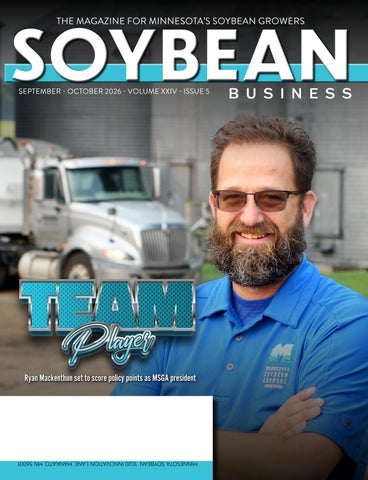
SOYBEAN THE MAGAZINE FOR MINNESOTA’S SOYBEAN GROWERS
SEPTEMBER - OCTOBER 2026 - VOLUME XXIV - ISSUE 5
TEAM Player P
Ryan Mackenthun set to score policy points as MSGA president
B U S I N E S S
MINNESOTA SOYBEAN 1020 INNOVATION LANE, MANKATO, MN MINNESOTA SOYBEAN 1020 INNOVATION LANE, MANKATO, MN 56001
SeedIQ
™
THE NEXT ERA OF YIELD STARTS NOW. We’ve all seen it. Two farmers across the road plant the same hybrid, in the same soil, on the same day, yet their results are drastically different. Why? Because performance isn’t determined by genetics alone. It’s influenced by how that hybrid is managed throughout the season, including population, fertility, stress management, and fungicide timing.
Don’t Just Manage Your Fields. Master Your Product Management.
2 - SOYBEAN BUSINESS -SEPTEMBER - OCTOBER - 2026
BIODIESEL OPEN THANK YOU TO OUR SPONSORS!
UNITED STATES
ALLIANCE
BENNETT GOVERNMENT CONSULTING
DUERR GOVERNMENT AFFAIRS
MCLEOD COUNTY CORN & SOYBEAN GROWERS KANDIYOHI COUNTY CORN & SOYBEAN GROWERS WATONWAN COUNTYCORN & SOYBEAN GROWERS FARIBAULT COUNTY CORN & SOYBEAN GROWERS
REDWOOD COUNTY CORN & SOYBEAN GROWERS MURRAY COUNTY CORN & SOYBEAN GROWERS NOBLES COUNTY CORN & SOYBEAN GROWERS SEPTEMBER - OCTOBER - 2026 - SOYBEAN BUSINESS - 3
CONTENTS
10
TABLE OF
08
08 ‘A huge win’
MSGA advocacy leads to withdrawal of Clean Cars Rule
10 Logo launch MSGA unveils rebrand
16 Cultivating Connextions MSGA director hosts Taiwanese trade team
28 Bright outlook
Future of Soy Summit fuels innovation, collaboration
4 - SOYBEAN BUSINESS -SEPTEMBER - OCTOBER - 2026
16
28
MISSION
STATEMENT
Tell the compelling stories behind Minnesota’s soybean farmers and their industry, from the field to Capitol Hill to international markets — and everywhere in between.
Minnesota Soybean Growers Association Officers and ASA Directors OFFICERS
County/at-large directors
President Ryan Mackenthun | McLeod County
Bruce Nelsen | Mower County
Vice President Kyle Jore | Pennington-Red Lake Counties
Dusty Neugebauer | Nobles County Lucas Peters | Rock County
Joe Smentek | jsmentek@mnsoybean.com
Treasurer Rose Karau | Watonwan County
Vernon Pooch | Pope County
Managing Editor
Secretary Bob Lindeman | McLeod County
Matt Purfeerst | Dakota-Rice Counties
EDITORIAL STAFF
Robert Nelsen | Murray County
Andy Pulk | Roseau-LOW Counties Tim Rasmussen | Otter Tail-Grant Counties Parker Revier | Renville County
ASA Directors
Gary Schoenfeld | Waseca County
Jamie Beyer | Traverse County
Jamie Seitzer | Nicollet-Sibley Counties
Adam Guetter | Redwood County Darin Johnson | Faribault County Jim Kukowski | Roseau-LOW Counties Jeff Sorenson | Redwood County
Cal Spronk | Pipestone County
MSGA Executive Director
Drew Lyon | drew@mnsoybean.com Ag Management Solutions Art Director Alex Troska | atroska@agmgmtsolutions.com Graphic Designer Ag Management Solutions
Jeremy Tischer | Clay-Wilkin Counties Doug Toreen | Renville County Tim Wolf | Dodge-Steele Counties
ADVERTISING Sales Manager Erin Rossow | erossow@agmgmtsolutions.com
Bob Worth | Lincoln County
507-902-9191
ASA Young Leader
Advertising space reservations can be made by the 15th
Andrew Mages | Clay-Wilkin Counties
day of the month prior to publication. In consideration of the acceptance of the advertisement, the agency and the advertiser must, in respect of the contents of
County/at-large directors Trevore Brekken | Polk County Mark Brown | Watonwan County Steve Brusven | Yellow Medicine County Jason Cadieux | Kittson County Nick Daugherty | Renville County Brian Fruechte | Lincoln County Tom Grundman | Douglas County Justin Hendricksen | Martin County Ray Hewitt | Le Sueur-Scott Counties Brad Hovel | Goodhue County Brent Imker | Cottonwood County Jordan Jacobson | Lyon County Mark Knutson | Marshall County Marcus Meiners | Todd County
About the Cover Ryan Mackenthun is lacing up his sneakers to deliver for the Minnesota Soybean Growers Association this year. As MSGA president, the Brownton family farmer and youth basketball coach is focused on leading a team of advocates to protect crop inputs, find new markets and lay the groundwork for emerging leaders to shine. Photo by John Cross. Read more, starting on page 22
the advertisement, indemnify and save the publisher harmless against any expense arising from claims or actions against the publisher because of the publication of the content of the advertisement. Advertisements within this publication contain the opinions and information of the advertisers and do not necessarily reflect the opinions or views of the Minnesota Soybean organizations or affiliated groups.
CIRCULATION Soybean Business is published six times a year on behalf of Minnesota Soybean. Comments and suggestions can be submitted to: Membership Manager Jodie Arndt | jodie@mnsoybean.com 507-388-1635
mnsoybean.org SEPTEMBER - OCTOBER - 2026 - SOYBEAN BUSINESS - 5
A LETTER FROM THE PRESIDENT When I look back on my leadership odyssey that’s led to becoming president of the Minnesota Soybean Growers Association, it all started with my county board. I served as chair of the McLeod County Corn & Soybean Board for RYAN MACKENTHUN five years. In 2018, I joined my local President, MSGA co-op board as an associate director. Through that opportunity, my wife, Tanya, and I attended the CHS New Leaders Workshop and later traveled to Washington, D.C., with the CHS board. That trip changed my perspective. I realized the people sitting across the table from members of Congress were no different than me — they too were farmers. They simply chose to step forward and advocate for agriculture. At the time, discussions centered around the USMCA and retaliatory tariffs. While the issues have evolved, it’s remarkable how many of the same challenges still face agriculture today. That experience inspired me to become more involved. I applied for, and was accepted into, the American Soybean Association (ASA) Corteva Young Leader Program. The program introduced me to outstanding agricultural leaders from across the country and reinforced how important it is for farmers to have a voice at all levels of government. After completing the program, I joined the MSGA Board of Directors. I’ll never forget my first meeting. As discussions turned to topics like dredging the Mississippi River, I quickly realized the issues at the state level were much broader and more complex than anything I had experienced at the county level. It was intimidating at first, but I was surrounded
6 - SOYBEAN BUSINESS --SEPTEMBER SEPTEMBER--OCTOBER OCTOBER - 2026
by experienced directors who were willing to teach and mentor me. Their guidance eventually led me to serving as secretary and now president of this incredible organization. Serving on MSGA has shown me how much happens behind the scenes on behalf of Minnesota soybean farmers. Whether it’s working with our outstanding staff, advocating at the Capitol, collaborating with national groups like ASA or meeting directly with policymakers, every conversation matters. One example stands out. Several years ago, MSGA joined the legal challenge against Minnesota’s proposed Clean Cars rule, which was based on California emissions standards. We believed the policy overlooked the significant environmental benefits already being delivered through biodiesel and renewable fuels. After years in court, that rule was ultimately withdrawn — a meaningful victory that demonstrates how membership in MSGA protects soybean farmers and rural communities. Today, I’m optimistic about the future of soybeans. A year ago, markets looked much different. A year ago, markets looked much different. Today, I’m optimistic about the future of soybeans. Stronger renewable fuel policies and increased stronger renewable fuel policies and increased renewable volume obligations (RVOs) have provided greater certainty for soybean oil demand. That certainty is encouraging investment in domestic processing and creating more opportunities to add value right here at home. Together, we’re strengthening markets while supporting jobs and economic growth throughout rural America. None of these accomplishments happen because of one person. They happen because farmers are willing to get involved, because members support organizations like MSGA and because dedicated people continue to advocate for our industry every day. I am truly honored to serve as your president. Thank you for your membership, your support and your trust. Together, we will continue working to ensure a strong future for Minnesota soybean farmers.
DEPARTMENT DISPATCH
CULTIVATING MINNESOTA’S FUTURE BY SUPPORTING NEW AND TRANSITIONING FARMERS
BY COMMISSIONER
THOM PETERSEN
This column is a series in Soybean Business featuring leaders from the Minnesota Department of Agriculture. Agriculture remains the backbone of Minnesota’s economy, yet the state faces a critical moment in its fields. According to the USDA Census of Agriculture, the average age of a Minnesota farmer is 57.1 years old, with over a quarter of producers nearing traditional retirement age. As thousands of experienced producers prepare to step back over the coming decade, supporting farm transitions is vital to not only to keep fertile acres in production, but to protect local food security, sustain rural communities and spark new growth in agriculture. Bringing new producers into farming injects fresh energy, diverse approaches and important momentum into the industry. Navigating the transition process, or starting a farm operation from scratch, presents steep financial barriers, including rising land costs, equipment overhead and tight lending terms. To bridge this gap, the Minnesota Department of Agriculture (MDA) offers a host of resources designed to help nextgeneration farmers launch, build and sustain their operations. •
•
Beginning Farmer Loan Program: Administered through the Rural Finance Authority, this program partners with commercial lenders to purchase a portion of a new farmer’s loan, offering lower fixed-rate financing to reduce interest costs and down payment hurdles for land or improvements. Beginning Farmer Tax Credit: This incentive encourages land transfers by providing state
tax credits to landowners who sell or lease farmland, equipment or livestock to beginning farmers. The Minnesota State Legislature temporarily removed the funding cap for the tax credit for 2026 transactions. This means all eligible asset owner applications that are complete and submitted by the appropriate deadlines can be approved. •
Down Payment Assistance Grant: To directly tackle the cost of purchasing land, this competitive grant offers eligible first-time farm buyers up to $20,000 toward purchasing agricultural real estate.
•
Beginning Farmer Equipment and Infrastructure Grant: Capital expenses extend beyond land. This program helps early-stage growers purchase items like machinery, irrigation systems, livestock fencing and cold storage.
•
Emerging Farmers Office: This office provides advocacy, outreach and assistance navigating program for historically underserved groups, including women, veterans and beginning farmers.
•
FarmLink: Serving as an online matching platform, FarmLink connects prospective farmers seeking land, apprenticeships or mentorship with retiring producers eager to see their operations continue.
•
Minnesota Farm Advocate Program: Transitioning a farm involves complex financial planning, debt restructuring and family dynamics. Farm Advocates offer free, confidential, one-on-one assistance to help farmers evaluate their financial position, negotiate with lenders and navigate state and federal assistance programs during major operational shifts or succession planning.
Sustaining Minnesota’s ag industry requires multiple approaches. By lowering financial hurdles, guiding succession strategies and creating clear paths for new producers, MDA’s programs ensure that the state’s farm economy remains resilient and prosperous for generations to come.
MSGA advocacy leads to withdrawal of Clean Cars Rule By Drew Lyon Membership in the Minnesota Soybean Growers Association (MSGA) means taking a stand and making a meaningful difference to improve farmer profitability for the short and long term. In early 2023, MSGA stood up for its members by joining a lawsuit challenging the state of Minnesota’s earlier adoption of California’s “Clean Cars Rule” in 2021. The lawsuit, filed in the U.S. District Court for the District of Minnesota, challenged the legality of Minnesota Pollution Control Agency rules that required new cars, light-duty trucks and medium-duty vehicles in the state meet emission limits set by California and match California’s requirements for the sale of a certain percentage of so-called “zero-emission vehicles,” as defined by California regulators. Those efforts have paid off. On June 30, 2026, the state of Minnesota entirely withdrew the Clean Cars Rule, signaling a win for Minnesota’s biofuels industry and the state’s nearly 26,000 soybean farmers. The process for withdrawal began in May, when Attorney General Keith Ellison submitted a letter to the U.S. District Court initiating the process to formally dismiss the Clean Cars Rule. “It’s a huge win,” said Michael Buschbacher, managing partner at Boyden Gray, which defended the lawsuit on behalf of MSGA, the National Association of Convenience Stores, Minnesota Service Station 8 - SOYBEAN BUSINESS -SEPTEMBER - OCTOBER - 2026
& Convenience Store Association and the Clean Fuels Development Coalition. “This gets rid of a very substantial regulatory burden that was harming biofuels across Minnesota and prevents enforcement of these destructive mandates.” The motion that was filed on June 30 states: •
Defendants will not enforce the greenhouse gas emissions standards or the zero emissions standards (Minnesota Rule Rules 7023.0250 or 7023.0300) for vehicles produced or delivered for sale or lease after model year 2025;
•
Defendants have initiated state notice-andcomment rulemaking to repeal Rules 7023.0250 and 7023.0300 by publishing a “Notice of Intent to Repeal Obsolete Rules” in the Minnesota State Register on June 29, 2026;
•
Defendants will make best efforts to finalize the Rules 7023.0250 and 7023.0300 by Dec. 31, 2026.
•
After such repeal is complete, defendants must engage in new notice-and-comment rulemaking to adopt any vehicle emissions standards as rules of the State.
“We’re proud that we successfully defended our members by pushing back against an electric vehicle mandate that threatened Minnesota’s biofuels industry,” MSGA President Ryan Mackenthun said.
Advocacy in Action
“Legal efforts like these underscore why it’s important to join MSGA, because we’re being proactive and working all the legislative, regulatory and legal channels we can to preserve valuable markets and improve the farm economy.” The lawsuit contended that the federal Energy Policy and Conservation Act (EPCA), which creates a uniform national standard for vehicle fuel efficiency, prohibits states from adopting policies “related to” federal fuel-economy standards. EPCA says that a “State or a political subdivision of a State” cannot “adopt or enforce a law or regulation related to fuel economy standards or average fuel economy standards.” Fueling Minnesota In Minnesota, biodiesel continues to help grow the state’s economy. Nearly $1.7 billion of Minnesota’s GDP is supported by the biodiesel industry, and biodiesel supports nearly 5,400 jobs in the state and 65,000
jobs in the U.S. Every 100 million gallons of production supports 3,200 jobs and biodiesel adds more than $1 to every bushel of soybeans, increasing demand by 13%. Aside from economic benefits, the biodiesel industry helps protect the environment. Studies show that biodiesel reduces greenhouse gas emissions by more than 50% and displaces roughly 130 million gallons of petroleum diesel in Minnesota each year. Using a B20 blend in the summer and a B5 blend in the winter equates to removing emissions from nearly a quartermillion vehicles from state roads every year. “Court cases are costly and can take a long time — this one took over three years,” Mackenthun said. “To continue prevailing in the court system, resources are required and that’s why membership in MSGA is so important.” To support MSGA’s legal efforts to protect farmers and Minnesota agriculture, become a member by visiting mnsoybean.org/msga.
The biodiesel and renewable diesel industry supports more than $42.4B in economic impact and 100,000+ jobs in the U.S.
Materials supported by United Soybean Board, soybean farmers and their checkoffs.
SEPTEMBER - OCTOBER - 2026 - SOYBEAN BUSINESS - 9
MSGA News
Forging an identity MSGA rebrands, refreshes logo By Drew Lyon Sometimes, in life and in business, the time is right to freshen things up and update one’s identity. In summer 2026, the Minnesota Soybean Growers Association decided the moment had arrived to develop and approve a new logo for only the third time in the organization’s 64-year history. “It’s been over a decade since we rebranded and updated our logo, and our board decided we wanted to brighten up our logo and emphasize positivity and our industry’s history within Minnesota,” said Ryan Mackenthun, MSGA president. “We sought an image that helps MSGA stand out in an optimistic way, as opposed to our previous black background, which didn’t always look inviting on a page.” The new vertical and horizonal logo reflects MSGA’s heritage and traditional colors — blue, green and gold — while incorporating the MSGA “M” within the Minnesota state outline, with rows of soybeans filling the bottom half of the state. Directors approved the new logo at MSGA’s June 2026 board meeting. “We wanted a logo that was clean and simple, easy to read, and shows that Minnesota and soybeans are intertwined,” said Joe Smentek, MSGA executive director. “Our directors worked with our marketing team on a logo that honors our past while looking beyond the horizon toward the future.”
Brand boost Changes have occurred at a rapid rate within MSGA and the soybean industry since 2015, when MSGA underwent a formal rebrand: Tariffs; the buffer law; a historic move to B20; increases to input costs; a pandemic; artificial intelligence; and consolidation within agriculture, just to name a few seismic events over the past 11 years. MSGA has also changed its leadership structure through forming internal task forces, its first governing board and proactive advocacy. What hasn’t changed is MSGA’s member-driven mission to promote farm-friendly legislative and regulatory policies in St. Paul and Washington, D.C. The rebrand helps reflect MSGA’s goal to stay up to date on modern trends, both in agriculture and marketing. “The last decade in agriculture has seen more changes than perhaps any era that came before it, from technology to huge swings in the farm economy and a new generation of leaders taking roles within MSGA,” said Sara Hewitt, MSGA’s marketing manager. “We want to continue adapting and improving, both internally and how we’re messaging ourselves to our farmers and the public. A new logo helps reflect how we’re sharpening our brand as we look ahead to not just the next year, but the 2030s and beyond.” MSGA isn’t completely eschewing its past designs: the “M” in its previous logo will still be used where applicable, and the original logo from the 1960s, still beloved by many directors, is occasionally used in throwback designs to raise funds for MSGA.
10 - SOYBEAN BUSINESS -SEPTEMBER - OCTOBER - 2026
Protect Your Business from Today’s Growing Fraud Threats Fraud is evolving. Criminals are using new technology, artificial intelligence, and increasingly sophisticated tactics to target businesses of all sizes, including agricultural operations and small businesses.
At Profinium Bank, we understand that business owners are focused on serving customers, managing operations, and growing their businesses. Unfortunately, fraudsters are focused on finding opportunities to disrupt that success. Taking proactive steps today can help protect your business and the work you have built.
COMMON FRAUD THREATS FACING BUSINESSES
Today’s most common fraud attempts include: Check fraud, including check washing and counterfeit checks Email account takeover leading to ACH or wire fraud Credit and debit card fraud AI impersonation scams Fraud connected to online purchases and marketplaces Technology has made fraud attempts harder to identify. A message, email, or payment request may appear legitimate, making it important to slow down and verify before taking action.
Taylor Herman VP Treasury Management NMLS# 938973
David Thamert Veronica Bruckhoff Senior VP Ag Banking VP Business Development
THREE WAYS TO HELP PROTECT YOUR BUSINESS 1. Strengthen Internal Controls Implement dual controls, separate financial responsibilities, and use multi-factor authentication whenever possible. Having additional layers of approval can help prevent unauthorized transactions. 2. Review Your Accounts Regularly Do not wait until the end of the month to review your account activity. Regularly monitoring transactions can help identify suspicious activity sooner and improve the chances of stopping or recovering funds. 3. Educate Your Team Employee awareness is one of the strongest defenses against fraud. Make sure your team knows what warning signs to watch for and how to handle suspicious requests.
WHEN SOMETHING FEELS WRONG, VERIFY
Many fraud attempts begin with a request that seems unusual. A vendor may request a payment change, or an email may ask for an urgent transfer. If something does not feel right, stop and verify. Call the person or business directly using a trusted phone number. Never provide personal or banking information through an unexpected email, text, or phone call.
PROFINIUM HELPS BUSINESSES FIGHT FRAUD
Profinium Bank partners with businesses and agricultural customers to understand their unique needs and recommend solutions that help strengthen financial security. Fraud prevention tools and services may include: Positive Pay for checks and ACH transactions Dual control and multi-factor authentication ACH services Bill Pay solutions Online card management My Financial Health, available in two tiers, providing financial wellness and protection resources If you suspect fraud, act quickly. Secure your accounts, preserve documentation, and contact your financial institution and IT partners immediately. Timing matters, and early action can help reduce the impact. Do not assume fraud will not happen to your business. Prepare today so you are ready to respond if it does.
MEET OUR AG LENDERS Visit profinium.com/ag-banking
At Profinium Bank, we are committed to helping businesses and agricultural customers protect what they have built and continue moving forward with confidence.
Products and services may require enrollment, other terms and conditions and fees may also apply. Third party fees for internet, QR codes, messaging, or data plans may apply. This is for informational purposes only.
Better days ahead Emerging leaders impress MSGA directors during summer Hill Visits By Drew Lyon The leadership structure of the Minnesota Soybean Growers Association is rock-solid, comprising an ideal mix of established directors and emerging farmers primed to represent Minnesota’s nearly 26,000 soybean farmers in the policy and regulatory arenas. And if Minnesota farmers Andrew Mages and Keeley Runge are any indication, the future is paved with strong leaders. Mages headed to Washington, D.C., for the American Soybean Association’s summer 2026 board meetings and Hill Visits after being selected to participate in the third portion of the prestigious American Soybean Association Corteva Young Leader Program. “The program has been so beneficial for me personally and professionally,” Mages said. “I’ve made a lot of great friends from across the country and have learned about leading and how to advocate and effectively communicate for farmers.” Mages had a perfect chance to put the program’s tools into practice during ASA’s summer Hill Visits. He joined ASA Director and past MSGA President Darin Johnson, ASA Directors Jeff Sorenson and Bob Worth and MSGA Executive Director Joe Smentek for a round of policy visits with Minnesota’s congressional delegation. While sitting alongside experienced director advocates, Mages didn’t hesitate to speak up and tell his story as a Belgrade, Minn., family farmer who’s also maintaining a full-time job as a risk management commodity analyst and crop insurance agent. Mages has quickly made an impression on his new colleagues. “We’ve had a lot of fantastic Young Leaders over the years, and Andrew ranks with the best of them,” Smentek said. “He really connected with our team through his assertiveness, preparation and ability to speak with legislators and their staff in a very professional, polished manner.” Fortunately for MSGA, the organization can continue to tap into Mages’ expertise: As part of completing the Young Leader program, he’s an at-large MSGA director, was recently elected to serve on MSGA’s governing board and is a member of the Clay-Wilkin County Corn & Soybean Growers Board. “I really enjoyed learning the ropes on my first Hill Visit with MSGA,” said Mages, whose dad, John, is past chair of the Minnesota Corn Research & Promotion Council. ‘An amazing experience’ MSGA divided into two groups to ensure faceto-face visits with all 10 members of Minnesota’s congressional delegation. ASA Executive Committee member Jamie Beyer, MSGA Vice President Kyle Jore and ASA Director Jim Kukowksi walked the Capitol to meet with Sen. Tina Smith, Rep. Kelly Morrison and staffers representing Reps. Ilhan Omar, Tom Emmer
12 - SOYBEAN BUSINESS -SEPTEMBER - OCTOBER - 2026
MSGA News
and Pete Stauber. Joining grower leaders was St. James farmer Keeley Runge, who was in the nation’s capital to participate in ASA’s Ag Voices of the Future program, which offers young people with farming backgrounds opportunities to learn more about farm-related policy issues and grow their advocacy skills. Runge, now in her second year at South Dakota State University, leaped at a chance to enter the program. After college, she hopes to work as a legislative aide on Capitol Hill. During her day advocating alongside some of the nation’s top farmer advocates, Runge saw how groups like MSGA work to improve the farm economy by advocating for farm-friendly federal priorities. “This was an amazing experience to be on Capitol Hill with MSGA and learn how they’re promoting legislation that will benefit Minnesota’s farm economy,” she said. “To see it all up close was a really unique opportunity.” Runge also had the chance to visit with her congressional representative — and family friend — Brad Finstad. Upon leaving Rep. Finstad’s office, she was surprised to run into more friends: fellow members of Minnesota’s FFA team. While on the Hill, both MSGA teams urged legislators and their staffers to support policies that will jumpstart the farm economy, including: •
Renewing USMCA by supporting a full 16-year renewal of the trilateral trade agreement that will provide much-needed certainty for soybean farmers in two critical export markets (Canada and Mexico). The agreement currently offers dutyfree treatment for soybeans and soy products.
•
Asking the Treasury Department to finalize 45Z Biofuel Tax Credit tax guidance to ensure the tax credit is viable through its 2029 expiration.
•
Lowering input costs by removing ag input tariff exemptions, opposing countervailing duties and supporting policies promoting competition and innovation.
•
Passing a comprehensive five-year Farm Bill before year’s end.
•
Ensuring reliable access to crop protection tools by supporting science-based access
•
Supporting edible soybean markets and highlighting soy as a healthy source of protein.
Beyond delivering priorities, MSGA makes it a point to build legislative relationships by putting a personal face behind the policy issues. “There are a lot of complicated issues within the farm economy right now, and it’s our jobs as farmer leaders to simplify them as best we can and explain how the policies are positively and negatively affecting our family businesses,” Johnson said. “We appreciate the time our legislative leaders take out of their schedules to engage with us and learn how D.C. policies can impact us back in Minnesota.” To cap the Hill Visit, both groups met with Sens. Amy Klobuchar and Tina Smith. ASA President Scott Metzger and Treasurer Tanner Johnson joined the Minnesota group during the Klobuchar meeting. While Mages and Runge can count on one hand the number of times they’ve walked Capitol Hill, for leaders like Bob Worth, that number has reached the dozens over the years. Still, the privilege of representing Minnesota farmers never grows stale. “Every time I’m in D.C. talking about soybean issues on behalf of MSGA and ASA, I’m proud to be here,” Worth said.
ASA Young Leader Andrew Mages (second to left) and Keeley Runge (third to left) joined ASA directors for thier summer Hill Visits in D.C., where they met with Rep. Brad Finstad (middle). SEPTEMBER - OCTOBER - 2026 - SOYBEAN BUSINESS - 13
Minnesota Farm Transition Survey 2025-2026 Feedback from producers provides a better understanding of their needs and creates an opportunity to improve resources that support successful farm ownership and management transitions. This survey was funded by MAELC.
Who Responded?
Mindset & Intentions
75+ producers representing 29 counties across southern and central Minnesota, with strong participation from Blue Earth, Goodhue, Le Sueur, Murray, Pipestone, and others.
Years of Experience
Production Type
Farm Size (in Acres)
(select all that apply)
30 + ye s ar
18%
7%
5
Planning Progress
< 50 51-250
Moderate
18%
I worry a lot
401-900 900+
Agritourism
40%
21%
13%
Intending to transfer your farm? NO
YES
251-400
0%
Value Added on Farm
8%
None
Specialty Crop
7%
6-9
Not at all
52% have over 400 acres
Livestock
Dairy
<
20 - 29
10
9
54%
Crop
60% of respondents have farmed for 20+ years
-1
89%
How much does farm transition keep you up at night?
(9%)
(91%)
When do you hope to start? Less than 3 years
4-7
8-9
10+
41%
29%
4%
26%
(Producers intending to transfer)
Who will own and manage the farm after you?
Top reasons for not starting: unsure where to begin, no time, too early, family not aligned.
Transition Planning Steps Taken
Estate Planning Status (select all that apply)
74% Family
(select all that apply)
Met with an attorney .......................................... 25%
I have a living will ...................................... 37%
Met with a tax accountant................................ 17%
I have created a trust............................... 18%
Met with a farm transition consultant ............... 12%
I haven’t started and am unsure how.... 21%
Attended a workshop/planning retreat........... 31%
I started the process but got stuck ......... 17%
Have not started yet........................................... 12%
Other............................................................. 7%
Other....................................................................... 3%
Top Barriers to Completing a Farm Transition (select all that apply) Capital gains tax
29%
26%
18%
Don’t know yet
1%
Non-family
Support Needed Most Requested Farm Transition Resources • Help starting the process • More workshops and planning retreats
Unsure where to begin
No Successor
Family dynamics
Long-term health care
24%
Other
14%
5%
8%
• Access to legal and tax expertise • Guidance on trusts, LLCs, land structures, and ownership • Balancing fairness among heirs
KEY INSIGHTS
• Real-world case examples and best practices A MAJOR TRANSITION WAVE IS COMING
PLANNING IS INCOMPLETE
FAMILY & FINANCIAL CHALLENGES
STRONG DEMAND FOR GUIDED SUPPORT
OPPORTUNITIES FOR PARTNERS
Producers Not Intending to Transition Their Farm (9%) Top Reasons
Over 90% plan to transfer, most within 3-7 years.
Many have started, and too many haven’t.
Biggest hurdles are emotional and technical.
Trusted advisors and practical hands-on help.
Planning, family, and legal/tax, resources.
MORE RESOURCES: centerofagriculture.org/farm-transition
Support They Need
• No heirs/successor
• Mentorship & counseling
• Next generation uninterested
• Info on perpetual or conservation-style trusts
• Still navigating a transition
• Guidance for end-of-life farm stewardship
This document is available in alternative formats to individuals with disabilities. To request an alternate format, contact Human Resources at 651-201-1664. Individuals with hearing or speech disabilities may contact us via their preferred Telecommunications Relay Service. Minnesota State is an affirmative action, equal opportunity employer and educator.
MN
YOUNG & EMERGING FARMER HOSTED BY THE MINNESOTA SOYBEAN GROWERS ASSOCIATION
WORKSHOP
It takes a village to run a farm. The MN Young & Emerging Farmer Workshop is here to help!
APPLY TODAY! Hosted by the Minnesota Soybean Growers Association, the fourth annual MN Young & Emerging Farmer Workshop offers networking, panel and roundtable discussions; insights on succession planning; a broader understanding of on-the-farm financials; and more.
Active crop farmers in Minnesota ages 21-45 years old are encouraged to apply! When: Jan. 18-20, 2027 Where: Mankato, MN, at MN Ag Expo Deadline to apply: Oct. 31 Cost: Participation is free with lodging expenses covered
For more information, contact Bailey Grubish at bgrubish@agmgmtsolutions.com or MSGA Director Jeremy Tischer at jtischerfarms@outlook.com.
Scan the QR code to apply!
Cultivating Faribault farmer makes fast friends with Taiwanese buyers following Soy Connext
Connextions By Drew Lyon Faribault farmer Matt Purfeerst isn’t just asked to host international trade teams because his family farm sits a mere hour south of the Minneapolis-St. Paul International Airport. His farm is also an ideal location for international delegations because Matt and his dad, Jim, are welcoming, affable and eager to share their story and explain how their family has raised highquality, sustainable crops since the 1850s. “I probably learn more from them than they do from me,” said Purfeerst, a fifth-generation farmer who represents Rice County on the Minnesota Soybean Growers Association (MSGA). “And the more we can export, the better off we all are. It helps them, too,
because they want to import our beans. It’s a win-win.” In August 2026, the Purfeersts took time away from what had become an increasingly busy stretch prior to harvest to welcome a team of agricultural industry leaders from Taiwan. “You’ve got to show your buyers what we’re producing,” Jim said. After welcoming the group into his farm shop, Matt Purfeerst walked his guests through the pace of the growing season. But he advised against stepping into his nearby soybean field on a muggy morning. “Walking in a bean field isn’t fun — you’ll be soaking wet,” Purfeerst said, before joking, “You guys want to go in?”
Matt Purfeerst is the newest member of MSGA’s governing board. During college, he also served as a Minnesota Soybean ambassador. 16 - SOYBEAN BUSINESS -SEPTEMBER - OCTOBER - 2026
Trade Teams
Preferring U.S. Soy The Taiwan buyers made their way to Minnesota following a visit to Soy Connext, the industry’s premier trade event, in Chicago. The delegation was accompanied by staff from the U.S. Soybean Export Council, which hosts Soy Connext, and the Minnesota Department of Agriculture. As part of efforts to build international markets, the Minnesota Soybean Research & Promotion Council invests checkoff resources towards supporting MDA’s Taiwan trade office. “These trade visits are such a good opportunity for Minnesota farmers to connect with buyers and give an up-close look at how they’re raising the crops that make their way to Taiwan,” said Irene Tsai, managing director of MDA’s Taiwan office. “Without the support of (MSR&PC), we wouldn’t be able to bring (the group) to Taiwan.” The group represented leaders from across Taiwan’s crushing and feed industries, including Lee Shou-Hao, a commodity trader at TTET Union Corporation, Taiwan’s largest soybean crusher. Located in southern Taiwan, TTET has an annual crushing capacity of 1.5 million tons. Lee Shou-Hao was returning to Minnesota: In 2018, he visited the state when the Taiwan Vegetable Oil Manufacturers Association signed a letter of intent at the Governor’s Mansion alongside MSR&PC CEO Tom Slunecka to purchase $1.56 billion worth of Minnesota and Iowa soybeans over a two-year period. “U.S. soybeans are preferable because of their higher quality and lighter color,” Lee Shou Hao said, adding, “It’s a very beautiful field here.” U.S. soybeans are one of Taiwan’s top agricultural
imports: The country imports nearly $700 million in U.S. soy, equating to about 18% of U.S.’s total ag exports to Taiwan. Minnesota soybeans are typically shipped by bulk vessels and containers via the Pacific Northwest. On a per-capita basis, Taiwan is the largest consumer of U.S. food products. Taiwan imports soy for both human and animal (mostly hogs and poultry) consumption, and there’s an increased demand in using soybean oil for biofuels, in addition to cooking oil. Taiwan’s imports of U.S. soybeans could grow by more than 50-60% in the years ahead. Minnesota Legislature has also passed numerous resolutions of support to encourage trade growth between the two countries, often referred to as “sister states.” “It’s a very vibrant country, and we have a really great relationship with the people of Taiwan,” said MSGA Executive Director Joe Smentek, who toured Taiwan in 2025 during a USDA trade mission. “It continues to be one of our top developing markets.” ‘What it’s all about’ The Purfeersts rotate about 4,000 acres of corn and soybeans. They have one full-time employee and also use seasonal help during the growing season. Workforce issues are a constant struggle across agriculture, Jim Purfeerst explained to his international guests. “Good labor is hard to find around here, and we’re no different,” he said. The Purfeersts are adapting to those challenges, thanks to new technology. Matt Purfeerst showed the delegation the farm’s new 100% autonomous and Continued on page 18
The trade team visit to Minnesota was a collaboration between MSR&PC, USSEC and the Minnesota Department of Agriculture. SEPTEMBER - OCTOBER - 2026 - SOYBEAN BUSINESS - 17
solar-powered, AI-driven sprayer — the first of its kind to be used in Minnesota. The sprayer helps reduce the Purfeersts herbicide use by over 90% and minimizes soil impaction. “You just leave it, and it goes between the rows,” Matt said. Jim Purfeerst said the new technology has caught the attention of his neighbors. “Yeah, they’re all asking about it,” he said. “Of course, equipment costs are going up, but we’re recommending it because of all the benefits, from less manpower to how accurate it is.” The group departed with gifts, including “Minnesoyta” hats, before heading for a tour of CHS’ Grain Terminal in Savage along the Minnesota River — but not before an invitation from Jim. “If you guys want to come back and run the combine during harvest, you’re welcome to,” he said. The Taiwan officials later capped their day by meeting with directors from MSR&PC at a Minnesota Twins baseball game, visiting with directors, including Joe Serbus, who signed an MOU alongside Taiwanese leaders in 2021. The trade group also departed Minnesota having purchased Minnesota soybeans.
“This is what it’s all about — developing relationships, both on and off the farm, in Minnesota and Taiwan,” Smentek said.
Council directors, staff, Taiwenese buyers and MDA officials gather during a Minnesota Twins game after touring CHS and visiting Matt Purfeerst's farm.
We put soybeans first because you put performance first. At Asgrow® brand, not only are we all about the beans, we’re all about your success as well. That’s why we offer localized products with leading genetics, weed management systems and maximum profit potential – all developed by soybean experts who put soybeans first.
DISCOVER HOW IT’S ALL ABOUT THE BEANS.
Asgrow.com
ALWAYS READ AND FOLLOW PESTICIDE LABEL DIRECTIONS. Asgrow and the A Design®, Bayer and Bayer Cross are registered trademarks of Bayer Group. ©2026 Bayer Group. All rights reserved.
ASA_2026_Minnesota_Half Page_Print_.indd 1
18 - SOYBEAN BUSINESS -SEPTEMBER - OCTOBER - 2026
21/07/26 7:33 p.m.
“WE CHOOSE U.S. SOY BECAUSE IT IS CULTIVATED TO MEET TRUE SUSTAINABLE STANDARDS.” Nhu Ngo of Vietnam-based Janbee Joit Stock Company on a tour of a U.S. Soy farm.
YOU GROW THE WORLD’S MOST SUSTAINABLE SOY. WE GROW DEMAND FOR IT. USSEC builds preference for U.S. Soy by bringing international buyers directly to American farms, where they can meet growers firsthand and see the care, consistency, and sustainable practices behind every harvest.
SCAN TO SEE HOW USSEC SHARES U.S. SOY’S SUSTAINABILITY WITH CUSTOMERS AROUND THE WORLD.
MSGA Events
Ties that bind MSGA hosts USDA secretary, connects with candidates at Farmfest
By Drew Lyon For his first Farmfest as president of the Minnesota Soybean Growers Association (MSGA), Ryan Mackenthun ditched the customary jeans, sneakers and a polo shirt for a suit and tie – at least temporarily. And for good reason: USDA Secretary Brooke Rollins kicked off the 2026 Farmfest by hosting a policy roundtable panel in MSGA’s booth. Mackenthun decided to err on the side of formal fashion when in the presence of a presidential cabinet secretary. “I truly appreciated the opportunity to represent soybean growers from across Minnesota and be given the opportunity to talk about them with Secretary Rollins,” Mackenthun said. “It’s a privilege to speak up on behalf of our producers.” Mackenthun, who farms in Brownton, was joined by leaders from across Minnesota agriculture for a 30-minute conversation with Secretary Rollins to discuss various issues and concerns facing farmers heading into the 2026 harvest. Mackenthun highlighted the importance of preserving the United States-Canada-Mexico Agreement (USMCA) and MSGA and the Minnesota Soybean Research & Promotion Council’s joint efforts in expanding markets for Minnesota soybean farmers. He also thanked Secretary Rollins for recent federal actions supporting biofuels, including stronger Renewable Volume Obligations (RVOs). “Thinking back to a year ago, we are feeling optimistic again,” Mackenthun told the secretary. “Our markets for biofuels are strong, and prices have begun to rebound.” Rollins, who spent summers on her family’s farm in Minnesota, also announced at Farmfest several steps that the USDA is taking to support America’s
farmers in response to ongoing challenges across the agricultural sector. These actions include a series of data modernization, payment flexibility and enhanced crop insurance options to benefit farmers. “We’re modernizing how USDA serves farmers, providing common sense flexibility when it’s needed most, and strengthening the risk management tools producers depend on,” Secretary Rollins said. Following the panel, Secretary Rollins visited with Mackenthun and MSGA staff, posing for photos and gladly accepting a “Minnesoyta” pen. “Minnesoyta — I love it!” she said. The panel, which was sponsored by the Farm Journal Foundation, also featured Small Business Administration Administrator Kelly Loefler, Reps. Brad Finstad and Michelle Fischbach, House Ag Committee Vice Chair Austin Scott and USDA Under Secretary for Trade Luke Lindberg. Nearly 75 Farmfest attendees made their way inside MSGA’s booth to listen to the discussion. “It was an honor to host so many dignitaries from our industry,” Mackenthun said. “I think it shows that MSGA has earned a reputation as a group that is sought out for our advocacy and eagerness to engage with legislative leaders and regulatory officials, regardless of party affiliation.” Grower leaders — including past MSGA President and American Soybean Association Director Darin Johnson and ASA Directors Jamie Beyer, Jim Kukowski, Jeff Sorenson and Bob Worth, along with state Director Gary Schoenfeld — spent the three days of Farmfest visiting state and federal legislative candidates from across the spectrum. Directors also participated in dozens of interviews with media from across the country.
20 - SOYBEAN BUSINESS -SEPTEMBER - OCTOBER - 2026
Soybean Business Cover Story
Coach
Ryan
MSGA’s new president is running point
By Drew Lyon The game of basketball might not seem like it shares traits with soybean lobbying, but there are similarities: Both activities require teamwork; strong defense combined with an offensive mindset; and a point guard to work the floor. Ryan Mackenthun can appreciate the parallels. He’s an avid basketball fan who, despite recently turning 50 years old, still plays pickup basketball while coaching multiple youth basketball teams. He’s also entering his prime as a farmer advocate following his June 2026 election as president of the Minnesota Soybean Growers Association. And sports fans, like farmers, remain optimistic about the future. Mackenthun is finding many reasons to stay positive heading into 2027: a resilient ag economy, high demand for soybean oil and new opportunities to build relationships with the incoming Legislature in St. Paul. “I’m excited again, and there hasn’t been a lot of excitement in farming over the past couple of years,” Mackenthun said during an interview at his bin site near his farm in Brownton. “Prices are going up, and we’re profitable again — I see a lot of hopeful opportunities for the future, not just as a farmer, but as president of MSGA.” Nothing but net Mackenthun has wasted no time creating opportunities for himself as both a farmer and advocate. Growing up, he worked on his fifthgeneration family farm, in operation since 1887, alongside his father, Dale, and started farming full time in 1994 after graduating high school. That summer, as a 4-H’er attending the Minnesota State Fair, Mackenthun was interviewed by Minnesota Public Radio and predicted his future in agriculture. 22 - SOYBEAN BUSINESS -SEPTEMBER - OCTOBER - 2026
“I’ll stay on the farm and see how it works,” he said in 1994. “I’ll probably end up farming, though.” Indeed, he did, but not without enduring trials and tribulations. In the early 2000s, the Mackenthuns made the difficult transition away from dairy farming to focus on row cropping; after renting for over a decade, Ryan joined the family corporation in 2009. Four years later, in 2013, Dale Mackenthun died suddenly, and Ryan began managing the farm site. “Agriculture wasn’t doing so good then,” said Mackenthun, who now farms with his brother-in-law, Nathan. “Farming wasn’t fun the first couple of years without my dad. Prices were brutal.” In 2014, Mackenthun joined the McLeod County Corn & Soybean Growers Board and started promoting farming at the local level. Five years later, he took a leap when he applied to become an American Soybean Association Young Leader. Looking back on the experience, which helped sharpen his leadership and communication skills, Mackenthun is proud of his successful efforts in urging MSGA to tweak its bylaws and allow ASA Young Leaders to stay on the board as at-large directors from one year to three years. “I was very close to not being on the board after (that first year),” Mackenthun said. “I’m glad the board reconsidered to allow our Young Leaders a chance to become more acclimated on the board. I think that’s important.” Mackenthun now lives on a once-abandoned farm site with his high school sweetheart and wife of 25 years, Tanya, and their three teenaged children, just down the road from the family farm. “I feel pretty lucky,” he said. “Most days, I can make my own hours. ... and in the summer, I can work wearing shorts.”
Floor general In 2022, while serving as MSGA secretary, Mackenthun stepped out of his comfort zone when he testified to the Minnesota Senate Agriculture Committee in advocating for increasing first-tier valuation for ag homestead property to $3.5 million for assessment year 2024. “Ryan was the only farmer who testified in support of the tax credit, which eventually passed and was a huge win for MSGA and the next generation of farmers in land transition. This bill will have a lasting impact, thanks to Ryan,” MSGA Executive Director Joe Smentek said. “His personal testimony had a real effect on lawmakers.” Mackenthun is seeking to have a similar impact as MSGA president. After serving for two years as vice president under Darin Johnson, Mackenthun no longer considers himself a rookie; he’s a veteran all-star advocate. As president, he’s encouraging his fellow directors to be more active in MSGA board meetings and within the organization’s internal committees. “(Former Director) Joel Schreurs said it best when he retired from the board a few months back: ‘It’s time for the younger directors to step up,’” Mackenthun said. “I think MSGA works best when we have many voices speaking up and being involved. Only good things can come from that.” Mackenthun’s colleague, MSGA Vice President Kyle Jore, commended Mackenthun’s leadership following MSGA’s August board meeting. “Ryan took the baton from Darin during a very important time in the year, especially with an election upcoming, and didn’t miss a beat,” Jore said. “He’s hit the ground running.” From the farm to the (basketball) floor, Mackenthun is leading a full-court press on behalf of Minnesota soybean farmers and their communities. “Farmers are bringing value and jobs to not just our farms, but our local businesses,” he said. “If we can continue to do that here in Minnesota, I feel like MSGA is doing our job.”
SEPTEMBER - OCTOBER - 2026 - SOYBEAN BUSINESS - 23
CERTIFIED VALUE
MN Soybean continues partnership with MCIA
By Allison Wright Offering many services and certifications, the Minnesota Crop Improvement Association (MCIA) has been a strong hand in adding value to agricultural products, including soybeans, since Theodore Roosevelt was president. For nearly 125 years, MCIA has continued to adapt to the changing needs of local agriculture by assisting producers through new markets and opportunities. “Crop improvement is designated by the state as a certifying agency for all seed crops and provides oversight on seed production for any crop that’s going to become seed in the in the state, as well as certifying organic production and facilities,” said MCIA Board Chair Kelsey Henke. “The whole staff has a wealth of knowledge for seed programs, seed opportunities throughout the whole state and are good at putting people with the right contact to get their foot in the door.” As a 501 (c)(3) non profit founded in 1903, MCIA relies on a membership base that allows producers and businesses access to a variety of certification and inspection programs. Each year, nearly 700 members use MCIA’s services throughout the state. Since 1955, MCIA has been recognized as Minnesota’s official seed-certifying agency. Products certified by MCIA include field crop seed, turf seed, sod, native plant seed, noxious weed seed–free forage and mulch, identity preserved grains for specialty grain markets, as well as numerous organic crops, livestock and food products. “Our members feel there would be a value added to their product that they are selling with the services
24 - SOYBEAN BUSINESS -SEPTEMBER - OCTOBER - 2026
that we can put on their product when they’re selling them,” said MCIA Executive Director Duane Dahlman. Henke, who is the board’s first female chair, says MCIA is providing solutions in a challenging farm economy. “With the way pricing has gone, people are looking for further opportunities to add value to what they are doing,” she said. MCIA offers a plethora of programs and certifications, each with different standards and guidelines that producers must follow to receive certification or labeling. The services range from seed certification and field inspections to organic certification, quality assurance programs and identity preservation. “They follow a set of standards and guides that you want to follow,” said Jody Prudhomme, MCIA administrative and certification manager. “If they do any final labeling there would be a certificate of some sort and you have to follow us to know the certain requirements in order to be eligible for those programs.” As the soybean industry has evolved, MCIA has shifted its services to fit the changing markets and production systems. “Twenty years ago, we were dealing with public soybeans, and that is what we dealt with. Looking now, that has slowly moved over to private,”
Checkoff Partnerships
Dahlman said. “We used to certify thousands of acres of soybeans, and now that has moved to food-grade soybeans and things along those lines.” Henke, who is a member of the Minnesota Soybean Growers Association, has used several of MCIA’s programs within her own operation in St. Peter, where she served on the Nicollet-Sibley County Growers Board before terming off in 2026. “We use Crop Improvement to inspect our soybeans because we raise treated beans and it is nice to have a third-party inspector to have future eyes on what we are doing,” Henke said. “We also grow certified oats and are a registered crop improvement approved facility.” MCIA is based out of the University of Minnesota (UMN) St. Paul campus. While MCIA holds a close relationship with the UMN, it’s not formally affiliated with the University. “We have great cooperation with the University of Minnesota,” MCIA Foundation Seed Services Manager Carl Anfinson said. “We get involved with the breeding programs, including the soybean breeding program, and some pure seed increases to help support more of the food-grade specialty soybean market for companies.” ‘Looking for opportunities’ Beyond certifications and inspections, MCIA also has opportunities for members to connect and shape the organization. “Our biggest event right now is our annual meeting, usually held in mid to late January,” Dahlman said. “All of the members are invited to attend for a day meeting where we talk about our goals and objectives, how we’ve
Continued on page 26
SEPTEMBER - OCTOBER - 2026 - SOYBEAN BUSINESS - 25
done financially as a company, and where we’re going in the future while also getting input from members on what they think we should do moving forward.” Henke started her journey with MCIA in 2011 when she worked as a part-time field inspector. In 2020, her then-boss nominated her for a seat on the MCIA board. In her role, Henke is also one of the youngest board members in MCIA’s history. “I have personally grown a lot being on the board because I was put into places that I wouldn’t have pushed myself into doing,” Henke said. “I have gotten to learn about many different crops that are grown in the state and the programs and certification involved with those.” With nine board members currently serving and representing areas from the Iowa border to the Canadian border, MCIA draws on a wide range of agricultural perspectives from across Minnesota. “We are looking for opportunities all the time,” Dahlman said. “Whenever someone has an idea, we look at it and see how we can help that person out with a process or certification of some sort.” MCIA and Minnesota Soybean have a longstanding partnership that goes back decades. MCIA directors helped establish the original Minnesota Soybean Growers Association (MSGA) board, and the Minnesota Soybean Research & Promotion Council continues to elevate MCIA through sponsoring MCIA’s Annual Meeting. “For Minnesota Soybean, it’s important to support the MCIA mission,” MSR&PC Director of Research Sergio Cabello Leiva said during MCIA’s 2026 Annual Meeting. “It’s part of our core goals: To facilitate farmers to improve their productivity and profitability in their soybean operation, and to access high-quality soybean seed.” Learn more about MCIA’s mission by visiting mncia.org.
Kelsey Henke (left), MCIA’s first female chair, farms in St. Peter.
In the field Former Council Director Kris Folland is a MCIA field services manager and received MCIA’s 2024 Premier Seed Grower Award. In 2017, MSGA Director Jim Kukowski, who farms in Strathcona, earned the Achievement in Crop Improvement Award, MCIA’s highest honor, in recognition of producing certified seed for over 30 years.
26 - SOYBEAN BUSINESS -SEPTEMBER - OCTOBER - 2026
Checkoff News
MSR&PC approves FY27 budget
Fiscal focused By Drew Lyon Among their many duties, perhaps the most important role that directors representing the Minnesota Soybean Research & Promotion Council are tasked with is finalizing an annual fiscal year budget. “This is really the heart of what MSR&PC does — making really important decisions on checkoff resources to ultimately help our fellow farmers and our communities,” Gail Donkers, a Faribault farmer and MSR&PC chair, said at the close of the August board meeting. “The farmers entrust us to be good stewards of the checkoff dollars, and that’s top of mind with every project we consider.” Since the mid-1970s, when Minnesota became the first state to oversee its own checkoff program, MSR&PC has dedicated countless hours to making sound investments to grow demand for soybeans through funding research, developing new uses and opening markets across the globe. During the Council’s August board meeting in Mankato, the elected board of 15 soybean farmers representing nine districts across Minnesota carefully examined, identified and approved the projects that will earn checkoff funding in FY27.
“It’s always encouraging to participate in this process alongside my colleagues to benefit our fellow soybean farmers,” said Council Treasurer Glen Groth, who farms in Winona County. “These checkoff dollars are the farmers’, and they want us to maximize every dollar to ensure these projects bring value back to their operations.” The Council’s budget, which runs from Sept. 1, 2026, through Aug. 31, 2027, comprises several core areas: •
Product Development
•
Promotion
•
Marketing/Communications
•
Influencer Education
•
Production Research (research projects are typically approved for funding during the April board meeting)
•
High Impact
•
Management & Compliance
•
Leadership Development
“The year ahead is going to be a busy one, because our farmer directors have chosen to fund projects that are exciting and bold,” MSR&PC CEO Tom Slunecka said. “As a staff, we’re up to the challenge and look forward to delivering on the potential these projects offer.”
Slunecka said he’s especially eager to work with farmer leaders on commercializing soy-based lawn fertilizer. “This has been in development for several years now, and we feel in 2027 the time is right to see how we can bring this product to the marketplace, because it can be a real win-win for farmers, the environment and consumers across the country,” he said. The farm economy still poses myriad challenges, including high input costs and emerging diseases like red crown rot. The Council continues to be mindful of potential roadblocks when setting the budget, but growers were feeling more optimistic outlook heading into the 2026 harvest. “This year’s budget process was smoother than last year, because prices have rebounded a bit and there’s a bit more clarity with trading partners like China, but there’s still a great deal of uncertainty and we have to be aware of that at all times,” Donkers said. “I just thank everyone on our board for their dedication to serving the soybean farmers of Minnesota.” Following harvest, the Council will reconvene in December for its final 2026 board meeting.
Since Minnesota’s soy checkoff was established, soybeans yields have more than doubled, and Minnesota’s soybean production has increased by over 300%, while global demand has grown by over 200%. SEPTEMBER - OCTOBER - 2026 - SOYBEAN BUSINESS - 27
Bright outlook Future of Soy Summit fuels innovation, collaboration By Mark Askelson The future can’t be predicted, but through collaboration of sharing knowledge and ideas, it can be shaped into a stronger foundation. The 2026 Future of Soy Summit, hosted by the Minnesota Soybean Research & Promotion Council (MSR&PC) in July in Breezy Point, gathered farmers of all generations, researchers and innovators with a common goal: Forging a path that ensures the needle for soy checkoff investments and agriculture continues moving in the right direction. Guided by soybean checkoff support, the Future of Soy Summit offered soybean producers a chance to get a deep dive into how MSR&PC and the Minnesota Soybean Growers Association (MSGA) work on behalf of the state’s nearly 26,000 soy farmers, while also participating in panel discussions and presentations and connect oneon-one with checkoff-supported researchers and industry leaders to better grasp the issues that are affecting producers and their operations. “It’s an amazing meeting for our researchers across universities — and some industry specialists — to come in and really hear from and have one-on-one conversations with farmers in a professional setting,” MSR&PC CEO Tom Slunecka said. “Those researchers get the opportunity to learn from the farmers about what they need on their operations and in their business this year, next year and for years to come.” Panels discussions and presentations at the Future of Soy covered an array of topics, including: •
Red crown rot, which was first discovered in 2025 in Minnesota, and other emerging diseases;
•
Managing burnout and mental health on the farm;
•
Pathways to leadership featuring Council and MSGA directors;
•
Soybean research;
•
The state of the soy crush industry;
•
A closer look at how the checkoff is helping bring soy-based products to the marketplace, and more.
Growers broke into small groups for table talks with industry experts focusing on soy-based products, soybean breeding/genetics, agronomy/physiology, nutrient management, integrated pest management and livestock feed. Both experienced and emerging leaders found value in the discussions. “The table talks were what I enjoyed most about the Future of Soy, and being able to have some oneon-one time and talking directly to other producers, researchers and other specialists and getting a more specific perspective on things,” said Norman County Corn & Soybean Growers board member Danika Quick, who attended her first Future of Soy as an emerging farmer. “This summit has been a fantastic learning experience.” The takeaways were multifold: As valuable as the Future of Soy Summit is to farmers, the same goes for researchers, who take the information they gathered from those table talks and use it to shape and improve their research projects. Participating in this year’s summit were some of the brightest minds in soybean research, including University of Minnesota’s (UMN) Aaron Lorenz, Seth Naeve and Bob Stupar, among many notable agronomic luminaries. “The researchers really enjoy being a part of this because they get ideas from producers across the state on what issues they should be focusing on,” said MSR&PC Vice Chair Ben Storm, who also attended the 2024 Future of Soy Summit. “For example, we heard about the IDC issues on the soybean breeding side and perhaps looking for different amino acid profiles on the feed side.”
28 - SOYBEAN BUSINESS - SEPTEMBER - OCTOBER - 2026
Checkoff Events
Sparking new conversations This is the fourth time that MSR&PC has hosted the Future of Soy Summit, which is typically held every other year. Having been a part of each one over the years, Slunecka said the needs of the soybean researchers and the growers themselves have continuously evolved over that time span. “The conversations are different each and every time,” Slunecka said. “The researchers have varied over the years, and we’ve definitely had a large mix of farmer leaders that come as well, so we’re always learning something new, because it’s coming from different perspectives.” Daniel Kaiser, a UMN soil scientist, said the conversations with growers help inform and improve his research proposals. “It’s nice to have an open dialogue and get general opinions on the issues they’re dealing with, while also getting feedback on current projects we’re working on,” Kaiser said. “I like coming to Future of Soy because I can provide some information on my end and help make farmers profitable.” Storm says the cross-collaboration between researchers, farmers, soy crushers and product developers at the event is what makes it a can’t-miss event for those looking to share their voice in moving the checkoff forward. “The type of conversations that don’t normally happen can happen here because of the mix of people involved,” Storm said. “Agriculture is a small world, but
unless you have events like this, people don’t really get a chance to know one another.” Storm was joined by fellow MSR&PC officers, including Treasurer Glen Groth and Secretary Pat Sullivan. Directors Corey Hanson, Paul Freeman, Ron Obermoller and Joe Serbus also attended. Dave Garry, who started his first three-year term as the Council’s District 1, 2 & 3 director earlier in July, got an up-close look at how the Council is at the forefront of checkoff innovation in sponsoring research and creating new uses. “The knowledge here is mind-blowing,” Garry said. “It’s pretty clear from being here that the farmers I’m working alongside are passionate about the projects we’re sponsoring. They want the best for their fellow farmers and their communities, and the researchers we work with are helping make that happen. ... I’m just looking forward to contributing.” Jeramie Weller, CEO/general manager of the Minnesota Soybean Processors, capped the Summit with an overview of the state of the soybean crush industry, which continues to expand and enjoy increased demand across various sectors. “Biofuels in the U.S. is hard to ignore,” Weller said. “The growth potential for biofuels is enormous.” The Future of Soy Summit was made possible thanks to a grant from the United Soybean Board. Visit mnsoybean.org and the Council’s social media pages for the latest information on the next Future of Soy Summit, which is expected to return in 2028.
In a post-Summit survey, 90% of respondents rated their overall experience either 4 or 5 stars (out of 5) & 90% reported the Summit met or exceeded their expectations.
SEPTEMBER - OCTOBER - 2026 - SOYBEAN BUSINESS - 29
New view
United Soybean Board sets FY27 budget, hires next CEO
By Drew Lyon With strategic input from four Minnesota farmers, the United Soybean Board (USB) is boosting demand for U.S. Soy by driving on-farm resilience and bringing value to the nearly 500,000 U.S. soybean farmers. Led by its 77 farmer-leaders, USB approved this summer a $122.5 million budget for the 2027 fiscal year, strategically allocating funds across vital research, promotion and education investments. The budget spans the food, feed, fuel, industrial, exports and sustainable production market segments. “Our farmer-leaders built this budget the same way we manage our own farms, by putting every dollar where it can do the most good,” said Brent Gatton, USB chair from Bremen, Ky. “Times are tough across the countryside, and the soy checkoff is the long-term, steady investment working to make sure farmers have strong markets and the innovation to stay competitive for years to come.” The board approved the budget during the organization’s July meeting in Indianapolis, prioritizing strategic investment in the priority areas of Health & Nutrition, Infrastructure & Connectivity, and Innovation & Technology. In addition, the board focuses its communication & education efforts on strengthening the reputation of U.S. Soy with customers, amplifying checkoff investments to inform U.S. soybean farmers and partnering with the over 30 state soybean boards on research and outreach. Tom Frisch, a Dumont, Minn., farmer who serves as
USB secretary, said USB is delivering on its mission to increase and diversify demand. “It was a great meeting with my fellow directors,” said Frisch, who attended a trade mission in August in Indonesia on behalf of USB. “There’s a big pile of beans to move, and we’re laser focused on our goal to bring value back to our farms by building markets both domestically and internationally.” Key investments USB is prioritizing in the coming fiscal year include:
USB Secretary Tom Frisch, who farms in Dumont, speaks during USB’s July 2026 Meeting.
30 - SOYBEAN BUSINESS -SEPTEMBER - OCTOBER - 2026
•
Food: Providing science-based evidence supporting the nutritional benefits of soy oil, positioning high oleic and conventional soy oil as the preferred frying solution for foodservice and accelerating demand for differentiated varieties.
•
Feed: Establishing validated energy values for soybean meal in animal diets, quantifying feeding rates that maximize animal performance and returns, and demonstrating how soy-fed animals produce better meat, milk and eggs.
•
Fuel: Growing renewable fuel markets across fleet, Bioheat, marine, aviation and rail, supported by record federal renewable fuel volumes of approximately 5.7 billion gallons of biomass-based diesel in 2027, and advancing equipment manufacturer approvals for higher biodiesel blends.
USB has named Courtney Knupp as its new CEO, effective Oct. 1.
Checkoff News
•
Industrial: Expanding demand for soybean oil in lubricants, surfactants, coatings, rubber and plastics, developing soybean meal applications including wood adhesives, and commercializing products that remove harmful “forever chemicals”.
•
Exports: Growing and protecting demand for U.S. Soy in nearly 100 countries, strengthening buyer and value chain relationships, and building demand for soybean meal through poultry, egg, pork and aquaculture export growth.
•
Sustainable Production: Protecting yields through pest, disease and stress tolerance research, improving input efficiency and soil health, strengthening carbon intensity modeling and expanding farmer compensation opportunities from premium markets to ecosystem services.
With 21 new board members, USB had one of its largest turnovers in its 35-year history. One of those directors is Tyler farmer Joel Schreurs, who participated in his first budget meetings since joining USB in December 2025. “It’s a lot bigger, of course, than a state soybean board, but I found it very interesting — the directors are very thoughtful in developing the budget,” said Schreurs, who is joined by Frisch, Patrick O’Leary and Lawrence Sukalski on USB. “I like to ask a lot of questions to learn how things work.” Schreurs was also involved in perhaps USB’s biggest decision this summer: He was part of the planning committee in hiring a new CEO. In July, USB announced that Courtney Knupp will join the organization as its chief executive officer starting Oct. 1. “She’s extremely qualified and brings a fresh perspective on delivering on checkoff ROI,” Schreurs said. Knupp currently serves as director of global supply chain at the National Security Council. Her checkoff and export experience includes serving as vice president of international market development at the National Pork Board and as director of global animal and aquaculture nutrition at the U.S. Soybean Export Council, where she led strategy to increase the value of U.S. soybean and soybean meal exports. “Soy touches every life, every day, from the food we eat and the feed that powers animal agriculture to fuel and industrial uses,” Knupp said. “The checkoff exists to deliver value back to the farm gate, and that mission is personal to me. I grew up on our family farm in Iowa, where we still grow soybeans, and it is an honor to work alongside USB’s farmerleaders, staff and partners to position U.S. Soy for success in a competitive global marketplace.”
Photos courtesy of USB.
SEPTEMBER - OCTOBER - 2026 - SOYBEAN BUSINESS - 31
Celebrating 35 years of the national Soy Checkoff need for a national checkoff. Soon after, farmer leaders on the American Soybean Association For U.S. soybean farmers, the decision to come voted overwhelmingly to pursue one, making investments available for international and together 35 years ago and form the national Soy SM domestic marketing as well as dedicated Checkoff was a defining moment that would research into new uses. USB Secretary and reshape American agriculture for generations. Minnesota soybean farmer Tom Frisch believes Through collective investments into food, feed, fuel, industrial, exports and sustainable the opportunity for every soybean farmer in production, U.S. soybean production has grown the country to pool their resources and make from 1.8 billion bushels in 1990 to over 4 billion a collective impact remains just as important 35 years later. “We need to continue to work today. Because of what farmers have built together as U.S. soybean farmers and not isolate together over 35 years, we’ve been able to create ourselves. We, as U.S. soybean farmers, need to entirely new markets from the ground up like biodiesel, expand exports around champion our industry every day, every month, every year,” says the world to 90 countries and Frisch. develop tools that protect yield on the farm. Qualified State Soybean Boards (QSSBs) have been there The partnership between every step of the way, serving as farmers and the Soy Checkoff the connective tissue between traces back to a pivotal moment in American agriculture. For national strategy and on-theground reality. “When I view many soybean farmers, the QSSBs, they are at the grassroots drought of 1988 exposed the Dear U.S. soybean community,
USB Past Chairs gather for a photo in the Soy Checkoff booth at Commodity Classic 2026 in Austin, Texas.
USB Past Chair Sandy Ludeman participates in a Soy Checkoff town hall in 1992.
USB is formed from the publication of the Soybean Promotion and Research Order under the 1990 Farm Bill.
level navigating concerns and opportunities with their farmers across the state. They are in touch with their local agriculture community about what’s happening in their backyard,” says USB Past Chair and Mississippi soybean farmer Philip Good. As the Soy Checkoff thinks about the next 35 years, every investment made aims to grow demand, improve resiliency of the soybean crop and bring additional revenue back to the farm. “The Soy Checkoff isn’t just about dollars invested from the half-million U.S. soybean farmers — it’s about giving them the power to shape their own future and deliver lasting impact,” says Indiana farmer and USB Treasurer Don Wyss. One example of how powerful this partnership has proven to be is the advancement of high oleic soybean research and farmer adoption. We’ve seen over a million acres of high oleic across states like Indiana, Ohio, Missouri and the Delmarva region with QSSBs helping promote premiums of $0.75 to $1.25 per bushel. And there’s potential to reach 5-7 million acres a decade from now. High oleic soybeans have returned nearly $400 million in premium payments to farmers — a direct return on the $130 million checkoff investment through 2025. Another great example of partnership is the lower Mississippi River dredging project which added an additional $461 million in revenue to U.S. soybean farmers. Through
checkoff investment in research, analysis and design, which kickstarted deepening the lower Mississippi River from 45 to 50 feet allowed for an increase of 500,000 bushels per ocean vessel and saves 13 cents per bushel of freight. This investment spanned collaboration with USB, the Soy Transportation Coalition, U.S. Soybean Export Council, the American Soybean Association and multiple QSSBs. “Investing in the research and engineering side of that project was a new venture for us, but it encouraged strategic thinking of how we can use checkoff funds in unique ways to improve all soybean farmers’ bottom line,” says Good. As the United Soybean Board celebrates its 35th Anniversary we are proud of the work we’ve accomplished for every single U.S. soybean farmer. With our continued partnerships with the QSSBs we look forward to what this next chapter brings for the U.S. soybean industry. Together we can continue to deliver sustainable soy solutions to every life, every day. Here’s to the next 35 years of the U.S. soybean industry!
Brent Gatton USB Chair Kentucky
Checkoff Investments
From seed to steel Soybeans helping lubricate the nation
By Mark Askelson Just as Paul Bunyan traveled across the country shaping the lakes and landscapes of our great nation, Dynamic Green Products (DGP) is traveling across the country shaping new markets for soybeans with its bio-based lubrication products. Based out of Texas, DGP produces a wide line-up of products for loggers, farmers, mechanics and the hardworking men and women who are the backbone of America. “We started as a bio-based lubricant manufacturer mainly for bar and chain oil and 2-cycles. Mainly because we believed if you’re cutting trees or servicing properties, you should use a biobased product that’s cleaner, safer to use and actually works better,” said Scott Porter, CEO and founder of DGP. “Now we have a whole platform of products, many of them based on soy, but everything is bio-based and none of it petroleum-based oils.” Along with the bar and chain oil, DGP also produces air tool oil, hydraulic oil, grease, cleaner and degreaser, multi-use oil and even a 10W-30 engine oil for small engines and outdoor power equipment. Porter chose soy oil as the main component of their products because it’s safer to use and better for the environment, but also because it outperforms traditional petroleum oils as a lubricant. “If we’re talking about conventional petroleum, we will always work better from a performance standpoint because the plant-based material gives us way better capacity, thermal ranges and our added chemistry gives us better wear, friction and load,” Porter said. “So, we have a product that outperforms conventional petroleum, competes with synthetic petroleum, which is about 15% of the market, but it’s safer, it’s sustainable and thirdparty certified.” On the road To spread the gospel about their bio-based products, Porter and DGP hit the road this summer 34 - SOYBEAN BUSINESS -SEPTEMBER - OCTOBER - 2026
traveling to every state in the Lower 48 in less than 50 days as part of their “Lubrication Across the Nation” tour. Putting their money where their mouth is, the trip was done on one oil change using their bio-based engine oil. “We’re talking a 16,000-mile journey in a 2019 Ford Transit to prove that our oil can handle the pressures of elevation, temperature and continuous driving on both the open highway and city traffic,” Porter said. Porter hit up significant points of interest along the way, including Mount Rushmore in South Dakota, Gifford Pinchot National Forest in Washington state and the Farm for Soy Innovation in Missouri. While in Bemidji, Minnesota, he paid homage to the ultimate Lumberjack, Paul Bunyan and his companion Babe the Blue Ox. The visit was fitting, given DGP’s staple product is soy-based bar and chain oil, which is trusted by both professional foresters in the most demanding of applications as well as regular consumers, as it can be utilized in both gas and electric chainsaws. The oil can also be found under the DeWalt brand name in thousands of retail stores nationwide, including Home Depot, Do it Best and Acme Tools. “Our product services a lot of lumberjacks and lumbermills, so it’s very fitting we’re here in Bemidji alongside Paul Bunyan and his partner, Babe the Blue Ox,” Porter said. But whether a chainsaw is powered by gas or battery, DGP’s products are also being powered by U.S. farmers. DGP worked in collaboration with the Ohio Soybean Council and United Soybean Board to develop soy-based lubricants and support soybean farmer by creating new markets and uses through checkoff investments. “We welcome DGP’s launch of additional soy-biobased products that are high-performing and cost-effective,” said Tom Frisch, secretary of the United Soybean Board and Minnesota Soybean Research & Promotion Council. “These sustainable products made with U.S. Soy here in America are safer for people and the planet.”
The checkoff’s support of biobased products is adding value to Minnesota’s farm economy. American’s biobased products contribute $470 billion to the U.S. economy each year. “Markets are built on opportunity and diversity,” said Mike Youngerberg, senior director of product development and commercialization for MSR&PC. “The more diversity we have in our products that use soybean oil, the more solid of a foundation we have long term.” And while harvesting soybeans and cutting down timber don’t have much in common, they are both important forms of agriculture in the state of Minnesota. Youngerberg says he’s encouraged to see a product of one commodity being used to make things better for another. “It’s great that our ag industry can help support another version of that in forestry,” Youngerberg said. “From an environmental standpoint, it means less petroleum pollution within those sensitive areas in the logging industry.” The biggest selling point for DGP’s lineup of biobased lubricants comes from people who are actually using it. Justin Sizemore, owner of Sizemore Tree Works in Ohio, is using the soy-based bar and chain oil in a wide variety of sizes, types and brands of chainsaws in his arsenal. “I think it’s better and cleaner than what I had been using,” Sizemore said. “It’s easier to clean my saw at the end of the day because debris doesn’t jam-up and get gunky and it seems smoother, which saves me time cleaning.” Porter said that while supporting agriculture and sustainability is important to DGP, what matters most is performance – and soy delivers. “We are a performance product company, so, yes, we care about sustainability, yes, we care about saving the earth, but more importantly our number one focus is building high-performance products,” Porter said. “Soy helps us do that and in turn we get to support our farmers, which is important to us.”
SEPTEMBER - OCTOBER - 2026 - SOYBEAN BUSINESS - 35
Fueling a Summer of Soy By Soybean Business Staff With fuel costs rising across Minnesota in summer 2026, many organized soybean counties across Minnesota launched fuel promotions in their communities to promote the economic value of biofuels. In addition, many counties directed soy checkoff funds to continue outreach efforts in their communities through breakfasts on the farm, golf outings, sponsorships and good old-fashioned public relations. “Our county program is the foundation of what we do at the Minnesota Soybean Research & Promotion Council,” said Council Chair Gail Donkers.
Northwest/West-central Minnesota The Clay-Wilkin County Soybean & Corn Growers kicked off the summer at the annual Breakfast on the Farm at Kasin Farms. With several thousand in attendance, it gave the group a chance to interact with a wide array of consumers and farmers to discuss innovations in soy uses and new market opportunities in the soybean industry. Later in August, a race night sponsorship at Buffalo River Speedway promoted biofuels. The Douglas County Soybean and Corn Growers partook in a busy summer supporting the local parades and county fair. The board continued supporting local pork producers by grilling pork chops at the Douglas County Fair. It later hosted an Ag and Technology Field Day, inviting local farmers to get
up close with new farm technology and demo different tillage options. MSR&PC Director of Research Sergio Cabello Leiva was on hand to visit with attendees about agronomic issues and soil health. The Kittson County Soybean Growers showed their support for the local fire departments by donating $250 to all five county departments to use biodiesel in their fire trucks. Also, during the Kittson County Fair, the board volunteered to serve and support the Farmer’s Share supper, where customers only paid what the farmers receive for the commodities used to make each meal. In Marshall and Polk counties, the two boards teamed up this summer to support the Region 1 FFA leadership retreat at the University of Minnesota Crookston. Both groups also supported their local county fairs. Prior to this year’s Norman County Fair, the Norman County Soybean & Corn Growers hosted their Dinner
36 - SOYBEAN BUSINESS -SEPTEMBER - OCTOBER - 2026
Council Director Corey Hanson (middle) and County Director David Swenson (right) grill local meats at the Dinner with a Farmer event.
Checkoff Programs
with a Farmer event, where they served pork burgers and pork brats to hundreds of community members. Along with pork, the board joined various ag groups to promote other locally grown commodities. The Pennington-Red Lake County Soybean & Corn Growers supported their local fair this summer by sponsoring the rodeo and promoting soybean use in livestock feed. They also donated boxes of soy crayons and coloring books. In other county news, board President Dave Garry was recently elected to serve a three-year term on MSR&PC. Garry’s colleague, Kyle Jore, was elected to serve as vice president of the Minnesota Soybean Growers Association. Continuing their support of local first responders, the Traverse County Soybean & Corn Growers supplied high oleic soybean oil to the fireman’s fish fry and donated bratwursts to the Wheaton ambulance brat feed late this spring. They also hosted their annual meeting at the Wheaton Country Club in August.
Southwest Minnesota Renville County brought its A-game to the Renville County Fair by bringing MSR&PC’s hockey game to center rink in their fair booth. They had many fairgoers play the hockey game to win Minnesoyta swag items. County directors also gave back to the community this summer by donating more than 500 pounds of pork to the Renville County Food Shelf. Soybeans are an important source of protein in livestock feed; this donation helped support Minnesota’s pork producers and the farmers who grow the crop. McLeod County hosted their second annual farm safety event that brought together local emergency responders, utility professionals and agricultural safety experts to educate community members on recognizing hazards and responding to emergencies. Through partnerships with McLeod Power, R3 Rescue, the Brownton Fire Department and McLeod Technical Rescue Team, attendees gained valuable knowledge they can take back to their own farming operations.
Swift County promotes the State of Soy in Appleton. Nicollet-Sibley County hosted its annual golf tournament in June, continuing a tradition that has brought local golfers and members of the agricultural community together for many years. The annual golf event continues to be a proud tradition for the Nicollet-Sibley County community. In early August, Chippewa County brought laughs and excitement around its annual meeting with comedian Tim the Dairy Farmer. The board also made recent donations to MACCRAY FFA Chapter to help fund their Ireland trip and sponsorship of the championship banners the 4-H’ers received at the Chippewa County Fair. Yellow Medicine County had a “dough-lightful” time at the fair this past July, bringing back their popular mini donut machine for another year of sweet success! This year marked a top year in donut production and sales by making over 6,000 mini donuts. They also hosted a Farmer’s Share breakfast, which received strong attendance. Redwood County hosted a fuel event in Wabasso, offering a $1.20 per-gallon discount on biodiesel. The event attracted community members from across the county who came to the Wabasso C-Store to take advantage of fuel savings. The discount provided a great opportunity for residents to save money while supporting biodiesel. Overall, the event was well received and showcased strong community participation and interest in renewable fuel options. Swift County set up a State of Soy-themed booth at a local event in Appleton, Healthy Roots & Clean Boots. This event covered topics surrounding soil health and sustainable farming. Many community members attended this event and interacted with the Swift County board’s air hockey table.
SEPTEMBER - OCTOBER - 2026 - SOYBEAN BUSINESS - 37
South-central/southeast Minnesota
Dakota-Rice County had a summer full of outreach and community involvement. The board participated in Northfield Elementary’s Ag Day, giving students a closer look at agriculture and where their food comes from. Volunteers also served meals in the Pork Stand at the Rice County Fair, promoted higher biofuel blends during a community fuel event and partnered with the Farmington and Randolph FFA chapters in the Dakota County Fair children’s barnyard to help educate families about agriculture. The county also participated in Passport to Ag Day at the Rice County Fairgrounds and finished the summer by co-hosting the annual Oinker Open golf event with the Rice County Pork Producers. “The soy house and soy prize wheel were two key parts of the crop display that drew consistent interest from the nearly 1,000 attendees,” said Board Chair Bruce Peterson. Faribault County stayed busy throughout the summer with events that supported both agriculture and the local community. The county presented scholarships to students from United South Central and Blue Earth Area schools, participated in Ag Day at the Children’s Museum and held its annual meeting back in June. Members also walked in the Minnesota Lake Festag Days and Wells Kernel Days parades, served nearly 250 meals during the Faribault County Fair 4-H Auction Meal, sponsored a new 4-H backdrop and held their annual golf tournament. Freeborn County focused on bringing members together this summer by hosting a membership night at a local winery. The county wrapped up the summer with its combined annual meeting and golf event, where members gathered for networking, listened to state updates and celebrated another successful year. Goodhue County partnered with Dakota-Rice County to host the annual Corncob & Beanpod Cup, featuring the Cannon Falls Bears and Faribault Lakers. The event combined the county’s annual meeting with a baseball game while promoting agriculture in the community. Later in the summer, the board hosted a fuel event to encourage the use of Minnesota-grown biofuels. Martin, Jackson, Cottonwood and Watonwan counties continued collaborating to host Salute to Agriculture Night at the Fairmont Raceway. The event welcomed 138 local farmers, who received a complimentary meal and race admission, while race fans had the chance to learn more about Minnesota agriculture. Concessions featured food cooked in high oleic soybean oil, highlighting one of soy’s many uses. Martin County also hosted its annual meeting and golf event. Members then gathered for checkoff updates fromnewly elected MSR&PC Director Lawrence Sukalski.
Ingrid Sandager earned top honors in Rock County’s agriculture drawing contest on Interstate 90.
Watonwan County also spent time connecting with community members and promoting the State of Soy during the Watonwan County Fair. Nobles County had another busy summer, beginning with its annual golf outing in partnership with the RockNobles Cattlemen’s Association. The event brought together 52 teams and served more than 400 steak dinners. Board members also participated in a Farm to Table event in Worthington, multiple burger and sweetcorn feeds and participated in the Adrian Parade — all with the goal of promoting agriculture throughout the community. Rock County spent the summer supporting local youth and supporting agriculture. The board awarded scholarships to three graduating seniors pursuing careers in agriculture and recognized local fourth and fifth grade students through its annual coloring contest, with the top three winners displayed along county highways. Members also participated in the Buffalo Days Parade, partnered with the Rock-Nobles Cattlemen’s Association for the annual Sweet Corn Feed and sponsored the Rock County Fair. The county also supplied soybean oil for the 4-H food stand fryers and provided chips made with soybean oil to help showcase another use for Minnesota soybeans. Waseca County welcomed community members to Taste of the Farm, where attendees had the opportunity to learn more about local agriculture while enjoying food and activities that highlighted Minnesota-grown products. The event was another great opportunity to connect with consumers beyond the farm. The county program is supported by three MSR&PC staffers: Mark Askelson (northwest/west-central Minnesota), Grace Britton (south-central/southeast) and Allison Wright (south-central/southwest).
38 - SOYBEAN BUSINESS -SEPTEMBER - OCTOBER - 2026
SUPPORT FOR EVERY PART OF FARMING BUILT BY SOYBEAN FARMERS. BACKED BY THE SOY CHECKOFF. READY WHEN YOU NEED IT.
Visit the Soy Farmer Support Hub to find resources for your fields, your operation, and you.
SCAN HERE TO CHECK IT OUT
SEPTEMBER - OCTOBER - 2026 - SOYBEAN BUSINESS - 39
Big Iron returns to West Fargo Minnesota Soybean Research & Promotion Council and Minnesota Soybean Growers Association directors will be stationed at the Big Iron Farm & Construction Show Sept. 15-17 in West Fargo, N.D., in booths C9-10. Attendees can receive free giveaways and learn how soy checkoff investments in research, value-added uses & building markets in the State of Soy bring in big profits for Minnesota soybean farmers. MSGA is also offering exclusive discounts for new members and promoting its grassroots policy priorities in St. Paul and Washington, D.C. MSR&PC takes TikTok to next level The Council’s TikTok account continues to reach a new audience in interactive ways. Some might say it’s making soybeans “chic” again. This summer, the Council created videos around events throughout Minnesota, including countylevel promotions, the Future of Soy Summit, Farmfest, educational workshops and a “Meet the Director” series, along with a reminder of free mental health services that are available to growers. To view the latest Council clips, visit tiktok.com/@mnsoybean Council directors honored at Farmfest A pair of Minnesota Soybean Research & Promotion Council officers were recognized at this year’s Farmfest. Council Chair Gail Donkers, who farms in Faribault with her husband, Jim, and their family, earned Rice County’s Farm Family of the Year honors. The Donkers have been farming together since 1989. Today, the Donkers family operates a diverse farm that includes soybeans, corn, alfalfa, finishing hogs and raising Babydoll and Dorset breeding sheep. In addition to her position as Council chair, Donkers is vice chair of the Soy Excellence Center, sits on the United State Identity Preserved Alliance and serves as Minnesota Farmer Union membership director. She has served on the Council since 2019. Council Treasurer Glen Groth and his wife, Melinda, along with their three daughters, were named Winona County’s Farm Family of the Year. Both Glen and Melinda were raised on farms and were involved in FFA and 4-H during their youth. Farming in Ridgeway, the Groths raise soybeans, corn, hay, small grains and canning crops. They also raise replacement heifers and feeder cattle, provide custom farming service and operate a seed dealership. Groth has served on MSR&PC since 2020 and also serves as chair of Northern Soy Marketing.
40 - SOYBEAN BUSINESS -SEPTEMBER - OCTOBER - 2026
Checkoff News
Soy Connext notches record attendance amid strong export numbers U.S. Soy exports (whole soybeans, soybean meal and soy oil) are projected to grow in the marketing year (MY) 2026/27 by 5%, driven by increasing demand across more markets and a projected return to normal trade relations with China, the world’s largest soybean buyer and U.S. Soy’s top export customer. These projected gains follow a year-over-year (YOY) decline in total U.S. Soy global exports during MY 2025/26, driven by U.S.-China trade tensions. WASDE projects China’s total global MY 2026/27 soybean imports at 115 million metric tons (MMT) — the strongest demand signal from China ever, setting the stage for a new record. Recent data shows China met its 12 MMT commitment of U.S. soybean purchases for MY 2025/26 made as part of the Busan trade agreement and is now shifting into a 25 MMT annual commitment to purchase U.S. Soy, putting purchases back in line with MY 2024/25 levels of 24.2 MMT. Growth is showing up across the map in MY 2025/26: •
While Mexico is on pace to remain as U.S. Soy’s second largest whole soybean market, Egypt is on pace to move into a top three slot, a rapid expansion from previous years. •
Whole bean exports remain strong in Japan, Indonesia and South Asia.
•
The EU-27 emerged as a strong soybean meal importer as we moved into the last quarter of the marketing year, up almost 500,000 MT from last year. •
Key markets in the Americas, the Philippines and Vietnam are posting strong soybean meal demand. •
The global stocks-to-use ratio for soybeans is projected to tighten to nearly 28% in MY 2026/27, down from 28.6% in MY 2025/26, even as global soybean production climbs from 429.2 MMT to 441.2 MMT over the same period.
Even with domestic crush on the rise, increased U.S. Soy crop production translates into whole soybeans available for export. The U.S. soybean crop is forecasted at a record level of 4.5 billion bushels. U.S. soybean meal exports are also projected to rise, driven by greater global demand and more availability resulting from increased domestic crush. In MY 2024/25, soybean meal exports were up 13.9% YOY, according to the U.S. Soybean Export Council’s end-of-year market report, surpassing the previous market year record at 16.3 MMT of meal exported. The data was shared with approximately 400 international buyers from 67 countries during the 2026 Soy Connext, which was co-sponsored by MSR&PC. The Council was represented at Soy Connext by Director Joel Schreurs, who serves on USSEC, and Directors Patrick O’Leary and Lawrence Sukalski, who also sit on the United Soybean Board.
United Soybean Board Directors Patrick O'Leary (left), Joel Schreurs (middle) and Lawrence Sukalski promote U.S. soybeans at the 2026 Soy Connext. SEPTEMBER - OCTOBER - 2026 - SOYBEAN BUSINESS - 41
Lindsey Brockberg
By Allison Wright As a wife, mother of four, co-owner of a small engine and repair shop and full-time employee with the Minnesota Department of Education (MDE), Lindsey Brockberg of Cottonwood County has dedicated her life to educating and championing agriculture’s next generation Brockberg was raised on a farm near Mountain Lake, where she quickly became involved in her local FFA chapter. She embraced every opportunity to become more involved in the organization, eventually serving as a regional FFA officer. Through her FFA experiences, Brockberg developed a passion for education, using her voice to help people learn more about agriculture and clarify industry misconceptions. Although Brockberg was unsure what career path she wanted to pursue in agriculture, she felt the positive impact her FFA teacher, Mr. Apple, made on her life. That experience inspired her to want to make the same kind of difference for other students. She also saw the joy her brother, TJ Brown, found at that time teaching agricultural education; she knew if she didn’t try teaching, she would always regret it. This eventually led her to Ridgewater College, where she participated in the 2+2 program and earned her associate degree and then transferred to the University of Minnesota, earning her bachelor’s degree in agricultural education. After college she returned to Mountain Lake to take on the agriculture teaching role. “I have a passion for agriculture, and I have a passion for educating young people in agriculture,” Brockberg said. One day, Brockberg received a call from Dale Evers, former chairman of the Cottonwood County Corn and Soybean Growers board, inviting her to attend a board meeting. Since that first meeting, Brockberg has enjoyed the opportunity to share her passion for education with the board and connect with an even broader community. Now serving as the secretary and sitting on the events and marketing committee, she hopes to continue educating others and to help promote a better understanding of the industry through her membership in the Minnesota Soybean Growers Association. “My goal from joining the Cottonwood County Corn & Soybean Growers is to work with other people to share the message of all the good that is agriculture and how we are trying to do great things with less land, water and limiting chemicals and pesticides,” Brockberg said. “Although I am not heavily involved on the production side of corn and soybeans, I have the passion to educate, and the Corn and Soybean Growers is a great way to reach a broader community that I can help educate.” Brockberg currently works full time as MDE’s agriculture, food and natural resource specialist. In her role, she works at the state level to help schools jumpstart agricultural programs, provide educational resources and strengthen agricultural education opportunities for students across Minnesota. At the 2026 Minnesota FFA Convention, Brockberg received an Honorary State FFA Degree for her leadership and advocacy on behalf of agriculture education in Minnesota.
42 - SOYBEAN BUSINESS -SEPTEMBER - OCTOBER - 2026
MSGA Members Make a Difference! The Minnesota Soybean Growers Association is energized by the two dozen members who joined MSGA since June 2026. In addition, over 130 members renewed this summer. Thank you! Our policy work continues through the harvest season as we look ahead to the 2027 legislative session. Your membership resources are helping us protect family farmers and industry partners this session in St. Paul and Washington, D.C. Visit with MSGA leaders at Big Iron Sept. 15-17 in booth C9-10 to
Member Addison Fraze Adolph Kukowski Andrew Rasmussen Brian Winsel Charles Radman Elliot Dejongh Evan Blomgren Guy Nelsen Hannah Derickson Isaac Folland James Sorensen Jamie Opdahl Joel Timm
County Le Sueur Roseau Redwood Pipestone Dakota Pipestone Redwood Meeker Cottonwood Kittson Freeborn Murray Yellow Medicine
help us better understand the issues affecting your farming operations and agribusinesses. Together, we’re joining forces to fight on your behalf in the legislative and regulatory spaces. To join the nation’s premier state soybean advocacy association, visit mnsoybean.org/msga/membership. Membership levels start at just $20 for students, and a 3-year membership costs less than a quarter per day. Join MSGA today!
Member Justin Plimpton Keith Mcnamara Larry Dejongh Mary Resch Paul Peterson Ideal Construction Les Schwab Tire Shine Bros Crop Tam Enterprises The Feed Shak - Fulda The Globe
County Nobles Renville Pipestone McLeod Renville Nobles Nobles Nobles Nobles Nobles Nobles
Cut on the line and return today! Name:____________________________________Date of Birth:______/________/_______ Farm/Company Name:_________________________________________________________ Address:___________________________________________________________________ City:_____________________________State:______Zip:_________County:_____________ Email:*________________________Phone:*_________________Cell:__________________ 3 Year Membership: $250 (includes MSGA jacket and $100 biodiesel rebate)
Payment information:
Check Enclosed (payable to MSGA) CC: (VISA/MASTER?DISC/AMEX) Card:______-______-______-______ Exp. Date (M/Y):____/____ CVV:____
Jacket size (circle one): S M L XL XXL XXXL Biodiesel Coupon (Value $100)
Signature_______________
1 Year Membership: $120 Yes I want to save $20! 1 Year Membership: $100 (with auto renew payment via credit card). By checking this option, I understand my annual membership to MSGA will renew automatically, charging the credit card on file at the time my membership expires Young Professional (age 35 and under) & Retired: $70 Student (age 22 and under): $20
I’m a new member
Renewing member ID#____________Recruiter Name:______________
Minnesota Soybean Growers Association 1020 Innovation Lane Mankato, MN 56001 507-388-1635 Online applications also available mnsoybean.org/msga/membership
SEPTEMBER - OCTOBER - 2026 - SOYBEAN BUSINESS - 43
2027
MN AG January 19-20, 2027
EXPO Mankato
Mayo Clinic Health System Event Center, Mankato
Over 1,500+ attendees
10+ educational or keynote sessions
Two days of non-stop networking
Over 150 booths
Two trade show floors
Get in the Game at MN Ag Expo! MN Ag Expo is the premier two-day, indoor agricultural conference and trade show for Minnesota’s farmers. Hosted by the Minnesota Soybean Growers Association (MSGA) and the Minnesota Corn Growers Association (MCGA) this event features two days of non-stop learning, networking and is home to both MSGA and MCGA’s annual meetings and resolution sessions. You won’t want to miss being part of the action at the 2027 MN Ag Expo!
Tuesday Keynote Speaker Minnesota Vikings Legend
Chad Greenway
Ready to Sponsor or Reserve Your Exhibit Booth? Contact Erin Rossow at erossow@agmgmtsolutions.com
mnagexpo.com