WOMEN’S HOCKEY TEAM SWEEPS WEEKEND PG 4 MONDAY, NOVEMBER 27, 2017
EARLY WEEK
MNDAILY.COM
THE GOPHERS OUTSCORED LINDENWOOD 7-4 IN 2 GAMES
POLICY
FOOTBALL
U students worried by GOP tax bill The U.S. Senate is expected to hold a full vote on the tax reform bill in the next week. BY MICHAEL ACHTERLING machterling@mndaily.com Snigdha Kumar left her home country of India to pursue a Ph.D. in sociology at the University of Minnesota. Kumar wanted to research poverty in India, and knew she’d be able to study internationally without financial pressure because of tuition waivers she’d receive in exchange for her work. “If the tuition waiver doesn’t exist, you can’t [afford] to study here,” she said. But the financial relief tuition waivers offer graduate students like Kumar could be cut if a tax plan sponsored by U.S. House Republicans moves forward. Under the proposed plan, tuition waivers would be taxed as income. The bill has raised alarms in the University of Minnesota graduate student community and higher education circles nationwide. “It is unconscionable… to see the Republican party attempt to hand massive tax cuts to the u See TAX BILL Page 3
CAMPUS
Student Legal Services fields uptick of cases UMN attorneys said this year has seen more business at the free legal consultation center.
MAX OSTENSO, DAILY
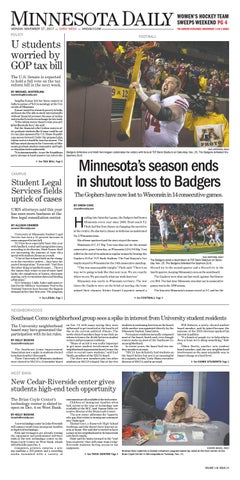
Badgers defensive end Matt Henningsen celebrates the victory with fans at TCF Bank Stadium on Saturday, Nov. 25. The Badgers defeated the Gophers 31-0.
Minnesota’s season ends in shutout loss to Badgers
The Gophers have now lost to Wisconsin in 14 consecutive games. BY DREW COVE dcove@mndaily.com
H
eading into Saturday’s game, the Badgers had beaten Minnesota every year since 2003. Head coach P.J.
BY ALLISON CRAMER acramer1@mndaily.com
Fleck had his first chance at changing the narrative
University of Minnesota Student Legal Service has seen a 15 percent increase in cases compared to last fall. SLS has been especially busy this year with landlord, rental and immigration cases, according to its director, Mark Karon. Staff are increasing the amount of time they spend with student clients as a result. “A lot of that is based both on the changes in the executive orders … that have impacted immigration,” Karon said. “And then the other thing is landlord-tenant … There’s the issues that relate to out-of-state landlords, the complexity of leases, electronic signing, early termination dates and binding arbitration.” SLS Attorney Linda Aaker said cases related to the Military Accessions Vital to the National Interest have become the biggest demand on her time this year. The program,
of the rivalry. He also had a chance to dethrone an undefeated No. 5 Wisconsin team. His offense sputtered and the story stayed the same. Minnesota (5-7, 2-7 Big Ten) was shut out for the second consecutive game Saturday, as Wisconsin (12-0, 9-0 Big Ten) rolled to the end of its unbeaten regular season by beating the Gophers 31-0 at TCF Bank Stadium. The Paul Bunyan’s Axe trophy stayed in Wisconsin for the 14th consecutive matchup. “This was unacceptable tonight,” Fleck said. “There’s no way we’re going to look like that next year. We are exactly where we are. We got exactly what our work deserves.” Minnesota was rarely in Wisconsin territory. The few times the Gophers were on the brink of scoring, the team missed their chances. Kicker Emmit Carpenter missed a
u See LEGAL Page 2
MAX OSTENSO, DAILY
The Badgers score a touchdown at TCF Bank Stadium on Saturday, Nov. 25. The Badgers defeated the Gophers 31-0.
46-yard try in the second quarter and a 48-yard try in the fourth quarter, keeping Minnesota’s zero on the scoreboard. The Gophers were shut out last week against Northwestern 39-0. The last time Minnesota was shut out in consecutive games was in the 1950 season. The loss sets Minnesota’s season record at 5-7, and for the
u See FOOTBALL Page 4
NEIGHBORHOODS
Southeast Como neighborhood group sees a spike in interest from University student residents The University neighborhood board may have generated the participation with its lax rules. BY KELLY BUSCHE kbusche@mndaily.com The Southeast Como Improvement Association saw a spike in students elected to its board earlier this month. Three University of Minnesota students were elected to SECIA’s 13-member board
on Nov. 14, with many saying they were influenced to get involved at the local level due to the current political climate. The newly elected members hope to use their positions to lessen the divide between student renters and permanent residents. “Many of us felt it was really important to get more student involvement on the neighborhood organization board, hence the effort to recruit more students,” said Karl Smith, president of the SECIA board. The three new members join two other students on SECIA’s board. One of the five
students is continuing his term on the board, while another was appointed directly by the Minnesota Student Association. Permanent residents normally composed most of the board, Smith said, even though renters make up most of the Southeast Como neighborhood. In recent years, the board had two student members at most. “SECIA has definitely had students on the board before but not in as meaningful of a capacity as this,” Cody Olson, executive director of SECIA, said in an email.
Will Roberts, a newly elected student board member, said he joined because the outcome of the 2016 elections sparked his interest in politics. “If a bunch of people try to help others, then at least we’re doing something,” Roberts. Abbey Burtis, another new student board member, said she saw neighborhood involvement as the most attainable way to impact change at a local level. u See COMO STUDENTS Page 2
WEST BANK
New Cedar-Riverside center gives students high-end tech opportunity The Brian Coyle Center’s technology center is slated to open on Dec. 4 on West Bank. BY KELLY BUSCHE kbusche@mndaily.com A new technology center in Cedar-Riverside will connect youth from immigrant families to high-end technology. Kids and teenagers are already testing the equipment and professional software tools at the new technology center in the Brian Coyle Center on West Bank, which will officially open Dec. 4. Computers, printers, cameras, a sewing machine, a 3-D printer and a recording studio furnished with a variety of
instruments are all available at the tech center. Children of immigrant families often lack access to the type of technology now available at the BCC, said Amano Dube, executive director of the Brian Coyle Center. The new center addresses the “opportunity gap that exists in immigrant communities,” Dube said. Shahad Geer, a Roosevelt High School freshman, said she doesn’t have internet access at home. She said she’s excited to have a place in her neighborhood to do homework and check emails. Dube said he looks forward to the “endless creativity” that will come from CedarRiverside students having access to the equipment. u See TECH CENTER Page 2
EASTON GREEN, DAILY
Shahad Geer watches a Ozobot miniature programmable toy robot at the tech center at the Brian Coyle Center in Minneapolis on Tuesday, Nov. 21.
VOLUME 118 ISSUE 24
2
MONDAY, NOVEMBER 27, 2017
MN DAILY
EXTENDED WEATHER FORECAST MONDAY TUESDAY HIGH 56° HIGH 46° LOW 38° LOW 26° Cloudy
Daily Review
MNDAILY.COM
Partly cloudy
WEDNESDAY HIGH 45° LOW 33° Partly cloudy
THURSDAY HIGH 41° LOW 30° Partly cloudy
FRIDAY HIGH 45° LOW 27° Partly cloudy
THIS DAY IN HISTORY
Monday, November 27, 2017 Vol. 118 No. 24
An Independent Student Newspaper, Founded in 1900. 2221 University Ave. SE, Suite 450 Minneapolis, MN 55414 Phone: (612) 627-4080 Fax: (612) 435-5865 Copyright © 2017 The Minnesota Daily This newspaper, its design and its contents are copyrighted.
1942 Guitar legend Jimi Hendrix, one of the most innovative guitar players of the rock era, was born in Seattle. HISTORYCHANNEL.COM/TDIH
OFFICE OF THE PUBLISHER Mike Hendrickson Editor-in-Chief mhendrickson@mndaily.com (612) 435-1575 Kathryn Chlystek Business Operations Officer kchlystek@mndaily.com (612) 435-2761
ART
NEWS STAFF Nick Wicker Managing Editor nwicker@mndaily.com Cedar Thomas Managing Production Editor cthomas@mndaily.com Jack White Sports Editor jwhite@mndaily.com Gunthar Reising A&E Editor greising@mndaily.com Alex Tuthill-Preus Multimedia Editor atuthill-preus@mndaily.com Maddy Fox Assistant Multimedia Editor mfox@mndaily.com Sheridan Swee Copy Desk Chief sswee@mndaily.com Christine Ha Assistant Copy Desk Chief cha@mndaily.com Harry Steffenhagen Visuals Editor hsteffenhagen@mndaily.com Jane Borstad Visuals Editor jborstad@mndaily.com Desmond Kamas Chief Page Designer dkamas@mndaily.com Rilyn Eischens Campus Editor reischens@mndaily.com Olivia Johnson Campus Editor ojohnson@mndaily.com Ryan Faircloth City Editor rfaircloth@mndaily.com David Clarey Features Editor dclarey@mndaily.com =
=
=
=
Participants engage in the University’s Art Department’s 31st annual Iron Pour at the Regis Foundry on Tuesday, Nov. 21.
ANANYA MISHRA, DAILY
=
=
STATE REPORT FRANKEN ASHAMED AMID GROPING CLAIMS, WILL RETURN TO WORK MINNEAPOLIS — Minnesota Sen. Al Franken said he feels “embarrassed and ashamed” amid allegations that he groped several women, but said he looks forward to returning to work on Monday and gradually regaining voters’ trust. The Democrat spoke to a handful of Minnesota media outlets on Sunday in the first interviews he’s granted since being swept into a nationwide tide of sexual misconduct allegations. Four women have accused the U.S. senator of sexual misconduct Three women allege Franken grabbed their buttocks while taking photos with them during campaign events. Franken told the Minneapolis Star Tribune on Sunday that he doesn’t remember the photos, but such groping is “not something I would intentionally do.” Asked whether he expected other women to step forward with similar allegations, Franken said: “If you had asked me two weeks ago, ‘Would any woman say I had treated her with disrespect?’ I would have said no. So this has just caught me by surprise. ... I certainly hope not.” The first woman to come forward was Los Angeles radio news anchor Leeann Tweeden. She released a photo this month showing the then-comedian grinning while reaching out as if to grope her as she slept on a military aircraft during a USO tour in 2006. Franken told Minnesota Public Radio on Sunday the photo was “inexcusable,” but he declined to explain it further. “What my intention was doesn’t matter. What matters is that I am chained to that photo,” Franken said. “She ... didn’t have any ability to consent. She had every right to feel violated by that photo. I have apologized to her and I was very grateful that she accepted my apology.” Tweeden said Franken also forcibly kissed her while rehearsing for a USO performance; Franken has said he has a different recollection of the rehearsal. ASSOCIATED PRESS
New Cedar-Riverside center gives students high-end tech opportunity Tech center u from Page 1
“It’s a great opportunity for children to reach their max potential,” Dube said. The Clubhouse Network and Best Buy chose to fund a tech center at the BCC because of the many teens in Cedar-Riverside that lack access to technology. Students will learn “marketable” skills by using the equipment, said Gail Breslow, executive director of The Clubhouse Network. Zakariya Hassan, a
Roosevelt High School freshman, said he is excited to use the 3-D printer because it will prepare him for a future career in mechanical engineering or biochemistry. “If I get a head start on it, I might be offered a job or opportunity,” Hassan said. Although the center hasn’t officially opened yet, it is already bustling with students during evening hours. The sign-up list for the recording studio fills minutes after the center opens. The tech center is expected to reach 200 to 300
Student Legal Services fields uptick of cases Legal u from Page 1
aimed at recruiting skilled foreign nationals into the military in exchange for citizenship, was suspended in 2016. Many international students come in simply to make sure they’ll be able to return to the United States if they leave to attend a family event, Aaker said. Although they should have no problems re-entering the U.S. under current law, the current executive branch has a record of making unpredicted changes, she said. Aaker said she’s seen more Deferred Action for Childhood Arrivals — a federal program that provided relief from deportation for people brought to the U.S. illegally as children — cases this year, although the number is still small because the University is a relatively expensive school. President Donald Trump rescinded the program in September. “While the number of
DACA students may not be much higher, the problems they face are much more complex with profoundly higher consequences looming,” Aaker said. While these outside factors increase student interest in SLS, the office has also been attempting to promote awareness of its services to students, like free lease reviews, Karon said. “We’re very busy, but we make adjustments,” Karon said. “We’re literally at a maximum here, but the staff is very good about accepting additional intake times.” Freshman Audrey Kennedy wanted to use the free lease review services this fall, but said she wasn’t able to get in soon enough to meet her needs. “I called them asking when their next appointment was and they said it was like two, three weeks from then, but the lease that I was trying to sign, I had to sign within the next three or four days,” Kennedy said.
“While the number of DACA students may not be much higher, the problems they face are much more complex with profoundly higher consequences looming.” LINDA AAKER Student Law Service attorney
Cedar-Riverside students each year, Dube said. The BCC will join a network of over 100 tech centers The Clubhouse supports across the world, Breslow said. The goal of its centers is to give kids hands-on experience to explore whatever career they may be interested in. “This is intended to be a place where no matter what your interest is, you can find a way to express and explore that interest,” Breslow said. Geer said when she is done with homework she
also uses the equipment for entertainment. She has started recording comedy videos, with hopes of starting a YouTube channel. “I like that you can use it for multiple things if you want to pursue multiple careers,” Geer said. Breslow said she hopes students use the variety of equipment to explore a multitude of future careers. “When kids walk through the doors, we want their eyes to lightup as they see all of the possibilities,” she said.
Como group sees spike in interest from students Como students u from Page 1
Roberts said SECIA is more accessible to students than other neighborhood organizations because its board seats have fewer residency requirements. O t h e r n e i g h b o rh o o d organizations require residency terms. The Marcy-Holmes Neighborhood Association requires those running for a board position to have been a resident for at least six months. Burtis said she hopes to impact the community in her new role by being a “liaison” between the students and families living in Southeast Como. Older residents are frustrated with the students because Southeast Como is treated as an “extension of Dinkytown,” she said. Cody Hoerning, also a new student board member, said permanent residents notice the uptick in alcohol-related incidents more than students. Students and permanent residents share many housing concerns, he said. Hoerning said he and other elected students have discussed community building to lessen the disparity. “I think a lot of issues that come up in the
n e i g h b o rh o o d c a n b e resolved by talking to and knowing your neighbors,” he said. Hoernig said more block parties will help build the community, like the annual Como Cookout where he was first welcomed by SECIA members in September. He said he also wants to build partnerships between landlords and the community to improve the quality and affordability of housing. Roberts said he hasn’t yet formulated specific plans on how to utilize his position, but added he plans to encourage student residents to get more involved in the community. “I think that’s a very valuable thing, to have an involved population,” he said.
“Many of us felt it was really important to get more student involvement on the neighborhood organization board, hence the effort to recruit more students.” KARL SMITH SECIA board president
=
=
EDITORIAL BOARD Anant Naik Editorials & Opinions Editor anaik@mndaily.com Aleezeh Hasan Editorial Board Member ahasan@mndaily.com Ray Weishan Editorial Board Member rweishan@mndaily.com Mike Hendrickson Editor-in-Chief mhendrickson@mndaily.com BUSINESS Genevieve Locke Sales Manager glocke@mndaily.com Corrections The Minnesota Daily strives for complete accuracy and corrects its errors immediately. Corrections and clarifications will always be printed in this space. If you believe the Daily has printed a factual error, please call the readers’ representative at (612) 627–4070, extension 3057, or email errors@mndaily.com immediately. THE MINNESOTA DAILY is a legally independent nonprofit 501(c)(3) organization and is a student-written and student-managed newspaper for the University of Minnesota’s Twin Cities campus. The Daily’s mission is: 1) to provide coverage of news and events affecting the University community; 2) to provide a forum for the communication and exchange of ideas for the University community; 3) to provide educational training and experience to University students in all areas of newspaper operations; and 4) to operate a fiscally responsible organization to ensure its ability to serve the University in the future. The Daily is a member of the Minnesota News Council, the Minnesota Associated Press, the Associated Collegiate Press, The Minnesota Newspaper Association and other organizations. The Daily is published Monday and Thursday during the regular school year and weekly during the summer, and it is printed by ECM Publishers in Princeton, Minn. Midwest News Service distributes the 13,000 issues daily. All Minnesota Daily inserts are recyclable within the University of Minnesota program and are at least 6 percent consumer waste. U.S. Postal Service: 351–480.w
Monday, November 27, 2017
3
U students worried by GOP tax bill Tax bill u from Page 1
wealthiest one percent, and pay for it by leveling devastating tax increases on graduate students,” said Rep. Keith Ellison, D-Minn., in a written statement. “As a nation, we should not be punishing people for pursuing an education.” On Nov. 16, the House passed the tax bill 227-205 along party lines with 13 Republican lawmakers joining Democrats in opposition. The Senate is expected to vote on its version of the bill as early as this week. University graduate students already claim an annual stipend averaging $21,958 per year for providing teaching assistance, tutoring and research work. The additional taxing of tuition waivers would further burden students’ finances, forcing them to claim income they never receive. “I have a number of friends who have to send money home to family members, even off of this meager stipend,” said Tracey Blasenheim, University Ph.D. candidate in political science. Blasenheim said he thinks research and other products of higher education may be at risk if the proposed tax bill gains final approval. Elena Gambino, a University Ph.D. candidate in political science, said “adding on a couple of thousand dollars in extra taxes would absolutely make [graduate programs] unaffordable.” Gambino, a Pennsylvania native, said she aspires to become a faculty member at the University. Because of her status as a fifth-year graduate student, she said the tax bill wouldn’t have a large effect on her future. Other graduate students,
however, wouldn’t be as lucky, Gambino said. “I do have colleagues that I know for a fact would [leave], and are already planning ahead for that as a contingency, a plan B,” she said. Students mobilize in opposition University graduate students shared personal concerns during a forum hosted by UMN Grads United, an allvolunteer group, on Tuesday. Around 100 University graduate students were presented with the potential effects of the tax bill during the “Taxed for Tuition” forum. The students then broke into small groups to discuss ways to oppose the bill as a community. Natalia Vargas Marquez, a University Ph.D. candidate in art history and organizer of the forum, said she worries the tax bill will create an unwelcoming environment for future graduate students. “[Graduate students] are already in a precarious position in the in-between state of worker and student,” Marquez said. Students announced at the end of the meeting that they would join a national graduate student walkout on Wednesday at noon to raise awareness for their opposition of the bill. “I am very sure I am going to walk out, but it is not a decision I take lightly,” said Jake Grossman, University Ph.D. candidate in ecology, evolution and behavior. Grossman currently works at the University writing center, and said his decision to walk out will have an effect on the assistance offered to students. “This is critical. [Students] also won’t be [assisted] if the writing center staff deteriorates because people have to leave grad school,” he said.
COURTNEY DEUTZ, DAILY
Lisa Fazzino, a University of Minnesota graduate student, talks about the tuition tax change in a small group on Tuesday, Nov. 21 in the Tate lab on East Bank.
Outlook bleak among international students International graduate students at the University would face unique challenges under the tax plan. Those studying with student visas cannot seek employment off-campus to ease the additional cost burden. “According to the visa rules, [student visa recipients] can work only in the University,” said Kajari Bera, University Ph.D. candidate in chemistry. “Officially, we are not allowed to do any part-time jobs.” There are strict work-hour requirements at the University, Bera said, and the increased tax burden would further stress students. Kumar said the work restrictions coupled with the
Transportation and Safety building set for expansion
financial burden from the tax plan could cause some international students to leave the country rather than finish their degrees. “It’s not like this thing passes and we will have an option to work, to pick up an extra job,” Kumar said. “We will have to leave.” The Senate bill does not have the tuition waiver provision included. If the bill passes, it will be sent to a conference committee alongside the House legislation to iron out policy differences, where the waiver-income provision could be added to the joint bill. The joint bill would then have to gain approval from the House and Senate before reaching President Donald Trump’s desk.
ELLEN SCHMIDT, DAILY
All public safety divisions will move into the building on Washington Ave. BY MADELINE DENINGER mdeninger@mndaily.com
A campus building that currently houses the University of Minnesota Police Department will soon expand to consolidate public safety services. The University’s Transportation and Safety Building on Washington Avenue will undergo an expansion next year to house all of the University’s public safety divisions under one roof. UMPD officers say the change will encourage interaction between students and the department. Centralizing the police department, University Security and the Public Safety Emergency Communications Center will help make public safety services more accessible, said UMPD Lieutenant Chuck Miner. “That’s a big part of the project — to kind of have things as a one-stop shop, mostly for students and staff to come here for all of their services, whether it be for a walking escort or to complete a police report or whatever the case might be,” Miner said. “One challenge we face now is that a lot of folks don’t really know where the police
department is, or where University Security is located.” The Transportation and Safety Building building currently sits at 511 Washington Ave SE, with UMPD occupying the first floor. University Security is currently located at Coffman Memorial Union, and the Public Safety Emergency Communications Center is located in the University Office Plaza at 2221 University Ave SE. With the expansion, public safety departments will take over office space on the second floor and in a soon-to-be-built space. UMPD Chief Matt Clark said a new entrance on the west end of the building will make the facility more welcoming for students to come and go. The new space and entrance may also be more inviting to students who don’t want to consult emergency services, Clark said. Student engagement was a big reason for the expansion, Clark said. Sgt. Jim Nystrom, part of UMPD’s community engagement team, said the additional space will let the team hold community outreach events in the building. “Right now, we work in satellite areas and make space where it’s available in terms of interactions with faculty, staff and students,” he said. “If our building has
the ability... we can create those events in-house.” Nystrom also said that consolidating divisions will enable more efficient communication within the University’s Department of Public Safety. UMPD officers rarely interact with student security under the current arrangement, he said. “All of the entities are under one roof. It’s not just an email here or a phone call there,” he said. “You get more of a face-to-face opportunity to work with the individuals.” The central location of the Transportation and Safety Building will help UMPD and other public safety divisions patrol events around campus, Clark said. “We’re always managing the Northrop events or events at TCF Bank Stadium. We’ll have a security presence, so we have a lot of contact with athletics and performing arts as well as students affairs,” he said. “Instead of having things spread out, we’d like to have it all in one spot.” The project is currently in the planning stage. University Capital Planning and Project Management will be undertaking the project with the help of an outside architectural firm. The expansion is expected to break ground next year.
UNDER CURRENT TAX LAW:
UNDER PROPOSED HOUSE GOP TAX PLAN:
ANNUAL STIPEND:
$21,958
$21,958
TUITION WAIVER:
$21,000
$21,000
TOTAL TAXABLE INCOME LIABILITY:
$21,958
$42,958
$1,219.95
$3,727.68
TAXES PAYABLE:
5.56% OF STIPEND
16.98% OF STIPEND
*UMN CLA graduate assistants receive a $17,500 annual stipend
SOURCE: UMN GRADS UNITED
The University of Minnesota’s personnel plan review underway These plans for the University have not been updated for several years. BY NATALIE RADEMACHER nrademacher@mndaily.com
The University’s Transportation and Safety Building on Washington Ave. will expand next year.
AVERAGE UMN GRADUATE STUDENT TAX LIABILITY
University of Minnesota administrators are working to strengthen college personnel plans. Many colleges in the University hadn’t developed these plans — which detail how many faculty members are tenure and non-tenuretrack — for several years. Faculty hope to make these plans more detailed than in years past to ensure administrators are aware of colleges’ needs. “These plans are an opportunity for colleges to stop and think about what their longterm strategies are and show where there is a lack of resources and problems that are going beyond the capabilities of the college,” said Phil Buhlmann, chair of the Academic Freedom and Tenure Committee, which is reviewing the new personnel plans. Under University policy, deans are responsible for
drawing up personnel plans every few years. However, the policy doesn’t specify exactly how often they must be re-evaluated. When Rebecca RopersHuilman became University vice provost in January 2016, she realized the existing plans were outdated and instructed deans to come up with new plans. Now, members of the Academic Freedom and Tenure Committee are working with the provost’s office to ensure the plans contain enough detail. For example, past reports lacked information about why colleges exceeded recommended employee ratios, Buhlmann said. “There was not a lot of things in these plans about how to make the colleges better,” said Jerry Cohen, a member of the committee. “We are trying to change that now.” The committee and provost gave a list of specific questions for the deans to answer in their personnel reports, Buhlmann said, including a request for plans to offer professional development opportunities for non-tenuretrack instructors.
“The goal is to make sure great people are teaching and make sure they have the support they need to do that,” Ropers-Huilman said. This month, Ropers-Huilman and Provost Karen Hanson have met with the deans to discuss the plans using feedback from the committee. “This [process] is meant to be a form of communication within and between colleges and central administration,” Ropers-Huilman said. Ropers-Huilman hopes creating these plans will show central administration where improvements and additional resources may be necessary. “Some colleges think we know what is going on already… but the University is so wide,” Buhlmann said. “Sometimes colleges need to make more of an effort to explain their local situation.” Going forward, RopersHuilman hopes to create a system that cycles through the colleges to prevent another gap of personnel plan inactivity. She anticipates the final revised versions of this year’s plans will be completed in spring 2018.
Greek councils elect new leadership University Greek life organizations’ executive boards will change next month. BY KAYLA SONG ksong@mndaily.com
The University of Minnesota’s Panhellenic Council and Interfraternity Council held their executive board elections on Nov. 12, bringing in a new president, vice president and six other members for each council. Kayla Juarez, Gamma Phi Beta member and neuroscience and English junior, will serve as president of PHC. Billy Langer, a member of Sigma Chi and finance junior, will be the president of IFC. The new presidents will assume their roles Dec. 3, taking over from current IFC president Simon Beck
and PHC president Molly Haeg. Juarez, who is also an executive member of the College of Biological Sciences Student Board, was the vice president of member development for PHC last year. She hopes to bring some of her experience from that position to her new role as president. “I’m going to take this presidential position in the lens of member development because it’s one of those positions… that is so applicable to all sectors of the community,” Juarez said. Langer was IFC’s vice president of recruitment last year and said his experience let him “work with many driven and accomplished individuals.” Juarez said as president, she is planning more outreach, increased incorporation of personal and professional
development in member education and the continuation of PHC’s financial transparency program. “If there’s anything that I want anyone to take home from how I want to approach this position, it’s just that I want people to feel like they’re heard and that they’re cared about and that their experience matters,” Juarez said. For Langer, his goals for the next year are to strengthen IFC partnerships with other chapters and student groups in sexual violence prevention efforts and to raise awareness about the issue. “The incoming executive board leaves IFC in great hands, and I am excited to see all they will accomplish,” said former IFC president Simon Beck. “I have the utmost confidence in them to not just perform, but excel in their new roles.”
4
Sports
MONDAY, NOVEMBER 27, 2017
MN DAILY
MNDAILY.COM
FOOTBALL
Minnesota can’t take Axe for 14th year Football u from Page 1
seniors, it marked their last game at TCF Bank Stadium. Minnesota will not see a bowl game for the first time since the 2011 season. “Hate to send the seniors out that way,” running back Rodney Smith said. “I know I laid it all on the line for those guys. It’s tough to send them out that way.” The Gophers had the same troubles offensively and defensively as they did against Northwestern just a week ago. Minnesota couldn’t stop the run, and Wisconsin’s running back Jonathan Taylor was his usual self, given that he came into the day averaging over 150 yards per game. He ran for 149 yards against Minnesota and scored a touchdown. “They had a good game plan,” linebacker Thomas Barber said. “We were really stacking the box trying to stop the run and [we weren’t] very disciplined on defense, we’ve got to keep our eyes on our man.” Taylor also had a long run of 53 yards for that touchdown, and he averaged 7.4 yards per carry. The Gophers didn’t have much going offensively Saturday, either. Quarterback Demry Croft didn’t have some of his usual receivers, like Tyler Johnson, or Eric Carter. Most of the receivers for the Gophers, besides Phillip Howard and Mark Williams, haven’t played the position all season or their
Gophers quarterback Demry Croft rushes with the ball at TCF Bank Stadium on Saturday, Nov. 25. The Badgers defeated the Gophers 31-0.
entire career. Minnesota’s longest reception on the day came from junior Will Reger, a 26-yard pass from Croft, that was the first reception of his career. Besides that reception, Croft only
completed two more passes, both to Smith. With the win, Wisconsin recorded their first undefeated regular season since 1912. The Badgers have a chance to qualify for the college football playoff. Both
WOMEN’S HOCKEY
No. 1 Alabama and No. 2 Miami lost over the weekend. With the win, Wisconsin now leads the all-time series — 60-59-8 — against Minnesota for the first time in its 127-year history. The Gophers season
ended in defeat, but Fleck doubled down on his statement of future success. “Those who stay will be champions,” Fleck said. “I’ll re-evaluate the ent ire football team… players, coaches, everybody.”
MAX OSTENSO, DAILY
FOOTBALL RESULTS
FRIDAY Wisconsin Minnesota
1 7 0
2 10 0
3 7 0
4 7 0
FINAL 31 0
SOURCE: GOPHERSPORTS.COM
VOLLEYBALL
Gophers top Scarlet Knights, lose to No. 1 Penn State over weekend
JACK RODGERS, DAILY FILE PHOTO
Forward Cara Piazza looks to pass the puck at the Ridder Arena on Saturday, Nov. 18.
Gophers cap off sweep with an overtime goal Olivia Knowles had the game-winning goal just 50 seconds into overtime. BY MAX BIEGERT mbiegert@mndaily.com Just 50 seconds into overtime, Olivia Knowles received a pass from Sophie Skarzynski and cemented the sweep for the Gophers. No. 6 Minnesota (13-41, 8-3-1 WCHA) defeated Lindenwood (2-9-1, 2-4-0 CHA) 4-3 in overtime after Lindenwood tied the game with 13:39 remaining in the third period. Knowles scored two goals, including her overtime game-winner. Sydney Baldwin and Cara Piazza both scored and Skarzynski had another three-assist game as well. “They showed great resiliency tonight; [I’m] really happy with the sweep,” said head coach Brad Frost. “It was a great weekend, in particular tonight for Olivia Knowles. Just proud of the opportunity she had to get those two goals.” The score stayed 3-2 until overtime where Knowles buried the puck in the net for her fifth goal of the season. Knowles
had three goals over the weekend. Alex Gulstene got the start on Sunday and made 15 saves. The Gophers are now 10-0 on the road. The two captains scored in the first period to get the Gophers out to a quick lead. Baldwin scored her fourth goal of the season and Piazza netted her sixth goal of the year. In the second period, the Lions answered with goals from Taylor Girard and Cierra Paisley. Knowles answered with her fourth goal of the season with 7:45 to go in the frame. “Getting back to conference play will be a great challenge for us, but we are looking forward to it,” Frost said. Two goals from Alex Woken and 20 saves from Sidney Peters gave the Gophers a 3-1 victory over Lindenwood in the first game of the series on Saturday afternoon. Skarzynski continued her strong play by assisting on three of the Gophers’ goals. Knowles also added a goal in a game where the Gophers outshot the Lions 45-21. “Our team really battled and got some real nice goaltending from Sid Peters,” Frost said. “Rolling
EASTON GREEN, DAILY FILE PHOTO
Freshman opposite hitter Stephanie Samedy practices with a weighted ball on Wednesday.
WOMEN’S HOCKEY RESULTS
SATURDAY Minnesota Lindenwood
SATURDAY Minnesota Lindenwood
FINAL 3 1 FINAL 4 3
SOURCE: GOPHERSPORTS.COM
with four defensemen is difficult, but all four defensemen played extremely hard and well.” Woken has 14 points on the y ear, including six goals. Her freshman season was cut short by a hip injury, but now in her sophomore season, she is becoming one of the Gophers go-to players. Skarzynski is now tied for the team lead in points after a six assist weekend. The Lions got on the board first when Hannah Alt scored with 3:12 into the second period. Then, Woken scored back-toback goals to take the lead. Piazza, along with Skarzynski picked up the assists on the first goal, and Baldwin and Skarzynski helped on the second Woken goal. Knowles scored her third goal of the year just 2:38 into the 3rd period.
Minnesota swept Rutgers on Friday, but lost in four sets to Penn State. BY ERIK NELSON enelson2@mndaily.com A crowd of 5,343 people filled the seats and bleachers at Maturi Pavillion on Saturday night with home fans hoping No. 8 Minnesota could upset No. 1 Penn State. However, the crowd’s energy and freshman Stephanie Samedy’s 22 kills weren’t enough for Minnesota to win its final match of the regular season. Penn State (29-1, 19-1 Big Ten) defeated Minnesota (26-5, 15-5 Big Ten) 3-1. It was Minnesota’s second loss in three matches. The Gophers won their first match of the weekend against Rutgers (5-27, 0-20 Big Ten) 3-0. “Our team competed hard. We battled,” head coach Hugh McCutcheon said. “Everyone wants to finish with a win, but you don’t always get what you want. What you hope for is that at least you’re going to compete.” Penn State won the first two sets, outscoring
Minnesota 29-27 and 2520. The Gophers won the third set 26-24, but the Nittany Lions fought back to win the fourth set and the match 25-20. Middle blocker Haleigh Washington led the offensive attack for Penn State with 21 kills, while outside hitter Ali Frantti had 17 digs. Samedy was one of three Gophers to tally 10 kills or more, with her game-leading 22 kills. Outside hitter Alexis Hart had 19, while middle blocker Regan Pittman had 10. Outside hitter Alyssa Goehner had 14 digs. Samedy said the crowd motivated the team throughout the match. “It was awesome,” Samedy said. “The fans were really supportive [and] behind our back the whole time.” After the match, Minnesota honored its senior class: Goehner, Maddie Beal, Molly Lohman and Dalianliz Rosado. Each player received a rose, and the senior class was honored in a video featuring their teammates. In a postgame speech, McCutcheon thanked the fans and said the best was yet to come for the Gophers. “Some of these lessons
VOLLEYBALL RESULTS
FRIDAY Rutgers Minnesota
SATURDAY Penn State Minnesota
1 2 3 FINAL 18 8 16 0 25 25 25 3 1 2 3 4 FINAL 3 29 25 24 25 1 27 20 26 20
SOURCE: GOPHERSPORTS.COM
aren’t particularly easy to learn. We get to do it in front of thousands of people,” McCutcheon said. “We don’t enjoy losing. No one wants to come out here and have that be the outcome, but because of our youth and because we’ve played against some good teams, we’ll learn a few things.” On Friday night, Minnesota defeated Rutgers (5-27, 0-20 Big Ten) 3-0. Minnesota won each set by more than six points. Hart and Samedy each had 14 kills, while Rosado had 13 digs. Both Rutgers and Minnesota had six blocks. “Our team did really well at communicating, so I felt like that gave us [motivation],” Hart said. “The crowd [is] always great. It was pretty close to being sold out, so it was great to see a lot of people come out and support us.”
5
MONDAY, NOVEMBER 27, 2017
MN DAILY
MNDAILY.com
ART
Foundry fire and dance The University of Minnesota Foundry’s 31st Annual Fall Iron Pour sparked teamwork from students, faculty and visiting artists.
ANANYA MISHRA, DAILY
Participants engage in the University’s Art Department’s 31st annual Iron Pour at the Regis Foundry on Tuesday, Nov. 21.
BY KATE DRAKULIC kdrakulic@mndaily.com
N
ot many people know that the University of Minnesota houses a foundry inside the depths of the Regis Center for Art, and even fewer know that students operate the heavy machinery. On Tuesday night, the University foundry bustled with students and spectators eager to witness the 31st Annual Fall Iron Pour. A group of 40 made up of students, faculty and visiting artists worked all night to transform moltenhot iron into sculptural art. To withstand the furnace temperatures of over 2,400 degrees Fahrenheit, they wore protective leather overalls, coats and face masks. Over the course of the night, the crew poured over 100 sand molds. Senior BFA student Stephen Edstrom is a former glass blower with e x p e r i e n c e w o rk i n g i n bronze. “I had heard great things about the U of M’s foundry and art program. I signed up for the metal casting class and was introduced to iron casting. I instantly knew I was in the right place,” Edstrom said. “The thing I enjoy most about foundry is the community that surrounds it. Foundry is like a team
sport mixed with fire and a dance. I like the idea that everyone is working together to cast everyone’s work.” For senior studio art major Rose Von Muchow, the foundry was a place where art met community. “The foundry is really hands on and community based. I love having a community to help me make art. I think it’s much more special to me than making art by myself,” Von Muchow said. Von Muchow first became interested in the metal work after learning how to weld in her introduction to sculpture class. She began as a painter whose work concerned portrayals of the body and figures. Now, she makes wax and sand-mold castings of her and others’ bodies to fill with molten metal. “I think [the foundry] is kind of unique because it gives you a chance to really know the industrial processes behind the artwork you’re making,” Von Muchow said. The first pour of the night began around 4:30 p.m. and the event wrapped up around 10 p.m. Sand molds belonged to faculty and students, including visiting artist Hannes B r u n n e r f ro m B e r l i n , Germany. The University of Minnesota foundry has been
ANANYA MISHRA, DAILY
Molds recently filled with hot iron during the University’s Art Department’s 31st annual Iron Pour at the Regis Foundry on Tuesday, Nov. 21.
established for over 50 years, and Professor Wayne Potratz, who ran the foundry until recently, first started iron pours. Today, assistant sculpture professor Tamsie Ringler heads the foundry and is the University’s only foundry professor.
“I think because so much of student academic work now is on computers, people really enjoy the hands on and physical making of something permanent. Once you cast something in iron, it can last a millennium,” Ringler said.
I n h e r o w n w o rk , Ringler combines metalwork and performance. She considers the potential for what metal is and can be, and the long history that is attached to specific metals. “As a teacher, I think what I find really rewarding
about the foundry is that it’s a transformation of a metal solid to liquid state, and there’s a lot of energy involved in it. It’s a catalyst of transformation for students as well,” said Ringler. “I really see teaching as a part of my sculptural practice.”
MUSIC
Review: Björk’s ‘Utopia’ Those whose favorite Björk albums are “Debut” and “Post” may be disappointed at how much her latest resembles 2015’s “Vulnicura.” “Utopia” is for die-hard fans of her latest style. BY HALEY BENNETT hbennett@mndaily.com
E
erie and ethereal, B j ö rk ’ s “ U t o p i a ” feels like the musical equivalent of the Driftless Area, that corner of the Midwest the glaciers never touched, leaving its landscape surprisingly different from the rest of the states that surround it. The Icelander first shocked the pop music scene with her first solo album “Debut” in 1993. Except in comparison to Sinead O’Connor, or maybe a dark Enya, her music was like nothing else on the charts at the time. That remains true. But though it’s still mysterious, her current style is far less wild than it once was. With each passing album,
Björk drifts further from Earth and closer to an alien world the rest of us can only access through her music. It’s the ultimate witchcraft anthem, but you won’t enjoy it if you’re not in the mood to be haunted. It’s not the bouncing, lyrically amusing beats of “Debut” and “Post.” Those albums were ferocious, fearless and youthful. While still unlike anything else being released today, “Utopia” is organized and controlled in such a way that it feels somewhat lifeless. With high-pitched flutes and repetitive choruses song after song, “Utopia” feels like it’s asking you to meditate or chant mantras as each tune fades into the next, similar one. It demands that you listen
intently, with closed eyes. Some key tracks: “Body Memory,” which incorporates a variety of noises into the soundscape to a creepily gorgeous effect; “Sue Me,” which uses an erratic, electrified backbeat that makes the song much more exciting than most of the album. True, her style mellowed out early in her career, just after she starred in the 2000 film “Dancer In the Dark.” But that’s likely just the result of working with filmmaker Lars Von Trier. Björk’s music is wistfully cosmic. If I didn’t know better, I’d call her scary Enya. (Actually, I don’t know better and think that’s a hilarious comparison.) Björk’s relationship to Earth grows more nebulous with each album. She’s a wildly skilled musician, but with each new album, her style becomes both more alien and more alienating. And since “Utopia” is based on a set of sounds narrower
COURTESY OF ONE LITTLE INDIAN RECORDS
even than “Vulnicura,” it gets rather boring after a few songs. The lackluster effect of “Utopia” doesn’t come from
the fact that the music is weird. Björk’s been weird since the start. But this album doesn’t do anything new. Listeners are better
off returning to her early stuff for thrills. Grade: C. The best Björk was early Björk.
6 MONDAY, NOVEMBER 27, 2017
MN DAILY
MNDAILY.COM
Editorials & Opinions
COLUMN
EDITORIAL
Don’t remain neutral about net neutrality
Voters should engage with their representatives
If the FCC gets rid of protections that ensure equal internet access, it would affect us all.
A
week ago, the Federal Communications Commission revealed their intent to break down regulations that protect equal internet PALMER HAASCH access. This concept, columnist better known as “net neutrality,” is crucial in ensuring that individuals have access to a wide variety of websites and services across the internet. Previously, FCC regulations passed in 2015 prevented internet carrier providers from differentiating and discriminating against how broadband is used. Now, under the leadership of FCC chairman Ajit Pai, these regulations are under threat and in turn, so is the sanctity of internet information access. Pai argues that fewer regulations will ultimately prove beneficial to market growth. However, this would open the field for internet service providers to charge
internet companies to pay for faster connections, a cost that would quickly work its way down to consumers. Those who can afford to pay would enjoy the privilege of content access via a “fast lane.” However, those who cannot absorb the extra cost would be relegated to the “slow lane,” suffering low speeds and in some cases blocked access to content. Internet access would likely be relegated into packages for content like video, e-mail, gaming and social media with individual costs. Admittedly, I didn’t quite understand what net neutrality would mean for me as an internet user until recently. I knew that I was in favor of it, but I wasn’t certain of how it would affect me personally. However, I’ve come across the same example time and time again: if we lose equal internet access, we might lose Netflix. While this may not be the most critical implication of a lack of net neutrality — in my opinion, that’s the restriction of information access for the poorest of Americans — it’s one that is by-andlarge understandable for the majority of university students. I binged “Stranger Things” Season 2 just like the rest of us, but in a world without net neutrality, this may have come with some extra costs. For example, AT&T and Time Warner are attempting to merge despitelegal protests from
the U.S. Department of Justice. If the merge is allowed to continue, AT&T will own HBO. In a world without net neutrality, AT&T would be incentivized to slow down speeds for Netflix unless users pay extra, while HBO would remain at high speeds at no extra cost, effectively pushing consumers to use HBO over Netflix. Furthermore, net neutrality is crucial to information access. For those who can’t afford to pay for a potential social media or news bundle, access to news and information will be severely limited. In an era when most knowledge is disseminated via the internet, losing net neutrality would be a critical blow to information access, eventually making knowledge a privilege for those who can afford it. We need to express our support for net neutrality to Congress. Write and call your representatives and urge them to vote in support of net neutrality if the FCC’s internal vote passes. If you’re so inclined, attend one of the protests happening at Verizon stores around the nation on Dec. 7. There are less than three weeks before the FCC votes to end net neutrality — as internet users and U.S. citizens, it’s time to make our voices heard. Palmer Haasch welcomes comments at phaasch@mndaily.com.
2017 GUN VIOLENCE
Total gun-related incidents: 55,532 Total number of deaths: 13,992 Total number of mass shootings: 323 Data compiled by gunviolencearchive.org
LETTER TO THE EDITOR Confronting uncertainty with action
Since my first day as a freshman intern for the Minnesota Student Association, student government has always been about advocating to extend our rights. Sometimes that meant fighting for stronger sexual assault policies, other times it meant a tuition freeze. Every push was an effort to make the University of Minnesota a more equitable and inclusive campus for students of all backgrounds. Since January of 2016, there has been a significant shift in our advocacy priorities. Rather than advocating to extend our rights as students, our mission has changed to preserving the rights we already have and combatting false narratives about our student populations. As students, we are constantly under attack, especially those of us that are the most vulnerable. In response to the termination of Deferred Action for Childhood Arrivals, reversal of Temporary Protected Status, and the travel ban, students are drowning in uncertainty: uncertainty about whether they will be able to live in the only country they have known, uncertainty about their ability to work, their ability to financially support their academic pursuits, and uncertainty about whether they will complete their undergraduate degree, which they have worked so hard to attain. A push to support these members of our community is crucial in such a time of unpredictability. The MSA Executive Board drafted a faculty letter (z.umn.edu/FacultyLetter), urging the University’s leadership to remove barriers to degree completion and to allow faculty to implement flexible learning plans in the event a student is no longer able to physically attend the University. Students — I ask you to share the letter with your professors. Faculty — I ask you to consider signing the letter and sharing this letter with your colleagues. To University administrators, I ask that you streamline and prioritize proactive planning for potential outcomes, even though some outcomes are far from ideal. Let’s have a plan in place to support all members of our University community in this time of uncertainty. Whether it is the news of Title IX, reversing the progress survivors and advocates have made when it comes to sexual assault policy, the GOP tax bill, making the goal of pursuing higher education seem more and more distant for undergraduates, or our country’s continuously changing and discriminatory immigration policy, making it clear who is and is not valued in our country, it is not the time to wait. It is not the time to be complacent. Now is the time to prove our “University of Minnesota values” with action. Let’s set an example for public institutions all across the country and demonstrate what it means to be a member of the University community. This letter has been lightly edited for clarity and style. Trish Palermo is the undergraduate student body president at the University of Minnesota.
CONTACT THE EDITOR Anant Naik anaik@mndaily.com
Robert McGrady welcomes comments at rmcgrady@mndaily.com.
COLUMN
Reconsider our legal drinking age The current legal drinking age is too strict and arbitrary to foster a healthy culture around alcohol.
A
s a legal adult, you can join the military, sign a contract or rent an apartment, but you cannot legally purchase or consume alcohol until the age of 21. Lawmakers in WisELLEN AILTS consin may soon columnist change that, having proposed a bill that lowers the state’s drinking age to 19. The bill comes from Republican state Reps. Adam Jarchow, Cindi Duchow and Rob Swearingen, and was proposed partly in the hope that a lower drinking age, one that allows college students to legally consume alcohol, would end the need for, as Rep. Jarchow described, “countless hours and hundreds of thousands of dollars” spent on the enforcement of drinking laws. This is especially true on college campuses, where underage drinking is a given — the figures on how many college students who consume alcohol range from about 60 to 80 percent. Besides saving money and time enforcing underage drinking laws, lowering the drinking age could also be a turning point in America’s alcohol culture. Nearly three Americans in 100,000 die of alcohol consumption per year. In Italy, the ratio is 0.37, though the legal drinking age is 16; in the United Kingdom, 1.70, with a legal drinking age of 18; Australia’s rate is 1.43, with a legal drinking age of 18. In the 1970s, Australia changed its legal drinking age to 18, and alcohol consumption in Australia has declined by 25 percent since the 1970s. The United States is only one of six countries with a legal drinking age of 21, with 18 being by far the most common. The drinking culture in the U.S. is often unhealthy, especially among young people. The minimum legal drinking age, or MLDA, being 21 creates a kind of “forbidden fruit” culture around alcohol, causing young people to drink in unregulated environments and decide among themselves what “normal”
Besides saving money and time enforcing underage drinking laws, lowering the drinking age could alse be a turning point in America’s alcohol culture. drinking habits look like. In countries where the drinking age is lower, young people more frequently consume alcohol in environments like restaurants, family functions and other, more constrained social situations where they observe alcohol being consumed responsibly. In college, alcohol culture is not so much informed by these kind of “safe” environments. Instead, we just have stressed-out college students drinking as much as humanly possible, trying to relish in the few nights per week when they’re “allowed” to drink. If alcohol just became a normal part of life, taught by example from a young age to be enjoyed in moderation, college drinking habits would naturally become less frenzied and rebellious. The underlying point of this fact is that the current MLDA is ineffective anyway. Alcohol consumption has already become so normalized and widespread on college campuses that the MLDA is essentially obsolete and only serves to force the behavior into private environments, which create unsafe situations where young people experiment with alcohol and risk disastrous consequences. By working to alter our alcohol culture — not only by lowering the legal drinking age, but through teaching by example how to enjoy alcohol responsibly — we could see widespread positive changes, on college campuses in particular. By exposing the problems of underage drinking, we could see negative consequences of college drinking, like fake ID misdemeanors, sexual assault, alcohol poisoning and other alcohol-related injuries, diminish and potentially even save lives as a result. Ellen Ailts welcomes comments at eailts@mndaily.com.
W
ith Minneapolis municipal elections in the past, it will be nearly a year until most Twin Cities residents think about engaging in the political sphere. The U.S. midterm elections are seemingly and strangely close. Regardless, midterm elections, historically, have much lower voter turnout rates than presidential elections. Nonetheless, there are plenty of ways that students and members of the community can stay politically active before, during and after major elections. While most of the political world follows President Donald Trump with close scrutiny, there are still several bills and policies being pushed through Congress, or across many levels of government. The latest to turn heads includes the Federal Communications Commission’s review of the Obama Administration net neutrality laws. With the board set to repeal laws that prohibit internet providers from charging certain companies, such as Netflix or Disney, more for faster speeds on their site, many have sprung into action, opposing this FCC policy move. This move could let internet providers dictate what type of content consumers interact with. In Portugal, this type of net neutrality does not exist and consumers have to pay for additional website packages, on top of what they already pay in internet fees. Repeal of the net neutrality law is a bad for consumers and for many small businesses unable to pay for faster speeds. However, people are fighting this movement and staying politically involved without an election. Battleforthenet.com has lead this movement for Americans against this policy shift. In one enormous show of internet protest, the movement boasts that people sent over 5 million emails and 124,000 calls to members of Congress. Congress members listen to their constituents, as well. All the pressure could get to at least one FCC chair, as well, and that vote could mean a different turnout; the board seems to be split 3-2, in favor of repealing net neutrality laws. There are plenty of other instances in which constituent pressure can affect U.S. lawmaking and policy. Several major policies have been working through Congress and, much to the chagrin of some lawmakers, have stopped due to public perception, mounting pressure and lack of votes. The first large example of this fell upon Congress’ failure to repeal the Affordable Care Act, which establishes a network for Americans to register for healthcare. Due to mounting pressures of public opinion and voter backlash, the bill did not pass the Senate, despite getting reworked several times. The same is happening currently, with some Republican lawmakers failing to support a tax system overhaul created by their own party. With such a divided Congress and shocking policy changes, it is important to remember that a citizen’s vote in still important outside of elections. There are plenty of ways for citizens to engage government officials and curve policy, without monopolizing their time and still being effective. To facilitate this, we urge every voter to make a call to their representative in Congress, either in the House or Senate, and speak to them about an issue that is important to them. One can use usa.gov/elected-officials if they are unsure of how to contact their representative. Many voters stop thinking about politics when they walk out of the polling booth; however, this country was created by the people, for the people and it should be seen as such.
EDITORIALS & OPINIONS DEPARTMENT Editorials represent the voice of the Minnesota Daily as an institution and are prepared by the editorial board.
SHARE YOUR VIEWS The Minnesota Daily welcomes letters and guest columns from readers. All letters must include the writer’s name, address and phone number for verification. The Daily reserves the right to edit all letters for style, space, libel and grammar. Letters to the editor should be no more than 500 words in length. Guest columns should be approximately 350 words. The Daily reserves the right to print any submission as a letter or guest column. Submission does not guarantee publication.
letters@mndaily.com Fax: (612) 435-5865 Phone: (612) 435-1578 Letters and columns to the editor 2221 University Ave. SE Suite 450 Minneapolis, MN 55414
THE EDIT ORIALS AND OPINIONS DEPAR TMENT IS INDEPENDENT OF THE NEW SROOM
7
MONDAY, NOVEMBER 27, 2017
MN DAILY
MNDAILY.COM FOR RELEASE NOVEMBER 27, 2017
HOROSCOPES Today’s Birthday (11/27): Ponder eternal mysteries over the next two years. Find spiritual and inner growth. Create dreams and visions. Changes in winter adventures inspire a creative flurry.
Los Angeles Times Daily Crossword Puzzle CROSSWORD Edited by Rich Norris and Joyce Lewis
To get the advantage, check the day’s rating: 10 is the easiest day, 0 the most challenging. Written by Nancy Black
Aries (3/21 - 4/19): Today is a 6 — Review priorities, and adapt your plans to circumstances. Slow to avoid hidden dangers. If an invitation goes against your grain, turn it down.
Libra (9/23 - 10/22): Today is an 8 — Maintain physical and health routines that build your energy. You can accomplish great things. Follow through with what you said.
Taurus (4/20 - 5/20): Today is an 8 — Check public opinion. Prepare for an upcoming event or launch. Plan your moves, and coordinate with your team.
Scorpio (10/23 - 11/21): Today is an 8 — Have fun, and let your heart dictate your actions. The best things in life are free. Talk about future dreams, and support each other.
Gemini (5/21 - 6/21): Today is an 8 — Prioritize your career, and dress to impress. Creative partnership pays off. The truth gets revealed in a lovely way. Discuss future options.
Sagittarius (11/22 - 12/21): Today is a 7 — Create harmony at home with color, delicious fragrances and music. Make a long-term improvement to raise your family’s comfort level.
Cancer (6/22 - 7/22): Today is a 7 — Explore new fields of study. Figure out what skills to grow. Invest in your own future. Choose your path carefully. Put your talents to work.
Capricorn (12/22 - 1/19): Today is a 7 — Get the word out about what you’re up to. Communications and transport flow with longdistance ease.
Leo (7/23 - 8/22): Today is an 8 — Family financial matters have your attention. Share your concerns with someone who always tells the truth. Accept assistance and support.
Aquarius (1/20 - 2/18): Today is a 9 — Keep producing valuable results. You’re earning longterm points. Old assumptions get challenged; keep your mind open.
Virgo (8/23 - 9/22): Today is a 7 — You and a partner can make beautiful music together. Invent future possibilities, and dream up something wonderful.
Pisces (2/19 - 3/20): Today is a 9 — You’re getting stronger and more confident. Achieve a new level of self-awareness. Abandon habits you no longer need. Invent an inspiring future.
CLASSIFIEDS The Minnesota Daily must approve all ad copy and reserves the right to request text changes, reject or re-classify an ad. Advertisers are responsible for the truthfulness of their ads. Advertisers are also subject to credit ap- proval. Corrections are accepted until 2 p.m., Mon.-Fri., by calling 612- 627-4080. To cancel an ad, call 612-6274080.
PRINT RATE: $2.70 PER LINE/DAY ONLINE RATE: $20 PER 15 DAYS To place a Classified linage ad, call: 612-627-4080 or email: nationalsales@ mndaily.com or go online to www.mndaily.com/page/ classifieds To place a display ad, call: 612-435-5772. For billing and all other questions, call: 612-627-4080.
EMPLOYMENT Liquor Store Clerk stocking and cashier workflexible hours competitive pay call 612-522-5412 ask for Dave or Steve Email mickysliquor@aol.com
ACROSS 1 The “m” in E = mc 2 5 Put into force 10 Wood-shaping tool 14 Severely damaged sea 15 Morning show featuring Al Roker 16 Drubbed or whipped 17 Calf-length skirt 18 Lady’s canine love 19 Omar of “The Mod Squad” 20 Seaside shade provider 23 Bone: Pref. 24 Second person 25 Grammy category 28 “Don’t play” music symbols 32 “I’ll do that!” 34 Opposite of pos. 37 Philatelist’s volumes 40 Soothing succulent 42 Inclined 43 Sitter’s nemesis 44 Practice that develops a variety of employee skills 47 Letters after ems 48 “Not __!”: “Quiet!” 49 Macho guy 51 Not agin 52 Musician’s gift 55 Curriculum __: résumé 59 Kid’s imaginary companions, and what’s literally found in this puzzle’s circles 64 Remove a rind from 66 “Ask me if __” 67 Pigeon banter 68 Drops the ball 69 Country south of Egypt 70 French I verb 71 Path behind a ship 72 Poet’s muse 73 Taken in, as a movie
11/27/17
By Mark McClain
DOWN 1 Cuban dance 2 Spring zodiac sign 3 ’70s-’80s Egyptian president Anwar 4 Deli machine 5 Caesar’s ides-ofMarch words 6 Good name for an average guy 7 Not much (of) 8 Top-selling Toyota 9 Blood bank spec 10 Second son 11 Act of leaving 12 Microwave 13 Sci-fi beings 21 Long-handled garden tools 22 Break in the action 26 Capital of Jordan 27 Annoying types 29 “Now!” in the OR 30 Brit’s sign-off 31 Northampton women’s college 33 Flow back 34 City south of Baghdad
Last Issue’s Puzzle Puzzle Solved Solved Saturday’s
©2017 Tribune Content Agency, LLC
35 Wed on the wing 36 Lose it big-time 38 Ballet dip 39 Tiny physics bit 41 Poetic palindrome 45 Oil gp. that includes Iraq 46 “Avatar” race 50 Nephews’ sisters 53 Come to light 54 Happen multiple times
11/27/17
56 Govt. security 57 Love dearly 58 German steel city 60 Beyond that 61 “Look what I did!” 62 Group with pledges 63 Nevada gambling city 64 Church bench 65 Notable time
SUDOKU
Complete the grid so each row, column and 3-by-3 box (in bold borders) contains every digit 1 to 9. For strategies on how to solve sudoku, visit sudoku.org.uk. 11/27/2017
Last issue’s solution
© 2017 Michael Mepham. Distributed by Tribune Media Services. All rights reserved.
8
Monday, November 27, 2017
CBS looks to improve in-class research Faculty hope to incorporate more active-learning into in-class labs. BY CLEO KREJCI ckrejci@mndaily.com
Lab experiments and instruction at the University of Minnesota are transitioning from a straightforward recipe to spontaneous learning. As part of the Campaign for the College of Biological Sciences, which launched Nov. 5, faculty plan to use new teaching methods in classrooms to improve labbased learning. These methods are based on University research from the three-yearold Biology Teaching and Learning Department, or BTL, one of a handful of departments around the country researching how students can most effectively understand science, said David Kirkpatrick, BTL’s interim head. The department was the first of its kind in the country, said Valery Forbes, CBS dean.
BTL faculty are hoping to leave behind predictable, “cookbook”-style lab experiments which have been performed the same way for years, Kirkpatrick said. “No one who is actually doing science knows what the answer is going to be, or you wouldn’t do the experiment,” Kirkpatrick said. Instead, BTL hopes to incorporate active-learning and course based undergraduate research experience, or CURE learning, into research labs. These are classroom methods which ask students to apply conceptual knowledge to handson learning, Kirkpatrick said. “It should be modeled on how real science is being done… students have to be able to do all the different steps that a scientist would do,” he said. “The data are very conclusive that these types of approaches work well.” Renovations to old-style labs in St. Paul’s Biological Sciences building will be funded by the Campaign for CBS and are set to be complete in a little over a year — though the project is still in the planning stages.
“I … feel like I’m retaining the information a lot better, just because I am forced to interact with the material constantly.” SOPHIE VRBA CBS student board president
Despite plans to update labs, CBS faculty have incorporated active-learning into classrooms for more than a decade. Universities around the country are also building active-learning classrooms and labs, many of which are modeled after Bruininks Hall, Forbes said. “[The department] is able to, in a sense, use the classroom as their lab,” she added. Shontel Smith, senior biology major and member of the CBS student board, said her active-learning courses were harder than others, sometimes causing frustration. Still, Smith said ac-
COURTNEY DEUTZ, DAILY
Lauren Kalvin, right, Emma Dombrow, center, and Pakou Lee, left, work together on a class activity during Biology 1001 on Nov. 21 in Willey Hall on West Bank.
tive-learning benefits the student body. “[Active learning] taught me to be accountable for my learning, and it taught me that… if you don’t understand something, you have to reach out and make that happen,” Smith said. Students said they pre-
fer to break the mold from traditional, lecture-based classes. “It allows you to have those interactions with the professors that go deeper just than the material that’s in the book or in the slide,” Smith said. Sophie Vrba, president of
the CBS student board and microbiology junior, said her active-learning courses have tests frequently throughout the semester. “I … feel like I’m retaining the information a lot better, just because I am forced to interact with the material constantly,” Vrba said.