A&E’S COLLEGE-BUDGET HOLIDAY COCKTAILS PG 4 WEDNESDAY, NOVEMBER 21, 2018
LATE WEEK
SPICE UP YOUR HOLIDAY MENU WITH THESE COCKTAILS
MNDAILY.COM
CRIME
HOUSING
Uptick in crime near apartments Police have responded to an increase of buglaries in campus-area apartments. BY NIAMH COOMEY ncoomey@mndaily.com
Targeted efforts by police have worked to tame a recent spike in burglaries in the Marcy-Holmes neighborhood this fall. Community members have cited an increase in burglaries in Marcy Holmes, many of which have been concentrated on the block of 8th Street Southeast and 15th Avenue Southeast, near the Radius apartments. Minneapolis and campus police departments have been tackling this small uptick in crime through increased patrols and other security measures. Cody Hoerning, a board member of Southeast Como Improvement Association and a member of the 2nd Precinct Advisory Council, compiled data from the Minneapolis Police Department, finding a 30 percent increase in burglaries in the Marcy-Holmes neighborhood from October 2017 to October 2018. Of the 15 burglaries reported in the neighborhood over this time frame, many occurred around the Radius apartments. According to the University of Minnesota u See BUGLARIES Page 3
STUDENT GROUPS
U sees influx in student groups seeking funds Office of Student Affairs will allocate $1.44 million for over 100 groups in spring semester. BY JORDAN WILLAUER jwillauer@mndaily.com
The highest number of student groups in recent years are seeking Student Services Fees funding for next semester. The Office for Student Affairs is currently deliberating how to allocate student group fees for the spring of 2019. During this deliberation cycle, 105 student groups requested over $1 million in student services fees for programs and events. This is 23 groups more than the number that requested funds for the spring of 2018. “Normally we’ll see a fluctuation of five or six [new] groups ... but this was definitely a surprise,” said Jude Goossens, a junior and Student Services Fee Committee Chair. Despite the increased number of groups applying and a higher request for funds, Sara Carvell, associate director for OSA, said it doesn’t necessarily mean that each student group will receive less funding than in previous years. For the 2018–2019 academic year, OSA is allocating approximately $1.44 million to the 105 student groups. Students at the University pay a Student Service Fee every semester, which helps fund these student groups on campus. Student groups submit funding requests to the Student Services Fee Committee, which then listens to presentations and allocates money based on the requests and justifications. “The process is very u See FUNDING Page 3
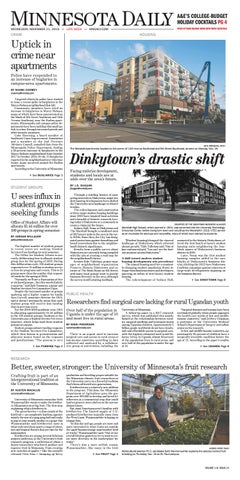
JACK RODGERS, DAILY
The Marshall apartments, located on the corner of 14th Avenue Southeast and 5th Street Southeast, as seen on Monday, Nov. 19.
Dinkytown’s drastic shift
Facing mid-rise development, students and locals are at odds over the area’s future. BY J.D. DUGGAN jduggan@mndaily.com
Through a winding history of competing interests in Dinkytown, major student housing developments have shifted the University-area landscape to what it is today. The redevelopment and construction of three major student housing buildings since 2010 have inspired local activism and a breadth of historic research, leaving today’s Dinkytown at a crossroads to create a vision for the future. Sydney Hall, Venue at Dinkytown and The Marshall brought a combined total of 582 luxury units to the area in the early 2010s. Since then, the City has designated protections against demolition and broad renovations due to the neighborhood’s historic significance. Results from a public survey about Dinkytown are currently being compiled with the aim of creating a road map for the neighborhood’s future. Kristen Eide-Tollefson, project manager of neighborhood organization Preserve Historic Dinkytown and coowner of The Book House on 4th Street, said many local groups want to pursue business diversity in the area, although the survey is still awaiting feedback.
COURTESY OF THE DINKYTOWN BUSINESS ALLIANCE
Marshall High School, which opened in 1924, was converted into the University Technology Enterprise Center before being torn down and rebuilt as the Marshall in 2013. UTEC served as an incubator for startups and nonprofits, many of which were started by students.
“[Student housing] changed the visceral landscape of Dinkytown, which affected alumni greatly,” Eide-Tollefson said. “One of [our customers] said, ‘You can’t see the horizon anymore across Dinkytown.’” A shift toward modern student housing developments sets precedence The annual housing need for a constantly-changing student population draws intrigue from business owners and developers, spurring an influx of new luxury student housing. The redevelopment of Sydney Hall,
connected to the historic Dinkydome, offered the first batch of luxury student housing units neighboring the fourblock square of Dinkytown’s business district in 2010. Later, Venue was the first student housing complex added to the core blocks of Dinkytown’s business district, eliciting the 2013 Save Dinkytown Coalition campaign against concerns of large-scale developments imposing on the business district. u See DINKY TOWN Page 8
PUBLIC HEALTH
Researchers find surgical care lacking for rural Ugandan youth Over half of the population in Uganda is under the age of 18 and most live in rural areas. BY NIKKI PEDERSON npederson@mndaily.com
There is an urgent need to increase surgical care and access in rural areas of low-income countries, according to data collected and analyzed by a collaborative group of universities, including the
University of Minnesota. A follow-up paper to a 2017 research survey, which was published this month, looked at the relationship between rurality, surgical condition and treatment status among Ugandan children. Approximately 5 billion people worldwide do not have timely, safe and affordable access to surgical care, with the highest estimated need in sub-Saharan Africa. In Uganda, almost 83 percent of the population lives in rural areas, and over half of the population is under the age of 18.
“Surgical diseases and trauma have been overlooked globally when people approach the health care needs of low and middleincome countries,” said Jeffrey Chipman, a professor at the University Medical School’s Department of Surgery and collaborator on the research. In low and middle-income countries, approximately 85 percent of children have a surgically-treatable condition before the age of 15. According to the paper’s results, u See UGANDA Page 8
RESEARCH
Better, sweeter, stronger: the University of Minnesota’s fruit research Crafting fruit is part of an intergenerational tradition at the University of Minnesota. BY AUSTEN MACALUS amacalus@mndaily.com
University of Minnesota researcher Seth Wannemuehler wants to make the kiwiberry Minnesota’s next big fruit. The first step: explaining what a kiwiberry is. The green berries — a close cousin of the kiwifruit — are completely hairless, approximately the size of a ping pong ball and ready to pop in your mouth, similar to a grape. But Wannemuehler said kiwiberries’ taste is what truly sets them apart: a range of sweet, tart and tropical flavors that are ripe for the mass market. Kiwiberries are among several delicious projects underway at the University’s fruit research program, a collection of about a dozen researchers who breed, produce and improve fruit in Minnesota. From creating new varieties of apples — like the recently released First Kiss — bumping up berry
production and breeding grapes suitable for the Minnesota climate, fruit researchers at the University carry on a flavorful tradition that’s been cultivated over generations. Kiwiberries are a relatively new addition to the program. This June, the Minnesota Department of Agriculture gave the program over $91,000 to develop and breed kiwiberries as a commercial crop that could land on grocery store shelves in the not-toodistant future. But, most Americans aren’t familiar with kiwiberries. The limited supply of U.S.produced kiwiberries typically come from the West Coast. Wannemuehler is hoping to change that. “In this day and age, people are more and more interested in what fruits are outside the apple-banana-orange supermarket kind of fruits,” Wannemuehler said. “One of my overall lifetime goals is to try to work to create more diversity in the marketplace for fruits.” There’s also a more selfish reason. Wannemuehler, like many in the fruit u See FRUIT Page 3
JASMIN KEMP, DAILY
Horticultural science Ph.D. candidate Seth Wannemuehler explains the science behind fruit breeding on Thursday, Nov. 15 on St. Paul campus.
VOLUME 119 ISSUE 24
2
WEDNESDAY, NOVEMBER 21, 2018
MN DAILY
EXTENDED WEATHER FORECAST WEDNESDAY THURSDAY HIGH 26° HIGH 35° LOW 22° LOW 33° Partly cloudy
Daily Review
MNDAILY.COM
Mostly cloudy
FRIDAY HIGH 42° LOW 31° Rainy
SATURDAY HIGH 37° LOW 27° Mostly cloudy
SUNDAY HIGH 30° LOW 22° Showers
Wednesday, November 21, 2018 Vol. 119 No. 24
An Independent Student Newspaper, Founded in 1900. 2221 University Ave. SE, Suite 450, Minneapolis, MN 55414 Phone: (612) 627-4080 Fax: (612) 435-5865
THIS DAY IN HISTORY
1877 The American inventor Thomas Edison announces his first great invention, the phonograph, which provided a way to record and play back sound. HISTORYCHANNEL.COM/TDIH
Copyright © 2018 The Minnesota Daily. This newspaper, its design and its contents are copyrighted. OFFICE OF THE PUBLISHER Kelly Busche Editor-in-Chief kbusche@mndaily.com (612) 435-1575 Genevieve Locke Business Operations Officer glocke@mndaily.com (612) 435-2761
CONCERT
EDITORIAL STAFF Max Chao Managing Editor mchao@mndaily.com Christine Ha Managing Production Editor cha@mndaily.com Natalie Rademacher Campus Activities Editor nrademacher@mndaily.com Madeline Deninger City Editor mdeninger@mndaily.com Katrina Pross Campus Administration Editor kpross@mndaily.com Drew Cove Sports Editor dcove@mndaily.com Sophie Vilensky A&E Editor svilensky@mndaily.com Ellen Schmidt Multimedia Editor eschmidt@mndaily.com Molly Tynjala Copy Desk Chief mtynjala@mndaily.com Desmond Kamas Chief Page Designer dkamas@mndaily.com Jane Borstad Visuals Editor jborstad@mndaily.com Hailee Schievelbein Visuals Editor hschievelbein@mndaily.com =
=
=
=
=
=
=
COURTNEY DEUTZ, DAILY
Aminé performs at First Avenue on Monday, Nov. 19 in Minneapolis.
City preserves affordable housing The City ordinance requires landlords be more transparent with their tenants. BY EMMA DILL edill@mndaily.com
A new City of Minneapolis policy aims to protect tenants living in naturally occurring affordable housing, including more than 1,000 units near campus. The ordinance, passed by City Council earlier this month, requires landlords to notify tenants and the City 60 days before a building with more than five affordable naturally occurring affordable housing units is sold. The measure also requires landlords to help relocate tenants who are priced out of their apartments due to rent increases caused by changes in ownership. More than 1,500 naturally occurring affordable housing units are located near the University of Minnesota. The Marcy-Holmes n e i g h b o rh o o d i n c l u d e s 1,187 units priced at 40 to 60 percent of the area’s median income without government subsidy, the second-highest number of any neighborhood in the city. Prospect Park has 311 units, Cedar-Riverside has 107 and Como has 58,
according to a 2018 report by the Minnesota Housing Partnership. The ordinance applies to housing units priced between 30 to 60 percent of the median income. Other cities, including St. Louis Park and Richfield, passed similar measures earlier this year. However, Minneapolis is the first to require a 60-day notice, said Eric Hauge, executive director of HOME Line, a nonprofit tenant advocacy group. “In all of those other cities, the ordinances that they’ve passed have only been about half of what Minneapolis passed,” he said. Some landlords expressed concerns about the 60-day notice at a public hearing last month. The ordinance requires landlords to notify tenants of sale negotiation, not just sales, which landlords said could create a false sense of alarm. Proponents of the ordinance say the 60-day notice will give tenants time to explore alternative housing options and will promote transparency. “It may be something that raises alarm for tenants but … it’s better than having people be in the dark about the fact that their building might be getting sold,” Hauge said.
BUSINESS Darya Karas Sales Manager dkaras@mndaily.com David Keane Controller dkeane@mndaily.com The Minnesota Daily strives for complete accuracy and corrects its errors immediately. Corrections and clarifications will always be printed in this space. If you believe the Daily has printed a factual error, please call the readers’ representative at (612) 627–4070, extension 3057, or email errors@mndaily.com immediately. Correction: A previous version of the article “New research shows students learn better when interacting with classmates” said Gillian Roehrig was the associate director of the STEM Education Center. The Center disbanded in 2017.
A view of WaHu apartments on Jan. 15, 2017.
By notifying tenants and the City of sale negotiation, the ordinance also aims to bring in other potential buyers who could keep rent prices consistent. “The notice period gives preservation-minded buyers the opportunity to compete in that market in a way that they don’t always have the opportunity to do now, because they might not even know that the building is for sale,” said Angie Skildum, residential finance manager in the City’s Housing Policy and Development division.
Under the policy, when a new owner purchases a complex, they must inform current residents of any rent increases. If affordable housing units are eliminated, the new owner must help relocate the tenants. Ward 11 Council member Jeremy Schroeder coauthored the ordinance. He said the naturally occurring affordable housing is an important way to keep rent in Minneapolis affordable. “We’re losing a lot of [naturally occurring
DAILY FILE PHOTO
affordable housing.] That’s what’s fueled the affordability crisis here in Minneapolis ... [it] was a big deal to work on this,” Schroeder said. Hauge said the ordinance is the first step to protecting renters in affordable housing. He said the council will continue efforts to protect tenants in the future, pointing to a renters’ bill of rights that the council will consider early next year. “This is the beginning,” Schroeder said. “Notice is just the first part.”
$13 million robotics labs open after renovations The Gemini-Huntley Robotics Research Laboratory opened on Friday, Nov. 9. BY MOHAMED IBRAHIM mibrahim@mndaily.com
The University of Minnesota unveiled newly-renovated robotics research labs that provide faculty and graduate students with various work spaces and resources. The 20,000-square-foot space, dubbed the GeminiHuntley Robotics Research Laboratory, opened Nov. 9 and will bolster the University’s robotics research. The labs make up the first two floors of the Shepherd Laboratories building on
the East Bank campus. The renovations include nine research labs, collaborative work spaces and a two-story drone flying space — a feature that is not commonly seen in this type of building, said Nikos Papanikolopoulos, a computer science and engineering professor and director of the University’s Center for Distributed Robotics. “You can fly drones with no constraints, and you can have several drones flying,” Papanikolopoulos said. “This is very impressive and I actually have not seen it here. I have seen it in Europe, but I have not seen it in an American university.” The labs were funded by $13 million in donations,
EDITORIAL BOARD Ray Weishan Editorials & Opinions Editor rweishan@mndaily.com Ariana Wilson Editorial Board Member awilson@mndaily.com Hailey Almstead Editorial Board Member halmstead@mndaily.com Kelly Busche Editor-in-Chief kbusche@mndaily.com
including $10 million from Gemini Inc. and $2 million in state funding through the University’s Minnesota Discovery, Research and Innovation Economy initiative. One of the labs, called the The Patrick J. Starr Solar Vehicle Project Laboratory, is a workspace funded by a $1 million donation from Carlson School of Management graduate Clifford I. Anderson. The lab gives the University’s solar vehicle researchers 1000 square feet of workshop space that includes an electronics lab and assembly room. The labs also feature glass windows in place of walls, which are intended to create a more open work environment.
“One of the things that’s very unique about this space, unlike any other space that I’ve seen, is that it’s so open,” said Dario Canelon, a graduate student at the University who is researching amphibious robotics. “If you come in, you don’t have to request access to see research you can just walk by and see what people are working on.” The renovations also bring together graduate students and professors from different disciplines to promote collaboration, said Ph.D. student Nick Heller, who is researching machine learning algorithms. “There’s definitely something to be said for being in the same room,” Heller said.
“Communication flows that much faster, it’s that much more immediate and we’re much more productive when we’re sitting together looking at the same screen.” The improvements made to the lab serve current faculty and graduate students in their research, but it may also be used as a recruiting tool to lure students interested in studying robotics, and possibly more degrees in robotics at the University in the future. “It’ll help us attract students, both undergraduates and graduates, and it will also help us attract more funding.” Papanikolopoulos said. “It never hurts to get more support for students.”
THE MINNESOTA DAILY is a legally independent nonprofit 501(c)(3) organization and is a student-written and student-managed newspaper for the University of Minnesota’s Twin Cities campus. The Daily’s mission is: 1) to provide coverage of news and events affecting the University community; 2) to provide a forum for the communication and exchange of ideas for the University community; 3) to provide educational training and experience to University students in all areas of newspaper operations; and 4) to operate a fiscally responsible organization to ensure its ability to serve the University in the future. The Daily is a member of the Minnesota News Council, the Minnesota Associated Press, the Associated Collegiate Press, The Minnesota Newspaper Association and other organizations. The Daily is published Monday and Thursday during the regular school year and weekly during the summer, and it is printed by ECM Publishers in Princeton, Minn. Midwest News Service distributes the 10,000 issues biweekly. All Minnesota Daily inserts are recyclable within the University of Minnesota program and are at least 6 percent consumer waste. U.S. Postal Service: 351–480.
Wednesday, November 21, 2018
TONY SAUNDERS, DAILY
The Radius apartments in Dinkytown on Saturday, Nov. 18.
Burglaries u from Page 1
Police Department daily crime log, six burglaries have been reported from Radius since the start of the academic year, more than any other University of Minnesota residence. Chris Lautenschlager, executive director of the MarcyH o l m e s N e i g h b o rh o o d Association, said while
Funding u from Page 1
nuanced,” Carvell said. “There’s 105 different groups and 105 sets of variables,” Carvell said of the deliberation process. “Things like: Did they meet the minimum requirements? Did they justify their requests? Have they managed funds before? How much are they contributing to their own requests?”
reports of burglaries do tend to increase during the fall, he hopes Radius will improve its security with its new ownership. “Security detail is not as robust as we would like it to be [at Radius],” he said. MNHA board member Marcus Mills said he has noticed more criminal activity around the corner of 8th Street Southeast and 15th Avenue Southeast. While general increases in crime
can be attributed to population growth in the area, that does not explain the concentration on that block, he said. “If that was true, it would be more spread out,” Mills said. A statement from the University noted Radius has all the same safety features as other University residences, including regular staff members, a 24-hour information desk and security monitors from 11 p.m. to 7 a.m.
“Radius security is designed to be the same format and schedule as other university operated residence halls and apartments,” the statement read. University junior Lydia Clinton, who lived in Radius last year, said she never experienced an instance of feeling unsafe during her time there. Clinton said her experience at Radius was similar to her experience at Centennial residence hall.
“I felt no more or less safe at one or the other,” she said. Campus and Minneapolis police have collaborated this fall to tackle the higher burglary rate in Marcy-Holmes, increasing overtime patrolling in the area. Minneapolis Police Department 2nd Precinct Inspector Todd Loining said he arranged for 96 hours of overtime patrol shifts in Marcy-Holmes over a four-week time period at the beginning of the school
year. Marcy-Holmes has also seen more overtime patrol than any other 2nd precinct neighborhood over the past four months. This effort is “in an attempt to address the ongoing Burglary of Dwelling crimes that have been occurring,” according to an emailed statement from Loining.
Students are automatically required to pay $18.91 for student activities on campus, an amount included in the student service fee that students pay per semester with their tuition. As to why more groups are applying for funds for the first time, Goossens said there are many possibilities to consider. This includes a revision to the SSF process where groups now request funding one semester in advance for programming, as opposed to a year ago where
groups originally requested funding for the entire year. “It’s been a full year since the revisions to the process … so more groups are feeling comfortable enough to enter the application process and to pursue funding from this particular source,” Goossens said. “As different groups change and evolve … that could also change their own personal considerations. It’s a lot of different possibilities. Those are the ones we’ve been thinking about.”
Ayan Mohamed, treasurer for the Association for Computing Machinery for Women, said this was the student group’s first time applying for SSF funding. With an increase in group interest and a new student office, Mohamed said her group needed the funds. “We usually get funded through the computer science department and that was usually enough for us ... but we noticed we had an increase in members and we needed to be able to support
that,” Mohamed said. Trygve Eggen, the director of finance for GOFIRST Robotics, a student group that has been requesting SSF funds since the 2011– 2012 academic year, said in an email that he welcomed the increased requests for group funding. “I am a strong proponent of student groups as a means for students to form communities within the University. ... More student groups applying for SSF funding indicates that there
are more active student groups that have programs that meet the requirements to be funded by SSF. This translates to more opportunities for students, so I think that this is a positive thing for the entire campus and student body,” Eggen said. Carvell echoed Eggen’s positive outlook, saying the increased number of groups applying shows that the SSF program is accessible. “New groups can come in and be successful,” she said.
processes is breeding plants that can withstand the state’s cold weather while still producing good fruit. “Cold hardiness is something of course that’s still important in Minnesota,” Luby said. “There’s not much difference between us and the North Pole when it all freezes over here.” For many in the program, that challenge is part of the fun. “While it’s challenging to grow fruit here because of our particular climate, it’s possible,” said Nathan Hecht, a researcher working on increasing strawberry production through natural pollinators. Hecht said there’s growing demand for locally produced fruit in Minnesota. “Our responsibility is to provide those resources and do that research so its possible to grow fruit productively here,” he said.
Breeding generations of researchers Many in the fruit research program have been doing this work for a long time; Luby has worked at the University since the early 1980s. But new generations of researchers are essential to ensuring the program continues to bear fruit, said Emily Hoover, head of the University’s Horticultural Science Department. “[Researchers] are probably not going to see everything that they’ve done to fruition,” Hoover said. “I find people who grow fruit to be really interesting individuals who have a commitment to the long term viability of agriculture.” Luby and Hoover, who are also married to one another, said the program is intergenerational by nature. “We’re getting toward
the end our careers and we hope to leave it full for the next generation of breeders,” Luby said. Wannemuehler, a Ph.D. student, is one of those young researchers. He said he wants to create a kiwiberry variety that’s cold-hardy, delicious and grown throughout Minnesota. But it will likely take several years before kiwiberries are ready for the groceries shelves — Wannemuehler’s ideal kiwiberry may take over a decade. Wannemuehler said his role may end up being small, but it remains important to the overall mission: making fruit more delicious for Minnesotans. “Aspirationally, I would love if through my research I could help kick off a revolution,” he said. “I see myself as someone laying the groundwork.”
Fruit u from Page 1
research program, has something of a sweet tooth for new fruits like the kiwiberry. A long road to good fruit For apple breeder Jim Luby, the mission of the fruit research program is straightforward. “Our overarching goal is basically getting good fruit for people to eat,” said Luby, one-half of a duo behind popular apple varieties such as the Honeycrisp. The fruit research program, which helped develop the state’s reputation for apple breeding and introduce wine-growing to the region, is a lucrative venture. In the past three decades, fruit research has brought in over $27 million in revenue, with the large majority coming
3
JASMIN KEMP, DAILY
Kiwiberries, a fruit University researchers are breeding, as seen on Thursday, Nov. 15 on the St. Paul campus.
from apples. But Luby said creating the perfect fruit can take time. Researchers essentially play matchmaker: cross-breeding plants over and over again until they have the perfect result — a sweet, crisp apple, a big red strawberry, or in the case of
kiwiberries, a tropical tasting fruit that can grow in Minnesota. Luby said new apples varieties, for example, can take 20-plus years to create; berries and grapes are closer to 10 or 15 years. Researchers say one of the most important
Emma Dill contributed to this report.
University professor brings Alzheimer’s awareness to each Minnesota county Joseph Gaugler will visit every county in the state to teach about Alzheimer’s. BY DYLAN MIETTINEN dmiettinen@mndaily.com
University of Minnesota professor Joseph Gaugler started an ambitious project this month: He plans to visit all 87 counties in the state to educate people about Alzheimer’s disease and resources available to those affected by memory loss. “This is a daunting task and there’s really not a timeframe,” Gaugler said. “I really wanted to make this a statewide initiative, to talk with families and share information and
information related to dementia. I really wanted to listen to families and their experiences to further refine our research and work.” Information about Alzheimer’s disease and dementia is needed throughout Minnesota. There are more than 94,000 Minnesotans age 65 and older living with Alzheimer’s, according to the Alzheimer’s Association. That number is expected to increase nearly 30 percent by 2025. The first two stops on the tour were in rural settings: Wabasha County and Zumbro Falls. The informational sessions, hosted at St. Elizabeth’s Medical Center and a Memory Cafe in Pine Island, addressed a wide range of questions
brought up by participants. Around 50 people attended the session. “We are the only hospital in Wabasha County, so we work very closely with Wabasha Public Health to focus on wellness and prevention, just trying to meet the rural health needs of our area,” said Jenny Schlagenhaft, director at St. Elizabeth’s Medical Center. “Rural healthcare is a specialty all its own.” Rural communities lack many of the resources found in urban settings, such as transportation, adequate end-of-life care for seniors, medical care and support for caregivers. “We’ve identified a real need around dementia and Alzheimer’s,” Schlagenhaft said.
Nationally, the current cost of care for Alzheimer’s disease is $277 billion. In 2017, there were 254,000 caregivers for Alzheimer’s patients in the state of Minnesota, according to the Alzheimer’s Association. “The unpaid cost of caregiving is really immense,” said Leah Challberg, senior program manager and care consultant for the Alzheimer’s Association. “Caregivers run out of [paid time off] and take a lot of time off. The more we can do to help alleviate the burden of these people, the better.” Schlagenhaft said that some in the hospice care industry worry the field may not be prepared for the care necessary as the Baby Boomer
generation ages. “The greatest challenge we face now are limited resources,” Schlagenhaft said. “I don’t know if we’re going to have enough skilled nursing care and capacity to accommodate all the people who may need it years from now.” Marie Hlava, who hosts Pine Island’s Memory Cafe, a support group for those with Alzheimer’s and their caregivers, said families often stop visiting their family members with Alzheimer’s disease because it can be too emotional to see their relatives forget them. “What they don’t realize is that person, when they know they’re going to have visitors, that whole day, they’re excited,” Hlava said. “They’re
excited that someone is coming to visit them. And they’re excited and happy to see them.” Although the future is uncertain for those with Alzheimer’s disease or dementia, there is hope in the support groups, like the Memory Cafe, and in educational sessions, like the ones Gaugler hosts. “Minnesota is aging, and it’s important to engage with families now and leverage the research opportunities that we do have,” Gaugler said. “One has to listen to those with memory loss. It is challenging to see that person as they regress. But, you have to focus not on what is lost, but what’s still there and how we can maintain that for as long as possible.”
4
WEDNESDAY, NOVEMBER 21, 2018
MN DAILY
MNDAILY.COM
MUSIC
Review: Aminé ‘reels in’ incredible positivity The “Club Banana” musician spread love and good vibes throughout the entire First Ave mainroom on Monday night. BY SAMIR FERDOWSI sferdowsi@mndaily.com
Standing in front of First Avenue on Monday night, a passerby would think there was a puppy adoption going on inside. As flurries of snow danced on the street, bass blasted within the venue. With smiling faces, laughs and genuine care, both staff and concert-goers were in the best of moods as they waited for the headliner to take center stage. Rarely do hip-hop artists practice what they preach these days. Aminé, however, does so to the fullest. As the lights fell, a cheer that reflected the “under 21” crowd erupted and laser lights began to shine. Bass instantly bombarded through the speakers, and Aminé was off to the races. Performing banger after banger, the artist went strong for a few songs before introducing himself to his loving fans — as if this was necessary. “I want you to do something for me during the show, all right?” the Portland emcee commanded
between hits off his summer album, “ONEPOINTFIVE.” “Every time I say, ‘you’re beautiful,’ you say, ‘I know!’ Can you do that? Because it’s true, you’re all pretty as fuck.” Sure enough, after almost every song the rapper would belt “you’re beautiful” into the mic about five times. The crowd always gave an affirming response. The backdrop to all of this zealousness was atypical for the main room. A huge LCD screen that reached the length of the stage and stood about sixfeet-tall projected graphics ranging from tropical island landscapes to Jack Black in “School of Rock.” Feeling half EDM show and half Rolling Loud, this scenery bolstered the show’s epic-ness even further. During a short but joyful intermission, the audience was entertained by the one and only Rickey Thompson projected on the screen. Then it was pretty much bangers for the rest of the set. As if Aminé hadn’t dropped enough of his positivity over the venue
COURTNEY DEUTZ, DAILY
ABOVE: Aminé carries around a bag given to him by a member of the crowd during his final song ‘REEL IT IN’ at First Avenue on Monday, Nov. 19 in Minneapolis. LEFT: Aminé performs at First Avenue on Monday, Nov. 19 in Minneapolis.
already, about three-fourths of the way into the show, he called a fan onstage to sign his tour pants. Decorated with license plates, the pants were to be signed by “the most lit fan in the crowd.” “I want you to write your name on the Minnesota plate, and then also what you want to become,” Aminé said to the chosen fan, who bunny-hopped in place
with excitement. From classics like “REDMERCEDES” to a remixed and incredibly groovy rendition of “Wannabe,” the music accented the night with choruses felt to the bone. This fact shouldn’t be overshadowed. But the energy from Aminé and his crew was a rare sort. An energy often projected in rap shows, but
seldom captured. Illuminated by neon lasers, the feel-good artist ended the night with his hit single “REEL IT IN.” The smiling crowd seemed to ask why he couldn’t stay on a bit longer. I was asking the same thing. Grade: A
COLLEGE KITCHEN
Spicing up the holiday season Friendsgiving cocktails for leftover lovers — and those antsy for December. BY SAMIR FERDOWSI sferdowsi@mndaily.com
care and say “bah humbug” to overpriced nonsense.
It’s that time of year again. Lights, ornaments and wreaths start decorating the bars downtown and money signs start decorating their cocktail menus. However fun they may be, “specialty cocktails” during the holiday season are ridiculously expensive. While some would argue that you’re paying for the “ambiance,” A&E thinks the makers of such spirits should be put on the naughty list. So, we’ve opened up our workshop and mixed up three college-budget cocktails that can keep you cozy on these spirit-filled nights. Whether it’s for a Friendsgiving shindig or a holiday movie marathon, enjoy with
Spiced Mayflower If only this drink would have been around in 1620. Not your average cocktail, this late fall refreshment is perfect for any sort of feast going down within the next month. In true New England fashion, we have a mixture of cranberry juice for sweetness, cinnamon for spice, simple syrup for an extra bit of goodness, a maraschino cherry for aesthetic and, naturally, rye whisky. A unique cocktail, the Spiced Mayflower will keep you sailing. Ingredients 1 part rye whisky 1 part cranberry juice .5 parts simple syrup
Ingredients for “Santa’s Little Helper” on Sunday, Nov. 18 in Minneapolis.
1 maraschino cherry A pinch of cinnamon How to mix it: Easy. Load whisky, cranberry juice and simple syrup into your drinking grail. Make sure to mix thoroughly with a teaspoon so that the simple syrup gets dispersed within the concoction. Once the whirlpool stops, grab a pinch of cinnamon and sprinkle it on top of the drink. Throw a maraschino cherry in for good measure. The Cranberry Old-Fashioned Ah, how quaint. Like the fixings of Thanksgiving meals themselves, this goto drink is great anytime of the year — but particularly now, and especially with this twist. With its Old World rye
and New World addition of cranberry juice, the Cranberry Old-Fashioned is an easy drink to show off to relatives you may be seeing sooner than you would wish. Ingredients 2 parts rye whisky .5 parts simple syrup 2 dashes of Angostura bitters 1 orange peel 1 maraschino cherry Ice How to mix it: T h ro w y o u r l i q u i d s into a cocktail shaker with crushed ice (if you don’t have a shaker, no need to call the Scotland Yard and panic — a glass and mixing spoon works just fine) and shake thoroughly. Let sit very briefly while you fill a glass with more
crushed ice and then pour the mixture into the cup. From here, add your two dashes of bitters. Last, slice off an orange peel, rub around the lip of the cup for aromatic purposes and then toss it right into the drink. Add a maraschino cherry if you’re that type of person. Santa’s Little Helper Ho ho ho-ly smokes ... is there something in this eggnog? A twist on a favorite, Santa’s Little Helper, can be your addition to any party this time of the year — especially if you’re sick of leftovers and ready to jump ahead to December. With some of the season’s greatest ingredients, this milky elixir contains the perfect amount of spice and, of course, peppermint to keep your holiday
JASMIN KEMP, DAILY
cheer strong through the thick of the season. Ingredients 3 parts eggnog 1 part rye whisky 2 mini candy canes Cinnamon (optional) How to mix it: It doesn’t get any simpler than this. Add your cold eggnog to a glass and then add a shot (or two) of rye whisky. After, grab a candy cane, crush it up into pieces and sprinkle it onto your drink. Last, grab another one of the peppermint wands and stir up your concoction so that all three parts blend into one delicious drink. Add a sprinkle of cinnamon if you want a little more pizzazz and hang the candy cane on the side for a post-drink sweet.
5
Sports SOFTBALL
All-Big Ten catcher to depart from Minnesota Kendyl Lindaman is no longer on the Gophers softball roster for 2019. BY DREW COVE dcove@mndaily.com
Minnesota will be without an all-Big Ten catcher starting in the 2019 season. Junior KENDYL Kendyl LINDAMAN Lindaman will be transferring from Minnesota after two seasons with the Gophers, the Star Tribune first reported. Lindaman is not listed on the roster for 2019 and her departure from the program was confirmed by a representative of Gopher Athletics. Lindaman was the Big Ten softball player of the year in both 2017 and 2018. She was the Big Ten freshman of the year in 2017. Her stats back up that recognition. The Ankeny, Iowa native hit 20 home runs in each of her two seasons, and she never hit below .400 in batting average in conference play. Lindaman was instrumental to the success of Minnesota’s Big Ten regular season championship in 2017 and Big Ten tournament victory in 2018. The Gophers went 4117 last season in the team’s first under head coach Jamie Trachsel. In Big Ten play, they had a 17-4 record. Minnesota currently has one player listed as a catcher on the roster for 2019, Anne Miller, a sophomore from Bloomington, Minnesota.
MNDAILY.COM
MN DAILY
WEDNESDAY, NOVEMBER 21, 2018
MEN’S BASKETBALL
Point guard good fit for Coffey Coffey is having plenty of success running the point so far this season. BY NICK JUNGHEIM njungheim@mndaily.com
One Gophers basketball player wasn’t brought in as a point guard, but he’s now thriving this season at the position. Amir Coffey may not look like a point guard but Minnesota is more than comfortable with the ball in the hands of the 6-foot-8 junior. Head coach Richard Pitino said his combination of size and skill creates mismatches for opponents on the court. “You have to make a decision on how you want to guard him,” Pitino said. “He’s really skilled, obviously. We’re taking for granted that he’s [6 feet, 8 inches] and he’s bringing the ball up the court like he’s [6 feet, 2 inches].” For his first two seasons with Minnesota, Coffey didn’t get as many opportunities to bring the ball up the court with Nate Mason running the offense. However, with Mason now graduated, Pitino has entrusted Coffey to play the point. So far, he’s shown no indication that the position change has posed any challenges for him. “I feel good,” Coffey said of the position change. “It’s something that I’ve been practicing all summer with my team. It’s no different than running the three, really, it’s just bringing the ball up.” The Hopkins, Minnesota native came into the program with high expectations on his shoulders. Those shoulders, specifically the right one, have unfortunately given Coffey problems. Last
TONY SAUNDERS, DAILY
Junior Amir Coffey jumps for the layup on Monday, Nov. 12 at Williams Arena. The Gophers beat the Utes 78-69 and Coffey finished with 14 points.
season he missed 14 games due to a shoulder injury. Before that, he had started all but one game of his college career. Recovery took time and effort, but Coffey now feels he’s back at full strength. “I had to lift a little bit different because of my shoulder,” Coffey said. “I started to get my strength back, I got back on the regular plan. Just getting stronger is most important.” There doesn’t appear to be any lingering effects of the injury hampering Coffey. Through the first three games of the season, he’s shooting 50 percent from the field and leading the team with nearly 15 points per game.
There’s no doubt having Coffey on the court makes the Gophers better. His teammates are glad to have him back after he missed so many crucial games last year, and have liked what they’ve seen from his ability to run the point. “When he decides to be aggressive, he’s a totally different person,” said senior Dupree McBrayer. “He’s tall, he sees over defenders, he makes passes that a shorter point guard wouldn’t make.” Part of becoming an upperclassman in any program is increased responsibility as one of the team’s leaders. While Coffey is the first to admit he’s not the most vocal teammate, he shows his leadership in other ways.
“I’m not really a big talker,” Coffey said. “I just like to stay quiet and do what needs to be done.” Coffey’s maturity has impressed his head coach since the day he joined the program, especially regarding his on-court demeanor. Pitino says his junior is somebody teammates can look to and strive to emulate in close games. “He’s a calming influence,” Pitino said. “We’ve got some calming influences on the court and [Coffey] is definitely that, and that’s important when you’re looking at a point guard. [Coffey] never ever seems rattled.” This season, it will be crucial that Coffey, McBrayer and other guards, freshman
Gabe Kalscheur, sophomore Isaiah Washington and redshirt senior Brock Stull all stay healthy and play well. The team already lost some backcourt depth they hoped to have this year. Last week, the NCAA denied sophomore Marcus Carr’s waiver appeal to become eligible immediately after he transferred from Pittsburgh. “I’m disappointed with it,” Pitino said of the ruling. “I think that this whole process is really flawed.” After completing three games in four days at the Vancouver Showcase, Coffey and the Gophers will travel to Massachusetts on Monday to play Boston College in the Big Ten/ ACC Challenge.
SWIM & DIVE
Swimmer Lindsey Kozelsky balances academics, athletics and marriage Kozelsky wants to be a good teammate in the rest of her career with UMN. BY DANIELLE PEDERSON dpederson@mndaily.com
Junior swimmer Lindsey Kozelsky is the typical student-athlete in many ways. Like a normal Gopher athlete, she runs from classes and homework to practice, travels on the weekends for competitions, and maintains a social life. But, in addition to managing all of the latter, Kozelsky takes on the role of a wife
and balances a marriage. Kozelsky is married to William Kozelsky, a member of the Marine Corps who is currently stationed in New Bern, North Carolina. The pair met their freshman year at Albert Lea High School and started out as good friends. “We always joke. I friendzoned him quite a few times and I just loved him as a friend. I didn’t want to take that step and have things possibly getting weird between us,” said Kozelsky. They began dating the end of sophomore year in high school. Kozelsky and her husband recently
celebrated their one year anniversary on Aug. 19. Though the two have to deal with the difficulties of a long-distance relationship, William continues to be supportive of Kozelsky. “He was deployed from March until October. That was our longest time apart since we’ve started dating, so that was really trying in our relationship. It definitely made us stronger, and it helps that he’s very supportive of me swimming and getting my education here in Minnesota,” said Kozelsky. To help keep her mind off the distance between she
and her husband, Kozelsky enjoys participating in CrossFit, playing with her Boston Terrier Pug, Bean, and spending time with friends and family. Teammate and captain Kaia Grobe enjoys having Kozelsky on the team. She said Kozelsky is a considerate individual and is always looking out for others. “She’s funny. We’re always giggling about something in the water,” said Grobe. “We call her the ‘Mom’ of the team because she’s always taking care of people. She’s very mature and she’s very neat and tidy.”
This sense of maturity and growth is also seen and valued by the head coach of the men’s and women’s swimming and diving teams, Kelly Kremer. “Watching how she’s balanced having elite level academics, elite level athletics and then balancing a marriage as well — that forces a person to grow. She does it all very well,” said Kremer. After college, Kozelsky hopes to join her husband in North Carolina where she can enjoy sweet tea, east coast history and architecture. She plans to apply to graduate schools, use her elementary education
degree and hopes to make a run at the 2020 Tokyo Olympics. Until then, Kozelsky is working hard to make her mark on Gopher athletics. She hopes to win a NCAA championship title in the 100 or 200-meter breaststroke. Most importantly, she hopes to be remembered as a good teammate. “I hope [my teammates] feel comfortable coming up to me and confiding in me if they need someone to talk to about any part of life. I want them to feel and know that they are valued for more than just swimming,” said Kozelsky.
MEN’S HOCKEY
Schierhorn and Robson rotate in net again for U Mat Robson took the loss Friday and Eric Schierhorn won on Saturday. BY JACK WARRICK jwarrick@mndaily.com
There is a goaltender battle in Stadium Village this year. Senior Eric Schierhorn and junior Mat Robson have almost evenly split games this year, as the netminders keep consistent play while the defensive core struggles. “If there’s been one consistent spot for us from the start of the year through all nine games, it’s been our goaltending,” head coach Bob Motzko said. “When I looked on paper, it looked like we had two good goalies. Here we are nine games in, it looks like we have two good goalies.” Robson started playing for the Gophers halfway through last year, sitting out the first part of the season due to NCAA transfer eligibility rules. He immediately had an impact and took time from Schierhorn,
TONY SAUNDERS, DAILY
Goaltender Eric Schierhorn takes a water break at Mariucci Arena on Saturday, Nov. 17. The Gophers beat the St. Lawrence Saints 3-0.
who had started all of the 75 total games of the 2015-16 and 2016-17 seasons — his freshman and sophomore years at Minnesota. Schierhorn earned his 12th career shutout on Saturday in what he called, “probably the easiest shut-
out that I’ve had in college hockey.” St. Lawrence mustered 12 total shots in the game to put Schierhorn in Gophers’ history as the goaltender with the second most shutouts in his career. The junior goaltender wasn’t so lucky.
“I think it was a bit of a wake up call for us, and obviously we can’t be letting that happen. It seems to happen a little too often right now,” Robson said about Friday’s game. Robson started Friday’s game and was left out by
the defense multiple times to make difficult saves. The Gophers gave up 39 shots on Friday — Robson’s fifth game of the season — and lost 4-3 in overtime on the first shot of the extra frame. “It was ... a tale of two different games this weekend,” Robson said. “It was good to see our team respond the way they did on Saturday.” Robson described the relationship between Robson and Schierhorn as a good friendship unless the two are in between whistles. “But then obviously when it’s time to get serious, we’re able to get serious. And we both wish success for one another, and it’s good to see him move into second place shutouts all time for Gopher hockey,” Robson said. Robson described the differences between the two. “He plays an aggressive athletic game for sure, a little bit more high tempo. I try to just slow things down and try and just be really calm in the crease,” Robson said. The Gophers took no penalties for a full period
since over a month ago in the second game against University of Minnesota Duluth on Oct. 7. Motzko has harped on the penalties being a major issue for the team as things have broken down in the last seven games. “But discipline continues to move in a better direction, but ... it’d really be nice to have a game where we’re just solid, from start to finish,” Motzko said. There is one other goaltender on the team — senior Brock Kautz. He played one game for the Gophers when he was a freshman and allowed two goals. Minnesota has a 3-5-1 record going into this week’s matchup against Michigan State (4-6). It is the second weekend of Big ten play after the Gophers split a twogame series with Wisconsin on Nov. 9 and Nov. 10 But last, year some of Schierhorn’s time was taken by junior goaltender Mat Robson, which has now given way to even more time. The two are currently splitting time, as Robson has five games played to Schierhorn’s five.
6 WEDNESDAY, NOVEMBER 21, 2018
MN DAILY
MNDAILY.COM
Editorials & Opinions
COLUMN
Private universities that cater to elites don’t need more funding
his week, following in the tradition of many men and women who have made mountains of money on Wall Street, a billionaire made a terrible financial JONATHAN ABABIY decision with a lot columnist of money. Michael Bloomberg, the founder of the Bloomberg LP, former New York City mayor and potential presidential candidate, announced Sunday in an editorial in The New York Times that he would be donating a massive $1.8 billion to Johns Hopkins University for financial aid for low- and medium-income people. This follows the $1.5 billion he has already given to Johns Hopkins. It’s a noble gift and the largest gift ever made to an educational institution. Johns Hopkins is now a part of a select group of schools that offer need-blind admissions and financial aid packages without loans. However, Bloomberg’s gift exposes a large trend in educational philanthropy: the super rich love giving money to schools that just don’t need it. Just 4 percent of American undergraduates attend
universities that have acceptance rates under 25 percent, and only 1 percent attend schools with acceptance rates under 10 percent. The seemingly endless checks flowing into the coffers of Johns Hopkins, Harvard and other elite private universities are misdirected. Johns Hopkins is an excellent example of a university that just doesn’t need the money because like most other private institutions, it serves pretty much no one. It only accepts a measly 1,249 undergraduates a year. There are more students in Frontier Hall and Territorial Hall combined than there are in the freshman class of Johns Hopkins. Of the people it actually gives admission to, only a microscopic 2.9 percent come from the bottom 20 percent economy — that’s just 36 people in the freshman class, or the front row of a psychology lecture in Willey Hall. Unsurprisingly, Johns Hopkins primarily serves the affluent. Eleven percent of its student body is from the top one percent. This isn’t because there aren’t enough poor, smart kids or the University’s financial circumstances. Numerous studies have found there are lots of lower income kids with great credentials, but that around 43 percent of those students don’t apply to competitive colleges and instead go to lower ranked schools. These “under matched” kids could have gone to Johns Hopkins, but the University never went looking for them. They’ve never been a priority, even with an endowment worth $3.8 billion for just 6,109 undergraduates.
EDITORIAL
EDITORIAL
Although the super rich continue giving money to universities, they give to schools that don’t need it.
T
A much needed break from class Stress and anxiety are mounting as students anticipate their first break since the semester started. Earlier this month, the American Psychological Association found what college students already know: Generation Z, or people aged 15 to 21 years old, are the most stressed generation. The study looked at the increased levels of anxiety and stress in young people as a result of our nation’s current issues. These factors include, but are not limited to, gun violence, immigration, sexual assault and climate change. If you add those factors to the academic stress that many students in Generation Z face, you create an atmosphere that puts an unhealthy amount of stress on young adults and teens. To help alleviate stress, we see one action the University of Minnesota could implement: incorporating a fall break.
To help alleviate stress, we see one action the University of Minnesota could implement: incorporating a fall break. Unlike spring semester where students get a week off in mid-March, fall semester begins the day after Labor Day and continues through most of November – without a break. On the University’s Morris and Duluth campuses, students receive two days off in October that serves as a fall break. Students on the Twin Cities campus should also be afforded this opportunity. Having the break during Thanksgiving week would help students transition smoothly into the last weeks of the semester. Midterms often fall on the weeks before the holiday, so a few extra days void of class would provide time for students to get feedback from professors and faculty. Having a week to reflect on course progress, exams taken and papers written will ultimately set up students to succeed during a fast-approaching finals week. Extending the Thanksgiving break would additionally give staff and faculty an opportunity to take time off for themselves. Professors could catch up on grading or open up more opportunities to hold office hours and meet with students. Offering students and professors the opportunity to catch their breath after sprinting through the first twothirds of the semester is needed. Students will also find more time to return home to spend time with their family. Over 38 percent of students on campus are from out of state or out of the country. Having extra days off during the week would allow students to have ample time to travel, regardless if they’re flocking home by plane, train or automobile. Academics are a priority in students’ lives. But when mental health comes into question, we encourage the administration to put the health of the students’ first. Students are already dealing with high levels of stress, and with many students balancing jobs and course work, it becomes overwhelming and unhealthy for students to take on. Having that time off during the fall semester will not only give students a chance to catch up on their school work, but ease some of the stress they face. The fall semester can often feel like a sprint that has turned into a marathon. However, there should be more time to rest, recuperate and refuel – before students make that final dash to the finish line.
In contrast, the University of Minnesota, a massive institution with over 35,000 undergraduates, has an endowment of $3.5 billion, which itself is actually larger than those at Wisconsin and North Carolina. The Johns Hopkins student body is so disconnected from demographic reality, despite immense financial resources, showing plain irresponsibility on the part of its administration. But Wall Street has kept on writing checks. Besides Bloomberg’s record breaking gift, other notable gifts in 2018 have been private equity CEO Stephen A. Schwarzman’s $350 million donation to Massachusetts Institute of Technology, the foundation of businessman Leonard Blavatnik’s $200 million donation to Harvard University and financier Edward P. Bass’ $160 million donation to Yale University. All these schools have endowments worth $14 billion and more students from the one percent than the bottom twenty. These elite private universities don’t need the money. They haven’t shown any commitment to diversity. But each gift is tax-exempt, so taxpayers subsidize it. Thank you Bloomberg, Schwarzmann, Blavatnik and Bass. As president of Johns Hopkins, Ronald J. Daniels, told NPR, “This reflects a failing to live up to the Jeffersonian ideal of equal opportunity.” He’s not wrong.
Jonathan Ababiy welcomes comments at jababiy@mndaily.com.
It is time to let felons vote Florida’s voters overturned a ban on felons voting, which poses implications for future elections. The midterm election in Florida — the third-largest state in the union by population — was notoriously inconclusive at the top of the ballot. But while the nation watches, and argues over, the Sunshine State’s recounts for governor and senator, a possibly more important result has flown largely under the radar. Amendment 4 on the Florida ballot, which passed easily, restores the voting rights of felons who have completed their sentences, with the exception of those convicted of murder or certain sex crimes. This is no minor matter. Amendment 4 restores the franchise to some 1.4 million Floridians, including an estimated 25 percent of that state’s blacks and 40 percent of its black men. In a year marked by allegations all over the country of voter suppression, this is a remarkable change. Florida’s felon-voting ban was enshrined in its 1868 post-Civil War constitution as a means of disenfranchising its black population, and 150 years later it remained remarkably effective at doing that. Had Amendment 4 been in force this election, the Democrats would likely have won Florida’s governor and senate races this year;
had it been in place in 2000, Al Gore would probably have become president. Florida’s strict ban was an outlier. Most states, including Minnesota, restore felon voting rights at the end of their sentence. (Maine and Vermont allow even prison inmates to vote.) But Minnesota can stand a re-examination of its rules as well. Minnesota does not allow felons on probation or parole to vote. And Minnesota is particularly strong on probation and supervised release. It takes longer for a felon to regain his or her voting rights here after being released from prison than in most other states. Research by University of Minnesota professor Christopher Uggen suggests that regaining the right to participate in politics is a crucial component in reintegrating released felons in society and may reduce recidivism. His research also finds broad public support for allowing those on probation or parole to vote. Minnesota’s ban, according to Sarah Walker, an advocate of restored suffrage, affects more whites than minorities and more residents of outstate than of the metro area, in no small part because of meth and opioid convictions. The Legislature would do well to examine loosening the standards for restoring the franchise.
This editorial was originally published in the Mankato Free Press.
COLUMN
US neighborhoods were made for both you and me Gentrification pushes longtime residents out of neighborhoods; let’s do our part to prevent that.
I
recently read a guest column in the Guardian from April 2017 called, “Confessions of a reluctant gentrifier,” about Rogers Park — the neighborhood in Chicago where I grew UMA VENKATA up. The article columnist was a cool bit of introspection because of the racial topics it tackled that have been daily information for residents, but not necessarily for others outside cities. Rogers Park’s claim to fame is its diversity. It is ranked by The Chicago Reader, time and again, as the most diverse neighborhood in the city. There’s a mix of all kinds of ethnic groups, including, for example, Rohingya Muslim refugees, Latin American immigrants (especially the Mexican community), the Somali community, the black community and the white community. Members of Rogers Park tend to have strong ties with Evanston, the suburb that borders Rogers Park, where Northwestern University is located. Those members tend to be white. There’s no cut-and-dry solution for avoiding the ills of gentrification, something Rogers Park has certainly been experiencing for years now. There are now dog-grooming salons and a restaurant dedicated to macaroni and cheese. Property values are rising, and there are plenty
of good effects from that. But the most clear negative consequence is that gentrification is pushing out the longtime residents. With more white people having moved in, the resident minority communities are under more scrutiny throughout their daily lives. No one should be prevented from moving into new neighborhoods, just as no one should have to be forced to move out of their own neighborhood against their will. These two things are not mutually exclusive, but finding the balance is tricky. It requires a noticeable measure of human decency and empathy from those who are moving in. Rogers Park borders Lake Michigan, so you can imagine the residents of the blocks next to the lake are of a different racial and economic makeup than those a few blocks inland. As University of Minnesota students, we will eventually graduate and move off campus. For many of us, that will be to cities, including Minneapolis — or even Chicago. Our responsibility as new community members, with the economic power to affect and shift rent and cost of living, is to try to mitigate that effect as much as we can. We should support local business, certainly. But more importantly, we must allow our communities to remain in peace, not divided by a self-inflicted fear or paranoia of the racial and cultural other. When one racial group constantly and unnecessarily calls the police on the other, it only deepens divides, mistrust and hurt. When we move into a new neighborhood, or when we visit another, we shouldn’t perpetuate that habit. That’s being a good neighbor.
Uma Venkata welcomes comments at uvenkata@mndaily.com.
EDITORIAL
Prevent abuse of non-compete agreements Non-compete agreements have become more common among all classes of workers recently. Unemployment in Minnesota is at 3.1 percent, a level that analysts view as essentially full employment. With the available talent so tight, it should be a great time for workers to negotiate a pay increase or to easily move to another job that holds better prospects. But many in Minnesota and in other states are held back by non-compete agreements in their contracts, even though there is no justification for the clauses. It’s something Congress should change, or lacking action there, by individual states. Non-compete agreements are contracts under which an employee agrees not to compete with the old employer or work for a competitor for a period of time. The clauses used to be used primarily for certain higher-paid or specialized positions. They are sometimes aimed at preventing an employee from building up a customer list and then leaving and taking those customers to their new company. The non-competes have also been common for employees who have higher level access to their company’s trade secrets or upcoming products so they don’t leave and then pass information on to a competitor of their former boss. But the restrictions have become far more common among all classes of workers. Two recent surveys found that between 16 and 18 percent of all American workers are bound by non-competes. Someone flipping a burger at a fast-food restaurant or doing other types of general labor or unspecialized work should not be hamstrung by non-compete clauses. By binding employees to non-competes, businesses know employee can’t easily leave their positions because their re-employment options would be very limited. And it gives the worker little clout to ask for a raise or for improvements in their work schedule or work conditions. Many argue that non-competes for any job are wrong. California bans all noncompetes, including those signed in other states. That law hasn’t harmed the state’s robust technology sector or growth in the economy. Both conservatives and liberals should support at least restricting non-competes to a handful of specialized jobs. The noncompetes harm economic growth, interfere with the free market and reduce workers’ rights. This editorial was originally published in the Mankato Free Press.
EDITORIALS & OPINIONS DEPARTMENT Editorials represent the voice of the Minnesota Daily as an institution and are prepared by the editorial board. SHARE YOUR VIEWS The Minnesota Daily welcomes letters and guest columns from readers. All letters must include the writer’s name, address and phone number for verification. The Daily reserves the right to edit all letters for style, space, libel and grammar. Letters to the editor should be no more than 500 words in length. Guest columns should be approximately 350 words. The Daily reserves the right to print any submission as a letter or guest column. Submission does not guarantee publication.
letters@mndaily.com Fax: (612) 435-5865 Phone: (612) 435-1578 Letters and columns to the editor 2221 University Ave. SE Suite 450 Minneapolis, MN 55414
THE EDIT ORIALS AND OPINIONS DEPAR TMENT IS INDEPENDENT OF THE NEW SROOM
7
WEDNESDAY, NOVEMBER 21, 2018
MN DAILY
MNDAILY.COM
CROSSWORD
HOROSCOPES Today’s Birthday (11/21): Communication profits this year. Share your affection and kindness steadily. Study to unveil a mystery. Summer glory for your crew comes before physical obstacles alert you to stop and smell the roses. Follow your heart this winter. Express your creativity and passion.
To get the advantage, check the day’s rating: 10 is the easiest day, 0 the most challenging. Written by Nancy Black
Aries (3/21 - 4/19): Today is a 9 — Take advantage of a lucrative opportunity. Make an important connection. Follow your intuition. Quick action takes extra ground.
Libra (9/23 - 10/22): Today is an 8 — Collaborate to cut costs and generate growth in shared accounts. Manage insurance, legal matters and investments.
Taurus (4/20 - 5/20): Today is a 9 — A personal dream is within reach. Spur yourself into action and get farther than expected. Make an amazing discovery.
Scorpio (10/23 - 11/21): Today is an 8 — Collaborative efforts get farther. Coordinate tasks with your partner and stay in close communication. Share resources, information and tricks.
Gemini (5/21 - 6/21): Today is a 5 — Take time to recharge your energy. Creative ideas abound. Others inspire you. Think, and make plans. Finish up one project before beginning the next.
Sagittarius (11/22 - 12/21): Today is a 9 — Concentrate on your physical moves. Practice, and your routines get easier. Advance powerfully toward your goal with focused action.
Cancer (6/22 - 7/22): Today is an 8 — Your team has an advantage. Push to advance a shared dream. A sweet victory lies within reach. Coordinate and motivate each other.
Capricorn (12/22 - 1/19): Today is an 8 — Follow your heart. Pursue a matter of passion and romance. Spend time with someone fun and attractive. Share laughter.
Leo (7/23 - 8/22): Today is an 8 — Take charge for a professional prize. A challenge requires a simple and elegant solution. Gather support and ideas to outsmart the competition.
Aquarius (1/20 - 2/18): Today is an 8 — Focus on practical domestic improvements for satisfying results. Beautify your surroundings and celebrate the outcome.
Virgo (8/23 - 9/22): Today is an 8 — Spread your wings and get out for a while. Explore, study and discover buried treasure. Enjoy classes, seminars and lectures. Try on new ideas.
Pisces (2/19 - 3/20): Today is an 8 — Your message goes further with a push from your allies and networks. Link arms and advance beyond expectation. Take action for a dream.
Last Issue’s Puzzle Solved
IN THE
KNOW a podcast by
mn DAILY
Breaking Down the U’s News
SUDOKU
DR. DATE Dear Dr. Date,
The holiday season is approaching fast and I couldn’t be more excited. I’m the kind of person who goes all out for every holiday, but all pale in comparison to the event of the year — Christmas. Now that it’s socially acceptable to start feeling excited, I’ve been buying things for the holiday. However, every time I come home with something new, my girlfriend rolls her eyes. She comments on how I should spend my money on better things at least once a day. Better things, apparently, mean gifts for her. She sent me a text last week saying she thinks I’ve been spending too much money and won’t have any left for the stuff she wants. I then received a list with gifts ranging from $30 to $300 dollars, and she told me she expects at least 10 presents. We both like celebrating, but apparently she likes receiving more than giving. How can I tell her this might be a dealbreaker?
—College Santa
Dear College Santa,
There’s so much in here I don’t even know where to begin. She’s trying to tell you how to spend your money, and unless you’re spending hundreds on in-app purchases or illegal substances, that isn’t really her call. And she’s insisting you have to show your worth monetarily. Hasn’t she ever heard it’s the thought that counts? I don’t know the whole story of your relationship, but these seem like red flags. This isn’t just about your love for Christmas. She seems controlling. If you don’t address this soon, you might have to sell off your reindeer statues. It’s cuffing season, so head to the Christmas section of Target and scout out enthusiastic girls there instead. Happy Thanksgiving!
—Dr. Date
Dear Dr. Date,
I’m starting to get worried about my boyfriend. We met through friends after they mentioned we’d make an attractive couple. I can see why they would say that
— we’re both really into fashion. Thrifted or designer, we both pride ourselves on looking good. When he first walked into our shared class in sweatpants a month ago, I thought it was a fashion statement. The whole athleisure thing is still on trend, and most guys look great in gray sweatpants — though his weren’t the fashionable type. I didn’t want to ask him about it, but after he showed up with unbrushed hair in pajamas for the fourth day in a row, I got a little concerned. Since then, no matter what the event, he goes in whatever he was sleeping in that day. I’ve tried to go to parties, out on dates or just to hangout with friends, and he doesn’t put in any effort at all. I’ve asked him what changed, and he said he’s just bored and doesn’t really care. I don’t know what’s happened. He’s become apathetic about his appearance and hygiene, and I’m starting to get embarrassed going out with him in public. I’m no snob, but I do draw the line at dinner with the parents in a stained hoodie. What can I do?
Complete the grid so each row, column and 3-by-3 box (in bold borders) contains every digit 1 to 9. For strategies on how to solve sudoku, visit sudoku.org.uk.
—Not a Hypebeast
Dear Not a Hypebeast,
There may be a deeper issue here. While we all eventually get comfortable in relationships, the fact that he’s lost all his passion for a subject he used to love seems off. Has he had a bad hair cut lately or something? He might just be uncomfortable with himself, not the clothes. His apathy toward everything sounds like it might be a mental health issue, not a fashion issue. Far be it from me to armchair diagnose (I just give dating advice), but you may want to ask him if there’s anything else going on. This is a rough time of the semester and we all need to check in on each other’s mental health. But hey, sweatpants are COMFY. Hopefully he’s only developed a preference for the finer things in life, right?
Last issue’s solution
11/21/18
—Dr. Date
Want advice from the love doctor? Email Dr. Date at drdate@mndaily. com
© 2018 Michael Mepham. Distributed by Tribune Media Services. All rights reserved.
8
Wednesday, November 21, 2018
More senior citizens enroll in U courses Minnesota statute allows residents over 62 years old to take free courses. BY MEGAN PALMER mpalmer@mndaily.com
On Tuesday and Thursday mornings, married couple John Hartman and Michele Gersich can be seen walking through campus to their British literature class in Lind Hall. They carry backpacks, take classes and look like regular students — only older. Hartman and Gersich are t w o of 4 2 0 n on -degree seeking students over the age of 62 taking University courses for free this semester. The University’s Senior Citizen Education
Program allows Minnesota residents over the age of 62 to audit classes for free or for $10 per credit. The number of non-degree seeking SCEP students has risen sharply in the past two years, increasing from 315 students in 2016 to 420 students in 2018. The program has seen steady growth over the past few years as word of mouth among eligible students has spread. The program exists at all higher education institutions in the state because of a statute enacted in 1975. Gersich first became a w a r e o f t h e p ro g r a m when talking to a neighbor about her experience auditing courses for free at the University. Hartman, who graduated with a master’s in electrical engineering
from the University in 1979, worked as a software engineer until his retirement in January 2018. “My wife and I were looking for something to do together. We’re both fans of 19th Century literature, so we found a course in that,” Hartman said. “You know learning something new, I like doing that … it’s a good stretch to keep the brain active.” Hartman and Gersich have been involved in the University community for many years. They live in the Como neighborhood and Gersich worked at the Loring Pasta Bar back when it was a drugstore. Gersich said that she loves the proximity, and that she is always learning something from the younger students.
Dinkytown u from Page 1
With the construction of the apartments, Dinkytown, which was historically made up of one and two-story buildings, saw its first six-story buildings developed into the core of the neighborhood. “The key driver [for developing the Venue] was about adding walkable high-quality residential experiences for students,” said Matt Rauenhorst, vice president of Opus Development Company, developer of Venue. The Sydney Hall redevelopment displaced a food court and approximately 21 other business, EideTollefson said. Similar to Sydney’s development, Venue at Dinkytown brought 140 units of luxury housing to the area. “We believe it was a good fit into the fabric of Dinkytown,” Rauenhorst said. “It offered a densification of an urban neighborhood … that was in line with the goals of the City of Minneapolis.” He said the team modified plans for the development to remain consistent with the commercial spaces Venue replaced, which were older buildings and a parking lot. Matt Hawbaker, co-owner of The Book House and key organizer of the Save Dinkytown campaign, said Venue set a precedent for the area. He said the City permitted Venue to bypass the area’s master plan, allowing large-scale buildings into the heart of Dinkytown. “We believe it was a good fit into the fabric of Dinkytown,” Rauenhorst said. “It offered a densification of an urban neighborhood … that was in line with the goals of the City of Minneapolis.” Melissa Bean, former executive director of MarcyH o l m e s N e i g h b o rh o o d Association, said the housing developments were inevitable. “There was a lot of
JACK RODGERS, DAILY
Dinkytown Wine and Spirits owner Irv Hershkovitz poses for a portrait inside of his liquor store on Tuesday, Nov. 20. The store opened in 1990.
low-quality student housing in the neighborhood, really sort of rundown and very expensive,” she said. “So, I think the thought was that … safer student housing, well-lit student housing that adhered to fire codes ... would be a good thing for the neighborhood.” The Marshall and historic preservation Plans for The Marshall were underway between 2012 and 2014, replacing a former high school that later housed approximately 100 small businesses. Projected at $56 million in 2013, The Marshall provided 317 units of luxury student housing to Dinkytown and was the largest 2013 construction project citywide. “ T h e n e i g h b o rh o o d was poised and ready for this, I think,” Bean said. “Sometimes change is good.” The high school building housed the University Technology Enterprise Center, a space that supported and housed growing small businesses. “We were a dynamic and deeply involved part of the community,” said Barry Bosold, who was the chief operating officer and facility manager of UTEC more than 12 years. “Not only was it a very lively business incubator, but it had in it clusters of really important organizations and businesses,” EideTollefson said, referring to a wide variety of nonprofits
and other small companies. During this boom, the City denied a 2014 proposal to replace the building which houses Mesa Pizza and Camdi with another six-story, mixed-used apartment. This denial prompted deeper engagement regarding historic preservation and in July 2015, the City designated Dinkytown a historic district. The designation protected the area from broad demolition and renovations. Present-day Dinky While many longtime Dinkytown community members are ambivalent toward the changes, some current students say they feel a sense of community and innovation that’s unique to the area. Longtime business owner in Dinkytown and Dinkytown Business Alliance board member Irv Hershkovitz said he expected the influx of student housing to add business in Dinkytown, but he and others say business has declined. “We did more business before all this change,” Hershkovitz said. Hershkovitz and Hawbaker said they think diversity in business has also declined in recent years. Hawbaker said the area has crept away from a diverse business node into a service district primarily targeted toward the University population — an expected shift
“I really get a lot of energy from young people,” Gersich said. “Young folks are just discovering everything, and I feel like I can learn something from them.” Elaine Auyoung is a professor in the English department and teaches the course Hartman and Gersich are currently enrolled in. Auyoung said that she enjoys having SCEP students in her courses because she appreciates different perspectives they bring to class. “Because literary texts often invite readers to draw on their own life experiences and emotional intelligence, older students always enrich our class discussions with a broader range of perspectives,” Auyoung said.
One SCEP student, Jim Struve, a Vietnam veteran who graduated from the University’s medical school in 1970, has been taking courses over the past three semesters because he said he wants to learn to write better and more creatively. “I’m learning something new each time. I’ve had to do some research, I’ve had to do some resource work, I’m using the computer more in a way that I’ve never used it before,” Struve said. “I’ve enjoyed my experiences at the U. I always felt that it’s been a great part of our heritage in Minnesota.” SCEP students also have an impact on campus. Julie Selander, Director of One Stop Student Services and University Veterans
Services, said her staff has countless stories about SCEP students. One student is studying African and European history to better understand his own heritage, and plans to write a book on the topic, she said. Another SCEP student is in his eighties and taking a self defense class. Many others are taking upper level math courses, language courses and gardening, according to Selander. “Some of our students are widows, and they just love being in the classroom with the younger generation,” Selander said. “I think they have a lot to give back too. It creates a lot of diversity in the classroom, and I think it’s a unique dynamic to add into the classes.”
expedited by the large-scale developments. Lena Norrman, a senior lecturer in Scandinavian languages at the University who has lived in Dinkytown for about 14 years, said student life is vibrant in the neighborhood, but the older population is mostly gone. “[I appreciate] the old [businesses], where they really work on the sense of community and the sense of belonging,” Norrman said. “It’s special to be in Dinkytown.” Nora Van Aartsen, a former University student who works in Dinkytown, said she thinks fellowship is strong among Dinkytown businesses. “Everybody on these blocks knows each other, all of the businesses know and talk to each other,” Van Aartsen said. “It feels like it’s like a big bustling area because there’s so many students, but I also feel like it’s kind of like a really intricate community too.” Madison Amland, a thirdyear University student studying journalism, lives in Dinkytown and said the large-scale complexes bring more students to the neighborhood than small apartments and houses. “There’s something for like everyone pretty much in Dinky,” Amland said. “I feel like [the large student apartments bring] in a lot more students than just like the houses and the small apartment buildings.” Van Aartsen said business at Gina + Will, a student-focused resale shop where she works, depends on the major student presence in Dinkytown. Eide-Tollefson said she wants to maintain the continuously evolving nature of the region while retaining the distinct look, a critical appeal for the neighborhood. “Dinkytown has many assets to draw on and develop, including its history, its vibrant student energy, its unique flavor and character,” she said in an email. “But it will take a concerted collaboration … to package these assets to bring Dinkytown into a new era.”
Uganda
themselves,” she said. The original research surveyed over 4,000 Ugandans to quantify the burden of surgicallytreatable conditions. It was a collaboration between members of multiple U.S. universities, as well as the Makerere University in Kampala, Uganda. The most frequent barrier to surgical care was a lack of financial resources. Of the 153 household deaths reported in the survey, 53 were identified to be surgically treatable, according to the paper. Tú Trâ`n, a medical student at the University, said he was humbled to be a part of the research in Uganda. Having the ability to collaborate and fund research is unique, he said. “I think it’s probably a higher priority on [Uganda’s] side to finance the direct, actual health care rather than health care research,” he added. The researchers agreed the project has a larger impact. Trần hopes this work will show that surgical conditions are a significant problem and worth government investment. Smith said she hopes this study will make the case to advocate for better health care in low-income countries. “We see such a disparity in kids who have a surgical condition that just don’t get the care that’s needed, and a lot of that’s related to lack of money and where they live.”
Uninsured patients are more likely to be transferred between hospitals, study says Frequent hospital transfers could contribute to higher mortality rates. BY MICHELLE GRIFFITH mgriffith@mndaily.com
Uninsured patients face less stability in emergency rooms, which could lead to higher mortality rates, according to a November study from a University of Minnesota faculty member. The study looked at approximately 353,000 transfers in five states and found that uninsured patients are more likely to be transferred from one hospital to another, which may have negative impacts on their health. Some hospitals are motivated to transfer uninsured patients because they don’t want to pay the bill, said Michael Usher, a University associate professor and physician who authored the study.
According to the Emergency Medical Treatment and Labor Act, a federal law passed in 1986, hospitals are required to treat patients in their emergency room regardless of their ability to pay or insurance status. If the hospital does not have the resources to treat the patient, they must transfer them to another hospital. “ T h e p ro b l e m w i t h EMTALA is while it mandated hospitals to take care of these emergencies, it didn’t provide any way to systematize these patients’ care and it doesn’t create any way to pay for it,” Usher said. The study did not analyze whether hospital transfers were the cause for the higher mortality, but did find that the transfers could contribute to their higher mortality rate, according to Usher. According to the Minnesota Department of Health, around 349,000 Minnesotans
were uninsured in 2017 — a number that is growing. Young adults, people with a high school education or less and people of color had the highest uninsured rates in the state. Transferring patients from one hospital to another is a flawed system, Usher said. The transition of information is limited, and often only includes a printed copy of the patient’s records and a five-minute phone call between hospitals, he added. Death may be an unfortunate consequence of this system. This process can often lead to miscommunication between the hospitals or the exclusion of important medical facts, he said. Uninsured people have lower life expectancies overall, said Mark Brakke, a retired physician and board member of Health Care for All Minnesota, a health care advocacy organization.
“Often when [an uninsured patient] is feeling sick, they avoid getting care and may even become seriously ill,” Brakke said. With the number of uninsured people in Minnesota rising, MNsure, a company created due to the Affordable Care Act, helps uninsured Minnesotans enroll for insurance through various outreach programs, said MNsure spokesperson Marie Harmon in a statement to the Minnesota Daily. Looking forward, Usher is using the study to see the effect of the ACA on the uninsured population and their hospital transfers. Usher said it’s ultimately the general population who pays for uninsured patients, so there needs to be a system for treating the patients who cannot pay. “All in all, having uninsured patients doesn’t make any sense,” Usher said.
u from Page 1
over half of the children with a surgical condition surveyed have not received surgical care and a large majority of these children live in rural areas. It’s common for surgical care to be overlooked by international organizations trying to help health care issues in low and middleincome countries, Chipman said. Many common diseases in those countries are actually surgical diseases and trauma, he said. Trauma is the leading cause of death for individuals up to the age of 45, according to the American Association for the Surgery of Trauma. “If you survive childhood, then you die from trauma,” Chipman said. A surgical condition is any type of condition that would require surgery, said Emily Smith, a professor of epidemiology at Baylor University and a collaborator on the project. “It could be ranging from a fracture or a burn to a cleft lip or brain mass,” she said. “They definitely range in severity and how fatal they can be.” While Smith was not involved in the original research collection, she led the sub-analysis papers that looked at the surgical needs of Ugandan children. “I chose the pediatric portion of that because children are vulnerable and don’t have a voice for
Auto thefts reported around U of M campus
JACK RODGERS, DAILY
Minneapolis Police officer patrols Dinkytown on Nov. 13.
UMPD and MPD also responded to other instances of theft and gunshots. BY NIAMH COOMEY ncoomey@mndaily.com
University of Minnesota and Minneapolis police departments responded to instances of thefts and shots fired around campus this week. UMPD Chief Matt Clark said as the temperatures drop and people begin staying inside more, fewer crimes tend to occur, resulting in a quiet week for crime around campus. On Tuesday, a suspect attempted the theft of a truck at the 30 block of Williams Avenue Southeast in Prospect Park at 10:00 a.m. He used a screwdriver to start the ignition and stole a bolt cutter from the truck before fleeing the scene on foot. Two witnesses photographed the suspect in the truck who had been arrested prior for other crimes, according to a Minneapolis
Police Department report. MPD responded to gunshots Thursday on the corner of Cedar Avenue South and Washington Avenue South, near the University’s West Bank campus. The shots were fired at 12:40 a.m. The suspects remain unknown and were gone on arrival. A MPD report states that the weapon discharged was a handgun. A theft at the 3000 block of University Avenue southeast was reported to MPD Thursday at around 5:00 p.m. The suspect was gone on arrival. Additionally, a car was stolen from the street outside the 1700 block of Rollins Avenue Southeast in Como sometime between 11:00 p.m. Wednesday and 1:30 p.m. Thursday. According to a MPD report, a suspect stole a moped from a garage at on the 1000 block of 14th Avenue Southeast sometime between noon Friday and 9:30 a.m. Saturday. According to University of Minnesota Police data, campus police responded to six thefts this week.