U DISCUSSES NEW PLAN FOR ST. PAUL CAMPUS PG 9 MONDAY, SEPTEMBER 17, 2018
EARLY WEEK
REGENTS CONSIDERED THE PLAN AT A RECENT MEETING
MNDAILY.COM
FOOTBALL
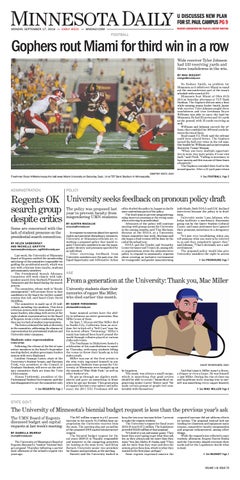
Gophers rout Miami for third win in a row Wide receiver Tyler Johnson had 133 receiving yards and three touchdowns in the win. BY MAX BIEGERT mbiegert@mndaily.com
No Rodney Smith, no problem for Minnesota as it rolled over Miami to round out the non-conference part of the team’s schedule with record of 3-0. Minnesota beat Miami of Ohio (0-3) 26-3 on Saturday afternoon at TCF Bank Stadium. The Gophers did not miss a beat while missing senior leader Smith. Junior wide receiver Tyler Johnson caught three touchdowns and true freshman Bryce Williams was able to carry the load for Minnesota. He had 33 carries and 141 yards on the ground, with 35 yards receiving as well. Williams and Johnson carried the offense, they combined for 309 total yards between the two of them. Head coach P.J. Fleck said the offense could have played better. The Gophers turned the ball over twice in the red zone. One fumble by Williams and an interception thrown by Tanner Morgan. “When you have multiple opportunities to score way more points, it’s our own fault,” said Fleck. “Failing is necessary to have success and this was one of those times offensively.” The Gophers extended their lead in the second quarter. After a 31-yard punt return COURTNEY DEUTZ, DAILY
Freshman Bryce Williams keeps the ball away Miami University on Saturday, Sept. 14 at TCF Bank Stadium in Minneapolis.
ADMINISTRATION
u See FOOTBALL Page 5
POLICY
Regents OK University seeks feedback on pronoun policy draft policy was proposed last search group The year to prevent faculty from despite critics misgendering UMN students. Some are concerned with the lack of student presence on the presidential search committee. BY HELEN SABROWSKY AND MICHELLE GRIFFITH hsabrowsky@mndaily.com, mgriffith@mndaily.com
Last week, the University of Minnesota Board of Regents ratified the membership and charge of the committee responsible for guiding the presidential search, which was met with criticism from faculty, students and community members. The Presidential Search Advisory Committee will work closely with independent search firm Storbeck/Pimentel & Associates and the board during the search process. The committee, whose work is “deeply consequential,” will present three to four candidates to the board for further consideration this fall, said board Chair David McMillan. The committee is made up of 23 individuals, including two students. This drew criticism system-wide from student governance leaders, who along with seven of the eight student representatives to the Board of Regents, wrote a letter condemning what they say is a lack of student representation. The letter criticized the lack of diversity in the committee, addressing the absence of representation for professional students and University sister campuses.
Students raise representation concerns Following the release of the list of committee members in the board’s September meeting docket, student governance leaders system-wide were displeased. Catalina Anampa Castro, chair of the University’s Student Senate, and Harrison Frisk, vice president of the Council of Graduate Students, will serve on the advisory committee. Both are from the Twin Cities campus. Alanna Pawlowski, president of the Professional Student Government, said she was disappointed to see the committee only u See REGENTS Page 2
BY AUSTEN MACALUS amacalus@mndaily.com
In response to concerns about free speech rights and potential disciplinary measures, University of Minnesota officials are reworking a proposed policy that would require University members to use the name, gender identity and pronouns specified by an individual. A f t e r r e c e i v i n g f e e d b a c k f ro m University members over the past year, the Equal Opportunity and Affirmative Action
office drafted the policy in August to clarify more contentious parts of the policy. The draft aims to prevent misgendering: using incorrect pronouns or the wrong name when referring to an individual. Advocates of the policy will continue meeting with groups across the University in the coming months, said Tina Marisam, director of the EOAA, at a University Senate committee last week. Marisam said she hopes a final version will be done by the end of the school year. EOAA and the Gender and Sexuality Center for Queer and Trans Life, among other organizations, wrote the administrative policy to respond to community requests about creating an inclusive environment for transgender and gender nonconforming
individuals. Both EOAA and GSC declined interviews because the policy is in draft form. University senior Luna Johnson, who helps facilitate a non-binary discussion group run by the Queer Student Cultural Center, said some professors have ignored their pronouns, sometimes in a derogatory way. “It’s just very invalidating when you tell someone what you want to be referred to as and they completely ignore that,” said Johnson. “That’s obviously not a safe environment.” The proposed policy would also give University members the right to access u See PRONOUNS Page 7
A&E
From a generation at the University: Thank you, Mac Miller University students share their memories of rapper Mac Miller, who died earlier this month. BY SAMIR FERDOWSKI sferdowski@mndaily.com
Some musical artists have the ability to influence an entire generation. Mac Miller is one of them. On Sept. 7, 26-year-old Mac Miller died in Studio City, California from an overdose. Set to kick off a “Self Care” tour for his newest album “Swimming,” Miller’s music has instead been heard around the world through tributes played at various clubs and events. The Pourhouse in Dinkytown hosted a celebration of his contributions to music on Thursday, with many students filling the venue to throw their hands up to his stolen youth. Miller was one of the first artists to die who truly ingrained himself in our generation. Students from across the University of Minnesota were brought up on the sounds of “Blue Slide Park,” as well as other works of art. He got us through our algebra worksheets and gave us something to blast when we got our license. This generation of rappers has lost a true spitter and influencer; the 2011 XXL Freshman will not
HAILEE SCHIEVELBEIN, DAILY
be forgotten. “His music was always a small escape, which is something that good artists should be able to create,” biomedical engineering senior Carter Ibister said. “He made certain groups of people feel comfortable with themselves.”
And that’s just it. Miller wasn’t a flexer, a dripper or even a hyper. He was himself — just Miller. During the rise of clout rap and hypebeast style, staying true to oneself was something every rapper boasted, u See MAC MILLER Page 6
STATE GOVT.
The University of Minnesota’s biennial budget request is less than the previous year’s ask The UMN Board of Regents discussed budget and capital requests at last week’s meeting. BY ISABELLA MURRAY imurray@mndaily.com
The University of Minnesota’s Board of Regents discussed a “modest” biennial budget proposal Thursday following a partial state allotment of the school’s request two years ago.
The $87 million request is a 6.7 percent increase to the nearly $1.3 billion base appropriation the University receives from the state. The meeting also saw an outline of the proposed 2019 capital infrastructure request. The biennial budget request for fiscal years 2020-21 is “fiscally responsible and sensitive to the competing priorities for funding at the state level,” said Brian Burnett, University senior vice president for finance and operations, at the meeting. Burnett said the University worked to
keep the two year increase below 7 percent to make the request realistic. The University’s request for fiscal years 2018-19 was $147.2 million. The legislature provided $54.62 million of that proposal. “It’s kind of a cat and mouse game. They know they aren’t going to get what they ask for, so they always ask for more than they want,” Sen. Jim Abeler, R-Anoka, said. “They ask for more than they want and then the system gives them less, which is what they wanted in the first place, perhaps.” Some regents expressed concern the
requested increase did not address effects on tuition. The proposal instead laid out funding for classroom and equipment maintenance, competitive faculty compensation and program enhancement, among other things. While the request’s size reflected a more realistic allotment, Regent Darrin Rosha said the University should overstate their needs and let the Legislature decide what to fund. u See BUDGET Page 2
VOLUME 118 ISSUE 70
2
MONDAY, SEPTEMBER 17, 2018
MN DAILY
EXTENDED WEATHER FORECAST MONDAY TUESDAY HIGH 77° HIGH 72° LOW 60° LOW 59° Mostly cloudy
Daily Review
MNDAILY.COM
Partly cloudy
WEDNESDAY HIGH 65° LOW 61° Thunderstorms
THURSDAY HIGH 69° LOW 53° Thunderstorms
FRIDAY HIGH 67° LOW 54° Partly cloudy
THIS DAY IN HISTORY
1787 The United States Constitution is signed by 38 of 41 delegates present at the conclusion of the Constitutional Convention in Philadelphia.
Monday, September 17, 2018 Vol. 118 No. 70
An Independent Student Newspaper, Founded in 1900. 2221 University Ave. SE, Suite 450 Minneapolis, MN 55414 Phone: (612) 627-4080 Fax: (612) 435-5865 Copyright © 2018 The Minnesota Daily This newspaper, its design and its contents are copyrighted.
HISTORYCHANNEL.COM/TDIH
Committee membership finalized
OFFICE OF THE PUBLISHER Kelly Busche Editor-in-Chief kbusche@mndaily.com (612) 435-1575 Genevieve Locke Business Operations Officer glocke@mndaily.com (612) 435-2761 EDITORIAL STAFF Max Chao Managing Editor mchao@mndaily.com Christine Ha Managing Production Editor cha@mndaily.com Natalie Rademacher Campus Activities Editor nrademacher@mndaily.com Madeline Deninger City Editor mdeninger@mndaily.com Katrina Pross Campus Administration Editor kpross@mndaily.com Drew Cove Sports Editor dcove@mndaily.com Sophie Vilensky A&E Editor svilensky@mndaily.com Ellen Schmidt Multimedia Editor eschmidt@mndaily.com Molly Tynjala Copy Desk Chief mtynjala@mndaily.com Desmond Kamas Chief Page Designer dkamas@mndaily.com Jane Borstad Visuals Editor jborstad@mndaily.com Hailee Schievelbein Visuals Editor hschievelbein@mndaily.com =
=
=
=
=
=
=
David McMillan speaks during the University’s Board of Regents meeting on Friday, Sep. 14 at the McNamara Alumni Center.
Regents u from Page 1
included two students and no professional students on the committee. “We are a large portion of students who may be affected by and work with the administration in slightly different ways than undergraduate and graduate students,” Pawlowski said. In addition to receiving criticism from professional students, the board also received criticism from some students for what they say is a lack of system campus representation. Mike Kenyanya, University of Minnesota Duluth’s student body president, said the experience of Twin Cities students and students who attend system campuses is “inherently different.” “In terms of representing this system campus and the other system campuses, [the
two students on the committee] can’t represent a Duluth student in the same way that I can’t represent Carlson [School of Management] students,” he said. Student body presidents said they have faith that Anampa and Frisk will represent the student voice well but fear they will not be heard because of the large number of executives and faculty on the committee.
Regents’ response The regents received nearly 400 nominations for committee membership, McMillan said. After the membership list became public, the board received criticism for the lack of faculty, staff and student representation and lack of executive governance expertise, McMillan said. In response to the criticism, McMillan announced that Mark Sheffert, a University graduate and founder and CEO of
Manchester Companies, was placed on the committee to add more executive management expertise. Joseph Konstan, chair of the University’s Faculty Consultative Committee, said faculty want a president who will support the needs of faculty and students. “Like everyone else I can quibble about the composition, I can give you a list of how the committee would be better ... but I can say that everyone I’ve spoken with is very happy with the qualifications of the individuals who are serving,” he said. Regents Peggy Lucas and Steve Sviggum will also serve on the committee, which will be led by Regent Abdul Omari. Lucas said while she would appreciate more student representation, a larger committee isn’t feasible. “I would love to have more students but I don’t want a 30-person committee,” she said.
JACK RODGERS, DAILY
Next steps
The board will hold seven listening sessions for faculty, staff, students, alumni and community members this month. Three of the sessions will be on the Twin Cities campus. Jael Kerandi, MSA’s ranking representative to the board, said students should attend these sessions to voice concerns about the lack of student representation on the committee. “We were very disappointed by the lack of action after the letter … we really wanted to ensure diversity,” Kerandi said. Despite the criticism, McMillan and the board still stand by their decision and unanimously voted to approve the committee membership and charge on Friday. “As we assembled the committee we considered how to best represent students across the system … we’re confident that they
“Like everyone else I can quibble about the composition, I can give you a list of how the committee would be better ... but I can say that everyone I’ve spoken with is very happy with the qualifications of the individuals who are serving.” JOSEPH KONSTAN UMN Faculty Consultative Committee Chair
together will be very effective in bringing broad student perspective to this process,” McMillan said.
University requests smaller biennial budget Budget u from Page 1
“My position is that the Legislature can make up their minds and we can give them a full range in opportunities,” Rosha said. The University will also ask the state for $232.3 million in its 2019 capital request. This includes $200 million in Higher Education Asset Preservation and Replacement (HEAPR) funds, $28 million for the Child Development building replacement on the Twin Cities campus and $4.3 million for the renovation of A.B. Anderson Hall on the Duluth campus. Abeler said the request’s focus on HEAPR and renovation of existing structures could have a positive impact on the eventual state allocation. “I’m happy they’re making their HEAPR request more than a new building request because they need to maintain what they have,” Abeler said, “Everything can’t be bright
BIENNIAL BUDGET AND CAPTIAL REQUESTS BY THE NUMBERS
$87 million REQUESTED FOR THE BIENNIAL BUDGET
$200 million PROPOSED FOR HIGHER EDU-
CATION ASSET PRESERVATION AND REPLACEMENT FUNDS (HEAPR)
$28 million REQUESTED FOR THE CHILD
DEVELOPMENT BUILDING REPLACEMENT ON THE TWIN CITIES CAMPUS
$4.3 million REQUESTED FOR THE RENOVATION OF A.B. ANDERSON HALL ON THE DULUTH CAMPUS
SOURCE: UNIVERSITY OF MINNESOTA
new and shiny.” But the completion of full request is unlikely, said Rep. Dean Urdahl, R-Grove City, chair of the House Capital Investment committee.
The Minnesota State Capitol as seen on May 13, 2013.
“$200 million is an awful lot ... I don’t doubt the need, it’s just there are a lot of needs across the state of Minnesota,” Urdahl said. The University system’s 10-year facility renewal
currently needs a total of $4.5 billion in deferred maintenance. This number has increased by around $300 million since the University’s 2018 HEAPR request was partially
BRIDGET BENNETT, DAILY FILE PHOTO
fulfilled last session. Action on the recommended biennial budget request and 2019 capital request is expected at the board’s next meeting in October.
EDITORIAL BOARD Ray Weishan Editorials & Opinions Editor rweishan@mndaily.com Ariana Wilson Editorial Board Member awilson@mndaily.com Hailey Almstead Editorial Board Member halmstead@mndaily.com Kelly Busche Editor-in-Chief kbusche@mndaily.com BUSINESS Darya Karas Sales Manager dkaras@mndaily.com David Keane Controller dkeane@mndaily.com The Minnesota Daily strives for complete accuracy and corrects its errors immediately. Corrections and clarifications will always be printed in this space. If you believe the Daily has printed a factual error, please call the readers’ representative at (612) 627–4070, extension 3057, or email errors@mndaily.com immediately. THE MINNESOTA DAILY is a legally independent nonprofit 501(c)(3) organization and is a student-written and student-managed newspaper for the University of Minnesota’s Twin Cities campus. The Daily’s mission is: 1) to provide coverage of news and events affecting the University community; 2) to provide a forum for the communication and exchange of ideas for the University community; 3) to provide educational training and experience to University students in all areas of newspaper operations; and 4) to operate a fiscally responsible organization to ensure its ability to serve the University in the future. The Daily is a member of the Minnesota News Council, the Minnesota Associated Press, the Associated Collegiate Press, The Minnesota Newspaper Association and other organizations. The Daily is published Monday and Thursday during the regular school year and weekly during the summer, and it is printed by ECM Publishers in Princeton, Minn. Midwest News Service distributes the 10,000 issues biweekly. All Minnesota Daily inserts are recyclable within the University of Minnesota program and are at least 6 percent consumer waste. U.S. Postal Service: 351–480.
Monday, September 17, 2018
3
Area vendors and businesses gathered on the former site of Dania Hall this weekend to connect with residents.
ELLEN SCHMIDT, DAILY
Chinese restaurant and bakery Keefer Court, which has been open for 30 years, is seen on Monday, June 25.
West Bank celebrates first-ever Night Market BY TIFFANY BUI tbui@mndaily.com
Local businesses and vendors were on showcase at West Bank’s first gathering of pop-up shops this weekend. The evening celebration, dubbed the “Night Market,” provided vendors the opportunity to connect with a wider audience. Vendors at the market ranged from neighborhood staples to artists. The market was hosted by the West Bank Business Association on the former site of Dania Hall, a historic cultural center that was demolished in 2000 after experiencing significant damage from
fires in both 1991 and 200. On a usual day, the site stands mostly empty except for a mosaic pillar commemorating Dania Hall. Jamie Schumacher, president of WBBA, said the organization wanted to put the spot to use. “Activating the space … it’s a way to boost crosstraffic [to nearby businesses],” said Schumacher. “When that space is dark or not really inviting, you don’t see that.” Schumacher said events like the market bring traffic to the neighborhood and encourage visitors to stay after to shop. “It gives our [resident artists] a connection point
in that cross-promotion,” said Shumacher. West Bank artist Sol Ras Assanti’s tent featured her copper-wrapped jewelry with an Afro-futuristic style. She lives just down the street, and neighbors are familiar with her work. But selling her pieces can be hard in a changing community, Assanti said. “It’s a lot less supportive because there’s a lot more gentrification and the more gentrification that happens in our community, the harder it is for us to be together and stay connected,” said Assanti. Although Assanti was surprised she hadn’t heard of the event until Sunday,
U researchers use satellites to create map of Antarctica The detailed map was unveiled earlier this month. BY CHUYING XIE cxie@mndaily.com
University of Minnesota researchers have created a map of Antarctica that shows the continent in more detail than its predecessors. On Sept. 4, researchers at the University’s Polar Geospatial Center and Ohio State University unveiled a map that has a higher resolution than any other map of the continent. Unlike past attempts to map Antarctica, researchers did not have to physically travel to Antarctica to collect the data, said PGC Director Paul Morin. They were able to use three satellites owned by the United States Government. “We realized that these satellites had some incredible capabilities, and so we started using that capability to not only image Antarctica but also figure out the height of it,” Morin said. The project began by taking about 180,000 stereo-images from the network of satellites. The data points across Antarctica provide researchers with detailed information on the height of the elevation changes, according to Mike Cloutier, user services lead at PGC. The high number of
data points collected by the satellites allows for a more accurate, higherresolution map. “It’s about 1,200 times the data points than we had before,” Morin said. “If they were doing [mapping] in the Twin Cities, it’s the difference between seeing a hill and seeing a building.” Graduate students on the research team compiled pictures collected from the data points, which have a resolution of 8 meters, to create a full map of the ice cap. “Over a number of years we get elevation models, basically [topographical] maps, of small areas, but we realized quickly that if we got enough imagery, if we got enough supercomputers, we can do this on a bigger scale.” Morin said. Researchers processed the data collected from the satellites using a large academic supercomputer called Blue Waters. They used the
images to create a digital elevation map called the Reference Elevation Model of Antarctica. Blue Waters’ memory equals 300 million images from a digital camera, according to the National Center for Supercomputing Applications. “That was one of the few computers that really has the capabilities to process this much data.” Morin said. PGC Geospatial Support Assistant Erik Husby said the map will be especially useful to researchers working in Antarctica. “If they have a recent high resolution topographic map, then that will help them see which crevasses they need to avoid,” Husby said. “Moving across Antarctica is a dangerous thing and whenever you have more information about what you are going to go over, that is of use to them.” PGC plans to release an update on the project later this month.
“It’s about 1,200 times the data points than we had before. If they were doing [mapping] in the Twin Cities, it’s the difference between seeing a hill and seeing a building. ” PAUL MORIN PGC Director
she took the opportunity to showcase her work. “I’m here selling ... because that’s literally the energy I woke up with this morning,” said Assanti. Three tables to Assanti’s right sat Henry Stofferahn, an LED artist and newcomer to the pop-up scene. He also lives near the site. Stofferahn said selling his art for the first time has been a learning experience, but he is taking his endeavors “one day at a time.” Meanwhile, some established local businesses connected with new customers. Michelle Kwan of Keefer Court said some residents
didn’t know where the restaurant was located, despite the shop’s 30-year tenure in the neighborhood. “There’s not a lot of foot traffic [on Cedar Avenue] ... so having events like this gets our neighbors out of their homes and adventuring out onto a block or street they don’t normally walk up and down,” said Kwan. High temperatures and a variety of overlapping events in the area dampened turnout, but Schumacher hopes the Night Market can happen annually. Depending on funding and vendor feedback, the market may pop up for another year.
“It’s a lot less supportive because there’s a lot more gentrification and the more gentrification that happens in our community, the harder it is for us to be together and stay connected.” SOL RAS ASSANTI West Bank artist
4
Monday, September 10, 2018
5
MONDAY. SEPTEMBER 17, 2018
MN DAILY
Sports
MNDAILY.COM
FOOTBALL
UMN wide receiver shines with three scores in Miami victory Johnson surpassed 1,000 career receiving yards in the first quarter.
Gophers rout Miami for third win in a row Football u from Page 1
BY JACK WARRICK jwarrick@mndaily.com
Minnesota’s top wide receiver made his way onto an exclusive program list Saturday. Gophers wide receiver Tyler Johnson passed 1,000 career receiving yards and tallied three touchdowns in Minnesota’s (3-0) victory over Miami of Ohio on Saturday afternoon. The play that put him over the edge was a sevenyard touchdown reception in the first quarter when quarterback Zack Annexstad threw him a perfect ball in the flats to give him a lane to the outside. He dove into the end zone and into the history books as the 25th Minnesota player to reach 1,000 career receiving yards. “That’s what Tyler does,” head coach P.J. Fleck said. “I thought he was exactly who he needed to be. He dominated the game. That’s what he does.” Johnson scored two more touchdowns, accounting for all three touchdown scores in Saturday’s 26-3 victory over Miami of Ohio (0-3) at TCF Bank Stadium. The star wide receiver finished with nine catches for 133 yards, catch-
FOOTBALL
COURTNEY DEUTZ, DAILY
Junior Tyler Johnson runs the ball on Saturday, Sept. 14 at TCF Bank Stadium in Minneapolis.
ing passes from three different quarterbacks. Johnson has five touchdowns on the year and 283 receiving yards in just three games. Last year, Johnson racked up seven total touchdowns on 677 yards. “In all honesty, I give credit to the offensive line,” Johnson said. “I couldn’t have gotten the ball without them. And then my quarterback. He’s just got a lot of trust in me right now, and looking forward to keeping it moving forward.” It was a hot and humid day, a combination not ideal for the quarterback-wide receiver connection. However, Johnson didn’t let it bother him, catching two touchdowns in the first half, along with 100 yards on seven
catches. He slowed down in the second with just two more catches for 33 yards and one touchdown. Johnson’s first catch of the second half was a five-yard touchdown from Annexstad to make it 26-3, which would be the final score. Johnson caught one touchdown pass from Annexstad in the first quarter and one from Seth Green in the second quarter — both were for seven-yards. Johnson said he doesn’t change anything in his approach when any one of the three quarterbacks is in. “I trust all three of them. Whether its running the ball, throwing the ball,” Johnson said. “I know they trust me and I trust them as well.”
Freshman running back Bryce Williams, who was the main player in the ground game Saturday, had the second most receiving yards behind Johnson with 35 on one catch. “He ran hard, he ran extremely hard,” offensive lineman Jared Weyler said. “But with any freshman there’s going to be failing, and he’s going to continue to grow.” Minnesota had a total of 1,513 passing yards last year with nine touchdowns. So far this year, the Gophers have five touchdowns, all of which are from Johnson, and 579 receiving yards. Minnesota will open up Big Ten play next week when they go to College Park, Maryland to take on Maryland (2-1).
VOLLEYBALL
by Anotine Winfield Jr., the Williams had runs of 11 yards and 10 yards to set up Emmit Carpenter’s 44-yard field goal early in the quarter. After punter Jacob Herbers pinned the RedHawks inside their own 5-yard line, Miami running back Alonzo Smith tripped in the end zone and Thomas Barber was credited with a safety. “Herbers was the player of the game for us,” Fleck said. Barber finished with 8 total tackles, tied for lead the Gophers defense with linebacker Kamal Martin. With 1:45 left to play in the second quarter, the Gophers converted on third down and 17 with a screen pass to Williams for 35 yards — setting up Minnesota in the red zone. Redshirt junior Seth Green came in for the wildcat formation and threw a slant to Johnson for his first touchdown pass of his career. It was Johnson’s second touchdown catch of the day. “He ran extremely hard, as there is with any freshman, there is going to be failing, and he is going to continue to grow,” offensive lineman Jared Weyler said. “I’m proud of him.” Antonio Shenault intercepted Miami quarterback
Gus Ragland’s pass and returned the ball 42 yards down to the RedHawks 12 yard line. From there, Annexstad found Johnson in the back of the end zone for the third time. Going into the fourth quarter, the Gophers had a 26-3 lead. “I give credit to the offensive line, I couldn’t have gotten the ball without them,” Johnson said. “My quarterback has a lot of trust in me right now.” Miami struggled to get anything going on offense against the stout Minnesota defense. The RedHawks finished with 199 total yards. They lost arguably their best player on offense, wide receiver James Gardner, when he collided with two Minnesota defenders over the middle. The Gophers will start Big Ten play next weekend on the road at Maryland, who is coming off a loss to Temple. The game time is set for 11:00 a.m. Minnesota is in familiar territory. Last year, the Gophers started 3-0, yet ended the season with just two wins in Big Ten play. They hope history won’t repeat itself. “We are focused on getting better tomorrow, we are going to celebrate this win,” Weyler said. “We are going to learn from the past, but just focus on getting better tomorrow.”
SOCCER
U beats Green Bay, has second game canceled Minnesota moved its record to 6-2 in victory over Green Bay on Thursday. BY DAVID MULLEN dmullen@mndaily.com
The No. 7 Gophers (6-2) were hosts of the annual Gopher Classic this weekend, but only played one match due to unusually hot weather conditions. “Due to extreme heat and unplayable conditions inside Maturi Pavilion, tonight’s volleyball match between the University of Minnesota and Kansas State has been postponed,” according to a press release from the University’s athletics department. In the same email, athletics director Mark Coyle said, “The safety and health of our student-athletes is always our primary concern when making these decisions.” The game Minnesota did play was Thursday evening. It was the kick-off for the Gopher Classic at Maturi Pavilion against the University of Wisconsin-Green Bay (5-6). Although the Gophers swept the Phoenix, it was a highly contested match. The results of the competitive three sets were 25-18, 25-15 and 25-22. Green Bay took the first three points in the third set and eventually took a 7-2 lead over the Gophers. “We dug ourselves into
a pretty big hole at the beginning of the set,” head coach Hugh McCutcheon said. “Certainly, Green Bay made some plays that made that happen.” After two attack errors by Green Bay, the score was 7-4 and the Gophers answered by matching each point made by the Phoenix, but the were still training 10-7. The Gophers then took seven points in a row to put them ahead 14-10. The final set continued to go back and forth, but the Gophers eventually took the set and swept Green Bay 25-22. “We had a lot of energy tonight and if we made a mistake we’d move onto the next point,” junior outside hitter Alexis Hart said. “I think it was great that we had each other’s back but we were all like, ‘let’s do this.’” Hart led the game with 14 points off of 13 kills. Hart, who has not seen as much playing time this season as in previous years, said whenever she goes in she is ready to play due to her teammates’ hard work in practice. “It’s just being consistent, and it helps that my teammates push me so hard in practice,” Hart said. In the first set against Green Bay, the Gophers showed their dominance by never trailing throughout the set — at one point they led the Phoenix by double digits with a score of 21-11. Although Green Bay
VOLLEYBALL RESULTS
THURSDAY Green Bay Minnesota
1 2 3 FINAL 18 15 22 0 25 25 25 3
SOURCE: GOPHERSPORTS.COM
fought back after multiple timeouts, they fell 25-18 in the opening set. After the first set, Hart led the Gophers with five kills followed by sophomore Stephanie Samedy with four kills. In the second set, the Gophers took a 10-6 lead after a service ace by senior Samantha Seliger-Swenson put the Gophers in control. After Green Bay fired back to make the second set close at 12-10, the Gophers answered and scored fivestraight points. Green Bay scored only two more points in the set while the Gophers would finish the set after a service error, winning 25-15. “[I’m] happy to win and I thought it was some good positives. Lots of elements in the game that we thought we did pretty well,” McCutcheon said. Although the Gophers swept Green Bay, McCutcheon says there is still plenty of things to work on. “I do think though there were some nice opportunities for improvement so hopefully we can work on that,” McCutcheon said.
TONY SAUNDERS, DAILY
Gopher women’s volleyball defeated Green Bay in three straight sets on Thursday, Sept. 13.
JACK RODGERS, DAILY
Forward April Bockin fights for the ball at Elizabeth Lyle Robbie Stadium on Sunday, Sept. 16. The Gophers defeated Northwestern 2-0.
Gophers split weekend matches against Illinois and Northwestern Minnesota defeated Northwestern for the first time since 2012. BY ERIK NELSON enelson2@mndaily.com
On a bright Sunday afternoon at Elizabeth Lyle Robbie Stadium, the Gophers took down a soccer giant. Minnesota (5-4-0, 1-1-0) defeated No. 12 Northwestern (6-1-2, 0-1-1) 2-0. It was Minnesota’s first home match and win against Northwestern since Oct. 14, 2012, and first win against a ranked opponent since 2015. Head coach Stefanie Golan said Minnesota’s win was a team effort. “They gritted through, they fought and then closed out the game well,” Golan said. “We’ve been waiting to play [Northwestern] at home.” Goalkeeper Maddie Nielsen stopped a Northwestern penalty kick in the eighth minute. After Minnesota was called for a handball, Northwestern midfielder Marisa Viggiano took the kick, but Nielsen dove to her right and made the save. The Gophers earned a penalty kick of their own in the 25th minute. Forward April Bockin converted the penalty, giving the Gophers a 1-0 lead. It was Bockin’s third goal of the season. Nielsen said Bockin’s goal magnified her save. “It made my PK save 10 times better,” Nielsen said. “It shows that we’re Gophers — we can do anything. That brought up everyone’s energy.” In the 71st minute, forward Megan Gray crossed the
ball to midfielder TJ McKendrick. McKendrick headed the ball past Wildcats goalkeeper Mackenzie Wood into the net. It was McKendrick’s first career goal. Midfielder Molly Fiedler recorded a secondary assist. McKendrick said the goal felt like something she would execute in practice. “It felt normal and it went right where I wanted it to go,” McKendrick said. “It’s good to finally have the [first] goal down. Hopefully, more to come.” Nielsen made four saves and earned her fifth win and second shutout of the season. Bockin said Minnesota’s win will improve the team’s confidence going forward. “That’s huge for us,” Bockin said. “Going into the Big Ten season, we dropped a game on Friday, which wasn’t great. To respond like this against a high-ranked team gives us good momentum going into our ThursdaySunday matchup against the Michigan schools next week.” Gophers fall to Illinois 2-0 on Senior Night The atmosphere at Elizabeth Lyle Robbie Stadium at the start of Friday night was celebratory. Minnesota honored its five seniors; Bockin, Fiedler, Maddie Castro, Emily Heslin and Emily Peterson before its match against Illinois. By the end of the night, the atmosphere was bittersweet. Illinois (6-3-0, 1-1-0) defeated Minnesota 2-0, scoring both of its goals off of
corner kicks. In the 13th minute, Illini midfielder Arianna Veland scored the first goal of the match after heading the ball past Nielsen. Midfielder Hope Breslin recorded an assist. Veland scored again in the 54th minute. Midfielder Katie Murray crossed the ball towards Veland, who headed the ball past Nielsen. Defender Marisa Windingstad said Minnesota wasn’t on the same page on set pieces. “Unfortunately, we weren’t marking tight enough in the box or communicating as well as we needed to,” Windingstad said. Golan said Minnesota needs to improve on offensive corner kicks. “We need to do better with those,” Golan said. “If we can get dangerous on set pieces on the opposite end, it makes up for our lack of taking care of those on the defensive end.” The Gophers’ next match will be on Thursday against Michigan State (5-2-2, 0-1-1) at the DeMartin Soccer Complex in East Lansing, Michigan. It is scheduled to start at 6 p.m.
WOMEN’S SOCCER RESULTS
FRIDAY Illinois Minnesota
SUNDAY Northwestern Minnesota
1 1 0
2 1 0
FINAL 2 0
1 0 1
2 0 1
FINAL 0 2
SOURCE: GOPHERSPORTS.COM
6
MONDAY, SEPTEMBER 17, 2018
MN DAILY
MNDAILY.COM
ZINE
WILL TOOKE, DAILY
Community members attend Twin Cities Zine Fest on Saturday, Sept. 15, at Minneapolis Central Library.
Twin Cities zine culture through punk rock, inclusive attitudes The Twin Cities Zine Fest acts as a hub for creatives hoping to share their art and advocate for a more diverse and welcoming society. BY KSENIA GORINSHTEYN kgorinshteyn@mndaily.com
Walking into the Minneapolis Central Library, you hear an unfamiliar buzz of conversation echoing off the walls of the otherwise quiet place. You go up the escalator and are immediately greeted with tables of original art, an infinite number of stickers and proud, smiling faces. This is the Twin Cities Zine Fest. The yearly event focuses on zines: hand-made publications that are not mass produced. A zine can take form in a variety of shapes and sizes, and each communicates a different theme. “[A zine is] mostly homemade and it’s got an attitude
that it carries with it,” said University of Minnesota associate writing studies professor Tom Reynolds. “It challenges authority usually and, in general, the form that it takes is expressive as well as the content that it’s trying to get across.” Zines have become almost a symbol of defiance — a physical representation of controlled chaos and a call to action. “There’s this emphasis on making, creating something that is not slick like magazines in the publishing world, but rather small but powerful,” Reynolds said. The medium is budding on the University campus. Sophomores Jonas Keeler and Brianna Mathias, along
with a group of friends, have taken their love of creativity to publish their own zine, “The Bazaar.” “We originally came up with the idea to start our own publication that would be completely focused on creativity and doing whatever you would like to put into a publication, accepting all forms of art, all forms of media — anything really,” Keeler said. “The Bazaar” has no boundaries and no rules. Creators are able to publish their work in any form it takes. “I like the idea of there being no rules, which is kind of what our zine is,” Mathias said. “It’s all freeform, we just put whatever in and it’s crazy, it’s random, it’s anarchist,
it’s punk, it’s very fun and it’s very inclusive.” The zine operates in the same way that the first zines did — as outlets for emotion and personal anecdotes coupled with recognition of social issues. “Communities would be created by sharing ideas, stories and emotions through these stream-of-consciousness collections,” said sophomore Hannah Dove, another member of “The Bazaar.” “Zines house feelings that wouldn’t normally be revealed on the big glamorous pages of popular magazines.” There’s an authenticity to zines that is seemingly absent from glossy, mass-produced pages. “It’s just crazy to think
that there’s so many people who are making art and loving it and enjoying it and not really expecting to get anything from it,” Keeler said. “I love that aspect.” The Zine Fest, which took place on Saturday, is an inclusive space that celebrates the many identities of the Twin Cities. Local artists shared their passions and talents through a hands-on medium while simultaneously raising awareness for various social issues. “I think zines are very different from magazines in that they’re created by people who don’t often see representation themselves. So we can make our own representation,” said Chase Underwood, a junior who began
making his own zines after attending a workshop three years ago. “I think that it’s a lot more accessible.” Free booklets and stickers are abundant at the Zine Fest, reflecting the accessibility and inclusivity that is central to this community of creators. There is no expectation of large profits, just a genuine desire to create a kinder world. “I love that zines are intersectional and inclusive,” Mathias said. “They started out being very queer, very gay ... underground zine culture has really been inspiring to me. I think that it’s super neat that we’re able to include everyone. Everyone feels included in zines.”
ART
MUSIC
Recording masculinity, gay culture in Twin Cities
From a generation at UMN:
Thank you, Mac Miller
Artist Christopher Selleck’s exhibit will open Saturday at the Soo Visual Arts Center. BY MADDY FOLSTEIN mfolstein@mndaily.com
The Soo Visual Arts Center in Lyn-Lake has opened both of its back gallery spaces to one artist for the first time ever — University of Minnesota alumnus Christopher Selleck’s exhibit, “This is a Record,” will fill the space with a range of visual art. “We just felt like it was right to give him a big space to experiment and push himself,” said Carolyn Payne, executive director of the Soo Visual Arts Center. “This is a Record” opens this Saturday, with a reception from 6 p.m. to 9 p.m. Selleck’s work frequently explores the intersection of masculinity and identity. “The majority of my work is about masculinity, but there’s always this secondary read of me being a gay man — this other investigation of feeling much more outside of traditional masculinity, which I think in society is still viewed as white [and] heterosexual,” Selleck said. One half of the gallery includes mostly Selleck’s photography, which examines a lack of a gay representation in culture and television. The other half of the exhibit consists of installations evoking the history of cruising and the now-shuttered back rooms of gay bars and bathhouses in the
Mac Miller u from Page 1
TONY SAUNDERS, DAILY
Christopher Selleck, a University graduate, prepares his exhibit, “This is a Record,” at the Soo Visual Arts Center on Saturday, Sept. 15.
Twin Cities. One space features photogravures — a form of printmaking and etching — of men’s bathroom stalls in once-popular cruising locations on the University’s West Bank. “There would be, a lot of times, messages left on the stalls that were like, ‘I’ll be here at this time,’ and they’re sort of cryptic and weird, and it feels very antiquated,” Selleck said. “But it’s still a method that obviously exists. … My focus was sort of documenting some of this residual graffiti that would still be left there.” Selleck also views these rooms as a transformative space, much like the darkrooms he works in. “It will be lit with these safe lights, which sort of ref-
erence my history with photography, ... In a darkroom, you’d take negatives and make a photograph,” Selleck said. “Or, in a coupling sense, two men would meet in here and become a couple or have an encounter that would be transforming two single people.” Selleck’s range and risktaking make his work an exciting choice for the gallery. “I’ve been familiar with his work for several years now. … I have been consistently impressed with the risks he takes with his work,” Payne said. “Besides just always pushing himself with subject matter … he’s always using different media and trying different types of visual art, which I think is great.” The title, “This is a Record,” takes on several mean-
ings within the exhibit — from the George Michael record in the exhibit’s entry to Selleck’s ability to record lost spaces, connections and experiences in the Twin Cities. “The space is a record of the ways that men needed to use to engage, like the graffiti on the bathroom walls that is still there,” Selleck said. “Whether it was jokingly put up or authentically somebody trying to connect with someone, [that] is also a record ... in the same way that these images serve as a record of that engagement as a human being.” What: “This is a Record” When: Sept. 22 through Oct. 27 Where: Soo Visual Arts Center, 2909 Bryant Ave. S. Suite 101, Minneapolis
but few stood true. “There were kids growing up who lived very similar lives to Mac and felt strong connections to what he had to say because they hadn’t heard it come from anyone else,” Ibister said. Mac Miller hailed from the same high school as Wiz Khalifa, and it’s important to note Miller’s roots. Putting the industry-heavy city of Pittsburgh on the map was no easy feat, yet he and Khalifa did so. This is something that connected with us Midwestern teens too — making a culture out of what we have. “I still remember wearing my Pirates hat to school all the time,” Michael Munson, a sophomore studying agriculture and marketing and communications, said. “He definitely spoke to a younger audience that did not have much of a voice yet.” Playing together at the 2013 Minnesota State Fair, Mac and Wiz brought the essential early 2010s rap ingredient — youthful
positivity — to Minnesotan ears. Think about it. Some of the biggest hits of the era were “Forever Young” by Jay-Z, “Young, Wild and Free” by Wiz and, of course, “Party on Fifth Ave.” by Mac. These were the anthems of high school tailgates across the state. “He found that place in music that spoke of struggles and accomplishments that others could find relation to,” Abby Poeschl, a freshman biology major, said. “I listened because it wasn’t just cool to listen to, but had an actual message.” This is a small snippet of how the Steel City native broke through the noise and began to culturally mold a generation that’s currently in college. A cultural classmate of those who composed the rise of a new sound in hip-hop, Miller was an icon that made us all feel OK with being ourselves. Nothing flashy, only pure human sound and story. Rest easy, Miller. You’ll be with us — in our headphones and in our thoughts — as we smile back on the times we had because of you. Thank you.
Monday, September 17, 2018
7
JACK RODGERS, DAILY
Em Conway, left, and Luna Johnson pose for pictures on the University of Minnesota campus.
U gender expression policy still in works Pronouns u from Page 1
facilities and programs that match their gender identities, including housing, restrooms and locker rooms. But the effort has run into opposition and questions about how the policy will be implemented and enforced. Although supportive of its goals, Joseph Konstan, chair of the Faculty Senate Consultative Committee, said he is concerned the proposed policy could potentially infringement on free speech rights. “Should you call people what they want to be called?
Yes,” Konstan said. “[But] it’s also allowable speech.” These concerns came to the forefront after the policy received increased publicity over the summer. Ahmad Qais Munhazim, the former interim director of GSC, said the policy received support when it was presented to groups last year. Although there were some questions about implementation, Munhazim said, the process only took “a controversial turn” when it “became more of a public discussion.” Members of several University Senate committees expressed support for the policy last year. The Minnesota Student
Ex-cop, Minneapolis wants to put shooting lawsuit on hold BY THE ASSOCIATED PRESS
MINNEAPOLIS — The city of Minneapolis and a former police officer who shot and killed an Australian woman are asking a federal judge to put a $50 million civil rights lawsuit by the woman’s family on hold while a criminal case is pending. In court documents filed in advance of a Friday hearing, attorneys for Mohamed Noor wrote that the civil case should be delayed in the “interests of justice” so Noor can fairly defend himself in both trials. The family of Justine Ruszczyk Damond disagrees, saying they deserve answers and that the cases should proceed at the same time. Noor is charged with murder and manslaughter in the July 15, 2017, shooting of Damond , a 40-year-old life coach who was shot by Noor after she called 911 to report a possible sexual assault in an alley behind her home. Noor has not spoken to investigators, invoking his constitutional right against selfincrimination. He has since been fired and no trial date has been set. Noor has not formally entered a plea, but his criminal defense attorney indicated in April that Noor intends to plead not guilty. In July, Damond’s father, John Ruszczyk, sued Noor, his partner, the city and the current and former police chief, alleging Damond’s rights were violated. He also accused officers of conspiring to cover up facts surrounding the shooting, and of making a conscious decision not to activate body cameras. Attorneys for Noor say the criminal and civil cases are intertwined, and that Noor can’t invoke his constitutional rights in his criminal trial while defending the civil claims. “If this case is not stayed, Noor will be forced to either claim his Fifth Amendment privilege and risk that deci-
sion being used against him in this case, or to vigorously defend this case and risk the prosecution using Noor’s defense to pursue the criminal case,” attorney Matt Forsgren wrote. “Either way, given the nature of the allegations in the civil and criminal actions, Noor is unable to effectively defend himself in both actions simultaneously.” Attorneys for the other defendants echoed that, saying they can’t get evidence to defend themselves from civil claims while Noor invokes the 5th Amendment. The Hennepin County Attorney’s Office, which is not part of the civil proceedings, has also asked the judge to pause the civil case while the criminal case is pending. Prosecutor Beth Stack argued there is strong interest in avoiding prejudicing a jury pool, and noted that evidence in the criminal case is under a protective order to bar wide dissemination. Once the state criminal trial has been conducted, all the evidence will be public “and this civil litigation can proceed without jeopardizing the important criminal justice interests at stake,” she wrote. Robert Bennett, an attorney for Ruszczyk, argued against delaying the civil proceeding. He said in court filings that he would be willing to agree to a protective order or other controls to ensure that Noor’s 5th Amendment assertions would have no effect on the criminal prosecution or defense. The shooting of Damond, a dual Australian-U.S. citizen who had been living in Minnesota for more than two years, drew international attention, cost the police chief her job and forced major revisions to the department’s policy on body cameras. Damond’s legal name was Justine Maia Ruszczyk, but she had been using the last name of her fiance, Don Damond, professionally.
Association and QSCC have also endorsed it. The new draft is meant to clarify how the University would handle those who don’t follow the rules, Marisam said at the committee meeting. Inadvertent slip-ups — such as a faculty member mistakenly misgendering a student — would not result in disciplinary actions, Mariam said. More intentional offenses could violate a pre-existing Board of Regents policy that prohibits discrimination and harassment based on gender identity and expression. “It only would become an issue of discrimination or
harassment in the rare case that the misgendering rose to a level where it was persistent, it was pervasive, it was severe,” Marisam said. “We absolutely recognize this is an area that is new. It’s an area where people make mistakes,” she said. Konstan said the policy will benefit from more discussion. He said the policy should focus more on helping people grow and less on punishment. “This [is] a policy that will have no value whatsoever, unless the process of adopting it leads to enough acceptance of it among the members of our community,” Konstan said.
Emmyra Conway, a nonbinary, trans woman and University student, said she approves of the policy as it is. She said she sees it as a way to empower students. “[It] allows students the space and confidence to actually assert themselves when in other situations they might have been afraid they are not going to be respected,” Conway said. Johnson said they would like the changes to come sooner rather than later, despite some people’s concerns. “It just sucks how politicized peoples’ identities are,” Johnson said. “We are talking about human beings here.”
“[The policy] allows students the space and confidence to actually assert themselves when in other situations they might have been afraid they are not going to be respected.” EMMYRA CONWAY non-binary trans woman and University student
Aer Lingus to offer flights between Minneapolis-St. Paul and Dublin BY THE ASSOCIATED PRESS
MINNEAPOLIS, ST. PAUL — Beginning July 8, 2019, Irish airline Aer Lingus will offer direct service between Minneapolis-St. Paul International Airport (MSP) and Dublin, Ireland. Dublin is the largest city in Ireland and serves as the nation’s capital. Located on the nation’s east coast, Dublin is situated at the mouth of the River Liffey and is fronted on the south by the Wicklow Mountains. Steeped in history and boasting a metropolitan population of nearly 2 million people, Dublin is the epicenter of education, the arts, finance and industry in Ireland. “ T h ro u g h o u r w o rk with GREATER MSP and t h e M S P Re gio na l Air Service Partnership, we learned that there is significant demand among Minnesota’s business community for direct air service to Ireland,” said Metropolitan Airports Commission (MAC) Executive Director and CEO Brian Ryks. “That information demonstrated to Aer
Lingus officials that nonstop service between the two cities would be profitable for the airline.” The MSP Regional Air Service Partnership (RASP) is a collaborative air service development initiative launched in 2017 by the MAC and GREATER MSP. The RASP helps identify air service needs of businesses in the region and supports MAC efforts to engage airlines that could potentially serve those markets. The RASP is chaired by Thomson Reuters Executive Vice President-Operations Rick King and former U.S. Bank Chief Executive Officer Richard Davis. “The addition of Aer Lingus non-stop service to Dublin is another enhancement to the growing access and international reach available to businesses within our region. We are excited about this offering which supports our continued efforts to be a top competitor in today’s global economy,” stated Michael Langley, CEO of GREATER MSP. Aer Lingus will operate the Dublin service daily
using Boeing 757 aircraft. Dublin is the second new international route for MSP announced this year. In June, Delta Air Lines announced service to Seoul, South Korea, slated to begin April 1, 2019. With the addition of Dublin, MSP offers direct scheduled service to six European cities. The others are Amsterdam, Netherlands; Frankfurt, Germany; London, England; Paris, France; and Reykjavik, Iceland. MSP also has direct scheduled service to Tokyo, Japan and, in April 2019, Seoul, South Korea. MSP set a new passenger record in 2017, with more than 38 million people traveling through the nation’s 16th busiest airport. The airport is Delta Air Lines’ second largest hub, and the home base of Sun Country Airlines. Since January 2016, 11 airlines have added 50 new routes at MSP. In both 2016 and 2017, MSP was named Best Airport in North America in its size category by Airports Council International, based on traveler feedback. The airport was also
named Most Efficiently Managed Airport of its size in North America for the past two years by the Air Transport Research Society. The Metropolitan Airports Commission is a public corporation of the state of Minnesota. The MAC owns and operates seven airports in the Twin Cities metropolitan area, including Minneapolis-St. Paul International Airport. All together MAC airports generate nearly $17 billion a year for the area economy and support more than 87,000 jobs. The MAC is funded through rents and user fees generated from airport users, not from income or property taxes. GREATER MSP is a private-public partnership with the mission to accelerate job growth and capital investment in the Greater MSP Region. It partners with economic d e v e l o p m e n t o r g a n i z ations throughout the region to develop strategy, brand and market the region, and serve as coordinator for business retention, expansion, and recruitment projects.
8
Monday, September 17, 2018
Regents discuss plans for the U, St. Paul
Peggy Lucas speaks during the University’s Board of Regents meeting on Friday, Sept. 14 at the McNamara Alumni Center on East Bank.
Board of Regents met for the first time this year on Friday last week. BY HELEN SABROWSKY hsabrowsky@mndaily.com
At its meeting on Friday, The University of Minnesota’s Board of Regents discussed long-term visions for the St. Paul campus, voted on the Presidential Search Advisory Com mittee membership and reviewed University President Eric Kaler’s systemwide priorities. Presidential search advisor y committee The board ratified the membership and charge of the Presidential Search Advisory Committee, which consists of University personnel responsible for guiding the presidential search. The regents received nearly 400 nominations for
committee membership, said Regent David McMillan. The committee is composed of 23 individuals including faculty, students, alumni, staff, regents and community members. In response to criticism from faculty and staff, students and community members on what they said is a lack of representation on the committee, McMillan announced that Mike Sheffert, a University graduate and founder and CEO of Manchester Companies, would join the committee. Regents Peggy Lucas, Steve Sviggum and Abdul Omari will serve on the committee, with Omari serving as committee leader. Earlier this week, seven student governance leaders from the Twin Cities and system campuses, along with seven of the eight student representatives to the board, wrote a letter of concern to the regents
criticizing the lack of student and system representation on the committee. The two students serving on the committee are Catalina Anampa Castro, chair of the University Student Senate Consultative Committee, and Harrison Frisk, vice president of the University’s Council of Graduate Students. “As we assembled the committee, we considered how to best represent students from across the system, so we appointed the chair of the University-wide Senate ... although that student is from the Twin Cities campus, her role is to represent the entire system at the senate and on this committee,” said McMillan. “We need to act more like a system, and this seat was intentionally filled by a student with system responsibility.” In response to student and staff concerns, McMillan said the regents will seek input from those
communities through listening sessions held on the Twin Cities and system campuses. “We look forward to hearing a breadth of student perspective and voices across these opportunities,” he said. St. Paul campus strategic facilities plan The regents heard and discussed updates to the St. Paul Strategic Facilities Plan on Thursday, which will create a cohesive vision and direction for the St. Paul campus. Possible changes to the St. Paul campus being considered include a way to improve the quality and perception of the campus, said Mike Berthelsen, vice president of University Services. One of the plan’s priorities is protecting research land and open space that exists on the campus, as these places are central to the St. Paul campus identity, Berthelsen said. Brian Burh, dean of the College of Food, Agriculture and Natural Resource Sciences, said University leaders want the campus to serve as an outreach destination, like the Minnesota Landscape Arboretum in Chaska. To implement this, ideas discussed at the meeting included converting Buford
Avenue into a more centralized main street, creating a new student commons area attached to the Magrath Library and demolishing and renovating certain buildings to improve research facilities on the campus. Regents Darrin Rosha, Michael Hsu, Dean Johnson and Omari expressed concern over creating a longterm, strategic facilities plan before establishing an academic strategic plan, which would arrange enrollment projections and the long-term goals of colleges. However, Kaler said most components of the campus’s academic future, like the location of CFANS and the Veterinary Medical Center, are unlikely to change. Berthelsen stressed that ideas discussed at the meeting are far from complete and will not be finalized until December. “It’s a broad, very longterm set of directions to guide our planning and ideas going forward,” he said. Systemwide strategic priorities In his final year as University president, Kaler will move forward with key elements of the school’s systemwide strategic plan. The plan’s priorities include pursuing opportuni-
JACK RODGERS, DAILY
ties to increase systemwide enrollment, addressing Minnesota’s research needs like opioid addiction and aging, and optimizing marketing, communications and resource use across the system, Kaler said. Also in his last year, Kaler will complete the M Health agreement, finalize the St. Paul Strategic Facilities plan and the Academic Health Center reorganization, move forward with plans to change historic building names and address the University’s child care needs. Hsu and Omari criticized Kaler for making slow progress on historical renamings. “I was also disappointed in the naming memo, that committee has been running for some time,” Hsu said. “I’m not going to take a position on whether or not we should rename something, but I think we need to get closer to that sooner or later because this is just going to drag on if we pass it from committee to committee.” While Kaler will focus on moving forward with some aspects of the systemwide strategic plan, the broader plan will be left for his successor to complete, said Regent Ken Powell. The next board meeting is scheduled for October.
Flooding fears surge and Wilmington is cut off BY THE ASSOCIATED PRESS
WILMINGTON, N.C. — Catastrophic flooding from Florence spread across the Carolinas on Sunday, with roads to Wilmington cut off by the epic deluge and muddy river water swamping entire neighborhoods miles inland. “The risk to life is rising with the angry waters,” Gov. Roy Cooper declared as the storm’s death toll climbed to 16. The storm continued to crawl westward, dumping more than 30 inches of rain in spots since Friday, and fears of historic flooding grew. Tens of thousands were ordered evacuated from communities along the state’s steadily rising rivers — with the Cape Fear, Little River, Lumber, Waccamaw and Pee Dee rivers all projected to burst their banks. In Wilmington , with roads leading in and out of the city underwater and streams still swelling upward, residents waited for hours outside stores and restaurants for basic necessities like water. Police guard-
ed the door of one store, and only 10 people were allowed inside at a time. Woody White, chairman of the board of commissioners of New Hanover County, said officials were planning for food and water to be flown into the coastal city of nearly 120,000 people. “Our roads are flooded,” he said. “There is no access to Wilmington.” “Our roads are flooded,” he said. “There is no access to Wilmington.” About 70 miles (115 kilometers) away from the coast, residents near the Lumber River stepped from their homes directly into boats floating in their front yards; river forecasts showed the scene could be repeated in towns as far as 250 miles inland as waters rise for days. Downgraded overnight to a tropical depression, Florence was still massive. Radar showed parts of the sprawling storm over six states, with North and South Carolina in the bull’s-eye. Half way around the world, meanwhile, Typhoon Mangkhut barreled into
southern China on Sunday after lashing the Philippines with strong winds and heavy rain that left dozens dead. More than 2.4 million people were evacuated from China’s southern Guangdong province ahead of the massive typhoon, the strongest to hit the region in nearly two decades. In North Carolina, fears of what could be the worst flooding in the state’s history led officials to order tens of thousands to evacuate, though it wasn’t clear how many had fled or even could. The head of the Federal Emergency Management Agency, Brock Long, said officials were focused on finding people and rescuing them. “We’ll get through this. It’ll be ugly, but we’ll get through it,” Long told NBC’s “Meet The Press.” President Donald Trump said federal emergency workers, first responders and law enforcement officials were “working really hard.” As the storm “begins to finally recede, they will kick into an even higher gear. Very Professional!” he declared in a tweet.
9
Monday, September 17, 2018
New exhibit highlights female architects
TONY SAUNDERS, DAILY
The exhibit, “Gendering Architecture, Architecting Gender,” put on by Women in Architecture Student Organization, or WiASO, is shown on Thursday, Sept. 13 in Rapson Hall. The exhibit displays the work that female architects are doing at the University.
Rapson’s newest exhibit serves as a response to bias in the academic field. BY JORDAN WILLAUER jwillauer@mndaily.com
Members of a University of Minnesota student group designed an exhibit to improve representation of women in the field. Women in Architecture Student Organization, which is dedicated to promoting gender equity in the architecture world, organized an exhibit titled “Gendering Architecture,
Architecting Gender” to be displayed from Sept. 4 to Feb. 3, 2019 in Rapson Hall. The exhibit features contemporary and past female architects to highlight unsung contributors to modern architecture. “The exhibit was meant to rewrite a historical narrative by inserting women into these powerful architectural movements,” said Dana Saari, a junior studying architecture and an organizer of the exhibit. “We don’t think about how in our history classes, there are no female architects referenced.” Saari said gender dis-
parity is still an issue in the architecture world. She became involved with WIASO last year after becoming frustrated with microaggressions and sexist remarks she received during reviews of her work. “[The exhibit] is highlighting women who were undervalued,” said Brittany Lindsay Pool, a graduate student studying architecture and an organizer of the exhibit. Lindsay found issues and double standards related to her gender, even in the professional architecture world. Lindsay said she found herself not being
taken seriously and marginalized into architecture roles stereotypically considered “feminine.” “In my first internship, I was fighting to get architecture work. They kept putting me in interior design roles or shoved me back to working and organizing interiors material, which was frustrating,” Lindsay said. Saari said one of her female colleagues was told by a professor that they would not review her work because women should not be architects. The treatment of women in the field has
slightly improved over time — from overt sexism to microaggressions and implicit biases — there i s s t i l l ro o m f o r m o r e improvement, however, Saari said. Along with the exhibit, members of WIASO have spoken with faculty with the objective of diversifying their syllabi to include more female architects, Lindsay said. “We just have to bring more women in,” said Julia Robinson, an architecture professor at the University who is featured in the exhibit. Robinson, a University
graduate, was the first female architecture professor in the school. Robinson said when she started at the University, she was one of two women in the architecture school of 125 students. “Being a woman in this field and in this department was so marginalizing at the very beginning … I felt like I was not considered central to the program,” Robinson said. After seeing herself in the exhibit, Robinson said she felt humbled. “But I realized maybe things are different. It was very exciting,” she said.
Facilities plan aims to upgrade St. Paul campus The plan for the U’s St. Paul campus is expected to be set by the year’s end. BY CAITLIN ANDERSON canderson@mndaily.com
A plan to improve the University of Minnesota’s St. Paul campus is one step closer to finalization following a presentation to the Board of Regents on Thursday. The St. Paul Strategic Facilities Plan, which was introduced last spring, aims to revamp the St. Paul campus. The plan is currently in its consultation phase and will be completed by the end of the year. “We have been working kind of continuously to make progress on the plan,” said Mike Berthelsen, vice president of University Services. “These campus-wide frameworks take a fair amount of time and involve a lot of people on the way.” The ideas proposed at the board meeting included changes to five areas of the campus: Buford Civic Spine, Buford Circle, Veterinary Medicine and Hospital Zone, NE Quadrant Partnership Development and Commonwealth Terrace Co-Op. Goals of the plan include renovating the student commons, as well as creating new facilities to draw researchers to the University for partnerships. Some regents voiced skepticism about the plan’s development — ranging from wanting to first focus on an academic strategy for shaping the campus, to calculating student enrollment numbers to fully understanding the scope of the project. “I think we have to first articulate the long-term academic strategy for the St.
COURTNEY DEUTZ, MINNESOTA DAILY
The sun begins to rise over St. Paul campus on April 19, 2017.
Paul campus,” said Regent David McMillan during the meeting. “Once we have that, then implement a campus plan that supports the academic strategies.” The plan’s goal is to preserve the campus as a core component of the Twin Cities campus financially, physically and academically. “Until we really decide what the size of the campus can be in terms of student body, we can’t really go through and figure out what the strategic vision of the facilities plan is,”
said Regent Michael Hsu. “They have a lot of great ideas, but, you know, how are you going to pay for all this stuff?” Berthelsen said the ideas are not finalized and remain an overarching vision. “[The ideas] are not a capital investment plan yet,” he said. Despite criticisms, the developmental phase will move forward. “We are definitely still in the planning and consultation process,” said Kenzie Barth, the student senator of the College of Food,
Agricultural and Natural Resource Sciences Undergraduate Student Board. “Students right now are kind of in a waiting game.” Students said they still feel hopeful the plan will be implemented even though progress is slow. “I was excited that they were finally paying attention and realizing that St. Paul needs to be updated,” said Rachel Anderson, a graphic design major who spends every day on St. Paul campus. Barth said she feels that the concerns of the student
board are being heard. “That’s been really refreshing to see that administrators are willing to invest in [the] St. Paul campus,” Barth said. “We are really excited to see this renewed investment.” A student board meeting will be held in the coming weeks to discuss the plan. The plan is expected to be finalized by the end of the year. “There’s a sense that the campus lacks a certain continuity and energy,” Berthelsen said. “If we put the right programs and
buildings in spaces in the right context with each other, we think we can enhance that.”
“That’s been really refreshing to see that administators are willin to invest in [the] St. Paul campus.” KENZIE BARTH Student Senator, College of Food, Agricultural and Natural Sciences
10 MONDAY, SEPTEMBER 17, 2018
MN DAILY
MNDAILY.COM
Editorials & Opinions
COLUMN
Despite stigma and stereotypes, cartoons are great and deserve your indulgence All-ages programming is actually — surprise — meant for individuals of all-ages.
L
ast Friday, I stayed up until 6 a.m. to be one of the first to watch the first nine episodes of “The Dragon Prince,” a new Netflix original cartoon. This is about as PALMER HAASCH on-brand as it gets for columnist me. I’ve spent the vast majority of my life immersed in cartoons like the timeless “Avatar: The Last Airbender” and “The Legend of Korra.” Cartoons are a critical part of who I am as an individual and are also the reason that I get told so often, “For the love of God, please shut up.” However, in a world where live-action hits like “Stranger Things” or “Brooklyn Nine-Nine” — or whatever fits your preference — are so prolific, it’s easy to give animated series a pass. While certain shows, like “Avatar”, may hold a special place in the hearts of many from our generation, for others the cartoon fever hasn’t carried on to adulthood. Given that animation is so strongly associated with all-ages programming, associating live-action with adult programming is logical. This isn’t to say that we are missing a strong niche of adult animation content.
Quite the opposite, actually. “The Simpsons” is the longest-running prime-time scripted series, and “Bob’s Burgers” is a long-running cultural phenomenon. Series like “Bojack Horseman” tackle serious topics like addiction with anthropomorphic animals. Matt Groening’s (of “The Simpsons” and “Futurama” fame) new Netflix series, “Disenchantment” is a twist on the classic fairy tale where the princess would rather binge drink and gamble instead of getting married. However, I’m here to advocate for animated series that aren’t geared to adults — rather, ones that aren’t chock-full of adult humor. It’s easy to forget that all-ages programming doesn’t just mean “for kids,” but “for all ages.” While I don’t see myself staying up in anticipation of a new season of “Peppa Pig,” it’s a no-brainer to decide to wake up at 6 a.m. for the newest season of “Voltron: Legendary Defender.” I did this twice just this summer. Series like “The Dragon Prince” or “Avatar” deftly balance humor and action while managing serious topics, like death and war. With fantasy world-building on par with “Game of Thrones” and the genuinely funny charm of all-ages programming, series like these have the best of both worlds when you’re not looking for too much grit and gore. Ultimately, animated programming is just a whole lot of fun. While a series like “Voltron” has its heavy moments, it’s complemented by quality goofs and endearing characters. Furthermore, the animated medium allows for visual elements that would be much more difficult and expen-
Animated series can be just as beautiful, heart-wrenching and harrowing as any liveaction program, and we shouldn’t dismiss them right off the bat as being too childish. sive to achieve on a live-action show. If you’re curious, compare the elemental manipulation in the cartoon and movie adaption of “Avatar.” One is very, very clearly more visually successful than the other. Cartoons carry a certain stigma and likely aren’t high on many adults’ priority viewing lists. However, animated series can be just as beautiful, heart-wrenching and harrowing as any live-action program, and we shouldn’t dismiss them right off the bat as being too childish. Rather, we should embrace and revel in their youthful spirit. While I don’t expect everyone to stay up the entire night to binge something like “The Dragon Prince” in one go, I do think it’s well worth everyone’s time to give it a chance. It’s what animated programming and the artists that create it deserve. Palmer Haasch welcomes comments at phaasch@mndaily.com.
COLUMN
Porn isn’t for women and it shouldn’t be for anyone Porn perpetuates images of women that are inherently submissive and overly sexual.
I
distinctly remember the first time I ever saw porn. I was in middle school and I barely understood what sex was, let alone was I interested in partaking in anything remotely ELLEN SCHNEIDER sexual. A boy in my columnist class had pulled it up on his phone. He and his friends laughed hysterically in the back of classroom as two fists shoved their way inside an anal cavity. I remember being disgusted and looking away as a crowd of preteens gathered in curiosity. What I don’t remember, is being confused as to why the woman in the video seemed to be in visible and audible pain and somehow that was OK. Because, while I didn’t understand the intricacies of sex, I did understand that it was something that happened to women — for men. The porn industry promotes this kind of thinking. It furthers the notion that women are sexual beings only to the extent that men want them to be. We exist purely for the pleasure of others and, in the process, are brutalized, overly sexualized and demeaned.
LETTER TO THE EDITOR Response to: Park Board master plan lays framework for nearby green spaces I arguably have one of the best views you can get from a dorm on campus; every day I wake up to the sight of the Washington Avenue Bridge and the park below. However, I also have a clear view of something a little less pretty: the Mississippi River. The Mississippi ranks in as the second most polluted river in the country. That’s because, on its way from Minnesota to the Gulf of Mexico, the Mississippi weaves between countless facilities run by Cargill and Tyson, two of the biggest culprits of water pollution in the US. Meat corporations are a huge source of water contamination, but often go unmentioned due to their supply chains being hidden from the public’s eye, so far removed from the food on our plate. I’m excited to see that the Minneapolis Park and Recreation Board is taking steps to increase green space along the Mississippi River and highlight this “critical corridor... of environmental and historical significance”. But as the river banks are becoming greener, so too is the river - as a result of the thousands of tons of toxins dumped in daily by Cargill and Tyson. Whole Foods and McDonald’s are two of these corporations’ largest buyers, and they are perpetuating this destruction by continuing to source their meat from such irresponsible producers. It’s time to stand up for our rivers and lakes and show these companies that consumers won’t accept this pollution any longer. It’s time for Whole Foods and McDonald’s to step up and be pioneers in sustainability by setting environmental standards for the meat they sell. Let’s make our cities green, but keep our water blue. Cassie Hagen is a freshman majoring in environmental science, policy and management.
It has become almost universally socially accepted that men, specifically young men, consume porn at excessive rates. Because it is so normalized, this is often many people’s first exposure to sex and people spend hours online viewing pornography before ever actually engaging in any sexual acts themselves. Being introduced to sex through porn allows the online world to write the norms of sexual culture. Men begin to expect what they view online to be reflected in their actual sex life. Porn is not only seeping into our own sex lives, but it is determining what they should be. The porn industry is produced by men, for men. It is important to understand that an entire industry that only uses women and does not in any way reflect their
The reality is that porn perpetuates a view of women not as sexual beings, but as means to a pleasurable end.
wants, needs or images of themselves is not one that is beneficial to society. This is shown in the kinds of porn men tend to consume — porn that features female subordination, as well as violence. Then, they categorize that violence by race, age and body parts, which is the ultimate degradation.
It certainly isn’t a huge jump in the social sphere to assume or acknowledge that young men watching porn are seeing women branded as sluts, bitches and whores, while violence committed against them is accepted as mainstream. This ultimately leads to those men not only believing that their sex lives should mirror that of the modern male porn star, but that they are justified in disrespecting and even hurting women. The evidence that porn consumption does ultimately lead to violence, rape and murder continues to grow. This violence should not exist online, but if it is going to exist in the depths of the internet, it is naive to believe that it will not be amplified in real life. I reject the notion that porn depicts sexually liberated women, because if it did more women would watch it. The reality is that porn perpetuates a view of women not as sexual beings, but as means to a pleasurable end. I don’t believe the solution is to ban porn, as restricting sexual depictions would undoubtedly have effects on art, culture and necessary conversations. I instead advocate for an acknowledgment that porn should not be socially accepted and will inevitably have adverse effects on the ways in which women are perceived and treated. To continue to watch porn is to ignore women in sexual culture. Ellen Schneider welcomes comments at eschneider@mndaily.com.
EDITORIAL
A ban on hard alcohol at fraternity houses would be a welcome change
The organization representing fraternities across the country has prohibited hard liquor. The agonizing series of college campus tragedies, including the hazing death of a university student, have a common thread: alcohol, particularly hard liquor. Finally, the association that oversees fraternities has taken steps to reduce problems. The North-American Interfraternity Conference, which represents 66 international and national men’s fraternities, has voted to ban liquor above 15 percent alcohol by volume from being present at any fraternity facility or chapter events. The ban, which goes into effect next fall, will allow hard liquor at events if sold by a licensed third party. The prohibition, which will affect 800 campuses, will still allow for beer and wine to be used by those 21 or older. Banning hard liquor at frats is overdue. Campuses and individual fraternities that have instituted such bans on their own have seen fewer medical emergencies from alcohol use, less binge drinking and reductions in other high risk behaviors, including sexual assaults. The ban coincided with the settlement of a lawsuit by the family of Timothy Piazza, a 19-year-old Pennsylvania State University student who died last year after an alcohol-fueled hazing. Officials say Piazza was made to drink large quantities of hard alcohol and died
after he fell down stairs and was not provided medical attention by other students at the fraternity. That case, along with other alcohol-related tragedies led the association, which represents 80 percent of all fraternities in the country, to take the action. Judson Horras, chief executive officer of the interfraternity conference, told The New York Times that their studies and discussions with students showed the dangers are clear from the increase in binge drinking and hard alcohol. “In all of the incidents that you hear about, the hospital transports, the overconsumption, the key ingredient, 99 percent of the time, is the use of this type of alcohol.” No one expects the ban will end the problems of alcohol abuse by students on and off campus. But it’s a necessary step and fraternities and universities need to take enforcement of the prohibition seriously. Hopefully the efforts to turn some of the focus away from alcohol will allow fraternities and sororities to better focus on their mission of bettering students and of public service.
Editor’s Note: This editorial was originally published in the Mankato Free Press.
EDITORIAL
Rising everyday campus fees may limit U’s diversity Students feel more burdened this fall, as tuition and the cost of parking rise at the U. In May, University of Minnesota President Eric Kaler announced a bill that raised in-state tuition at the University by 2 percent. Implemented this fall, in-state students saw an increase of about $258, excluding student fees. Our campus also saw a recent increase in parking fees, with almost every parking lot around campus increasing by at least one dollar. While this may not seem like a huge inconvenience to most, those little costs add up and can prevent minority students from accessing our campus community. Campus parking is a headache for everyone, but especially those with a low or limited income. The University’s parking passes run for a couple hundred dollars and daily parking rates can range from $5 to $12 a day. Some students may choose between paying for parking or attending class. Little fees like these are not only affecting students’ finances, but also their ability to receive an education. You could argue the extra funding coming in from these fees contributes to restoring and updating campus buildings — amping up public safety plans and creating opportunities for fun events and spaces for students. But if we have students working multiple jobs to cover their finances, taking full credit loads and trying to maintain extracurricular activities or internships to boost their resume, they are not able to really take advantage of those benefits. The school promotes these experiences for all, which are funded by our tuition dollars and student service fees. In reality, not all students are able to participate because up-front costs may be creating another barrier to entry, especially for low-income students. If the University wants to promote and encourage diversity on campus, then they need to enact policies that make it more financially feasible for students of all socioeconomic backgrounds to attend. In spring 2018, there were 30,588 white identified students attending the University. That accounts for over 63 percent of the student body. We cannot continue to say that we are a diverse student body when the statistical data does not completely back up the claim. A great way to increase our University’s diversity is to reduce everyday fees that students are subjected to. Students of racial minority groups typically face a higher chance of experiencing poverty in Minnesota. Some students may already be intimidated by the University’s price tag, and that is excluding the hidden student services fees and other day-to-day expenses. We encourage the University to examine the costs it imposes on students, as well as how it affects the academic and financial experience of students. While the fight for affordable higher education is ongoing at the federal and state levels, colleges and universities should be doing all they can to ensure they accommodate for all. EDITORIALS & OPINIONS DEPARTMENT Editorials represent the voice of the Minnesota Daily as an institution and are prepared by the editorial board. SHARE YOUR VIEWS The Minnesota Daily welcomes letters and guest columns from readers. All letters must include the writer’s name, address and phone number for verification. The Daily reserves the right to edit all letters for style, space, libel and grammar. Letters to the editor should be no more than 500 words in length. Guest columns should be approximately 350 words. The Daily reserves the right to print any submission as a letter or guest column. Submission does not guarantee publication.
letters@mndaily.com Fax: (612) 435-5865 Phone: (612) 435-1578 Letters and columns to the editor 2221 University Ave. SE Suite 450 Minneapolis, MN 55414
THE EDIT ORIALS AND OPINIONS DEPAR TMENT IS INDEPENDENT OF THE NEW SROOM
11
MONDAY, SEPTEMBER 17, 2018
MN DAILY
MNDAILY.COM
CROSSWORD
HOROSCOPES Today’s Birthday (9/17): Communication profits this year. Share your affection and kindness steadily. Study to unveil a mystery. Summer glory for your crew comes before physical obstacles alert you to stop and smell the roses. Follow your heart this winter. Express your creativity and passion.
To get the advantage, check the day’s rating: 10 is the easiest day, 0 the most challenging. Written by Nancy Black
Aries (3/21 - 4/19): Today is an 8 — Get into a testing phase. Opportunities arise through tomorrow to benefit your career. Experience pays off. Polish your work before presenting it.
Libra (9/23 - 10/22): Today is an 8 — Domestic matters have your attention. Listen respectfully. Learn through another’s experience. Keep promises, especially with family.
Taurus (4/20 - 5/20): Today is an 8 — Get out and explore. The completion of a difficult project opens time for something more fun. Travel to intriguing destinations.
Scorpio (10/23 - 11/21): Today is a 9 — Make promises, goals and milestones. Set deadlines and schedule them. When opportunity knocks, answer the door.
Gemini (5/21 - 6/21): Today is an 8 — Resolve a financial puzzle with your partner over the next few days. Responsibilities fall into place. Disciplined efforts reap valuable rewards.
Sagittarius (11/22 - 12/21): Today is a 9 — Steady efforts get lucrative today and tomorrow. Keep doing what’s working to maintain momentum. Do your financial homework.
Cancer (6/22 - 7/22): Today is an 8 — Negotiate to refine the plan. Collaborate with your partner today and tomorrow. Focus on practical priorities. Handle chores.
Capricorn (12/22 - 1/19): Today is a 9 — Provide leadership and collaborate to advance. Apply your confidence into disciplined action and words.
Leo (7/23 - 8/22): Today is an 8 — Discipline with health, fitness and work pays off, especially through tomorrow. Follow the rules closely to improve performance. Practice for a test.
Aquarius (1/20 - 2/18): Today is a 5 — Get into thoughtful planning mode. Set schedules and make reservations. Organize and file documents and materials. Savor peace and quiet.
Virgo (8/23 - 9/22): Today is a 7 — Things are coming together. Romance sparks in playful moments. Enjoy some fun with someone attractive.
Pisces (2/19 - 3/20): Today is a 9 — Teamwork makes a difference. Disciplined coordination propels shared efforts to success. Organize plans and clean up messes.
Last Issue’s Puzzle Solved
DR. DATE Dr. Date,
This girl I’ve been seeing is the hottest person ever, but she’s also literally the hottest. She like, only eats spicy foods. On the couple of dates we’ve been on, she’s covered her dish in the hottest of hot sauces. That’s chill, but when she goes down on me later, well, it hurts. Sometimes it’ll sting for hours and hours after. Capsaicin should not come anywhere near my “V,” or anyone’s for that matter. I want to make things official soon and I think she could be the one: she’s the most interesting, intellectual, incredible woman I’ve ever met. How can I tell her nicely to avoid the spice before sexy times?
—Oof Ouch My V Oof Ouch My V
Yikes. I winced at the thought of this. But seriously, what restaurants do you keep going to where everything can be covered in hot sauce, or where multiple hot sauces are available? At this point, you’ll become a self-fulfilling prophecy. Next time, invite her over to your place, order delivery and hide anything spicy. Or if I were you, I would attempt to assert dominance by eating even more spicy foods and reciprocating. You get great food and she gets — well, the obvious. It’s a win-win! If it still doesn’t work, you’ll have to evaluate your priorities (aka in Scoville units, how hot is that bod?).
like her to find a safer job. When I expressed my concerns, she told me I was just worrying too much and she didn’t want to give it up. What should I do?
—Jealous John Jealous John,
I’m not going to lie, I think every girl at a university has had the thought: “Well, if college doesn’t work out, I could always be a stripper.” Have you seen the starting salary for a dating advice columnist? Honestly, considering how much student jobs pay and how much of a pain retail and food service is, I can’t blame your girlfriend for finding a less typical college job. Your feelings are valid. The thought of people seeing your girlfriend in a g-string can definitely be uncomfortable for some. It looks like you’ll have to decide what’s a deal breaker in your relationship. You can try and have one more serious talk discussing how you feel, but for right now, your girlfriend seems to have made her position clear. If you decide it’s not a relationship ender, just make sure she’s safe and mentally OK — work takes a toll on anyone, no matter what the job.
SUDOKU
—Dr. Date
—Dr. Date Dr. Date,
My girlfriend is working as an exotic dancer to pay for college. I thought it was kind of hot when we first started dating, but now I get PO’d when I think about her working. I don’t like the idea of strange men and women tucking singles into her g-string. I think the work is degrading and I’d
Want advice from the love doctor? Email Dr. Date at drdate@ mndaily.com
Complete the grid so each row, column and 3-by-3 box (in bold borders) contains every digit 1 to 9. For strategies on how to solve sudoku, visit sudoku.org.uk.
Last issue’s solution
9/17/2018
© 2018 Michael Mepham. Distributed by Tribune Media Services. All rights reserved.
12
Monday, September 17, 2018