THREE UMN STUDENTS RUN FOR REP. SEAT PG 3 WEDNESDAY, JULY 18, 2018
SUMMER EDITION
CANDIDATES MET WITH COMMUNITY AT MON. FORUM
MNDAILY.COM
ADMINISTRATION
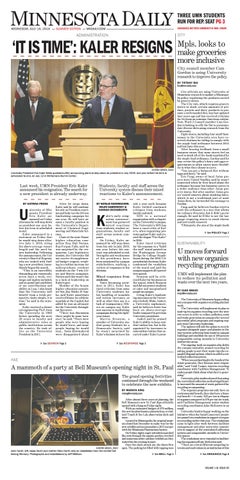
‘IT IS TIME’: KALER RESIGNS
CITY
Mpls. looks to make groceries more inclusive City council member Cam Gordon is using University research to improve the policy. BY TIFFANY BUI tbui@mndaily.com
EASTON GREEN, DAILY
University President Eric Kaler fields questions after announcing plans to step down as president in July 2019, one year before his term is scheduled to end, on July 13 in McNamara Alumni Center.
Last week, UMN President Eric Kaler announced his resignation. The search for a new president is already underway. BY KATRINA PROSS
U
niversity of Minnesota President Eric Kaler announced on Friday afternoon he will step down as president one year before his term is scheduled to end. Kaler announced in a statement on Friday that he would step down effective July 1, 2019, citing his above-average tenure length and the need for new leadership. Following the announcement, the University’s Board of Regents, who are tasked with finding a new president, immediately began the search. “This is an incredibly demanding job, essentially seven days a week, evenings and nights included, and as proud and confident of my contributions and ability as I am, I also know that the University will benefit from a fresh perspective. Quite simply, it is time,” he said in the statement. Kaler received a chemical engineering Ph.D. from the University in 1982 before spending the next 29 years in faculty and administrative roles at public institutions across the country. He took office as the University President in 2011.
After he steps down, Kaler said he will continue his role as President emeritus and help run the Driven fundraising campaign for one year. He will later assume a faculty position in the University’s Department of Chemical Engineering and Materials Science. Chair of the state House higher education committee Rep. Bud Nornes, Rep-Fergus Falls, said he was surprised by the resignation. Last legislative session, the University did not receive its supplemental budget request, resulting in a tuition increase for undergraduate resident students on the Twin Cities and Morris campuses. Nornes said this wasn’t due to a lack of leadership on Kaler’s part. Member of the Senate higher education committee Sen. Jim Abeler, R-Anoka, said Kaler sometimes received blame for athletic scandals at the Capitol, but added he was an advocate for the University throughout his career. “There was discussion there might be some turnover,” he said. “There were people who were hoping he would leave, and some people hoping he would stay… Some [lawmakers] were disappointed about
Students, faculty and staff across the University system discuss their mixed reactions to Kaler’s announcement. BY NATALIE RADEMACHER, HELEN SABROWSKY & HANNAH OVCHARCHYN
K
aler’s early resignation announcement has garnered m ixed react ions from students, student organizations, faculty and staff across system campuses. On Friday, Kaler announced he will step down from his role in July 2019, one year before his contract was scheduled to end. Strengths and weaknesses of his presidency have been mentioned by campus stakeholders, marking a variety of responses to his decision. Mixed responses from students Since becoming president in 2011, Kaler has faced criticism from some University students for his handling of scandals and tuition increases, as well as what they say is a lack of transparency. Others on campus say Kaler saw success in fundraising campaigns during his eightyear tenure. Martin Branyon, a member of University student group Students for a Democratic Society, said he wasn’t surprised by Kaler’s decision to leave his
u See SEARCH Page 3
role a year early because Kaler fielded continued critiques from students, faculty and staff. SDS is a national organization with a chapter on the University’s campus. The University’s SDS has been a vocal critic of Kaler’s, often organizing protests against Kaler and created the slogan “Fire Kaler” in 2016. Kaler faced criticism for his response to a “build the wall” mural painted on the Washington Avenue Bridge by College Republicans during the 2016 U.S. presidential elections. Kaler condemned the vandalism of the mural and said the campus supports all types of free speech. Branyon said he criticized Kaler for his stance on the mural, which Branyon said did not protect students of color and marginalized people on campus. Citing Kaler’s fundraising successes on the University’s behalf, Blake Andert, a University sophomore, said he believes Kaler has been an above-average leader compared to previous University presidents. Andert said he praised Kaler’s ability to keep resident tuition low, but is disappointed by increases to nonresident tuition that occurred under Kaler’s presi-
SUSTAINABILITY
U moves forward with new organics recycling program UMN will implement the plan to reduce its pollution and waste over the next two years. BY CLEO KREJCI krejci@mndaily.com
After almost three years of planning, the Bell Museum’s new St. Paul digs officially opened with a bang on Friday night. With an estimated budget of $79 million, the new location boasts a planetarium, revitalized Touch & See Lab, observation deck and more. Located in Minneapolis, the original museum closed last December to make way for the new exhibits and accommodate a 2011 merger with the Minnesota Planetarium Society. On Friday night, eager attendees marched like ants through the aquatic garden, riverbed and numerous other outdoor exhibits as they waited for the evening to start. Once the clock struck six, the doors flew open. The parking lot filled with tapping toes u See BELL Page 5
u See ORGANICS Page 8
A&E
A mammoth of a party at Bell Museum’s opening night in St. Paul The grand opening festivities continued through the weekend to celebrate the new exhibits. BY MARAYA KING mking@mndaily.com
EASTON GREEN, DAILY
u See POLICY Page 2
The University of Minnesota began rolling out a campus-wide organics recycling plan last week. The University will implement its plan to scale-up its organics recycling over the next two years in order to reduce pollution, costs and waste generation on campus after several successful pilot programs and ongoing support from University leadership. The updates will add the option to recycle organics alongside paper and plastics in the four-system collection bins found in campus buildings and establish the use of 100 percent compostable eating utensils in University food service areas. The ongoing work on organics also shifts the campus mentality around recycling by asking people to sort their waste into the expanded disposal options, which is called a centralized collection system. “When you put [sorting] in the hands of the waste generator, they become more responsible,” said Todd Tanner, interim recycling coordinator with Facilities Management. “It makes people think about what they’re generating.” University pilot studies showed that using the centralized collection method significantly increased the amount of waste gathered for recycling or composting. The organics programs not only have an environmental benefit, they also have a financial benefit — it costs $25 per ton to dispose of organics compared to $76 per ton for trash, said Facilities Management senior student recycling coordinator John McKeown in an email. University leaders began working on the initiative when the Social Concerns Committee passed two resolutions in support of organics recycling earlier this year. The resolutions came to light after work between facilities management and other university committees in support of the centralized collection system and compostable utensils in University spaces. The resolutions were essential in facilitating the organics roll out, McKeown said. “There are a lot of different competing interests and motivations in an institution of this
u See RESPONSE Page 3
John North, left, Issac North and mother Mary North view an installation from the exhibit Collecting Memory: Photographs and Installations by Jeff Millikan.
City officials are using University of Minnesota research to update a Minneapolis policy regulating the products carried by grocery stores. The City rule, which requires grocery stores to stock certain amounts of produce, protein and dairy products to promote a well-rounded diet, was last updated four years ago and has received criticism for its focus on common American cuisine. Now, Ward 2 Council member Cam Gordon is looking to edit the list to accommodate diverse diets using research from the University. Eight stores, including four small businesses in the University area have received citations for failing to comply with the staple food ordinance between 2014 and late June this year. After hearing feedback from a small business owner that some stores feel no need to stock all of the foods mandated by the staple food ordinance, Gordon said he may revise the policy’s dairy and eggs requirements to allow stores more flexibility in what they choose to carry. “You can get a balanced diet without eggs and dairy,” he said. Eric Fung, owner of local Asian grocery store United Noodles, said he wasn’t concerned when he first heard about the ordinance because his business caters to a wider audience than other Asian grocery stores. But after another Asian grocer voiced concern about stocking dairy, which is not a traditional part of most Asian diets, he forwarded the message to Gordon. Fung said he believes Gordon tried to craft the ordinance in a way that allows for culinary diversity, but it didn’t go far enough. He said he’d like to see the language requiring stores to stock cheese and cow’s milk removed. “Ultimately, the aim of the staple foods
VOLUME 118 ISSUE 65
2
WEDNESDAY, JULY 18, 2018
MN DAILY
EXTENDED WEATHER FORECAST WEDNESDAY THURSDAY HIGH 84° HIGH 72° LOW 67° LOW 66° Mostly sunny
Daily Review
MNDAILY.COM
FRIDAY HIGH 77° LOW 64°
Thunderstorms
Showers
SATURDAY HIGH 82° LOW 63° Partly cloudy
SUNDAY HIGH 81° LOW 64° Mostly sunny
THIS DAY IN HISTORY
Wednesday, July 18, 2018 Vol. 118 No. 65
An Independent Student Newspaper, Founded in 1900. 2221 University Ave. SE, Suite 450 Minneapolis, MN 55414 Phone: (612) 627-4080 Fax: (612) 435-5865 Copyright © 2018 The Minnesota Daily This newspaper, its design and its contents are copyrighted.
64 Emperor Nero’s Rome burst into flames; a week later, the flames died down and two-thirds of Rome was destroyed. HISTORYCHANNEL.COM/TDIH
City looks to change grocery laws
OFFICE OF THE PUBLISHER Kelly Busche Editor-in-Chief kbusche@mndaily.com (612) 435-1575 Genevieve Locke Business Operations Officer glocke@mndaily.com (612) 435-2761 NEWS STAFF Max Chao Managing Editor mchao@mndaily.com Cedar Thomas Managing Production Editor cthomas@mndaily.com Drew Cove Sports Editor dcove@mndaily.com Sophie Vilensky A&E Editor svilensky@mndaily.com Ellen Schmidt Multimedia Editor eschmidt@mndaily.com Christine Ha Copy Desk Chief cha@mndaily.com Harry Steffenhagen Visuals Editor hsteffenhagen@mndaily.com Jane Borstad Visuals Editor jborstad@mndaily.com =
=
=
=
Natalie Rademacher Campus Editor nrademacher@mndaily.com Madeline Deninger City Editor mdeninger@mndaily.com =
EDITORIAL BOARD Ray Weishan Editorials & Opinions Editor rweishan@mndaily.com Ellen Ailts Editorial Board Member eailts@mndaily.com Kelly Busche Editor-in-Chief kbusche@mndaily.com TONY SAUNDERS, DAILY
Stocker Zach North fills cooler shelves at United Noodles in Minneapolis on Friday, July 13. The Staple Foods Ordinance requires all grocers to carry certain healthy food items, but some small businesses have violated it, leading city council members and UMN researchers to reconsider the ordinance’s value.
Policy u from Page 1
ordinance was to remove food deserts in Minneapolis, which is a good cause,” Fung said. “However, the implementation of it was forcing all supermarkets to sell a certain diet that really only pertains to certain people in Minneapolis, particularly Caucasians.” The policy also has trouble brands recognizing brands not common in the United States. United Noodles was recently cited by the Minneapolis Health
Department for not carrying enough cereal. Fung said he was in compliance, but the inspector failed to recognize the product because the cereal he stocks comes in a different form than mainstream brands. An amendment won’t be brought forward to the City Council until at least late fall. Gordon said he is awaiting the results of a Health Department and University of Minnesota study to inform his decision. The Staple Foods Ordinance Evaluation study, created by University re-
searchers, has been tracking the policy’s effects in small and nontraditional grocery stores since 2014. The primary purpose is to determine whether food environments in Minneapolis are becoming healthier using St. Paul as a control group, said Melissa Laska, the study’s principal investigator from the University’s School of Public Health. Preliminary analyses show Minneapolis stores are stocking healthier foods since the ordinance passed, but St. Paul also shows a similar pattern.
U systemwide strategic plan nearing completion The plan will use the U’s mission and goals to benefit the state of Minnesota. BY KATRINA PROSS kpross@mndaily.com
University of Minnesota administrators are working to finalize the school’s first systemwide strategic plan, a multi-year process that is nearing completion after the final presentation was made to the Board of Regents last week. The plan aims to define the priorities of the University and how the system campuses can best serve the state. “The goal of this plan is to better articulate the manner in which the University system serves the state of Minnesota in particular... it is about leveraging all of our collective strengths across the system,” said Jon Steadland, chief of staff for the Office of the President. The systemwide strategic plan focuses on outreach, research, health and education, as well as financial support for the plan. These are areas that tie into the University’s mission and current goals, Steadland said. Many University regents say that the systemwide strategic plan is essential and necessary for the University
STRATEGIC PLAN TIMELINE July 2018 Final focus area presentation to the Board on “Supporting the Mission” August 2018 Draft plan available for public review and comment
September 2018 Final plan presented for Board review October 2018 Final plan presented for Board action
SOURCE: MNDAILY REPORTING
because it outlines University priorities. “There is no question that strategic planning is one of the most fundamental things that the Board does with its chief executive... it’s critical that all the institutions have a quality strategic plan,” said Regent Darrin Rosha. The plan is expected to be modified over time due to ever-changing circumstances. “[The systemwide strategic plan] is necessary and should be done on an ongoing basis. Once we have the plan, we have to review it every so often because things change, such as our appropriation from the [state] Legislature,” Regent Steve Sviggum said. Rosha said that strategic planning played an important role in the University’s budget requests to the Minnesota Legislature back in the 1990s, when
Rosha previously served on the Board. Having a strategic plan made the Legislature more comfortable providing funding for the University because it knew the University’s goals and priorities, Rosha said. The new systemwide plan is currently being drafted. There will also be an opportunity for public feedback and comment on the plan starting early August, Steadland said. The final plan will be presented to the Board for review in September and the Board will likely take action in October, he said. With University President Eric Kaler’s early resignation in 2019, the new president may be able to make suggestions to the plan. “The incoming person will have to look at that plan and make his or her comments on what they like and don’t like about it,” said Regent Randy Simonson Joshua Preston, Chair of the Student Representatives to the Board, said the strategic plan must go forward despite Kaler’s resignation and that the next president will be responsible for seeing the plan go into action. “It’s only been in the last few years that any attention has been given to [the strategic plan] and President Kaler has been a huge advocate on this issue… it will make the University a truly statewide institution,” Preston said.
It’s not yet clear what is behind the change, but one possibility is that the ordinance encouraged chain stores with locations in both cities to provide healthier options, Laska said. Laska noted that improving access to healthy foods is a complex process that needs a system-level approach beyond the ordinance. “My opinion overall is that we need healthier food environments and that we need creative and innovative ways of making that happen,” Laska said.
“My opinion overall is that we need healthier food environments and that we need creative and innovative ways of making that happen” MELISSA LASKA Investigator with the University’s School of Public Health
Three burglaries, two robberies around U campus this week Incidents happened in Stadium Village, Dinkytown, Como and Prospect Park. BY HANNAH OVCHARCHYN hovcharchyn@mndaily.com
The Minneapolis Police Department responded to three burglaries near the University of Minnesota campus this week, as well as two robberies and a narcotics violation. These reports follow the department’s crime alert released in recent weeks due to an influx of burglaries in the Southeast Como neighborhoods. MPD responded to a report of a burglary on the 1000 block of 4th Street SE at midnight Sunday. One resident told officers his bedroom door was “kicked open with apparent forced entry,” according to the police report. The 21-year-old said his roommate’s bedroom door was kicked open as well, even though it had been locked. Officers are investigating another burglary that occurred around the same time and on the same block. Two residents at The Cluster apartments told MPD their apartment was burglarized at 3:30 a.m. Sunday. MPD responded to a call of a burglary in progress
on June 9 at around noon on the 2700 block of 4th Street SE. A University law student told officers the suspect entered her apartment through a window and stole her computer. The case is ongoing at this time and suspect information was not released to the public. MPD Crime Prevention Specialist Nick Juarez said most burglaries occur late at night when residents are sleeping. It can be especially tricky for those who share living spaces with multiple roommates, he said. A homeless man was ro b b e d a ro u n d 5 a . m . Wednesday at a SuperAmerica gas station in Prospect Park. The 41-year-old suffered no injuries but was only able to provide MPD with limited information. MPD responded to a suspicious person call around 4 a.m. Sunday at Stadium Village’s Hong Kong Noodle. Officers detained a 24-yearold male and discovered he was carrying methamphetamine. He was then arrested and booked at Hennepin County Jail. A St. Paul man was robbed on the 900 block of 15th Avenue SE near Van Cleve Park around 11:00 p.m. Friday. The man had minor injuries and was unable to give a description of the suspect, according to an MPD police report.
BUSINESS Darya Karas Sales Manager dkaras@mndaily.com David Keane Controller dkeane@mndaily.com The Minnesota Daily strives for complete accuracy and corrects its errors immediately. Corrections and clarifications will always be printed in this space. If you believe the Daily has printed a factual error, please call the readers’ representative at (612) 627–4070, extension 3057, or email errors@mndaily.com immediately. THE MINNESOTA DAILY is a legally independent nonprofit 501(c)(3) organization and is a student-written and student-managed newspaper for the University of Minnesota’s Twin Cities campus. The Daily’s mission is: 1) to provide coverage of news and events affecting the University community; 2) to provide a forum for the communication and exchange of ideas for the University community; 3) to provide educational training and experience to University students in all areas of newspaper operations; and 4) to operate a fiscally responsible organization to ensure its ability to serve the University in the future. The Daily is a member of the Minnesota News Council, the Minnesota Associated Press, the Associated Collegiate Press, The Minnesota Newspaper Association and other organizations. The Daily is published Monday and Thursday during the regular school year and weekly during the summer, and it is printed by ECM Publishers in Princeton, Minn. Midwest News Service distributes the 10,000 issues biweekly. All Minnesota Daily inserts are recyclable within the University of Minnesota program and are at least 6 percent consumer waste. U.S. Postal Service: 351–480.
Wednesday, July 18, 2018
3
President Eric Kaler announced his resignation; search underway Search u from Page 1
the scandals, and [Kaler] is the top of the food chain.” Joshua Preston, chair of the student representatives to the Board, said the next president needs to represent the diversity of the University and take student input into account. “The next president will also be responsible for the systemwide strategic plan, not to mention set the tone for how the University responds to sexual assault in the future, managing the costs of tuition and lead[ing] a $4 billion institution,” Preston said. The search for the 17th president The search for the next University of Minnesota president is already underway. At a Friday afternoon press conference, Kaler said he’s held conversations with the board about his resignation over the past six months. “I think the timing is good on President Kaler’s decision to step away; it gives us some time to find the right person,” said Regent Randy Simonson. Regent Vice Chair Ken Powell and Chair David McMillan have begun conversations about how to conduct the search for the new president. “The board is committed to a very robust set of input opportunities with key stakeholders and with almost all the University,’’ McMillan said. The board plans to create a search committee for the new president but hasn’t yet decided how many members the committee
will have or who will lead it. Every member of the board, as well as students, faculty and stakeholders, will be involved in the search process, McMillan said. “The whole board will have input; it won’t be just decided by the committee,” Simonson said. In a statement released by the Minnesota Student Association, student body president Simran Mishra said she wants students to be able to give input on the selection. Preston also stressed the importance of student involvement in the selection process. “Students must be involved in the selection of our University’s next president... students have to be at the table,” he said The board will also consult with a third-party firm to garner expertise and aid in the selection process “We’re an unpaid, parttime board. I highly doubt that everyone on the board is going to be able to provide a thorough investigation of the candidates, so I would expect there to be some kind of outside support,” said Regent Darrin Rosha. Kaler and McMillan said they are looking for a new president who holds fresh perspectives on navigating challenges facing higher education. “[For the next president,] I’d like another Eric Kaler – somebody who is able to look over the horizon at the changing business model for public higher education,” McMillan said at the press conference. Kelly Busche, Max Chao, Madeline Deninger and Helen Sabrowsky contributed to this report.
“This is an incredibly demanding job, essentially seven days a week, evenings and nights included, and as proud and confident of my contributions and ability as I am, I also know that the University will benefit from a fresh perspective. Quite simply, it is time.” ERIC KALER
HARRY STEFFENHAGEN, DAILY
Mixed reactions from staff, students Response u from Page 1
dency. “[Kaler] has done a good job promoting publicprivate partnerships with industry,” he said. Kaler’s presidency saw backlash for increasing tuition for resident and nonresident students, which occasionally resulted in protests. The Board of Regents recently approved Kaler’s proposal to increase resident undergraduate tuition for students on the Twin Cities and Morris campuses in the upcoming academic year. Since taking the position in 2011, Kaler has increased resident tuition at a lower rate than previous presidents. During Kaler’s tenure, resident undergraduate tuition has risen over 11 percent. Under University President Bob Bruininks, resident tuition rose around 48 percent. Nonresident tuition under Kaler has increased around 12.5 percent during the previous academic year. University sophomore Austin Berger said he believes Kaler has been more progressive than other presidents, although he criticized Kaler for not ending tuition hikes. Berger also cited Kaler’s opposition to the results of the UMN Divest referendum, which passed during last year’s all-campus elections, as a failure of his tenure. The student body passed the referendum by 217 votes, calling for the University to divest involvement with companies
involved with Israel. “He’s done a good job of listening to students’ demands when it fits his own agenda, but when it comes to other ideas I don’t see him being a proponent of those ideas in an inclusive manner,” Berger said. Students want search input Student government leaders and campus groups hope the next president will be receptive to student voices at the University. In a statement on behalf of the Minnesota Student Association, student body president Simran Mishra said she would like to see student voices included in the new president search. “We call for administration to consciously involve all levels of student organizations to ensure a diverse mindset in the selection process,” she said in a text message to the Minnesota Daily. “By involving student governments in the process, student needs can be accurately considered and addressed in years to come.” Andert said he would like the next president to be more transparent than Kaler. He would also like to see the new president focus on ensuring that tuition is affordable for all students, he said. Faculty reacts across system campuses Throughout Kaler’s tenure, financial and academic priorities have been key points among feedback from faculty and staff across the University system.
Joseph Konstan, chair of the Faculty Consultative Committee, said the decision surprised some in the Twin Cities’ faculty, while it has prompted others to offer input in the search for a new president. On the Morris campus, professor of chemistry and University Senate Educational Policy Committee Chair Jennifer Goodnough said a majority of the faculty doesn’t feel strongly about the decision. “Seven years [as president] is a long time. I think that it is really good that people are neutral about his presidency and resignation. He did a lot during his time,” she said. University of MinnesotaDuluth Chancellor Lendley Black said Kaler’s advocacy at the Capitol extended to Duluth’s needs, demonstrating a commitment to all system campuses. “President Kaler has been a strong supporter of UMD and helped us define our important role within the UMN system,” Black said in a statement. Kaler often stressed keeping undergraduate tuition low throughout his time in office. But Konstan said this emphasis sometimes took away from other University priorities. “It was always frustrating how challenging it was to get the rest of the University the same amount of attention,” Konstan said. This focus on undergraduate tuition partially came from pressure from the state Legislature to align the University’s priorities with those of lawmakers, Konstan said.
Last legislative session, the University requested $10 million from the state’s surplus to hold tuition flat for undergraduate resident students, but the allocation was denied by the state’s higher education committees. Daniel Frisbie, head of the Department of Chemical Engineering and Materials Science, said Kaler has been successful in representing the University’s needs at the Capitol. “The biggest challenge [in the presidency] is to communicate with the Legislature,” he said. “Despite the surprises Kaler had to deal with, he’s done a great job so far.” Faculty’s focus on search As the search begins for Kaler’s replacement, faculty members say they hope their perspectives will be considered in the process. “I want to see somebody that has a real vision for the role that a public research university can play... someone who can build a strong rapport with the public, state Legislature and the governor,” Konstan said. Jigna Desai, a professor in the Gender, Women and Sexuality Studies department, said it’s important the next president have an academic background like Kaler. “Most importantly, [there is consensus from faculty] that University presidents should be scholars and academics rather than political or business figures,” she said. Helen Sabrowsky contributed to this report.
Seven candidates for 60B engage with community at forum Ilhan Omar leaves a crowded race for the district after filing to run for Congress. BY HELEN SABROWSKY sabrowsky@mndaily.com Following Rep. Ilhan Omar’s, DFL-Minneapolis, decision to run for the U.S. House of Representatives, a candidate forum was hosted Monday to provide the public an opportunity to engage with candidates ahead of the primary next month. After Omar, who Senate District 60’s DFL party had previously endorsed for the 60B seat, left the race, a number of candidates filed to run in the last minute. The forum, held at the University of Minnesota’s Cowles Auditorium, was followed by a straw poll meant to take the place of a formal endorsement. In a straw-poll of about 100 people who attended the forum, Peter Wagenius won with about 36 votes. Among the seven candidates running include three University of Minnesota students: Joshua Preston, Angelo Jaramillo and Haaris Pasha. Mohamud Noor, a prominent figure in the Cedar-Riverside neighborhood who ran against Omar for the same seat in 2016, also filed. University alumna Sonia Neculescu, chair of Senate District 60’s DFL branch, said while organizing a candidate forum under such short notice was challenging, she was happy that all seven candidates were present to engage with
EASTON GREEN, DAILY
Candidates for the 60B Senate seat sit for a forum to give members of the public a chance to learn more about them before the primaries next month on Monday, July 16 at Cowles Auditorium.
EASTON GREEN, DAILY
Mohamud Noor speaks during a forum for candidates for the 60B Senate seat formerly held by Ilhan Omar on Monday, July 16 at Cowles Auditorium.
the public. Neculescu, who was elected in March, said she is excited to be a voice for young people in the district and hoped to engage them through the forum. “44 percent of the residents in district 60 are under the age of 24 so I am really proud to bring that
perspective to the district, which I don’t think has been represented before,” she said. Omar spoke at the beginning of the forum, emphasizing the diversity of the district which includes the University of Minnesota, Augsburg University, Prospect Park, Seward, Como and Cedar-Riverside.
Noor said he aims to expand his supporter base beyond the East African community to the entire district, including students and long-time residents. “We have a natural base which is the East Africans in the district, but the best way to engage is to win everybody,” he said. “Last time I was the second candidate because [Omar] won the minds and the hearts of students, so whoever can mobilize the three communities is the only person who can win.” Jaramillo, a second-year graduate student studying public policy at the University, said he is focused on issues affecting young people, including affordable college tuition and healthcare. “I’m 23 years old, I am a student, so I understand students and what our generation is going through,” he said. Pasha, a University law student, said he was drawn to run with the hope of diversifying the voices represented in the party. “I think that now is the time that as a person of color and as a Muslim, I am seeing the same kind of timidity from democrats and I think that we need someone who is going to be honest and fight for what is right.” Preston, who currently serves as the student representative to the University’s Board of Regents, said increasing access to education at all levels, criminal justice reform and affordable healthcare, including mental health care, is the focus of his campaign. But regardless of the results of the primary, he said he is happy with the diverse
topics a crowded race brings to the attention of the public. “What I think is going to be highlighted for voters is that now they are going to know, whether they live in Marcy-Holmes or Prospect Park or the University area or [the] CedarRiverside neighborhood is that this whole district is connected and that you can’t just simply have a candidate who represents just one narrow district of 60B,” he said.
“44 percent of the residents in district 60 are under the age of 24 so I am really proud to bring that perspective to the district, which I don’t think has been represented before” SONIA NECULESCU Chair of DFL’s district 60 branch
4
Sports
WEDNESDAY, JULY 18, 2018
MN DAILY
MNDAILY.COM
BASEBALL
Former Gophers’ infielder retires
Luke Petterson reacts as he watches to see if his hit is a foul ball during the game against Canisius on Friday, June 1 at Siebert Field. The Gophers won 10-1.
Luke Pettersen had signed with the St. Paul Saints but he retired soon after. BY DAVID MULLEN dmullen@mndaily.com Since the end of the Gophers baseball team’s postseason run, one former player has experienced a whirlwind few months. Former Minnesota second baseman Luke Pettersen was signed by the St. Paul Saints on June 22, 13 days after the Gophers’ season ended in the NCAA Tournament. “Our season ended on Saturday [June 9] and a few days later our coach reached
out to me and laid out a plan,” Pettersen said. Pettersen hit lead-off for the Gophers throughout his senior campaign. He had a .322 batting average, scored a team-leading 58 runs and had an on-base percentage of .411. He was named to the All-Big Ten third team and All-Big Ten Tournament team his senior year. “We had a need for an infielder… [Pettersen] had a really good year with the [University] so we were interested,” said Saints Manager George Tsamis. Although Pettersen excelled on offense for the Gophers, the Saints were intrigued by his ability on the field, Tsamis said.
“He only had 3 errors all year, so that shows consistency,” he said. Pettersen made his debut for the Saints on June 22, the same day he signed. He went 1-5 at the plate, but scored a run against the Winnipeg Goldeyes at CHS Field in St. Paul. Pettersen wasn’t drafted by a major league team, but four of his Minnesota teammates were selected in the MLB draft in June. After nine appearances with the Saints, Pettersen decided to hang up the cleats and exchange his glove for a suit and tie to focus on a career in real estate with Engel & Völkers. “I believe that there comes
a time in everyone’s baseball career when it is time to move on. I felt like, for the last few weeks, I was fighting against... [facing] that my time had come,” Pettersen said. Pettersen received his real estate license in January, and he’s been working for Engel & Völkers ever since. “During the school year, I worked there because I only had one class, but with the Saints it’s a little harder,” Pettersen said. Although his baseball career came to a close, Pettersen said he has nothing but fond memories of his career, especially the memory of winning the NCAA regional in May. “Winning a regional at home, in front of our home
fans, especially when our coaching staff had never won a regional before… that was pretty fun,” Pettersen said. Jeff Fasching, Gophers pitcher and Pettersen’s roommate, said he was an exemplary teammate. “He’s an incredibly supportive teammate, an incredibly gifted leader and generally cares about how you are doing in life,” Fasching said. Fasching and Pettersen played against each other throughout the summers of their upperclassmen years in high school. Fasching originally disliked Pettersen because of how hard he played. “[Pettersen] is such a grinder and works so hard. You just hate playing against those
ELLEN SCHMIDT, DAILY
“I believe that there comes a time in everyone’s baseball career when it is time to move on.” LUKE PETTERSON Former infielder
type of guys,” Fasching said. The Minnetonka native is working full-time as a real estate advisor and is looking forward to whatever comes next. “I am excited to use my energy and passion towards a new chapter in my life,” Pettersen said.
MEN’S HOCKEY
Three hockey players get chance in front of NHL eyes The three players worked to prepare for the season and life after college. BY DREW COVE dcove@mndaily.com This offseason wasn’t completely “off” for three men’s hockey players. Though the Gophers’ season ended in disappointment by missing the playoffs and their longtime head coach stepped down, captain Tyler Sheehy, defenseman Jack Sadek and goaltender Mat Robson played at the development camp for the Minnesota Wild of the NHL to condition for the season and look to their hockey careers beyond their time with the Gophers. “It was a fun week,” Sheehy said. “I mentioned to the player development coach here, you work on some things here you don’t get to work on in college ... Overall, I thought it was a good week for myself.” The development camp is one the Wild holds annually every summer for players in its prospect pool and players that they invite that hadn’t been drafted or are not already in the team’s minor league system. Sheehy was an invitee to the development camp. Along with him was Robson, who isn’t in the Wild’s system. Sadek, though, was drafted by the Wild in the 7th round of the NHL
Entry Draft in 2015. It is clear Sadek knows the routine of the development camps by now. “Yeah, it’s my fourth camp in the books now,” Sadek said. “It’s always good seeing new guys and new faces, but good seeing old guys too.” The Wild opened two scrimmages for the public to come to the the Xcel Energy Center and watch, one on Thursday and one on Sunday. Sunday, Sadek and Robson were teammates on the white team while Sheehy was on the green team. Aside from those three, college hockey players familiar to the Gophers players participated. Two notable names — two who played at the same arena in the NCAA Frozen Four in April — were goaltender Hunter Shepard from the national championship-winning Minnesota-Duluth and Ohio State forward Mason Jobst. When it comes to the Gophers players preparing for their upcoming season in October, they said the camp helped them work on routine and keeping the little things in mind. “[It is the] little stuff I can work on,” Sheehy said. “Some little drills if I’m out on the ice by myself. I don’t know how much I can take back to the team here at [Minnesota], but I thought the drills and things like that were some good, key points to work on.” Robson had one experience
Sophomore forward Tyler Sheehy skates down the ice at Mariucci Arena on Feb. 4, 2017.
with him through the camp that was a first: vision testing and eye training. He said the goaltending coach Frederic Chabot took the goalies to a hockey training facility to go through tests and training for their vision and how their eyes could track things and react quickly to situations. “[Some of the tests were] how quick your eyes can
pick up on something, how quickly they can process information, reaction times, how quickly you can move your eyes inward to something coming at you,” Robson said. “It was a really cool experience and I’m definitely going to try and keep that up.” Each of the players steps into an increasingly elevated role for the Gophers next season. Sheehy starts
his second season as team captain. Sadek will be the only senior on the defensive corps. Robson will have his first full season of eligibility with the Gophers and compete for a starting spot in net. Now as they prepare themselves for the next season, they also have a new head coach in Bob Motzko. Sheehy said he
ELLEN SCHMIDT, DAILY
expects Motzko and new assistant coach Garrett Raboin will be supportive of him and the team this season. “ [ F ro m ] a c a p t a i n ’ s standpoint, they’re going to be there to help me out,” Sheehy said. “I think they’re going to be really connected to the team this year, which may be a little bit different.”
5
WEDNESDAY, JULY 18, 2018
MN DAILY
MNDAILY.COM
STYLE
Street Style: Bell Museum grand opening
EASTON GREEN, DAILY
From left, Alan Tse, Kelsey Oseid, Nick Wojciak, Parke Kunkle, Liz Placzek, Ryan Placzek and Craig Hergert
Chic, themed and even lightup clothing — we found it all. BY MARAYA KING mking@mndaily.com
O
n Friday, the new Bell Museum’s opening brought out people of all ages, interests and — most importantly — styles. With the recreation totaling almost three years and $79 million, this was the most-anticipated grand opening of the year. A&E wandered through planetariums, interactive
labs and 24-foot-tall glaciers to track down the evening’s best dressed attendees. Alan Tse Graphic Designer What he wore: Hat from Canada, Zara shirt, Rufskin shorts and Converse shoes. Tse’s outfit was a place of refuge amongst a torrent of earth tones. With splashes of yellow and a decadent cap, this graphic designer was hard to miss. Kelsey Oseid Illustrator at Kelzuki What she wore: Target dress, Madewell bag and Chacos sandals. Oseid’s navy dress stole glances all night long, but
her tattoos are what caught A&E’s eye. An incredibly detailed whale graced her forearm, making the shades of blue in her dress stand out in comparison. Nick Wojciak Operations Director at Kelzuki What he wore: “Savers from head to toe” and Chacos sandals. Wojciak’s discounted look had a rugged flair we couldn’t deny. His laidback outfit paired with his wife’s blue dress, and their matching Chacos were match made in heaven. Parke Kunkle Member of Bell Museum
FOOD
Advisor y Board, retired astronomy professor What he wore: Gifted hat, glasses found in the kids’ box at the dentist’s office, gifted tie, gifted tie clip and JC Penney’s shirt and pants. Kunkle was turning heads all night long with his light-up cap, astronomythemed tie and sparkling personality. Whether he was catching up with former colleagues or showcasing his commemorative tie, Kunkle stole the show. Liz Placzek Pediatrician What she wore: Warby Parker glasses, Madewell
shirt, Target pants and Vans sneakers. Placzek, who attended the event with her husband, was the epitome of chic-casual. With a cactus-covered shirt, Warby Parker frames and Vans to top it all off, she turned heads. Clearly, this husband-wife duo knows their style. Ryan Placzek Brewer at Wild Mind Artisan Ales What he wore: a shirt and hat from Doug’s Hood River, Levi’s shorts and Vans sneakers. As pops of color intertwined with classic black denim, Placzek’s outfit was hard to miss. He could
have walked off a trendy boutique photoshoot or come straight from the skatepark. Either way, this brewer had it all figured out. Craig Hergert Professor at Minneapolis Community and Technical College What he wore: Eyedeals glasses, Target shirt, pants from Vietnam and Marshall’s shoes. Hergert stood out from the crowd in his vivacious blue button-up, complete with fuchsia flowers. As if the shirt wasn’t enough, he also donned the trendiest eyeglasses of the evening. Well done, Craig.
EVENTS
A&E’s guide to Trader Joe’s Yes, there’s cookie butter involved. BY MADDY FOLSTEIN molstein@mndaily.com
T
he recently-opened Fresh Thyme near campus has found competition in downtown Minneapolis — a brand new Trader Joe’s, opening this Friday. Located a couple blocks away from the Guthrie Theater and a short walk from both a Metro bus stop and the Green Line, the new store is sure to attract crowds. So, if you’re heading to the store on Washington Avenue this weekend, come armed with a list. H e r e ’ s A & E ’ s ro u n d u p of suggestions for any snacking occasion you might face in the coming months: Best por table for m of cookie butter: Cookie butter sandwich cookies Trader Joe’s has turned this decadent spread into chocolate bars, ice cream and cheesecake. This version of the treat is sandwiched between two buttery cookies, perfect for grabbing on your way out the door. No knife required. Best af fordable vegan dinner: Green jackfruit in brine and BBQ sauce of your choice The Twin Cities are home to plenty of vegan restaurants, stores and even a butcher. But these options can run pricey. Instead, you can pick up a can of jackfruit for around $2 and make a vegan version of pulled pork or chicken. Just cook with your favorite Trader Joe’s barbecue sauce — we chose the organic brown sugar BBQ sauce and marinade. Best at-home cold brew: Coconut cold brew concentrate Whether you’re still mourning the loss of Espresso Royale and Espresso Exposé on campus or you’re trying to cut back on your daily Starbucks run on the way to work, cold brew concentrates are the way to go. Mix one part concentrate with two parts wa-
TONY SAUNDERS, DAILY
The Minnesota Daily rated the best products from Trader Joes for students. A new Trader Joes will open on South Washington Avenue on July 20.
ter or milk, and pour over ice. Best breakfast on-the-go if you have an 8 a.m.: Greek yogur t with trail mix Breakfast may be the most important meal of the day, but — if you find yourself jumping out of bed 15 minutes before your 8 a.m. lecture on West Bank — it can also be the trickiest. We like the strawberry vanilla yogurt; it has a resealable lid, making it extra-portable if you need to finish it on a Campus Connector ride. Top it off with a sprinkle of granola — we like the individually packaged “Handful of Breakfast” trek mix. Best treat to bring to a group project meeting: Gluten free chocolate chip brownie mix Something for everyone, whether they’re glutenfree, vegan or simply in love with chocolate. Just use your favorite vegan egg substitute and use unrefined coconut oil for a subtle, coconut-y flavor. Best snack to ser ve for your roommates: Mini chicken tacos Though you could probably polish off an entire plate on your own, this frozen snack is a great sharing option if you live with a few friends. Serve with an open jar of Trader Joe’s salsa; the salsa verde is always excellent. Best lunch to keep in t he fr e e ze r at wor k : Chicken tikka masala Be sure to write your name on this one; it will get stolen from the freezer
at work otherwise. The Trader Joe’s chicken tikka masala takes less than four minutes to make but still tastes decadent. You’ll be looking forward to lunch all day.
EASTON GREEN, DAILY
Sarah Komperud dials in a telescope to connect with the setting sun, with the goal of viewing sunspots.
Cheapest weeknight comfor t food meal: Macaroni and cheese (with Wisconsin cheddar!) Cheap and cheesy. There’s no need to resist boxed macaroni and cheese, especially when Wisconsin cheddar is involved. Fastest route to an impressive mixed drink: Jalapeño limeade Why bother with Crystal Light anymore? Thanks to a hint of jalapeño, this limeade is spicy, tangy and an easy way to take your average mixed drink to the next level. Easiest dish to impress your dinner date: Asparagus risotto Way less stirring required here! Serve this easy risotto alongside chicken and vegetables, and you’ll have the taste of the Loring Bar and Restaurant without the bill at the end of the night. Just make sure to throw away the freezer bag before your date comes over. Best treat for the green line ride back to campus: Dark chocolate peanut butter cups A perennial Trader Joe’s favorite. Grab the small package of these for the ride home to split with your roommates, and throw the rest in your freezer for a frozen dessert later.
EASTON GREEN, DAILY
Spectators watch a demo presentation for opening day in the Whitney and Elizabeth MacMillan Planetarium.
Bell u from Page 1
and anxious whispers. Guests ranged in age from only a few months old to on the cusp of a century — it truly is a museum for all ages. Parke Kunkle, a member of the museum’s advisory board and former astronomy professor at Minneapolis Community and Technical College, was smiling from ear to ear as he looked across the museum. “This was a gift from my girlfriend tonight,” Kunkle said, gesturing to his embossed tie clip that read “Planetarium 7-13-18.” As the first of its kind
with capabilities ranging from the stars to the seas, the 120-seat Whitney and Elizabeth MacMillan Planetarium was the belle of the ball. Of course, for every Belle there is a beast. This evening’s came in the form of a full-scale woolly mammoth. The mammoth and his native-Minnesotan friends can be found seated in a 24-foot high glacier on the second floor of the museum. When they weren’t ogling the mammoth, many of the youngest attendees could be found in the new-and-improved Touch & See Lab. But don’t be fooled, it’s not just for kids. In celebration of 50 years of active learning and sensory engagement, the
lab features live insects, reptiles and a collection of more than 4,000 specimens. Kelsey Oseid, an illustrator and attendee, said she was stunned by it all — even the gift shop. Oseid has many of her themed prints for sale in the cleverly named “curiosity shop.” They’re reflective of the exhibits and void of being “kitschy,” she said. With live music hosted by The Current, catered D’Amico & Sons cuisine and guests dressed to the nines, the evening was well worth the wait. Regular museum hours (10 a.m. to 5 p.m.) begin July 16 and free admission is offered to University of Minnesota students.
6 WEDNESDAY, JULY 18, 2018
MN DAILY
MNDAILY.COM
Editorials & Opinions
COLUMN
Don’t stress: social media exhaustion happens to everyone The best option may be to put yourself first and take a step back.
I
’ve poured entirely too much energy into Twitter in the five years since I joined. As someone looking to cover internet culture and fandom spaces, I like to think that bePALMER HAASCH ing perpetually active columnist on Twitter is essential to my future career as a digital journalist. I maintain two accounts: one, a personal account that earns most of my time and the other, a disastrous fan account that will never see the light of day. Managing my intake was never a problem in the past, but a large influx of followers and notifications recently pushed me to a critical point. Just over week ago, a tweet calling me an idiot because of an article I had written made the
rounds on anime Twitter. I was inundated with angry notifications from fans until I finally muted the tweet. I wasn’t really mad. Mostly, I was surprised it hadn’t happened sooner. Despite my apathy, the blitz of mentions had done the job. Any notification, even if it was positive, had me groaning. Social media exhaustion isn’t a problem that’s unique to me. I wish I could attribute it to one factor like an increased follower count or getting called dumb by anonymous men on Twitter, but this is just something that happens. No matter what platform you use, how many followers you have or how often you post, social media exhaustion is a real and persistent problem. There’s only so much information that we can handle, especially in times of heavy and particularly emotionally charged news that necessitates response and action. Information intake in general can quickly wear you down, even if it
seems innocuous in the moment. Taking a social media hiatus, in some cases, may be the best option. For me it wasn’t; Twitter is unavoidable for me, and frankly, I’m a little too roped into it at this point to drop it cold turkey, even for a week. In search of some relief, my strategy to mitigate social media exhaustion has come down to one guiding philosophy; I’m allowed to engage with social media how and when I wish, but I have no obligation to do so at all. That sounds self-centered. However, remembering that you don’t have an obligation to immediately respond to a comment or direct message is the biggest hurdle to cross. I felt guilty not responding to my friends, but it admittedly felt great to continue liking and retweeting content while not fretting about conversation. Sometimes, cutting back on the more draining part — while still engaging with the less intensive aspects such as liking photos — of social media can make a big difference. Your friends
will understand that you weren’t able to answer their message until later. Sometimes, we simply don’t have the energy for it. While attempting to crush my sense of reply duty, I also tried to limit the amount of time I spent on Twitter each day. At work, I didn’t hold back. At home and on my commute I wrote, read and played games to give myself a break. In the end, I also ended up making a private Twitter account that’s limited to a very small amount of friends. Having a space to retreat to where I don’t have to closely curate my own content or worry about myriad replies is equally invaluable and relieving. Ultimately, listen to your overloaded brain and cut back when necessary, even if you’re as plugged in as I am. Your followers and friends will wait. Palmer Haasch welcomes comments at phaasch@mndaily.com.
EDITORIALS
Why we should listen to the message behind the Ben Shapiro lawsuit
Young America’s Foundation, Students for a Conservative Voice and conservative speaker Ben Shapiro are suing the University of Minnesota for discrimination and violation of First Amendment rights after Shapiro’s February speaking event was relocated to a smaller venue on the St. Paul campus, with the University citing as security reasons as its motive. This lawsuit is evidence that conservative students feel disrespected and marginalized on campuses. As a University, we should ensure that conservative students feel heard and seen, regardless of whether or not the relocation of Shapiro’s event was an act of discrimination. Considering the fact that the University of California Berkeley had to spend over half a million dollars on security when hosting Shapiro, the University of Minnesota being swayed by a “heckler’s veto,” as YAF claimed, isn’t terribly surprising. It’s no secret that the University of Minnesota is a largely left-leaning campus, and its vitriol against right-wingers has been especially intense since the Trump administration took office. College campuses might feel the need to protect inclusive, progressive spaces in an age when bigotry influences both our elected officials and our culture at-large. But in our attempts to create inclusive spaces, are colleges discriminating against anyone who might be considered less than liberal? The filing of this lawsuit by a conservative student group at the University might spur us to reckon with the fact that conservative students feel dismissed, even discriminated against, at our school. As much as our student body wants to create a campus in which inclusivity and acceptance are prioritized, more should be done to extend that sentiment to those whose politics are right
of center. The goal of this, ultimately, should be to create a campus environment in which ideas can be discussed freely and openly. Higher education should serve as an example to the rest of the country as to how we can communicate civilly and respectfully with one another, engaging with the ideas of those who think differently than us, without resorting to reactionary anger and resentment. Clinging to an “us versus them” mentality is not the path to resolving political friction on our campus. In fact, it will in all likelihood only radicalize each side that much more; there will be no consensus or even conversation, just increasingly hostile behavior that will further broaden the abyss between conservatives and liberals, deepening our echo chambers and reinforcing unchallenged beliefs. Conservative students have as much of a right to express their views without institutional suppression, and we can do better in listening and responding. A top priority of higher education should be open discourse and to support spaces in which that’s possible. The fact that only around 80 people showed up to peacefully protest the Shapiro event should be evidence enough that our student body can handle ideas that are different or even offensive to their own. There’s a growing base of people, largely on the conservative end of the political spectrum, loudly decrying higher education. Actions like the one by the University will only fuel the conservative fire against colleges and universities. We can either live in a country in which we are segregated by our political beliefs, or one in which we can accept the responsibility we have to listen to and respect one another.
Robert McGrady welcomes comments at rmcgrady@mndaily.com.
COLUMN
Shifting food mentality because imperfect produce is perfectly We can eliminate enormous amounts of food waste if we stop shaming and start using asymmetrical produce.
T
he hoops grocery stores have to jump through are pretty high. A manager has to anticipate how much they will sell in a given order period, taking care to not undershoot and end UMA VENKATA up with bare shelves, or columnist overshoot, which causes some produce to rot, in turn spoiling even more other food. But modernization has made this easier. Grocery is a delicate balancing act that, thankfully, has been harmonized by computerization in most places. Stores have been analyzing their customers’ buying trends for as long as stores have been around. Never think that what you buy doesn’t matter, because it always has and
always will. Stores can now closely follow trends to place just the right orders. “It’s a lot different than what it was 10, 15 years ago, when you had a back room full of product, and you piled it high and watched it go,” said Ben Gustavson, a manager of Cub Foods located in The Quarry. “It’s not that way anymore because there are so many different competitors out there, so we’ve become a lot more tight, so to speak. And it’s a lot better business. You don’t have all that inventory hanging over your head, and it’s still accommodating to the customers,” he said. Gustavson went on to explain Cub’s other practices, like its packaging recycling, food-shelf contributions for unsold food and, when that food is no longer fit for human consumption, compost. It sounded pretty close to the 90 percent reclamation, or zero waste, that I learned about from the University of Minnesota’s recycling program. But there is one thing that grocery stores like Cub could do that would save about 20 percent of edible crops from being wasted: selling imper-
fect produce. Selling imperfect fruit, rather than ditching it for aesthetics, saves millions of dollars for consumers, tens of millions of pounds of food, hundreds of millions of gallons of water and reduces our carbon footprint, according to Imperfect Produce, a San Francisco-based group who took its statistics from UNESCO and Environmental Working Group. Apart from the environmental implications, refusing to buy imperfect produce hurts farmers too. Losing the revenue from that 20 percent of their crop yield can cause real financial stress. This is a painfully easy problem to fix because imperfect produce is no less nutritious or delicious than symmetric produce. Gustavson does not subscribe to imperfect fruit, though. “As far as I’m concerned, it’s a niche market. We look for the best produce that we possibly can, we have a lot of people who spent a lot of time going after it,” he said. That makes complete sense. In his twenty-plus years in the business, his customers have told him that perfect produce is what they want.
DAILY DISCUSSION Plastics: Social pressure making impact on plastic use
The problems associated with singleuse plastics — things such as straws, plastic bags and one-use food containers — is more apparent to more people all the time. One of the biggest problems is with the amount of plastic that ends up in the oceans, harming and killing sea animals, birds and coral reefs. We produce 300 million tons of plastic every year, half of which is for single use. More than 8 million tons of plastic is dumped into our oceans every year. While some cities and states around the country have instituted bans on plastic bags or plastic straws, many countries have been more proactive. Britain several years ago instituted a policy where shoppers have to pay extra if they want plastic bags. The journal Science of the Total Environment recently published an article about a scientific study showing about a 30 percent drop in plastic bags found in the ocean around Britain. The big
improvement is prompting a push for similar policies to be instituted across Europe. Critics of government interventions note that paper or cloth shopping bags or paper straws often have a larger carbon footprint to make. That’s true, but the higher carbon footprint compared to the reduction of ocean pollution and landfill space used by plastic that won’t degrade for hundreds or thousands of years is a good trade-off. And like many things, once something is unavailable the marketplace is adept at finding replacements that become ever more economical and environmentally friendly to make. Remember the uproar from some when inefficient incandescent light bulbs were under attack? They argued there would be no alternative that would be cheap and effective. Today LED lights are getting even cheaper and lasting even longer. While governments may increasingly be unable to act on much of anything these days, people are making more of an impact on their own.
Social pressure to move away from single-use plastics is beginning to have an effect. Starbucks announced this week that it will ban plastic straws from all of its stores globally in less than two years. That will mean 1 billion fewer plastic straws each year. McDonalds is moving away from plastic straws, albeit at a slower pace than Starbucks. Meanwhile researchers and manufacturers are making quick progress in finding alternatives, including straws very similar to plastic but that are biodegradable. Consumer pressure will continue to make improvements on more sustainable products. Finding alternatives to single-use plastics is good for our world, which is good for everyone.
Editor’s Note: This editorial was originally published in the Mankato Free Press.
But we, those very consumers, are best off shedding this perfectionist mentality. A wonky carrot is a small price to pay for diverting needless waste and backing our under-supported farmers. And maybe you can think back to your childhood and reconjure the thrill of cracking open a two-yolk egg, or finding a snake’s-tongue strawberry. Especially for city kids, that kind of thing was pure art. In the meantime – and if you have children to convince to eat their vegetables – you may want to check out the Ugly Fruit and Veg Delivery Directory. All over the world, local vendors deliver its fun fruit. Maybe this niche market will grow into something more mainstream and less wasteful in the future.
Uma Venkata welcomes comments at uvenkata@mndaily.com. EDITORIALS & OPINIONS DEPARTMENT Editorials represent the voice of the Minnesota Daily as an institution and are prepared by the editorial board. SHARE YOUR VIEWS The Minnesota Daily welcomes letters and guest columns from readers. All letters must include the writer’s name, address and phone number for verification. The Daily reserves the right to edit all letters for style, space, libel and grammar. Letters to the editor should be no more than 500 words in length. Guest columns should be approximately 350 words. The Daily reserves the right to print any submission as a letter or guest column. Submission does not guarantee publication.
letters@mndaily.com Fax: (612) 435-5865 Phone: (612) 435-1578 Letters and columns to the editor 2221 University Ave. SE Suite 450 Minneapolis, MN 55414 THE EDIT ORIALS AND OPINIONS DEPAR TMENT IS INDEPENDENT OF THE NEW SROOM
7
WEDNESDAY, JULY 18, 2018
MN DAILY
MNDAILY.COM FOR RELEASE JULY 18, 2018
HOROSCOPES Today’s Birthday (7/18): Dance with someone who makes your heart skip a beat this year. A group challenge shifts your view. Make future plans. Hit your personal mark this summer before family fortunes shift, compelling a boost in personal income. Winter romance inspires your partnership.
Los Angeles Times Daily Crossword Puzzle CROSSWORD Edited by Rich Norris and Joyce Lewis
To get the advantage, check the day’s rating: 10 is the easiest day, 0 the most challenging. Written by Nancy Black
Aries (3/21 - 4/19): Today is an 8 — Collaborate with a partner. Support each other through tricky waters. Discover a structural problem. Avoid arguments. Get expert advice.
Libra (9/23 - 10/22): Today is a 7 — Carve out time for yourself. Polish your personal presentation. Try a new style or look. Clean and repair closets and clothing. Recharge your batteries.
Taurus (4/20 - 5/20): Today is a 7 — Something you try doesn’t work. Avoid assumptions. Reduce force, and use gentle pressure. Guard your health.
Scorpio (10/23 - 11/21): Today is a 5 — Maintain a mystery. Cloak yourself in privacy. Consider recent changes, and make new plans. Neither lend nor borrow.
Gemini (5/21 - 6/21): Today is a 7 — Postpone chores and relax. Things may not go as expected, especially with romance and family. Stay flexible.
Sagittarius (11/22 - 12/21): Today is a 7 — You can work things out between friends. Get help cleaning a mess. Keep your cool with a breakdown.
Cancer (6/22 - 7/22): Today is a 7 — Domestic chaos swirls. Authorize improvements and repairs. Choose for long-lasting quality within your budget. Apply elbow grease.
Capricorn (12/22 - 1/19): Today is an 8 — Follow instructions carefully at work. Keep equipment in repair. Structural problems could interrupt things.
Leo (7/23 - 8/22): Today is a 7 — Communications may not go as planned. Stick to basics. Keep your word. Integrity provides workability.
Aquarius (1/20 - 2/18): Today is a 6 — Academic studies, education and travels may not go as imagined. It could get chaotic or awkward.
Virgo (8/23 - 9/22): Today is an 8 — Financial breakdowns or obstacles take focus. Adapt plans to ongoing changes. Keep bringing home the bacon. Maintain patience and a sense of humor.
Pisces (2/19 - 3/20): Today is a 7 — Resolve a challenge with shared finances. Investigate best strategies. Prepare your report to make sense of the numbers.
CLASSIFIEDS The Minnesota Daily must approve all ad copy and reserves the right to request text changes, reject or reclassify an ad. Advertisers are responsible for the truthfulness of their ads. Advertisers are also subject to credit approval. Corrections are accepted until 2 p.m., Mon.-Fri., by calling 612627-4080. To cancel an ad, call 612-627- 4080.
To place a Classified linage ad, call: 612-627-4080 or email: nationalsales@mndaily.com or go online to www.mndaily.com/ page/classifieds To place a display ad, call: 612-435-5772. For billing and all other questions, call: 612-627-4080.
PRINT RATE: $2.70 PER LINE/DAY ONLINE RATE: $20 PER 15 DAYS HOUSING
SERVICE
Female Student to Share House-No Lease. Female non smoker student to share house with same. 5 blocks from St. Paul campus. Furnished, includes utilities, cable, internet, parking & washer/dryer. Text/ call 612-801-0013.
50% OFF Compact Refrigerators & More! $65 in-box Apple BEATS EP headphones! TEXT 651-2496410 for pics & more info.
ACROSS 1 Moo __ pork 4 Low-level employment 9 Starz competitor 12 Police 14 Sweet text 15 “No argument” 16 “Don’t make __ hard!” 17 Drew (in) 18 Backwoods possessive 19 “__, Brute?” 20 Some ski lifts 21 “It is the __, and Juliet is the sun”: Romeo 22 “How cool!” 24 Former JFK lander 25 “Burnt” pigment 26 Comic strip woman who married Irving 27 Baja bear 28 Mac 29 Language suffix 30 Prefaced 33 Au pair’s subj. 34 Many Olympic events 35 Wolfs (down) 40 Vistula River city 46 Chef’s hat 47 Little untruth 50 Ewe-ish? 51 Uncertainty 52 Master 53 Medieval weapons 54 Completes a road test maneuver ... or the answers to starred clues, as arranged 57 Game before the finals 58 Doughnut finish 59 Analogy words 61 __ II razor 62 One wearing gloves to work 63 Poolroom array 64 Tax form IDs 65 Pipsqueak 66 Omar of “House”
7/18/18
By Jeffrey Wechsler
DOWN 1 *It may be political 2 Starbucks purchases 3 Lake Placid, vis-à-vis New York City 4 Jazz vibraphonist Jackson 5 Spritzer mixer 6 *Period in the Age of Reptiles 7 Intimation 8 Blossoms-to-be 9 Subject to court judgment 10 Common paella ingredients 11 *New Orleans time zone 13 *Deep __ 15 *Main idea 23 Skinny toon Olive 25 Mysterious craft 31 Stammering sounds 32 Disapproving sound 35 Criterion: Abbr.
Tuesday’s Last Issue’sPuzzle PuzzleSolved Solved
©2018 Tribune Content Agency, LLC
36 Craftsmen paid by the barrel? 37 Atlantis dweller of comics 38 Protocols 39 Greek cheese 41 Tomato variety 42 Greed 43 Creates, as a fuss 44 Ragtime dance 45 Director Craven
7/18/18
47 Uncultivated, as farmland 48 Mountaineer’s aid 49 Richard of “Law & Order: SVU” 55 Pride parade letters 56 Heist puller 57 City map parts: Abbr. 60 CIA predecessor
SUDOKU
Complete the grid so each row, column and 3-by-3 box (in bold borders) contains every digit 1 to 9. For strategies on how to solve sudoku, visit sudoku.org.uk. 7/18/2018
Last issue’s solution
© 2018 Michael Mepham. Distributed by Tribune Media Services. All rights reserved.
8
Wednesday, July 18, 2018
University chef volunteers in disaster A UMN chef supported kitchendriven volcanic relief efforts.
“In all the relief kitchens I have been in with WCK, you hear stories of sadness and happiness but it always ends in laughter.”
BY CLEO KREJCI ckrejci@mndaily.com
A University of Minnesota chef recently traveled to Hawaii and Guatemala to support ongoing disaster relief efforts following recent volcanic eruptions in the areas. Gregg Malsbary, the University’s district executive chef, took time off from work at the University this summer to oversee relief kitchens as part of his involvement with the international nonprofit World Central Kitchen. WCK encompasses a building network of about 200 chefs who provide ongoing support and cook meals to aid in disaster relief. Malsbary connects his work overseas to his job at the University because of ties to his background and projects within culinary education. “I enjoy doing [com-
Organics u from Page 1
size,” Tanner said. “You can’t undertake a monumental task like this without generating building cooperation through the system.” University leaders say it’s essential to increase education efforts in order to keep moving forward on the University’s sustainability goals, which include reducing contamination and increasing recycling rates The Minnesota Student Association has been aiding in the effort by working on pilot programs for implementing organics recycling in University residence halls since 2016. The Minnesota Student Association has been aiding in the effort by working on pilot programs for imple-
TIM KILCOYNE WCK Chef
EASTON GREEN, DAILY
District Executive Chef Gregg Malsbary poses inside TCF bank stadium on Monday, July. 18. munity engagement]. I feel like I develop very good relationships in the community, and everything comes back to food,” Malsbary said. Aramark and M Dining, the University’s food services, conduct local out-
menting organics recycling in University residence halls since 2016. “It’s kind of... a push and pull between [MSA] having these ideas and kinda just giving them out to the students and like getting feedback in return,” said Jake Marble, MSA’s 2018 organics project lead. MSA ran successful pilot organics programs in the Middlebrook, Comstock and Bailey residence halls in spring 2018, Marble said. Facilities Management will prioritize setting up organics recycling in all University residence halls this fall. “Scientists agree the climate is changing,” Tanner said. “I think more and more people are becoming more aware of this and altering their behaviors, because everybody starts to realize that they have an impact on it and at some point if we don’t
reach initiatives that Malsbary has played a crucial role in, said M Dining resident district manager Jeff McKinley over email. McKinley added that the culinary field can provide tremendous support after disasters, such as
cooking for groups and teaching others how to prepare food. “[As] disasters continue to increase, especially with global warming... we have to look at relief and feeding people differently, and we have to look at it through
the eyes of a chef,” Malsbary said. The menus created by chefs in WCK are based off of resources provided by local communities; Malsbary remembers utilizing lettuce produced by nearby organic farmers, tropical fruits and fresh-caught tuna, mahi mahi and wahoo fish in Hawaii. “It was a mystery basket every day for 1,000 people,” Malsbary said. WCK executive director Nathan Mook said the organization emphasizes using local
foods in meal preparation because it supports local preferences and access to foods. A majority of the daily volunteers in Hawaii were individuals who had lost a home or job in the eruptions; many spent consecutive days or weeks donating their time in the kitchens, Malsbary said. “In all the relief kitchens I have been in with WCK, you hear stories of sadness and happiness but it always ends in laughter,” said chef Tim Kilcoyne over email from Hawaii, where he is currently aiding in the ongoing relief efforts. Kilyocne said one of the best aspects of his work has been getting to know volunteers, especially hearing their stories about food. “We come to a disaster area with our own vision of food, but then you need to adjust based on the local tastes,” Kilcoyne said. “Not everyone is in a financial place that they can donate money so this gives them something hands on to come and do.”
COST OF PROCESSING ORGANICS VS. TRASH
BY THE NUMBERS
$25/ton
IS THE COST FOR THE UNIVERSITY TO SEND ORGANIC RECYCLING
$76/ton
IS THE COST FOR THE UNIVERSITY TO SEND IT TO A LANDFILL OR INCINERATOR
$51/ton
IS SAVED WHEN RECYCLING ORGANIC SOURCE: UMN FACILITIES MANAGEMENT
have enough people in the transition— well, I don’t wanna talk about that.”
TONY SAUNDERS, DAILY
A worker at the Como recycling center sorts out recyclable paper products on a conveyor belt.